

ISO 4962:2024
(Main)Nanotechnologies — In vitro acute nanoparticle phototoxicity assay
General Information
- Abstract
This document specifies a procedure to evaluate acute phototoxicity of nanoparticles (NPs), suspended in cell culture media, by measuring the relative reduction in cellular viability under near ultraviolet (UVA) exposure (315 nm to 400 nm). The measurement is intended to assess the potential for acute phototoxicity of NPs by comparing NP photoactivity in vitro to a positive control chlorpromazine. It is not designed to predict other joint effects of nanomaterials and light, such as genotoxicity, photo-allergy or photo-mutagenicity. The method is also applicable to NP aggregates and agglomerates.
- Status
- Published
- Publication Date
- 04-Nov-2024
- Technical Committee
- ISO/TC 229 - Nanotechnologies
- Current Stage
- 6060 - International Standard published
- Start Date
- 05-Nov-2024
- Due Date
- 06-May-2025
- Completion Date
- 05-Nov-2024
Overview
ISO 4962:2024 is an international standard from ISO focused on nanotechnologies, specifically providing a validated in vitro procedure for assessing acute nanoparticle phototoxicity. The standard outlines a method to evaluate the potential phototoxic effects of nanoparticles (NPs) suspended in cell culture media by measuring the reduction in cellular viability after exposure to near ultraviolet A (UVA) light (315 nm to 400 nm). By comparing the in vitro photoactivity of nanoparticles to a known positive control (chlorpromazine), this standard helps determine the acute phototoxicity of various nanomaterials, including nanoparticle aggregates and agglomerates. The standard is not intended for predicting other light-material interaction effects like genotoxicity, photo-allergy, or photo-mutagenicity.
Key Topics
- Phototoxicity Evaluation: The core of ISO 4962:2024 is the procedure to measure acute phototoxicity of nanoparticles. Phototoxicity refers to toxic responses triggered or intensified upon exposure to light, particularly UVA, due to activation of photoreactive substances.
- Test Methodology: The standard specifies using a 96-well plate format, incorporating a controlled UVA light source, and optical plate readers for rapid and reproducible results. Cell viability is determined after NP/UVA exposure by standard colorimetric assays.
- Controls and Comparisons: Simultaneous use of positive (chlorpromazine) and negative (cell media) controls is required to benchmark any phototoxic effects observed.
- Sample Preparation and Validation: Detailed steps on how to prepare, dose, and characterize nanoparticle suspensions are provided, with special attention to avoiding endotoxin contamination and verifying NP dispersion and stability in the test medium.
- Assay Interference: The standard addresses potential artefacts and interference from nanoparticles with the cell viability assay, ensuring that measured cell toxicity is truly due to phototoxic mechanisms.
Applications
ISO 4962:2024 is a valuable tool for researchers, regulatory agencies, material scientists, and industries engaged in the development and safety assessment of nanoparticles. Typical applications include:
- Safety Testing of Nanomaterials: Evaluate potential acute phototoxic risks during the development of nanotechnology-enabled products such as cosmetics, sunscreens, topical medications, advanced coatings, and medical devices.
- Product Development: Guide manufacturers in screening the phototoxic behavior of nanoparticle formulations early in the design process to ensure consumer and environmental safety.
- Regulatory Submissions: Provide evidence of compliance with international best practices for nanomaterial safety, increasingly required for regulatory approvals in biotechnology, healthcare, and consumer goods.
- Comparative Material Studies: Enable consistent comparison of phototoxic potential between different NP types (e.g., TiO₂, ZnO, quantum dots, metal nanoparticles) or between nano-formulated and traditional products.
- Academic Research: Facilitate fundamental research into biological effects of nanomaterials, supporting reproducibility and cross-laboratory consistency in toxicity testing.
Related Standards
To ensure comprehensive evaluation and reporting in nanoparticle toxicity and characterization, the following related standards are often referenced alongside ISO 4962:2024:
- ISO 80004-1:2023 - Nanotechnologies - Vocabulary - Part 1: Core vocabulary (provides definitions for key nanotechnology terms)
- ISO 22412 - Particle size analysis - Dynamic light scattering (DLS) (used for verifying NP dispersion)
- ISO 29701 - Nanotechnologies - Endotoxin test on nanomaterial samples for in vitro systems (addresses endotoxin contamination detection)
- ISO 19007 - Nanotechnologies - In vitro MTS assay for measuring cell viability (referenced for cell viability assessment procedure)
- OECD 432 - In vitro 3T3 NRU phototoxicity test (relevant for soluble chemicals; background for method differentiation)
By following ISO 4962:2024, stakeholders can apply a harmonized, robust approach to nanoparticle phototoxicity screening, supporting safe innovation in nanotechnology and alignment with international regulatory expectations.
Frequently Asked Questions
ISO 4962:2024 is a standard published by the International Organization for Standardization (ISO). Its full title is "Nanotechnologies — In vitro acute nanoparticle phototoxicity assay". This standard covers: This document specifies a procedure to evaluate acute phototoxicity of nanoparticles (NPs), suspended in cell culture media, by measuring the relative reduction in cellular viability under near ultraviolet (UVA) exposure (315 nm to 400 nm). The measurement is intended to assess the potential for acute phototoxicity of NPs by comparing NP photoactivity in vitro to a positive control chlorpromazine. It is not designed to predict other joint effects of nanomaterials and light, such as genotoxicity, photo-allergy or photo-mutagenicity. The method is also applicable to NP aggregates and agglomerates.
This document specifies a procedure to evaluate acute phototoxicity of nanoparticles (NPs), suspended in cell culture media, by measuring the relative reduction in cellular viability under near ultraviolet (UVA) exposure (315 nm to 400 nm). The measurement is intended to assess the potential for acute phototoxicity of NPs by comparing NP photoactivity in vitro to a positive control chlorpromazine. It is not designed to predict other joint effects of nanomaterials and light, such as genotoxicity, photo-allergy or photo-mutagenicity. The method is also applicable to NP aggregates and agglomerates.
ISO 4962:2024 is classified under the following ICS (International Classification for Standards) categories: 07.120 - Nanotechnologies. The ICS classification helps identify the subject area and facilitates finding related standards.
ISO 4962:2024 is available in PDF format for immediate download after purchase. The document can be added to your cart and obtained through the secure checkout process. Digital delivery ensures instant access to the complete standard document.
Standards Content (Sample)
International
Standard
ISO 4962
First edition
Nanotechnologies — In vitro acute
2024-11
nanoparticle phototoxicity assay
Nanotechnologies — Essai in vitro de phototoxicité aiguë des
nanoparticules
Reference number
© ISO 2024
All rights reserved. Unless otherwise specified, or required in the context of its implementation, no part of this publication may
be reproduced or utilized otherwise in any form or by any means, electronic or mechanical, including photocopying, or posting on
the internet or an intranet, without prior written permission. Permission can be requested from either ISO at the address below
or ISO’s member body in the country of the requester.
ISO copyright office
CP 401 • Ch. de Blandonnet 8
CH-1214 Vernier, Geneva
Phone: +41 22 749 01 11
Email: copyright@iso.org
Website: www.iso.org
Published in Switzerland
ii
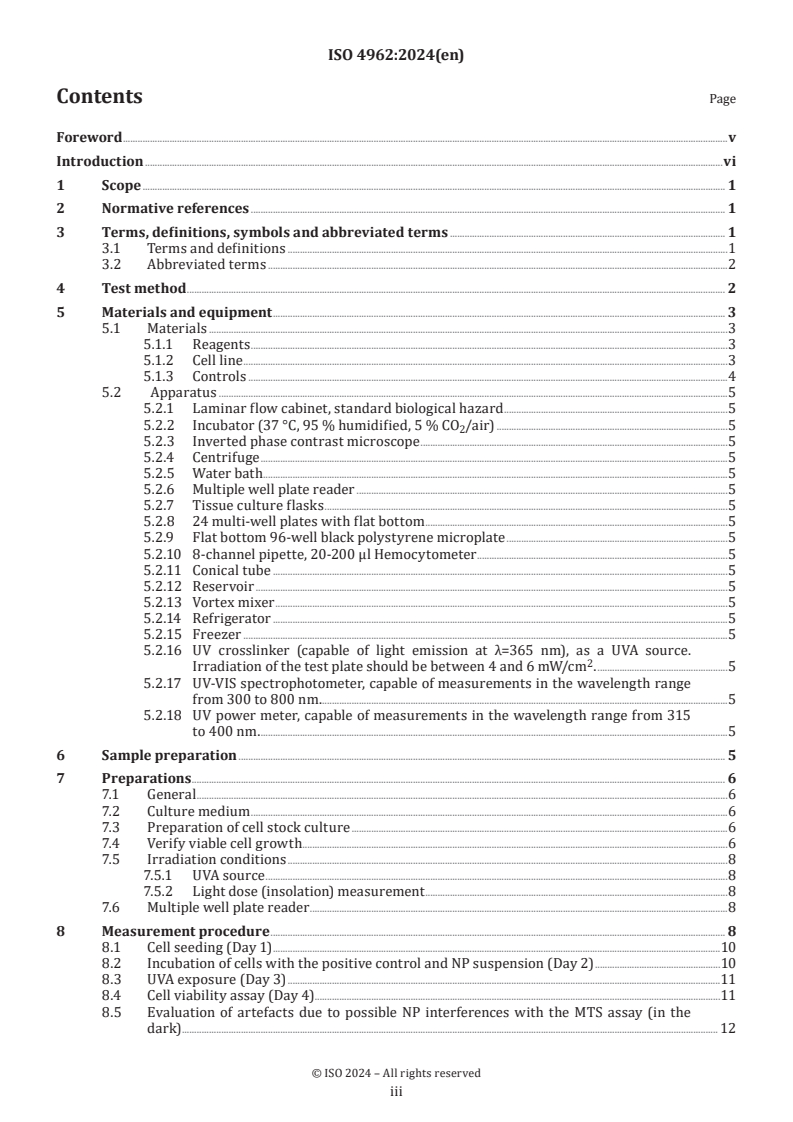
Contents Page
Foreword .v
Introduction .vi
1 Scope . 1
2 Normative references . 1
3 Terms, definitions, symbols and abbreviated terms . 1
3.1 Terms and definitions .1
3.2 Abbreviated terms .2
4 Test method . 2
5 Materials and equipment . 3
5.1 Materials .3
5.1.1 Reagents .3
5.1.2 Cell line .3
5.1.3 Controls .4
5.2 Apparatus .5
5.2.1 Laminar flow cabinet, standard biological hazard .5
5.2.2 Incubator (37 °C, 95 % humidified, 5 % CO /air) .5
5.2.3 Inverted phase contrast microscope .5
5.2.4 Centrifuge .5
5.2.5 Water bath .5
5.2.6 Multiple well plate reader .5
5.2.7 Tissue culture flasks .5
5.2.8 24 multi-well plates with flat bottom .5
5.2.9 Flat bottom 96-well black polystyrene microplate .5
5.2.10 8-channel pipette, 20-200 μl Hemocytometer .5
5.2.11 Conical tube .5
5.2.12 Reservoir .5
5.2.13 Vortex mixer .5
5.2.14 Refrigerator .5
5.2.15 Freezer .5
5.2.16 UV crosslinker (capable of light emission at λ=365 nm), as a UVA source.
Irradiation of the test plate should be between 4 and 6 mW/cm . .5
5.2.17 UV-VIS spectrophotometer, capable of measurements in the wavelength range
from 300 to 800 nm. .5
5.2.18 UV power meter, capable of measurements in the wavelength range from 315
to 400 nm. .5
6 Sample preparation . 5
7 Preparations . 6
7.1 General .6
7.2 Culture medium .6
7.3 Preparation of cell stock culture .6
7.4 Verify viable cell growth . .6
7.5 Irradiation conditions .8
7.5.1 UVA source .8
7.5.2 Light dose (insolation) measurement .8
7.6 Multiple well plate reader .8
8 Measurement procedure . 8
8.1 Cell seeding (Day 1) .10
8.2 Incubation of cells with the positive control and NP suspension (Day 2) .10
8.3 UVA exposure (Day 3) .11
8.4 Cell viability assay (Day 4) . .11
8.5 Evaluation of artefacts due to possible NP interferences with the MTS assay (in the
dark) . 12
iii
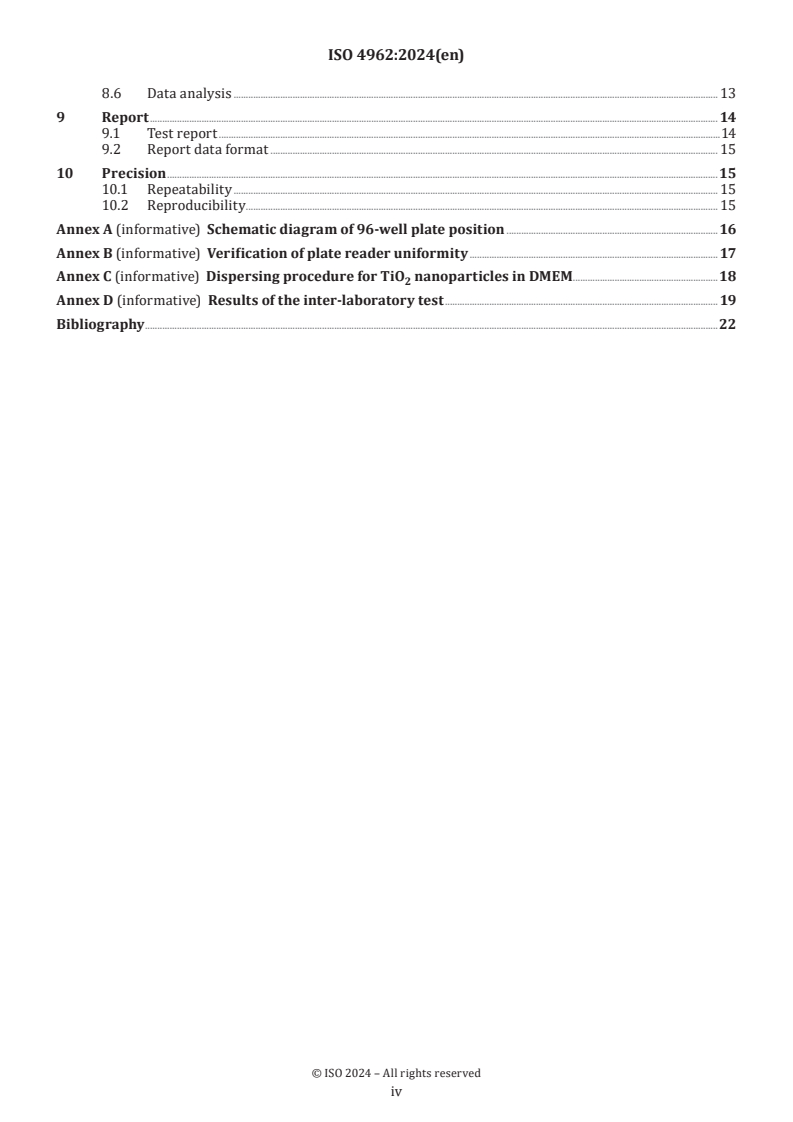
8.6 Data analysis . 13
9 Report . 14
9.1 Test report .14
9.2 Report data format . 15
10 Precision .15
10.1 Repeatability . 15
10.2 Reproducibility . 15
Annex A (informative) Schematic diagram of 96-well plate position .16
Annex B (informative) Verification of plate reader uniformity . 17
Annex C (informative) Dispersing procedure for TiO nanoparticles in DMEM .18
Annex D (informative) Results of the inter-laboratory test . 19
Bibliography .22
iv
Foreword
ISO (the International Organization for Standardization) is a worldwide federation of national standards
bodies (ISO member bodies). The work of preparing International Standards is normally carried out through
ISO technical committees. Each member body interested in a subject for which a technical committee
has been established has the right to be represented on that committee. International organizations,
governmental and non-governmental, in liaison with ISO, also take part in the work. ISO collaborates closely
with the International Electrotechnical Commission (IEC) on all matters of electrotechnical standardization.
The procedures used to develop this document and those intended for its further maintenance are described
in the ISO/IEC Directives, Part 1. In particular, the different approval criteria needed for the different types
of ISO document should be noted. This document was drafted in accordance with the editorial rules of the
ISO/IEC Directives, Part 2 (see www.iso.org/directives).
ISO draws attention to the possibility that the implementation of this document may involve the use of (a)
patent(s). ISO takes no position concerning the evidence, validity or applicability of any claimed patent
rights in respect thereof. As of the date of publication of this document, ISO had not received notice of (a)
patent(s) which may be required to implement this document. However, implementers are cautioned that
this may not represent the latest information, which may be obtained from the patent database available at
www.iso.org/patents. ISO shall not be held responsible for identifying any or all such patent rights.
Any trade name used in this document is information given for the convenience of users and does not
constitute an endorsement.
For an explanation of the voluntary nature of standards, the meaning of ISO specific terms and expressions
related to conformity assessment, as well as information about ISO's adherence to the World Trade
Organization (WTO) principles in the Technical Barriers to Trade (TBT), see www.iso.org/iso/foreword.html.
This document was prepared by Technical Committee ISO/TC 229, Nanotechnologies.
Any feedback or questions on this document should be directed to the user’s national standards body. A
complete listing of these bodies can be found at www.iso.org/members.html.
v
Introduction
Phototoxicity (PT) is defined as a toxic response to an organism exposed to a substance, where the
response is either elicited or increased (apparent at lower dose levels) after subsequent exposure to light,
or that is induced by skin irradiation after systemic administration of a substance. The increasing use of
nanomaterials in various industries also leads to increased exposure, especially to skin. Furthermore, some
nanomaterials are used in commercial sunscreens. Hence, possible impacts on human health including
detrimental chemical reactions in the presence of light (both natural and artificial) or photo-protective
effects, is of interest.
PT is based on a quantum phenomenon. The absorption of a photon with sufficient energy generates an
electron-hole pair that can migrate to the nanoparticle (NP) surface and react with water and oxygen, thus
forming extremely reactive radicals and reactive oxygen species (ROS). Generation of the ROS by some wide-
bandgap materials, such as TiO , ZnO, WO , CeO , carbon nanotubes, quantum dots and some metal NPs
2 3 2
when illuminated by UV-VIS light, can cause oxidative stress, resulting in toxic effects in living organisms.
Absorption of a photon with sufficient energy is the necessary condition for photochemical reactions to
induce phototoxic response. Material PT is closely related to photocatalytic activity (PCA). Measurement of
PCA under physiological conditions allows for an assessment of its phototoxicity potency (see ISO 20814).
A wide variety of light sources, light exposure levels, cell lines, incubation times, viability assays, used for
nanomaterial PT measurement hamper data comparison. Existing PT standard test methods for soluble
chemical substances (e.g. OECD 432) are not directly applicable to determine nanomaterial PT. It states that
DMSO or EtOH should be used as cosolvents in case the material is not soluble in water with additional tests
for cosolvent toxicity. The method is not applicable for particulate materials.
The in vitro NP PT test is intended to evaluate the nanomaterial acute phototoxicity when exposed to a near
ultraviolet (UVA) light. Cell viability is assessed at a fixed NP concentration after exposure to six doses of the
UVA light.
vi
International Standard ISO 4962:2024(en)
Nanotechnologies — In vitro acute nanoparticle
phototoxicity assay
1 Scope
This document specifies a procedure to evaluate acute phototoxicity of nanoparticles (NPs), suspended in
cell culture media, by measuring the relative reduction in cellular viability under near ultraviolet (UVA)
exposure (315 nm to 400 nm).
The measurement is intended to assess the potential for acute phototoxicity of NPs by comparing NP
photoactivity in vitro to a positive control chlorpromazine. It is not designed to predict other joint effects
of nanomaterials and light, such as genotoxicity, photo-allergy or photo-mutagenicity. The method is also
applicable to NP aggregates and agglomerates.
2 Normative references
The following documents are referred to in the text in such a way that some or all of their content constitutes
requirements of this document. For dated references, only the edition cited applies. For undated references,
the latest edition of the referenced document (including any amendments) applies.
ISO 80004-1:2023, Nanotechnologies – Vocabulary — Part 1: Core vocabulary
3 Terms, definitions, symbols and abbreviated terms
For the purposes of this document, the terms and definitions given in ISO 80004-1 and the following apply.
ISO and IEC maintain terminology databases for use in standardization at the following addresses:
— ISO Online browsing platform: available at https:// www .iso .org/ obp
— IEC Electropedia: available at https:// www .electropedia .org/
3.1 Terms and definitions
3.1.1
phototoxicity
acute light-induced response, which occurs when photoreactive chemicals are activated by light and
transformed into toxic products to cells.
3.1.2
dispersion
microscopic multi-phase system in which discontinuities of any state (solid, liquid or gas: discontinuous
phase) are dispersed in a continuous phase of a different composition or state
[SOURCE: ISO/TR 13097:2013, 2.5, modified — Note to entry deleted and "in general" deleted from the
definition.]
3.1.3
endotoxin
part of the outer membrane of the cell envelope of Gram-negative bacteria
3.1.4
positive control
material or chemical which, when tested in accordance with this document, provides a reproducible
phototoxic response
3.1.5
negative control
material or chemical which, when tested in accordance with this document, does not exhibit phototoxic
response
[SOURCE: ISO 10993-5:2009, 3.4, modified — "or chemical" added, "this part of ISO 10993 " changed to " this
document", "cytotoxic" changed to "phototoxic" and Note to entry deleted.]
3.1.6
test sample
material that is subjected to biological or chemical testing or evaluation
[SOURCE: ISO 10993-12:2021, 3.14, modified — "medical device, component or material (or a representative
sample thereof, manufactured and processed by equivalent methods), or an extract or portion thereof"
replaced by "material".]
3.1.7
ultraviolet A
UVA
type of electromagnetic radiation with wavelengths between 320 and 400 nanometers
3.2 Abbreviated terms
BSA Bovine Serum Albumin
CPZ Chlorpromazine
DIW deionized water with ≥ 18 MΩ·cm resistivity
FBS Fetal Bovine Serum
MTS 3-(4,5-dimethylthiazol-2-yl)-5-(3-carboxymethoxyphenyl)-2-(4-sulfophenyl)-2H-tetrazolium
NADH nicotine adenine dinucleotide hydrate
NIH/3T3 embryonic mouse fibroblast cell line
NP nanoparticle
OD optical density
PT phototoxicity
ROS reactive oxygen species
UVA ultraviolet A
UV-Vis ultraviolet and visible
4 Test method
This document describes a set of procedures for the phototoxicity measurement method of NPs present in
an aqueous suspension. NPs that are phototoxic cause the photocatalytic action after successive irradiation
with artificial UV light, resulting in a decrease in cell survival level. The cell survival level is affected by
the concentration of NPs and the dose of the received UVA light. Cell survival level is measured at a fixed
NP concentration and six UVA light doses. The resulting cell survival levels are then plotted vs the UVA
dose. The slopes of these dependences are calculated for negative control (media only), positive control
(chlorpromazine), and test NP. The multiplexed assay utilizes a 96-well plate, UVA source and a multiple-
plate optical reader leading to a fast and accurate measurement. A separate 96-well plate is utilized to
account for possible NP interferences with the cell viability assay.
5 Materials and equipment
5.1 Materials
5.1.1 Reagents
5.1.1.1 DIW
5.1.1.2 Dulbecco modified eagle medium (DMEM) with or without phenol red
5.1.1.3 Phosphate-buffered saline (PBS, pH 7,4)
5.1.1.4 Fetal bovine serum (FBS)
5.1.1.5 Trypsin-EDTA (2,5 g/l)
5.1.1.6 1X Penicillin/Streptomycin
5.1.1.7 Bovine serum albumin (BSA)
5.1.1.8 Trypan blue solution (4 g/l)
5.1.1.9 MTS (3-(4,5-dimethylthiazol-2-yl)-5-(3-carboxymethoxyphenyl)-2-(4-sulfophenyl)-2H-
tetrazolium)
5.1.1.10 Chlorpromazine hydrochloride (CPZ)
5.1.2 Cell line
® 1)
NIH/3T3 cell line (mouse fibroblast): e.g. ATCC CRL-1658™.
Established cell lines are preferred and, where used, shall be obtained from recognized repositories.
If a stock culture of a cell line is stored, storage shall be at −80 °C or below in the corresponding culture
medium but containing a cryoprotectant, e.g. dimethylsulfoxide or glycerol. Long-term storage (several
months up to many years) is only possible at −196 °C or below.
Only cells free from mycoplasma shall be used for the test. Before use, stock cultures should be tested for the
[1]
absence of mycoplasma.
Human skin keratinocytes (HaCaT) may also be used with the test procedure with culture conditions
adapted for them and appropriate phototoxicity response to CPZ can be demonstrated. ®
1) ATCC CRL-1658™ is an example of a suitable product available commercially. This information is given for the
convenience of users of this document and does not constitute an endorsement by ISO of this product.
5.1.3 Controls
A known phototoxic chemical shall be tested concurrently with each in vitro 3T3 phototoxicity test.
Chlorpromazine hydrochloride (CPZ, CAS Number: 69-09-0) should be used as a positive control according
to 8.2. Cell media should be used as a negative control.
The procedure is as follows:
— Prepare 1 ml 20 mg/ml solution of CPZ by dissolving 20 mg of the dry CPZ in 1 ml of 100 % ethyl alcohol
(by volume).
— Store the solution at −20 °C.
— For preparation of CPZ at 5 µg/ml, transfer 1 μl of 20 mg/ml CPZ solution into the 15 ml tube with 4 ml
of DMEM-FBS.
5.2 Apparatus
5.2.1 Laminar flow cabinet, standard biological hazard
5.2.2 Incubator (37 °C, 95 % humidified, 5 % CO /air)
5.2.3 Inverted phase contrast microscope
5.2.4 Centrifuge
5.2.5 Water bath
5.2.6 Multiple well plate reader
5.2.7 Tissue culture flasks
5.2.8 24 multi-well plates with flat bottom
5.2.9 Flat bottom 96-well black polystyrene microplate
5.2.10 8-channel pipette, 20-200 μl Hemocytometer
5.2.11 Conical tube
5.2.12 Reservoir
5.2.13 Vortex mixer
5.2.14 Refrigerator
5.2.15 Freezer
5.2.16 UV crosslinker (capable of light emission at λ=365 nm), as a UVA source. Irradiation of the test
plate should be between 4 and 6 mW/cm .
5.2.17 UV-VIS spectrophotometer, capable of measurements in the wavelength range from 300 to 800 nm.
5.2.18 UV power meter, capable of measurements in the wavelength range from 315 to 400 nm.
6 Sample preparation
Following the basic principle of sample preparation, nanoparticles shall be dispersed in a biologically
compatible fluid with a reproducible procedure. These can include sonication and mixing by vortexing. NP
suspension for phototoxicity testing should be homogeneous and stable in aqueous solution for the duration
of the measurement (48 h). For dispersion, it may contain dispersants such as BSA. It is recommended to
use the newly dispersed NP for each test. Specific dispersing techniques are not discussed in this document.
Details for dispersion can be found in the references cited in the notes in Clause 6 and in Annex C.
NOTE 1 Several procedures have been published that identify methods to reproducibly disperse nanoparticles and
characterize nanosuspensions and their stability, see References [2], [3], [4], [5], [6], and [7].
NOTE 2 For information regarding biologically compatible chemical stabilizers, see Reference [8]. For information
regarding coatings such as albumin, see Reference [9].
The size distribution of NP suspension and its stability over 24 h must be verified in culture medium. The
dispersion state of NP suspension may be characterized using DLS as described in ISO 22412.
NOTE 3 The biomolecules and protein corona in the culture medium can increase the average size of NP and may
[11]
change the cellular uptake pathway.
NPs can be contaminated with endotoxin (lipopolysaccharides, LPS) during production or handling.
Contamination by endotoxins confounds the result of tests in vitro. Therefore, the preliminary detection of
endotoxins is required in order to minimize the contamination by endotoxins or to confirm the insignificant
levels of endotoxins in the test sample (see ISO 29701).
7 Preparations
7.1 General
All procedures must be carried out under sterile conditions and in a laminar flow cabinet (biological hazard
standard).
7.2 Culture medium
The culture medium shall be sterile and meet the growth requirements of the NIH/3T3 cell line.
Storage conditions such as refrigerator temperature shall be validated.
NOTE The stability of the culture medium varies with the composition and storage conditions.
7.2.1
...