


ISO/PRF 1183-2
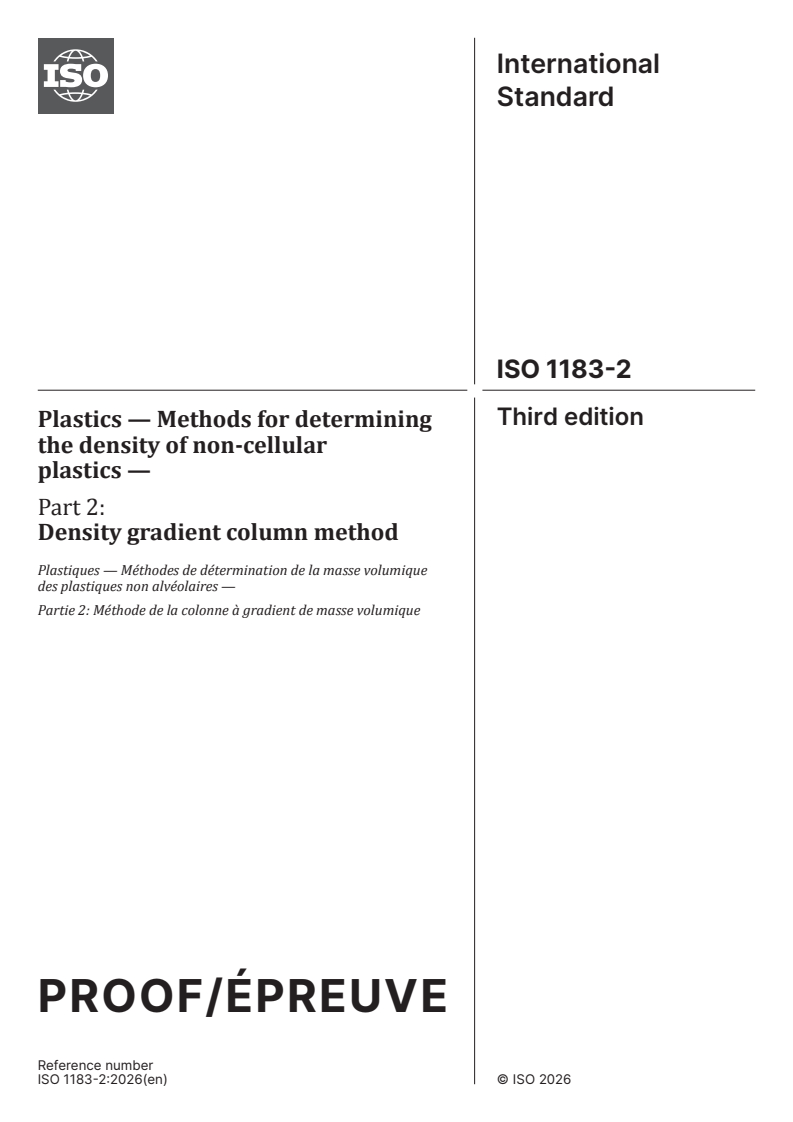
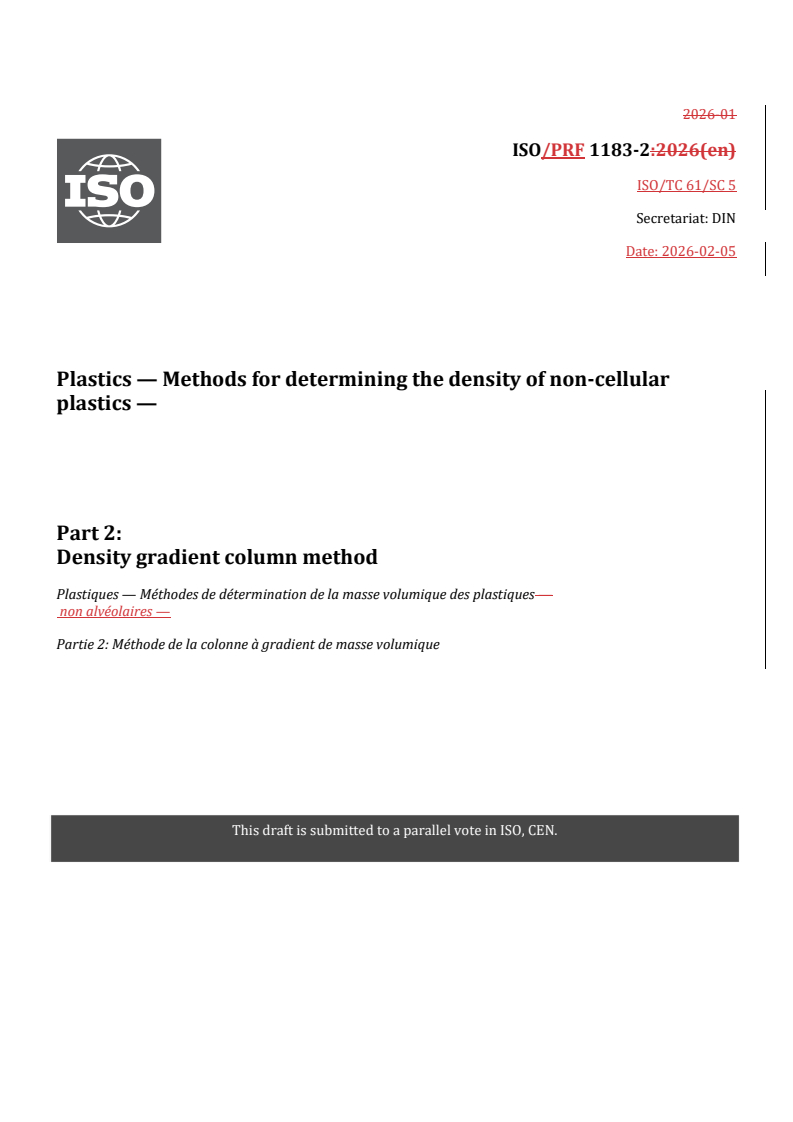
(Main)Plastics — Methods for determining the density of non-cellular plastics — Part 2: Density gradient column method
Plastics — Methods for determining the density of non-cellular plastics — Part 2: Density gradient column method
This document specifies a gradient column method for the determination of the density of non-cellular moulded or extruded plastics or pellets in void-free form. Density gradient columns are columns containing a mixture of two liquids, the density in the column increasing uniformly from top to bottom. NOTE Density is frequently used to follow variations in physical structure or composition of plastic materials. Density can also be useful in assessing the uniformity of samples or specimens. The density of plastic materials can depend upon the choice of specimen preparation method. When this is the case, precise details of the specimen preparation method are intended to be included in the appropriate material specification.
Plastiques — Méthodes de détermination de la masse volumique des plastiques non alvéolaires — Partie 2: Méthode de la colonne à gradient de masse volumique
Le présent document spécifie une méthode qui utilise une colonne à gradient pour déterminer la masse volumique des plastiques non alvéolaires, moulés ou extrudés, ou de granulés exempts de cavités fermées. Les colonnes à gradient de masse volumique contiennent un mélange de deux liquides, dont la masse volumique augmente uniformément du haut de la colonne vers le bas. NOTE La masse volumique est fréquemment utilisée pour suivre les variations de la structure physique ou de la composition des matériaux plastiques. La masse volumique peut également se révéler utile pour évaluer l'uniformité des échantillons ou des éprouvettes. La masse volumique des matériaux plastiques peut dépendre du choix de la méthode de préparation de l'échantillon. Lorsque cela est applicable, des détails précis de la méthode de préparation de l'échantillon doivent être donnés dans les spécifications appropriées relatives à la matière.
General Information
- Status
- Not Published
- Technical Committee
- ISO/TC 61/SC 5 - Physical-chemical properties
- Drafting Committee
- ISO/TC 61/SC 5/WG 11 - Analytical methods
- Current Stage
- 5020 - FDIS ballot initiated: 2 months. Proof sent to secretariat
- Start Date
- 06-Feb-2026
- Completion Date
- 14-Feb-2026
Relations
- Effective Date
- 12-Feb-2026
- Effective Date
- 07-Jan-2025
- Effective Date
- 07-Jan-2025
Overview
ISO/PRF 1183-2:2026, published by the International Organization for Standardization (ISO), specifies a standardized method for the determination of the density of non-cellular plastics using the density gradient column technique. This document applies to void-free, moulded or extruded plastics and pellets. Density measurement using a gradient column is key for monitoring variations in physical structure or composition, as well as evaluating the uniformity and consistency of plastic materials. This method is widely recognized for its precision and ability to handle a range of specimen types.
Key Topics
Density Gradient Column Principle: The method utilizes a vertical column filled with a mixture of two miscible liquids with a uniform density gradient from top to bottom. Plastic specimens are immersed to determine their density based on the height where they reach equilibrium.
Specimen Preparation: Ensuring specimens are void-free, uniformly shaped, and free from surface cavities to prevent air entrapment that could affect measurement accuracy.
Immersion Liquids Selection: The chosen pair of liquids must be compatible, not affecting the specimen chemically or physically, and should cover the targeted density range.
Calibration and Measurement:
- Use of calibrated glass floats to establish the density profile within the column.
- Placing specimens and monitoring their equilibrium position after a sufficient settling time.
- Density determination by referencing the specimen's final position relative to calibrated floats, graphically or via interpolation.
Reporting Requirements: Comprehensive details must be recorded, including specimen preparation, immersion liquids, measured density values, temperature, buoyancy corrections, procedural deviations, and test dates.
Applications
The density gradient column method described in ISO 1183-2 is widely employed in the plastics industry for:
- Quality Control: Ensuring the consistency and specification compliance of plastic mouldings, extrudates, and pellets during production.
- Material Characterization: Assessing batch-to-batch variation, uniformity, and the physical structure of plastic materials.
- Research and Development: Supporting formulation changes and testing new plastic compounds by comparing density variations.
- Material Identification: Distinguishing between plastics with similar appearances but different compositional or physical properties.
Typical users of this standard include plastics manufacturers, material testing laboratories, quality assurance teams, and research institutions.
Related Standards
- ISO 1183-1: Plastics - Methods for determining the density of non-cellular plastics - Part 1: Immersion method, liquid pycnometer method and titration method.
- ISO 291: Plastics - Standard atmospheres for conditioning and testing.
- ISO 80000-4: Quantities and units - Part 4: Mechanics (for definitions of density and related quantities).
Additional guidance on liquid systems for density determinations and column preparation methods is supplied in annexes to ISO 1183-2.
Conclusion
ISO/PRF 1183-2:2026 provides a reliable, reproducible method for determining the density of non-cellular plastics using a density gradient column. Following this international standard enhances measurement accuracy, ensures data comparability, and supports quality assurance across the plastics industry. By adhering to this method, organizations can confidently assess material consistency, monitor product quality, and comply with industry specifications.
Buy Documents
ISO/PRF 1183-2 - Plastics — Methods for determining the density of non-cellular plastics — Part 2: Density gradient column method Released:6. 02. 2026
REDLINE ISO/PRF 1183-2 - Plastics — Methods for determining the density of non-cellular plastics — Part 2: Density gradient column method Released:6. 02. 2026
Get Certified
Connect with accredited certification bodies for this standard

Smithers Quality Assessments
US management systems and product certification.

DIN CERTCO
DIN Group product certification.
Sponsored listings
Frequently Asked Questions
ISO/PRF 1183-2 is a draft published by the International Organization for Standardization (ISO). Its full title is "Plastics — Methods for determining the density of non-cellular plastics — Part 2: Density gradient column method". This standard covers: This document specifies a gradient column method for the determination of the density of non-cellular moulded or extruded plastics or pellets in void-free form. Density gradient columns are columns containing a mixture of two liquids, the density in the column increasing uniformly from top to bottom. NOTE Density is frequently used to follow variations in physical structure or composition of plastic materials. Density can also be useful in assessing the uniformity of samples or specimens. The density of plastic materials can depend upon the choice of specimen preparation method. When this is the case, precise details of the specimen preparation method are intended to be included in the appropriate material specification.
This document specifies a gradient column method for the determination of the density of non-cellular moulded or extruded plastics or pellets in void-free form. Density gradient columns are columns containing a mixture of two liquids, the density in the column increasing uniformly from top to bottom. NOTE Density is frequently used to follow variations in physical structure or composition of plastic materials. Density can also be useful in assessing the uniformity of samples or specimens. The density of plastic materials can depend upon the choice of specimen preparation method. When this is the case, precise details of the specimen preparation method are intended to be included in the appropriate material specification.
ISO/PRF 1183-2 is classified under the following ICS (International Classification for Standards) categories: 83.080.01 - Plastics in general. The ICS classification helps identify the subject area and facilitates finding related standards.
ISO/PRF 1183-2 has the following relationships with other standards: It is inter standard links to prEN ISO 1183-2, ISO/TS 5341, ISO 1183-2:2019. Understanding these relationships helps ensure you are using the most current and applicable version of the standard.
ISO/PRF 1183-2 is available in PDF format for immediate download after purchase. The document can be added to your cart and obtained through the secure checkout process. Digital delivery ensures instant access to the complete standard document.
Standards Content (Sample)
International
Standard
ISO 1183-2
Third edition
Plastics — Methods for determining
the density of non-cellular
plastics —
Part 2:
Density gradient column method
Plastiques — Méthodes de détermination de la masse volumique
des plastiques non alvéolaires —
Partie 2: Méthode de la colonne à gradient de masse volumique
PROOF/ÉPREUVE
Reference number
ISO 1183-2:2026(en) © ISO 2026
ISO 1183-2:2026(en)
© ISO 2026
All rights reserved. Unless otherwise specified, or required in the context of its implementation, no part of this publication may
be reproduced or utilized otherwise in any form or by any means, electronic or mechanical, including photocopying, or posting on
the internet or an intranet, without prior written permission. Permission can be requested from either ISO at the address below
or ISO’s member body in the country of the requester.
ISO copyright office
CP 401 • Ch. de Blandonnet 8
CH-1214 Vernier, Geneva
Phone: +41 22 749 01 11
Email: copyright@iso.org
Website: www.iso.org
Published in Switzerland
PROOF/ÉPREUVE
ii
ISO 1183-2:2026(en)
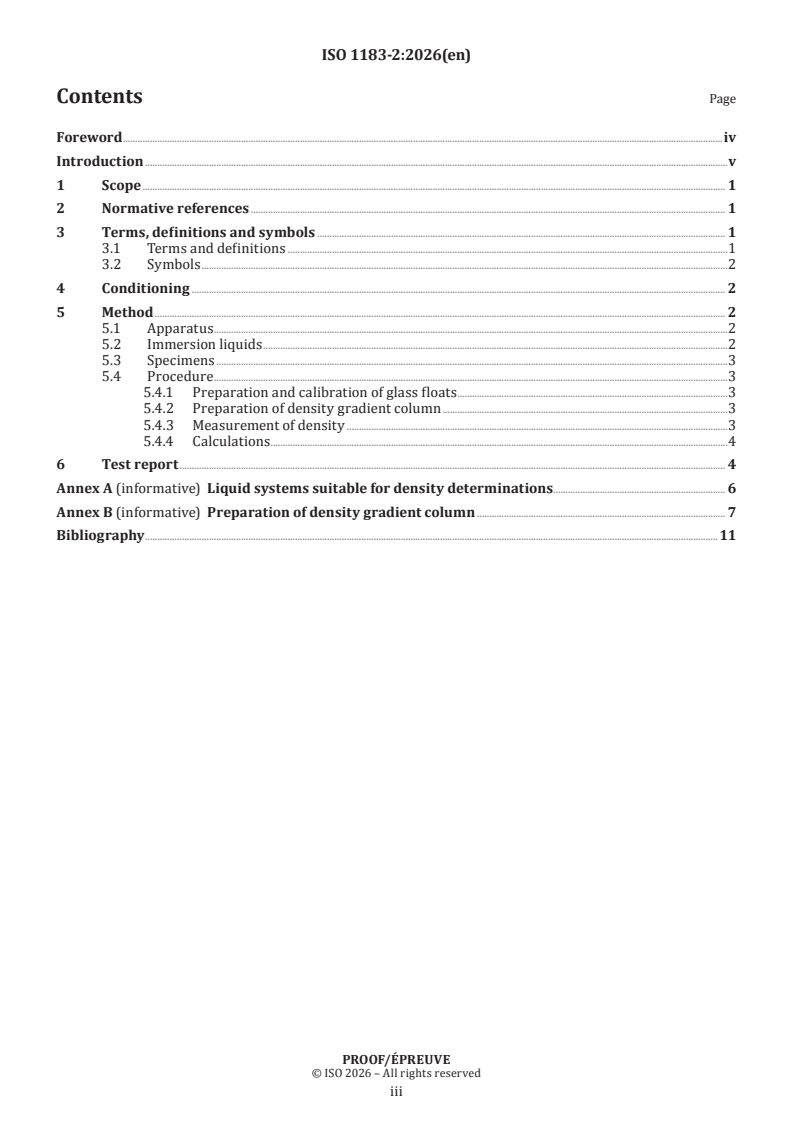
Contents Page
Foreword .iv
Introduction .v
1 Scope . 1
2 Normative references . 1
3 Terms, definitions and symbols . 1
3.1 Terms and definitions .1
3.2 Symbols .2
4 Conditioning . 2
5 Method . 2
5.1 Apparatus .2
5.2 Immersion liquids .2
5.3 Specimens .3
5.4 Procedure .3
5.4.1 Preparation and calibration of glass floats .3
5.4.2 Preparation of density gradient column .3
5.4.3 Measurement of density .3
5.4.4 Calculations . .4
6 Test report . 4
Annex A (informative) Liquid systems suitable for density determinations . 6
Annex B (informative) Preparation of density gradient column . 7
Bibliography .11
PROOF/ÉPREUVE
iii
ISO 1183-2:2026(en)
Foreword
ISO (the International Organization for Standardization) is a worldwide federation of national standards
bodies (ISO member bodies). The work of preparing International Standards is normally carried out through
ISO technical committees. Each member body interested in a subject for which a technical committee
has been established has the right to be represented on that committee. International organizations,
governmental and non-governmental, in liaison with ISO, also take part in the work. ISO collaborates closely
with the International Electrotechnical Commission (IEC) on all matters of electrotechnical standardization.
The procedures used to develop this document and those intended for its further maintenance are described
in the ISO/IEC Directives, Part 1. In particular, the different approval criteria needed for the different types
of ISO document should be noted. This document was drafted in accordance with the editorial rules of the
ISO/IEC Directives, Part 2 (see www.iso.org/directives).
ISO draws attention to the possibility that the implementation of this document may involve the use of (a)
patent(s). ISO takes no position concerning the evidence, validity or applicability of any claimed patent
rights in respect thereof. As of the date of publication of this document, ISO had not received notice of (a)
patent(s) which may be required to implement this document. However, implementers are cautioned that
this may not represent the latest information, which may be obtained from the patent database available at
www.iso.org/patents. ISO shall not be held responsible for identifying any or all such patent rights.
Any trade name used in this document is information given for the convenience of users and does not
constitute an endorsement.
For an explanation of the voluntary nature of standards, the meaning of ISO specific terms and expressions
related to conformity assessment, as well as information about ISO's adherence to the World Trade
Organization (WTO) principles in the Technical Barriers to Trade (TBT), see www.iso.org/iso/foreword.html.
This document was prepared by Technical Committee ISO/TC 61, Plastics, Subcommittee SC 5, Physical-
chemical properties, in collaboration with the European Committee for Standardization (CEN) Technical
Committee CEN/TC 249, Plastics, in accordance with the Agreement on technical cooperation between ISO
and CEN (Vienna Agreement).
This third edition cancels and replaces the second edition (ISO 1183-2:2019), which has been technically
revised. The main changes are as follows:
— reference to this document, any deviations and any unusual features observed have been added to the
test report.
A list of all parts in the ISO 1183 series can be found on the ISO website.
Any feedback or questions on this document should be directed to the user’s national standards body. A
complete listing of these bodies can be found at www.iso.org/members.html.
PROOF/ÉPREUVE
iv
ISO 1183-2:2026(en)
Introduction
Density is frequently used to follow variations in physical structure or composition of plastic materials.
Density can also be useful in assessing the uniformity of samples or specimens. The density of plastic
materials can depend upon the choice of specimen preparation method. When this is the case, precise details
of the specimen preparation method are intended to be included in the appropriate material specification.
PROOF/ÉPREUVE
v
International Standard ISO 1183-2:2026(en)
Plastics — Methods for determining the density of non-
cellular plastics —
Part 2:
Density gradient column method
WARNING — The use of this document may involve hazardous materials, operations or equipment.
This document does not purport to address all of the safety problems, if any, associated with its
use. It is the responsibility of the user of this document to establish appropriate health and safety
practices.
1 Scope
This document specifies a gradient column method for the determination of the density of non-cellular
moulded or extruded plastics or pellets in void-free form.
2 Normative references
The following documents are referred to in the text in such a way that some or all of their content constitutes
requirements of this document. For dated references, only the edition cited applies. For undated references,
the latest edition of the referenced document (including any amendments) applies.
ISO 291, Plastics — Standard atmospheres for conditioning and testing
ISO 1183-1, Plastics — Methods for determining the density of non-cellular plastics — Part 1: Immersion method,
liquid pycnometer method and titration method
3 Terms, definitions and symbols
3.1 Terms and definitions
For the purposes of this document, the following terms and definitions apply.
ISO and IEC maintain terminological databases for use in standardization at the following addresses:
— ISO Online browsing platform: available at https:// www .iso .org/ obp
— IEC Electropedia: available at https:// www .electropedia .org/
3.1.1
density
ρ
3 3 3
ratio of the mass m of a sample to its volume V (at the temperature T) expressed in kg/m , kg/dm (g/cm ),
or kg/l (g/ml)
[1]
Note 1 to entry: The following terms, based upon ISO 80000-4, are given in 3.2 for clarification.
3.1.2
density gradient column
column containing a mixture of two liquids, the density in the column increasing uniformly from top to
bottom
PROOF/ÉPREUVE
ISO 1183-2:2026(en)
3.2 Symbols
Term Symbol Formulation Units
kg/m
3 3
Density ρ m/V kg/dm (g/cm )
kg/l (g/ml)
m /kg
3 3
Specific volume ν V/m (= 1/ρ) dm /kg (cm /g)
l/kg (ml/g)
4 Conditioning
Conditioning and testing shall be in accordance with ISO 291 or the appropriate material standard. In
general, conditioning specimens to constant temperature is not required, because the determination itself
brings the specimen to the constant temperature of the test.
Specimens which change in density during the test to such an extent that the change is greater than the
required accuracy of the density determination shall be conditioned prior to measurement in accordance
with the applicable material specification. When changes in density with time or atmospheric conditions are
the primary purpose of the measurements, the specimens shall be conditioned as specified in the material
specification and, if no material specification exists, then as agreed upon by the interested parties.
5 Method
5.1 Apparatus
5.1.1 Density gradient column, consisting of a suitable graduated column, not less than 40 mm in
diameter, with a cover. The height of the column shall be compatible with the accuracy required. A graduation
interval of 1 mm for the scale on the column is normal.
5.1.2 Liquid bath, capable of being thermostatically controlled to within ±0,1 K or ±0,5 K, depending on
the sensitivity required (see Annex B).
5.1.3 Calibrated glass floats, covering the density range in which measurements are to be made and
approximately evenly distributed throughout this range.
These can be purchased from an accredited source or prepared as specified in 5.4.1.
5.1.4 Balance, accurate to ±0,1 mg.
5.1.5 Siphon or capillary filling tube, for filling the gradient column (5.1.1), as shown in
Figure B.1 or Figure B.2, or any other suitable device.
5.2 Immersion liquids
Required are two miscible liquids of different densities, freshly distilled in the case of pure liquids. The
densities of various
...
2026-01
ISO/TC 61/SC 5
Secretariat: DIN
Date: 2026-02-05
Plastics — Methods for determining the density of non-cellular
plastics —
Part 2:
Density gradient column method
Plastiques — Méthodes de détermination de la masse volumique des plastiques —
non alvéolaires —
Partie 2: Méthode de la colonne à gradient de masse volumique
ThiThiThiThiThiThis drs drs drs drs drs drafafafafafaft is t is t is t is t is t is submitted tsubmitted tsubmitted tsubmitted tsubmitted tsubmitted toooooo a a a a a a p p p p p parallel arallel arallel arallel arallel arallel vovovovovovote in ISOte in ISOte in ISOte in ISOte in ISOte in ISO, CE, CE, CE, CE, CE, CEN.N.N.N.N.N.
PROOF
All rights reserved. Unless otherwise specified, or required in the context of its implementation, no part of this publication
may be reproduced or utilized otherwise in any form or by any means, electronic or mechanical, including photocopying,
or posting on the internet or an intranet, without prior written permission. Permission can be requested from either ISO
at the address below or ISO’s member body in the country of the requester.
ISO copyright office
CP 401 • Ch. de Blandonnet 8
CH-1214 Vernier, Geneva
Phone: + 41 22 749 01 11
E-mail: copyright@iso.org
Website: www.iso.org
Published in Switzerland
Contents Page
Foreword . v
Introduction . vi
1 Scope . 1
2 Normative references . 1
3 Terms, definitions and symbols . 1
3.1 Terms and definitions . 1
3.2 Symbols . 2
4 Conditioning . 2
5 Method . 2
5.1 Apparatus . 2
5.2 Immersion liquids . 2
5.3 Specimens . 3
5.4 Procedure . 3
6 Test report . 5
Annex A (informative) Liquid systems suitable for density determinations . 6
Annex B (informative) Preparation of density gradient column . 7
Bibliography . 13
iv
Foreword
ISO (the International Organization for Standardization) is a worldwide federation of national standards
bodies (ISO member bodies). The work of preparing International Standards is normally carried out through
ISO technical committees. Each member body interested in a subject for which a technical committee has been
established has the right to be represented on that committee. International organizations, governmental and
non-governmental, in liaison with ISO, also take part in the work. ISO collaborates closely with the
International Electrotechnical Commission (IEC) on all matters of electrotechnical standardization.
The procedures used to develop this document and those intended for its further maintenance are described
in the ISO/IEC Directives, Part 1. In particular, the different approval criteria needed for the different types of
ISO document should be noted. This document was drafted in accordance with the editorial rules of the
ISO/IEC Directives, Part 2 (see www.iso.org/directives).
ISO draws attention to the possibility that the implementation of this document may involve the use of (a)
patent(s). ISO takes no position concerning the evidence, validity or applicability of any claimed patent rights
in respect thereof. As of the date of publication of this document, ISO had not received notice of (a) patent(s)
which may be required to implement this document. However, implementers are cautioned that this may not
represent the latest information, which may be obtained from the patent database available at
www.iso.org/patents. ISO shall not be held responsible for identifying any or all such patent rights.
Any trade name used in this document is information given for the convenience of users and does not
constitute an endorsement.
For an explanation of the voluntary nature of standards, the meaning of ISO specific terms and expressions
related to conformity assessment, as well as information about ISO's adherence to the World Trade
Organization (WTO) principles in the Technical Barriers to Trade (TBT), see www.iso.org/iso/foreword.html.
This document was prepared by Technical Committee ISO/TC 61, Plastics, Subcommittee SC 5, Physical-
chemical properties, in collaboration with the European Committee for Standardization (CEN) Technical
Committee CEN/TC 249, Plastics, in accordance with the Agreement on technical cooperation between ISO
and CEN (Vienna Agreement).
This third edition cancels and replaces the second edition (ISO 1183-2:2019), which has been technically
revised. The main changes are as follows:
— — reference to this document, any deviations and any unusual features observed have been added to the
test report.
A list of all parts in the ISO 1183 series can be found on the ISO website.
Any feedback or questions on this document should be directed to the user’s national standards body. A
complete listing of these bodies can be found at www.iso.org/members.html.
v
Introduction
Density is frequently used to follow variations in physical structure or composition of plastic materials.
Density can also be useful in assessing the uniformity of samples or specimens. The density of plastic materials
can depend upon the choice of specimen preparation method. When this is the case, precise details of the
specimen preparation method are intended to be included in the appropriate material specification.
vi
Plastics — Methods for determining the density of non-cellular
plastics —
Part 2:
Density gradient column method
WARNING — The use of this document may involve hazardous materials, operations or equipment.
This document does not purport to address all of the safety problems, if any, associated with its use. It
is the responsibility of the user of this document to establish appropriate health and safety practices.
1 Scope
This document specifies a gradient column method for the determination of the density of non-cellular
moulded or extruded plastics or pellets in void-free form.
2 Normative references
The following documents are referred to in the text in such a way that some or all of their content constitutes
requirements of this document. For dated references, only the edition cited applies. For undated references,
the latest edition of the referenced document (including any amendments) applies.
ISO 291, Plastics — Standard atmospheres for conditioning and testing
ISO 1183--1, Plastics — Methods for determining the density of non-cellular plastics — Part 1: Immersion
method, liquid pycnometer method and titration method
3 Terms, definitions and symbols
3.1 Terms and definitions
For the purposes of this document, the following terms and definitions apply.
ISO and IEC maintain terminological databases for use in standardization at the following addresses:
— — ISO Online browsing platform: available at https://www.iso.org/obp
— — IEC Electropedia: available at https://www.electropedia.org/
3.1.1 3.1.1
density
ρ
3 3 3
ratio of the mass m of a sample to its volume V (at the temperature T) expressed in kg/m , kg/dm (g/cm ), or
kg/l (g/ml)
[ [1] ]
Note 1 to entry: The following terms, based upon ISO 80000-4, 1 , are given in 3.23.2 for clarification.
3.1.2 3.1.2
density gradient column
column containing a mixture of two liquids, the density in the column increasing uniformly from top to bottom
ISO/DIS PRF 1183-2:2025(E2026(en)
3.2 Symbols
Term Symbol Formulation Units
kg/m
3 3
Density ρ m/V kg/dm (g/cm )
kg/l (g/ml)
m /kg
3 3
Specific volume ν V/m (= 1/ρ) dm /kg (cm /g)
l/kg (ml/g)
4 Conditioning
Conditioning and testing shall be in accordance with ISO 291 or the appropriate material standard. In general,
conditioning specimens to constant temperature is not required, because the determination itself brings the
specimen to the constant temperature of the test.
Specimens which change in density during the test to such an extent that the change is greater than the
required accuracy of the density determination shall be conditioned prior to measurement in accordance with
the applicable material specification. When changes in density with time or atmospheric conditions are the
primary purpose of the measurements, the specimens shall be conditioned as specified in the material
specification and, if no material specification exists, then as agreed upon by the interested parties.
5 Method
5.1 Apparatus
5.1.1 5.1.1 Density gradient column, consisting of a suitable graduated column, not less than 40 mm in
diameter, with a cover. The height of the column shall be compatible with the accuracy required. A
graduation interval of 1 mm for the scale on the column is normal.
5.1.2 5.1.2 Liquid bath, capable of being thermostatically controlled to within ±0,1 K or ±0,5 K, depending
on the sensitivity required (see Annex BAnnex B).).
5.1.3 5.1.3 Calibrated glass floats, covering the density range in which measurements are to be made
and approximately evenly distributed throughout this range.
These can be purchased from an accredited source or prepared as specified in 5.4.15.4.1.
5.1.4 5.1.4 Balance, accurate to ±0,1 mg.
5.1.5 5.1.5 Siphon or capillary filling tube, for filling the gradient column (5.1.1(5.1.1),), as shown in
Figure B.1Figure B.1 or Figure B.2Figure B.2,, or any other suitable device.
5.2 Immersion liquids
Required are two miscible liquids of different densities, freshly distilled in the case of pure liquids. The
densities of various liquids are given in Annex AAnnex A as a guide.
ii
The liquid with which the specimen comes into contact during the measurement shall have no effect on the
specimen.
Prepare the mixture of liquids as specified in 5.4.1.25.4.1.2.
5.3 Specimens
Specimens shall consist of pieces of the material cut to any convenient shape for ease of identification. The
dimensions of each piece shall be chosen to permit accurate measurement of the position of the centre of the
piece.
When cutting specimens from larger samples, care shall be taken to ensure that the characteristics of the
material are not changed due to excessive heat generation. The surface of the specimen shall be smooth and
free from cavities to minimize the entrapment of air bubbles upon immersion in the liquid, otherwise errors
will be introduced.
NOTE Specimens of less than 5 mm in diameter are normally suitable.
5.4 Procedure
5.4.1 Preparation and calibration of glass floats
5.4.1.1 5.4.1.1 The glass floats (5.1.3(5.1.3)) may be produced by any convenient method.
They shall be approximately spherical, of diameter not greater than 5 mm and fully annealed.
5.4.1.2 5.4.1.2 To prepare the glass floats for use, prepare a series of mixtures of about 500 ml
of the two immersion liquids (5.2(
...
Questions, Comments and Discussion
Ask us and Technical Secretary will try to provide an answer. You can facilitate discussion about the standard in here.
Loading comments...