


ISO 18589-2:2015
(Main)Measurement of radioactivity in the environment — Soil — Part 2: Guidance for the selection of the sampling strategy, sampling and pre-treatment of samples
Measurement of radioactivity in the environment — Soil — Part 2: Guidance for the selection of the sampling strategy, sampling and pre-treatment of samples
ISO 18589-2:2015 specifies the general requirements, based on ISO 11074 and ISO/IEC 17025, for all steps in the planning (desk study and area reconnaissance) of the sampling and the preparation of samples for testing. It includes the selection of the sampling strategy, the outline of the sampling plan, the presentation of general sampling methods and equipment, as well as the methodology of the pre-treatment of samples adapted to the measurements of the activity of radionuclides in soil. ISO 18589-2:2015 is addressed to the people responsible for determining the radioactivity present in soil for the purpose of radiation protection. It is applicable to soil from gardens, farmland, urban, or industrial sites, as well as soil not affected by human activities. ISO 18589-2:2015 is applicable to all laboratories regardless of the number of personnel or the range of the testing performed. When a laboratory does not undertake one or more of the activities covered by this part of ISO 18589, such as planning, sampling, or testing, the corresponding requirements do not apply.
Mesurage de la radioactivité dans l'environnement — Sol — Partie 2: Lignes directrices pour la sélection de la stratégie d'échantillonnage, l'échantillonnage et le prétraitement des échantillons
L'ISO 18589-2:2015 spécifie les exigences générales pour réaliser, sur la base de l'ISO 11074 et de l'ISO/IEC 17025, toutes les phases de planification (étude théorique et reconnaissance sur le terrain) de l'échantillonnage et de la préparation des échantillons pour essai. Elle inclut la sélection de la stratégie d'échantillonnage, l'élaboration du plan d'échantillonnage, la présentation des méthodes générales d'échantillonnage et des équipements et la méthodologie de prétraitement d'échantillons adaptés aux mesurages de l'activité des radionucléides dans le sol. L'ISO 18589-2:2015 s'adresse aux personnes chargées de déterminer la radioactivité présente dans les sols dans un but de radioprotection. Elle est applicable aux sols de jardins ou de terres agricoles, aux sols de sites urbains ou industriels et aux sols qui n'ont pas été modifiés par des activités humaines. L'ISO 18589-2:2015 est destinée à tous les laboratoires, quel que soit leur effectif ou leur domaine d'essai. Lorsqu'un laboratoire n'est pas concerné par une ou plusieurs des activités couvertes par la présente partie de l'ISO 18589, telles que la planification, l'échantillonnage ou les essais, les exigences correspondantes ne sont pas applicables.
General Information
- Status
- Withdrawn
- Publication Date
- 30-Jan-2015
- Technical Committee
- ISO/TC 85/SC 2 - Radiological protection
- Drafting Committee
- ISO/TC 85/SC 2/WG 17 - Radioactivity measurements
- Current Stage
- 9599 - Withdrawal of International Standard
- Start Date
- 09-Dec-2022
- Completion Date
- 12-Feb-2026
Relations
- Effective Date
- 21-Aug-2021
- Effective Date
- 04-May-2013




Get Certified
Connect with accredited certification bodies for this standard

NSF International
Global independent organization facilitating standards development and certification.

BSMI (Bureau of Standards, Metrology and Inspection)
Taiwan's standards and inspection authority.
CIS Institut d.o.o.
Personal Protective Equipment (PPE) certification body. Notified Body NB-2890 for EU Regulation 2016/425 PPE.
Sponsored listings
Frequently Asked Questions
ISO 18589-2:2015 is a standard published by the International Organization for Standardization (ISO). Its full title is "Measurement of radioactivity in the environment — Soil — Part 2: Guidance for the selection of the sampling strategy, sampling and pre-treatment of samples". This standard covers: ISO 18589-2:2015 specifies the general requirements, based on ISO 11074 and ISO/IEC 17025, for all steps in the planning (desk study and area reconnaissance) of the sampling and the preparation of samples for testing. It includes the selection of the sampling strategy, the outline of the sampling plan, the presentation of general sampling methods and equipment, as well as the methodology of the pre-treatment of samples adapted to the measurements of the activity of radionuclides in soil. ISO 18589-2:2015 is addressed to the people responsible for determining the radioactivity present in soil for the purpose of radiation protection. It is applicable to soil from gardens, farmland, urban, or industrial sites, as well as soil not affected by human activities. ISO 18589-2:2015 is applicable to all laboratories regardless of the number of personnel or the range of the testing performed. When a laboratory does not undertake one or more of the activities covered by this part of ISO 18589, such as planning, sampling, or testing, the corresponding requirements do not apply.
ISO 18589-2:2015 specifies the general requirements, based on ISO 11074 and ISO/IEC 17025, for all steps in the planning (desk study and area reconnaissance) of the sampling and the preparation of samples for testing. It includes the selection of the sampling strategy, the outline of the sampling plan, the presentation of general sampling methods and equipment, as well as the methodology of the pre-treatment of samples adapted to the measurements of the activity of radionuclides in soil. ISO 18589-2:2015 is addressed to the people responsible for determining the radioactivity present in soil for the purpose of radiation protection. It is applicable to soil from gardens, farmland, urban, or industrial sites, as well as soil not affected by human activities. ISO 18589-2:2015 is applicable to all laboratories regardless of the number of personnel or the range of the testing performed. When a laboratory does not undertake one or more of the activities covered by this part of ISO 18589, such as planning, sampling, or testing, the corresponding requirements do not apply.
ISO 18589-2:2015 is classified under the following ICS (International Classification for Standards) categories: 13.080.01 - Soil quality and pedology in general; 17.240 - Radiation measurements. The ICS classification helps identify the subject area and facilitates finding related standards.
ISO 18589-2:2015 has the following relationships with other standards: It is inter standard links to ISO 18589-2:2022, ISO 18589-2:2007. Understanding these relationships helps ensure you are using the most current and applicable version of the standard.
ISO 18589-2:2015 is available in PDF format for immediate download after purchase. The document can be added to your cart and obtained through the secure checkout process. Digital delivery ensures instant access to the complete standard document.
Standards Content (Sample)
INTERNATIONAL ISO
STANDARD 18589-2
Second edition
2015-02-01
Measurement of radioactivity in the
environment — Soil —
Part 2:
Guidance for the selection of the
sampling strategy, sampling and pre-
treatment of samples
Mesurage de la radioactivité dans l’environnement — Sol —
Partie 2: Lignes directrices pour la sélection de la stratégie
d’échantillonnage, l’échantillonnage et le prétraitement des échantillons
Reference number
©
ISO 2015
© ISO 2015
All rights reserved. Unless otherwise specified, no part of this publication may be reproduced or utilized otherwise in any form
or by any means, electronic or mechanical, including photocopying, or posting on the internet or an intranet, without prior
written permission. Permission can be requested from either ISO at the address below or ISO’s member body in the country of
the requester.
ISO copyright office
Case postale 56 • CH-1211 Geneva 20
Tel. + 41 22 749 01 11
Fax + 41 22 749 09 47
E-mail copyright@iso.org
Web www.iso.org
Published in Switzerland
ii © ISO 2015 – All rights reserved
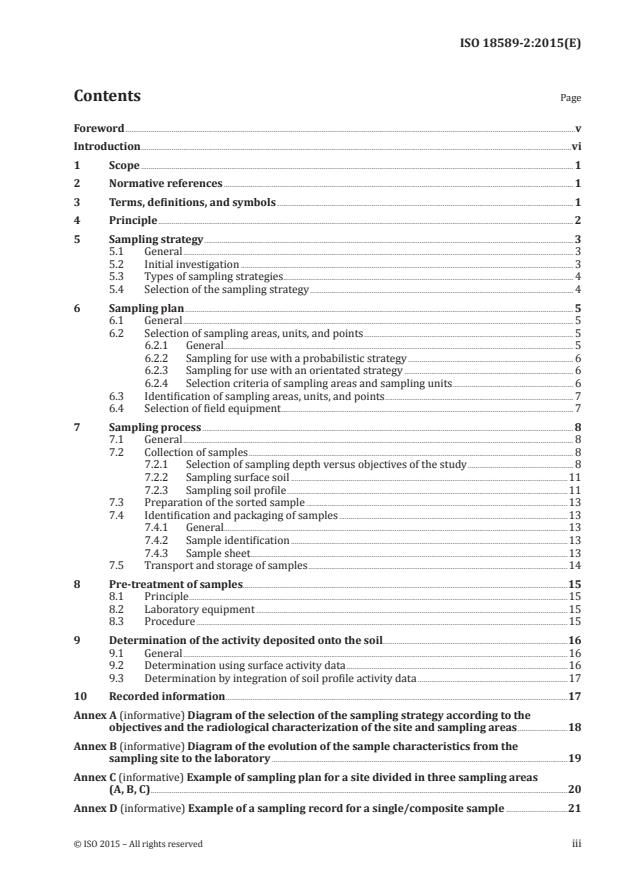
Contents Page
Foreword .v
Introduction .vi
1 Scope . 1
2 Normative references . 1
3 Terms, definitions, and symbols . 1
4 Principle . 2
5 Sampling strategy . 3
5.1 General . 3
5.2 Initial investigation . 3
5.3 Types of sampling strategies. 4
5.4 Selection of the sampling strategy . 4
6 Sampling plan . 5
6.1 General . 5
6.2 Selection of sampling areas, units, and points . 5
6.2.1 General. 5
6.2.2 Sampling for use with a probabilistic strategy . 6
6.2.3 Sampling for use with an orientated strategy . 6
6.2.4 Selection criteria of sampling areas and sampling units . 6
6.3 Identification of sampling areas, units, and points . 7
6.4 Selection of field equipment . 7
7 Sampling process . 8
7.1 General . 8
7.2 Collection of samples . 8
7.2.1 Selection of sampling depth versus objectives of the study . 8
7.2.2 Sampling surface soil .11
7.2.3 Sampling soil profile .11
7.3 Preparation of the sorted sample .13
7.4 Identification and packaging of samples .13
7.4.1 General.13
7.4.2 Sample identification .13
7.4.3 Sample sheet.13
7.5 Transport and storage of samples .14
8 Pre-treatment of samples.15
8.1 Principle .15
8.2 Laboratory equipment .15
8.3 Procedure .15
9 Determination of the activity deposited onto the soil .16
9.1 General .16
9.2 Determination using surface activity data .16
9.3 Determination by integration of soil profile activity data .17
10 Recorded information .17
Annex A (informative) Diagram of the selection of the sampling strategy according to the
objectives and the radiological characterization of the site and sampling areas .18
Annex B (informative) Diagram of the evolution of the sample characteristics from the
sampling site to the laboratory .19
Annex C (informative) Example of sampling plan for a site divided in three sampling areas
(A, B, C) .20
Annex D (informative) Example of a sampling record for a single/composite sample .21
Annex E (informative) Example for a sample record for a soil profile with soil description .22
Bibliography .24
iv © ISO 2015 – All rights reserved
Foreword
ISO (the International Organization for Standardization) is a worldwide federation of national standards
bodies (ISO member bodies). The work of preparing International Standards is normally carried out
through ISO technical committees. Each member body interested in a subject for which a technical
committee has been established has the right to be represented on that committee. International
organizations, governmental and non-governmental, in liaison with ISO, also take part in the work.
ISO collaborates closely with the International Electrotechnical Commission (IEC) on all matters of
electrotechnical standardization.
The procedures used to develop this document and those intended for its further maintenance are
described in the ISO/IEC Directives, Part 1. In particular the different approval criteria needed for the
different types of ISO documents should be noted. This document was drafted in accordance with the
editorial rules of the ISO/IEC Directives, Part 2 (see www.iso.org/directives).
Attention is drawn to the possibility that some of the elements of this document may be the subject of
patent rights. ISO shall not be held responsible for identifying any or all such patent rights. Details of any
patent rights identified during the development of the document will be in the Introduction and/or on
the ISO list of patent declarations received (see www.iso.org/patents).
Any trade name used in this document is information given for the convenience of users and does not
constitute an endorsement.
For an explanation on the meaning of ISO specific terms and expressions related to conformity
assessment, as well as information about ISO’s adherence to the WTO principles in the Technical Barriers
to Trade (TBT), see the following URL: Foreword — Supplementary information.
The committee responsible for this document is ISO/TC 85, Nuclear energy, nuclear technologies, and
radiological protection, Subcommittee SC 2, Radiological protection.
This second edition cancels and replaces the first edition (ISO 18589-2:2007), which has been
technically revised.
ISO 18589 consists of the following parts, under the general title Measurement of radioactivity in the
environment — Soil:
— Part 1: General guidelines and definitions
— Part 2: Guidance for the selection of the sampling strategy, sampling and pre-treatment of samples
— Part 3: Test method for gamma-emitting radionuclides using gamma ray spectrometry
— Part 4: Measurement of plutonium isotopes (plutonium 238 and plutonium 239+240) by alpha spectrometry
— Part 5: Measurement of strontium 90
— Part 6: Measurement of gross alpha and gross beta activities
— Part 7: In situ measurement of gamma-emitting radionuclides
Introduction
This International Standard is published in several parts to be used jointly or separately according to
needs. ISO 18589-1 to ISO 18589-6 concerning the measurements of radioactivity in the soil, have been
prepared simultaneously. These parts are complementary and are addressed to those responsible for
determining the radioactivity present in soils. The first two parts are general in nature. ISO 18589-3
to ISO 18589-5 deal with radionuclide-specific measurements and ISO 18589-6 deals with non-specific
measurements of gross alpha or gross beta activities. ISO 18589-7 deals with the measurement of
gamma emitters radionuclides using in situ spectrometry.
Additional parts can be added to ISO 18589 in the future if the standardization of the measurement of
other radionuclides becomes necessary.
vi © ISO 2015 – All rights reserved
INTERNATIONAL STANDARD ISO 18589-2:2015(E)
Measurement of radioactivity in the environment — Soil —
Part 2:
Guidance for the selection of the sampling strategy,
sampling and pre-treatment of samples
1 Scope
This part of ISO 18589 specifies the general requirements, based on ISO 11074 and ISO/IEC 17025, for
all steps in the planning (desk study and area reconnaissance) of the sampling and the preparation of
samples for testing. It includes the selection of the sampling strategy, the outline of the sampling plan,
the presentation of general sampling methods and equipment, as well as the methodology of the pre-
treatment of samples adapted to the measurements of the activity of radionuclides in soil.
This part of ISO 18589 is addressed to the people responsible for determining the radioactivity present
in soil for the purpose of radiation protection. It is applicable to soil from gardens, farmland, urban, or
industrial sites, as well as soil not affected by human activities.
This part of ISO 18589 is applicable to all laboratories regardless of the number of personnel or the range of
the testing performed. When a laboratory does not undertake one or more of the activities covered by this
part of ISO 18589, such as planning, sampling, or testing, the corresponding requirements do not apply.
2 Normative references
The following documents, in whole or in part, are normatively referenced in this document and are
indispensable for its application. For dated references, only the edition cited applies. For undated
references, the latest edition of the referenced document (including any amendments) applies.
ISO 31-9, Quantities and units — Part 9: Atomic and nuclear physics
ISO 11074, Soil quality — Vocabulary
ISO/IEC 17025, General requirements for the competence of testing and calibration laboratories
ISO 18589-1, Measurement of radioactivity in the environment — Soil — Part 1: General guidelines and definitions
3 Terms, definitions, and symbols
For the purposes of this document, the terms, definitions, and symbols given in ISO 31-9, ISO 18589-1,
ISO 11074, and the following apply.
e thickness of the layer sampled
m wet mass of the sorted sample
ss
m′ wet mass of a subsample of the sorted sample
ss
m dry mass of the test sample
ts
a activity per unit of mass of the test sample
A activity per unit area
S
S surface area sampled
4 Principle
The purpose of the measurement of soil radioactivity is to monitor the environmental impact of
[1] [2],[3],[4],[5]
radioactive substances and/or to assess the radiological impact on the population.
The main objectives of the measurement of radionuclides in soil (see ISO 18589-1) are the following:
— characterization of radioactivity in the environment;
— routine surveillance of the impact of radioactivity released from nuclear installations or of the
general evolution of the radioactivity in a region;
— investigations of accidents and incidents;
— planning and surveillance of remedial action;
— decommissioning of installations or the disposal of materials.
Consequently, measurements of soil radioactivity are performed in a variety of situations, but a generic
approach can be described, with the following steps as outlined in this part of ISO 18589:
a) Planning process — Selection of the sampling strategy
The selection of the sampling strategy depends on the main objectives and on the results of the
initial investigation of the area. The sampling strategy shall lead to the knowledge of the nature,
activity concentrations, spatial distribution, as well as temporal evolution of the radionuclides,
taking into account changes caused by migration, atmospheric conditions, and land/soil use.
An initial investigation of the area shall be carried out to determine the sampling strategy.
[6] [7]
ISO 10381-1 gives general guidance on the selection of the sampling strategy; ISO 10381-4
gives specific guidance for the investigation of natural, near-natural, and cultivated areas; and
[8]
ISO 10381-5 deals with the investigation of soil contamination at urban and industrial sites.
Details are given in Clause 5 and a scheme for the selection of the sampling strategy is given in Annex A.
b) Planning process — Sampling plan
The sampling plan shall be developed according to the sampling strategy selected. It shall specify the
selection of sampling areas and units, the sampling pattern, the sampling points, the types of samples,
the sampling procedures and equipment, as well as the safety requirements for the personnel.
Details, such as the selection of sampling areas and the sampling units that result from the type
of grid applied to these areas, are given in Clause 6. Definitions of the types of sample are given in
ISO 18589-1. The relationship between sample types is given in Annex B.
c) Sampling process — Collection of samples
The collection of any soil samples in the field shall conform to the established sampling plan.
— For sampling of the top layer, a single sample or n increments of a defined thickness are taken
from each of the selected sampling units.
— For vertical sampling of several soil layers, samples are taken at increasing depth vertically
below the surface sampling point. A single sample or n increments are collected from the various
soil layers with different thicknesses according to the sampling depth. Special care should be
exercised in order not to mix samples from different soil layers.
Details are given in Clauses 6 and 7.
2 © ISO 2015 – All rights reserved
d) Sampling process — Preparation of the sorted sample
The preparation of sorted samples is carried out by the reduction of single or composite samples. A
sorted sample should be representative of the average value of one or more given soil characteristics.
The identification, labelling, packaging, and transport procedures of sorted samples to the laboratory
shall guarantee the preservation of their characteristics.
Details are given in 7.3, 7.4, and 7.5.
e) Laboratory process — Handling of the laboratory sample
After arrival at the laboratory, the sorted samples are considered as laboratory samples for storage
and further pre-treatment before their analysis.
Details are given in Clause 8.
f) Laboratory process — Preparation of the test sample
Before any testing, the laboratory samples are pre-treated by drying, crushing, sieving, and
homogenizing to produce test samples in the form of a fine, homogeneous powder. Pre-treatment
shall guarantee that the physical and chemical characteristics of the test sample are constant
over time, thus rendering the results easier to interpret. Representative subsamples with masses
determined by the specifications of the different radioactivity measurements shall be isolated from
the test sample as test portions.
Details are given in Clause 8.
If some material is stored for future investigations or for the purpose of settling a potential dispute,
subsamples shall be taken from the laboratory sample or the test sample in an acceptable and
documented manner.
5 Sampling strategy
5.1 General
During the planning process, the sampling strategy for the site under investigation is determined
according to the objectives described in Clause 4 item a), resulting in the definition of a sampling plan.
[1],[2],[4],[9],[11],[12]
5.2 Initial investigation
Whatever the objective of the work being carried out, certain preliminaries shall be undertaken during
the initial investigation phase to help define the sampling strategy, such as the following:
— analysis of historical and administrative data, company archives, previous studies, and interviews
with former employees, which help identify potential sources of radioactive contamination;
— collection of information on geological, hydrological, and pedological characteristics and on the
main climatic parameters, in order to characterize the spatial and temporal development of the
characteristics of the radioactivity of an area;
— survey of the site under investigation to identify its topography, the nature of the vegetation cover,
and any peculiarities that can affect the techniques and the sampling plan;
— for farmland, collection of information from the farmers on the nature and depth of works (sub-
soiling or drainage, ploughing and harrowing ditches, etc.) and on chemical fertilizers and additives
that can lead to excessive natural radioactivity (nature and quantity of products applied).
When data on radioactive soil contamination are not available or in case of suspicion of contamination,
in situ analytical investigation using portable detectors or some preliminary sampling and subsequent
laboratory analysis can be necessary in order to select the sampling areas and strategy.
5.3 Types of sampling strategies
Sampling strategies are either orientated or probabilistic depending upon the objectives and the initial
knowledge of radioactivity distribution over the area under investigation.
Orientated strategies are based on a priori constraints that lead to a selection of sampling units in a
specific area under special scrutiny because of particular interest or level of contamination.
Probabilistic strategies are based on a selection of sampling units without any a priori constraints.
The selection of sampling units and points is described in 6.2.
5.4 Selection of the sampling strategy
The approach or sampling strategy shall be selected depending on the objective pursued and the relevant
end points, for example the protection of humans and the environment, taking into account social
and economic constraints. The sampling strategy selected should ensure that the radioactivity of the
samples is representative of the distribution of radionuclides in the soil of the area under investigation.
[1],[2],[4],[6],[9]
Although the strategy can only be defined on a case-by-case basis, the selection of the sampling strategy
should follow these stages:
— analysis of the records, which enables an historic study of the sampling site, in particular of its
previous use (identification of the source);
— evaluation of preferential migration pathways and/or accumulation areas;
— site reconnaissance with respect to the boundaries of the sampling areas and sampling undertaken;
— site reconnaissance: a rapid analytical investigation using portable radioactivity detectors can be
used to characterize the distribution of the radioactivity of the areas to be studied.
This step in the planning process determines a large number of choices and can generate important
and costly activities. It also includes the definition of the objectives of the data quality according to the
parameters to be analysed.
Annex A gives a flow diagram that helps in the selection of a sampling strategy according to the objectives
of the investigation.
The choice of the strategy determines the sampling density, the temporal and spatial distribution of the
units from which samples are collected and the timing of the sampling, taking into account the following:
— potential distribution of radionuclide: homogeneous or heterogeneous (“hot” spots);
— characteristics of the environment;
— minimum mass of soil necessary to carry out all the laboratory tests; and
— maximum number of tests that can be performed by the laboratory for the study.
In many cases, a prediction of the possible presence of soil contamination and its distribution
(homogeneous or heterogeneous) can be drawn up. It is then necessary to verify these hypotheses
by an orientated sampling strategy. One variant of this strategy, which is systematic with selected
representative sampling points, is adapted for the routine monitoring of sites whose radioactive origins
and distribution patterns are known. This allows a more accurate definition of the number and location
of the sampling points than a purely probabilistic sampling strategy. This subjective selection of the
sampling points can be combined with a statistical approach to meet the quality requirements for the
4 © ISO 2015 – All rights reserved
interpretation. When the spatial radioactivity distribution is unknown, it is necessary to adopt an
orientated spatially random strategy.
Probabilistic strategies with random sampling (random distribution of sampling points) are suitable
only if the distribution of the radioactivity on the site is considered homogeneous. For a site with
occasional heterogeneities (point sources), the implementation of a systematic sampling strategy that
is dependent upon the degree of knowledge of the distribution of these heterogeneities in the different
sampling areas is recommended.
When the objective of the investigation is the characterization of a recent deposit on the soil surface,
such as in the case of fallout following a routine, authorized gaseous release, or an accident, the collection
of the top layer is recommended.
When the objective is the study of a polluted site, where it is necessary to know the vertical migration of
radionuclides with depth (in order to predict the potential contamination of the groundwater), samples
from layers at various depths shall be collected. Layers can be defined either with the same thickness or
as representative of the different soil horizons.
The sampling strategy leads to a set of technical options that are detailed in Clause 6.
6 Sampling plan
6.1 General
The sampling plan is a precise procedure that, depending on the application of the principles of the
strategy adopted, defines all actions to be realized in the field. The plan also defines the human
resources needed for the sampling operation. The plan is directly linked to the purposes of the study,
the characteristics of the environment of the site, the capacity of the laboratory testing facilities, and
the objectives for the data quality requisite for the interpretation of the results of the measurements.
The sampling plan shall be set up on a case-by-case basis. The plan shall contain all information needed
to perform the sampling, i.e. sampling areas, sampling units, location of sampling points in the sampling
units, types of samples, single or composite, number of increments for composite samples, periodicity,
required mass of a sample considering the planned tests, requirement for archiving the material, vertical
distribution, etc.
6.2 Selection of sampling areas, units, and points
6.2.1 General
After deciding on the sampling strategy, sampling areas and units are defined based on the results of the
initial investigation. In some cases, the boundaries of sampling areas and the location of sampling units
for routine surveillance/monitoring can be fixed by legal requirements, for example as in the operation
of a new nuclear installation. They are defined as a result of the reference radiological study performed
for the project. For accident investigations, the size of the sampling area and location of the sampling
units can also be determined by the environmental conditions (wind strength and direction, topography,
etc.) at the time of accident, as well as the variation of the source characteristics (radionuclides, activity,
release duration, etc.).
For a probabilistic strategy, the sampling units can be selected either by systematic or random approaches
whereas it cannot be done by a random approach for an orientated strategy.
For both strategies, the sampling points can be selected either by a systematic or a random approach.
On the same site, depending on the heterogeneity of the radioactivity distribution, a combination of
these strategies can be applied to the different sampling areas.
6.2.2 Sampling for use with a probabilistic strategy
For a probabilistic strategy, the sampling areas, following their identification, are covered with a grid
that defines the sampling units. The size of the grid mesh should take into account the surface area of the
site and is also governed by the analytical capacity of the laboratory and the financial constraints that
restrict the number of samples that can be analysed. The surface area of the grid units can range from a
few square metres to several square kilometres depending on the site under investigation.
If a radioactivity map is available as a result of a preliminary in situ radiological inspection (see
[24]
ISO 18589-7 ), the grid mesh imposed on the sampling area can correspond to the grid adopted for the
radioactive cartography. The radioactivity map can be denser where contaminated areas are suspected,
or less dense in the presumed absence of contamination.
For systematic sampling, a sampling point is selected in each knot or centre of the sampling unit. The final
number of sampling units that are eventually sampled depends on the heterogeneity of the environmental
characteristics and on the access restrictions imposed by the topographical complexity of the area.
For random sampling, the sampling units are referenced and a number chosen at random.
When the purpose of the study is to investigate the impact on the environment of the contribution of a
specific source of radioactivity, it shall be compared to the background activity level. The latter can be
determined in an area assumed to be uncontaminated by the source under investigation (for example, not
influenced by any effluent discharges from the plant under study) and is considered as the reference area.
6.2.3 Sampling for use with an orientated strategy
For an orientated sampling strategy, the sampling area is defined by the constraints imposed by the
objectives of the investigation on the basis of the environmental data and the cartography results.
The sampling plan is based on a subjective selection of sampling units as a result of prior knowledge of
the area and/or initial in situ radioactivity investigations.
When the objective is to collect the samples with the highest activity level and there are no radioactivity
data available, a preliminary radiological investigation with a portable detector allows the creation of a
map of the site that highlights the contaminated area(s) and helps to define the sampling plan with the
[24]
precise location of the sampling unit (see ISO 18589-7 ).
NOTE One of the aspects of this initial investigation is also to assess the risks of exposure of workers in
charge of the sampling operation and, therefore, to define radiation protection measures, in particular, those to
be implemented on-site relating to the protection of personnel against radiation.
In routine surveillance of a nuclear installation, the sampling unit can be chosen as the point of maximum
concentration of the predicted fallout of gaseous discharges from the plant.
When the radioactivity of the soil and other components of the environment (air, water, bio-indicators,
elements of the human food chain) is investigated simultaneously, then the selection of the sampling
unit should take into account the presence of the other indicators.
6.2.4 Selection criteria of sampling areas and sampling units
Using the data of past environmental studies and visual reconnaissance of the site, sampling areas with
homogeneous topological configuration and vegetation cover are identified. This requires the separation
of elevated zones from sloping zones, herbaceous areas from bushy ones, forested areas from cultivated
and ploughed areas, etc.
If possible, sampling units with a soil layer that has not been disturbed by human activity, and with a well-
kept herbaceous cover, should be selected. The surface of the sampling unit shall be at least several square
metres. Any disturbance shall be noted, indicating the scale, nature, and origin on the sample sheet.
The radioactive surveillance of disturbed soils may be carried out in addition to radioactivity investigation
of plants in the field. For agricultural land, the upper layer with a thickness equal to the ploughed depth
6 © ISO 2015 – All rights reserved
may be considered as homogeneous, if contamination occurred before the zone had been ploughed. In
the case of industrial or built-up land, material used for ground fill may be investigated, taking into
account its intrinsic heterogeneity and the way it was deposited.
For routine surveillance, the sampling units that are regularly sampled over time have to be kept clear
of trees and bushes.
When a description of the soil profile is called for by the sampling strategy, then the layer thickness shall
[13],[14],[15],[16]
be determined by pedological characteristics or by the expected rate of vertical migration
of the radionuclides. Details of the sampling method for the collection of samples with depth are given in
7.2.3 and an example of a sampling plan is given in Annex C.
For farmland, border effects, in particular, can be avoided by remaining at least 20 m inside the perimeter
of the plot, unless otherwise specified in the objectives of the study.
6.3 Identification of sampling areas, units, and points
Sampling areas and units shall be identified by the following parameters:
— administrative district, name of the town, site, or commonly accepted name of location;
— name or reference of the sampling area and units;
— geographic coordinates established using a topographic map or a global positioning system.
The use of an official topographic map issued by a national body is recommended, with a sufficiently
detailed scale of detail, for the delineation of area(s) limits and, if required, the limits and identification
of the sampling units.
The sampling points are described by their geographical coordinates using a topographic map or a
global positioning system.
6.4 Selection of field equipment
[23]
Equipment should be chosen in accordance with ISO 10381-2 . Particular attention shall be paid to the
quality of the sampling equipment and, in particular, that the equipment used should not alter, i.e. allow
the pollution or loss of, the radionuclides to be determined.
Depending on the sampling plan that defines the sampling depth and the nature of the soil required, the
equipment used can be chosen from the following list:
a) material for setting the boundaries: posts, tapes, etc.;
b) for surface or near-surface samples: shovel, coring tool such as metallic frame, gouge auger, gimlet,
straight probe, spade (equipment shall be cleaned between sampling);
c) for samples up to a depth of 2 m: auger or construction machinery, such as
— mechanical digger with bucket to dig a trench from which samples are taken (attention shall be
paid to weak walls in crumbly or disturbed soils);
— mechanical or hydraulic thrust sampling tube;
d) for samples at depths greater than 2 m: a core driller equipped with drilling tubes made of material
that does not react with the soil;
e) equipment common to all samples:
— stainless steel spatula or knife;
— container(s) with a capacity of at least 10 l;
— clean, dry canvas sheets that do not react with soil, measuring approximately 2 m ;
— wide-necked bags, or bottles, or plastics boxes with a capacity of at least 2 l, which are moisture-
resistant, waterproof, dustproof, and do not react with the soil;
— sample identification equipment: labels, markers, etc.;
During the investigation of volatile radionuclides, it is necessary to take particular precautions to
avoid loss of volatiles during the collection and storage of samples.
f) specific equipment used to determine surface activity:
— balances with a maximum range and sufficient accuracy;
— measuring tape or gauge of sufficient length to measure the dimensions of the increments.
7 Sampling process
7.1 General
The sampling process is defined in the sampling plan and depends on the objectives of the study. The
collection of samples and preparation of sorted samples are independent of the sampling strategy
(probabilistic or orientated) selected. The objectives of the study are described in 7.2.1 for a given
sampling unit for sampling at the upper layers down to 20 cm and at deeper layers for the different
applications.
The generic instructions presented in 7.2.2 to 7.2.3 are applicable to the following cases:
— initial characterization of radioactivity in the environment;
— routine surveillance of the impact of nuclear installations or of the evolution of the surrounding
general territory;
— investigations of accidents and incidents;
— planning and surveillance of remedial action;
— de-commissioning of installations and disposal of soil from the site;
— specific advice is given on
— investigation of the vertical distribution of radionuclides, including samples taken from a trench;
— determination of the activity deposited in the soil.
7.2 Collection of samples
7.2.1 Selection of sampling depth versus objectives of the study
7.2.1.1 Initial characterization of radioactivity in the environment
For undisturbed soil, the depth of the layer or layers for sampling can be determined using either of the
following two approaches.
— Uniform approach, with sampling performed at depths independent of the natural variations of the
[13],[14]
soil characteristics. For example, a surface layer can be sampled as a single unit down to
20 cm or, if a reference surface layer is needed to identify a potential future fallout, a surface layer
[17]
can be sampled as two units, one from the surface down to a depth of 5 cm and the second one to
[18]
a depth down to 20 cm.
8 © ISO 2015 – All rights reserved
[2]
— Non-uniform approach adapted to natural characteristics, in which the sampling layers are
determined by the depth of the root layer or the pedological characteristic of the profile. In the
latter case, when different soil horizons are present, a corresponding number of separate samples
should be taken for each horizon.
For soils disturbed by human activities, such as farming, two approaches are distinguished:
a) uniform approach, with sampling performed at a depth specifically adapted to the local agricultural
practice. For example, it can be performed down to a depth of 20 cm or more, depending on the
ploughed depth;
b) non-uniform approach adapted to the actual characteristics of the soil. For profile sampling,
the surface layer is determined by the depth of the disturbed horizon and the lower layers by
their pedological characteristics. In the latter case, when different soil horizons are present, a
corresponding number of separate samples should be taken for each horizon.
7.2.1.2 Routine surveillance of the impact of nuclear installations or of the evolution of the
surrounding general territory
Undisturbed soils for sampling are selected following a uniform approach as defined in 7.2.1.1. In order
for samples to be comparable from one sampling operation to another, it is important to sample the
soil in a part of the area that has not been sampled for at least one year. When a reference surface layer
is defined during the initial characterization of the site, the same surface depth layer shall be used to
identify the potential fallout.
If the physical and chemical properties of the soil are homogeneous in the sampling unit and if there
is no potential evolution with time of its radioactive characteristics, sampling may be limited to one
sampling point.
Soil increments can be taken using a suitable tool to collect a minimum mass, equivalent to 1 kg of dry
soil for each sampling point. For the surveillance of the general territory performed by different groups,
the sampling procedure shall guarantee that soil from the same depth is collected in order to compare
the results (see 9.2).
7.2.1.3 Investigations of accidents and incidents
When an area is likely to be contaminated following an accident, surface sampling should be carried out
as soon as it is technically feasible on the whole of the suspect area, taking into account the radiation
protection principles. The objective is to determine the extent of the horizontal contamination and, in
the event of heterogeneous diffuse pollution (source points identified), the resulting activity gradient.
As a measure of preparedness for an accident or incident, particularly suitable sampling units around
facilities can be selected in advance to allow for adequate sampling immediately after an event.
In cases where the assessment concerns the determination of soil radioactivity following recent
contamination, it is recommended to sample the surface level to a maximum depth of 5 cm. Since
the measurement results shall be expressed in terms of surface activity, it is important to accurately
determine the area of the sampled surface, the mass of the sorted sample and that of the laboratory
sample. The depth of sampling increments shall be the same and documented (additional details are
given in Clause 9).
In cases of past contamination, the sampling procedure shall consider the movement of radionuclides
in the soil. Sampling of various levels to a maximum depth, dependent upon the vertical migration rates
influenced by the soil characteristics as well as the chemical and physical properties of the radionuclides,
shall be performed (additional details are given in 7.2.3).
When debris of installation, for example under the form of building materials, are identified on the site,
their radiological characterization can be done to assess if they can be considered as a potential source
of radionuclides and radiation exposure.
As fallout can contaminate heterogeneous sites restricting the number of ideal areas available for
sampling, for example, in built-up or forested areas, the operation may be carried out in an open area
away from housing and/or trees.
7.2.1.4 Planning and surveillance of remedial action
This operation involves horizontal and vertical profile sampling across the entire area under
...
NORME ISO
INTERNATIONALE 18589-2
Deuxième édition
2015-02-01
Mesurage de la radioactivité dans
l’environnement — Sol —
Partie 2:
Lignes directrices pour la sélection
de la stratégie d’échantillonnage,
l’échantillonnage et le prétraitement
des échantillons
Measurement of radioactivity in the environment — Soil —
Part 2: Guidance for the selection of the sampling strategy, sampling
and pre-treatment of samples
Numéro de référence
©
ISO 2015
DOCUMENT PROTÉGÉ PAR COPYRIGHT
© ISO 2015
Droits de reproduction réservés. Sauf indication contraire, aucune partie de cette publication ne peut être reproduite ni utilisée
sous quelque forme que ce soit et par aucun procédé, électronique ou mécanique, y compris la photocopie, l’affichage sur
l’internet ou sur un Intranet, sans autorisation écrite préalable. Les demandes d’autorisation peuvent être adressées à l’ISO à
l’adresse ci-après ou au comité membre de l’ISO dans le pays du demandeur.
ISO copyright office
Case postale 56 • CH-1211 Geneva 20
Tel. + 41 22 749 01 11
Fax + 41 22 749 09 47
E-mail copyright@iso.org
Web www.iso.org
Publié en Suisse
ii © ISO 2015 – Tous droits réservés
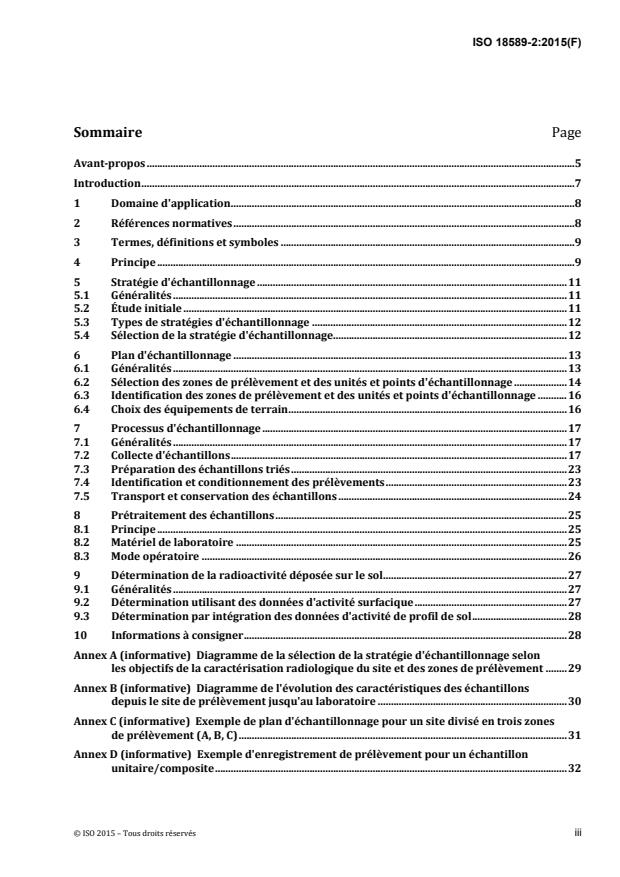
Sommaire Page
Avant-propos . 5
Introduction . 7
1 Domaine d'application . 8
2 Références normatives . 8
3 Termes, définitions et symboles . 9
4 Principe . 9
5 Stratégie d'échantillonnage . 11
5.1 Généralités . 11
5.2 Étude initiale . 11
5.3 Types de stratégies d'échantillonnage . 12
5.4 Sélection de la stratégie d'échantillonnage. 12
6 Plan d'échantillonnage . 13
6.1 Généralités . 13
6.2 Sélection des zones de prélèvement et des unités et points d'échantillonnage . 14
6.3 Identification des zones de prélèvement et des unités et points d'échantillonnage . 16
6.4 Choix des équipements de terrain . 16
7 Processus d'échantillonnage . 17
7.1 Généralités . 17
7.2 Collecte d'échantillons . 17
7.3 Préparation des échantillons triés . 23
7.4 Identification et conditionnement des prélèvements . 23
7.5 Transport et conservation des échantillons . 24
8 Prétraitement des échantillons . 25
8.1 Principe . 25
8.2 Matériel de laboratoire . 25
8.3 Mode opératoire . 26
9 Détermination de la radioactivité déposée sur le sol . 27
9.1 Généralités . 27
9.2 Détermination utilisant des données d'activité surfacique . 27
9.3 Détermination par intégration des données d'activité de profil de sol . 28
10 Informations à consigner . 28
Annex A (informative) Diagramme de la sélection de la stratégie d'échantillonnage selon
les objectifs de la caractérisation radiologique du site et des zones de prélèvement . 29
Annex B (informative) Diagramme de l'évolution des caractéristiques des échantillons
depuis le site de prélèvement jusqu'au laboratoire . 30
Annex C (informative) Exemple de plan d'échantillonnage pour un site divisé en trois zones
de prélèvement (A, B, C) . 31
Annex D (informative) Exemple d'enregistrement de prélèvement pour un échantillon
unitaire/composite . 32
© ISO 2015 – Tous droits réservés iii
Annex E (informative) Exemple d'enregistrement d'échantillon pour un profil de sol, avec
description du sol . 33
Bibliographie . 35
iv © ISO 2015 – Tous droits réservés
Avant-propos
L'ISO (Organisation internationale de normalisation) est une fédération mondiale d'organismes
nationaux de normalisation (comités membres de l'ISO). L'élaboration des Normes internationales est
en général confiée aux comités techniques de l'ISO. Chaque comité membre intéressé par une étude a le
droit de faire partie du comité technique créé à cet effet. Les organisations internationales,
gouvernementales et non gouvernementales, en liaison avec l'ISO, participent également aux travaux.
L’ISO collabore étroitement avec la Commission électrotechnique internationale (IEC) en ce qui
concerne la normalisation électrotechnique.
Les procédures utilisées pour élaborer le présent document et celles destinées à sa mise à jour sont
décrites dans les Directives ISO/IEC, Partie 1. Il convient, en particulier, de prendre note des différents
critères d'approbation requis pour les différents types de documents ISO. Le présent document a été
rédigé conformément aux règles de rédaction données dans les Directives ISO/IEC, Partie 2 (voir
www.iso.org/directives).
L’attention est appelée sur le fait que certains des éléments du présent document peuvent faire l’objet
de droits de propriété intellectuelle ou de droits analogues. L'ISO ne saurait être tenue pour
responsable de ne pas avoir identifié de tels droits de propriété et averti de leur existence. Les détails
concernant les références aux droits de propriété intellectuelle ou autres droits analogues identifiés
lors de l'élaboration du document sont indiqués dans l'Introduction et/ou dans la liste des déclarations
de brevets reçues par l'ISO (voir www.iso.org/brevets).
Les appellations commerciales éventuellement mentionnées dans le présent document sont données
pour information, par souci de commodité, à l'intention des utilisateurs et ne sauraient constituer un
engagement.
Pour une explication de la signification des termes et expressions spécifiques de l'ISO liés à l'évaluation
de la conformité, ou pour toute information au sujet de l'adhésion de l'ISO aux principes de l'OMC
concernant les obstacles techniques au commerce (OTC), voir le lien suivant: Avant‐propos ‐
Informations supplémentaires
Le comité chargé de l'élaboration du présent document est l'ISO/TC 85, Énergie nucléaire, technologies
nucléaires, et radioprotection, sous‐comité SC 2, Radioprotection.
Cette seconde édition annule et remplace la première édition (ISO 18589‐2:2007), qui a fait l'objet
d'une révision technique.
L'ISO 18589 comprend les parties suivantes, présentées sous le titre général Mesurage de la
radioactivité dans l'environnement — Sol:
— Partie 1: Lignes directrices générales et définitions
— Partie 2: Lignes directrices pour la sélection de la stratégie d'échantillonnage, échantillonnage et le
prétraitement des échantillons
— Partie 3: Méthode d’essai des radionucléides émetteurs gamma par spectrométrie gamma
— Partie 4: Mesurage des isotopes du plutonium (plutonium 238 et plutonium 239+240) par
spectrométrie alpha
— Partie 5: Mesurage du strontium 90
© ISO 2015 – Tous droits réservés v
— Partie 6: Mesurage des activités alpha globale et bêta globale
— Partie 7: Mesurage in situ des radionucléides émetteurs gamma
vi © ISO 2015 – Tous droits réservés
Introduction
La présente Norme internationale est publiée en plusieurs parties, à utiliser ensemble ou séparément
selon les besoins. Les normes ISO 18589‐1 à ISO 18589‐6, concernant le mesurage de la radioactivité
dans le sol, ont été élaborées en même temps. Elles sont complémentaires entre elles et s'adressent aux
personnes chargées de déterminer la radioactivité présente dans les sols. Les deux premières parties
comportent des informations d'ordre général. Les normes ISO 18589‐3 à ISO 18589‐5 traitent des
mesurages spécifiques des radionucléides et l’ISO 18589‐6 traite de mesurages non spécifiques des
activités alpha globale et bêta globale. L’ISO 18589‐7 traite du mesurage des radionucléides émetteurs
gamma par spectrométrie in situ.
D'autres parties sont susceptibles d'être ajoutées ultérieurement à l'ISO 18589, s'il devient nécessaire
de normaliser les mesurages d'autres radionucléides.
© ISO 2015 – Tous droits réservés vii
Mesurage de la radioactivité dans l’environnement — Sol —
Partie 2: Lignes directrices pour la sélection de la stratégie
d’échantillonnage, l’échantillonnage et le prétraitement des
échantillons
1 Domaine d'application
La présente partie de l'ISO 18589 spécifie les exigences générales pour réaliser, sur la base de
l'ISO 11074 et de l'ISO/IEC 17025, toutes les phases de planification (étude théorique et reconnaissance
sur le terrain) de l'échantillonnage et de la préparation des échantillons pour essai. Elle inclut la
sélection de la stratégie d'échantillonnage, l'élaboration du plan d'échantillonnage, la présentation des
méthodes générales d'échantillonnage et des équipements et la méthodologie de prétraitement
d'échantillons adaptés aux mesurages de l'activité des radionucléides dans le sol.
La présente partie de l'ISO 18589 s'adresse aux personnes chargées de déterminer la radioactivité
présente dans les sols dans un but de radioprotection. Elle est applicable aux sols de jardins ou de
terres agricoles, aux sols de sites urbains ou industriels et aux sols qui n'ont pas été modifiés par des
activités humaines.
La présente partie de l'ISO 18589 est destinée à tous les laboratoires, quel que soit leur effectif ou leur
domaine d'essai. Lorsqu'un laboratoire n'est pas concerné par une ou plusieurs des activités couvertes
par la présente partie de l'ISO 18589, telles que la planification, l'échantillonnage ou les essais, les
exigences correspondantes ne sont pas applicables.
2 Références normatives
Les documents ci‐après, dans leur intégralité ou non, sont des références normatives indispensables à
l’application du présent document. Pour les références datées, seule l'édition citée s'applique. Pour les
références non datées, la dernière édition du document de référence s'applique (y compris les éventuels
amendements).
ISO 31‐9, Grandeurs et unités — Partie 9: Physique atomique et nucléaire
ISO 11074, Qualité du sol — Vocabulaire
ISO/IEC 17025, Exigences générales concernant la compétence des laboratoires d'étalonnages et d'essais
ISO 18589‐1, Mesurage de la radioactivité dans l'environnement — Sol — Partie 1: Lignes directrices
générales et définitions
8 © ISO 2015 – Tous droits réservés
3 Termes, définitions et symboles
Pour les besoins du présent document, les termes, définitions et symboles donnés dans l’ISO 31‐9,
l'ISO 18589‐1 et l'ISO 11074, ainsi que les suivants s'appliquent.
e épaisseur de la couche échantillonnée
m masse humide de l'échantillon trié
ss
m′ masse humide d'un sous‐échantillon de l'échantillon trié
ss
m masse sèche de l'échantillon pour essai
ts
a activité du radionucléide par unité de masse de l'échantillon pour essai
A activité du radionucléide par unité de surface
S
S surface de la zone échantillonnée
4 Principe
L'objet du mesurage de la radioactivité des sols est la surveillance de l'impact environnemental des
[1] [2],[3],[4],[5]
substances radioactives et/ou l'évaluation de l'impact radiologique sur la population .
Les principaux objectifs du mesurage des radionucléides présents dans le sol (voir l'ISO 18589‐1) sont
les suivants:
— la caractérisation de la radioactivité dans l'environnement;
— la surveillance de routine de l'impact de la radioactivité émise par les installations nucléaires ou de
l'évolution de la radioactivité du territoire en général;
— les études de situations d'accident ou d'incident;
— la planification et la surveillance des actions correctives;
— le déclassement d'installations ou la mise au rebut des matériaux.
En conséquence, la radioactivité du sol est mesurée dans diverses situations mais il est possible de
décrire une approche générale, constituée des étapes suivantes, qui sont développées dans la présente
partie de l'ISO 18589:
a) Processus de planification — Sélection de la stratégie d'échantillonnage
La sélection de la stratégie d'échantillonnage dépend des principaux objectifs et des résultats de
l'étude initiale de la zone concernée. La stratégie d'échantillonnage doit apporter une connaissance
de la nature des radionucléides, de leurs activités volumiques, de leur distribution spatiale ainsi
que de leur évolution temporelle, en tenant compte des modifications dues à la migration, aux
conditions atmosphériques et à l'occupation des terrains/sols.
Une étude initiale de la zone doit être effectuée afin de déterminer la stratégie d'échantillonnage.
[6]
L'ISO 10381‐1 donne des recommandations générales sur la sélection de la stratégie
[7]
d'échantillonnage; l'ISO 10381‐4 donne des lignes directrices spécifiques pour les zones de sol
naturel, quasi naturel et cultivé; en ce qui concerne l'étude relative à la contamination du sol des
[8]
sites urbains et industriels, elle est décrite dans l'ISO 10381‐5 .
© ISO 2015 – Tous droits réservés 9
L'Article 5 fournit les détails correspondants, et l'Annexe A donne une méthode de sélection de la
stratégie d'échantillonnage.
b) Processus de planification — Plan d'échantillonnage
Le plan d'échantillonnage doit être élaboré conformément à la stratégie d'échantillonnage choisie.
Il doit spécifier la sélection des zones de prélèvement et des unités d'échantillonnage, la grille
d'échantillonnage, les points d'échantillonnage, les types d'échantillons, les modes opératoires et
les équipements d'échantillonnage ainsi que les exigences de sécurité pour le personnel.
L'Article 6 fournit les détails particuliers tels que la sélection des zones de prélèvement et des
unités d'échantillonnage qui résultent du type de maillage appliqué à ces zones. Les définitions des
types d'échantillons sont données dans l'ISO 18589‐1. La relation entre types d'échantillons est
donnée dans l'Annexe B.
c) Processus d'échantillonnage — Collecte d'échantillons
La collecte de tout échantillon sur le terrain doit être conforme au plan d'échantillonnage établi.
— Pour l'échantillonnage de la couche supérieure, un échantillon unique ou n prélèvements
élémentaires d'une épaisseur définie sont collectés dans chacune des unités d'échantillonnage
choisies.
— Pour l'échantillonnage vertical de différentes couches du sol, les échantillons sont prélevés
verticalement à des profondeurs croissantes sous la surface du point d'échantillonnage. Un
échantillon unique ou n prélèvements élémentaires sont prélevés au sein des diverses couches
du sol, avec des épaisseurs différentes en fonction de la profondeur d'échantillonnage. Il
convient de prendre des précautions particulières afin d'éviter de mélanger des échantillons
des diverses couches du sol.
Une description détaillée est fournie dans les Articles 6 et 7.
d) Processus d'échantillonnage — Préparation des échantillons triés
La préparation des échantillons triés est effectuée par la réduction d'échantillons unitaires ou
composites. Il convient qu'un échantillon trié soit représentatif de la valeur moyenne d'une ou
plusieurs caractéristiques du sol. Les procédures d'identification, d'étiquetage, de conditionnement
et de transport des échantillons triés vers le laboratoire doivent garantir la préservation de leurs
caractéristiques.
Une description détaillée est donnée en 7.3, 7.4, et 7.5.
e) Processus de laboratoire — Manipulation de l'échantillon pour laboratoire
Une fois arrivés dans les locaux du laboratoire, les échantillons triés sont considérés être des
échantillons pour laboratoire qui sont entreposés et doivent être prétraités ultérieurement avant
analyse.
Une description détaillée est donnée dans l'Article 8.
10 © ISO 2015 – Tous droits réservés
f) Processus de laboratoire — Préparation de l'échantillon pour essai
Avant tout essai, les échantillons pour laboratoire doivent faire l'objet d'un prétraitement (séchage,
broyage, tamisage et homogénéisation) pour produire des échantillons pour essai à l'état de poudre
fine et homogène. Le prétraitement doit produire un échantillon pour essai dont les
caractéristiques physico‐chimiques demeurent constantes au cours du temps, de manière à faciliter
l'interprétation des résultats. Des sous‐échantillons représentatifs doivent être isolés de
l'échantillon pour essai, en tant que prises d'essai dont les masses sont déterminées par les
spécifications des différents mesurages de la radioactivité.
Une description détaillée est donnée dans l'Article 8.
Si certains matériaux doivent être conservés pour des études ultérieures ou dans le cadre du
règlement d'un éventuel litige, des sous‐échantillons doivent être préservés à partir de l'échantillon
pour laboratoire ou de l'échantillon pour essai, selon une méthode acceptable et documentée.
5 Stratégie d'échantillonnage
5.1 Généralités
Au cours du processus de planification, la stratégie d'échantillonnage du site étudié est déterminée en
fonction des objectifs décrits dans l'Article 4 point a) et donne lieu à la définition d'un plan
[1],[2],[4],[9],[11],[12]
d'échantillonnage.
5.2 Étude initiale
Quel que soit l'objectif de l'intervention, un certain nombre d'actions préliminaires doivent être menées
au cours de la phase d’étude initiale pour aider à la définition de la stratégie d'échantillonnage, telles
que:
— analyse de l'historique du site, de données administratives, d'archives d'entreprises, d'entretiens
avec d'anciens employés et d'études antérieures pour identifier les sources potentielles de
contamination radioactive;
— collecte d'informations sur les caractéristiques géologiques, hydrologiques et pédologiques et sur
les principaux paramètres climatologiques lorsqu'il s'agit de caractériser un site et de suivre
l'évolution spatio‐temporelle de ses caractéristiques radioactives;
— reconnaissance du site étudié pour repérer la topographie des lieux, la nature de la couverture
végétale et relever toute particularité pouvant orienter les techniques de prélèvement et le plan
d'échantillonnage;
— dans le cas de terres agricoles, collecte de données auprès des agriculteurs sur la nature et la
profondeur des travaux (sous‐solage ou tranchées de drainage, labour, hersage, etc.) et sur les
engrais chimiques et les amendements ajoutés qui peuvent entraîner un excès de radioactivité
naturelle (nature et quantité des produits répandus).
Lorsque les données de radioactivité de la contamination du sol ne sont pas disponibles ou dans le cas
d'une suspicion de contamination radioactive, il peut être nécessaire d'effectuer une étude analytique
sur site au moyen de détecteurs portatifs ou de réaliser quelques prélèvements préliminaires, suivis
d'une analyse en laboratoire, afin de sélectionner les zones et la stratégie d'échantillonnage.
© ISO 2015 – Tous droits réservés 11
5.3 Types de stratégies d'échantillonnage
En fonction des objectifs et de la connaissance initiale de la distribution de la radioactivité sur la zone
étudiée, les stratégies d'échantillonnage sont soit de type orienté, soit de type probabiliste.
Les stratégies orientées sont fondées sur des contraintes a priori qui donnent lieu à une sélection
d'unités d'échantillonnage dans une zone spécifique, soumise à un examen spécialement minutieux, du
fait de son intérêt particulier ou de son niveau de contamination.
Les stratégies probabilistes utilisent une sélection d'unités d'échantillonnage sans contrainte à priori.
La sélection des unités et des points d'échantillonnage est décrite en 6.2.
5.4 Sélection de la stratégie d'échantillonnage
L'approche ou la stratégie d'échantillonnage doit être choisie en fonction du but poursuivi, des résultats
finaux pertinents, comme la protection des hommes et de l'environnement, en tenant compte des
contraintes économiques et sociales. Il convient que la stratégie d'échantillonnage choisie assure que la
radioactivité des échantillons est représentative de la distribution des radionucléides dans le sol de la
[1],[2],[4],[6],[9]
zone objet de l'étude.
Bien que la stratégie d'échantillonnage ne puisse être définie qu'au cas par cas, il est recommandé que
la sélection de la stratégie d'échantillonnage suive les étapes suivantes:
— l'analyse des archives, qui permet une étude historique du site de prélèvement et notamment de
son utilisation précédente (identification de la source);
— l'évaluation des voies de migration préférentielle et/ou des zones d'accumulation;
— la reconnaissance du site en termes de limites des zones de prélèvement et de l'échantillonnage
effectué;
— la reconnaissance du site: une étude analytique rapide à l'aide de détecteurs portatifs de
radioactivité peut être utilisée pour caractériser la distribution de la radioactivité des zones
concernées.
Cette étape du processus de planification détermine un grand nombre de décisions et peut engendrer
des activités importantes et coûteuses. Elle inclut également la définition des objectifs de qualité des
données en fonction des paramètres à analyser.
L'Annexe A fournit un diagramme aidant à sélectionner une stratégie d'échantillonnage en fonction des
objectifs de l'étude.
Le choix de la stratégie détermine la densité d'échantillonnage ainsi que la distribution spatiale et
temporelle des unités d'échantillonnage à partir desquelles les échantillons seront prélevés en fonction
du temps; ce choix doit tenir compte:
— de la distribution éventuelle des radionucléides: homogène ou hétérogène (point « chaud »);
— des caractéristiques de l'environnement;
— de la quantité minimale de masse de sol nécessaire pour effectuer tous les essais de laboratoire; et
— du nombre maximal d'essais à effectuer par le laboratoire, pour l'étude.
12 © ISO 2015 – Tous droits réservés
Dans de nombreux cas, il est possible de partir d'hypothèses sur la présence éventuelle d'une
contamination du sol et de sa distribution (homogène ou hétérogène). Ces hypothèses doivent ensuite
être vérifiées par une stratégie d'échantillonnage orientée. Une variante de cette stratégie, systématique
pour des points d'échantillonnage représentatifs choisis, est adaptée à la surveillance de routine des
sites dont les origines de la radioactivité et sa distribution sont connues. Cela permet de définir le
nombre et l'emplacement des points d'échantillonnage avec une plus grande précision que par une
stratégie d'échantillonnage exclusivement probabiliste. Cette sélection subjective des points
d'échantillonnage peut être combinée à une approche statistique pour répondre aux critères de qualité
de l'interprétation. Lorsque la distribution spatiale de la radioactivité n'est pas connue, une stratégie
probabiliste dans l'espace doit être choisie.
Des stratégies probabilistes avec un échantillonnage aléatoire (distribution aléatoire des points
d'échantillonnage) ne sont adaptées que si la distribution de la radioactivité sur le site est considérée
comme homogène. Dans le cas d'un site présentant des hétérogénéités de type ponctuel (points
sources), il est recommandé de mettre en œuvre une stratégie d'échantillonnage systématique suivant
le degré de connaissance de la distribution de ces hétérogénéités dans les différentes zones de
prélèvement.
Lorsque l'objectif de l'étude est de caractériser un dépôt récent à la surface du sol, comme dans le cas de
retombées suite à un rejet chronique autorisé d'effluents gazeux ou à un accident, la collecte de la
couche supérieure est recommandée.
Lorsque l'objectif est d'étudier un site pollué et qu'il est nécessaire de connaître la migration verticale
des radionucléides en profondeur (afin de prédire la contamination éventuelle des eaux souterraines),
des échantillons de couches à diverses profondeurs doivent être prélevés. Les couches peuvent être
définies comme ayant la même épaisseur ou de manière à être représentatives des différents horizons.
La stratégie d'échantillonnage donne lieu à un ensemble de choix techniques détaillés dans l'Article 6.
6 Plan d'échantillonnage
6.1 Généralités
Le plan d'échantillonnage est un mode opératoire précis qui, en fonction de l'application des principes
de la stratégie adoptée, définit toutes les actions à entreprendre sur le terrain ainsi que les ressources
humaines nécessaires à l'opération de prélèvement proprement dite. Le plan est directement lié au but
de l'étude, aux caractéristiques de l'environnement du site, à la capacité des installations d'essai en
laboratoire et aux objectifs de qualité des données nécessaires pour l'interprétation des résultats des
mesurages.
Le plan d'échantillonnage doit être établi au cas par cas. Il doit contenir toutes les informations
nécessaires à l'exécution du prélèvement, c'est‐à‐dire les zones de prélèvement, les unités
d'échantillonnage, l'emplacement des points d'échantillonnage dans les unités d'échantillonnage, les
types d'échantillons (unitaires ou composites), le nombre de prélèvements élémentaires pour des
échantillons composites, la périodicité, la masse requise d'un échantillon donné compte tenu des essais
prévus, la nécessité de conserver du matériel en archive, la distribution verticale, etc.
© ISO 2015 – Tous droits réservés 13
6.2 Sélection des zones de prélèvement et des unités et points d'échantillonnage
6.2.1 Généralités
Après avoir décidé de la stratégie d'échantillonnage, les zones de prélèvement et les unités
d'échantillonnage doivent être définies sur la base des résultats de l'étude initiale. Dans certains cas, les
limites des zones de prélèvement et l'emplacement des unités d'échantillonnage pour la surveillance ou
le suivi de routine peuvent être fixées par des prescriptions légales, comme dans le cas de l'exploitation
d'une nouvelle installation nucléaire. Ces limites seront définies suite à une étude radiologique de
référence réalisée pour le projet. Dans des situations d'accident, la dimension de la zone de prélèvement
et l'emplacement des unités d'échantillonnage peuvent également être déterminés par les conditions
environnementales (la force et la direction du vent, la topographie, etc.) au moment de l'accident ainsi
que par la variation des caractéristiques du terme source (radionucléides, activité, durée du rejet, etc.).
Pour la stratégie probabiliste, les unités d'échantillonnage peuvent être choisies par approche soit
systématique, soit aléatoire, alors que pour une stratégie orientée l'approche aléatoire n'est pas
possible.
Pour les deux stratégies, les points d'échantillonnage peuvent être choisis sur la base d'une approche
systématique ou aléatoire.
En fonction de l'hétérogénéité de la distribution de la radioactivité, il est admis d'utiliser, sur le même
site, une combinaison de ces stratégies aux différentes zones de prélèvement.
6.2.2 Échantillonnage à effectuer avec une stratégie probabiliste
Pour une stratégie probabiliste, une fois identifiées, les zones de prélèvement sont couvertes d'une
grille qui définit les unités d'échantillonnage. Il convient que la taille du maillage tienne compte de la
surface du site. Elle dépend également de la capacité analytique du laboratoire ainsi que des contraintes
financières qui limitent le nombre d'échantillons qui peut être analysé. Selon le site objet de l'étude, la
surface des mailles unitaires peut aller de quelques mètres carrés à plusieurs kilomètres carrés.
[24]
Si, suite à une étude radiologique préliminaire sur site (voir l'ISO 18589‐7 ), une carte de la
radioactivité est disponible, le maillage imposé sur la zone de prélèvement peut correspondre à la grille
adoptée pour la cartographie de la radioactivité. La carte de la radiographie peut être plus dense
lorsque des zones contaminées sont prévues ou moins dense en l'absence présumée de contamination.
Pour l'échantillonnage systématique, un point d'échantillonnage est choisi dans chaque nœud ou au
centre de la maille unitaire. Le nombre final d'unités d'échantillonnage faisant finalement l'objet d'un
échantillonnage dépend de l'hétérogénéité des caractéristiques de l'environnement et des restrictions
d'accès imposées par la complexité topographique de la zone.
Pour l'échantillonnage aléatoire, les unités d'échantillonnage sont référencées et un nombre d'unités est
choisi au hasard.
Lorsque l'objet de l'étude est de rechercher l'impact de la contribution d'une source spécifique de
radioactivité sur l'environnement, elle doit être comparée au niveau du bruit de fond radioactif. Ce
niveau peut être déterminé dans une zone supposée être non contaminée par la source objet de l'étude
(par exemple, non affectée par d'éventuels rejets d'effluent de la centrale étudiée) et sera considérée
être la zone de référence.
6.2.3 Échantillonnage à effectuer avec une stratégie orientée
Pour une stratégie d'échantillonnage orientée, la zone de prélèvement est définie par les contraintes
qu'imposent les objectifs de l'étude, sur la base des données environnementales et des résultats
cartographiques.
14 © ISO 2015 – Tous droits réservés
Le plan d'échantillonnage est fondé sur un choix subjectif d'unités d'échantillonnage résultant d'une
connaissance précédente de la zone ou/et d'études de radioactivité initiales réalisées sur place.
Lorsque l'objectif est de prélever les échantillons ayant le niveau d'activité le plus élevé et qu'aucune
donnée de radioactivité n'est disponible, une étude radiologique préliminaire, à l'aide d'un détecteur
portatif, permet d'établir une cartographie du site permettant de mettre en évidence la (les) zone(s)
contaminée(s) et aide à définir le plan d'échantillonnage en situant avec précision l'unité
[24]
d'échantillonnage (voir l'ISO 18589‐7 ).
NOTE L'un des buts de cette étude initiale est également d'évaluer les risques d'exposition des personnes
chargées de l'opération de prélèvement et, par conséquent, de définir des mesures de radioprotection, notamment
celles qui doivent être mises en œuvre sur le site et concernant la protection du personnel contre les
rayonnements.
En matière de surveillance de routine d'une installation nucléaire, l'unité d'échantillonnage peut être
choisie comme étant le point de concentration maximale de retombées prévues d'effluents gazeux
atmosphériques émis par l'installation.
Lorsque l'étude porte simultanément sur la radioactivité du sol et d'autres composants de
l'environnement (air, eau, bioindicateurs, éléments de la chaîne alimentaire menant jusqu'à l'homme), il
convient de choisir l'unité d'échantillonnage en tenant compte de la présence des autres indicateurs.
6.2.4 Critères de sélection des zones de prélèvement et des unités d'échantillonnage
L'utilisation de données d'études environnementales passées ainsi que la reconnaissance visuelle du
site permettent d'identifier des zones de prélèvement ayant des configurations topologiques et des
couvertures végétales homogènes. Il est pour cela nécessaire de faire la distinction entre zones élevées
et zones en pente, entre zones herbeuses et zones buissonneuses, entre zones boisées et zones
cultivées, labourées, etc.
Il convient dans la mesure du possible de choisir des unités d'échantillonnage dont une couche du sol
n'a pas été remaniée par l'activité humaine et disposant d'un couvert herbacé bien conservé. La surface
de l'unité d'échantillonnage doit au moins avoir plusieurs mètres carrés. Tout remaniement doit être
noté, en indiquant l'échelle, la nature et l'origine du remaniement sur la fiche de prélèvement.
La surveillance radioactive de sols remaniés peut être menée en complément des études sur la
radioactivité des plantes sur le terrain. Pour les terrains agricoles, la couche superficielle dont
l'épaisseur correspond à la profondeur de labourage peut être considérée comme homogène, si la
contamination de la zone a eu lieu avant labourage. Dans le cas de terrains industriels ou construits, les
matériaux utilisés pour combler les sols peuvent être examinés en tenant compte de leur hétérogénéité
intrinsèque et de la technique de remblayage.
Pour la surveillance de routine, les unités d'échantillonnage qui font l'objet d'un prélèvement régulier
dans le temps doivent être maintenues exemptes d'arbres et de broussailles.
Lorsque la stratégie d'échantillonnage nécessite une description du profil du sol, l'épaisseur de la
[13],[14],[15],[16]
couche doit être déterminée par des caractéristiques pédologiques ou par le taux prévu de
migration verticale de radionucléides. Le paragraphe 7.2.3 donne une description détaillée de la
méthode d'échantillonnage pour le prélèvement d'échantillons en profondeur, et l'Annexe C donne un
exemple de plan d'échantillonnage.
Pour les terres agricoles, on peut éviter en particulier les effets de bordure en rentrant d'au moins une
vingtaine de mètres à l'intérieur de la parcelle, sauf indication contraire liée aux objectifs de l'étude.
© ISO 2015 – Tous droits réservés 15
6.3 Identification des zones de prélèvement et des unités et points d'échantillonnage
Les zones de prélèvement et les unités d'échantillonnage doivent être identifiées par les paramètres
suivants:
— le département, le nom de la commune, le nom du site ou du lieu‐dit;
— le nom ou la référence de la zone de prélèvement et des unités d'échantillonnage;
— les coordonnées géographiques, établies à l'aide d'une carte topographique ou d'un système de
positionnement global.
Il est recommandé d'utiliser une carte topographique officielle éditée par un organisme national à
l'échelle adéquate, sur laquelle les limites de la (des) zone(s) et, au besoin, celles des unités
d'échantillonnage doivent être reportées en même temps que leurs identifications.
Les points d'échantillonnage doivent être décrits par leurs coordonnées géographiques, à l'aide d'une
carte topographique ou d'un système de positionnement global.
6.4 Choix des équipements de terrain
[23]
Il convient de choisir des équipements conformes à l'ISO 10381‐2 . Une attention particulière doit
être portée à la qualité des équipements de prélèvement, et il convient notamment de s'assurer que le
matériel utilisé n'induit aucune interférence (pollution ou perte) avec les radionucléides à déterminer.
Selon le plan d'échantillonnage, qui définit la profondeur du prélèvement et la nature du terrain, le
matériel à utiliser peut être sélectionné dans la liste suivante:
a) matériel pour délimiter les zones (fiches, rubans, etc.);
b) pour les prélèvements de surface ou à faible profondeur: pelle, outil de carottage tel que gabarit
métallique, tarière à gouge, vrille, sonde droite, bêche (les équipements doivent être nettoyés avant
l'échantillonnage);
c) pour les prélèvements jusqu'à une profondeur de 2 m: tarière ou engin de chantier tels que:
— pelle à godet pour l'ouverture d'une tranchée où sont réalisés les prélèvements (prendre garde
à la faible stabilité des parois dans le cas de sols friables ou remaniés);
— tube échantillonneur à poussée mécanique ou hydraulique;
d) pour les prélèvements à des profondeurs supérieures à 2 m: carottier muni de tubes de carottage
en matériau inerte vis‐à‐vis du sol;
e) matériel commun à tous les prélèvements:
— spatule ou couteau à lame d'acier inoxydable;
— seau(x) d'une contenance d'au moins 10 l;
— bâches sèches, propres et inertes vis‐à‐vis du sol d'environ 2 m ;
— sacs ou flacons à large ouverture ou boîtes en plastique d'une contenance d'au moins 2 l,
résistant à l'humidité, étanches à l'eau et à la poussière et inertes vis‐à‐vis du sol;
— matériel d'identification des échantillons (étiquettes, marqueurs, etc.);
16 © ISO 2015 – Tous droits réservés
L'étude de radionucléides volatils nécessite des précautions particulières pour éviter les pertes de
composés volatils pendant la collecte et le stockage de l'échantillon.
f) matériel spécifique dans le cas de la détermination de l'activité surfacique:
— balances ayant une gamme de pesées maximale et une précision adéquate;
— ruban de mesure ou gabarit de longueur adéquate permettant le mesurage des dimensions des
prélèvements élémentaires.
7 Processus d'échantillonnage
7.1 Généralités
Le processus d'échantillonnage est défini dans le plan d'échantillonnage en fonction des objectifs de
l'étude. La collecte des échantillons et la préparation des échantillons triés sont indépendantes de la
stratégie d'échantillonnage choisie (probabiliste ou orientée). Les objectifs de l'étude sont décrits
en 7.2.1, pour une unité d'échantillonnage donnée pour un prélèvement dans les couches supérieures
jusqu'à 20 cm et dans des couches plus profondes, pour les différentes applications.
Les instructions génériques présentées en 7.2.2 à 7.2.3 sont applicables aux cas suivants:
— caractérisation initiale de la radioactivité dans l'environnement;
— surveillance de routine de l'impact des installations nucléaires ou de l'évolution du territoire en
général;
— recherches de situations d'accident ou d'incident;
— planification et surveillance des actions de remédiation;
— déclassement d'installations et libération sans contrainte des sols du site;
— des conseils spécifiques sont fournis pour:
— l'étude de la distribution verticale des radionucléides, y compris les échantillons prélevés dans
une tranchée;
— la détermination de la radioactivité déposée dans le sol.
7.2 Collecte d'échantillons
7.2.1 Sélection de la profondeur de prélèvement par rapport aux objectifs de l'étude
7.2.1.1 Caractérisation initiale de la radioactivité dans l'environnement
Pour les sols vierges, la profondeur de la (des) couche(s) à échantillonner peut être déterminée en
utilisant l'une des deux approches suivantes.
— Approche uniforme avec prélèvement effectué à une profondeur indépendante des variations
[13],[14]
naturelles des caractéristiques du sol . Par exemple, il est possible de réaliser
l'échantillonnage de la couche supérieure jusqu'à 20 cm ou, si une couche de surface de référence
est requise pour identifier d'éventuelles retombées futures, l'échantillonnage peut être effectué en
[17]
prélevant deux couches, la première allant de la surface jusqu'à une profondeur de 5 cm et la
[18]
seconde jusqu'à une profondeur de 20 cm .
© ISO 2015 – Tous droits réservés 17
— Approche non uniforme adaptée aux caractéristiques naturelles: la profondeur de la couche de la
rhizosphère ou les caractéristiques pédologiques d'un échantillonnage de profil(s) déterminent les
[2]
couches de prélèvement . Dans ce dernier cas, lorsque différents horizons sont présents, il
convient de prélever autant d'échantillons élémentaires qu'il y a d'horizons distincts.
Pour des sols remaniés par des activités humaines, tels que les terres agricoles, on distingue deux
approches:
a) approche uniforme avec prélèvement effectué en profondeur, indépendamment du fait qu'il soit
adapté aux pratiques agricoles locales. Par exemple, il peut être effectué jusqu'à une profondeur de
20 cm ou plus, en fonction de la profondeur de labourage;
b) approche non uniforme adaptée aux caractéristiques réelles du sol. Pour l'échantillonnage de
profil(s), la couche de surface est déterminée par la profondeur de l'horizon remanié et les couches
inférieures par leurs caractéristiques pédologiques. Dans ce dernier cas, lorsque différents horizons
sont présents, il convient de prélever autant d'échantillons élémentaires qu'il y a d'horizons
distincts.
7.2.1.2 Surveillance de routine de l'impact des installations nucléaires ou de l'évolution du
territoire en général
Le choix des sols non remaniés à prélever doit être effectué selon une approche uniforme comme
définie en 7.2.1.1. Pour que les échantillons soient comparables d'une opération de prélèvement à
l'autre, il est important de prélever le sol dans une partie de la zone qui n'a pas été échantillonnée
depuis au moins une année. Lorsqu'une couche de surface de référence a été identifiée au cours de la
caractéri
...
Questions, Comments and Discussion
Ask us and Technical Secretary will try to provide an answer. You can facilitate discussion about the standard in here.
Loading comments...