


ISO 18589-2:2007
(Main)Measurement of radioactivity in the environment — Soil — Part 2: Guidance for the selection of the sampling strategy, sampling and pre-treatment of samples
Measurement of radioactivity in the environment — Soil — Part 2: Guidance for the selection of the sampling strategy, sampling and pre-treatment of samples
ISO 18589-2:2007 specifies the general requirements, based on ISO 11074 and ISO/IEC 17025, for all steps in the planning (desk study and area reconnaissance) of the sampling and the preparation of samples for testing. It includes the selection of the sampling strategy, the outline of the sampling plan, the presentation of general sampling methods and equipment, as well as the methodology of the pre-treatment of samples adapted to the measurements of the activity of radionuclides in soil. ISO 18589-2:2007 is addressed to the people responsible for determining the radioactivity present in soil for the purpose of radiation protection. It is applicable to soil from gardens, farmland, urban or industrial sites, as well as soil not affected by human activities. ISO 18589-2:2007 is applicable to all laboratories regardless of the number of personnel or the range of the testing performed. When a laboratory does not undertake one or more of the activities covered by ISO 18589-2:2007, such as planning, sampling or testing, the corresponding requirements do not apply.
Mesurage de la radioactivité dans l'environnement — Sol — Partie 2: Lignes directrices pour la sélection de la stratégie d'échantillonnage, l'échantillonnage et le prétraitement des échantillons
L'ISO 18589-2:2007 spécifie les exigences générales pour réaliser, sur la base de l'ISO 11074 et de l'ISO/CEI 17025, toutes les phases de planification (étude théorique et reconnaissance sur le terrain) de l'échantillonnage et de la préparation des échantillons pour essai. Elle inclut la sélection de la stratégie d'échantillonnage, l'élaboration du plan d'échantillonnage, la présentation des méthodes générales d'échantillonnage et des équipements et la méthodologie de prétraitement d'échantillons adaptés aux mesurages de l'activité des radionucléides dans le sol. L'ISO 18589-2:2007 s'adresse aux personnes chargées de déterminer la radioactivité présente dans les sols dans un but de radioprotection. Elle est applicable aux sols de jardins ou de terres agricoles, aux sols de sites urbains ou industriels et aux sols qui n'ont pas été modifiés par des activités humaines. L'ISO 18589-2:2007 est destinée à tous les laboratoires, quel que soit leur effectif ou leur domaine d'essai. Lorsqu'un laboratoire n'est pas concerné par une ou plusieurs des activités couvertes par ll'ISO 18589-2:2007, telles que la planification, l'échantillonnage ou les essais, les exigences correspondantes ne sont pas applicables.
General Information
- Status
- Withdrawn
- Publication Date
- 02-Dec-2007
- Withdrawal Date
- 02-Dec-2007
- Technical Committee
- ISO/TC 85/SC 2 - Radiological protection
- Drafting Committee
- ISO/TC 85/SC 2/WG 17 - Radioactivity measurements
- Current Stage
- 9599 - Withdrawal of International Standard
- Start Date
- 31-Jan-2015
- Completion Date
- 14-Feb-2026
Relations
- Effective Date
- 04-May-2013
Buy Documents



ISO 18589-2:2007 - Measurement of radioactivity in the environment -- Soil


ISO 18589-2:2007 - Mesurage de la radioactivité dans l'environnement -- Sol

Get Certified
Connect with accredited certification bodies for this standard

NSF International
Global independent organization facilitating standards development and certification.

BSMI (Bureau of Standards, Metrology and Inspection)
Taiwan's standards and inspection authority.
CIS Institut d.o.o.
Personal Protective Equipment (PPE) certification body. Notified Body NB-2890 for EU Regulation 2016/425 PPE.
Sponsored listings
Frequently Asked Questions
ISO 18589-2:2007 is a standard published by the International Organization for Standardization (ISO). Its full title is "Measurement of radioactivity in the environment — Soil — Part 2: Guidance for the selection of the sampling strategy, sampling and pre-treatment of samples". This standard covers: ISO 18589-2:2007 specifies the general requirements, based on ISO 11074 and ISO/IEC 17025, for all steps in the planning (desk study and area reconnaissance) of the sampling and the preparation of samples for testing. It includes the selection of the sampling strategy, the outline of the sampling plan, the presentation of general sampling methods and equipment, as well as the methodology of the pre-treatment of samples adapted to the measurements of the activity of radionuclides in soil. ISO 18589-2:2007 is addressed to the people responsible for determining the radioactivity present in soil for the purpose of radiation protection. It is applicable to soil from gardens, farmland, urban or industrial sites, as well as soil not affected by human activities. ISO 18589-2:2007 is applicable to all laboratories regardless of the number of personnel or the range of the testing performed. When a laboratory does not undertake one or more of the activities covered by ISO 18589-2:2007, such as planning, sampling or testing, the corresponding requirements do not apply.
ISO 18589-2:2007 specifies the general requirements, based on ISO 11074 and ISO/IEC 17025, for all steps in the planning (desk study and area reconnaissance) of the sampling and the preparation of samples for testing. It includes the selection of the sampling strategy, the outline of the sampling plan, the presentation of general sampling methods and equipment, as well as the methodology of the pre-treatment of samples adapted to the measurements of the activity of radionuclides in soil. ISO 18589-2:2007 is addressed to the people responsible for determining the radioactivity present in soil for the purpose of radiation protection. It is applicable to soil from gardens, farmland, urban or industrial sites, as well as soil not affected by human activities. ISO 18589-2:2007 is applicable to all laboratories regardless of the number of personnel or the range of the testing performed. When a laboratory does not undertake one or more of the activities covered by ISO 18589-2:2007, such as planning, sampling or testing, the corresponding requirements do not apply.
ISO 18589-2:2007 is classified under the following ICS (International Classification for Standards) categories: 13.080.01 - Soil quality and pedology in general; 17.240 - Radiation measurements. The ICS classification helps identify the subject area and facilitates finding related standards.
ISO 18589-2:2007 has the following relationships with other standards: It is inter standard links to ISO 18589-2:2015. Understanding these relationships helps ensure you are using the most current and applicable version of the standard.
ISO 18589-2:2007 is available in PDF format for immediate download after purchase. The document can be added to your cart and obtained through the secure checkout process. Digital delivery ensures instant access to the complete standard document.
Standards Content (Sample)
INTERNATIONAL ISO
STANDARD 18589-2
First edition
2007-12-01
Measurement of radioactivity in the
environment — Soil —
Part 2:
Guidance for the selection of the
sampling strategy, sampling and
pre-treatment of samples
Mesurage de la radioactivité dans l'environnement — Sol —
Partie 2: Lignes directrices pour la sélection de la stratégie
d'échantillonnage, l'échantillonnage et le prétraitement des échantillons
Reference number
©
ISO 2007
PDF disclaimer
This PDF file may contain embedded typefaces. In accordance with Adobe's licensing policy, this file may be printed or viewed but
shall not be edited unless the typefaces which are embedded are licensed to and installed on the computer performing the editing. In
downloading this file, parties accept therein the responsibility of not infringing Adobe's licensing policy. The ISO Central Secretariat
accepts no liability in this area.
Adobe is a trademark of Adobe Systems Incorporated.
Details of the software products used to create this PDF file can be found in the General Info relative to the file; the PDF-creation
parameters were optimized for printing. Every care has been taken to ensure that the file is suitable for use by ISO member bodies. In
the unlikely event that a problem relating to it is found, please inform the Central Secretariat at the address given below.
© ISO 2007
All rights reserved. Unless otherwise specified, no part of this publication may be reproduced or utilized in any form or by any means,
electronic or mechanical, including photocopying and microfilm, without permission in writing from either ISO at the address below or
ISO's member body in the country of the requester.
ISO copyright office
Case postale 56 • CH-1211 Geneva 20
Tel. + 41 22 749 01 11
Fax + 41 22 749 09 47
E-mail copyright@iso.org
Web www.iso.org
Published in Switzerland
ii © ISO 2007 – All rights reserved
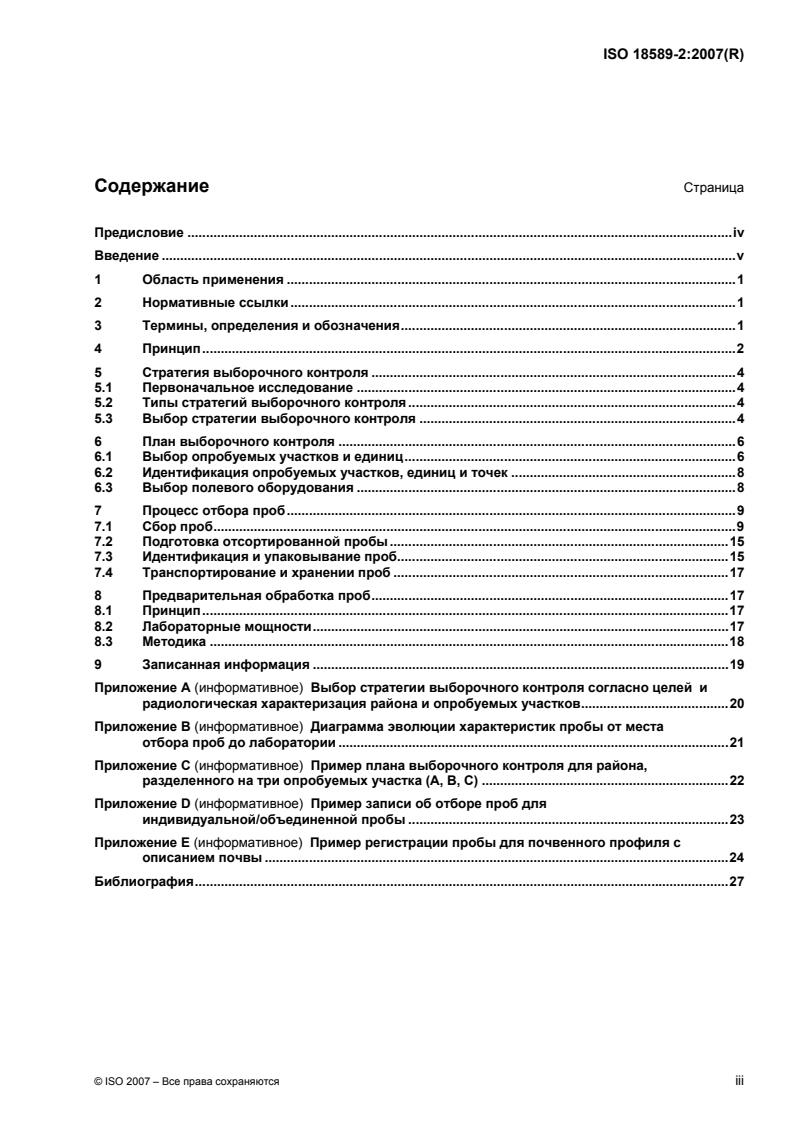
Contents Page
Foreword. iv
Introduction . v
1 Scope . 1
2 Normative references . 1
3 Terms and definitions and symbols . 1
4 Principle. 2
5 Sampling strategy. 3
5.1 Initial investigation . 3
5.2 Types of sampling strategies . 4
5.3 Selection of the sampling strategy . 4
6 Sampling plan . 5
6.1 Selection of sampling areas and units . 5
6.2 Identification of sampling areas, units and points. 7
6.3 Selection of field equipment. 7
7 Sampling process. 8
7.1 Collection of samples. 9
7.2 Preparation of the sorted sample. 14
7.3 Identification and packaging of samples .14
7.4 Transport and storage of samples. 15
8 Pre-treatment of samples. 16
8.1 Principle. 16
8.2 Laboratory equipment. 16
8.3 Procedure . 16
9 Recorded information. 17
Annex A (informative) Selection of the sampling strategy according to the objectives and the
radiological characterization of the site and sampling areas . 18
Annex B (informative) Diagram of the evolution of the sample characteristics from the sampling
site to the laboratory . 19
Annex C (informative) Example of sampling plan for a site divided in three sampling areas
(A, B, C). 20
Annex D (informative) Example of a sampling record for a single/composite sample. 21
Annex E (informative) Example for a sample record for a soil profile with soil description. 22
Bibliography . 25
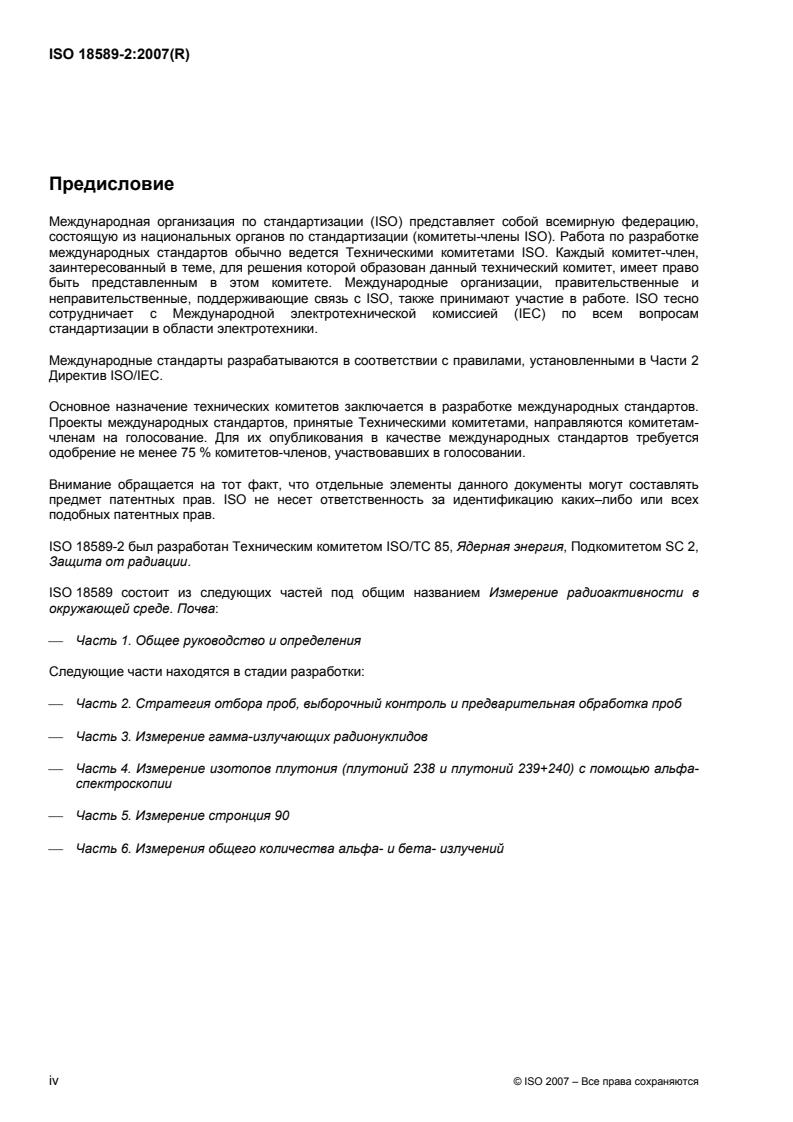
Foreword
ISO (the International Organization for Standardization) is a worldwide federation of national standards bodies
(ISO member bodies). The work of preparing International Standards is normally carried out through ISO
technical committees. Each member body interested in a subject for which a technical committee has been
established has the right to be represented on that committee. International organizations, governmental and
non-governmental, in liaison with ISO, also take part in the work. ISO collaborates closely with the
International Electrotechnical Commission (IEC) on all matters of electrotechnical standardization.
International Standards are drafted in accordance with the rules given in the ISO/IEC Directives, Part 2.
The main task of technical committees is to prepare International Standards. Draft International Standards
adopted by the technical committees are circulated to the member bodies for voting. Publication as an
International Standard requires approval by at least 75 % of the member bodies casting a vote.
Attention is drawn to the possibility that some of the elements of this document may be the subject of patent
rights. ISO shall not be held responsible for identifying any or all such patent rights.
ISO 18589-2 was prepared by Technical Committee ISO/TC 85, Nuclear energy, Subcommittee SC 2,
Radiation protection.
ISO 18589 consists of the following parts, under the general title Measurement of radioactivity in the
environment — Soil:
⎯ Part 1: General guidelines and definitions
⎯ Part 2: Guidance for the selection of the sampling strategy, sampling and pre-treatment of samples
⎯ Part 3: Measurement of gamma-emitting radionuclides
⎯ Part 4: Measurement of plutonium isotopes (plutonium 238 and plutonium 239+240) by alphla
spectrometry
⎯ Part 5: Measurement of strontium 90
⎯ Part 6: Measurement of gross alpha and gross beta activities
iv © ISO 2007 – All rights reserved
Introduction
This International Standard is published in several parts to be used jointly or separately according to needs.
Parts 1 to 6, concerning the measurements of radioactivity in the soil, have been prepared simultaneously.
These parts are complementary and are addressed to those responsible for determining the radioactivity
present in soils. The first two parts are general in nature. Parts 3 to 5 deal with radionuclide-specific
measurements and Part 6 with non-specific measurements of gross alpha or gross beta activities.
Additional parts may be added to ISO 18589 in the future if the standardization of the measurement of other
radionuclides becomes necessary.
INTERNATIONAL STANDARD ISO 18589-2:2007(E)
Measurement of radioactivity in the environment — Soil —
Part 2:
Guidance for the selection of the sampling strategy, sampling
and pre-treatment of samples
1 Scope
This part of ISO 18589 specifies the general requirements, based on ISO 11074 and ISO/IEC 17025, for all
steps in the planning (desk study and area reconnaissance) of the sampling and the preparation of samples
for testing. It includes the selection of the sampling strategy, the outline of the sampling plan, the presentation
of general sampling methods and equipment, as well as the methodology of the pre-treatment of samples
adapted to the measurements of the activity of radionuclides in soil.
This part of ISO 18589 is addressed to the people responsible for determining the radioactivity present in soil
for the purpose of radiation protection. It is applicable to soil from gardens, farmland, urban or industrial sites,
as well as soil not affected by human activities.
This part of ISO 18589 is applicable to all laboratories regardless of the number of personnel or the range of
the testing performed. When a laboratory does not undertake one or more of the activities covered by this part
of ISO 18589, such as planning, sampling or testing, the corresponding requirements do not apply.
2 Normative references
The following referenced documents are indispensable for the application of this document. For dated
references, only the edition cited applies. For undated references, the latest edition of the referenced
document (including any amendments) applies.
ISO 31-9, Quantities and units — Part 9: Atomic and nuclear physics
ISO 10381-2, Soil quality — Sampling — Part 2: Guidance on sampling techniques
ISO 11074, Soil quality — Vocabulary
ISO/IEC 17025, General requirements for the competence of testing and calibration laboratories
ISO 18589-1, Measurement of radioactivity in the environment — Soil — Part 1: General guidelines and
definitions
3 Terms, definitions and symbols
For the purpose of this document, the terms, definitions and symbols given in ISO 31-9, ISO 18589-1,
ISO 11074 and the following apply.
e thickness of the layer sampled
m wet mass of the sorted sample
ss
m′ wet mass of a subsample of the sorted sample
ss
m dry mass of the test sample
ts
a activity per unit of mass of the test sample
A activity per unit area
S
S surface area sampled
4 Principle
The purpose of the measurement of soil radioactivity is to monitor the environmental impact of radioactive
[1] [2], [3], [4], [5]
substances and/or to assess the radiological impact on the population .
The main objectives of the measurement of radionuclides in soil (see ISO 18589-1) are the following:
⎯ characterization of radioactivity in the environment;
⎯ routine surveillance of the impact of radioactivity released from nuclear installations or of the general
evolution of the radioactivity in a region;
⎯ investigations of accidents and incidents;
⎯ planning and surveillance of remedial action;
⎯ decommissioning of installations or the disposal of materials.
Consequently, measurements of soil radioactivity are performed in a variety of situations, but a generic
approach can be described, with the following steps as outlined in this part of ISO 18589:
a) Planning process — Selection of the sampling strategy
The selection of the sampling strategy depends on the main objectives and on the results of the initial
investigation of the area. The sampling strategy shall lead to the knowledge of the nature, activity
concentrations, spatial distribution, as well temporal evolution, of the radionuclides, taking into account
changes caused by migration, atmospheric conditions and land/soil use.
An initial investigation of the area shall be carried out to determine the sampling strategy.
ISO 10381-1 gives general guidance on the selection of the sampling strategy; ISO 10381-4 gives specific
guidance for the investigation of natural, near-natural and cultivated areas; and ISO 10381-5 deals with the
investigation of soil contamination at urban and industrial sites.
Details are given in Clause 5 and a scheme for the selection of the sampling strategy is given in Annex A.
b) Planning process — Sampling plan
The sampling plan shall be developed according to the sampling strategy selected. It shall specify the
selection of sampling areas and units, the sampling pattern, the sampling points, the types of samples, the
sampling procedures and equipment, as well as the safety requirements for the personnel.
Definitions of the types of sample are given in ISO 18589-1. The relationship between sample types is given in
Annex B. Details, such as the selection of sampling areas and the sampling units that result from the type of
grid applied to these areas, are given in Clause 6.
2 © ISO 2007 – All rights reserved
c) Sampling process — Collection of samples
The collection of any soil samples in the field shall conform to the established sampling plan.
⎯ For sampling of the top layer, a single sample or increments of a defined thickness are taken from each of
the selected sampling units.
⎯ For vertical sampling of several soil layers, samples are taken at increasing depth vertically below the
surface sampling point. A single sample or increments are collected from the various soil layers with
different thicknesses according to the sampling depth. Special care should be exercised in order not to
mix samples from different soil layers.
Details are given in Clauses 6 and 7.
d) Sampling process — Preparation of the sorted sample
The preparation of sorted samples is carried out by reduction of single or composite samples. A sorted sample
should be representative of the average value of one or more given soil characteristics. The identification,
labelling, packaging and transport procedures of sorted samples to the laboratory shall guarantee the
preservation of their characteristics.
Details are given in 7.2, 7.3 and 7.4.
e) Laboratory process — Handling of the laboratory sample
After arrival at the laboratory, the sorted samples are considered as laboratory samples for storage and further
pre-treatment before their analysis.
Details are given in Clause 8.
f) Laboratory process — Preparation of the test sample
Before any testing, the laboratory samples are pre-treated by drying, crushing, sieving and homogenization to
produce test samples in the form of a fine, homogeneous powder. Pre-treatment shall guarantee that the
physical and chemical characteristics of the test sample are constant over time, thus rendering the results
easier to interpret. Representative subsamples with masses determined by the specifications of the different
radioactivity measurements shall be isolated from the test sample as test portions.
Details are given in Clause 8.
If some material is stored for future investigations or for the purpose of settling a potential dispute,
subsamples shall be taken from the laboratory sample or the test sample in an acceptable and documented
manner.
5 Sampling strategy
During the planning process, the sampling strategy for the site under investigation is determined according to
[6], [7], [8]
the objectives described in 4 a), resulting in the definition of a sampling plan .
5.1 Initial investigation
Whatever the objective of the work being carried out, certain preliminaries shall be undertaken during the
initial investigation phase to help define the sampling strategy, such as the following:
⎯ analysis of historical and administrative data, company archives, previous studies, and interviews with
former employees, which help identify potential sources of radioactive contamination;
⎯ collection of information on geological, hydrological and pedological characteristics and on the main
climatic parameters, in order to characterize the spatial and temporal development of the characteristics
of the radioactivity of an area;
⎯ survey of the site under investigation to identify its topography, the nature of the vegetation cover and any
peculiarities that can affect the techniques and the sampling plan;
⎯ for farmland, collection of information from the farmers on the nature and depth of works (sub-soiling or
drainage, ploughing and harrowing ditches, etc.) and on chemical fertilizers and additives that can lead to
excessive natural radioactivity (nature and quantity of products applied).
When data on radioactive soil contamination are not available or in case of suspicion of contamination, in situ
analytical investigation using portable detectors or some preliminary sampling and subsequent laboratory
analysis can be necessary in order to select the sampling areas and strategy.
5.2 Types of sampling strategies
Sampling strategies are either orientated or probabilistic depending upon the objectives and the initial
knowledge of radioactivity distribution over the area under investigation.
Orientated strategies are based on a priori constraints that lead to a selection of sampling units in a specific
area under special scrutiny because of particular interest or level of contamination.
Probabilistic strategies are based on a selection of sampling units without any a priori constraints.
The selection of sampling units and points is described in 6.1.
5.3 Selection of the sampling strategy
The approach or sampling strategy shall be selected depending on the objective pursued and the relevant
endpoints, for example the protection of humans and the environment, taking into account social and
economic constraints. The sampling strategy selected should ensure that the radioactivity of the samples is
[1], [2], [4], [6], [9]
representative of the distribution of radionuclides in the soil of the area under investigation .
Although the strategy can only be defined on a case-by-case basis, the selection of the sampling strategy
should follow these stages:
⎯ analysis of the records, which enables an historic study of the sampling site, in particular of its previous
use (identification of the source);
⎯ evaluation of preferential migration pathways and/or accumulation areas;
⎯ site reconnaissance with respect to the boundaries of the sampling areas and sampling undertaken;
⎯ site reconnaissance: a rapid analytical investigation using portable radioactivity detectors may be used to
characterize the distribution of the radioactivity of the areas to be studied.
This step in the planning process determines a large number of choices and can generate important and
costly activities. It also includes the definition of the objectives of the data quality according to the parameters
to be analysed.
Annex A gives a flow diagram that helps in the selection of a sampling strategy according to the objectives of
the investigation.
The choice of the strategy determines the sampling density, the temporal and spatial distribution of the units
from which samples are collected and the timing of the sampling, taking into account the following:
⎯ potential distribution of radionuclide: homogeneous or heterogeneous (“hot” spots);
4 © ISO 2007 – All rights reserved
⎯ characteristics of the environment;
⎯ minimum mass of soil necessary to carry out all the laboratory tests; and
⎯ maximum number of tests that can be performed by the laboratory for the study.
In many cases, a prediction of the possible presence of soil contamination and its distribution (homogenous or
heterogeneous) can be drawn up. It is then necessary to verify these hypotheses by an orientated sampling
strategy. One variant of this strategy, which is systematic with selected representative sampling points, is
adapted for the routine monitoring of sites whose radioactive origins and distribution patterns are known. This
allows a more accurate definition of the number and location of the sampling points than a purely probabilistic
sampling strategy. This subjective selection of the sampling points may be combined with a statistical
approach to meet the quality requirements for the interpretation. When the spatial radioactivity distribution is
unknown, it is necessary to adopt an orientated spatially random strategy.
Probabilistic strategies with random sampling (random distribution of sampling points) are suitable only if the
distribution of the radioactivity on the site is considered homogeneous. For a site with occasional
heterogeneities (point sources), the implementation of a systematic sampling strategy that is dependant upon
the degree of knowledge of the distribution of these heterogeneities in the different sampling areas is
recommended.
When the objective of the investigation is the characterization of a recent deposit on the soil surface, such as
in the case of fallout following a routine, authorized gaseous release or an accident, the collection of the top
layer is recommended.
When the objective is the study of a polluted site where it is necessary to know the vertical migration of
radionuclides with depth (in order to predict the potential contamination of the groundwater), samples from
layers at various depths shall be collected. Layers may be defined either with the same thickness or as
representative of the different soil horizons.
The sampling strategy leads to a set of technical options that are detailed in Clause 6.
6 Sampling plan
The sampling plan is a precise procedure that, depending on the application of the principles of the strategy
adopted, defines all actions to be realized in the field. The plan also defines the human resources needed for
the sampling operation. The plan is directly linked to the purposes of the study, the characteristics of the
environment of the site, the capacity of the laboratory testing facilities and the objectives for the data quality
requisite for the interpretation of the results of the measurements.
The sampling plan shall be set up on a case-by-case basis. The plan shall contain all information needed to
perform the sampling, i.e. sampling areas, sampling units, location of sampling points in the sampling units,
types of samples, single or composite, number of increments for composite samples, periodicity, required
mass of a sample considering the planned tests, requirement for archiving the material, vertical distribution,
etc.
6.1 Selection of sampling areas and units
After deciding on the sampling strategy, sampling areas and units are defined based on the results of the
initial investigation. In some cases, the boundaries of sampling areas and the location of sampling units for
routine surveillance/monitoring can be fixed by legal requirements, for example as in the operation of a new
nuclear installation. They are defined as a result of the reference radiological study performed for the project.
For accident investigations, the size of the sampling area and location of the sampling units can also be
determined by the environmental conditions (wind strength and direction, topography, etc.) at the time of
accident, as well as the variation of the source characteristics (radionuclides, activity, release duration, etc.).
For a probabilistic strategy, the sampling units can be selected either by systematic or random approaches
whereas it cannot be done by a random approach for an orientated strategy.
For both strategies, the sampling points may be selected either by a systematic or random approach.
On the same site, depending on the heterogeneity of the radioactivity distribution, a combination of these
strategies may be applied to the different sampling areas.
6.1.1 Sampling for use with a probabilistic strategy
For a probabilistic strategy, the sampling areas, following their identification, are covered with a grid that
defines the sampling units. The size of the grid mesh should take into account the surface area of the site and
is also governed by the analytical capacity of the laboratory and the financial constraints that restrict the
number of samples that can be analysed. The surface area of the grid units can range from a few square
metres to several square kilometres depending on the site under investigation.
If a radioactivity map is available as a result of a preliminary in situ radiological inspection, the grid mesh
imposed on the sampling area may correspond to the grid adopted for the radioactive cartography. The
radioactivity map may be more dense where contaminated areas are suspected, or less dense in the
presumed absence of contamination.
For systematic sampling, each knot or centre of the sample unit is sampled. The final number of sampling
areas that are eventually sampled depends on the heterogeneity of the environmental characteristics and on
the access restrictions imposed by the topographical complexity of the area.
For random sampling, the sampling units are referenced and a number chosen at random.
When the purpose of the study is to investigate the impact on the environment of the contribution of a specific
source of radioactivity, it shall be compared to the background activity level. The latter can be determined in
an area assumed to be uncontaminated by the source under investigation (for example, not influenced by any
effluent discharges from the plant under study) and is considered as the reference area.
6.1.2 Sampling for use with an orientated strategy
For an orientated sampling strategy, the sampling area is defined by the constraints imposed by the objectives
of the investigation on the basis of the environmental data and the cartography results.
The sampling plan is based on a subjective selection of sampling units as a result of prior knowledge of the
area and/or initial in situ radioactivity investigations.
When the objective is to collect the samples with the highest activity level and there are no radioactivity data
available, a preliminary radiological investigation with a portable detector allows the creation of a map of the
site that highlights the contaminated area(s) and helps to define the sampling plan with the precise location of
the sampling unit.
NOTE One of the aspects of this initial investigation is also to assess the risks of exposure of workers in charge of
the sampling operation and, therefore, to define radiation protection measures, in particular those to be implemented on-
site relating to the protection of personnel against radiation.
In routine surveillance of a nuclear installation, the sampling unit may be chosen as the point of maximum
concentration of the predicted fallout of gaseous discharges from the plant.
When the radioactivity of the soil and other components of the environment (air, water, bio-indicators,
elements of the human food chain) is investigated simultaneously, then the selection of the sampling unit
should take into account the presence of the other indicators.
6.1.3 Selection criteria of sampling areas and sampling units
Using the data of past environmental studies and visual reconnaissance of the site, sampling areas with
homogeneous topological configuration and vegetation cover are identified. This requires the separation of
elevated zones from sloping zones, herbaceous areas from bushy ones, forested areas from cultivated and
ploughed areas, etc.
6 © ISO 2007 – All rights reserved
If possible, sampling units with a soil layer that has not been disturbed by human activity, and with a well-kept
herbaceous cover, should be selected. The surface of the sampling unit shall be at least several square
metres. Any disturbance shall be noted, indicating the scale, nature and origin on the sample sheet.
The radioactive surveillance of disturbed soils may be carried out in addition to radioactivity investigation of
plants in the field. For agricultural land, the upper layer with a thickness equal to the ploughed depth may be
considered as homogeneous, if contamination occurred before the zone had been ploughed. In the case of
industrial or built-up land, material used for ground fill may be investigated, taking into account its intrinsic
heterogeneity and the way it was deposited.
For routine surveillance, the sampling units that are regularly sampled over time have to be kept clear of trees
and bushes.
When a description of the soil profile is called for by the sampling strategy, then the layer thickness shall be
[11], [12], [13], [14]
determined by pedological characteristics or by the expected rate of vertical migration of the
radionuclides. Details of the sampling method for the collection of samples with depth are given in 7.1.3 and
an example of a sampling plan is given in Annex C.
NOTE For farmland, border effects in particular can be avoided by remaining at least 20 m inside the perimeter of the
plot, unless otherwise specified in the objectives of the study.
6.2 Identification of sampling areas, units and points
Sampling areas shall be identified by the following parameters:
⎯ administrative district, name of the town, site or commonly accepted name of location;
⎯ name or reference of the sampling area;
⎯ geographic coordinates established using a topographic map or a global positioning system.
The use of an official topographic map issued by a national body is recommended, with a sufficiently detailed
scale of detail, for the delineation of area(s) limits and, if required, the limits and identification of the sampling
units.
The sampling points are described by their geographical co-ordinates using a topographic map or a global
positioning system.
6.3 Selection of field equipment
Equipment should be chosen in accordance with ISO 10381-2. Particular attention shall be paid to the quality
of the sampling equipment and, in particular, that the equipment used should not alter (i.e., allow the pollution
or loss of) the radionuclides to be determined.
Depending on the sampling plan that defines the sampling depth and the nature of the soil required, the
equipment used may be chosen from the following list:
a) material for setting the boundaries: posts, tapes, etc.;
b) for surface or near-surface samples: shovel, coring tool such as metallic frame, gouge auger, gimlet,
straight probe, spade (equipment shall be cleaned between sampling);
c) for samples up to a depth of 2 m: auger or construction machinery, such as
⎯ mechanical digger with bucket to dig a trench from which samples are taken (attention shall be paid
to weak walls in crumbly or disturbed soils),
⎯ mechanical or hydraulic thrust sampling tube;
d) for samples at depths greater than 2 m: a core driller equipped with drilling tubes made of material that
does not react with the soil;
e) equipment common to all samples:
⎯ stainless steel spatula or knife,
⎯ container(s) with a capacity of at least 10 l,
⎯ clean, dry canvas sheets that do not react with soil, measuring approximately 2 m ,
⎯ wide-necked bags or bottles or plastics boxes with a capacity of at least 2 l, which are moisture-
resistant, waterproof, dustproof and do not react with the soil,
⎯ sample identification equipment: labels, markers, etc.;
NOTE During the investigation of volatile radionuclides, it is necessary to take particular precautions to avoid
loss of volatiles during the collection and storage of samples.
f) specific equipment used to determine surface activity:
⎯ balances with a maximum range and sufficient accuracy,
⎯ measuring tape or gauge of sufficient length to measure the dimensions of the increments.
7 Sampling process
The sampling process is defined in the sampling plan and depends on the objectives of the study. The
collection of samples and preparation of sorted samples are independent of the sampling strategy
(probabilistic or orientated) selected. The objectives of the study are described in 7.1.1 for a given sampling
unit for sampling at the upper layers down to 20 cm and at deeper layers for the different applications.
The generic instructions presented in 7.1.2 to 7.1.4 are applicable to the following cases:
⎯ initial characterization of radioactivity in the environment;
⎯ routine surveillance of the impact of nuclear installations or of the evolution of the surrounding general
territory;
⎯ investigations of accidents and incidents;
⎯ planning and surveillance of remedial action;
⎯ de-commissioning of installations and disposal of soil from the site;
⎯ specific advice is given on
⎯ investigation of the vertical distribution of radionuclides, including samples taken from a trench,
⎯ determination of the activity deposited in the soil.
8 © ISO 2007 – All rights reserved
7.1 Collection of samples
7.1.1 Selection of sampling depth versus objectives of the study
7.1.1.1 Initial characterization of radioactivity in the environment
For undisturbed soil, the depth of the layer or layers for sampling may be determined using either of the
following two approaches.
⎯ Uniform approach, with sampling performed at depths independent of the natural variations of the soil
[11], [12]
characteristics . For example, a surface layer can be sampled as a single unit down to 20 cm or, if
a reference surface layer is needed to identify a potential future fallout, a surface layer can be sampled as
[15]
two units, one from the surface down to a depth of 5 cm and the second one to a depth down to
[16]
20 cm .
[2]
⎯ Non-uniform approach adapted to natural characteristics, in which the sampling layers are determined
by the depth of the root layer or the pedological characteristic of the profile. In the later case, when
different soil horizons are present, a corresponding number of separate samples should be taken for each
horizon.
For soils disturbed by human activities, such as farming, two approaches are distinguished:
a) Uniform approach, with sampling performed at a depth specifically adapted to the local agricultural
practice. For example, it can be performed down to a depth of 20 cm or more, depending on the ploughed
depth.
b) Non-uniform approach adapted to the actual characteristics of the soil. For profile sampling, the surface
layer is determined by the depth of the disturbed horizon and the lower layers by their pedological
characteristics. In the latter case, when different soil horizons are present, a corresponding number of
separate samples should be taken for each horizon.
7.1.1.2 Routine surveillance of the impact of nuclear installations or of the evolution of the
surrounding general territory
Undisturbed soils for sampling are selected following a uniform approach as defined in 7.1.1.1. In order for
samples to be comparable from one sampling operation to another, it is important to sample the soil in a part
of the area that has not been sampled for at least one year. When a reference surface layer is defined during
the initial characterization of the site, the same surface depth layer shall be used to identify the potential fallout.
If the physical and chemical properties of the soil are homogeneous in the sampling area and if there is no
potential evolution with time of its radioactive characteristics, sampling may be limited to one sampling point.
Soil increments can be taken using a suitable tool to collect a minimum mass, equivalent to 1 kg of dry soil for
each sampling point. For the surveillance of the general territory performed by different groups, the sampling
procedure shall guarantee that soil from the same depth is collected in order to compare the results
(see 7.1.4.1).
7.1.1.3 Investigations of accidents and incidents
When an area is likely to be contaminated following an accident, surface sampling should be carried out as
soon as technically feasible on the whole of the suspect area, taking into account the radiation protection
principles. The objective is to determine the extent of the horizontal contamination and, in the event of
heterogeneous diffuse pollution (source points identified), the resulting activity gradient.
NOTE As a measure of preparedness for an accident or incident, particularly suitable sampling units around facilities
can be selected in advance to allow for adequate sampling immediately after an event.
In cases where the assessment concerns the determination of soil radioactivity following recent contamination,
it is recommended to sample the surface level to a maximum depth of 5 cm. Since the measurement results
shall be expressed in terms of surface activity, it is important to accurately determine the area of the sampled
surface, the mass of the sorted sample and that of the laboratory sample. The depth of sampling increments
shall be the same and documented (additional details are given in 7.1.4).
In cases of past contamination, the sampling procedure shall consider the movement of radionuclides in the
soil. Sampling of various levels to a maximum depth, dependent upon the vertical migration rates influenced
by the soil characteristics as well as the chemical and physical properties of the radionuclides, shall be
performed (additional details are given in 7.1.3).
As fallout can contaminate heterogeneous sites restricting the number of ideal areas available for sampling,
for example, in built-up or forested areas, then the operation may be carried out in an open area away from
housing and/or trees.
7.1.1.4 Planning and surveillance of remedial action
This operation involves horizontal and vertical profile sampling across the entire area under investigation to
determine the characteristics of disturbed soil at all levels. This can lead to an extension of the sampling depth
to the point where the radionuclides in question are no longer detected. For farmland, the total depth of the
sample shall be at least equal to the ploughed depth or to the depth of the root layer (whichever is the greater).
Two cases are possible: either the contamination of the site is well known, as in the case of an ancient
uranium-mining area, or the contamination, due to a past activity that was not registered, is only recently
suspected.
In the case of well defined contamination, protection measures usually have already been taken. The planning
of remedial action can be done following the generic process described in the first paragraph above.
In the case of recently suspected radioactive contamination of the soil, which was discovered as a result of
such reasons as a rumour, the request of an individual, the discovery by chance of past uses of radionuclides
on a site, the status of the site shall be established and necessary steps for a rapid investigation shall be
taken, regardless of the origin of the suspicion.
A gamma dose rate measurement can be carried out as a first step. In the event that the gamma dose rate is
normal, a measurement can be carried out using a counter equipped with the appropriate detector. These
rapid investigations along with historical research can help to confirm or dispel doubt.
If the doubt is not dispelled, protective measures can be taken and a more detailed investigation can be done.
The planning of this investigation can be done following the generic process described in the first paragraph
above. For the sampling unit to be examined, a series of at least five levels is sampled at every level of the
disturbed soil. The surface layer is sampled to a maximum depth of 5 cm. The underlying layers are sampled
by successive sections with a thickness equal to the height examined divided by the number of sampling
levels. However, the thickness of each layer shall not exceed 10 cm for farmland and 50 cm for landfill sites.
Moreover, sampling at each level shall not cause the soil horizons (farmland) or materials (landfill sites) to be
mixed.
Samples for disturbed soil are taken following recommendations given in section 7.1.3.
7.1.1.5 Decommissioning of installations and re-use of sites
The soil remedial operation and decommissioning of installations that have used radioactive materials can
lead to the production of waste and materials to be managed according to national rules. Some of these
materials may be re-used, recycled or disposed as waste. Compliance with national requirements has to be
demonstrated for these materials.
10 © ISO 2007 – All rights reserved
The sampling strategy shall take into account the future use of the site. The sampling strategy for the
characterization of waste for disposal and materials for re-use depends on whether the material is
⎯ still spread over the area,
⎯ arranged in piles,
⎯ temporarily stored in bags, drums or other containers, or
⎯ loaded loose or in containers on trucks.
When contaminated soil or rubble is spread over an area, characterization of its radioactivity involves
horizontal and vertical sampling across the entire area as described in 7.1.1.4.
Techniques, such as in situ measurements or the monitoring of truck loads for enhanced radioactivity, may
also be undertaken but are not covered by this part of ISO 18589.
7.1.2 Sampling surface soil
When considering the sampling unit, part of the vegetation above the soil surface should be removed and
saved if necessary (transfer pathway study, see 6.1.2) at all sampling points.
7.1.2.1 Core sampling
Insert the core into the soil down to the desired depth (5 cm or greater) below the soil surface, depending on
the objectives of the study. Remove the core and the soil plug, including the residual aerial part of the plant
and the roots, is placed in an appropriate container. The operation is repeated for each sampling point of the
[15], [16]
sampling unit and the soil plugs are mixed into one composite sample .
NOTE The coring tool containing the soil plug can be transported to the laboratory, where the extraction, the
combination of increments and their possible reduction with the elimination of coarse elements can take place under
conditions more favourable than those on-site.
7.1.2.2 Frame sampling
[16]
For some types of dry, loose soil, a square frame, 20 cm side with a height of 5 cm , or a ring of 10 cm in
[15]
diameter and 5 cm deep , may be used. The frame is pressed into the soil surface. The
...
NORME ISO
INTERNATIONALE 18589-2
Première édition
2007-12-01
Mesurage de la radioactivité dans
l'environnement — Sol —
Partie 2:
Lignes directrices pour la sélection de la
stratégie d'échantillonnage,
l'échantillonnage et le prétraitement des
échantillons
Measurement of radioactivity in the environment — Soil —
Part 2: Guidance for the selection of the sampling strategy, sampling
and pre-treatment of samples
Numéro de référence
©
ISO 2007
PDF – Exonération de responsabilité
Le présent fichier PDF peut contenir des polices de caractères intégrées. Conformément aux conditions de licence d'Adobe, ce fichier
peut être imprimé ou visualisé, mais ne doit pas être modifié à moins que l'ordinateur employé à cet effet ne bénéficie d'une licence
autorisant l'utilisation de ces polices et que celles-ci y soient installées. Lors du téléchargement de ce fichier, les parties concernées
acceptent de fait la responsabilité de ne pas enfreindre les conditions de licence d'Adobe. Le Secrétariat central de l'ISO décline toute
responsabilité en la matière.
Adobe est une marque déposée d'Adobe Systems Incorporated.
Les détails relatifs aux produits logiciels utilisés pour la création du présent fichier PDF sont disponibles dans la rubrique General Info
du fichier; les paramètres de création PDF ont été optimisés pour l'impression. Toutes les mesures ont été prises pour garantir
l'exploitation de ce fichier par les comités membres de l'ISO. Dans le cas peu probable où surviendrait un problème d'utilisation,
veuillez en informer le Secrétariat central à l'adresse donnée ci-dessous.
DOCUMENT PROTÉGÉ PAR COPYRIGHT
© ISO 2007
Droits de reproduction réservés. Sauf prescription différente, aucune partie de cette publication ne peut être reproduite ni utilisée sous
quelque forme que ce soit et par aucun procédé, électronique ou mécanique, y compris la photocopie et les microfilms, sans l'accord écrit
de l'ISO à l'adresse ci-après ou du comité membre de l'ISO dans le pays du demandeur.
ISO copyright office
Case postale 56 • CH-1211 Geneva 20
Tel. + 41 22 749 01 11
Fax. + 41 22 749 09 47
E-mail copyright@iso.org
Web www.iso.org
Publié en Suisse
ii © ISO 2007 – Tous droits réservés
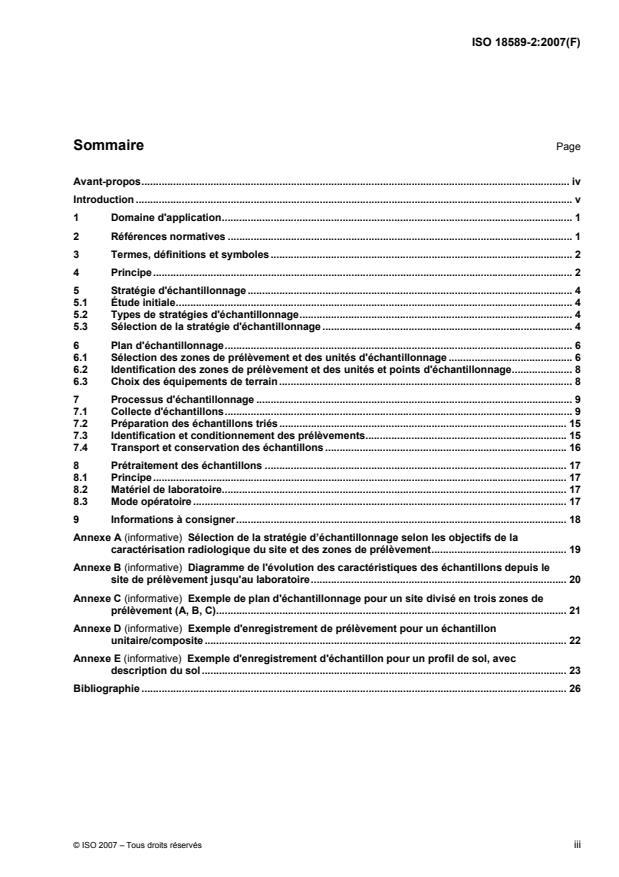
Sommaire Page
Avant-propos. iv
Introduction . v
1 Domaine d'application. 1
2 Références normatives . 1
3 Termes, définitions et symboles. 2
4 Principe. 2
5 Stratégie d'échantillonnage. 4
5.1 Étude initiale. 4
5.2 Types de stratégies d'échantillonnage. 4
5.3 Sélection de la stratégie d'échantillonnage . 4
6 Plan d'échantillonnage. 6
6.1 Sélection des zones de prélèvement et des unités d'échantillonnage . 6
6.2 Identification des zones de prélèvement et des unités et points d'échantillonnage. 8
6.3 Choix des équipements de terrain. 8
7 Processus d'échantillonnage . 9
7.1 Collecte d'échantillons. 9
7.2 Préparation des échantillons triés . 15
7.3 Identification et conditionnement des prélèvements. 15
7.4 Transport et conservation des échantillons . 16
8 Prétraitement des échantillons . 17
8.1 Principe. 17
8.2 Matériel de laboratoire. 17
8.3 Mode opératoire . 17
9 Informations à consigner. 18
Annexe A (informative) Sélection de la stratégie d’échantillonnage selon les objectifs de la
caractérisation radiologique du site et des zones de prélèvement. 19
Annexe B (informative) Diagramme de l'évolution des caractéristiques des échantillons depuis le
site de prélèvement jusqu'au laboratoire. 20
Annexe C (informative) Exemple de plan d'échantillonnage pour un site divisé en trois zones de
prélèvement (A, B, C). 21
Annexe D (informative) Exemple d'enregistrement de prélèvement pour un échantillon
unitaire/composite. 22
Annexe E (informative) Exemple d'enregistrement d'échantillon pour un profil de sol, avec
description du sol. 23
Bibliographie . 26
Avant-propos
L'ISO (Organisation internationale de normalisation) est une fédération mondiale d'organismes nationaux de
normalisation (comités membres de l'ISO). L'élaboration des Normes internationales est en général confiée
aux comités techniques de l'ISO. Chaque comité membre intéressé par une étude a le droit de faire partie du
comité technique créé à cet effet. Les organisations internationales, gouvernementales et non
gouvernementales, en liaison avec l'ISO participent également aux travaux. L'ISO collabore étroitement avec
la Commission électrotechnique internationale (CEI) en ce qui concerne la normalisation électrotechnique.
Les Normes internationales sont rédigées conformément aux règles données dans les Directives ISO/CEI,
Partie 2.
La tâche principale des comités techniques est d'élaborer les Normes internationales. Les projets de Normes
internationales adoptés par les comités techniques sont soumis aux comités membres pour vote. Leur
publication comme Normes internationales requiert l'approbation de 75 % au moins des comités membres
votants.
L'attention est appelée sur le fait que certains des éléments du présent document peuvent faire l'objet de
droits de propriété intellectuelle ou de droits analogues. L'ISO ne saurait être tenue pour responsable de ne
pas avoir identifié de tels droits de propriété et averti de leur existence.
L'ISO 18589-2 a été élaborée par le comité technique ISO/TC 85, Énergie nucléaire, sous-comité SC 2,
Radioprotection.
L'ISO 18589 comprend les parties suivantes, présentées sous le titre général Mesurage de la radioactivité
dans l'environnement — Sol:
⎯ Partie 1: Lignes directrices générales et définitions
⎯ Partie 2: Lignes directrices pour la sélection de la stratégie d'échantillonnage, l'échantillonnage et le
prétraitement des échantillons
⎯ Partie 3: Mesurage des radionucléides émetteurs gamma
⎯ Partie 4: Mesurage des isotopes du plutonium (plutonium 238 et plutonium 239+240) par spectrométrie
alpha
⎯ Partie 5: Mesurage du strontium 90
⎯ Partie 6: Mesurage des activités alpha globale et bêta globale
iv © ISO 2007 – Tous droits réservés
Introduction
L'ISO 18589 est publiée en plusieurs parties, à utiliser ensemble ou séparément selon les besoins. Les
Parties 1 à 6, concernant le mesurage de la radioactivité dans le sol, ont été élaborées en même temps. Elles
sont complémentaires entre elles et s'adressent aux personnes chargées de déterminer la radioactivité
présente dans les sols. Les deux premières parties comportent des informations d'ordre général. Les
Parties 3 à 5 traitent des mesurages spécifiques des radionucléides et la Partie 6 de mesurages non
spécifiques des activités alpha globale et bêta globale.
D'autres parties sont susceptibles d'être ajoutées ultérieurement à l'ISO 18589, s'il devient nécessaire de
normaliser les mesurages d'autres radionucléides.
NORME INTERNATIONALE ISO 18589-2:2007(F)
Mesurage de la radioactivité dans l'environnement — Sol —
Partie 2:
Lignes directrices pour la sélection de la stratégie
d'échantillonnage, l'échantillonnage et le prétraitement des
échantillons
1 Domaine d'application
La présente partie de l'ISO 18589 spécifie les exigences générales pour réaliser, sur la base de l'ISO 11074
et de l'ISO/CEI 17025, toutes les phases de planification (étude théorique et reconnaissance sur le terrain) de
l'échantillonnage et de la préparation des échantillons pour essai. Elle inclut la sélection de la stratégie
d'échantillonnage, l'élaboration du plan d'échantillonnage, la présentation des méthodes générales
d'échantillonnage et des équipements et la méthodologie de prétraitement d'échantillons adaptés aux
mesurages de l'activité des radionucléides dans le sol.
La présente partie de l'ISO 18589 s'adresse aux personnes chargées de déterminer la radioactivité présente
dans les sols dans un but de radioprotection. Elle est applicable aux sols de jardins ou de terres agricoles,
aux sols de sites urbains ou industriels et aux sols qui n'ont pas été modifiés par des activités humaines.
La présente partie de l'ISO 18589 est destinée à tous les laboratoires, quel que soit leur effectif ou leur
domaine d'essai. Lorsqu'un laboratoire n'est pas concerné par une ou plusieurs des activités couvertes par la
présente partie de l'ISO 18589, telles que la planification, l'échantillonnage ou les essais, les exigences
correspondantes ne sont pas applicables.
2 Références normatives
Les documents de référence suivants sont indispensables pour l'application du présent document. Pour les
références datées, seule l'édition citée s'applique. Pour les références non datées, la dernière édition du
document de référence s'applique (y compris les éventuels amendements).
ISO 31-9, Grandeurs et unités — Partie 9: Physique atomique et nucléaire
ISO 10381-2, Qualité du sol — Échantillonnage — Partie 2: Lignes directrices pour les techniques
d'échantillonnage
ISO 11074, Qualité du sol — Vocabulaire
ISO/CEI 17025, Exigences générales concernant la compétence des laboratoires d'étalonnages et d'essais
ISO 18589-1, Mesurage de la radioactivité dans l'environnement — Sol — Partie 1: Lignes directrices
générales et définitions
3 Termes, définitions et symboles
Pour les besoins du présent document, les termes, définitions et symboles donnés dans l'ISO 31-9,
l'ISO 18589-1 et l'ISO 11074 ainsi que les symboles suivants s'appliquent.
e épaisseur de la couche échantillonnée
m masse humide de l'échantillon trié
ss
m′ masse humide d'un sous-échantillon de l'échantillon trié
ss
m masse sèche de l'échantillon pour essai
ts
a activité du radionucléide par unité de masse sèche de l'échantillon pour essai
A activité du radionucléide par unité de surface
S
S surface de la zone échantillonnée
4 Principe
L'objet du mesurage de la radioactivité des sols est la surveillance de l'impact environnemental des
[1] [2], [3], [4], [5]
substances radioactives et/ou l'évaluation de l'impact radiologique sur la population .
Les principaux objectifs des mesurages de radionucléides dans le sol (voir l'ISO 18589-1) sont les suivants:
⎯ la caractérisation de la radioactivité dans l'environnement;
⎯ la surveillance de routine de l'impact de la radioactivité émise par les installations nucléaires ou de
l'évolution de la radioactivité du territoire en général;
⎯ les études de situations d'accident ou d'incident;
⎯ la planification et la surveillance des actions correctives;
⎯ le déclassement d'installations ou la mise au rebut des matériaux.
En conséquence, la radioactivité du sol est mesurée dans diverses situations mais il est possible de décrire
une approche générale, constituée des étapes suivantes, qui sont développées dans la présente partie de
l'ISO 18589.
a) Processus de planification — Sélection de la stratégie d'échantillonnage
La sélection de la stratégie d'échantillonnage dépend des principaux objectifs et des résultats de l'étude
initiale de la zone concernée. La stratégie d'échantillonnage doit apporter une connaissance de la nature des
radionucléides, de leurs concentrations en activité, de leur distribution spatiale ainsi que de leur évolution
temporelle, en tenant compte des modifications dues à la migration, aux conditions atmosphériques et à
l'occupation des terrains/sols.
Une étude initiale de la zone doit être effectuée afin de déterminer la stratégie d'échantillonnage.
L'ISO 10381-1 donne des recommandations générales sur la sélection de la stratégie d'échantillonnage;
l'ISO 10381-4 donne des lignes directrices spécifiques pour les zones de sol naturel, quasi naturel et cultivé;
en ce qui concerne l'étude relative à la contamination du sol des sites urbains et industriels, elle est décrite
dans l'ISO 10381-5.
2 © ISO 2007 – Tous droits réservés
L'Article 5 fournit les détails correspondants, et l'Annexe A donne une méthode de sélection de la stratégie
d'échantillonnage.
b) Processus de planification — Plan d'échantillonnage
Le plan d'échantillonnage doit être élaboré conformément à la stratégie d'échantillonnage choisie. Il doit
spécifier la sélection des zones de prélèvement et des unités d'échantillonnage, la grille d'échantillonnage, les
points d'échantillonnage, les types d'échantillons, les modes opératoires et les équipements d'échantillonnage
ainsi que les exigences de sécurité pour le personnel.
Les définitions des types d'échantillons sont données dans l'ISO 18589-1. La relation entre types
d'échantillons est donnée dans l'Annexe B. L'Article 6 fournit les détails particuliers tels que la sélection des
zones de prélèvement et des unités d'échantillonnage qui résultent du type de maillage appliqué à ces zones.
c) Processus d'échantillonnage — Collecte d'échantillons
La collecte de tout échantillon sur le terrain doit être conforme au plan d'échantillonnage établi.
⎯ Pour l'échantillonnage de la couche supérieure, des échantillons unitaires ou des prélèvements
élémentaires d'épaisseur définie sont effectués dans chacune des unités d'échantillonnage choisies.
⎯ Pour l'échantillonnage vertical de différentes couches du sol, les échantillons sont prélevés verticalement
à des épaisseurs croissantes sous la surface du point d'échantillonnage. Les échantillons unitaires ou les
prélèvements élémentaires sont recueillis à partir des diverses couches du sol, avec des épaisseurs
différentes en fonction de la profondeur d'échantillonnage. Il convient de prendre des précautions
particulières afin d'éviter de mélanger des échantillons des diverses couches du sol.
Une description détaillée est fournie dans les Articles 6 et 7.
d) Processus d'échantillonnage — Préparation des échantillons triés
La préparation des échantillons triés doit être effectuée par réduction d'échantillons unitaires ou composites. Il
convient qu'un échantillon trié soit représentatif de la valeur moyenne d'une ou plusieurs caractéristiques du
sol. Les procédures d'identification, d'étiquetage, de conditionnement et de transport des échantillons triés
vers le laboratoire doivent garantir la préservation de leurs caractéristiques.
Une description détaillée est donnée en 7.2, 7.3 et 7.4
e) Processus de laboratoire — Manipulation de l'échantillon pour laboratoire
Une fois arrivés dans les locaux du laboratoire, les échantillons triés sont considérés être des échantillons
pour laboratoire qui sont entreposés et doivent être prétraités ultérieurement avant analyse.
Une description détaillée est donnée dans l'Article 8.
f) Processus de laboratoire — Préparation de l'échantillon pour essai
Avant tout essai, les échantillons pour laboratoire doivent faire l'objet d'un prétraitement (séchage, broyage,
tamisage et homogénéisation) pour produire des échantillons pour essai à l'état de poudre fine et homogène.
Le prétraitement doit produire un échantillon pour essai dont les caractéristiques physico-chimiques
demeurent constantes au cours du temps, de manière à faciliter l'interprétation des résultats. Des sous-
échantillons représentatifs doivent être isolés de l'échantillon pour essai, en tant que prises d'essai dont les
masses sont déterminées par les spécifications des différents mesurages de la radioactivité.
Une description détaillée est donnée dans l'Article 8.
Si certains matériaux doivent être conservés pour des études ultérieures ou dans le cadre du règlement d'un
éventuel litige, des sous-échantillons doivent être préservés à partir de l'échantillon pour laboratoire ou de
l'échantillon pour essai, selon une méthode acceptable et documentée.
5 Stratégie d'échantillonnage
Au cours du processus de planification, la stratégie d'échantillonnage du site étudié est déterminée en
[6], [7], [8]
fonction des objectifs décrits en 4 a) et donne lieu à la définition d'un plan d'échantillonnage .
5.1 Étude initiale
Quel que soit l'objectif de l'intervention, un certain nombre d'actions préliminaires doivent être menées pour
aider à la définition de la stratégie d'échantillonnage, telles que:
⎯ analyse de l'historique du site, de données administratives, d'archives d'entreprises, d'entretiens avec
d'anciens employés et d'études antérieures pour identifier les sources potentielles de contamination
radioactive;
⎯ collecte d'informations sur les caractéristiques géologiques, hydrologiques et pédologiques et sur les
principaux paramètres climatologiques lorsqu'il s'agit de caractériser un site et de suivre l'évolution
spatio-temporelle de ses caractéristiques radioactives;
⎯ reconnaissance du site étudié pour repérer la topographie des lieux, la nature de la couverture végétale
et relever toute particularité pouvant orienter les techniques de prélèvement et le plan d'échantillonnage;
⎯ dans le cas de terres agricoles, collecte de données auprès des agriculteurs sur la nature et la
profondeur des travaux (sous-solage ou tranchées de drainage, labour, hersage, etc.) et sur les engrais
chimiques et les amendements ajoutés qui peuvent entraîner un excès de radioactivité naturelle (nature
et quantité des produits répandus).
Lorsque les données de radioactivité de la contamination du sol ne sont pas disponibles ou dans le cas d'une
suspicion de contamination radioactive, il peut être nécessaire d'effectuer une étude analytique sur site au
moyen de détecteurs portatifs ou de réaliser quelques prélèvements préliminaires, suivie d'une analyse en
laboratoire, afin de sélectionner les zones et la stratégie d'échantillonnage.
5.2 Types de stratégies d'échantillonnage
En fonction des objectifs et de la connaissance initiale de la distribution de la radioactivité sur la zone étudiée,
les stratégies d'échantillonnage sont soit de type orientée, soit de type probabiliste.
Les stratégies orientées sont fondées sur des contraintes a priori qui donnent lieu à une sélection d'unités
d'échantillonnage dans une zone spécifique, soumise à un examen spécialement minutieux, du fait de son
intérêt particulier ou de son niveau de contamination.
Les stratégies probabilistes utilisent une sélection d'unités d'échantillonnage sans contrainte à priori.
La sélection des unités et des points d'échantillonnage est décrite en 6.1.
5.3 Sélection de la stratégie d'échantillonnage
L'approche ou la stratégie d'échantillonnage doit être choisie en fonction du but poursuivi, des résultats finaux
pertinents, comme la protection des hommes et de l'environnement, en tenant compte des contraintes
économiques et sociales. Il convient que la stratégie d'échantillonnage choisie assure que la radioactivité des
échantillons est représentative de la distribution des radionucléides dans le sol de la zone objet de
[1], [2], [4], [6], [9]
l'étude .
La stratégie d'échantillonnage ne peut être définie qu'au cas par cas. Il est recommandé que la sélection de la
stratégie d'échantillonnage suive les étapes suivantes:
⎯ l'analyse des archives, qui permet une étude historique du site de prélèvement et notamment de son
utilisation précédente (identification de la source);
4 © ISO 2007 – Tous droits réservés
⎯ l'évaluation des voies de migration préférentielle et/ou des zones d'accumulation;
⎯ la reconnaissance du site en termes de limites des zones de prélèvement et de l'échantillonnage
effectué;
⎯ la reconnaissance du site: une étude analytique rapide à l'aide de détecteurs portatifs de radioactivité
peut être utilisée pour caractériser la distribution de la radioactivité des zones concernées.
Cette étape du processus de planification détermine un grand nombre de décisions et peut engendrer des
activités importantes et coûteuses. Elle inclut également la définition des objectifs de qualité des données en
fonction des paramètres à analyser.
L'Annexe A fournit un diagramme aidant à sélectionner une stratégie d'échantillonnage en fonction des
objectifs de l'étude.
Le choix de la stratégie d'échantillonnage détermine la densité d'échantillonnage ainsi que la distribution
spatiale et temporelle des unités d'échantillonnage à partir desquelles les échantillons seront prélevés en
fonction du temps; ce choix doit tenir compte
⎯ de la distribution éventuelle des radionucléides: homogène ou hétérogène (point «chaud»),
⎯ des caractéristiques de l'environnement,
⎯ de la quantité minimale de masse de sol nécessaire pour effectuer tous les essais de laboratoire, et
⎯ du nombre maximal d'essais à effectuer par le laboratoire, pour l'étude.
Dans de nombreux cas, il est possible de partir d'hypothèses sur la présence éventuelle d'une contamination
du sol et de sa distribution (homogène ou hétérogène). Ces hypothèses doivent ensuite être vérifiées par une
stratégie d'échantillonnage orientée. Une variante de cette stratégie, systématique en fonction du temps pour
des points d'échantillonnage représentatifs choisis, est adaptée à la surveillance de routine des sites dont les
origines de la radioactivité et sa distribution sont connues. Cela permet de définir le nombre et l'emplacement
des points d'échantillonnage avec une plus grande précision que par une stratégie d'échantillonnage
exclusivement probabiliste. Cette sélection subjective des points d'échantillonnage peut être combinée à une
approche statistique pour répondre aux critères de qualité de l'interprétation. Lorsque la distribution spatiale
de la radioactivité n'est pas connue, une stratégie probabiliste dans l'espace doit être choisie.
Des stratégies probabilistes avec un échantillonnage aléatoire (distribution aléatoire des points
d'échantillonnage) ne sont adaptées que si la distribution de la radioactivité sur le site est considérée comme
homogène. Dans le cas d'un site présentant des hétérogénéités de type ponctuel (points sources), il est
recommandé de mettre en œuvre une stratégie d'échantillonnage systématique suivant le degré de
connaissance de la distribution de ces hétérogénéités dans les différentes zones de prélèvement.
Lorsque l'objectif de l'étude est de caractériser un dépôt récent à la surface du sol, comme dans le cas de
retombées suite à un rejet chronique autorisé d'effluents gazeux ou à un accident, la collecte de la couche
supérieure est recommandée.
Lorsque l'objectif est d'étudier un site pollué et qu'il est nécessaire de connaître la migration verticale des
radionucléides en profondeur (afin de prédire la contamination éventuelle des eaux souterraines), des
échantillons de couches à diverses profondeurs doivent être recueillis. Les couches peuvent être définies
comme ayant la même épaisseur ou de manière à être représentatives des différents horizons.
La stratégie d'échantillonnage donne lieu à un ensemble de choix techniques détaillés dans l'Article 6.
6 Plan d'échantillonnage
Le plan d'échantillonnage est un mode opératoire précis qui, en fonction de l'application des principes de la
stratégie adoptée, définit toutes les actions à entreprendre sur le terrain ainsi que les ressources humaines
nécessaires à l'opération de prélèvement proprement dite. Le plan est directement lié au but de l'étude, aux
caractéristiques de l'environnement du site, à la capacité des installations d'essai en laboratoire et aux
objectifs de qualité des données nécessaires pour l'interprétation des résultats des mesurages.
Le plan d'échantillonnage doit être établi au cas par cas. Il doit contenir toutes les informations nécessaires à
l'exécution du prélèvement, c'est-à-dire les zones de prélèvement, les unités d'échantillonnage,
l'emplacement des points d'échantillonnage dans les unités d'échantillonnage, les types d'échantillons
(unitaires ou composites), le nombre de prélèvements élémentaires pour des échantillons composites, la
périodicité, la masse requise d'un échantillon donné compte tenu des essais prévus, la nécessité de
conserver du matériel en archive, la distribution verticale, etc.
6.1 Sélection des zones de prélèvement et des unités d'échantillonnage
Après avoir décidé de la stratégie d'échantillonnage, les zones de prélèvement et les unités d'échantillonnage
doivent être définies sur la base des résultats de l'étude initiale. Dans certains cas, les limites des zones de
prélèvement et l'emplacement des unités d'échantillonnage pour la surveillance ou le suivi de routine peuvent
être fixées par des prescriptions légales, comme dans le cas de l'exploitation d'une nouvelle installation
nucléaire. Ces limites seront définies suite à une étude radiologique de référence réalisée pour le projet. Dans
des situations d'accident, la dimension de la zone de prélèvement et l'emplacement des unités
d'échantillonnage peuvent également être déterminés par les conditions environnementales (la force et la
direction du vent, la topographie, etc.) au moment de l'accident ainsi que par la variation des caractéristiques
du terme source (radionucléides, activité, durée du rejet, etc.).
Pour la stratégie probabiliste, les unités d'échantillonnage peuvent être choisies par approche soit
systématique, soit aléatoire, alors que pour une stratégie orientée l'approche aléatoire n'est pas possible.
Pour les deux stratégies, les points d'échantillonnage peuvent être choisis sur la base d'une approche
systématique ou aléatoire.
En fonction de l'hétérogénéité de la distribution de la radioactivité, il est admis d'utiliser, sur le même site, une
combinaison de ces stratégies aux différentes zones de prélèvement.
6.1.1 Échantillonnage à effectuer avec une stratégie probabiliste
Pour une stratégie probabiliste, une fois identifiées, les zones de prélèvement sont couvertes d'une grille qui
définit les unités d'échantillonnage. Il convient que la taille du maillage tienne compte de la surface du site.
Elle dépend également de la capacité analytique du laboratoire ainsi que des contraintes financières qui
limitent le nombre d'échantillons qui peut être analysé. Selon le site objet de l'étude, la surface des mailles
unitaires peut aller de quelques mètres carrés à plusieurs kilomètres carrés.
Si, suite à une étude radiologique préliminaire sur site, une carte de la radioactivité est disponible, le maillage
imposé sur la zone de prélèvement peut correspondre à la grille adoptée pour la cartographie de la
radioactivité. La carte de la radiographie peut être plus dense lorsque des zones contaminées sont prévues
ou moins dense en l'absence de contamination présumée.
Pour l'échantillonnage systématique, un échantillon doit être prélevé à chaque nœud ou au centre de la maille
unitaire. Le nombre final de zones de prélèvement faisant finalement l'objet d'un échantillonnage dépend de
l'hétérogénéité des caractéristiques de l'environnement et des restrictions d'accès imposées par la complexité
topographique de la zone.
Pour l'échantillonnage aléatoire, les unités d'échantillonnage sont référencées et un nombre d'unités est
choisi au hasard.
6 © ISO 2007 – Tous droits réservés
Lorsque l'objet de l'étude est de rechercher l'impact de la contribution d'une source spécifique de radioactivité
sur l'environnement, elle peut être comparée au niveau du bruit de fond radioactif. Ce niveau doit être
déterminé dans une zone supposée être non contaminée par la source objet de l'étude (par exemple, non
affectée par d'éventuels rejets d'effluent de la centrale étudiée) et sera considérée être la zone de référence.
6.1.2 Échantillonnage à effectuer avec une stratégie orientée
Pour une stratégie d'échantillonnage orientée, la zone de prélèvement est définie par les contraintes
qu'imposent les objectifs de l'étude, sur la base des données environnementales et des résultats
cartographiques.
Le plan d'échantillonnage est fondé sur un choix subjectif d'unités d'échantillonnage résultant d'une
connaissance précédente de la zone ou/et d'études de radioactivité initiales réalisées sur place.
Lorsque l'objectif est de recueillir les échantillons ayant le niveau d'activité le plus élevé et qu'aucune donnée
de radioactivité n'est disponible, une étude radiologique préliminaire, à l'aide d'un détecteur portatif, permet
d'établir une cartographie du site permettant de mettre en évidence la(les) zone(s) contaminée(s) et aide à
définir le plan d'échantillonnage en situant avec précision l'unité d'échantillonnage.
NOTE L'un des buts de cette étude initiale est également d'évaluer les risques d'exposition des personnes chargées
de l'opération de prélèvement et, par conséquent, de définir des mesures de radioprotection, notamment celles qui doivent
être mises en œuvre sur le site et concernant la protection du personnel contre les rayonnements.
En matière de surveillance de routine d'une installation nucléaire, l'unité d'échantillonnage peut être choisie
comme étant le point maximal de retombées prévues d'effluents gazeux atmosphériques émis par l'installation.
Lorsque l'étude porte simultanément sur la radioactivité du sol et d'autres composants de l'environnement (air,
eau, bioindicateurs, éléments de la chaîne alimentaire menant jusqu'à l'homme), il convient de choisir l'unité
d'échantillonnage en tenant compte de la présence des autres indicateurs.
6.1.3 Critères de sélection des zones de prélèvement et des unités d'échantillonnage
L'utilisation de données d'études environnementales passées ainsi que la reconnaissance visuelle du site
permettent d'identifier des zones de prélèvement ayant des configurations topologiques et des couvertures
végétales homogènes. Il est pour cela nécessaire de faire la distinction entre zones élevées et zones en
pente, entre zones herbeuses et zones buissonneuses, entre zones boisées et zones cultivées, labourées, etc.
Il convient dans la mesure du possible de choisir des unités d'échantillonnage dont une couche du sol n'a pas
été remaniée par l'activité humaine et disposant d'un couvert herbacé bien conservé. La surface de l'unité
d'échantillonnage doit au moins avoir plusieurs mètres carrés. Tout remaniement doit être noté, en indiquant
l'échelle, la nature et l'origine du remaniement sur la fiche de prélèvement.
La surveillance radioactive de sols remaniés peut être menée en complément des études sur la radioactivité
des plantes sur le terrain. Pour les terrains agricoles, la couche superficielle dont l'épaisseur correspond à la
profondeur de labourage peut être considérée comme homogène, si la contamination de la zone a eu lieu
avant labourage. Dans le cas de terrains industriels ou construits, les matériaux utilisés pour combler les sols
peuvent être examinés en tenant compte de leur hétérogénéité intrinsèque et de la technique de remblayage.
Pour la surveillance de routine, les unités d'échantillonnage qui font l'objet d'un prélèvement régulier dans le
temps doivent être maintenues exemptes d'arbres et de broussailles.
Lorsque la stratégie d'échantillonnage nécessite une description du profil du sol, l'épaisseur de la couche doit
[11], [12], [13], [14]
être déterminée par des caractéristiques pédologiques ou par le taux prévu de migration
verticale de radionucléides. Le paragraphe 7.1.3 donne une description détaillée de la méthode
d'échantillonnage pour le prélèvement d'échantillons en profondeur, et l'Annexe C donne un exemple de plan
d'échantillonnage.
NOTE Pour les terres agricoles, on peut éviter en particulier les effets de bordure en rentrant d'au moins une
vingtaine de mètres à l'intérieur de la parcelle, sauf indication contraire liée aux objectifs de l'étude.
6.2 Identification des zones de prélèvement et des unités et points d'échantillonnage
Les zones de prélèvement doivent être identifiées par les paramètres suivants:
⎯ le département, le nom de la commune, le nom du site ou du lieu-dit;
⎯ le nom ou la référence de la zone de prélèvement;
⎯ les coordonnées géographiques, établies à l'aide d'une carte topographique ou d'un système de
positionnement global.
Il est recommandé d'utiliser une carte topographique officielle éditée par un organisme national à l'échelle
adéquate, sur laquelle les limites de la (des) zone(s) et, au besoin, celles des unités d'échantillonnage doivent
être reportées en même temps que leurs identifications.
Les points d'échantillonnage doivent être décrits par leurs coordonnées géographiques, à l'aide d'une carte
topographique ou d'un système de positionnement global.
6.3 Choix des équipements de terrain
Il convient de choisir des équipements conformes à l'ISO 10381-2. Une attention particulière doit être portée à
la qualité des équipements de prélèvement, et il convient notamment de s'assurer que le matériel utilisé
n'induit aucune interférence (pollution ou perte) avec les radionucléides à déterminer.
Selon le plan d'échantillonnage, qui définit la profondeur du prélèvement et la nature du terrain, le matériel à
utiliser peut être sélectionné dans la liste suivante:
a) matériel pour délimiter les zones (fiches, rubans, …);
b) pour les prélèvements de surface ou à faible profondeur: pelle, outil de carottage tel que gabarit
métallique, tarière à gouge, vrille, sonde droite, bêche (les équipements doivent être nettoyés avant
l'échantillonnage);
c) pour les prélèvements jusqu'à une profondeur de 2 m: tarière ou engin de chantier tels que:
⎯ pelle à godet pour l'ouverture d'une tranchée où sont réalisés les prélèvements (prendre garde à la
faible stabilité des parois dans le cas de sols friables ou remaniés);
⎯ tube échantillonneur à poussée mécanique ou hydraulique;
d) pour les prélèvements à des profondeurs supérieures à 2 m: carottier muni de tubes de carottage en
matériau inerte vis-à-vis du sol;
e) matériel commun à tous les prélèvements:
⎯ spatule ou couteau à lame d'acier inoxydable;
⎯ seau(x) d'une contenance d'au moins 10 l;
⎯ bâches sèches, propres et inertes vis-à-vis du sol d'environ 2 m ;
⎯ sacs ou flacons à large ouverture ou boîtes en plastique d'une contenance d'au moins 2 l, résistant à
l'humidité, étanches à l'eau et à la poussière et inertes vis-à-vis du sol;
⎯ matériel d'identification des échantillons (étiquettes, marqueurs, etc.);
NOTE L'étude de radionucléides volatils nécessite des précautions particulières pour éviter les pertes de
composés volatils pendant la collecte et le stockage de l'échantillon.
8 © ISO 2007 – Tous droits réservés
f) matériel spécifique dans le cas de la détermination de l'activité surfacique:
⎯ balances ayant une gamme de pesées maximale et une précision adéquates;
⎯ ruban de mesure ou gabarit de longueur adéquate permettant le mesurage des dimensions des
prélèvement élémentaires.
7 Processus d'échantillonnage
Le processus d'échantillonnage doit être défini dans le plan d'échantillonnage en fonction des objectifs de
l'étude. La collecte des échantillons et la préparation des échantillons triés sont indépendantes de la stratégie
d'échantillonnage choisie (probabiliste ou orientée). Les objectifs de l'étude sont décrits en 7.1.1, pour une
unité d'échantillonnage donnée pour un prélèvement dans les couches supérieures jusqu'à 20 cm et dans des
couches plus profondes, pour les différentes applications.
Les instructions génériques présentées en 7.1.2 à 7.1.4 sont applicables aux cas suivants:
⎯ caractérisation initiale de la radioactivité dans l'environnement;
⎯ surveillance de routine de l'impact des installations nucléaires ou de l'évolution du territoire en général;
⎯ recherches de situations d'accident ou d'incident;
⎯ planification et surveillance des actions de remédiation;
⎯ déclassement d'installations et libération sans contrainte des sols du site;
⎯ des conseils spécifiques sont fournis pour:
⎯ l'étude de la distribution verticale des radionucléides, y compris les échantillons prélevés dans une
tranchée;
⎯ la détermination de la radioactivité déposée dans le sol.
7.1 Collecte d'échantillons
7.1.1 Sélection de la profondeur de prélèvement par rapport aux objectifs de l'étude
7.1.1.1 Caractérisation initiale de la radioactivité dans l'environnement
Pour les sols vierges, la profondeur de la (des) couche(s) à échantillonner peut être déterminée en utilisant
l'une des deux approches suivantes.
⎯ Approche uniforme avec prélèvement effectué à une profondeur indépendante des variations naturelles
[11], [12]
des caractéristiques du sol . Par exemple, il est possible de réaliser l'échantillonnage de la couche
supérieure jusqu'à 20 cm ou, si une couche de surface de référence est requise pour identifier
d'éventuelles retombées futures, l'échantillonnage peut être effectué en prélevant deux couches, une
[15]
allant de la surface jusqu'à une profondeur de 5 cm et la seconde jusqu'à une profondeur
[16]
de 20 cm .
⎯ Approche non uniforme adaptée aux caractéristiques naturelles: la profondeur de la couche de la
rhizosphère ou les caractéristiques pédologiques d'un échantillonnage de profil(s) déterminent les
[2]
couches de prélèvement . Dans ce dernier cas, lorsque différents horizons sont présents, il convient de
prélever autant d'échantillons élémentaires qu'il y a d'horizons distincts.
Pour des sols remaniés par des activités humaines, tels que les terres agricoles, on distingue deux approches.
a) Approche uniforme avec prélèvement effectué en profondeur, indépendamment du fait qu'il soit adapté
aux pratiques agricoles locales. Par exemple, il peut être effectué jusqu'à une profondeur de 20 cm ou
plus, en fonction de la profondeur de labourage.
b) Approche non uniforme adaptée aux caractéristiques réelles du sol. Pour l'échantillonnage de profil(s), la
couche de surface est déterminée par la profondeur de l'horizon remanié et les couches inférieures par
leurs caractéristiques pédologiques. Dans ce dernier cas, lorsque différents horizons sont présents, il
convient de prélever autant d'échantillons élémentaires qu'il y a d'horizons distincts.
7.1.1.2 Surveillance de routine de l'impact des installations nucléaires ou de l'évolution du territoire
en général
Le choix des sols non remaniés à prélever doit être effectué selon une approche uniforme comme définie
en 7.1.1.1. Pour que les échantillons soient comparables d'une opération de prélèvement à l'autre, il est
important de prélever le sol dans une partie de la zone qui n'a pas été échantillonnée depuis au moins une
année. Lorsqu'une couche de surface de référence a été identifiée au cours de la caractérisation initiale du
site, la même profondeur de couche de surface doit être utilisée pour identifier les retombées éventuelles.
Si les propriétés physiques et chimiques du sol sont homogènes dans la zone de prélèvement et s'il n'y a pas
d'évolution potentielle de ses caractéristiques radioactives au cours du temps, l'échantillonnage peut être
limité à un point d'échantillonnage.
Les prélèvements élémentaires de sol peuvent être réalisés à l'aide d'un outil approprié, de façon à recueillir
une masse minimale équivalente à un kilogramme de terre sèche pour chaque point d'échantillonnage. Pour
la surveillance du territoire en général, réalisée par différents groupes, la procédure des prélèvements doit
garantir la collecte de sol à la même profondeur, afin de comparer les résultats (voir 7.1.4.1).
7.1.1.3 Études de situations d'accident ou d'incident
Lorsqu'une zone est susceptible d'être contaminée suite à un accident, il convient d'effectuer le prélèvement
de surface dès que cela est techniquement faisable, sur l'ensemble de la zone suspecte en tenant compte
des principes de radioprotection. L'objectif est de déterminer l'étendue de la contamination dans le plan
horizontal et, dans le cas d'une pollution diffuse hétérogène (points source identifiés), le gradient des
concentrations en activité qui en résultent.
NOTE En préparation à des situations d'accidents ou incidents, des unités d'échantillonnage particulièrement
adaptées autour des installations peuvent être sélectionnées afin d'y effectuer des prélèvements adéquats très
rapidement après un événement.
Dans le cas où l'évaluation concerne la détermination de la radioactivité du sol suite à une contamination
récente, il est recommandé d'échantillonner le niveau de surface à une profondeur maximale de 5 cm. Étant
donné que les résultats des mesures doivent être exprimés en activité surfacique, il importe de connaître avec
précision la zone de la surface prélevée, la masse de l'échantillon trié et celle de l'échantillon pour laboratoire.
La profondeur des prélèvements élémentaires doit être la même et documentée (des détails supplémentaires
sont donnés en 7.1.4).
Dans le cas d'une contamination passée, le
...
МЕЖДУНАРОДНЫЙ ISO
СТАНДАРТ 18589-2
Первое издание
2007-12-01
Измерение радиоактивности в
окружающей среде. Почва.
Часть 2.
Руководство по выбору стратегии
выборочного контроля, отбору проб и
предварительной обработке проб
Measurement of radioactivity in the environment – Soil –
Part 2:
Guidance for the selection of the sampling strategy, sampling and
pre-treatment of samples
Ответственность за подготовку русской версии несёт GOST R
(Российская Федерация) в соответствии со статьёй 18.1 Устава ISO
Ссылочный номер
©
ISO 2007
Отказ от ответственности при работе в PDF
Настоящий файл PDF может содержать интегрированные шрифты. В соответствии с условиями лицензирования, принятыми
фирмой Adobe, этот файл можно распечатать или смотреть на экране, но его нельзя изменить, пока не будет получена
лицензия на установку интегрированных шрифтов в компьютере, на котором ведется редактирование. В случае загрузки
настоящего файла заинтересованные стороны принимают на себя ответственность за соблюдение лицензионных условий
фирмы Adobe. Центральный секретариат ISO не несет никакой ответственности в этом отношении.
Adobe - торговый знак фирмы Adobe Systems Incorporated.
Подробности, относящиеся к программным продуктам, использованным для создания настоящего файла PDF, можно найти в
рубрике General Info файла; параметры создания PDF были оптимизированы для печати. Были приняты во внимание все
меры предосторожности с тем, чтобы обеспечить пригодность настоящего файла для использования комитетами-членами
ISO. В редких случаях возникновения проблемы, связанной со сказанным выше, просьба проинформировать Центральный
секретариат по адресу, приведенному ниже.
ДОКУМЕНТ ОХРАНЯЕТСЯ АВТОРСКИМ ПРАВОМ
© ISO 2007
Все права сохраняются. Если не указано иное, никакую часть настоящей публикации нельзя копировать или использовать в
какой-либо форме или каким-либо электронным или механическим способом, включая фотокопии и микрофильмы, без
предварительного письменного согласия ISO, которое должно быть получено после запроса о разрешении, направленного по
адресу, приведенному ниже, или в комитет-член ISO в стране запрашивающей стороны.
ISO copyright office
Case postale 56 • CH-1211 Geneva 20
Tel. + 41 22 749 01 11
Fax + 41 22 734 09 47
E-mail copyright @ iso.org
Web www.iso.org
Опубликовано в Швейцарии
ii © ISO 2007 – Все права сохраняются
Содержание Страница
Предисловие . iv
Введение . v
1 Область применения . 1
2 Нормативные ссылки . 1
3 Термины, определения и обозначения . 1
4 Принцип . 2
5 Стратегия выборочного контроля . 4
5.1 Первоначальное исследование . 4
5.2 Типы стратегий выборочного контроля . 4
5.3 Выбор стратегии выборочного контроля . 4
6 План выборочного контроля . 6
6.1 Выбор опробуемых участков и единиц . 6
6.2 Идентификация опробуемых участков, единиц и точек . 8
6.3 Выбор полевого оборудования . 8
7 Процесс отбора проб . 9
7.1 Сбор проб . 9
7.2 Подготовка отсортированной пробы . 15
7.3 Идентификация и упаковывание проб . 15
7.4 Транспортирование и хранении проб . 17
8 Предварительная обработка проб . 17
8.1 Принцип . 17
8.2 Лабораторные мощности . 17
8.3 Методика . 18
9 Записанная информация . 19
Приложение А (информативное) Выбор стратегии выборочного контроля согласно целей и
радиологическая характеризация района и опробуемых участков . 20
Приложение В (информативное) Диаграмма эволюции характеристик пробы от места
отбора проб до лаборатории . 21
Приложение С (информативное) Пример плана выборочного контроля для района,
разделенного на три опробуемых участка (A, B, C) . 22
Приложение D (информативное) Пример записи об отборе проб для
индивидуальной/объединенной пробы . 23
Приложение Е (информативное) Пример регистрации пробы для почвенного профиля с
описанием почвы . 24
Библиография . 27
Предисловие
Международная организация по стандартизации (ISO) представляет собой всемирную федерацию,
состоящую из национальных органов по стандартизации (комитеты-члены ISO). Работа по разработке
международных стандартов обычно ведется Техническими комитетами ISO. Каждый комитет-член,
заинтересованный в теме, для решения которой образован данный технический комитет, имеет право
быть представленным в этом комитете. Международные организации, правительственные и
неправительственные, поддерживающие связь с ISO, также принимают участие в работе. ISO тесно
сотрудничает с Международной электротехнической комиссией (IEC) по всем вопросам
стандартизации в области электротехники.
Международные стандарты разрабатываются в соответствии с правилами, установленными в Части 2
Директив ISO/IEC.
Основное назначение технических комитетов заключается в разработке международных стандартов.
Проекты международных стандартов, принятые Техническими комитетами, направляются комитетам-
членам на голосование. Для их опубликования в качестве международных стандартов требуется
одобрение не менее 75 % комитетов-членов, участвовавших в голосовании.
Внимание обращается на тот факт, что отдельные элементы данного документы могут составлять
предмет патентных прав. ISO не несет ответственность за идентификацию каких–либо или всех
подобных патентных прав.
ISO 18589-2 был разработан Техническим комитетом ISO/TC 85, Ядерная энергия, Подкомитетом SC 2,
Защита от радиации.
ISO 18589 состоит из следующих частей под общим названием Измерение радиоактивности в
окружающей среде. Почва:
Часть 1. Общее руководство и определения
Следующие части находятся в стадии разработки:
Часть 2. Стратегия отбора проб, выборочный контроль и предварительная обработка проб
Часть 3. Измерение гамма-излучающих радионуклидов
Часть 4. Измерение изотопов плутония (плутоний 238 и плутоний 239+240) с помощью альфа-
спектроскопии
Часть 5. Измерение стронция 90
Часть 6. Измерения общего количества альфа- и бета- излучений
iv © ISO 2007 – Все права сохраняются
Введение
Настоящий международный стандарт опубликован в нескольких частях, которые можно использовать
вместе или по раздельности по мере необходимости. Части 1−6, касающиеся измерений
радиоактивности почвы, были разработаны одновременно. Эти части являются взаимодополняющими
и адресованы тем, кто отвечает за определение радиоактивности почвы. Первые две части являются
общими по характеру. Части 3 − 5 связаны с радионуклид-специфическими измерениями, а Часть 6 с
неспецифическими измерениями общих альфа и бета-излучений.
К ISO 18589 могут быть разработаны дополнительные части в будущем, если потребуется
стандартизация измерения других радионуклидов.
МЕЖДУНАРОДНЫЙ СТАНДАРТ ISO 18589-2:2007(R)
Измерение радиоактивности в окружающей среде. Почва.
Часть 2.
Руководство по выбору стратегии выборочного контроля,
отбору проб и предварительной обработке проб
1 Область применения
Настоящая часть ISO 18589 устанавливает общие требования, основанные на ISO 11074 и
ISO/IEC 17025, ко всем этапам планирования (предварительное (кабинетное) исследование и разведка
района) отбора проб и подготовки проб для испытания. Сюда входит выбор стратегии выборочного
контроля, разработка плана выборочного контроля, представление общих методов отбора проб и
пробоотборного оборудования, а также методологии предварительной обработки проб,
адаптированной к измерениям активности радионуклидов в почве.
Настоящая часть ISO 18589 адресована работникам, несущим ответственность за определение
радиоактивности почвы с целью защиты от радиации. Она применяется к почвам садов,
сельскохозяйственных угодий, городских и промышленных площадок, а также почвы, не
подвергающейся влиянию деятельности человека.
Данная часть ISO 18589 применима ко всем лабораториям, независимо от количества персонала или
объема выполняемых испытаний. Если лаборатория не занимается одним или несколькими видами
деятельности, подпадающими под данную часть ISO 18589, такими как планирование, отбор проб или
испытания, то к этой лаборатории соответствующие требования не применяются.
2 Нормативные ссылки
Нижеследующие документы являются обязательными для применения данного документа. Для
датированных ссылок действительно только указанное издание. В случае недатированных ссылок
используется последняя редакция документа, на который дается ссылка (включая все изменения).
ISO 31-9, Единицы и величины. Часть 9. Атомная и ядерная физика
ISO 10381-2, Качество почвы. Отбор проб. Часть 2. Руководство по технике отбора проб
ISO 11074, Качество почвы. Словарь
ISO/IEC 17025, Общие требования к компетентности испытательных и калибровочных
лабораторий
ISO 18589-1, Измерение радиоактивности в окружающей среде. Почва. Часть 1. Общее руководство
и определения
3 Термины, определения и обозначения
Применительно к данному документу используются термины, определения и обозначения,
приведенные в ISO 31-9, ISO 18589-1, ISO 11074, а также следующие.
e толщина опробуемого слоя
m влажная масса отсортированной пробы
ss
m′ влажная масса части пробы, отобранной от отсортированной пробы
ss
m сухая масса пробы для испытания
ts
a активность на единицу массы пробы для испытания
A активность на единицу площади
S
S площадь опробуемого участка
4 Принцип
Цель измерения радиоактивности почвы заключается в наблюдении влияния на окружающую среду
[1] [2], [3], [4], [5]
радиоактивных веществ и/или оценке радиологического влияния на население .
Основными целями измерения радионуклидов в почве (см. ISO 18589-1) являются следующие:
характеристика радиоактивности в окружающей среде;
повседневное наблюдение влияния радиоактивности, излучаемой из ядерных установок, или
общей картины радиоактивности в районе;
исследование аварий и несчастных случаев;
планирование и наблюдение за ремедиационными действиями;
вывод из эксплуатации установок или утилизация материалов.
Следовательно, измерения радиоактивности почвы осуществляются в различных ситуациях, но можно
описать общий подход, включающий следующие этапы в соответствии с данной частью ISO 18589:
a) Процесс планирования. Выбор стратегии выборочного контроля.
Выбор стратегии выборочного контроля зависит от основных целей и результатов первоначального
исследования (рекогносцировочного осмотра) участка. Стратегия выборочного контроля должна
привести к знанию характера, концентрации активности, пространственного ее распределения, а также
развития во времени радионуклидов, принимая во внимание изменения, вызванные миграцией,
атмосферными условиями и использованием земель/почвы.
Первоначальное исследование участка должно осуществляться для определения стратегии
выборочного контроля.
ISO 10381-1 дает общее руководство по выбору стратегии выборочного контроля; ISO 10381-4
представляет конкретные указания в отношении исследования природных, возделываемых и
смешанных участков; а ISO 10381-5 касается исследования загрязнения почвы на городских и
промышленных участках.
Подробности приведены в Разделе 5, а схема выбора стратегии выборочного контроля приводится в
Приложении A.
b) Процесс планирования. План выборочного контроля
План выборочного контроля должен разрабатываться в соответствии с выбранной стратегией
выборочного контроля. В плане должен задаваться выбор опробуемых участков и единиц, состав
2 © ISO 2007 – Все права сохраняются
выборки, места отбора точечных проб, типы проб, методы отбора проб и оборудование, а также
требования к безопасности персонала.
Определение типов проб представлено в ISO 18589-1. Взаимосвязь между типами проб описывается в
Приложении B. Такие детали как выбор опробуемых участков и единиц, что зависит от типа
координатной сетки элементарных участков, накладываемой на опробуемые участки, приведены в
Разделе 6.
c) Процесс отбора проб. Сбор проб
Сбор проб почвы в полевых условиях должен соответствовать разработанному плану выборочного
контроля.
Для отбора проб из верхнего слоя, индивидуальная проба или точечные пробы с определенной
толщины отбираются от каждой выбранной опробуемой единицы (пробной площадки).
Для отбора проб с учетом вертикальной структуры из нескольких слоев почвы пробы отбирают на
разных уровнях глубины по вертикали, начиная с места отбора точечной пробы вниз.
Индивидуальную пробу или точечные пробы отбирают из разных слоев почвы различной
толщины согласно глубине отбора проб. Необходимо особенно внимательно следить за тем,
чтобы не смешать пробы, взятые из различных слоев почвы.
Подробности приводятся в Разделах 6 и 7.
d) Процесс отбора проб. Подготовка отсортированной пробы
Приготовление отсортированных проб осуществляется путем сокращения индивидуальной или
составной (объединенной) пробы. Отсортированная проба должна быть репрезентативной по
среднему значению одного или нескольких данных параметров почвы. Процедуры идентификации,
этикетирования, упаковывания и транспортирования отсортированных проб в лабораторию должны
гарантировать сохранение их характеристик.
Подробности описаны в 7.2, 7.3 и 7.4.
e) Лабораторный процесс. Обращение с лабораторной пробой
По прибытии в лабораторию отсортированные пробы считаются лабораторными пробами для
хранения и дальнейшей обработки перед анализом.
Это подробно описано в Разделе 8.
f) Лабораторный процесс. Подготовка пробы для испытания
Перед испытаниями лабораторные пробы предварительно готовят путем сушки, измельчения,
пропускания через сито и гомогенизации, чтобы получить пробы для испытания в форме
мелкодисперсного гомогенного порошка. Предварительная обработка должна гарантировать, что
физические и химические характеристики пробы для испытания постоянны во времени, таким образом,
облегчая толкование результатов. От пробы для испытания необходимо отбирать репрезентативные
аликвоты, имеющие массы определенные техническими требованиями к различным измерениям
радиоактивности, в качестве проб (навесок) для анализа.
Подробности приведены в Разделе 8.
Если материал хранят для исследования в будущем или с целью урегулирования возможных
разногласий, от лабораторной пробы или пробы для испытания необходимо взять часть приемлемым
и описанным в документе способом.
5 Стратегия выборочного контроля
В процессе планирования определяют стратегию выборочного контроля исследуемого участка
[6], [7], [8]
согласно задачам, описанным в 4 a), что приводит к определению плана выборочного контроля .
5.1 Первоначальное исследование
С какой бы целью не проводилась работа, определенные предварительные шаги необходимо
выполнить на этапе начального исследования, чтобы облегчить определение стратегии выборочного
контроля, такие как следующие:
анализ исторических и административных данных, архивы компании, предварительные
исследования, и собеседования с предшественниками, что помогает идентифицировать
потенциальные источники радиоактивного загрязнения;
сбор информации по геологическим, гидрологическим и почвоведческим характеристикам, а также
основным климатическим параметрам, чтобы охарактеризовать пространственное и временное
распределение характеристик радиоактивности участка;
обследование исследуемого участка и определение его топографии, характера растительного
покрова и всех особенностей, которые могут повлиять на технику и план выборочного контроля;
для сельскохозяйственных угодий сбор информации от фермеров о характере и глубине
производства работ (углубление пахотного слоя или дренаж, пахотные и бороновые канавы, и т.д.)
и о химических удобрениях и добавках, которые могут привести к избыточной природной
радиоактивности (характер и качество применяемых продуктов).
Если данных по радиоактивному загрязнению почвы не имеется или в случае подозрений в отношении
загрязнения, может потребоваться аналитическое исследование in situ с помощью портативных
детекторов или некоторого предварительного отбора проб и последующего лабораторного анализа,
чтобы выбрать опробуемые участки и стратегию.
5.2 Типы стратегий выборочного контроля
Стратегии выборочного контроля являются либо ориентированными, либо вероятностными, в
зависимости от целей и начального знания распределения радиоактивности по исследуемому участку.
Ориентированные стратегии основаны на a priori ограничивающих условиях, в соответствии с
которыми выбирают опробуемые единицы на конкретном участке, находящемся под специальным
исследованием, ввиду особого интереса или уровня загрязнения.
Вероятностные стратегии основаны на выборе опробуемых единиц без каких-либо ограничений a priori.
Выбор опробуемых единиц и точек отбора проб описан в 6.1.
5.3 Выбор стратегии выборочного контроля
Подход или стратегия выборочного контроля должны выбираться в зависимости от преследуемой цели
и соответствующих задач, таких как, например, защита людей и окружающей среды, принимая во
внимание социальные и экономические ограничения. Выбранная стратегия выборочного контроля
должна обеспечить, чтобы радиоактивность проб являлась представительной для распространения
[1], [2], [4], [6], [9]
радионуклидов в почве рассматриваемого участка .
Хотя стратегию можно определить только для каждого отдельного случая, выбор стратегии
выборочного контроля должен пройти следующие этапы:
анализ записей, которые облегчают исторические исследования места отбора проб, в частности
его предшествующего использования (идентификация источника);
4 © ISO 2007 – Все права сохраняются
оценка предпочтительных путей миграции и/или зоны накопления;
рекогносцировка местности в отношении границ опробуемых участков и предполагаемого отбора
проб;
рекогносцировка местности: аналитический экспресс-анализ с помощью портативных детекторов
радиоактивности можно использовать для характеризации распределения подлежащих
исследованию участков.
Этот этап в процессе планирования предполагает большое разнообразие вариантов и может вылиться
в важные, но дорогостоящие мероприятия. Он также включает определение целей и задач по качеству
данных в соответствии с подлежащими анализу параметрами.
В Приложении A приводится блок-схема, которая помогает в выборе стратегии выборочного контроля
согласно целям исследования.
Выбор стратегии определяет плотность отбора проб, временное и пространственное распределение
площадок, с которых пробы будут отбираться, и время отбора проб, принимая во внимание
следующее:
потенциальное распределение радионуклида: гомогенное или гетерогенное (“горячие” пятна);
характеристики окружающей среды;
минимальную массу почвы, требующуюся для выполнения всех лабораторных испытаний; и
максимальное число испытаний, которые может выполнить лаборатория для исследования.
В большинстве случаев, можно составить прогноз возможного наличия загрязнения в почве и его
распределения (гомогенное или гетерогенное). Затем необходимо проверить эти гипотезы с помощью
ориентированной стратегии выборочного контроля. Один из вариантов такой стратегии, который
является систематическим с заранее выбранными репрезентативными точками отбора проб,
адаптирован для повседневного мониторинга районов, происхождение радиоактивности и ее
распределение которых известно. Это позволяет более точно определить число и местоположение
точек отбора проб, чем при чисто вероятностной стратегии выборочного контроля. Такой субъективный
выбор точек отбора проб можно сочетать со статистическим подходом, чтобы удовлетворить
требования к качеству интерпретации результатов. Там где пространственное распределение
радиоактивности неизвестно, необходимо принять пространственно ориентированную стратегию
случайного выбора.
Вероятностные стратегии со случайным отбором проб (случайное распределение точек пробоотбора)
подходит только в том случае, если распределение радиоактивности в исследуемом районе считается
гомогенным. Для района со случайной гетерогенностью (точечные источники), рекомендуется
выполнение систематической стратегии выборочного контроля, т.е. зависимой от степени знания
распределения этих гетерогенностей на различных опробуемых участках.
Если целью исследования является характеризация недавних отложений на поверхности почвы, как,
например, в случае выпадения осадков после обычного разрешенного выброса газообразных веществ
в атмосферу или в случае аварии, рекомендуется отбор проб верхнего слоя почвы.
Если целью исследования является изучение загрязненного района, в котором необходимо знать
миграцию радионуклидов по вертикали в глубину (чтобы прогнозировать потенциальное загрязнение
грунтовых вод), необходимо отбирать пробы из слоев на разной глубине. Слои можно определить либо
с одинаковой толщиной, либо как репрезентативные для различных почвенных горизонтов.
Стратегия выборочного контроля ведет к набору технических вариантов, описанных в Разделе 6.
6 План выборочного контроля
План выборочного контроля является точной процедурой, которая, в зависимости от применения
принципов принятой стратегии, определяет все действия, которые необходимо реализовать в поле.
Этот план также определяет людские ресурсы, необходимые для осуществления операций отбора
проб. План непосредственно связан с задачами исследования, характеристиками окружающей среды
исследуемого района, мощностью испытательных средств лаборатории и задачами, касающимися
требуемого качества данных для интерпретации результатов измерений.
План выборочного контроля должен быть разработан в каждом отдельном случае. Этот план должен
включать всю информацию, необходимую для осуществления отбора проб, т.е. опробуемые участки,
опробуемые единицы, расположение точек отбора проб на пробных площадках, типы проб:
индивидуальные или объединенные, число точечных проб для объединенной пробы, периодичность
отбора, требуемая масса пробы с учетом запланированных испытаний, требование к архивированию
материала, вертикальное распределение, и т.д.
6.1 Выбор опробуемых участков и единиц
После принятия решения в отношении стратегии выборочного контроля, определяют опробуемые
участки и единицы на основе результатов начального исследования. В некоторых случаях границы
опробуемых участков и расположение опробуемых единиц для повседневного мониторинга/надзора
можно зафиксировать в соответствии с законными требованиями, например, как при работе новой
ядерной установки. Они определяются в результате контрольного радиологического исследования,
выполненного для данного проекта. Для исследования аварийных случаев размер опробуемого
участка и расположение опробуемых единиц можно также определить условиями окружающей среды
(сила и направление ветра, топография, и т.д.) на момент аварии, а также изменением характеристик
источника (радионуклиды, активность, продолжительность выброса, и т.д.).
Для вероятностной стратегии опробуемые единицы можно выбирать либо с применением
систематического, либо случайного подхода, тогда как это невозможно осуществить случайным
образом при ориентированной стратегии.
Для обоих типов стратегии точки пробоотбора можно выбрать либо систематическим, либо случайным
образом.
В одном и том же районе, в зависимости от неравномерности распределения радиоактивности, можно
применить сочетание этих стратегий к различным опробуемым участкам.
6.1.1 Отбор проб для использования с вероятностной стратегией
Для вероятностной стратегии опробуемые участки после их идентификации покрывают сеткой, с
помощью которой определяют опробуемые единицы (элементарные участки). Размер ячеек сетки
следует приниматься с учетом площади поверхности района, а также необходимо при этом
руководствоваться аналитической мощностью лаборатории и финансовыми ресурсами,
ограничивающими число проб, которые можно проанализировать. Площадь поверхности
элементарных участков может варьироваться от нескольких квадратных метров до нескольких
квадратных километров, в зависимости от исследуемой территории.
Если имеется карта радиоактивности, как результат предварительного радиологического контроля in
situ, ячейка сетки, накладываемой на опробуемый участок, может соответствовать сетке, принятой в
радиоактивной картографии. Карта радиоактивности может быть более плотной, когда подозревается
наличие загрязненных участков, или менее плотной при предполагаемом отсутствии загрязнения.
Для систематического выборочного контроля пробу отбирают от каждого узла или центра опробуемой
единицы. Окончательное число опробуемых участков, с которых, в конечном счете, отбирают пробы,
зависит от гетерогенности характеристик окружающей среды и от ограниченности доступа к ним,
налагаемой топографической сложностью территории.
6 © ISO 2007 – Все права сохраняются
Для случайного выборочного контроля опробуемые единицы нумеруются, и их количество выбирается
случайным образом.
Если цель исследования заключается в исследовании вклада воздействия на окружающую среду
конкретного источника радиации, его необходимо сравнить с уровнем фоновой активности. Фоновую
радиоактивность можно определить по участку, который предположительно не является загрязненным
от исследуемого источника (например, этот участок не подвержен воздействию сбрасываемых сточных
вод с изучаемого предприятия) и считается контрольным участком.
6.1.2 Выборочный контроль при ориентированной стратегии
Для ориентированной стратегии выборочного контроля опробуемый участок определяют в
соответствии с ограничениями, налагаемыми задачами исследования на основе данных по
окружающей среде и результатов картографии.
План выборочного контроля основан на субъективном выборе опробуемых единиц как результате
имеющихся знаний об участке и/или начального исследования радиоактивности in situ.
Когда целью является отбор проб с самой высоким уровнем активности, а данных по радиоактивности
не имеется, предварительное радиологическое исследование с помощью портативного детектора
излучения позволяет создать карту района, на которой обозначены загрязненные участки, и помогает
определить план выборочного контроля с точным местоположением опробуемой единицы.
ПРИМЕЧАНИЕ Одним из аспектов этого начального исследования также является оценка рисков воздействия
на рабочих, занятых отбором проб, и, следовательно, определение мер противорадиационной защиты, в
частности, тех, которые необходимо осуществлять на месте, и которые относятся к защите персонала от
радиации.
При повседневном надзоре за ядерной установкой опробуемая единица (пробная площадка) может
быть выбрана как точка максимальной концентрации прогнозируемого выпадения осадков от
газообразных выбросов с предприятия.
Если радиоактивность почвы и других компонентов окружающей среды (воздух, вода, биоиндикаторы,
элементы пищевой цепочки человека) исследуется одновременно, то при выборе опробуемой единицы
следует принимать во внимание наличие других индикаторов.
6.1.3 Критерии выбора опробуемых участков и опробуемых единиц
Используя данные последних исследований окружающей среды и визуальной рекогносцировки
местности, идентифицируют опробуемые участки с гомогенной топологической конфигурацией и
растительным покровом. Это требует разделения возвышенных зон и наклонных зон, травянистых
участков и участков, поросших кустарником, лесных зон от возделываемых и пахотных земель, и т.д.
Если возможно, рекомендуется выбирать опробуемые единицы, почвенный слой которых не нарушен
человеческой деятельностью и имеет хорошо сохранившийся травяной покров. Поверхность
опробуемой единицы должна составлять, как минимум, нескольких квадратных метров. Любое
нарушение должно быть отмечено с указанием масштаба, характера и происхождения в форме,
заполняемой на пробу.
Радиоактивный надзор грунтов с нарушенной структурой можно осуществлять дополнительно к
радиоактивному исследованию растений в поле. Для сельскохозяйственных угодий верхний слой
толщиной равной глубине вспашки можно считать гомогенным, если загрязнение возникло до того, как
зона была вспахана. В случае промышленных или застроенных участков земли, можно исследовать
сваленный материал, принимая во внимание присущую ему гетерогенность и способ его сваливания.
Для повседневного надзора, опробуемые единицы, с которых регулярно отбирают пробы в течение
длительного времени, необходимо держать не занятыми деревьями и кустарником.
Если стратегия выборочного контроля требует описания почвенного профиля, тогда толщина слоя
[11], [12], [13], [14]
должна определяться по почвоведческим характеристикам или по ожидаемой степени
вертикальной миграции радионуклидов. Подробности метода пробоотбора для сбора проб с глубины
приведены в 7.1.3 , а пример плана выборочного контроля приведен в Приложении C.
ПРИМЕЧАНИЕ В отношении обрабатываемых земель, граничных эффектов, в частности, можно избежать, не
отбирая пробы с полосы не менее 20 м по периметру внутри участка, если нет иных указаний в задачах
исследования.
6.2 Идентификация опробуемых участков, единиц и точек
Опробуемые участки должны быть идентифицированы по следующим параметрам:
административный район, название города, местности, или общепринятое название территории;
наименование или иная справочная информация об опробуемом участке;
географические координаты, установленные по топографической карте или глобальной системе
позиционирования.
Рекомендуется использовать официальную топографическую карту, изданную национальным органом
с достаточно подробным масштабированием деталей для очерчивания границ участка(ов) и, если
требуется, пределов идентификации опробуемых единиц.
Точки отбора проб описываются их географическими координатами с помощью топографической карты
или системы глобального позиционирования.
6.3 Выбор полевого оборудования
Оборудование рекомендуется выбирать в соответствии с ISO 10381-2. Особое внимание необходимо
обратить на качество пробоотборного оборудования и, в частности на то, что используемое
оборудование не должно изменять (т.е. позволить загрязнение или потерю) подлежащие определению
радионуклиды.
В зависимости от плана выборочного контроля, который определяет глубину отбора проб и характер
требуемой для исследования почвы, используемое оборудование можно выбрать из следующего
перечня:
a) материал для установления границ: столбов, лент, и т.д.;
b) для поверхностных или околоповерхностных проб: совок, колонковый буровой инструмент, такой
как металлическая рама, ложечный бур, бурав, прямолинейный зонд, лопата (между отборами
проб оборудование должно очищаться);
c) для проб, отбираемых с глубины до 2 м: бур или строительное оборудование, такое как
механическое землеройное оборудование с ковшом для рытья траншеи, из которой отбирают
пробы (необходимо обратить внимание на слабые стенки в рассыпчатых почвах или почвах с
нарушенной структурой),
механическая или гидравлическая пробоотборная труба;
d) для проб, отбираемых с глубины свыше 2 м: колонковый бур, оснащенный буровыми трубами,
изготовленными из материала, который не вступает в реакцию с почвой;
e) оборудование, общее для всех пробоотборных операций:
шпатель или нож из нержавеющей стали,
8 © ISO 2007 – Все права сохраняются
контейнер(ы) вместимостью не менее 10 л,
чистые сухие брезентовые листы, которые не реагируют с почвой, размером примерно 2 м ,
широкие пакеты, или широкогорлые бутыли или пластиковые ящики вместимостью не менее
2 л, влагонепроницаемые, пыленепроницаемые и не реагирующие с почвой,
приспособления для идентификации проб: бирки, маркеры, и т.д.;
ПРИМЕЧАНИЕ В процессе исследования летучих радионуклидов, необходимо принимать конкретные
меры, чтобы избежать потери летучих веществ во время сбора и хранения проб.
f) Специальное оборудование, используемое для определения радиоактивности почвы:
весы максимального диапазона и достаточной точности,
рулетка или измерительное приспособление достаточной длины, чтобы измерить размеры
точечных проб.
7 Процесс отбора проб
Процесс отбора проб определяется в плане выборочного контроля и зависит от целей исследования.
Сбор проб и подготовка отсортированных проб зависят от выбранной стратегии выборочного контроля
(вероятностной или ориентированной). Цели исследования описаны в 7.1.1 для данной опробуемой
единицы при отборе проб из верхних слоев вглубь до 20 см и более глубоких слоев для различных
задач.
Общие инструкции, представленные в 7.1.2 - 7.1.4, применяются в следующих случаях:
начальная характеризация радиоактивности в окружающей среде;
повседневный надзор воздействия ядерных установок или развития прилегающей общей
территории;
исследования аварий и несчастных случаев;
планирование и надзор восстановительных действий;
вывод из эксплуатации установки и утилизация почвы с участка;
конкретные рекомендации даются в отношении
исследования распределения радионуклидов по вертикали, включая пробы, взятые из
траншеи,
определение активности отложений в почве.
7.1 Сбор проб
7.1.1 Выбор глубины для отбора проб в зависимости от целей исследования
7.1.1.1 Начальная характеризация радиоактивности в окружающей среде
Для почвы с ненарушенной структурой глубину слоя или слоев для отбора проб можно определить,
используя один из следующих подходов.
Равномерный подход, с отбором проб, производимым на глубинах, независимых от природных
[11], [12]
изменений характеристик почвы . Например, поверхностный слой можно опробовать как
отдельную единицу вглубь до 20 см или, если требуется контрольный поверхностный слой для
идентификации потенциальных осадков в будущем, поверхностный слой можно опробовать как
[15] [16]
две единицы, одну с поверхности до глубины 5 см , а вторую с глубины до 20 см .
Неравномерный подход, адаптированный к природным характеристикам, при котором опробуемые
[2]
слои определяются по глубине корневого слоя или по почвоведческой характеристике
почвенного профиля. В последнем случае, если присутствуют различные почвенные горизонты,
рекомендуется с каждого горизонта отбирать соответствующее количество отдельных проб.
Для почв, структура которых нарушена в результате деятельности человека, таких как
сельскохозяйственные земли, различают два подхода:
a) Равномерный подход, с отбором проб, производимым на глубине, специально адаптированной
для местной сельскохозяйственной практики. Например, отбор можно выполнять вглубь до 20 см
или больше, в зависимости от глубины вспашки.
b) Неравномерный подход, адаптированный к фактическим характеристикам почвы. Для
профильного отбора проб поверхностный слой определяется по глубине нарушенного горизонта, а
нижние слои по их почвоведческим характеристикам. В последнем случае, если присутствуют
различные почвенные горизонты, рекомендуется с каждого горизонта отбирать соответствующее
количество отдельных проб.
7.1.1.2 Повседневный надзор воздействия ядерных установок или развития прилегающей
общей территории
Ненарушенные почвы для отбора проб выбираются в соответствии с равномерным подходом,
описанным в 7.1.1.1. Чтобы пробы были сопоставимы в разных операциях отбора проб, важно
опробовать почву на части участка, с которого не отбирали пробы в течение не менее одного года.
Если контрольный слой поверхности определяется в процессе начальной характеризации района,
поверхностный слой такой же глубины должен использоваться для идентификации потенциальных
осадков.
Если физические и химические свойства почвы однородны на опробуемом участке и если не
существует потенциального развития во времени радиоактивных характеристик этого участка, отбор
проб можно ограничить одной точкой отбора проб.
Точечные пробы почвы можно отбирать, используя подходящий инструмент для отбора минимальной
массы, эквивалентной 1 кг сухой почвы для каждой точки отбора проб. Для надзора за всей
территорией, выполняемого разными группами, процедура отбора проб должна гарантировать, чтобы
почва отбиралась с одной и той же глубины, чтобы сопоставлять результаты (см. 7.1.4.1).
7.1.1.3 Исследование аварий и несчастных случаев
Если участок может быть загрязнен в результате аварии, отбор проб с поверхности следует
осуществить так быстро, как позволит техника на всей предполагаемой площади загрязнения,
принимая во внимание принципы защиты от радиации. Цель заключается в определении степени
горизонтального загрязнения и, в случае гетерогенного диффузионного загрязнения
(идентифицированы точечные источники), результирующий градиент активности.
ПРИМЕЧАНИЕ В качестве меры готовности к аварии или несчастному случаю, можно выбрать особенно
удобные опробуемые единицы вблизи установок заранее, чтобы можно было выполнить адекватный отбор проб
сразу же после события.
В тех случаях, когда оценка касается определения радиоактивности почвы после недавнего
загрязнения, рекомендуется произвести отбор проб с поверхностного уровня до максимальной
глубины 5 см. Поскольку результаты измерения должны выражаться в пересчете на активность
поверхности, важно точно определить участок опробуемой поверхности, массу отсортированной пробы
10 © ISO 2007 – Все права сохраняются
и массу лабораторной пробы. Глубина отбора точечных проб должна быть одинаковой и
документально подтверждаться (дополнительная информация приведена в 7.1.4).
В случаях прошлого загрязнения процедура отбора проб должна учитывать движение радионуклидов в
почве. Необходимо производить отбор проб с различных уровней до максимальной глубины, в
зависимости от скорости вертикальной миграции, на которую влияют характеристики почвы, а также
химические и физические свойства радионуклидов (дополнительная информация приведена в 7.1.3).
Поскольку выпадение осадков может загрязнить гетерогенные районы, ограничивая количество
идеальных участков, имеющихся для отбора проб, например, в застроенных районах или на лесных
участках, тогда операцию отбора проб можно осуществлять на открытых участках на расстоянии от
домов и/или деревьев.
7.1.1.4 Планирование и надзор за ремедиацией
Эта операция включает отбор проб с горизонтального и вертикального профиля по всей исследуемой
площади, чтобы определить характеристики почвы с нарушенной структурой на всех уровнях. Это
может привести к увеличению опробуемой глубины до уровня, где искомые радионуклиды больше не
обнаруживаются. Для сельскохозяйственных земель общая глубина отбора проб должна быть, как
минимум, равна глубине вспашки или глубине корневого слоя (в зависимости от того, какая величина
больше).
Возможны два случая: либо о загрязнении района хорошо известно, как в случае старых разработок
урана, либо о загрязнении, произошедшем в результате прошлой деятельности человека, которое не
было зарегистрировано, заподозрили только недавно.
В случае хорошо определенного загрязнения защитные меры обычно уже приняты. Планирование
ремедиации может быть осуществлено в соответствии с общим процессом, описанным в первом
абзаце выше.
В случае недавно заподозренного радиоактивного загрязнения почвы, которое было обнаружено по
слухам, требованию отдельного представителя, случайного открытия использования радионуклидов в
прошлом в данном районе, необходимо установить статус территории и предпринять необходимые
шаги для выполнения быстрого обследования, независимо от происхождения подозрений.
Измерение мощности дозы гамма-облучения можно осуществить в качестве первого шага. В случае,
если мощность дозы гамма-излучения нормальная, измерение можно выполнить с помощью счетчика,
оснащенного соответствующим детектором. Такое быстрое обследование наряду с историческим
поиском может помочь подтвердить или рассеять сомнения.
Если подозрения не развеяны, могут быть приняты защитные меры, и проделано более подробное
исследование. Планирование такого исследования можно осуществить в соответствии с общим
процессом, описанным в первом абзаце выше. Для изучения опробуемой единицы отбирают серию
проб не менее чем на пяти уровнях с каждого уровня нарушенной почвы. Поверхностный слой
опробуют на максимальной глубине 5 см. Нижележащие слои опробуются последовательными
частями толщиной, равной исследуемой высоте, деленной на число опробуемых уровней. Однако,
толщина каждого слоя не должна превышать 10 см для сельскохозяйственных земель и 50 см в местах
свалки мусора. Более того, отбор проб на каждом уровне не должен вызывать смешение почвенных
горизонтов (сельскохозяйственные земли) или материалов (свалки).
Пробы почвы с нарушенной структурой отбирают в соответствии с рекомендациями, приведенными в
7.1.3.
7.1.1.5 Вывод из эксплуатации ядерных установок и использование участков заново
Операции по восстановлению почвы и вывода из эксплуатации установок, использующих
радиоактивных материалов, может привести
...
Questions, Comments and Discussion
Ask us and Technical Secretary will try to provide an answer. You can facilitate discussion about the standard in here.
Loading comments...