


ISO 11298-3:2010
(Main)Plastics piping systems for renovation of underground water supply networks — Part 3: Lining with close-fit pipes
Plastics piping systems for renovation of underground water supply networks — Part 3: Lining with close-fit pipes
ISO 11298-3:2010, in conjunction with ISO 11298-1, specifies requirements and test methods for close-fit lining systems intended to be used for the renovation of water supply networks, which transport water intended for human consumption, including raw water intake pipelines. It is applicable to polyethylene (PE) pipe for both independent and interactive pressure pipe liners as well as associated fittings and joints for the construction of the lining system.
Systèmes de canalisations en plastique pour la rénovation des réseaux enterrés d'alimentation en eau — Partie 3: Tubage par tuyau continu sans espace annulaire
L'ISO 11298-3:2010, conjointement à l'ISO 11298-1, spécifie les exigences et les méthodes d'essai pour les systèmes de tubages par tuyau continu sans espace annulaire utilisés pour la rénovation des réseaux enterrés pour l'alimentation en eau, qui acheminent l'eau destinée à la consommation humaine, y compris les canalisations pour prise d'eau brute. Elle couvre les tubes en polyéthylène (PE) à la fois pour les tubages autostructurants et les tubages nécessitant le maintien de l'enveloppe ainsi que les raccords associés et les assemblages pour la construction du système de rénovation.
General Information
- Status
- Withdrawn
- Publication Date
- 22-Feb-2010
- Withdrawal Date
- 22-Feb-2010
- Technical Committee
- ISO/TC 138/SC 8 - Rehabilitation of pipeline systems
- Drafting Committee
- ISO/TC 138/SC 8 - Rehabilitation of pipeline systems
- Current Stage
- 9599 - Withdrawal of International Standard
- Start Date
- 31-Aug-2018
- Completion Date
- 12-Feb-2026
Relations
- Effective Date
- 14-Nov-2015
ISO 11298-3:2010 - Plastics piping systems for renovation of underground water supply networks
ISO 11298-3:2010 - Systemes de canalisations en plastique pour la rénovation des réseaux enterrés d'alimentation en eau
Get Certified
Connect with accredited certification bodies for this standard

Institut za varilstvo d.o.o. (Welding Institute)
Slovenia's leading welding institute since 1952. ISO 3834, EN 1090, pressure equipment certification, NDT personnel, welder qualification. Only IIW Au
Zavod za gradbeništvo Slovenije (ZAG) - Inšpekcija
ZAG inspection body for construction products, structures, and materials.
Sponsored listings
Frequently Asked Questions
ISO 11298-3:2010 is a standard published by the International Organization for Standardization (ISO). Its full title is "Plastics piping systems for renovation of underground water supply networks — Part 3: Lining with close-fit pipes". This standard covers: ISO 11298-3:2010, in conjunction with ISO 11298-1, specifies requirements and test methods for close-fit lining systems intended to be used for the renovation of water supply networks, which transport water intended for human consumption, including raw water intake pipelines. It is applicable to polyethylene (PE) pipe for both independent and interactive pressure pipe liners as well as associated fittings and joints for the construction of the lining system.
ISO 11298-3:2010, in conjunction with ISO 11298-1, specifies requirements and test methods for close-fit lining systems intended to be used for the renovation of water supply networks, which transport water intended for human consumption, including raw water intake pipelines. It is applicable to polyethylene (PE) pipe for both independent and interactive pressure pipe liners as well as associated fittings and joints for the construction of the lining system.
ISO 11298-3:2010 is classified under the following ICS (International Classification for Standards) categories: 23.040.20 - Plastics pipes; 23.040.45 - Plastics fittings; 93.025 - External water conveyance systems. The ICS classification helps identify the subject area and facilitates finding related standards.
ISO 11298-3:2010 has the following relationships with other standards: It is inter standard links to ISO 11298-3:2018. Understanding these relationships helps ensure you are using the most current and applicable version of the standard.
ISO 11298-3:2010 is available in PDF format for immediate download after purchase. The document can be added to your cart and obtained through the secure checkout process. Digital delivery ensures instant access to the complete standard document.
Standards Content (Sample)
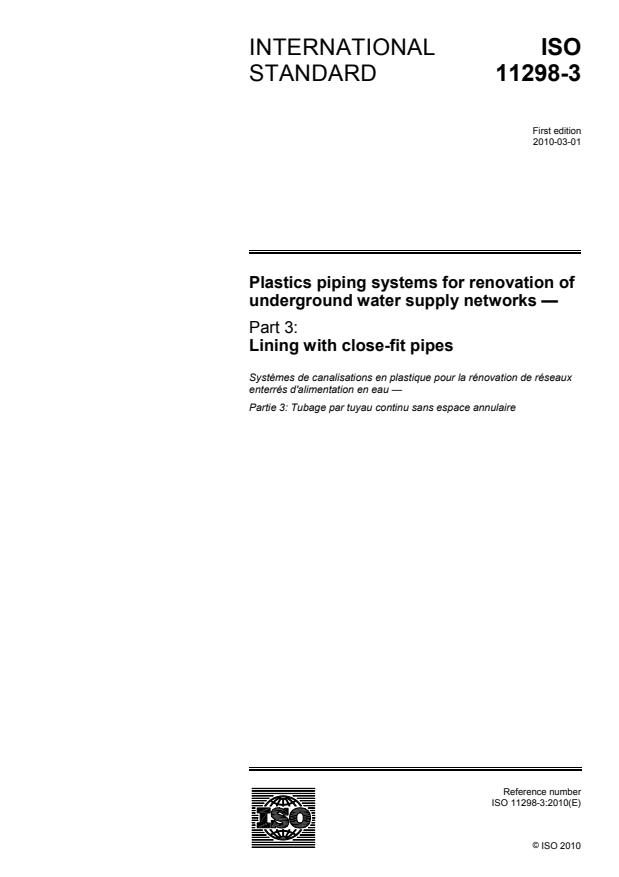
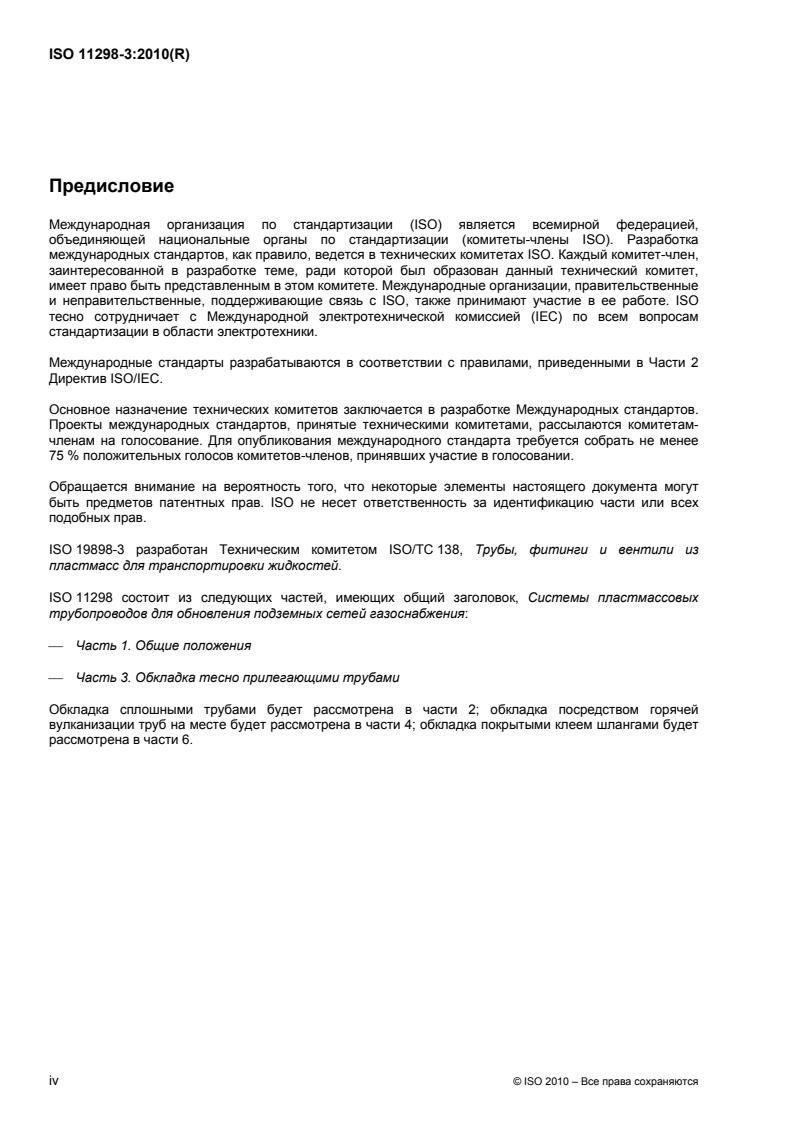
INTERNATIONAL ISO
STANDARD 11298-3
First edition
2010-03-01
Plastics piping systems for renovation of
underground water supply networks —
Part 3:
Lining with close-fit pipes
Systèmes de canalisations en plastique pour la rénovation de réseaux
enterrés d'alimentation en eau —
Partie 3: Tubage par tuyau continu sans espace annulaire
Reference number
©
ISO 2010
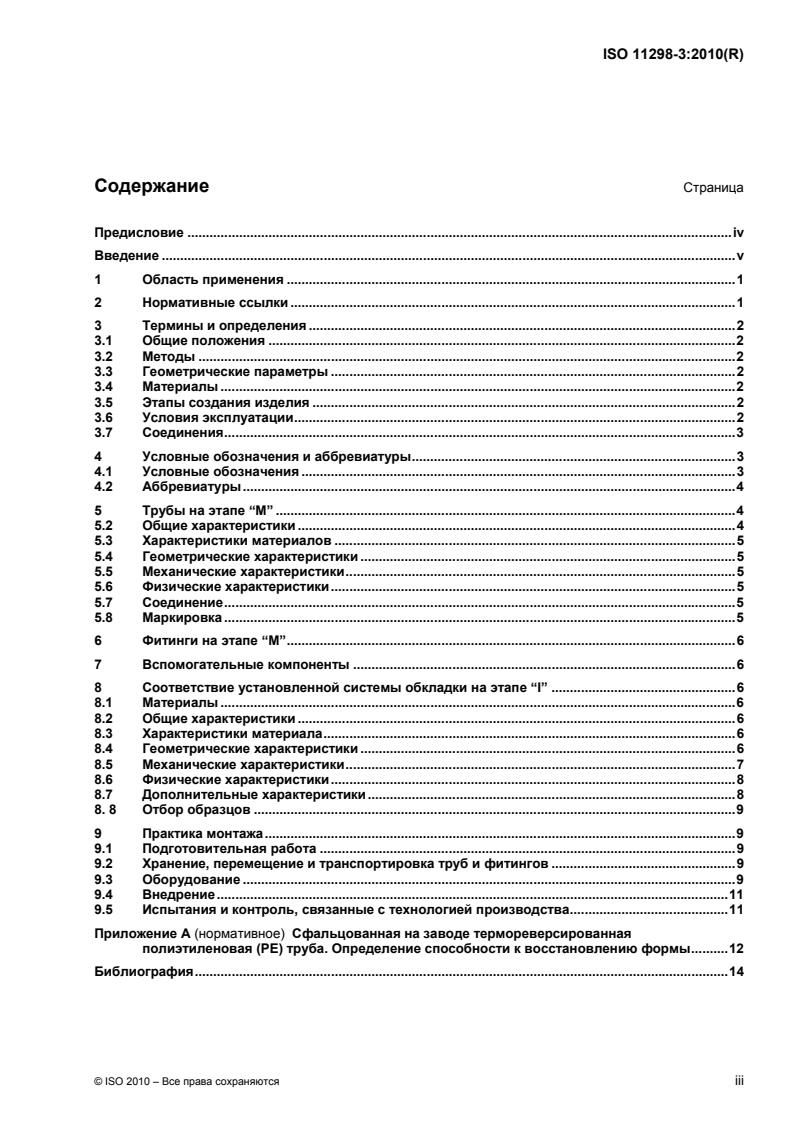
PDF disclaimer
This PDF file may contain embedded typefaces. In accordance with Adobe's licensing policy, this file may be printed or viewed but
shall not be edited unless the typefaces which are embedded are licensed to and installed on the computer performing the editing. In
downloading this file, parties accept therein the responsibility of not infringing Adobe's licensing policy. The ISO Central Secretariat
accepts no liability in this area.
Adobe is a trademark of Adobe Systems Incorporated.
Details of the software products used to create this PDF file can be found in the General Info relative to the file; the PDF-creation
parameters were optimized for printing. Every care has been taken to ensure that the file is suitable for use by ISO member bodies. In
the unlikely event that a problem relating to it is found, please inform the Central Secretariat at the address given below.
© ISO 2010
All rights reserved. Unless otherwise specified, no part of this publication may be reproduced or utilized in any form or by any means,
electronic or mechanical, including photocopying and microfilm, without permission in writing from either ISO at the address below or
ISO's member body in the country of the requester.
ISO copyright office
Case postale 56 • CH-1211 Geneva 20
Tel. + 41 22 749 01 11
Fax + 41 22 749 09 47
E-mail copyright@iso.org
Web www.iso.org
Published in Switzerland
ii © ISO 2010 – All rights reserved
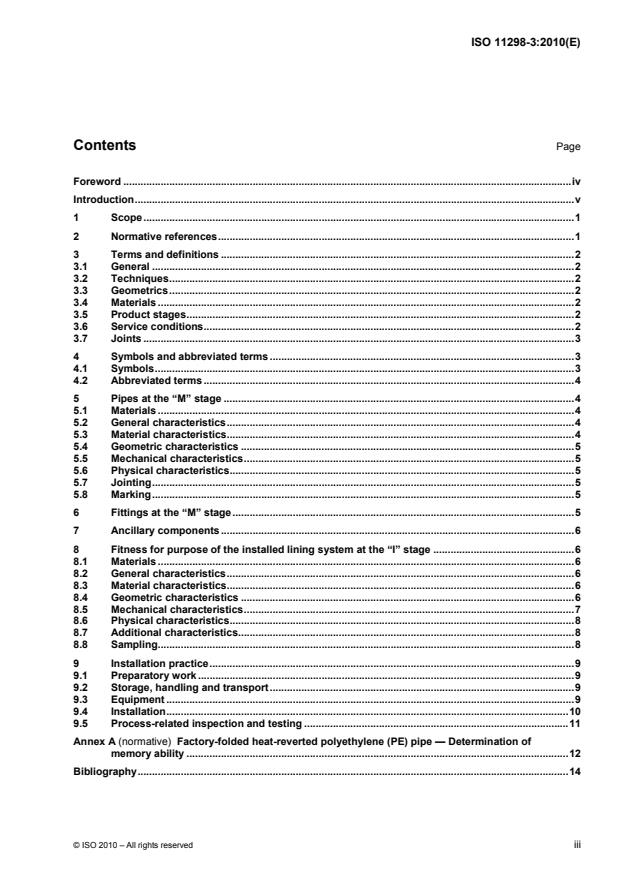
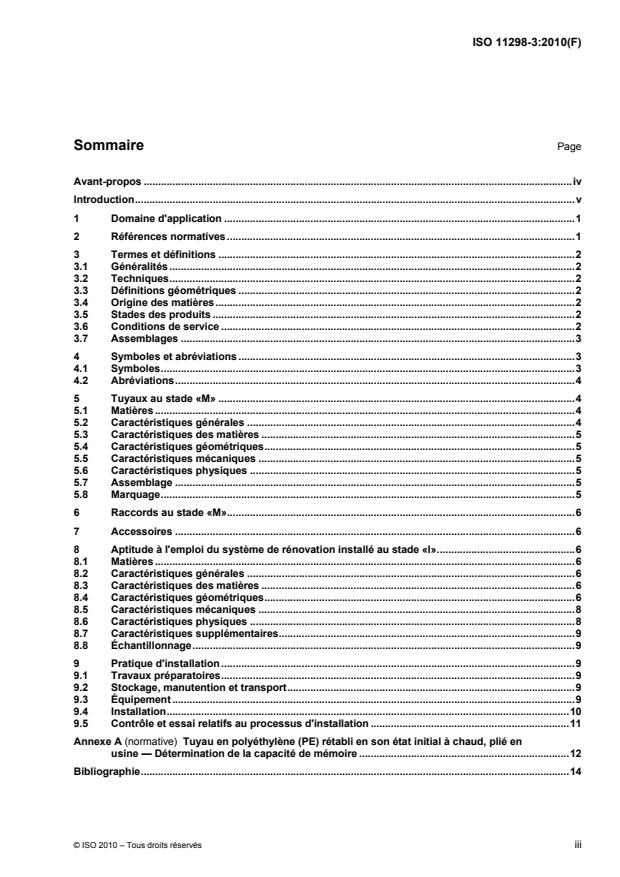
Contents Page
Foreword .iv
Introduction.v
1 Scope.1
2 Normative references.1
3 Terms and definitions .2
3.1 General .2
3.2 Techniques.2
3.3 Geometrics.2
3.4 Materials .2
3.5 Product stages.2
3.6 Service conditions.2
3.7 Joints .3
4 Symbols and abbreviated terms .3
4.1 Symbols.3
4.2 Abbreviated terms .4
5 Pipes at the “M” stage .4
5.1 Materials .4
5.2 General characteristics.4
5.3 Material characteristics.4
5.4 Geometric characteristics .5
5.5 Mechanical characteristics.5
5.6 Physical characteristics.5
5.7 Jointing.5
5.8 Marking.5
6 Fittings at the “M” stage.5
7 Ancillary components.6
8 Fitness for purpose of the installed lining system at the “I” stage .6
8.1 Materials .6
8.2 General characteristics.6
8.3 Material characteristics.6
8.4 Geometric characteristics .6
8.5 Mechanical characteristics.7
8.6 Physical characteristics.8
8.7 Additional characteristics.8
8.8 Sampling.8
9 Installation practice.9
9.1 Preparatory work .9
9.2 Storage, handling and transport.9
9.3 Equipment .9
9.4 Installation.10
9.5 Process-related inspection and testing .11
Annex A (normative) Factory-folded heat-reverted polyethylene (PE) pipe — Determination of
memory ability .12
Bibliography.14
Foreword
ISO (the International Organization for Standardization) is a worldwide federation of national standards bodies
(ISO member bodies). The work of preparing International Standards is normally carried out through ISO
technical committees. Each member body interested in a subject for which a technical committee has been
established has the right to be represented on that committee. International organizations, governmental and
non-governmental, in liaison with ISO, also take part in the work. ISO collaborates closely with the
International Electrotechnical Commission (IEC) on all matters of electrotechnical standardization.
International Standards are drafted in accordance with the rules given in the ISO/IEC Directives, Part 2.
The main task of technical committees is to prepare International Standards. Draft International Standards
adopted by the technical committees are circulated to the member bodies for voting. Publication as an
International Standard requires approval by at least 75 % of the member bodies casting a vote.
Attention is drawn to the possibility that some of the elements of this document may be the subject of patent
rights. ISO shall not be held responsible for identifying any or all such patent rights.
ISO 11298-3 was prepared by Technical Committee ISO/TC 138, Plastics pipes, fittings and valves for the
transport of fluids.
ISO 11298 consists of the following parts, under the general title Plastics piping systems for renovation of
underground water supply networks:
⎯ Part 1: General
⎯ Part 3: Lining with close-fit pipes
Lining with continuous pipes is to form the subject of a part 2; lining with cured-in-place pipes is to form the
subject of a part 4; lining with adhesive-backed hoses is to form the subject of a part 6.
iv © ISO 2010 – All rights reserved
Introduction
This part of ISO 11298 is a part of a System Standard for plastics piping systems of various materials used for
the renovation of existing pipelines in a specified application area. System Standards for renovation deal with
the following applications:
⎯ Plastics piping systems for renovation of underground non-pressure drainage and sewerage networks;
⎯ Plastics piping systems for renovation of underground water supply networks;
⎯ Plastics piping systems for renovation of underground gas supply networks;
⎯ Plastics piping systems for renovation of underground drainage and sewerage networks under pressure.
These System Standards are distinguished from those for conventionally installed plastics piping systems by
the requirement to verify certain characteristics in the as-installed condition, after site processing. This is in
addition to specifying requirements for plastics piping systems components as manufactured.
This System Standard comprises a:
⎯ Part 1: General
and all applicable renovation technique family-related parts from the following:
⎯ Part 2: Lining with continuous pipes
⎯ Part 3: Lining with close-fit pipes
⎯ Part 4: Lining with cured-in-place pipes
⎯ Part 6: Lining with adhesive-backed hoses
The requirements for any given renovation technique family are given in part 1, applied in conjunction with the
relevant other part. For example, ISO 11298-1 and this part of ISO 11298 together specify the requirements
relating to lining with close-fit pipes. For complementary information, see ISO 11295. Not all technique families
are pertinent to every area of application and this is reflected in the part numbers included in each System
Standard.
A consistent structure of clause headings has been adopted for all parts of ISO 11298, in order to facilitate
direct comparisons across renovation technique families.
Figure 1 shows the common part and clause structure and the relationship between ISO 11298 and the
System Standards for other application areas.
Figure 1 — Format of the renovation System Standards
vi © ISO 2010 – All rights reserved
INTERNATIONAL STANDARD ISO 11298-3:2010(E)
Plastics piping systems for renovation of underground water
supply networks —
Part 3:
Lining with close-fit pipes
1 Scope
This part of ISO 11298, in conjunction with ISO 11298-1, specifies requirements and test methods for close-fit
lining systems intended to be used for the renovation of water supply networks, which transport water
intended for human consumption, including raw water intake pipelines.
It is applicable to polyethylene (PE) pipe for both independent and interactive pressure pipe liners as well as
associated fittings and joints for the construction of the lining system.
2 Normative references
The following referenced documents are indispensable for the application of this document. For dated
references, only the edition cited applies. For undated references, the latest edition of the referenced
document (including any amendments) applies.
ISO 3126, Plastics piping systems — Plastics components — Determination of dimensions
ISO 4427-1:2007, Plastics piping systems — Polyethylene (PE) pipes and fittings for water supply — Part 1:
General
ISO 4427-2, Plastics piping systems — Polyethylene (PE) pipes and fittings for water supply — Part 2: Pipes
ISO 4427-3, Plastics piping systems — Polyethylene (PE) pipes and fittings for water supply — Part 3: Fittings
ISO 4427-5:2007, Plastics piping systems — Polyethylene (PE) pipes and fittings for water supply — Part 5:
Fitness for purpose of the system
ISO 11298-1:2009, Plastics piping systems for renovation of underground water supply networks — Part 1:
General
ISO 12176-1, Plastics pipes and fittings — Equipment for fusion jointing polyethylene systems — Part 1: Butt
fusion
ISO 12176-2, Plastics pipes and fittings — Equipment for fusion jointing polyethylene systems — Part 2:
Electrofusion
EN 12201-4, Plastics piping systems for water supply — Polyethylene (PE) — Part 4: Valves
3 Terms and definitions
For the purposes of this document, the terms and definitions given in ISO 4427-1 and ISO 11298-1 and the
following apply.
3.1 General
3.1.1
close fit
situation of the outside of the installed liner relative to the inside of the existing pipeline, which may either be
an interference fit or include a small annular gap resulting from shrinkage and tolerances only
3.1.2
close-fit pipe
continuous lining pipe of thermoplastic material reshaped or otherwise expanded after insertion to achieve a
close fit to the existing pipeline
3.2 Techniques
No additional definitions apply.
3.3 Geometrics
3.3.1
maximum mean outside diameter
d
em, max
maximum value of the outside diameter as specified for a given nominal size
3.4 Materials
No additional definitions apply.
3.5 Product stages
No additional definitions apply.
3.6 Service conditions
3.6.1
maximum operating pressure
MOP
1)
maximum effective pressure of the fluid in the piping system, expressed in bar , which is allowed in
continuous use
NOTE 1 It takes into account the physical and the mechanical characteristics of the components of a piping system.
NOTE 2 It is calculated using the following equation:
20 × MRS
()
ΜΟP =
()
C × SDR-1
()
5 2
1) 1 bar = 0,1 MPa = 10 Pa; 1 MPa = 1 N/mm .
2 © ISO 2010 – All rights reserved
3.7 Joints
3.7.1
electrofusion joint
joint between a PE socket or saddle electrofusion fitting and a pipe or fitting with spigotted ends, made by
heating the electrofusion fittings by the Joule effect of the heating element incorporated at their jointing
surfaces, causing the material adjacent to them to melt and pipe and fitting surfaces to fuse
3.7.2
butt fusion joint
joint made by heating the planed ends of matching surfaces by holding them against a flat heating plate until
the PE material reaches fusion temperature, quickly removing the heating plate and pushing the two softened
ends against one another
3.7.3
mechanical joint
joint made by assembling a PE pipe to another PE pipe, or any other element of the piping system that
generally includes a compression part, to provide for pressure integrity, leaktightness and resistance to end
loads
NOTE A support sleeve inserted into the pipe bore can be used to provide a permanent support for the PE pipe to
prevent creep in the pipe wall under radial compressive forces.
3.7.4
fusion compatibility
ability of two similar or dissimilar PE materials to be fused together to form a joint which conforms to the
performance requirements of this part of ISO 11298
4 Symbols and abbreviated terms
4.1 Symbols
For the purpose of this document, the symbols given in ISO 11298-1 and the following apply.
C overall service (design) coefficient
d outside diameter (at any point)
e
d maximum mean outside diameter
em, max
d original circular outside diameter of the pipe (before processing for insertion)
manuf
e maximum mean wall thickness
m, max
T temperature at which stress rupture data have been determined
t time to occurrence of a leak in the pipe
t wall thickness tolerance
y
σ design stress
s
4.2 Abbreviated terms
LPL lower confidence limit of the predicted hydrostatic strength
MFR melt mass-flow rate
MOP maximum operating pressure
MRS minimum required strength
PE polyethylene
R series of preferred numbers, conforming to the Renard series
5 Pipes at the “M” stage
5.1 Materials
5.1.1 Virgin material
The virgin material used shall be in accordance with one of the PE compound designations given in Table 1.
Table 1 — PE compound designations
Designation Classification by MRS
MPa
PE 80 8
PE 100 10
The compound shall conform to ISO 4427-1.
5.1.2 Reprocessable and recyclable material
In accordance with ISO 4427-1, own reprocessable material may be used, provided that it is derived from the
same compound as used for the relevant production.
Reprocessable material obtained from external sources and recyclable material shall not be used.
5.2 General characteristics
5.2.1 Appearance
When viewed without magnification, the internal and external surfaces of the pipe shall be smooth, clean and
free from scoring, cavities and other defects, which would prevent conformity to this part of ISO 11298.
5.2.2 Colour
The pipes shall be blue or black with blue identification stripes.
5.3 Material characteristics
The material from which the pipes are made shall conform to the requirements specified in Tables 1 and 2 of
ISO 442
...
NORME ISO
INTERNATIONALE 11298-3
Première édition
2010-03-01
Systèmes de canalisations en plastique
pour la rénovation de réseaux enterrés
d'alimentation en eau —
Partie 3:
Tubage par tuyau continu sans espace
annulaire
Plastics piping systems for renovation of underground water supply
networks —
Part 3: Lining with close-fit pipes
Numéro de référence
©
ISO 2010
PDF – Exonération de responsabilité
Le présent fichier PDF peut contenir des polices de caractères intégrées. Conformément aux conditions de licence d'Adobe, ce fichier
peut être imprimé ou visualisé, mais ne doit pas être modifié à moins que l'ordinateur employé à cet effet ne bénéficie d'une licence
autorisant l'utilisation de ces polices et que celles-ci y soient installées. Lors du téléchargement de ce fichier, les parties concernées
acceptent de fait la responsabilité de ne pas enfreindre les conditions de licence d'Adobe. Le Secrétariat central de l'ISO décline toute
responsabilité en la matière.
Adobe est une marque déposée d'Adobe Systems Incorporated.
Les détails relatifs aux produits logiciels utilisés pour la création du présent fichier PDF sont disponibles dans la rubrique General Info
du fichier; les paramètres de création PDF ont été optimisés pour l'impression. Toutes les mesures ont été prises pour garantir
l'exploitation de ce fichier par les comités membres de l'ISO. Dans le cas peu probable où surviendrait un problème d'utilisation,
veuillez en informer le Secrétariat central à l'adresse donnée ci-dessous.
DOCUMENT PROTÉGÉ PAR COPYRIGHT
© ISO 2011
Droits de reproduction réservés. Sauf prescription différente, aucune partie de cette publication ne peut être reproduite ni utilisée sous
quelque forme que ce soit et par aucun procédé, électronique ou mécanique, y compris la photocopie et les microfilms, sans l'accord écrit
de l'ISO à l'adresse ci-après ou du comité membre de l'ISO dans le pays du demandeur.
ISO copyright office
Case postale 56 • CH-1211 Geneva 20
Tel. + 41 22 749 01 11
Fax + 41 22 749 09 47
E-mail copyright@iso.org
Web www.iso.org
Version française parue en 2011
Publié en Suisse
ii © ISO 2010 – Tous droits réservés
Sommaire Page
Avant-propos .iv
Introduction.v
1 Domaine d'application .1
2 Références normatives.1
3 Termes et définitions .2
3.1 Généralités .2
3.2 Techniques.2
3.3 Définitions géométriques .2
3.4 Origine des matières.2
3.5 Stades des produits .2
3.6 Conditions de service .2
3.7 Assemblages .3
4 Symboles et abréviations .3
4.1 Symboles.3
4.2 Abréviations.4
5 Tuyaux au stade «M» .4
5.1 Matières .4
5.2 Caractéristiques générales .4
5.3 Caractéristiques des matières .5
5.4 Caractéristiques géométriques.5
5.5 Caractéristiques mécaniques .5
5.6 Caractéristiques physiques .5
5.7 Assemblage .5
5.8 Marquage.5
6 Raccords au stade «M».6
7 Accessoires .6
8 Aptitude à l'emploi du système de rénovation installé au stade «I».6
8.1 Matières .6
8.2 Caractéristiques générales .6
8.3 Caractéristiques des matières .6
8.4 Caractéristiques géométriques.6
8.5 Caractéristiques mécaniques .8
8.6 Caractéristiques physiques .8
8.7 Caractéristiques supplémentaires.9
8.8 Échantillonnage.9
9 Pratique d'installation .9
9.1 Travaux préparatoires.9
9.2 Stockage, manutention et transport.9
9.3 Équipement .9
9.4 Installation.10
9.5 Contrôle et essai relatifs au processus d'installation .11
Annexe A (normative) Tuyau en polyéthylène (PE) rétabli en son état initial à chaud, plié en
usine — Détermination de la capacité de mémoire .12
Bibliographie.14
Avant-propos
L'ISO (Organisation internationale de normalisation) est une fédération mondiale d'organismes nationaux de
normalisation (comités membres de l'ISO). L'élaboration des Normes internationales est en général confiée
aux comités techniques de l'ISO. Chaque comité membre intéressé par une étude a le droit de faire partie du
comité technique créé à cet effet. Les organisations internationales, gouvernementales et non
gouvernementales, en liaison avec l'ISO participent également aux travaux. L'ISO collabore étroitement avec
la Commission électrotechnique internationale (CEI) en ce qui concerne la normalisation électrotechnique.
Les Normes internationales sont rédigées conformément aux règles données dans les Directives ISO/CEI,
Partie 2.
La tâche principale des comités techniques est d'élaborer les Normes internationales. Les projets de Normes
internationales adoptés par les comités techniques sont soumis aux comités membres pour vote. Leur
publication comme Normes internationales requiert l'approbation de 75 % au moins des comités membres
votants.
L'attention est appelée sur le fait que certains des éléments du présent document peuvent faire l'objet de
droits de propriété intellectuelle ou de droits analogues. L'ISO ne saurait être tenue pour responsable de ne
pas avoir identifié de tels droits de propriété et averti de leur existence.
L'ISO 11298-3 a été élaborée par le comité technique ISO/TC 138, Tubes, raccords et robinetterie en
matières plastiques pour le transport des fluides.
L'ISO 11298 comprend les parties suivantes, présentées sous le titre général Systèmes de canalisations en
plastique pour la rénovation de réseaux enterrés d'alimentation en eau:
⎯ Partie 1: Généralités
⎯ Partie 3: Tubage par tuyau continu sans espace annulaire
Le tubage par tuyau continu avec espace annulaire fera l'objet d'une future Partie 2, le chemisage continu
polymérisé en place fera l'objet d'une future Partie 4 et le tubage par gaines souples revêtues d'un adhésif
fera l'objet d'une future Partie 6.
iv © ISO 2010 – Tous droits réservés
Introduction
La présente partie de l'ISO 11298 constitue une partie d'une Norme de Système pour des systèmes de
canalisations en plastique à base de matériaux variés utilisés pour la rénovation de canalisations existantes
dans un domaine d'application spécifié. Les Normes de Systèmes relatives à la rénovation traitent des
applications suivantes:
⎯ Systèmes de canalisations en plastique pour la rénovation des réseaux d'assainissement enterrés sans
pression;
⎯ Systèmes de canalisations en plastique pour la rénovation de réseaux enterrés d'alimentation en eau;
⎯ Systèmes de canalisations en plastique pour la rénovation des réseaux de gaz enterrés;
⎯ Systèmes de canalisations en plastique pour la rénovation des réseaux d'assainissement enterrés sous
pression.
Ces Normes de Systèmes se distinguent des normes relatives aux systèmes de canalisations en plastique
installés traditionnellement du fait qu'elles établissent des exigences concernant certaines caractéristiques
liées aux conditions d'installation, après mise en œuvre sur le site. Cela s'ajoute aux exigences spécifiques
pour les composants du système de canalisations en plastique tels que fabriqués.
Chacune des Normes de Systèmes comprend une Partie 1 (Généralités) et toutes les parties applicables aux
familles de techniques de rénovation contenues dans la liste suivante:
⎯ Partie 2: Tubage par tuyau continu avec espace annulaire
⎯ Partie 3: Tubage par tuyau continu sans espace annulaire
⎯ Partie 4: Tubage continu par tubes polymérisés sur place
⎯ Partie 6: Tubage par gaines souples revêtues d'un adhésif
Les exigences applicables à toute famille de techniques de rénovation donnée sont indiquées dans la Partie 1,
appliquée conjointement à toute autre partie associée. Par exemple, l'ISO 11298-1 et la présente partie de
l'ISO 11298 spécifient les exigences se rapportant au tubage par tuyau continu sans espace annulaire. Pour
toute information complémentaire, voir l'ISO 11295. Toutes les familles de techniques ne sont pas applicables
à chaque domaine d'application et cela se reflète dans les numéros de parties compris dans chaque Norme
de Système.
Une structure cohérente des titres des articles a été adoptée pour toutes les parties de l'ISO 11298 afin de
faciliter des comparaisons directes entre les différentes familles de techniques de rénovation.
La Figure 1 illustre la structure commune des parties et des articles et la relation entre l'ISO 11298 et les
Normes de Systèmes concernant d'autres domaines d'application.
Figure 1 — Présentation des Normes de Systèmes de rénovation
vi © ISO 2010 – Tous droits réservés
NORME INTERNATIONALE ISO 11298-3:2010(F)
Systèmes de canalisations en plastique pour la rénovation de
réseaux enterrés d'alimentation en eau —
Partie 3:
Tubage par tuyau continu sans espace annulaire
1 Domaine d'application
La présente partie de l'ISO 11298, conjointement à l'ISO 11298-1, spécifie les exigences et les méthodes
d'essai pour les systèmes de tubages par tuyau continu sans espace annulaire utilisés pour la rénovation des
réseaux enterrés pour l'alimentation en eau, qui acheminent l'eau destinée à la consommation humaine, y
compris les canalisations pour prise d'eau brute.
Elle couvre les tubes en polyéthylène (PE) à la fois pour les tubages autostructurants et les tubages
nécessitant le maintien de l'enveloppe ainsi que les raccords associés et les assemblages pour la
construction du système de rénovation.
2 Références normatives
Les documents de référence suivants sont indispensables à l'application du présent document. Pour les
références datées, seule l'édition citée s'applique. Pour les références non datées, la dernière édition du
document de référence s'applique (y compris les éventuels amendements).
ISO 3126, Systèmes de canalisations en plastiques — Composants en plastiques — Détermination des
dimensions
ISO 4427-1:2007, Systèmes de canalisations en plastique — Tubes et raccords en polyéthylène (PE)
destinés à l'alimentation en eau — Partie 1: Généralités
ISO 4427-2, Systèmes de canalisations en plastique — Tubes et raccords en polyéthylène (PE) destinés à
l'alimentation en eau — Partie 2: Tubes
ISO 4427-3, Systèmes de canalisations en plastique — Tubes et raccords en polyéthylène (PE) destinés à
l'alimentation en eau — Partie 3: Raccords
ISO 4427-5:2007, Systèmes de canalisations en plastique — Tubes et raccords en polyéthylène (PE)
destinés à l'alimentation en eau — Partie 5: Aptitude à l'emploi du système
ISO 11298-1:2010, Systèmes de canalisations en matières plastiques pour la rénovation des réseaux
enterrés d'alimentation en eau — Partie 1: Généralités
ISO 12176-1, Tubes et raccords en matières plastiques — Appareillage pour l'assemblage par soudage des
systèmes en polyéthylène — Partie 1: Soudage bout à bout
ISO 12176-2, Tubes et raccords en matières plastiques — Appareillage pour l'assemblage par soudage des
systèmes en polyéthylène — Partie 2: Électrosoudage
EN 12201-4, Systèmes de canalisations en plastique pour l'alimentation en eau — Polyéthylène (PE) —
Partie 4: Robinets
3 Termes et définitions
Pour les besoins du présent document, les termes et définitions donnés dans l'ISO 4427-1 et l'ISO 11298-1
ainsi que les suivants s'appliquent.
3.1 Généralités
3.1.1
sans espace annulaire
situation de l'extérieur du tubage installé par rapport à l'intérieur de la canalisation existante, qui peut soit être
un contact avec interférence, soit inclure un petit espace annulaire dû uniquement au retrait et aux tolérances
3.1.2
tuyau continu sans espace annulaire
tubage réalisé à l'aide d'un tuyau en matière thermoplastique continu réformé, ou dilaté d'une autre manière,
après l'insertion, assurant l'absence d'espace annulaire avec la canalisation existante
3.2 Techniques
Aucune définition supplémentaire ne s'applique.
3.3 Définitions géométriques
3.3.1
diamètre extérieur moyen maximal
d
em,max
valeur maximale du diamètre extérieur moyen, spécifiée pour une dimension nominale donnée
3.4 Origine des matières
Aucune définition supplémentaire ne s'applique.
3.5 Stades des produits
Aucune définition supplémentaire ne s'applique.
3.6 Conditions de service
3.6.1
pression maximale de service
MOP
1)
pression effective maximale du fluide dans le système de canalisations, exprimée en bar , qui est admise en
utilisation continue
NOTE 1 Elle tient compte des caractéristiques physiques et mécaniques des composants d'un système de
canalisations.
5 2
1) 1 bar = 0,1 MPa = 10 Pa; 1 MPa = 1 N/mm .
2 © ISO 2010 – Tous droits réservés
NOTE 2 Elle est calculée en utilisant l'équation suivante:
20× MRS
MOP=
C×()SDR-1
3.7 Assemblages
3.7.1
assemblage électrosoudable
assemblage entre un raccord à emboîture électrosoudable ou une selle électrosoudable en PE et un tube ou
un raccord à bouts mâles, réalisé en chauffant les raccords électrosoudables par effet Joule de l'élément
chauffant incorporé au niveau de leurs surfaces de raccordement, ce qui provoque la fusion du matériau/de la
matière adjacent(e) et le soudage des surfaces du tube et du raccord
3.7.2
assemblage par soudage bout à bout
assemblage réalisé par chauffage des extrémités planes des surfaces qui coïncident, en les maintenant
contre une plaque chauffante plane jusqu'à ce que la matière PE atteigne la température de fusion, en retirant
la plaque chauffante rapidement et en appliquant les deux extrémités ramollies l'une contre l'autre
3.7.3
assemblage mécanique
assemblage effectué par assemblage d'un tube en PE avec un autre tube en PE, ou tout autre élément du
système de canalisations qui comprend généralement une partie de compression qui assure la tenue à la
pression, l'étanchéité et la résistance à l'effet de fond
NOTE Un manchon de support inséré à l'intérieur du trou du tuyau peut être utilisé pour fournir un support permanent
pour le tuyau en PE afin d'empêcher un fluage dans la paroi du tuyau soumise à des forces de compression radiales.
3.7.4
compatibilité au soudage
capacité de deux matières PE semblables ou différentes à être soudées ensemble pour former un
assemblage qui réponde aux exigences de performance de la présente partie de l'ISO 11298
4 Symboles et abréviations
4.1 Symboles
C coefficient global de service (de calcul)
d diamètre extérieur (en un point quelconque)
e
d diamètre extérieur moyen maximal
em,max
d diamètre circulaire d'origine du tuyau (avant traitement pour insertion)
manuf
e épaisseur de paroi moyenne maximale
m,max
T température à laquelle les données de contraintes de rupture ont été déterminées
t tenue du tuyau avant l'apparition d'une fuite
t tolérance sur l'épaisseur de paroi
y
σ contrainte de calcul
s
4.2 Abréviations
LPL limite inférieure de confiance de la résistance hydrostatique prévue
MFR indice de fluidité à chaud en masse
MOP pression maximale de service
MRS résistance minimale requise
PE polyéthylène
R série de nombres normaux, conforme à la série de Renard
5 Tuyaux au stade «M»
5.1 Matières
5.1.1 Matière vierge
La matière vierge utilisée doit être conforme à une des désignations des compositions de PE données dans le
Tableau 1.
Tableau 1 — Désignations des compositions de PE
Classification par MRS
Désignation
MPa
PE 80 8
PE 100 10
La composition doit être conforme à l'ISO 4427-1.
5.1.2 Matière retraitable et matière régénérée
Conformément à l'ISO 4427-1, la matière retraitable interne peut être utilisée, sous réserve qu'elle provienne
de la même composition, comme utilisée pour la fabrication concernée.
La matière retraitable externe obtenue à partir de sources externes et la matière régénérée ne doivent pas
être utilisées.
5.2 Caractéristiques générales
5.2.1 Aspect
Lors de l'inspection sans grossissement, les surfaces interne et externe du tuyau doivent être lisses, propres
et exemptes de rayures, de cavités ainsi que de tout autre défaut susceptibles d'entraver leur conformité à la
présente partie de l'ISO 11298.
4 © ISO 2010 – Tous droits réservés
5.2.2 Couleur
Les tubes doivent être bleus ou noirs avec des bandes d'identification bleues.
5.3 Caractéristiques des matières
Les matières à partir desquelles les tuyaux sont fabriqués doivent être conformes aux exigences spécifiées
dans l'ISO 4427-1:2007, Tableaux 1 et 2.
5.4 Caractéristiques géométriques
Le diamètre du tuyau, l'épaisseur de paroi et la forme au stade «M» dépendent de la technique spécifique de
tubage par tuyau continu sans espace annulaire. Les dimensions au stade «M» nécessaires pour respecter
les dimensions du stade «I» (voir 8.4) doivent être déclarées, avec leurs tolérances, par le fabricant.
NOTE Dans le cas de tuyaux pliés en usine, il est possible qu'il y ait de
...
МЕЖДУНАРОДНЫЙ ISO
СТАНДАРТ 11298-3
Первое издание
2010-03-01
Пластмассовые трубопроводы для
обновления подземных
водопроводных сетей.
Часть 3.
Обкладка плотно прилегающими
трубами
Plastics piping systems for renovation of underground water supply
networks —
Part 3 : Lining with closed-fit pipes
Ответственность за подготовку русской версии несёт GOST R
(Российская Федерация) в соответствии со статьёй 18.1 Устава ISO
Ссылочный номер
©
ISO 2010
Отказ от ответственности при работе в PDF
Настоящий файл PDF может содержать интегрированные шрифты. В соответствии с условиями лицензирования, принятыми
фирмой Adobe, этот файл можно распечатать или смотреть на экране, но его нельзя изменить, пока не будет получена
лицензия на установку интегрированных шрифтов в компьютере, на котором ведется редактирование. В случае загрузки
настоящего файла заинтересованные стороны принимают на себя ответственность за соблюдение лицензионных условий
фирмы Adobe. Центральный секретариат ISO не несет никакой ответственности в этом отношении.
Adobe – торговый знак фирмы Adobe Systems Incorporated.
Подробности, относящиеся к программным продуктам, использованным для создания настоящего файла PDF, можно найти в
рубрике General Info файла; параметры создания PDF были оптимизированы для печати. Были приняты во внимание все
меры предосторожности с тем, чтобы обеспечить пригодность настоящего файла для использования комитетами-членами
ISO. В редких случаях возникновения проблемы, связанной со сказанным выше, просьба проинформировать Центральный
секретариат по адресу, приведенному ниже.
ДОКУМЕНТ ЗАЩИЩЕН АВТОРСКИМ ПРАВОМ
Все права сохраняются. Если не задано иначе, никакую часть настоящей публикации нельзя копировать или использовать в
какой-либо форме или каким-либо электронным или механическим способом, включая фотокопии и микрофильмы, без
предварительного письменного согласия офиса ISO по адресу, указанному ниже, или членов ISO в стране регистрации
пребывания.
ISO copyright office
Case postale 56 • CH-1211 Geneva 20
Tel. + 41 22 749 01 11
Fax + 41 22 749 09 47
E-mail copyright@iso.org
Web www.iso.org
Опубликовано в Швейцарии
ii © ISO 2010 – Все права сохраняются
Содержание Страница
Предисловие .iv
Введение .v
1 Область применения .1
2 Нормативные ссылки .1
3 Термины и определения .2
3.1 Общие положения .2
3.2 Методы .2
3.3 Геометрические параметры .2
3.4 Материалы .2
3.5 Этапы создания изделия .2
3.6 Условия эксплуатации.2
3.7 Соединения.3
4 Условные обозначения и аббревиатуры.3
4.1 Условные обозначения .3
4.2 Аббревиатуры.4
5 Трубы на этапе “M” .4
5.2 Общие характеристики .4
5.3 Характеристики материалов .5
5.4 Геометрические характеристики .5
5.5 Механические характеристики.5
5.6 Физические характеристики.5
5.7 Соединение.5
5.8 Маркировка .5
6 Фитинги на этапе “M”.6
7 Вспомогательные компоненты .6
8 Соответствие установленной системы обкладки на этапе “I” .6
8.1 Материалы .6
8.2 Общие характеристики .6
8.3 Характеристики материала.6
8.4 Геометрические характеристики .6
8.5 Механические характеристики.7
8.6 Физические характеристики.8
8.7 Дополнительные характеристики.8
8. 8 Отбор образцов .9
9 Практика монтажа.9
9.1 Подготовительная работа .9
9.2 Хранение, перемещение и транспортировка труб и фитингов .9
9.3 Оборудование .9
9.4 Внедрение.11
9.5 Испытания и контроль, связанные с технологией производства.11
Приложение A (нормативное) Сфальцованная на заводе термореверсированная
полиэтиленовая (PE) труба. Определение способности к восстановлению формы.12
Библиография.14
Предисловие
Международная организация по стандартизации (ISO) является всемирной федерацией,
объединяющей национальные органы по стандартизации (комитеты-члены ISO). Разработка
международных стандартов, как правило, ведется в технических комитетах ISO. Каждый комитет-член,
заинтересованной в разработке теме, ради которой был образован данный технический комитет,
имеет право быть представленным в этом комитете. Международные организации, правительственные
и неправительственные, поддерживающие связь с ISO, также принимают участие в ее работе. ISO
тесно сотрудничает с Международной электротехнической комиссией (IEC) по всем вопросам
стандартизации в области электротехники.
Международные стандарты разрабатываются в соответствии с правилами, приведенными в Части 2
Директив ISO/IEC.
Основное назначение технических комитетов заключается в разработке Международных стандартов.
Проекты международных стандартов, принятые техническими комитетами, рассылаются комитетам-
членам на голосование. Для опубликования международного стандарта требуется собрать не менее
75 % положительных голосов комитетов-членов, принявших участие в голосовании.
Обращается внимание на вероятность того, что некоторые элементы настоящего документа могут
быть предметов патентных прав. ISO не несет ответственность за идентификацию части или всех
подобных прав.
ISO 19898-3 разработан Техническим комитетом ISO/TC 138, Трубы, фитинги и вентили из
пластмасс для транспортировки жидкостей.
ISO 11298 состоит из следующих частей, имеющих общий заголовок, Системы пластмассовых
трубопроводов для обновления подземных сетей газоснабжения:
⎯ Часть 1. Общие положения
⎯ Часть 3. Обкладка тесно прилегающими трубами
Обкладка сплошными трубами будет рассмотрена в части 2; обкладка посредством горячей
вулканизации труб на месте будет рассмотрена в части 4; обкладка покрытыми клеем шлангами будет
рассмотрена в части 6.
iv © ISO 2010 – Все права сохраняются
Введение
Настоящая часть ISO 11298 представляет собой системный стандарт на системы пластмассовых
трубопроводов из различных материалов, используемые для обновления существующих
трубопроводов в установленной области применения. Системные стандарты на обновление
распространяются на нижеследующее:
⎯ системы пластмассовых трубопроводов для обновления подземных безнапорных дренажных и
канализационных сетей;
⎯ системы пластмассовых трубопроводов для обновления подземных водопроводных сетей;
⎯ системы пластмассовых трубопроводов для обновления подземных газопроводных сетей;
⎯ системы пластмассовых трубопроводов для обновления подземных дренажных и
канализационных сетей под давлением.
Эти системные стандарты отличаются от стандартов на обычные системы пластмассовых труб, т.к.
устанавливают требования к проверке определенных характеристик по состоянию на момент монтажа,
после соответствующей обработки на месте. Настоящий документ дополняет требования к
компонентам систем на стадии производства.
Данный системный стандарт состоит из:
⎯ Часть 1. Общие положения
и всех применимых частей, относящихся к семейству методов обновления, которые приводятся ниже:
⎯ Часть 2. Обкладка сплошными трубами
⎯ Часть 3. Обкладка плотно прилегающими трубами
⎯ Часть 4. Обкладка посредством горячей вулканизации труб на месте
⎯ Часть 6. Обкладка покрытыми клеем шлангами
Требования к любому установленному семейству методов обновления приводятся в части 1,
применимой с другой соответствующей частью. Например, ISO 11298-1 и настоящая часть ISO 11298
совместно устанавливают требования, касающиеся обкладки тесто прилегающими трубами.
Относительно дополнительной информации, см. ISO 11295. Не все семейства методов могут
относиться к каждой области применения, что нашло отражение в номерах частей, включенных в
каждый системный стандарт.
Для удобства проводить прямые сравнения между семействами методов обновления была
разработана совместимая структура заголовков для всех частей в ISO 11298.
Для прочих областей применения Рисунок 1 иллюстрирует структуру общей части и разделов и
зависимость между ISO 11298 и системными стандартами.
Рисунок 1 — Формат для системных стандартов на обновление
vi © ISO 2010 – Все права сохраняются
МЕЖДУНАРОДНЫЙ СТАНДАРТ ISO 11298-3:2010(R)
Пластмассовые трубопроводы для обновления подземных
водопроводных сетей.
Часть 3.
Обкладка плотно прилегающими трубами
1 Область применения
Настоящая часть ISO 11298, вместе с ISO 11298-1, устанавливает методы испытаний и требования к
системам обкладки тесноприлегающими трубами, предназначенными для использования с целью
обновления водопроводных сетей, которые транспортируют воду, предназначенную для потребления
людей, включая впускные трубопроводы для сырой воды.
Стандарт распространяется на полиэтиленовые (PE) трубы, как на независимые, так и интерактивные
трубные обкладки под давлением, а также на соответствующие фитинги и соединения для конструкции
обкладочной системы.
2 Нормативные ссылки
Нижеследующие ссылочные документы обязательны для применения настоящего документа. В
отношении датированных ссылок действительны только указанные издания. В отношении
недатированных ссылок применимо последнее издание упоминаемого документа, включая любые к
нему изменения.
ISO 3126, Трубы пластмассовые. Пластмассовые компоненты. Определение размеров
ISO 4427-1:2007, Трубы полиэтиленовые и фитинги для водоснабжения. Часть 1. Общие положения
ISO 4427-2, Трубы полиэтиленовые и фитинги для водоснабжения. Часть 2. Трубы
ISO 4427-3, Трубы полиэтиленовые и фитинги для водоснабжения. Часть 3. Фитинги
ISO 4427-5:2007, Трубы полиэтиленовые и фитинги для водоснабжения. Часть 5. Пригодность для
целей системы
ISO 11298-1:2009, Системы трубопроводные пластмассовые для обновления подземных
водопроводных сетей. Часть 1. Общие положения
ISO 12176-1, Трубы и фитинги пластмассовые. Оборудование для соединения плавлением
полиэтиленовых систем. Часть 1. Стыковое соединение плавлением
ISO 12176-2, Трубы и фитинги пластмассовые. Оборудование для соединения плавлением
полиэтиленовых систем. Часть 2. Электроплавление
EN 12201-4, Трубопроводы для питьевой воды полиэтиленовые. Часть 4. Клапаны
3 Термины и определения
Исходя из назначения настоящего документа, применимы термины и определения, приведенные в
ISO 4427-1 и ISO 11298-1 и нижеследующее.
3.1 Общие положения
3.1.1
тесное прилегание
close fit
ситуация снаружи установленной обкладки относительно внутренней стороны существующего
трубопровода, которая может быть либо посадкой с натягом, или включать небольшой окружной зазор
в результате только усадки и допусков
3.1.2
тесно прилегающая труба
close-fit pipe
сплошная обкладочная труба из термопластичного материала, которая имеет восстановленную
первоначальную форму, или каким-либо способом была развальцована после введения с целью
достижения точной посадки с существующим трубопроводом
3.2 Методы
Не применимы дополнительные определения.
3.3 Геометрические параметры
3.3.1
максимальное значение наружного диаметра
maximum mean outside diameter
d
em, max
максимальное значение наружного диаметра, заданное для приведенного номинального размера
3.4 Материалы
Не применимы дополнительные определения.
3.5 Этапы создания изделия
Не применимы дополнительные определения.
3.6 Условия эксплуатации
3.6.1
максимальное рабочее давление
МОР
maximum operating pressure
MOP
максимальное эффективное давление текучей среды в системе трубопроводов, выражаемое в барах,
которое допустимо для непрерывного использования
ПРИМЕЧАНИЕ 1 С учетом физических и механических характеристик компонентов системы трубопроводов.
ПРИМЕЧАНИЕ 2 Вычисляют с применением следующего уравнения:
5 2
1 бар = 0,1 МПа = 10 Па; 1 МПа = 1 Н/мм .
2 © ISO 2010 – Все права сохраняются
20× MRS
( )
МПP =
()
C× SDR-1
()
3.7 Соединения
3.7.1
соединение, полученное электроплавлением
electrofusion joint
соединение между PE раструбом или опорой электроплавленного фитинга или трубой и фитингом с
втулочными концами, полученное путем нагревания электроплавленных фитингов с помощью
теплового действия тока нагревательного элемента, введенного в их соединяемые поверхности,
которое приводит к оплавлению материала, прилагающего к ним, и расплавлению поверхностей трубы
и фитинга
3.7.2
стыковое соединение плавлением
butt fusion joint
соединение, полученное путем нагревания плоских концов сопряженных поверхностей посредством
прижатия их к плоской нагревательной панели до тех пор, пока PE материал не достигнет температуры
плавления, быстрого удаления этой панели и тесного контакта двух размягченных концов друг к другу
3.7.3
механическое соединение
mechanical joint
соединение, полученное сборкой PE трубы с еще одной PE трубой, или любого другого элемента
трубопроводной системы, который обычно включает компрессионную часть, с целью обеспечения
целостности при воздействии давления, герметичности и стойкости к торцевым нагрузкам
ПРИМЕЧАНИЕ Несущая втулка, помещенная в канал трубы, используется для обеспечения постоянной опоры
для РЕ трубы, предотвращая ползучесть стенок трубы при радиальных сжимающих усилиях.
3.7.4
совместимость при плавлении
fusion compatibility
способность двух однородных или разнородных PE материалов сплавляться, образуя соединение,
которое соответствует требованиям к эксплуатации настоящей части ISO 11298
4 Условные обозначения и аббревиатуры
4.1 Условные обозначения
Исходя из назначения настоящего документа, применимы условные обозначения, приведенные в
ISO 11298-1, а также нижеследующиеy.
C общий рабочий (расчетный) коэффициент
d наружный диаметр (в любой точке)
e
d максимальный средний наружный диаметр
em, max
d начальный окружной наружный диаметр трубы (перед обработкой для ввода)
manuf
e максимальная средняя толщина стенок
m, max
T температура, при которой были получены результаты испытаний на длительную прочность
t время до появления утечки в трубе
t допуск на толщину стенок
y
σ расчетное напряжение
s
4.2 Аббревиатуры
LPL нижний доверительный предел прогнозируемой гидростатической прочности
MFR удельный массовый расход расплава
MOP максимальное рабочее давление
MRS минимальная требуемая прочность
PE полиэтилен
R ряд предпочтительных чисел, соответствующий ряду Ренара
5 Трубы на этапе “M”
5.1 Свежий материал
Используемый свежий материал должен соответствовать одному из наименований PE соединений,
указанных в Таблице 1.
Таблица 1 –– Обозначения PE соединений
Классификация по MRS
Обозначение
МПа
PE 80 8
PE 100 10
Соединение должно соответствовать ISO 4427-1.
5.1.2 Переработанный и повторно используемый материал
В соответствии с ISO 4427-1 может использоваться собственный переработанный материал
изготовителя, при условии, что он получен из того же самого соединения, которое применялось для
соответствующего производства.
Переработанный материал, полученный из внешних источников, и повторно используемый материал,
не должны использоваться.
5.2 Общие характеристики
5.2.1 Внешний вид
При осмотре без помощи средств увеличения внутренние и внешние поверхности трубы должны быть
гладкими, чистыми и свободными от царапин, каверн и других дефектов, которые могут предотвратить
соответствие настоящей части ISO 11298.
5.2.2 Цвет
Трубы должны быть синего или черного цвета с синими идентификационными полосами.
4 © ISO 2010 – Все права сохраняются
5.3 Характеристики материалов
Материал, из которого изготавливают трубы, должен соответствовать требованиям, установленным в
Таблицах 1 и 2 ISO 4427-1:2007.
5.4 Геометрические характеристики
Диаметры труб, толщина их стенок и форма на этапе “M” зависят от специфического метода плотного
прилегания. Размеры этапа “M”, необходимые для получения размеров на этапе “I” (см. 8.4),
устанавливает изготовит
...
Questions, Comments and Discussion
Ask us and Technical Secretary will try to provide an answer. You can facilitate discussion about the standard in here.
Loading comments...