

ISO 7491:2000
(Main)Dental materials — Determination of colour stability
General Information
- Abstract
- Status
- Published
- Publication Date
- 16-Aug-2000
- Technical Committee
- ISO/TC 106/SC 2 - Prosthodontic materials
- Drafting Committee
- ISO/TC 106/SC 2 - Prosthodontic materials
- Current Stage
- 9093 - International Standard confirmed
- Start Date
- 16-Oct-2025
- Completion Date
- 29-Aug-2026
Buy Documents
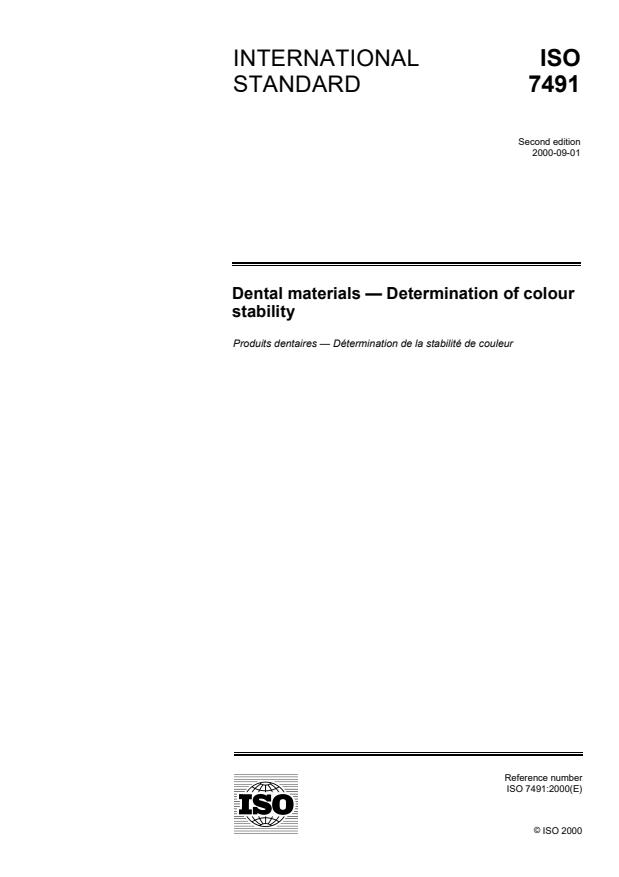
ISO 7491:2000 - Dental materials — Determination of colour stability Released:8/17/2000
ISO 7491:2000 - Produits dentaires — Détermination de la stabilité de couleur Released:8/17/2000
Overview
ISO 7491:2000 – Dental materials – Determination of colour stability provides a standardized method for assessing the colour stability of dental materials. Developed by the International Organization for Standardization (ISO) under technical committee ISO/TC 106, Dentistry, this standard ensures reliable and repeatable testing for materials commonly used in dental restorations and prosthodontics. The ability to consistently evaluate colour changes after exposure to light and water is critical for maintaining the aesthetics and quality of dental treatments.
Key Topics
- Colour Stability Evaluation: Defines procedures for testing the resistance of dental materials to colour changes after exposure to specific conditions.
- Testing Conditions: Specifies the use of a xenon medium-pressure lamp, ultraviolet filters, and water baths maintained at controlled temperatures.
- Test Specimen Preparation: Refers to guidance in material-specific standards for specimen size and conditioning, ensuring compatibility across various dental materials.
- Visual Comparison: Involves a systematic approach where trained observers assess colour differences, ensuring objective results.
- Use of Reference Standards: Incorporates references to ISO and CIE standards for water quality and colour measurement, ensuring consistency with global best practices.
- Appropriate Backgrounds and Lighting: Details the ideal viewing conditions-including diffuse daylight or equivalent artificial light and specific background reflectance-to mitigate subjective perception errors.
Applications
ISO 7491:2000 is widely used in:
- Dental Material Development: Manufacturers use the standard to validate the colour stability of new restorative materials, composites, ceramics, or polymers, ensuring they maintain aesthetic quality over time.
- Quality Control in Manufacturing: Routine testing based on this standard helps maintain consistency in the appearance of dental products before market release.
- Regulatory Compliance: Dental material suppliers and manufacturers rely on ISO 7491:2000 to meet international regulatory requirements for product performance related to colour stability.
- Research and Clinical Trials: Academic and industrial researchers employ this standard to objectively compare new materials or the impact of modified formulations.
- Procurement and Specification: Dentists, laboratories, and clinics can specify compliance with ISO 7491:2000 in procurement processes to ensure long-lasting, aesthetic restorations for patients.
Related Standards
For a comprehensive approach to colour testing and stability assessment of dental materials, the following related standards and references are integral:
- ISO 3696: Water for analytical laboratory use – Specification and test methods (for water used in testing environments)
- ISO 4892-1 & ISO 4892-2: Plastics – Methods of exposure to laboratory light sources (general guidance and use of xenon-arc sources)
- CIE Publication 15.2: Colorimetry (guidelines for colour measurement and evaluation)
- ISO 4582: Plastics – Determination of changes in colour after exposure to light
Aligning with ISO 7491:2000 facilitates higher confidence in the durability and visual performance of dental materials, making it an essential resource for organizations and professionals involved in dental material development, testing, and quality assurance. The standard is crucial for meeting patient expectations for long-lasting and natural-looking dental restorations.
Relations
- Effective Date
- 25-Aug-2026
- Effective Date
- 25-Aug-2026
- Referred By
EN ISO 20795-1:2008 - Dentistry - Base polymers - Part 1: Denture base polymers (ISO 20795-1:2008) - Effective Date
- 25-Aug-2026
- Effective Date
- 25-Aug-2026
- Effective Date
- 25-Aug-2026
- Effective Date
- 25-Aug-2026
- Referred By
EN ISO 10477:2020 - Dentistry - Polymer-based crown and veneering materials (ISO 10477:2020) - Effective Date
- 25-Aug-2026
- Effective Date
- 25-Aug-2026
- Effective Date
- 25-Aug-2026
- Referred By
EN ISO 10477:2018 - Dentistry - Polymer-based crown and veneering materials (ISO 10477:2018) - Effective Date
- 25-Aug-2026
- Effective Date
- 25-Aug-2026
- Referred By
EN ISO 20795-1:2013 - Dentistry - Base polymers - Part 1: Denture base polymers (ISO 20795-1:2013) - Effective Date
- 25-Aug-2026
- Referred By
EN ISO 10477:2004 - Dentistry - Polymer-based crown and bridge materials (ISO 10477:2004) - Effective Date
- 25-Aug-2026
- Effective Date
- 25-Aug-2026
- Effective Date
- 03-Jun-2026
Buy Documents
ISO 7491:2000 - Dental materials — Determination of colour stability Released:8/17/2000
ISO 7491:2000 - Produits dentaires — Détermination de la stabilité de couleur Released:8/17/2000
Get Certified
Connect with accredited certification bodies for this standard

BSI Group
BSI (British Standards Institution) is the business standards company that helps organizations make excellence a habit.

TÜV Rheinland
TÜV Rheinland is a leading international provider of technical services.

TÜV SÜD
TÜV SÜD is a trusted partner of choice for safety, security and sustainability solutions.
Sponsored listings
Frequently Asked Questions
ISO 7491:2000 is a standard published by the International Organization for Standardization (ISO). Its full title is "Dental materials — Determination of colour stability". This standard covers: La présente Norme internationale spécifie une méthode pour la détermination de la stabilité de couleur des produits dentaires après exposition à la lumière et à l'eau.
La présente Norme internationale spécifie une méthode pour la détermination de la stabilité de couleur des produits dentaires après exposition à la lumière et à l'eau.
ISO 7491:2000 is classified under the following ICS (International Classification for Standards) categories: 11.060.10 - Dental materials. The ICS classification helps identify the subject area and facilitates finding related standards.
ISO 7491:2000 has the following relationships with other standards: It is inter standard links to EN ISO 3696:1995, EN ISO 9917-2:2010, EN ISO 20795-1:2008, EN ISO 20795-2:2010, EN ISO 9917-2:2017, EN ISO 9917-1:2025, EN ISO 10477:2020, EN ISO 20795-2:2013, EN ISO 4049:2009, EN ISO 10477:2018, EN ISO 9917-1:2007, EN ISO 20795-1:2013, EN ISO 10477:2004, EN ISO 22112:2017, EN ISO 22112:2006. Understanding these relationships helps ensure you are using the most current and applicable version of the standard.
ISO 7491:2000 is available in PDF format for immediate download after purchase. The document can be added to your cart and obtained through the secure checkout process. Digital delivery ensures instant access to the complete standard document.
Standards Content (Sample)
INTERNATIONAL ISO
STANDARD 7491
Second edition
2000-09-01
Dental materials — Determination of colour
stability
Produits dentaires — Détermination de la stabilité de couleur
Reference number
©
ISO 2000
PDF disclaimer
This PDF file may contain embedded typefaces. In accordance with Adobe's licensing policy, this file may be printed or viewed but shall not
be edited unless the typefaces which are embedded are licensed to and installed on the computer performing the editing. In downloading this
file, parties accept therein the responsibility of not infringing Adobe's licensing policy. The ISO Central Secretariat accepts no liability in this
area.
Adobe is a trademark of Adobe Systems Incorporated.
Details of the software products used to create this PDF file can be found in the General Info relative to the file; the PDF-creation parameters
were optimized for printing. Every care has been taken to ensure that the file is suitable for use by ISO member bodies. In the unlikely event
that a problem relating to it is found, please inform the Central Secretariat at the address given below.
All rights reserved. Unless otherwise specified, no part of this publication may be reproduced or utilized in any form or by any means, electronic
or mechanical, including photocopying and microfilm, without permission in writing from either ISO at the address below or ISO's member body
in the country of the requester.
ISO copyright office
Case postale 56 � CH-1211 Geneva 20
Tel. + 41 22 749 01 11
Fax + 41 22 749 09 47
E-mail copyright@iso.ch
Web www.iso.ch
Printed in Switzerland
ii © ISO 2000 – All rights reserved
Foreword
ISO (the International Organization for Standardization) is a worldwide federation of national standards bodies (ISO
member bodies). The work of preparing International Standards is normally carried out through ISO technical
committees. Each member body interested in a subject for which a technical committee has been established has
the right to be represented on that committee. International organizations, governmental and non-governmental, in
liaison with ISO, also take part in the work. ISO collaborates closely with the International Electrotechnical
Commission (IEC) on all matters of electrotechnical standardization.
International Standards are drafted in accordance with the rules given in the ISO/IEC Directives, Part 3.
Draft International Standards adopted by the technical committees are circulated to the member bodies for voting.
Publication as an International Standard requires approval by at least 75 % of the member bodies casting a vote.
Attention is drawn to the possibility that some of the elements of this International Standard may be the subject of
patent rights. ISO shall not be held responsible for identifying any or all such patent rights.
International Standard ISO 7491 was prepared by Technical Committee ISO/TC 106, Dentistry, Subcommittee
SC 2, Prosthodontic materials.
This second edition cancels and replaces the first edition (ISO 7491:1985), which has been technically revised.
Introduction
Colour stability is an important characteristic of dental materials and it is expected that the test methods in this
International Standard will be referred to in the International Standards specifying such materials.
iv © ISO 2000 – All rights reserved
INTERNATIONAL STANDARD ISO 7491:2000(E)
Dental materials — Determination of colour stability
1 Scope
This International Standard specifies a method for the determination of the colour stability of dental materials after
exposure to light and water.
2 Normative references
The following normative documents contain provisions which, through reference in this text, constitute provisions of
this International Standard. For dated references, subsequent amendments to, or revisions of, any of these
publications do not apply. However, parties to agreements based on this International Standard are encouraged to
investigate the possibility of applying the most recent editions of the normative documents indicated below. For
undated references, the latest edition of the normative document referred to applies. Members of ISO and IEC
maintain registers of currently valid International Standards.
ISO 3696, Water for analytical laboratory use — Specification and test metho
...
NORME ISO
INTERNATIONALE 7491
Deuxième édition
2000-09-01
Produits dentaires — Détermination
de la stabilité de couleur
Dental materials — Determination of colour stability
Numéro de référence
©
ISO 2000
PDF – Exonération de responsabilité
Le présent fichier PDF peut contenir des polices de caractères intégrées. Conformément aux conditions de licence d'Adobe, ce fichier peut
être imprimé ou visualisé, mais ne doit pas être modifiéà moins que l'ordinateur employéà cet effet ne bénéficie d'une licence autorisant
l'utilisation de ces polices et que celles-ci y soient installées. Lors du téléchargement de ce fichier, les parties concernées acceptent de fait la
responsabilité de ne pas enfreindre les conditions de licence d'Adobe. Le Secrétariat central de l'ISO décline toute responsabilité en la
matière.
Adobe est une marque déposée d'Adobe Systems Incorporated.
Les détails relatifs aux produits logiciels utilisés pour la créationduprésent fichier PDF sont disponibles dans la rubrique General Info du
fichier; les paramètres de création PDF ont été optimisés pour l'impression. Toutes les mesures ont été prises pour garantir l'exploitation de
ce fichier par les comités membres de l'ISO. Dans le cas peu probable où surviendrait un problème d'utilisation, veuillez en informer le
Secrétariat central à l'adresse donnée ci-dessous.
Droits de reproduction réservés. Sauf prescription différente, aucune partie de cette publication ne peut être reproduite ni utilisée sous quelque
forme que ce soit et par aucun procédé, électronique ou mécanique, y compris la photocopie et les microfilms, sans l'accord écrit de l’ISO à
l’adresse ci-aprèsouducomité membre de l’ISO dans le pays du demandeur.
ISO copyright office
Case postale 56 � CH-1211 Geneva 20
Tel. + 41 22 749 01 11
Fax. + 41 22 749 09 47
E-mail copyright@iso.ch
Web www.iso.ch
Imprimé en Suisse
ii © ISO 2000 – Tous droits réservés
Avant-propos
L'ISO (Organisation internationale de normalisation) est une fédération mondiale d'organismes nationaux de
normalisation (comités membres de l'ISO). L'élaboration des Normes internationales est en général confiéeaux
comités techniques de l'ISO. Chaque comité membre intéressé par une étude aledroit de faire partie ducomité
technique créé à cet effet. Les organisations internationales, gouvernementales et non gouvernementales, en
liaison avec l'ISO participent également aux travaux. L'ISO collabore étroitement avec la Commission
électrotechnique internationale (CEI) en ce qui concerne la normalisation électrotechnique.
Les Normes internationales sont rédigées conformément aux règles données dans les Directives ISO/CEI,
Partie 3.
Les projets de Normes internationales adoptés par les comités techniques sont soumis aux comités membres pour
vote. Leur publication comme Normes internationales requiert l'approbation de 75 % au moins des comités
membres votants.
L’attention est appelée sur le fait que certains des éléments delaprésente Norme internationale peuvent faire
l’objet de droits de propriété intellectuelle ou de droits analogues. L’ISO ne saurait être tenue pour responsable de
ne pas avoir identifié de tels droits de propriété et averti de leur existence.
La Norme internationale ISO 7491 a étéélaborée par le comité technique ISO/TC 106, Art dentaire, sous-comité
SC 2, Produits pour prothèses dentaires.
Cette deuxième édition annule et remplace la première édition (ISO 7491:1985), dont elle constitue une révision
technique.
Introduction
La stabilité de couleur est une caractéristique importante des produits dentaires et il est souhaitable que les
Normes internationales définissant les spécifications de ces produits fassent référence aux méthodes d'essai
décrites dans la présente Norme internationale.
iv © ISO 2000 – Tous droits réservés
NORME INTERNATIONALE ISO 7491:2000(F)
Produits dentaires — Détermination de la stabilité de couleur
1 Domaine d'application
La présente Norme internationale spécifie une méthode pour la déterminationdela stabilité de couleur des
produits dentaires après exposition à la lumière et à l'eau.
2Références normatives
Les documents normatifs suivants contiennent des dispositions qui, par suite de la référence qui y est faite,
constituent des dispositions valables pour la présente Norme internationale. Pour les références datées, les
amendements ultérieurs ou les révisions de ces publications ne s’appliquent pas. Toutefois, les parties prenantes
aux accords fondés sur la présente Norme internationale sont invitées à rechercher la possibilité d'appliquer les
éditions les plus récentes des documents normatifs indiqués ci-après. Pour les références non datées, la dernière
édition du document normatif en référence s’applique. Les membres de l'ISO et de la CEI possèdent le registre des
Normes internationales en vigueur.
ISO 3696, Eau pour laboratoire à usage analytique — Spécification et méthodes d’essai.
ISO 4892-2, Plastiques — Méthodes d'exposition à des sources lumineuses de laborato
...