

ISO 21782-5:2021
(Main)Electrically propelled road vehicles — Test specification for electric propulsion components — Part 5: Operating load testing of the motor system
General Information
- Abstract
This document specifies operating load tests and test criteria for the motor system designed as a voltage class B electric propulsion system for electrically propelled road vehicles.
- Status
- Published
- Publication Date
- 16-May-2021
- Technical Committee
- ISO/TC 22/SC 37 - Electrically propelled vehicles
- Current Stage
- 9092 - International Standard to be revised
- Start Date
- 01-Oct-2026
- Completion Date
- 03-Oct-2026
Buy Documents


ISO 21782-5:2021 - Electrically propelled road vehicles -- Test specification for electric propulsion components
ISO 21782-5:2021 - Electrically propelled road vehicles — Test specification for electric propulsion components — Part 5: Operating load testing of the motor system/17/2021
Overview
ISO 21782-5:2021 defines operating load tests and acceptance criteria for the motor system of electrically propelled road vehicles designed to voltage class B. Part 5 of the ISO 21782 series focuses on the combined motor‑and‑inverter assembly (paired system) and specifies test procedures to evaluate mechanical and electrical durability under repeated high‑stress operating conditions. Key test areas include endurance cycling, surge voltage measurement, and over‑speed assessment, with requirements for instrumentation, test conditions and reporting.
Key Topics
- Scope and test setup
- Applies to motor systems as voltage class B electric propulsion systems for road vehicles.
- Tests are performed on the paired motor + inverter with a defined test bench (DC supply, load, torque/speed and power measurement).
- Endurance test
- Alternating maximum torque and maximum speed modes are cycled to evaluate fatigue of components such as motor shaft key, rotor fixture, stator fixtures, power semiconductor chips and DC bus capacitors.
- Cycle ranks and counts: S = 2,000,000; A = 1,000,000; B = 500,000; C = 300,000 (start at rank C unless otherwise agreed).
- Energizing checks after cycles include back‑EMF, position sensor origin, torque‑speed characteristics and vibration.
- Acceptable limits: back‑EMF within 5%, torque within 5%, position sensor within 5° electrical angle.
- Optional disassembly criteria check for mechanical wear and electrical parameter drift (e.g., semiconductor resistance and capacitor characteristics within 10%).
- Surge voltage measurement test
- Verifies that motor input terminal voltage remains below manufacturer’s withstand voltage limits considering temperature, humidity and pressure.
- Uses storage oscilloscope and monitored case voltage to capture transient surges.
- Over‑speed test
- Procedures and ranks for verifying safe mechanical and electrical behavior beyond rated speed (annex provides ranking methods).
Applications
- Manufacturers and suppliers use ISO 21782-5:2021 to qualify motor systems and demonstrate durability of propulsion components.
- Test laboratories and OEMs apply the standard for component acceptance, R&D validation, supplier audits and warranty testing.
- Regulatory and homologation bodies can reference the standard when assessing safety and reliability claims for electrically propelled vehicles.
- Practical benefits include reduced field failures, clearer supplier–customer test agreements, and consistent reporting for procurement decisions.
Related Standards
- ISO 21782-1:2019 - General test conditions and definitions for electric propulsion components.
- ISO 21498-1 - Specification of voltage sub‑classes for voltage class B.
Using ISO 21782-5:2021 helps ensure consistent, repeatable operating load testing for motor systems in electric vehicles, improving reliability and enabling clearer supplier–OEM verification.
Relations
- Effective Date
- 29-Oct-2022
Buy Documents
ISO 21782-5:2021 - Electrically propelled road vehicles -- Test specification for electric propulsion components
ISO 21782-5:2021 - Electrically propelled road vehicles — Test specification for electric propulsion components — Part 5: Operating load testing of the motor system/17/2021
Get Certified
Connect with accredited certification bodies for this standard

TÜV Rheinland
TÜV Rheinland is a leading international provider of technical services.

TÜV SÜD
TÜV SÜD is a trusted partner of choice for safety, security and sustainability solutions.

DEKRA Certification Inc.
DEKRA US certification services.
Sponsored listings
Frequently Asked Questions
ISO 21782-5:2021 is a standard published by the International Organization for Standardization (ISO). Its full title is "Electrically propelled road vehicles — Test specification for electric propulsion components — Part 5: Operating load testing of the motor system". This standard covers: This document specifies operating load tests and test criteria for the motor system designed as a voltage class B electric propulsion system for electrically propelled road vehicles.
This document specifies operating load tests and test criteria for the motor system designed as a voltage class B electric propulsion system for electrically propelled road vehicles.
ISO 21782-5:2021 is classified under the following ICS (International Classification for Standards) categories: 43.120 - Electric road vehicles. The ICS classification helps identify the subject area and facilitates finding related standards.
ISO 21782-5:2021 has the following relationships with other standards: It is inter standard links to ISO 7921:2024. Understanding these relationships helps ensure you are using the most current and applicable version of the standard.
ISO 21782-5:2021 is available in PDF format for immediate download after purchase. The document can be added to your cart and obtained through the secure checkout process. Digital delivery ensures instant access to the complete standard document.
Standards Content (Sample)
INTERNATIONAL ISO
STANDARD 21782-5
First edition
2021-05
Electrically propelled road vehicles —
Test specification for electric
propulsion components —
Part 5:
Operating load testing of the motor
system
Véhicules à propulsion electrique — Spécification d'essai pour les
composants de propulsion électrique —
Partie 5: Essai de charge de fonctionnement d'un système de moteur
Reference number
©
ISO 2021
© ISO 2021
All rights reserved. Unless otherwise specified, or required in the context of its implementation, no part of this publication may
be reproduced or utilized otherwise in any form or by any means, electronic or mechanical, including photocopying, or posting
on the internet or an intranet, without prior written permission. Permission can be requested from either ISO at the address
below or ISO’s member body in the country of the requester.
ISO copyright office
CP 401 • Ch. de Blandonnet 8
CH-1214 Vernier, Geneva
Phone: +41 22 749 01 11
Email: copyright@iso.org
Website: www.iso.org
Published in Switzerland
ii © ISO 2021 – All rights reserved
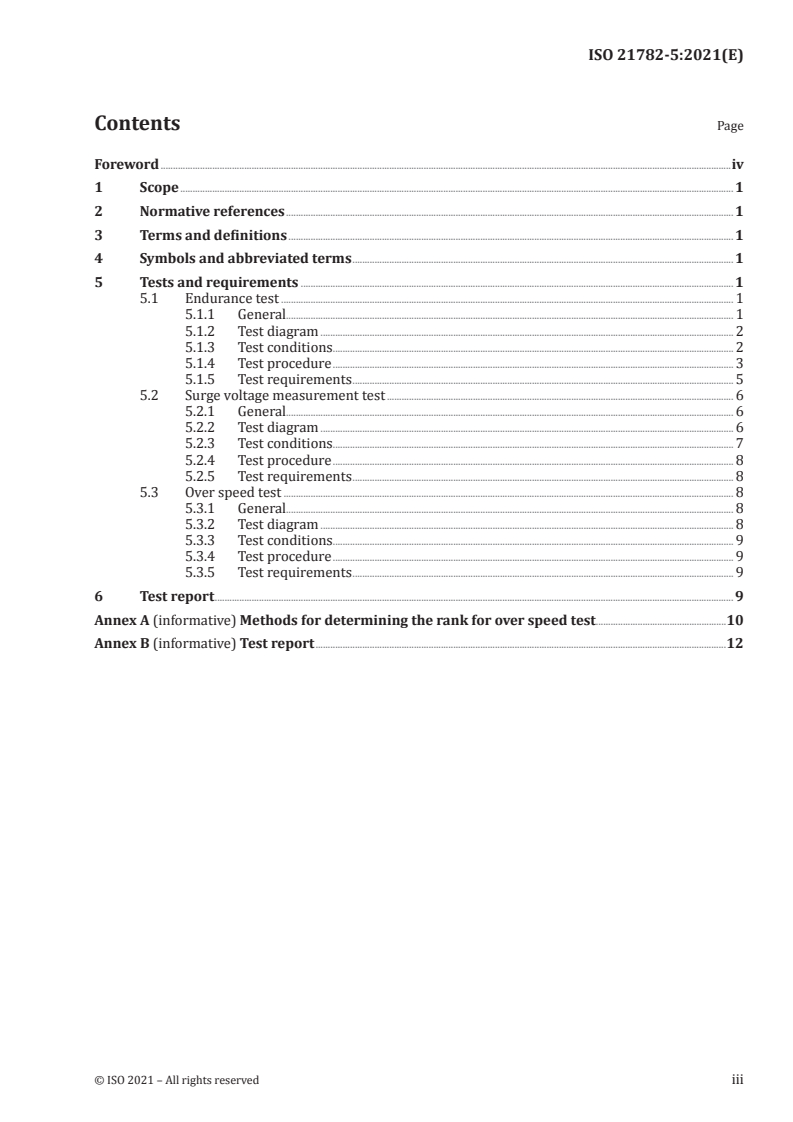
Contents Page
Foreword .iv
1 Scope . 1
2 Normative references . 1
3 Terms and definitions . 1
4 Symbols and abbreviated terms . 1
5 Tests and requirements . 1
5.1 Endurance test . 1
5.1.1 General. 1
5.1.2 Test diagram . 2
5.1.3 Test conditions. 2
5.1.4 Test procedure . 3
5.1.5 Test requirements . 5
5.2 Surge voltage measurement test . 6
5.2.1 General. 6
5.2.2 Test diagram . 6
5.2.3 Test conditions. 7
5.2.4 Test procedure . 8
5.2.5 Test requirements . 8
5.3 Over speed test . 8
5.3.1 General. 8
5.3.2 Test diagram . 8
5.3.3 Test conditions. 9
5.3.4 Test procedure . 9
5.3.5 Test requirements . 9
6 Test report . 9
Annex A (informative) Methods for determining the rank for over speed test .10
Annex B (informative) Test report .12
Foreword
ISO (the International Organization for Standardization) is a worldwide federation of national standards
bodies (ISO member bodies). The work of preparing International Standards is normally carried out
through ISO technical committees. Each member body interested in a subject for which a technical
committee has been established has the right to be represented on that committee. International
organizations, governmental and non-governmental, in liaison with ISO, also take part in the work.
ISO collaborates closely with the International Electrotechnical Commission (IEC) on all matters of
electrotechnical standardization.
The procedures used to develop this document and those intended for its further maintenance are
described in the ISO/IEC Directives, Part 1. In particular, the different approval criteria needed for the
different types of ISO documents should be noted. This document was drafted in accordance with the
editorial rules of the ISO/IEC Directives, Part 2 (see www .iso .org/ directives).
Attention is drawn to the possibility that some of the elements of this document may be the subject of
patent rights. ISO shall not be held responsible for identifying any or all such patent rights. Details of
any patent rights identified during the development of the document will be in the Introduction and/or
on the ISO list of patent declarations received (see www .iso .org/ patents).
Any trade name used in this document is information given for the convenience of users and does not
constitute an endorsement.
For an explanation of the voluntary nature of standards, the meaning of ISO specific terms and
expressions related to conformity assessment, as well as information about ISO's adherence to the
World Trade Organization (WTO) principles in the Technical Barriers to Trade (TBT), see www .iso .org/
iso/ foreword .html.
This document was prepared by Technical Committee ISO/TC 22, Road vehicles, Subcommittee SC 37,
Electrically propelled vehicles.
A list of all parts in the ISO 21782 series can be found on the ISO website.
Any feedback or questions on this document should be directed to the user’s national standards body. A
complete listing of these bodies can be found at www .iso .org/ members .html.
iv © ISO 2021 – All rights reserved
INTERNATIONAL STANDARD ISO 21782-5:2021(E)
Electrically propelled road vehicles — Test specification
for electric propulsion components —
Part 5:
Operating load testing of the motor system
1 Scope
This document specifies operating load tests and test criteria for the motor system designed as a
voltage class B electric propulsion system for electrically propelled road vehicles.
2 Normative references
The following documents are referred to in the text in such a way that some or all of their content
constitutes requirements of this document. For dated references, only the edition cited applies. For
undated references, the latest edition of the referenced document (including any amendments) applies.
ISO 21782-1:2019, Electrically propelled road vehicles — Test specification for electric propulsion
components — Part 1: General test conditions and definitions
ISO 21498-1, Electrically propelled road vehicles — Specification of voltage sub-classes for voltage class B
3 Terms and definitions
For the purposes of this document, the terms and definitions given in ISO 21782-1 apply.
ISO and IEC maintain terminological databases for use in standardization at the following addresses:
— ISO Online browsing platform: available at https:// www .iso .org/ obp
— IEC Electropedia: available at http:// www .electropedia .org/
4 Symbols and abbreviated terms
For the purposes of this document, symbols and abbreviated terms given in ISO 21782-1 apply.
5 Tests and requirements
5.1 Endurance test
5.1.1 General
The purpose of this test is to evaluate and rank the strength for the components – motor shaft key,
rotor fixture, shaft tightening part, stator fixtures, power semiconductor chip, and DC bus capacitor –
which are affected by mechanical or electrical fatigue. The test is set considering repeated operations
at the upper specification limits of the motor system, which operate under the conditions of the paired
inverter and motor combination. Unless otherwise specified, the test method can be decided by the
supplier and customer.
5.1.2 Test diagram
The test diagram is shown in Figure 1.
Key
1 DUT
2 motor
3 inverter
4 DC power supply
5 load
6 torque / speed detector
7 power meter
8 torque / speed meter
9 thermo meter
10 inverter output current (in A)
11 motor torque (in Nm)
-1
12 motor speed (in min )
13 measurement points temperatures (in °C)
Figure 1 — Diagram for the endurance test of the motor system
5.1.3 Test conditions
Test conditions are shown in Table 1.
Table 1 — Conditions for endurance test of the motor system
Items Value Remark
Inverter input voltage Rated voltage as defined in ISO 21782- — DC voltage tolerance, see ISO
1:2019, 3.22 21782-1:2019, 5.3
Ambient conditions Room temperature (RT) and humidity as
defined in ISO 21782-1:2019, 5.4
Coolant tem- Liquid Maximum temperature for unlimited operat- — Ethylene glycol and propylene
perature ing capability glycol as example of coolant
Air Maximum temperature for unlimited operat-
ing capability
Coolant flow Liquid Minimum flow rate for unlimited operating
rate capability
Air Minimum flow rate for unlimited operating
capability
2 © ISO 2021 – All rights reserved
5.1.4 Test procedure
The test pattern consisting of maximum torque mode and maximum speed mode is shown in Figure 2.
Time parameter t , t and t in Figure 2 shall be as shown in Table 2. The tests shall be conducted by
1 2 3
alternating the maximum torque mode and maximum speed mode as shown in Figure 3 and Table 3.
The tests shall be conducted by repeating the number of cycles according to the corresponding rank
listed in Table 4. The temperature of each part of the motor system shall be controlled so that they are
substantially equal to the saturation temperature.
NOTE To protect torque meter, test can be performed without it, after setting up the maximum torque. In
that case, torque meter can be replaced by power meter to measure motor input currents.
a) maximum torque mode b) maximum speed mode
Key
t time (in s)
-1
n speed (in min )
-1
n rated speed (in min )
r
-1
n maximum speed (in min )
m
M torque (in Nm)
M maximum torque of the motor system for duration of t =2 (in Nm)
t=2 0
M calculated torque of the motor system at operating point “c” (in Nm)
c
s 1 cycle
t , t , t time parameter
1 2 3
Figure 2 — Endurance test pattern for the motor system
Table 2 — Description of time parameter in Figure 2
Time
Requirements and recommendations
parameters
t This shall be reduced to the technically possible minimum.
t This should be shorter than 1 s.
Table 2 (continued)
Time
Requirements and recommendations
parameters
t Thi
...
INTERNATIONAL ISO
STANDARD 21782-5
First edition
2021-05
Electrically propelled road vehicles —
Test specification for electric
propulsion components —
Part 5:
Operating load testing of the motor
system
Véhicules à propulsion electrique — Spécification d'essai pour les
composants de propulsion électrique —
Partie 5: Essai de charge de fonctionnement d'un système de moteur
Reference number
©
ISO 2021
© ISO 2021
All rights reserved. Unless otherwise specified, or required in the context of its implementation, no part of this publication may
be reproduced or utilized otherwise in any form or by any means, electronic or mechanical, including photocopying, or posting
on the internet or an intranet, without prior written permission. Permission can be requested from either ISO at the address
below or ISO’s member body in the country of the requester.
ISO copyright office
CP 401 • Ch. de Blandonnet 8
CH-1214 Vernier, Geneva
Phone: +41 22 749 01 11
Email: copyright@iso.org
Website: www.iso.org
Published in Switzerland
ii © ISO 2021 – All rights reserved
Contents Page
Foreword .iv
1 Scope . 1
2 Normative references . 1
3 Terms and definitions . 1
4 Symbols and abbreviated terms . 1
5 Tests and requirements . 1
5.1 Endurance test . 1
5.1.1 General. 1
5.1.2 Test diagram . 2
5.1.3 Test conditions. 2
5.1.4 Test procedure . 3
5.1.5 Test requirements . 5
5.2 Surge voltage measurement test . 6
5.2.1 General. 6
5.2.2 Test diagram . 6
5.2.3 Test conditions. 7
5.2.4 Test procedure . 8
5.2.5 Test requirements . 8
5.3 Over speed test . 8
5.3.1 General. 8
5.3.2 Test diagram . 8
5.3.3 Test conditions. 9
5.3.4 Test procedure . 9
5.3.5 Test requirements . 9
6 Test report . 9
Annex A (informative) Methods for determining the rank for over speed test .10
Annex B (informative) Test report .12
Foreword
ISO (the International Organization for Standardization) is a worldwide federation of national standards
bodies (ISO member bodies). The work of preparing International Standards is normally carried out
through ISO technical committees. Each member body interested in a subject for which a technical
committee has been established has the right to be represented on that committee. International
organizations, governmental and non-governmental, in liaison with ISO, also take part in the work.
ISO collaborates closely with the International Electrotechnical Commission (IEC) on all matters of
electrotechnical standardization.
The procedures used to develop this document and those intended for its further maintenance are
described in the ISO/IEC Directives, Part 1. In particular, the different approval criteria needed for the
different types of ISO documents should be noted. This document was drafted in accordance with the
editorial rules of the ISO/IEC Directives, Part 2 (see www .iso .org/ directives).
Attention is drawn to the possibility that some of the elements of this document may be the subject of
patent rights. ISO shall not be held responsible for identifying any or all such patent rights. Details of
any patent rights identified during the development of the document will be in the Introduction and/or
on the ISO list of patent declarations received (see www .iso .org/ patents).
Any trade name used in this document is information given for the convenience of users and does not
constitute an endorsement.
For an explanation of the voluntary nature of standards, the meaning of ISO specific terms and
expressions related to conformity assessment, as well as information about ISO's adherence to the
World Trade Organization (WTO) principles in the Technical Barriers to Trade (TBT), see www .iso .org/
iso/ foreword .html.
This document was prepared by Technical Committee ISO/TC 22, Road vehicles, Subcommittee SC 37,
Electrically propelled vehicles.
A list of all parts in the ISO 21782 series can be found on the ISO website.
Any feedback or questions on this document should be directed to the user’s national standards body. A
complete listing of these bodies can be found at www .iso .org/ members .html.
iv © ISO 2021 – All rights reserved
INTERNATIONAL STANDARD ISO 21782-5:2021(E)
Electrically propelled road vehicles — Test specification
for electric propulsion components —
Part 5:
Operating load testing of the motor system
1 Scope
This document specifies operating load tests and test criteria for the motor system designed as a
voltage class B electric propulsion system for electrically propelled road vehicles.
2 Normative references
The following documents are referred to in the text in such a way that some or all of their content
constitutes requirements of this document. For dated references, only the edition cited applies. For
undated references, the latest edition of the referenced document (including any amendments) applies.
ISO 21782-1:2019, Electrically propelled road vehicles — Test specification for electric propulsion
components — Part 1: General test conditions and definitions
ISO 21498-1, Electrically propelled road vehicles — Specification of voltage sub-classes for voltage class B
3 Terms and definitions
For the purposes of this document, the terms and definitions given in ISO 21782-1 apply.
ISO and IEC maintain terminological databases for use in standardization at the following addresses:
— ISO Online browsing platform: available at https:// www .iso .org/ obp
— IEC Electropedia: available at http:// www .electropedia .org/
4 Symbols and abbreviated terms
For the purposes of this document, symbols and abbreviated terms given in ISO 21782-1 apply.
5 Tests and requirements
5.1 Endurance test
5.1.1 General
The purpose of this test is to evaluate and rank the strength for the components – motor shaft key,
rotor fixture, shaft tightening part, stator fixtures, power semiconductor chip, and DC bus capacitor –
which are affected by mechanical or electrical fatigue. The test is set considering repeated operations
at the upper specification limits of the motor system, which operate under the conditions of the paired
inverter and motor combination. Unless otherwise specified, the test method can be decided by the
supplier and customer.
5.1.2 Test diagram
The test diagram is shown in Figure 1.
Key
1 DUT
2 motor
3 inverter
4 DC power supply
5 load
6 torque / speed detector
7 power meter
8 torque / speed meter
9 thermo meter
10 inverter output current (in A)
11 motor torque (in Nm)
-1
12 motor speed (in min )
13 measurement points temperatures (in °C)
Figure 1 — Diagram for the endurance test of the motor system
5.1.3 Test conditions
Test conditions are shown in Table 1.
Table 1 — Conditions for endurance test of the motor system
Items Value Remark
Inverter input voltage Rated voltage as defined in ISO 21782- — DC voltage tolerance, see ISO
1:2019, 3.22 21782-1:2019, 5.3
Ambient conditions Room temperature (RT) and humidity as
defined in ISO 21782-1:2019, 5.4
Coolant tem- Liquid Maximum temperature for unlimited operat- — Ethylene glycol and propylene
perature ing capability glycol as example of coolant
Air Maximum temperature for unlimited operat-
ing capability
Coolant flow Liquid Minimum flow rate for unlimited operating
rate capability
Air Minimum flow rate for unlimited operating
capability
2 © ISO 2021 – All rights reserved
5.1.4 Test procedure
The test pattern consisting of maximum torque mode and maximum speed mode is shown in Figure 2.
Time parameter t , t and t in Figure 2 shall be as shown in Table 2. The tests shall be conducted by
1 2 3
alternating the maximum torque mode and maximum speed mode as shown in Figure 3 and Table 3.
The tests shall be conducted by repeating the number of cycles according to the corresponding rank
listed in Table 4. The temperature of each part of the motor system shall be controlled so that they are
substantially equal to the saturation temperature.
NOTE To protect torque meter, test can be performed without it, after setting up the maximum torque. In
that case, torque meter can be replaced by power meter to measure motor input currents.
a) maximum torque mode b) maximum speed mode
Key
t time (in s)
-1
n speed (in min )
-1
n rated speed (in min )
r
-1
n maximum speed (in min )
m
M torque (in Nm)
M maximum torque of the motor system for duration of t =2 (in Nm)
t=2 0
M calculated torque of the motor system at operating point “c” (in Nm)
c
s 1 cycle
t , t , t time parameter
1 2 3
Figure 2 — Endurance test pattern for the motor system
Table 2 — Description of time parameter in Figure 2
Time
Requirements and recommendations
parameters
t This shall be reduced to the technically possible minimum.
t This should be shorter than 1 s.
Table 2 (continued)
Time
Requirements and recommendations
parameters
t Thi
...