


ISO 17363:2007
(Main)Supply chain applications of RFID — Freight containers
Supply chain applications of RFID — Freight containers
ISO 17363:2007 defines the usage of read/write radio-frequency identification technology (RFID) cargo shipment-specific tags on freight containers for supply chain management purposes (shipment tags). It defines the air-interface communications, a common set of required data structures, and a commonly organized set of optional data requirements (through common syntax and semantics). It contains recommendations about a containerized cargo supply chain RFID system, based on shipment tags; specific recommendations about mandatory non-reprogrammable information on the shipment tag; and specific recommendations about optional, re-programmable information on the shipment tag. Identified within ISO 17363:2007 are the air-interface and communication parameters for active radio-frequency identification communications using ISO/IEC 18000-7. ISO 17363:2007 is applicable to freight containers as defined in ISO 668 and to freight containers that are not defined by other ISO standards. It complements ISO 10374 for permanent container license-plate tags. It fully describes cargo shipment-specific tags. It does not address smart container technologies affixed to, or inside, freight containers (e.g. sensors) for supply chain management purposes.
Applications RFID à la chaîne logistique — Conteneurs de fret
General Information
- Status
- Withdrawn
- Publication Date
- 18-Jun-2007
- Withdrawal Date
- 18-Jun-2007
- Technical Committee
- ISO/TC 122 - Packaging
- Drafting Committee
- ISO/TC 122/WG 12 - Supply chain applications of logistics technology
- Current Stage
- 9599 - Withdrawal of International Standard
- Start Date
- 25-Feb-2013
- Completion Date
- 12-Feb-2026
Relations
- Effective Date
- 06-Nov-2010

Get Certified
Connect with accredited certification bodies for this standard

BRCGS (Brand Reputation Compliance Global Standards)
Global food safety and quality standards owner.
Sponsored listings
Frequently Asked Questions
ISO 17363:2007 is a standard published by the International Organization for Standardization (ISO). Its full title is "Supply chain applications of RFID — Freight containers". This standard covers: ISO 17363:2007 defines the usage of read/write radio-frequency identification technology (RFID) cargo shipment-specific tags on freight containers for supply chain management purposes (shipment tags). It defines the air-interface communications, a common set of required data structures, and a commonly organized set of optional data requirements (through common syntax and semantics). It contains recommendations about a containerized cargo supply chain RFID system, based on shipment tags; specific recommendations about mandatory non-reprogrammable information on the shipment tag; and specific recommendations about optional, re-programmable information on the shipment tag. Identified within ISO 17363:2007 are the air-interface and communication parameters for active radio-frequency identification communications using ISO/IEC 18000-7. ISO 17363:2007 is applicable to freight containers as defined in ISO 668 and to freight containers that are not defined by other ISO standards. It complements ISO 10374 for permanent container license-plate tags. It fully describes cargo shipment-specific tags. It does not address smart container technologies affixed to, or inside, freight containers (e.g. sensors) for supply chain management purposes.
ISO 17363:2007 defines the usage of read/write radio-frequency identification technology (RFID) cargo shipment-specific tags on freight containers for supply chain management purposes (shipment tags). It defines the air-interface communications, a common set of required data structures, and a commonly organized set of optional data requirements (through common syntax and semantics). It contains recommendations about a containerized cargo supply chain RFID system, based on shipment tags; specific recommendations about mandatory non-reprogrammable information on the shipment tag; and specific recommendations about optional, re-programmable information on the shipment tag. Identified within ISO 17363:2007 are the air-interface and communication parameters for active radio-frequency identification communications using ISO/IEC 18000-7. ISO 17363:2007 is applicable to freight containers as defined in ISO 668 and to freight containers that are not defined by other ISO standards. It complements ISO 10374 for permanent container license-plate tags. It fully describes cargo shipment-specific tags. It does not address smart container technologies affixed to, or inside, freight containers (e.g. sensors) for supply chain management purposes.
ISO 17363:2007 is classified under the following ICS (International Classification for Standards) categories: 55.020 - Packaging and distribution of goods in general. The ICS classification helps identify the subject area and facilitates finding related standards.
ISO 17363:2007 has the following relationships with other standards: It is inter standard links to ISO 17363:2013. Understanding these relationships helps ensure you are using the most current and applicable version of the standard.
ISO 17363:2007 is available in PDF format for immediate download after purchase. The document can be added to your cart and obtained through the secure checkout process. Digital delivery ensures instant access to the complete standard document.
Standards Content (Sample)
INTERNATIONAL ISO
STANDARD 17363
First edition
2007-07-01
Supply chain applications of RFID —
Freight containers
Applications de chaîne d'approvisionnements de RFID — Récipients de
fret
Reference number
©
ISO 2007
PDF disclaimer
This PDF file may contain embedded typefaces. In accordance with Adobe's licensing policy, this file may be printed or viewed but
shall not be edited unless the typefaces which are embedded are licensed to and installed on the computer performing the editing. In
downloading this file, parties accept therein the responsibility of not infringing Adobe's licensing policy. The ISO Central Secretariat
accepts no liability in this area.
Adobe is a trademark of Adobe Systems Incorporated.
Details of the software products used to create this PDF file can be found in the General Info relative to the file; the PDF-creation
parameters were optimized for printing. Every care has been taken to ensure that the file is suitable for use by ISO member bodies. In
the unlikely event that a problem relating to it is found, please inform the Central Secretariat at the address given below.
© ISO 2007
All rights reserved. Unless otherwise specified, no part of this publication may be reproduced or utilized in any form or by any means,
electronic or mechanical, including photocopying and microfilm, without permission in writing from either ISO at the address below or
ISO's member body in the country of the requester.
ISO copyright office
Case postale 56 • CH-1211 Geneva 20
Tel. + 41 22 749 01 11
Fax + 41 22 749 09 47
E-mail copyright@iso.org
Web www.iso.org
Published in Switzerland
ii © ISO 2007 – All rights reserved
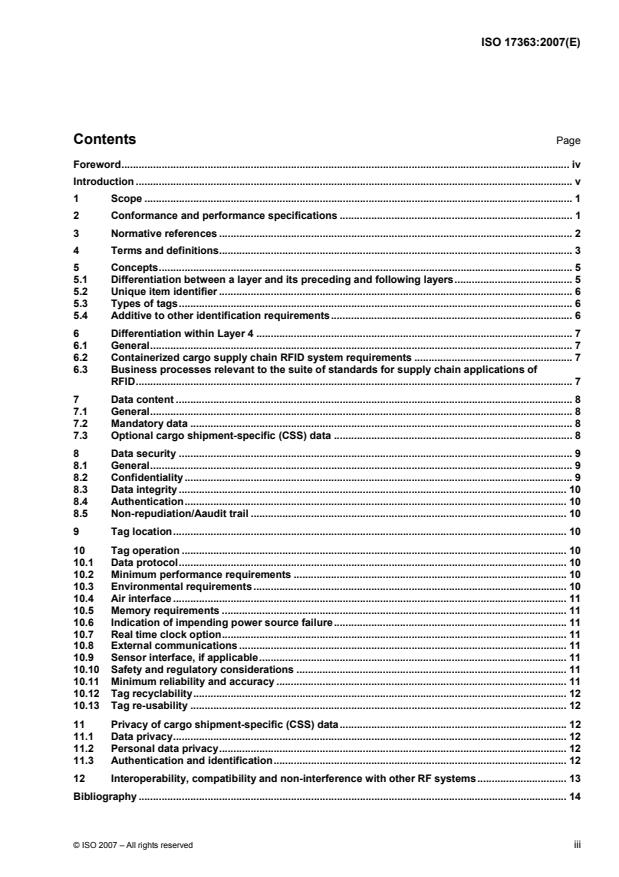
Contents Page
Foreword. iv
Introduction . v
1 Scope . 1
2 Conformance and performance specifications . 1
3 Normative references . 2
4 Terms and definitions. 3
5 Concepts. 5
5.1 Differentiation between a layer and its preceding and following layers. 5
5.2 Unique item identifier . 6
5.3 Types of tags. 6
5.4 Additive to other identification requirements. 6
6 Differentiation within Layer 4 . 7
6.1 General. 7
6.2 Containerized cargo supply chain RFID system requirements . 7
6.3 Business processes relevant to the suite of standards for supply chain applications of
RFID. 7
7 Data content . 8
7.1 General. 8
7.2 Mandatory data . 8
7.3 Optional cargo shipment-specific (CSS) data . 8
8 Data security . 9
8.1 General. 9
8.2 Confidentiality. 9
8.3 Data integrity . 10
8.4 Authentication. 10
8.5 Non-repudiation/Aaudit trail . 10
9 Tag location. 10
10 Tag operation . 10
10.1 Data protocol. 10
10.2 Minimum performance requirements . 10
10.3 Environmental requirements . 10
10.4 Air interface . 11
10.5 Memory requirements . 11
10.6 Indication of impending power source failure. 11
10.7 Real time clock option. 11
10.8 External communications . 11
10.9 Sensor interface, if applicable. 11
10.10 Safety and regulatory considerations . 11
10.11 Minimum reliability and accuracy . 11
10.12 Tag recyclability. 12
10.13 Tag re-usability . 12
11 Privacy of cargo shipment-specific (CSS) data. 12
11.1 Data privacy. 12
11.2 Personal data privacy. 12
11.3 Authentication and identification. 12
12 Interoperability, compatibility and non-interference with other RF systems. 13
Bibliography . 14
Foreword
ISO (the International Organization for Standardization) is a worldwide federation of national standards bodies
(ISO member bodies). The work of preparing International Standards is normally carried out through ISO
technical committees. Each member body interested in a subject for which a technical committee has been
established has the right to be represented on that committee. International organizations, governmental and
non-governmental, in liaison with ISO, also take part in the work. ISO collaborates closely with the
International Electrotechnical Commission (IEC) on all matters of electrotechnical standardization.
International Standards are drafted in accordance with the rules given in the ISO/IEC Directives, Part 2.
The main task of technical committees is to prepare International Standards. Draft International Standards
adopted by the technical committees are circulated to the member bodies for voting. Publication as an
International Standard requires approval by at least 75 % of the member bodies casting a vote.
Attention is drawn to the possibility that some of the elements of this document may be the subject of patent
rights. ISO shall not be held responsible for identifying any or all such patent rights.
ISO 17363 was prepared by Technical Committee TC 122, Packaging, in collaboration with Technical
Committee TC 104, Freight containers.
iv © ISO 2007 – All rights reserved
Introduction
The supply chain is a multi-level concept that covers all aspects of taking a product from raw materials to a
final product, to shipping, to a final place of sale. Each of these levels covers many aspects of dealing with
products and the business process for each level is both unique and overlapping with other levels.
This International Standard has been created with a vision of compatibility both at the physical and command
level and the data level with the four other standards within the suite of standards, Supply chain applications
of RFID, together with ISO 10374 and ISO 18185. Due to the different data structures in each of these
standards, they cannot take the form of interchangeability. However, these standards are designed to be
interoperable and non-interfering. They include
⎯ ISO 17363, Supply chain applications of RFID — Freight containers,
⎯ ISO 17364, Supply chain applications of RFID — Returnable transport items (RTIs),
⎯ ISO 17365, Supply chain applications of RFID — Transport units,
⎯ ISO 17366, Supply chain applications of RFID — Product packaging,
⎯ ISO 17367, Supply chain applications of RFID — Product tagging, and
⎯ ISO 10374, Freight containers — Automatic identification
These International Standards define the technical aspects and data hierarchy of supply chain management
information required in each layer of the supply chain. Air interface and communication protocol standards
supported within these standards are the ISO/IEC 18000 series; commands and messages are supported by
ISO/IEC 15961 and ISO/IEC 15962. The semantics of these standards are defined in ISO/IEC 15418 and their
syntax is defined in ISO/IEC 15434.
Excluded, although embraced, is the work of
⎯ ISO/IEC JTC 1/SC 31 in the area of technical standards related to air interface, data semantic and syntax
construction, and conformance standards, and
⎯ ISO/TC 104 in the area of freight container security, including electronic seals (e-seals) (ISO 18185 in
multiple parts), and container identification.
INTERNATIONAL STANDARD ISO 17363:2007(E)
Supply chain applications of RFID — Freight containers
1 Scope
This International Standard defines the usage of read/write radio-frequency identification technology (RFID)
cargo shipment-specific tags on freight containers for supply chain management purposes (“shipment tags”).
This International Standard, through reference to other standards within ISO/TC 122, ISO/TC 104 and
ISO/IEC JTC 1/SC 31, defines the air-interface communications, a common set of required data structures,
and a commonly organized set of optional data requirements (through common syntax and semantics).
It contains the following recommendations:
a) recommendations about a containerized cargo supply chain RFID system, based on shipment tags;
NOTE Such a containerized cargo supply chain RFID system would co-exist with, but be separate from, a container
security and identification RFID framework using permanent container lifetime RFID tags (“container tags”), described
in ISO 10374, and cargo shipment-specific electronic seals (e-seals) for which a standard in multiple parts
(ISO 18185) is being developed. Specifically, readings for container security and identification purposes of the
information in the container tags and e-seals are intended to be in separate messages and not through the shipment
tag.
b) specific recommendations about mandatory non-reprogrammable information on the shipment tag;
c) specific recommendations about optional, reprogrammable information on the shipment tag.
Identified within this International Standard are the air-interface and communication parameters for active
radio-frequency identification communications using ISO/IEC 18000-7.
This International Standard is applicable to freight containers as defined in ISO 668 and to freight containers
that are not defined by other ISO standards. It complements ISO 10374 for permanent container license-plate
tags (see 4.7), hereinafter referred to as “container tags”.
This International Standard fully describes cargo shipment-specific tags (see 4.8), hereinafter referred to as
“shipment tags”.
It does not address “smart” container technologies affixed to, or inside, freight containers (e.g. sensors) for
supply chain management purposes. These issues will be addressed in future revisions.
2 Conformance and performance specifications
All of the devices and equipment that claim compliance with this International Standard in either performance
and/or conformance shall also conform to the appropriate sections and parameters specified in
ISO/IEC 18046 for performance and ISO/IEC TR 18047-7 for conformance of active devices operating at
433,92 MHz.
The underlying conformance requirements of this International Standard are to provide the structure
necessary to raise the level of interoperability of components and systems built to this standard, while leaving
open opportunity for continued technical improvement and differentiation.
Implementation of a containerized cargo supply chain RFID system and its components shall be deemed in
conformance with this standard provided that it meets, and supports, the following six (6) requirements:
a) the required functional performance specified in Clause 6.
b) the data requirements specified in Clause 7;
c) the data security requirements specified in Clause 8;
d) the tag location requirements specified in Clause 9;
e) the tag operation requirements specified in Clause 10;
f) the security and privacy requirements specified in Clause 11.
3 Normative references
The following referenced documents are indispensable for the application of this document. For dated
references, only the edition cited applies. For undated references, the latest edition of the referenced
document (including any amendments) applies.
ISO 668, Series 1 freight containers — Classification, dimensions and ratings
ISO 830, Freight containers — Vocabulary
ISO 6346, Freight containers — Coding, identification and marking
ISO 10374, Freight containers — Automatic identification
ISO 18185-3, Freight containers — Electronic seals — Part 3: Environmental characteristics
ISO/IEC 15418, Information technology — Automatic identification and data capture techniques — GS1
application identifiers and ASC MH 10 data identifiers and maintenance
ISO/IEC 15434, Information technology — Automatic identification and data capture techniques — Syntax for
high-capacity ADC media
ISO/IEC 15961, Information technology — Radio frequency identification (RFID) for item management — Data
protocol: application interface
ISO/IEC 15962, Information technology — Radio frequency identification (RFID) for item management — Data
protocol: data encoding rules and logical memory functions
ISO/IEC 15963, Information technology — Radio frequency identification for item management — Unique
identification for RF tags
ISO/IEC 18000-7, Information technology — Radio frequency identification for item management — Part 7:
Parameters for active air interface communications at 433 MHz
ISO/IEC 18046, Information technology — Automatic identification and data capture techniques — Radio
frequency identification device performance test methods
ISO/IEC TR 18047-7, Information technology — Radio frequency identification device conformance test
methods — Part 7: Test methods for active air interface communications at 433 MHz
ISO/IEC 19762 (all parts), Information technology — Automatic identification and data capture (AIDC)
techniques — Harmonized vocabulary
2 © ISO 2007 – All rights reserved
IEEE 1451, Smart Transducer Interface for Sensors and Actuators — Mixed-mode Communication Protocols
and Transducer Electronic Data Sheet (TEDS) Formats
4 Terms and definitions
For the purposes of this document, the terms and definitions given in ISO 830, ISO/IEC 19762 and the
following apply.
4.1
transport unit
either a transport package or a unit load
[ISO 15394:2000, 4.2]
4.2
unit load
one or more transport packages or other items held together by means such as pallet, slip sheet, strapping,
interlocking, glue, shrink wrap, or net wrap, making them suitable for transport, stacking, and storage as a unit
[ISO 15394:2000, 4.2]
4.3
transport package
package intended for the transportation and handling of one or more articles, smaller packages, or bulk
material
[ISO 15394:2000, 4.2]
4.4
returnable transport item
RTI
all means to assemble goods for transportation, storage, handling and product protection in the supply chain
which are returned for further usage, including for example pallets with and without cash deposits, as well as
all forms of reusable crates, trays, boxes, roll pallets, barrels, trolleys, pallet collars and lids
NOTE 1 The term returnable transport item is usually allocated to secondary packaging. But in certain circumstances
also primary packaging may be considered as a form of RTI.
NOTE 2 Freight containers, trailers and other similar enclosed modules are not covered by the term returnable
transport item.
NOTE 3 The term returnable transport equipment is considered to have the same definition as the term returnable
transport item within an electronic data interchange environment.
4.5
product package (primary)
first tie, wrap or container to a single item or quantity thereof that constitutes a complete identifiable pack
NOTE A product package may be an item packaged singularly, multiple quantities of the same item packaged
together or a group of parts packaged together.
[ISO 22742:2005, 3.32]
4.6
product
first level or higher assembly that is sold in a complete end-usable configuration
[EIA 802, 3.16]
4.7
permanent container license-plate tag
container tag
permanently affixed, read-only (including Write Once Read Many – WORM) tag containing limited data
relating only to physical identification and description of the container to which it is affixed
NOTE This tag, affixed by or on behalf of the container owner, should last the lifetime of its associated container
(except in situations where the container changes ownership and/or equipment ID).
4.8
cargo shipment-specific tag
shipment tag
read-write tag into which data specific to a containerized cargo shipment can be stored
NOTE 1 The tag and the data uploaded in it are the responsibility of the shipper.
NOTE 2 The tag may be affixed to the container by the shipper or, per the shipper’s instructions, by the party that
physically performs the loading (“stuffing”) of the container.
NOTE 3 Data capabilities are flexible and may, at the shipper’s discretion, include destination, routing, conveyance or
other transportation information, cargo information (including hazardous material information, where applicable) or other
trip-specific information.
NOTE 4 The tag is intended to perform reliably from the point of stuffing of the container to delivery destination, and to
be removed by the consignee upon final delivery. The tag may be re-usable.
4.9
mandatory shipment tag information
two non-reprogrammable data elements [i.e. a unique permanent ID of the integrated circuit (chip ID) and a
unique permanent ID of the actual tag (tag ID)] and one reprogrammable data element (the tag data routing
code)
NOTE The non-reprogrammable data elements will be imbedded in the shipment tag by the tag manufacturer.
4.10
permanent container tag information
non-reprogrammable information that resides on the container tag for the duration of the lifetime of the
container (or until the container changes ownership and/or equipment ID), and which is uploaded and
maintained by, or on behalf of, the container owner and at its responsibility
NOTE The permanent, non-reprogrammable information elements are specified in ISO 10374.
4.11
cargo shipment-specific (CSS) tag information
optional information residing in the shipment tag for the duration of the containerized cargo shipment until its
final delivery
4.12
integrity
designed such that any modification of the electronically stored information, without proper authorization, is
not possible
4.13
originality
validity
designed such that a compromise of the shipment through misrepresentation of the information on the
shipment tag is not possible under the following circumstances:
⎯ any modification of the mandatory non-reprogrammable information;
⎯ any unauthorized modification of optional reprogrammable information
4 © ISO 2007 – All rights reserved
4.14
freight container
ISO freight container as specified in ISO 668 as well as containers not defined by other ISO standards
4.15
classified information
information which for reasons of national security is restricted to government authorized or approved persons
4.16
tag data routing code
data string that enables the system that reads the tag header to forward in-transit visibility data to the owner of
the tag
5 Concepts
5.1 Differentiation between a layer and its preceding and following layers
The supply chain is a multi-level concept that covers all aspects of taking a product from raw materials to a
...
Questions, Comments and Discussion
Ask us and Technical Secretary will try to provide an answer. You can facilitate discussion about the standard in here.
Loading comments...