

ISO/TR 15801:2017
(Main)Document management — Electronically stored information — Recommendations for trustworthiness and reliability
General Information
- Abstract
ISO/TR 15801:2017 describes the implementation and operation of information management systems that store and make available for use electronically stored information (ESI) in a trustworthy and reliable manner. Such ESI can be of any type, including "page based" information, information in databases and audio/video information. ISO/TR 15801:2017 is for use by any organization that uses systems to store trustworthy ESI over time. Such systems incorporate policies, procedures, technology and audit requirements that ensure that trustworthiness of the ESI is maintained. ISO/TR 15801:2017 does not cover processes used to evaluate whether ESI can be considered to be trustworthy prior to it being stored or imported into the system. However, it can be used to demonstrate that, once the electronic information is stored, output from the system will be a true and accurate reproduction of the ESI created and/or imported.
- Status
- Withdrawn
- Publication Date
- 16-May-2017
- Technical Committee
- ISO/TC 171/SC 1 - Quality, preservation and integrity of information
- Current Stage
- 9599 - Withdrawal of International Standard
- Start Date
- 19-May-2026
- Completion Date
- 29-Aug-2026
Buy Documents

ISO/TR 15801:2017 - Document management -- Electronically stored information -- Recommendations for trustworthiness and reliability
ISO/TR 15801:2017 - Document management — Electronically stored information — Recommendations for trustworthiness and reliability/17/2017
Overview - ISO/TR 15801:2017 (Document management, ESI trustworthiness and reliability)
ISO/TR 15801:2017 provides recommendations for implementing and operating information management systems that store and make available electronically stored information (ESI) in a trustworthy and reliable way. It applies to any organization that uses systems to retain ESI - including page-based documents, databases, and audio/video - and covers the combination of policies, procedures, technology and audit requirements needed to maintain the integrity and authenticity of stored ESI over time. The technical report focuses on ensuring that outputs from the system are true and accurate reproductions of the ESI once stored; it does not prescribe how to evaluate trustworthiness before import.
Key technical topics and requirements
The standard addresses practical elements across the ESI lifecycle, including:
- Information management policy: scope of ESI covered, roles and responsibilities, security classification, storage media, file formats, retention and disposal schedules, outsourcing and compliance.
- Duty of care and information security: trusted system principles, controls, segregation of roles, risk assessment, security policy and business continuity planning.
- Procedures and processes: documented procedures, capture (creation/import), metadata management, version control, date/time stamping, and auditability.
- Document image and data capture: preparation of paper documents, batching, scanning, image quality control, rescanning and image processing considerations.
- Database and indexing considerations: schema, master data management, transactional vs. updating systems, manual and automatic indexing, index accuracy and amendment controls.
- Preservation and retention: preservation strategies, retention schedules, authenticated output procedures and destruction controls.
- Operational resilience: backup and system recovery, system maintenance, storage media considerations, access levels, encryption key handling, and system integrity checks.
- Use of contracted services: managing outsourcing, transport of paper records, and trusted third-party considerations.
Practical applications and who uses it
ISO/TR 15801:2017 is practical for organizations implementing or auditing ESI storage systems, including:
- Records managers and archivists
- IT and systems administrators
- Information security and compliance teams
- Legal and e-discovery professionals
- Business continuity planners
- Service providers offering scanning, archiving or trusted third‑party custody
Use cases include designing trustworthy ESI repositories, drafting information management policies, defining capture/scanning workflows, ensuring reliable authenticated output for legal/regulatory needs, and preparing for audits.
Related standards (commonly used together)
Organizations often align ISO/TR 15801:2017 with other standards for records, information security and digital preservation such as ISO 15489 (records management), ISO/IEC 27001 (information security management) and digital preservation guidance - to build a comprehensive, compliant ESI governance program.
Keywords: ISO/TR 15801:2017, electronically stored information, ESI, document management, trustworthiness, information management policy, scanning, metadata, retention, preservation, backup.
Relations
- Effective Date
- 13-May-2023
- Effective Date
- 28-Jun-2014
Buy Documents
ISO/TR 15801:2017 - Document management -- Electronically stored information -- Recommendations for trustworthiness and reliability
ISO/TR 15801:2017 - Document management — Electronically stored information — Recommendations for trustworthiness and reliability/17/2017
Frequently Asked Questions
ISO/TR 15801:2017 is a technical report published by the International Organization for Standardization (ISO). Its full title is "Document management — Electronically stored information — Recommendations for trustworthiness and reliability". This standard covers: ISO/TR 15801:2017 describes the implementation and operation of information management systems that store and make available for use electronically stored information (ESI) in a trustworthy and reliable manner. Such ESI can be of any type, including "page based" information, information in databases and audio/video information. ISO/TR 15801:2017 is for use by any organization that uses systems to store trustworthy ESI over time. Such systems incorporate policies, procedures, technology and audit requirements that ensure that trustworthiness of the ESI is maintained. ISO/TR 15801:2017 does not cover processes used to evaluate whether ESI can be considered to be trustworthy prior to it being stored or imported into the system. However, it can be used to demonstrate that, once the electronic information is stored, output from the system will be a true and accurate reproduction of the ESI created and/or imported.
ISO/TR 15801:2017 describes the implementation and operation of information management systems that store and make available for use electronically stored information (ESI) in a trustworthy and reliable manner. Such ESI can be of any type, including "page based" information, information in databases and audio/video information. ISO/TR 15801:2017 is for use by any organization that uses systems to store trustworthy ESI over time. Such systems incorporate policies, procedures, technology and audit requirements that ensure that trustworthiness of the ESI is maintained. ISO/TR 15801:2017 does not cover processes used to evaluate whether ESI can be considered to be trustworthy prior to it being stored or imported into the system. However, it can be used to demonstrate that, once the electronic information is stored, output from the system will be a true and accurate reproduction of the ESI created and/or imported.
ISO/TR 15801:2017 is classified under the following ICS (International Classification for Standards) categories: 37.080 - Document imaging applications. The ICS classification helps identify the subject area and facilitates finding related standards.
ISO/TR 15801:2017 has the following relationships with other standards: It is inter standard links to ISO 15801:2026, ISO/TR 15801:2009. Understanding these relationships helps ensure you are using the most current and applicable version of the standard.
ISO/TR 15801:2017 is available in PDF format for immediate download after purchase. The document can be added to your cart and obtained through the secure checkout process. Digital delivery ensures instant access to the complete standard document.
Standards Content (Sample)
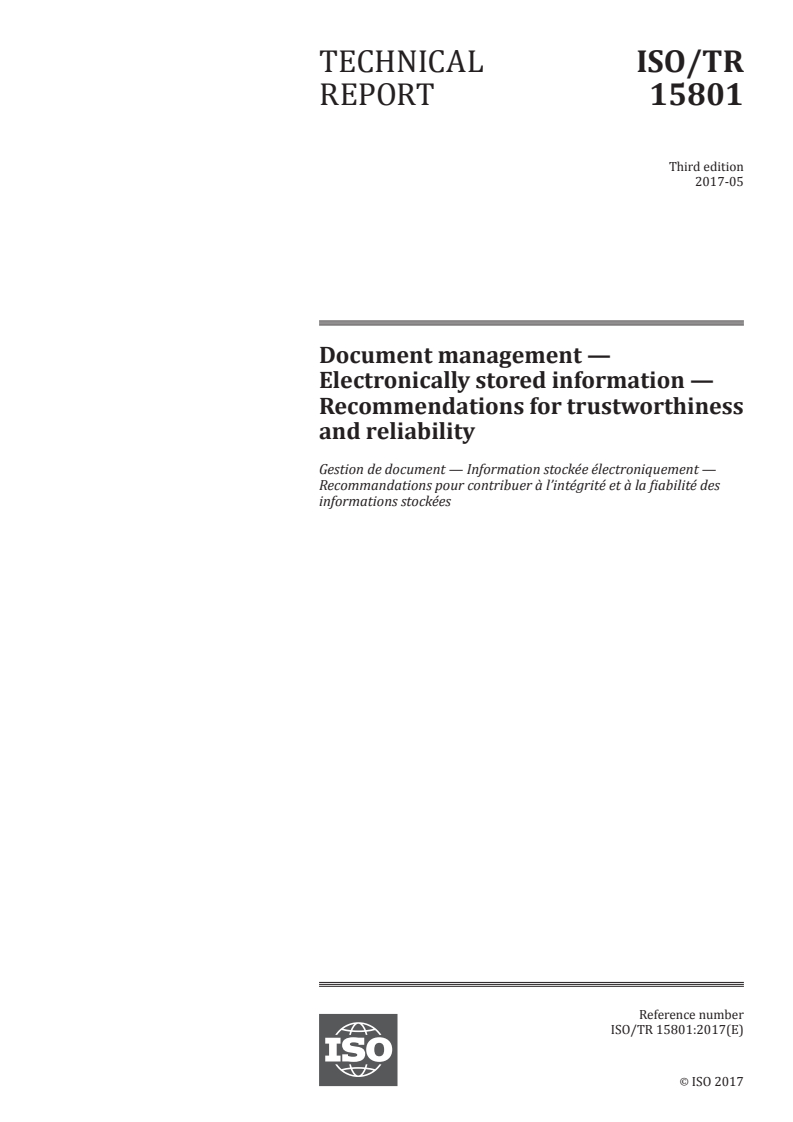
TECHNICAL ISO/TR
REPORT 15801
Third edition
2017-05
Document management —
Electronically stored information —
Recommendations for trustworthiness
and reliability
Gestion de document — Information stockée électroniquement —
Recommandations pour contribuer à l’intégrité et à la fiabilité des
informations stockées
Reference number
©
ISO 2017
© ISO 2017, Published in Switzerland
All rights reserved. Unless otherwise specified, no part of this publication may be reproduced or utilized otherwise in any form
or by any means, electronic or mechanical, including photocopying, or posting on the internet or an intranet, without prior
written permission. Permission can be requested from either ISO at the address below or ISO’s member body in the country of
the requester.
ISO copyright office
Ch. de Blandonnet 8 • CP 401
CH-1214 Vernier, Geneva, Switzerland
Tel. +41 22 749 01 11
Fax +41 22 749 09 47
copyright@iso.org
www.iso.org
ii © ISO 2017 – All rights reserved
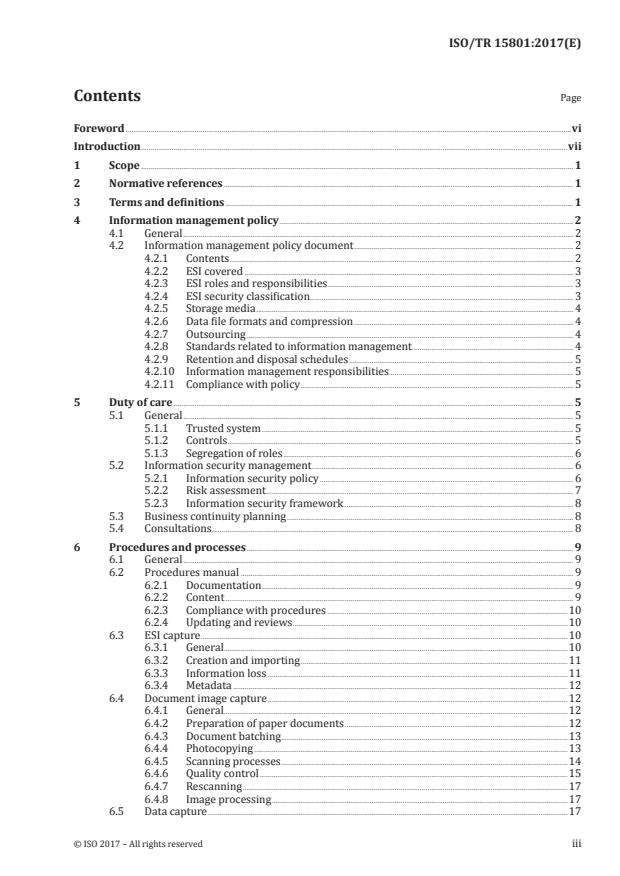
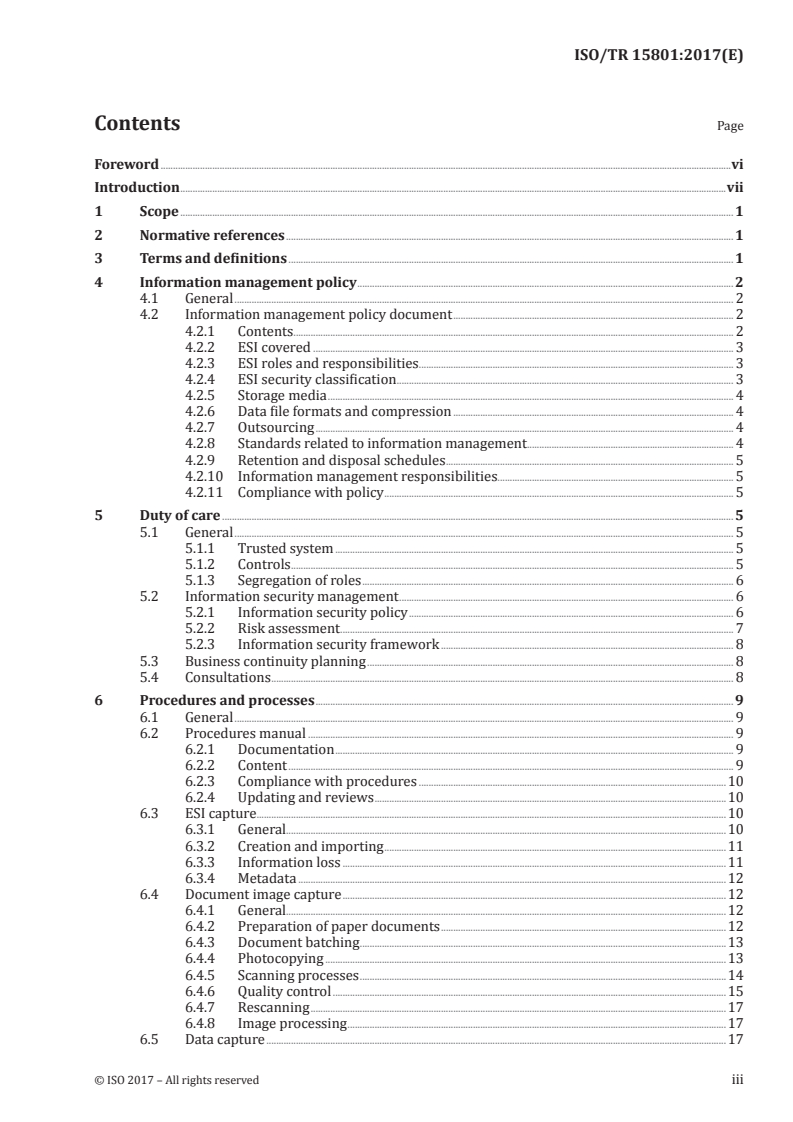
Contents Page
Foreword .vi
Introduction .vii
1 Scope . 1
2 Normative references . 1
3 Terms and definitions . 1
4 Information management policy . 2
4.1 General . 2
4.2 Information management policy document . 2
4.2.1 Contents . . 2
4.2.2 ESI covered . 3
4.2.3 ESI roles and responsibilities . 3
4.2.4 ESI security classification . 3
4.2.5 Storage media . 4
4.2.6 Data file formats and compression . 4
4.2.7 Outsourcing . 4
4.2.8 Standards related to information management . 4
4.2.9 Retention and disposal schedules . 5
4.2.10 Information management responsibilities . . 5
4.2.11 Compliance with policy . 5
5 Duty of care . 5
5.1 General . 5
5.1.1 Trusted system . 5
5.1.2 Controls . 5
5.1.3 Segregation of roles . 6
5.2 Information security management . 6
5.2.1 Information security policy . 6
5.2.2 Risk assessment . . 7
5.2.3 Information security framework . 8
5.3 Business continuity planning . 8
5.4 Consultations . 8
6 Procedures and processes . 9
6.1 General . 9
6.2 Procedures manual . 9
6.2.1 Documentation . 9
6.2.2 Content . 9
6.2.3 Compliance with procedures .10
6.2.4 Updating and reviews .10
6.3 ESI capture .10
6.3.1 General.10
6.3.2 Creation and importing .11
6.3.3 Information loss .11
6.3.4 Metadata .12
6.4 Document image capture .12
6.4.1 General.12
6.4.2 Preparation of paper documents .12
6.4.3 Document batching .13
6.4.4 Photocopying .13
6.4.5 Scanning processes .14
6.4.6 Quality control .15
6.4.7 Rescanning .17
6.4.8 Image processing .17
6.5 Data capture .17
6.5.1 Data creation .17
6.5.2 Conversion and migration .18
6.6 Database considerations .18
6.6.1 General.18
6.6.2 Database systems .18
6.6.3 Database schemas .20
6.6.4 Master data management .20
6.6.5 Transactional vs. updating .21
6.7 Indexing .21
6.7.1 General.21
6.7.2 Manual indexing .21
6.7.3 Automatic indexing .21
6.7.4 Index storage .21
6.7.5 Index amendments .22
6.7.6 Index accuracy .22
6.8 Authenticated output procedures .22
6.9 ESI transmission .23
6.9.1 Intra-system ESI transfer .23
6.9.2 External transmission of files .23
6.10 Information retention .24
6.11 Information preservation .25
6.12 Information destruction .25
6.13 Backup and system recovery .25
6.14 System maintenance .26
6.14.1 General.26
6.14.2 Scanning systems .26
6.15 Security and protection .27
6.15.1 Security procedures .27
6.15.2 Encryption keys .27
6.16 Use of contracted services . .28
6.16.1 General.28
6.16.2 Procedural considerations .28
6.16.3 Transportation of paper documents .29
6.16.4 Use of trusted third party .29
6.17 Workflow .29
6.18 Date and time stamps .30
6.19 Version control .30
6.19.1 Information.30
6.19.2 Documentation .30
6.19.3 Procedures and processes .31
6.20 Maintenance of documentation .31
7 Enabling technologies .31
7.1 General .31
7.2 System description manual .32
7.3 Storage media and sub-system considerations .32
7.4 Access levels .33
7.5 System integrity checks .33
7.5.1 General.33
7.5.2 Digital and electronic signatures (including biometric signatures) .34
7.6 Image processing .34
7.7 Compression techniques .35
7.8 Form overlays and form removal .36
7.9 Environmental considerations .36
7.10 Migration .36
7.11 Information deletion and/or expungement .37
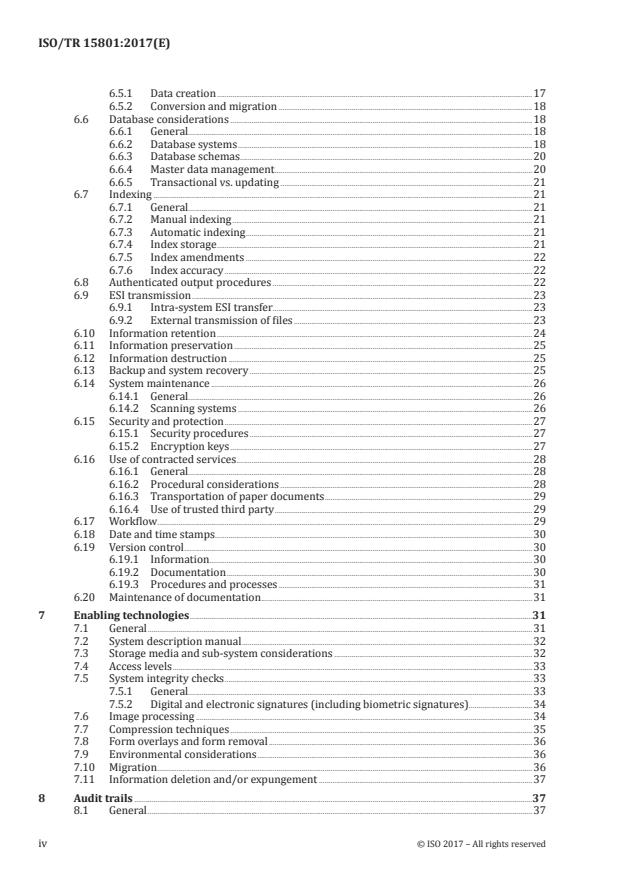
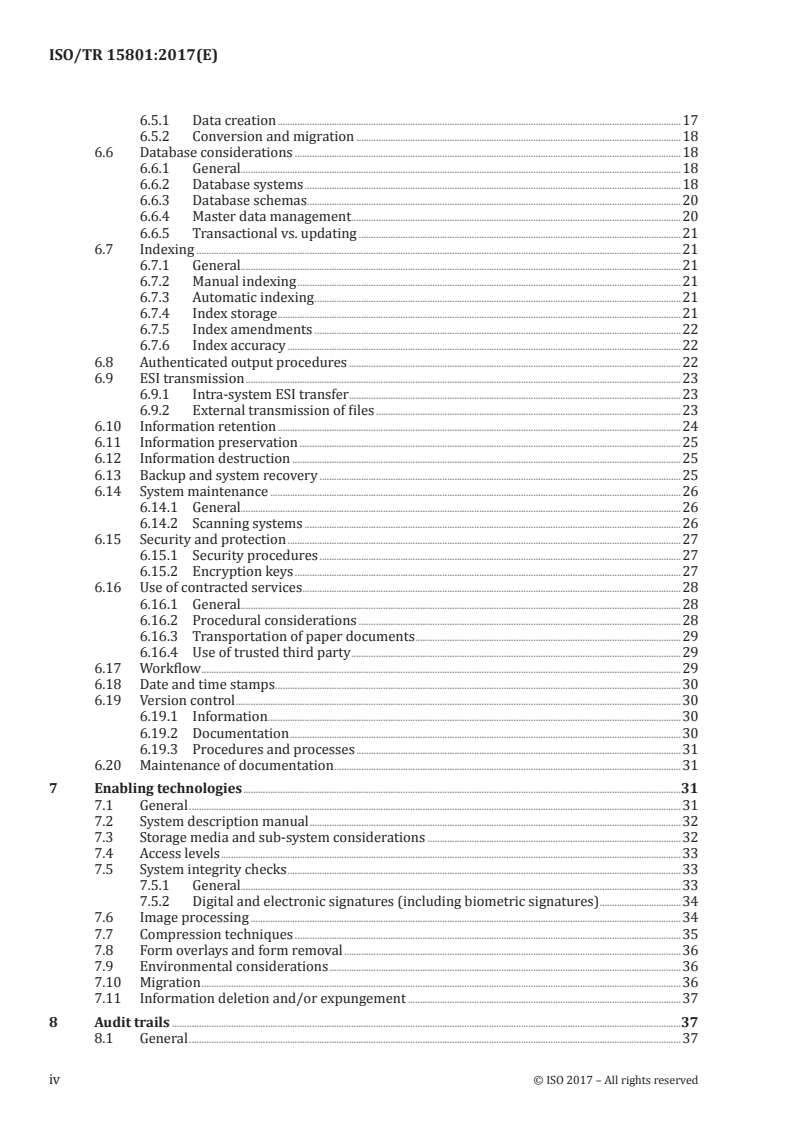
8 Audit trails .37
8.1 General .37
iv © ISO 2017 – All rights reserved
8.1.1 Audit trail data .37
8.1.2 Creation .38
8.1.3 Date and time .38
8.1.4 Storage .38
8.1.5 Access .39
8.1.6 Security and protection .39
8.2 System.39
8.2.1 General.39
8.2.2 Audit trail information .40
8.2.3 Migration and conversion .40
8.3 ESI .40
8.3.1 General.40
8.3.2 ESI capture .40
8.3.3 Batch information .41
8.3.4 Indexing .42
8.3.5 Change control .42
8.3.6 Digital signatures . .42
8.3.7 Destruction of information .43
8.3.8 Workflow .43
Bibliography .44
Foreword
ISO (the International Organization for Standardization) is a worldwide federation of national standards
bodies (ISO member bodies). The work of preparing International Standards is normally carried out
through ISO technical committees. Each member body interested in a subject for which a technical
committee has been established has the right to be represented on that committee. International
organizations, governmental and non-governmental, in liaison with ISO, also take part in the work.
ISO collaborates closely with the International Electrotechnical Commission (IEC) on all matters of
electrotechnical standardization.
The procedures used to develop this document and those intended for its further maintenance are
described in the ISO/IEC Directives, Part 1. In particular, the different approval criteria needed for the
different types of ISO documents should be noted. This document was drafted in accordance with the
editorial rules of the ISO/IEC Directives, Part 2 (see www .iso .org/ directives).
Attention is drawn to the possibility that some of the elements of this document may be the subject of
patent rights. ISO shall not be held responsible for identifying any or all such patent rights. Details of
any patent rights identified during the development of the document will be in the Introduction and/or
on the ISO list of patent declarations received (see www .iso .org/ patents).
Any trade name used in this document is information given for the convenience of users and does not
constitute an endorsement.
For an explanation on the voluntary nature of standards, the meaning of ISO specific terms and
expressions related to conformity assessment, as well as information about ISO’s adherence to the
World Trade Organization (WTO) principles in the Technical Barriers to Trade (TBT) see the following
URL: w w w . i s o .org/ iso/ foreword .html.
This document was prepared by Technical Committee ISO/TC 171, Document management applications,
Subcommittee SC 1, Quality, preservation and integrity of information.
This third edition cancels and replaces the second edition (ISO/TR 15801:2009), which has been
technically revised.
vi © ISO 2017 – All rights reserved
Introduction
This document defines recommended practices for electronic storage of business or other information
in an electronic form. As such, complying with its recommendations is of value to organizations even
when the trustworthiness of the stored information is not being challenged, especially in jurisdictions
with e-discovery legislation.
Information originates from many sources. This document covers information in any form, from the
traditional scanned images, word processed documents and spreadsheets to the more “modern” forms
which include e-mail, web content, instant messages, CAD drawing files, blogs, wikis, etc. Also included
is information stored in databases and other data storage systems. Recommendations in this document
can be useful in systems that use local and/or cloud storage.
Users of this document should be aware that the implementation of these recommendations does
not automatically ensure acceptability of the evidence contained within the information. Where
electronically stored information (ESI) might be required in court or other adversarial situation,
implementers of this document are advised to seek legal advice to ascertain the precise situation within
their relevant legal environment.
This document describes means by which it can be demonstrated, at any time, that the information
created or existing within an information management system has not changed since it was created
within the system or imported into it.
Regardless of the original format, it will be possible to demonstrate that information stored in a
trustworthy information management system can be reliably reproduced in a consistent manner and
accurately reflects what was originally stored without any material modification.
Alternative versions of the information in a document might legitimately develop, e.g. revision of a
contract. In these cases, the new versions are treated as new documents. The same principle can be
applied when a significant change is made to a document in a workflow environment.
Information technology based systems can store, in an electronic form, both documents and records.
This document describes means for storing all types of ESI in a trustworthy and reliable manner, as
part of an information governance strategy. Where records (as defined in ISO 15489-1) are stored,
the requirements of this document can be used in conjunction with those specified in ISO 15489-1 to
ensure that the policies and procedures described in this document work in conjunction with those
specified in ISO 15489-1.
When information preservation is considered, the requirements of ISO 14641 can be used in conjunction
with this document. Readers are advised to use this document in conjunction with other local sources,
particularly with relevance to governmental and legal requirements in their respective jurisdictions.
TECHNICAL REPORT ISO/TR 15801:2017(E)
Document management — Electronically stored
information — Recommendations for trustworthiness and
reliability
1 Scope
This document describes the implementation and operation of information management systems that
store and make available for use electronically stored information (ESI) in a trustworthy and reliable
manner. Such ESI can be of any type, including “page based” information, information in databases and
audio/video information.
This document is for use by any organization that uses systems to store trustworthy ESI over time.
Such systems incorporate policies, procedures, technology and audit requirements that ensure that
trustworthiness of the ESI is maintained.
This document does not cover processes used to evaluate whether ESI can be considered to be
trustworthy prior to it being stored or imported into the system. However, it can be used to demonstrate
that, once the electronic information is stored, output from the system will be a true and accurate
reproduction of the ESI created and/or imported.
2 Normative references
The following documents are referred to in the text in such a way that some or all of their content
constitutes requirements of this document. For dated references, only the edition cited applies. For
undated references, the latest edition of the referenced document (including any amendments) applies.
ISO 12651 (all parts), Electronic document management — Vocabulary
3 Terms and definitions
For the purposes of this document, the terms and definitions given in ISO 12651 (all parts) and the
following apply.
ISO and IEC maintain terminological databases for use in standardization at the following addresses:
— IEC Electropedia: available at http:// www .electropedia .org/
— ISO Online browsing platform: available at http:// www .iso .org/ obp
3.1
electronically stored information
ESI
data or information of any kind and from any source, whose temporal existence is evidenced by being
stored in or on any electronic medium
Note 1 to entry: ESI includes traditional e-mail, memos, letters, spreadsheets, databases, office documents,
presentations and other electronic formats commonly found on a computer. ESI also includes system, application
and file-associated metadata such as timestamps, revision history, file type, etc.
Note 2 to entry: Electronic medium can take the form of, but is not limited to, storage devices and storage
elements.
[SOURCE: ISO/IEC 27040:2015, 3.16]
3.2
information type
groups of related information
Note 1 to entry: In specific applications, “groups” can be identified as “sets”, “files”, “collections” or other
similar terms.
EXAMPLE Invoices, financial documents, data sheets, correspondence.
3.3
trustworthy
ability to demonstrate authenticity, integrity and availability of ESI (3.1) over time
3.4
trusted system
information technology system with the capability of managing ESI (3.1) in a trustworthy (3.3) manner
4 Information management policy
4.1 General
Information is one of the most important assets that any organization has at its disposal. Everything
an organization does involve using information in some way. The quantity of information can be vast
and there are many different ways of representing and storing it. The value of information used and the
manner in which it is applied and moved within and between organizations can determine the success
or failure of those organizations.
Information, like any other asset, needs to be classified, structured, validated, valued, secured,
monitored, measured and managed efficiently and effectively.
This clause describes documentation that states the organization’s policy for the management of ESI.
Additionally, this clause provides guidance to organizations with respect to the level of documentation
required to enable an organization to clearly establish how the ESI contained in a trusted system is
reliable, accurate and trustworthy. Availability of this documentation can also be used to demonstrate
that ESI management is part of normal business procedures.
Where an information management system manages ESI that might be used as evidence in any legal or
business process, the appropriate legal advisors should be consulted (see 5.4) to ensure that compliance
with relevant legal or regulatory requirements is demonstrable. As legal and regulatory requirements
vary from country to country (and sometimes within a country), legal advice should cover all relevant
jurisdictions.
4.2 Information management policy document
4.2.1 Contents
An information management policy document (the policy document) should be produced, documenting
the organization’s policy on the storage of ESI, as applicable to the trusted system.
The policy document should contain sections which:
— specify what ESI is covered (see 4.2.2);
— state policy regarding roles and responsibilities for ESI (see 4.2.3);
— state ESI security classification policies (see 4.2.4);
— state policy regarding storage media (see 4.2.5);
— state policy regarding electronic file formats and version control (see 4.2.6);
2 © ISO 2017 – All rights reserved
— state policy for the use of outsourcing (see 4.2.7);
— state policy regarding relevant information management standards (see 4.2.8);
— define ESI retention and disposal policies (see 4.2.9);
— define responsibilities for information management functions (see 4.2.10);
— define responsibilities for monitoring compliance with this policy (see 4.2.11).
The policy document should be approved by senior management of the organization and should be
reviewed at regular intervals.
Essential to this implementation of this document is the agreement and implementation of a retention
schedule for ESI. Where reference is made to the policy document in the rest of this document, the
retention schedule is included in such a reference.
4.2.2 ESI covered
In order to define the organization’s information management policy, information should be grouped
into types, the policy for all information within a type being consistent. For example, information types
can be specified either by reference to application (e.g. financial projections, invoices, customer address
list), by association with a specific business process (e.g. applications, complaints, renewals) or by
reference to generic groups (e.g. accounting data, customer documents, manufacturing documents).
During the drafting of the policy document, specific information might need to be regrouped to ensure
consistency of policy within an information type.
The policy document should list all types of information that are to be stored in compliance with the
policy. The policy document should include, as an information type, all information produced, received
and stored in compliance with the policy.
4.2.3 ESI roles and responsibilities
The individuals or teams responsible for the management of the ESI should be identified and their roles
defined. These roles should include:
— following a systematic approach to ESI management;
— being business focused and aware of the current business requirements;
— being able to communicate at all levels within the organization;
— having a good understanding of risk management in relation to trustworthy ESI.
4.2.4 ESI security classification
In some applications, it may be appropriate to implement an ESI security classification system, typically
used to indicate the accessibility of particular information. In government and other public bodies, this
is often indicated by the use of security “labels” such as “top secret”, “classified” or “publicly available”.
In the private sector, security classification schemes may be aligned to departmental requirements
(such as accounts, credit control or customer services).
The ESI security classification system should be simple to use and should be based on risk, need,
priority and the degree of protection appropriate. Excessive classification levels should be avoided.
Where an ESI security classification system is in use, the policy document should include with each
information type the relevant classification level.
4.2.5 Storage media
Different types of media have different long-term storage characteristics. Most organizations will
manage ESI on a variety of media types: electronic (hard disk drives, cloud storage), paper, microform,
optical (write-once and rewritable/erasable) or hybrid types. In some applications, specific pieces of
ESI can, throughout their retention period, be stored on different media types.
The organization should have policies regarding the use of specific types of media for different
information storage requirements (e.g. access requirements, retention periods and security
requirements). These policies should be detailed in the policy document.
The media type on which each information type (see 4.2.3) can be stored should be specified.
Where copies of ESI exist, it might be important to be able to demonstrate that no changes have
occurred to any purported copy. In the case of ESI that exist in different versions, for the purposes of
this document, each version should be treated as a new source or original ESI.
The policy for the management of copies of ESI should be detailed in the policy document.
4.2.6 Data file formats and compression
The policy document should contain details of the approved data file formats that can be used for each
information type.
All ESI managed by information management systems require software for retrieval and display. This
software is subject to change, either by the implementation of new releases or by changes to operating
systems and/or hardware. By implementing a policy of approved data file formats and compression
technologies (where utilized), the necessary data migration or alternative procedures can be
implemented satisfactorily to ensure long-term retrieval of the ESI.
Where compression techniques are employed, policy on their use should be documented.
Where multiple versions of ESI can exist, a policy is required which ensures that all relevant versions
are managed and their relationship maintained. The policy document should contain details of policy
on the management of versions of ESI.
For additional information on this, see 6.5.2, 6.11, 7.10 and 8.2.3.
4.2.7 Outsourcing
The policy document should contain guidelines on the use of outsourcing processes that can be used
for each information type. The policy should include the use of specific contract clauses where this is
appropriate [in particular, where information about individuals (personal data, PII) is involved]; this
can be achieved by the use of standard contract clauses or the use of a draft contract. It may also be
appropriate for the policy document to require an appropriate service level agreement to be included in
the final contract with the outsource organization.
For additional information, see 6.16.
4.2.8 Standards related to information management
Where the organization operates a quality management system (such as the ISO 9000- series) whose
scope includes part or all of the trusted system, all relevant procedural documentation should be
included in the quality management system.
Where national or international regulatory requirements are mandatory, or where national or
International Standards are applicable, they should be listed and complied with.
4 © ISO 2017 – All rights reserved
4.2.9 Retention and disposal schedules
A retention schedule should be established for each information type.
Retention periods should be agreed by all relevant departments and personnel within the organization.
Retention periods should be agreed upon after taking relevant advice to ensure that legal or regulatory
issues, or both, are resolved.
All relevant system and procedural documentation that is produced should be covered by the retention
schedule.
The retention schedule should include the organization’s policy for its periodic review.
The retention schedule should include the organization’s policy for the controlled destruction of ESI.
4.2.10 Information management responsibilities
Individual or job function responsibilities for the policy document should be defined in the policy
document. Individual or job function responsibilities for each information type should be identified and
included in the policy document.
Individual or job function responsibilities should include the need to seek relevant advice when creating
or updating the contents of the policy document.
4.2.11 Compliance with policy
Where it is important that compliance with the policy document can be demonstrated, the individual
or job function responsibilities for obtaining and maintaining such compliance should be identified and
defined.
5 Duty of care
5.1 General
5.1.1 Trusted system
A trusted system is one that ensures that all ESI managed by the system can be considered to be original
information, or a true and accurate copy of the original information, regardless of the original format.
Trusted systems should include the following as a recommended minimum:
— the creation of at least one copy of the ESI on to a system that protects the ESI from modification,
inappropriate additions or deletion throughout its approved lifecycle; this copy needs to be stored
and maintained in a safe location that is separate and remote from other copies of the ESI;
— the utilization of hardware and storage media that protect the ESI from modification, inappropriate
additions or deletion throughout its approved lifecycle (see also 7.3);
— the ability to verify through i
...
TECHNICAL ISO/TR
REPORT 15801
Third edition
2017-05
Document management —
Electronically stored information —
Recommendations for trustworthiness
and reliability
Gestion de document — Information stockée électroniquement —
Recommandations pour contribuer à l’intégrité et à la fiabilité des
informations stockées
Reference number
©
ISO 2017
© ISO 2017, Published in Switzerland
All rights reserved. Unless otherwise specified, no part of this publication may be reproduced or utilized otherwise in any form
or by any means, electronic or mechanical, including photocopying, or posting on the internet or an intranet, without prior
written permission. Permission can be requested from either ISO at the address below or ISO’s member body in the country of
the requester.
ISO copyright office
Ch. de Blandonnet 8 • CP 401
CH-1214 Vernier, Geneva, Switzerland
Tel. +41 22 749 01 11
Fax +41 22 749 09 47
copyright@iso.org
www.iso.org
ii © ISO 2017 – All rights reserved
Contents Page
Foreword .vi
Introduction .vii
1 Scope . 1
2 Normative references . 1
3 Terms and definitions . 1
4 Information management policy . 2
4.1 General . 2
4.2 Information management policy document . 2
4.2.1 Contents . . 2
4.2.2 ESI covered . 3
4.2.3 ESI roles and responsibilities . 3
4.2.4 ESI security classification . 3
4.2.5 Storage media . 4
4.2.6 Data file formats and compression . 4
4.2.7 Outsourcing . 4
4.2.8 Standards related to information management . 4
4.2.9 Retention and disposal schedules . 5
4.2.10 Information management responsibilities . . 5
4.2.11 Compliance with policy . 5
5 Duty of care . 5
5.1 General . 5
5.1.1 Trusted system . 5
5.1.2 Controls . 5
5.1.3 Segregation of roles . 6
5.2 Information security management . 6
5.2.1 Information security policy . 6
5.2.2 Risk assessment . . 7
5.2.3 Information security framework . 8
5.3 Business continuity planning . 8
5.4 Consultations . 8
6 Procedures and processes . 9
6.1 General . 9
6.2 Procedures manual . 9
6.2.1 Documentation . 9
6.2.2 Content . 9
6.2.3 Compliance with procedures .10
6.2.4 Updating and reviews .10
6.3 ESI capture .10
6.3.1 General.10
6.3.2 Creation and importing .11
6.3.3 Information loss .11
6.3.4 Metadata .12
6.4 Document image capture .12
6.4.1 General.12
6.4.2 Preparation of paper documents .12
6.4.3 Document batching .13
6.4.4 Photocopying .13
6.4.5 Scanning processes .14
6.4.6 Quality control .15
6.4.7 Rescanning .17
6.4.8 Image processing .17
6.5 Data capture .17
6.5.1 Data creation .17
6.5.2 Conversion and migration .18
6.6 Database considerations .18
6.6.1 General.18
6.6.2 Database systems .18
6.6.3 Database schemas .20
6.6.4 Master data management .20
6.6.5 Transactional vs. updating .21
6.7 Indexing .21
6.7.1 General.21
6.7.2 Manual indexing .21
6.7.3 Automatic indexing .21
6.7.4 Index storage .21
6.7.5 Index amendments .22
6.7.6 Index accuracy .22
6.8 Authenticated output procedures .22
6.9 ESI transmission .23
6.9.1 Intra-system ESI transfer .23
6.9.2 External transmission of files .23
6.10 Information retention .24
6.11 Information preservation .25
6.12 Information destruction .25
6.13 Backup and system recovery .25
6.14 System maintenance .26
6.14.1 General.26
6.14.2 Scanning systems .26
6.15 Security and protection .27
6.15.1 Security procedures .27
6.15.2 Encryption keys .27
6.16 Use of contracted services . .28
6.16.1 General.28
6.16.2 Procedural considerations .28
6.16.3 Transportation of paper documents .29
6.16.4 Use of trusted third party .29
6.17 Workflow .29
6.18 Date and time stamps .30
6.19 Version control .30
6.19.1 Information.30
6.19.2 Documentation .30
6.19.3 Procedures and processes .31
6.20 Maintenance of documentation .31
7 Enabling technologies .31
7.1 General .31
7.2 System description manual .32
7.3 Storage media and sub-system considerations .32
7.4 Access levels .33
7.5 System integrity checks .33
7.5.1 General.33
7.5.2 Digital and electronic signatures (including biometric signatures) .34
7.6 Image processing .34
7.7 Compression techniques .35
7.8 Form overlays and form removal .36
7.9 Environmental considerations .36
7.10 Migration .36
7.11 Information deletion and/or expungement .37
8 Audit trails .37
8.1 General .37
iv © ISO 2017 – All rights reserved
8.1.1 Audit trail data .37
8.1.2 Creation .38
8.1.3 Date and time .38
8.1.4 Storage .38
8.1.5 Access .39
8.1.6 Security and protection .39
8.2 System.39
8.2.1 General.39
8.2.2 Audit trail information .40
8.2.3 Migration and conversion .40
8.3 ESI .40
8.3.1 General.40
8.3.2 ESI capture .40
8.3.3 Batch information .41
8.3.4 Indexing .42
8.3.5 Change control .42
8.3.6 Digital signatures . .42
8.3.7 Destruction of information .43
8.3.8 Workflow .43
Bibliography .44
Foreword
ISO (the International Organization for Standardization) is a worldwide federation of national standards
bodies (ISO member bodies). The work of preparing International Standards is normally carried out
through ISO technical committees. Each member body interested in a subject for which a technical
committee has been established has the right to be represented on that committee. International
organizations, governmental and non-governmental, in liaison with ISO, also take part in the work.
ISO collaborates closely with the International Electrotechnical Commission (IEC) on all matters of
electrotechnical standardization.
The procedures used to develop this document and those intended for its further maintenance are
described in the ISO/IEC Directives, Part 1. In particular, the different approval criteria needed for the
different types of ISO documents should be noted. This document was drafted in accordance with the
editorial rules of the ISO/IEC Directives, Part 2 (see www .iso .org/ directives).
Attention is drawn to the possibility that some of the elements of this document may be the subject of
patent rights. ISO shall not be held responsible for identifying any or all such patent rights. Details of
any patent rights identified during the development of the document will be in the Introduction and/or
on the ISO list of patent declarations received (see www .iso .org/ patents).
Any trade name used in this document is information given for the convenience of users and does not
constitute an endorsement.
For an explanation on the voluntary nature of standards, the meaning of ISO specific terms and
expressions related to conformity assessment, as well as information about ISO’s adherence to the
World Trade Organization (WTO) principles in the Technical Barriers to Trade (TBT) see the following
URL: w w w . i s o .org/ iso/ foreword .html.
This document was prepared by Technical Committee ISO/TC 171, Document management applications,
Subcommittee SC 1, Quality, preservation and integrity of information.
This third edition cancels and replaces the second edition (ISO/TR 15801:2009), which has been
technically revised.
vi © ISO 2017 – All rights reserved
Introduction
This document defines recommended practices for electronic storage of business or other information
in an electronic form. As such, complying with its recommendations is of value to organizations even
when the trustworthiness of the stored information is not being challenged, especially in jurisdictions
with e-discovery legislation.
Information originates from many sources. This document covers information in any form, from the
traditional scanned images, word processed documents and spreadsheets to the more “modern” forms
which include e-mail, web content, instant messages, CAD drawing files, blogs, wikis, etc. Also included
is information stored in databases and other data storage systems. Recommendations in this document
can be useful in systems that use local and/or cloud storage.
Users of this document should be aware that the implementation of these recommendations does
not automatically ensure acceptability of the evidence contained within the information. Where
electronically stored information (ESI) might be required in court or other adversarial situation,
implementers of this document are advised to seek legal advice to ascertain the precise situation within
their relevant legal environment.
This document describes means by which it can be demonstrated, at any time, that the information
created or existing within an information management system has not changed since it was created
within the system or imported into it.
Regardless of the original format, it will be possible to demonstrate that information stored in a
trustworthy information management system can be reliably reproduced in a consistent manner and
accurately reflects what was originally stored without any material modification.
Alternative versions of the information in a document might legitimately develop, e.g. revision of a
contract. In these cases, the new versions are treated as new documents. The same principle can be
applied when a significant change is made to a document in a workflow environment.
Information technology based systems can store, in an electronic form, both documents and records.
This document describes means for storing all types of ESI in a trustworthy and reliable manner, as
part of an information governance strategy. Where records (as defined in ISO 15489-1) are stored,
the requirements of this document can be used in conjunction with those specified in ISO 15489-1 to
ensure that the policies and procedures described in this document work in conjunction with those
specified in ISO 15489-1.
When information preservation is considered, the requirements of ISO 14641 can be used in conjunction
with this document. Readers are advised to use this document in conjunction with other local sources,
particularly with relevance to governmental and legal requirements in their respective jurisdictions.
TECHNICAL REPORT ISO/TR 15801:2017(E)
Document management — Electronically stored
information — Recommendations for trustworthiness and
reliability
1 Scope
This document describes the implementation and operation of information management systems that
store and make available for use electronically stored information (ESI) in a trustworthy and reliable
manner. Such ESI can be of any type, including “page based” information, information in databases and
audio/video information.
This document is for use by any organization that uses systems to store trustworthy ESI over time.
Such systems incorporate policies, procedures, technology and audit requirements that ensure that
trustworthiness of the ESI is maintained.
This document does not cover processes used to evaluate whether ESI can be considered to be
trustworthy prior to it being stored or imported into the system. However, it can be used to demonstrate
that, once the electronic information is stored, output from the system will be a true and accurate
reproduction of the ESI created and/or imported.
2 Normative references
The following documents are referred to in the text in such a way that some or all of their content
constitutes requirements of this document. For dated references, only the edition cited applies. For
undated references, the latest edition of the referenced document (including any amendments) applies.
ISO 12651 (all parts), Electronic document management — Vocabulary
3 Terms and definitions
For the purposes of this document, the terms and definitions given in ISO 12651 (all parts) and the
following apply.
ISO and IEC maintain terminological databases for use in standardization at the following addresses:
— IEC Electropedia: available at http:// www .electropedia .org/
— ISO Online browsing platform: available at http:// www .iso .org/ obp
3.1
electronically stored information
ESI
data or information of any kind and from any source, whose temporal existence is evidenced by being
stored in or on any electronic medium
Note 1 to entry: ESI includes traditional e-mail, memos, letters, spreadsheets, databases, office documents,
presentations and other electronic formats commonly found on a computer. ESI also includes system, application
and file-associated metadata such as timestamps, revision history, file type, etc.
Note 2 to entry: Electronic medium can take the form of, but is not limited to, storage devices and storage
elements.
[SOURCE: ISO/IEC 27040:2015, 3.16]
3.2
information type
groups of related information
Note 1 to entry: In specific applications, “groups” can be identified as “sets”, “files”, “collections” or other
similar terms.
EXAMPLE Invoices, financial documents, data sheets, correspondence.
3.3
trustworthy
ability to demonstrate authenticity, integrity and availability of ESI (3.1) over time
3.4
trusted system
information technology system with the capability of managing ESI (3.1) in a trustworthy (3.3) manner
4 Information management policy
4.1 General
Information is one of the most important assets that any organization has at its disposal. Everything
an organization does involve using information in some way. The quantity of information can be vast
and there are many different ways of representing and storing it. The value of information used and the
manner in which it is applied and moved within and between organizations can determine the success
or failure of those organizations.
Information, like any other asset, needs to be classified, structured, validated, valued, secured,
monitored, measured and managed efficiently and effectively.
This clause describes documentation that states the organization’s policy for the management of ESI.
Additionally, this clause provides guidance to organizations with respect to the level of documentation
required to enable an organization to clearly establish how the ESI contained in a trusted system is
reliable, accurate and trustworthy. Availability of this documentation can also be used to demonstrate
that ESI management is part of normal business procedures.
Where an information management system manages ESI that might be used as evidence in any legal or
business process, the appropriate legal advisors should be consulted (see 5.4) to ensure that compliance
with relevant legal or regulatory requirements is demonstrable. As legal and regulatory requirements
vary from country to country (and sometimes within a country), legal advice should cover all relevant
jurisdictions.
4.2 Information management policy document
4.2.1 Contents
An information management policy document (the policy document) should be produced, documenting
the organization’s policy on the storage of ESI, as applicable to the trusted system.
The policy document should contain sections which:
— specify what ESI is covered (see 4.2.2);
— state policy regarding roles and responsibilities for ESI (see 4.2.3);
— state ESI security classification policies (see 4.2.4);
— state policy regarding storage media (see 4.2.5);
— state policy regarding electronic file formats and version control (see 4.2.6);
2 © ISO 2017 – All rights reserved
— state policy for the use of outsourcing (see 4.2.7);
— state policy regarding relevant information management standards (see 4.2.8);
— define ESI retention and disposal policies (see 4.2.9);
— define responsibilities for information management functions (see 4.2.10);
— define responsibilities for monitoring compliance with this policy (see 4.2.11).
The policy document should be approved by senior management of the organization and should be
reviewed at regular intervals.
Essential to this implementation of this document is the agreement and implementation of a retention
schedule for ESI. Where reference is made to the policy document in the rest of this document, the
retention schedule is included in such a reference.
4.2.2 ESI covered
In order to define the organization’s information management policy, information should be grouped
into types, the policy for all information within a type being consistent. For example, information types
can be specified either by reference to application (e.g. financial projections, invoices, customer address
list), by association with a specific business process (e.g. applications, complaints, renewals) or by
reference to generic groups (e.g. accounting data, customer documents, manufacturing documents).
During the drafting of the policy document, specific information might need to be regrouped to ensure
consistency of policy within an information type.
The policy document should list all types of information that are to be stored in compliance with the
policy. The policy document should include, as an information type, all information produced, received
and stored in compliance with the policy.
4.2.3 ESI roles and responsibilities
The individuals or teams responsible for the management of the ESI should be identified and their roles
defined. These roles should include:
— following a systematic approach to ESI management;
— being business focused and aware of the current business requirements;
— being able to communicate at all levels within the organization;
— having a good understanding of risk management in relation to trustworthy ESI.
4.2.4 ESI security classification
In some applications, it may be appropriate to implement an ESI security classification system, typically
used to indicate the accessibility of particular information. In government and other public bodies, this
is often indicated by the use of security “labels” such as “top secret”, “classified” or “publicly available”.
In the private sector, security classification schemes may be aligned to departmental requirements
(such as accounts, credit control or customer services).
The ESI security classification system should be simple to use and should be based on risk, need,
priority and the degree of protection appropriate. Excessive classification levels should be avoided.
Where an ESI security classification system is in use, the policy document should include with each
information type the relevant classification level.
4.2.5 Storage media
Different types of media have different long-term storage characteristics. Most organizations will
manage ESI on a variety of media types: electronic (hard disk drives, cloud storage), paper, microform,
optical (write-once and rewritable/erasable) or hybrid types. In some applications, specific pieces of
ESI can, throughout their retention period, be stored on different media types.
The organization should have policies regarding the use of specific types of media for different
information storage requirements (e.g. access requirements, retention periods and security
requirements). These policies should be detailed in the policy document.
The media type on which each information type (see 4.2.3) can be stored should be specified.
Where copies of ESI exist, it might be important to be able to demonstrate that no changes have
occurred to any purported copy. In the case of ESI that exist in different versions, for the purposes of
this document, each version should be treated as a new source or original ESI.
The policy for the management of copies of ESI should be detailed in the policy document.
4.2.6 Data file formats and compression
The policy document should contain details of the approved data file formats that can be used for each
information type.
All ESI managed by information management systems require software for retrieval and display. This
software is subject to change, either by the implementation of new releases or by changes to operating
systems and/or hardware. By implementing a policy of approved data file formats and compression
technologies (where utilized), the necessary data migration or alternative procedures can be
implemented satisfactorily to ensure long-term retrieval of the ESI.
Where compression techniques are employed, policy on their use should be documented.
Where multiple versions of ESI can exist, a policy is required which ensures that all relevant versions
are managed and their relationship maintained. The policy document should contain details of policy
on the management of versions of ESI.
For additional information on this, see 6.5.2, 6.11, 7.10 and 8.2.3.
4.2.7 Outsourcing
The policy document should contain guidelines on the use of outsourcing processes that can be used
for each information type. The policy should include the use of specific contract clauses where this is
appropriate [in particular, where information about individuals (personal data, PII) is involved]; this
can be achieved by the use of standard contract clauses or the use of a draft contract. It may also be
appropriate for the policy document to require an appropriate service level agreement to be included in
the final contract with the outsource organization.
For additional information, see 6.16.
4.2.8 Standards related to information management
Where the organization operates a quality management system (such as the ISO 9000- series) whose
scope includes part or all of the trusted system, all relevant procedural documentation should be
included in the quality management system.
Where national or international regulatory requirements are mandatory, or where national or
International Standards are applicable, they should be listed and complied with.
4 © ISO 2017 – All rights reserved
4.2.9 Retention and disposal schedules
A retention schedule should be established for each information type.
Retention periods should be agreed by all relevant departments and personnel within the organization.
Retention periods should be agreed upon after taking relevant advice to ensure that legal or regulatory
issues, or both, are resolved.
All relevant system and procedural documentation that is produced should be covered by the retention
schedule.
The retention schedule should include the organization’s policy for its periodic review.
The retention schedule should include the organization’s policy for the controlled destruction of ESI.
4.2.10 Information management responsibilities
Individual or job function responsibilities for the policy document should be defined in the policy
document. Individual or job function responsibilities for each information type should be identified and
included in the policy document.
Individual or job function responsibilities should include the need to seek relevant advice when creating
or updating the contents of the policy document.
4.2.11 Compliance with policy
Where it is important that compliance with the policy document can be demonstrated, the individual
or job function responsibilities for obtaining and maintaining such compliance should be identified and
defined.
5 Duty of care
5.1 General
5.1.1 Trusted system
A trusted system is one that ensures that all ESI managed by the system can be considered to be original
information, or a true and accurate copy of the original information, regardless of the original format.
Trusted systems should include the following as a recommended minimum:
— the creation of at least one copy of the ESI on to a system that protects the ESI from modification,
inappropriate additions or deletion throughout its approved lifecycle; this copy needs to be stored
and maintained in a safe location that is separate and remote from other copies of the ESI;
— the utilization of hardware and storage media that protect the ESI from modification, inappropriate
additions or deletion throughout its approved lifecycle (see also 7.3);
— the ability to verify through i
...