

ISO 48-1:2018
(Main)Rubber, vulcanized or thermoplastic — Determination of hardness — Part 1: Introduction and guidance
General Information
- Abstract
This document provides guidance on the determination of the hardness of vulcanized and thermoplastic rubbers. It is intended to provide an understanding of the significance of hardness as a material property and to assist in the selection of an appropriate test method.
- Status
- Published
- Publication Date
- 19-Aug-2018
- Technical Committee
- ISO/TC 45/SC 2 - Testing and analysis
- Drafting Committee
- ISO/TC 45/SC 2/WG 1 - Physical properties
- Current Stage
- 9093 - International Standard confirmed
- Start Date
- 04-Jan-2024
- Completion Date
- 29-Aug-2026
Buy Documents



ISO 48-1:2018 - Rubber, vulcanized or thermoplastic -- Determination of hardness
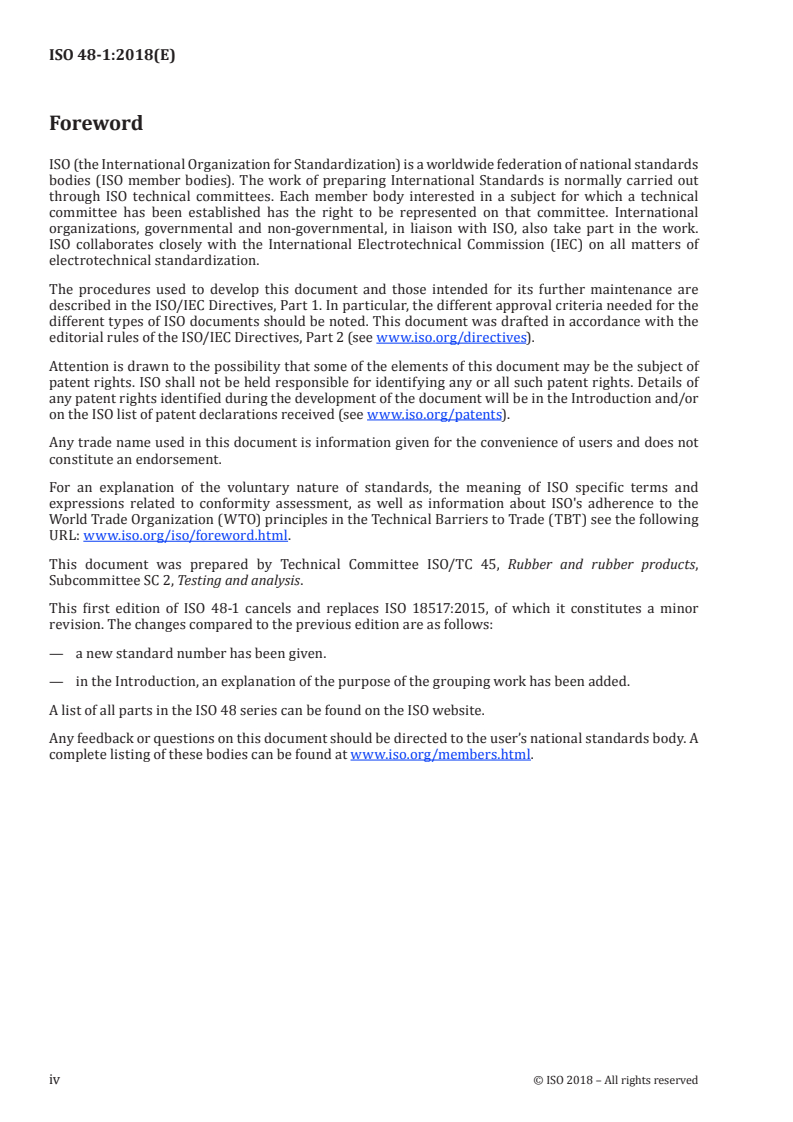
ISO 48-1:2018 - Rubber, vulcanized or thermoplastic — Determination of hardness — Part 1: Introduction and guidance/20/2018



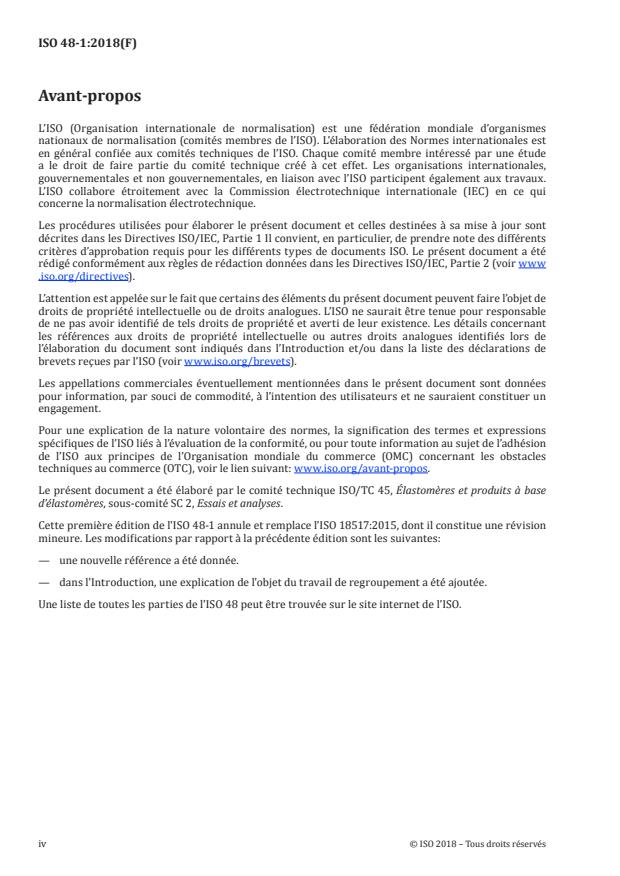
ISO 48-1:2018 - Caoutchouc vulcanisé ou thermoplastique -- Détermination de la dureté
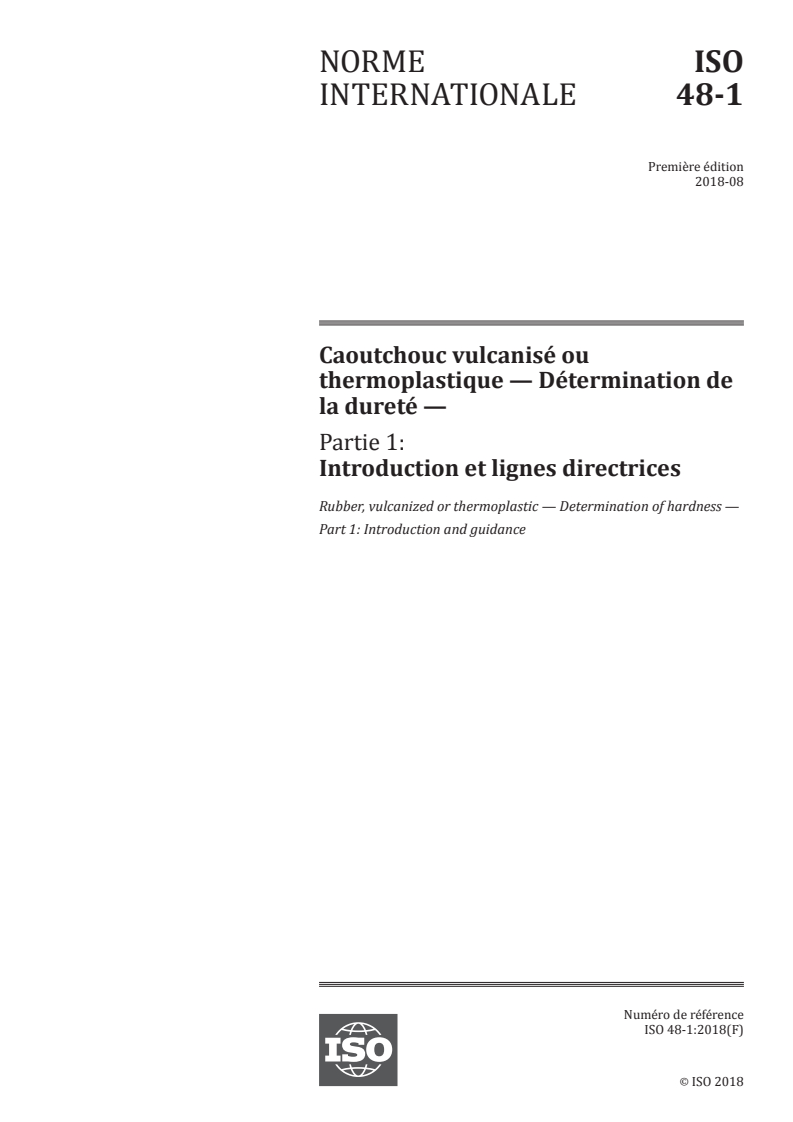
ISO 48-1:2018 - Caoutchouc vulcanisé ou thermoplastique — Détermination de la dureté — Partie 1: Introduction et lignes directrices/20/2018
Overview
ISO 48-1:2018 is an international standard published by ISO that provides guidance on determining the hardness of vulcanized and thermoplastic rubbers. As Part 1 in the ISO 48 series, this document introduces key concepts and aids users in understanding the significance of hardness as a critical material property. It serves as a foundational guide for selecting appropriate test methods aligned with the material type and testing requirements.
The standard covers the principles behind indentation hardness measurement, types of hardness tests, significance of hardness results, and practical considerations such as sample preparation and calibration. Hardness testing plays a crucial role in rubber product design, quality control, and performance assessment.
Key Topics
1. Indentation Hardness Measurement
- Hardness is defined as a measure of stiffness, evaluated by pressing an indentor into the rubber surface and measuring the indentation depth under a constant load.
- The standard explains the typical setup including the indentor, pressure foot, and force application methods, with visual guidance on the test principle.
2. Types of Hardness Tests
- Dead-load tests use weights to apply load; methods in ISO 48-2 specify the IRHD (International Rubber Hardness Degrees) scale from 0 (soft) to 100 (hard).
- Durometer tests employ spring-loaded indentors with popular scales such as Shore A (common for softer rubbers) and Shore D (for harder materials). Variations include micro and pocket hardness meters for specialized applications.
- ISO 48-3 covers very soft materials using a Very Low Rubber Hardness scale (VLRH).
3. Significance of Hardness
- Hardness correlates approximately with the rubber’s modulus but is not a fundamental material property due to its empirical nature.
- Testing is widely appreciated for being simple, inexpensive, non-destructive, and versatile across different rubber formulations.
4. Uses of Hardness Testing
- Essential for quality control, product specification, and classification of rubber compounds.
- Used to assess uniformity of vulcanization, aging effects, contamination, and porosity nondestructively.
- Helpful for troubleshooting manufacturing issues and validating performance requirements.
5. Test Piece Considerations
- Hardness results depend on sample dimensions-thickness and geometry. Standard test pieces are recommended for reliable comparison.
- Results from non-standard test pieces are termed “apparent hardness” and should only be compared under identical testing conditions.
6. Calibration and Standard Blocks
- Hardness testers require periodic calibration per ISO 48-9. Standard reference blocks aid in verifying instrument accuracy between formal calibrations.
7. Comparisons Between Hardness Scales
- While IRHD and Shore A scales generally agree for elastic rubbers in mid-range hardness, deviations occur at extremes and with different material hysteresis behavior.
- Conversion between Shore A and D scales exists but should be treated as approximate.
Applications
ISO 48-1:2018 is highly applicable for:
- Rubber Manufacturers needing standardized hardness testing for material characterization and quality assurance.
- Product Developers selecting rubber compounds with target stiffness properties based on hardness data.
- Test Laboratories performing routine hardness evaluation with guidance on method selection and sample preparation.
- Quality Control Engineers monitoring consistency in vulcanized and thermoplastic rubber products during manufacturing.
- Research and Development tracking rubber aging, degradation, or contamination effects through changes in hardness.
- Rubber Roller and Sheeting Producers using specialized hardness techniques for coated or curved surfaces.
Related Standards
The ISO 48-1:2018 standard is part of a comprehensive series covering rubber hardness testing, including:
- ISO 48-2: Hardness determination between 10 IRHD and 100 IRHD using dead-load methods.
- ISO 48-3: Very low rubber hardness scale (VLRH) method for extremely soft rubbers.
- ISO 48-4: Durometer methods using Shore hardness scales (A, D, AO, AM).
- ISO 48-5: Pocket hardness meter method read on the IRHD scale.
- ISO 48-6 to ISO 48-8: Apparent hardness assessment for rubber-covered rollers and other specialized applications.
- ISO 48-9: Calibration method for hardness testers and reference blocks.
This structured grouping offers a clear framework for comprehensive and consistent measurement of rubber hardness across diverse testing environments.
By following ISO 48-1:2018, stakeholders in the rubber industry can ensure reliable, standardized hardness testing practices that support material selection, quality control, and product performance evaluation. This contributes to improved product reliability and enhanced customer satisfaction in rubber-based applications.
Relations
- Effective Date
- 09-Feb-2026
- Revises
ISO 18517:2015 - Rubber, vulcanized or thermoplastic — Hardness testing — Introduction and guide - Effective Date
- 15-Dec-2017
Buy Documents
ISO 48-1:2018 - Rubber, vulcanized or thermoplastic -- Determination of hardness
ISO 48-1:2018 - Rubber, vulcanized or thermoplastic — Determination of hardness — Part 1: Introduction and guidance/20/2018
ISO 48-1:2018 - Caoutchouc vulcanisé ou thermoplastique -- Détermination de la dureté
ISO 48-1:2018 - Caoutchouc vulcanisé ou thermoplastique — Détermination de la dureté — Partie 1: Introduction et lignes directrices/20/2018
Get Certified
Connect with accredited certification bodies for this standard

DIN CERTCO
DIN Group product certification.

Smithers Quality Assessments
US management systems and product certification.
Sponsored listings
Frequently Asked Questions
ISO 48-1:2018 is a standard published by the International Organization for Standardization (ISO). Its full title is "Rubber, vulcanized or thermoplastic — Determination of hardness — Part 1: Introduction and guidance". This standard covers: This document provides guidance on the determination of the hardness of vulcanized and thermoplastic rubbers. It is intended to provide an understanding of the significance of hardness as a material property and to assist in the selection of an appropriate test method.
This document provides guidance on the determination of the hardness of vulcanized and thermoplastic rubbers. It is intended to provide an understanding of the significance of hardness as a material property and to assist in the selection of an appropriate test method.
ISO 48-1:2018 is classified under the following ICS (International Classification for Standards) categories: 83.060 - Rubber. The ICS classification helps identify the subject area and facilitates finding related standards.
ISO 48-1:2018 has the following relationships with other standards: It is inter standard links to CEN/TR 15990:2021, ISO 18517:2015. Understanding these relationships helps ensure you are using the most current and applicable version of the standard.
ISO 48-1:2018 is available in PDF format for immediate download after purchase. The document can be added to your cart and obtained through the secure checkout process. Digital delivery ensures instant access to the complete standard document.
Standards Content (Sample)
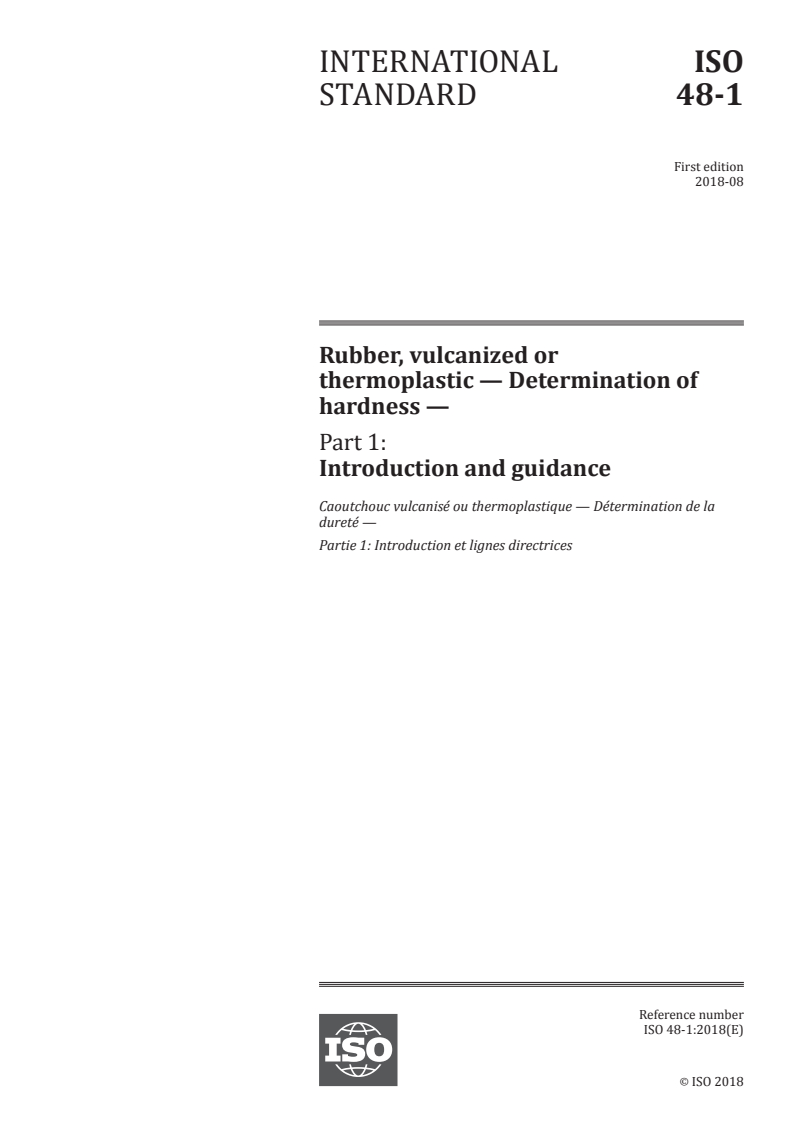
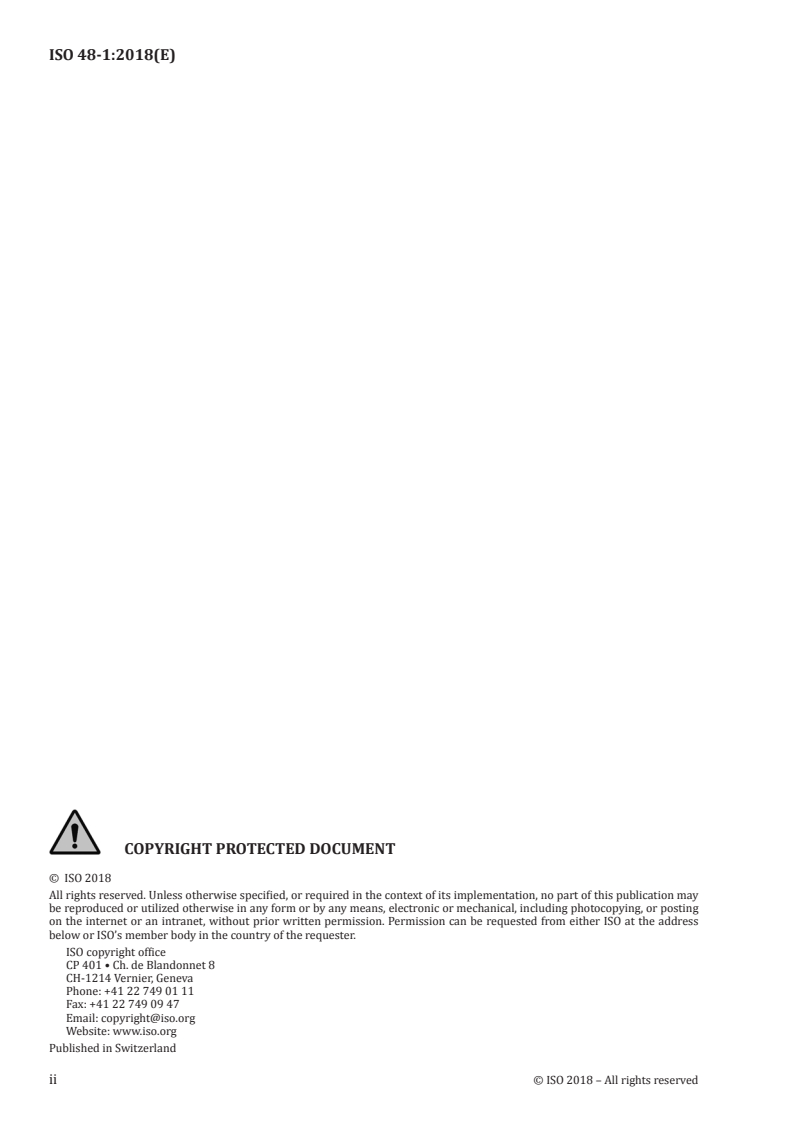
INTERNATIONAL ISO
STANDARD 48-1
First edition
2018-08
Rubber, vulcanized or
thermoplastic — Determination of
hardness —
Part 1:
Introduction and guidance
Caoutchouc vulcanisé ou thermoplastique — Détermination de la
dureté —
Partie 1: Introduction et lignes directrices
Reference number
©
ISO 2018
© ISO 2018
All rights reserved. Unless otherwise specified, or required in the context of its implementation, no part of this publication may
be reproduced or utilized otherwise in any form or by any means, electronic or mechanical, including photocopying, or posting
on the internet or an intranet, without prior written permission. Permission can be requested from either ISO at the address
below or ISO’s member body in the country of the requester.
ISO copyright office
CP 401 • Ch. de Blandonnet 8
CH-1214 Vernier, Geneva
Phone: +41 22 749 01 11
Fax: +41 22 749 09 47
Email: copyright@iso.org
Website: www.iso.org
Published in Switzerland
ii © ISO 2018 – All rights reserved
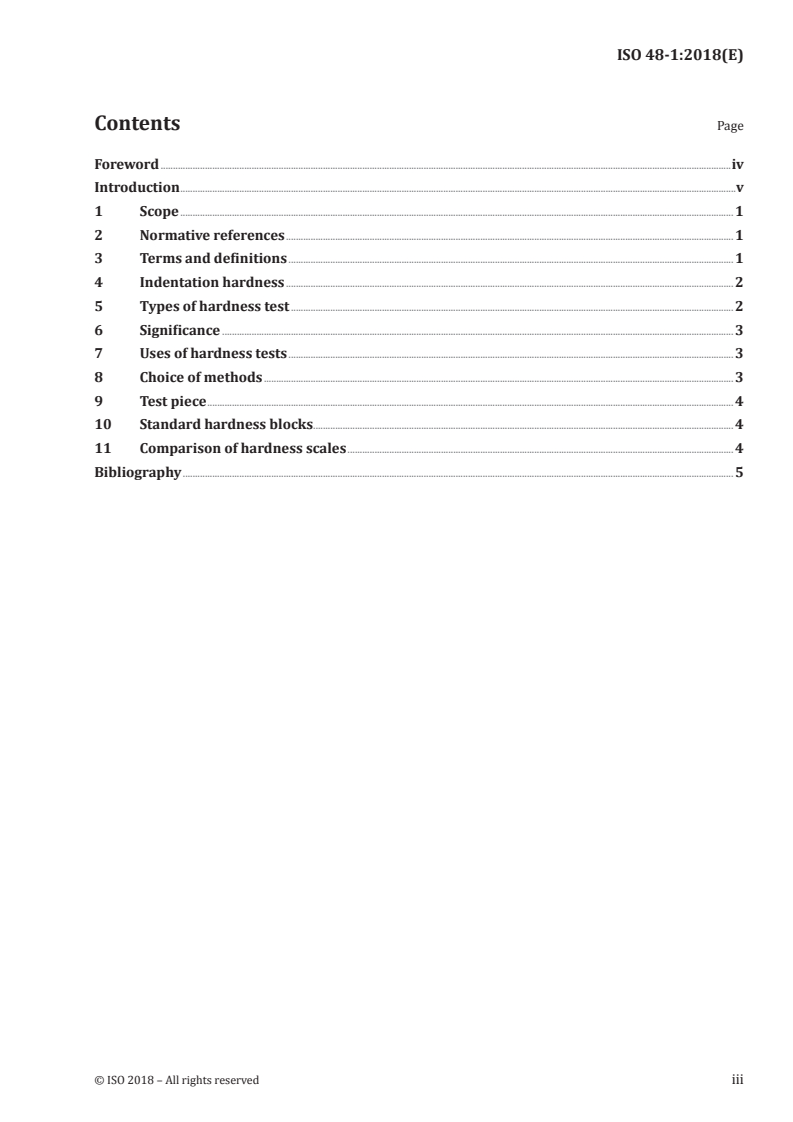
Contents Page
Foreword .iv
Introduction .v
1 Scope . 1
2 Normative references . 1
3 Terms and definitions . 1
4 Indentation hardness . 2
5 Types of hardness test . 2
6 Significance . 3
7 Uses of hardness tests . 3
8 Choice of methods . 3
9 Test piece . 4
10 Standard hardness blocks. 4
11 Comparison of hardness scales . 4
Bibliography . 5
Foreword
ISO (the International Organization for Standardization) is a worldwide federation of national standards
bodies (ISO member bodies). The work of preparing International Standards is normally carried out
through ISO technical committees. Each member body interested in a subject for which a technical
committee has been established has the right to be represented on that committee. International
organizations, governmental and non-governmental, in liaison with ISO, also take part in the work.
ISO collaborates closely with the International Electrotechnical Commission (IEC) on all matters of
electrotechnical standardization.
The procedures used to develop this document and those intended for its further maintenance are
described in the ISO/IEC Directives, Part 1. In particular, the different approval criteria needed for the
different types of ISO documents should be noted. This document was drafted in accordance with the
editorial rules of the ISO/IEC Directives, Part 2 (see www .iso .org/directives).
Attention is drawn to the possibility that some of the elements of this document may be the subject of
patent rights. ISO shall not be held responsible for identifying any or all such patent rights. Details of
any patent rights identified during the development of the document will be in the Introduction and/or
on the ISO list of patent declarations received (see www .iso .org/patents).
Any trade name used in this document is information given for the convenience of users and does not
constitute an endorsement.
For an explanation of the voluntary nature of standards, the meaning of ISO specific terms and
expressions related to conformity assessment, as well as information about ISO's adherence to the
World Trade Organization (WTO) principles in the Technical Barriers to Trade (TBT) see the following
URL: www .iso .org/iso/foreword .html.
This document was prepared by Technical Committee ISO/TC 45, Rubber and rubber products,
Subcommittee SC 2, Testing and analysis.
This first edition of ISO 48-1 cancels and replaces ISO 18517:2015, of which it constitutes a minor
revision. The changes compared to the previous edition are as follows:
— a new standard number has been given.
— in the Introduction, an explanation of the purpose of the grouping work has been added.
A list of all parts in the ISO 48 series can be found on the ISO website.
Any feedback or questions on this document should be directed to the user’s national standards body. A
complete listing of these bodies can be found at www .iso .org/members .html.
iv © ISO 2018 – All rights reserved
Introduction
ISO/TC 45/SC 2 established a principle that it would be helpful for users if standards on the same subject
but covering different aspects or methods were grouped together, preferably with an introductory
guidance standard, rather than being scattered throughout the numbering system. This has been
achieved for some subjects, for example curemeters (ISO 6502) and dynamic properties (ISO 4664).
In 2017, it was decided to group standards for hardness and, subsequently, it was agreed that they
would be grouped under the ISO 48 number. The new standards together with the previously numbered
standards are listed below.
— ISO 48-1: former ISO 18517
— ISO 48-2: former ISO 48
— ISO 48-3: former ISO 27588
— ISO 48-4: former ISO 7619-1
— ISO 48-5: former ISO 7619-2
— ISO 48-6: former ISO 7267-1
— ISO 48-7: former ISO 7267-2
— ISO 48-8: former ISO 7267-3
— ISO 48-9: former ISO 18898
INTERNATIONAL STANDARD ISO 48-1:2018(E)
Rubber, vulcanized or thermoplastic — Determination of
hardness —
Part 1:
Introduction and guidance
1 Scope
This document provides guidance on the determination of the hardness of vulcanized and thermoplastic
rubbers.
It is intended to provide an understanding of the significance of hardness as a material property and to
assist in the selection of an appropriate test method.
2 Normative references
There are no normative references in this document.
3 Terms and definitions
For the purposes of this document, the following terms and definitions apply.
ISO and IEC maintain terminological databases for use in standardization at the following addresses:
— ISO Online browsing platform: available at https: //www .iso .org/obp
— IEC Electropedia: available at https: //www .electropedia .org/
3.1
international rubber hardness degrees
IRHD
hardness scale chosen so that “0” represents the hardness of material having a Young’s modulus of zero
and “100” represents the hardness of a material of infinite Young’s modulus
Note 1 to entry: The following conditions are fulfilled over most of the normal range of hardness:
a) one international rubber hardness degree always represents approximately the same proportional
difference in Young's modulus;
b) for highly elastic rubbers, the IRHD and Shore A scales are comparable.
3.2
standard hardness
S
hardness, in international rubber hardness degrees, obtained using the procedures described in
ISO 48-2 on test pieces of the standard thickness and not less than the minimum lateral dimensions
specified
3.3
apparent hardness
hardness, in international rubber hardness degrees, obtained using the procedures described in
ISO 48-2 on test pieces of non-standard dimensions
4 Indentation hardness
The term hardness when applied to rubbers refers to a measure of stiffness obtained from an indentation
test. An indentor is pressed into the rubber under a given force and the resulting indentation measured
as illustrated in Figure 1. In contrast to some methods for other materials, the indentation is measured
with the load applied.
In most tests, the indentor is surrounded by a foot which rests on the test piece under a given force.
I
...
INTERNATIONAL ISO
STANDARD 48-1
First edition
2018-08
Rubber, vulcanized or
thermoplastic — Determination of
hardness —
Part 1:
Introduction and guidance
Caoutchouc vulcanisé ou thermoplastique — Détermination de la
dureté —
Partie 1: Introduction et lignes directrices
Reference number
©
ISO 2018
© ISO 2018
All rights reserved. Unless otherwise specified, or required in the context of its implementation, no part of this publication may
be reproduced or utilized otherwise in any form or by any means, electronic or mechanical, including photocopying, or posting
on the internet or an intranet, without prior written permission. Permission can be requested from either ISO at the address
below or ISO’s member body in the country of the requester.
ISO copyright office
CP 401 • Ch. de Blandonnet 8
CH-1214 Vernier, Geneva
Phone: +41 22 749 01 11
Fax: +41 22 749 09 47
Email: copyright@iso.org
Website: www.iso.org
Published in Switzerland
ii © ISO 2018 – All rights reserved
Contents Page
Foreword .iv
Introduction .v
1 Scope . 1
2 Normative references . 1
3 Terms and definitions . 1
4 Indentation hardness . 2
5 Types of hardness test . 2
6 Significance . 3
7 Uses of hardness tests . 3
8 Choice of methods . 3
9 Test piece . 4
10 Standard hardness blocks. 4
11 Comparison of hardness scales . 4
Bibliography . 5
Foreword
ISO (the International Organization for Standardization) is a worldwide federation of national standards
bodies (ISO member bodies). The work of preparing International Standards is normally carried out
through ISO technical committees. Each member body interested in a subject for which a technical
committee has been established has the right to be represented on that committee. International
organizations, governmental and non-governmental, in liaison with ISO, also take part in the work.
ISO collaborates closely with the International Electrotechnical Commission (IEC) on all matters of
electrotechnical standardization.
The procedures used to develop this document and those intended for its further maintenance are
described in the ISO/IEC Directives, Part 1. In particular, the different approval criteria needed for the
different types of ISO documents should be noted. This document was drafted in accordance with the
editorial rules of the ISO/IEC Directives, Part 2 (see www .iso .org/directives).
Attention is drawn to the possibility that some of the elements of this document may be the subject of
patent rights. ISO shall not be held responsible for identifying any or all such patent rights. Details of
any patent rights identified during the development of the document will be in the Introduction and/or
on the ISO list of patent declarations received (see www .iso .org/patents).
Any trade name used in this document is information given for the convenience of users and does not
constitute an endorsement.
For an explanation of the voluntary nature of standards, the meaning of ISO specific terms and
expressions related to conformity assessment, as well as information about ISO's adherence to the
World Trade Organization (WTO) principles in the Technical Barriers to Trade (TBT) see the following
URL: www .iso .org/iso/foreword .html.
This document was prepared by Technical Committee ISO/TC 45, Rubber and rubber products,
Subcommittee SC 2, Testing and analysis.
This first edition of ISO 48-1 cancels and replaces ISO 18517:2015, of which it constitutes a minor
revision. The changes compared to the previous edition are as follows:
— a new standard number has been given.
— in the Introduction, an explanation of the purpose of the grouping work has been added.
A list of all parts in the ISO 48 series can be found on the ISO website.
Any feedback or questions on this document should be directed to the user’s national standards body. A
complete listing of these bodies can be found at www .iso .org/members .html.
iv © ISO 2018 – All rights reserved
Introduction
ISO/TC 45/SC 2 established a principle that it would be helpful for users if standards on the same subject
but covering different aspects or methods were grouped together, preferably with an introductory
guidance standard, rather than being scattered throughout the numbering system. This has been
achieved for some subjects, for example curemeters (ISO 6502) and dynamic properties (ISO 4664).
In 2017, it was decided to group standards for hardness and, subsequently, it was agreed that they
would be grouped under the ISO 48 number. The new standards together with the previously numbered
standards are listed below.
— ISO 48-1: former ISO 18517
— ISO 48-2: former ISO 48
— ISO 48-3: former ISO 27588
— ISO 48-4: former ISO 7619-1
— ISO 48-5: former ISO 7619-2
— ISO 48-6: former ISO 7267-1
— ISO 48-7: former ISO 7267-2
— ISO 48-8: former ISO 7267-3
— ISO 48-9: former ISO 18898
INTERNATIONAL STANDARD ISO 48-1:2018(E)
Rubber, vulcanized or thermoplastic — Determination of
hardness —
Part 1:
Introduction and guidance
1 Scope
This document provides guidance on the determination of the hardness of vulcanized and thermoplastic
rubbers.
It is intended to provide an understanding of the significance of hardness as a material property and to
assist in the selection of an appropriate test method.
2 Normative references
There are no normative references in this document.
3 Terms and definitions
For the purposes of this document, the following terms and definitions apply.
ISO and IEC maintain terminological databases for use in standardization at the following addresses:
— ISO Online browsing platform: available at https: //www .iso .org/obp
— IEC Electropedia: available at https: //www .electropedia .org/
3.1
international rubber hardness degrees
IRHD
hardness scale chosen so that “0” represents the hardness of material having a Young’s modulus of zero
and “100” represents the hardness of a material of infinite Young’s modulus
Note 1 to entry: The following conditions are fulfilled over most of the normal range of hardness:
a) one international rubber hardness degree always represents approximately the same proportional
difference in Young's modulus;
b) for highly elastic rubbers, the IRHD and Shore A scales are comparable.
3.2
standard hardness
S
hardness, in international rubber hardness degrees, obtained using the procedures described in
ISO 48-2 on test pieces of the standard thickness and not less than the minimum lateral dimensions
specified
3.3
apparent hardness
hardness, in international rubber hardness degrees, obtained using the procedures described in
ISO 48-2 on test pieces of non-standard dimensions
4 Indentation hardness
The term hardness when applied to rubbers refers to a measure of stiffness obtained from an indentation
test. An indentor is pressed into the rubber under a given force and the resulting indentation measured
as illustrated in Figure 1. In contrast to some methods for other materials, the indentation is measured
with the load applied.
In most tests, the indentor is surrounded by a foot which rests on the test piece under a given force.
I
...
NORME ISO
INTERNATIONALE 48-1
Première édition
2018-08
Caoutchouc vulcanisé ou
thermoplastique — Détermination de
la dureté —
Partie 1:
Introduction et lignes directrices
Rubber, vulcanized or thermoplastic — Determination of hardness —
Part 1: Introduction and guidance
Numéro de référence
©
ISO 2018
DOCUMENT PROTÉGÉ PAR COPYRIGHT
© ISO 2018
Tous droits réservés. Sauf prescription différente ou nécessité dans le contexte de sa mise en œuvre, aucune partie de cette
publication ne peut être reproduite ni utilisée sous quelque forme que ce soit et par aucun procédé, électronique ou mécanique,
y compris la photocopie, ou la diffusion sur l’internet ou sur un intranet, sans autorisation écrite préalable. Une autorisation peut
être demandée à l’ISO à l’adresse ci-après ou au comité membre de l’ISO dans le pays du demandeur.
ISO copyright office
Case postale 401 • Ch. de Blandonnet 8
CH-1214 Vernier, Genève
Tél.: +41 22 749 01 11
Fax: +41 22 749 09 47
E-mail: copyright@iso.org
Web: www.iso.org
Publié en Suisse
ii © ISO 2018 – Tous droits réservés
Sommaire Page
Avant-propos .iv
Introduction .v
1 Domaine d'application . 1
2 Références normatives . 1
3 Termes et définitions . 1
4 Dureté de pénétration . 2
5 Types d'essais de dureté . 2
6 Signification . 3
7 Utilisations des essais de dureté . 3
8 Choix des méthodes . 3
9 Éprouvette . 4
10 Blocs de référence . 4
11 Comparaison entre les échelles de dureté . 4
Bibliographie . 5
Avant-propos
L’ISO (Organisation internationale de normalisation) est une fédération mondiale d’organismes
nationaux de normalisation (comités membres de l’ISO). L’élaboration des Normes internationales est
en général confiée aux comités techniques de l’ISO. Chaque comité membre intéressé par une étude
a le droit de faire partie du comité technique créé à cet effet. Les organisations internationales,
gouvernementales et non gouvernementales, en liaison avec l’ISO participent également aux travaux.
L’ISO collabore étroitement avec la Commission électrotechnique internationale (IEC) en ce qui
concerne la normalisation électrotechnique.
Les procédures utilisées pour élaborer le présent document et celles destinées à sa mise à jour sont
décrites dans les Directives ISO/IEC, Partie 1 Il convient, en particulier, de prendre note des différents
critères d’approbation requis pour les différents types de documents ISO. Le présent document a été
rédigé conformément aux règles de rédaction données dans les Directives ISO/IEC, Partie 2 (voir www
.iso .org/directives).
L’attention est appelée sur le fait que certains des éléments du présent document peuvent faire l’objet de
droits de propriété intellectuelle ou de droits analogues. L’ISO ne saurait être tenue pour responsable
de ne pas avoir identifié de tels droits de propriété et averti de leur existence. Les détails concernant
les références aux droits de propriété intellectuelle ou autres droits analogues identifiés lors de
l’élaboration du document sont indiqués dans l’Introduction et/ou dans la liste des déclarations de
brevets reçues par l’ISO (voir www .iso .org/brevets).
Les appellations commerciales éventuellement mentionnées dans le présent document sont données
pour information, par souci de commodité, à l’intention des utilisateurs et ne sauraient constituer un
engagement.
Pour une explication de la nature volontaire des normes, la signification des termes et expressions
spécifiques de l’ISO liés à l’évaluation de la conformité, ou pour toute information au sujet de l’adhésion
de l’ISO aux principes de l’Organisation mondiale du commerce (OMC) concernant les obstacles
techniques au commerce (OTC), voir le lien suivant: www .iso .org/avant -propos.
Le présent document a été élaboré par le comité technique ISO/TC 45, Élastomères et produits à base
d'élastomères, sous-comité SC 2, Essais et analyses.
Cette première édition de l'ISO 48-1 annule et remplace l'ISO 18517:2015, dont il constitue une révision
mineure. Les modifications par rapport à la précédente édition sont les suivantes:
— une nouvelle référence a été donnée.
— dans l'Introduction, une explication de l'objet du travail de regroupement a été ajoutée.
Une liste de toutes les parties de l'ISO 48 peut être trouvée sur le site internet de l’ISO.
iv © ISO 2018 – Tous droits réservés
Introduction
L'ISO/TC 45/SC 2 a établi un principe selon lequel il serait utile pour les utilisateurs que les normes
portant sur la même thématique, mais couvrant différents aspects ou méthodes, soient regroupées
de préférence avec une norme de lignes directrices introductives, plutôt que dispersées dans tout le
système de numérotation. Cela a été réalisé pour certains sujets, par exemple les rhéomètres (ISO 6502)
et les propriétés dynamiques (ISO 4664).
En 2017, il a été décidé de regrouper les normes de dureté et, par la suite, il a été convenu qu'elles
seraient regroupées sous la référence ISO 48. Les nouvelles normes avec leurs anciennes références
sont listées ci-dessous.
— ISO 48-1: précédemment ISO 18517
— ISO 48-2: précédemment ISO 48
— ISO 48-3: précédemment ISO 27588
— ISO 48-4: précédemment ISO 7619-1
— ISO 48-5: précédemment ISO 7619-2
— ISO 48-6: précédemment ISO 7267-1
— ISO 48-7: précédemment ISO 7267-2
— ISO 48-8: précédemment ISO 7267-3
— ISO 48-9: précédemment ISO 18898
NORME INTERNATIONALE ISO 48-1:2018(F)
Caoutchouc vulcanisé ou thermoplastique —
Détermination de la dureté —
Partie 1:
Introduction et lignes directrices
1 Domaine d'application
Le présent document fournit des lignes directrices sur la détermination de la dureté des caoutchoucs
vulcanisés et thermoplastiques.
Il est destiné à faire comprendre la signification de la dureté en tant que propriété d’un matériau et à
apporter une aide dans le choix de la méthode d'essai appropriée.
2 Références normatives
Le présent document ne contient aucune référence normative.
3 Termes et définitions
Pour les besoins du présent document, les termes et définitions suivants s'appliquent.
L’ISO et l’IEC tiennent à jour des bases de données terminologiques destinées à être utilisées en
normalisation, consultables aux adresses suivantes:
— IEC Electropedia: disponible à l’adresse http: //www .electropedia .org/
— ISO Online browsing platform: disponible à l’adresse https: //www .iso .org/obp
3.1
degrés internationaux de dureté du caoutchouc
DIDC
échelle de dureté établie de telle façon que «0» représente la dureté d'un matériau dont le module de
Young est égal à zéro et «100» la dureté d'un matériau dont le module de Young est infini
Note 1 à l'article: Les conditions suivantes sont normalement remplies sur presque toute l'étendue de la plage
de dureté:
a) un degré international de dureté du caoutchouc correspond toujours approximativement à la même variation
relative du module de Young;
b) pour les caoutchoucs à élasticité élevée, l'échelle en DIDC et l'échelle de dureté Shore A sont comparables.
3.2
dureté normalisée
S
dureté, en degrés internationaux de dureté du caoutchouc, obtenue en suivant les modes opératoires
décrits dans l’ISO 48-2 sur des éprouvettes d'épaisseur normalisée dont les dimensions latérales ne
sont pas inférieures aux valeurs minimales spécifiées
3.3
dureté apparente
dureté, en degrés internationaux de dureté du caoutchouc, obtenue en suivant les modes opératoires
décrits dans l’ISO 48-2 sur des éprouvettes n'ayant pas les dimensions normalisées
4 Dureté de pénétration
Le terme dureté appliqué aux élastomères signifie la mesure de la rigidité obtenue à partir de l'essai
de pénétration. Un pénétrateur est enfoncé dans l'élastomère sous une force donnée et la pénétration
obtenue mesurée comme indiqué sur la Figure 1. Contrairement à certaines méthodes s'appliquant à
d'autres matériaux, la pénétration se mesure la charge étant appliquée.
Dans la plupart des essais, le pénétrateur est muni d'un pied annulaire reposant sur l'éprouvette
sous une force donnée. Dans les essais avec poids morts (voir Article 5), la pénétration mesurée est la
différence entre les pénétrations causées par une force initiale faible et une force finale plus importante.
Légende
1 masse ou ressort pour appliquer la force
2 pénétrateur
3 pied presseur
4 éprouvette
Figure 1 — Principe de l'essai de dureté
5 Types d'essais de dureté
Une différenciation est faite entre les essais avec poids morts, où la force de pénétration est pr
...
NORME ISO
INTERNATIONALE 48-1
Première édition
2018-08
Caoutchouc vulcanisé ou
thermoplastique — Détermination de
la dureté —
Partie 1:
Introduction et lignes directrices
Rubber, vulcanized or thermoplastic — Determination of hardness —
Part 1: Introduction and guidance
Numéro de référence
©
ISO 2018
DOCUMENT PROTÉGÉ PAR COPYRIGHT
© ISO 2018
Tous droits réservés. Sauf prescription différente ou nécessité dans le contexte de sa mise en œuvre, aucune partie de cette
publication ne peut être reproduite ni utilisée sous quelque forme que ce soit et par aucun procédé, électronique ou mécanique,
y compris la photocopie, ou la diffusion sur l’internet ou sur un intranet, sans autorisation écrite préalable. Une autorisation peut
être demandée à l’ISO à l’adresse ci-après ou au comité membre de l’ISO dans le pays du demandeur.
ISO copyright office
Case postale 401 • Ch. de Blandonnet 8
CH-1214 Vernier, Genève
Tél.: +41 22 749 01 11
Fax: +41 22 749 09 47
E-mail: copyright@iso.org
Web: www.iso.org
Publié en Suisse
ii © ISO 2018 – Tous droits réservés
Sommaire Page
Avant-propos .iv
Introduction .v
1 Domaine d'application . 1
2 Références normatives . 1
3 Termes et définitions . 1
4 Dureté de pénétration . 2
5 Types d'essais de dureté . 2
6 Signification . 3
7 Utilisations des essais de dureté . 3
8 Choix des méthodes . 3
9 Éprouvette . 4
10 Blocs de référence . 4
11 Comparaison entre les échelles de dureté . 4
Bibliographie . 5
Avant-propos
L’ISO (Organisation internationale de normalisation) est une fédération mondiale d’organismes
nationaux de normalisation (comités membres de l’ISO). L’élaboration des Normes internationales est
en général confiée aux comités techniques de l’ISO. Chaque comité membre intéressé par une étude
a le droit de faire partie du comité technique créé à cet effet. Les organisations internationales,
gouvernementales et non gouvernementales, en liaison avec l’ISO participent également aux travaux.
L’ISO collabore étroitement avec la Commission électrotechnique internationale (IEC) en ce qui
concerne la normalisation électrotechnique.
Les procédures utilisées pour élaborer le présent document et celles destinées à sa mise à jour sont
décrites dans les Directives ISO/IEC, Partie 1 Il convient, en particulier, de prendre note des différents
critères d’approbation requis pour les différents types de documents ISO. Le présent document a été
rédigé conformément aux règles de rédaction données dans les Directives ISO/IEC, Partie 2 (voir www
.iso .org/directives).
L’attention est appelée sur le fait que certains des éléments du présent document peuvent faire l’objet de
droits de propriété intellectuelle ou de droits analogues. L’ISO ne saurait être tenue pour responsable
de ne pas avoir identifié de tels droits de propriété et averti de leur existence. Les détails concernant
les références aux droits de propriété intellectuelle ou autres droits analogues identifiés lors de
l’élaboration du document sont indiqués dans l’Introduction et/ou dans la liste des déclarations de
brevets reçues par l’ISO (voir www .iso .org/brevets).
Les appellations commerciales éventuellement mentionnées dans le présent document sont données
pour information, par souci de commodité, à l’intention des utilisateurs et ne sauraient constituer un
engagement.
Pour une explication de la nature volontaire des normes, la signification des termes et expressions
spécifiques de l’ISO liés à l’évaluation de la conformité, ou pour toute information au sujet de l’adhésion
de l’ISO aux principes de l’Organisation mondiale du commerce (OMC) concernant les obstacles
techniques au commerce (OTC), voir le lien suivant: www .iso .org/avant -propos.
Le présent document a été élaboré par le comité technique ISO/TC 45, Élastomères et produits à base
d'élastomères, sous-comité SC 2, Essais et analyses.
Cette première édition de l'ISO 48-1 annule et remplace l'ISO 18517:2015, dont il constitue une révision
mineure. Les modifications par rapport à la précédente édition sont les suivantes:
— une nouvelle référence a été donnée.
— dans l'Introduction, une explication de l'objet du travail de regroupement a été ajoutée.
Une liste de toutes les parties de l'ISO 48 peut être trouvée sur le site internet de l’ISO.
iv © ISO 2018 – Tous droits réservés
Introduction
L'ISO/TC 45/SC 2 a établi un principe selon lequel il serait utile pour les utilisateurs que les normes
portant sur la même thématique, mais couvrant différents aspects ou méthodes, soient regroupées
de préférence avec une norme de lignes directrices introductives, plutôt que dispersées dans tout le
système de numérotation. Cela a été réalisé pour certains sujets, par exemple les rhéomètres (ISO 6502)
et les propriétés dynamiques (ISO 4664).
En 2017, il a été décidé de regrouper les normes de dureté et, par la suite, il a été convenu qu'elles
seraient regroupées sous la référence ISO 48. Les nouvelles normes avec leurs anciennes références
sont listées ci-dessous.
— ISO 48-1: précédemment ISO 18517
— ISO 48-2: précédemment ISO 48
— ISO 48-3: précédemment ISO 27588
— ISO 48-4: précédemment ISO 7619-1
— ISO 48-5: précédemment ISO 7619-2
— ISO 48-6: précédemment ISO 7267-1
— ISO 48-7: précédemment ISO 7267-2
— ISO 48-8: précédemment ISO 7267-3
— ISO 48-9: précédemment ISO 18898
NORME INTERNATIONALE ISO 48-1:2018(F)
Caoutchouc vulcanisé ou thermoplastique —
Détermination de la dureté —
Partie 1:
Introduction et lignes directrices
1 Domaine d'application
Le présent document fournit des lignes directrices sur la détermination de la dureté des caoutchoucs
vulcanisés et thermoplastiques.
Il est destiné à faire comprendre la signification de la dureté en tant que propriété d’un matériau et à
apporter une aide dans le choix de la méthode d'essai appropriée.
2 Références normatives
Le présent document ne contient aucune référence normative.
3 Termes et définitions
Pour les besoins du présent document, les termes et définitions suivants s'appliquent.
L’ISO et l’IEC tiennent à jour des bases de données terminologiques destinées à être utilisées en
normalisation, consultables aux adresses suivantes:
— IEC Electropedia: disponible à l’adresse http: //www .electropedia .org/
— ISO Online browsing platform: disponible à l’adresse https: //www .iso .org/obp
3.1
degrés internationaux de dureté du caoutchouc
DIDC
échelle de dureté établie de telle façon que «0» représente la dureté d'un matériau dont le module de
Young est égal à zéro et «100» la dureté d'un matériau dont le module de Young est infini
Note 1 à l'article: Les conditions suivantes sont normalement remplies sur presque toute l'étendue de la plage
de dureté:
a) un degré international de dureté du caoutchouc correspond toujours approximativement à la même variation
relative du module de Young;
b) pour les caoutchoucs à élasticité élevée, l'échelle en DIDC et l'échelle de dureté Shore A sont comparables.
3.2
dureté normalisée
S
dureté, en degrés internationaux de dureté du caoutchouc, obtenue en suivant les modes opératoires
décrits dans l’ISO 48-2 sur des éprouvettes d'épaisseur normalisée dont les dimensions latérales ne
sont pas inférieures aux valeurs minimales spécifiées
3.3
dureté apparente
dureté, en degrés internationaux de dureté du caoutchouc, obtenue en suivant les modes opératoires
décrits dans l’ISO 48-2 sur des éprouvettes n'ayant pas les dimensions normalisées
4 Dureté de pénétration
Le terme dureté appliqué aux élastomères signifie la mesure de la rigidité obtenue à partir de l'essai
de pénétration. Un pénétrateur est enfoncé dans l'élastomère sous une force donnée et la pénétration
obtenue mesurée comme indiqué sur la Figure 1. Contrairement à certaines méthodes s'appliquant à
d'autres matériaux, la pénétration se mesure la charge étant appliquée.
Dans la plupart des essais, le pénétrateur est muni d'un pied annulaire reposant sur l'éprouvette
sous une force donnée. Dans les essais avec poids morts (voir Article 5), la pénétration mesurée est la
différence entre les pénétrations causées par une force initiale faible et une force finale plus importante.
Légende
1 masse ou ressort pour appliquer la force
2 pénétrateur
3 pied presseur
4 éprouvette
Figure 1 — Principe de l'essai de dureté
5 Types d'essais de dureté
Une différenciation est faite entre les essais avec poids morts, où la force de pénétration est pr
...