

ISO 28721-4:2015
(Main)Vitreous and porcelain enamels — Glass-lined apparatus for process plants — Part 4: Quality requirements for glass-lined flanged steel pipes and flanged steel fittings
General Information
- Abstract
ISO 28721-4:2015 specifies the quality requirements for glass-lined flanged steel pipes and flanged steel fittings used for process plants.
- Status
- Published
- Publication Date
- 25-Oct-2015
- Technical Committee
- ISO/TC 107 - Metallic and other inorganic coatings
- Drafting Committee
- ISO/TC 107/WG 2 - Vitreous and porcelain enamel coatings
- Current Stage
- 9060 - Close of review
- Completion Date
- 02-Dec-2031
Buy Documents
ISO 28721-4:2015 - Vitreous and porcelain enamels -- Glass-lined apparatus for process plants
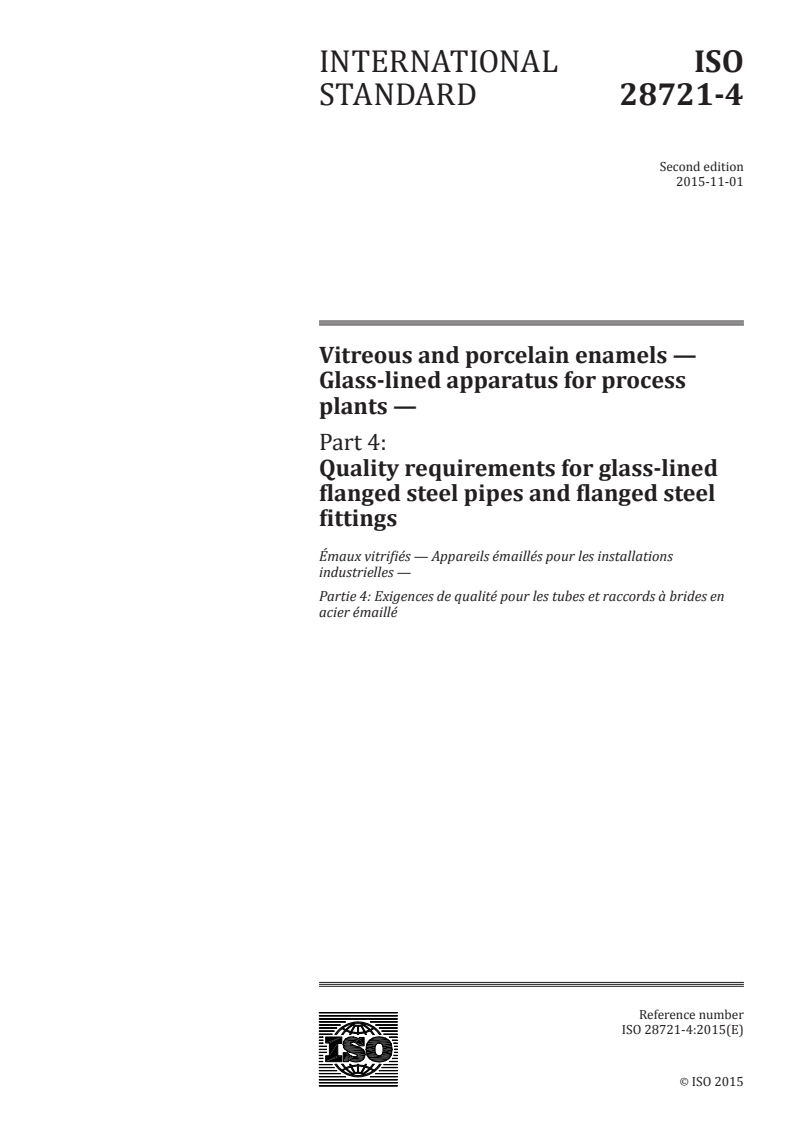
ISO 28721-4:2015 - Vitreous and porcelain enamels — Glass-lined apparatus for process plants — Part 4: Quality requirements for glass-lined flanged steel pipes and flanged steel fittings/26/2015
ISO 28721-4:2015 - Émaux vitrifiés -- Appareils émaillés pour les installations industrielles
ISO 28721-4:2015 - Émaux vitrifiés — Appareils émaillés pour les installations industrielles — Partie 4: Exigences de qualité pour les tubes et raccords à brides en acier émaillé/19/2015
Overview
ISO 28721-4:2015 is an international standard published by the International Organization for Standardization (ISO) that specifies quality requirements for glass-lined flanged steel pipes and flanged steel fittings used in industrial process plants. This standard focuses on vitreous and porcelain enamels applied to steel components, ensuring their durability, performance, and safety in demanding industrial environments.
This part of ISO 28721 addresses key aspects such as material selection, manufacturing processes, surface quality, protective coatings, and comprehensive testing requirements. Adherence to this standard ensures reliable performance and compliance with international industrial requirements for glass-lined steel components.
Key Topics
Scope and Application
The standard applies to glass-lined flanged steel pipes and fittings used in process plants, clarifying quality parameters that support their use in chemical, pharmaceutical, and other heavy industries.Material Requirements
Steel materials must conform to EN 13480-2 and be suitable for enameling. Chemical composition, mechanical properties, and weldability are specified to maintain structural integrity after enameling.Welding and Fabrication
Full penetration welding per ISO 5817 (quality level B) and EN 1708-1 is mandatory. Weld repairs are permitted only if they meet quality requirements. Fabricators must have competent personnel and proper welding procedures to ensure consistent weld quality.Surface and External Protection
Steel surfaces must be properly prepared by abrasive blasting (ISO 8501-1 Sa 2½) and coated externally with primers that comply with ISO 12944-5 to provide corrosion resistance.Enamel Coating Quality
The vitreous enamel layer must be uniform, smooth, and defect-free-free from chipping, cracks, porosity, or inclusions such as refractory clay particles except for limited calamine content with restrictions. The enamel layer thickness should generally be between 0.8 mm and 2.0 mm, with specific allowances for curvature and gradual thickness transitions.Testing and Certification
Components must undergo visual inspection, high voltage dielectric testing according to EN 14430, and enamel thickness measurement with precise instruments. Test certificates must comply with EN 10204 type 2.2 standards and affirm base material and enamel properties.Marking and Documentation
Clear marking on components and thorough documentation, including material certificates and test reports, ensure traceability and compliance with the standard.
Applications
ISO 28721-4:2015 is critical for manufacturers, fabricators, procurement specialists, and quality assurance personnel working with glass-lined steel piping systems in process industries. Typical applications include:
- Chemical Process Plants: Protection against corrosion and chemical attack in pipelines and connections.
- Pharmaceutical Industry: Ensuring hygienic and inert surfaces within process piping.
- Food and Beverage Manufacturing: Durable, corrosion-resistant fittings for sanitary process lines.
- Water Treatment Facilities: Long-lasting, chemically resistant piping components.
- Industrial Equipment Manufacturing: Quality glass-lined apparatus compatible with customer specifications for flange connections.
By implementing ISO 28721-4, organizations can reduce downtime, extend equipment lifetime, and comply with regulatory requirements for process safety and product quality.
Related Standards
Several complementary standards are referenced in ISO 28721-4 to ensure a comprehensive framework for glass-lined steel components and process equipment:
- ISO 5817: Quality levels for welded joints in steel, nickel, and titanium alloys.
- EN 13480 Series: Metallic industrial piping standards covering materials, design, and fabrication.
- ISO 12944-5: Corrosion protection of steel structures by paint systems (external coating).
- EN 14430: Test for high-voltage resistance of vitreous enamel coatings.
- ISO 28706 Series: Methods to determine chemical corrosion resistance of vitreous enamels.
- EN 10204: Types of inspection documents for metallic products.
- DIN 2873: Specifications for flanged enamelled steel pipes and fittings (PN 10 and PN 25).
- EN 15826: Glossary and terminology related to vitreous and porcelain enamels.
Understanding and applying these interconnected standards enables better control over the quality and reliability of glass-lined steel piping systems used in process plants.
Adopting ISO 28721-4:2015 helps ensure high-quality glass-lined flanged pipes and fittings that meet stringent industrial performance and safety standards, making it an essential reference for the engineering and manufacturing of durable process plant apparatus.
Relations
- Effective Date
- 12-Feb-2026
- Effective Date
- 06-Jun-2022
- Effective Date
- 12-Feb-2014
Buy Documents
ISO 28721-4:2015 - Vitreous and porcelain enamels -- Glass-lined apparatus for process plants
ISO 28721-4:2015 - Vitreous and porcelain enamels — Glass-lined apparatus for process plants — Part 4: Quality requirements for glass-lined flanged steel pipes and flanged steel fittings/26/2015
ISO 28721-4:2015 - Émaux vitrifiés -- Appareils émaillés pour les installations industrielles
ISO 28721-4:2015 - Émaux vitrifiés — Appareils émaillés pour les installations industrielles — Partie 4: Exigences de qualité pour les tubes et raccords à brides en acier émaillé/19/2015
Get Certified
Connect with accredited certification bodies for this standard

DVS-ZERT GmbH
German welding certification society.
CARES (UK Certification Authority for Reinforcing Steels)
UK certification for reinforcing steels and construction.
EWF/IIW (European/International Welding Federation)
International welding personnel certification.
Sponsored listings
Frequently Asked Questions
ISO 28721-4:2015 is a standard published by the International Organization for Standardization (ISO). Its full title is "Vitreous and porcelain enamels — Glass-lined apparatus for process plants — Part 4: Quality requirements for glass-lined flanged steel pipes and flanged steel fittings". This standard covers: ISO 28721-4:2015 specifies the quality requirements for glass-lined flanged steel pipes and flanged steel fittings used for process plants.
ISO 28721-4:2015 specifies the quality requirements for glass-lined flanged steel pipes and flanged steel fittings used for process plants.
ISO 28721-4:2015 is classified under the following ICS (International Classification for Standards) categories: 25.220.50 - Enamels. The ICS classification helps identify the subject area and facilitates finding related standards.
ISO 28721-4:2015 has the following relationships with other standards: It is inter standard links to EN ISO 28721-4:2015, ISO/IEC 24756:2009, ISO 28721-4:2010. Understanding these relationships helps ensure you are using the most current and applicable version of the standard.
ISO 28721-4:2015 is available in PDF format for immediate download after purchase. The document can be added to your cart and obtained through the secure checkout process. Digital delivery ensures instant access to the complete standard document.
Standards Content (Sample)
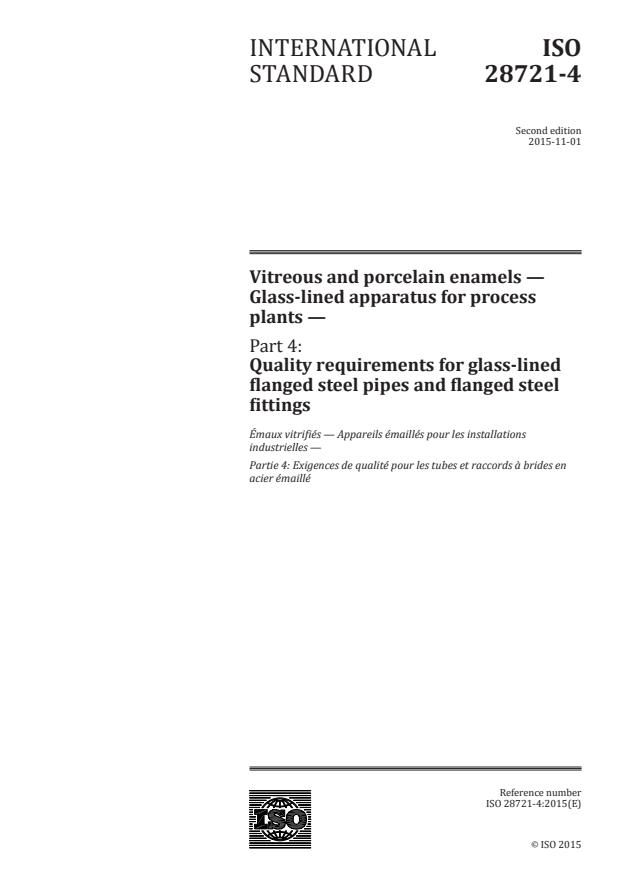
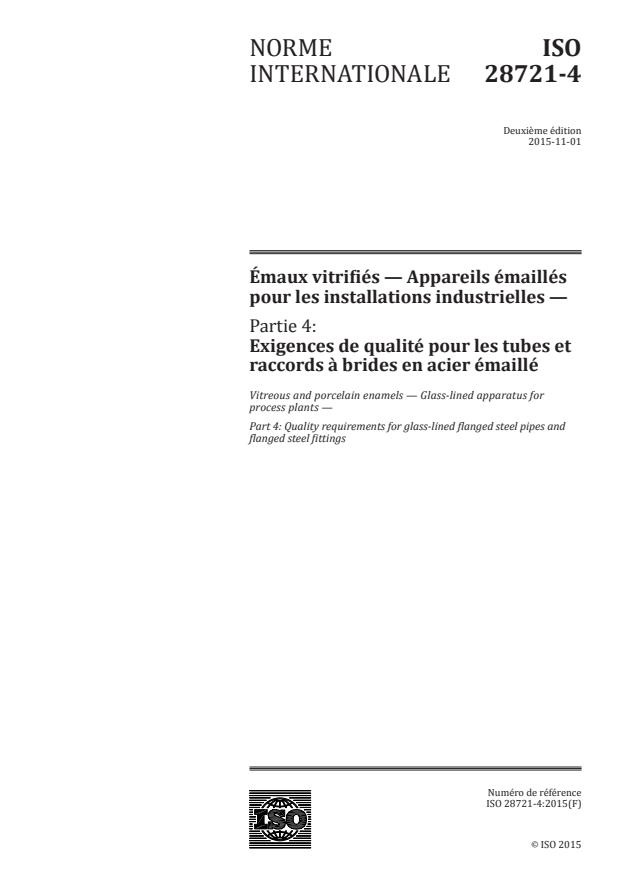
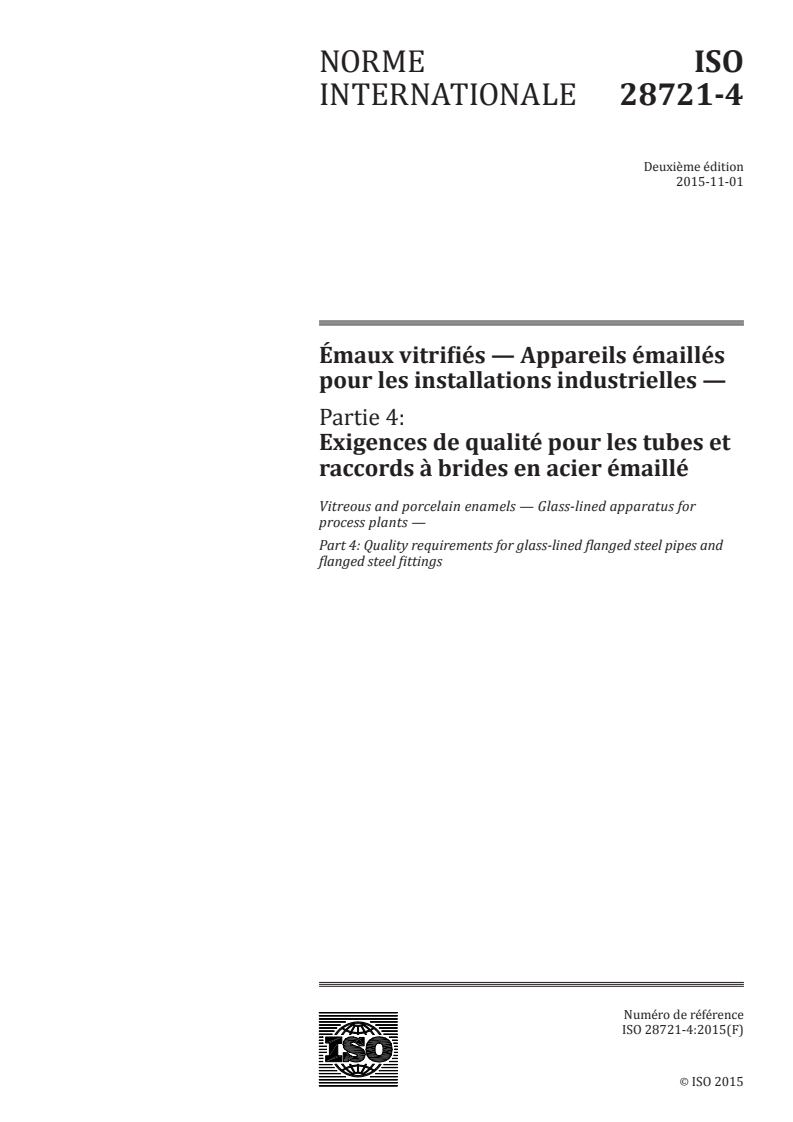
INTERNATIONAL ISO
STANDARD 28721-4
Second edition
2015-11-01
Vitreous and porcelain enamels —
Glass-lined apparatus for process
plants —
Part 4:
Quality requirements for glass-lined
flanged steel pipes and flanged steel
fittings
Émaux vitrifiés — Appareils émaillés pour les installations
industrielles —
Partie 4: Exigences de qualité pour les tubes et raccords à brides en
acier émaillé
Reference number
©
ISO 2015
© ISO 2015, Published in Switzerland
All rights reserved. Unless otherwise specified, no part of this publication may be reproduced or utilized otherwise in any form
or by any means, electronic or mechanical, including photocopying, or posting on the internet or an intranet, without prior
written permission. Permission can be requested from either ISO at the address below or ISO’s member body in the country of
the requester.
ISO copyright office
Ch. de Blandonnet 8 • CP 401
CH-1214 Vernier, Geneva, Switzerland
Tel. +41 22 749 01 11
Fax +41 22 749 09 47
copyright@iso.org
www.iso.org
ii © ISO 2015 – All rights reserved
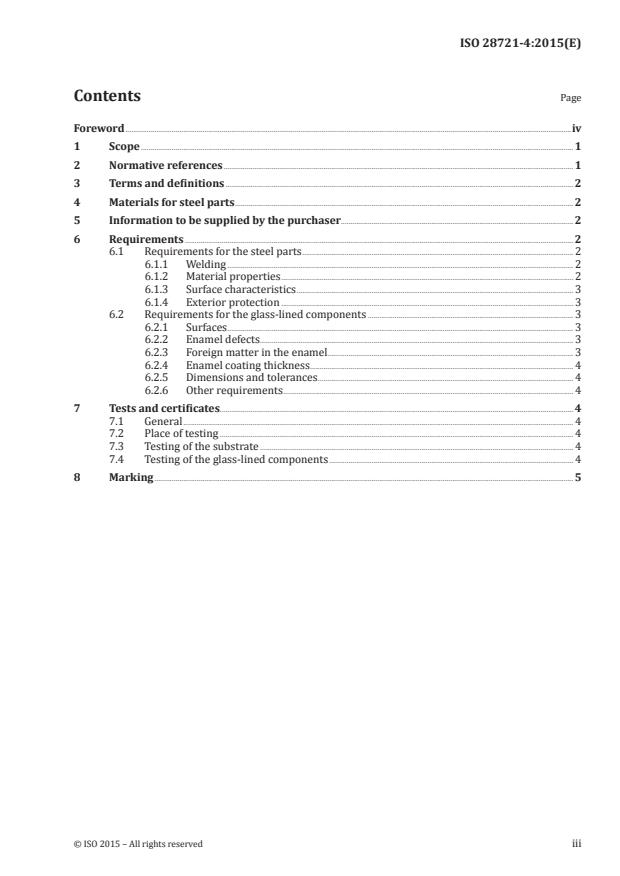
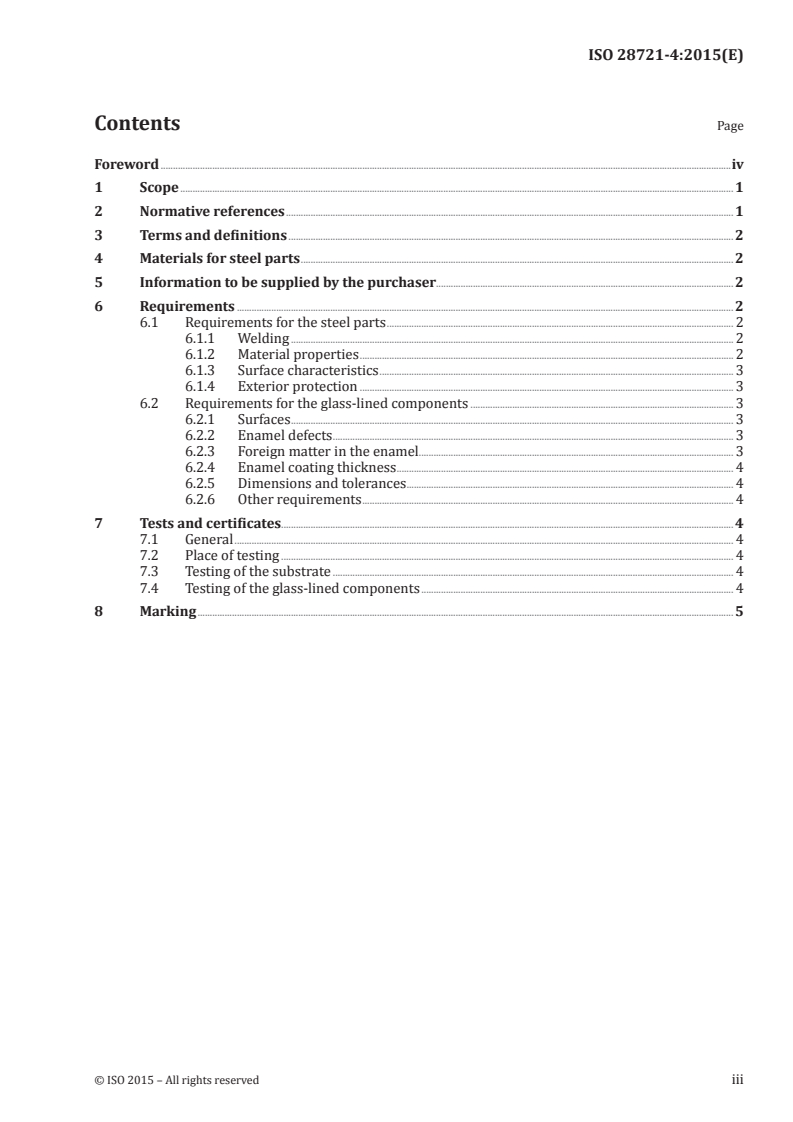
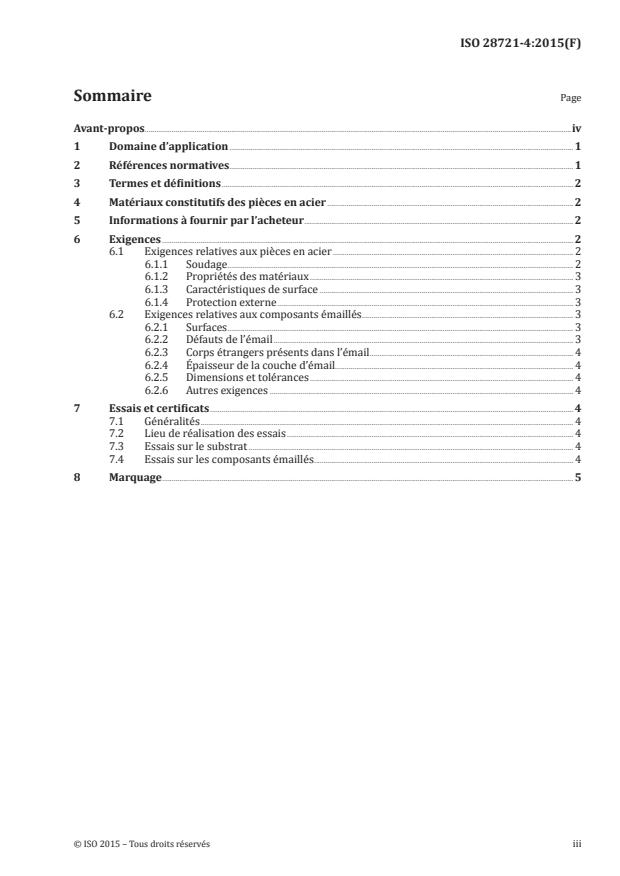
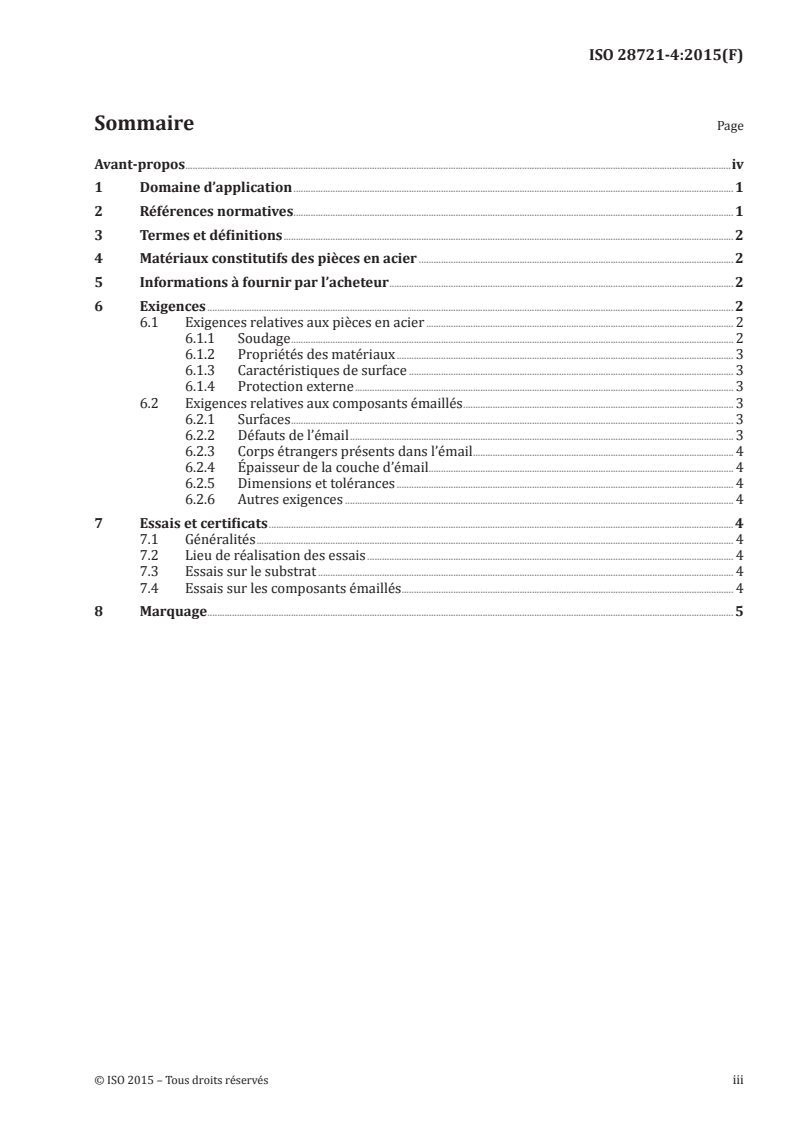
Contents Page
Foreword .iv
1 Scope . 1
2 Normative references . 1
3 Terms and definitions . 2
4 Materials for steel parts . 2
5 Information to be supplied by the purchaser. 2
6 Requirements . 2
6.1 Requirements for the steel parts . 2
6.1.1 Welding . 2
6.1.2 Material properties . 2
6.1.3 Surface characteristics . 3
6.1.4 Exterior protection . 3
6.2 Requirements for the glass-lined components . 3
6.2.1 Surfaces . 3
6.2.2 Enamel defects . 3
6.2.3 Foreign matter in the enamel . . 3
6.2.4 Enamel coating thickness . 4
6.2.5 Dimensions and tolerances . 4
6.2.6 Other requirements . 4
7 Tests and certificates. 4
7.1 General . 4
7.2 Place of testing . 4
7.3 Testing of the substrate . 4
7.4 Testing of the glass-lined components . 4
8 Marking . 5
Foreword
ISO (the International Organization for Standardization) is a worldwide federation of national standards
bodies (ISO member bodies). The work of preparing International Standards is normally carried out
through ISO technical committees. Each member body interested in a subject for which a technical
committee has been established has the right to be represented on that committee. International
organizations, governmental and non-governmental, in liaison with ISO, also take part in the work.
ISO collaborates closely with the International Electrotechnical Commission (IEC) on all matters of
electrotechnical standardization.
The procedures used to develop this document and those intended for its further maintenance are
described in the ISO/IEC Directives, Part 1. In particular the different approval criteria needed for the
different types of ISO documents should be noted. This document was drafted in accordance with the
editorial rules of the ISO/IEC Directives, Part 2 (see www.iso.org/directives).
Attention is drawn to the possibility that some of the elements of this document may be the subject of
patent rights. ISO shall not be held responsible for identifying any or all such patent rights. Details of
any patent rights identified during the development of the document will be in the Introduction and/or
on the ISO list of patent declarations received (see www.iso.org/patents).
Any trade name used in this document is information given for the convenience of users and does not
constitute an endorsement.
For an explanation on the meaning of ISO specific terms and expressions related to conformity
assessment, as well as information about ISO’s adherence to the WTO principles in the Technical
Barriers to Trade (TBT) see the following URL: Foreword - Supplementary information
The committee responsible for this document is ISO/TC 107, Metallic and other inorganic coatings.
This second edition cancels and replaces the first edition (ISO 28721-4:2010), which has been
technically revised.
ISO 28721 consists of the following parts, under the general title Vitreous and porcelain enamels —
Glass-lined apparatus for process plants:
— Part 1: Quality requirements for apparatus, components, appliances and accessories
— Part 2: Designation and specification of resistance to chemical attack and thermal shock
— Part 3: Thermal shock resistance
— Part 4: Quality requirements for glass-lined flanged steel pipes and flanged steel fittings
— Part 5: Presentation and characterization of defects
iv © ISO 2015 – All rights reserved
INTERNATIONAL STANDARD ISO 28721-4:2015(E)
Vitreous and porcelain enamels — Glass-lined apparatus
for process plants —
Part 4:
Quality requirements for glass-lined flanged steel pipes
and flanged steel fittings
WARNING — This part of ISO 28721 calls for the use of substances and/or procedures that
may be injurious to health if adequate safety measures are not taken. This part of ISO 28721
does not address any health hazards, safety or environmental matters associated with its use.
It is the responsibility of the user of this part of ISO 28721 to establish appropriate health,
safety and environmentally acceptable practices and
...
INTERNATIONAL ISO
STANDARD 28721-4
Second edition
2015-11-01
Vitreous and porcelain enamels —
Glass-lined apparatus for process
plants —
Part 4:
Quality requirements for glass-lined
flanged steel pipes and flanged steel
fittings
Émaux vitrifiés — Appareils émaillés pour les installations
industrielles —
Partie 4: Exigences de qualité pour les tubes et raccords à brides en
acier émaillé
Reference number
©
ISO 2015
© ISO 2015, Published in Switzerland
All rights reserved. Unless otherwise specified, no part of this publication may be reproduced or utilized otherwise in any form
or by any means, electronic or mechanical, including photocopying, or posting on the internet or an intranet, without prior
written permission. Permission can be requested from either ISO at the address below or ISO’s member body in the country of
the requester.
ISO copyright office
Ch. de Blandonnet 8 • CP 401
CH-1214 Vernier, Geneva, Switzerland
Tel. +41 22 749 01 11
Fax +41 22 749 09 47
copyright@iso.org
www.iso.org
ii © ISO 2015 – All rights reserved
Contents Page
Foreword .iv
1 Scope . 1
2 Normative references . 1
3 Terms and definitions . 2
4 Materials for steel parts . 2
5 Information to be supplied by the purchaser. 2
6 Requirements . 2
6.1 Requirements for the steel parts . 2
6.1.1 Welding . 2
6.1.2 Material properties . 2
6.1.3 Surface characteristics . 3
6.1.4 Exterior protection . 3
6.2 Requirements for the glass-lined components . 3
6.2.1 Surfaces . 3
6.2.2 Enamel defects . 3
6.2.3 Foreign matter in the enamel . . 3
6.2.4 Enamel coating thickness . 4
6.2.5 Dimensions and tolerances . 4
6.2.6 Other requirements . 4
7 Tests and certificates. 4
7.1 General . 4
7.2 Place of testing . 4
7.3 Testing of the substrate . 4
7.4 Testing of the glass-lined components . 4
8 Marking . 5
Foreword
ISO (the International Organization for Standardization) is a worldwide federation of national standards
bodies (ISO member bodies). The work of preparing International Standards is normally carried out
through ISO technical committees. Each member body interested in a subject for which a technical
committee has been established has the right to be represented on that committee. International
organizations, governmental and non-governmental, in liaison with ISO, also take part in the work.
ISO collaborates closely with the International Electrotechnical Commission (IEC) on all matters of
electrotechnical standardization.
The procedures used to develop this document and those intended for its further maintenance are
described in the ISO/IEC Directives, Part 1. In particular the different approval criteria needed for the
different types of ISO documents should be noted. This document was drafted in accordance with the
editorial rules of the ISO/IEC Directives, Part 2 (see www.iso.org/directives).
Attention is drawn to the possibility that some of the elements of this document may be the subject of
patent rights. ISO shall not be held responsible for identifying any or all such patent rights. Details of
any patent rights identified during the development of the document will be in the Introduction and/or
on the ISO list of patent declarations received (see www.iso.org/patents).
Any trade name used in this document is information given for the convenience of users and does not
constitute an endorsement.
For an explanation on the meaning of ISO specific terms and expressions related to conformity
assessment, as well as information about ISO’s adherence to the WTO principles in the Technical
Barriers to Trade (TBT) see the following URL: Foreword - Supplementary information
The committee responsible for this document is ISO/TC 107, Metallic and other inorganic coatings.
This second edition cancels and replaces the first edition (ISO 28721-4:2010), which has been
technically revised.
ISO 28721 consists of the following parts, under the general title Vitreous and porcelain enamels —
Glass-lined apparatus for process plants:
— Part 1: Quality requirements for apparatus, components, appliances and accessories
— Part 2: Designation and specification of resistance to chemical attack and thermal shock
— Part 3: Thermal shock resistance
— Part 4: Quality requirements for glass-lined flanged steel pipes and flanged steel fittings
— Part 5: Presentation and characterization of defects
iv © ISO 2015 – All rights reserved
INTERNATIONAL STANDARD ISO 28721-4:2015(E)
Vitreous and porcelain enamels — Glass-lined apparatus
for process plants —
Part 4:
Quality requirements for glass-lined flanged steel pipes
and flanged steel fittings
WARNING — This part of ISO 28721 calls for the use of substances and/or procedures that
may be injurious to health if adequate safety measures are not taken. This part of ISO 28721
does not address any health hazards, safety or environmental matters associated with its use.
It is the responsibility of the user of this part of ISO 28721 to establish appropriate health,
safety and environmentally acceptable practices and
...
NORME ISO
INTERNATIONALE 28721-4
Deuxième édition
2015-11-01
Émaux vitrifiés — Appareils émaillés
pour les installations industrielles —
Partie 4:
Exigences de qualité pour les tubes et
raccords à brides en acier émaillé
Vitreous and porcelain enamels — Glass-lined apparatus for
process plants —
Part 4: Quality requirements for glass-lined flanged steel pipes and
flanged steel fittings
Numéro de référence
©
ISO 2015
DOCUMENT PROTÉGÉ PAR COPYRIGHT
© ISO 2015, Publié en Suisse
Droits de reproduction réservés. Sauf indication contraire, aucune partie de cette publication ne peut être reproduite ni utilisée
sous quelque forme que ce soit et par aucun procédé, électronique ou mécanique, y compris la photocopie, l’affichage sur
l’internet ou sur un Intranet, sans autorisation écrite préalable. Les demandes d’autorisation peuvent être adressées à l’ISO à
l’adresse ci-après ou au comité membre de l’ISO dans le pays du demandeur.
ISO copyright office
Ch. de Blandonnet 8 • CP 401
CH-1214 Vernier, Geneva, Switzerland
Tel. +41 22 749 01 11
Fax +41 22 749 09 47
copyright@iso.org
www.iso.org
ii © ISO 2015 – Tous droits réservés
Sommaire Page
Avant-propos .iv
1 Domaine d’application . 1
2 Références normatives . 1
3 Termes et définitions . 2
4 Matériaux constitutifs des pièces en acier . 2
5 Informations à fournir par l’acheteur . 2
6 Exigences . 2
6.1 Exigences relatives aux pièces en acier . 2
6.1.1 Soudage . 2
6.1.2 Propriétés des matériaux . 3
6.1.3 Caractéristiques de surface . 3
6.1.4 Protection externe . 3
6.2 Exigences relatives aux composants émaillés . 3
6.2.1 Surfaces . 3
6.2.2 Défauts de l’émail . 3
6.2.3 Corps étrangers présents dans l’émail . 4
6.2.4 Épaisseur de la couche d’émail. 4
6.2.5 Dimensions et tolérances . 4
6.2.6 Autres exigences . 4
7 Essais et certificats . 4
7.1 Généralités . 4
7.2 Lieu de réalisation des essais . 4
7.3 Essais sur le substrat . 4
7.4 Essais sur les composants émaillés . 4
8 Marquage . 5
Avant-propos
L’ISO (Organisation internationale de normalisation) est une fédération mondiale d’organismes
nationaux de normalisation (comités membres de l’ISO). L’élaboration des Normes internationales est
en général confiée aux comités techniques de l’ISO. Chaque comité membre intéressé par une étude
a le droit de faire partie du comité technique créé à cet effet. Les organisations internationales,
gouvernementales et non gouvernementales, en liaison avec l’ISO participent également aux travaux.
L’ISO collabore étroitement avec la Commission électrotechnique internationale (IEC) en ce qui
concerne la normalisation électrotechnique.
Les procédures utilisées pour élaborer le présent document et celles destinées à sa mise à jour sont
décrites dans les Directives ISO/IEC, Partie 1. Il convient, en particulier, de prendre note des différents
critères d’approbation requis pour les différents types de documents ISO. Le présent document a été
rédigé conformément aux règles de rédaction données dans les Directives ISO/IEC, Partie 2 (voir www.
iso.org/directives).
L’attention est appelée sur le fait que certains des éléments du présent document peuvent faire l’objet de
droits de propriété intellectuelle ou de droits analogues. L’ISO ne saurait être tenue pour responsable
de ne pas avoir identifié de tels droits de propriété et averti de leur existence. Les détails concernant
les références aux droits de propriété intellectuelle ou autres droits analogues identifiés lors de
l’élaboration du document sont indiqués dans l’Introduction et/ou dans la liste des déclarations de
brevets reçues par l’ISO (voir www.iso.org/brevets).
Les appellations commerciales éventuellement mentionnées dans le présent document sont données
pour information, par souci de commodité, à l’intention des utilisateurs et ne sauraient constituer
un engagement.
Pour une explication de la signification des termes et expressions spécifiques de l’ISO liés à
l’évaluation de la conformité, ou pour toute information au sujet de l’adhésion de l’ISO aux principes
de l’OMC concernant les obstacles techniques au commerce (OTC), voir le lien suivant: Avant-propos —
Informations supplémentaires.
Le comité chargé de l’élaboration du présent document est l’ISO/TC, Revêtements métalliques et autres
revêtements inorganiques.
Cette deuxième édition annule et remplace la première édition (ISO 28721-4:2010), qui a fait l’objet
d’une révision technique.
L’ISO 28721 comprend les parties suivantes, sous le titre général Émaux vitrifiés — Appareils émaillés
pour les installations industrielles:
— Partie 1: Exigences de qualité relatives aux appareillages, composants, appareils et accessoires
— Partie 2: Désignation et spécifications de la résistance à l’attaque chimique et au choc thermique
— Partie 3: Résistance au choc thermique
— Partie 4: Exigences de qualité pour les tubes et raccords à bride en acier émaillé
— Partie 5: Présentation et caractérisation des défauts
iv © ISO 2015 – Tous droits réservés
NORME INTERNATIONALE ISO 28721-4:2015(F)
Émaux vitrifiés — Appareils émaillés pour les installations
industrielles —
Partie 4:
Exigences de qualité pour les tubes et raccords à brides en
acier émaillé
AVERTISSEMENT — La présente partie de l’ISO 28721 nécessite l’utilisation de substances et/ou
de modes opératoires qui peuvent être préjudiciables à la santé si les précautions appropriées
ne sont pas prises. La présente partie de l’ISO 28721 n’aborde aucun des risques pour la
santé, ni aucune question de sécurité ou d’environnement liés à son utilisation. Il incombe à
l’utilisateur de la présente partie de l’ISO 28721 d’établir des pratiques appropriées en matière
de santé, de sécurité et d’environnement et de prendre des mesures adaptées pour respecter les
réglementations nationales et internationales en vigueur. La conformité à la présente partie de
l’ISO 28721 ne dispense pas en elle-même du respect des obligations légales.
1 Domaine d’application
La présente partie de l’ISO 28721 spécifie les exigences de qualité relatives aux tubes et raccords à
bride en acier émaillé utilisés dans les installations industrielles.
2 Références normatives
Les documents ci-après, dans leur intégralité ou non, sont des ré
...
NORME ISO
INTERNATIONALE 28721-4
Deuxième édition
2015-11-01
Émaux vitrifiés — Appareils émaillés
pour les installations industrielles —
Partie 4:
Exigences de qualité pour les tubes et
raccords à brides en acier émaillé
Vitreous and porcelain enamels — Glass-lined apparatus for
process plants —
Part 4: Quality requirements for glass-lined flanged steel pipes and
flanged steel fittings
Numéro de référence
©
ISO 2015
DOCUMENT PROTÉGÉ PAR COPYRIGHT
© ISO 2015, Publié en Suisse
Droits de reproduction réservés. Sauf indication contraire, aucune partie de cette publication ne peut être reproduite ni utilisée
sous quelque forme que ce soit et par aucun procédé, électronique ou mécanique, y compris la photocopie, l’affichage sur
l’internet ou sur un Intranet, sans autorisation écrite préalable. Les demandes d’autorisation peuvent être adressées à l’ISO à
l’adresse ci-après ou au comité membre de l’ISO dans le pays du demandeur.
ISO copyright office
Ch. de Blandonnet 8 • CP 401
CH-1214 Vernier, Geneva, Switzerland
Tel. +41 22 749 01 11
Fax +41 22 749 09 47
copyright@iso.org
www.iso.org
ii © ISO 2015 – Tous droits réservés
Sommaire Page
Avant-propos .iv
1 Domaine d’application . 1
2 Références normatives . 1
3 Termes et définitions . 2
4 Matériaux constitutifs des pièces en acier . 2
5 Informations à fournir par l’acheteur . 2
6 Exigences . 2
6.1 Exigences relatives aux pièces en acier . 2
6.1.1 Soudage . 2
6.1.2 Propriétés des matériaux . 3
6.1.3 Caractéristiques de surface . 3
6.1.4 Protection externe . 3
6.2 Exigences relatives aux composants émaillés . 3
6.2.1 Surfaces . 3
6.2.2 Défauts de l’émail . 3
6.2.3 Corps étrangers présents dans l’émail . 4
6.2.4 Épaisseur de la couche d’émail. 4
6.2.5 Dimensions et tolérances . 4
6.2.6 Autres exigences . 4
7 Essais et certificats . 4
7.1 Généralités . 4
7.2 Lieu de réalisation des essais . 4
7.3 Essais sur le substrat . 4
7.4 Essais sur les composants émaillés . 4
8 Marquage . 5
Avant-propos
L’ISO (Organisation internationale de normalisation) est une fédération mondiale d’organismes
nationaux de normalisation (comités membres de l’ISO). L’élaboration des Normes internationales est
en général confiée aux comités techniques de l’ISO. Chaque comité membre intéressé par une étude
a le droit de faire partie du comité technique créé à cet effet. Les organisations internationales,
gouvernementales et non gouvernementales, en liaison avec l’ISO participent également aux travaux.
L’ISO collabore étroitement avec la Commission électrotechnique internationale (IEC) en ce qui
concerne la normalisation électrotechnique.
Les procédures utilisées pour élaborer le présent document et celles destinées à sa mise à jour sont
décrites dans les Directives ISO/IEC, Partie 1. Il convient, en particulier, de prendre note des différents
critères d’approbation requis pour les différents types de documents ISO. Le présent document a été
rédigé conformément aux règles de rédaction données dans les Directives ISO/IEC, Partie 2 (voir www.
iso.org/directives).
L’attention est appelée sur le fait que certains des éléments du présent document peuvent faire l’objet de
droits de propriété intellectuelle ou de droits analogues. L’ISO ne saurait être tenue pour responsable
de ne pas avoir identifié de tels droits de propriété et averti de leur existence. Les détails concernant
les références aux droits de propriété intellectuelle ou autres droits analogues identifiés lors de
l’élaboration du document sont indiqués dans l’Introduction et/ou dans la liste des déclarations de
brevets reçues par l’ISO (voir www.iso.org/brevets).
Les appellations commerciales éventuellement mentionnées dans le présent document sont données
pour information, par souci de commodité, à l’intention des utilisateurs et ne sauraient constituer
un engagement.
Pour une explication de la signification des termes et expressions spécifiques de l’ISO liés à
l’évaluation de la conformité, ou pour toute information au sujet de l’adhésion de l’ISO aux principes
de l’OMC concernant les obstacles techniques au commerce (OTC), voir le lien suivant: Avant-propos —
Informations supplémentaires.
Le comité chargé de l’élaboration du présent document est l’ISO/TC, Revêtements métalliques et autres
revêtements inorganiques.
Cette deuxième édition annule et remplace la première édition (ISO 28721-4:2010), qui a fait l’objet
d’une révision technique.
L’ISO 28721 comprend les parties suivantes, sous le titre général Émaux vitrifiés — Appareils émaillés
pour les installations industrielles:
— Partie 1: Exigences de qualité relatives aux appareillages, composants, appareils et accessoires
— Partie 2: Désignation et spécifications de la résistance à l’attaque chimique et au choc thermique
— Partie 3: Résistance au choc thermique
— Partie 4: Exigences de qualité pour les tubes et raccords à bride en acier émaillé
— Partie 5: Présentation et caractérisation des défauts
iv © ISO 2015 – Tous droits réservés
NORME INTERNATIONALE ISO 28721-4:2015(F)
Émaux vitrifiés — Appareils émaillés pour les installations
industrielles —
Partie 4:
Exigences de qualité pour les tubes et raccords à brides en
acier émaillé
AVERTISSEMENT — La présente partie de l’ISO 28721 nécessite l’utilisation de substances et/ou
de modes opératoires qui peuvent être préjudiciables à la santé si les précautions appropriées
ne sont pas prises. La présente partie de l’ISO 28721 n’aborde aucun des risques pour la
santé, ni aucune question de sécurité ou d’environnement liés à son utilisation. Il incombe à
l’utilisateur de la présente partie de l’ISO 28721 d’établir des pratiques appropriées en matière
de santé, de sécurité et d’environnement et de prendre des mesures adaptées pour respecter les
réglementations nationales et internationales en vigueur. La conformité à la présente partie de
l’ISO 28721 ne dispense pas en elle-même du respect des obligations légales.
1 Domaine d’application
La présente partie de l’ISO 28721 spécifie les exigences de qualité relatives aux tubes et raccords à
bride en acier émaillé utilisés dans les installations industrielles.
2 Références normatives
Les documents ci-après, dans leur intégralité ou non, sont des ré
...