

ISO 18242:2016
(Main)Cardiovascular implants and extracorporeal systems — Centrifugal blood pumps
General Information
- Abstract
ISO 18242:2016 specifies requirements for sterile, single-use, extracorporeal centrifugal blood pumps, whether coated, non-surface modified, or surface-modified, intended for producing blood flow during extracorporeal circulation. Such blood flow is most commonly used to provide systemic perfusion during cardiopulmonary bypass, but also has applications for veno-venous bypass, kinetic-assisted venous drainage, or extracorporeal membrane oxygenation. It does not apply to - centrifugal pumps used as ventricular assist devices, and - other components of extracorporeal circuits (e.g. blood tubing, pump console/driver).
- Status
- Published
- Publication Date
- 14-Aug-2016
- Technical Committee
- ISO/TC 150/SC 2 - Cardiovascular implants and extracorporeal systems
- Drafting Committee
- ISO/TC 150/SC 2 - Cardiovascular implants and extracorporeal systems
- Current Stage
- 9093 - International Standard confirmed
- Start Date
- 01-Aug-2023
- Completion Date
- 29-Aug-2026
Buy Documents

ISO 18242:2016 - Cardiovascular implants and extracorporeal systems -- Centrifugal blood pumps

ISO 18242:2016 - Cardiovascular implants and extracorporeal systems — Centrifugal blood pumps/15/2016
Overview
ISO 18242:2016 - Cardiovascular implants and extracorporeal systems - Centrifugal blood pumps - specifies requirements and test methods for sterile, single‑use extracorporeal centrifugal blood pumps (coated, surface‑modified or not) intended to produce blood flow during extracorporeal circulation. The standard covers devices used for cardiopulmonary bypass, veno‑venous bypass, kinetic‑assisted venous drainage, and extracorporeal membrane oxygenation (ECMO). It does not apply to centrifugal pumps used as ventricular assist devices (VADs) or to other extracorporeal components such as tubing or pump consoles.
Key topics and technical requirements
- Scope & definitions: Clear terms for centrifugal blood pump, blood pathway, operating variables, blood cell damage, normalized index of hemolysis (NIH), etc.
- Biological requirements:
- Sterility and non‑pyrogenicity verification per sterilization and biocompatibility standards.
- Biocompatibility of all blood‑contacting parts (refer to ISO 10993 series).
- Physical integrity:
- Blood pathway leak test: 1.5× manufacturer’s max pressure or 152 kPa if unspecified; visual inspection for minimum 6 hours.
- Prime volume: measured from inlet tip to outlet tip across operating range.
- Connector integrity: must withstand a 15 N pull for 15 s; common connector inner diameters noted (4.8, 6.3, 9.5, 12.7 mm) and ISO 7199 compatibility.
- Performance testing:
- Hydraulic performance: measure flow vs pressure differential across RPM range; test at 37 °C ± 1 °C using blood analogue or anticoagulated blood.
- Blood cell damage: in‑vitro tests with anticoagulated whole blood measuring plasma‑free hemoglobin, platelet and white blood cell counts at defined time points (pre, 30, 180, 360 min); NIH and hemolysis reporting expected.
- Bearing durability: worst‑case conditions at max RPM and clinical backpressure; operate for minimum of 6 hours (or manufacturer‑specified).
- Shelf life: accelerated aging of finished, packaged devices to demonstrate rated shelf life.
- Manufacturer information: required labeling and performance parameters to enable device comparison.
Applications and users
ISO 18242:2016 is used by:
- Medical device manufacturers to design, verify and document centrifugal pump safety and performance.
- Test laboratories to perform standardized hydraulic, hemolysis and durability testing.
- Regulatory authorities and notified bodies for evaluation of extracorporeal single‑use pumps.
- Clinical engineers and procurement teams who compare pump performance and labeling for purchase or clinical selection.
Related standards
Normative references commonly used with ISO 18242 include:
- ISO 10993 series (biocompatibility)
- ISO 11135, ISO 11137, ISO 17665 (sterilization)
- ISO 11607 (packaging)
- ISO 11658 (blood/tissue contact surface modifications)
- ASTM F1830 (selection of blood for in‑vitro pump testing)
Keywords: ISO 18242:2016, centrifugal blood pumps, extracorporeal, cardiopulmonary bypass, ECMO, biocompatibility, hydraulic performance, hemolysis, NIH, medical device testing.
Relations
- Effective Date
- 17-Jul-2021
Buy Documents
ISO 18242:2016 - Cardiovascular implants and extracorporeal systems -- Centrifugal blood pumps
ISO 18242:2016 - Cardiovascular implants and extracorporeal systems — Centrifugal blood pumps/15/2016
Get Certified
Connect with accredited certification bodies for this standard

BSI Group
BSI (British Standards Institution) is the business standards company that helps organizations make excellence a habit.

TÜV Rheinland
TÜV Rheinland is a leading international provider of technical services.

TÜV SÜD
TÜV SÜD is a trusted partner of choice for safety, security and sustainability solutions.
Sponsored listings
Frequently Asked Questions
ISO 18242:2016 is a standard published by the International Organization for Standardization (ISO). Its full title is "Cardiovascular implants and extracorporeal systems — Centrifugal blood pumps". This standard covers: ISO 18242:2016 specifies requirements for sterile, single-use, extracorporeal centrifugal blood pumps, whether coated, non-surface modified, or surface-modified, intended for producing blood flow during extracorporeal circulation. Such blood flow is most commonly used to provide systemic perfusion during cardiopulmonary bypass, but also has applications for veno-venous bypass, kinetic-assisted venous drainage, or extracorporeal membrane oxygenation. It does not apply to - centrifugal pumps used as ventricular assist devices, and - other components of extracorporeal circuits (e.g. blood tubing, pump console/driver).
ISO 18242:2016 specifies requirements for sterile, single-use, extracorporeal centrifugal blood pumps, whether coated, non-surface modified, or surface-modified, intended for producing blood flow during extracorporeal circulation. Such blood flow is most commonly used to provide systemic perfusion during cardiopulmonary bypass, but also has applications for veno-venous bypass, kinetic-assisted venous drainage, or extracorporeal membrane oxygenation. It does not apply to - centrifugal pumps used as ventricular assist devices, and - other components of extracorporeal circuits (e.g. blood tubing, pump console/driver).
ISO 18242:2016 is classified under the following ICS (International Classification for Standards) categories: 11.040.40 - Implants for surgery, prosthetics and orthotics. The ICS classification helps identify the subject area and facilitates finding related standards.
ISO 18242:2016 has the following relationships with other standards: It is inter standard links to ISO 18242:2016/Amd 1:2023. Understanding these relationships helps ensure you are using the most current and applicable version of the standard.
ISO 18242:2016 is available in PDF format for immediate download after purchase. The document can be added to your cart and obtained through the secure checkout process. Digital delivery ensures instant access to the complete standard document.
Standards Content (Sample)
INTERNATIONAL ISO
STANDARD 18242
First edition
2016-09-01
Cardiovascular implants and
extracorporeal systems — Centrifugal
blood pumps
Implants cardiovasculaires et systèmes extracorporels — Pompes
sanguines centrifuges
Reference number
©
ISO 2016
© ISO 2016, Published in Switzerland
All rights reserved. Unless otherwise specified, no part of this publication may be reproduced or utilized otherwise in any form
or by any means, electronic or mechanical, including photocopying, or posting on the internet or an intranet, without prior
written permission. Permission can be requested from either ISO at the address below or ISO’s member body in the country of
the requester.
ISO copyright office
Ch. de Blandonnet 8 • CP 401
CH-1214 Vernier, Geneva, Switzerland
Tel. +41 22 749 01 11
Fax +41 22 749 09 47
copyright@iso.org
www.iso.org
ii © ISO 2016 – All rights reserved
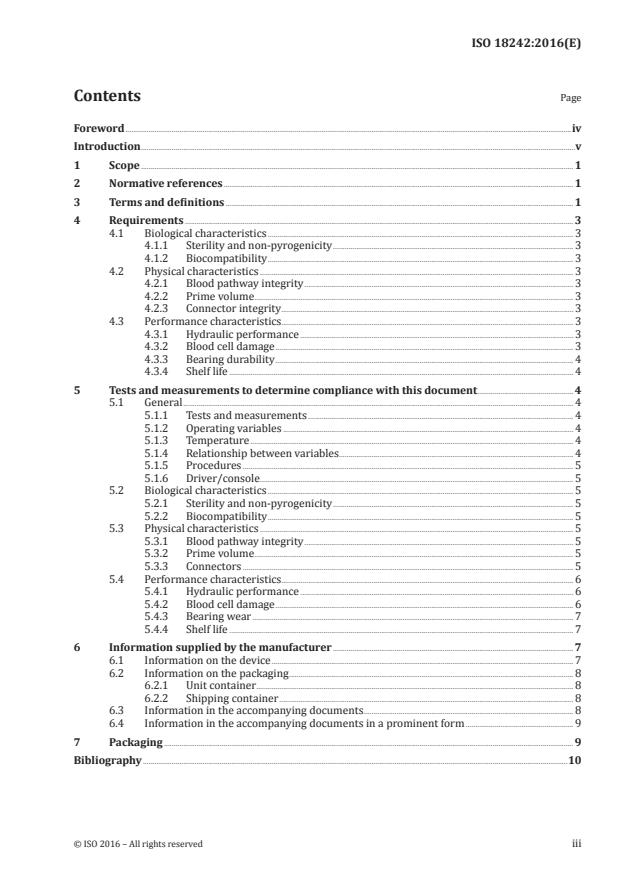
Contents Page
Foreword .iv
Introduction .v
1 Scope . 1
2 Normative references . 1
3 Terms and definitions . 1
4 Requirements . 3
4.1 Biological characteristics . 3
4.1.1 Sterility and non-pyrogenicity . 3
4.1.2 Biocompatibility . 3
4.2 Physical characteristics . 3
4.2.1 Blood pathway integrity . 3
4.2.2 Prime volume . 3
4.2.3 Connector integrity . 3
4.3 Performance characteristics. 3
4.3.1 Hydraulic performance . 3
4.3.2 Blood cell damage . 3
4.3.3 Bearing durability . 4
4.3.4 Shelf life . 4
5 Tests and measurements to determine compliance with this document .4
5.1 General . 4
5.1.1 Tests and measurements . 4
5.1.2 Operating variables . 4
5.1.3 Temperature . 4
5.1.4 Relationship between variables. 4
5.1.5 Procedures . 5
5.1.6 Driver/console . 5
5.2 Biological characteristics . 5
5.2.1 Sterility and non-pyrogenicity . 5
5.2.2 Biocompatibility . 5
5.3 Physical characteristics . 5
5.3.1 Blood pathway integrity . 5
5.3.2 Prime volume . 5
5.3.3 Connectors . 5
5.4 Performance characteristics. 6
5.4.1 Hydraulic performance . 6
5.4.2 Blood cell damage . 6
5.4.3 Bearing wear . 7
5.4.4 Shelf life . 7
6 Information supplied by the manufacturer . 7
6.1 Information on the device . 7
6.2 Information on the packaging . 8
6.2.1 Unit container . 8
6.2.2 Shipping container . 8
6.3 Information in the accompanying documents . 8
6.4 Information in the accompanying documents in a prominent form . 9
7 Packaging . 9
Bibliography .10
Foreword
ISO (the International Organization for Standardization) is a worldwide federation of national standards
bodies (ISO member bodies). The work of preparing International Standards is normally carried out
through ISO technical committees. Each member body interested in a subject for which a technical
committee has been established has the right to be represented on that committee. International
organizations, governmental and non-governmental, in liaison with ISO, also take part in the work.
ISO collaborates closely with the International Electrotechnical Commission (IEC) on all matters of
electrotechnical standardization.
The procedures used to develop this document and those intended for its further maintenance are
described in the ISO/IEC Directives, Part 1. In particular the different approval criteria needed for the
different types of ISO documents should be noted. This document was drafted in accordance with the
editorial rules of the ISO/IEC Directives, Part 2 (see www.iso.org/directives).
Attention is drawn to the possibility that some of the elements of this document may be the subject of
patent rights. ISO shall not be held responsible for identifying any or all such patent rights. Details of
any patent rights identified during the development of the document will be in the Introduction and/or
on the ISO list of patent declarations received (see www.iso.org/patents).
Any trade name used in this document is information given for the convenience of users and does not
constitute an endorsement.
For an explanation on the meaning of ISO specific terms and expressions related to conformity assessment,
as well as information about ISO’s adherence to the World Trade Organization (WTO) principles in the
Technical Barriers to Trade (TBT) see the following URL: www.iso.org/iso/foreword.html.
The committee responsible for this document is ISO/TC 150, Implants for surgery, Subcommittee SC 2,
Cardiovascular implants and extracorporeal systems.
iv © ISO 2016 – All rights reserved
Introduction
This document is intended to ensure that devices designed to provide continuous flow of blood in
support of, or as a substitution for, the normal pumping function of the heart have been adequately tested
for both their safety and function, and that extracorporeal device characteristics are appropriately
disclosed when labelling the device.
This document therefore contains procedures to be used for evaluation of extracorporeal centrifugal
blood pumps. Test procedures for determination of the hydraulic performance, blood cell damage and
other performance characteristics are described, although limits for these characteristics are not
specified. Ready identification of the performance characteristics should, however, assist the user in
the selection of a centrifugal blood pump that will suit the needs of the patient.
This document also includes minimum reporting requirements, which will allow the user to compare
performance characteristics of centrifugal blood pumps of different designs in a standard way.
This document makes reference to other International Standards in which methods for determination
of characteristics common to medical devices can be found.
Requirements for animal and clinical studies have not been included in this document. Such studies
may be part of a manufacturer’s quality system.
This document contains only those requirements that are specific to centrifugal blood pumps. Non-
specific requirements are covered by references to other International Standards listed in Clause 2.
INTERNATIONAL STANDARD ISO 18242:2016(E)
Cardiovascular implants and extracorporeal systems —
Centrifugal blood pumps
1 Scope
This document specifies requirements for sterile, single-use, extracorporeal centrifugal blood pumps,
whether coated, non-surface modified, or surface-modified, intended for producing blood flow during
extracorporeal circulation. Such blood flow is most commonly used to provide systemic perfusion
during cardiopulmonary bypass, but also has applications for veno-venous bypass, kinetic-assisted
venous drainage, or extracorporeal membrane oxygenation.
This document does not apply to
— centrifugal pumps used as ventricular assist devices, and
— other components of extracorporeal circuits (e.g. blood tubing, pump console/driver).
2 Normative references
The following documents are referred to in the text in such a way that some or all of their content
constitutes requirements of this document. For dated references, only the edition cited applies. For
undated references, the latest edition of the referenced document (including any amendments) applies.
ISO 10993-1, Biological evaluation of medical devices — Part 1: Evaluation and testing within a risk
management process
ISO 10993-4, Biological evaluation of medical devices — Part4: Selection of tests for interactions with blood
ISO 10993-7, Biological evaluation of medical devices — Part 7: Ethylene oxide sterilization residuals
ISO 10993-11, Biological evaluation of medical devices — Part 11: Tests for systemic toxicity
ISO 11135, Sterilization of health-care products — Ethylene oxide — Requirements for the development,
validation and routine control of a sterilization process for medical devices
ISO 11137-1, Sterilization of health care products — Radiation — Part 1: Requirements for development,
validation and routine control of a sterilization process for medi
...
INTERNATIONAL ISO
STANDARD 18242
First edition
2016-09-01
Cardiovascular implants and
extracorporeal systems — Centrifugal
blood pumps
Implants cardiovasculaires et systèmes extracorporels — Pompes
sanguines centrifuges
Reference number
©
ISO 2016
© ISO 2016, Published in Switzerland
All rights reserved. Unless otherwise specified, no part of this publication may be reproduced or utilized otherwise in any form
or by any means, electronic or mechanical, including photocopying, or posting on the internet or an intranet, without prior
written permission. Permission can be requested from either ISO at the address below or ISO’s member body in the country of
the requester.
ISO copyright office
Ch. de Blandonnet 8 • CP 401
CH-1214 Vernier, Geneva, Switzerland
Tel. +41 22 749 01 11
Fax +41 22 749 09 47
copyright@iso.org
www.iso.org
ii © ISO 2016 – All rights reserved
Contents Page
Foreword .iv
Introduction .v
1 Scope . 1
2 Normative references . 1
3 Terms and definitions . 1
4 Requirements . 3
4.1 Biological characteristics . 3
4.1.1 Sterility and non-pyrogenicity . 3
4.1.2 Biocompatibility . 3
4.2 Physical characteristics . 3
4.2.1 Blood pathway integrity . 3
4.2.2 Prime volume . 3
4.2.3 Connector integrity . 3
4.3 Performance characteristics. 3
4.3.1 Hydraulic performance . 3
4.3.2 Blood cell damage . 3
4.3.3 Bearing durability . 4
4.3.4 Shelf life . 4
5 Tests and measurements to determine compliance with this document .4
5.1 General . 4
5.1.1 Tests and measurements . 4
5.1.2 Operating variables . 4
5.1.3 Temperature . 4
5.1.4 Relationship between variables. 4
5.1.5 Procedures . 5
5.1.6 Driver/console . 5
5.2 Biological characteristics . 5
5.2.1 Sterility and non-pyrogenicity . 5
5.2.2 Biocompatibility . 5
5.3 Physical characteristics . 5
5.3.1 Blood pathway integrity . 5
5.3.2 Prime volume . 5
5.3.3 Connectors . 5
5.4 Performance characteristics. 6
5.4.1 Hydraulic performance . 6
5.4.2 Blood cell damage . 6
5.4.3 Bearing wear . 7
5.4.4 Shelf life . 7
6 Information supplied by the manufacturer . 7
6.1 Information on the device . 7
6.2 Information on the packaging . 8
6.2.1 Unit container . 8
6.2.2 Shipping container . 8
6.3 Information in the accompanying documents . 8
6.4 Information in the accompanying documents in a prominent form . 9
7 Packaging . 9
Bibliography .10
Foreword
ISO (the International Organization for Standardization) is a worldwide federation of national standards
bodies (ISO member bodies). The work of preparing International Standards is normally carried out
through ISO technical committees. Each member body interested in a subject for which a technical
committee has been established has the right to be represented on that committee. International
organizations, governmental and non-governmental, in liaison with ISO, also take part in the work.
ISO collaborates closely with the International Electrotechnical Commission (IEC) on all matters of
electrotechnical standardization.
The procedures used to develop this document and those intended for its further maintenance are
described in the ISO/IEC Directives, Part 1. In particular the different approval criteria needed for the
different types of ISO documents should be noted. This document was drafted in accordance with the
editorial rules of the ISO/IEC Directives, Part 2 (see www.iso.org/directives).
Attention is drawn to the possibility that some of the elements of this document may be the subject of
patent rights. ISO shall not be held responsible for identifying any or all such patent rights. Details of
any patent rights identified during the development of the document will be in the Introduction and/or
on the ISO list of patent declarations received (see www.iso.org/patents).
Any trade name used in this document is information given for the convenience of users and does not
constitute an endorsement.
For an explanation on the meaning of ISO specific terms and expressions related to conformity assessment,
as well as information about ISO’s adherence to the World Trade Organization (WTO) principles in the
Technical Barriers to Trade (TBT) see the following URL: www.iso.org/iso/foreword.html.
The committee responsible for this document is ISO/TC 150, Implants for surgery, Subcommittee SC 2,
Cardiovascular implants and extracorporeal systems.
iv © ISO 2016 – All rights reserved
Introduction
This document is intended to ensure that devices designed to provide continuous flow of blood in
support of, or as a substitution for, the normal pumping function of the heart have been adequately tested
for both their safety and function, and that extracorporeal device characteristics are appropriately
disclosed when labelling the device.
This document therefore contains procedures to be used for evaluation of extracorporeal centrifugal
blood pumps. Test procedures for determination of the hydraulic performance, blood cell damage and
other performance characteristics are described, although limits for these characteristics are not
specified. Ready identification of the performance characteristics should, however, assist the user in
the selection of a centrifugal blood pump that will suit the needs of the patient.
This document also includes minimum reporting requirements, which will allow the user to compare
performance characteristics of centrifugal blood pumps of different designs in a standard way.
This document makes reference to other International Standards in which methods for determination
of characteristics common to medical devices can be found.
Requirements for animal and clinical studies have not been included in this document. Such studies
may be part of a manufacturer’s quality system.
This document contains only those requirements that are specific to centrifugal blood pumps. Non-
specific requirements are covered by references to other International Standards listed in Clause 2.
INTERNATIONAL STANDARD ISO 18242:2016(E)
Cardiovascular implants and extracorporeal systems —
Centrifugal blood pumps
1 Scope
This document specifies requirements for sterile, single-use, extracorporeal centrifugal blood pumps,
whether coated, non-surface modified, or surface-modified, intended for producing blood flow during
extracorporeal circulation. Such blood flow is most commonly used to provide systemic perfusion
during cardiopulmonary bypass, but also has applications for veno-venous bypass, kinetic-assisted
venous drainage, or extracorporeal membrane oxygenation.
This document does not apply to
— centrifugal pumps used as ventricular assist devices, and
— other components of extracorporeal circuits (e.g. blood tubing, pump console/driver).
2 Normative references
The following documents are referred to in the text in such a way that some or all of their content
constitutes requirements of this document. For dated references, only the edition cited applies. For
undated references, the latest edition of the referenced document (including any amendments) applies.
ISO 10993-1, Biological evaluation of medical devices — Part 1: Evaluation and testing within a risk
management process
ISO 10993-4, Biological evaluation of medical devices — Part4: Selection of tests for interactions with blood
ISO 10993-7, Biological evaluation of medical devices — Part 7: Ethylene oxide sterilization residuals
ISO 10993-11, Biological evaluation of medical devices — Part 11: Tests for systemic toxicity
ISO 11135, Sterilization of health-care products — Ethylene oxide — Requirements for the development,
validation and routine control of a sterilization process for medical devices
ISO 11137-1, Sterilization of health care products — Radiation — Part 1: Requirements for development,
validation and routine control of a sterilization process for medi
...