


ISO 14819-3:2013
(Main)Intelligent transport systems — Traffic and travel information messages via traffic message coding — Part 3: Location referencing for Radio Data System — Traffic Message Channel (RDS-TMC) using ALERT-C
Intelligent transport systems — Traffic and travel information messages via traffic message coding — Part 3: Location referencing for Radio Data System — Traffic Message Channel (RDS-TMC) using ALERT-C
ISO 14819-3:2013 sets out ways of specifying places and positions in traffic and travel information messages, including RDS-TMC messages (the Radio Data System - Traffic Message Channel). It primarily addresses the needs of RDS-TMC ALERT-C messages which are already being implemented. However, the modular approach used is intended to facilitate future extension of the location referencing rules to other traffic and travel messaging systems.
Systèmes intelligents de transport — Informations sur le trafic et le tourisme via le codage de messages sur le trafic — Partie 3: Références de localisants pour le système de radiodiffusion de données (RDS) — Canal de messages d'informations sur le trafic (RDS-TMC) avec ALERT-C
La présente partie de la norme ISO 14819 définit les moyens de spécifier les endroits et les positions dans les messages d'information sur le trafic et le voyage, y compris les messages RDS-TMC (le système de données radio - Canal de messages sur le trafic). Il répond principalement aux besoins des messages RDS-TMC ALERT-C qui sont déjà implémentés. Toutefois, l'approche modulaire utilisée ici vise à faciliter l'extension future des règles de localisation à d'autres systèmes de messagerie d'information sur le trafic et le voyage. Les règles de localisation définies dans la présente partie de la norme couvrent les exigences spécifiques des systèmes TMC (Traffic Message Channel - Canal de messages routiers), qui utilisent des formats de codage abrégés pour fournir des messages TTI. Ces règles traitent notamment du RDS-TMC qui est un moyen de fournir des informations sur le trafic et le tourisme codées numériquement à des usagers utilisant un canal de données silencieux (RDS) diffusé par des stations de radiodiffusion en FM, sur la base du protocole ALERT-C.
General Information
- Status
- Withdrawn
- Publication Date
- 20-Nov-2013
- Withdrawal Date
- 20-Nov-2013
- Technical Committee
- ISO/TC 204 - Intelligent transport systems
- Drafting Committee
- ISO/TC 204/WG 10 - Traveller information systems
- Current Stage
- 9599 - Withdrawal of International Standard
- Start Date
- 08-Feb-2021
- Completion Date
- 12-Feb-2026
Relations
- Effective Date
- 12-Feb-2026
- Effective Date
- 06-Jun-2022
- Effective Date
- 23-Apr-2020
- Effective Date
- 05-Feb-2011

ISO 14819-3:2013 - Intelligent transport systems -- Traffic and travel information messages via traffic message coding

ISO 14819-3:2013 - Systemes intelligents de transport -- Informations sur le trafic et le tourisme via le codage de messages sur le trafic
Get Certified
Connect with accredited certification bodies for this standard

BSI Group
BSI (British Standards Institution) is the business standards company that helps organizations make excellence a habit.

Great Wall Tianjin Quality Assurance Center
Established 1993, first batch to receive national accreditation with IAF recognition.
Hong Kong Quality Assurance Agency (HKQAA)
Hong Kong's leading certification body.
Sponsored listings
Frequently Asked Questions
ISO 14819-3:2013 is a standard published by the International Organization for Standardization (ISO). Its full title is "Intelligent transport systems — Traffic and travel information messages via traffic message coding — Part 3: Location referencing for Radio Data System — Traffic Message Channel (RDS-TMC) using ALERT-C". This standard covers: ISO 14819-3:2013 sets out ways of specifying places and positions in traffic and travel information messages, including RDS-TMC messages (the Radio Data System - Traffic Message Channel). It primarily addresses the needs of RDS-TMC ALERT-C messages which are already being implemented. However, the modular approach used is intended to facilitate future extension of the location referencing rules to other traffic and travel messaging systems.
ISO 14819-3:2013 sets out ways of specifying places and positions in traffic and travel information messages, including RDS-TMC messages (the Radio Data System - Traffic Message Channel). It primarily addresses the needs of RDS-TMC ALERT-C messages which are already being implemented. However, the modular approach used is intended to facilitate future extension of the location referencing rules to other traffic and travel messaging systems.
ISO 14819-3:2013 is classified under the following ICS (International Classification for Standards) categories: 03.220.20 - Road transport; 35.240.60 - IT applications in transport. The ICS classification helps identify the subject area and facilitates finding related standards.
ISO 14819-3:2013 has the following relationships with other standards: It is inter standard links to EN ISO 14819-3:2013, ISO 22882:2004, ISO 14819-3:2021, ISO 14819-3:2004. Understanding these relationships helps ensure you are using the most current and applicable version of the standard.
ISO 14819-3:2013 is available in PDF format for immediate download after purchase. The document can be added to your cart and obtained through the secure checkout process. Digital delivery ensures instant access to the complete standard document.
Standards Content (Sample)
INTERNATIONAL ISO
STANDARD 14819-3
Second edition
2013-12-01
Intelligent transport systems — Traffic
and travel information messages via
traffic message coding —
Part 3:
Location referencing for Radio Data
System — Traffic Message Channel (RDS-
TMC) using ALERT-C
Systèmes intelligents de transport — Informations sur le trafic et le
tourisme via le codage de messages sur le trafic —
Partie 3: Références de localisants pour le système de radiodiffusion de
données (RDS) — Canal de messages d'informations sur le trafic
(RDS-TMC) avec ALERT-C
Reference number
©
ISO 2013
© ISO 2013
All rights reserved. Unless otherwise specified, no part of this publication may be reproduced or utilized otherwise in any form or by any
means, electronic or mechanical, including photocopying, or posting on the internet or an intranet, without prior written permission.
Permission can be requested from either ISO at the address below or ISO’s member body in the country of the requester.
ISO copyright office
Case postale 56 CH-1211 Geneva 20
Tel. + 41 22 749 01 11
Fax + 41 22 749 09 47
E-mail copyright@iso.org
Web www.iso.org
Published in Switzerland
ii © ISO 2013 – All rights reserved
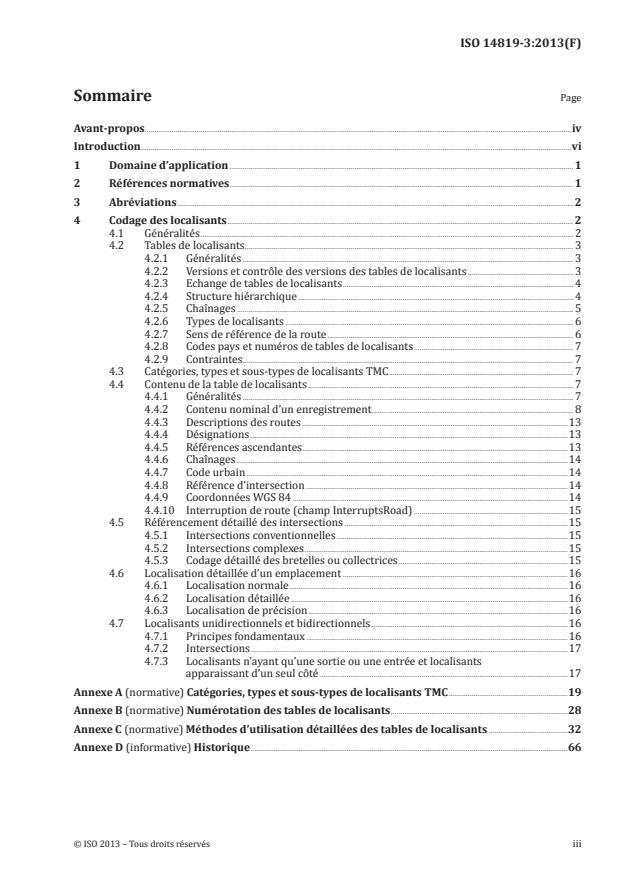
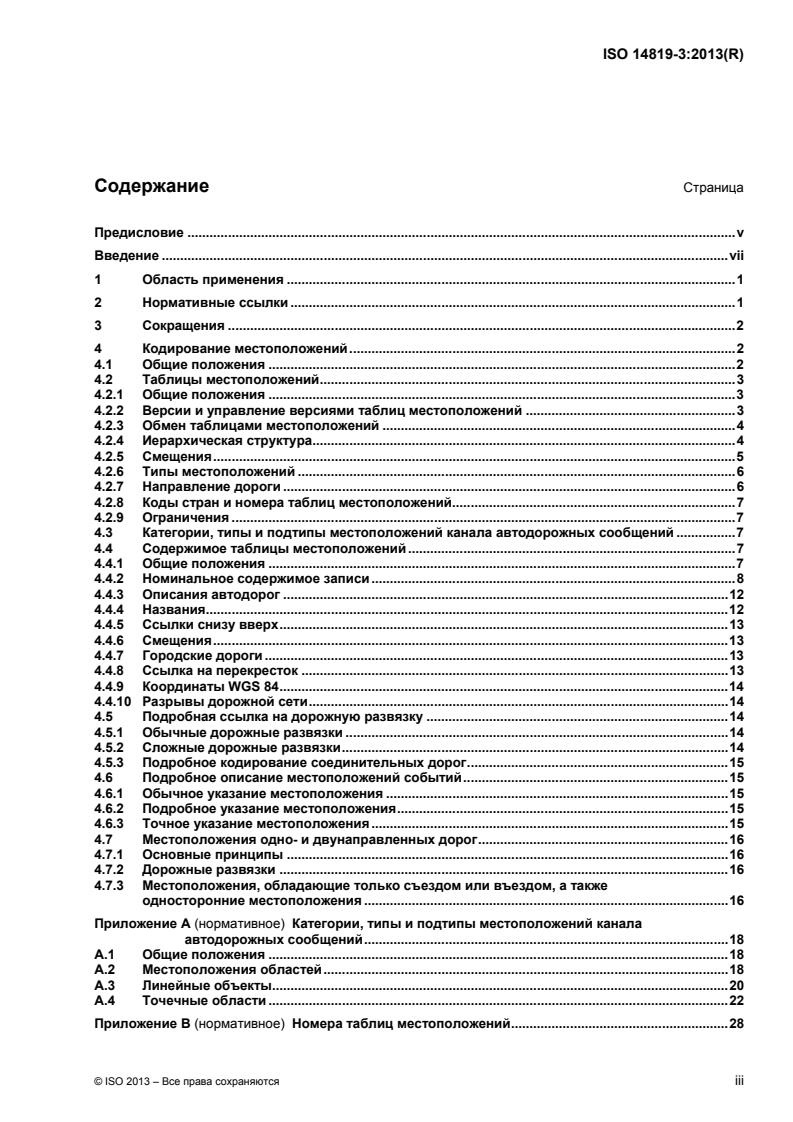
Contents Page
Foreword . v
Introduction . vii
1 Scope . 1
2 Normative references . 1
3 Abbreviated terms . 1
4 Location coding . 2
4.1 General . 2
4.2 Location tables . 3
4.2.1 General . 3
4.2.2 Versions and versioning of location tables . 3
4.2.3 Exchanging location tables . 4
4.2.4 Hierarchical structure . 4
4.2.5 Offsets . 5
4.2.6 Location types . 6
4.2.7 Direction of the road . 6
4.2.8 Country codes and location table numbers . 6
4.2.9 Constraints . 7
4.3 TMC Location categories, types and subtypes . 7
4.4 Location table content . 7
4.4.1 General . 7
4.4.2 Nominal record content . 7
4.4.3 Road descriptions . 12
4.4.4 Names . 12
4.4.5 Upward references . 12
4.4.6 Offsets . 13
4.4.7 Urban . 13
4.4.8 Intersection reference . 13
4.4.9 WGS 84 co-ordinates . 13
4.4.10 InterruptsRoad . 13
4.5 Detailed junction referencing . 14
4.5.1 Conventional junctions . 14
4.5.2 Complex junctions . 14
4.5.3 Detailed coding of link roads . 14
4.6 Detailed situation locations . 15
4.6.1 Normal location referencing . 15
4.6.2 Detailed location referencing . 15
4.6.3 Precise location referencing . 15
4.7 One and two way locations . 15
4.7.1 Basic principles . 15
4.7.2 Junctions . 15
4.7.3 Locations having only an exit or entry and locations occurring on one side only . 15
Annex A (normative) TMC Location categories, types and subtypes . 18
A.1 General . 18
A.2 Area locations . 18
A.3 Linear locations . 20
A.4 Point locations . 22
Annex B (normative) Location table numbers . 28
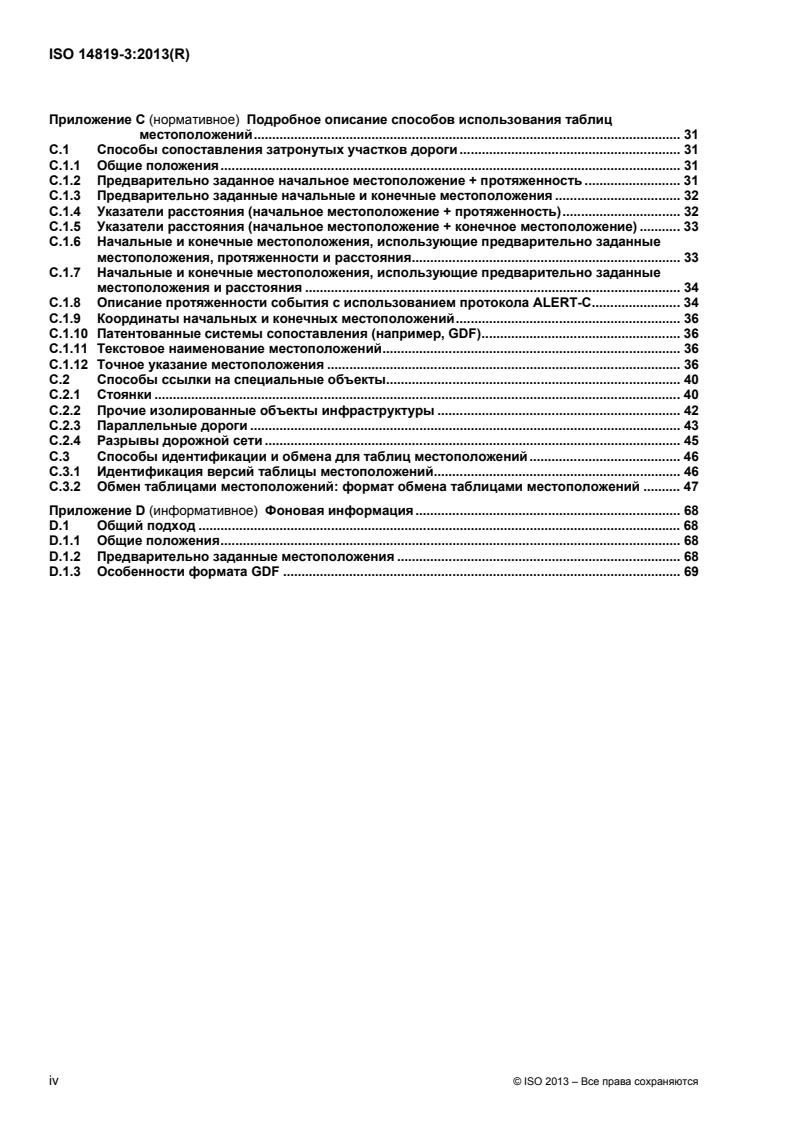
Annex C (normative) Detailed methods for the usage of location tables . 31
C.1 Methods for referencing affected road sections .31
C.1.1 General .31
C.1.2 Pre-defined primary location + extent .31
C.1.3 Pre-defined primary and secondary locations .32
C.1.4 Distance markers (primary location + extent).32
C.1.5 Distance markers (primary + secondary location) .33
C.1.6 Primary and secondary locations using pre-defined location, extent and distances .33
C.1.7 Primary and secondary locations using pre-defined locations + distances .34
C.1.8 Describing the extent of an event in ALERT-C .34
C.1.9 Co-ordinates (primary + secondary locations) .36
C.1.10 Proprietary referencing systems, e.g. GDF .36
C.1.11 Text location naming .36
C.1.12 Precise location referencing .36
C.2 Methods for referencing specific features .40
C.2.1 Parking facilities .40
C.2.2 Other isolated POIs .42
C.2.3 Parallel Roads .43
C.2.4 Interrupted Roads .45
C.3 Methods for identifying and exchanging location tables .46
C.3.1 Identifying versions of a location table .46
C.3.2 Exchanging location tables – the Location Table Exchange Format .46
Annex D (informative) Background information .66
D.1 Overall approach.66
D.1.1 General .66
D.1.2 Pre-defined locations .66
D.1.3 GDF features .67
Bibliography . Error! Bookmark not defined.
iv © ISO 2013 – All rights reserved
Foreword
ISO (the International Organization for Standardization) is a worldwide federation of national standards bodies
(ISO member bodies). The work of preparing International Standards is normally carried out through ISO
technical committees. Each member body interested in a subject for which a technical committee has been
established has the right to be represented on that committee. International organizations, governmental and
non-governmental, in liaison with ISO, also take part in the work. ISO collaborates closely with the
International Electrotechnical Commission (IEC) on all matters of electrotechnical standardization.
The procedures used to develop this document and those intended for its further maintenance are described
in the ISO/IEC Directives, Part 1. In particular the different approval criteria needed for the different types of
ISO documents should be noted. This document was drafted in accordance with the editorial rules of the
ISO/IEC Directives, Part 2. www.iso.org/directives
Attention is drawn to the possibility that some of the elements of this document may be the subject of patent
rights. ISO shall not be held responsible for identifying any or all such patent rights. Details of any patent
rights identified during the development of the document will be in the Introduction and/or on the ISO list of
patent declarations received. www.iso.org/patents
Any trade name used in this document is information given for the convenience of users and does not
constitute an endorsement.
For an explanation on the meaning of ISO specific terms and expressions related to conformity assessment,
as well as information about ISO's adherence to the WTO principles in the Technical Barriers to Trade (TBT)
see the following URL: Foreword - Supplementary information
The committee responsible for this document is ISO/TC 204, Intelligent transport systems.
This second edition cancels and replaces the first edition (ISO 14819-3:2004), which has been technically
revised.
ISO 14819 consists of the following parts, under the general title Intelligent transport systems — Traffic and
travel information messages via traffic message coding:
Part 1: Coding protocol for Radio Data System — Traffic Message Channel (RDS-TMC) using ALERT-C
Part 2: Event and information codes for Radio Data System — Traffic Message Channel (RDS-TMC)
using ALERT-C
Part 3: Location referencing for Radio Data System — Traffic message Channel (RDS-TMC) using
ALERT-C
Part 6: Encryption and conditional access for the Radio Data System — Traffic Message Channel ALERT
C coding
Compared to previous releases, this version includes the following additions:
Precise location referencing
Tendencies of Traffic Queue Lengths (TTQL)
Coding of parking POIs
Coding of interrupted roads
Coding of other isolated POIs (except parking POIs)
Coding of parallel roads
Version identification of TMC location tables
Location Table Exchange Format
North American Safety Events in TMC
Explicit Location Table Country Code transmission in TMC
Guidelines for Service Providers and Terminal Manufacturers for Implementation of explicit Location
Table Country Code transmission
Coding of link roads
GB-English - List of Quantifiers
Additional Event Codes identified by Germany
Additional TMC Events from Danish proposal
Additional TMC Supplementary Information: Unconfirmed Report
RDS-TMC delivery of IVR Telephone Number
Coding of link roads
vi © ISO 2013 – All rights reserved
Introduction
This part of ISO 14819 sets out ways of specifying places and positions in traffic and travel information
messages, including RDS-TMC messages (the Radio Data System - Traffic Message Channel).
It defines the structure and semantics of location tables for Traffic Information Centres (TICs) and receivers.
a) Traffic and travel messages;
1) Traffic and travel information is created and updated in an originating database, by human operators
or automated systems. Information is transferred to one or more remote systems by means of
messages.
2) In this context, a message is a collection of data which is exchanged to convey information for an
agreed purpose between two or more parties. Traffic and travel messages are digitally coded sets of
data exchanged by interested parties, which convey information about traffic, travel and/or transport
networks. Digital coding can be alphanumeric, as in EDIFACT, or binary, as in RDS-TMC.
3) The traffic and travel messages developed in programmes of the European Union are open, non-
proprietary proposals for standards intended to serve the public interest by facilitating interconnection
and interoperability of the relevant information systems.
b) Location referencing.
The location referencing component of a traffic and travel message enables a service provider to indicate the
physical location of the event being described. The management of TMC location databases requires on-
going maintenance. It is necessary to both manage location database ID allocation for countries implementing
TMC services and to validate new and updated location databases when ground features change. These
activities are led by service providers who also need to ensure that their end-users are kept up-to-date. The
Traveller Information Services Association (www.tisa.org) manages the ID allocation on a worldwide basis.
TISA provides location database validation for service providers who generally arrange location database
updates on a bi-annual cycle.
INTERNATIONAL STANDARD ISO 14819-3:2013(E)
Intelligent transport systems — Traffic and travel information
messages via traffic message coding —
Part 3:
Location referencing for Radio Data System — Traffic Message
Channel (RDS-TMC) using ALERT-C
1 Scope
This part of ISO 14819 sets out ways of specifying places and positions in traffic and travel information
messages, including RDS-TMC messages (the Radio Data System - Traffic Message Channel). It primarily
addresses the needs of RDS-TMC ALERT-C messages which are already being implemented. However, the
modular approach used here is intended to facilitate future extension of the location referencing rules to other
traffic and travel messaging systems.
The location referencing rules defined in this part of ISO 14819 address the specific requirements of Traffic
Message Channel (TMC) systems, which use abbreviated coding formats to provide TTI messages. In
particular, the rules address the Radio Data System - Traffic Message Channel (RDS-TMC), a means of
providing digitally-coded traffic and travel information to travellers using a silent data channel (RDS) on FM
radio stations, based on the ALERT-C protocol.
2 Normative references
The following documents, in whole or in part, are normatively referenced in this document and are
indispensable for its application. For dated references, only the edition cited applies. For undated references,
the latest edition of the referenced document (including any amendments) applies.
ISO/IEC 8859-15:1999, Information technology — 8-bit single-byte coded graphic character sets — Part 15:
Latin alphabet No. 9
ISO/IEC 10646:2012, Information technology — Universal Coded Character Set (UCS)
ISO 14819-1:2013, Intelligent transport systems — Traffic and travel information messages via traffic
message coding — Part 1: Coding protocol for Radio Data System — Traffic Message Channel (RDS-TMC)
using ALERT-C
ISO 14825:2011, Intelligent transport systems — Geographic Data Files (GDF) — GDF5.0
IEC 62106:2009, Specification of the radio data system (RDS) for VHF/FM sound broadcasting in the
frequency range from 87,5 to 108,0 MHz
NIMA Technical Report TR8350.2, US Department of Defense
3 Abbreviated terms
For the purposes of this document, the following abbreviated terms apply:
ALERT-C Advice and problem Location for European Road Traffic, Version C
ASCII American Standard Code for Information Interchange
CCD Country code
CID Country Identifier
CLST Code of Location Subtype
CNAME Country name
ECC Extended Country Code (an RDS feature)
EDIFACT Electronic Data Interchange For Administration Commerce and Transport
GDF Geographic Data Files (ISO 14825 for modelling and exchange of geographic data for
transport telematics applications.)
LC Location Code
LTCC Location Table Country Code
LTN Location Table Number
NIMA National Imagery and Mapping Agency (US)
POI Point of Interest
RDS Radio Data System (digital information channel on FM sub carrier)
TIC Traffic Information Centre
TISA Traveller Information Services Association
TMC Traffic Message Channel
TTI Traffic and Travel Information
WGS 84 World Geodetic System 1984
4 Location coding
4.1 General
Location references used by RDS-TMC are covered by the location referencing rules defined in this section.
The ALERT-C coding protocol for RDS-TMC is defined in The following documents, in whole or in part, are
normatively referenced in this document and are indispensable for its application. For dated references, only
the edition cited applies. For undated references, the latest edition of the referenced document (including any
amendments) applies.
ISO/IEC 8859-15:1999, Information technology — 8-bit single-byte coded graphic character sets — Part 15:
Latin alphabet No. 9
ISO/IEC 10646:2012, Information technology — Universal Coded Character Set (UCS)
2 © ISO 2013 – All rights reserved
ISO 14819-1.
ALERT-C supports a digital, silent data broadcast service for motorists, providing information about many
kinds of traffic situations. This includes roadwork, weather and traffic incident information relating to major
national and international roads, regional roads and local or urban roads.
4.2 Location tables
4.2.1 General
Within RDS-TMC, locations are identified and referenced by their location code. A given RDS-TMC service
uses a pre-defined location table, containing the pre-stored details of the locations that can be referenced in
messages from that service.
A location code in such a message refers and serves as a tabular ‘address’ of the pre-stored location details
in the location table used by the service. A real world location may have more than one location code within
the same location table. However, within a given location table, each location code refers to one and only one
location. A location code has a number in the range 1 to 63,487.
NOTE In ALERT-C, a further 2048 numbers are reserved for INTER-ROAD (see The following documents, in whole
or in part, are normatively referenced in this document and are indispensable for its application. For dated references, only
the edition cited applies. For undated references, the latest edition of the referenced document (including any
amendments) applies.
ISO/IEC 8859-15:1999, Information technology — 8-bit single-byte coded graphic character sets — Part 15: Latin
alphabet No. 9
ISO/IEC 10646:2012, Information technology — Universal Coded Character Set (UCS)
ISO 14819-1) and other forms of referencing.
A table may contain a maximum number of 65,536 codes allocated in the following way:
Location code Use
0 reserved
1 - 63,487 free for normal location coding
63,488 - 64,511 for special purposes
64,512 - 65,532 for INTER-ROAD
64,533 - 65,535 special functions
NOTE INTER-ROAD is a coding mechanism within ALERT-C to reference in a specific type of ALERT-C message
(the INTER-ROAD message) a location belonging to a different location table. This can be a table in the same country as
well as a table in another country.
4.2.2 Versions and versioning of location tables
Once a location has been allocated, it cannot easily be re-allocated (in an RDS-TMC/ALERT-C environment).
Therefore, all existing locations and their associated location codes in a given location table should be
regarded as fixed. However, other attributes of a location may, within certain constraints, sometimes change
(e.g. name, positive offset, negative offset).
Within each location table, space (unallocated location codes) shall be left to accommodate future
requirements for additional locations (to deal with new construction, and location referencing requirements not
originally foreseen).
Whenever new locations are added to, or removed from, a location table (for example to extend coverage or
to reflect changes to the road network), the resulting table shall be treated as a new version. The creation and
tracking of versions of a location table allows the evolution of a location table to be understood and supports
the successful use of the table and associated TMC service. A new version of an existing location table must
remain compatible with the previous versions of the same location table – the changes must not be such that
the location of a TMC message could be wrongly interpreted by a receiver. For example, location codes which
are deleted should not be used for a long period. Also changing the attributes class and type of a location
might cause an incompatible version of the table. It is part of TISA's location certification process to judge if a
table is backwards compatible.
The method for identifying and labelling different versions of a location table is shown in Annex C.3.1
TISA has established an allocation of location tables to show which are in use or available for use in each
country. The responsible agency in a country can apply for additional location table numbers in future, to
support further applications or more detailed, regional location tables. New tables can also be issued
occasionally to allow for complete updates to existing tables. Such major changes will however be very
disruptive for users, as existing receivers will not recognise TMC messages relating to the new location table
unless the same location table is also installed in the receiver. Switches from one location table to a different
one (rather than a new version of the same table) should therefore be avoided as far as possible, especially in
established markets.
4.2.3 Exchanging location tables
For TMC services to work well, the different organisations involved need to be able to understand the location
table number, version and contents. To achieve this, a Location Table Exchange Format has been defined.
This format will be used for the exchange of TMC Location Tables between the various functional areas, e.g.
receiver manufactures, map providers, certification of TMC location tables, Traffic Information Centres and
service providers.
The Location Table Exchange Format specifies the information that must be provided as part of a location
table, and the way in which it is to be presented. The Location Table Exchange Format aims to provide a
complete and precise description of a TMC Location table, that is readable from software programs without
any changes or adaptations.
A location table defined using the Location Table Exchange Format consists of a series of text files, each
containing a set of records made up of predefined fields. The method for using the Location Table Exchange
Format is defined in Annex C.3.2.
4.2.4 Hierarchical structure
RDS-TMC location tables use a hierarchical structure of pre-defined locations. A system of pointers provides
upward references to higher-level locations of which the specified location forms a part.
Example Kent would have an upward area reference to south-east England. South-east England may be
referenced up to the UK, then the British Isles, then Europe, etc. (Figure 1).
4 © ISO 2013 – All rights reserved
Key
A County of Kent
B South East England
C United Kingdom
D British Isles
E Europe
Figure 1 — Upward Area Referencing
Junction 25 on the M1 motorway in UK would have a linear reference to a motorway segment, e.g. Leicester
- Sheffield. This segment could then be referenced up to the whole road (the M1 Motorway).
Hierarchical tables help to make location referencing simple and unambiguous. A major benefit of hierarchical
tables is that they facilitate automated sorting and selection of information for users. However, both
hierarchical and unstructured tables are currently used in various applications.
4.2.5 Offsets
Most point locations and certain linear locations point to previous and next locations of the same type. This is
indicated by negative and positive offsets.
Example Junction 25 on a motorway may be offset to Junction 26 in the positive direction, and to Junction 24 in
the negative direction. A sign convention adopted at the time of coding locations specifies the positive direction of travel
along each road (Figure 2).
Key
a positive direction
b negative offset
c positive offset
Figure 2 — Offsets
4.2.6 Location types
Location types and subtypes are required for language independence of the information given, and to tell the
receiving system what data fields to expect.
At the highest level, locations fall into three categories:
a) area locations
b) linear locations
c) point locations
Within each category, location types are distinguished (in principle) whenever a location is functionally distinct
in the way it shall be handled by the message recipient. Therefore a set of predefined location types and
subtypes is set out in Annex A.
Subtypes can be used to give further details of (for example) facilities available at a particular location, such
as a service area. The current list, in Annex A, will be added to as further needs are agreed.
Official translations of the language-independent terms that describe location types and subtypes should be
agreed on a national level.
4.2.7 Direction of the road
The predefined direction of the road (see 4.2.3) is reflected in the positive and negative offsets in the location
table and in the order of the names of the end points of a road or road segment (see Table 1).
When newly specifying positive directions along roads within pre-defined tables, it is recommended to use
geographic positive directions relative to the co-ordinate system, i.e. on the Northern Hemisphere from south
to north and from west to east.
For ring roads the clockwise travel direction is recommended positive.
In any case it is not allowed to reverse the direction along continuous and / or connecting segments of a road,
e.g. at administrative borders.
4.2.8 Country codes and location table numbers
With ALERT-C, it is assumed that RDS-TMC service and location tables are organised and defined on a
country-by-country basis. Therefore each service and each location table is associated to a country code in
the range 1-15 (hexadecimal 1-F) as described in IEC 62106. A service and the location table it uses shall
6 © ISO 2013 – All rights reserved
have the same country code. There can be more than 1 location table per country. They are distinguished by
an additional location table number in the range 1-63. Country codes are not unique. The extended country
code (ECC, see IEC 62106) is therefore available in addition. The combination of extended country code
(8 bits), country code (4 bits), location table number (6 bits) and location code (16 bits) defines an extended
location code, which is unique worldwide.
TISA has established an allocation of location table numbers for each country, given in Annex B. As far as
possible, the allocated combinations of country code and location table number define a location table
uniquely, regardless of extended country code. This ensures support for countries where, for historical
reasons, the extended country code is not in use. As can be concluded from Annex B, a country like e.g.
Austria can have at most 8 location tables.
4.2.9 Constraints
Constraints on location coding may in future be agreed, modelled and documented. At present, however,
national authorities and/or service providers are free to allocate location codes within a location table as they
wish, to locations specified in accordance with these rules.
4.3 TMC Location categories, types and subtypes
Location categories, types and location subtypes are standardised, and specified in Annex A. Each location is
described by a code, which is composed of:
a character (A, L or P), indicating the location category (area, linear or point),
a number indicating the type,
a dot,
a number indicating a subtype.
EXAMPLE 1 P1.8 - roundabout (P = point, P1 = junction)
For types for which not a subtype is defined, the subtype code 0 (zero) has to be used to define the type as a
subtype.
EXAMPLE 2 A3.0 – country
4.4 Location table content
4.4.1 General
The location table content is fixed only for the purposes of definition and exchange. The information used
within specific applications or by individual manufacturers is not fixed, and is not within the scope of these
specifications.
For international consistency, one single location table content shall be adhered to for definition and exchange
purposes. In this structure, some items are mandatory; some items are mandatory where they exist; and some
items are optional.
4.4.2 Nominal record content
The nominal content of each record in the location table is as follows:
location code,
code of location (sub) type,
road/junction number,
road name,
first name,
second name,
area reference,
linear reference,
negative offset,
positive offset,
urban,
intersection reference,
WGS 84 co-ordinates (longitude and latitude) conforming to NIMA Technical Report TR8350.2.
Not all of these items shall be present in every record. Table 1 indicates which references are required and/or
allowed, according to location type.
8 © ISO 2013 – All rights reserved
Table 1 — Content of location table for ALERT-C
inter-
loc- road/ WGS 84
code of location road section Interrupts
ation junction first name second name area reference linear reference negative offset positive offset urban co-
(sub) type name refer- Road
code number ordinates
ence
(M) continent - - name (M) - - - - - - - - -
Area
(M) country group - - name (M) - country group or - - - - - - -
continent (M)
(M) country - - name (M) - country group or - - - - - - -
continent (M)
(M) other area (water - - name (M) - lowest order - - - - - - -
area, fuzzy area, administrative area
application or other area (m)
region)
(M) nth order area - - name (M) - nth order area (M) - - - - - - -
(n = 1 to 5)
2 2
(M) road (m) (m) negative end positive end nth order area or - - - - - - -
name (M) name (M) country (M)
Linear
2 2
(M) ring road (m) (m) name (O) - nth order area or - - - - - - -
country (M)
2 2
(M) nth order segment (m) (m) negative end positive end nth order area or first order segment, preceding subsequent - - - -
(n = 1, 2) name (M) name (M) country or other road or ring road (M) nth order nth order
area (O) segment (m) segment (m)
(M) urban street - (M) name (O) name (O) nth order area or - - - - - - -
other area (M)
(M) vehicular link - (m) negative end positive end nth order area or - - - - - - -
name (M) name (M) other area (O)
(M) link road - - origin road destination lowest order - - - - - - -
administrative area
number and road number
origin end and or other area of the
name (M) destination intersection to
end name which the link road
(M) belongs (m)
11 11
(M) parallel road (m) (m) negative end positive end lowest order - - - - - - -
12 12
name (M) name (M) administrative area
or other area (M)
10 © ISO 2013 – All rights reserved
inter-
loc- road/ WGS 84
code of location road section Interrupts
ation junction first name second name area reference linear reference negative offset positive offset urban co-
(sub) type name refer- Road
code number ordinates
ence
3 3 9
(M) junction (m) (O) junction name road number lowest order lowest order preceding subsequent (M) (m) (M) (m)
(m) or name of administrative area segment, road or point (m) point (m)
Point
intersecting or other area (M) ring road (M)
road (O)
(M) intermediate point - - point descriptor - lowest order lowest order preceding subsequent (M) - (M) (m)
(M) administrative area segment, road or point (m) point (m)
or other area (M) ring road (M)
(M) other landmark - - point name (M) - lowest order lowest order preceding subsequent (M) (O) (M) (m)
1, 10
point administrative area segment, road or point (m) point (m)
or other area (M) ring road (M)
6 7 9
(M) link road (m) (O) junction name - lowest order link road (M) - - (M) (M) (M) (m)
pointjunction (m) administrative area
number or other area (M)
8 9
(M) parking POI - (O) name of the - lowest order - - - (M) - (M) (m)
parking POI administrative area
or other area (M)
(M) other isolated - (O) name of the - lowest order - - - (M) - (M) -
POI isolated POI administrative area
or other area (M)
Table 1 contains an overview of the content of a location table for RDS-TMC. Mandatory fields are shown by
(M), while (m) means mandatory where it exists, and (O) means optional. Fields not present are shown by -
(dash). The first column is for explanation only. The second column (location code) represents the key of the
table, and therefore has the entry (M) for each record in the table. The sequence of the columns in the table is
not significant. Non-empty fields in the columns area reference, linear reference, negative offset, positive
offset contain the code of the location within the same location table to which the field references. For detailed
descriptions of all location types and their codes see Annex A.
NOTE 1 Other points include motorway service areas, and prominent landmarks such as named, major bridges and
tunnels.
NOTE 2 For roads, ring roads and nth order segments at least one of the two fields road/junction number and road
name shall have a value.
NOTE 3 For junctions at least one of the four fields road/junction number, road name, first name and second name
shall have a value.
NOTE 4 The column code of location (sub)type in this explanatory table contains descriptions of location types and
subtypes. In a real location table this column contains location (sub)type codes.
NOTE 5 For link roads, the field first name shall be equal to the combination of the values of the field road number, and
the field first name (negative end name) or the field second name (positive end name), of the lowest level of the road or
segment to which the start (related to the driving direction) of the positively coded link road connects.
Of the first name and the second name, that one shall be selected that can be logically considered to be the negative end
name of the link road. In case the first or second name of the relevant segment does not add useful information, then the
respective value of a next higher level (segment or road) may be used. In case the first or second name of the highest
level (road) does not provide meaningful information, it is recommended to use another entry as first name.
In case the link road originates from both directions of the road or segment, then the value of first name field shall only
consist of the road number of the main road. Note that in this case the origin end name is not (M).
The field second name is constructed in the same way but referring to the destination road at the end of the link not the
origin road at the start of the link.
NOTE 6 For link road points, the intersection reference is a cross reference to a location code referring to the same
junction. If the junction is coded by three or more roads, cross-references are represented in the location table anti-
clockwise in a circular way, such that each location code references only one other location code explicitly, and the
other(s) implicitly.
NOTE 7 For link road points, the WGS84 co-ordinate value shall be the co-ordinate taken at the middle of the link road
on the link road.
NOTE 8 For parking POI points P5, If a corresponding P3 type point is also coded as P5 type, for consistency the
same name shall be used for the P3 and the P5 locations. If a corresponding P3 type location exists, the value shall be the
same as for the P3 type location. Otherwise the coordinates of the approximate centre of the location shall be given.
NOTE 9 For points where the field 'InterruptsRoad' has a non-zero value (i.e. the road is interrupted adjacent to that
point), the last point location before the interruption shall not have a positive offset (to the first point location after the
interruption) and the first point location after the interruption shall not have a negative offset (to the last point location
before the interruption). Segments as defined for the road shall always be refer to each other by positive and negative
offsets, independent of the interruption of the road. (See section 4.4.10 for definition of Interrupted Roads)
NOTE 10 The same location shall not be coded both as a P3 location type and as a P6 location type.
NOTE 11 If there is no specific road number or road name for the parallel road, the road number or road name from the
main road to which the parallel road runs parallel shall be filled in here.
NOTE 12 First name and second name indicate the direction of travel on the parallel road (the rule “west-east and
south-north coding” shall not be applied here, see also section 4.2.7).
NOTE 13 The location code of category LINEAR to which the P1.16 and P1.17 refer are of type L8.0.
NOTE 14 P1.16 shall have a positive offset and no negative offset, P1.17 shall have a negative offset and no positive
offset.
4.4.3 Road descriptions
4.4.3.1 Road numbers and road names
Road descriptions are normally road numbers. They shall be indicated at the highest level of the hierarchy (e.g.
road/ring road) only. In addition to the road number (A1 – R0), a road name (e.g. Autoroute du Nord) or other
road number (e.g. E13 for A1) may be defined. If no road number exists, a road name is mandatory (e.g.
Boulevard Périphérique).
Some segments of a road may carry additional numbers and/or names (e.g. A6 - Autoroute du Soleil, A4 -
Kölner Ring). In the case that a road segment belongs to more than one road this shall lead to multiple entries in
the location table. If the multiple numbers and/or names do not signify the fact that the segment is part of more
than one road, they can be indicated at the segment level in the road-name field, where required. The higher-
level road number still applies.
For vehicular links, the road name can be the name of a company, e.g. Stena Sealink; Eurotunnel; a
...
NORME ISO
INTERNATIONALE 14819-3
Deuxième édition
2013-12-01
Systèmes intelligents de transport —
Informations sur le trafic et le
tourisme via le codage de messages
sur le trafic —
Partie 3:
Références de localisants pour
le système de radiodiffusion de
données (RDS) — Canal de messages
d'informations sur le trafic (RDS-TMC)
avec ALERT-C
Intelligent transport systems — Traffic and travel information
messages via traffic message coding —
Part 3: Location referencing for Radio Data System — Traffic Message
Channel (RDS-TMC) using ALERT-C
Numéro de référence
©
ISO 2013
DOCUMENT PROTÉGÉ PAR COPYRIGHT
© ISO 2013
Tous droits réservés. Sauf prescription différente ou nécessité dans le contexte de sa mise en œuvre, aucune partie de cette
publication ne peut être reproduite ni utilisée sous quelque forme que ce soit et par aucun procédé, électronique ou mécanique,
y compris la photocopie, ou la diffusion sur l’internet ou sur un intranet, sans autorisation écrite préalable. Une autorisation peut
être demandée à l’ISO à l’adresse ci-après ou au comité membre de l’ISO dans le pays du demandeur.
ISO copyright office
Case postale 401 • Ch. de Blandonnet 8
CH-1214 Vernier, Genève
Tél.: +41 22 749 01 11
Fax: +41 22 749 09 47
E-mail: copyright@iso.org
Web: www.iso.org
Publié en Suisse
ii © ISO 2013 – Tous droits réservés
Sommaire Page
Avant-propos .iv
Introduction .vi
1 Domaine d’application . 1
2 Références normatives . 1
3 Abréviations . 2
4 Codage des localisants . 2
4.1 Généralités . 2
4.2 Tables de localisants . 3
4.2.1 Généralités . 3
4.2.2 Versions et contrôle des versions des tables de localisants . 3
4.2.3 Echange de tables de localisants . 4
4.2.4 Structure hiérarchique . 4
4.2.5 Chaînages . 5
4.2.6 Types de localisants . 6
4.2.7 Sens de référence de la route . 6
4.2.8 Codes pays et numéros de tables de localisants . 7
4.2.9 Contraintes . 7
4.3 Catégories, types et sous-types de localisants TMC . 7
4.4 Contenu de la table de localisants . 7
4.4.1 Généralités . 7
4.4.2 Contenu nominal d’un enregistrement. 8
4.4.3 Descriptions des routes .13
4.4.4 Désignations .13
4.4.5 Références ascendantes .13
4.4.6 Chaînages .14
4.4.7 Code urbain .14
4.4.8 Référence d’intersection .14
4.4.9 Coordonnées WGS 84 .14
4.4.10 Interruption de route (champ InterruptsRoad) .15
4.5 Référencement détaillé des intersections .15
4.5.1 Intersections conventionnelles .15
4.5.2 Intersections complexes .15
4.5.3 Codage détaillé des bretelles ou collectrices .15
4.6 Localisation détaillée d’un emplacement .16
4.6.1 Localisation normale .16
4.6.2 Localisation détaillée .16
4.6.3 Localisation de précision .16
4.7 Localisants unidirectionnels et bidirectionnels .16
4.7.1 Principes fondamentaux .16
4.7.2 Intersections .17
4.7.3 Localisants n’ayant qu’une sortie ou une entrée et localisants
apparaissant d’un seul côté .17
Annexe A (normative) Catégories, types et sous-types de localisants TMC .19
Annexe B (normative) Numérotation des tables de localisants .28
Annexe C (normative) Méthodes d’utilisation détaillées des tables de localisants .32
Annexe D (informative) Historique .66
Avant-propos
L'ISO (Organisation internationale de normalisation) est une fédération mondiale d'organismes
nationaux de normalisation (comités membres de l'ISO). L'élaboration des Normes internationales est
en général confiée aux comités techniques de l'ISO. Chaque comité membre intéressé par une étude
a le droit de faire partie du comité technique créé à cet effet. Les organisations internationales,
gouvernementales et non gouvernementales, en liaison avec l'ISO participent également aux travaux.
L'ISO collabore étroitement avec la Commission électrotechnique internationale (CEI) en ce qui
concerne la normalisation électrotechnique.
Les procédures utilisées pour élaborer le présent document et celles destinées à sa mise à jour sont
décrites dans les Directives ISO/IEC, Partie 1. Il convient, en particulier, de prendre note des différents
critères d’approbation requis pour les différents types de documents. Le présent document a été rédigé
conformément aux règles de rédaction données dans les Directives ISO/IEC, Partie 2 (voir www. iso
.org/directives).
L’attention est attirée sur le fait que certains des éléments du présent document peuvent faire l’objet
de droits de brevet. L’IEC et l’ISO ne sauraient être tenues pour responsables de ne pas avoir identifié
de tels droits de propriété et averti de leur existence. Les détails concernant les références aux droits
de propriété intellectuelle ou autres droits analogues identifiés lors de l’élaboration du document sont
indiqués dans l’Introduction et/ou dans la liste des déclarations de brevets reçues par l’ISO (voir www
.iso.o rg/patents).
Les appellations commerciales éventuellement mentionnées dans le présent document sont données
pour information, par souci de commodité, à l’intention des utilisateurs et ne sauraient constituer un
engagement.
Pour une explication de la signification des termes et expressions spécifiques de l’ISO liés à l’évaluation
de la conformité, ou pour toute information au sujet de l’adhésion de l’ISO aux principes de l’OMC
concernant les obstacles techniques au commerce (OTC), voir le lien suivant: Avant-propos -Informations
supplémentaires
Le comité technique responsable de ce document est le ISO/TC204, Systèmes intelligents de transport.
Cette seconde édition annule et remplace la première édition (ISO 14819-3:2004 qui a fait l’objet d’une
révision technique.
L'ISO 14819 comprend les parties suivantes, présentées sous le titre général Systèmes intelligents de
transport — Informations sur le trafic et le tourisme via le codage de messages sur le trafic:
— Partie 1: Protocole de codage pour le système de radiodiffusion de données (RDS) — Canal de messages
d'informations sur le trafic (RDS-TMC) avec ALERT-C
— Partie 2: Codes d'événements et d'informations pour le système de radiodiffusion de données (RDS) —
Canal de messages d'informations sur le trafic (RDS-TMC) avec ALERT-C
— Partie 3: Références de localisants pour le système de radiodiffusion de données (RDS) — Canal de
messages d'informations sur le trafic (RDS-TMC) avec ALERT-C
— Parties 6: Accès au cryptage et accès conditionnel pour le système de radiodiffusion de données —
Codage ALERT C du canal de messages sur le trafic
Comparée à la précédente, cette version inclus les ajouts suivants:
— Localisation précise
— Tendances sur les longueurs de bouchons (TTQL)
— Codage des POI de type stationnement
— Codage des routes interrompues
iv © ISO 2013 – Tous droits réservés
— Codage d'autres POIs isolés (sauf les POIs de type stationnement)
— Codage de routes parallèles
— Identification de la version des tables de localisants TMC
— Format d'échange des tables de localisants
— Événements relatifs à la sécurité en Amérique du Nord en TMC
— Transmission explicite en TMC des codes pays des tables de localisants
— Lignes directrices à l'intention des fournisseurs de services et des fabricants de terminaux pour la
mise en œuvre de la transmission explicite des codes pays des tables de localisants
— Codage des bretelles de liaison
— Anglais - GB - Liste des quantificateurs
— Codes d'événements supplémentaires identifiés par l'Allemagne
— Événements TMC supplémentaires sur proposition danoise
— Autres informations supplémentaires en TMC: Rapport non confirmé
— Diffusion RDS-TMC des numéros de téléphone audiotel
Introduction
Le présent document établit les méthodes de spécification des lieux et positions dans les messages
d'information sur le trafic et le tourisme, dont les messages RDS-TMC (Abréviation de l'anglais Radio
Data System/Traffic Message Channel - Système de radiodiffusion de données / Canal de messages
d’information sur le trafic).
Il définit la structure et la sémantique des tables de localisants pour les Centres d'Information Routière
(TIC) et les récepteurs.
a) MESSAGES D’INFORMATION SUR LE TRAFIC ET LE TOURISME
1) Les informations sur le trafic et le tourisme sont créées et mises à jour dans une base de
données source, par des opérateurs humains ou des systèmes automatisés. Les informations
sont transférées par messages à un ou plusieurs systèmes distants.
2) Dans ce contexte, un message est un ensemble de données échangé pour transporter les
informations dans un but convenu entre deux parties ou plus. Les messages d'information sur
le trafic et le voyage sont des ensembles de données codées numériquement, échangées par
les parties concernées et transportant des informations relatives au trafic, aux voyageurs et/
ou aux réseaux de transport. Le codage numérique peut être alphanumérique, comme dans
EDIFACT ou binaire comme dans RDS-TMC.
3) Les messages d'information sur le trafic et le voyage développés dans les programmes de l'Union
Européenne sont des propositions ouvertes et non propriétaires de normes destinées à servir
l'intérêt public en facilitant l'interconnexion et l'interopérabilité des systèmes d'information
intéressés.
b) REFERENCEMENT GEOGRAPHIQUE
Le composant de référence de localisation d'un message de trafic et de voyage permet à un prestataire
de services d'indiquer l'emplacement physique de l'événement décrit. La gestion des bases de
données de localisation TMC nécessite une maintenance continue. Il est nécessaire à la fois de gérer
l'attribution d'dentifiants de tables de localisants pour les pays qui mettent en œuvre des services TMC
et de valider les tables de localisants nouvelles et les mettre à jour lorsque les caractéristiques terrain
changent. Ces activités sont menées par des prestataires de services qui doivent également veiller
à ce que leurs utilisateurs finaux soient tenus au courant des mises à jour. La Traveller Information
Services Association (www .tisa .org) gère l'attribution des identifiants de table dans le monde entier.
La TISA fournit la validation des tables de localisants pour les fournisseurs de services qui organisent
généralement des mises à jour semestrielles de leurs tables de localisants.
vi © ISO 2013 – Tous droits réservés
NORME INTERNATIONALE ISO 14819-3:2013(F)
Systèmes intelligents de transport — Informations sur
le trafic et le tourisme via le codage de messages sur le
trafic —
Partie 3:
Références de localisants pour le système de radiodiffusion
de données (RDS) — Canal de messages d'informations sur
le trafic (RDS-TMC) avec ALERT-C
1 Domaine d’application
La présente partie de la norme ISO 14819 définit les moyens de spécifier les endroits et les positions
dans les messages d'information sur le trafic et le voyage, y compris les messages RDS-TMC (le système
de données radio - Canal de messages sur le trafic). Il répond principalement aux besoins des messages
RDS-TMC ALERT-C qui sont déjà implémentés. Toutefois, l'approche modulaire utilisée ici vise à faciliter
l'extension future des règles de localisation à d'autres systèmes de messagerie d'information sur le
trafic et le voyage.
Les règles de localisation définies dans la présente partie de la norme couvrent les exigences spécifiques
des systèmes TMC (Traffic Message Channel - Canal de messages routiers), qui utilisent des formats de
codage abrégés pour fournir des messages TTI. Ces règles traitent notamment du RDS-TMC qui est un
moyen de fournir des informations sur le trafic et le tourisme codées numériquement à des usagers
utilisant un canal de données silencieux (RDS) diffusé par des stations de radiodiffusion en FM, sur la
base du protocole ALERT-C.
2 Références normatives
Les documents suivants, en totalité ou partie, sont référencés comme norme dans ce document et sont
indispensables à son application. Pour les références datées, seule l’édition citée s’applique. Pour les
références non datées, la dernière édition du document de référence s’applique (y compris les éventuels
amendements).
ISO/CEI 8859-15:1999, Technologies de l'information — Jeux de caractères graphiques codés sur un seul
octet — Partie 15: Alphabet latin no 9
ISO/CEI 10646:2012, Technologies de l’information — Jeu universel de caractères codés (JUC)
ISO 14819-1:2013, Systèmes intelligents de transport — Informations sur le trafic et le tourisme via le
codage de messages sur le trafic — Partie 1: Protocole de codage pour le système de radiodiffusion de
données (RDS) — Canal de messages d'informations sur le trafic (RDS-TMC) avec ALERT-C
ISO 14825:2011, Systèmes intelligents de transport — Fichiers de données géographiques (GDF) — GDF5.0
CEI 62106:2009, Spécification du système de radiodiffusion de données (RDS) en VHF/FM dans la bande de
fréquences 87,5 MHz à 108,0 MHz
NIMA Technical Report TR8350.2, US Department of Defense
3 Abréviations
Pour les besoins du présent document, les abréviations suivantes s'appliquent:
ALERT-C Advice and problem Location for Euro- Avertissement et localisation des difficultés
pean Road Traffic, Version C sur le trafic routier européen, Version C
ASCII American Standard Code for Informa- Code américain normalisé pour l'échange
tion Interchange d'information
CCD Country code Code pays
CID Country Identifier Identifiant du pays
CLST Code of Location Subtype Code du sous-type de localisant
CNAME Country name Nom de pays
ECC Extended Country Code (an RDS feature) Code pays étendu – fonction RDS
EDIFACT Electronic Data Interchange For Admi- Echange de données informatisées pour l'ad-
nistration Commerce and Transport ministration, le commerce et les transports
GDF Geographic Data Files (ISO 14825 for mo- Fichiers de données géographiques) (de
delling and exchange of geographic data l'ISO 14825 pour la modélisation et l'échange
for transport telematics applications.) de données géographiques destinées à des
applications télématiques du transport
LC Location Code Code localisant
LTCC Location Table Country Code Code pays de la table de localisants
LTN Location Table Number Numéro de table de localisants
NIMA National Imagery and Mapping Agency Agence nationale d'imagerie et de cartogra-
(US) phie (USA)
POI Point of Interest Point d'intérêt
RDS Radio Data System (digital information Système de radiodiffusion de données (canal
channel on FM sub carrier) d'informations numériques sur une sous-por-
teuse en modulation de fréquence)
TIC Traffic Information Centre Centre d'Information Routière
TISA Traveller Information Services Associa- Association pour les services d'information
tion aux voyageurs
TMC Traffic Message Channel Canal de messages routiers
TTI Traffic and Travel Information Système d'informations sur le trafic et le
tourisme
WGS 84 World Geodetic System 1984 Système géodésique mondial 1984
4 Codage des localisants
4.1 Généralités
Les références des localisants (lieux) utilisées par le système RDS-TMC sont couvertes par les règles de
localisation définies dans le présent article. Le protocole de codage ALERT-C pour le système RDS-TMC
est défini dans l'EN ISO 14819-1.
Le protocole ALERT-C utilise un service de radiodiffusion de données numérique et silencieux destiné
aux automobilistes et fournissant des informations relatives à de nombreux types de situations de
trafic. Cela comprend les informations sur les chantiers, la météorologie et les incidents de la circulation
concernant les principales routes nationales et internationales, les routes régionales ainsi que les voies
locales ou urbaines.
2 © ISO 2013 – Tous droits réservés
4.2 Tables de localisants
4.2.1 Généralités
Dans le système RDS-TMC, les lieux sont identifiés et référencés par leur code localisant. Un service
RDS-TMC utilise une table de localisants prédéfinie contenant une description détaillée de lieux
préenregistrés qui peuvent être référencés dans les messages en provenance de ce service.
Un code localisant utilisé dans un tel message sert d’adresse pour accéder au tableau décrivant de
manière détaillée les lieux préenregistrés pouvant être utilisés par le service. Un lieu dans le monde
réel peut avoir plusieurs codes localisants dans la même table de localisants. Cependant, dans une table
de localisants donnée, chaque code localisant fait référence à un seul et unique lieu. Un code localisant
est numéroté dans une plage allant de 1 à 63 487.
NOTE Dans le protocole ALERT-C, 2048 autres numéros sont réservés pour INTER-ROAD (voir
l'EN ISO 14819-1) ainsi que pour d'autres formes de référencement.
Un tableau peut contenir au maximum 65 536 codes attribués de la manière suivante:
Code localisants Utilisation
0 réservé
1 – 63 487 libre pour le codage normal des localisants
63 488 – 64 511 à des fins particulières
64 512 – 65 532 pour INTER-ROAD
64 533 – 65 535 fonctions spéciales
NOTE INTER-ROAD est un mécanisme de codage dans le protocole ALERT-C permettant de référencer dans
un type spécifique de message ALERT-C (le message INTER-ROAD) un localisant appartenant à une table de
localisants différente. Il peut s'agir tout autant d'une table du même pays que d'une table d'un pays différent.
4.2.2 Versions et contrôle des versions des tables de localisants
Une fois qu'un localisant a été attribué, il ne peut pas être facilement ré-attribué (dans un environnement
RDS-TMC/ALERT-C). Il convient par conséquent de considérer comme fixes tous les localisants existants
et les codes qui leur sont associés. Il est admis cependant que d'autres attributs d'un localisant donné
puissent, dans certaines conditions, être quelquefois modifiés (par exemple, le nom, le chaînage positif,
le chaînage négatif).
Dans chaque table de localisants, un espace (c'est-à-dire des codes de localisants non attribués) doit être
laissé libre pour répondre à de futures exigences de localisants supplémentaires (pour de nouvelles
constructions et pour des exigences de localisation non prévues initialement).
Toutes les fois que de nouveaux localisants sont ajoutés ou retirés d’une table de localisants (par
exemple pour étendre la couverture ou pour refléter les changements sur le réseau routier), la table
résultante doit être traitée comme une nouvelle version. La création et le suivi des versions d’une
table de localisants favorisent l’évolution et la compréhension de cette table de localisants ainsi qu’une
bonne utilisation de la table et du service TMC associé. Une nouvelle version d’une table de localisants
existante doit rester compatible avec les versions antérieures de la même table de localisants – il ne faut
pas que les modifications puissent conduire à une mauvaise interprétation du localisant d’un message
TMC par un récepteur. Par exemple, il convient que les codes de localisants qui sont supprimés ne soient
plus utilisés sur une longue période. De même, le changement de la classe et du type des attributs d’un
localisant pourrait engendrer une version incompatible de la table. Il appartient à TISA, dans le cadre de
son processus de certification de localisants, de décider si une table est rétrocompatible ou non.
La méthode d’identification et d’étiquetage des différentes versions d’une table de localisants est
présentée en C.3.1.
La TISA a institué une attribution des tables de localisants pour indiquer celles qui sont en cours
d’utilisation ou disponibles pour utilisation dans chaque pays. L’autorité compétente en la matière
dans un pays donné peut demander des numéros supplémentaires de tables de localisants à l'appui
d'applications futures ou pour des tables régionales de localisants plus détaillées. De nouvelles tables
peuvent également être publiées de temps en temps pour permettre des mises à jour complètes de
tables existantes. Cependant, ces modifications majeures seront extrêmement perturbatrices pour les
utilisateurs, car les récepteurs existants ne reconnaîtront pas les messages TMC relatifs à la nouvelle
table de localisants à moins que cette même table soit aussi installée dans le récepteur. Par conséquent,
il convient que les passages d’une table de localisants à une autre (plutôt qu’à une nouvelle version de la
même table) soient autant que possible évités, notamment dans les marchés bien établis.
4.2.3 Echange de tables de localisants
Pour que les services TMC fonctionnent bien, il faut que les différentes organisations impliquées soient
en mesure de comprendre le numéro, la version et le contenu de la table de localisants. Pour ce faire, un
format d’échange de tables de localisants a été défini.
Ce format est utilisé pour l’échange des tables de localisants TMC entre les différentes zones
fonctionnelles, par exemple, les fabricants de récepteurs, les fournisseurs de cartes, la certification des
tables de localisants TMC, les centres d’information routière et les fournisseurs de services.
Le format d’échange de tables de localisants spécifie l’information qui doit être fournie comme élément
d’une table de localisants, et la façon dont elle doit être présentée. Le but de ce format d’échange est de
fournir une description complète et précise d’une table de localisants TMC, qui soit interprétable par
des logiciels sans aucune modification ni adaptation.
Une table de localisants définie, utilisant le format d’échange de tables de localisants, comprend
une série de fichiers texte, contenant chacun un ensemble d’enregistrements composés de champs
prédéfinis. La méthode d’utilisation du format d’échange de tables de localisants est définie en C.3.2.
4.2.4 Structure hiérarchique
Les tables de localisants RDS-TMC utilisent une structure hiérarchique de localisants prédéfinis. Un
système de pointeurs fournit des références ascendantes à des localisants de niveau supérieur dont le
localisant spécifié fait partie.
EXEMPLE La région du Kent aurait une référence zonale ascendante au Sud-Est de l'Angleterre. Le Sud-Est
de l'Angleterre peut avoir une référence ascendante au Royaume-Uni, puis aux îles Britanniques puis à l'Europe,
etc. (Figure 1).
4 © ISO 2013 – Tous droits réservés
Légende
A Comté de Kent
B Sud-Est de l’Angleterre
C Royaume-Uni
D Iles Britanniques
E Europe
Figure 1 — Référencement zonal ascendant
L’échangeur 25 sur l'autoroute M1 au Royaume-Uni aurait une référence linéaire à un segment
d'autoroute, par exemple, Leicester - Sheffield. Ce segment pourrait avoir une référence ascendante à
l'ensemble de la route (l'autoroute M1).
Des tables hiérarchiques permettent de simplifier et d'éviter toute ambiguïté du référencement
géographique. L'un des principaux avantages des tables hiérarchiques est qu'elles facilitent le tri et la
sélection automatisés des informations destinées aux utilisateurs. Cependant, diverses applications
utilisent aujourd'hui à la fois des tables hiérarchiques et des tables non structurées.
4.2.5 Chaînages
La plupart des localisants ponctuels et certains localisants linéaires sont chaînés vers des localisants
précédents et suivants du même type. Cela est indiqué par des chaînages négatif et positif.
EXEMPLE L’échangeur 25 sur une autoroute peut être chaîné à l’échangeur 26 dans le sens positif, et
à l’échangeur 24 dans le sens négatif. Une convention de signe adoptée au moment du codage des localisants
spécifie le sens positif de déplacement sur chaque route (Figure 2).
Légende
a
Sens positif.
b
Chaînage négatif.
c
Chaînage positif.
Figure 2 — Chaînages
4.2.6 Types de localisants
Des types et des sous-types de localisants sont nécessaires pour l’indépendance de l’information
fournie vis-à-vis de la langue et pour indiquer au système récepteur les champs de données auxquels il
doit s'attendre.
Au plus haut niveau, les localisants se divisent en trois catégories:
a) les localisants zonaux;
b) les localisants linéaires;
c) les localisants ponctuels.
Dans chaque catégorie, les types de localisant se distinguent (en principe) chaque fois qu’un localisant
est fonctionnellement distinct dans son traitement par le récepteur du message. L'Annexe A définit un
ensemble de types et de sous-types prédéfinis de localisants.
Les sous-types peuvent être utilisés pour donner plus de détails, par exemple des installations
disponibles en un lieu particulier tel qu'une aire de service. La liste actuelle donnée en Annexe A, sera
complétée au fur et à mesure que de nouveaux besoins seront acceptés.
Il convient de valider au niveau national les traductions officielles des termes indépendant de la langue
qui décrivent les types et sous-types de localisants.
4.2.7 Sens de référence de la route
Le sens de référence prédéfini de la route (voir 4.2.3) a des conséquences sur les chaînages positif et
négatif indiqués dans la table de localisants ainsi que sur l'ordre des noms des points d'extrémité d'une
route ou d'un segment de route (voir le Tableau 1).
Lorsqu’on définit le sens positif de nouvelles routes dans les tables prédéfinies, il est recommandé
d'utiliser des sens positifs géographiques par rapport au système de coordonnées, c'est-à-dire du sud au
nord et de l'ouest à l'est pour l'hémisphère nord.
Pour les rocades circulaires (ou périphériques), il est recommandé de définir le sens horaire comme
sens positif de déplacement.
Dans tous les cas, il n'est pas permis d'inverser le sens sur des segments continus d'une route et/ou se
raccordant, par exemple à des frontières administratives.
6 © ISO 2013 – Tous droits réservés
4.2.8 Codes pays et numéros de tables de localisants
Dans le protocole ALERT-C, il est tenu pour acquis que le service RDS-TMC et les tables de localisants
soient organisés et définis pays par pays. Par conséquent, chaque service et chaque table de localisants
est associé à un code pays dans une plage de 1 à 15 (hexadécimal 1-F) comme décrit dans la norme
CEI 62106. Un service ainsi que la table de localisants qu’il utilise doivent avoir le même code pays. Il peut
y avoir plusieurs tables de localisants par pays. Celles-ci se distinguent par un numéro supplémentaire
de table de localisants dans une plage allant de 1 à 63. Les codes pays ne sont pas uniques. Par ailleurs,
le code étendu de pays (ECC, voir la CEI 62106) est par conséquent disponible. La combinaison du code
étendu de pays (sur 8 bits), du code pays (sur 4 bits), du numéro de table de localisants (sur 6 bits) et du
code de localisants (sur 16 bits) définit un code de localisant étendu qui est unique à l’échelle mondiale.
La TISA a institué un système d’attribution de numéros de table de localisants pour chaque pays (voir
Annexe B). Dans toute la mesure du possible, les combinaisons attribuées du code pays et du numéro de
table de localisants définissent de manière unique une table de localisants, indépendamment du code
étendu de pays. Cela vient à l’appui des pays où, pour des raisons historiques, le code étendu de pays
n’est pas utilisé. Comme on peut le voir dans l'Annexe B, un pays tel que l'Autriche peut avoir au plus 8
tables de localisants.
4.2.9 Contraintes
Il est possible dans le futur de convenir, modéliser et documenter des contraintes relatives au codage
des localisants. Cependant, à l'heure actuelle, les autorités nationales et/ou les fournisseurs de services
sont libres d'attribuer des codes de localisants contenus dans une table de localisants, comme ils le
souhaitent, à des lieux spécifiés conformément à ces règles.
4.3 Catégories, types et sous-types de localisants TMC
Les catégories, types et sous-types de localisants sont normalisés et spécifiés en Annexe A. Chaque
localisant est décrit par un code, constitué de:
— un caractère (A, L ou P), indiquant la catégorie du localisant (zonale, linéaire ou ponctuelle);
— un numéro indiquant le type;
— un point (.);
— un numéro indiquant le sous-type.
EXEMPLE 1 P1.8 - rond-point (P = ponctuel, P1 = échangeur).
Pour des types sans sous-type défini, le code de sous-type 0 (zéro) doit être utilisé afin de définir le
type comme un sous-type.
EXEMPLE 2 A3.0 – pays.
4.4 Contenu de la table de localisants
4.4.1 Généralités
Le contenu de la table de localisants est fixé uniquement à des fins de définition et d'échange. Les
informations utilisées dans des applications spécifiques ou par des fabricants particuliers ne sont pas
fixées et ne sont pas couvertes par le domaine d'application des présentes spécifications.
Pour assurer sa cohérence à l'échelle internationale, à des fins de définition et d’échange, il ne faut qu’un
seul contenu par table de localisants. Dans cette structure, certains éléments sont toujours obligatoires;
d'autres éléments sont obligatoires lorsqu'ils existent et certains autres éléments sont facultatifs.
4.4.2 Contenu nominal d’un enregistrement
Le contenu nominal de chaque enregistrement dans la table de localisants est le suivant:
— code de localisant;
— code de type (sous-type) de localisant;
— numéro de route/échangeur;
— nom de la route;
— nom 1;
— nom 2;
— référence zonale;
— référence linéaire;
— chaînage négatif;
— chaînage positif;
— code urbain;
— référence d’intersection;
— coordonnées géographiques (longitude et latitude) conformes au Rapport technique NIMA
TR8350.2.
Il n'est pas nécessaire que tous ces éléments soient présents dans chaque enregistrement. Le Tableau 1
indique les références qui sont exigées et/ou admises, en fonction du type de localisant.
8 © ISO 2013 – Tous droits réservés
Tableau 1 — Contenu de la table de localisants pour ALERT-C
Réfé-
Numé-
Code rence Coor-
Code de type ro de Nom Inter-
de Référence Référence Chaînage Chaînage Code d’in- don-
(sous-type) de route/ de la Nom 1 Nom 2 rup-tion
lo- zonale linéaire négatif positif t ur- ter- nées
localisant échan- route de route
cali- bain sec- WGS 84
geur
sant tion
(M) continent - - nom (M) - - - - - - - - -
groupe de pays
(M) groupe de pays - - nom (M) - - - - - - - -
ou continent (M)
groupe de pays
(M) pays - - nom (M) - - - - - - - -
ou continent (M)
Zo-
nale
autre zone
zone adminis-
(plan d’eau,
trative d’ordre le
(M) zone floue, - - nom (M) - - - - - - - -
plus bas ou autre
région d’appli-
zone (m)
cation)
zone de nième
zone de nième
(M) ordre - - nom (M) - - - - - - - -
ordre (M)
(n = 1 à 5)
désignation désignation
zone de nième
2 2
(M) route (m) (m) d’extrémité d’extrémité - - - - - - -
ordre ou pays (M)
négative (M) positive (M)
rocade circu- zone de nième
2 2
(M) (m) (m) nom (O) - - - - - - - -
laire ordre ou pays (M)
segment de segment de
segment de désignation désignation zone de nième segment de
premier ordre, nième ordre
2 2
(M) nième ordre (n (m) (m) d’extrémité d’extrémité ordre ou pays ou nième ordre - - - -
route ou rocade précédent
= 1, 2) négative (M) positive (M) autre zone (O) suivant (m)
circulaire (M) (m)
zone de nième
Li-
(M) voie urbaine - (M) nom (O) nom (O) ordre ou autre - - - - - - -
néaire
zone (M)
10 © ISO 2013 – Tous droits réservés
Tableau 1 (suite)
Réfé-
Numé-
Code rence Coor-
Code de type ro de Nom Inter-
de Référence Référence Chaînage Chaînage Code d’in- don-
(sous-type) de route/ de la Nom 1 Nom 2 rup-tion
lo- zonale linéaire négatif positif t ur- ter- nées
localisant échan- route de route
cali- bain sec- WGS 84
geur
sant tion
liaison non désignation désignation zone de nième
(M) routière pour - (m) d’extrémité d’extrémité ordre ou autre - - - - - - -
véhicules négative (M) positive (M) zone (O)
zone adminis-
numéro numéro de
trative d’ordre
de la route la route de
le plus bas ou
d’origine et destination
autre zone de
Bretelle ou
désignation et désigna-
(M) - - l’intersection - - - - - - -
collectrice
d’extrémité tion d’extré-
à la laquelle la
initiale mité finale
bretelle ou collec-
trice appartient
5 5
(M) (M)
(m)
désignation désignation zone adminis-
d’extré- d’extrémité trative d’ordre le
(M) route parallèle (m) - - - - - - -
(m) mité négative positive plus bas ou autre
12 12
(M) (M) zone (M)
numéro
zone adminis- segment d’ordre
nom de de route
trative d’ordre le le plus bas, route point précé- point sui-
3 3 9
Point (M) intersection (m) (O) l’intersection ou nom de (M) (m) (M) (m)
plus bas ou autre ou rocade circu- dent (m) vant (m)
(m) la route
zone (M) laire (M)
sécante (O)
zone adminis- segment d’ordre
point intermé- descripteur trative d’ordre le le plus bas, route point précé- point sui-
(M) - - - (M) - (M) (m)
diaire du point (M) plus bas ou autre ou rocade circu- dent (m) vant (m)
zone (M) laire (M)
Tableau 1 (suite)
Réfé-
Numé-
Code rence Coor-
Code de type ro de Nom Inter-
de Référence Référence Chaînage Chaînage Code d’in- don-
(sous-type) de route/ de la Nom 1 Nom 2 rup-tion
lo- zonale linéaire négatif positif t ur- ter- nées
localisant échan- route de route
cali- bain sec- WGS 84
geur
sant tion
zone adminis- segment d’ordre
autre point de nom du point trative d’ordre le le plus bas, route point précé- point sui-
(M) - - - (M) (O) (M) (m)
1, 10
repère (M) plus bas ou autre ou rocade circu- dent (m) vant (m)
zone (M) laire (M)
numéro du
zone adminis-
point d’inter- nom de
trative d’ordre le bretelle ou col-
6 7 9
(M) section de la (m) (O) l’intersection - - - (M) (M) (M) (m)
plus bas ou autre lectrice (M)
bretelle ou (m)
zone (M)
collectrice
zone adminis-
nom du POI
POI de type trative d’ordre le
8 9
(M) - (O) de type sta- - - - - (M) - (M) (m)
stationnement plus bas ou autre
tionnment
zone (M)
zone adminis-
autre POI nom du POI trative d’ordre le
(M) - (O) - - - - (M) - (M) -
isolé isolé plus bas ou autre
zone (M)
Le Tableau 1 donne une présentation générale du contenu d'une table de localisants pour le système
RDS-TMC. Les champs obligatoires sont désignés par (M), tandis que (m) signifie obligatoire lorsqu'il
existe et (O) signifie facultatif. Les champs qui ne sont pas utilisés sont illustrés par - (tiret). La première
colonne est indiquée uniquement pour la compréhension du tableau. La deuxième colonne (code de
localisant) est la clé de la table et par conséquent elle porte la mention (M) pour chaque enregistrement
dans la table. L'ordre des colonnes dans la table n'est pas significatif. Les champs qui ne sont pas vides
dans les colonnes référence zonale, référence linéaire, chaînage négatif, chaînage positif, contiennent le
code du localisant de la même table auquel le champ fait référence. Pour une description plus détaillée
de tous les types de localisants et de leurs codes, voir Annexe A.
NOTE 1 Les autres points de repère comprennent les aires de service d'autoroute et les repères importants
tels que les principaux ponts et tunnels désignés.
NOTE 2 Pour les routes, rocades circulaires et segments de nième ordre, au moins l'un des deux champs
numéro de route/échangeur et nom de la route doit être renseigné.
NOTE 3 Pour les intersections, au moins un des quatre champs - numéro de route/échangeur, nom de la route,
nom 1 et nom 2 - doit être renseigné.
NOTE 4 La colonne code de type (sous -type) de localisant dans cette table explicative contient des descriptions
des types et sous-types de localisants. Dans une table de localisants réelle, cette colonne contient des codes de
type (sous-type) de localisants.
NOTE 5 Pour les bretelles ou collectrices, le champ nom 1 doit correspondre à la combinaison des valeurs du
champ numéro de route, et du champ nom 1 (désignation d’extrémité négative) ou du champ nom 2 (désignation
d’extrémité positive), du plus bas niveau de la route ou du segment auquel le début (relatif au sens de circulation)
de la bretelle de collectrice codée positivement se raccorde.
Le nom à choisir entre le nom 1 et le nom 2 doit être celui qui peut être logiquement considéré comme
la désignation d’extrémité négative de la bretelle collectrice. Au cas où le nom 1 ou le nom 2 du segment
considéré ne fournit pas d’informations utiles, il est alors admis d’utiliser la valeur correspondante
d’un niveau immédiatement supérieur (du segment ou de la route). Dans le cas où le nom 1 ou le nom
2 du niveau le plus élevé (de la route) ne fournit pas d’informations significatives, il est recommandé
d’utiliser une autre entrée comme nom 1.
Lorsque la bretelle ou collectrice provient des deux sens de la route ou du segment, alors la valeur du
champ nom 1 doit être constituée uniquement du numéro de route de la route principale. A noter dans
ce cas que la désignation d’extrémité initiale n’est pas (M).
Le champ nom 2 est conçu de la même manière mais se rapporte à la route de destination à la fin de la
bretelle ou collectrice et non à la route d’origine au début de la bretelle ou collectrice.
NOTE 6 Pour les points de bretelles ou collectrices, la référence d’intersection est une référence croisée
vers un code localisant représentant la même intersection. Si l’intersection est codée par trois routes ou plus,
les références croisées sont représentées circulairement dans la table de localisants dans le sens anti-horaire,
de sorte que chaque code localisant fasse référence de manière explicite à un seul autre code localisant et de
manière implicite à l’(aux) autre(s) code(s).
NOTE 7 Concernant les points de bretelles ou collectrices, les valeurs des coordonnées WGS84 doivent être les
valeurs de coordonnées prises sur la bretelle ou collectrice au milieu de celle-ci.
NOTE 8 Concernant les points POI de type stationnement (type P5), si un point c
...
МЕЖДУНАРОДНЫЙ ISO
СТАНДАРТ 14819-3
Второе издание
2013-12-01
Интеллектуальные транспортные
системы. Кодированные транспортные
информационные сообщения.
Часть 3.
Указание местоположения для канала
автодорожных сообщений
информационной радиосистемы (RDS-
TMC) с использованием протокола
ALERT-C
Intelligent transport systems — Traffic and travel information messages
via traffic message coding —
Part 3: Location referencing for Radio Data System — Traffic Message
Channel (RDS-TMC) using ALERT-C
Ответственность за подготовку русской версии несёт GOST R
(Российская Федерация) в соответствии со статьёй 18.1 Устава
Ссылочный номер
©
ISO 2013
ДОКУМЕНТ ЗАЩИЩЕН АВТОРСКИМ ПРАВОМ
© ISO 2013 г.
Все права сохранены. Если не указано иное, без предварительного письменного согласия издателя никакую часть настоящей
публикации нельзя воспроизводить или использовать в какой-либо форме или каким-либо электронным или механическим
способом, включая фотокопирование, а также публикацию в глобальных и внутренних сетях. Для получение разрешения
необходимо обратиться в ISO по нижеуказанному адресу или к представителю комитета-члена ISO в стране нахождения
инициатора запроса.
Ведомство по охране авторского права ISO
Case postale 56 • CH-1211 Geneva 20
Тел.: + 41 22 749 01 11
Факс: + 41 22 749 09 47
Эл. почта: copyright@iso.org
Веб-сайт: www.iso.org
Опубликовано в Швейцарии
ii © ISO 2013 – Все права сохраняются
Содержание Страница
Предисловие .v
Введение .vii
1 Область применения .1
2 Нормативные ссылки .1
3 Сокращения .2
4 Кодирование местоположений.2
4.1 Общие положения .2
4.2 Таблицы местоположений.3
4.2.1 Общие положения .3
4.2.2 Версии и управление версиями таблиц местоположений .3
4.2.3 Обмен таблицами местоположений .4
4.2.4 Иерархическая структура.4
4.2.5 Смещения.5
4.2.6 Типы местоположений .6
4.2.7 Направление дороги .6
4.2.8 Коды стран и номера таблиц местоположений.7
4.2.9 Ограничения .7
4.3 Категории, типы и подтипы местоположений канала автодорожных сообщений .7
4.4 Содержимое таблицы местоположений .7
4.4.1 Общие положения .7
4.4.2 Номинальное содержимое записи.8
4.4.3 Описания автодорог .12
4.4.4 Названия.12
4.4.5 Ссылки снизу вверх.13
4.4.6 Смещения.13
4.4.7 Городские дороги .13
4.4.8 Ссылка на перекресток .13
4.4.9 Координаты WGS 84.14
4.4.10 Разрывы дорожной сети.14
4.5 Подробная ссылка на дорожную развязку .14
4.5.1 Обычные дорожные развязки .14
4.5.2 Сложные дорожные развязки.14
4.5.3 Подробное кодирование соединительных дорог.15
4.6 Подробное описание местоположений событий.15
4.6.1 Обычное указание местоположения .15
4.6.2 Подробное указание местоположения.15
4.6.3 Точное указание местоположения .15
4.7 Местоположения одно- и двунаправленных дорог.16
4.7.1 Основные принципы .16
4.7.2 Дорожные развязки .16
4.7.3 Местоположения, обладающие только съездом или въездом, а также
односторонние местоположения .16
Приложение A (нормативное) Категории, типы и подтипы местоположений канала
автодорожных сообщений.18
A.1 Общие положения .18
A.2 Местоположения областей.18
A.3 Линейные объекты.20
A.4 Точечные области .22
Приложение B (нормативное) Номера таблиц местоположений.28
Приложение C (нормативное) Подробное описание способов использования таблиц
местоположений. 31
C.1 Способы сопоставления затронутых участков дороги . 31
C.1.1 Общие положения. 31
C.1.2 Предварительно заданное начальное местоположение + протяженность . 31
C.1.3 Предварительно заданные начальные и конечные местоположения . 32
C.1.4 Указатели расстояния (начальное местоположение + протяженность). 32
C.1.5 Указатели расстояния (начальное местоположение + конечное местоположение) . 33
C.1.6 Начальные и конечные местоположения, использующие предварительно заданные
местоположения, протяженности и расстояния. 33
C.1.7 Начальные и конечные местоположения, использующие предварительно заданные
местоположения и расстояния . 34
C.1.8 Описание протяженности события с использованием протокола ALERT-C. 34
C.1.9 Координаты начальных и конечных местоположений. 36
C.1.10 Патентованные системы сопоставления (например, GDF). 36
C.1.11 Текстовое наименование местоположений. 36
C.1.12 Точное указание местоположения . 36
C.2 Способы ссылки на специальные объекты. 40
C.2.1 Стоянки . 40
C.2.2 Прочие изолированные объекты инфраструктуры . 42
C.2.3 Параллельные дороги . 43
C.2.4 Разрывы дорожной сети . 45
C.3 Способы идентификации и обмена для таблиц местоположений. 46
C.3.1 Идентификация версий таблицы местоположений. 46
C.3.2 Обмен таблицами местоположений: формат обмена таблицами местоположений . 47
Приложение D (информативное) Фоновая информация. 68
D.1 Общий подход . 68
D.1.1 Общие положения. 68
D.1.2 Предварительно заданные местоположения . 68
D.1.3 Особенности формата GDF . 69
iv © ISO 2013 – Все права сохраняются
Предисловие
Международная организация по стандартизации (ISO) является всемирной федерацией национальных
организаций по стандартизации (комитетов-членов ISO). Разработка международных стандартов
обычно осуществляется техническими комитетами ISO. Каждый комитет-член, заинтересованный в
деятельности, для которой был создан технический комитет, имеет право быть представленным в этом
комитете. Международные правительственные и неправительственные организации, имеющие связи с
ISO, также принимают участие в работах. Что касается стандартизации в области электротехники, то
ISO работает в тесном сотрудничестве с Международной электротехнической комиссией (IEC).
Процедуры, использованные при разработке настоящего документа, а также процедуры его
дальнейшего утверждения, описаны в директивах ISO/IEC (Часть 1). Особо необходимо отметить, что
для различных типов документов ISO применяются различные критерии утверждения. Данный
международный стандарт разработан в соответствии с редакционными правилами директив ISO/IEC
(Часть 2). www.iso.org/directives
Следует иметь в виду, что некоторые элементы настоящего международного стандарта могут быть
объектом патентных прав. Международная организация по стандартизации не может нести
ответственность за идентификацию какого-либо одного или всех патентных прав. Сведения о любых
патентных правах, обнаруженных во время разработки настоящего документа, будут указаны в
разделе Введение и/или в списке патентных уведомлений, полученных ISO. www.iso.org/patents
Все торговые названия, используемые в этом документе, указаны для удобства пользователей и не
должны рассматриваться в качестве одобрения.
Пояснения специальных терминов и выражений, связанных с оценкой соответствия, и сведения о
соблюдении ISO принципов ВТО по недопущению технических препятствий торговле (TBT) см. по
адресу: Предисловие - Дополнительные сведения
За разработку настоящего документа отвечает комитет ISO/ТC 204 Интеллектуальные
транспортные системы.
Второе издание настоящего стандарта отменяет и замещает первое издание стандарта
ISO 14819-3:2004, который подвергся пересмотру в техническом плане.
Стандарт ISO 14819 состоит из следующих частей под общим заголовком: Интеллектуальные
транспортные системы. Кодированные транспортные информационные сообщения:
⎯ Часть 1. Протокол кодирования канала автодорожных сообщений информационной
радиосистемы (RDS-TMC) с использованием протокола ALERT-C
⎯ Часть 2. Кодирование событий и информации для канала автодорожных сообщений
информационной радиосистемы (RDS-TMC) с использованием протокола ALERT-C
⎯ Часть 3. Указание местоположения для канала автодорожных сообщений информационной
радиосистемы (RDS-TMC) с использованием протокола ALERT-C
⎯ Часть 6. Шифрование и условный доступ для информационной радиосистемы. Кодирование
канала автодорожных сообщений с использованием протокола ALERT-C
Данная версия содержит следующие дополнения, которые отсутствовали в тексте предыдущего
стандарта:
⎯ Точное указание местоположения
⎯ Тенденции изменения протяженности транспортного затора (TTQL)
⎯ Кодирование автомобильных стоянок
⎯ Кодирование разрывов дорожной сети
⎯ Кодирование прочих изолированных объектов инфраструктуры (кроме автомобильных стоянок)
⎯ Кодирование параллельных дорог
⎯ Идентификация версий таблиц местоположений канала автодорожных сообщений
⎯ Формат обмена таблицами местоположений
⎯ Передача североамериканских кодов предупреждений по каналу автодорожных сообщений
⎯ Точная передача кода страны таблицы местоположений по каналу автодорожных сообщений
⎯ Рекомендации для поставщиков услуг и производителей оконечного оборудования, используемых
при реализации точной передачи кода страны таблицы местоположений
⎯ Кодирование соединительных дорог
⎯ Добавлен список квантификаторов (GB-English)
⎯ Дополнительные коды событий, используемые в Германии
⎯ Дополнительные события канала автодорожных сообщений, добавленные по предложению
датского комитета-члена ISO
⎯ Дополнительная вспомогательная информация канала автодорожных сообщений:
неподтверждённый отчёт
⎯ Передача телефонного номера системы интерактивного речевого отклика (IVR) по каналу
автодорожных сообщений информационной радиосистемы
⎯ Кодирование соединительных дорог
vi © ISO 2013 – Все права сохраняются
Введение
Данная часть стандарта ISO 14819 содержит описание способов указания мест и положений в
транспортных информационных сообщениях, среди которых сообщения RDS-TMC (сообщения канала
автодорожных сообщений информационной радиосистемы).
Кроме того, данный стандарт дает определение структуры и семантики таблиц местоположений для
транспортных информационных центров (TIC) и получателей.
a) Транспортные сообщения.
1) Транспортная информация накапливается и обновляется в исходной базе данных с помощью
операторов или автоматизированных систем. Посредством сообщений информация
передается одной или нескольким дистанционным системам.
2) В данной ситуации сообщение представляет собой массив данных, который используется для
обмена информацией между двумя или более сторонами, предварительно согласовавших
цель такого обмена. Заинтересованные стороны выполняют цифровое кодирование
транспортных сообщений, чтобы передать информацию о транспортном потоке, перемещении
и/или транспортных сетях. Возможно символьное (EDIFACT) или двоичное (RDS-TMC)
цифровое кодирование.
3) Транспортные сообщения, подготовленные в рамках проектов Европейского Союза,
представляют собой общедоступные, незапатентованные сообщения, которые можно
использовать в стандартах, служащих общественным интересам путем обеспечения
объединения и совместимости соответствующую информационных систем.
b) Указание местоположения.
Компонент транспортного сообщения, указывающий местоположение, позволяет поставщику услуг
указать физическое местоположение описываемого события. В рамках управления координатными
базами данных канала автодорожных сообщений требуется выполнять текущее обслуживание.
Необходимо управлять назначением идентификаторов баз данных местоположений для стран,
реализующих службы канала автодорожных сообщений, а также проверять новые и обновленные базы
данных местоположений при изменении элементов рельефа. Данные действия осуществляются
поставщиками услуг, которые также нуждаются в обеспечении актуальности информации для своих
конечных потребителей. Traveller Information Services Association (www.tisa.org) управляет назначением
идентификаторов по всему миру. TISA проверяет базы данных местоположений, используемых
поставщиками услуг, которые обычно два раза в год регулярно систематизируют обновления баз
данных местоположений.
МЕЖДУНАРОДНЫЙ СТАНДАРТ ISO 14819-3:2013(R)
Интеллектуальные транспортные системы. Кодированные
транспортные информационные сообщения.
Часть 3.
Указание местоположения для канала автодорожных
сообщений информационной радиосистемы (RDS-TMC) с
использованием протокола ALERT-C
1 Область применения
Данная часть стандарта ISO 14819 содержит описание способов указания мест и положений в
транспортных информационных сообщениях, среди которых сообщения RDS-TMC (сообщения канала
автодорожных сообщений информационной радиосистемы). В настоящей части стандарта прежде
всего рассмотрены сообщения RDS-TMC, реализованные на основе протокола ALERT-C. Кроме того,
модульная структура сообщений предусматривает последующее расширение правил указания
местоположений для других систем обмена транспортными сообщениями.
Правила указания местоположений, определение которых дано в настоящей части стандарта
ISO 14819, указывают конкретные требования систем канала автодорожных сообщений (TMC),
использующих сокращенные форматы кодирования при передаче транспортных сообщений. В
частности, правила применяются к каналу автодорожных сообщений информационной радиосистемы
(RDS-TMC), по которому передается цифровая кодированная транспортная информация для
путешественников, использующих фоновый канал данных (RDS) радиостанций ЧМ-диапазона и
протокол ALERT-C.
2 Нормативные ссылки
Нижеперечисленные документы, полностью или частично, представляют собой обязательные к
применению нормативные ссылки настоящего стандарта. Для датированных ссылок применяется
только цитируемое издание. Для недатированных ссылок применяется самое последнее издание
ссылочного документа (в том числе изменения).
ISO/IEC 8859-15:1999. Информационные технологии. 8-битные однобайтовые наборы кодированных
графических знаков. Часть 15. Латинский алфавит № 9
ISO/IEC 10646:2012. Информационные технологии. Универсальный набор кодированных символов (UCS)
ISO 14819-1:2013. Интеллектуальные транспортные системы. Транспортные информационные
сообщения, передаваемые с использованием кодирования. Часть 1. Протокол кодирования канала
автодорожных сообщений информационной радиосистемы (RDS-TMC) с использованием протокола
ALERT-C
ISO 14825:2011. Интеллектуальные транспортные системы. Файлы географических данных (GDF). GDF 5.0
IEC 62106:2009. Спецификация информационной радиосистемы (RDS) для ВЧ/ЧМ радиовещания в
диапазоне частот от 87,5 до 108,0 МГц
Технический отчет NIMA TR8350.2, Министерство обороны США
3 Сокращения
Для целей настоящего документа применяются следующие сокращения.
ALERT-C Advice and Problem Location for European Road Traffic, Version C (Передача рекомендаций и
обнаружение проблем для европейского дорожного движения, версия С)
ASCII American Standard Code for Information Interchange (Американский стандартный код для
обмена информацией; код ASCII)
CCD Country code (Код страны)
CID Country Identifier (Идентификатор страны)
CLST Code of Location Subtype (Код подтипа местоположения)
CNAME Country name (Название страны)
ECC Extended Country Code (Расширенный код страны; характеристика информационной
радиосистемы)
EDIFACT Electronic Data Interchange For Administration Commerce and Transport (Электронный
обмен данными в управлении, торговле и на транспорте)
GDF Geographic Data Files (Файлы географических данных; стандарт ISO 14825 разработан в
целях моделирования и обмена географическими данными для транспортных
телематических приложений)
LC Location Code (Код местоположения)
LTCC Location Table Country Code (Код страны таблицы местоположений)
LTN Location Table Number (Номер таблицы местоположений)
NIMA National Imagery and Mapping Agency (Национальное агентство съемки и картографии (США))
POI Point of Interest (Достопримечательность)
RDS Radio Data System (Информационная радиосистема; канал цифровой информации на
поднесущей с частотной модуляцией)
TIC Traffic Information Centre (Транспортный информационный центр)
TISA Traveller Information Services Association (Ассоциация транспортных информационных услуг)
TMC Traffic Message Channel (Канал транспортных сообщений)
TTI Traffic and Travel Information (Транспортная информация)
WGS 84 World Geodetic System 1984 (Всемирная геодезическая система)
4 Кодирование местоположений
4.1 Общие положения
Данный раздел содержит определение правил, применяемых к указанию ссылок на местоположения
для канала автодорожных сообщений информационной радиосистемы. Описание протокола
кодирования ALERT-C для канала автодорожных сообщений информационной радиосистемы дано в
соответствующей нормативной документации. Нижеперечисленные документы, полностью или
частично, представляют собой обязательные к применению нормативные ссылки настоящего
стандарта. Для датированных ссылок применяется только цитируемое издание. Для недатированных
ссылок применяется самое последнее издание ссылочного документа (в том числе изменения).
ISO/IEC 8859-15:1999. Информационные технологии. 8-битные однобайтовые наборы кодированных
графических знаков. Часть 15. Латинский алфавит № 9
ISO/IEC 10646:2012. Информационные технологии. Универсальный набор кодированных символов (UCS)
ISO 14819-1.
2 © ISO 2013 – Все права сохраняются
Протокол ALERT-C разработан для цифровых широковещательных служб, предоставляющих
автомобилистам информацию о различного рода дорожной обстановке. Например, сведения о
дорожных работах, метеорологической обстановке и дорожно-транспортных происшествиях на
национальных и международных автотрассах, региональных автомагистралях, дорогах местного
значения и городских дорогах.
4.2 Таблицы местоположений
4.2.1 Общие положения
Местоположения и ссылки на них в рамках канала автодорожных сообщений информационной
радиосистемы обозначаются с помощью кодов местоположений. Службы RDS-TMC используют
предварительно определенную таблицу местоположений, содержащую ранее накопленные сведения о
местоположениях, на которые могут ссылаться соответствующие службы в своих сообщениях.
Коды местоположений в таких сообщениях служат идентификаторами ранее накопленных сведений о
местоположениях, содержащихся в таблице местоположений, используемой соответствующей
службой. Реальному местоположению может соответствовать несколько кодов местоположения в
рамках одной таблицы местоположений. Однако каждый код местоположения соответствует только
одному местоположению в рамках конкретной таблицы местоположений. Коду местоположения
назначается значение в диапазоне от 1 до 63 487.
ПРИМЕЧАНИЕ В протоколе ALERT-C указано, что 2048 дополнительных числовых значений зарезервированы
для INTER-ROAD (см. Нижеперечисленные документы, полностью или частично, представляют собой
обязательные к применению нормативные ссылки настоящего стандарта. Для датированных ссылок применяется
только цитируемое издание. Для недатированных ссылок применяется самое последнее издание ссылочного
документа (в том числе изменения).
ISO/IEC 8859-15:1999. Информационные технологии. 8-битные однобайтовые наборы кодированных
графических знаков. Часть 15. Латинский алфавит № 9
ISO/IEC 10646:2012. Информационные технологии. Универсальный набор кодированных символов (UCS)
ISO 14819-1) и прочих вариантов сопоставления.
Таблица может содержать не более 65 536 кодов, распределенных следующим образом:
Код местоположения Использование
0 зарезервировано
1 - 63 487 свободно для обычного кодирования местоположений
63 488 - 64 511 для специальных целей
64 512 - 65 532 для INTER-ROAD
64 533 - 65 535 специальные функции
ПРИМЕЧАНИЕ INTER-ROAD — способ кодирования в рамках протокола ALERT-C, используемый для
определенного типа сообщений ALERT-C (сообщений INTER-ROAD) при указании местоположения, принадлежащего
другой таблице местоположений. Данная таблица может соответствовать той же или другой стране.
4.2.2 Версии и управление версиями таблиц местоположений
Последующее изменение назначенных местоположений может оказаться затруднительным (для
инфраструктуры RDS-TMC/ALERT-C). По этой причине все имеющиеся местоположения и связанные с
ними коды местоположений, содержащиеся в конкретной таблице местоположений, должны оставаться
неизменными. Однако иногда возможно ограниченное изменение некоторых других характеристик
местоположений (например, наименование, положительное смещение, отрицательное смещение).
В каждой таблице местоположений должны оставаться нераспределенные коды местоположений.
Благодаря этому становится возможным выполнение будущих требований, предъявляемых к
дополнительным местоположениям (новые объекты дорожной инфраструктуры и изначально не
предусмотренные требования, связанные с указанием местоположений).
Таблица местоположений, измененная путем добавления или удаления каких-либо ее элементов (например,
для расширения охвата или учета изменений в дорожной сети), должна рассматриваться в качестве новой
версии такой таблицы. Создание и отслеживание версий таблицы местоположений позволяет понять
последовательность формирования таблицы местоположений, а также способствует успешному
использованию этой таблицы и соответствующей службы канала автодорожных сообщений. Новая версия
имеющейся таблицы местоположений должна оставаться совместимой со своими предыдущими версиями.
Изменения не должны приводить к неправильной интерпретации местоположений при получении сообщений
TMC. Например, удаленные коды местоположений не должны использоваться для продолжительных
периодов времени. Кроме того, изменение классов и типов характеристик местоположений может стать
причиной несовместимости версии таблицы. Проверка обратной совместимости таблиц местоположений
является составной частью процедуры сертификации, проводимой TISA.
Метод идентификации и маркировки различающихся версий таблицы местоположений указан в
Приложении С.3.1.
Ассоциация TISA систематизировала таблицы местоположений, чтобы показать какие из них используются или
доступны для использования в каждой стране. Ответственное учреждение соответствующей страны может в
дальнейшем применять дополнительные значения таблицы местоположений, чтобы обеспечить расширение
области применения или совместимость с более подробными региональными таблицами местоположений.
Иногда публикуются новые таблицы, предназначенные для полного обновления имеющихся таблиц. Однако
такие существенные изменения могут оказаться чрезвычайно неудобными для пользователей, поскольку
имеющиеся оконечные устройства не распознают сообщения TMC, связанные с новой таблицей
местоположений, за исключением случаев, когда новая таблица местоположений ранее встроена в оконечном
устройстве. По этой причине следует избегать переходов с одной таблицы местоположений на другую (новую
версию одной и той же таблицы), особенно на устоявшихся рынках.
4.2.3 Обмен таблицами местоположений
Для надлежащей работы служб канала автодорожных сообщений различные заинтересованные
организации должны иметь возможность распознавания номера, версии и содержимого таблицы
местоположений. С этой целью дано определение формата обмена таблицами местоположений.
Данный формат будет использоваться для обмена таблицами местоположений TMC между различными
сферами деятельности (производители приёмников, поставщики карт, органы сертификации таблиц
местоположений TMC, транспортные информационные центры, поставщики услуг и т. д.).
Формат обмена таблицами местоположений указывает информацию, которая должна предоставляться
в рамках таблицы местоположений, а также способ ее представления. Кроме того, формат обмена
таблицами местоположений обеспечивает полное и точное описание таблицы местоположений TMC,
считываемой из программного обеспечения без каких-либо изменений или модификаций.
Таблица местоположений, определение которой дано с использованием формата обмена таблицами
местоположений, состоит из последовательности текстовых файлов, содержащих группы записей в
виде стандартных полей. Описание методики использования формата обмена таблицами
местоположений приведено в Приложении С.3.2.
4.2.4 Иерархическая структура
Таблицы местоположений RDS-TMC используют иерархическую структуру предварительно
определенных местоположений. Система указателей позволяет ссылаться снизу вверх до
местоположений более высокого уровня, формирующих часть определенного местоположения.
Пример Графству Кент сопоставлена восходящая ссылка на юго-восток Англии. Юго-востоку Англии
сопоставлена ссылка на Великобританию, затем на Британские острова, Европу и т. д. (Рисунок 1).
4 © ISO 2013 – Все права сохраняются
Обозначение
A Графство Кент
B Юго-восточная Англия
C Великобритания
D Британские острова
E Европа
Рисунок 1 — Ссылка на географические области по принципу «снизу вверх»
Дорожной развязке 25 автомагистрали M1 в Великобритании можно сопоставить линейную ссылку на
участок автомагистрали (например, Лестер - Шеффилд). Затем данный участок используется для
восходящей ссылки на всю дорогу (автомагистраль M1).
Иерархические таблицы помогают упростить и обеспечить однозначность указания местоположений.
Одно из главных преимуществ иерархических таблиц заключается в упрощении автоматической
сортировки и выбора информации для пользователей. Однако в настоящее время различные
программные приложения используют одновременно иерархические и неструктурированные таблицы.
4.2.5 Смещения
Большинство точечных областей и некоторые линейные объекты указывают на предыдущие и
последующие местоположения одинакового типа. Для их обозначения используются отрицательные и
положительные смещения.
Пример Дорожная развязка 25 автомагистрали может смещаться к дорожной развязке 26 в положительном
направлении, а также к дорожной развязке 24 в отрицательном направлении. Правило знаков, принятое в момент
кодирования местоположений, указывает положительное направление перемещения вдоль каждой автодороги
(Рисунок 2).
Обозначение
a положительное направление
b отрицательное смещение
c положительное смещение
Рисунок 2 — Смещения
4.2.6 Типы местоположений
Типы и подтипы местоположений обеспечивают языковую независимость предоставляемой
информации, а также указывают приёмной системе ожидаемые поля данных.
На самом высоком уровне местоположения делятся на три категории:
a) площадные участки
b) линейные объекты
c) точечные области
В каждой категории типы местоположений функционально отличаются способом обработки на стороне
получателя сообщений. Приложение A содержит набор предварительно заданных типов и подтипов
местоположений.
Подтипы можно использовать для предоставления дополнительных сведений об инфраструктуре,
доступной в определенном месте (например, информацию о зоне обслуживания). Текущий список
(см. Приложение A) будет обновляться по мере согласования дополнительных потребностей.
Официальные переводы общераспространенных терминов, описывающих типы и подтипы
местоположений, должны согласовываться на национальном уровне.
4.2.7 Направление дороги
Предварительно заданное направление дороги (см. 4.2.3) характеризуется положительными и
отрицательными смещениями, указанными в таблице местоположений, согласно порядку
наименования конечных точек автодороги или участка автодороги (см. Таблицу 1).
При новом определении положительных направлений вдоль автодорог, указанных в предварительно
определенных таблицах, рекомендуется использовать географические положительные направления
относительно системы координат, например, в северном полушарии: с юга на север и с запада на
восток.
Для кольцевых автодорог направление перемещения по часовой стрелке рекомендуется выбирать в
качестве положительного направления.
В любом случае нельзя изменять направление вдоль непрерывных и/или соединительных участков
автодороги, например, на административных границах.
6 © ISO 2013 – Все права сохраняются
4.2.8 Коды стран и номера таблиц местоположений
В рамках протокола ALERT-C предполагается, что служба RDS-TMC и таблицы местоположений
систематизированы и определены с учетом деления на страны. Вследствие этого каждая служба и
каждая таблица местоположений связаны с кодом страны в диапазоне 1-15 (шестнадцатеричные 1-F)
согласно IEC 62106. Служба и используемая ею таблица местоположений должны обладать
одинаковым кодом страны. Каждой стране можно сопоставить несколько таблиц местоположений. Для
их идентификации применяются дополнительные номера таблиц местоположений (в диапазоне
от 1 до 63). Коды стран не уникальны, поэтому также используется расширенный код страны (ECC,
см. IEC 62106). Комбинация расширенного кода страны (8 бит), кода страны (4 бита), номера таблицы
местоположений (6 бит) и кода местоположения (16 бит) определяет расширенный код
местоположения, имеющий глобальную уникальность.
Приложение B содержит номера таблиц местоположений, указанные TISA для каждой страны.
Назначенные комбинации кода страны и номера таблицы местоположений обеспечивают
максимальную уникальность таблицы местоположений независимо от расширенного кода страны.
Благодаря этому гарантируется поддержка для стран, где в силу исторических причин расширенный
код страны не используется. На основании Приложения B можно сделать вывод о том, что стране
(например, Австрии) сопоставляется не более 8 таблиц местоположений.
4.2.9 Ограничения
В дальнем возможно согласование, оформление и документирование ограничений на кодирование
местоположений. Однако по состоянию на сегодняшний день национальные органы власти и/или
поставщики услуг могут по своему усмотрению назначать коды местоположений в рамках таблицы
местоположений, указанных согласно данным правилам.
4.3 Категории, типы и подтипы местоположений канала автодорожных сообщений
Категории, типы и подтипы местоположений стандартизированы и указаны в Приложении A. Каждое
местоположение описывается кодом, состоящим из следующих элементов:
⎯ символ (A, L или P), обозначающий категорию местоположения (область, линия или точка);
⎯ номер, обозначающий тип;
⎯ точка;
⎯ номер, обозначающий подтип.
ПРИМЕР 1 P1.8 - объезд (P = точка, P1 = дорожная развязка)
Для типов без подтипов необходимо использовать нулевой код подтипа, чтобы задать тип в качестве
подтипа.
ПРИМЕР 2 A3.0 – страна
4.4 Содержимое таблицы местоположений
4.4.1 Общие положения
Содержимое таблицы местоположений постоянно только для целей определения и обмена.
Информация, используемая в определенных областях применения или отдельными производителями,
не ограничена и выходит за рамки данных спецификаций.
Для целей единообразия определения и международного обмена необходимо применять одну
единственную таблицу местоположений. В этой структуре некоторые элементы являются
обязательными. Некоторые элементы обязательны при их наличии, а другие являются
необязательными элементами.
4.4.2 Номинальное содержимое записи
Номинальное содержимое каждой записи таблицы местоположений состоит из следующих элементов:
⎯ код местоположения;
⎯ код типа (подтипа) местоположения;
⎯ номер дороги/дорожной развязки;
⎯ название дороги;
⎯ первая часть названия;
⎯ вторая часть названия;
⎯ ссылка на область;
⎯ ссылка на линейный участок;
⎯ отрицательное смещение;
⎯ положительное смещение;
⎯ городская дорога,
⎯ ссылка на перекресток;
⎯ координаты WGS 84 (долгота и широта), соответствующие техническому отчету NIMA TR8350.2.
В записях могут отсутствовать некоторые из вышеперечисленных элементов. Таблица 1 содержит
сведения о необходимых и/или разрешенных ссылках с учетом типа местоположения.
8 © ISO 2013 – Все права сохраняются
Таблица 1 — Содержимое таблицы местоположений для протокола ALERT-C
Код Номер Город Ссылка
Назва- Коорди-
местоКод типа (подтипа) дороги/ Первая часть Вторая часть Ссылка на линейный Отрицатель- Положитель- ская на Разрывы
ние Ссылка на область наты
полож местоположения названия названия участок ное смещение ное смещение доро- перекре- дороги
дорожной
дороги WGS 84
ения развязки га сток
(M) континент - - название (M) - - - - - - - - -
Обла-
(M) группа стран - - название (M) - группа стран или - - - - - - -
сть
континент (M)
(M) страна - - название (M) - группа стран или - - - - - - -
континент (M)
(M) другая область - - название (M) - административный - - - - - - -
(акватория, район низшего
нечеткая порядка или иная
область, регион область (m)
применения)
(M) область n-го - - название (M) - область n-го - - - - - - -
порядка порядка (M)
(n = 1 . 5)
2 2
(M) дорога (m) (m) название название область n-го - - - - - - -
отрицатель- положитель- порядка или
Линей-
ной конечной ной конечной страна (M)
ный
точки (M) точки (M)
участок
2 2
(M) кольцевая (m) (m) название (O) - область n-го - - - - - - -
автодорога порядка или
страна (M)
2 2
(M) участок дороги (m) (m) название название область n-го участок дороги предшествую последующей - - - -
n-го порядка отрицатель- положитель- порядка, страна первого порядка, щий участок участок
(n = 1, 2) ной конечной ной конечной или иная область дорога или дороги n-го дороги n-го
точки (M) точки (M) (O) кольцевая порядка (m) порядка (m)
автодорога (M)
(M) городская улица - (M) название (O) название (O) область n-го - - - - - - -
порядка или иная
область (M)
(M) автодорожное - (m) название название область n-го - - - - - - -
ответвление отрицатель- положитель- порядка или иная
ной конечной ной конечной область (O)
точки (M) точки (M)
(M) соединительная - - номер номер административный - - - - - - -
дорога исходной целевой район низшего
дороги и дороги и порядка или иная
название название область
Код Номер Город Ссылка
Назва- Коорди-
местоКод типа (подтипа) дороги/ Первая часть Вторая часть Ссылка на линейный Отрицатель- Положитель- ская на Разрывы
ние Ссылка на область наты
полож местоположения дорожной названия названия участок ное смещение ное смещение доро- перекре- дороги
дороги WGS 84
ения
развязки га сток
исходной целевой пересечения, к
конечной конечной которой
5 5
точки (M) точки (M) принадлежит
соединительная
дорога (m)
11 11
(M) параллельная (m) (m) название название административный - - - - - - -
дорога отрицатель- положитель- район низшего
ной конечной ной конечной порядка или иная
12 12
точки (M) точки (M) область (M)
3 3 9
(M) дорожная (m) (O) название номер дороги административный участок дороги Предшеству- последующая (M) (m) (M) (m)
развязка дорожной или название район низшего низшего порядка, ющая точка точка (m)
Точка 3
развязки (m) пересекаю- порядка или иная дорога или (m)
щейся дороги область (M) кольцевая
(O) автодорога (M)
(M) промежуточная - - дескриптор - административный участок дороги Предшеству- последующая (M) - (M) (m)
точка точки (M) район низшего низшего порядка, ющая точка точка (m)
порядка или иная дорога или (m)
область (M) кольцевая
автодорога (M)
(M) другая граничная - - название - административный участок дороги Предшеству- последующая (M) (O) (M) (m)
1, 10
точка точки (M) район низшего низшего порядка, ющая точка точка (m)
порядка или иная дорога или (m)
область (M) кольцевая
автодорога (M)
6 7 9
(M) номер развязки (m) (O) название - административный соединительная - - (M) (M) (M) (m)
соединительной дорожной район низшего дорога (M)
дороги развязки (m) порядка или иная
область (M)
8 9
(M) парковка - (O) название - административный - - - (M) - (M) (m)
парковки район низшего
порядка или иная
область (M)
(M) другой - (O) название - административный - - - (M) - (M) -
изолированный изолирован- район низшего
объект ного объекта порядка или иная
инфраструкту- инфраструкту- область (M)
ры ры
10 © ISO 2013 – Все права сохраняются
Таблица 1 предоставляет общие сведения о содержимом таблицы местоположений для канала
автодорожных сообщений информационной радиосистемы. Обязательные поля помечены буквой (M), при
этом (m) соответствует обязательным полям при их наличии, а (O) указывает на необязательные поля.
Отсутствующие поля помечены тире. Первый столбец предназначен только для пояснения. Второй
столбец (код местоположения) содержит ключ таблицы, поэтому помечен (M) для каждой записи таблицы.
Последовательность столбцов таблицы не имеет значения. Заполненные поля столбцов (ссылка на
область, ссылка на линейный участок, отрицательное смещение, положительное смещение) содержат
код местоположения в рамках одной таблицы местоположений на которое ссылается поле. Подробное
описание всех типов местоположений и их кодов см. в Приложении А.
ПРИМЕЧАНИЕ 1 К числу других точек относятся области предоставления услуг на автомагистралях, а также
хорошо заметные ориентиры, такие как именованные главные мосты и туннели.
ПРИМЕЧАНИЕ 2 Для обычных дорог, кольцевых автодорог и участков дорог n-го порядка как минимум одно из
двух полей (номер дороги/дорожной
...
Questions, Comments and Discussion
Ask us and Technical Secretary will try to provide an answer. You can facilitate discussion about the standard in here.
Loading comments...