

ISO/FDIS 16383-2
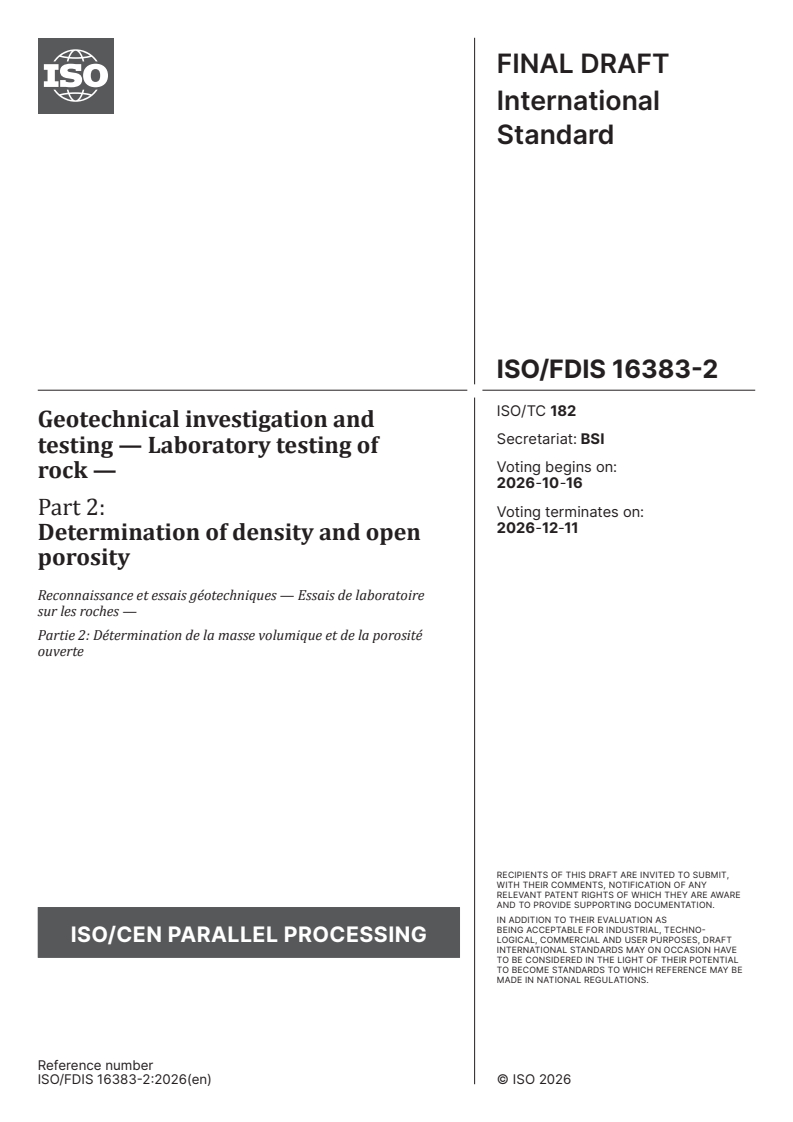
(Main)Geotechnical investigation and testing — Laboratory testing of rock — Part 2: Determination of density and open porosity
- Abstract
This document will specify methods for the determination of the bulk density of rock. This document is applicable to the laboratory determination of the bulk density of rock samples
- Status
- Not Published
- Technical Committee
- ISO/TC 182 - Geotechnics
- Drafting Committee
- ISO/TC 182 - Geotechnics
- Current Stage
- 5000 - FDIS registered for formal approval
- Start Date
- 26-Jun-2026
- Completion Date
- 27-Jul-2026
ISO/FDIS 16383-2 is a Final Draft International Standard from ISO for laboratory testing of rock in geotechnical investigation and testing. It specifies methods for determining bulk, dry and grain densities and open porosity of rock specimens. The document is written for laboratories, geotechnical engineers, and others who need repeatable rock-property results for investigation, description, and reporting.
What does ISO/FDIS 16383-2 specify?
ISO/FDIS 16383-2 specifies the laboratory procedure for measuring density and open porosity in rock specimens. The main measurement paths are the immersion method and a combination of the linear method and gas pycnometry, and the document also allows other volume-determination methods if they meet its requirements.
The document is organized into eight clauses, followed by two annexes.
| Annex | What it covers |
|---|---|
| Annex A | Calibration, maintenance, and checks for the measuring equipment |
| Annex B | Alternative methods for volume determination |
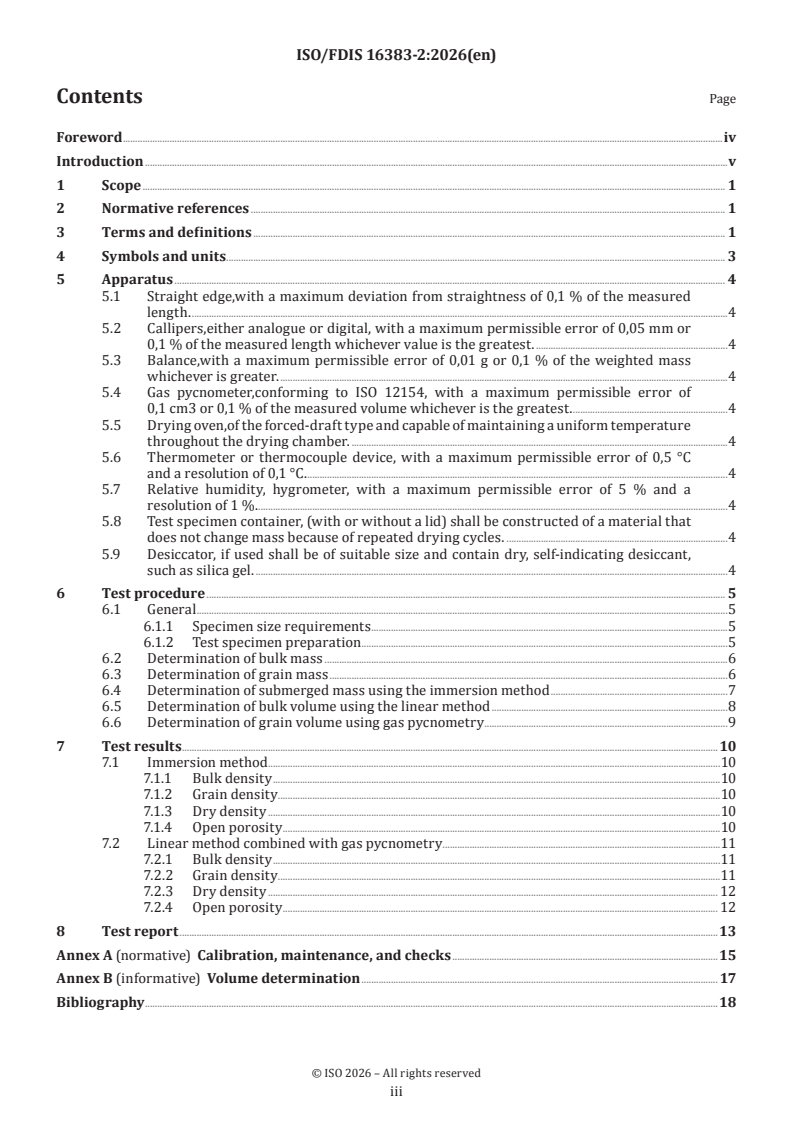
Clause 1 gives the scope, Clause 2 lists the normative references, Clause 3 defines the terms, Clause 4 sets out symbols and units, Clause 5 lists the apparatus, Clause 6 describes the test procedure, Clause 7 gives the calculation of results, and Clause 8 defines what the test report shall contain.
What are the key requirements of ISO/FDIS 16383-2?
ISO/FDIS 16383-2 focuses on controlling the specimen, the measurement path, and the reporting so the results can be compared from one laboratory to another. In practice, the document asks the laboratory to select a representative specimen, prepare it consistently, measure it with suitable equipment, and record the conditions that affect the result.
Specimen selection and preparation
Clause 6 requires a representative rock specimen and sets specimen size expectations for the test. The specimen is to be cleaned without damage, and for the linear method it has to be shaped into a right circular cylinder or a rectangular cuboid with controlled face geometry.
This matters because irregular or poorly prepared specimens can distort volume and density results. The laboratory must choose a specimen and shape that fit the method being used.
Choice of method
Clause 6 allows two main routes: the immersion method or the linear method combined with gas pycnometry. Annex B also recognizes other bulk-volume or grain-volume methods when they satisfy the document’s requirements.
This means the method can be matched to the rock type and specimen condition, but the laboratory still has to justify the choice and keep the accuracy comparable.
Bulk mass, grain mass, and drying
Clause 6 separates bulk mass from grain mass. The grain mass is determined after drying the specimen to constant mass, and the document notes special care for rocks that contain gypsum or other minerals with chemically bonded water.
In practice, this is the point where the lab distinguishes between the rock as received and the rock after moisture has been removed. That distinction affects dry density and open porosity, so the drying step has to be controlled and documented.
Immersion testing
Clause 6 requires the specimen to be fully saturated before bulk mass and submerged mass are measured by the immersion method. The document also requires the immersion liquid to be reported and calls for the ambient temperature and liquid temperature to be recorded.
This matters because trapped air, incomplete saturation, or an unrecorded liquid can change buoyancy and distort the calculation. The lab has to handle the specimen carefully and keep the immersion setup stable.
Linear dimensions and gas pycnometry
Clause 6 describes how to measure specimen dimensions for cylindrical and rectangular specimens, and how to determine grain volume using gas pycnometry in accordance with ISO 12154. Clause 7 then uses those measurements to calculate bulk density, dry density, grain density, and open porosity.
This gives the laboratory a second route for specimens that can be measured dimensionally and analyzed by pycnometry. It is useful when the specimen shape supports direct length measurement and when grain-volume determination needs gas pycnometry.
Calculation and reporting
Clause 7 states the result types to be calculated for each method. Clause 8 requires the report to identify the method used, the specimen, the rock description, the specimen shape and size, the immersion liquid if relevant, the densities or porosity reported, the water content from ISO 16383-1, and any deviations or special events.
This matters because the numbers alone are not enough for interpretation. The reader of the report needs the specimen identity, method, condition, and measurement context to use the result correctly.
Calibration and equipment control
Annex A requires calibration, maintenance, and checks for the measuring equipment, including third-party or in-house calibration with traceability to recognized standards. It also requires the laboratory to record environmental conditions and keep the equipment within its calibrated range.
In practice, this is the quality-control backbone of the method. If the balance, measuring device, oven, or pycnometer is not controlled, the rock result cannot be trusted.
What terms does ISO/FDIS 16383-2 define?
- Immersion liquid - the liquid used to immerse the specimen, typically water, during submerged-mass measurement.
- Open void - a void that the immersion liquid can penetrate.
- Closed void - a void that the immersion liquid cannot penetrate.
- Grain volume - the volume of the rock matrix, including closed voids but excluding open voids.
- Bulk volume - the total specimen volume, including the rock matrix and both open and closed void volumes.
- Bulk mass - the total mass of the specimen, including the rock matrix and both open and closed void volumes.
- Open porosity - the ratio of void volume to bulk volume.
- Constant mass - the point where further drying changes the mass by less than the stated limit over repeated measurements.
Who uses ISO/FDIS 16383-2?
ISO/FDIS 16383-2 is used by geotechnical laboratories, rock testing laboratories, and engineers who need laboratory measurements of rock density and porosity. It is also relevant to quality managers and buyers who need a clear, standardized test method for specifying or checking rock properties.
In practice, the document supports site investigation, laboratory characterization, and reporting for geotechnical projects. It is also useful where the visual description of rock is recorded under ISO 14689 and water content is reported under ISO 16383-1.
Which standards are used with ISO/FDIS 16383-2?
| Standard | What it contributes |
|---|---|
| ISO 12154 | The gas pycnometry basis used for determining grain volume |
| ISO 14689 | The principles for visual geological description of the tested rock |
| ISO 16383-1 | The water-content determination and the constant-mass reference used for drying |
| ISO/IEC 17025 | The calibration-laboratory competence basis referenced in Annex A |
| EN 1997-2 | A note says this document fulfils the requirement for bulk-density determination for geotechnical investigation and testing |
| ISO/TS 24283-1 & 2 | The source named for the qualified person associated with selecting a representative specimen |
What does the ISO/FDIS 16383-2 document contain?
ISO/FDIS 16383-2 contains an apparatus list, detailed test procedures, result calculations, reporting requirements, and calibration rules. The apparatus section covers items such as measuring devices, drying equipment, humidity and temperature measurement, specimen containers, and desiccation equipment.
Clause 6 is presented with flow charts that summarize the sequence for bulk mass, grain mass, submerged mass, bulk volume, and grain volume determination. Clause 7 sets out the calculation routes for the immersion method and for the linear-method-plus-pycnometry route.
Annex A provides the maintenance and calibration framework, including a table of oven temperature tolerances and checks for balances, thermometers, hygrometers, and length-measuring tools. Annex B lists alternative volume-determination methods such as fluid displacement, glass bead, laser volumetry, acoustic volumetry, 3D scanning, and tomography, and explains when their use should be reported as a deviation.
Relations
- Effective Date
- 12-Feb-2026
- Consolidates
ISO 10993-2:2022 - Biological evaluation of medical devices — Part 2: Animal welfare requirements - Effective Date
- 27-Jan-2024
Get Certified
Connect with accredited certification bodies for this standard

CIS Institut d.o.o.
Personal Protective Equipment (PPE) certification body. Notified Body NB-2890 for EU Regulation 2016/425 PPE.

Kiwa BDA Testing
Building and construction product certification.
Kmetijski inštitut Slovenije
Agricultural Institute of Slovenia. Soil testing, plant health, agricultural product analysis.
Sponsored listings
Frequently Asked Questions
ISO/FDIS 16383-2 is a draft published by the International Organization for Standardization (ISO). Its full title is "Geotechnical investigation and testing — Laboratory testing of rock — Part 2: Determination of density and open porosity". This standard covers: This document will specify methods for the determination of the bulk density of rock. This document is applicable to the laboratory determination of the bulk density of rock samples
This document will specify methods for the determination of the bulk density of rock. This document is applicable to the laboratory determination of the bulk density of rock samples
ISO/FDIS 16383-2 is classified under the following ICS (International Classification for Standards) categories: 13.080.40 - Hydrological properties of soils; 93.020 - Earthworks. Excavations. Foundation construction. Underground works. The ICS classification helps identify the subject area and facilitates finding related standards.
ISO/FDIS 16383-2 has the following relationships with other standards: It is inter standard links to prEN ISO 16383-2, ISO 10993-2:2022. Understanding these relationships helps ensure you are using the most current and applicable version of the standard.
ISO/FDIS 16383-2 is available in PDF format for immediate download after purchase. The document can be added to your cart and obtained through the secure checkout process. Digital delivery ensures instant access to the complete standard document.
Standards Content (Sample)
FINAL DRAFT
International
Standard
ISO/TC 182
Geotechnical investigation and
Secretariat: BSI
testing — Laboratory testing of
Voting begins on:
rock —
2026-10-16
Part 2:
Voting terminates on:
2026-12-11
Determination of density and open
porosity
Reconnaissance et essais géotechniques — Essais de laboratoire
sur les roches —
Partie 2: Détermination de la masse volumique et de la porosité
ouverte
RECIPIENTS OF THIS DRAFT ARE INVITED TO SUBMIT,
WITH THEIR COMMENTS, NOTIFICATION OF ANY
RELEVANT PATENT RIGHTS OF WHICH THEY ARE AWARE
AND TO PROVIDE SUPPOR TING DOCUMENTATION.
IN ADDITION TO THEIR EVALUATION AS
BEING ACCEPTABLE FOR INDUSTRIAL, TECHNO-
ISO/CEN PARALLEL PROCESSING LOGICAL, COMMERCIAL AND USER PURPOSES, DRAFT
INTERNATIONAL STANDARDS MAY ON OCCASION HAVE
TO BE CONSIDERED IN THE LIGHT OF THEIR POTENTIAL
TO BECOME STAN DARDS TO WHICH REFERENCE MAY BE
MADE IN NATIONAL REGULATIONS.
Reference number
FINAL DRAFT
International
Standard
ISO/TC 182
Geotechnical investigation and
Secretariat: BSI
testing — Laboratory testing of
Voting begins on:
rock —
Part 2:
Voting terminates on:
Determination of density and open
porosity
Reconnaissance et essais géotechniques — Essais de laboratoire
sur les roches —
Partie 2: Détermination de la masse volumique et de la porosité
ouverte
© ISO 2026
All rights reserved.
RECIPIENTS OF THIS DRAFT ARE INVITED TO SUBMIT,
WITH THEIR COMMENTS, NOTIFICATION OF ANY
This ISO publication is protected by copyright and is owned by ISO and/or its licensors.
RELEVANT PATENT RIGHTS OF WHICH THEY ARE AWARE
The content of this ISO publication is provided under licence, not sold. Use is subject to the applicable licence terms issued by ISO,
AND TO PROVIDE SUPPOR TING DOCUMENTATION.
an ISO member body, or an authorized third-party distributor.
IN ADDITION TO THEIR EVALUATION AS
BEING ACCEPTABLE FOR INDUSTRIAL, TECHNO-
Except as required for implementation or expressly permitted by a separate licence, no part of this ISO publication may be
ISO/CEN PARALLEL PROCESSING
LOGICAL, COMMERCIAL AND USER PURPOSES, DRAFT
reproduced, distributed, modified, used, or made available in any form or by any means – electronic or mechanical, including
INTERNATIONAL STANDARDS MAY ON OCCASION HAVE
photocopying, scanning, recording, or posting on internal or external digital platforms. TO BE CONSIDERED IN THE LIGHT OF THEIR POTENTIAL
TO BECOME STAN DARDS TO WHICH REFERENCE MAY BE
Any use beyond the scope of the granted rights is prohibited and may result in legal action.
MADE IN NATIONAL REGULATIONS.
ISO copyright office
CP 401 • CH-1214 Vernier, Geneva
Phone: +41 22 749 01 11
Email: copyright@iso.org
Website: www.iso.org
Published in Switzerland
Reference number
ii
Contents Page
Foreword .iv
Introduction .v
1 Scope . 1
2 Normative references . 1
3 Terms and definitions . 1
4 Symbols and units. 3
5 Apparatus . 4
5.1 Straight edge,with a maximum deviation from straightness of 0,1 % of the measured
length. .4
5.2 Callipers,either analogue or digital, with a maximum permissible error of 0,05 mm or
0,1 % of the measured length whichever value is the greatest. .4
5.3 Balance,with a maximum permissible error of 0,01 g or 0,1 % of the weighted mass
whichever is greater. .4
5.4 Gas pycnometer,conforming to ISO 12154, with a maximum permissible error of
0,1 cm3 or 0,1 % of the measured volume whichever is the greatest. .4
5.5 Drying oven,of the forced-draft type and capable of maintaining a uniform temperature
throughout the drying chamber. .4
5.6 Thermometer or thermocouple device, with a maximum permissible error of 0,5 °C
and a resolution of 0,1 °C. .4
5.7 Relative humidity, hygrometer, with a maximum permissible error of 5 % and a
resolution of 1 %.4
5.8 Test specimen container, (with or without a lid) shall be constructed of a material that
does not change mass because of repeated drying cycles. .4
5.9 Desiccator, if used shall be of suitable size and contain dry, self-indicating desiccant,
such as silica gel. .4
6 Test procedure . 5
6.1 General .5
6.1.1 Specimen size requirements .5
6.1.2 Test specimen preparation .5
6.2 Determination of bulk mass .6
6.3 Determination of grain mass .6
6.4 Determination of submerged mass using the immersion method .7
6.5 Determination of bulk volume using the linear method .8
6.6 Determination of grain volume using gas pycnometry .9
7 Test results . .10
7.1 Immersion method . . .10
7.1.1 Bulk density .10
7.1.2 Grain density .10
7.1.3 Dry density .10
7.1.4 Open porosity .10
7.2 Linear method combined with gas pycnometry .11
7.2.1 Bulk density .11
7.2.2 Grain density .11
7.2.3 Dry density . 12
7.2.4 Open porosity . 12
8 Test report .13
Annex A (normative) Calibration, maintenance, and checks .15
Annex B (informative) Volume determination . 17
Bibliography .18
iii
Foreword
ISO (the International Organization for Standardization) is a worldwide federation of national standards
bodies (ISO member bodies). The work of preparing International Standards is normally carried out through
ISO technical committees. Each member body interested in a subject for which a technical committee
has been established has the right to be represented on that committee. International organizations,
governmental and non-governmental, in liaison with ISO, also take part in the work. ISO collaborates closely
with the International Electrotechnical Commission (IEC) on all matters of electrotechnical standardization.
The procedures used to develop this document and those intended for its further maintenance are described
in the ISO/IEC Directives, Part 1. In particular, the different approval criteria needed for the different types
of ISO document should be noted. This document was drafted in accordance with the editorial rules of the
ISO/IEC Directives, Part 2 (see www.iso.org/directives).
ISO draws attention to the possibility that the implementation of this document may involve the use of (a)
patent(s). ISO takes no position concerning the evidence, validity or applicability of any claimed patent
rights in respect thereof. As of the date of publication of this document, ISO had not received notice of (a)
patent(s) which may be required to implement this document. However, implementers are cautioned that
this may not represent the latest information, which may be obtained from the patent database available at
www.iso.org/patents. ISO shall not be held responsible for identifying any or all such patent rights.
Any trade name used in this document is information given for the convenience of users and does not
constitute an endorsement.
For an explanation of the voluntary nature of standards, the meaning of ISO specific terms and expressions
related to conformity assessment, as well as information about ISO's adherence to the World Trade
Organization (WTO) principles in the Technical Barriers to Trade (TBT), see www.iso.org/iso/foreword.html.
This document was prepared by Technical Committee ISO/TC 182, Geotechnical investigation and testing, in
collaboration with the European Committee for Standardization (CEN) Technical Committee CEN/TC 341,
Geotechnical Investigation and Testing,in accordance with the Agreement on technical cooperation between
ISO and CEN (Vienna Agreement).
A list of all parts in the ISO 16383 series can be found on the ISO website.
Any feedback or questions on this document should be directed to the user’s national standards body. A
complete listing of these bodies can be found at www.iso.org/members.html.
iv
Introduction
This document covers areas in the international field of geotechnical engineering never previously
standardized internationally. It is intended that this document presents broad good practice throughout the
world and significant differences with national documents is not anticipated. It is based on international
practice.
v
FINAL DRAFT International Standard ISO/FDIS 16383-2:2026(en)
Geotechnical investigation and testing — Laboratory testing
of rock —
Part 2:
Determination of density and open porosity
1 Scope
This document specifies the procedure for determining bulk, dry and grain densities as well as open porosity
of a rock specimen using the immersion method and a combination of the linear method and gas pycnometry.
This document is applicable to the laboratory determination of density and open porosity of a rock test
specimen within the scope of geotechnical investigations.
Other methods for determining the bulk mass, grain mass, bulk volume and grain volume of the specimen
that fulfil the requirements set in this document can also be considered acceptable (see Annex B). Used
method should be chosen based on the use case (type of specimen, availability etc.).
Bulk, dry and grain density as well as open porosity are determined for the specimen as is and are dependent
on fluid content, which is determined and reported as per ISO 16383-1.
NOTE This document fulfils the requirements of the determination of bulk density of rock for geotechnical
investigation and testing according to EN 1997-2 (2024).
2 Normative references
The following documents are referred to in the text in such a way that some or all of their content constitutes
requirements of this document. For dated references, only the edition cited applies. For undated references,
the latest edition of the referenced document (including any amendments) applies.
ISO 12154, Determination of density by volumetric displacement — Skeleton density by gas pycnometry
ISO 14689, Geotechnical investigation and testing — Identification, description and classification of rock
ISO 16383-1, Geotechnical investigation and testing — Laboratory testing of rock — Part 1: Determination of
water content
3 Terms and definitions
For the purposes of this document, the following terms and definitions apply.
ISO and IEC maintain terminological databases for use in standardization at the following addresses:
— IEC Electropedia: available at https:// www .electropedia .org/
— ISO Online browsing platform: available at https:// www .iso .org/ obp
3.1
immersion liquid
liquid the specimen is immersed in, typically water
3.2
open void
void that can be penetrated by the immersion liquid
3.3
closed void
void that cannot be penetrated by the immersion liquid
3.4
void volume
volume of open voids
3.5
grain volume
volume of the rock matrix, including closed voids, but excluding open voids
3.6
grain mass
mass of the rock matrix, including closed voids, but excluding open voids
3.7
bulk volume
total volume of the specimen, including the rock matrix, and open and closed void volumes
3.8
bulk mass
total mass of the specimen, including the rock matrix, and open and closed void volumes
3.9
submerged mass
total mass of the specimen, including the rock matrix, and open and closed void volumes, submerged in the
immersion liquid
3.10
water density
density of water, a constant value of 0,998 2 g/cm corresponding to the density of pure water at 20 °C is
used in this document
Note 1 to entry: See reference [1]
3.12
water content
ratio of the mass of free water to the mass of the dry specimen
Note 1 to entry: The standard for the determination of water content is ISO 16383-1.
3.13
density
specific mass
mass of a substance per unit of volume
3.14
specific gravity
relative density
ratio of the density of a substance to the density of a given reference material, typically water at its densest
(at 4 °C)
3.15
bulk density
apparent density
bulk mass of the rock specimen divided by its bulk volume
3.16
dry density
grain mass of the rock specimen divided by its bulk volume
Note 1 to entry: Specimen is considered fully dried when it has been dried to a constant mass as per ISO 16383-1.
3.17
grain density
matrix density
particle density
grain mass of the rock specimen divided by its grain volume, also known as matrix density or particle
density
3.18
open porosity
ratio of void volume to bulk volume
3.19
constant mass
point at which there is less than 0,1 % further change in mass of the rock test specimen when dried for a
further period of at least 1 h, over three consecutive measurements
Note 1 to entry: The process is described in ISO 16383-1.
3.20
representative specimen
specimen chosen by a qualified person associated with the characteristic features of the rock mass
Note 1 to entry: A qualified person is specified in ISO/TS 24283-1 & 2.
4 Symbols and units
V void volume (cm )
V
V grain volume (cm )
G
M grain mass (g)
G
V bulk volume (cm )
M bulk mass (g)
M submerged mass (g)
S
ρ water density (g/cm )
W
ρ immersion liquid density (g/cm )
L
w water content (%)
r radius of the specimen (cm)
h height of the specimen (cm)
L length of the longest dimension of the specimen (cm)
L length of the second longest dimension of the specimen (cm)
L length of the shortest dimension of the specimen (cm)
V volume of the sample chamber (cm )
V volume of the reference chamber (cm )
p equilibrated gauge pressure prior to expansion (Pa)
p equilibrated gauge pressure after expansion (Pa)
ρ bulk density (g/cm )
ρ grain density (g/cm )
G
ρ dry density (g/cm )
D
P open porosity (%)
NOTE In this document, r refers to the radius of a cylindrical or spherical specimen, h refers to the height of a
cylindrical specimen, and L , L and L refer to the dimensions of a rectangular cuboid specimen.
1 2 3
5 Apparatus
The usual laboratory apparatus and, in particular, the following shall be used.
The calibration of the apparatus listed below shall be carried out according to Annex A.
5.1 Straight edge,with a maximum deviation
...