

ISO 4159:1978
(Main)Ferromanganese and ferrosilicomanganese — Determination of manganese content — Potentiometric method
General Information
- Abstract
The method is applicable to alloys containing from 55 to 95 % (m/m) manganese. Specifies principle, reagents, apparatus, sample, procedure, expression of results, reproducibility and test report. Warns of perchloric acid fumes.
- Status
- Published
- Publication Date
- 30-Nov-1978
- Technical Committee
- ISO/TC 132 - Ferroalloys
- Drafting Committee
- ISO/TC 132 - Ferroalloys
- Current Stage
- 9060 - Close of review
- Completion Date
- 04-Mar-2031
Buy Documents
ISO 4159:1978 - Ferromanganese and ferrosilicomanganese -- Determination of manganese content -- Potentiometric method
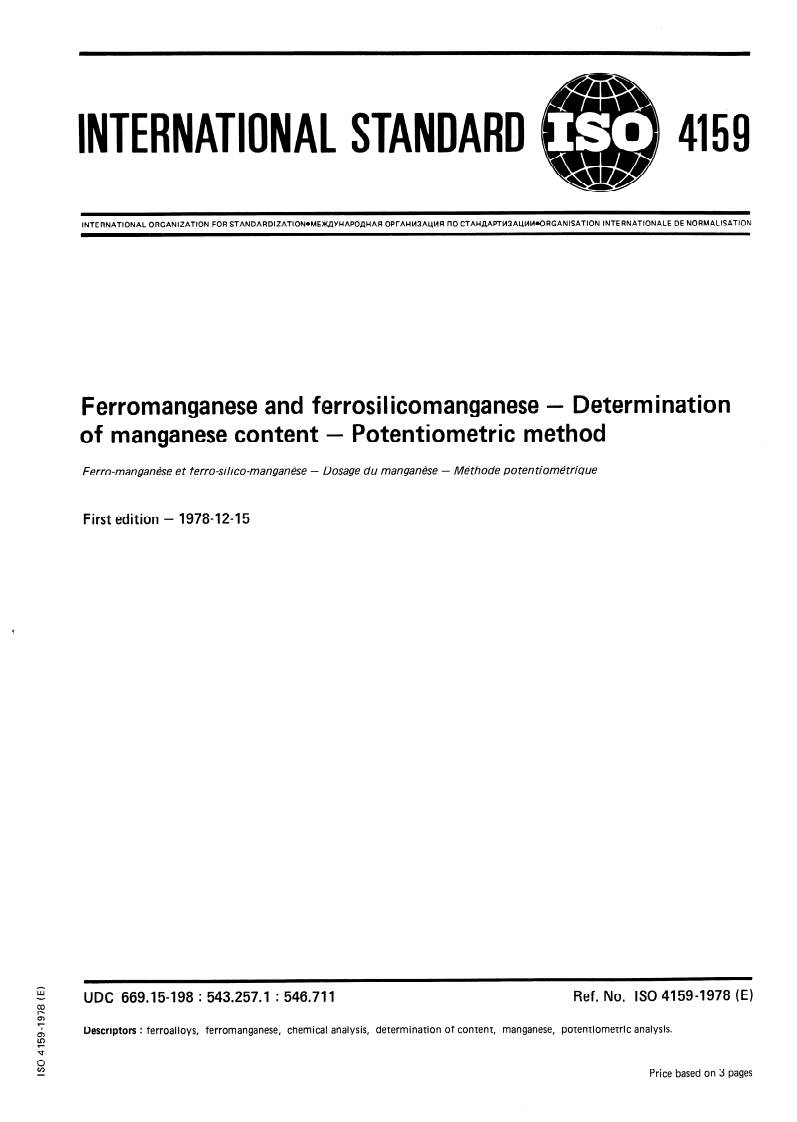
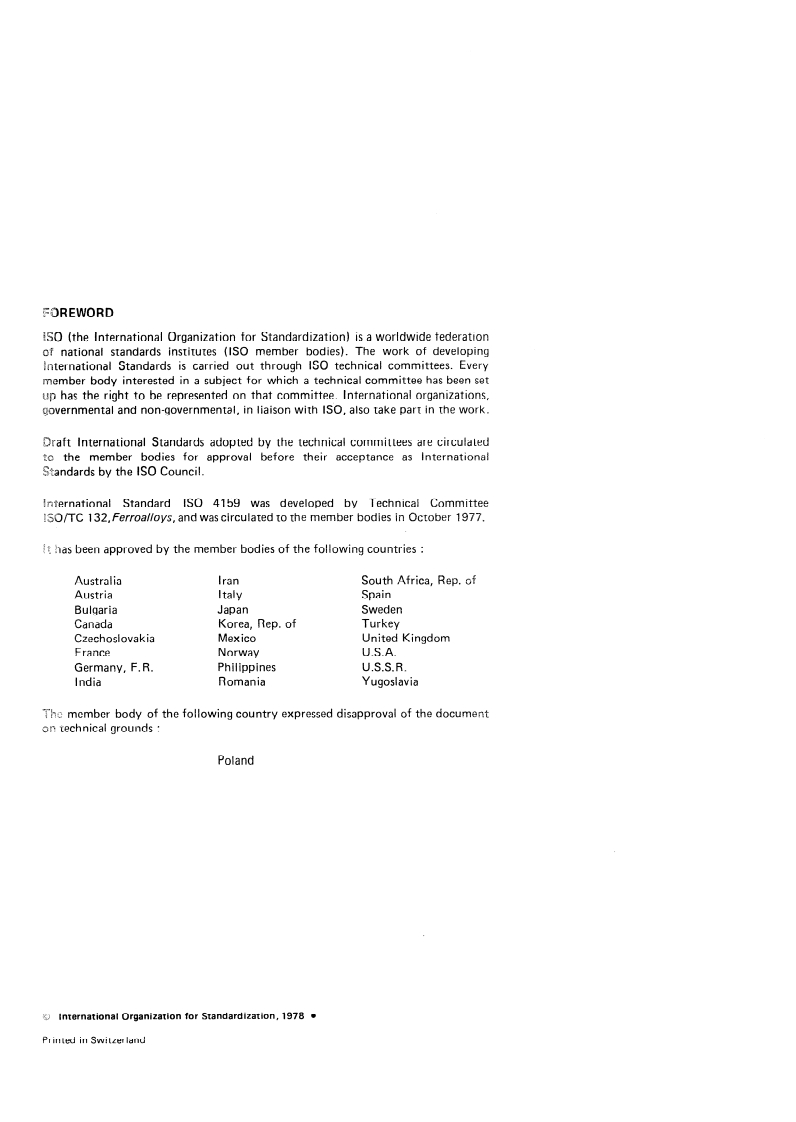
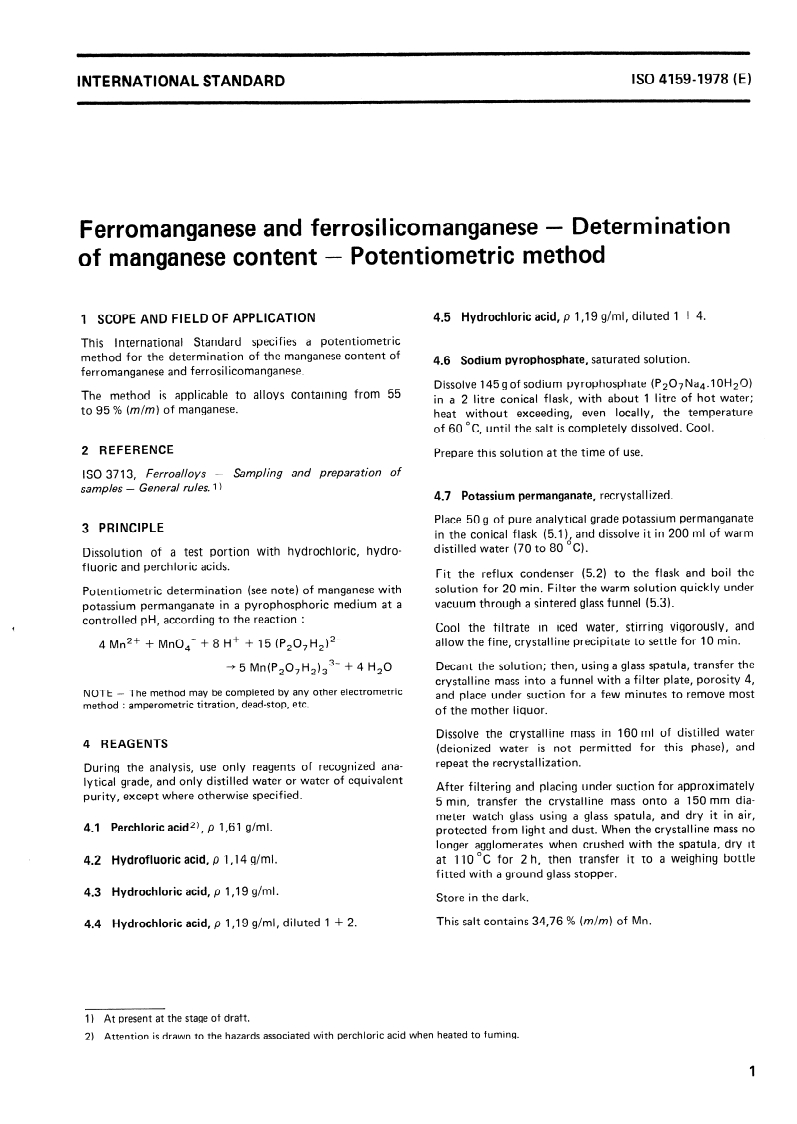
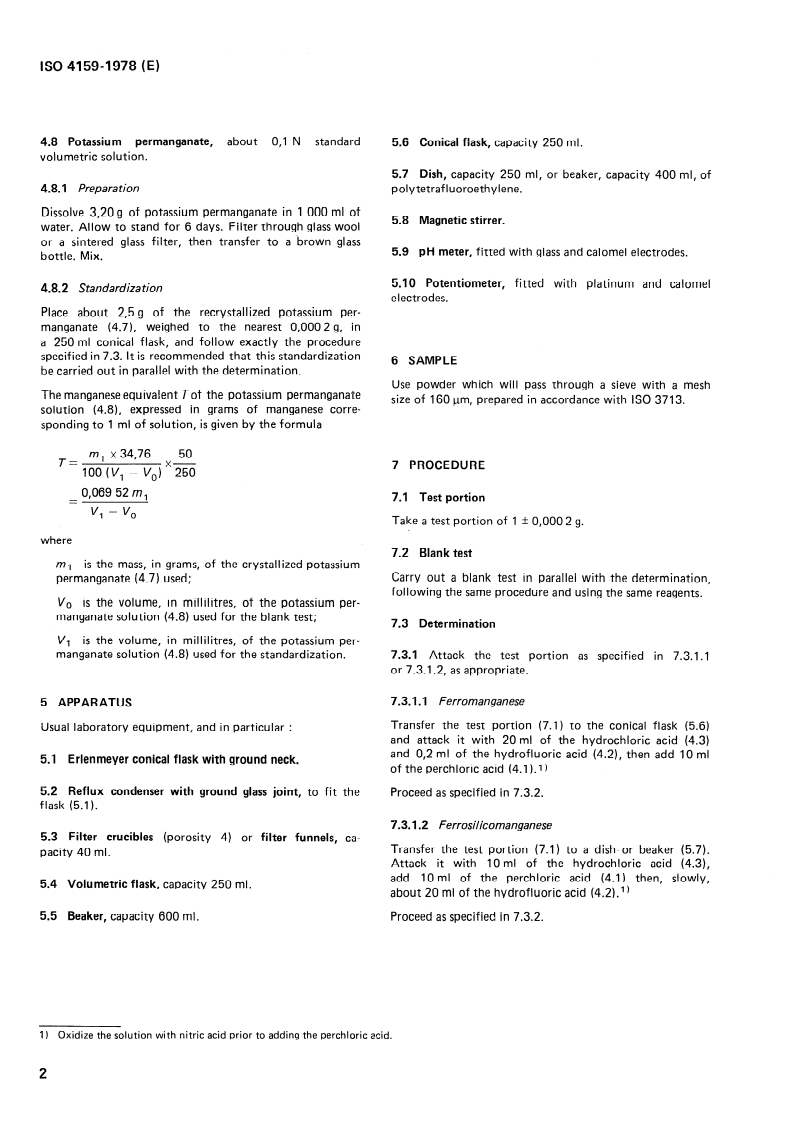
ISO 4159:1978 - Ferromanganese and ferrosilicomanganese — Determination of manganese content — Potentiometric method/1/1978
ISO 4159:1978 - Ferro-manganese et ferro-silico-manganese -- Dosage du manganese -- Méthode potentiométrique
ISO 4159:1978 - Ferro-manganèse et ferro-silico-manganèse — Dosage du manganèse — Méthode potentiométrique/1/1978
ISO 4159:1978 - Ferro-manganèse et ferro-silico-manganèse — Dosage du manganèse — Méthode potentiométrique/1/1978
Overview
ISO 4159:1978 is an international standard published by the International Organization for Standardization (ISO) that specifies a potentiometric method for the determination of manganese content in ferromanganese and ferrosilicomanganese alloys. This method is applicable to alloys containing between 55% and 95% manganese by mass. The standard outlines the principle, required reagents, apparatus, sampling, detailed procedure, expression of results, reproducibility criteria, and the documentation required for a test report. It also draws attention to safety concerns such as the handling of perchloric acid fumes during the analysis.
Key Topics
- Scope: Applicable for manganese content determination in ferromanganese and ferrosilicomanganese alloys with manganese composition from 55% to 95% (m/m).
- Method Principle: Based on a potentiometric titration using potassium permanganate in a pyrophosphoric medium with controlled pH conditions. The test involves acid dissolution of the sample and titration to determine manganese content by monitoring potential changes.
- Reagents: Includes perchloric acid, hydrofluoric acid, hydrochloric acid (concentrated and diluted), sodium pyrophosphate solution, recrystallized potassium permanganate, and potassium permanganate standard solution.
- Apparatus: Uses common laboratory equipment with special mention of Erlenmeyer flasks, reflux condensers, filtration apparatus, pH meters with glass and calomel electrodes, potentiometers fitted with platinum electrodes, magnetic stirrers, and volumetric flasks.
- Procedure Highlights:
- Acid digestion of samples with hydrochloric, hydrofluoric, and perchloric acids under reflux.
- Filtration and recrystallization of precipitates.
- Preparation and standardization of potassium permanganate solution for titration.
- Adjustment of pH between 6.5 and 7 using sodium pyrophosphate and diluted hydrochloric acid.
- Potentiometric endpoint determination is achieved by detecting a sudden 100 mV increase in potential.
- Safety Note: Perchloric acid fumes are hazardous and require careful handling during heating steps.
Applications
The ISO 4159:1978 potentiometric method is widely used in metallurgical and chemical laboratories involved in quality control and chemical analysis of ferroalloys, specifically ferromanganese and ferrosilicomanganese. Key applications include:
- Quality Assurance: Accurate determination of manganese content ensures alloy conformity to industry specifications.
- Process Control: Monitoring manganese levels during production facilitates process optimization and consistency.
- Research and Development: Reliable chemical analysis supports the development of new ferroalloys and refining processes.
- Regulatory Compliance: Ensures adherence to international alloy composition standards for trade and manufacturing.
Related Standards
- ISO 3713: Ferroalloys - Sampling and preparation of samples - General rules. This standard is referenced for sample preparation guidance critical to achieving reliable results according to ISO 4159.
- Other ISO standards related to chemical analysis and metallurgical sampling provide complementary methodologies and sampling protocols applicable to alloy composition determination.
Keywords: ISO 4159, manganese determination, ferromanganese, ferrosilicomanganese, potentiometric method, potassium permanganate titration, ferroalloys analysis, manganese content testing, chemical analysis standard, metallurgical quality control.
Relations
- Consolidated By
ISO 10651-4:2002 - Lung ventilators — Part 4: Particular requirements for operator-powered resuscitators - Effective Date
- 06-Jun-2022
Buy Documents
ISO 4159:1978 - Ferromanganese and ferrosilicomanganese -- Determination of manganese content -- Potentiometric method
ISO 4159:1978 - Ferromanganese and ferrosilicomanganese — Determination of manganese content — Potentiometric method/1/1978
ISO 4159:1978 - Ferro-manganese et ferro-silico-manganese -- Dosage du manganese -- Méthode potentiométrique
ISO 4159:1978 - Ferro-manganèse et ferro-silico-manganèse — Dosage du manganèse — Méthode potentiométrique/1/1978
ISO 4159:1978 - Ferro-manganèse et ferro-silico-manganèse — Dosage du manganèse — Méthode potentiométrique/1/1978
Get Certified
Connect with accredited certification bodies for this standard

Element Materials Technology
Materials testing and product certification.

Inštitut za kovinske materiale in tehnologije
Institute of Metals and Technology. Materials testing, metallurgical analysis, NDT.
Sponsored listings
Frequently Asked Questions
ISO 4159:1978 is a standard published by the International Organization for Standardization (ISO). Its full title is "Ferromanganese and ferrosilicomanganese — Determination of manganese content — Potentiometric method". This standard covers: The method is applicable to alloys containing from 55 to 95 % (m/m) manganese. Specifies principle, reagents, apparatus, sample, procedure, expression of results, reproducibility and test report. Warns of perchloric acid fumes.
The method is applicable to alloys containing from 55 to 95 % (m/m) manganese. Specifies principle, reagents, apparatus, sample, procedure, expression of results, reproducibility and test report. Warns of perchloric acid fumes.
ISO 4159:1978 is classified under the following ICS (International Classification for Standards) categories: 77.100 - Ferroalloys. The ICS classification helps identify the subject area and facilitates finding related standards.
ISO 4159:1978 has the following relationships with other standards: It is inter standard links to ISO 10651-4:2002. Understanding these relationships helps ensure you are using the most current and applicable version of the standard.
ISO 4159:1978 is available in PDF format for immediate download after purchase. The document can be added to your cart and obtained through the secure checkout process. Digital delivery ensures instant access to the complete standard document.
Standards Content (Sample)
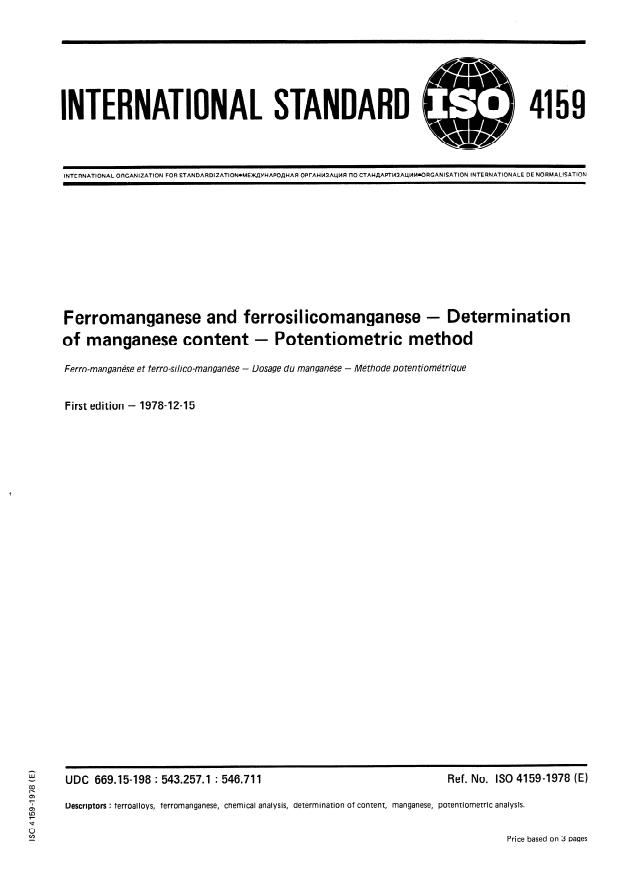
INTERNATIONAL STANDARD
INTERNATIONAL ORGANIZATION FOR STANDARDIZATIONWE~YHAPO~HAR OPrAHM3ALWlR I-IO CTAH~APTM3Al@lbWORGANISATION INTERNATIONALE DE NORMALISATION
Ferromanganese and ferrosilicomanganese - Determination
of manganese content - Potentiometric method
Ferro-manganese et ferro-silico-manganke - Dosage du manganese - JWthode potentiom&rique
First edition - 1978-12-15
iii
-
UDC 669.15-198 : 543.257.1 : 546.711 Ref. No. ISO 4159-1978 (E)
Descriptors : ferroalloys, ferromanganese, Chemical analysis, determination of content, manganese, potentiometric analysis.
Price based on 3 pages
0 (the International Organization for Standardization) is a worldwide federation
of national Standards institutes (ISO member bodies). The work of developing
International Standards is carried out through ISO technical committees. Every
member body interested in a subject for which a technical committee has been set
up has the right to be represented on that committee. International organizations,
gowernmental and non-governmental, in liaison with ISO, also take part in the work.
International Standard EO 4159 was developed by Technical Committee
!SO/TC 132, FerroaDoys, and was circulated to the member bodies in October 1977.
p ‘11
‘@ has been approved by the member bodies of the fokMng countries :
Austral ia Iran South Africa, Rep. sf
Austria
I taly Spain
Bulgaria Japan Sweden
Canada Korea, Rep. of Turkey
Cnechoslovakia Mexico klnited Kingdom
France Norway U.S.A.
Germany, F. R. Philippines U.S.S.R.
Romania
India Yugoslavia
2 member body of the following country expr disapproval of the document
rechnical grounds :
Poland
63 International Organkation for Standardkation, 1978 l
Printed in Switzerland
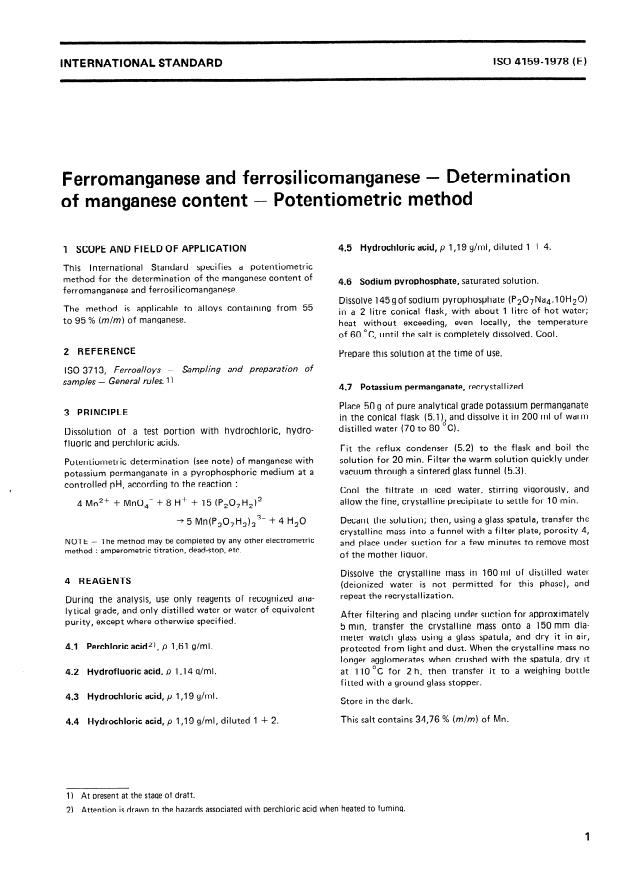
INTERNATIONAL STANDARD ISO4159=1978(E)
Ferromanganese and ferrosilicomanganese - Determination
of manganese content - Potentiometric method
1 SCOPE AND FIELD OF APPLICATION 4.5 Hydrochlorit acid, p 1,19 g/ml, diluted 1 i- 4.
This International Standard specifies a potentiometric
method for the determination of the manganese content of
4.6 Sodium pyrophosphate, saturated Solution.
ferromanganese and ferrosilicomanganese.
Dissolve 145 g of sodium pyrophosphate (P207Na4.10H20)
The method is applicable to alloys containing from 55
in a 2 litre conical flask, with about 1 litre of hot water;
to 95 % (mlm) of manganese.
heat without exceeding, even locally, the temperature
of 60 OC, until the salt is completely dissolved. Cool.
2 REFERENCE
Prepare this Solution at the time of use.
ISO 37 13, Ferroalloys - Sampling and preparation of
samples - General wies. 1)
4.7 Potassium permanganate, recrystal I ized.
Place 50 g of pure analytical grade potassium permanganate
3 PRINCIPLE
in the conical flask (5.1), and dissolve it in 200 ml of warm
distilled water (70 to 80 “CL
Dissolution of a test Portion with hydrochloric, hydro-
f luoric and perchloric acids.
Fit the reflux condenser (5.2) to the flask and boil the
Potentiometric determination (see note) of manganese with Solution for 20 min. Filter the warm Solution quickly under
vacuum through a sintered glass funnel (5.3).
potassium permanganate in a pyrophosphoric medium at a
controlled pH, according to the reaction :
Cool the filtrate in iced water, stirring vigorously, and
allow the fine, crystalline precipitate to settle for 10 min.
4 Mn2+ -l- MnO,- + 8 H+ + 15 (P207H2)2-
Decant the Solution; then, using a glass spatula, transfer the
-+ 5 Mn(P20,H2),3- + 4 H,O
crystalline mass into a funnel with a filter plate, porosity 4,
NOTE - The method may be completed by any other electrometric
and place under suction for a few minutes to remove most
method : amperometric titration, dead-stop, etc.
of the mother liquor.
Dissolve the crystalline mass in 160 ml of distilled water
4 REAGENTS
(deionized water is not permitted for this Phase), and
repeat the recrystallization.
During the analysis, use only reagents of recognized ana-
lytical grade, and only distilled water or water of equivalent
After filtering and placing under suction for approximately
purity, except where otherwise specified.
5 min, transfer the crystalline mass onto a 150 mm dia-
meter watch glass using a glass spatula, and dry it in air,
4.1 Perchlorit acid2), p 1,61 g/ml.
protected from light and dust. When the crystalline mass no
longer agglomerates when crushed with the spatula, dry it
4.2 Hydrofluoric acid, p 1 ,14 g/ml. at 110 “C for 2 h, then transfer it to a weighing bottle
fitted with a ground glass stopper.
4.3 Hydrochlorit acid, p 1 ,19 g/ml.
Store in the dark.
This salt contains 34,76 % (mlm) of Mn.
4.4 Hydrochlorit acid, p 1 ,19 g/ml, diluted 1 + 2.
1) At present at the Stage of draft.
2) Attention is drawn to the hazards associated with perchloric acid when heated to fuming.
ISO4159-1978(E)
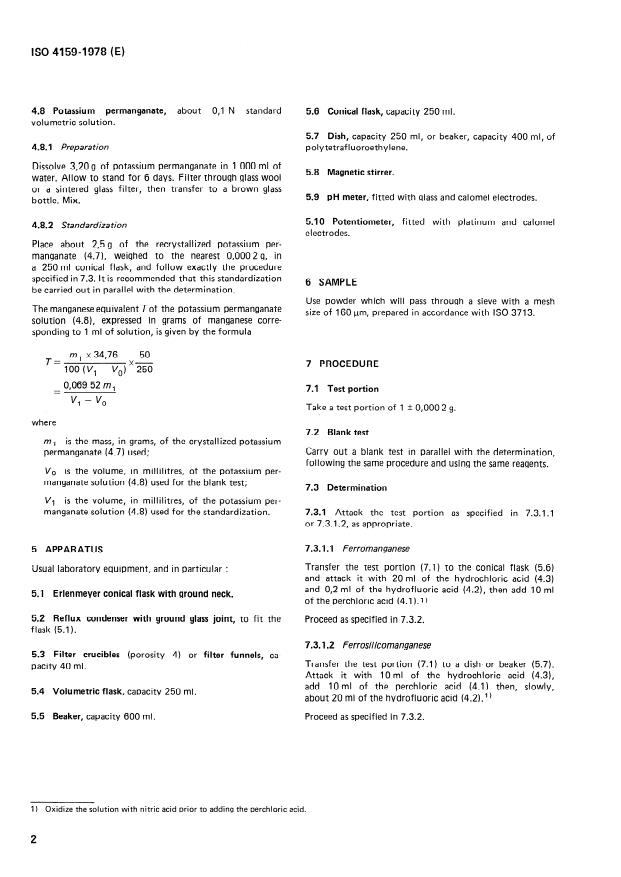
permanganate, 0,l N Standard
4.8 Pstassiu m 5.6 Conical flask, capacity 250 ml.
volu metric solu tion.
5.7 Dish, capacity 250 ml, or beaker, capacity 400 ml, of
4.8.1 Prepara tion polytetraf luoroethylene.
Dissolve 3,20 g of potassium permanganate in 1 000 ml of
5.8 Magnetit stirrer.
water. Allow to stand for 6 days. Filter through glass wo01
or a sintered glass filter, then transfer to a brown glass
...
INTERNATIONAL STANDARD
INTERNATIONAL ORGANIZATION FOR STANDARDIZATIONWE~YHAPO~HAR OPrAHM3ALWlR I-IO CTAH~APTM3Al@lbWORGANISATION INTERNATIONALE DE NORMALISATION
Ferromanganese and ferrosilicomanganese - Determination
of manganese content - Potentiometric method
Ferro-manganese et ferro-silico-manganke - Dosage du manganese - JWthode potentiom&rique
First edition - 1978-12-15
iii
-
UDC 669.15-198 : 543.257.1 : 546.711 Ref. No. ISO 4159-1978 (E)
Descriptors : ferroalloys, ferromanganese, Chemical analysis, determination of content, manganese, potentiometric analysis.
Price based on 3 pages
0 (the International Organization for Standardization) is a worldwide federation
of national Standards institutes (ISO member bodies). The work of developing
International Standards is carried out through ISO technical committees. Every
member body interested in a subject for which a technical committee has been set
up has the right to be represented on that committee. International organizations,
gowernmental and non-governmental, in liaison with ISO, also take part in the work.
International Standard EO 4159 was developed by Technical Committee
!SO/TC 132, FerroaDoys, and was circulated to the member bodies in October 1977.
p ‘11
‘@ has been approved by the member bodies of the fokMng countries :
Austral ia Iran South Africa, Rep. sf
Austria
I taly Spain
Bulgaria Japan Sweden
Canada Korea, Rep. of Turkey
Cnechoslovakia Mexico klnited Kingdom
France Norway U.S.A.
Germany, F. R. Philippines U.S.S.R.
Romania
India Yugoslavia
2 member body of the following country expr disapproval of the document
rechnical grounds :
Poland
63 International Organkation for Standardkation, 1978 l
Printed in Switzerland
INTERNATIONAL STANDARD ISO4159=1978(E)
Ferromanganese and ferrosilicomanganese - Determination
of manganese content - Potentiometric method
1 SCOPE AND FIELD OF APPLICATION 4.5 Hydrochlorit acid, p 1,19 g/ml, diluted 1 i- 4.
This International Standard specifies a potentiometric
method for the determination of the manganese content of
4.6 Sodium pyrophosphate, saturated Solution.
ferromanganese and ferrosilicomanganese.
Dissolve 145 g of sodium pyrophosphate (P207Na4.10H20)
The method is applicable to alloys containing from 55
in a 2 litre conical flask, with about 1 litre of hot water;
to 95 % (mlm) of manganese.
heat without exceeding, even locally, the temperature
of 60 OC, until the salt is completely dissolved. Cool.
2 REFERENCE
Prepare this Solution at the time of use.
ISO 37 13, Ferroalloys - Sampling and preparation of
samples - General wies. 1)
4.7 Potassium permanganate, recrystal I ized.
Place 50 g of pure analytical grade potassium permanganate
3 PRINCIPLE
in the conical flask (5.1), and dissolve it in 200 ml of warm
distilled water (70 to 80 “CL
Dissolution of a test Portion with hydrochloric, hydro-
f luoric and perchloric acids.
Fit the reflux condenser (5.2) to the flask and boil the
Potentiometric determination (see note) of manganese with Solution for 20 min. Filter the warm Solution quickly under
vacuum through a sintered glass funnel (5.3).
potassium permanganate in a pyrophosphoric medium at a
controlled pH, according to the reaction :
Cool the filtrate in iced water, stirring vigorously, and
allow the fine, crystalline precipitate to settle for 10 min.
4 Mn2+ -l- MnO,- + 8 H+ + 15 (P207H2)2-
Decant the Solution; then, using a glass spatula, transfer the
-+ 5 Mn(P20,H2),3- + 4 H,O
crystalline mass into a funnel with a filter plate, porosity 4,
NOTE - The method may be completed by any other electrometric
and place under suction for a few minutes to remove most
method : amperometric titration, dead-stop, etc.
of the mother liquor.
Dissolve the crystalline mass in 160 ml of distilled water
4 REAGENTS
(deionized water is not permitted for this Phase), and
repeat the recrystallization.
During the analysis, use only reagents of recognized ana-
lytical grade, and only distilled water or water of equivalent
After filtering and placing under suction for approximately
purity, except where otherwise specified.
5 min, transfer the crystalline mass onto a 150 mm dia-
meter watch glass using a glass spatula, and dry it in air,
4.1 Perchlorit acid2), p 1,61 g/ml.
protected from light and dust. When the crystalline mass no
longer agglomerates when crushed with the spatula, dry it
4.2 Hydrofluoric acid, p 1 ,14 g/ml. at 110 “C for 2 h, then transfer it to a weighing bottle
fitted with a ground glass stopper.
4.3 Hydrochlorit acid, p 1 ,19 g/ml.
Store in the dark.
This salt contains 34,76 % (mlm) of Mn.
4.4 Hydrochlorit acid, p 1 ,19 g/ml, diluted 1 + 2.
1) At present at the Stage of draft.
2) Attention is drawn to the hazards associated with perchloric acid when heated to fuming.
ISO4159-1978(E)
permanganate, 0,l N Standard
4.8 Pstassiu m 5.6 Conical flask, capacity 250 ml.
volu metric solu tion.
5.7 Dish, capacity 250 ml, or beaker, capacity 400 ml, of
4.8.1 Prepara tion polytetraf luoroethylene.
Dissolve 3,20 g of potassium permanganate in 1 000 ml of
5.8 Magnetit stirrer.
water. Allow to stand for 6 days. Filter through glass wo01
or a sintered glass filter, then transfer to a brown glass
...
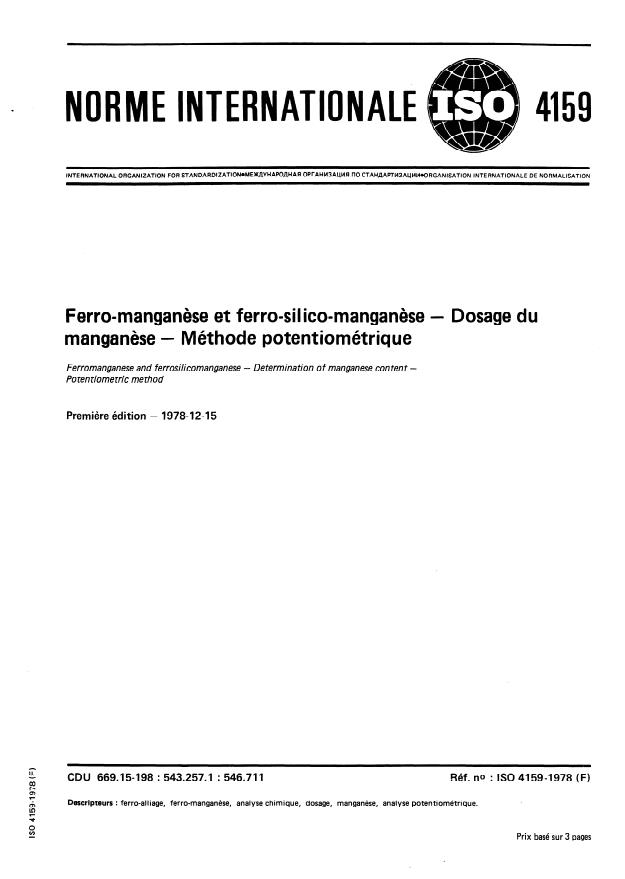
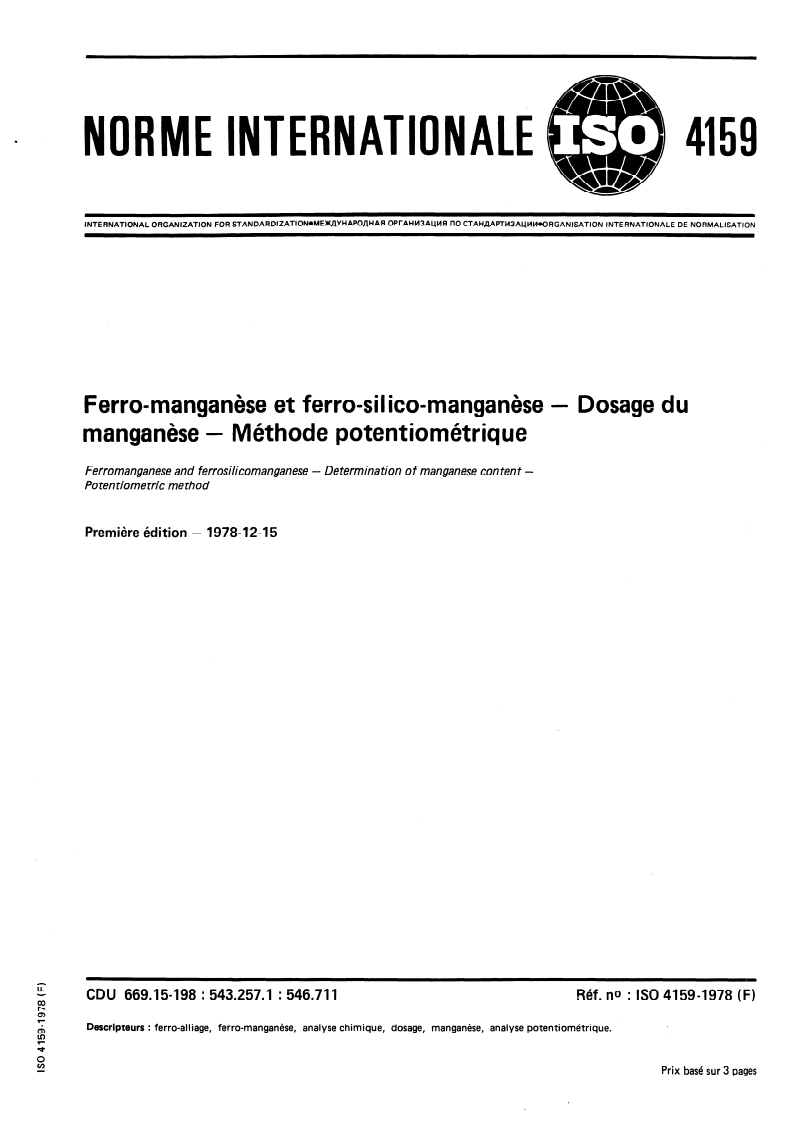
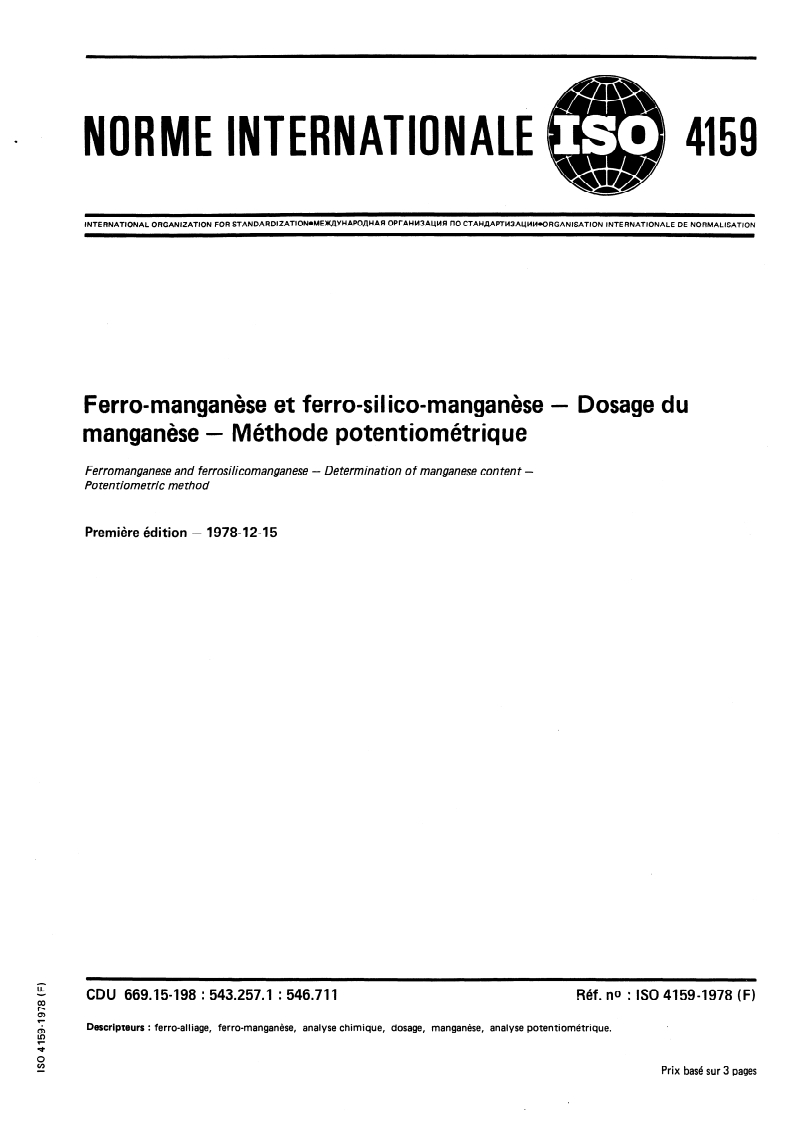
e NORME INTERNATIONALE 4159
INTERNATIONAL ORGANIZATION FOR STANDARDIZATlONWWKQYHAPO~HAR Of’rAHM3AWIfl n0 CTAH~APTH3AUMMWRGANISATION INTERNATIONALE DE NORMALISATION
Ferro-manganèse et ferro-sil ico-manganèse - Dosage du
manganèse - Méthode potentiométrique
Ferromanganese and ferrosilicomanganese - Determination of manganese content -
Po ten tiometric me thod
Première édition - 1978-12-15
CDU 669.15-198 : 543.257.1 : 546.711 Réf. no : ISO 4159-1978 (F)
Descripteurs : ferro-alliage, ferro-manganèse, analyse chimique, dosage, manganèse, analyse potentiométrique.
Prix basé sur 3 pages
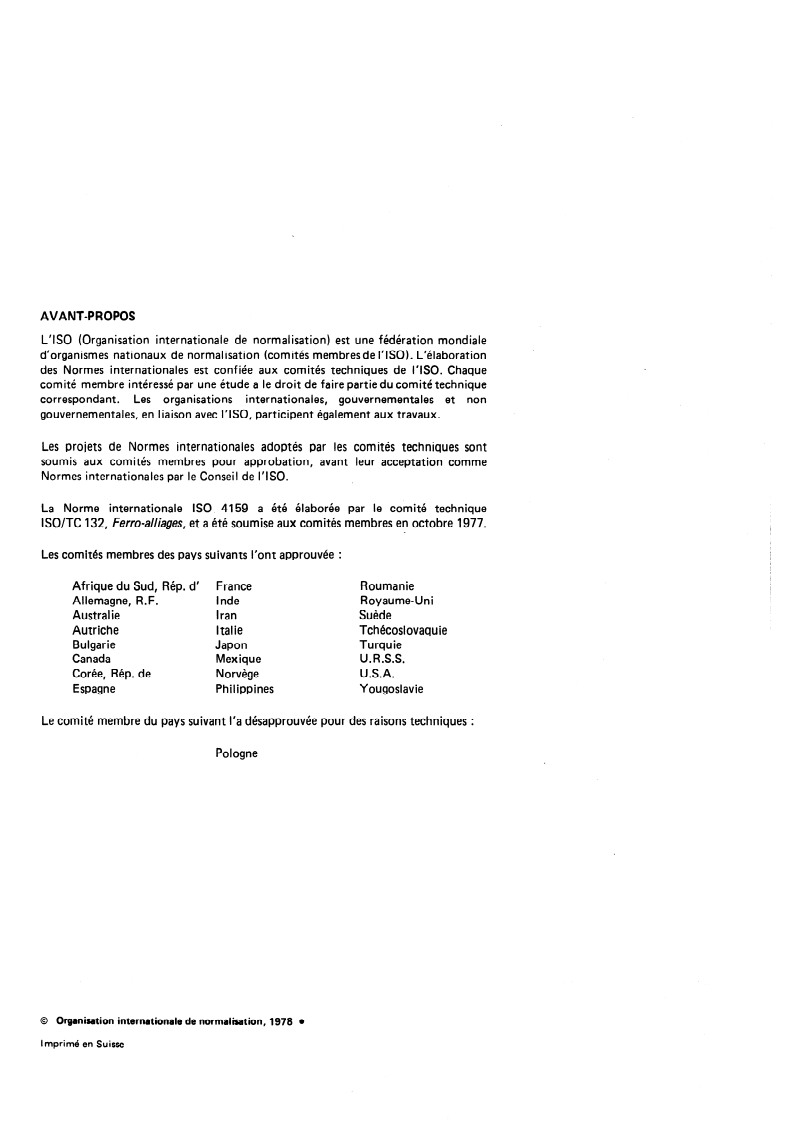
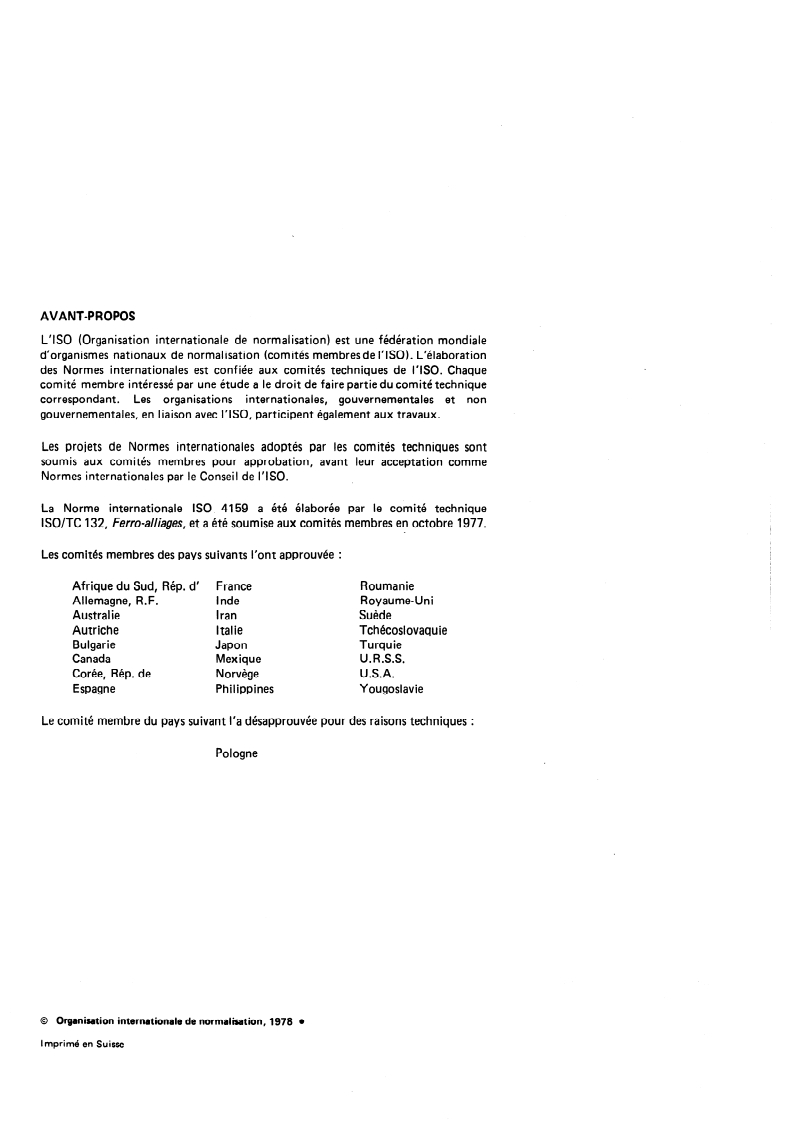
AVANT-PROPOS
L’ISO (Organisation internationale de normalisation) est une fédération mondiale
d’organismes nationaux de normalisation (comités membres de I’ISO). L’élaboration
des Normes internationales est confiée aux comités techniques de I’ISO. Chaque
comité membre intéressé par une étude a le droit de faire partie du comité technique
correspondant. Les organisations internationales, gouvernementales et non
gouvernementales, en liaison avec I’ISO, participent également aux travaux.
Les projets de Normes internationales adoptés par les comités techniques sont
soumis aux comités membres pour approbation, avant leur acceptation comme
Normes internationales par le Conseil de I’ISO.
La Norme internationale ISO 4159 a été élaborée par le comité technique
ISO/TC 132, Ferro-aNages, et a été soumise aux comités membres en octobre 1977.
Les comités membres des pays suivants l’ont approuvée :
Afrique du Sud, Rép. d’ France Roumanie
Allemagne, R.F. Inde Royaume-Uni
Australie Iran Suède
Autriche Italie Tchécoslovaquie
Bulgarie
Japon Turquie
U.R.S.S.
Canada Mexique
Corée, Rép. de Norvège U.S.A.
Espagne Philippines Yougoslavie
Le comité membre du pays suivant l’a désapprouvée pour des raisons techniques :
Pologne
0 Organisation internationale de normalisation, 1978 l
Imprimé en Suisse
ISO 4159-1978 (F)
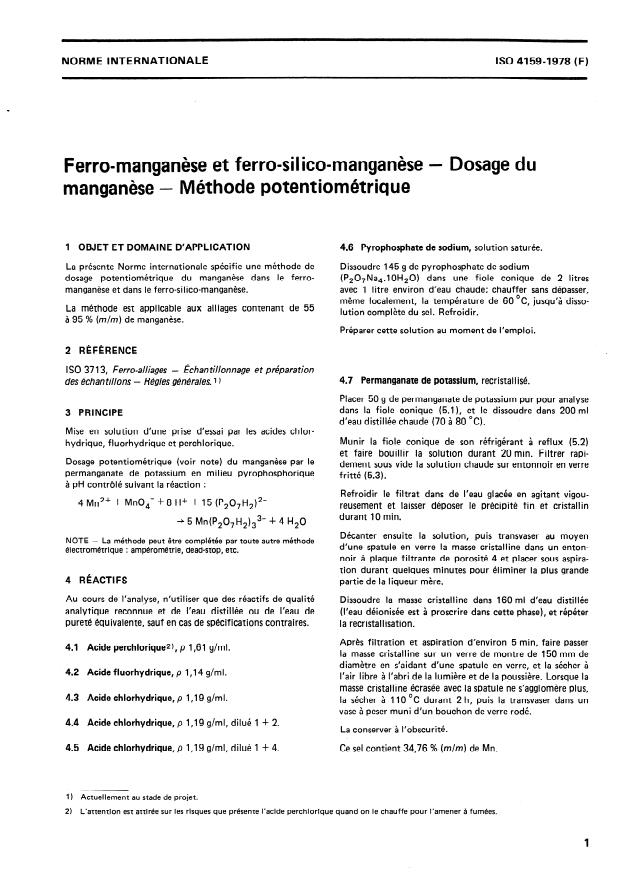
NORME INTERNATIONALE
Ferro-manganèse et ferro-sil ico-manganèse - Dosage du
Méthode potentiométrique
manganèse -
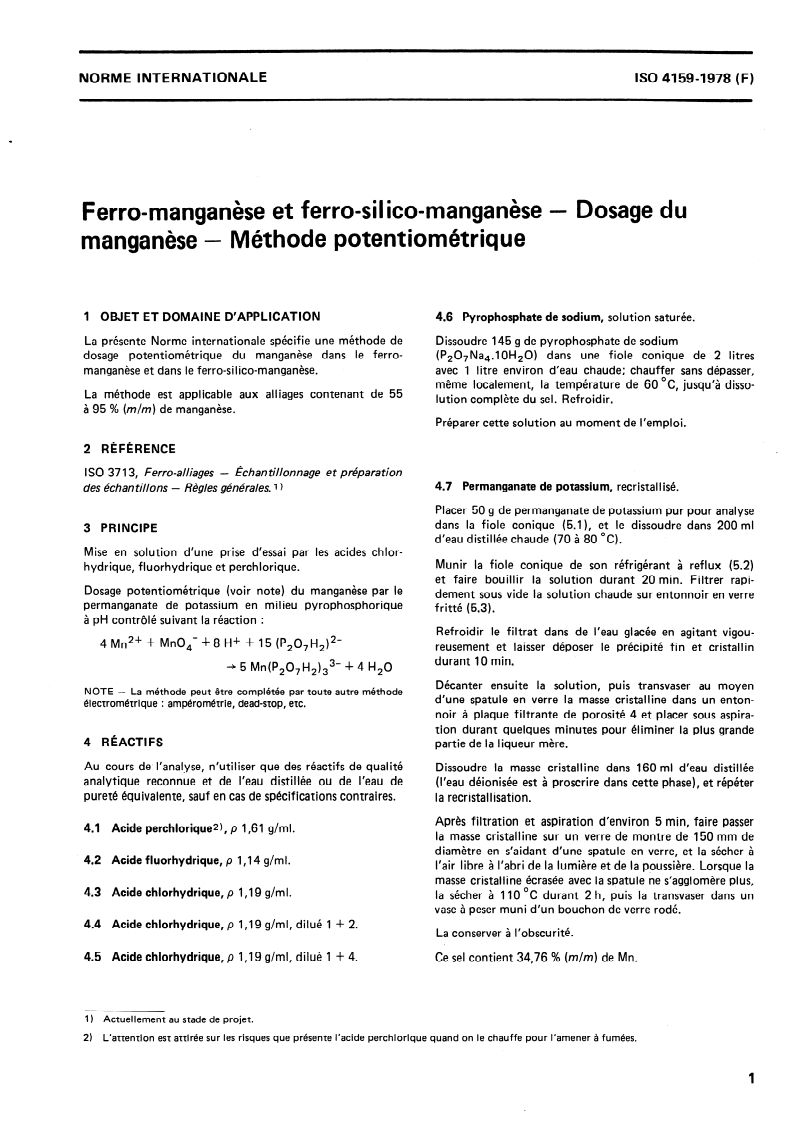
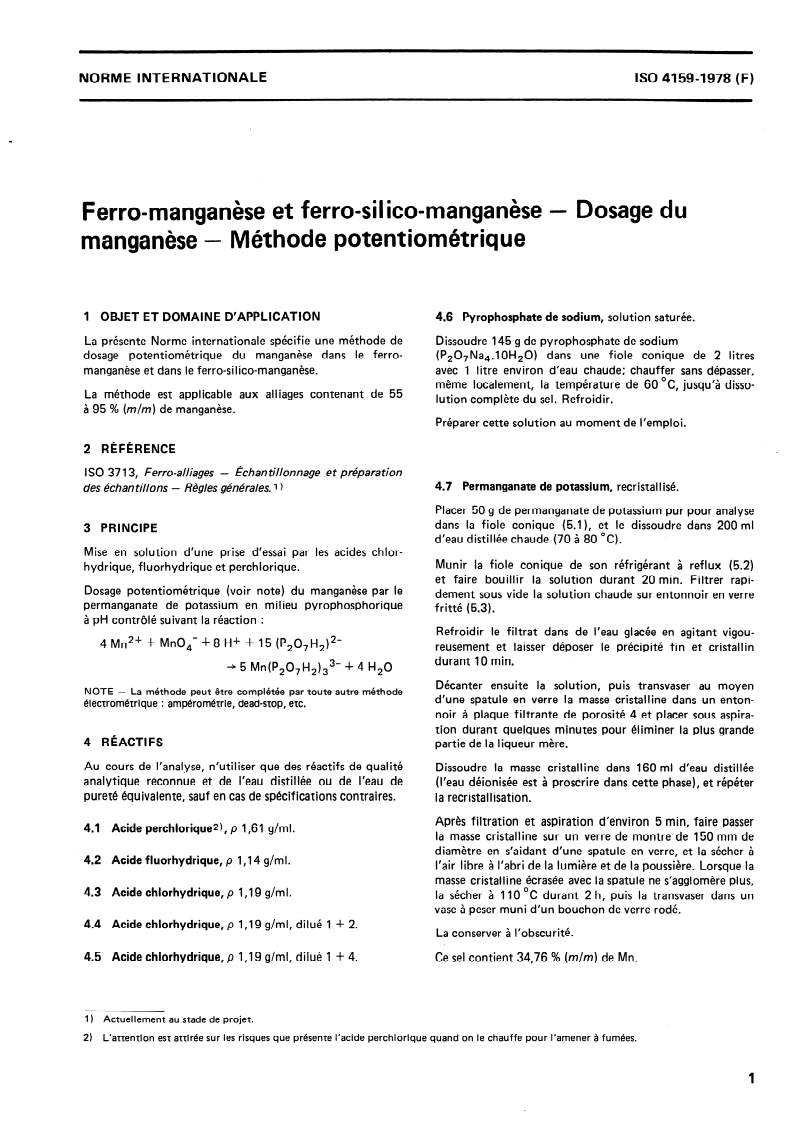
4.6 Pyrophosphate de sodium, solution saturée.
1 OBJET ET DOMAINE D’APPLICATION
Dissoudre 145 g de pyrophosphate de sodium
La présente Norme internationale spécifie une méthode de
(P207Nad.10H20) dans une fiole conique de 2 litres
dosage potentiométrique du manganèse dans le ferro-
avec 1 litre environ d’eau chaude; chauffer sans dépasser,
manganèse et dans le ferro-silice-manganèse.
même localement, la température de 60 OC, jusqu’à disso-
La méthode est applicable aux alliages contenant de 55
lution complète du sel. Refroidir.
à 95 % (mlm) de manganèse.
Préparer cette solution au moment de l’emploi.
2 RÉFÉRENCE
I SO 37 13, Ferra-alliages - Échan tillonnage et préparation
4.7 Permanganate de potassium, recristal I isé.
des échantillons - Règles générales. 1)
Placer 50 g de permanganate de potassium pur pour analyse
dans la fiole conique (5.1), et le dissoudre dans 200 ml
3 PRINCIPE
d’eau distillée chaude (70 à 80 “C).
Mise en solution d’une prise d’essai par les acides chlor-
Munir la fiole conique de son réfrigérant à reflux (5.2)
hydrique, fluorhydrique et perchlorique.
et faire bouillir la solution durant 20 min. Filtrer rapi-
Dosage potentiométrique (voir note) du manganèse par le
dement sous vide la solution chaude sur entonnoir en verre
permanganate de potassium en milieu pyrophosphorique
f ritté (5.3).
à pH contrôlé suivant la réaction :
Refroidir le filtrat dans de l’eau glacée en agitant vigou-
4 Mn2+ i- MnO,- +8 H+ + 15 (P207H2)2-
reusement et laisser déposer le précipité fin et cristallin
durant 10 min.
+ 5 Mn(P20,H2)33- + 4 H,O
Décanter ensuite la solution, puis transvaser au moyen
NOTE - La méthode peut être complétée par toute autre méthode
d’une spatule en verre la masse cristalline dans un enton-
électrométrique : ampérométrie, dead-stop, etc.
noir à plaque filtrante de porosité 4 et placer sous aspira-
tion durant quelques minutes pour éliminer la plus grande
4 RÉACTIFS partie de la liqueur mère.
Au cours de, l’analyse, n’utiliser que des réactifs de qualité Dissoudre la masse cristalline dans 160 ml d’eau distillée
analytique reconnue et de l’eau distillée ou de l’eau de (l’eau déionisée est à proscrire dans cette phase), et répéter
pureté équivalente, sauf en cas de spécifications contraires. la recristallisation.
Après filtration et aspiration d’environ 5 min, faire passer
4.1 Acide perchlorique2), p 1,61 g/ml.
la masse cristalline sur un verre de montre de 150 mm de
diamètre en s’aidant d’une spatule en verre, et la sécher à
4.2 Acide fluorhydrique, p 1 ,14 g/ml.
l’air libre à l’abri de la lumière et de la poussière. Lorsque la
masse cristalline écrasée avec la spatule ne s’agglomère plus,
4.3 Acide chlorhydrique, p 1 ,19 g/mI.
la sécher à 110 “C durant 2 h, puis la transvaser dans un
vase à peser muni d’un bouchon de verre rodé.
4.4 Acide chlorhydrique, p 1,19 g/ml, dilué 1 + 2.
La conserver à l’obscurité.
4.5 Acide chlorhydrique, p 1,19 g/ml, dilué 1 -t 4. Ce sel contient 34,76 % (mlm) de Mn.
1) Actuellement au stade de projet.
2) L’attention est attirée sur les risques que présente l’acide perchlorique quand on le chauffe pour l’amener à fumées.
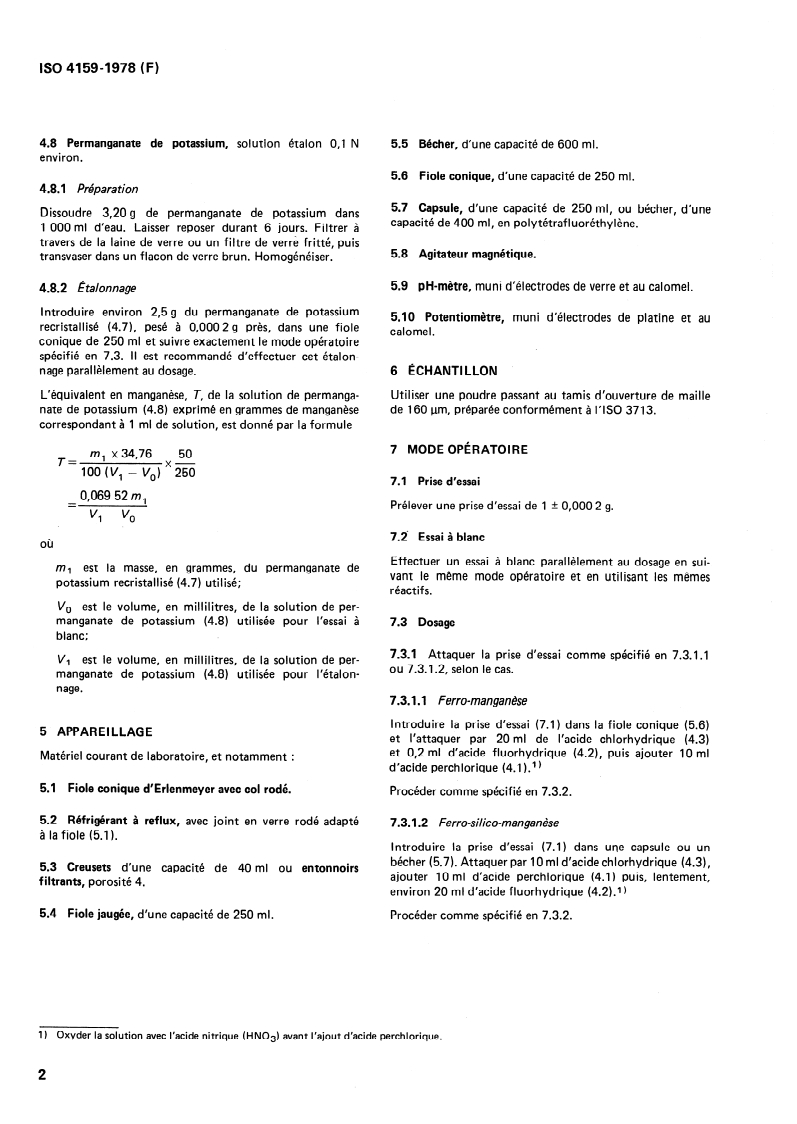
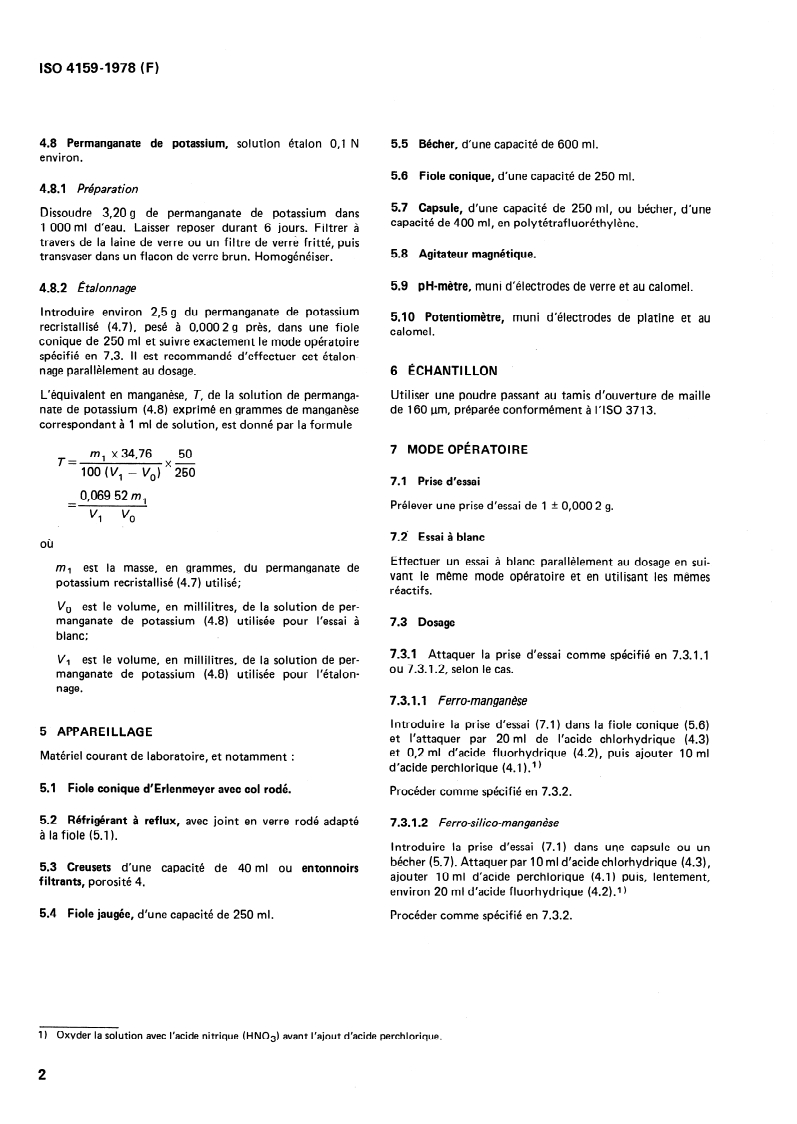
ISO4159-1978(F)
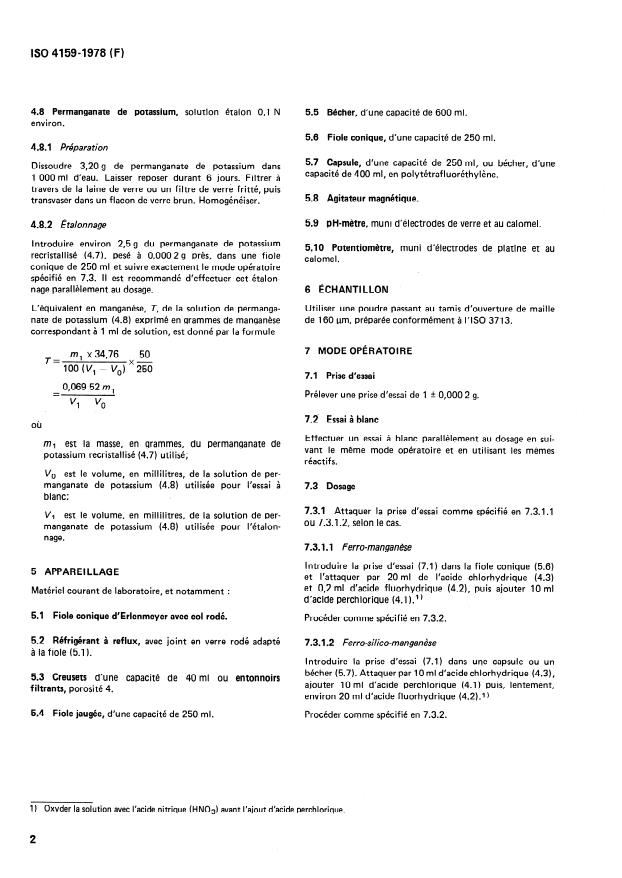
5.5 Bécher, d’une capacité de 600 ml.
4.8 Permanganate de potassium, solution étalon 0,l N
env iron.
5.6 Fiole conique, d’une capacité de 250 ml.
4.8.1 Préparation
5.7 Capsule, d’une capacité de 250 ml, ou bécher, d’une
Dissoudre 3,20 g de permanganate de potassium dans
capacité de 400 ml, en polytétrafluoréthylène.
1 000 ml d’eau. Laisser repose
...
e NORME INTERNATIONALE 4159
INTERNATIONAL ORGANIZATION FOR STANDARDIZATlONWWKQYHAPO~HAR Of’rAHM3AWIfl n0 CTAH~APTH3AUMMWRGANISATION INTERNATIONALE DE NORMALISATION
Ferro-manganèse et ferro-sil ico-manganèse - Dosage du
manganèse - Méthode potentiométrique
Ferromanganese and ferrosilicomanganese - Determination of manganese content -
Po ten tiometric me thod
Première édition - 1978-12-15
CDU 669.15-198 : 543.257.1 : 546.711 Réf. no : ISO 4159-1978 (F)
Descripteurs : ferro-alliage, ferro-manganèse, analyse chimique, dosage, manganèse, analyse potentiométrique.
Prix basé sur 3 pages
AVANT-PROPOS
L’ISO (Organisation internationale de normalisation) est une fédération mondiale
d’organismes nationaux de normalisation (comités membres de I’ISO). L’élaboration
des Normes internationales est confiée aux comités techniques de I’ISO. Chaque
comité membre intéressé par une étude a le droit de faire partie du comité technique
correspondant. Les organisations internationales, gouvernementales et non
gouvernementales, en liaison avec I’ISO, participent également aux travaux.
Les projets de Normes internationales adoptés par les comités techniques sont
soumis aux comités membres pour approbation, avant leur acceptation comme
Normes internationales par le Conseil de I’ISO.
La Norme internationale ISO 4159 a été élaborée par le comité technique
ISO/TC 132, Ferro-aNages, et a été soumise aux comités membres en octobre 1977.
Les comités membres des pays suivants l’ont approuvée :
Afrique du Sud, Rép. d’ France Roumanie
Allemagne, R.F. Inde Royaume-Uni
Australie Iran Suède
Autriche Italie Tchécoslovaquie
Bulgarie
Japon Turquie
U.R.S.S.
Canada Mexique
Corée, Rép. de Norvège U.S.A.
Espagne Philippines Yougoslavie
Le comité membre du pays suivant l’a désapprouvée pour des raisons techniques :
Pologne
0 Organisation internationale de normalisation, 1978 l
Imprimé en Suisse
ISO 4159-1978 (F)
NORME INTERNATIONALE
Ferro-manganèse et ferro-sil ico-manganèse - Dosage du
Méthode potentiométrique
manganèse -
4.6 Pyrophosphate de sodium, solution saturée.
1 OBJET ET DOMAINE D’APPLICATION
Dissoudre 145 g de pyrophosphate de sodium
La présente Norme internationale spécifie une méthode de
(P207Nad.10H20) dans une fiole conique de 2 litres
dosage potentiométrique du manganèse dans le ferro-
avec 1 litre environ d’eau chaude; chauffer sans dépasser,
manganèse et dans le ferro-silice-manganèse.
même localement, la température de 60 OC, jusqu’à disso-
La méthode est applicable aux alliages contenant de 55
lution complète du sel. Refroidir.
à 95 % (mlm) de manganèse.
Préparer cette solution au moment de l’emploi.
2 RÉFÉRENCE
I SO 37 13, Ferra-alliages - Échan tillonnage et préparation
4.7 Permanganate de potassium, recristal I isé.
des échantillons - Règles générales. 1)
Placer 50 g de permanganate de potassium pur pour analyse
dans la fiole conique (5.1), et le dissoudre dans 200 ml
3 PRINCIPE
d’eau distillée chaude (70 à 80 “C).
Mise en solution d’une prise d’essai par les acides chlor-
Munir la fiole conique de son réfrigérant à reflux (5.2)
hydrique, fluorhydrique et perchlorique.
et faire bouillir la solution durant 20 min. Filtrer rapi-
Dosage potentiométrique (voir note) du manganèse par le
dement sous vide la solution chaude sur entonnoir en verre
permanganate de potassium en milieu pyrophosphorique
f ritté (5.3).
à pH contrôlé suivant la réaction :
Refroidir le filtrat dans de l’eau glacée en agitant vigou-
4 Mn2+ i- MnO,- +8 H+ + 15 (P207H2)2-
reusement et laisser déposer le précipité fin et cristallin
durant 10 min.
+ 5 Mn(P20,H2)33- + 4 H,O
Décanter ensuite la solution, puis transvaser au moyen
NOTE - La méthode peut être complétée par toute autre méthode
d’une spatule en verre la masse cristalline dans un enton-
électrométrique : ampérométrie, dead-stop, etc.
noir à plaque filtrante de porosité 4 et placer sous aspira-
tion durant quelques minutes pour éliminer la plus grande
4 RÉACTIFS partie de la liqueur mère.
Au cours de, l’analyse, n’utiliser que des réactifs de qualité Dissoudre la masse cristalline dans 160 ml d’eau distillée
analytique reconnue et de l’eau distillée ou de l’eau de (l’eau déionisée est à proscrire dans cette phase), et répéter
pureté équivalente, sauf en cas de spécifications contraires. la recristallisation.
Après filtration et aspiration d’environ 5 min, faire passer
4.1 Acide perchlorique2), p 1,61 g/ml.
la masse cristalline sur un verre de montre de 150 mm de
diamètre en s’aidant d’une spatule en verre, et la sécher à
4.2 Acide fluorhydrique, p 1 ,14 g/ml.
l’air libre à l’abri de la lumière et de la poussière. Lorsque la
masse cristalline écrasée avec la spatule ne s’agglomère plus,
4.3 Acide chlorhydrique, p 1 ,19 g/mI.
la sécher à 110 “C durant 2 h, puis la transvaser dans un
vase à peser muni d’un bouchon de verre rodé.
4.4 Acide chlorhydrique, p 1,19 g/ml, dilué 1 + 2.
La conserver à l’obscurité.
4.5 Acide chlorhydrique, p 1,19 g/ml, dilué 1 -t 4. Ce sel contient 34,76 % (mlm) de Mn.
1) Actuellement au stade de projet.
2) L’attention est attirée sur les risques que présente l’acide perchlorique quand on le chauffe pour l’amener à fumées.
ISO4159-1978(F)
5.5 Bécher, d’une capacité de 600 ml.
4.8 Permanganate de potassium, solution étalon 0,l N
env iron.
5.6 Fiole conique, d’une capacité de 250 ml.
4.8.1 Préparation
5.7 Capsule, d’une capacité de 250 ml, ou bécher, d’une
Dissoudre 3,20 g de permanganate de potassium dans
capacité de 400 ml, en polytétrafluoréthylène.
1 000 ml d’eau. Laisser repose
...
e NORME INTERNATIONALE 4159
INTERNATIONAL ORGANIZATION FOR STANDARDIZATlONWWKQYHAPO~HAR Of’rAHM3AWIfl n0 CTAH~APTH3AUMMWRGANISATION INTERNATIONALE DE NORMALISATION
Ferro-manganèse et ferro-sil ico-manganèse - Dosage du
manganèse - Méthode potentiométrique
Ferromanganese and ferrosilicomanganese - Determination of manganese content -
Po ten tiometric me thod
Première édition - 1978-12-15
CDU 669.15-198 : 543.257.1 : 546.711 Réf. no : ISO 4159-1978 (F)
Descripteurs : ferro-alliage, ferro-manganèse, analyse chimique, dosage, manganèse, analyse potentiométrique.
Prix basé sur 3 pages
AVANT-PROPOS
L’ISO (Organisation internationale de normalisation) est une fédération mondiale
d’organismes nationaux de normalisation (comités membres de I’ISO). L’élaboration
des Normes internationales est confiée aux comités techniques de I’ISO. Chaque
comité membre intéressé par une étude a le droit de faire partie du comité technique
correspondant. Les organisations internationales, gouvernementales et non
gouvernementales, en liaison avec I’ISO, participent également aux travaux.
Les projets de Normes internationales adoptés par les comités techniques sont
soumis aux comités membres pour approbation, avant leur acceptation comme
Normes internationales par le Conseil de I’ISO.
La Norme internationale ISO 4159 a été élaborée par le comité technique
ISO/TC 132, Ferro-aNages, et a été soumise aux comités membres en octobre 1977.
Les comités membres des pays suivants l’ont approuvée :
Afrique du Sud, Rép. d’ France Roumanie
Allemagne, R.F. Inde Royaume-Uni
Australie Iran Suède
Autriche Italie Tchécoslovaquie
Bulgarie
Japon Turquie
U.R.S.S.
Canada Mexique
Corée, Rép. de Norvège U.S.A.
Espagne Philippines Yougoslavie
Le comité membre du pays suivant l’a désapprouvée pour des raisons techniques :
Pologne
0 Organisation internationale de normalisation, 1978 l
Imprimé en Suisse
ISO 4159-1978 (F)
NORME INTERNATIONALE
Ferro-manganèse et ferro-sil ico-manganèse - Dosage du
Méthode potentiométrique
manganèse -
4.6 Pyrophosphate de sodium, solution saturée.
1 OBJET ET DOMAINE D’APPLICATION
Dissoudre 145 g de pyrophosphate de sodium
La présente Norme internationale spécifie une méthode de
(P207Nad.10H20) dans une fiole conique de 2 litres
dosage potentiométrique du manganèse dans le ferro-
avec 1 litre environ d’eau chaude; chauffer sans dépasser,
manganèse et dans le ferro-silice-manganèse.
même localement, la température de 60 OC, jusqu’à disso-
La méthode est applicable aux alliages contenant de 55
lution complète du sel. Refroidir.
à 95 % (mlm) de manganèse.
Préparer cette solution au moment de l’emploi.
2 RÉFÉRENCE
I SO 37 13, Ferra-alliages - Échan tillonnage et préparation
4.7 Permanganate de potassium, recristal I isé.
des échantillons - Règles générales. 1)
Placer 50 g de permanganate de potassium pur pour analyse
dans la fiole conique (5.1), et le dissoudre dans 200 ml
3 PRINCIPE
d’eau distillée chaude (70 à 80 “C).
Mise en solution d’une prise d’essai par les acides chlor-
Munir la fiole conique de son réfrigérant à reflux (5.2)
hydrique, fluorhydrique et perchlorique.
et faire bouillir la solution durant 20 min. Filtrer rapi-
Dosage potentiométrique (voir note) du manganèse par le
dement sous vide la solution chaude sur entonnoir en verre
permanganate de potassium en milieu pyrophosphorique
f ritté (5.3).
à pH contrôlé suivant la réaction :
Refroidir le filtrat dans de l’eau glacée en agitant vigou-
4 Mn2+ i- MnO,- +8 H+ + 15 (P207H2)2-
reusement et laisser déposer le précipité fin et cristallin
durant 10 min.
+ 5 Mn(P20,H2)33- + 4 H,O
Décanter ensuite la solution, puis transvaser au moyen
NOTE - La méthode peut être complétée par toute autre méthode
d’une spatule en verre la masse cristalline dans un enton-
électrométrique : ampérométrie, dead-stop, etc.
noir à plaque filtrante de porosité 4 et placer sous aspira-
tion durant quelques minutes pour éliminer la plus grande
4 RÉACTIFS partie de la liqueur mère.
Au cours de, l’analyse, n’utiliser que des réactifs de qualité Dissoudre la masse cristalline dans 160 ml d’eau distillée
analytique reconnue et de l’eau distillée ou de l’eau de (l’eau déionisée est à proscrire dans cette phase), et répéter
pureté équivalente, sauf en cas de spécifications contraires. la recristallisation.
Après filtration et aspiration d’environ 5 min, faire passer
4.1 Acide perchlorique2), p 1,61 g/ml.
la masse cristalline sur un verre de montre de 150 mm de
diamètre en s’aidant d’une spatule en verre, et la sécher à
4.2 Acide fluorhydrique, p 1 ,14 g/ml.
l’air libre à l’abri de la lumière et de la poussière. Lorsque la
masse cristalline écrasée avec la spatule ne s’agglomère plus,
4.3 Acide chlorhydrique, p 1 ,19 g/mI.
la sécher à 110 “C durant 2 h, puis la transvaser dans un
vase à peser muni d’un bouchon de verre rodé.
4.4 Acide chlorhydrique, p 1,19 g/ml, dilué 1 + 2.
La conserver à l’obscurité.
4.5 Acide chlorhydrique, p 1,19 g/ml, dilué 1 -t 4. Ce sel contient 34,76 % (mlm) de Mn.
1) Actuellement au stade de projet.
2) L’attention est attirée sur les risques que présente l’acide perchlorique quand on le chauffe pour l’amener à fumées.
ISO4159-1978(F)
5.5 Bécher, d’une capacité de 600 ml.
4.8 Permanganate de potassium, solution étalon 0,l N
env iron.
5.6 Fiole conique, d’une capacité de 250 ml.
4.8.1 Préparation
5.7 Capsule, d’une capacité de 250 ml, ou bécher, d’une
Dissoudre 3,20 g de permanganate de potassium dans
capacité de 400 ml, en polytétrafluoréthylène.
1 000 ml d’eau. Laisser repose
...