

ISO 6467:2018
(Main)Ferrovanadium — Determination of vanadium content — Potentiometric method
General Information
- Abstract
ISO 6467:2018 specifies a potentiometric method for the determination of the vanadium content of ferrovanadium. The method is applicable to vanadium contents between 35,0 % and 85,0 % (mass fraction) in ferrovanadium.
- Status
- Published
- Publication Date
- 30-Jan-2018
- Technical Committee
- ISO/TC 132 - Ferroalloys
- Drafting Committee
- ISO/TC 132 - Ferroalloys
- Current Stage
- 9093 - International Standard confirmed
- Start Date
- 08-May-2024
- Completion Date
- 29-Aug-2026
Buy Documents

ISO 6467:2018 - Ferrovanadium -- Determination of vanadium content -- Potentiometric method
ISO 6467:2018 - Ferrovanadium — Determination of vanadium content — Potentiometric method/31/2018
Overview
ISO 6467:2018 specifies a potentiometric titration method for the determination of vanadium content in ferrovanadium. The standard applies to ferrovanadium materials with vanadium mass fractions between 35.0 % and 85.0 %. This second edition (2018) updates procedure, precision data and the applicable vanadium range from the earlier 1980 edition.
Key topics and technical requirements
- Principle: Dissolve a test portion in nitric and sulfuric acids; oxidize vanadium(IV) to vanadium(V) with potassium permanganate; destroy excess oxidant with potassium nitrite and urea; then reduce V(V) to V(IV) by titration with standard ammonium iron(II) sulfate while monitoring the end-point potentiometrically.
- Applicability range: Vanadium content between 35.0 % and 85.0 % (mass fraction).
- Reagents: Analytical-grade reagents and grade 2 water (ISO 3696). Key reagents include potassium permanganate, potassium nitrite, phosphoric/nitric/sulfuric acids, urea, potassium dichromate (for standardization) and ammonium iron(II) sulfate as titrant.
- Apparatus: Class A volumetric glassware (ISO 648, ISO 1042), a precision potentiometer with platinum indicating electrode and a Hg/Hg2SO4/K2SO4 (saturated) or Ag/AgCl/KCl (saturated) reference electrode, magnetic stirrer and burettes.
- Sample preparation: Use powder passing a 250 μm sieve, prepared per ISO 3713. Typical test portion is 0.5000 g ± 0.0001 g.
- Result expression: Vanadium content is calculated from titrant volume, titrant concentration and test portion mass; the atomic mass factor 50.94 is used in the formula provided in the standard.
- Precision: Inter-laboratory validation (eight labs) produced repeatability and reproducibility limits. Example values: at ~47 % V, r = 0.175 and R = 0.478; at ~78 % V, r = 0.305 and R = 0.624. Interpretation follows ISO 5725-2.
Applications and users
ISO 6467:2018 is primarily intended for:
- Metallurgical laboratories performing compositional analysis of ferroalloys.
- Ferrovanadium producers and quality control teams verifying vanadium content for product certification and trade.
- Third‑party testing and inspection bodies that require a standardized, traceable method for vanadium assay.
- Research laboratories studying ferrovanadium chemistry or process optimization.
Practical uses include incoming material inspection, product specification verification, compliance testing for trade and process control in steelmaking where ferrovanadium is used as an alloying addition.
Related standards
- ISO 3713 - Sampling and preparation of ferroalloy samples
- ISO 3696 - Water for analytical laboratory use
- ISO 648 / ISO 1042 - Laboratory volumetric glassware specifications
- ISO 5725-2 - Accuracy (trueness and precision) - determination of repeatability and reproducibility
Keywords: ISO 6467, ferrovanadium, vanadium determination, potentiometric method, ammonium iron(II) sulfate, metallurgical analysis, ferroalloys, precision, repeatability, reproducibility.
Relations
- Effective Date
- 23-Nov-2013
Buy Documents
ISO 6467:2018 - Ferrovanadium -- Determination of vanadium content -- Potentiometric method
ISO 6467:2018 - Ferrovanadium — Determination of vanadium content — Potentiometric method/31/2018
Get Certified
Connect with accredited certification bodies for this standard

Element Materials Technology
Materials testing and product certification.

Inštitut za kovinske materiale in tehnologije
Institute of Metals and Technology. Materials testing, metallurgical analysis, NDT.
Sponsored listings
Frequently Asked Questions
ISO 6467:2018 is a standard published by the International Organization for Standardization (ISO). Its full title is "Ferrovanadium — Determination of vanadium content — Potentiometric method". This standard covers: ISO 6467:2018 specifies a potentiometric method for the determination of the vanadium content of ferrovanadium. The method is applicable to vanadium contents between 35,0 % and 85,0 % (mass fraction) in ferrovanadium.
ISO 6467:2018 specifies a potentiometric method for the determination of the vanadium content of ferrovanadium. The method is applicable to vanadium contents between 35,0 % and 85,0 % (mass fraction) in ferrovanadium.
ISO 6467:2018 is classified under the following ICS (International Classification for Standards) categories: 77.100 - Ferroalloys. The ICS classification helps identify the subject area and facilitates finding related standards.
ISO 6467:2018 has the following relationships with other standards: It is inter standard links to ISO 6467:1980. Understanding these relationships helps ensure you are using the most current and applicable version of the standard.
ISO 6467:2018 is available in PDF format for immediate download after purchase. The document can be added to your cart and obtained through the secure checkout process. Digital delivery ensures instant access to the complete standard document.
Standards Content (Sample)
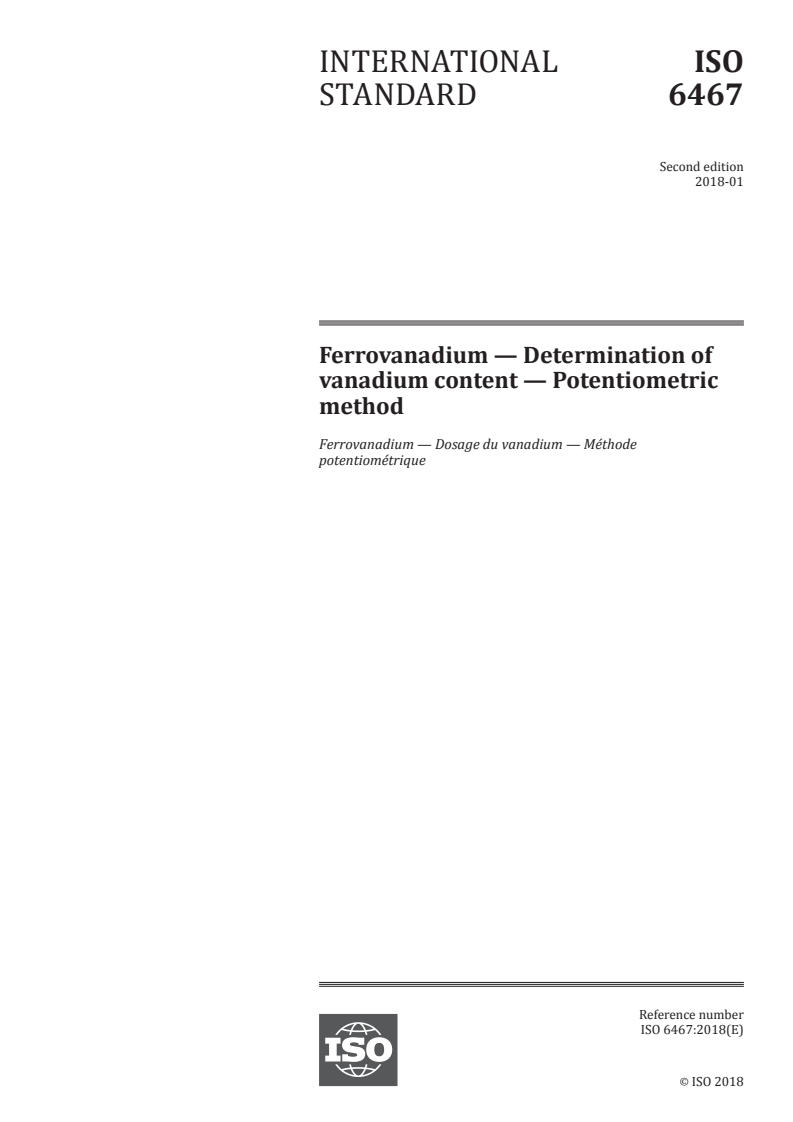
INTERNATIONAL ISO
STANDARD 6467
Second edition
2018-01
Ferrovanadium — Determination of
vanadium content — Potentiometric
method
Ferrovanadium — Dosage du vanadium — Méthode
potentiométrique
Reference number
©
ISO 2018
© ISO 2018
All rights reserved. Unless otherwise specified, or required in the context of its implementation, no part of this publication may
be reproduced or utilized otherwise in any form or by any means, electronic or mechanical, including photocopying, or posting
on the internet or an intranet, without prior written permission. Permission can be requested from either ISO at the address
below or ISO’s member body in the country of the requester.
ISO copyright office
CP 401 • Ch. de Blandonnet 8
CH-1214 Vernier, Geneva, Switzerland
Tel. +41 22 749 01 11
Fax +41 22 749 09 47
copyright@iso.org
www.iso.org
Published in Switzerland
ii © ISO 2018 – All rights reserved
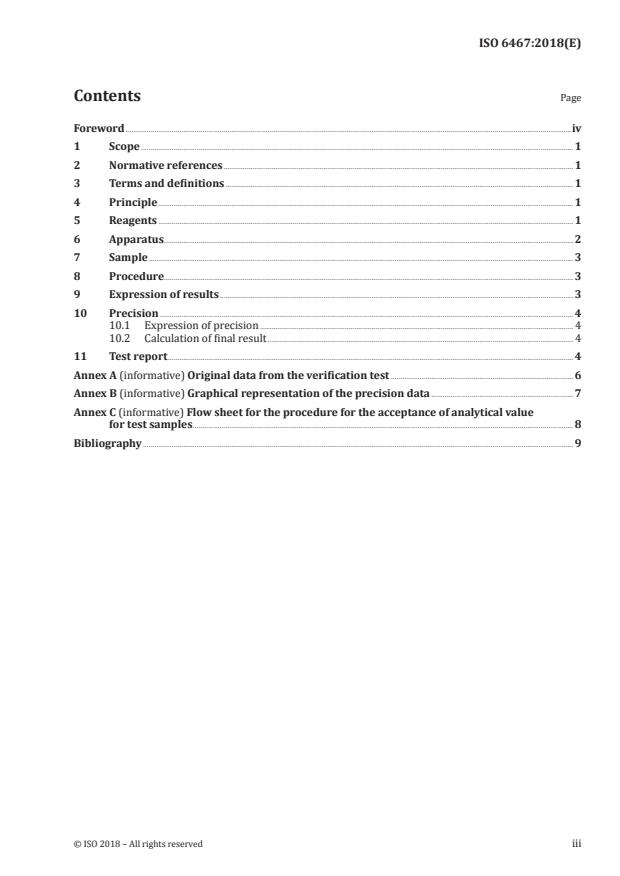
Contents Page
Foreword .iv
1 Scope . 1
2 Normative references . 1
3 Terms and definitions . 1
4 Principle . 1
5 Reagents . 1
6 Apparatus . 2
7 Sample . 3
8 Procedure. 3
9 Expression of results . 3
10 Precision . 4
10.1 Expression of precision . 4
10.2 Calculation of final result . 4
11 Test report . 4
Annex A (informative) Original data from the verification test . 6
Annex B (informative) Graphical representation of the precision data . 7
Annex C (informative) Flow sheet for the procedure for the acceptance of analytical value
for test samples . 8
Bibliography . 9
Foreword
ISO (the International Organization for Standardization) is a worldwide federation of national standards
bodies (ISO member bodies). The work of preparing International Standards is normally carried out
through ISO technical committees. Each member body interested in a subject for which a technical
committee has been established has the right to be represented on that committee. International
organizations, governmental and non-governmental, in liaison with ISO, also take part in the work.
ISO collaborates closely with the International Electrotechnical Commission (IEC) on all matters of
electrotechnical standardization.
The procedures used to develop this document and those intended for its further maintenance are
described in the ISO/IEC Directives, Part 1. In particular the different approval criteria needed for the
different types of ISO documents should be noted. This document was drafted in accordance with the
editorial rules of the ISO/IEC Directives, Part 2 (see www .iso .org/ directives).
Attention is drawn to the possibility that some of the elements of this document may be the subject of
patent rights. ISO shall not be held responsible for identifying any or all such patent rights. Details of
any patent rights identified during the development of the document will be in the Introduction and/or
on the ISO list of patent declarations received (see www .iso .org/ patents).
Any trade name used in this document is information given for the convenience of users and does not
constitute an endorsement.
For an explanation on the voluntary nature of standards, the meaning of ISO specific terms and
expressions related to conformity assessment, as well as information about ISO's adherence to the
World Trade Organization (WTO) principles in the Technical Barriers to Trade (TBT) see the following
URL: www .iso .org/ iso/ foreword .html.
This document was prepared by Technical Committee ISO/TC 132, Ferroalloys.
This second edition cancels and replaces the first edition (ISO 6467:1980), which has been technically
revised. Changes have been made to the vanadium range, the procedure and the precision.
iv © ISO 2018 – All rights reserved
INTERNATIONAL STANDARD ISO 6467:2018(E)
Ferrovanadium — Determination of vanadium content —
Potentiometric method
1 Scope
This document specifies a potentiometric method for the determination of the vanadium content of
ferrovanadium.
The method is applicable to vanadium contents between 35,0 % and 85,0 % (mass fraction) in
ferrovanadium.
2 Normative references
The following documents are referred to in the text in such a way that some or all of their content
constitutes requirements of this document. For dated references, only the edition cited applies. For
undated references, the latest edition of the referenced document (including any amendments) applies.
ISO 648, Laboratory glassware — Single-volume pipettes
ISO 1042, Laboratory glassware — One-mark volumetric flasks
ISO 3696, Water for analytical laboratory use — Specification and test methods
ISO 3713, Ferroalloys — Sampling and preparation of samples — General rules
3 Terms and definitions
No terms and definitions are listed in this document.
ISO and IEC maintain terminological databases for use in standardization at the following addresses:
— IEC Electropedia: available at http:// www .electropedia .org/
— ISO Online browsing platform: available at https:// www .iso .org/ obp
4 Principle
Dissolution of a test portion with nitric and sulfuric acids. Cold oxidation of the vanadium(IV) to
vanadium(V) by a slight excess of potassium permanganate. Destruction of the excess of potassium
permanganate by potassium nitrite, the excess of the latter being itself destroyed by urea. Reduction of
the vanadium(V) to vanadium(IV) by iron(II) in a potentiometric titration.
5 Reagents
During the analysis, unless otherwise specified, use only reagents of recognized analytical grade and
only grade 2 water as specified in ISO 3696.
5.1 Urea.
5.2 Nitric acid, ρ 1,38 to 1,42 g/ml.
5.3 Phosphoric acid.
...
INTERNATIONAL ISO
STANDARD 6467
Second edition
2018-01
Ferrovanadium — Determination of
vanadium content — Potentiometric
method
Ferrovanadium — Dosage du vanadium — Méthode
potentiométrique
Reference number
©
ISO 2018
© ISO 2018
All rights reserved. Unless otherwise specified, or required in the context of its implementation, no part of this publication may
be reproduced or utilized otherwise in any form or by any means, electronic or mechanical, including photocopying, or posting
on the internet or an intranet, without prior written permission. Permission can be requested from either ISO at the address
below or ISO’s member body in the country of the requester.
ISO copyright office
CP 401 • Ch. de Blandonnet 8
CH-1214 Vernier, Geneva, Switzerland
Tel. +41 22 749 01 11
Fax +41 22 749 09 47
copyright@iso.org
www.iso.org
Published in Switzerland
ii © ISO 2018 – All rights reserved
Contents Page
Foreword .iv
1 Scope . 1
2 Normative references . 1
3 Terms and definitions . 1
4 Principle . 1
5 Reagents . 1
6 Apparatus . 2
7 Sample . 3
8 Procedure. 3
9 Expression of results . 3
10 Precision . 4
10.1 Expression of precision . 4
10.2 Calculation of final result . 4
11 Test report . 4
Annex A (informative) Original data from the verification test . 6
Annex B (informative) Graphical representation of the precision data . 7
Annex C (informative) Flow sheet for the procedure for the acceptance of analytical value
for test samples . 8
Bibliography . 9
Foreword
ISO (the International Organization for Standardization) is a worldwide federation of national standards
bodies (ISO member bodies). The work of preparing International Standards is normally carried out
through ISO technical committees. Each member body interested in a subject for which a technical
committee has been established has the right to be represented on that committee. International
organizations, governmental and non-governmental, in liaison with ISO, also take part in the work.
ISO collaborates closely with the International Electrotechnical Commission (IEC) on all matters of
electrotechnical standardization.
The procedures used to develop this document and those intended for its further maintenance are
described in the ISO/IEC Directives, Part 1. In particular the different approval criteria needed for the
different types of ISO documents should be noted. This document was drafted in accordance with the
editorial rules of the ISO/IEC Directives, Part 2 (see www .iso .org/ directives).
Attention is drawn to the possibility that some of the elements of this document may be the subject of
patent rights. ISO shall not be held responsible for identifying any or all such patent rights. Details of
any patent rights identified during the development of the document will be in the Introduction and/or
on the ISO list of patent declarations received (see www .iso .org/ patents).
Any trade name used in this document is information given for the convenience of users and does not
constitute an endorsement.
For an explanation on the voluntary nature of standards, the meaning of ISO specific terms and
expressions related to conformity assessment, as well as information about ISO's adherence to the
World Trade Organization (WTO) principles in the Technical Barriers to Trade (TBT) see the following
URL: www .iso .org/ iso/ foreword .html.
This document was prepared by Technical Committee ISO/TC 132, Ferroalloys.
This second edition cancels and replaces the first edition (ISO 6467:1980), which has been technically
revised. Changes have been made to the vanadium range, the procedure and the precision.
iv © ISO 2018 – All rights reserved
INTERNATIONAL STANDARD ISO 6467:2018(E)
Ferrovanadium — Determination of vanadium content —
Potentiometric method
1 Scope
This document specifies a potentiometric method for the determination of the vanadium content of
ferrovanadium.
The method is applicable to vanadium contents between 35,0 % and 85,0 % (mass fraction) in
ferrovanadium.
2 Normative references
The following documents are referred to in the text in such a way that some or all of their content
constitutes requirements of this document. For dated references, only the edition cited applies. For
undated references, the latest edition of the referenced document (including any amendments) applies.
ISO 648, Laboratory glassware — Single-volume pipettes
ISO 1042, Laboratory glassware — One-mark volumetric flasks
ISO 3696, Water for analytical laboratory use — Specification and test methods
ISO 3713, Ferroalloys — Sampling and preparation of samples — General rules
3 Terms and definitions
No terms and definitions are listed in this document.
ISO and IEC maintain terminological databases for use in standardization at the following addresses:
— IEC Electropedia: available at http:// www .electropedia .org/
— ISO Online browsing platform: available at https:// www .iso .org/ obp
4 Principle
Dissolution of a test portion with nitric and sulfuric acids. Cold oxidation of the vanadium(IV) to
vanadium(V) by a slight excess of potassium permanganate. Destruction of the excess of potassium
permanganate by potassium nitrite, the excess of the latter being itself destroyed by urea. Reduction of
the vanadium(V) to vanadium(IV) by iron(II) in a potentiometric titration.
5 Reagents
During the analysis, unless otherwise specified, use only reagents of recognized analytical grade and
only grade 2 water as specified in ISO 3696.
5.1 Urea.
5.2 Nitric acid, ρ 1,38 to 1,42 g/ml.
5.3 Phosphoric acid.
...