

ISO 1215:2015
(Main)Virgin cork, raw reproduction cork, ramassage, gleanings, burnt cork, corkwaste, boiled cork pieces and raw corkwaste — Definitions and packaging
General Information
- Abstract
ISO 1215:2015 applies to commercially dry virgin cork, raw reproduction cork, ramassage, gleanings, burnt cork, corkwaste, boiled cork pieces, and boiled corkwaste and specifies the conditions of packaging for each type.
- Status
- Published
- Publication Date
- 10-May-2015
- Technical Committee
- ISO/TC 87 - Cork
- Drafting Committee
- ISO/TC 87/WG 17 - Raw material
- Current Stage
- 9093 - International Standard confirmed
- Start Date
- 28-Jul-2022
- Completion Date
- 29-Aug-2026
Buy Documents
ISO 1215:2015 - Virgin cork, raw reproduction cork, ramassage, gleanings, burnt cork, corkwaste, boiled cork pieces and raw corkwaste -- Definitions and packaging
REDLINE ISO 1215:2015 - Virgin cork, raw reproduction cork, ramassage, gleanings, burnt cork, corkwaste, boiled cork pieces and raw corkwaste -- Definitions and packaging
ISO 1215:2015 - Virgin cork, raw reproduction cork, ramassage, gleanings, burnt cork, corkwaste, boiled cork pieces and raw corkwaste — Definitions and packaging/11/2015
REDLINE ISO 1215:2015 - Virgin cork, raw reproduction cork, ramassage, gleanings, burnt cork, corkwaste, boiled cork pieces and raw corkwaste — Definitions and packaging/11/2015
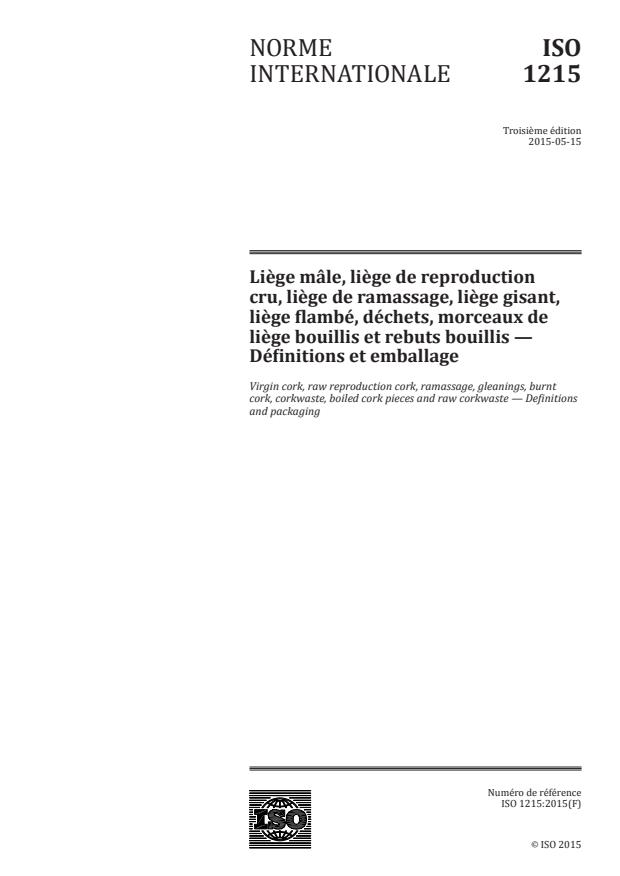
ISO 1215:2015 - Liege mâle, liege de reproduction cru, liege de ramassage, liege gisant, liege flambé, déchets, morceaux de liege bouillis et rebuts bouillis -- Définitions et emballage
ISO 1215:2015 - Liège mâle, liège de reproduction cru, liège de ramassage, liège gisant, liège flambé, déchets, morceaux de liège bouillis et rebuts bouillis — Définitions et emballage/11/2015
Overview
ISO 1215:2015 is an international standard established by the International Organization for Standardization (ISO) that defines and specifies packaging requirements for various types of cork materials. The scope covers commercially dry virgin cork, raw reproduction cork, ramassage, gleanings, burnt cork, corkwaste, boiled cork pieces, and boiled corkwaste. The standard ensures consistent classification and packaging practices tailored to preserve the quality and integrity of cork products during storage and transportation.
This standard is essential for manufacturers, exporters, and users of cork materials looking to maintain product quality and comply with internationally recognized packaging norms. By setting moisture content limits and packaging specifications, ISO 1215:2015 helps reduce losses during transit and supports efficient handling within the cork industry.
Key Topics
- Types of Cork Covered: Includes virgin cork, raw reproduction cork, ramassage (collected cork), gleanings, burnt cork, corkwaste, boiled cork pieces, and boiled corkwaste.
- Moisture Content Specification: Cork products covered by the standard must have a moisture content not exceeding 14%, determined by ISO 2386 testing methods.
- Packaging Requirements:
- Cork materials are typically packaged in compressed bales shaped as rectangular parallelepipeds or in alternative packaging agreed upon by parties involved.
- Compression is maintained using steel hoops or other mutually agreed methods.
- Packaging aids such as cork planks, wood fillets, and sacking wraps may be used to preserve bale shape and compactness.
- Nets or bags are standard packaging forms unless otherwise agreed.
- Packaging Mass Limits:
- Tare weight (weight of packaging materials) should not exceed 3% of the bale's gross mass.
- When additional packaging aids like sacking, steel wire, or wood fillets are used, tare can be up to 5% of gross mass.
- Marking and Identification:
- Each bale must be clearly marked to indicate the cork type, conditioning, exporter’s name or trademark, and country of origin.
- Loss in Transit Allowance:
- Acceptable loss due to breakage or damage during transport must not exceed 3% of the gross mass of bales under normal carriage conditions.
Applications
ISO 1215:2015 is a critical standard for various stakeholders in the cork industry:
- Cork Suppliers and Producers: Ensure their cork products meet international moisture content and packaging standards.
- Exporters and Importers: Benefit from standardized packaging and marking, facilitating global trade and mitigating disputes related to cargo condition.
- Logistics and Storage Providers: Use the packaging requirements to maintain cork quality during handling, warehousing, and transportation.
- Manufacturers Using Cork Materials: Such as cork stoppers, flooring, insulation, and other cork-based products, who rely on consistent quality and moisture standards to achieve product performance.
- Quality Inspectors and Regulatory Bodies: Apply the ISO 1215 definitions and packaging conditions to verify compliance and ensure fair commercial practices.
Related Standards
ISO 633: Cork - Vocabulary
Provides key terminologies and definitions related to cork materials, supporting uniform understanding in the cork industry.ISO 2386: Corkwood in Planks, Virgin Cork, Ramassage, Gleanings, Corkwood Refuse and Corkwaste - Determination of Moisture Content
Specifies the method to determine moisture content in cork, which is a critical parameter defined in ISO 1215.
By adhering to ISO 1215:2015, organizations involved in the production, packaging, and marketing of cork materials improve product quality assurance, facilitate international trade, and reduce material losses during transit. This standard plays a vital role in sustaining the global cork market's efficiency and reliability.
Relations
- Effective Date
- 05-Oct-2013
Buy Documents
ISO 1215:2015 - Virgin cork, raw reproduction cork, ramassage, gleanings, burnt cork, corkwaste, boiled cork pieces and raw corkwaste -- Definitions and packaging
REDLINE ISO 1215:2015 - Virgin cork, raw reproduction cork, ramassage, gleanings, burnt cork, corkwaste, boiled cork pieces and raw corkwaste -- Definitions and packaging
ISO 1215:2015 - Virgin cork, raw reproduction cork, ramassage, gleanings, burnt cork, corkwaste, boiled cork pieces and raw corkwaste — Definitions and packaging/11/2015
REDLINE ISO 1215:2015 - Virgin cork, raw reproduction cork, ramassage, gleanings, burnt cork, corkwaste, boiled cork pieces and raw corkwaste — Definitions and packaging/11/2015
ISO 1215:2015 - Liege mâle, liege de reproduction cru, liege de ramassage, liege gisant, liege flambé, déchets, morceaux de liege bouillis et rebuts bouillis -- Définitions et emballage
ISO 1215:2015 - Liège mâle, liège de reproduction cru, liège de ramassage, liège gisant, liège flambé, déchets, morceaux de liège bouillis et rebuts bouillis — Définitions et emballage/11/2015
Get Certified
Connect with accredited certification bodies for this standard

Gozdarski inštitut Slovenije
Slovenian Forestry Institute. Forest management certification support, timber testing.
Sponsored listings
Frequently Asked Questions
ISO 1215:2015 is a standard published by the International Organization for Standardization (ISO). Its full title is "Virgin cork, raw reproduction cork, ramassage, gleanings, burnt cork, corkwaste, boiled cork pieces and raw corkwaste — Definitions and packaging". This standard covers: ISO 1215:2015 applies to commercially dry virgin cork, raw reproduction cork, ramassage, gleanings, burnt cork, corkwaste, boiled cork pieces, and boiled corkwaste and specifies the conditions of packaging for each type.
ISO 1215:2015 applies to commercially dry virgin cork, raw reproduction cork, ramassage, gleanings, burnt cork, corkwaste, boiled cork pieces, and boiled corkwaste and specifies the conditions of packaging for each type.
ISO 1215:2015 is classified under the following ICS (International Classification for Standards) categories: 79.100 - Cork and cork products. The ICS classification helps identify the subject area and facilitates finding related standards.
ISO 1215:2015 has the following relationships with other standards: It is inter standard links to ISO 1215:1986. Understanding these relationships helps ensure you are using the most current and applicable version of the standard.
ISO 1215:2015 is available in PDF format for immediate download after purchase. The document can be added to your cart and obtained through the secure checkout process. Digital delivery ensures instant access to the complete standard document.
Standards Content (Sample)
INTERNATIONAL ISO
STANDARD 1215
Third edition
2015-05-15
Virgin cork, raw reproduction cork,
ramassage, gleanings, burnt cork,
corkwaste, boiled cork pieces and raw
corkwaste — Definitions and packaging
Liège mâle, liège de reproduction cru, liège de ramassage, liège
gisant, liège flambé, déchets, morceaux de liège bouillis et rebuts
bouillis — Définitions et emballage
Reference number
©
ISO 2015
© ISO 2015, Published in Switzerland
All rights reserved. Unless otherwise specified, no part of this publication may be reproduced or utilized otherwise in any form
or by any means, electronic or mechanical, including photocopying, or posting on the internet or an intranet, without prior
written permission. Permission can be requested from either ISO at the address below or ISO’s member body in the country of
the requester.
ISO copyright office
Ch. de Blandonnet 8 • CP 401
CH-1214 Vernier, Geneva, Switzerland
Tel. +41 22 749 01 11
Fax +41 22 749 09 47
copyright@iso.org
www.iso.org
ii © ISO 2015 – All rights reserved
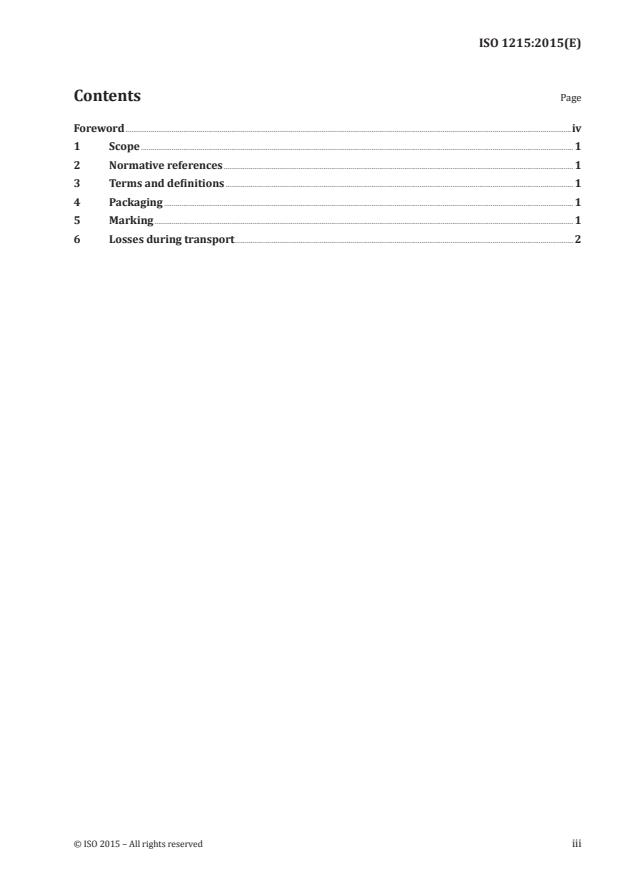
Contents Page
Foreword .iv
1 Scope . 1
2 Normative references . 1
3 Terms and definitions . 1
4 Packaging . 1
5 Marking . 1
6 Losses during transport . 2
Foreword
ISO (the International Organization for Standardization) is a worldwide federation of national standards
bodies (ISO member bodies). The work of preparing International Standards is normally carried out
through ISO technical committees. Each member body interested in a subject for which a technical
committee has been established has the right to be represented on that committee. International
organizations, governmental and non-governmental, in liaison with ISO, also take part in the work.
ISO collaborates closely with the International Electrotechnical Commission (IEC) on all matters of
electrotechnical standardization.
The procedures used to develop this document and those intended for its further maintenance are
described in the ISO/IEC Directives, Part 1. In particular the different
...
INTERNATIONAL ISO
STANDARD 1215
Redline version
compares Third edition to
Second edition
Virgin cork, raw reproduction cork,
ramassage, gleanings, burnt cork,
corkwaste, boiled cork pieces and
raw corkwaste — Definitions and
packaging
Liège mâle, liège de reproduction cru, liège de ramassage, liège
gisant, liège flambé, déchets, morceaux de liège bouillis et rebuts
bouillis — Définitions et emballage
Reference number
ISO 1215:redline:2015(E)
©
ISO 2015
ISO 1215:redline:2015(E)
IMPORTANT — PLEASE NOTE
This is a mark-up copy and uses the following colour coding:
Text example 1 — indicates added text (in green)
Text example 2 — indicates removed text (in red)
— indicates added graphic figure
— indicates removed graphic figure
1.x . — Heading numbers containg modifications are highlighted in yellow in
the Table of Contents
All changes in this document have yet to reach concensus by vote and as such should only
be used internally for review purposes.
DISCLAIMER
This Redline version provides you with a quick and easy way to compare the main changes
between this edition of the standard and its previous edition. It doesn’t capture all single
changes such as punctuation but highlights the modifications providing customers with
the most valuable information. Therefore it is important to note that this Redline version is
not the official ISO standard and that the users must consult with the clean version of the
standard, which is the official standard, for implementation purposes.
© ISO 2015, Published in Switzerland
All rights reserved. Unless otherwise specified, no part of this publication may be reproduced or utilized otherwise in any form
or by any means, electronic or mechanical, including photocopying, or posting on the internet or an intranet, without prior
written permission. Permission can be requested from either ISO at the address below or ISO’s member body in the country of
the requester.
ISO copyright office
Ch. de Blandonnet 8 • CP 401
CH-1214 Vernier, Geneva, Switzerland
Tel. +41 22 749 01 11
Fax +41 22 749 09 47
copyright@iso.org
www.iso.org
ii © ISO 2015 – All rights reserved
ISO 1215:redline:2015(E)
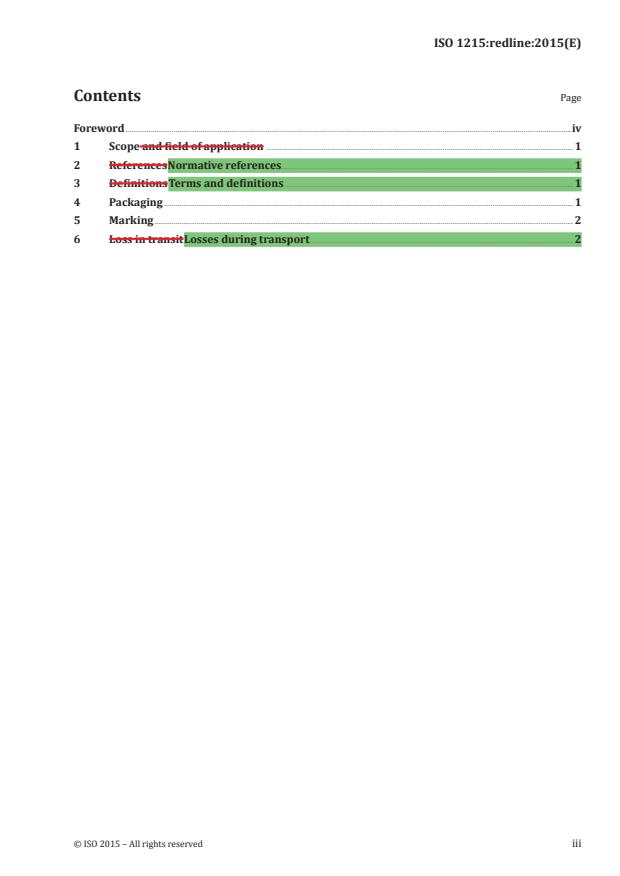
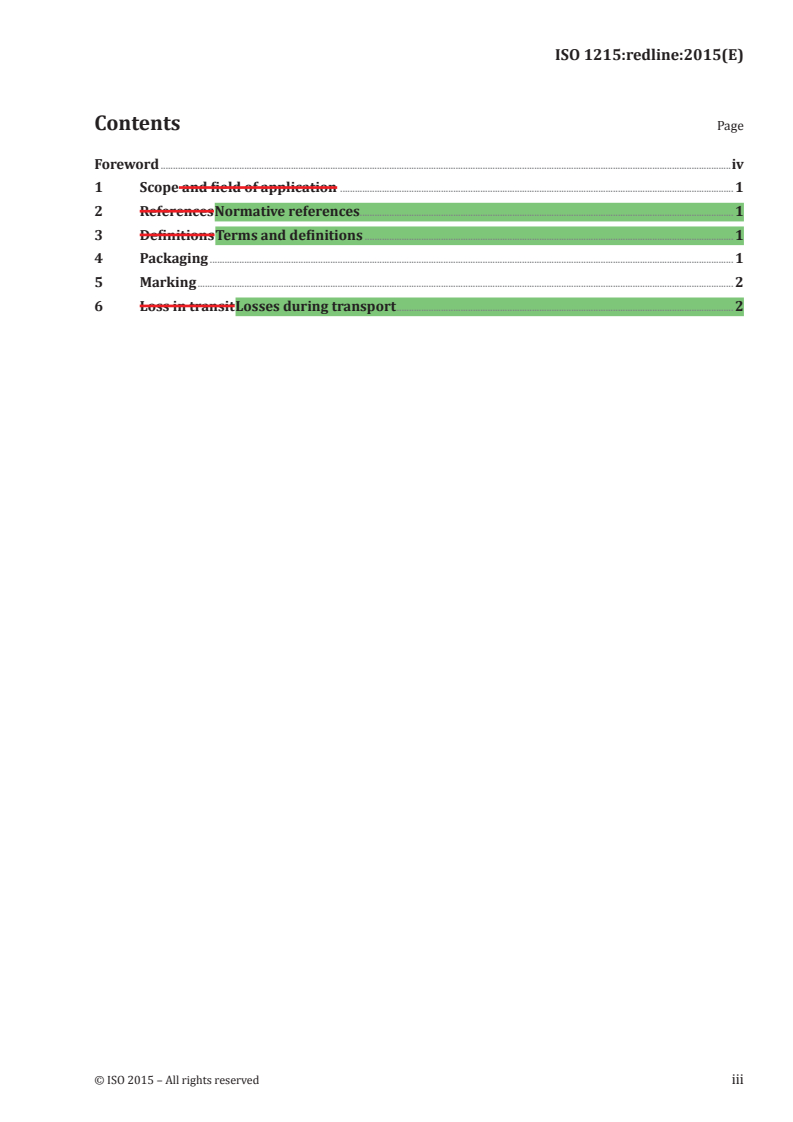
Contents Page
Foreword .iv
1 Scope and field of application . 1
2 References Normative references. 1
3 Definitions Terms and definitions . 1
4 Packaging . 1
5 Marking . 2
6 Loss in transit Losses during transport . 2
ISO 1215:redline:2015(E)
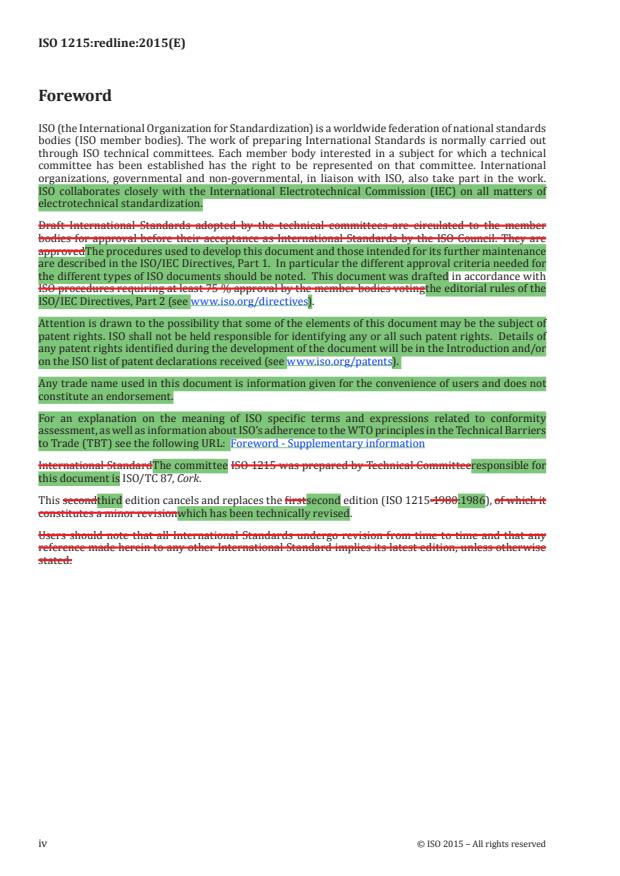
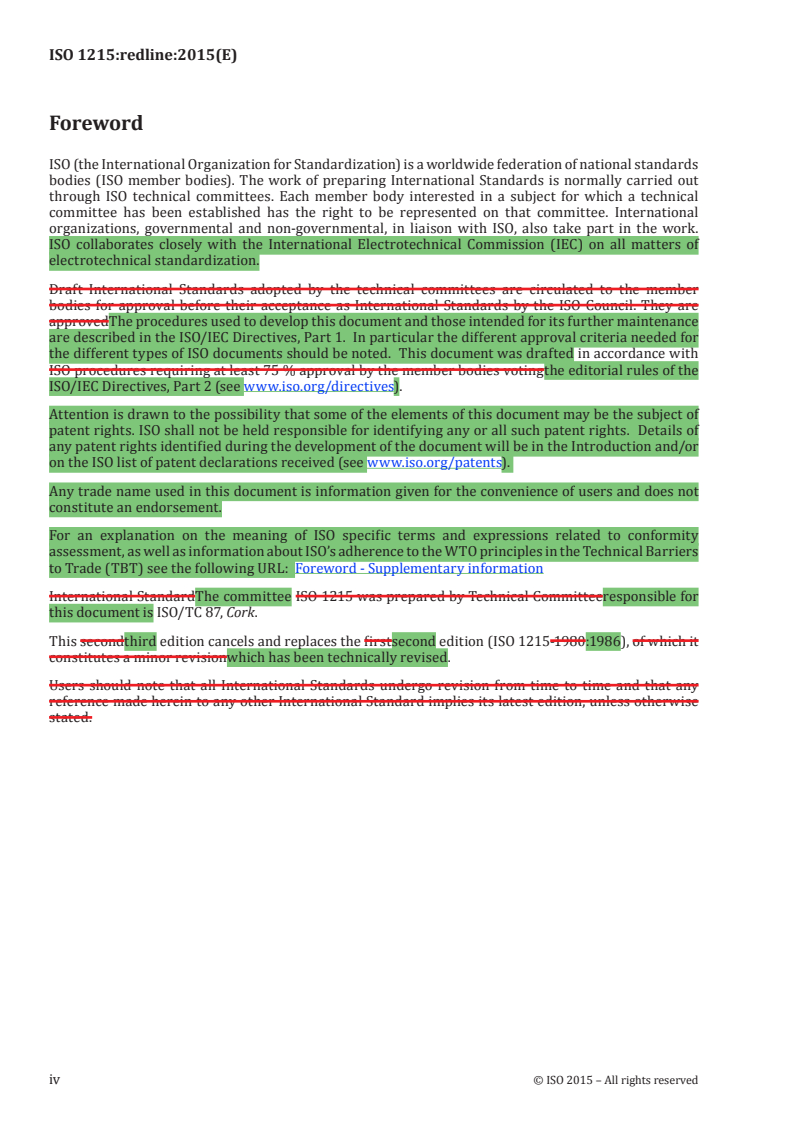
Foreword
ISO (the International Organization for Standardization) is a worldwide federation of national standards
bodies (ISO member bodies). The work of preparing International Standards is normally carried out
through ISO technical committees. Each member body interested in a subject for which a technical
committee has been established has the right to be represented on that committee. International
organizations, governmental and non-governmental, in liaison with ISO, also take part in the work.
ISO collaborates closely with the International Electrotechnical Commission (IEC) on all matters of
electrotechnical standardization.
Draft International Standards adopted by the technical committees are circulated to the member
bodies for approval before their acceptance as International Standards by the ISO Council. They are
approvedThe procedures used to develop this document and those intended for its further maintenance
are described in the ISO/IEC Directives, Part 1. In particular the different approval criteria needed for
the different types of ISO documents should be noted. This document was drafted in accordance with
ISO procedures requiring at least 75 % approval by the member bodies votingthe editorial rules of the
ISO/IEC Directives, Part 2 (see www.iso.org/directives).
Attention is drawn to the possibility that some of the elements of this document may be the subject of
patent rights. ISO shall not be held resp
...
INTERNATIONAL ISO
STANDARD 1215
Third edition
2015-05-15
Virgin cork, raw reproduction cork,
ramassage, gleanings, burnt cork,
corkwaste, boiled cork pieces and raw
corkwaste — Definitions and packaging
Liège mâle, liège de reproduction cru, liège de ramassage, liège
gisant, liège flambé, déchets, morceaux de liège bouillis et rebuts
bouillis — Définitions et emballage
Reference number
©
ISO 2015
© ISO 2015, Published in Switzerland
All rights reserved. Unless otherwise specified, no part of this publication may be reproduced or utilized otherwise in any form
or by any means, electronic or mechanical, including photocopying, or posting on the internet or an intranet, without prior
written permission. Permission can be requested from either ISO at the address below or ISO’s member body in the country of
the requester.
ISO copyright office
Ch. de Blandonnet 8 • CP 401
CH-1214 Vernier, Geneva, Switzerland
Tel. +41 22 749 01 11
Fax +41 22 749 09 47
copyright@iso.org
www.iso.org
ii © ISO 2015 – All rights reserved
Contents Page
Foreword .iv
1 Scope . 1
2 Normative references . 1
3 Terms and definitions . 1
4 Packaging . 1
5 Marking . 1
6 Losses during transport . 2
Foreword
ISO (the International Organization for Standardization) is a worldwide federation of national standards
bodies (ISO member bodies). The work of preparing International Standards is normally carried out
through ISO technical committees. Each member body interested in a subject for which a technical
committee has been established has the right to be represented on that committee. International
organizations, governmental and non-governmental, in liaison with ISO, also take part in the work.
ISO collaborates closely with the International Electrotechnical Commission (IEC) on all matters of
electrotechnical standardization.
The procedures used to develop this document and those intended for its further maintenance are
described in the ISO/IEC Directives, Part 1. In particular the different
...
INTERNATIONAL ISO
STANDARD 1215
Redline version
compares Third edition to
Second edition
Virgin cork, raw reproduction cork,
ramassage, gleanings, burnt cork,
corkwaste, boiled cork pieces and
raw corkwaste — Definitions and
packaging
Liège mâle, liège de reproduction cru, liège de ramassage, liège
gisant, liège flambé, déchets, morceaux de liège bouillis et rebuts
bouillis — Définitions et emballage
Reference number
ISO 1215:redline:2015(E)
©
ISO 2015
ISO 1215:redline:2015(E)
IMPORTANT — PLEASE NOTE
This is a mark-up copy and uses the following colour coding:
Text example 1 — indicates added text (in green)
Text example 2 — indicates removed text (in red)
— indicates added graphic figure
— indicates removed graphic figure
1.x . — Heading numbers containg modifications are highlighted in yellow in
the Table of Contents
All changes in this document have yet to reach concensus by vote and as such should only
be used internally for review purposes.
DISCLAIMER
This Redline version provides you with a quick and easy way to compare the main changes
between this edition of the standard and its previous edition. It doesn’t capture all single
changes such as punctuation but highlights the modifications providing customers with
the most valuable information. Therefore it is important to note that this Redline version is
not the official ISO standard and that the users must consult with the clean version of the
standard, which is the official standard, for implementation purposes.
© ISO 2015, Published in Switzerland
All rights reserved. Unless otherwise specified, no part of this publication may be reproduced or utilized otherwise in any form
or by any means, electronic or mechanical, including photocopying, or posting on the internet or an intranet, without prior
written permission. Permission can be requested from either ISO at the address below or ISO’s member body in the country of
the requester.
ISO copyright office
Ch. de Blandonnet 8 • CP 401
CH-1214 Vernier, Geneva, Switzerland
Tel. +41 22 749 01 11
Fax +41 22 749 09 47
copyright@iso.org
www.iso.org
ii © ISO 2015 – All rights reserved
ISO 1215:redline:2015(E)
Contents Page
Foreword .iv
1 Scope and field of application . 1
2 References Normative references. 1
3 Definitions Terms and definitions . 1
4 Packaging . 1
5 Marking . 2
6 Loss in transit Losses during transport . 2
ISO 1215:redline:2015(E)
Foreword
ISO (the International Organization for Standardization) is a worldwide federation of national standards
bodies (ISO member bodies). The work of preparing International Standards is normally carried out
through ISO technical committees. Each member body interested in a subject for which a technical
committee has been established has the right to be represented on that committee. International
organizations, governmental and non-governmental, in liaison with ISO, also take part in the work.
ISO collaborates closely with the International Electrotechnical Commission (IEC) on all matters of
electrotechnical standardization.
Draft International Standards adopted by the technical committees are circulated to the member
bodies for approval before their acceptance as International Standards by the ISO Council. They are
approvedThe procedures used to develop this document and those intended for its further maintenance
are described in the ISO/IEC Directives, Part 1. In particular the different approval criteria needed for
the different types of ISO documents should be noted. This document was drafted in accordance with
ISO procedures requiring at least 75 % approval by the member bodies votingthe editorial rules of the
ISO/IEC Directives, Part 2 (see www.iso.org/directives).
Attention is drawn to the possibility that some of the elements of this document may be the subject of
patent rights. ISO shall not be held resp
...
NORME ISO
INTERNATIONALE 1215
Troisième édition
2015-05-15
Liège mâle, liège de reproduction
cru, liège de ramassage, liège gisant,
liège flambé, déchets, morceaux de
liège bouillis et rebuts bouillis —
Définitions et emballage
Virgin cork, raw reproduction cork, ramassage, gleanings, burnt
cork, corkwaste, boiled cork pieces and raw corkwaste — Definitions
and packaging
Numéro de référence
©
ISO 2015
DOCUMENT PROTÉGÉ PAR COPYRIGHT
© ISO 2015
Droits de reproduction réservés. Sauf indication contraire, aucune partie de cette publication ne peut être reproduite ni utilisée
sous quelque forme que ce soit et par aucun procédé, électronique ou mécanique, y compris la photocopie, l’affichage sur
l’internet ou sur un Intranet, sans autorisation écrite préalable. Les demandes d’autorisation peuvent être adressées à l’ISO à
l’adresse ci-après ou au comité membre de l’ISO dans le pays du demandeur.
ISO copyright office
Case postale 56 • CH-1211 Geneva 20
Tel. + 41 22 749 01 11
Fax + 41 22 749 09 47
E-mail copyright@iso.org
Web www.iso.org
Publié en Suisse
ii © ISO 2015 – Tous droits réservés
Sommaire Page
Avant-propos .iv
1 Domaine d’application . 1
2 Références normatives . 1
3 Termes et définitions . 1
4 Emballage. 1
5 Marquage . 1
6 Pertes lors du transport . 2
Avant-propos
L’ISO (Organisation internationale de normalisation) est une fédération mondiale d’organismes
nationaux de normalisation (comités membres de l’ISO). L’élaboration des Normes internationales est
en général confiée aux comités techniques de l’ISO. Chaque comité membre intéressé par une étude
a le droit de faire partie du comité technique créé à cet effet. Les organisations internationales,
gouvernementales et non gouvernementales, en liaison avec l’ISO participent également aux travaux.
L’ISO collabore étroitement avec la Commission électrotechnique internationale (IEC) en ce qui concerne
la normalisation électrotechnique.
Les procédures utilisées pour élaborer le présent document et celles destinées à sa mise à jour sont
décrites dans les Directives ISO/IEC, Partie 1. Il convient, en particulier de prendre note des différents
critères d’approbation requis pour les différents types de documents ISO. Le présent document a été
rédigé conformément aux règles de rédaction données dans les Directives ISO/IEC, Partie 2 (voir www.
iso.org/directives).
L’attention est
...
NORME ISO
INTERNATIONALE 1215
Troisième édition
2015-05-15
Liège mâle, liège de reproduction
cru, liège de ramassage, liège gisant,
liège flambé, déchets, morceaux de
liège bouillis et rebuts bouillis —
Définitions et emballage
Virgin cork, raw reproduction cork, ramassage, gleanings, burnt
cork, corkwaste, boiled cork pieces and raw corkwaste — Definitions
and packaging
Numéro de référence
©
ISO 2015
DOCUMENT PROTÉGÉ PAR COPYRIGHT
© ISO 2015
Droits de reproduction réservés. Sauf indication contraire, aucune partie de cette publication ne peut être reproduite ni utilisée
sous quelque forme que ce soit et par aucun procédé, électronique ou mécanique, y compris la photocopie, l’affichage sur
l’internet ou sur un Intranet, sans autorisation écrite préalable. Les demandes d’autorisation peuvent être adressées à l’ISO à
l’adresse ci-après ou au comité membre de l’ISO dans le pays du demandeur.
ISO copyright office
Case postale 56 • CH-1211 Geneva 20
Tel. + 41 22 749 01 11
Fax + 41 22 749 09 47
E-mail copyright@iso.org
Web www.iso.org
Publié en Suisse
ii © ISO 2015 – Tous droits réservés
Sommaire Page
Avant-propos .iv
1 Domaine d’application . 1
2 Références normatives . 1
3 Termes et définitions . 1
4 Emballage. 1
5 Marquage . 1
6 Pertes lors du transport . 2
Avant-propos
L’ISO (Organisation internationale de normalisation) est une fédération mondiale d’organismes
nationaux de normalisation (comités membres de l’ISO). L’élaboration des Normes internationales est
en général confiée aux comités techniques de l’ISO. Chaque comité membre intéressé par une étude
a le droit de faire partie du comité technique créé à cet effet. Les organisations internationales,
gouvernementales et non gouvernementales, en liaison avec l’ISO participent également aux travaux.
L’ISO collabore étroitement avec la Commission électrotechnique internationale (IEC) en ce qui concerne
la normalisation électrotechnique.
Les procédures utilisées pour élaborer le présent document et celles destinées à sa mise à jour sont
décrites dans les Directives ISO/IEC, Partie 1. Il convient, en particulier de prendre note des différents
critères d’approbation requis pour les différents types de documents ISO. Le présent document a été
rédigé conformément aux règles de rédaction données dans les Directives ISO/IEC, Partie 2 (voir www.
iso.org/directives).
L’attention est
...