

ISO 2385:2020
(Main)Packed cork — Virgin cork, raw reproduction cork, burnt cork, boiled reproduction cork and raw cork waste — Sampling to determine moisture content
General Information
- Abstract
This document specifies a method of sampling for the determination of moisture content of packed cork, either virgin cork, raw reproduction cork, burnt cork, boiled reproduction cork and raw cork waste.
- Status
- Published
- Publication Date
- 04-Oct-2020
- Technical Committee
- ISO/TC 87 - Cork
- Drafting Committee
- ISO/TC 87/WG 17 - Raw material
- Current Stage
- 9060 - Close of review
- Completion Date
- 04-Jun-2031
Buy Documents


ISO 2385:2020 - Packed cork -- Virgin cork, raw reproduction cork, burnt cork, boiled reproduction cork and raw cork waste -- Sampling to determine moisture content
ISO 2385:2020 - Packed cork — Virgin cork, raw reproduction cork, burnt cork, boiled reproduction cork and raw cork waste — Sampling to determine moisture content/5/2020
Overview
ISO 2385:2020 specifies a standardized sampling method to determine the moisture content of packed cork. Applicable to virgin cork, raw reproduction cork, burnt cork, boiled reproduction cork and raw cork waste, this fourth edition (2020) streamlines sampling while maintaining representativeness. The document supports consistent quality control, contractual compliance and reliable laboratory testing across the cork supply chain.
Key Topics
- Batch handling and uniformity: All packages in a batch must be identical and contain the same cork type and, where applicable, the same grouping by thickness/quality.
- Time constraint: No more than 24 hours may elapse between determining the initial total mass of the batch and taking the laboratory samples.
- Minimum sampling scope:
- Count total number of packages in the batch and determine the total initial mass (packages included) by direct weighing.
- Select randomly at least 5 packages with a combined mass of at least 60 kg.
- From opened packages, collect a random, equal number of cork pieces or parts to obtain approximately 30 kg of cork for testing.
- If only part of a cork piece is sampled, ensure the portion is representative of the whole piece for moisture content.
- Laboratory samples: Divide the approx. 30 kg into two similar laboratory samples, place them in hermetically sealed, identified containers. One sample is used for testing; the other is retained for control purposes.
- Documentation: A detailed sampling report must accompany the sampling and include product designation, batch number, supplier/customer, counts and masses, dates, sampling location, responsible entity, incidents, and reference to ISO 2385:2020.
Applications
This standard is essential for stakeholders involved in cork production, processing, trade and quality assurance:
- Quality control labs determining moisture content for process control and product specification.
- Manufacturers and packers ensuring batch representativeness before drying or treatment.
- Buyers and inspectors using a standardized sampling method for contractual acceptance and dispute resolution.
- Exporters and storage managers monitoring moisture to prevent spoilage or dimensional changes during transit.
Related Standards
- ISO 633 - Cork - Vocabulary: provides terminology used throughout ISO 2385:2020.
- ISO/IEC Directives (editorial rules) referenced for document preparation and maintenance.
By following ISO 2385:2020, organizations achieve repeatable, defensible sampling for moisture determination of packed cork, improving test reliability and facilitating trade and compliance across the cork value chain.
Relations
- Consolidated By
ISO 80000-11:2019/Amd 1:2025 - Quantities and units — Part 11: Characteristic numbers — Amendment 1 - Effective Date
- 10-Jun-2023
- Effective Date
- 23-Apr-2020
Buy Documents
ISO 2385:2020 - Packed cork -- Virgin cork, raw reproduction cork, burnt cork, boiled reproduction cork and raw cork waste -- Sampling to determine moisture content
ISO 2385:2020 - Packed cork — Virgin cork, raw reproduction cork, burnt cork, boiled reproduction cork and raw cork waste — Sampling to determine moisture content/5/2020
Get Certified
Connect with accredited certification bodies for this standard

Gozdarski inštitut Slovenije
Slovenian Forestry Institute. Forest management certification support, timber testing.
Sponsored listings
Frequently Asked Questions
ISO 2385:2020 is a standard published by the International Organization for Standardization (ISO). Its full title is "Packed cork — Virgin cork, raw reproduction cork, burnt cork, boiled reproduction cork and raw cork waste — Sampling to determine moisture content". This standard covers: This document specifies a method of sampling for the determination of moisture content of packed cork, either virgin cork, raw reproduction cork, burnt cork, boiled reproduction cork and raw cork waste.
This document specifies a method of sampling for the determination of moisture content of packed cork, either virgin cork, raw reproduction cork, burnt cork, boiled reproduction cork and raw cork waste.
ISO 2385:2020 is classified under the following ICS (International Classification for Standards) categories: 79.100 - Cork and cork products. The ICS classification helps identify the subject area and facilitates finding related standards.
ISO 2385:2020 has the following relationships with other standards: It is inter standard links to ISO 80000-11:2019/Amd 1:2025, ISO 2385:2015. Understanding these relationships helps ensure you are using the most current and applicable version of the standard.
ISO 2385:2020 is available in PDF format for immediate download after purchase. The document can be added to your cart and obtained through the secure checkout process. Digital delivery ensures instant access to the complete standard document.
Standards Content (Sample)
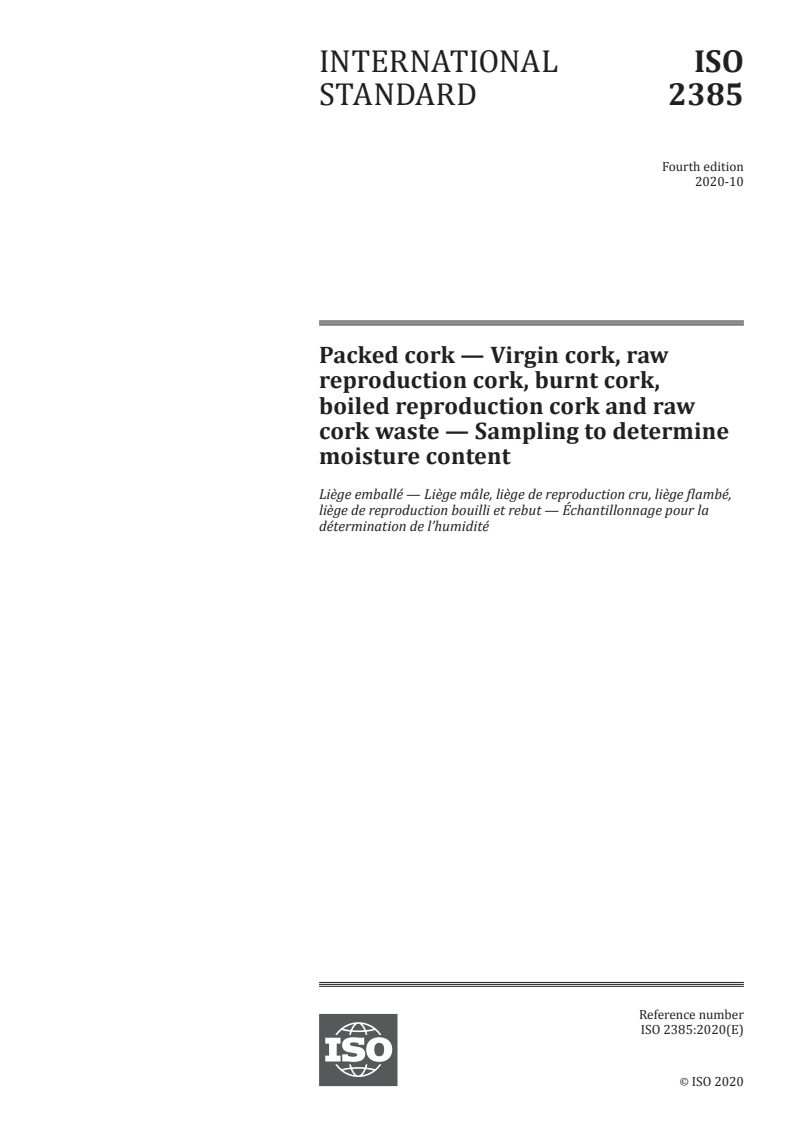
INTERNATIONAL ISO
STANDARD 2385
Fourth edition
2020-10
Packed cork — Virgin cork, raw
reproduction cork, burnt cork,
boiled reproduction cork and raw
cork waste — Sampling to determine
moisture content
Liège emballé — Liège mâle, liège de reproduction cru, liège flambé,
liège de reproduction bouilli et rebut — Échantillonnage pour la
détermination de l’humidité
Reference number
©
ISO 2020
© ISO 2020
All rights reserved. Unless otherwise specified, or required in the context of its implementation, no part of this publication may
be reproduced or utilized otherwise in any form or by any means, electronic or mechanical, including photocopying, or posting
on the internet or an intranet, without prior written permission. Permission can be requested from either ISO at the address
below or ISO’s member body in the country of the requester.
ISO copyright office
CP 401 • Ch. de Blandonnet 8
CH-1214 Vernier, Geneva
Phone: +41 22 749 01 11
Email: copyright@iso.org
Website: www.iso.org
Published in Switzerland
ii © ISO 2020 – All rights reserved
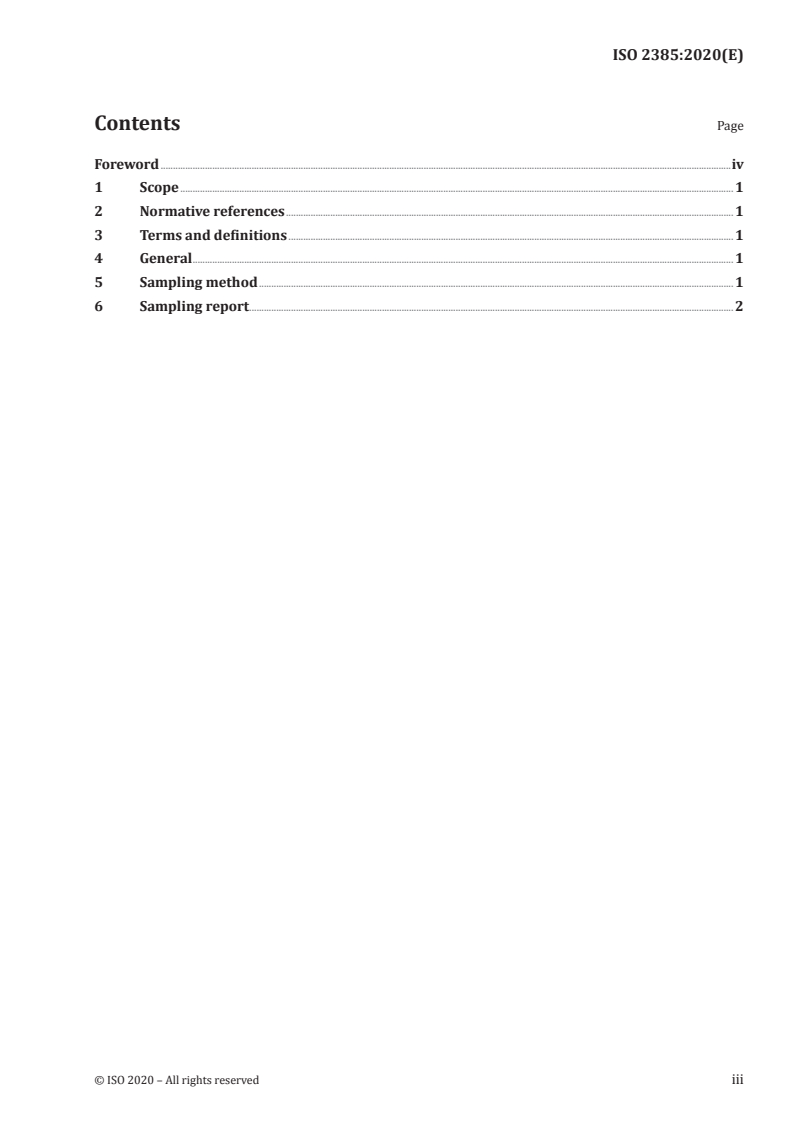
Contents Page
Foreword .iv
1 Scope . 1
2 Normative references . 1
3 Terms and definitions . 1
4 General . 1
5 Sampling method . 1
6 Sampling report. 2
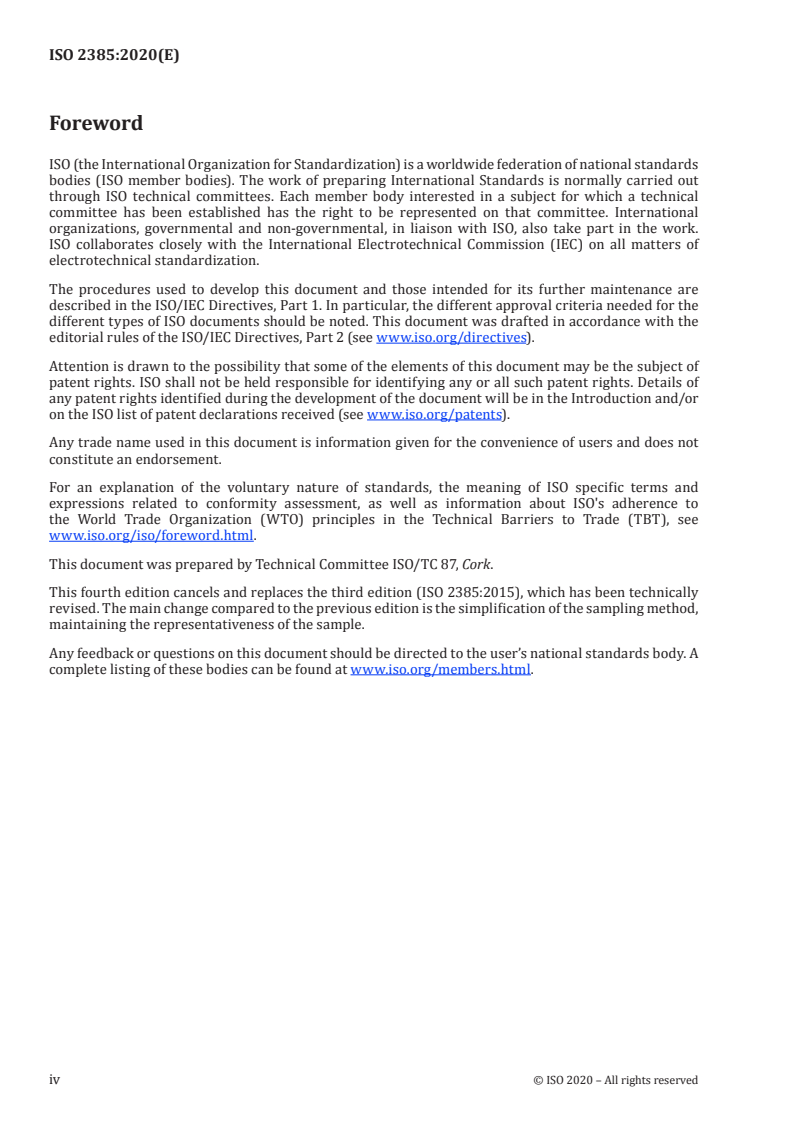
Foreword
ISO (the International Organization for Standardization) is a worldwide federation of national standards
bodies (ISO member bodies). The work of preparing International Standards is normally carried out
through ISO technical committees. Each member body interested in a subject for which a technical
committee has been established has the right to be represented on that committee. International
organizations, governmental and non-governmental, in liaison with ISO, also take part in the work.
ISO collaborates closely with the International Electrotechnical Commission (IEC) on all matters of
electrotechnical standardization.
The procedures used to develop this document and those intended for its further maintenance are
described in the ISO/IEC Directives, Part 1. In particular, the different approval criteria needed for the
different types of ISO documents should be noted. This document was drafted in accordance with the
editorial rules of the ISO/IEC Directives, Part 2 (see www .iso .org/ directives).
Attention is drawn to the possibility that some of the elements of this document may be the subject of
patent rights. ISO shall not be held responsible for identifying any or all such patent rights. Details of
any patent rights identified during the development of the document will be in the Introduction and/or
on the ISO list of patent declarations received (see www .iso .org/ patents).
Any trade name used in this document is information given for the convenience of users and does not
constitute an endorsement.
For an explanation of the voluntary nature of standards, the meaning of ISO specific terms and
expressions related to conformity assessment, as well as information about ISO's adherence to
the World Trade Organization (WTO) prin
...
INTERNATIONAL ISO
STANDARD 2385
Fourth edition
2020-10
Packed cork — Virgin cork, raw
reproduction cork, burnt cork,
boiled reproduction cork and raw
cork waste — Sampling to determine
moisture content
Liège emballé — Liège mâle, liège de reproduction cru, liège flambé,
liège de reproduction bouilli et rebut — Échantillonnage pour la
détermination de l’humidité
Reference number
©
ISO 2020
© ISO 2020
All rights reserved. Unless otherwise specified, or required in the context of its implementation, no part of this publication may
be reproduced or utilized otherwise in any form or by any means, electronic or mechanical, including photocopying, or posting
on the internet or an intranet, without prior written permission. Permission can be requested from either ISO at the address
below or ISO’s member body in the country of the requester.
ISO copyright office
CP 401 • Ch. de Blandonnet 8
CH-1214 Vernier, Geneva
Phone: +41 22 749 01 11
Email: copyright@iso.org
Website: www.iso.org
Published in Switzerland
ii © ISO 2020 – All rights reserved
Contents Page
Foreword .iv
1 Scope . 1
2 Normative references . 1
3 Terms and definitions . 1
4 General . 1
5 Sampling method . 1
6 Sampling report. 2
Foreword
ISO (the International Organization for Standardization) is a worldwide federation of national standards
bodies (ISO member bodies). The work of preparing International Standards is normally carried out
through ISO technical committees. Each member body interested in a subject for which a technical
committee has been established has the right to be represented on that committee. International
organizations, governmental and non-governmental, in liaison with ISO, also take part in the work.
ISO collaborates closely with the International Electrotechnical Commission (IEC) on all matters of
electrotechnical standardization.
The procedures used to develop this document and those intended for its further maintenance are
described in the ISO/IEC Directives, Part 1. In particular, the different approval criteria needed for the
different types of ISO documents should be noted. This document was drafted in accordance with the
editorial rules of the ISO/IEC Directives, Part 2 (see www .iso .org/ directives).
Attention is drawn to the possibility that some of the elements of this document may be the subject of
patent rights. ISO shall not be held responsible for identifying any or all such patent rights. Details of
any patent rights identified during the development of the document will be in the Introduction and/or
on the ISO list of patent declarations received (see www .iso .org/ patents).
Any trade name used in this document is information given for the convenience of users and does not
constitute an endorsement.
For an explanation of the voluntary nature of standards, the meaning of ISO specific terms and
expressions related to conformity assessment, as well as information about ISO's adherence to
the World Trade Organization (WTO) prin
...