

ISO 9727-8:2022
(Main)Cylindrical cork stoppers — Physical tests — Part 8: Determination of capillarity
General Information
- Abstract
This document specifies the test method to determine the capillarity of cylindrical cork stoppers. It consists in measuring the capillary rise by dipping in a hydro-alcoholic solution containing a dye. Two methods using the same procedure but different concentrations of hydro-alcoholic solutions are described. It is applicable to all types of cylindrical cork stoppers, ready for use.
- Status
- Published
- Publication Date
- 20-Apr-2022
- Technical Committee
- ISO/TC 87 - Cork
- Drafting Committee
- ISO/TC 87/WG 9 - Stoppers - Physical test methods
- Current Stage
- 9092 - International Standard to be revised
- Start Date
- 04-Dec-2025
- Completion Date
- 29-Aug-2026
Buy Documents


ISO 9727-8:2022 - Cylindrical cork stoppers — Physical tests — Part 8: Determination of capillarity Released:4/21/2022

ISO 9727-8:2022 - Cylindrical cork stoppers — Physical tests — Part 8: Determination of capillarity Released:4/21/2022
Overview
ISO 9727-8:2022 is an international standard that specifies the test methods for determining the capillarity of cylindrical cork stoppers. Capillarity measurement is crucial for assessing the physical properties of cork stoppers used primarily in the wine and beverage industries. The standard involves measuring the capillary rise when the stoppers are dipped in a hydro-alcoholic solution containing a dye. Different methods are outlined based on varying concentrations of hydro-alcoholic solutions, tailored to provide flexibility in testing speed and accuracy. This standard applies to all ready-for-use cylindrical cork stoppers.
Key Topics
Test Methods:
The standard describes three testing procedures with different solution concentrations and contact times:- Reference method: Uses a 12% vol. ethanolic solution, 24 hours contact.
- Rapid method: Uses a 50% vol. ethanolic solution, 1 hour contact.
- Very fast control method: Uses a 70% vol. ethanolic solution, 10 minutes contact.
Testing Procedure:
- Cork stoppers are placed upright in a container with a colored hydro-alcoholic solution at a depth of 3 mm (or 6 mm for chamfered stoppers).
- After the contact period, the capillary rise on the stopper surface is measured using a ruler with 0.5 mm accuracy.
Test Conditions:
- Environmental temperature maintained at 21 °C ± 4 °C.
- Relative air humidity at 60% ± 20%.
- Cork stopper temperature verified at the start of testing.
Measurement and Reporting:
- The maximum height of the capillary rise on the periphery is recorded in millimeters.
- Occasional discontinuities and isolated rises are excluded from measurement.
- Test reports include all relevant test conditions, sample identification, and any deviations.
Applications
Quality Control in Cork Production:
- Manufacturers use ISO 9727-8:2022 to ensure cork stoppers meet capillarity standards critical for preserving beverage quality.
- Capillarity testing prevents issues like unwanted leakage or premature oxidation.
Industry Compliance:
- Wineries and bottling companies incorporate this standard to validate cork stopper batches, ensuring product safety and consistency during storage and transportation.
Research & Development:
- Testing capillarity facilitates the development of improved cork formulations and treatments that optimize the sealing properties and longevity of cork stoppers.
Related Standards
ISO 633: Cork - Vocabulary
This standard provides definitions and terminology relevant to cork, which supports consistent understanding and application of ISO 9727-8:2022.Other Parts of ISO 9727 Series
The ISO 9727 series covers various physical tests for cork stoppers, complementing capillarity determination with measurements such as permeability, mechanical strength, and dimensional stability.Relevant Beverage Packaging Standards
Aligning cork stopper standards with international beverage packaging requirements ensures comprehensive quality assurance.
By adhering to ISO 9727-8:2022, stakeholders in the cork and beverage industries benefit from standardized, reliable physical testing methods that support quality control, product safety, and enhanced consumer satisfaction.
Buy Documents
ISO 9727-8:2022 - Cylindrical cork stoppers — Physical tests — Part 8: Determination of capillarity Released:4/21/2022
ISO 9727-8:2022 - Cylindrical cork stoppers — Physical tests — Part 8: Determination of capillarity Released:4/21/2022
Get Certified
Connect with accredited certification bodies for this standard

BRCGS (Brand Reputation Compliance Global Standards)
Global food safety and quality standards owner.
Gozdarski inštitut Slovenije
Slovenian Forestry Institute. Forest management certification support, timber testing.
Sponsored listings
Frequently Asked Questions
ISO 9727-8:2022 is a standard published by the International Organization for Standardization (ISO). Its full title is "Cylindrical cork stoppers — Physical tests — Part 8: Determination of capillarity". This standard covers: This document specifies the test method to determine the capillarity of cylindrical cork stoppers. It consists in measuring the capillary rise by dipping in a hydro-alcoholic solution containing a dye. Two methods using the same procedure but different concentrations of hydro-alcoholic solutions are described. It is applicable to all types of cylindrical cork stoppers, ready for use.
This document specifies the test method to determine the capillarity of cylindrical cork stoppers. It consists in measuring the capillary rise by dipping in a hydro-alcoholic solution containing a dye. Two methods using the same procedure but different concentrations of hydro-alcoholic solutions are described. It is applicable to all types of cylindrical cork stoppers, ready for use.
ISO 9727-8:2022 is classified under the following ICS (International Classification for Standards) categories: 55.100 - Bottles. Pots. Jars; 79.100 - Cork and cork products. The ICS classification helps identify the subject area and facilitates finding related standards.
ISO 9727-8:2022 is available in PDF format for immediate download after purchase. The document can be added to your cart and obtained through the secure checkout process. Digital delivery ensures instant access to the complete standard document.
Standards Content (Sample)
INTERNATIONAL ISO
STANDARD 9727-8
First edition
2022-04
Cylindrical cork stoppers — Physical
tests —
Part 8:
Determination of capillarity
Bouchons cylindriques en liège — Essais physiques —
Partie 8: Détermination de la capillarité
Reference number
© ISO 2022
All rights reserved. Unless otherwise specified, or required in the context of its implementation, no part of this publication may
be reproduced or utilized otherwise in any form or by any means, electronic or mechanical, including photocopying, or posting on
the internet or an intranet, without prior written permission. Permission can be requested from either ISO at the address below
or ISO’s member body in the country of the requester.
ISO copyright office
CP 401 • Ch. de Blandonnet 8
CH-1214 Vernier, Geneva
Phone: +41 22 749 01 11
Email: copyright@iso.org
Website: www.iso.org
Published in Switzerland
ii
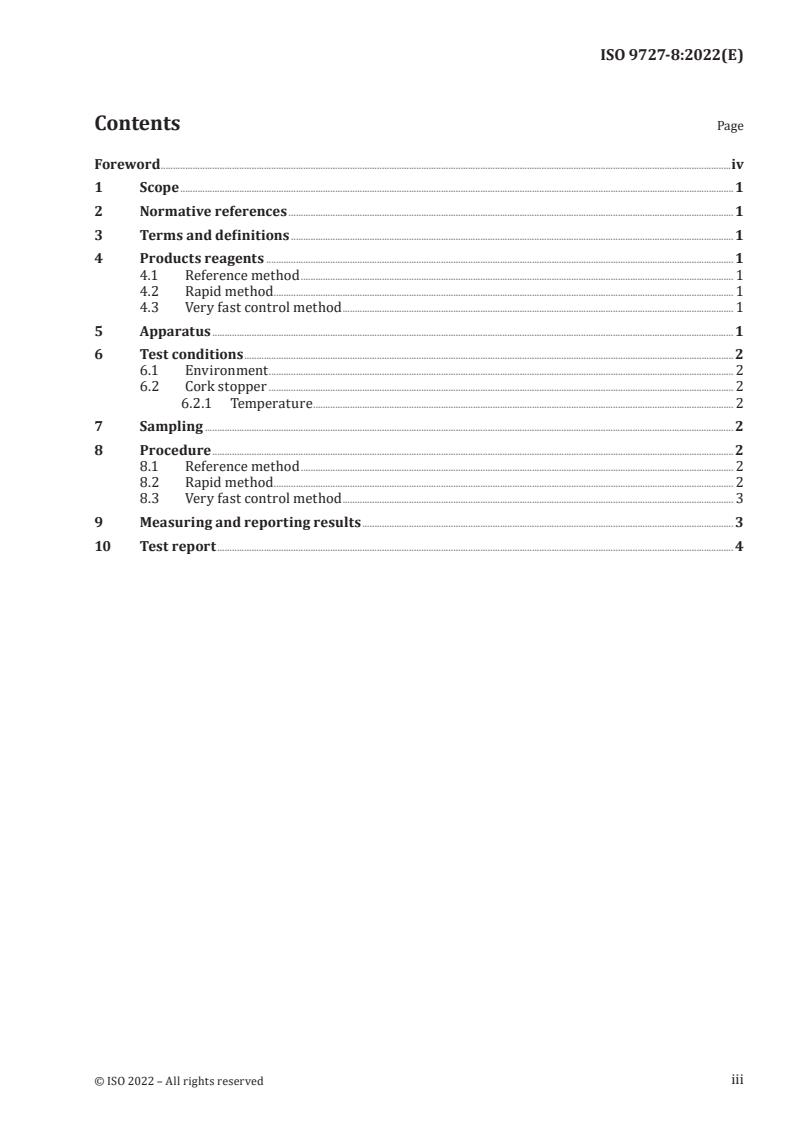
Contents Page
Foreword .iv
1 Scope . 1
2 Normative references . 1
3 Terms and definitions . 1
4 Products reagents . 1
4.1 Reference method . 1
4.2 Rapid method . 1
4.3 Very fast control method . 1
5 Apparatus . 1
6 Test conditions .2
6.1 Environment . 2
6.2 Cork stopper . 2
6.2.1 Temperature . 2
7 Sampling . 2
8 Procedure .2
8.1 Reference method . 2
8.2 Rapid method . 2
8.3 Very fast control method . 3
9 Measuring and reporting results . 3
10 Test report . 4
iii
Foreword
ISO (the International Organization for Standardization) is a worldwide federation of national standards
bodies (ISO member bodies). The work of preparing International Standards is normally carried out
through ISO technical committees. Each member body interested in a subject for which a technical
committee has been established has the right to be represented on that committee. International
organizations, governmental and non-governmental, in liaison with ISO, also take part in the work.
ISO collaborates closely with the International Electrotechnical Commission (IEC) on all matters of
electrotechnical standardization.
The procedures used to develop this document and those intended for its further maintenance are
described in the ISO/IEC Directives, Part 1. In particular, the different approval criteria needed for the
different types of ISO documents should be noted. This document was drafted in accordance with the
editorial rules of the ISO/IEC Directives, Part 2 (see www.iso.org/directives).
Attention is drawn to the poss
...
NORME ISO
INTERNATIONALE 9727-8
Première édition
2022-04
Bouchons cylindriques en liège —
Essais physiques —
Partie 8:
Détermination de la capillarité
Cylindrical cork stoppers — Physical tests —
Part 8: Determination of capillarity
Numéro de référence
DOCUMENT PROTÉGÉ PAR COPYRIGHT
© ISO 2022
Tous droits réservés. Sauf prescription différente ou nécessité dans le contexte de sa mise en œuvre, aucune partie de cette
publication ne peut être reproduite ni utilisée sous quelque forme que ce soit et par aucun procédé, électronique ou mécanique,
y compris la photocopie, ou la diffusion sur l’internet ou sur un intranet, sans autorisation écrite préalable. Une autorisation peut
être demandée à l’ISO à l’adresse ci-après ou au comité membre de l’ISO dans le pays du demandeur.
ISO copyright office
Case postale 401 • Ch. de Blandonnet 8
CH-1214 Vernier, Genève
Tél.: +41 22 749 01 11
E-mail: copyright@iso.org
Web: www.iso.org
Publié en Suisse
ii
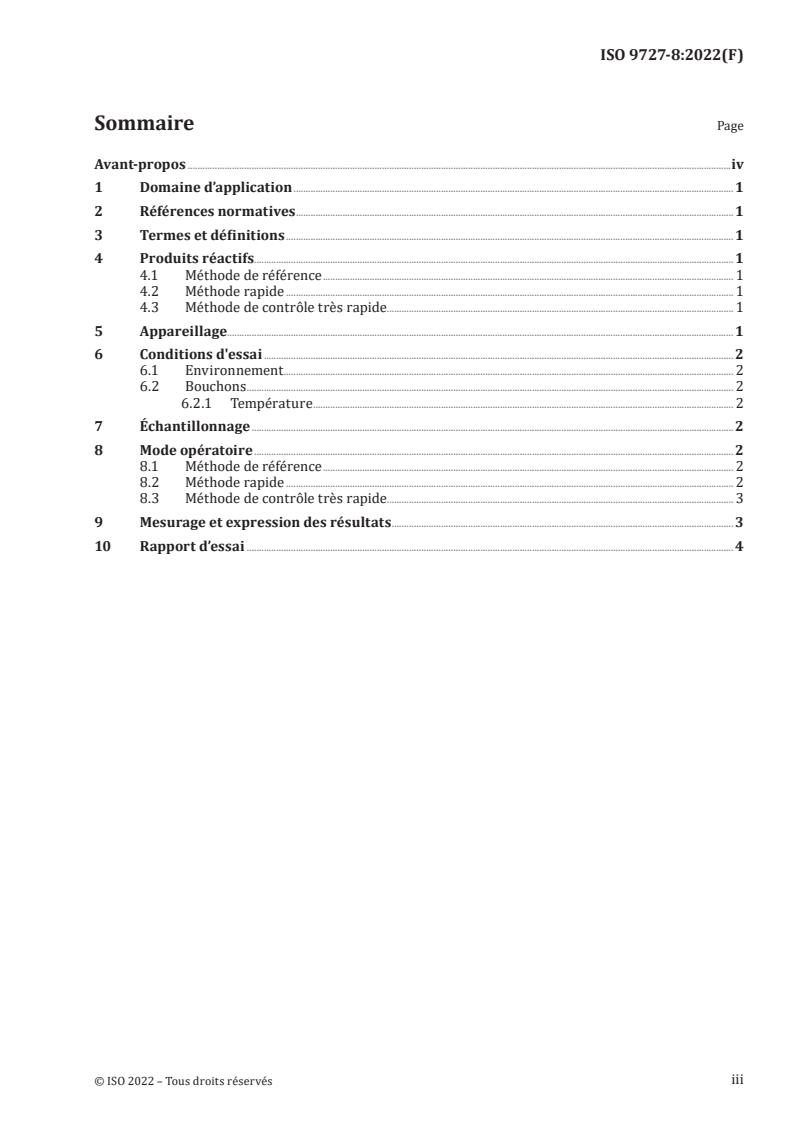
Sommaire Page
Avant-propos .iv
1 Domaine d’application . 1
2 Références normatives .1
3 Termes et définitions . 1
4 Produits réactifs.1
4.1 Méthode de référence . 1
4.2 Méthode rapide . 1
4.3 Méthode de contrôle très rapide . . 1
5 Appareillage . 1
6 Conditions d'essai . 2
6.1 Environnement . 2
6.2 Bouchons . 2
6.2.1 Température . 2
7 Échantillonnage .2
8 Mode opératoire . 2
8.1 Méthode de référence . 2
8.2 Méthode rapide . 2
8.3 Méthode de contrôle très rapide . . 3
9 Mesurage et expression des résultats . 3
10 Rapport d’essai . 4
iii
Avant-propos
L'ISO (Organisation internationale de normalisation) est une fédération mondiale d'organismes
nationaux de normalisation (comités membres de l'ISO). L'élaboration des Normes internationales est
en général confiée aux comités techniques de l'ISO. Chaque comité membre intéressé par une étude
a le droit de faire partie du comité technique créé à cet effet. Les organisations internationales,
gouvernementales et non gouvernementales, en liaison avec l'ISO participent également aux travaux.
L'ISO collabore étroitement avec la Commission électrotechnique internationale (IEC) en ce qui
concerne la normalisation électrotechnique.
Les procédures utilisées pour élaborer le présent document et celles destinées à sa mise à jour sont
décrites dans les Directives ISO/IEC, Partie 1. Il convient, en particulier, de prendre note des différents
critères d'approbation requis pour les différents types de documents ISO. Le présent document
a été rédigé conformément aux règles de rédaction données dans les Directives ISO/IEC, Partie 2
(voir www.iso.org/directives).
L'attention est appelée sur le fait que certains des éléments du présent document peuvent faire l'objet de
droits de propriété intellectuelle ou de droits analogues. L’ISO ne saurait être tenue pour responsable
de ne pas avoir identifié de tels droits de propriété. Les détails concernant les références aux droits
de propriété intellectuelle ou autres droits analogues identifiés lors de l'élaboration du document
sont indiqués dans l'Introduction et/ou dans la liste des déclarations de brevets reçues par l'ISO
...