


ISO/TS 24534-1:2007
(Main)Automatic vehicle and equipment identification — Electronic Registration Identification (ERI) for vehicles — Part 1: Architecture
Automatic vehicle and equipment identification — Electronic Registration Identification (ERI) for vehicles — Part 1: Architecture
ISO TS 24534-1:2007 provides the requirements for electronic registration that is based on an identifier assigned to a vehicle (e.g. for recognition by national authorities), suitable to be used for : electronic identification of local and foreign vehicles by national authorities, vehicle manufacturing, in-life maintenance and end-of-life identification (vehicle life cycle management), adaptation of vehicle data (e.g. for international resales), safety-related purposes, crime reduction, and commercial services. It adheres to privacy and data protection regulations ISO TS 24534-1:2007 provides an overview of the ERI system concept, in terms of the onboard vehicle components and the external off-vehicle components required for an operational system.
Identification automatique des véhicules et des équipements — Identification d'enregistrement électronique (ERI) pour les véhicules — Partie 1: Architecture
General Information
- Status
- Withdrawn
- Publication Date
- 09-Dec-2007
- Withdrawal Date
- 09-Dec-2007
- Technical Committee
- ISO/TC 204 - Intelligent transport systems
- Drafting Committee
- ISO/TC 204 - Intelligent transport systems
- Current Stage
- 9599 - Withdrawal of International Standard
- Start Date
- 14-Jul-2010
- Completion Date
- 12-Feb-2026
Relations
- Effective Date
- 12-Feb-2026
- Effective Date
- 20-Jun-2008
Get Certified
Connect with accredited certification bodies for this standard

BSI Group
BSI (British Standards Institution) is the business standards company that helps organizations make excellence a habit.

Great Wall Tianjin Quality Assurance Center
Established 1993, first batch to receive national accreditation with IAF recognition.
Hong Kong Quality Assurance Agency (HKQAA)
Hong Kong's leading certification body.
Sponsored listings
Frequently Asked Questions
ISO/TS 24534-1:2007 is a technical specification published by the International Organization for Standardization (ISO). Its full title is "Automatic vehicle and equipment identification — Electronic Registration Identification (ERI) for vehicles — Part 1: Architecture". This standard covers: ISO TS 24534-1:2007 provides the requirements for electronic registration that is based on an identifier assigned to a vehicle (e.g. for recognition by national authorities), suitable to be used for : electronic identification of local and foreign vehicles by national authorities, vehicle manufacturing, in-life maintenance and end-of-life identification (vehicle life cycle management), adaptation of vehicle data (e.g. for international resales), safety-related purposes, crime reduction, and commercial services. It adheres to privacy and data protection regulations ISO TS 24534-1:2007 provides an overview of the ERI system concept, in terms of the onboard vehicle components and the external off-vehicle components required for an operational system.
ISO TS 24534-1:2007 provides the requirements for electronic registration that is based on an identifier assigned to a vehicle (e.g. for recognition by national authorities), suitable to be used for : electronic identification of local and foreign vehicles by national authorities, vehicle manufacturing, in-life maintenance and end-of-life identification (vehicle life cycle management), adaptation of vehicle data (e.g. for international resales), safety-related purposes, crime reduction, and commercial services. It adheres to privacy and data protection regulations ISO TS 24534-1:2007 provides an overview of the ERI system concept, in terms of the onboard vehicle components and the external off-vehicle components required for an operational system.
ISO/TS 24534-1:2007 is classified under the following ICS (International Classification for Standards) categories: 03.220.20 - Road transport; 35.240.60 - IT applications in transport. The ICS classification helps identify the subject area and facilitates finding related standards.
ISO/TS 24534-1:2007 has the following relationships with other standards: It is inter standard links to CEN ISO/TS 24534-1:2007, ISO 24534-1:2010. Understanding these relationships helps ensure you are using the most current and applicable version of the standard.
ISO/TS 24534-1:2007 is available in PDF format for immediate download after purchase. The document can be added to your cart and obtained through the secure checkout process. Digital delivery ensures instant access to the complete standard document.
Standards Content (Sample)
TECHNICAL ISO/TS
SPECIFICATION 24534-1
First edition
2007-12-15
Automatic vehicle and equipment
identification — Electronic Registration
Identification (ERI) for vehicles —
Part 1:
Architecture
Identification automatique des véhicules et des équipements —
Identification d'enregistrement électronique (ERI) pour les véhicules —
Partie 1: Architecture
Reference number
©
ISO 2007
PDF disclaimer
This PDF file may contain embedded typefaces. In accordance with Adobe's licensing policy, this file may be printed or viewed but
shall not be edited unless the typefaces which are embedded are licensed to and installed on the computer performing the editing. In
downloading this file, parties accept therein the responsibility of not infringing Adobe's licensing policy. The ISO Central Secretariat
accepts no liability in this area.
Adobe is a trademark of Adobe Systems Incorporated.
Details of the software products used to create this PDF file can be found in the General Info relative to the file; the PDF-creation
parameters were optimized for printing. Every care has been taken to ensure that the file is suitable for use by ISO member bodies. In
the unlikely event that a problem relating to it is found, please inform the Central Secretariat at the address given below.
© ISO 2007
All rights reserved. Unless otherwise specified, no part of this publication may be reproduced or utilized in any form or by any means,
electronic or mechanical, including photocopying and microfilm, without permission in writing from either ISO at the address below or
ISO's member body in the country of the requester.
ISO copyright office
Case postale 56 • CH-1211 Geneva 20
Tel. + 41 22 749 01 11
Fax + 41 22 749 09 47
E-mail copyright@iso.org
Web www.iso.org
Published in Switzerland
ii © ISO 2007 – All rights reserved
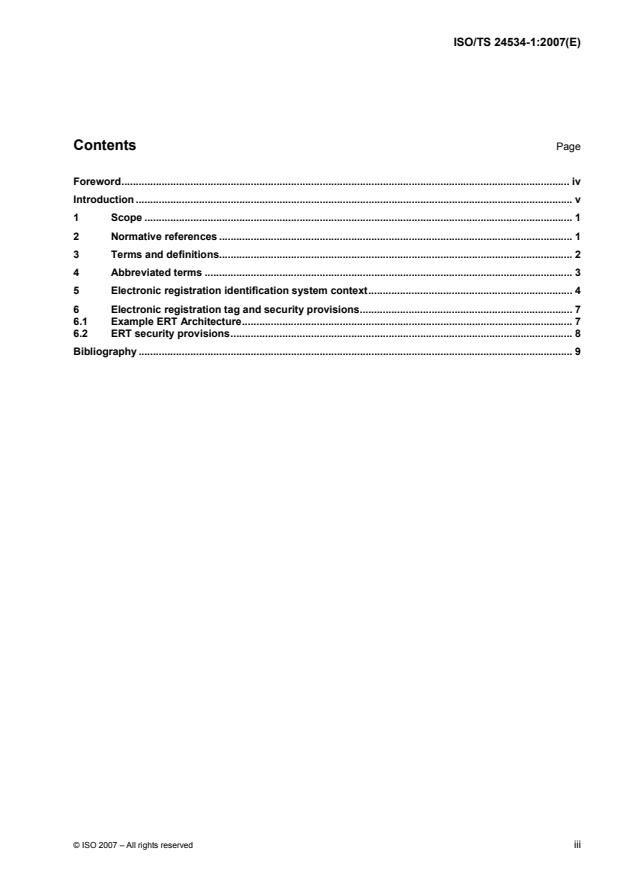
Contents Page
Foreword. iv
Introduction . v
1 Scope. 1
2 Normative references. 1
3 Terms and definitions. 2
4 Abbreviated terms. 3
5 Electronic registration identification system context. 4
6 Electronic registration tag and security provisions. 7
6.1 Example ERT Architecture. 7
6.2 ERT security provisions. 8
Bibliography . 9
Foreword
ISO (the International Organization for Standardization) is a worldwide federation of national standards bodies
(ISO member bodies). The work of preparing International Standards is normally carried out through ISO
technical committees. Each member body interested in a subject for which a technical committee has been
established has the right to be represented on that committee. International organizations, governmental and
non-governmental, in liaison with ISO, also take part in the work. ISO collaborates closely with the
International Electrotechnical Commission (IEC) on all matters of electrotechnical standardization.
International Standards are drafted in accordance with the rules given in the ISO/IEC Directives, Part 2.
The main task of technical committees is to prepare International Standards. Draft International Standards
adopted by the technical committees are circulated to the member bodies for voting. Publication as an
International Standard requires approval by at least 75 % of the member bodies casting a vote.
In other circumstances, particularly when there is an urgent market requirement for such documents, a
technical committee may decide to publish other types of normative document:
— an ISO Publicly Available Specification (ISO/PAS) represents an agreement between technical experts in
an ISO working group and is accepted for publication if it is approved by more than 50 % of the members
of the parent committee casting a vote;
— an ISO Technical Specification (ISO/TS) represents an agreement between the members of a technical
committee and is accepted for publication if it is approved by 2/3 of the members of the committee casting
a vote.
An ISO/PAS or ISO/TS is reviewed after three years in order to decide whether it will be confirmed for a
further three years, revised to become an International Standard, or withdrawn. If the ISO/PAS or ISO/TS is
confirmed, it is reviewed again after a further three years, at which time it must either be transformed into an
International Standard or be withdrawn.
Attention is drawn to the possibility that some of the elements of this document may be the subject of patent
rights. ISO shall not be held responsible for identifying any or all such patent rights.
ISO/TS 24534-1 was prepared by Technical Committee ISO/TC 204, Intelligent transport systems, and by
Technical Committee CEN/TC 278, Road transport and traffic telematics in collaboration.
ISO/TS 24534 consists of the following parts, under the general title Automatic vehicle and equipment
identification — Electronic Registration Identification (ERI) for vehicles:
— Part 1: Architecture
— Part 2: Operational requirements
— Part 3: Vehicle data
— Part 4: Secure communications using asymmetrical techniques
⎯ Part 5: Secure communications using symmetrical techniques
iv © ISO 2007 – All rights reserved
Introduction
A quickly emerging need has been identified with administrations to improve the unique identification of
vehicles for a variety of services. Situations are already occurring where manufacturers intend to fit lifetime
tags to vehicles. Various governments are considering the needs and benefits of Electronic Registration
Identification (ERI) as a legal proof of vehicle identity with potential mandatory uses. There is commercial and
economic justification both in respect of tags and infrastructure that a standard enables an interoperable
solution.
ERI is a means of uniquely identifying road vehicles. The application of ERI will offer significant benefits over
existing techniques for vehicle identification. It will be a suitable tool for the future management and
administration of traffic and transport, including applications in free-flow, multi-lane traffic conditions with the
capability to support mobile transactions. ERI addresses the need of authorities and other road users for a
trusted electronic identification, including roaming vehicles.
The unique vehicle identifier is held in a secure environment within an Electronic Registration Tag (ERT) fitted
to a vehicle. The identifier used to identify a vehicle is called the vehicle identifier or vehicleId. The preferred
vehicle identifier is the VIN, assigned to the vehicle by its manufacturer in accordance with ISO 3779, or a
variant of this vehicle identifier.
The ERT may contain vehicle data in addition to the unique identifier, as required by authorities or their agents
for ERI applications (e.g. vehicle registration details). An ERT is the core component for simple to complex
applications of ERI, ranging from a simple read-only device, with more complex applications requiring one or
more communications systems.
The ERT may be accessed by an Electronic Registration Reader (ERR), either to read, or read/write data,
from or to an ERT.
Optionally, the ERT may communicate with other onboard vehicle equipment. The potential range of ERI
applications, simple to complex, will require interoperability to exist between an ERT and an ERR by
application.
This part of ISO/TS 24534 illustrates the ERI system concept and the fully featured ERI function enabling
simple to complex applications of ERI.
The various parts of ISO 24534 provide the overall framework for ERI and specification of requirements for
“fully featured” ERI. An associated International Standard in this family of ERI standards, ISO 24535, provides
a subset of these requirements to provide a “basic ERI” functionality. Figure 1 shows the functional stack
accommodating both fully featured and basic ERI.
Figure 1 — Functional stack accommodating both "fully featured" and "basic" ERI
vi © ISO 2007 – All rights reserved
TECHNICAL SPECIFICATION ISO/TS 24534-1:2007(E)
Automatic vehicle and equipment identification — Electronic
Registration Identification (ERI) for vehicles —
Part 1:
Architecture
1 Scope
This part of ISO/TS 24534 provides the requirements for electronic registration that is based on an identifier
assigned to a vehicle (e.g. for recognition by national authorities), suitable to be used for:
⎯ electronic identification of local and foreign vehicles by national authorities,
⎯ vehicle manufacturing, in-life maintenance and end-of-life identification (vehicle life cycle management),
⎯ adaptation of vehicle data (e.g. for international resales),
⎯ safety-related purposes,
⎯ crime reduction, and
⎯ commercial services.
It adheres to privacy and data protection regulations.
This part of ISO/TS 24534 provides an overview of the ERI system concept, in terms of the onboard vehicle
components and the external off-vehicle components required for an operational system. The detailed
requirements are defined in the Parts 2, 3, 4 and 5 of ISO 24534 and for the more limited, relevant provisions
of ISO 24535.
2 Normative references
The following referenced documents are indispensable for the application of this document. For dated
references, only the edit
...
Questions, Comments and Discussion
Ask us and Technical Secretary will try to provide an answer. You can facilitate discussion about the standard in here.
Loading comments...