


ISO/FDIS 11785
(Main)Radio frequency identification of animals — Technical concept
Radio frequency identification of animals — Technical concept
Identification des animaux par radiofréquence — Concept technique
La présente Norme internationale prescrit le mode d'activation d'un transpondeur et le mode de transfert des informations qui y sont enregistrées vers un émetteur-récepteur.
General Information
- Status
- Not Published
- Technical Committee
- ISO/TC 23/SC 19 - Agricultural electronics
- Drafting Committee
- ISO/TC 23/SC 19/WG 3 - Identification
- Current Stage
- 5020 - FDIS ballot initiated: 2 months. Proof sent to secretariat
- Start Date
- 29-Dec-2025
- Completion Date
- 29-Dec-2025
Relations
- Effective Date
- 07-Jan-2025
Overview
ISO/FDIS 11785:2025 is the international standard defining the technical concept of radio-frequency identification (RFID) for animals. Developed by ISO/TC 23/SC 19 (Agricultural electronics), this standard specifies how animal identification transponders are activated and how the stored information is transmitted to transceivers. It serves as a complement to ISO 11784, which describes the structure and content of the identification codes carried in the transponders.
This updated edition establishes harmonized requirements and communication protocols for full duplex (FDX) and half duplex (HDX) RFID systems operating at 134.2 kHz frequency band. It aims to ensure interoperability, accurate animal identification, and reliable data exchange in agricultural and veterinary applications worldwide.
Key Topics
- Activation Field: The transceiver emits an electromagnetic activation field at 134.2 kHz (±13.42 kHz), energizing the transponder for data transmission.
- Data Transfer Methods:
- Full Duplex (FDX): The transponder transmits while the transceiver continues emitting the activation field.
- Half Duplex (HDX): The transponder transmits after the transceiver stops the activation field.
- Synchronization: Defined activation and pause cycles optimize data transmission while minimizing interference. Synchronization aligns with ISO 24631-7 to coordinate activation timing across multiple transceivers.
- Encoding and Modulation: Specifies use of frequency shift keying (FSK), phase shift keying (PSK), and differential bi-phase encoding (DBP) to maintain data integrity.
- Error Detection: Incorporates cyclic redundancy check (CRC) algorithms per Annex A to detect transmission errors and enhance reliability.
- Identification Code Structure: Uses a 64-bit identification telegram format, aligned with ISO 11784, containing header, identification code, CRC checksum, and trailer bits.
- Transceiver Types:
- Stationary Transceivers: Fixed units activating transponders with timed activation and pause cycles.
- Mobile Transceivers: Units capable of detecting other active transceivers and adjusting activation protocols accordingly.
Applications
ISO/FDIS 11785:2025 facilitates the use of RFID technology for diverse animal identification needs, including:
- Livestock Management: Tracking cattle, sheep, pigs, and other farm animals for health monitoring, breeding, traceability, and inventory management.
- Wildlife Conservation: Monitoring wild animal populations for research, protection, and anti-poaching efforts.
- Veterinary Services: Identifying individual animals to provide accurate treatments, disease control, and vaccination records.
- Food Safety and Traceability: Ensuring reliable origin tracking from farm to table by linking RFID tags with animal identification codes.
- Agricultural Electronics Integration: Compatible implementation alongside machinery management systems to improve farm operational efficiency.
By standardizing RFID technical concepts, ISO 11785 enhances global interoperability, minimizes risk of animal misidentification, and supports accurate data flow across different tools and systems used in animal husbandry and veterinary care.
Related Standards
- ISO 11784: Specifies the structure and coding of RFID animal identification data stored on the transponder.
- ISO 24631-7: Covers synchronization methods for ISO 11785 identification systems to harmonize activation and pause cycles of multiple transceivers.
- ISO/IEC Directives Part 1 & 2: Prescribe procedures for the development, approval, and maintenance of ISO standards.
- Technical Corrigendum ISO 11785:1996/Cor.1:2008: Addresses corrections and updates to the original 1996 edition, integrated into the current revision.
For organizations and professionals involved in animal identification technology, integrating ISO/FDIS 11785:2025 ensures compliance with internationally recognized communication protocols, enabling dependable RFID implementations for improved animal traceability, safety, and management across agricultural and veterinary sectors.


ISO/FDIS 11785 - Radio frequency identification of animals — Technical concept Released:15. 12. 2025
REDLINE ISO/FDIS 11785 - Radio frequency identification of animals — Technical concept Released:15. 12. 2025
Get Certified
Connect with accredited certification bodies for this standard

Control Union Certifications
Global certification for agriculture and sustainability.

ECOCERT
Organic and sustainability certification.

Rainforest Alliance Certification
Sustainable agriculture and forestry certification.
Sponsored listings
Frequently Asked Questions
ISO/FDIS 11785 is a draft published by the International Organization for Standardization (ISO). Its full title is "Radio frequency identification of animals — Technical concept". This standard covers: La présente Norme internationale prescrit le mode d'activation d'un transpondeur et le mode de transfert des informations qui y sont enregistrées vers un émetteur-récepteur.
La présente Norme internationale prescrit le mode d'activation d'un transpondeur et le mode de transfert des informations qui y sont enregistrées vers un émetteur-récepteur.
ISO/FDIS 11785 is classified under the following ICS (International Classification for Standards) categories: 65.040.99 - Other standards related to farm buildings and installations. The ICS classification helps identify the subject area and facilitates finding related standards.
ISO/FDIS 11785 has the following relationships with other standards: It is inter standard links to ISO 11785:1996. Understanding these relationships helps ensure you are using the most current and applicable version of the standard.
ISO/FDIS 11785 is available in PDF format for immediate download after purchase. The document can be added to your cart and obtained through the secure checkout process. Digital delivery ensures instant access to the complete standard document.
Standards Content (Sample)
FINAL DRAFT
International
Standard
ISO/TC 23/SC 19
Radio frequency identification of
Secretariat: DIN
animals — Technical concept
Voting begins on:
Identification des animaux par radiofréquence — Concept 2025-12-29
technique
Voting terminates on:
2026-02-23
RECIPIENTS OF THIS DRAFT ARE INVITED TO SUBMIT,
WITH THEIR COMMENTS, NOTIFICATION OF ANY
RELEVANT PATENT RIGHTS OF WHICH THEY ARE AWARE
AND TO PROVIDE SUPPOR TING DOCUMENTATION.
IN ADDITION TO THEIR EVALUATION AS
BEING ACCEPTABLE FOR INDUSTRIAL, TECHNO
LOGICAL, COMMERCIAL AND USER PURPOSES, DRAFT
INTERNATIONAL STANDARDS MAY ON OCCASION HAVE
TO BE CONSIDERED IN THE LIGHT OF THEIR POTENTIAL
TO BECOME STAN DARDS TO WHICH REFERENCE MAY BE
MADE IN NATIONAL REGULATIONS.
Reference number
FINAL DRAFT
International
Standard
ISO/TC 23/SC 19
Radio frequency identification of
Secretariat: DIN
animals — Technical concept
Voting begins on:
Identification des animaux par radiofréquence — Concept
technique
Voting terminates on:
RECIPIENTS OF THIS DRAFT ARE INVITED TO SUBMIT,
WITH THEIR COMMENTS, NOTIFICATION OF ANY
RELEVANT PATENT RIGHTS OF WHICH THEY ARE AWARE
AND TO PROVIDE SUPPOR TING DOCUMENTATION.
© ISO 2025
IN ADDITION TO THEIR EVALUATION AS
All rights reserved. Unless otherwise specified, or required in the context of its implementation, no part of this publication may
BEING ACCEPTABLE FOR INDUSTRIAL, TECHNO
LOGICAL, COMMERCIAL AND USER PURPOSES, DRAFT
be reproduced or utilized otherwise in any form or by any means, electronic or mechanical, including photocopying, or posting on
INTERNATIONAL STANDARDS MAY ON OCCASION HAVE
the internet or an intranet, without prior written permission. Permission can be requested from either ISO at the address below
TO BE CONSIDERED IN THE LIGHT OF THEIR POTENTIAL
or ISO’s member body in the country of the requester.
TO BECOME STAN DARDS TO WHICH REFERENCE MAY BE
MADE IN NATIONAL REGULATIONS.
ISO copyright office
CP 401 • Ch. de Blandonnet 8
CH-1214 Vernier, Geneva
Phone: +41 22 749 01 11
Email: copyright@iso.org
Website: www.iso.org
Published in Switzerland Reference number
ii
Contents Page
Foreword .iv
Introduction .v
1 Scope . 1
2 Normative references . 1
3 Terms and definitions . 1
4 Abbreviated terms . 3
5 Requirements . 3
5.1 General .3
5.2 Full duplex system . .4
5.3 Half duplex system .6
Annex A (normative) Cyclic redundancy check (CRC) check for error detection .10
Annex B (informative) Synchronization .13
Bibliography .15
iii
Foreword
ISO (the International Organization for Standardization) is a worldwide federation of national standards
bodies (ISO member bodies). The work of preparing International Standards is normally carried out through
ISO technical committees. Each member body interested in a subject for which a technical committee
has been established has the right to be represented on that committee. International organizations,
governmental and non-governmental, in liaison with ISO, also take part in the work. ISO collaborates closely
with the International Electrotechnical Commission (IEC) on all matters of electrotechnical standardization.
The procedures used to develop this document and those intended for its further maintenance are described
in the ISO/IEC Directives, Part 1. In particular, the different approval criteria needed for the different types
of ISO documents should be noted. This document was drafted in accordance with the editorial rules of the
ISO/IEC Directives, Part 2 (see www.iso.org/directives).
ISO draws attention to the possibility that the implementation of this document may involve the use of (a)
patent(s). ISO takes no position concerning the evidence, validity or applicability of any claimed patent
rights in respect thereof. As of the date of publication of this document, ISO had received notice of (a)
patent(s) which may be required to implement this document. However, implementers are cautioned that
this may not represent the latest information, which may be obtained from the patent database available at
www.iso.org/patents. ISO shall not be held responsible for identifying any or all such patent rights.
Any trade name used in this document is information given for the convenience of users and does not
constitute an endorsement.
For an explanation of the voluntary nature of standards, the meaning of ISO specific terms and expressions
related to conformity assessment, as well as information about ISO's adherence to the World Trade
Organization (WTO) principles in the Technical Barriers to Trade (TBT), see www.iso.org/iso/foreword.html.
This document was prepared by Technical Committee ISO/TC 23, Tractors and machinery for agriculture and
forestry, Subcommittee SC 19, Agricultural electronics.
This second edition cancels and replaces the first edition (ISO 11785:1996), which has been technically
revised. It also incorporates the Technical Corrigendum ISO 11785:1996/Cor. 1:2008.
The main changes are as follows.
— The annex integration of the installed base has been removed.
Any feedback or questions on this document should be directed to the user’s national standards body. A
complete listing of these bodies can be found at www.iso.org/members.html.
iv
Introduction
The technical concept of animal identification described is based upon the principle of radio-frequency
identification (RFID). ISO 11785 is applicable in connection with ISO 11784 which describes the structure
and the information content of the codes stored in the transponder.
v
FINAL DRAFT International Standard ISO/FDIS 11785:2025(en)
Radio frequency identification of animals — Technical
concept
1 Scope
This document specifies how a transponder is activated and how the stored information is transferred to a
transceiver.
2 Normative references
The following documents are referred to in the text in such a way that some or all of their content constitutes
requirements of this document. For dated references, only the edition cited applies. For undated references,
the latest edition of the referenced document (including any amendments) applies.
ISO 11784, Radio frequency identification of animals — Code structure
ISO 24631-7, Radiofrequency identification of animals — Part 7: Synchronization of ISO 11785 identification
systems
3 Terms and definitions
For the purposes of this document, the following terms and definitions apply.
ISO and IEC maintain terminology databases for use in standardization at the following addresses:
— ISO Online browsing platform: available at https:// www .iso .org/ obp
— IEC Electropedia: available at https:// www .electropedia .org/
3.1
activation field
electromagnetic field transmitted by a transceiver to energize and/or activate a transponder
3.2
activation frequency
frequency of the activation field
3.4
bit rate
number of bits transmitted per second
3.5
differential bi-phase encoding
DBP
method of encoding in which data bit 0 is represented by a mid-bit transition, data bit 1 is represented by no
transition, and there is always a transition in between two bits
3.6
encoding
one to one relationship between basic information elements and modulation patterns
3.7
error detection code
bits that contain information which can be used to detect errors
3.8
frequency shift keying
FSK
binary information is superimposed onto a carrier electromagnetic field by shifting between discrete
frequencies of the field
3.9
full duplex
method of information exchange in which the information is communicated while the transceiver transmits
the activation field
3.10
half duplex
method of information exchange in which the information is communicated after the transceiver has
stopped transmitting the activation field
3.11
header
bits transmitted before the useful information, uniquely identifying the start of a page, which may also be
used for synchronization of the transponder and the transceiver
3.12
identification code
64 bits of the identification telegram which are specified in ISO 11784
3.13
identification telegram
total identification message (header, identification code, error detection code and trailer), possibly
repeatedly transmitted by the transponder upon activation
3.14
mobile transceiver
transceiver that is not connected to other transceivers when these are in its vicinity to synchronize
activation periods and pauses
3.15
modulation
method of superimposing information onto an electromagnetic field by means of varying a specific
parameter of the field
3.16
non-return to zero encoding
NRZ
method of encoding in which data bit 1 is a high signal and data bit 0 is a low signal
3.17
page
coherent part of the communicated information
3.18
phase shift keying
PSK
binary information is superimposed onto a carrier electromagnetic field by introducing discrete phase
shifts of the field
3.19
stationary transceiver
transceiver that is connected to other transceivers when these are in its vicinity to synchronize activation
periods and pauses
3.20
trailer
bits transmitted after the error detection code; the content of which is dependent upon the value of the flag
for an additional data block which is specified in ISO 11784
3.21
transceiver
device used to communicate with a transponder
3.22
transponder
device which transmits its stored information when activated by a transceiver and may be able to store new
information
4 Abbreviated terms
AM amplitude modulation
BCC block control character
CRC cyclic redundancy check
DBP differential bi-phase encoding
FDX full duplex
FSK frequency shift keying
HDX half duplex
LSB least significant bits
MSB most significant bits
NRZ non-return to zero encoding
PSK phase shift keying
RFID radio-frequency identification
5 Requirements
5.1 General
The system shall be defined in such a way that the FDX and HDX transponders can be read by one transceiver.
A stationary transceiver shall activate transponders using an activation field with an activation frequency
-3
of (134,2 ± 13,42 × 10 ) kHz. The activation period shall be 50 ms. If an FDX signal is received during
activation but is not validated, the activation period shall be extended until be identification telegram is
validated, but not longer than 100 ms. Consecutively, there shall be a pause in the activation signal. If an HDX
signal is received the pause shall last for 20 ms. If no HDX signal is detected within 3 ms after a 3 dB decay
of the activation field, activation shall be resumed. For synchronization reasons, each tenth activation cycle
shall have a fixed pattern of 50 ms activation and 20 ms pause (see Annex B). Synchronization of ISO 11785
identification systems shall be in accordance with ISO 24631-7.
A mobile transceiver shall be able to detect the presence of additio
...
Formatted: Left
Style Definition
...
Formatted: zzCover large
ISO/TC 23/SC 19
Formatted: Top: 1.4 cm, Bottom: 1 cm, Section start:
New page, Header distance from edge: 1.27 cm, Footer
Secretariat: DIN
distance from edge: 1.27 cm
Formatted
Date: 2025-12-0215
...
Formatted
...
Formatted
...
Formatted: English (United Kingdom)
Formatted: Cover Title_A1
Radio- frequency identification of animals — Technical concept
Formatted
...
Identification des animaux par radiofréquence — Concept technique
FDIS stage
Formatted: Left
Formatted: HeaderCentered
Formatted: Font: Bold
Formatted: Indent: Left: 0 cm, Right: 0 cm, Space
Before: 0 pt, No page break before, Adjust space
All rights reserved. Unless otherwise specified, or required in the context of its implementation, no part of this publication
between Latin and Asian text, Adjust space between
may be reproduced or utilized otherwise in any form or by any means, electronic or mechanical, including photocopying,
Asian text and numbers
or posting on the internet or an intranet, without prior written permission. Permission can be requested from either ISO
Formatted: Default Paragraph Font
at the address below or ISO’s member body in the country of the requester.
Formatted: Default Paragraph Font
ISO copyright office
CP 401 • Ch. de Blandonnet 8
CH-1214 Vernier, Geneva
Phone: + 41 22 749 01 11
Formatted: French (Switzerland)
EmailE-mail: copyright@iso.org
Formatted: French (Switzerland)
Website: www.iso.orgwww.iso.org
Formatted: French (Switzerland)
Published in Switzerland
Formatted: French (Switzerland)
Formatted: English (United Kingdom)
Formatted: FooterPageRomanNumber
ii
Formatted: HeaderCentered, Left
Formatted: Font: Bold
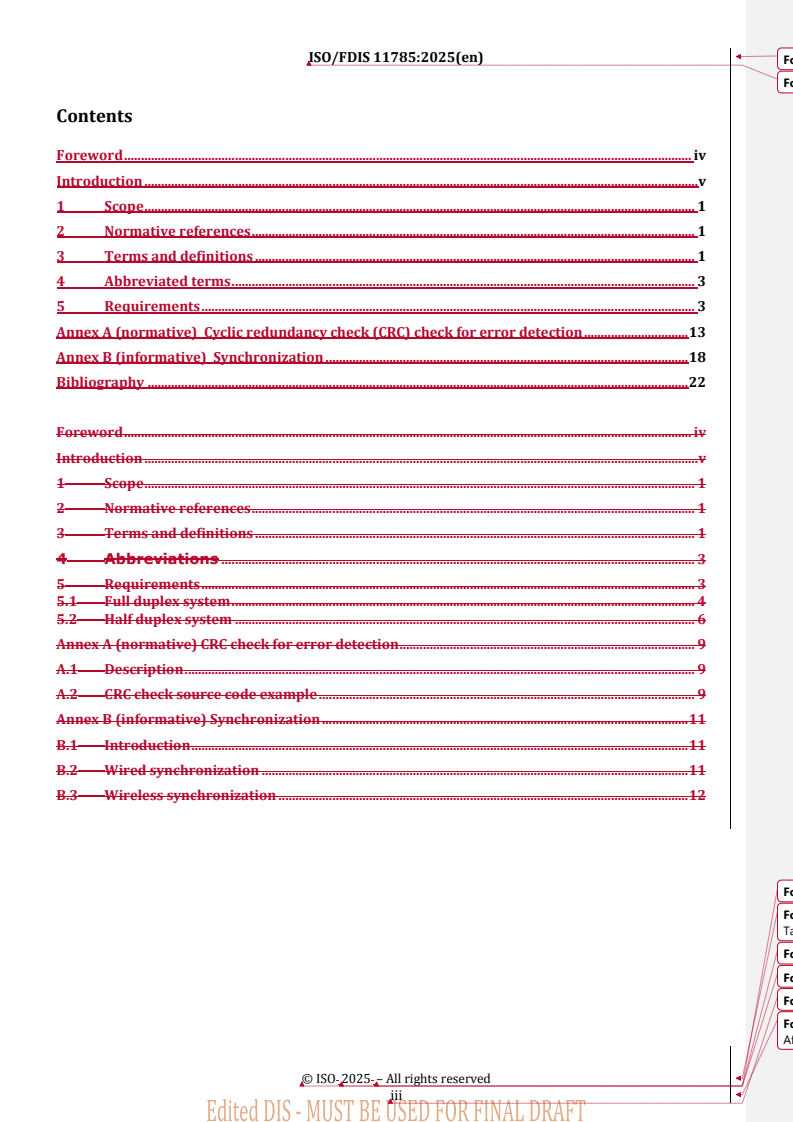
Contents
Foreword . iv
Introduction . v
1 Scope . 1
2 Normative references . 1
3 Terms and definitions . 1
4 Abbreviated terms . 3
5 Requirements . 3
Annex A (normative) Cyclic redundancy check (CRC) check for error detection . 13
Annex B (informative) Synchronization . 18
Bibliography . 22
Foreword . iv
Introduction . v
1 Scope . 1
2 Normative references . 1
3 Terms and definitions . 1
4 Abbreviations . 3
5 Requirements . 3
5.1 Full duplex system . 4
5.2 Half duplex system . 6
Annex A (normative) CRC check for error detection . 9
A.1 Description . 9
A.2 CRC check source code example . 9
Annex B (informative) Synchronization . 11
B.1 Introduction . 11
B.2 Wired synchronization . 11
B.3 Wireless synchronization . 12
Formatted: Font: 10 pt
Formatted: FooterCentered, Left, Space Before: 0 pt,
Tab stops: Not at 17.2 cm
Formatted: Font: 10 pt
Formatted: Font: 10 pt
Formatted: Font: 11 pt
Formatted: FooterPageRomanNumber, Left, Space
After: 0 pt, Tab stops: Not at 17.2 cm
© ISO 2025 – All rights reserved
iii
Formatted: HeaderCentered
Formatted: Font: Bold
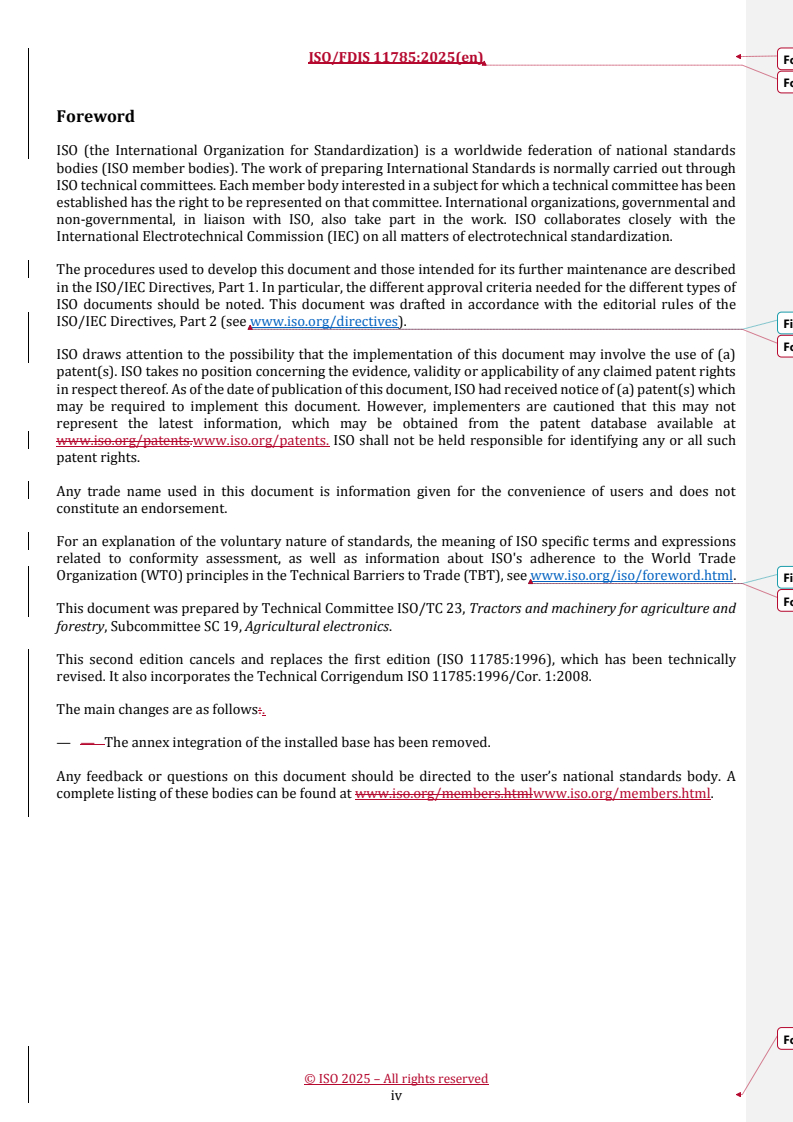
Foreword
ISO (the International Organization for Standardization) is a worldwide federation of national standards
bodies (ISO member bodies). The work of preparing International Standards is normally carried out through
ISO technical committees. Each member body interested in a subject for which a technical committee has been
established has the right to be represented on that committee. International organizations, governmental and
non-governmental, in liaison with ISO, also take part in the work. ISO collaborates closely with the
International Electrotechnical Commission (IEC) on all matters of electrotechnical standardization.
The procedures used to develop this document and those intended for its further maintenance are described
in the ISO/IEC Directives, Part 1. In particular, the different approval criteria needed for the different types of
ISO documents should be noted. This document was drafted in accordance with the editorial rules of the
ISO/IEC Directives, Part 2 (see www.iso.org/directives).
Field Code Changed
Formatted: English (United Kingdom)
ISO draws attention to the possibility that the implementation of this document may involve the use of (a)
patent(s). ISO takes no position concerning the evidence, validity or applicability of any claimed patent rights
in respect thereof. As of the date of publication of this document, ISO had received notice of (a) patent(s) which
may be required to implement this document. However, implementers are cautioned that this may not
represent the latest information, which may be obtained from the patent database available at
www.iso.org/patents.www.iso.org/patents. ISO shall not be held responsible for identifying any or all such
patent rights.
Any trade name used in this document is information given for the convenience of users and does not
constitute an endorsement.
For an explanation of the voluntary nature of standards, the meaning of ISO specific terms and expressions
related to conformity assessment, as well as information about ISO's adherence to the World Trade
Organization (WTO) principles in the Technical Barriers to Trade (TBT), see www.iso.org/iso/foreword.html.
Field Code Changed
Formatted: English (United Kingdom)
This document was prepared by Technical Committee ISO/TC 23, Tractors and machinery for agriculture and
forestry, Subcommittee SC 19, Agricultural electronics.
This second edition cancels and replaces the first edition (ISO 11785:1996), which has been technically
revised. It also incorporates the Technical Corrigendum ISO 11785:1996/Cor. 1:2008.
The main changes are as follows:.
— — The annex integration of the installed base has been removed.
Any feedback or questions on this document should be directed to the user’s national standards body. A
complete listing of these bodies can be found at www.iso.org/members.htmlwww.iso.org/members.html.
Formatted: FooterPageRomanNumber
iv
Formatted: HeaderCentered, Left
Formatted: Font: Bold
Introduction
The technical concept of animal identification described is based upon the principle of radio-frequency
identification (RFID). ISO 11785 is applicable in connection with ISO 11784 which describes the structure and
the information content of the codes stored in the transponder.
Formatted: Font: 10 pt
Formatted: FooterCentered, Left, Space Before: 0 pt,
Tab stops: Not at 17.2 cm
Formatted: Font: 10 pt
Formatted: Font: 10 pt
Formatted: Font: 11 pt
Formatted: FooterPageRomanNumber, Left, Space
After: 0 pt, Tab stops: Not at 17.2 cm
© ISO 2025 – All rights reserved
v
DRAFT International Standard ISO/FDIS 11785:2025(en)
Formatted: Font: Not Bold
Formatted: Header, Space After: 0 pt, Line spacing:
single
Formatted: Main Title 1, Adjust space between Latin
Radio- frequency identification of animals — Technical concept
and Asian text, Adjust space between Asian text and
numbers
1 Scope
This document specifies how a transponder is activated and how the stored information is transferred to a
transceiver.
2 Normative references
The following documents are referred to in the text in such a way that some or all of their content constitutes
requirements of this document. For dated references, only the edition cited applies. For undated references,
the latest edition of the referenced document (including any amendments) applies.
ISO 11784, Radio frequency identification of animals — Code structure
Formatted: Default Paragraph Font
Formatted: Adjust space between Latin and Asian text,
ISO 24631--7, Radiofrequency identification of animals — Part 7: Synchronization of ISO 11785 identification
Adjust space between Asian text and numbers, Tab
systems
stops: Not at 0.7 cm + 1.4 cm + 2.1 cm + 2.8 cm +
3.5 cm + 4.2 cm + 4.9 cm + 5.6 cm + 6.3 cm + 7 cm
3 Terms and definitions
Formatted: Default Paragraph Font
For the purposes of this document, the following terms and definitions apply. Formatted: Default Paragraph Font, Font: Italic
Formatted: Default Paragraph Font
ISO and IEC maintain terminology databases for use in standardization at the following addresses:
Formatted: Default Paragraph Font
— — ISO Online browsing platform: available at https://www.iso.org/obphttps://www.iso.org/obp
Formatted: Default Paragraph Font
Formatted: Default Paragraph Font, Font: Italic
— — IEC Electropedia: available at https://www.electropedia.org/https://www.electropedia.org/
Formatted: Adjust space between Latin and Asian text,
Adjust space between Asian text and numbers
3.1 3.1
activation field
Formatted: Adjust space between Latin and Asian text,
electromagnetic field transmitted by a transceiver to energize and/or activate a transponder
Adjust space between Asian text and numbers, Tab
stops: Not at 0.7 cm + 1.4 cm + 2.1 cm + 2.8 cm +
3.2 3.2
3.5 cm + 4.2 cm + 4.9 cm + 5.6 cm + 6.3 cm + 7 cm
activation frequency
Formatted: TermNum2, Adjust space between Latin and
frequency of the activation field
Asian text, Adjust space between Asian text and
numbers
3.3 3.4
bit rate
number of bits transmitted per second
3.4 3.5
differential bi-phase encoding
DBP
method of encoding in which data bit 0 is represented by a mid-bit transition;, data bit 1 is represented by no
transition;, and there is always a transition in between two bits
3.5 3.6
encoding
one to one relationship between basic information elements and modulation patterns
Formatted: Footer, Left, Space After: 0 pt, Tab stops:
Not at 17.2 cm
Formatted: Font: Bold
Formatted: HeaderCentered
3.6 3.7
error detection code
bits that contain information which can be used to detect errors
3.7 3.8
frequency shift keying
FSK
binary information is superimposed onto a carrier electromagnetic field by shifting between discrete
frequencies of the field
3.8 3.9
full duplex
method of information exchange in which the information is communicated while the transceiver transmits
the activation field
3.9 3.10
half duplex
method of information exchange in which the information is communicated after the transceiver has stopped
transmitting the activation field
3.10 3.11
header
bits transmitted before the useful information, uniquely identifying the start of a page, which may also be used
for synchronization of the transponder and the transceiver
3.11 3.12
identification code
64 bits of the identification telegram which are specified in ISO 11784
3.12 3.13
identification telegram
total identification message (header, identification code, error detection code and trailer), possibly repeatedly
transmitted by the transponder upon activation
3.13 3.14
mobile transceiver
transceiver that is not connected to other transceivers when these are in its vicinity to synchronize activation
periods and pauses
3.14 3.15
modulation
method of superimposing information onto an electromagnetic field by means of varying a specific parameter
of the field
3.15 3.16
non-return to zero encoding
NRZ
method of encoding in which data bit 1 is a high signal and data bit 0 is a low signal
3.16 3.17
Formatted: Font: 10 pt
page
coherent part of the communicated information
Formatted: Font: 10 pt
Formatted: FooterPageNumber, Space After: 0 pt, Line
spacing: single
Formatted: Font: 11 pt
2 © ISO #### 2025 – All rights reserved
Formatted: HeaderCentered, Left
Formatted: Font: Bold
3.17 3.18
phase shift keying
PSK
binary information is superimposed onto a carrier electromagnetic field by introducing discrete phase shifts
Formatted Table
of the field
Formatted: Table body (+), Adjust space between Latin
3.18 3.19
and Asian text, Adjust space between Asian text and
stationary transceiver
numbers
transceiver that is connected to other transceivers when these are in its vicinity to synchronize activation
Formatted: Table body (+), Adjust space between Latin
periods and pauses
and Asian text, Adjust space between Asian text and
numbers
3.19 3.20
Formatted: Table body (+), Adjust space between Latin
trailer
and Asian text, Adjust space between Asian text and
bits transmitted after the error detection code; the content of which is dependent upon the value of the flag
numbers
for an additional data block which is specified in ISO 11784
Formatted: Table body (+), Adjust space between Latin
3.20 3.21 and Asian text, Adjust space between Asian text and
numbers
transceiver
device used to communicate with a transponder
Formatted: Table body (+), Adjust space between Latin
and Asian text, Adjust space between Asian text and
3.21 3.22
numbers
transponder
Formatted: Table body (+), Adjust space between Latin
device which transmits its stored information when activated by a transceiver and may be able to store new
and Asian text, Adjust space between Asian text and
information
numbers
Formatted: Table body (+), Adjust space between Latin
4 Abbreviated terms
and Asian text, Adjust space between Asian text and
numbers
AM amplitude modulation
Formatted: Table body (+), Adjust space between Latin
BCC block control character
and Asian text, Adjust space between Asian text and
numbers
CRC cyclic redundancy check
Formatted: Table body (+), Adjust space between Latin
DBP differential bi-phase encoding
and Asian text, Adjust space between Asian text and
numbers
FDX full duplex
Formatted: Table body (+), Adjust space between Latin
FSK frequency shift keying
and Asian text, Adjust space between Asian text and
HDX half duplex
numbers
LSB least significant bits Formatted: Table body (+), Adjust space between Latin
and Asian text, Adjust space between Asian text and
MSB most significant bits
numbers
NRZ non-return to zero encoding
Formatted
...
PSK phase shift keying
Formatted: Adjust space between Latin and Asian text,
Adjust space between Asian text and numbers
RFID radio-frequency identification
Formatted: Superscript
5 Requirements
Formatted: Font: 10 pt
Formatted: FooterCentered, Left, Space Before: 0 pt,
5.1 General
Tab stops: Not at 17.2 cm
Formatted: Font: 10 pt
The system shall be defined in such a way that the FDX and HDX transponders can be read by one transceiver.
Formatted: Font: 10 pt
A stationary transceiver shall activate transponders using an activation field with an activation frequency of
Formatted: Font: 11 pt
-3
(134,2 ± 13,42 x× 10 ) kHz. The activation period shall be 50 ms. If an FDX signal is received during activation
but is not validated, the activation period shall be extended until be identification telegram is validated, but Formatted: FooterPageNumber, Left, Space After: 0 pt,
Tab stops: Not at 17.2 cm
© ISO 2025 – All rights reserved
Formatted: Font: Bold
Formatted: HeaderCentered
not longer than 100 ms. Consecutively, there shall be a pause in the activation signal. If an HDX signal is
received the pause shall last for 20 ms. If no HDX signal is detected within 3 ms after a 3 dB decay of the
activation field, activation shall be resumed. For synchronization reasons, each tenth activation cycle shall
have a fixed pattern of 50 ms activation and 20 ms pause (see annex B).Annex B). Synchronization of ISO
11785 identification systems shall be in accordance with ISO 24631-7.
A mobile transceiver shall be able to detect the presence of additional active transceivers through the
reception of activation signals. If no activation signal is detected within 30 ms, the mobile transceiver is out of
reach of other active transceivers and shall use the activation protocol defined above for a stationary
transceiver. If the mobile transceiver does detect an activation signal it shall wait for the rising edge of the
next activation signal and shall activate during a fixed period of 50 ms.
The identification code shall be in accordance with ISO 11784. The identification code, the CRC error detection
bits (in accordance with Annex A)Annex A) and the trailer shall be transmitted starting with the LSB and
ending with the MSB.
In view of future enhancements, for example multi-page transponders incorporating sensors and/or writable
memory, the identification telegram shall terminate in 24 trailer bits in which, for instance, information from
sensors or the contents of trailing pages may be stored. If the flag for additional data blocks, which is specified
in ISO 11784, is binary 0 the value of most of the trailer bits is unspecified. The value of the trailer bits for
additional data blocks which have a flag equal to binary 1 will be defined by a future International Standard.
NOTE 1 Since errors in the trailer will not be detected by the error detection protocol of the identification telegram, it
is not necessary to read these bits in order to correctly detect the identification code.
NOTE 2 In most countries the use of transceivers as described in this document is subject to regulations. Type
approval from the national regulatory agencies can be required before they can be operated or traded in these countries.
5.2 Full duplex system
An FDX transponder receiving the activation field shall transmit its code during the activation period. The FDX
transponder uses a modified DBP encoded sub-carrier which is amplitude modulated upon the radio
frequency carrier. Because the slope of a low-high transition is not infinitely steep, every low-high transition
is advanced in time to a maximum of eight cycles to obtain optimal performance (see Figure 1).0). The
transponder shall send its message back using the frequency bands 129,0 kHz to 133,2 kHz and 135,2 kHz to
139,4 kHz. The duration of one bit is 32 activation field cycles. This corresponds to a bit rate of 4 194 bit/s.
NOTE The basic frequency of the sub-carrier, containing the phase encoded data signal, is not influenced by the
advancement in time of the low-high transition and remains 4 194 Hz (binary 1 :1 800 phase shift; binary 0: no phase
shift).
Formatted: Font: 10 pt
Formatted: Font: 10 pt
Formatted: FooterPageNumber, Space After: 0 pt, Line
spacing: single
Formatted: Font: 11 pt
4 © ISO #### 2025 – All rights reserved
Formatted: HeaderCentered, Left
Formatted: Font: Bold
Formatted: Font: 10 pt
Formatted: FooterCente
...
Questions, Comments and Discussion
Ask us and Technical Secretary will try to provide an answer. You can facilitate discussion about the standard in here.
Loading comments...