

ISO 11784:1996/Amd 2:2010
(Amendment)Radio frequency identification of animals — Code structure — Amendment 2: Indication of an advanced transponder
General Information
- Abstract
- Status
- Withdrawn
- Publication Date
- 11-May-2010
- Technical Committee
- ISO/TC 23/SC 19 - Agricultural electronics
- Drafting Committee
- ISO/TC 23/SC 19/WG 3 - Identification
- Current Stage
- 9599 - Withdrawal of International Standard
- Start Date
- 10-Dec-2024
- Completion Date
- 29-Aug-2026
Buy Documents
ISO 11784:1996/Amd 2:2010 - Radio frequency identification of animals — Code structure — Amendment 2: Indication of an advanced transponder Released:5/12/2010
ISO 11784:1996/Amd 2:2010 - Identification des animaux par radiofréquence — Structure du code — Amendement 2: Identification d'un transpondeur évolué Released:5/12/2010
Overview
ISO 11784:1996/Amd 2:2010 is an important amendment to the international standard ISO 11784, which specifies the code structure for the radio frequency identification (RFID) of animals. This amendment introduces a crucial enhancement-the indication of an advanced transponder type within the animal identification system. Developed by ISO’s technical committee ISO/TC 23/SC 19, focused on electronics in agriculture, this update ensures backward compatibility with earlier RFID standards while accommodating advanced transponder technologies.
This standard defines how RFID codes are structured to uniquely identify animals and incorporates new provisions for advanced RFID transponders that offer additional functionalities like extra data storage and integrated sensors.
Key Topics
Advanced Transponder Identification
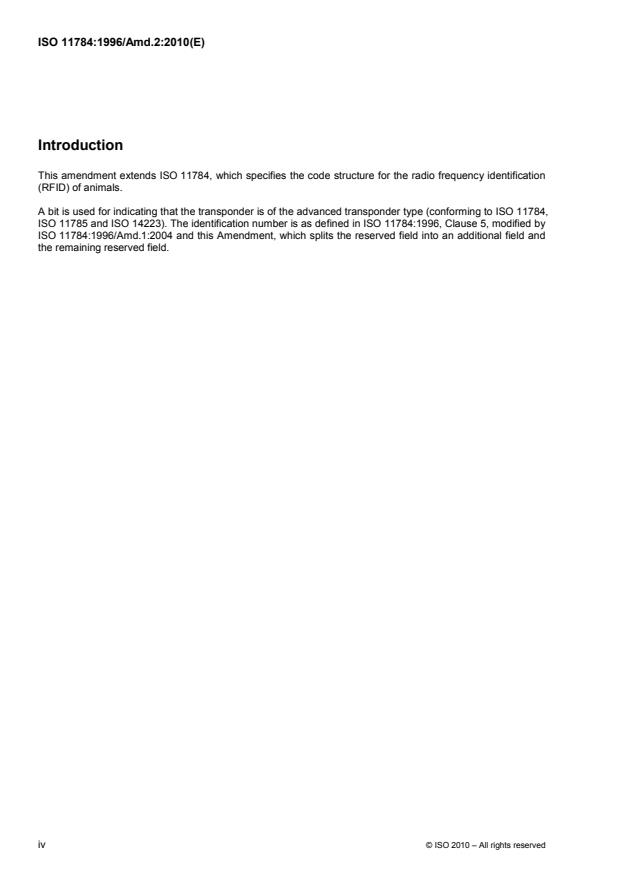
The amendment introduces a specific bit-referred to as the RUDI bit (Reference to User Data Inside)-within the identification code that signals whether a transponder is of an advanced type as per ISO 14223. The RUDI bit enables differentiation of enhanced RFID devices capable of storing and returning additional data.Code Structure Modification
The amendment modifies the reserved bits (bits 10 to 15) within the code structure. Bit 15 is assigned as the RUDI bit to indicate advanced transponders, while bits 10 to 14 remain reserved and must be zero. This structure maintains compatibility with prior standards ISO 11784 and ISO 11785.Reference to Related Standards
The amendment closely relates to ISO 14223 parts 1, 2, and 3, which define the interface, code, command structure, and applications of advanced transponders for animal identification.Terminology Additions
Two new definitions are introduced:- Advanced transponder: An RFID device compliant with ISO 14223, supporting backward compatibility and additional features like sensor integration.
- RUDI bit: A code bit referencing internal user data, indicating the transponder’s advanced status.
Applications
ISO 11784:1996/Amd 2:2010 is specifically designed for broad use in the RFID animal identification industry to enhance traceability, health management, and regulatory compliance across agriculture and livestock management. Key practical applications include:
Livestock Management
Advanced RFID transponders allow farmers and agricultural professionals to monitor animal health more effectively by enabling additional data collection through embedded sensors integrated into the RFID tags.Regulatory Compliance and Traceability
The unique code structure standardized by ISO 11784 facilitates global regulatory requirements for animal identification and tracking, ensuring reliable data exchange between various systems and authorities.Research and Development
The amendment supports innovative developments in RFID technology for animals, encouraging integration of advanced sensor data and expanded user information within identification tags.Veterinary and Wildlife Monitoring
Advanced transponders enable enhanced data storage and sensor feedback, supporting complex monitoring needs such as tracking movement patterns, vital signs, or environmental conditions relevant to animal health and conservation.
Related Standards
- ISO 11784:1996 – Original standard specifying animal identification code structure for RFID.
- ISO 11785 – Defines the technical concept and transmission protocols for RFID animal identification systems.
- ISO 14223 Parts 1-3 – Defines advanced transponders for animal identification, detailing interface (Part 1), code and command structure (Part 2), and applications (Part 3), enhancing RFID functionalities beyond the original standards.
Summary
ISO 11784:1996/Amd 2:2010 serves as a key amendment to support evolving RFID technologies in animal identification, allowing agricultural sectors and related industries to adopt advanced transponders without sacrificing compatibility with existing systems. By recognizing new bit assignments and clearly defining the advanced transponder concept, this standard plays a fundamental role in the modernization and expansion of RFID use for animal traceability, health monitoring, and data collection.
For professionals involved in RFID tagging, animal husbandry, traceability technology, and agricultural compliance, adherence to ISO 11784:1996/Amd 2:2010 ensures cutting-edge RFID code structure with future-proof benefits.
Relations
- Effective Date
- 06-Jun-2022
- Effective Date
- 06-Jun-2022
- Effective Date
- 15-Apr-2008
Buy Documents
ISO 11784:1996/Amd 2:2010 - Radio frequency identification of animals — Code structure — Amendment 2: Indication of an advanced transponder Released:5/12/2010
ISO 11784:1996/Amd 2:2010 - Identification des animaux par radiofréquence — Structure du code — Amendement 2: Identification d'un transpondeur évolué Released:5/12/2010
Get Certified
Connect with accredited certification bodies for this standard

Control Union Certifications
Global certification for agriculture and sustainability.

ECOCERT
Organic and sustainability certification.

FSC International
Forest Stewardship Council certification.
Sponsored listings
Frequently Asked Questions
ISO 11784:1996/Amd 2:2010 is a standard published by the International Organization for Standardization (ISO). Its full title is "Radio frequency identification of animals — Code structure — Amendment 2: Indication of an advanced transponder". This standard covers: Radio frequency identification of animals — Code structure — Amendment 2: Indication of an advanced transponder
Radio frequency identification of animals — Code structure — Amendment 2: Indication of an advanced transponder
ISO 11784:1996/Amd 2:2010 is classified under the following ICS (International Classification for Standards) categories: 65.040.99 - Other standards related to farm buildings and installations. The ICS classification helps identify the subject area and facilitates finding related standards.
ISO 11784:1996/Amd 2:2010 has the following relationships with other standards: It is inter standard links to ISO 11784:1996, ISO 11784:2024; is excused to ISO 11784:1996. Understanding these relationships helps ensure you are using the most current and applicable version of the standard.
ISO 11784:1996/Amd 2:2010 is available in PDF format for immediate download after purchase. The document can be added to your cart and obtained through the secure checkout process. Digital delivery ensures instant access to the complete standard document.
Standards Content (Sample)
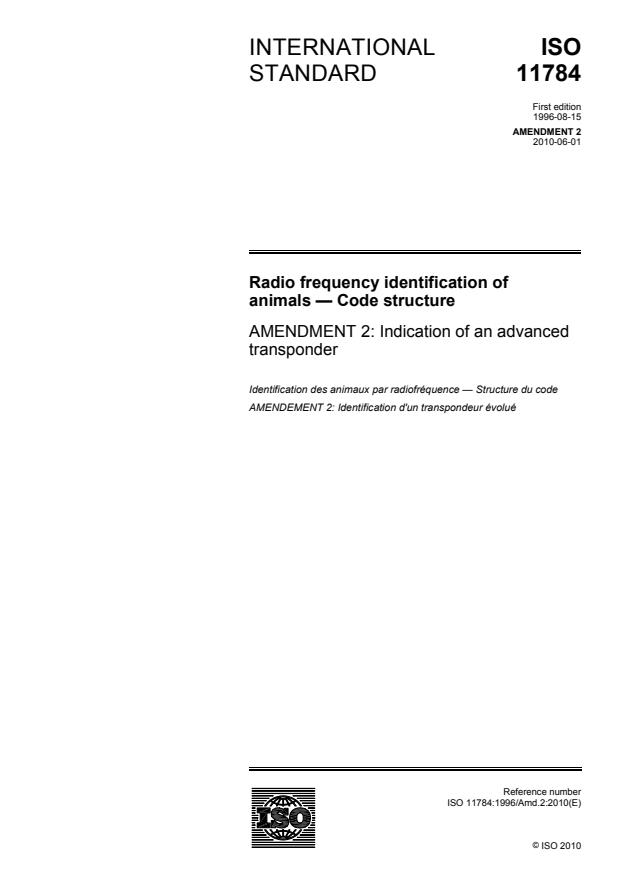
INTERNATIONAL ISO
STANDARD 11784
First edition
1996-08-15
AMENDMENT 2
2010-06-01
Radio frequency identification of
animals — Code structure
AMENDMENT 2: Indication of an advanced
transponder
Identification des animaux par radiofréquence — Structure du code
AMENDEMENT 2: Identification d'un transpondeur évolué
Reference number
ISO 11784:1996/Amd.2:2010(E)
©
ISO 2010
ISO 11784:1996/Amd.2:2010(E)
PDF disclaimer
This PDF file may contain embedded typefaces. In accordance with Adobe's licensing policy, this file may be printed or viewed but
shall not be edited unless the typefaces which are embedded are licensed to and installed on the computer performing the editing. In
downloading this file, parties accept therein the responsibility of not infringing Adobe's licensing policy. The ISO Central Secretariat
accepts no liability in this area.
Adobe is a trademark of Adobe Systems Incorporated.
Details of the software products used to create this PDF file can be found in the General Info relative to the file; the PDF-creation
parameters were optimized for printing. Every care has been taken to ensure that the file is suitable for use by ISO member bodies. In
the unlikely event that a problem relating to it is found, please inform the Central Secretariat at the address given below.
© ISO 2010
All rights reserved. Unless otherwise specified, no part of this publication may be reproduced or utilized in any form or by any means,
electronic or mechanical, including photocopying and microfilm, without permission in writing from either ISO at the address below or
ISO's member body in the country of the requester.
ISO copyright office
Case postale 56 • CH-1211 Geneva 20
Tel. + 41 22 749 01 11
Fax + 41 22 749 09 47
E-mail copyright@iso.org
Web www.iso.org
Published in Switzerland
ii © ISO 2010 – All rights reserved
ISO 11784:1996/Amd.2:2010(E)
Foreword
ISO (the International Organization for Standardization) is a worldwide federation of national standards bodies
(ISO member bodies). The work of preparing International Standards is normally carried out through ISO
technical committees. Each member body interested in a subject for which a technical committee has been
established has the right to be represented on that committee. International organizations, governmental and
non-governmental, in liaison with ISO, also take part in the work. ISO collaborates closely with the
International Electrotechnical Commission (IEC) on all matters of electrotechnical standardization.
International Standards are drafted in accordance with the rules given in the ISO/IEC Directives, Part 2.
The main task of technical committees is to prepare International Standards. Draft International Standards
adopted by the technical committees are circula
...
NORME ISO
INTERNATIONALE 11784
Première édition
1996-08-15
AMENDEMENT 2
2010-06-01
Identification des animaux par
radiofréquence — Structure du code
AMENDEMENT 2: Identification d'un
transpondeur évolué
Radio frequency identification of animals — Code structure
AMENDMENT 2: Indication of an advanced transponder
Numéro de référence
ISO 11784:1996/Amd.2:2010(F)
©
ISO 2010
ISO 11784:1996/Amd.2:2010(F)
PDF – Exonération de responsabilité
Le présent fichier PDF peut contenir des polices de caractères intégrées. Conformément aux conditions de licence d'Adobe, ce fichier
peut être imprimé ou visualisé, mais ne doit pas être modifié à moins que l'ordinateur employé à cet effet ne bénéficie d'une licence
autorisant l'utilisation de ces polices et que celles-ci y soient installées. Lors du téléchargement de ce fichier, les parties concernées
acceptent de fait la responsabilité de ne pas enfreindre les conditions de licence d'Adobe. Le Secrétariat central de l'ISO décline toute
responsabilité en la matière.
Adobe est une marque déposée d'Adobe Systems Incorporated.
Les détails relatifs aux produits logiciels utilisés pour la création du présent fichier PDF sont disponibles dans la rubrique General Info
du fichier; les paramètres de création PDF ont été optimisés pour l'impression. Toutes les mesures ont été prises pour garantir
l'exploitation de ce fichier par les comités membres de l'ISO. Dans le cas peu probable où surviendrait un problème d'utilisation,
veuillez en informer le Secrétariat central à l'adresse donnée ci-dessous.
DOCUMENT PROTÉGÉ PAR COPYRIGHT
© ISO 2010
Droits de reproduction réservés. Sauf prescription différente, aucune partie de cette publication ne peut être reproduite ni utilisée sous
quelque forme que ce soit et par aucun procédé, électronique ou mécanique, y compris la photocopie et les microfilms, sans l'accord écrit
de l'ISO à l'adresse ci-après ou du comité membre de l'ISO dans le pays du demandeur.
ISO copyright office
Case postale 56 • CH-1211 Geneva 20
Tel. + 41 22 749 01 11
Fax + 41 22 749 09 47
E-mail copyright@iso.org
Web www.iso.org
Publié en Suisse
ii © ISO 2010 – Tous droits réservés
ISO 11784:1996/Amd.2:2010(F)
Avant-propos
L'ISO (Organisation internationale de normalisation) est une fédération mondiale d'organismes nationaux de
normalisation (comités membres de l'ISO). L'élaboration des Normes internationales est en général confiée
aux comités techniques de l'ISO. Chaque comité membre intéressé par une étude a le droit de faire partie du
comité technique créé à cet effet. Les organisations internationales, gouvernementales et non
gouvernementales, en liaison avec l'ISO participent également aux travaux. L'ISO collabore étroitement avec
la Commission électrotechnique internationale (CEI) en ce qui concerne la normalisation électrotechnique.
Les Normes internationales sont rédigées conformément aux règles données dans les Directives ISO/CEI,
Partie 2.
La tâche principale des comités techniques est d'élaborer les Normes internationales. Les projets de Normes
internationales adoptés par les comités techniques s
...