

ISO 6881:2023
(Main)Radio-frequency identification of animals — Code structure ultra high frequency transponders
General Information
- Abstract
This document defines the rules for encoding the animal identification code in a specific memory bank known as MB 01 in the memory of an ISO 18000-63 transponder (UHF RFID technology).
- Status
- Published
- Publication Date
- 13-Dec-2023
- Technical Committee
- ISO/TC 23/SC 19 - Agricultural electronics
- Drafting Committee
- ISO/TC 23/SC 19 - Agricultural electronics
- Current Stage
- 9092 - International Standard to be revised
- Start Date
- 01-Apr-2026
- Completion Date
- 29-Aug-2026
Buy Documents
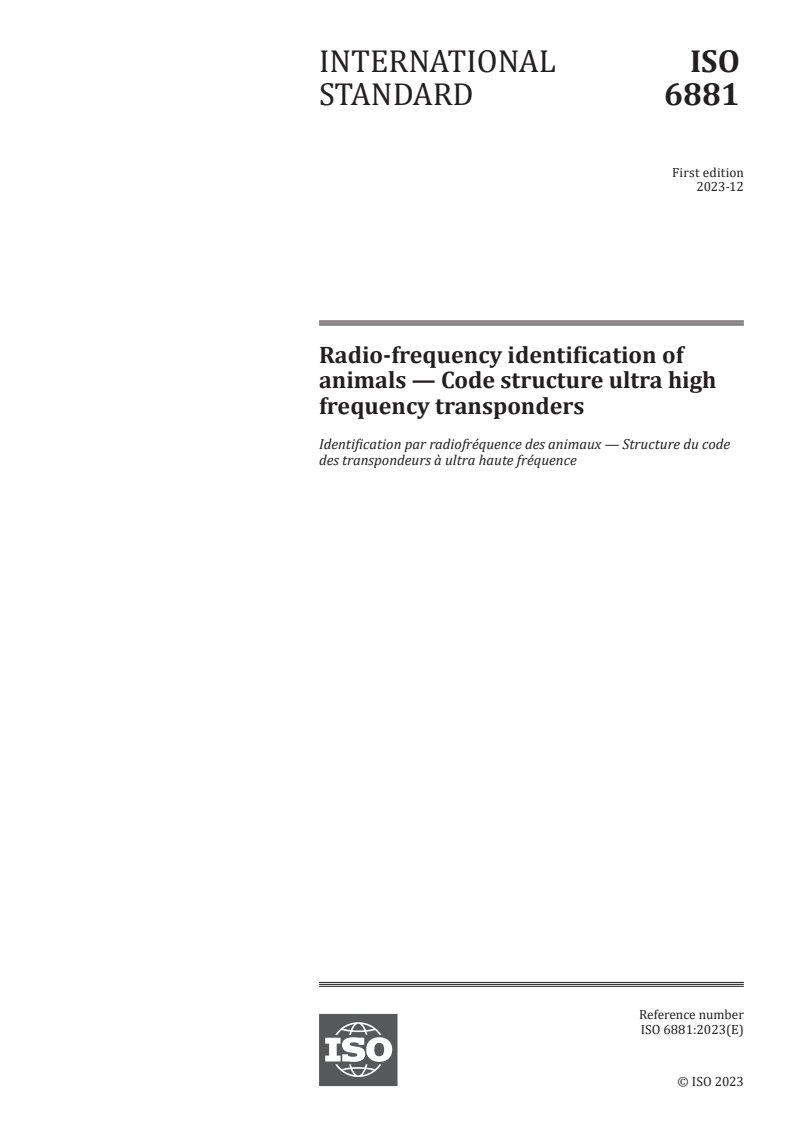
ISO 6881:2023 - Radio-frequency identification of animals — Code structure ultra high frequency transponders Released:14. 12. 2023
ISO 6881:2023 - Identification par radiofréquence des animaux — Structure du code des transpondeurs à ultra haute fréquence/22/2023
Overview
ISO 6881:2023 specifies how to encode an animal identification code into the UII memory bank (MB 01) of an ISO 18000-63 (UHF RFID) transponder. It defines the 96‑bit UII structure, related protocol-control fields and integrity checks so UHF RFID tags can be used reliably for animal identification using ISO coding (not EPC coding). The standard is intended for transponders used exclusively for animal ID and references mechanisms such as the Application Family Identifier (AFI) to enable selective bulk reading.
Key topics and requirements
- Memory bank model (ISO 18000-63): Defines four memory banks - MB00 (Reserved), MB01 (UII), MB10 (TID) and optional MB11 (User memory).
- UII structure: A 96‑bit UII containing the DSFID (Data Storage Format Identifier), a 16‑bit animal identification header, a 64‑bit animal identification code and an 8‑bit CRC. UII Trailer bits (if present) default to zero.
- Animal identification code (64 bits): Encodes either a country code or manufacturer’s code (10 bits), a national identification code (38 bits), plus control bits (16 bits). The 64‑bit format aligns with ISO 11784 definitions.
- Control bits: Include the animal application bit, retagging counter, user information field, reserved bits, the RUDI‑bit (indicates MB11 data) and the data block bit. The UMI in StoredPC must match RUDI.
- StoredPC and storedCRC: MB01 holds protocol-control info (StoredPC) - Length Indicator, UMI, XI, Toggle Bit and AFI. A 16‑bit storedCRC covers StoredPC + UII. An 8‑bit CRC protects UII bit integrity.
- Security / passwords: MB00 stores Kill and Access passwords; for ISO 6881 transponders the Kill command is disabled (Kill Password set to zero and locked).
- TID: A 64‑bit Tag Identifier (MB10) is write‑perm‑locked by the IC manufacturer to ensure uniqueness.
- ISO coding vs EPC: This document mandates ISO coding and AFI usage (ISO/IEC 15961) for application selection rather than EPC schemes.
- Backward compatibility: Clause 6 addresses compatibility considerations with previous generation systems (including LF reference).
Applications and users
- Livestock management & traceability: Tagging cattle, sheep, pigs and other animals for identification, movement controls and disease tracing.
- Regulatory bodies & veterinarians: Enforcing animal ID regulations and compliance audits.
- RFID tag manufacturers & IC vendors: Implementing MB01 UII encoding, StoredPC, CRCs and disabling Kill functionality per the standard.
- System integrators & reader manufacturers: Ensuring readers recognize AFI/DSFID, interpret UII fields and support optional MB11 user memory.
- Databases and traceability software providers: Storing and processing the standardized 64‑bit animal code and associated metadata.
Related standards
- ISO 18000-63 (UHF RFID air interface)
- ISO 11784 (animal code structure)
- ISO/IEC 15961 (AFI and data storage format rules)
- ISO 11785 (contactless identification - complementary LF/HF references)
Keywords: ISO 6881:2023, UHF RFID, animal identification, ISO 18000-63, UII MB01, AFI, DSFID, TID, CRC, livestock traceability, ICAR.
Buy Documents
ISO 6881:2023 - Radio-frequency identification of animals — Code structure ultra high frequency transponders Released:14. 12. 2023
ISO 6881:2023 - Identification par radiofréquence des animaux — Structure du code des transpondeurs à ultra haute fréquence/22/2023
Get Certified
Connect with accredited certification bodies for this standard

Control Union Certifications
Global certification for agriculture and sustainability.

ECOCERT
Organic and sustainability certification.

FSC International
Forest Stewardship Council certification.
Sponsored listings
Frequently Asked Questions
ISO 6881:2023 is a standard published by the International Organization for Standardization (ISO). Its full title is "Radio-frequency identification of animals — Code structure ultra high frequency transponders". This standard covers: This document defines the rules for encoding the animal identification code in a specific memory bank known as MB 01 in the memory of an ISO 18000-63 transponder (UHF RFID technology).
This document defines the rules for encoding the animal identification code in a specific memory bank known as MB 01 in the memory of an ISO 18000-63 transponder (UHF RFID technology).
ISO 6881:2023 is classified under the following ICS (International Classification for Standards) categories: 65.040.99 - Other standards related to farm buildings and installations. The ICS classification helps identify the subject area and facilitates finding related standards.
ISO 6881:2023 is available in PDF format for immediate download after purchase. The document can be added to your cart and obtained through the secure checkout process. Digital delivery ensures instant access to the complete standard document.
Standards Content (Sample)
INTERNATIONAL ISO
STANDARD 6881
First edition
2023-12
Radio-frequency identification of
animals — Code structure ultra high
frequency transponders
Identification par radiofréquence des animaux — Structure du code
des transpondeurs à ultra haute fréquence
Reference number
© ISO 2023
All rights reserved. Unless otherwise specified, or required in the context of its implementation, no part of this publication may
be reproduced or utilized otherwise in any form or by any means, electronic or mechanical, including photocopying, or posting on
the internet or an intranet, without prior written permission. Permission can be requested from either ISO at the address below
or ISO’s member body in the country of the requester.
ISO copyright office
CP 401 • Ch. de Blandonnet 8
CH-1214 Vernier, Geneva
Phone: +41 22 749 01 11
Email: copyright@iso.org
Website: www.iso.org
Published in Switzerland
ii
Contents Page
Foreword .iv
Introduction .v
1 Scope . 1
2 Normative references . 1
3 Terms and definitions . 1
4 Symbols (and abbreviated terms) . 5
5 General requirements . 5
5.1 General . 5
5.2 Structure of Reserved Memory Bank (MB 00) . 6
5.3 Structure of TID Memory Bank (MB 10) . 7
5.4 Structure of UII Memory Bank (MB 01) . 7
5.4.1 General . 7
5.4.2 Structure of the StoredPC . 7
5.4.3 Structure of the UII . 8
6 Backward compatibility .10
6.1 General . 10
6.2 LF transponders (for reference) . 11
6.3 UHF transponders . 11
Annex A (informative) CRC 8 source code.13
Bibliography .14
iii
Foreword
ISO (the International Organization for Standardization) is a worldwide federation of national standards
bodies (ISO member bodies). The work of preparing International Standards is normally carried out
through ISO technical committees. Each member body interested in a subject for which a technical
committee has been established has the right to be represented on that committee. International
organizations, governmental and non-governmental, in liaison with ISO, also take part in the work.
ISO collaborates closely with the International Electrotechnical Commission (IEC) on all matters of
electrotechnical standardization.
The procedures used to develop this document and those intended for its further maintenance are
described in the ISO/IEC Directives, Part 1. In particular, the different approval criteria needed for the
different types of ISO document should be noted. This document was drafted in accordance with the
editorial rules of the ISO/IEC Directives, Part 2 (see www.iso.org/directives).
ISO draws attention to the possibility that the implementation of this document may involve the use
of (a) patent(s). ISO takes no position concerning the evidence, validity or applicability of any claimed
patent rights in respect thereof. As of the date of publication of this document, ISO had not received
notice of (a) patent(s) which may be required to implement this document. However, implementers are
cautioned that this may not represent the latest information, which may be obtained from the patent
database available at www.iso.org/patents. ISO shall not be held responsible for identifying any or all
such patent rights.
Any trade name used in this document is information given for the convenience of users and does not
constitute an endorsement.
For an explanation of the voluntary nature of standards, the meaning of ISO specific terms and
expressions related to conformity assessment, as well as information about ISO's adherence to
the World Trade Organization (WTO) principles in the Technical Barriers to Trade (TBT), see
www.iso.org/iso/foreword.html.
This document was prepared by Technical Committee ISO/TC 23, Tractors and machinery for agriculture
and forestry, Subcommittee SC 19, Agricultural electronics.
Any feedback or questions on this document should be directed to the user’s national standards body. A
complete listing of these bodies can be found at www.iso.org/members.html.
iv
Introduction
This document does not use EPC coding but ISO coding. To define an ISO 18000-63 transponder as
assigned for animal identification only, an Application Family Identifier (AFI) shall be implemented
according to ISO 15961. The AFI is used in an ISO 18000-63 transponder to select in the bulk reading
process only those transponders programmed for the dedicated application.
This document does not specify the characteristics of the transmission protocols between transponder
and transceiver. These characteristics are the subject of ISO 18000-63.
Transponders are in conformance with this document provided they meet the requirements given in
Clauses 5 and 6.
v
INTERNATIONAL STANDARD ISO 6881:2023(E)
Radio-frequency identification of animals — Code
structure ultra high frequency transponders
1 Scope
This document defines the rules for encoding the animal identification code in a specific memory bank
known as MB 01 in the memory of an ISO 18000-63 transponder (UHF RFID technology).
2 Normative references
The following documents are referred to in the text in such a way that some or all of their content
constitutes requirements of this document. For dated references, only the edition cited applies. For
undated references, the latest edition of the referenced document (including any amendments) applies.
ISO 11784, Radio frequency identification of animals — Code structure
3 Terms and definitions
For the purposes of this document, the following terms and definitions apply.
ISO and IEC maintain terminology databases for use in standardization at the following addresses:
— ISO Online browsing platform: available at https:// www .iso .org/ obp
— IEC Electropedia: available at https:// www .electropedia .org/
3.1
unique item identifier
UII
96-bit pattern which defines a unique number that contains the DSFID (3.2), the animal identification
header, the animal identification code and the 8-bit CRC
Note 1 to entry: If the ISO 18000-63 transponder has more than 96 bits of UII memory, the additional bits are
considered UII Trailer bits and shall be set to 0 as default value.
Note 2 to entry: See DSFID (3.2), animal identification header (3.3), animal identification code (3.4), 8-bit CRC (3.15)
and ISO 18000–63 transponder (3.30).
3.2
data storage format identifier
DSFID
8-bit number defined by ISO/IEC 15962 that indicates the application and how the data is structured
into the UII memory of the ISO 18000-63 transponder, i.e. the access method and data format
Note 1 to entry: See UII (3.1) and ISO 18000-63 transponder (3.30).
3.3
animal identification header
16-bit code reserved for future use
Note 1 to entry: The animal identification header shall be set to 0 as default.
3.4
animal identification code
64-bit pattern which unequivocally identifies an animal comprising the country code or manufacturer’s
code, the national identification code and the control bits
Note 1 to entry: The animal identification code is defined by the ISO 11784.
Note 2 to entry: See country code (3.5), manufacturer’s code (3.6), national identification code (3.7) and control bits
(3.8).
3.5
country code
10-bit pattern to define the country where the transponder was issued or used, according to ISO 3166-1
3.6
manufacturer’s code
10-bit pattern identifying the manufacturer of the transponder
Note 1 to entry: The manufacturer’s code is used as alternative to the country code, when no competent authority
is available to issue the country code authorization.
Note 2 to entry: ISO has appointed the International Committee for Animal Recording (ICAR) as the registration
authority (RA) competent to register and manage manufacturer codes used in the radio frequency identification
(RFID) of animals in accordance with ISO 11784 and ISO 11785.
3.7
national identification code
38-bit code field with a unique number within a country, where the code structure and sequence is
defined by the country in charge
3.8
control bits
16-bit code that contains the animal application bit, the retagging counter, the user information field,
the reserved field, the RUDI bit and the data block bit
Note 1 to entry: See animal application bit (3.9), retagging counter (3.10), user information field (3.11), reserved
field (3.12), RUDI-bit (3.13) and data block bit (3.14).
3.9
animal application bit
bit which signals whether the transponder is used for animal identification or not
Note 1 to entry: In all animal applications this bit shall be 1.
3.10
retagging counter
three-bit counter for counting the number of retagging
3.11
user information field
five-bit field for additional user information, used only in conjunction with the country code
Note 1 to entry: See country code (3.5).
3.12
reserved field
6-bit code reserved for future use
3.13
RUDI-bit
bit indicating the existence of data in the User Memory (MB11)
Note 1 to entry: The RUDI-bit shall have the same value of the UMI bit. The RUDI-bit and UMI bit shall be encoded
with the value 0 if the User Memory is empty or not available.
Note 2 to entry: See country code (3.5) and UMI (3.19).
3.14
data block bit
bit indicating the existence of data in the additional UII memory
3.15
8-bit CRC
8-bit Cyclic Redundancy Check computed over the contents of the UII
Note 1 to entry: The 8-bit CRC protects the information against bit flipping.
3.16
memory bank
MB
designated name of a segmented memory structure
Note 1 to entry: For this document, the memory banks are: 00 (Reserved), 01 (UII memory), 10 (TID), and 11
(User memory) using binary notation.
Note 2 to entry: See ISO 18000-63 transponder (3.30).
3.17
storedCRC
16-bit CRC automatically generated, computed over the contents of the StoredPC and the UII
Note 1 to entry: The storedCRC does not protect against bit flipping (unintentional change of state of a bit stored
in memory).
Note 2 to entry: See StoredPC (3.18) and UII (3.1).
3.18
storedPC
protocol-control information stored in the UII Memory Bank (MB 01) that contains the Length Indicator,
the UMI, the XI, the Toggle Bit and the AFI
Note 1 to entry: See StoredPC (3.18), UMI (3.19), XI (3.20), toggle bit (3.21) and AFI (3.22).
3.19
user memory indicator
UMI
Boolean flag in the UII Memory Bank (MB 01) indicating whether the User Memory Bank (MB 11) is
present and contains data
Note 1 to entry: The UMI bit shall have the same value of the RUDI-bit.
Note 2 to entry: See RUDI-bit (3.13).
3.20
extended protocol control indicator
XI
bit in the UII Memory Bank (MB 01) indicating whether XPC words are present
3.21
toggle bit
Boolean flag in the UII Memory Bank (MB 01) indicating whether the presence of an Application Family
Identifier (AFI)
Note 1 to entry: The Toggle bit shall be encoded with the value 1 to indicate the presence of the AFI.
Note 2 to entry: See AFI (3.22).
3.22
application family identifier
AFI
code programmed in the UII Memory Bank (MB 01) used to select a class of RFID tags relevant to an
application, or aspect of an application, and to ignore further communications with other classes of
RFID tags with different identifiers
Note 1 to entry: This document does not use GS1 EPC coding but ISO coding.
Note 2 to entry: Application Family Identifier is defined in ISO/IEC 15961-3.
3.23
ISO coding
application whose usage denotes an acceptance of ISO standards and policies and where in MB01 an
Application Family Identifier as defined in ISO/IEC 15961-3 is encoded
3.24
kill password
32-bit password in the Reserved Memory Bank (MB 00) that is presented to the tag in order to complete
the mandatory “Kill” command
Note 1 to entry: The “Kill” command is used to permanently silence a tag.
Note 2 to entry: For ISO 6881 transponders, the use of the Kill Command is disabled (see 5.2).
3.25
access password
32-bit password in the Reserved Memory Bank (MB 00) that is presented to the tag in order to perform
privileged operations
3.26
tag identifier
TID
64-bit unique unmodifiable, pre-programmed identification number generated by the IC manufacturer
in the TID Memory Bank (MB 10) that guarantees the uniqueness of each device on the market and
ensures full traceability
3.27
backward compatibility
compatibility with former generation systems and/or databases
3.28
transceiver
device used to activate and then communicate with a transponder (also called RFID reader)
Note 1 to entry: See transponder (3.29).
3.29
transponder
device which transmits its stored information when activated by a transceiver and may be able to store
new information
Note 1 to entry: See transceiver (3.28).
3.30
ISO 18000-63 transponder
device in accordance with ISO/IEC 18000-63 which transmits its stored information when activated by
a transceiver and may be able to store new information
Note 1 to entry: In this document, the ISO 18000-63 transponder shall have a minimum of 96 bits of UII memory
encoding size.
Note 2 to entry: See transceiver (3.28).
4 Symbols (and abbreviated terms)
AFI Application Family Identifier
CRC Cyclic Redundancy Check
DSFID Data Storage Format Identifier
EPC Electronic Product Code
ICAR International Committee for Animal Recording
IEC International Electrotechnical Commission
ISO International Standard Organization
LF Low Frequency
LFSR Linear Feedback Shift Register
MB Memory Bank
PC Protocol Control
RA Registration Authority
RFID Radio Frequency Identification
RFU Reserved for Future Use
TID Tag Identifier
UHF Ultra-High Frequency
UII Unique Item Identifier
UMI User Memory Indictor
XPC Extended protocol control
5 General requirements
5.1 General
ISO 18000-63 transponders have what is known as a segmented memory structure, where three or four
different Memory Banks are sup
...
NORME ISO
INTERNATIONALE 6881
Première édition
2023-12
Identification par radiofréquence des
animaux — Structure du code des
transpondeurs à ultra haute fréquence
Radio-frequency identification of animals — Code structure ultra
high frequency transponders
Numéro de référence
DOCUMENT PROTÉGÉ PAR COPYRIGHT
© ISO 2023
Tous droits réservés. Sauf prescription différente ou nécessité dans le contexte de sa mise en œuvre, aucune partie de cette
publication ne peut être reproduite ni utilisée sous quelque forme que ce soit et par aucun procédé, électronique ou mécanique,
y compris la photocopie, ou la diffusion sur l’internet ou sur un intranet, sans autorisation écrite préalable. Une autorisation peut
être demandée à l’ISO à l’adresse ci-après ou au comité membre de l’ISO dans le pays du demandeur.
ISO copyright office
Case postale 401 • Ch. de Blandonnet 8
CH-1214 Vernier, Genève
Tél.: +41 22 749 01 11
E-mail: copyright@iso.org
Web: www.iso.org
Publié en Suisse
ii
Sommaire Page
Avant-propos .iv
Introduction .v
1 Domaine d’application .1
2 Références normatives .1
3 Termes et définitions .1
4 Symboles (et abréviations) .5
5 Exigences générales . .6
5.1 Généralités . 6
5.2 Structure de la banque mémoire réservée (MB 00) . 6
5.3 Structure de la banque mémoire TID (MB 10) . 7
5.4 Structure de la banque mémoire UII (MB 01) . 7
5.4.1 Généralités . 7
5.4.2 Structure du storedPC . 8
5.4.3 Structure de l’UII . 8
6 Rétrocompatibilité .11
6.1 Généralités . 11
6.2 Transpondeurs LF (pour référence) .12
6.3 Transpondeurs UHF .12
Annexe A (informative) Code source du CRC 8 .15
Bibliographie .16
iii
Avant-propos
L’ISO (Organisation internationale de normalisation) est une fédération mondiale d’organismes
nationaux de normalisation (comités membres de l’ISO). L’élaboration des Normes internationales est
en général confiée aux comités techniques de l’ISO. Chaque comité membre intéressé par une étude
a le droit de faire partie du comité technique créé à cet effet. Les organisations internationales,
gouvernementales et non gouvernementales, en liaison avec l’ISO participent également aux travaux.
L’ISO collabore étroitement avec la Commission électrotechnique internationale (IEC) en ce qui
concerne la normalisation électrotechnique.
Les procédures utilisées pour élaborer le présent document et celles destinées à sa mise à jour sont
décrites dans les Directives ISO/IEC, Partie 1. Il convient, en particulier, de prendre note des différents
critères d’approbation requis pour les différents types de documents ISO. Le présent document
a été rédigé conformément aux règles de rédaction données dans les Directives ISO/IEC, Partie 2
(voir www.iso.org/directives).
L’ISO attire l’attention sur le fait que la mise en application du présent document peut entraîner
l’utilisation d’un ou de plusieurs brevets. L’ISO ne prend pas position quant à la preuve, à la validité et
à l’applicabilité de tout droit de propriété revendiqué à cet égard. À la date de publication du présent
document, l’ISO n’avait pas reçu notification qu’un ou plusieurs brevets pouvaient être nécessaires à sa
mise en application. Toutefois, il y a lieu d’avertir les responsables de la mise en application du présent
document que des informations plus récentes sont susceptibles de figurer dans la base de données de
brevets, disponible à l’adresse www.iso.org/brevets. L’ISO ne saurait être tenue pour responsable de ne
pas avoir identifié tout ou partie de tels droits de propriété.
Les appellations commerciales éventuellement mentionnées dans le présent document sont données
pour information, par souci de commodité, à l’intention des utilisateurs et ne sauraient constituer un
engagement.
Pour une explication de la nature volontaire des normes, la signification des termes et expressions
spécifiques de l’ISO liés à l’évaluation de la conformité, ou pour toute information au sujet de l’adhésion
de l’ISO aux principes de l’Organisation mondiale du commerce (OMC) concernant les obstacles
techniques au commerce (OTC), voir www.iso.org/avant-propos.
Le présent document a été élaboré par le comité technique TC 23, Tracteurs et matériels agricoles et
forestiers, sous-comité SC 19, Électronique en agriculture.
Il convient que l’utilisateur adresse tout retour d’information ou toute question concernant le présent
document à l’organisme national de normalisation de son pays. Une liste exhaustive desdits organismes
se trouve à l’adresse www.iso.org/fr/members.html.
iv
Introduction
Le présent document n’utilise pas le codage EPC, mais le codage ISO. Pour définir l’affectation d’un
transpondeur ISO 18000-63 à la seule identification des animaux, un Identifiant de famille d’applications
(AFI) doit être mis en œuvre conformément à l’ISO 15961. L’AFI est utilisé dans un transpondeur
ISO 18000-63 pour sélectionner, lors du processus de lecture globale, uniquement les transpondeurs
programmés pour l’application spécifique.
Le présent document ne spécifie pas les caractéristiques des protocoles de transmission entre le
transpondeur et l’émetteur-récepteur. Ces caractéristiques font l’objet de l’ISO 18000-63.
Les transpondeurs sont conformes au présent document à condition qu’ils satisfassent aux exigences
des Articles 5 et 6.
v
NORME INTERNATIONALE ISO 6881:2023(F)
Identification par radiofréquence des animaux —
Structure du code des transpondeurs à ultra haute
fréquence
1 Domaine d’application
Le présent document définit les règles pour l’encodage du code d’identification des animaux dans une
banque mémoire spécifique désignée par MB 01 dans la mémoire d’un transpondeur ISO 18000-63
(technologie RFID UHF).
2 Références normatives
Les documents suivants sont cités dans le texte de sorte qu’ils constituent, pour tout ou partie de leur
contenu, des exigences du présent document. Pour les références datées, seule l’édition citée s’applique.
Pour les références non datées, la dernière édition du document de référence s'applique (y compris les
éventuels amendements).
ISO 11784, Identification des animaux par radiofréquence — Structure du code
3 Termes et définitions
Pour les besoins du présent document, les termes et définitions suivants s’appliquent.
L’ISO et l’IEC tiennent à jour des bases de données terminologiques destinées à être utilisées en
normalisation, consultables aux adresses suivantes:
— ISO Online browsing platform: disponible à l’adresse https:// www .iso .org/ obp
— IEC Electropedia: disponible à l’adresse https:// www .electropedia .org/
3.1
identifiant unique d’élément
UII
séquence de 96 bits qui définit un numéro unique qui contient le DSFID (3.2), l’en-tête d’identification
des animaux, le code d’identification des animaux et le CRC 8 bits
Note 1 à l'article: Si le transpondeur ISO 18000-63 a plus de 96 bits de mémoire d’UII, les bits supplémentaires
sont considérés comme des bits d’en-queue de l’UII et doivent être définis à 0 comme valeur par défaut.
Note 2 à l'article: Voir DSFID (3.2), en-tête d’identification des animaux (3.3), code d’identification des animaux (3.4),
CRC 8 bits (3.15) et transpondeur ISO 18000-63 (3.30).
3.2
identifiant de format de stockage de données
DSFID
numéro de 8 bits défini par l’ISO/IEC 15962 qui indique l’application et comment les données sont
structurées dans la mémoire d’UII du transpondeur ISO 18000-63, c’est-à-dire la méthode d’accès et le
format des données
Note 1 à l'article: Voir UII (3.1) et transpondeur ISO 18000-63 (3.30).
3.3
en-tête d’identification des animaux
code de 16 bits réservé pour une utilisation ultérieure
Note 1 à l'article: L’en-tête d’identification des animaux doit être défini à 0 par défaut.
3.4
code d’identification des animaux
séquence de 64 bits qui identifie sans équivoque un animal, contenant le code pays ou le code du
fabricant, le code d’identification national et les bits de contrôle
Note 1 à l'article: Le code d’identification des animaux est défini par l’ISO 11784.
Note 2 à l'article: Voir code pays (3.5), code du fabricant (3.6), code d’identification national (3.7) et bits de contrôle
(3.8).
3.5
code pays
séquence de 10 bits pour définir le pays où le transpondeur a été émis ou utilisé, conformément à la
norme ISO 3166-1
3.6
code du fabricant
séquence de 10 bits identifiant le fabricant du transpondeur
Note 1 à l'article: Le code du fabricant est utilisé en remplacement du code pays, lorsqu’aucune autorité
compétente n’est disponible pour émettre l’autorisation de code pays.
Note 2 à l'article: L’ISO a désigné le Comité international pour le contrôle des performances en élevage (ICAR)
comme l’organisme d’enregistrement (RA) ayant la compétence d’enregistrer et gérer les codes du fabricant
utilisés dans l’identification par radiofréquence (RFID) des animaux, conformément à l’ISO 11784 et l’ISO 11785.
3.7
code d’identification national
champ de code de 38 bits avec un numéro unique au sein d’un pays, où la structure et la séquence du
code sont définies par le pays concerné
3.8
bits de contrôle
code de 16 bits qui contient le bit d’application concernant les animaux, le compteur de rebouclage,
le champ d’informations de l’utilisateur, le champ réservé, le bit RUDI et le bit de bloc de données
Note 1 à l'article: Voir bit d’application concernant les animaux (3.9), compteur de rebouclage (3.10), champ
d’informations de l’utilisateur (3.11), champ réservé (3.12), bit RUDI (3.13) et bit de bloc de données (3.14).
3.9
bit d’application concernant les animaux
bit qui indique si le transpondeur est utilisé pour l’identification des animaux ou non
Note 1 à l'article: Dans toutes les applications concernant les animaux, ce bit doit être défini à 1.
3.10
compteur de rebouclage
compteur à trois bits permettant de compter le nombre de rebouclages
3.11
champ d’informations de l’utilisateur
champ à cinq bits destiné à fournir des informations supplémentaires de l’utilisateur, utilisé uniquement
en association avec le code pays
Note 1 à l'article: Voir code pays (3.5).
3.12
champ réservé
code de 6 bits réservé pour une utilisation ultérieure
3.13
bit RUDI
bit indiquant l’existence de données dans la mémoire utilisateur (MB11)
Note 1 à l'article: Le bit RUDI doit avoir la même valeur que le bit UMI. Le bit RUDI et le bit UMI doivent être
encodés avec la valeur 0 si la mémoire utilisateur est vide ou indisponible.
Note 2 à l'article: Voir code pays (3.5) et UMI (3.19).
3.14
bit de bloc de données
bit indiquant l’existence de données dans la mémoire d’UII supplémentaire
3.15
CRC 8 bits
contrôle de redondance cyclique à 8 bits calculé sur le contenu de l’UII
Note 1 à l'article: Le CRC 8 bits protège les informations contre le saut de bits.
3.16
banque mémoire
MB
nom désigné d’une structure mémoire segmentée
Note 1 à l'article: Pour le présent document, les banques mémoire sont: 00 (Réservé), 01 (mémoire UII), 10 (TID)
et 11 (Mémoire utilisateur) utilisant la notation binaire.
Note 2 à l'article: Voir transpondeur ISO 18000-63 (3.30).
3.17
storedCRC
CRC 16 bits généré automatiquement, calculé à partir du contenu du storedPC et de l’UII
Note 1 à l'article: Le storedCRC ne protège pas contre le saut de bits (changement d’état inattendu d’un bit stocké
dans la mémoire).
Note 2 à l'article: Voir StoredPC (3.18) et UII (3.1).
3.18
storedPC
information de contrôle de protocole stockée dans la banque mémoire de l’UII (MB 01), qui contient
l’indicateur de longueur, l’UMI, le XI, le bit bascule et l’AFI
Note 1 à l'article: Voir StoredPC (3.18), UMI (3.19), XI (3.20), bit bascule (3.21) et AFI (3.22).
3.19
indicateur de mémoire utilisateur
UMI
indicateur booléen dans la banque mémoire de l’UII (MB 01) indiquant si la banque mémoire utilisateur
(MB 11) est présente et contient des données
Note 1 à l'article: Le bit UMI doit avoir la même valeur que le bit RUDI.
Note 2 à l'article: Voir bit RUDI (3.13).
3.20
indicateur de contrôle de protocole étendu
XI
bit dans la banque mémoire de l’UII (MB 01) indiquant si des mots XPC sont présents
3.21
bit bascule
indicateur booléen dans la banque mémoire de l’UII (MB 01) indiquant l’éventuelle présence d’un
identificateur de famille d’applications (AFI)
Note 1 à l'article: Le bit bascule doit être encodé avec la valeur 1 pour indiquer la présence de l’AFI.
Note 2 à l'article: Voir AFI (3.22).
3.22
identifiant de famille d’applications
AFI
code programmé dans la banque mémoire de l’UII (MB 01) utilisé pour sélectionner une classe
d’étiquettes RFID relatives à une application, ou à un aspect d’une application, et pour ignorer toute
communication ultérieure avec d’autres classes d’étiquettes RFID dont l’identifiant est différent
Note 1 à l'article: Le présent document n’utilise pas le codage GS1 EPC, mais le codage ISO.
Note 2 à l'article: L’identifiant de famille d’applications est défini dans l’ISO/IEC 15961-3.
3.23
codage ISO
application dont l’utilisation indique une acceptation des normes et politiques ISO et où, dans MB01,
un identifiant de famille d’applications tel que défini dans l’ISO/IEC 15961-3 est encodé
3.24
mot de passe de désactivation
mot de passe de 32 bits dans la banque mémoire réservée (MB 00) qui est présenté à l’étiquette afin
d’exécuter la commande obligatoire «Kill» (Désactiver)
Note 1 à l'article: La commande «Kill» est utilisée pour désactiver une étiquette de manière permanente.
Note 2 à l'article: Pour le transpondeur ISO 6881, la commande «Kill» est désactivée (voir 5.2).
3.25
mot de passe d’accès
mot de passe de 32 bits dans la banque mémoire réservée (MB 00) qui est présenté à l’étiquette afin
d’effectuer des opérations d’administration
3.26
identifiant d’étiquette
TID
numéro d’identification à 64 bits préprogrammé, unique et non modifiable, généré par le fabricant de
circuits intégrés dans la banque mémoire TID (MB 10), qui garantit l’unicité de chaque dispositif sur le
marché et assure la complète traçabilité
3.27
rétrocompatibilité
compatible avec les systèmes et/ou les bases de données d’ancienne génération
3.28
émetteur-récepteur
dispositif utilisé pour activer un transpondeur, puis communiquer avec (également nommé lecteur
RFID)
Note 1 à l'article: Voir transpondeur (3.29).
3.29
transpondeur
dispositif qui transmet l’information qu’il a en mémoire lorsqu’il est activé par un émetteur-récepteur
et qui peut stocker une nouvelle information
Note 1 à l'article: Voir émetteur-récepteur (3.28).
3.30
transpondeur ISO 18000-63
dispositif conforme à l’ISO/IEC 18000-63 qui transmet l’information qu’il a en mémoire lorsqu’il est
activé par un émetteur-récepteur et qui peut stocker une nouvelle information
Note 1 à l'article: Dans le présent document, le transpondeur ISO 18000-63 doit avoir une taille minimale
d’encodage de la mémoire d’UII de 96 bits.
Note 2 à l'article: Voir émetteur-récepteur (3.28).
4 Symboles (et abréviations)
AFI Application Family Identifier (Identifiant de famille d’applications)
CRC Cyclic Redundancy Check (Contrôle de redondance cyclique)
DSFID Data Storage Format Identifier (Identifiant de format de stockage de données)
EPC Electronic Product Code (Code de produit électronique)
ICAR International Committee for Animal Recording (Comité international pour le contrôle
des performances en élevage)
IEC International Electrotechnical Commission (Commission électrotechnique internationale)
ISO International Standard Organization (Organisation internationale de normalisation)
LF Low Frequency (Basse fréquence)
LFSR Linear Feedback Shift Register (Registre à décalage à rétroaction linéaire)
MB Memory Bank (Banque mémoire)
PC Protocol Control (Contrôle de protocole)
RA Registration Authority (Autorité d’enregistrement)
RFID Radio Frequency Identification (Identification par radiofréquence)
RFU Reserved for Future Use (Réservé pour une utilisation future)
TID Tag Identifier (Identifiant d’étiquette)
UHF Ultra-High Frequency (Ultra haute fréquence)
UII Unique Item Identifier (Identifiant unique d’élément)
UMI User Memory Indicator (Indicateur de mémoire utilisateur)
XPC Extended protocol control (Contrôle de protocole étendu)
5 Exigences générales
5.1 Généralités
Les transpondeurs ISO 18000-63 ont ce qui est connu sous le nom de structure de mémoire segmentée,
où sont prises en charge trois ou
...