

ISO 17386:2023
(Main)Intelligent transport systems — Manoeuvring aids for low-speed operation (MALSO) — Performance requirements and test procedures
General Information
- Abstract
This document addresses light-duty vehicles, such as passenger cars, pick-up trucks, light vans and sport utility vehicles (motorcycles excluded) equipped with Manoeuvring Aids for Low Speed Operation (MALSO) systems. It specifies the minimum functionality requirements which the driver can generally expect of the device, i.e. detection of and information on the presence of relevant obstacles within a defined (short) detection range. It defines minimum requirements for failure indication as well as performance test procedures; it includes rules for the general information strategy but does not restrict the kind of information or display system. MALSO systems use object-detection devices (sensors) for ranging in order to provide the driver with information based on the distance to obstacles. Although sensing technology is not addressed in this document, technology does affect the performance-test procedures set up in Clause 7. The current test objects are defined based on systems using ultrasonic sensors, which reflect the most commonly used technology at the time of publication. For other sensing technologies which will potentially emerge in the future, these test objects shall be checked and changed if required. Visibility-enhancement systems like video-camera aids without distance ranging and warning are not covered by this document. Reversing aids and obstacle-detection devices on heavy commercial vehicles are not addressed by this document.
- Status
- Published
- Publication Date
- 25-May-2023
- Technical Committee
- ISO/TC 204 - Intelligent transport systems
- Drafting Committee
- ISO/TC 204 - Intelligent transport systems
- Current Stage
- 6060 - International Standard published
- Start Date
- 26-May-2023
- Due Date
- 28-Apr-2023
- Completion Date
- 26-May-2023

Overview
ISO 17386:2023 - Intelligent transport systems - Manoeuvring aids for low-speed operation (MALSO) - Performance requirements and test procedures defines minimum functional and test requirements for vehicle-mounted MALSO systems on light‑duty vehicles (passenger cars, pick‑up trucks, light vans, SUVs). It covers expected system behaviour at very low speeds (< 0.5 m/s), defines monitoring ranges around the vehicle, and specifies performance test procedures (Clause 7) and failure/diagnostic indication requirements. The standard focuses on obstacle detection and driver information, not on specific sensing technologies or camera-only visibility enhancements. Test objects and procedures currently reflect ultrasonic‑based systems; provisions note that test objects may be revised for new sensing technologies.
Key topics and technical requirements
- Scope and vehicle class: Applicable to light‑duty vehicles; excludes motorcycles, heavy commercial vehicles, reversing aids for heavy trucks and visibility‑only camera systems without distance ranging/warning.
- Functional expectations: Minimum functionality drivers can expect-detection of and information about relevant obstacles within a defined short detection range.
- Monitoring ranges: Defines three‑dimensional monitoring ranges (front, front corner, rear‑1, rear‑2, rear corner) and minimum coverage/coverage ratios for horizontal and vertical areas of relevance.
- Detection performance: Requirements for dynamic object detection including relative velocity, start‑up detection delay and detection latency (a test added in this edition).
- Information strategy & human factors: Rules for driver interface-audible and visual information, combinations, signalling duration and progressive warning levels (does not mandate a specific display type). References ergonomic standards for in‑vehicle presentation.
- Self‑test and failure indication: Minimum requirements for system monitoring, self‑test capabilities and how failures are signalled to the driver.
- Trailer operation: Rules for trailer‑hitch handling and MALSO behaviour when a trailer is connected.
- Test procedures: Operational test methods, standard test object definitions (ultrasonic‑based and notes for radar), ambient conditions and stepwise test setups for coverage and vertical/horizontal detection.
Practical applications and users
- Vehicle OEMs and system integrators - to design and validate MALSO functionality and driver interfaces.
- Sensor and ADAS suppliers - to align sensor coverage, test‑object response and latency performance with ISO requirements.
- Test laboratories and regulatory bodies - to perform conformance testing and certification using the standard test procedures (Clause 7).
- Aftermarket system developers - for product specification and safety claims.
Benefits include consistent performance expectations, harmonized test methods, improved parking/manoeuvring safety, and clearer failure‑indication requirements for end users.
Related standards
- ISO 2575 - road vehicle symbols for controls/indicators
- ISO 15006 - in‑vehicle auditory presentation (ergonomics)
- ISO 15008 - in‑vehicle visual presentation (ergonomics)
Keywords: ISO 17386:2023, MALSO, manoeuvring aids, intelligent transport systems, low‑speed operation, obstacle detection, ultrasonic sensors, performance requirements, test procedures, detection latency.
Relations
- Effective Date
- 06-Jun-2022
Get Certified
Connect with accredited certification bodies for this standard

TÜV Rheinland
TÜV Rheinland is a leading international provider of technical services.

TÜV SÜD
TÜV SÜD is a trusted partner of choice for safety, security and sustainability solutions.

DEKRA Certification Inc.
DEKRA US certification services.
Sponsored listings
Frequently Asked Questions
ISO 17386:2023 is a standard published by the International Organization for Standardization (ISO). Its full title is "Intelligent transport systems — Manoeuvring aids for low-speed operation (MALSO) — Performance requirements and test procedures". This standard covers: This document addresses light-duty vehicles, such as passenger cars, pick-up trucks, light vans and sport utility vehicles (motorcycles excluded) equipped with Manoeuvring Aids for Low Speed Operation (MALSO) systems. It specifies the minimum functionality requirements which the driver can generally expect of the device, i.e. detection of and information on the presence of relevant obstacles within a defined (short) detection range. It defines minimum requirements for failure indication as well as performance test procedures; it includes rules for the general information strategy but does not restrict the kind of information or display system. MALSO systems use object-detection devices (sensors) for ranging in order to provide the driver with information based on the distance to obstacles. Although sensing technology is not addressed in this document, technology does affect the performance-test procedures set up in Clause 7. The current test objects are defined based on systems using ultrasonic sensors, which reflect the most commonly used technology at the time of publication. For other sensing technologies which will potentially emerge in the future, these test objects shall be checked and changed if required. Visibility-enhancement systems like video-camera aids without distance ranging and warning are not covered by this document. Reversing aids and obstacle-detection devices on heavy commercial vehicles are not addressed by this document.
This document addresses light-duty vehicles, such as passenger cars, pick-up trucks, light vans and sport utility vehicles (motorcycles excluded) equipped with Manoeuvring Aids for Low Speed Operation (MALSO) systems. It specifies the minimum functionality requirements which the driver can generally expect of the device, i.e. detection of and information on the presence of relevant obstacles within a defined (short) detection range. It defines minimum requirements for failure indication as well as performance test procedures; it includes rules for the general information strategy but does not restrict the kind of information or display system. MALSO systems use object-detection devices (sensors) for ranging in order to provide the driver with information based on the distance to obstacles. Although sensing technology is not addressed in this document, technology does affect the performance-test procedures set up in Clause 7. The current test objects are defined based on systems using ultrasonic sensors, which reflect the most commonly used technology at the time of publication. For other sensing technologies which will potentially emerge in the future, these test objects shall be checked and changed if required. Visibility-enhancement systems like video-camera aids without distance ranging and warning are not covered by this document. Reversing aids and obstacle-detection devices on heavy commercial vehicles are not addressed by this document.
ISO 17386:2023 is classified under the following ICS (International Classification for Standards) categories: 43.040.15 - Car informatics. On board computer systems. The ICS classification helps identify the subject area and facilitates finding related standards.
ISO 17386:2023 has the following relationships with other standards: It is inter standard links to ISO 17386:2010. Understanding these relationships helps ensure you are using the most current and applicable version of the standard.
ISO 17386:2023 is available in PDF format for immediate download after purchase. The document can be added to your cart and obtained through the secure checkout process. Digital delivery ensures instant access to the complete standard document.
Standards Content (Sample)
INTERNATIONAL ISO
STANDARD 17386
Third edition
2023-05
Intelligent transport systems —
Manoeuvring aids for low-speed
operation (MALSO) — Performance
requirements and test procedures
Systèmes de transport intelligents — Aides à la conduite pour
manœuvre à vitesse réduite (MALSO) — Exigences de performance et
procédures d'essai
Reference number
© ISO 2023
All rights reserved. Unless otherwise specified, or required in the context of its implementation, no part of this publication may
be reproduced or utilized otherwise in any form or by any means, electronic or mechanical, including photocopying, or posting on
the internet or an intranet, without prior written permission. Permission can be requested from either ISO at the address below
or ISO’s member body in the country of the requester.
ISO copyright office
CP 401 • Ch. de Blandonnet 8
CH-1214 Vernier, Geneva
Phone: +41 22 749 01 11
Email: copyright@iso.org
Website: www.iso.org
Published in Switzerland
ii
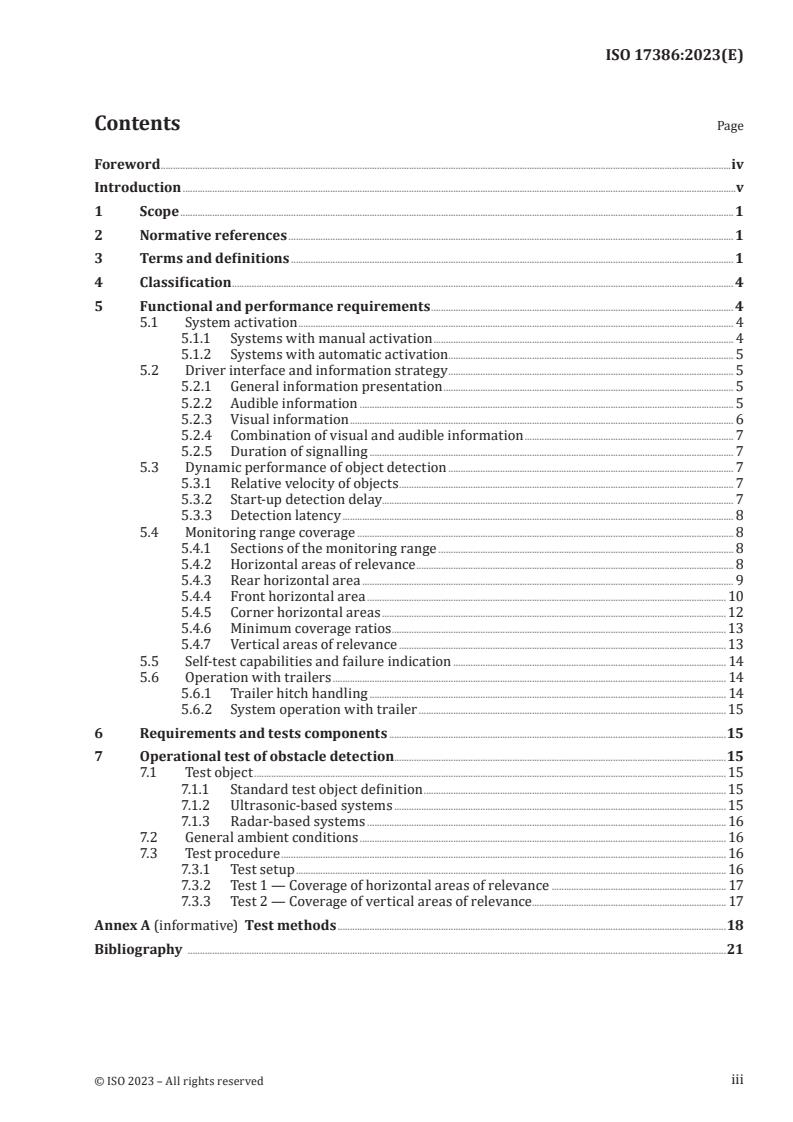
Contents Page
Foreword .iv
Introduction .v
1 Scope . 1
2 Normative references . 1
3 Terms and definitions . 1
4 Classification . 4
5 Functional and performance requirements . 4
5.1 System activation . 4
5.1.1 Systems with manual activation . 4
5.1.2 Systems with automatic activation . . 5
5.2 Driver interface and information strategy . 5
5.2.1 General information presentation . 5
5.2.2 Audible information . 5
5.2.3 Visual information . 6
5.2.4 Combination of visual and audible information . 7
5.2.5 Duration of signalling . 7
5.3 Dynamic performance of object detection . 7
5.3.1 Relative velocity of objects . 7
5.3.2 Start-up detection delay. 7
5.3.3 Detection latency . 8
5.4 Monitoring range coverage . 8
5.4.1 Sections of the monitoring range . 8
5.4.2 Horizontal areas of relevance . 8
5.4.3 Rear horizontal area . 9
5.4.4 Front horizontal area . 10
5.4.5 Corner horizontal areas .12
5.4.6 Minimum coverage ratios . 13
5.4.7 Vertical areas of relevance . 13
5.5 Self-test capabilities and failure indication . 14
5.6 Operation with trailers . 14
5.6.1 Trailer hitch handling . 14
5.6.2 System operation with trailer . 15
6 Requirements and tests components .15
7 Operational test of obstacle detection .15
7.1 Test object . 15
7.1.1 Standard test object definition . 15
7.1.2 Ultrasonic-based systems . 15
7.1.3 Radar-based systems . 16
7.2 General ambient conditions . 16
7.3 Test procedure . 16
7.3.1 Test setup . 16
7.3.2 Test 1 — Coverage of horizontal areas of relevance . 17
7.3.3 Test 2 — Coverage of vertical areas of relevance. 17
Annex A (informative) Test methods .18
Bibliography .21
iii
Foreword
ISO (the International Organization for Standardization) is a worldwide federation of national standards
bodies (ISO member bodies). The work of preparing International Standards is normally carried out
through ISO technical committees. Each member body interested in a subject for which a technical
committee has been established has the right to be represented on that committee. International
organizations, governmental and non-governmental, in liaison with ISO, also take part in the work.
ISO collaborates closely with the International Electrotechnical Commission (IEC) on all matters of
electrotechnical standardization.
The procedures used to develop this document and those intended for its further maintenance are
described in the ISO/IEC Directives, Part 1. In particular, the different approval criteria needed for the
different types of ISO document should be noted. This document was drafted in accordance with the
editorial rules of the ISO/IEC Directives, Part 2 (see www.iso.org/directives).
ISO draws attention to the possibility that the implementation of this document may involve the use
of (a) patent(s). ISO takes no position concerning the evidence, validity or applicability of any claimed
patent rights in respect thereof. As of the date of publication of this document, ISO had not received
notice of (a) patent(s) which may be required to implement this document. However, implementers are
cautioned that this may not represent the latest information, which may be obtained from the patent
database available at www.iso.org/patents. ISO shall not be held responsible for identifying any or all
such patent rights.
Any trade name used in this document is information given for the convenience of users and does not
constitute an endorsement.
For an explanation of the voluntary nature of standards, the meaning of ISO specific terms and
expressions related to conformity assessment, as well as information about ISO's adherence to
the World Trade Organization (WTO) principles in the Technical Barriers to Trade (TBT), see
www.iso.org/iso/foreword.html.
This document was prepared by Technical Committee ISO/TC 204, Intelligent transport systems.
This third edition cancels and replaces the second edition (ISO 17386:2010), which has been technically
revised.
The main changes are as follows:
— requirements updated according to state-of-the-art systems regarding detection characteristic;
— test method for detection latency added.
Any feedback or questions on this document should be directed to the user’s national standards body. A
complete listing of these bodies can be found at www.iso.org/members.html.
iv
Introduction
Today's aerodynamically-shaped vehicles often result in restricted rear and front visibility. Manoeuvring
Aids for Low Speed Operation (MALSO) enhance security and driver convenience during parking or
manoeuvring situations at very low speed, e.g. squeezing into small parking spaces or through narrow
passages. Drivers can avoid collisions with obstacles that cannot be seen but can be detected by the
system and they can make more effective use of limited parking space.
MALSO systems are detection devices with non-contact sensors which assist the driver during low-
speed manoeuvring. MALSO systems indicate to the driver the presence of front, rear or corner objects.
They are regarded as an aid to drivers for use at speeds of up to 0,5 m/s, and they do not relieve drivers
of their responsibility when driving the vehicle.
v
INTERNATIONAL STANDARD ISO 17386:2023(E)
Intelligent transport systems — Manoeuvring aids for low-
speed operation (MALSO) — Performance requirements
and test procedures
1 Scope
This document addresses light-duty vehicles, such as passenger cars, pick-up trucks, light vans and
sport utility vehicles (motorcycles excluded) equipped with Manoeuvring Aids for Low Speed Operation
(MALSO) systems. It specifies the minimum functionality requirements which the driver can generally
expect of the device, i.e. detection of and information on the presence of relevant obstacles within a
defined (short) detection range. It defines minimum requirements for failure indication as well as
performance test procedures; it includes rules for the general information strategy but does not restrict
the kind of information or display system.
MALSO systems use object-detection devices (sensors) for ranging in order to provide the driver with
information based on the distance to obstacles. Although sensing technology is not addressed in this
document, technology does affect the performance-test procedures set up in Clause 7. The current test
objects are defined based on systems using ultrasonic sensors, which reflect the most commonly used
technology at the time of publication. For other sensing technologies which will potentially emerge in
the future, these test objects shall be checked and changed if required.
Visibility-enhancement systems like video-camera aids without distance ranging and warning are not
covered by this document.
Reversing aids and obstacle-detection devices on heavy commercial vehicles are not addressed by this
document.
2 Normative references
The following documents are referred to in the text in such a way that some or all of their content
constitutes requirements of this document. For dated references, only the edition cited applies. For
undated references, the latest edition of the referenced document (including any amendments) applies.
ISO 2575, Road vehicles — Symbols for controls, indicators and tell-tales
ISO 15006, Road vehicles — Ergonomic aspects of transport information and control systems —
Specifications for in-vehicle auditory presentation
ISO 15008, Road vehicles — Ergonomic aspects of transport information and control systems —
Specifications and test procedures for in-vehicle visual presentation
3 Terms and definitions
For the purposes of this document, the following terms and definitions apply.
ISO and IEC maintain terminology databases for use in standardization at the following addresses:
— ISO Online browsing platform: available at https:// www .iso .org/ obp
— IEC Electropedia: available at https:// www .electropedia .org/
3.1
audible warning and information
acoustical signal that is used to present information about relevant obstacles to the driver
EXAMPLE Pulses, speech.
Note 1 to entry: Acoustical pulses can be coded mainly by carrier frequency, repetition rate and position of sound
generator.
Note 2 to entry: See Figure 1.
3.2
evaluation for warning and advice
information about detected obstacles that, when the system is activated, is evaluated to warn and
advise the driver in order to help with the current low speed manoeuvre
Note 1 to entry: See Figure 1.
Figure 1 — Block diagram of the potential sub-functions of a manoeuvring aid for low speed
operation
3.3
manoeuvring aid for low-speed operation
MALSO
system that, at low speeds (< 0,5 m/s), is capable of informing the driver of the presence of stationary
obstacles in particular areas in close proximity to the subject vehicle, mainly during parking and
manoeuvring in narrow passages
3.4
monitoring range
specific three-dimensional space around the vehicle, which is divided into rear and front corner
monitoring range, front, rear-1 and rear-2 monitoring range
Note 1 to entry: The covered monitoring ranges depend on the intended use of the system (see Clause 4).
Note 2 to entry: See Figure 2.
Key
1 front
2 front corner
3 rear corner
4 rear-1
5 rear-2
Figure 2 — Monitoring ranges (plan view)
3.5
reversing detection system
system that gives an indication to the driver, when the reverse gear is selected, whether there are
objects in the monitoring range
3.6
sensor
component that detects objects in the monitoring range
Note 1 to entry: There are a variety of sensor principles which can be used. The most common principle is
the flight time measurement (e.g. radar, lidar, sonar). Active sensor elements create a pulsed or continuously
modulated field of microwaves, (infrared) light or ultrasonic sound. The reflected energy due to an object in
the detection area is received, and the distance to the object is measured. The lateral position of the object is
estimated based on the beam or field directional characteristics, or based on the timing relationships between
sensors with overlapping coverage areas. Alternative principles include distance measurement by triangulation
principle and passive sensor systems using image processing.
3.7
system activation
action of transitioning the system operation from a quiescent mode to an active one in which the system
is monitoring the monitoring ranges, evaluating the objects detected and generating appropriate
feedback to assist the driver
3.8
test object
object with a specific material, geometry and surface for testing the monitoring range
Note 1 to entry: This test object should give comparable results for the relevant sensor types.
3.9
visual information and warning
optical signal which is used to present information about relevant obstacles to the driver
EXAMPLE Telltale, display.
Note 1 to entry: Visual information can be coded, for example, by colour, repetition rate, symbols or text. The
driver can be warned by continuous or pulsating signalling of possibly coloured telltales. Information can be
graphical or alphanumeric.
3.10
warning levels
progressive critical levels of audible/visual/tactile/kinaesthetic information or feedback to the driver
regarding the hazard environment
4 Classification
The MALSO system classification reflects the diversity of driving behaviour and market demand in
different regions of the world. For example, in certain countries, drivers manoeuvre within a very tight
area and have come to rely on warnings given at very short range. In other regions, drivers expect
warnings to be given at a relatively longer range. A manufacturer may select the most suitable system
parameters based on the driving style and expectations of the target driver population.
The Manoeuvring Aids for Low Speed Operation are classified according to their capability of covering
the different monitoring ranges. Each monitoring range corresponds to a particular part of the vehicle
boundary to prevent colliding with an obstacle. See Figure 2. The class of the system is indicated by an
abbreviation corresponding to the monitoring ranges covered.
Table 1 — Classification of Manoeuvring Aids for Low Speed Operation — Abbreviations of
monitoring ranges
Monitoring range Abbreviation Detection Maximum driving
distance speed
m m/s
Rear-1 R1 0,6 0,3
Rear-2 R2 1,0 0,5
Rear corner driver side Rcd 0,5 0,3
Rear corner passenger side Rcp 0,5 0,3
Front F 0,6 0,3
Front corner driver side Fcd 0,5 0,3
Front corner passenger side Fcp 0,5 0,3
Any combination of monitoring ranges may be used if it is beneficial for the intended use of the system.
The corner type systems have monitoring ranges restricted to particular corners of the vehicle and are
mainly intended to assist the driver while driving through narrow passages.
For convenience and most efficient use of the manoeuvring aid, the driver shall be informed about the
type of system the vehicle is equipped with, according to the classification above.
5 Functional and performance requirements
5.1 System activation
5.1.1 Systems with manual activation
The system is turned on and off by the driver with a switch or push-button. After activation, the
system may indicate readiness for service acoustically or visually. This indication shall be clearly
distinguishable from distance information about obstacles.
5.1.2 Systems with automatic activation
The system is activated/deactivated automatically according to the driving situation. The possible
monitoring ranges (see Clause 4) may be activated separately in order to avoid nuisance signals. After
automatic activation, readiness for service may be indicated to the driver. There may be an on/off
switch or push-button to override automatic (de)activation.
Recommended activation and deactivation criteria are the gear selection (reverse/forward), the vehicle
speed, v, and the travelled distance, x, since system activation as described in Table 2. Further criteria
may be used by the OEM to improve comfort or safety of the system. The system shall be activated
according to Table 2 if the vehicle speed, v, is greater than zero. In the case that the vehicle speed, v,
equals zero, application of Table 2 is up to the manufacturers.
The vehicle speed v for activation and v for deactivation shall be ≥ 0,5 m/s or 0,3 m/s, depending on
on off
the monitoring range under consideration (see Table 1, maximum driving speed).
Table 2 — System activation/deactivation criteria
Monitoring range Reverse gear selected Gear other than reverse is selected
v < v v ≥ v or x > x
on off off
Front o + −
Front corners o + −
Rear + o −
Rear corners + o −
“o” indicates optional
“+” indicates active
“−” indicates inactive
On vehicles with automatic transmission, the MALSO system may be deactivated if the P (parking) gear
position is selected. It is also possible to deactivate the system while the parking brake is engaged.
5.2 Driver interface and information strategy
5.2.1 General information presentation
For the driver interface, at least the audible information channel shall be used. Visual information and
warning may be used as a supplement. A standardized information strategy will be the basis for the
development of both types of information components, as this makes the use in different vehicles easier
and safer. The most relevant information for the driver is the distance, i.e. the clearance, between the
vehicle boundary and an obstacle. The location of the obstacle relative to the vehicle may be indicated
as additional information.
Failures shall also be indicated to the driver.
A general information strategy cannot be established because of the following reasons:
— there are many different ways of coding the information;
— each car manufacturer will integrate the manoeuvring aids into its driver-information system with
its specific driver interface.
Subclauses 5.2.2 to 5.2.5 may be regarded as guidance in the implementation of an information strategy.
5.2.2 Audible information
The audible information shall be presented in accordance with ISO 15006.
The following basic code is recommended for the audible information channel.
a) Distance should be coded into at least two levels. These zones may be represented by different
repetition rates, with the basic rule that a high repetition rate or a continuous sound corresponds
to short distances. If a different or an additional code is used, it should not interfere with the basic
rule.
b) The different areas may be represented by different carrier frequencies (e.g. high frequency for the
front, low frequency for the back of the vehicle). In this case, not more than two different areas/
carrier frequencies should be used. Synthesized or recorded voice messages may also be used.
c) The activation/deactivation of the system and the indication of failure/disturbance may be
presented by an audible signal, clearly distinguishable from the other signals.
5.2.3 Visual information
The visual information shall be presented in accordance with ISO 15008.
If the visual information channel is used as a supplement to the audible channel, the following basic
code is recommended.
a) The information should be codified into at least two levels, represented by multiple colours: for
example, red for level 1 (imminent collision level) and yellow or green for level 2 (attention level).
If a different code or an additional advisory level is used, it should not interfere with these basic
code elements. The two levels may be subdivided by using more than one display element with the
same colour, e.g. a bar graph with three red and three yellow bars, allowing for six sub-levels. If a
monochromatic element is used instead of multiple colours, the two levels may be represented by a
combination of continuous and flashing illumination, or a display consisting of incremental bars.
Figure 3 shows the warning levels for the rear monitoring range.
Key
1 level 1 x distance to vehicle
2 level 2 x distance to beginning of level 1
3 advisory level x distance to beginning of level 2
4 rear monitoring range x distance to beginning of advisory level
m
Figure 3 — Warning levels for rear monitoring range
b) The display should be located so as to minimize the likelihood of inducing drivers to change their
direction of vision. For example, it is recommended to place the display for the rear monitoring
range in the rear part of the passenger compartment, because this allows drivers to watch the
display while simultaneously looking through the rear mirror or over their shoulder directly
through the rear window. For the same reason it is recommended to locate the display for the front
monitoring range in the dashboard.
c) It is recommended to indicate the activation/deactivation and malfunction of the system by a
telltale or a symbol in all active displays of the system. These symbols shall be in accordance with
ISO 2575.
5.2.4 Combination of visual and audible information
A combination of visual and audible information may be used to improve the system performance
or to reduce the possibility of annoying the driver and passengers, taking into account the specific
advantages of bot
...