

ISO 16304:2018
(Main)Ships and marine technology — Marine environment protection — Arrangement and management of port waste reception facilities
General Information
- Abstract
This document provides a method for addressing ship generated waste and cargo residues from when they are offloaded from the ship, to how they are managed ashore. The provision, operation and use of port reception facilities (PRFs) are inherently linked, so this document addresses the design of PRFs, and their operation and management. This document is designed to be used by ports and terminals with existing PRFs which aim to refine their systems; it can also be used by new ports and terminals that are developing PRFs. Parties to MARPOL are obligated as Port States to ensure that port reception facilities (PRFs) adequate to meet the needs of the ships using them without causing undue delay are provided at their ports and terminals. MARPOL does not seek to regulate the management of ship generated waste and cargo residues at ports and terminals beyond the reception facility requirement. However, ports and terminals may need to consider national, regional and local regulations. While these regulations can exceed the scope of MARPOL, the IMO recognises the need to manage ship generated waste and cargo residues at ports and terminals as part of an environmentally sound management approach for avoiding, minimising, and eliminating pollution from ships. In consideration of above, this document applies to the management of ship generated waste and cargo residues regulated by MARPOL that are discharged at ports and terminals. It also covers principles and issues that should be considered in the development of a PWMP, its implementation and PRF operations. The operation of any PRF is governed by the principles and procedures included in the PWMP. The procedures to operate the PRF and the development of a PWMP are closely linked and therefore are integrated into this document. This document addresses the principles and issues that should be considered in: — The development of a port waste management strategy; — The design and operation of PRF; — PWMP development, implementation and compliance; and — PRF management and accountability. This document has been designed to be used by ports and terminals of any size. It does not give specifics on the size or location of a PRF in each port, but provides a list of principles to be considered and applied to any size of type of port or terminal (e.g. marina, fishing port, container terminal, oil terminal, roll on/roll off terminal, cruise terminal, ferry terminal, bulk or general cargo terminal, ship repair or recycling facility, and offshore terminal). Inland ports and marinas and those ports that have entered regional arrangements for the provision of a PRF can also use this document.
- Status
- Published
- Publication Date
- 28-Aug-2018
- Technical Committee
- ISO/TC 8/SC 2 - Marine environment protection
- Drafting Committee
- ISO/TC 8/SC 2 - Marine environment protection
- Current Stage
- 9092 - International Standard to be revised
- Start Date
- 02-May-2024
- Completion Date
- 29-Aug-2026
Buy Documents


ISO 16304:2018 - Ships and marine technology -- Marine environment protection -- Arrangement and management of port waste reception facilities
ISO 16304:2018 - Ships and marine technology — Marine environment protection — Arrangement and management of port waste reception facilities/29/2018
Overview
ISO 16304:2018 - Ships and marine technology: Marine environment protection - Arrangement and management of port waste reception facilities (PRFs) - provides a practical, standardized method for managing ship generated waste and cargo residues from the moment they are offloaded to their downstream ashore management. It helps ports and terminals (new or existing) design, operate and manage PRFs and develop a Port Waste Management Plan (PWMP) that meets MARPOL obligations while supporting environmentally sound waste minimisation.
Key topics and technical requirements
ISO 16304:2018 covers the full lifecycle of PRF provision and operation. Major technical topics include:
- Waste management strategy elements - administrative, legal, technological, infrastructure and support services.
- Design and operation of PRFs - port characteristics, spatial and siting considerations, types (fixed, floating, mobile), handling capacity and equipment, storage and accessibility.
- Waste characteristics and handling - segregation, recycling, final disposal options and participation in reuse/recovery programs.
- Port Waste Management Plan (PWMP) - development, legislation/regulatory alignment, roles and responsibilities, documentation and procedures.
- Cost recovery and finance - fee systems, incentives and economic considerations to support PRF operations.
- Data collection, monitoring and notifications - data management for compliance, reporting and continuous improvement.
- Implementation and assurance - PWMP review, periodic auditing and corrective actions.
- Supporting material - annexes with examples of ship-originating waste streams and conversion factors to aid planning.
The standard emphasizes the waste-minimisation hierarchy: prevention → recycling → energy recovery → disposal (onboard) and avoidance → reduction → reuse → recycling → incineration with energy recovery → disposal (ashore).
Applications and who uses it
ISO 16304:2018 is designed for practical use by:
- Port authorities and terminal operators (marinas, fishing ports, container, oil, ro-ro, cruise, ferry, bulk, ship repair/recycling, offshore terminals)
- Maritime regulators and national authorities implementing MARPOL obligations
- Environmental and operations managers developing PWMPs and PRF procedures
- Consultants and designers planning PRF infrastructure and logistics
- Ship owners, ship agents and waste service providers seeking harmonized reception practices
Use cases include PRF design, operational procedures, cost-recovery schemes, regulatory compliance checks, and integration with broader environmental management systems.
Related standards
- MARPOL (IMO) requirements for port reception facilities (legal framework)
- ISO 21070 (shipboard waste segregation methodology)
- ISO 14001 (environmental management systems) - ISO 16304 complements ISO 14001 by focusing specifically on PRFs and PWMPs
ISO 16304:2018 supports consistent, environmentally responsible port waste management and helps ports meet MARPOL obligations while optimising operational efficiency.
Relations
- Effective Date
- 04-May-2024
- Effective Date
- 05-Jul-2014
Buy Documents
ISO 16304:2018 - Ships and marine technology -- Marine environment protection -- Arrangement and management of port waste reception facilities
ISO 16304:2018 - Ships and marine technology — Marine environment protection — Arrangement and management of port waste reception facilities/29/2018
Get Certified
Connect with accredited certification bodies for this standard

BSI Group
BSI (British Standards Institution) is the business standards company that helps organizations make excellence a habit.

Bureau Veritas
Bureau Veritas is a world leader in laboratory testing, inspection and certification services.

DNV
DNV is an independent assurance and risk management provider.
Sponsored listings
Frequently Asked Questions
ISO 16304:2018 is a standard published by the International Organization for Standardization (ISO). Its full title is "Ships and marine technology — Marine environment protection — Arrangement and management of port waste reception facilities". This standard covers: This document provides a method for addressing ship generated waste and cargo residues from when they are offloaded from the ship, to how they are managed ashore. The provision, operation and use of port reception facilities (PRFs) are inherently linked, so this document addresses the design of PRFs, and their operation and management. This document is designed to be used by ports and terminals with existing PRFs which aim to refine their systems; it can also be used by new ports and terminals that are developing PRFs. Parties to MARPOL are obligated as Port States to ensure that port reception facilities (PRFs) adequate to meet the needs of the ships using them without causing undue delay are provided at their ports and terminals. MARPOL does not seek to regulate the management of ship generated waste and cargo residues at ports and terminals beyond the reception facility requirement. However, ports and terminals may need to consider national, regional and local regulations. While these regulations can exceed the scope of MARPOL, the IMO recognises the need to manage ship generated waste and cargo residues at ports and terminals as part of an environmentally sound management approach for avoiding, minimising, and eliminating pollution from ships. In consideration of above, this document applies to the management of ship generated waste and cargo residues regulated by MARPOL that are discharged at ports and terminals. It also covers principles and issues that should be considered in the development of a PWMP, its implementation and PRF operations. The operation of any PRF is governed by the principles and procedures included in the PWMP. The procedures to operate the PRF and the development of a PWMP are closely linked and therefore are integrated into this document. This document addresses the principles and issues that should be considered in: — The development of a port waste management strategy; — The design and operation of PRF; — PWMP development, implementation and compliance; and — PRF management and accountability. This document has been designed to be used by ports and terminals of any size. It does not give specifics on the size or location of a PRF in each port, but provides a list of principles to be considered and applied to any size of type of port or terminal (e.g. marina, fishing port, container terminal, oil terminal, roll on/roll off terminal, cruise terminal, ferry terminal, bulk or general cargo terminal, ship repair or recycling facility, and offshore terminal). Inland ports and marinas and those ports that have entered regional arrangements for the provision of a PRF can also use this document.
This document provides a method for addressing ship generated waste and cargo residues from when they are offloaded from the ship, to how they are managed ashore. The provision, operation and use of port reception facilities (PRFs) are inherently linked, so this document addresses the design of PRFs, and their operation and management. This document is designed to be used by ports and terminals with existing PRFs which aim to refine their systems; it can also be used by new ports and terminals that are developing PRFs. Parties to MARPOL are obligated as Port States to ensure that port reception facilities (PRFs) adequate to meet the needs of the ships using them without causing undue delay are provided at their ports and terminals. MARPOL does not seek to regulate the management of ship generated waste and cargo residues at ports and terminals beyond the reception facility requirement. However, ports and terminals may need to consider national, regional and local regulations. While these regulations can exceed the scope of MARPOL, the IMO recognises the need to manage ship generated waste and cargo residues at ports and terminals as part of an environmentally sound management approach for avoiding, minimising, and eliminating pollution from ships. In consideration of above, this document applies to the management of ship generated waste and cargo residues regulated by MARPOL that are discharged at ports and terminals. It also covers principles and issues that should be considered in the development of a PWMP, its implementation and PRF operations. The operation of any PRF is governed by the principles and procedures included in the PWMP. The procedures to operate the PRF and the development of a PWMP are closely linked and therefore are integrated into this document. This document addresses the principles and issues that should be considered in: — The development of a port waste management strategy; — The design and operation of PRF; — PWMP development, implementation and compliance; and — PRF management and accountability. This document has been designed to be used by ports and terminals of any size. It does not give specifics on the size or location of a PRF in each port, but provides a list of principles to be considered and applied to any size of type of port or terminal (e.g. marina, fishing port, container terminal, oil terminal, roll on/roll off terminal, cruise terminal, ferry terminal, bulk or general cargo terminal, ship repair or recycling facility, and offshore terminal). Inland ports and marinas and those ports that have entered regional arrangements for the provision of a PRF can also use this document.
ISO 16304:2018 is classified under the following ICS (International Classification for Standards) categories: 13.020.99 - Other standards related to environmental protection. The ICS classification helps identify the subject area and facilitates finding related standards.
ISO 16304:2018 has the following relationships with other standards: It is inter standard links to ISO 16304, ISO 16304:2013. Understanding these relationships helps ensure you are using the most current and applicable version of the standard.
ISO 16304:2018 is available in PDF format for immediate download after purchase. The document can be added to your cart and obtained through the secure checkout process. Digital delivery ensures instant access to the complete standard document.
Standards Content (Sample)
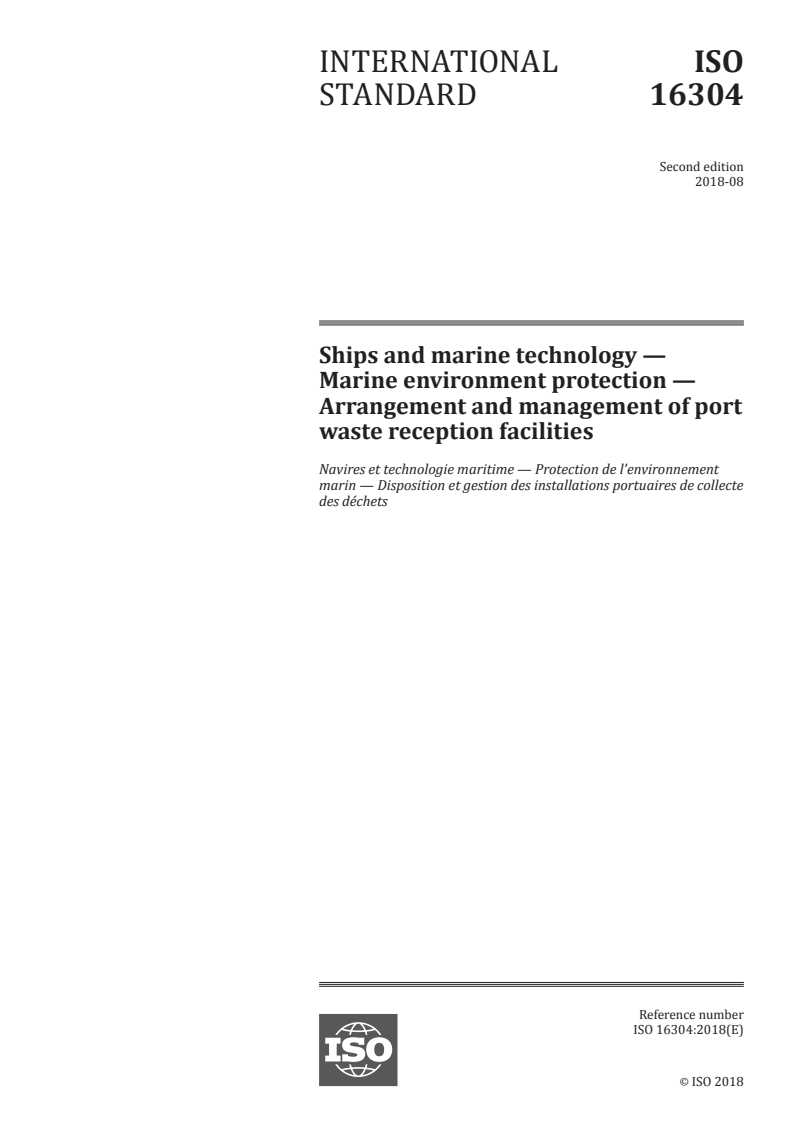
INTERNATIONAL ISO
STANDARD 16304
Second edition
2018-08
Ships and marine technology —
Marine environment protection —
Arrangement and management of port
waste reception facilities
Navires et technologie maritime — Protection de l'environnement
marin — Disposition et gestion des installations portuaires de collecte
des déchets
Reference number
©
ISO 2018
© ISO 2018
All rights reserved. Unless otherwise specified, or required in the context of its implementation, no part of this publication may
be reproduced or utilized otherwise in any form or by any means, electronic or mechanical, including photocopying, or posting
on the internet or an intranet, without prior written permission. Permission can be requested from either ISO at the address
below or ISO’s member body in the country of the requester.
ISO copyright office
CP 401 • Ch. de Blandonnet 8
CH-1214 Vernier, Geneva
Phone: +41 22 749 01 11
Fax: +41 22 749 09 47
Email: copyright@iso.org
Website: www.iso.org
Published in Switzerland
ii © ISO 2018 – All rights reserved
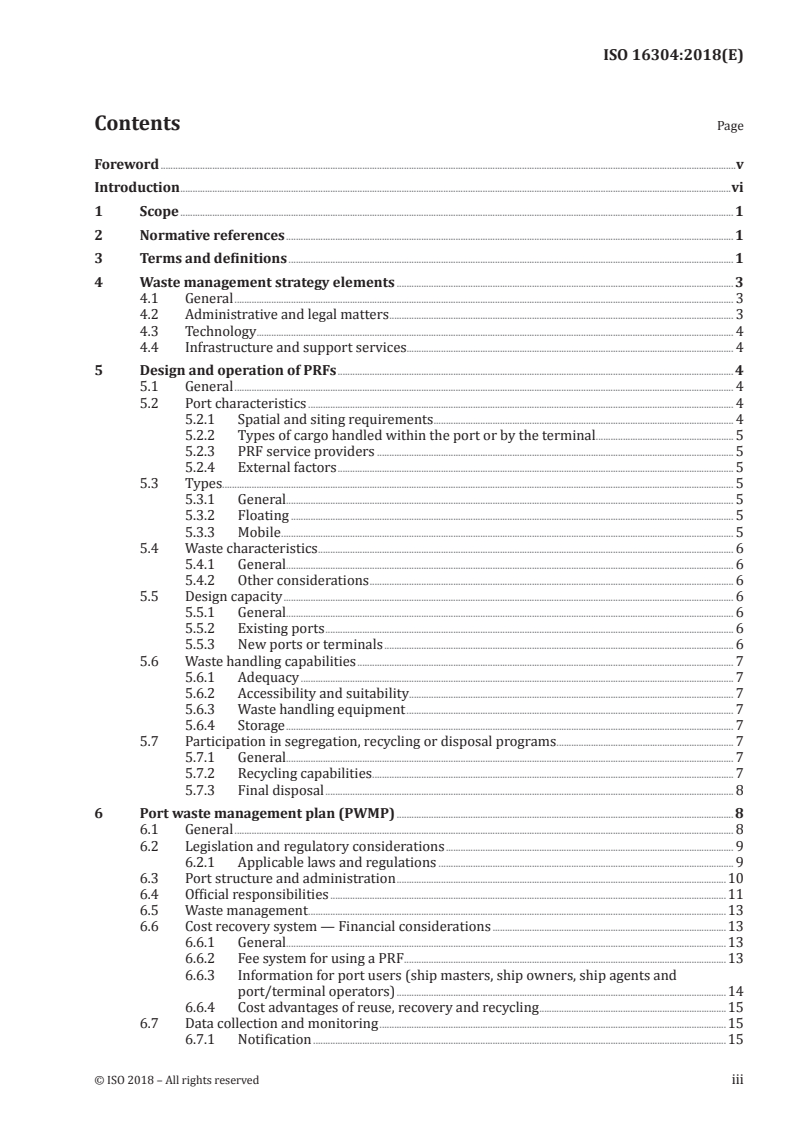
Contents Page
Foreword .v
Introduction .vi
1 Scope . 1
2 Normative references . 1
3 Terms and definitions . 1
4 Waste management strategy elements . 3
4.1 General . 3
4.2 Administrative and legal matters . 3
4.3 Technology . 4
4.4 Infrastructure and support services. 4
5 Design and operation of PRFs . 4
5.1 General . 4
5.2 Port characteristics . 4
5.2.1 Spatial and siting requirements . 4
5.2.2 Types of cargo handled within the port or by the terminal . 5
5.2.3 PRF service providers . 5
5.2.4 External factors . 5
5.3 Types. 5
5.3.1 General. 5
5.3.2 Floating . 5
5.3.3 Mobile . 5
5.4 Waste characteristics . 6
5.4.1 General. 6
5.4.2 Other considerations . 6
5.5 Design capacity . 6
5.5.1 General. 6
5.5.2 Existing ports . 6
5.5.3 New ports or terminals . 6
5.6 Waste handling capabilities . 7
5.6.1 Adequacy . 7
5.6.2 Accessibility and suitability . . 7
5.6.3 Waste handling equipment . 7
5.6.4 Storage . 7
5.7 Participation in segregation, recycling or disposal programs . 7
5.7.1 General. 7
5.7.2 Recycling capabilities . . 7
5.7.3 Final disposal . 8
6 Port waste management plan (PWMP) . 8
6.1 General . 8
6.2 Legislation and regulatory considerations . 9
6.2.1 Applicable laws and regulations . 9
6.3 Port structure and administration .10
6.4 Official responsibilities .11
6.5 Waste management .13
6.6 Cost recovery system — Financial considerations .13
6.6.1 General.13
6.6.2 Fee system for using a PRF .13
6.6.3 Information for port users (ship masters, ship owners, ship agents and
port/terminal operators) .14
6.6.4 Cost advantages of reuse, recovery and recycling .15
6.7 Data collection and monitoring .15
6.7.1 Notification .15
6.7.2 Data management .15
6.8 Pre- and ongoing consultation .15
6.9 Additional documentation .16
7 Implementation .16
7.1 General .16
7.2 PWMP review .16
7.3 Periodic auditing .16
7.3.1 Conducting the audit .17
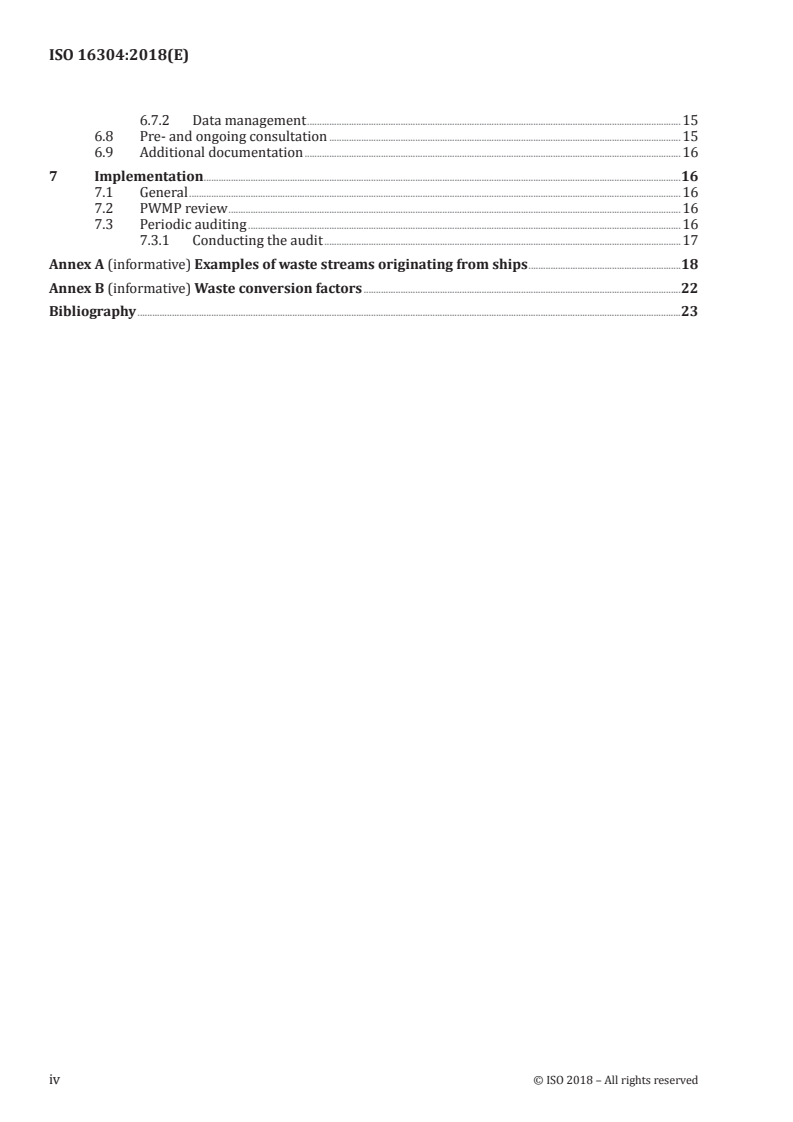
Annex A (informative) Examples of waste streams originating from ships .18
Annex B (informative) Waste conversion factors .22
Bibliography .23
iv © ISO 2018 – All rights reserved
Foreword
ISO (the International Organization for Standardization) is a worldwide federation of national standards
bodies (ISO member bodies). The work of preparing International Standards is normally carried out
through ISO technical committees. Each member body interested in a subject for which a technical
committee has been established has the right to be represented on that committee. International
organizations, governmental and non-governmental, in liaison with ISO, also take part in the work.
ISO collaborates closely with the International Electrotechnical Commission (IEC) on all matters of
electrotechnical standardization.
The procedures used to develop this document and those intended for its further maintenance are
described in the ISO/IEC Directives, Part 1. In particular the different approval criteria needed for the
different types of ISO documents should be noted. This document was drafted in accordance with the
editorial rules of the ISO/IEC Directives, Part 2 (see www .iso .org/directives).
Attention is drawn to the possibility that some of the elements of this document may be the subject of
patent rights. ISO shall not be held responsible for identifying any or all such patent rights. Details of
any patent rights identified during the development of the document will be in the Introduction and/or
on the ISO list of patent declarations received (see www .iso .org/patents).
Any trade name used in this document is information given for the convenience of users and does not
constitute an endorsement.
For an explanation on the voluntary nature of standards, the meaning of ISO specific terms and
expressions related to conformity assessment, as well as information about ISO's adherence to the
World Trade Organization (WTO) principles in the Technical Barriers to Trade (TBT) see the following
URL: www .iso .org/iso/foreword .html.
This document was prepared by Technical Committee ISO/TC 8, Ships and marine technology,
Subcommittee SC 2, Marine environment protection.
This second edition cancels and replaces the first edition (ISO 16304:2013), which has been technically
revised.
Any feedback or questions on this document should be directed to the user’s national standards body. A
complete listing of these bodies can be found at www .iso .org/members .html.
Introduction
The development of adequate port reception facilities (PRFs) for ship generated waste and cargo
residues is a major factor in the management of each of the shipboard waste streams covered by the
International Convention for the Prevention of Pollution from Ships (MARPOL) Annexes I to VI, as
amended, excluding Annex III (packaged dangerous goods). MARPOL requires that Party States ensure
the provision of adequate reception facilities in ports to receive these wastes. Parties to MARPOL
should have developed implementing legislation to provide for PRFs. Regional and intergovernmental
legislation has also been developed. However, due to operational, ownership, geographic, and legislative
differences in ports, there is a large disparity in how operations are conducted. To overcome some of
the major issues, the International Maritime Organization (IMO), through its implementation of IMO
Instruments (III) Subcommittee (formerly the subcommittee on Flag State Implementation) developed
an action programme to tackle the inadequacy of PRFs.
To obtain the most efficient management of waste and to reduce the time and resource burden in
segregating and handling waste in the ports, the concept of waste minimisation has been integrated
into this document by incorporating the following principles:
— For waste generated aboard a ship:
“Prevention before recycling before energy recovery before disposal”
— Once the waste is offloaded ashore:
“Avoidance before reduction, before reuse, before recycling, before incineration with energy
recovery, before disposal”
Ship owners and operators, cargo owners, and port and terminal owners and operators, along with
governments are aware of the importance of well-organised and managed waste collection, especially
with respect to health and safety on board ships and at ports and terminals. It has been acknowledged
at the IMO that standardized methodologies for waste management both on board ships and ashore
at PRFs would harmonize practices and ensure a smooth delivery of ship generated waste and cargo
residues to shore-side facilities. ISO 21070 provides a methodology for ships to segregate their garbage,
thus, port reception facilities worldwide may expect a certain level of ship segregated waste and
cargo residues. However, ISO 21070 cannot work alone and needs to be complemented by a parallel
International Standard for the reception of ship generated waste. This document assists in the planning
for the provision of adequate PRFs.
This document is also meant to complement ISO 14001 by adding a component that extends its
principles to management of ships' waste in ports. It provides a specific methodology that any
port, harbour, terminal, or marina can apply to the planning, development and operation of its PRF.
The document can be incorporated easily into other plans for achieving ISO 14001 accreditation, as
an extension that focuses on PRF. Conversely, the processes put in place during the preparations for
ISO 14001 accreditation will assist in meeting the development of a holistic Port Waste Management
Plan (PWMP) under this document.
vi © ISO 2018 – All rights reserved
INTERNATIONAL STANDARD ISO 16304:2018(E)
Ships and marine technology — Marine environment
protection — Arrangement and management of port waste
reception facilities
1 Scope
This document provides a method for addressing ship generated waste and cargo residues from when
they are offloaded from the ship, to how they are managed ashore. The provision, operation and use of
port reception facilities (PRFs) are inherently linked, so this document addresses the design of PRFs,
and their operation and management. This document is designed to be used by ports and terminals
with existing PRFs which aim to refine their systems; it can also be used by new ports and terminals
that are developing PRFs.
Parties to MARPOL are obligated as Port States to ensure that port reception facilities (PRFs) adequate
to meet the needs of the ships using them without causing undue delay are provided at their ports
and terminals. MARPOL does not seek to regulate the management of ship generated waste and
cargo residues at ports and terminals beyond the reception facility requirement. However, ports
and terminals may need to consider national, regional and local regulations. While these regulations
can exceed the scope of MARPOL, the IMO recognises the need to manage ship generated waste and
cargo residues at ports and terminals as part of an environmentally sound management approach for
avoiding, minimising, and eliminating pollution from ships.
In consideration of above, this document applies to the management of ship generated waste and cargo
residues regulated by MARPOL that are discharged at ports and terminals. It also covers principles and
issues that should be considered in the development of a PWMP, its implementation and PRF operations.
The operation of any PRF is governed by the principles and procedures included in the PWMP. The
procedures to operate the PRF and the development of a PWMP are closely linked and therefore are
integrated into this document.
This document addresses the principles and issues that should be considered in:
— The development of a port waste management strategy;
— The design and operation of PRF;
— PWMP development, implementation and compliance; and
— PRF management and accountability.
This document has been designed to be used by ports and terminals of any size. It does not give specifics
on the size or location of a PRF in each port, but provides a list of principles to be considered and applied
to any size of type of port or terminal (e.g. marina, fishing port, container terminal, oil terminal, roll on/
roll off terminal, cruise terminal, ferry terminal, bulk or general cargo terminal, ship repair or recycling
facility, and offshore terminal). Inland ports and marinas and those ports that have entered regional
arrangements for the provision of a PRF can also use this document.
2 Normative references
There are no normative references in this document.
3 Terms and definitions
For the purposes of this document, the following terms and definitions apply.
ISO and IEC maintain terminological databases for use in standardization at the following addresses:
— IEC Electropedia: available at http: //www .electropedia .org/
— ISO Online browsing platform: available at http: //www .iso .org/obp
3.1
adequacy
meeting the needs of ships normally calling at the port by PRFs and not providing ships with a
disincentive to use them, not causing undue delays and contributing to the protection of the environment
[SOURCE: IMO Circular 834]
3.2
cargo residues
remnants of any cargo material which are not covered by Annexes I, II, IV and VI of the MARPOL
convention and which remain on the deck or in holds following loading or unloading, including loading
and loading excess or spillage, whether in wet or dry conditions or entrained in wash water but not
including cargo dust remaining on the deck after sweeping or dust on the external surfaces of the ship
Note 1 to entry: Dry bulk cargo residues may include substances that are harmful to the marine environment
(HME) with special restrictions for discharges including HME entrained in cargo hold wash water. PRFs for cargo
residues considered to be HME may be required at loading or discharge ports that handle dry bulk cargoes.
3.3
energy recovery
energy reclamation from waste
3.4
hazardous waste
waste which, due to its nature, physical, chemical or infectious properties, is potentially hazardous to
human health
3.5
medical waste
any solid waste that is generated in the diagnosis, treatment, or immunization of human beings or
animals, in research pertaining thereto, or in the production or testing of biological materials, including
but not limited to isolation wastes, infectious agents, human blood and blood products, pathological
wastes, sharps, body parts, contaminated bedding, surgical wastes and potentially contaminated
laboratory wastes and dialysis wastes
Note 1 to entry: Medical waste is distinguished into two categories: infectious and non-infectious [WHO 2007].
3.6
port
place of geographical area consisting of infrastructure and equipment as to permit, principally,
the reception of all types of ships, including fishing vessels and recreational craft, for the loading or
unloading of passengers, cargo, stores, equipment, fuel, fish from commercial or sport fishing, or for
repairs or berthing or other related activities
3.7
port administration
public or private organisation or partnership with the responsibility for the operation of the port
3.8
port authority
organisation, either private or governmental, that manages the operations of a port, in whole or part
Note 1 to entry: Port authorities may have complete or limited jurisdiction within a geographic region.
2 © ISO 2018 – All rights reserved
3.9
port reception facility/ies
PRF
PRFs
any facility or facilities operating in, or provided by, a port or terminal which is fixed, floating or mobile
and is capable of receiving ship generated waste and cargo residues
3.10
quarantine waste
any solid or liquid waste that requires special handling, segregation and disposal due to its potential to
spread disease, diseases, or plant and animal pests when discharged or delivered ashore
Note 1 to entry: Quarantine waste may also include food waste from galley operations and may be described as
international catering waste.
3.11
recreational craft
boat or ship of any type regardless of means of propulsion that is intended for non-commercial sport or
leisure purposes
3.12
ship
vessel of any type whatsoever operating in the marine environment, including hydrofoil boats, air
cushion vehicles, submersibles, floating craft, and fixed or floating platforms
Note 1 to entry: Ships may call at inland ports.
[SOURCE: MARPOL Article 2]
3.13
ship generated waste
all waste, including sewage, and residues other than cargo residues, which are generated during the
service of a ship and fall under the scope of Annexes I, II, IV and VI to MARPOL and operational waste as
defined in Annex V or MARPOL
3.14
terminal
specific and distinct cargo or passenger loading and unloading facility for ships
3.15
waste recovery
recycling, reclamation or treatment of waste for reuse
4 Waste management strategy elements
4.1 General
There are three main components of any waste management strategy: administrative and legal matters;
1)
technology; and infrastructure and support services.
4.2 Administrative and legal matters
Many states have implemented legislation, policies and national waste management strategies that
govern the management of waste received at PRFs. Such legislation may be considered when developing
a port waste management strategy, as it will assist in determining how local compliance may affect the
operation of PRFs within a port. Additionally, there may be a need for licensing and/or local approvals,
and the port or terminal operator should consider waste tracking and documentation.
1) International Maritime Organization, 1999.
The best possible environmental solution for waste recovery and disposal should be identified.
Waste management targets adopted by the national administration for ports and terminals within its
jurisdiction may be considered in the development of port waste management strategies. If there are no
such targets, then the port or terminal operator may wish to consider developing them.
4.3 Technology
PRFs should use waste management technology that is current and applicable for ship generated waste
and cargo residues expected from ships using the port or terminal. Recycling and reclamation of waste
is preferable to disposal (see 6.5). Therefore, any waste management strategy should recognize and
promote alternative methods of waste management that utilise new and emerging technologies.
4.4 Infrastructure and support services
The waste management strategy should be developed with an awareness of the infrastructure and
support services not only throughout the port or terminal, but also beyond those physical limits.
There shall be in place suitable waste transport logistics, recycling facilities, treatment facilities, and if
necessary, final disposal sites. These treatment and disposal facilities may or may not be located within
the port. Waste management strategies should also incorporate proactive mechanisms to inform and
educate those having an interest in using the PRF.
5 Design and operation of PRFs
5.1 General
The types and number of ships normally calling at the port or terminal and the nature of operations
should be considered in the planning for the provision of a PRF. PRFs for relevant wastes shall be
available without causing undue delay to ships or imposing economic or other disincentives for their
use. The PWMP will provide options for waste collection and handling. The calculated PRF capacity
and the design of the PRF provide a foundation for the PWMP. However, for those waste volumes that
could be anticipated to fluctuate widely over different periods, the provision of a PRF should be adapted
appropriately. The system designed to support and operate a PRF should consider the following core
components.
5.2 Port characteristics
5.2.1 Spatial and siting requirements
2)
The location of a PRF should be “convenient” and not create a disincentive for ships to use. The location
shall be suitable and sufficient to allow easy and safe use that does not impose an undue delay upon the
ship. Siting considerations should include an awareness of the impact on other port operations as well
as the public areas surrounding the port or terminal.
Larger ports and terminals may require higher capacities or more diverse capabilities. Construction of
a new port or terminal may offer greater flexibility in design as opposed to making improvements to an
existing PRF.
Regardless of the type of PRF that is chosen, the port or terminal geography and layout should be
considered as part of the design phase. The best way to collect each waste stream throughout the port
or at the terminal shall be determined. In a compact port with large berths, garbage waste disposal
bins on each quay or a direct transfer to the waste handler could be implemented. However, in certain
other port configurations, it may be better to collect waste by barge. If the port is lock-bound, waste can
be landed upon entry or exit to the lock.
2) International Maritime Organization, 1999.
4 © ISO 2018 – All rights reserved
A port or terminal that is planning to increase operations in the future may see a rise in shipping
waste volumes. This may result in a need to consider providing excess PRF capability during planning
activities.
5.2.2 Types of cargo handled within the port or by the terminal
Multiple MARPOL waste reception facilities may be required. Ports or terminals that receive ships with
diverse cargoes that could produce cargo residues, oily waste, and noxious liquid substance wash water
could create unique waste handling challenges.
5.2.3 PRF service providers
Companies that are licensed or otherwise certified or approved to provide waste handling services
should be identified and verified by the port administration or port authority. Effective port waste
management goes beyond the act of receiving waste from ships. Good downstream waste management
supports the intent and purpose of having a PRF.
5.2.4 External factors
Extreme weather conditions or extreme tidal cycles may make it difficult to access PRF services or
hinder the operation of traditional waste handling equipment.
5.3 Types
5.3.1 General
The type of PRF can vary between ports and terminals and is determined after assessing the needs of
users and the frequency of use.
5.3.2 Floating
The use of barges may have distinct advantages, as they are relatively mobile, typically have sufficient
capacity to service multiple ships, and can receive most wastes. Their shallow draught allows for access
in most port and terminal areas. However, sea state limitations may prevent floating reception facilities
from operating at all times. Additionally, there is an added element of risk when transferring waste to
a floating PRF, especially oily or noxious liquid mixtures, or in ports and terminals where ship traffic is
heavy and continuous in volume.
5.3.3 Mobile
Vehicle-borne PRFs offer speed and flexibility, particularly with respect to smaller ports, terminals or
marinas as a number of ships can be serviced before the vehicle is full. However, the capacity of vehicles,
such as tank trucks and traditional garbage collection trucks may be a limiting factor when servicing
large ships. This can cause delays and increase congestion in ports and terminals. Furthermore, certain
areas may be off limits to third party waste collection organisations due to either safety or security
concerns, or both. Also, the size of the vehicle may prohibit access to all areas of the port or terminal.
5.3.3.1 Other considerations
Temporary placement of containers or collection bins that are dropped off via truck and picked up at a
later date after the container/bin is full, may be an option.
5.4 Waste characteristics
5.4.1 General
All types of ship generated waste and cargo residues that will be received and handled at the port or
terminal shall be identified. Failure to consider certain waste streams may limit the services that the
port or terminal may be able to provide. Wastes may be offloaded by ships in many different forms,
from single waste streams such as oil, sewage or segregated waste, to mixed waste streams such as
garbage. Annex A provides further information on types of ship generated waste and cargo residues.
NOTE See Annex A for a listing of waste streams and treatment options.
5.4.2 Other considerations
Not all waste streams will necessarily be produced by every ship or be offloaded in every port.
Additionally, in some circumstances ships may need or wish to offload waste, such as food waste
and cargo residues that could be discharged into the sea under the provisions of MARPOL but due to
operations, company policy, or other considerations, the master of the ship chooses to offload these
wastes ashore. Therefore, the PWMP should consider the following:
a) Some ports or terminals may require ships to offload all, or part of, their waste prior to departure.
b) Some port or terminals may treat waste from ships on international voyages differently than waste
from ships on domestic voyages (such waste may include quarantine waste, international catering
waste or food waste from galley operations).
c) Ship generated waste and cargo residues may include hazardous waste or other wastes determined
to be harmful to the marine environment.
5.5 Design capacity
5.5.1 General
The design of a PRF should be based on the number and types of ships calling on the port. The basic PRF
capacity needed in the port or terminal, per waste stream or per ship type, can be calculated based on
the expected or most probable level of traffic in the port.
5.5.2 Existing ports
For existing ports and terminals, the level/quantities of waste received in previous years can be used
to determine PRF capacity. Additionally, if there is any anticipated change in traffic, regulation or waste
management technology, then the initial figures may have to be modified.
5.5.3 New ports or terminals
When designing a new port or terminal or redesigning an existing port to handle new business, or
larger or different types of ships, a calculation of waste reception facility capacity shall be made using
estimates of the expected ship traffic. Calculations should take into consideration the number and
frequency of port calls for each type of ship and the expected wastes that are generated aboard and
delivered ashore based on:
— The type and size of ship;
— Cargo(es) handled (volumes or tonnes);
— The crew size, the number of passengers (if any);
— The average length of voyages for inbound ships; and
6 © ISO 2018 – All rights reserved
— Whether the port is a loading or unloading port or a combination of both.
If no data are available for a new port, the information could be obtained from other ports with similar
traffic.
NOTE ISO 21070, Annex A provides information on calculation of the expected amounts of (Annex V) wastes.
5.6 Waste handling capabilities
5.6.1 Adequacy
A fundamental consideration is to determine the waste handling capabilities needed in order to meet
the definition of adequacy (see 3.1).
5.6.2 Accessibility and suitability
Suitable PRFs for all waste streams shall be easily accessible by the ship. PRFs that are difficult to use
and poorly arranged may create a disincentive for ships to properly dispose of their waste while at the
port or terminal.
5.6.3 Waste handling equipment
There is a variety of equipment that can be used to collect, store and in some cases, treat or further
process the different waste streams collected at ports and terminals. The equipment selected should be
suitable for the type and quantity of waste.
Proper sighting at the berth of waste handling equipment should be considered. Poor siting and lack of
sufficient space for operation of equipment may raise safety concerns for ship personnel when using
the PRF equipment. It could also create a risk for discharge into the environment and possibly create a
disincentive for proper waste disposal.
5.6.4 Storage
Consideration should also be given to the period of time the fixed or mobile PRF can store the ship
generated waste and cargo residues on site. This should also be taken into account in the PWMP.
Lengthy storage of waste should be avoided, as it can create stress on the supporting infrastructure
and impact the waste handling services for future ships. It may also affect the health and safety of
workers and the environment if stored waste quantities exceed storage capacities. PWMPs that do not
arrange for routine waste removal services shall ensure that waste storage receptacles of sufficient
capacity and quantity are provided. Conversely, PRF that are serviced frequently may not need to have
large capacity waste storage receptacles.
5.7 Participation in segregation, recycling or disposal programs
5.7.1 General
The provision for waste segregation may lead to increased participation in recycling programs. For this
to be successful, segregated waste should remain segregated until the final treatment. Many PRF can be
conveniently arranged to accommodate recycling and other waste management services. Additionally,
ships that implement ISO 21070 will have waste segregation procedures that will make operations at
the PRF and downstream waste management easier.
5.7.2 Recycling capabilities
Recycling is a process where materials, which are otherwise destined for final disposal are collected,
processed or reprocessed, and then reused. These materials all have useful chemical or physical
properties after having served their original purpose.
5.7.3 Final disposal
Final disposal of wastes should be viewed as a last option to be exercised only after alternatives have
been explored, including energy recovery from wastes, and deemed unattainable. Several options for
final disposal exist, and the benefits and drawbacks should be considered and documented in the port
or terminal's waste management strategy.
6 Port waste management plan (PWMP)
6.1 General
Ports and terminals should, at a minimum, provide PRFs for ship generated waste (3.13) and cargo
residues (see 3.2). As such, the PWMP takes into account the national waste management strategy
and defines how and by whom waste is collected at a port or terminal. This is necessary as waste
streams received from ships calling on ports or terminals shall be dealt with in an environmentally
sound manner. Developing and following such a waste management strategy will ensure that all parties
involved in the generation, reception and transfer of ship generated waste and cargo residues conform
to recognised practices and standards. This serves to protect the health and quality of the port users,
public and the environment.
There are five key elements that should be considered in a PWMP. They are:
a) Development;
b) Publication;
c) Implementation;
d) Enforcement of delivery of ship-generated waste and cargo residues by competent authorities; and
e) Monitoring of the plan to ensure that all parties, including ships and facility providers are adhering
to the plan, the plan is and remains fit for use and the reception facilities are adequate.
The development of a PWMP is the planning stage for the eventual provision of a PRF and is the most
crucial and time consuming part of the process. First, the port should consider what waste reception
services they should provide and exactly how they can provide them. The PWMP needs to be developed
to manage the different waste streams generated on board a ship in an efficient and environmentally
sound manner that does not cause undue delay to ships or disincentives to shipping. A PWMP can be
developed in-house, or by a consultant; and it shall be transparent, auditable, include provisions for
consultation with the stakeholders. It should identify the major principles of waste minimisation,
management and disposal, while ensuring the health, safety and security concerns of the port or
terminal user. The PWMP should also result in the development of a formal plan that shall be consulted
upon, approved (if necessary) and used as the basis for developing the day-to-day manual for the
management and operation of the PRF.
The PWMP should include relevant information on the following key areas outlining pertinent
procedures and management measures, as appropriate:
— An analysis of the relevant regulations;
— The waste management structure into which the PWMP fits;
— The official responsibilities of the port owners/operators and other relevant parties and the
different governmental administrations involved in controlling the management of ship generated
waste and cargo residues;
— Geographical and administrative scope of the PWMP;
— Official responsibilities within the management and operation of the PRF within the port;
— An assessment of the need for the PRF (see 5.1);
8 © ISO 2018 – All rights reserved
— A description of the cost recovery system;
3)
— Procedures for how to report and take action on alleged inadequacies of PRF;
4)
— Explanation of reporting and notification procedures for ship generated waste and cargo residues;
— A description of the method for recording the amounts of wastes received;
— Procedures for ongoing consultations with organisations representing the port or terminal users,
waste contractors, and other stakeholders, including a description of how the essential information
will be made available to the public (e.g. shipping agents and other relevant stakeholders);
— Review, refinement (corrective and preventive) actions and/or auditing; and
— Enforcement measures.
Each plan will take into account the specific nature of the port or terminal and its users. This is then
5)
outlined in a formal plan which is implemented after consultation with all port stakeholders.
6.2 Legislation and regulatory considerations
6.2.1 Applicable laws and regulations
Before any PWMP or PRF can be developed or established, port or terminal administrators should
undertake an analysis of the international, regional, national and local regulations that control waste
and ship generated waste and cargo residues. That analysis should be included in the PWMP. National
regulation, at a minimum, will reflect the international requirements found in MARPOL. These
regulations may also set out the responsibilities, legal processes, waste management options and
procedures with which the port or terminal will have to comply. Specific regulations may include but
are not limited to:
— Responsibility for developing a PWMP;
— Procedure for approval of the PWMP;
— Procedures to keep the plan up-to-date and valid;
— Health and safety responsibilities for the port with respect to waste management, waste transfer
and waste handling;
— Recovery and disposal regulations for different waste types;
— Any reporting requirements;
— Licensing
...
INTERNATIONAL ISO
STANDARD 16304
Second edition
2018-08
Ships and marine technology —
Marine environment protection —
Arrangement and management of port
waste reception facilities
Navires et technologie maritime — Protection de l'environnement
marin — Disposition et gestion des installations portuaires de collecte
des déchets
Reference number
©
ISO 2018
© ISO 2018
All rights reserved. Unless otherwise specified, or required in the context of its implementation, no part of this publication may
be reproduced or utilized otherwise in any form or by any means, electronic or mechanical, including photocopying, or posting
on the internet or an intranet, without prior written permission. Permission can be requested from either ISO at the address
below or ISO’s member body in the country of the requester.
ISO copyright office
CP 401 • Ch. de Blandonnet 8
CH-1214 Vernier, Geneva
Phone: +41 22 749 01 11
Fax: +41 22 749 09 47
Email: copyright@iso.org
Website: www.iso.org
Published in Switzerland
ii © ISO 2018 – All rights reserved
Contents Page
Foreword .v
Introduction .vi
1 Scope . 1
2 Normative references . 1
3 Terms and definitions . 1
4 Waste management strategy elements . 3
4.1 General . 3
4.2 Administrative and legal matters . 3
4.3 Technology . 4
4.4 Infrastructure and support services. 4
5 Design and operation of PRFs . 4
5.1 General . 4
5.2 Port characteristics . 4
5.2.1 Spatial and siting requirements . 4
5.2.2 Types of cargo handled within the port or by the terminal . 5
5.2.3 PRF service providers . 5
5.2.4 External factors . 5
5.3 Types. 5
5.3.1 General. 5
5.3.2 Floating . 5
5.3.3 Mobile . 5
5.4 Waste characteristics . 6
5.4.1 General. 6
5.4.2 Other considerations . 6
5.5 Design capacity . 6
5.5.1 General. 6
5.5.2 Existing ports . 6
5.5.3 New ports or terminals . 6
5.6 Waste handling capabilities . 7
5.6.1 Adequacy . 7
5.6.2 Accessibility and suitability . . 7
5.6.3 Waste handling equipment . 7
5.6.4 Storage . 7
5.7 Participation in segregation, recycling or disposal programs . 7
5.7.1 General. 7
5.7.2 Recycling capabilities . . 7
5.7.3 Final disposal . 8
6 Port waste management plan (PWMP) . 8
6.1 General . 8
6.2 Legislation and regulatory considerations . 9
6.2.1 Applicable laws and regulations . 9
6.3 Port structure and administration .10
6.4 Official responsibilities .11
6.5 Waste management .13
6.6 Cost recovery system — Financial considerations .13
6.6.1 General.13
6.6.2 Fee system for using a PRF .13
6.6.3 Information for port users (ship masters, ship owners, ship agents and
port/terminal operators) .14
6.6.4 Cost advantages of reuse, recovery and recycling .15
6.7 Data collection and monitoring .15
6.7.1 Notification .15
6.7.2 Data management .15
6.8 Pre- and ongoing consultation .15
6.9 Additional documentation .16
7 Implementation .16
7.1 General .16
7.2 PWMP review .16
7.3 Periodic auditing .16
7.3.1 Conducting the audit .17
Annex A (informative) Examples of waste streams originating from ships .18
Annex B (informative) Waste conversion factors .22
Bibliography .23
iv © ISO 2018 – All rights reserved
Foreword
ISO (the International Organization for Standardization) is a worldwide federation of national standards
bodies (ISO member bodies). The work of preparing International Standards is normally carried out
through ISO technical committees. Each member body interested in a subject for which a technical
committee has been established has the right to be represented on that committee. International
organizations, governmental and non-governmental, in liaison with ISO, also take part in the work.
ISO collaborates closely with the International Electrotechnical Commission (IEC) on all matters of
electrotechnical standardization.
The procedures used to develop this document and those intended for its further maintenance are
described in the ISO/IEC Directives, Part 1. In particular the different approval criteria needed for the
different types of ISO documents should be noted. This document was drafted in accordance with the
editorial rules of the ISO/IEC Directives, Part 2 (see www .iso .org/directives).
Attention is drawn to the possibility that some of the elements of this document may be the subject of
patent rights. ISO shall not be held responsible for identifying any or all such patent rights. Details of
any patent rights identified during the development of the document will be in the Introduction and/or
on the ISO list of patent declarations received (see www .iso .org/patents).
Any trade name used in this document is information given for the convenience of users and does not
constitute an endorsement.
For an explanation on the voluntary nature of standards, the meaning of ISO specific terms and
expressions related to conformity assessment, as well as information about ISO's adherence to the
World Trade Organization (WTO) principles in the Technical Barriers to Trade (TBT) see the following
URL: www .iso .org/iso/foreword .html.
This document was prepared by Technical Committee ISO/TC 8, Ships and marine technology,
Subcommittee SC 2, Marine environment protection.
This second edition cancels and replaces the first edition (ISO 16304:2013), which has been technically
revised.
Any feedback or questions on this document should be directed to the user’s national standards body. A
complete listing of these bodies can be found at www .iso .org/members .html.
Introduction
The development of adequate port reception facilities (PRFs) for ship generated waste and cargo
residues is a major factor in the management of each of the shipboard waste streams covered by the
International Convention for the Prevention of Pollution from Ships (MARPOL) Annexes I to VI, as
amended, excluding Annex III (packaged dangerous goods). MARPOL requires that Party States ensure
the provision of adequate reception facilities in ports to receive these wastes. Parties to MARPOL
should have developed implementing legislation to provide for PRFs. Regional and intergovernmental
legislation has also been developed. However, due to operational, ownership, geographic, and legislative
differences in ports, there is a large disparity in how operations are conducted. To overcome some of
the major issues, the International Maritime Organization (IMO), through its implementation of IMO
Instruments (III) Subcommittee (formerly the subcommittee on Flag State Implementation) developed
an action programme to tackle the inadequacy of PRFs.
To obtain the most efficient management of waste and to reduce the time and resource burden in
segregating and handling waste in the ports, the concept of waste minimisation has been integrated
into this document by incorporating the following principles:
— For waste generated aboard a ship:
“Prevention before recycling before energy recovery before disposal”
— Once the waste is offloaded ashore:
“Avoidance before reduction, before reuse, before recycling, before incineration with energy
recovery, before disposal”
Ship owners and operators, cargo owners, and port and terminal owners and operators, along with
governments are aware of the importance of well-organised and managed waste collection, especially
with respect to health and safety on board ships and at ports and terminals. It has been acknowledged
at the IMO that standardized methodologies for waste management both on board ships and ashore
at PRFs would harmonize practices and ensure a smooth delivery of ship generated waste and cargo
residues to shore-side facilities. ISO 21070 provides a methodology for ships to segregate their garbage,
thus, port reception facilities worldwide may expect a certain level of ship segregated waste and
cargo residues. However, ISO 21070 cannot work alone and needs to be complemented by a parallel
International Standard for the reception of ship generated waste. This document assists in the planning
for the provision of adequate PRFs.
This document is also meant to complement ISO 14001 by adding a component that extends its
principles to management of ships' waste in ports. It provides a specific methodology that any
port, harbour, terminal, or marina can apply to the planning, development and operation of its PRF.
The document can be incorporated easily into other plans for achieving ISO 14001 accreditation, as
an extension that focuses on PRF. Conversely, the processes put in place during the preparations for
ISO 14001 accreditation will assist in meeting the development of a holistic Port Waste Management
Plan (PWMP) under this document.
vi © ISO 2018 – All rights reserved
INTERNATIONAL STANDARD ISO 16304:2018(E)
Ships and marine technology — Marine environment
protection — Arrangement and management of port waste
reception facilities
1 Scope
This document provides a method for addressing ship generated waste and cargo residues from when
they are offloaded from the ship, to how they are managed ashore. The provision, operation and use of
port reception facilities (PRFs) are inherently linked, so this document addresses the design of PRFs,
and their operation and management. This document is designed to be used by ports and terminals
with existing PRFs which aim to refine their systems; it can also be used by new ports and terminals
that are developing PRFs.
Parties to MARPOL are obligated as Port States to ensure that port reception facilities (PRFs) adequate
to meet the needs of the ships using them without causing undue delay are provided at their ports
and terminals. MARPOL does not seek to regulate the management of ship generated waste and
cargo residues at ports and terminals beyond the reception facility requirement. However, ports
and terminals may need to consider national, regional and local regulations. While these regulations
can exceed the scope of MARPOL, the IMO recognises the need to manage ship generated waste and
cargo residues at ports and terminals as part of an environmentally sound management approach for
avoiding, minimising, and eliminating pollution from ships.
In consideration of above, this document applies to the management of ship generated waste and cargo
residues regulated by MARPOL that are discharged at ports and terminals. It also covers principles and
issues that should be considered in the development of a PWMP, its implementation and PRF operations.
The operation of any PRF is governed by the principles and procedures included in the PWMP. The
procedures to operate the PRF and the development of a PWMP are closely linked and therefore are
integrated into this document.
This document addresses the principles and issues that should be considered in:
— The development of a port waste management strategy;
— The design and operation of PRF;
— PWMP development, implementation and compliance; and
— PRF management and accountability.
This document has been designed to be used by ports and terminals of any size. It does not give specifics
on the size or location of a PRF in each port, but provides a list of principles to be considered and applied
to any size of type of port or terminal (e.g. marina, fishing port, container terminal, oil terminal, roll on/
roll off terminal, cruise terminal, ferry terminal, bulk or general cargo terminal, ship repair or recycling
facility, and offshore terminal). Inland ports and marinas and those ports that have entered regional
arrangements for the provision of a PRF can also use this document.
2 Normative references
There are no normative references in this document.
3 Terms and definitions
For the purposes of this document, the following terms and definitions apply.
ISO and IEC maintain terminological databases for use in standardization at the following addresses:
— IEC Electropedia: available at http: //www .electropedia .org/
— ISO Online browsing platform: available at http: //www .iso .org/obp
3.1
adequacy
meeting the needs of ships normally calling at the port by PRFs and not providing ships with a
disincentive to use them, not causing undue delays and contributing to the protection of the environment
[SOURCE: IMO Circular 834]
3.2
cargo residues
remnants of any cargo material which are not covered by Annexes I, II, IV and VI of the MARPOL
convention and which remain on the deck or in holds following loading or unloading, including loading
and loading excess or spillage, whether in wet or dry conditions or entrained in wash water but not
including cargo dust remaining on the deck after sweeping or dust on the external surfaces of the ship
Note 1 to entry: Dry bulk cargo residues may include substances that are harmful to the marine environment
(HME) with special restrictions for discharges including HME entrained in cargo hold wash water. PRFs for cargo
residues considered to be HME may be required at loading or discharge ports that handle dry bulk cargoes.
3.3
energy recovery
energy reclamation from waste
3.4
hazardous waste
waste which, due to its nature, physical, chemical or infectious properties, is potentially hazardous to
human health
3.5
medical waste
any solid waste that is generated in the diagnosis, treatment, or immunization of human beings or
animals, in research pertaining thereto, or in the production or testing of biological materials, including
but not limited to isolation wastes, infectious agents, human blood and blood products, pathological
wastes, sharps, body parts, contaminated bedding, surgical wastes and potentially contaminated
laboratory wastes and dialysis wastes
Note 1 to entry: Medical waste is distinguished into two categories: infectious and non-infectious [WHO 2007].
3.6
port
place of geographical area consisting of infrastructure and equipment as to permit, principally,
the reception of all types of ships, including fishing vessels and recreational craft, for the loading or
unloading of passengers, cargo, stores, equipment, fuel, fish from commercial or sport fishing, or for
repairs or berthing or other related activities
3.7
port administration
public or private organisation or partnership with the responsibility for the operation of the port
3.8
port authority
organisation, either private or governmental, that manages the operations of a port, in whole or part
Note 1 to entry: Port authorities may have complete or limited jurisdiction within a geographic region.
2 © ISO 2018 – All rights reserved
3.9
port reception facility/ies
PRF
PRFs
any facility or facilities operating in, or provided by, a port or terminal which is fixed, floating or mobile
and is capable of receiving ship generated waste and cargo residues
3.10
quarantine waste
any solid or liquid waste that requires special handling, segregation and disposal due to its potential to
spread disease, diseases, or plant and animal pests when discharged or delivered ashore
Note 1 to entry: Quarantine waste may also include food waste from galley operations and may be described as
international catering waste.
3.11
recreational craft
boat or ship of any type regardless of means of propulsion that is intended for non-commercial sport or
leisure purposes
3.12
ship
vessel of any type whatsoever operating in the marine environment, including hydrofoil boats, air
cushion vehicles, submersibles, floating craft, and fixed or floating platforms
Note 1 to entry: Ships may call at inland ports.
[SOURCE: MARPOL Article 2]
3.13
ship generated waste
all waste, including sewage, and residues other than cargo residues, which are generated during the
service of a ship and fall under the scope of Annexes I, II, IV and VI to MARPOL and operational waste as
defined in Annex V or MARPOL
3.14
terminal
specific and distinct cargo or passenger loading and unloading facility for ships
3.15
waste recovery
recycling, reclamation or treatment of waste for reuse
4 Waste management strategy elements
4.1 General
There are three main components of any waste management strategy: administrative and legal matters;
1)
technology; and infrastructure and support services.
4.2 Administrative and legal matters
Many states have implemented legislation, policies and national waste management strategies that
govern the management of waste received at PRFs. Such legislation may be considered when developing
a port waste management strategy, as it will assist in determining how local compliance may affect the
operation of PRFs within a port. Additionally, there may be a need for licensing and/or local approvals,
and the port or terminal operator should consider waste tracking and documentation.
1) International Maritime Organization, 1999.
The best possible environmental solution for waste recovery and disposal should be identified.
Waste management targets adopted by the national administration for ports and terminals within its
jurisdiction may be considered in the development of port waste management strategies. If there are no
such targets, then the port or terminal operator may wish to consider developing them.
4.3 Technology
PRFs should use waste management technology that is current and applicable for ship generated waste
and cargo residues expected from ships using the port or terminal. Recycling and reclamation of waste
is preferable to disposal (see 6.5). Therefore, any waste management strategy should recognize and
promote alternative methods of waste management that utilise new and emerging technologies.
4.4 Infrastructure and support services
The waste management strategy should be developed with an awareness of the infrastructure and
support services not only throughout the port or terminal, but also beyond those physical limits.
There shall be in place suitable waste transport logistics, recycling facilities, treatment facilities, and if
necessary, final disposal sites. These treatment and disposal facilities may or may not be located within
the port. Waste management strategies should also incorporate proactive mechanisms to inform and
educate those having an interest in using the PRF.
5 Design and operation of PRFs
5.1 General
The types and number of ships normally calling at the port or terminal and the nature of operations
should be considered in the planning for the provision of a PRF. PRFs for relevant wastes shall be
available without causing undue delay to ships or imposing economic or other disincentives for their
use. The PWMP will provide options for waste collection and handling. The calculated PRF capacity
and the design of the PRF provide a foundation for the PWMP. However, for those waste volumes that
could be anticipated to fluctuate widely over different periods, the provision of a PRF should be adapted
appropriately. The system designed to support and operate a PRF should consider the following core
components.
5.2 Port characteristics
5.2.1 Spatial and siting requirements
2)
The location of a PRF should be “convenient” and not create a disincentive for ships to use. The location
shall be suitable and sufficient to allow easy and safe use that does not impose an undue delay upon the
ship. Siting considerations should include an awareness of the impact on other port operations as well
as the public areas surrounding the port or terminal.
Larger ports and terminals may require higher capacities or more diverse capabilities. Construction of
a new port or terminal may offer greater flexibility in design as opposed to making improvements to an
existing PRF.
Regardless of the type of PRF that is chosen, the port or terminal geography and layout should be
considered as part of the design phase. The best way to collect each waste stream throughout the port
or at the terminal shall be determined. In a compact port with large berths, garbage waste disposal
bins on each quay or a direct transfer to the waste handler could be implemented. However, in certain
other port configurations, it may be better to collect waste by barge. If the port is lock-bound, waste can
be landed upon entry or exit to the lock.
2) International Maritime Organization, 1999.
4 © ISO 2018 – All rights reserved
A port or terminal that is planning to increase operations in the future may see a rise in shipping
waste volumes. This may result in a need to consider providing excess PRF capability during planning
activities.
5.2.2 Types of cargo handled within the port or by the terminal
Multiple MARPOL waste reception facilities may be required. Ports or terminals that receive ships with
diverse cargoes that could produce cargo residues, oily waste, and noxious liquid substance wash water
could create unique waste handling challenges.
5.2.3 PRF service providers
Companies that are licensed or otherwise certified or approved to provide waste handling services
should be identified and verified by the port administration or port authority. Effective port waste
management goes beyond the act of receiving waste from ships. Good downstream waste management
supports the intent and purpose of having a PRF.
5.2.4 External factors
Extreme weather conditions or extreme tidal cycles may make it difficult to access PRF services or
hinder the operation of traditional waste handling equipment.
5.3 Types
5.3.1 General
The type of PRF can vary between ports and terminals and is determined after assessing the needs of
users and the frequency of use.
5.3.2 Floating
The use of barges may have distinct advantages, as they are relatively mobile, typically have sufficient
capacity to service multiple ships, and can receive most wastes. Their shallow draught allows for access
in most port and terminal areas. However, sea state limitations may prevent floating reception facilities
from operating at all times. Additionally, there is an added element of risk when transferring waste to
a floating PRF, especially oily or noxious liquid mixtures, or in ports and terminals where ship traffic is
heavy and continuous in volume.
5.3.3 Mobile
Vehicle-borne PRFs offer speed and flexibility, particularly with respect to smaller ports, terminals or
marinas as a number of ships can be serviced before the vehicle is full. However, the capacity of vehicles,
such as tank trucks and traditional garbage collection trucks may be a limiting factor when servicing
large ships. This can cause delays and increase congestion in ports and terminals. Furthermore, certain
areas may be off limits to third party waste collection organisations due to either safety or security
concerns, or both. Also, the size of the vehicle may prohibit access to all areas of the port or terminal.
5.3.3.1 Other considerations
Temporary placement of containers or collection bins that are dropped off via truck and picked up at a
later date after the container/bin is full, may be an option.
5.4 Waste characteristics
5.4.1 General
All types of ship generated waste and cargo residues that will be received and handled at the port or
terminal shall be identified. Failure to consider certain waste streams may limit the services that the
port or terminal may be able to provide. Wastes may be offloaded by ships in many different forms,
from single waste streams such as oil, sewage or segregated waste, to mixed waste streams such as
garbage. Annex A provides further information on types of ship generated waste and cargo residues.
NOTE See Annex A for a listing of waste streams and treatment options.
5.4.2 Other considerations
Not all waste streams will necessarily be produced by every ship or be offloaded in every port.
Additionally, in some circumstances ships may need or wish to offload waste, such as food waste
and cargo residues that could be discharged into the sea under the provisions of MARPOL but due to
operations, company policy, or other considerations, the master of the ship chooses to offload these
wastes ashore. Therefore, the PWMP should consider the following:
a) Some ports or terminals may require ships to offload all, or part of, their waste prior to departure.
b) Some port or terminals may treat waste from ships on international voyages differently than waste
from ships on domestic voyages (such waste may include quarantine waste, international catering
waste or food waste from galley operations).
c) Ship generated waste and cargo residues may include hazardous waste or other wastes determined
to be harmful to the marine environment.
5.5 Design capacity
5.5.1 General
The design of a PRF should be based on the number and types of ships calling on the port. The basic PRF
capacity needed in the port or terminal, per waste stream or per ship type, can be calculated based on
the expected or most probable level of traffic in the port.
5.5.2 Existing ports
For existing ports and terminals, the level/quantities of waste received in previous years can be used
to determine PRF capacity. Additionally, if there is any anticipated change in traffic, regulation or waste
management technology, then the initial figures may have to be modified.
5.5.3 New ports or terminals
When designing a new port or terminal or redesigning an existing port to handle new business, or
larger or different types of ships, a calculation of waste reception facility capacity shall be made using
estimates of the expected ship traffic. Calculations should take into consideration the number and
frequency of port calls for each type of ship and the expected wastes that are generated aboard and
delivered ashore based on:
— The type and size of ship;
— Cargo(es) handled (volumes or tonnes);
— The crew size, the number of passengers (if any);
— The average length of voyages for inbound ships; and
6 © ISO 2018 – All rights reserved
— Whether the port is a loading or unloading port or a combination of both.
If no data are available for a new port, the information could be obtained from other ports with similar
traffic.
NOTE ISO 21070, Annex A provides information on calculation of the expected amounts of (Annex V) wastes.
5.6 Waste handling capabilities
5.6.1 Adequacy
A fundamental consideration is to determine the waste handling capabilities needed in order to meet
the definition of adequacy (see 3.1).
5.6.2 Accessibility and suitability
Suitable PRFs for all waste streams shall be easily accessible by the ship. PRFs that are difficult to use
and poorly arranged may create a disincentive for ships to properly dispose of their waste while at the
port or terminal.
5.6.3 Waste handling equipment
There is a variety of equipment that can be used to collect, store and in some cases, treat or further
process the different waste streams collected at ports and terminals. The equipment selected should be
suitable for the type and quantity of waste.
Proper sighting at the berth of waste handling equipment should be considered. Poor siting and lack of
sufficient space for operation of equipment may raise safety concerns for ship personnel when using
the PRF equipment. It could also create a risk for discharge into the environment and possibly create a
disincentive for proper waste disposal.
5.6.4 Storage
Consideration should also be given to the period of time the fixed or mobile PRF can store the ship
generated waste and cargo residues on site. This should also be taken into account in the PWMP.
Lengthy storage of waste should be avoided, as it can create stress on the supporting infrastructure
and impact the waste handling services for future ships. It may also affect the health and safety of
workers and the environment if stored waste quantities exceed storage capacities. PWMPs that do not
arrange for routine waste removal services shall ensure that waste storage receptacles of sufficient
capacity and quantity are provided. Conversely, PRF that are serviced frequently may not need to have
large capacity waste storage receptacles.
5.7 Participation in segregation, recycling or disposal programs
5.7.1 General
The provision for waste segregation may lead to increased participation in recycling programs. For this
to be successful, segregated waste should remain segregated until the final treatment. Many PRF can be
conveniently arranged to accommodate recycling and other waste management services. Additionally,
ships that implement ISO 21070 will have waste segregation procedures that will make operations at
the PRF and downstream waste management easier.
5.7.2 Recycling capabilities
Recycling is a process where materials, which are otherwise destined for final disposal are collected,
processed or reprocessed, and then reused. These materials all have useful chemical or physical
properties after having served their original purpose.
5.7.3 Final disposal
Final disposal of wastes should be viewed as a last option to be exercised only after alternatives have
been explored, including energy recovery from wastes, and deemed unattainable. Several options for
final disposal exist, and the benefits and drawbacks should be considered and documented in the port
or terminal's waste management strategy.
6 Port waste management plan (PWMP)
6.1 General
Ports and terminals should, at a minimum, provide PRFs for ship generated waste (3.13) and cargo
residues (see 3.2). As such, the PWMP takes into account the national waste management strategy
and defines how and by whom waste is collected at a port or terminal. This is necessary as waste
streams received from ships calling on ports or terminals shall be dealt with in an environmentally
sound manner. Developing and following such a waste management strategy will ensure that all parties
involved in the generation, reception and transfer of ship generated waste and cargo residues conform
to recognised practices and standards. This serves to protect the health and quality of the port users,
public and the environment.
There are five key elements that should be considered in a PWMP. They are:
a) Development;
b) Publication;
c) Implementation;
d) Enforcement of delivery of ship-generated waste and cargo residues by competent authorities; and
e) Monitoring of the plan to ensure that all parties, including ships and facility providers are adhering
to the plan, the plan is and remains fit for use and the reception facilities are adequate.
The development of a PWMP is the planning stage for the eventual provision of a PRF and is the most
crucial and time consuming part of the process. First, the port should consider what waste reception
services they should provide and exactly how they can provide them. The PWMP needs to be developed
to manage the different waste streams generated on board a ship in an efficient and environmentally
sound manner that does not cause undue delay to ships or disincentives to shipping. A PWMP can be
developed in-house, or by a consultant; and it shall be transparent, auditable, include provisions for
consultation with the stakeholders. It should identify the major principles of waste minimisation,
management and disposal, while ensuring the health, safety and security concerns of the port or
terminal user. The PWMP should also result in the development of a formal plan that shall be consulted
upon, approved (if necessary) and used as the basis for developing the day-to-day manual for the
management and operation of the PRF.
The PWMP should include relevant information on the following key areas outlining pertinent
procedures and management measures, as appropriate:
— An analysis of the relevant regulations;
— The waste management structure into which the PWMP fits;
— The official responsibilities of the port owners/operators and other relevant parties and the
different governmental administrations involved in controlling the management of ship generated
waste and cargo residues;
— Geographical and administrative scope of the PWMP;
— Official responsibilities within the management and operation of the PRF within the port;
— An assessment of the need for the PRF (see 5.1);
8 © ISO 2018 – All rights reserved
— A description of the cost recovery system;
3)
— Procedures for how to report and take action on alleged inadequacies of PRF;
4)
— Explanation of reporting and notification procedures for ship generated waste and cargo residues;
— A description of the method for recording the amounts of wastes received;
— Procedures for ongoing consultations with organisations representing the port or terminal users,
waste contractors, and other stakeholders, including a description of how the essential information
will be made available to the public (e.g. shipping agents and other relevant stakeholders);
— Review, refinement (corrective and preventive) actions and/or auditing; and
— Enforcement measures.
Each plan will take into account the specific nature of the port or terminal and its users. This is then
5)
outlined in a formal plan which is implemented after consultation with all port stakeholders.
6.2 Legislation and regulatory considerations
6.2.1 Applicable laws and regulations
Before any PWMP or PRF can be developed or established, port or terminal administrators should
undertake an analysis of the international, regional, national and local regulations that control waste
and ship generated waste and cargo residues. That analysis should be included in the PWMP. National
regulation, at a minimum, will reflect the international requirements found in MARPOL. These
regulations may also set out the responsibilities, legal processes, waste management options and
procedures with which the port or terminal will have to comply. Specific regulations may include but
are not limited to:
— Responsibility for developing a PWMP;
— Procedure for approval of the PWMP;
— Procedures to keep the plan up-to-date and valid;
— Health and safety responsibilities for the port with respect to waste management, waste transfer
and waste handling;
— Recovery and disposal regulations for different waste types;
— Any reporting requirements;
— Licensing
...