


ISO 16304:2013
(Main)Ships and marine technology — Marine environment protection — Arrangement and management of port waste reception facilities
Ships and marine technology — Marine environment protection — Arrangement and management of port waste reception facilities
ISO 16304:2013 applies to the management of ship generated waste regulated by MARPOL that is discharged at ports and terminals. It also covers principles and issues that should be considered in the development of a port waste management plan (PWMP), its implementation and port reception facilities (PRF) operations. The operation of any PRF is governed by the principles and procedures included in the PWMP. The procedures to operate the PRF and the development of a PWMP are closely linked and therefore are integrated into ISO 16304:2013. ISO 16304:2013 addresses the principles and issues that should be considered in: a) The development of a port waste management strategy; b) The design and operation of PRFs; c) PWMP development, implementation and compliance; and d) PRF management and accountability. ISO 16304:2013 has been designed to be used by ports of any size and capability. It does not give specifics on the size or location of PRFs in each port, but provides a list of principles to be considered and applied to any size or type of port or terminal (e.g. marina, fishing port, container terminal, oil terminal, roll on/roll off terminal, cruise terminal, ferry terminal, bulk or general cargo terminal, ship repair or recycling facility, and offshore terminal). ISO 16304:2013 can also be used by those ports that have entered regional arrangements for the provision of their PRF, or inland ports and marinas, providing that the definition of waste and its management in the national legislation of the facility are referenced accordingly. Many ports already have systems in place that work efficiently; therefore ISO 16304:2013 can be used by ports with existing PRFs as well as new ports or existing ports developing new PRFs.
Navires et technologie maritime — Protection de l'environnement marin — Disposition et gestion des installations portuaires de collecte des déchets
General Information
- Status
- Withdrawn
- Publication Date
- 18-Mar-2013
- Withdrawal Date
- 18-Mar-2013
- Technical Committee
- ISO/TC 8/SC 2 - Marine environment protection
- Drafting Committee
- ISO/TC 8/SC 2 - Marine environment protection
- Current Stage
- 9599 - Withdrawal of International Standard
- Start Date
- 29-Aug-2018
- Completion Date
- 12-Feb-2026
Relations
- Effective Date
- 05-Jul-2014
Get Certified
Connect with accredited certification bodies for this standard

BSI Group
BSI (British Standards Institution) is the business standards company that helps organizations make excellence a habit.

Bureau Veritas
Bureau Veritas is a world leader in laboratory testing, inspection and certification services.

DNV
DNV is an independent assurance and risk management provider.
Sponsored listings
Frequently Asked Questions
ISO 16304:2013 is a standard published by the International Organization for Standardization (ISO). Its full title is "Ships and marine technology — Marine environment protection — Arrangement and management of port waste reception facilities". This standard covers: ISO 16304:2013 applies to the management of ship generated waste regulated by MARPOL that is discharged at ports and terminals. It also covers principles and issues that should be considered in the development of a port waste management plan (PWMP), its implementation and port reception facilities (PRF) operations. The operation of any PRF is governed by the principles and procedures included in the PWMP. The procedures to operate the PRF and the development of a PWMP are closely linked and therefore are integrated into ISO 16304:2013. ISO 16304:2013 addresses the principles and issues that should be considered in: a) The development of a port waste management strategy; b) The design and operation of PRFs; c) PWMP development, implementation and compliance; and d) PRF management and accountability. ISO 16304:2013 has been designed to be used by ports of any size and capability. It does not give specifics on the size or location of PRFs in each port, but provides a list of principles to be considered and applied to any size or type of port or terminal (e.g. marina, fishing port, container terminal, oil terminal, roll on/roll off terminal, cruise terminal, ferry terminal, bulk or general cargo terminal, ship repair or recycling facility, and offshore terminal). ISO 16304:2013 can also be used by those ports that have entered regional arrangements for the provision of their PRF, or inland ports and marinas, providing that the definition of waste and its management in the national legislation of the facility are referenced accordingly. Many ports already have systems in place that work efficiently; therefore ISO 16304:2013 can be used by ports with existing PRFs as well as new ports or existing ports developing new PRFs.
ISO 16304:2013 applies to the management of ship generated waste regulated by MARPOL that is discharged at ports and terminals. It also covers principles and issues that should be considered in the development of a port waste management plan (PWMP), its implementation and port reception facilities (PRF) operations. The operation of any PRF is governed by the principles and procedures included in the PWMP. The procedures to operate the PRF and the development of a PWMP are closely linked and therefore are integrated into ISO 16304:2013. ISO 16304:2013 addresses the principles and issues that should be considered in: a) The development of a port waste management strategy; b) The design and operation of PRFs; c) PWMP development, implementation and compliance; and d) PRF management and accountability. ISO 16304:2013 has been designed to be used by ports of any size and capability. It does not give specifics on the size or location of PRFs in each port, but provides a list of principles to be considered and applied to any size or type of port or terminal (e.g. marina, fishing port, container terminal, oil terminal, roll on/roll off terminal, cruise terminal, ferry terminal, bulk or general cargo terminal, ship repair or recycling facility, and offshore terminal). ISO 16304:2013 can also be used by those ports that have entered regional arrangements for the provision of their PRF, or inland ports and marinas, providing that the definition of waste and its management in the national legislation of the facility are referenced accordingly. Many ports already have systems in place that work efficiently; therefore ISO 16304:2013 can be used by ports with existing PRFs as well as new ports or existing ports developing new PRFs.
ISO 16304:2013 is classified under the following ICS (International Classification for Standards) categories: 13.020.99 - Other standards related to environmental protection. The ICS classification helps identify the subject area and facilitates finding related standards.
ISO 16304:2013 has the following relationships with other standards: It is inter standard links to ISO 16304:2018. Understanding these relationships helps ensure you are using the most current and applicable version of the standard.
ISO 16304:2013 is available in PDF format for immediate download after purchase. The document can be added to your cart and obtained through the secure checkout process. Digital delivery ensures instant access to the complete standard document.
Standards Content (Sample)
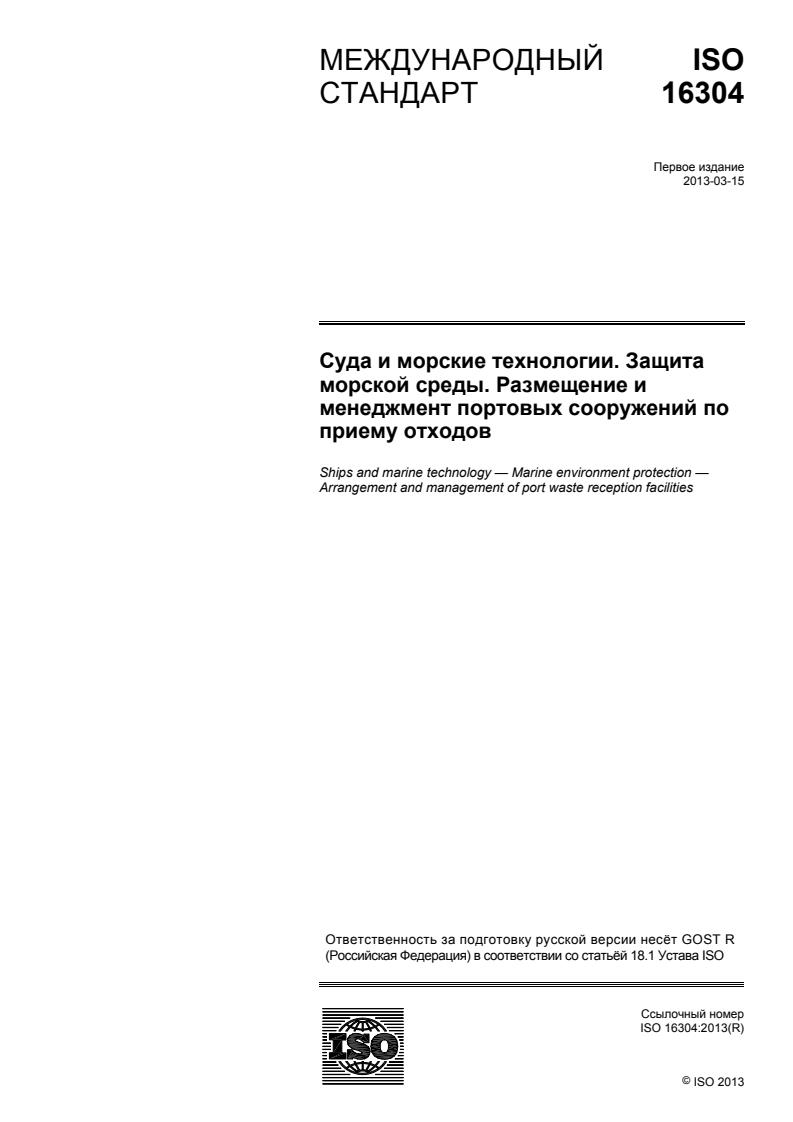
INTERNATIONAL ISO
STANDARD 16304
First edition
2013-03-15
Ships and marine technology —
Marine environment protection —
Arrangement and management of port
waste reception facilities
Navires et technologie maritime — Protection de l’environnement
marin — Disposition et gestion des installations portuaires de
collecte des déchets
Reference number
©
ISO 2013
© ISO 2013
All rights reserved. Unless otherwise specified, no part of this publication may be reproduced or utilized otherwise in any form
or by any means, electronic or mechanical, including photocopying, or posting on the internet or an intranet, without prior
written permission. Permission can be requested from either ISO at the address below or ISO’s member body in the country of
the requester.
ISO copyright office
Case postale 56 • CH-1211 Geneva 20
Tel. + 41 22 749 01 11
Fax + 41 22 749 09 47
E-mail copyright@iso.org
Web www.iso.org
Published in Switzerland
ii © ISO 2013 – All rights reserved
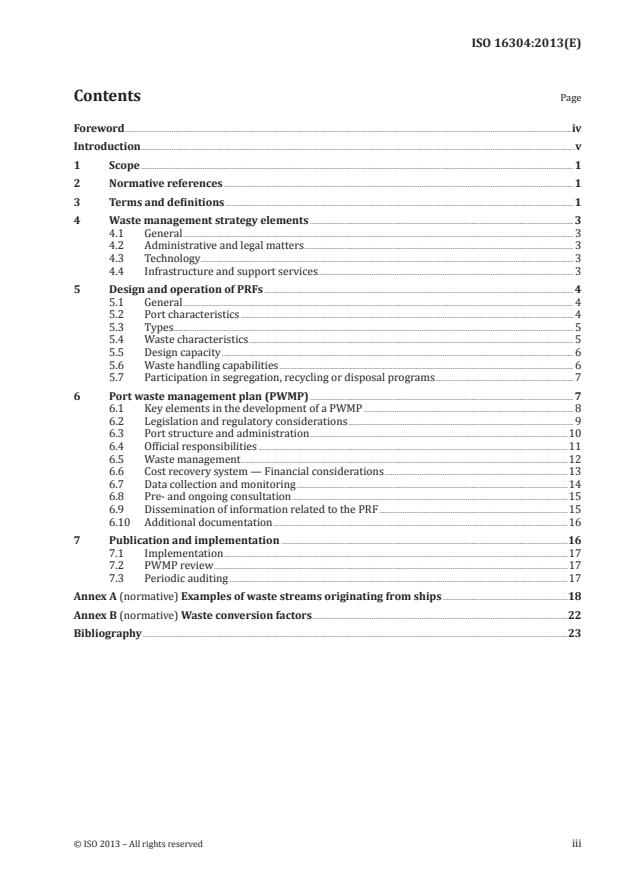
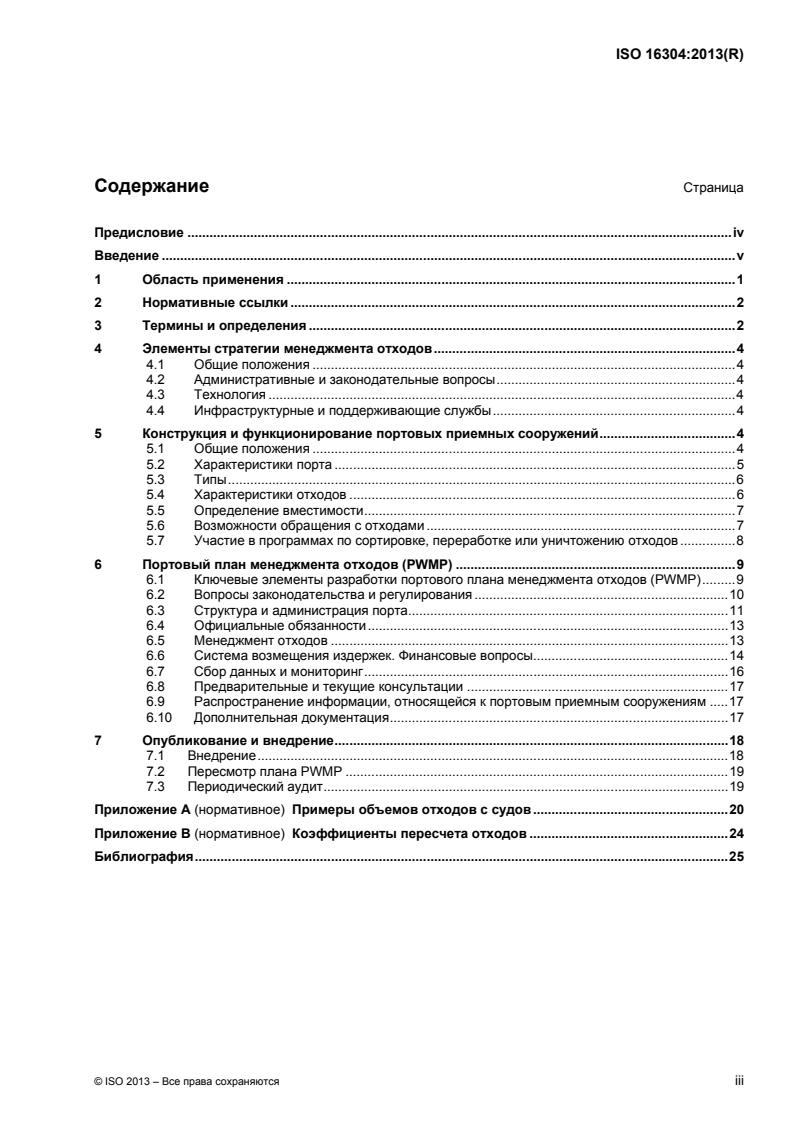
Contents Page
Foreword .iv
Introduction .v
1 Scope . 1
2 Normative references . 1
3 Terms and definitions . 1
4 Waste management strategy elements . 3
4.1 General . 3
4.2 Administrative and legal matters . 3
4.3 Technology . 3
4.4 Infrastructure and support services. 3
5 Design and operation of PRFs . 4
5.1 General . 4
5.2 Port characteristics . 4
5.3 Types. 5
5.4 Waste characteristics . 5
5.5 Design capacity . 6
5.6 Waste handling capabilities . 6
5.7 Participation in segregation, recycling or disposal programs . 7
6 Port waste management plan (PWMP) . 7
6.1 Key elements in the development of a PWMP . 8
6.2 Legislation and regulatory considerations . 9
6.3 Port structure and administration .10
6.4 Official responsibilities .11
6.5 Waste management .12
6.6 Cost recovery system — Financial considerations .13
6.7 Data collection and monitoring .14
6.8 Pre- and ongoing consultation .15
6.9 Dissemination of information related to the PRF .15
6.10 Additional documentation .16
7 Publication and implementation .16
7.1 Implementation .17
7.2 PWMP review .17
7.3 Periodic auditing .17
Annex A (normative) Examples of waste streams originating from ships .18
Annex B (normative) Waste conversion factors .22
Bibliography .23
Foreword
ISO (the International Organization for Standardization) is a worldwide federation of national standards
bodies (ISO member bodies). The work of preparing International Standards is normally carried out
through ISO technical committees. Each member body interested in a subject for which a technical
committee has been established has the right to be represented on that committee. International
organizations, governmental and non-governmental, in liaison with ISO, also take part in the work.
ISO collaborates closely with the International Electrotechnical Commission (IEC) on all matters of
electrotechnical standardization.
The procedures used to develop this document and those intended for its further maintenance are
described in the ISO/IEC Directives, Part 1. In particular the different approval criteria needed for the
different types of ISO documents should be noted. This document was drafted in accordance with the
editorial rules of the ISO/IEC Directives, Part 2. www.iso.org/directives
Attention is drawn to the possibility that some of the elements of this document may be the subject of
patent rights. ISO shall not be held responsible for identifying any or all such patent rights. Details of
any patent rights identified during the development of the document will be in the Introduction and/or
on the ISO list of patent declarations received. www.iso.org/patents
Any trade name used in this document is information given for the convenience of users and does not
constitute an endorsement.
The committee responsible for this document is ISO/TC 8, Ships and marine technology, Subcommittee
SC 2, Marine environment protection.
iv © ISO 2013 – All rights reserved
Introduction
The development of adequate Port Reception Facilities (PRFs) for ship generated waste and cargo
residues is a major element in the management of each of the shipboard waste streams covered by the
International Convention for the Prevention of Pollution from Ships, 1973, as modified by the Protocol of
1978 relating thereto (MARPOL) Annex 1 to VI, as amended, excluding Annex III (packaged dangerous
goods). MARPOL requires that Party States ensure the provision of adequate reception facilities in
ports to receive these wastes. Parties to MARPOL are encouraged to develop implementing legislation
1)
and should consider incorporating regional and intergovernmental legislation. However, due to
operational, ownership, geographic, and legislative differences in ports, there is a large disparity in how
operations are conducted. In order to overcome some of the major issues, IMO, through its Flag State
Implementation (FSI) Subcommittee developed an action programme to tackle the inadequacy of port
reception facilities.
This International Standard provides a method for addressing ship generated waste and cargo residues
from when it is delivered from the ship to how it is managed ashore. The provision, operation and use
of PRFs are inherently linked, so this International Standard addresses the design of the PRFs, and their
operation and management. It is designed to be used by ports and terminals with existing PRFs which
aim to refine their systems; it is also to be used by new ports and terminals that are developing PRFs.
To obtain the most efficient management of waste and to reduce the time and resource burden in
segregating and handling waste in the ports, the concept of waste minimization has been integrated
into this International Standard by incorporating the following basic principle:
• For waste generated aboard a vessel:
“Prevention before recycling before energy recovery before disposal”
• Once the waste is landed ashore:
“Avoidance before reduction before reuse before recycling before incineration with energy recovery
before disposal”
Ship owners and operators, cargo owners, and port and terminal owners and operators, along with
governments, are aware of the importance of well organized and managed waste collection, especially
with respect to health and safety onboard ships and at ports and terminals. It has been acknowledged
at the IMO that standard methodologies for waste management both onboard ships and ashore at PRFs
2)
would harmonize practices and ensure a smooth delivery of ship generated waste to shore-side facilities.
The parties to the Basel Convention also support the development of this International Standard and
have requested the Secretariat to continue its cooperation with ISO with the objective of including the
Basel Convention requirements of waste minimization and environmentally sound management in this
International Standard.
ISO has published ISO 21070, which provides a methodology for ships to segregate their garbage, Thus,
port facilities worldwide may therefore expect a certain level of segregated ship generated waste.
However, ISO 21070 cannot work alone and needs to be complemented by a parallel International
Standard for reception of the waste. This International Standard assists in the planning for the provision
of an appropriate PRF.
Many ports and terminals have invested much in achieving ISO 14001 Environmental Management
Systems accreditation. This International Standard is also meant to complement ISO 14001 by adding
a port component which extends the principles of ISO 14001 to ships’ waste management in ports. It
provides a specific methodology that any port, harbour, terminal or marina can apply to the planning,
development and operation of its PRF. This International Standard can be incorporated easily into
1) An example of intergovernmental legislation is “Directive 2000/59/EC of the European Parliament and of the
Council of 27 November 2000 on port reception facilities for ship-generated waste and cargo residues”. Regional
arrangements between countries or ports to jointly provide facilities have also been agreed.
2) This has been reflected in the FSI Action Programme, Work Item 3.2 “Equipment/Technology – Standardize
garbage segregation requirements and containment identification.’
other plans for achieving ISO 14001 accreditation, as an extension that focuses on PRFs. Conversely,
the processes put in place during the preparations for ISO 14001 accreditation will assist in meeting
the development of a holistic Port Waste Management Plan (PWMP) under this International Standard.
vi © ISO 2013 – All rights reserved
INTERNATIONAL STANDARD ISO 16304:2013(E)
Ships and marine technology — Marine environment
protection — Arrangement and management of port waste
reception facilities
1 Scope
Parties to MARPOL are obligated as Port States to ensure that port reception facilities (PRFs) adequate
to meet the needs of the ships using them without causing undue delay are provided at their ports
and terminals. MARPOL does not seek to regulate the management of ship generated waste at ports
and terminals beyond the reception facility requirement. However, ports and terminals must observe
any national and regional regulations. While these regulations exceed the scope of MARPOL, the IMO
recognizes the need to manage ship generated waste at ports and terminals as part of an environmentally
sound management approach for avoiding, minimizing and eliminating pollution from ships.
This International Standard applies to the management of ship generated waste regulated by MARPOL
that is discharged at ports and terminals. It also covers principles and issues that should be considered
in the development of a port waste management plan (PWMP), its implementation and PRF operations.
The operation of any PRF is governed by the principles and procedures included in the PWMP. The
procedures to operate the PRF and the development of a PWMP are closely linked and therefore are
integrated into this International Standard.
This International Standard addresses the principles and issues that should be considered in:
• The development of a port waste management strategy;
• The design and operation of PRFs;
• PWMP development, implementation and compliance; and
• PRF management and accountability.
This International Standard has been designed to be used by ports of any size and capability. It does not
give specifics on the size or location of PRFs in each port, but provides a list of principles to be considered
and applied to any size or type of port or terminal (e.g. marina, fishing port, container terminal, oil
terminal, roll on/roll off terminal, cruise terminal, ferry terminal, bulk or general cargo terminal, ship
repair or recycling facility, and offshore terminal). This International Standard can also be used by
those ports that have entered into regional arrangements for the provision of their PRF, or inland ports
and marinas, providing that the definition of waste and its management in the national legislation of
the facility are referenced accordingly. Many ports already have systems in place that work efficiently;
therefore this International Standard can be used by ports with existing PRFs as well as new ports or
existing ports developing new PRFs.
2 Normative references
The following referenced documents are indispensable for the application of this document. For dated
references, only the edition cited applies. For undated references, the latest edition of the referenced
document (including any amendments) applies.
ISO 21070:2011, Ships and marine technology — Marine environment protection — Management and
handling of shipboard garbage
3 Terms and definitions
For the purposes of this document, the following terms and definitions apply.
3.1
adequacy
meeting the needs of ships normally calling at the port, without providing ships with a disincentive
to use them, without causing undue delays, and contributing to the protection of the environment
[IMO Circular 671]
3.2
cargo residues
remnants of any cargo material on board which remain on the deck or in cargo holds or tanks following
loading and unloading, including loading and unloading excess or spillage, whether in wet or dry
conditions or entrained in wash water
Note 1 to entry: Does not include dust remaining on the deck after sweeping or dust on the external surfaces of the ship.
3.3
energy recovery
energy reclamation from waste before final disposal
3.4
port
place or geographical area consisting of infrastructure and equipment as to permit, principally, the
reception of ships, including fishing vessels and recreational craft, for the loading or unloading of
passengers, cargo, stores, equipment, fuel, fish from commercial or sport fishing, or for repairs or
berthing or other related activities
3.5
port administration
public or private organization with the responsibility for the operation of the port
3.6
port authority
organization, either private or governmental, that manages the operations of a port, in whole or part
Note 1 to entry: Port authorities may have complete or limited jurisdiction within a geographic region.
3.7
port reception facility
PRF
any facility operating in a port, which is fixed, floating or mobile and capable of receiving ship generated
waste or cargo residues in a way consistent with national, regional and local requirements
3.8
quarantine waste
any solid or liquid waste determined by national, regional or local legislation to require special handling,
segregation, management and final disposal due to its potential to spread disease or plant and animal pests
3.9
recreational craft
boat or ship of any type, regardless of means of propulsion, that is intended for non-commercial sport
or leisure purposes
3.10
ship
sea-going vessel of any type whatsoever operating in the marine environment, including hydrofoil boats,
air cushion vehicles, submersibles, floating craft, and fixed or floating platforms
[MARPOL Annex V]
Note 1 to entry: Ships may call at inland ports.
2 © ISO 2013 – All rights reserved
3.11
ship generated waste and residue
all wastes and cargo residues which are generated during the normal operation of a ship and fall under
the scope of Annexes I, II, IV, V and VI to MARPOL
Note 1 to entry: Hazardous Waste may also be generated in the event of breakage and subsequent spillage of
Annex III packaged cargos.
3.12
terminal
specific and distinct cargo or passenger loading and unloading facility for ships
3.13
waste recovery
reuse, recycling, reclamation or treatment of waste for reuse
4 Waste management strategy elements
4.1 General
There are three main components of any waste management strategy: administrative and legal matters;
3)
technology; and infrastructure and support services.
4.2 Administrative and legal matters
Many nations have implemented legislation, policies and national waste management strategies
that govern the management of waste at PRFs, including ship generated waste. Such legislation must
be considered when developing a port waste management strategy as it will determine the level of
compliance that must be maintained. Additional requirements such as the need for licensing and/or
approvals, and waste tracking and documentation must also be considered.
The best possible environmental solution for waste recovery and disposal should be identified. Waste
management targets adopted by the national administration for ports within its jurisdiction should be
included in the development of waste management strategies. If there are no such targets, then the port
should consider developing them.
4.3 Technology
Waste management technology that is current and suitable should be employed. The technology
considered as part of the waste management strategy should reflect the most current state of waste
management techniques. However, the focus is shifting toward recycling and reclamation of waste,
versus disposal (see 6.5). Thus, the waste management strategy should recognize and promote
alternative methods of waste management that harness the benefits of new and emerging technologies.
4.4 Infrastructure and support services
The waste management strategy must be developed in an effective way with an awareness of the
infrastructure and support services not only throughout the port or terminal, but also beyond those
physical limits. There must be in place suitable waste transport organizations, recycling facilities,
treatment facilities, and if necessary, final disposal sites. These treatment and disposal facilities may
or may not be located within the port. Waste management strategies should also incorporate proactive
mechanisms to inform and educate those having an interest in using the PRFs.
3) International Maritime Organization, 1999
5 Design and operation of PRFs
5.1 General
The types and number of ships normally calling at the port and the nature of operations must be
considered. PRFs for relevant wastes need to be available without causing undue delay to ships or
imposing economic or other disincentives for their use, such as prohibiting waste offload at a specific pier
during cargo handling for safety reasons. Reference to the PWMP will provide options for waste stream
collection and handling, and this, combined with the calculated PRF capacity, provides a foundation
for the PRF design. However, for those waste volumes that could be anticipated to fluctuate widely
over different periods, the provision of PRFs should be adapted appropriately. The system designed to
support and operate a PRF should take into account the following core components.
5.2 Port characteristics
5.2.1 Spatial and siting requirements
4)
The location of PRFs should be “convenient” and not be a disincentive to use. The location must be
suitable and sufficient to allow easy and safe use that does not impose an undue delay upon the ship.
Siting considerations should include an awareness of the impact on other port operations as well as the
public areas surrounding the port or terminal.
Larger ports and terminals may require higher capacities or more diverse capabilities. Construction of
a new port or terminal may offer greater flexibility in design as opposed to making improvements to an
existing PRF.
Regardless of the type of PRF that is chosen, the port or terminal geography and layout must be
considered as part of the design phase. The best way to collect each waste stream throughout the port
or at the terminal must be determined. In a compact port with large berths, garbage waste disposal bins
on each quay or a direct transfer to the waste handler could be implemented. However, in certain other
port configurations, it may be better to collect waste by barge. If the port is lock-bound, waste can be
landed upon entry or exit at the lock.
A port or terminal with expansive space to increase operations in the future may see a rise in shipping
waste volumes. This may drive a need to consider providing excess capability during PRF planning
activities so as not to limit future port or terminal expansion activities.
5.2.2 Types of cargo handled within the port or by the terminal
Multiple MARPOL waste reception facilities may be required. Ports or terminals that receive ships with
diverse cargoes that could produce cargo residues, such as oil and noxious liquid substances, would
create unique waste handling challenges.
5.2.3 PRF service providers
Companies that are licensed or otherwise certified or approved to provide waste handling services
should be identified and verified by the port administration or port authority. Effective port waste
management goes beyond the act of receiving waste from ships. Good downstream waste management
supports the intent and purpose of having PRFs.
5.2.4 External factors
Extreme weather conditions or extreme tidal cycles may make it difficult to access PRF services or
hinder the operation of traditional waste handling equipment.
4) International Maritime Organization, 1999
4 © ISO 2013 – All rights reserved
5.3 Types
5.3.1 General
The type of PRF can vary between ports and terminals and is determined after assessing the
different options.
5.3.2 Floating
The use of barges may have distinct advantages, as they are relatively mobile, typically have sufficient
capacity to service multiple ships, and can receive most wastes. Their shallow draught allows for access
in most port and terminal areas. However, sea state limitations may prevent floating reception facilities
from operating at all times. Additionally, there is an added element of risk when transferring waste to
a floating PRF, especially those containing oily or noxious liquid mixtures, or in ports and terminals
where ship traffic is heavy and continuous in volume.
5.3.3 Mobile
Vehicle-borne PRFs offer speed and flexibility, particularly with respect to smaller ports, terminals or
marinas. However, the capacity of vehicles such as tank trucks and traditional over-the-road garbage
collection trucks may be a limiting factor when servicing large ships. This may mean a smaller number
of ships can be serviced before the vehicle is full. This can cause delays and increase congestion in the
already very busy ports and terminals. Furthermore, certain areas may be off limits to third party waste
collection organizations due to either safety and/or security concerns, or both.
5.3.3.1 Other considerations
Temporary placement of containers or collection bins that are dropped off via truck and picked up at a
later date, after the container/bin is full, may be an option.
5.3.4 Fixed
The use of fixed PRFs might be the preferred route for locations where terminals operate their PRFs
independently. Centralized PRF arrangements (e.g. at or near frequently used locks) may be considered,
however, it should be recognized that such arrangements could increase the burden on ships due to
scheduling requirements. In cases where specialized PRFs are needed, such as those for oily or noxious
liquid mixtures, having distinct and separate PRFs at each terminal might be the best option. This
arrangement will ensure that the ships having business with those terminals are provided with the
appropriate type of reception facility services.
5.4 Waste characteristics
5.4.1 General
All types of ship generated waste that will be received and handled at the port or terminal must be
determined. Failure to consider certain waste streams may limit the future potential of the port or
terminal. Wastes may be delivered by ships in many different forms, from single compound waste
streams such as oil, sewage or segregated waste, to mixed waste streams such as garbage. Ship generated
wastes are discussed in 6.7.
NOTE See Table A.1 for a listing of waste streams and treatment options.
5.4.2 Other considerations
a) Not all waste streams will necessarily be produced by every ship or be discharged in every port.
Additionally, in some circumstances ships may need or wish to discharge waste, such as food
waste and non-harmful cargo residues that could be discharges into the sea under the provisions
of MARPOL but due to operations, company policy, or other considerations, the master of the ship
chooses to discharge these wastes ashore. Therefore, the PRF should consider these additional
waste streams.
b) Ports may also have to take into account any local, national or regional legislation and guidance that
requires vessels to deliver all of their waste, or part of their waste prior to departure.
c) Special national legislative considerations may have to be taken into account when receiving ships
on international voyages as opposed to domestic voyages (such as food waste or quarantine waste).
d) Where applicable, in cases where ship generated wastes and cargo residues are considered “hazardous
wastes” or “other wastes” under the Basel Convention, the requirement for environmentally sound
management should be taken into account.
5.5 Design capacity
5.5.1 General
The design of a PRF should be based on the number and types of ships calling on the port. The basic PRF
capacity needed in the port or terminal, per waste stream or per ship type, can be calculated based on
the expected or most probable level of traffic in the port.
5.5.2 Existing ports
For existing ports and terminals the level/quantities of waste received in previous years can be used to
determine PRF capacity. Additionally, if there is any anticipated change in traffic, legislation or waste
management technology, then the initial figures may have to be modified.
5.5.3 New ports or terminals
When designing a new port or terminal or redesigning an existing port to handle new business, or
larger or different types of ships, a calculation of waste reception facility capacity must be made using
estimates of the expected vessel traffic. Calculations should take into consideration the number and
frequency of port calls for each type of vessel and the expected wastes that are generated aboard those
vessels based on the type and size of vessel and cargo(es) handed (volumes or tonnes), the crew size, the
number of passengers (if any), the average length of the voyages for inbound ships, and whether the port
is a loading or unloading port or a combination.
If no data are available for a new port, the information could be obtained from other ports with
similar traffic.
NOTE Annex A of ISO 21070:2011 provides information on calculation of the expected amounts of
(Annex V) wastes.
5.6 Waste handling capabilities
5.6.1 Adequacy
A fundamental consideration is to determine the waste handling capabilities needed in order to be
considered adequate (see 3.1.).
5.6.2 Accessibility and suitability
Suitable PRF equipment for all waste streams must be easily accessible by the ship. PRF equipment that
is difficult to use and poorly arranged may create a disincentive for ships to properly dispose of their
waste while at the port or terminal.
6 © ISO 2013 – All rights reserved
5.6.3 Waste handling equipment
There is a variety of equipment that can be used to collect, store and in some cases, treat the different
waste streams collected at ports and terminals. The equipment selected must be suitable for the type
and quantity of waste.
Inadequate space at the berth to support waste handling equipment and its use must be avoided as
it may compromise the safety of the PRF and ship personnel, create the risk for discharges into the
environment and possibly create a disincentive for proper waste disposal.
5.6.4 Storage
Consideration must also be given to the period of time the port or terminal could store the ship generated
waste on-site. Lengthy storage of waste should be avoided, as it can create stress on the supporting
infrastructure and impact the waste handling services for future ships. It may also affect the health and
safety of workers and the environment if stored waste quantities exceed storage capacities. PRFs that
do not plan to arrange for routine waste removal services must ensure that waste storage receptacles
of sufficient capacity and quantity are provided. Conversely, PRFs that are serviced frequently may not
need to have large capacity waste storage receptacles.
5.7 Participation in segregation, recycling or disposal programs
5.7.1 General
The provision for waste segregation may lead to increased participation in recycling programs. In order
for this to be successful, segregated waste should remain segregated until the final treatment. Many
PRFs can be conveniently arranged to accommodate recycling and other waste management services.
Additionally, ships that implement ISO 21070 will have waste segregation procedures that will make
operations at the PRF and downstream waste management easier.
5.7.2 Recycling capabilities
Recycling is a process where materials, which are otherwise destined for final disposal, are collected,
processed or reprocessed, and then reused. These materials all have useful chemical or physical
properties after having served their original purpose.
5.7.3 Final disposal
Final disposal of wastes should be viewed as a last option to be exercised only after alternatives have
been exploited, including energy recovery from wastes, and deemed unattainable. Several options for
final disposal exist, and the benefits and drawbacks should be considered and documented in the port
or terminal’s waste management strategy.
6 Port waste management plan (PWMP)
Ports and terminals must, at a minimum provide PRFs for MARPOL wastes (see 3.11). As such, the
PWMP takes into account the national waste management strategy and defines how and by whom waste
is collected at a port and/or terminal. This is necessary as waste streams received from ships calling
on ports and terminals must be dealt with in an environmentally and economically sound manner.
Developing and following a reasonable waste management strategy will ensure that all parties involved
in the generation, reception and transfer of waste abide by practices and standards that not only serve
to protect the health and quality of the environment and public, but also ensure compliance with local,
national and international laws and treaties.
6.1 Key elements in the development of a PWMP
There are five major elements to consider in the provision of PWMP. They are:
• The development,
• Its publication,
• Its implementation,
• Enforcement of delivery of ship-generated waste and cargo residues by competent authorities, and
• Monitoring of the plan to ensure that all parties, including ships and facility providers are adhering
to the plan, the plan is and remains fit for use and the reception facilities are adequate.
The development of a PWMP is the planning stage for the eventual provision of a PRF and is the most
crucial and time consuming part of the process. First, the port should consider what waste reception
services they should provide and exactly how they can provide them. The PWMP needs to be developed
to manage the different waste streams generated onboard a ship in an efficient and environmentally
sound manner without causing undue delay to ships or cause disincentives to shipping. A PWMP can
be developed in-house, or by a consultant, but nevertheless it has to be transparent, auditable, include
provisions for consultation with the stakeholders and fulfil all legal requirements within the national
legislation of the port. It should identify the major principles of waste minimization, management and
disposal, while ensuring the health, safety and security concerns of the port or terminal user. The
PWMP should also result in the development of a formal plan that must be consulted upon, approved (if
necessary) and used as the day to day manual for the management and operation of the PRF.
The PWMP should include relevant information on the following key areas outlining pertinent procedures
and management measures, as appropriate:
• An analysis of the relevant legislation, the international, regional, national and local waste
management structure that the PWMP fits into, including the official responsibilities of the
port owners/operators and other relevant parties under national waste laws and the different
governmental administrations involved in controlling the management of ship generated waste;
• Geographical and administrative scope of the PWMP;
• Official responsibilities within the management and operation of the PRF within the port;
• An assessment of the need for PRFs (see 5.1);
• A description of the cost recovery system;
5)
• Procedures for how to report and take action on alleged inadequacies of PRFs;
6)
• Explanation of reporting and notification procedures for ship generated waste;
• A description of the method for recording the amounts of wastes received;
• Procedures for ongoing consultations with organisations representing the port or terminal users;
waste contractors, and other stakeholders, including a description of how the essential information
will be made available to the public (e.g. shipping agents and other relevant stakeholders);
• Review, refinement (corrective and preventive) actions and/or auditing; and
• Enforcement measures.
5) International Maritime Organization, 2007
6) International Maritime Organization, 2007
8 © ISO 2013 – All rights reserved
Each plan will take into account the specific nature of the port or terminal and its users. This is then
7)
outlined in a formal plan which is implemented after consultation with the users of the port.
6.2 Legislation and regulatory considerations
6.2.1 Applicable laws and regulations
Before any PWMP or PRF can be developed or established, there needs to be an analysis of the
international, regional, national and local legislation that controls waste and waste generated on ships,
and that analysis should be included in the PWMP. National legislation will, at a minimum, reflect
the international requirements of MARPPOL. However, this legislation is also likely to set out the
responsibilities, legal processes, waste management options and procedures that the port will have to
comply with. Issues to specifically note include, but are not limited to:
• Responsibility for developing a PWMP;
• The procedure for approval of the PWMP;
• The procedures to keep the plan up-to-date and valid;
• The duty of care responsibilities for the port with respect to waste management, waste transfer and
waste handling;
• Recovery and disposal regulations for different waste types;
• Licensing and other requirements for the transfer, storage and the disposal of the waste; and
• Requirements for the payment of fees, if applicable.
Strict compliance with local and national legislation is critical when considering the design of PRFs
to ensure that they are both adequate and legally sufficient. The design of PRFs must be based in part
on the principle that ships using PRFs will not be subject to disincentives to properly dispose of their
wastes. The following areas should also be examined:
• The existence of a waste management strategy for the port or terminal;
• Special rules regarding health, safety, security and the environment; and
• The port or terminal’s experience with waste management.
Parties to MARPOL have a responsibility to ensure the provision of port reception facilities at their
8)
ports and terminals, depending on the nature of their operation. Prospective wastes, as defined in the
Annexes to MARPOL include:
— Oily wastes
— Noxious liquid substances in bulk
— Sewage
— Garbage
— Residues from exhaust gas cleaning systems and ozone depleting substances
7) International Maritime Organization, 2009
8) Refer to the MARPOL Annexes for regulations pertaining to each waste type.
6.3 Port structure and administration
The first issue to consider is the scope of the PWMP and what it will cover. Ports or terminals may
join together in one plan to provide more efficient waste management services. The scope of the plan
depends on the following factors:
• The official responsibilities placed on the ports or terminals;
• The type and size of the port;
• The geographical spread of these facilities and the geographical layout of the port;
• Types of facilities within the port;
• If, in terms of cost to shipping and economies of scale, whether or not these port facilities should
have their own PWMP; and
• Relationships and interfaces with, and agreements between, adjacent and nearby ports and port
facilities.
The port owner/management must analyse the makeup of the port or terminal and decide on the most
appropriate way to handle ship generated waste. A port may decide that certain terminals must have
their own PWMP, include all terminals in one PWMP or have a hybrid system. This may depend on the
relevant national legislation which may identify the responsible party for creating and running a PWMP
and depending on this, the PWMP developed may have many options as outlined in Table 1.
10 © ISO 2013 – All rights reserved
Table 1 — Examples of different options in PWMP planning
Potential PWMP
Port structure Comments
The PWMP covers all PRF in all port facilities
One port One PWMP
throughout the port.
One port with discrete terminals/
port facilities contracted to other
The PWMP brings together independently devel-
companies (container, bulk, oil,
One PWMP oped and run plans for each terminal/port facility
cruise, etc.) or forming port facilities
in one volume.
for one type of ship (fishing vessel
berths or marinas)
One port with discrete terminals/
port facilities contracted to other Each discrete terminal or port facility has an inde-
companies (container, bulk, oil, pendently developed and run PWMP. Efficiency of
Many PWMPs
cruise, etc.) or forming port facilities size and economies of scale depend on the size of
for one type of ship (fishing vessel the port facility and the traffic visiting it.
berths or marinas)
The PWMP brings together any independently run
One port with one or two discrete
plans for each terminal as a discrete section in the
terminals contracted to other compa- One PWMP
PWMP, and also provides an overarching PWMP
nies (container, bulk, oil, etc.)
for the other port facilities in the port.
Each discrete terminal has an independently
One port with one or two discrete
developed and run PWMP, with the other port
terminals contracted to other compa- Many PWMPs
facilities in the port covered by a separate over-
nies (container, bulk, oil, etc.)
arching PWMP.
One PWMP is produced to cover two ports or port
facilities that are inherently linked by trade or
One PWMP
geographic proximity to provide efficiency of size
and economies of sc
...
МЕЖДУНАРОДНЫЙ ISO
СТАНДАРТ 16304
Первое издание
2013-03-15
Суда и морские технологии. Защита
морской среды. Размещение и
менеджмент портовых сооружений по
приему отходов
Ships and marine technology — Marine environment protection —
Arrangement and management of port waste reception facilities
Ответственность за подготовку русской версии несёт GOST R
(Российская Федерация) в соответствии со статьёй 18.1 Устава ISO
Ссылочный номер
©
ISO 2013
ДОКУМЕНТ ЗАЩИЩЕН АВТОРСКИМ ПРАВОМ
© ISO 2013
Все права сохраняются. Если не указано иное, никакую часть настоящей публикации нельзя копировать или использовать в
какой-либо форме или каким-либо электронным или механическим способом, включая фотокопии и микрофильмы, без
предварительного письменного согласия ISO по соответствующему адресу, указанному ниже, или комитета-члена ISO в стране
заявителя.
ISO copyright office
Case postale 56 • CH-1211 Geneva 20
Tel. + 41 22 749 01 11
Fax + 41 22 749 09 47
E-mail copyright@iso.org
Web www.iso.org
Опубликовано в Швейцарии
ii © ISO 2013 – Все права сохраняются
Содержание Страница
Предисловие .iv
Введение .v
1 Область применения .1
2 Нормативные ссылки .2
3 Термины и определения .2
4 Элементы стратегии менеджмента отходов.4
4.1 Общие положения .4
4.2 Административные и законодательные вопросы.4
4.3 Технология .4
4.4 Инфраструктурные и поддерживающие службы.4
5 Конструкция и функционирование портовых приемных сооружений.4
5.1 Общие положения .4
5.2 Характеристики порта .5
5.3 Типы.6
5.4 Характеристики отходов .6
5.5 Определение вместимости.7
5.6 Возможности обращения с отходами .7
5.7 Участие в программах по сортировке, переработке или уничтожению отходов .8
6 Портовый план менеджмента отходов (PWMP) .9
6.1 Ключевые элементы разработки портового плана менеджмента отходов (PWMP).9
6.2 Вопросы законодательства и регулирования .10
6.3 Структура и администрация порта.11
6.4 Официальные обязанности.13
6.5 Менеджмент отходов .13
6.6 Система возмещения издержек. Финансовые вопросы.14
6.7 Сбор данных и мониторинг.16
6.8 Предварительные и текущие консультации .17
6.9 Распространение информации, относящейся к портовым приемным сооружениям .17
6.10 Дополнительная документация.17
7 Опубликование и внедрение.18
7.1 Внедрение.18
7.2 Пересмотр плана PWMP .19
7.3 Периодический аудит.19
Приложение A (нормативное) Примеры объемов отходов с судов .20
Приложение B (нормативное) Коэффициенты пересчета отходов .24
Библиография.25
Предисловие
Международная организация по стандартизации (ISO) является всемирной федерацией национальных
организаций по стандартизации (комитетов-членов ISO). Разработка международных стандартов
обычно осуществляется техническими комитетами ISO. Каждый комитет-член, заинтересованный в
деятельности, для которой был создан технический комитет, имеет право быть представленным в этом
комитете. Международные правительственные и неправительственные организации, имеющие связи с
ISO, также принимают участие в работах. Что касается стандартизации в области электротехники, ISO
работает в тесном сотрудничестве с Международной электротехнической комиссией (IEC).
Процедуры, используемые для разработки настоящего документа и предназначенные для его
дальнейшего поддержания, указаны Директивах ISO/IEC, Часть 1. В особенности следует отметить,
что для различных типов документов ISO необходимы разные критерии для утверждения. Настоящий
документ был разработан в соответствии с редакционными правилами Директив ISO/IEC,
Часть 2. www.iso.org/directives
Обращается внимание на возможность патентования некоторых элементов данного международного
стандарта. ISO не несет ответственности за идентификацию какого-либо или всех таких патентных
прав. Детали любых патентных прав, идентифицированных при разработке документа, должны
содержаться в Введении и/или в перечне полученных патентов ISO. www.iso.org/patents
Любое фирменное наименование в настоящем документе является информацией, предоставляемой
для удобства пользователей, и не носит рекомендательный характер.
За настоящий документ несет ответственность Технический комитет ISO/TC 8, Суда и морские
технологии, Подкомитет SC 2, Охрана морской окружающей среды.
iv © ISO 2013 – Все права сохраняются
Введение
Создание отвечающих требованиям портовых приемных сооружений (PRFs) для судовых отходов и
остатков грузов является основным элементом менеджмента любого объема судовых отходов,
которые охватывает Международная конвенция по предотвращению загрязнения с судов, 1973 года
(MARPOL), исправленная Протоколом к ней 1978 года, Приложения с 1 по VI с поправками, за
исключением Приложения III (пакетированные опасные грузы). Конвенция MARPOL требует, чтобы
Стороны Конвенции гарантировали наличие в портах отвечающих требованиям сооружений для
приема судовых отходов. Участники Конвенции MARPOL получают поддержку в разработке
имплементирующего законодательства и должны рассматривать включение региональных и
межправительственных законов. Однако вследствие эксплуатационных, географических,
законодательных и связанных с правом собственности различий в портах, существует значительное
различие в функционировании. Чтобы преодолеть некоторые основные проблемы, ИМО через свой
Подкомитет по осуществлению документов государством флага (FSI) разработала программу действий
по устранению несоответствия портовых приемных сооружений.
Настоящий международный стандарт предоставляет методику для обращения с судовыми отходами и
остатками груза от их доставки с судна до менеджмента на берегу. Предоставление,
функционирование и использование портовых приемных сооружений связаны по своей сути, поэтому
настоящий международный стандарт рассматривает их конструкции, функционирование и менеджмент.
Он разработан для использования в портах и терминалах с имеющимися приемными сооружениями
для усовершенствования их систем, а также в новых портах и терминалах, которые создают свои
приемные сооружения.
Чтобы достигнуть наиболее эффективного управления мусором и уменьшить время и объем при его
сортировке и переработке в портах, концепция минимизации отходов была заложена в основу
настоящего международного стандарта включением следующего базового принципа:
• Для мусора, образовавшегося на борту судна:
“Предотвращение до переработки до осуществления возврата тепла до утилизации”
• Для мусора, один раз выгруженного на берег:
“Предотвращение до уменьшения объема до повторного использования до переработки до сжигания с
возвратом тепла до утилизации”
Судовладельцы и операторы, владельцы груза, а также владельцы портов и терминалов и операторы
вместе с правительствами осведомлены о важности хорошо организованного и управляемого сбора
отходов, что особенно касается охраны здоровья и безопасности на борту судов и в портах и
терминалах. В ИМО было признано, что стандартные методики управления отходами на судах и на
береговых приемных сооружениях должны привести в соответствие практики и обеспечить
беспрепятственную доставку судовых отходов на береговые приемные сооружения. Стороны
Базельской конвенции также поддерживают разработку настоящего международного стандарта и
обратились к Секретариату с заявлением о продолжении кооперации с ISO с целью включения
требований Базельской конвенции о минимизации отходов и экологически рациональному
менеджменту в настоящий международный стандарт.
ISO опубликовала ISO 21070, который определяет методику сортировки судового мусора для судов.
Таким образом портовые сооружения по всему миру могут рассчитывать на определенный уровень
Примером межправительственного законодательства является "Директива 2000/59/EC Европейского
парламента и Совета Европы от 27 ноября 2000 года по портовым сооружениям для приема судовых отходов и
остатков грузов". Также были одобрены региональные соглашения между странами или портами о совместном
предоставлении сооружений.
Это нашло отражение в Программе действий FSI, Рабочая статья 3.2 "Оборудование/Технология –
Стандартизация требований сортировки мусора и определение объемов.'
отсортированных судовых отходов. Однако стандарт ISO 21070 не может использоваться один и
требует дополнения параллельным международным стандартом по приему отходов. Настоящий
международный стандарт содействует планированию для обеспечения соответствующих требованиям
портовых приемных сооружений.
Многие порты и терминалы привлекли значительные инвестиции для достижения сертификации в
соответствии с экологическими системами менеджмента по ISO 14001. Настоящий международный
стандарт также подразумевает дополнение стандарта ISO 14001, поскольку включает портовую
составляющую, распространяя принципы ISO 14001 на менеджмент судовых отходов в портах. Он
предоставляет специальную методику, которую может применить любой порт, гавань, терминал или
яхтклуб для планирования, создания и функционирования своих сооружений для приема отходов.
Настоящий международный стандарт может быть легко включен в другие планы по получению
сертификации в соответствии с ISO 14001 в качестве дополнения, относящегося к портовым приемным
сооружениям. С другой стороны, процессы, реализуемые при подготовке к сертификации по ISO 14001,
будут способствовать разработке целостного портового плана менеджмента отходов (PWMP),
соответствующего настоящему международного стандарту.
vi © ISO 2013 – Все права сохраняются
МЕЖДУНАРОДНЫЙ СТАНДАРТ ISO 16304:2013(R)
Суда и морские технологии. Защита морской среды.
Размещение и менеджмент портовых сооружений по
приему отходов
1 Область применения
Стороны Конвенции MARPOL обязаны как Государства порта гарантировать, что предоставляемые в
их портах и терминалах портовые приемные сооружения (PRFs) достаточны для удовлетворения нужд
использующих их судов без излишних задержек. Конвенция MARPOL не стремится регулировать
менеджмент судовых отходов в портах и терминалах сверх требований к приемным сооружениям.
Однако порты и терминалы должны соблюдать национальные и региональные нормативные
документы. Несмотря на то, что эти документы выходят за область применения MARPOL, ИМО
признает необходимость управления судовыми отходами в портах и терминалах, как части концепции
экологически рационального менеджмента в целях предотвращения, минимизации и ликвидации
загрязнений с судов.
Настоящий международный стандарт используется применительно к менеджменту судовых отходов,
регламентируемых Конвенцией MARPOL, которые выгружаются в портах и терминалах. Он также
охватывает принципы и вопросы, которые должны приниматься во внимание при разработке портового
плана по менеджменту отходов (PWMP), его применении и эксплуатации портовых приемных
сооружений. Работа любого сооружения регулируется принципами и процедурами, включенными в
план PWMP. Процедуры функционирования приемных сооружений и разработки плана PWMP тесно
связаны и поэтому рассмотрены в настоящем международном стандарте.
Настоящий международный стандарт рассматривает принципы и вопросы, которые следует принимать
во внимание при:
• Разработке стратегии управления отходами в порту;
• Проектировании и функционировании портовых приемных сооружений;
• Разработке, применении и приведении в соответствие плана PWMP; и
• Менеджменте и отчетности портовых приемных сооружений.
Настоящий международный стандарт разработан для применения портами любого размера и
производительности. Он не предусматривает детальные размеры и местоположение приемных
сооружений для каждого порта, а предоставляет перечень принципов, которые следует рассматривать
и применять для портов или терминалов любого размера и типа (например, яхтклуб, рыбный порт,
контейнерный терминал, нефтяной терминал, терминал ро-ро, круизный терминал, паромный
терминал, терминал навалочных или генеральных грузов, судоремонтное или утилизационное
предприятие и шельфовый терминал). Настоящий международный стандарт также может быть
использован теми портами, которые предоставляют свои портовые приемные сооружения в
соответствии с региональными соглашениями, внутренними портами и яхтклубами, при обеспечении
соответствующего определения отходов согласно национальному законодательству. Многие порты
уже имеют эффективно работающие системы, поэтому настоящий международный стандарт может
использоваться портами, имеющими приемные сооружения, и новыми или существующими портами,
которые приемные сооружения для отходов только создают.
2 Нормативные ссылки
Следующие ссылочные документы являются обязательными при применении данного документа. При
датированных ссылочных документах применяется только приведенное издание документа. При
недатированных ссылках необходимо использовать самое последнее издание нормативного
ссылочного документа (включая любые изменения).
ISO 21070:2011, Суда и морские технологии. Защита морской окружающей среды. Управление и
переработка судового мусора
3 Термины и определения
В настоящем документе используются термины и их определения ISO 9000:2005, а также следующие.
3.1
соответствие
adequacy
портовые приемные сооружения, которые удовлетворяют требованиям обычно заходящих в порт
судов и при этом не создают препятствий для их использования, не вызывают непредвиденных
задержек и содействуют защите окружающей среды
[Циркуляр IMO 671]
3.2
грузовые остатки
cargo residues
остатки любого груза на борту судна, остающиеся на палубе или в грузовых трюмах или танках после
погрузки или разгрузки, включая избыток груза и неразгруженные остатки или утечки в сыром или
сухом состоянии, или попавшие в промывочные воды
ПРИМЕЧАНИЕ к статье: Не включается пыль, оставшаяся на палубе после уборки, или пыль на внешних
поверхностях судна.
3.3
регенерация энергии
energy recovery
утилизация энергии отходов перед их окончательным уничтожением
3.4
порт
port
зона или географический район, имеющий инфраструктуру и оборудование, позволяющее принимать
суда, включая рыболовные и прогулочные, для погрузки или разгрузки пассажиров, грузов, запасов,
оборудования, топлива, рыбы коммерческого и любительского вылова, или для ремонта, постановки к
причалу или других соответствующих целей
3.5
администрация порта
port administration
государственная или частная организация, несущая ответственность за функционирование порта
3.6
оператор порта
port authority
организация, частная или правительственная, которая управляет работой всего порта или его части
ПРИМЕЧАНИЕ к статье: Операторы порта могут иметь полную или ограниченную юрисдикцию в границах
географического района.
2 © ISO 2013 – Все права сохраняются
3.7
портовое приемное сооружение
port reception facility
PRF
любое работающее в порту сооружение, стационарное, плавучее или передвижное, способное
принимать появившиеся на судне отходы и грузовые остатки в соответствии с национальными,
региональными и местными требованиями
3.8
карантинные отходы
quarantine waste
любые твердые или жидкие отходы, определяемые национальным, региональным или местным
законодательством как требующие специальной обработки, сортировки, менеджмента и
окончательного уничтожения из-за их потенциальной возможности распространять заболевания или
паразитов растительного и животного происхождения
3.9
прогулочное судно
recreational craft
лодка или судно любого типа, независимо от движителя, предназначенное для некоммерческого
спорта или отдыха
3.10
судно
ship
морское плавучее средство любого типа, включая суда на подводных крыльях, на воздушной подушке,
погружные суда, а также плавучие средства и стационарные или плавучие платформы
[MARPOL Приложение V]
ПРИМЕЧАНИЕ к статье: Суда могут заходить во внутренние порты.
3.11
судовые отходы и грузовые остатки
ship generated waste and residue
все отходы и грузовые остатки, которые накоплены на судне в процессе его нормальной эксплуатации
и подпадают под область применения Приложений I, II, IV, V и VI к Конвенции MARPOL
ПРИМЕЧАНИЕ к статье: Опасные отходы также могут появиться в случае аварии и последующего разлива
пакетированных грузов, упомянутых в Приложении III.
3.12
терминал
terminal
специальное сооружение для судов, предназначенное для погрузки и разгрузки грузов или пассажиров
3.13
регенерация отходов
waste recovery
повторное использование отходов, их переработка, восстановление или очистка для повторного
использования
4 Элементы стратегии менеджмента отходов
4.1 Общие положения
Любая стратегия менеджмента отходов имеет три основных компонента: административные и
законодательные вопросы, технологию и инфраструктурные и поддерживающие службы.
4.2 Административные и законодательные вопросы
Многие страны реализовали законодательство, политику и национальные стратегии менеджмента
отходов, которые регулируют менеджмент отходов на портовых приемных сооружениях, включая
судовые отходы. Такое законодательство должно приниматься во внимание при разработке стратегии
менеджмента отходов в порту, поскольку она будет определять уровень соответствия, который
следует поддерживать. Также должны быть рассмотрены дополнительные требования такие, как
необходимость лицензирования и/или одобрений, а также отслеживания отходов и документирования.
Следует определить лучшее с точки зрения защиты окружающей среды решение по регенерации и
уничтожению отходов. Цели менеджмента отходов, принятые национальной администрацией для
портов в рамках ее юрисдикции, должны быть включены в разработку стратегий менеджмента отходов.
Если таковых целей не существует, порты должны предусмотреть их определение.
4.3 Технология
Должна использоваться современная технология менеджмента отходов. Технология, рассматриваемая
как часть стратегии менеджмента отходов, должна отражать самое современное состояние
менеджмента отходов. Однако, внимание следует уделять больше на переработке и восстановлении
отходов, нежели на их уничтожении (см. 6.5). Таким образом, стратегия менеджмента отходов должна
признавать и продвигать альтернативные методы менеджмента, которые используют в полной мере
преимущества новых и развивающихся технологий.
4.4 Инфраструктурные и поддерживающие службы
Стратегия менеджмента отходов должна разрабатываться эффективным способом с
информированием инфраструктурных и поддерживающих служб не только на территории порта или
терминала, но и за их пределами. Должны быть в наличии готовые к работе транспортные организации,
перерабатывающие, очистные сооружения и, если необходимо, площадки окончательного
уничтожения. Эти мощности по очистке и уничтожению могут быть расположены на территории порта и
вне ее. Стратегии менеджмента отходов также должны включать упреждающие механизмы
информирования и обучения персонала портовых приемных сооружений.
5 Конструкция и функционирование портовых приемных сооружений
5.1 Общие положения
Типы и количество судов, обычно заходящих в порт, и характер операций должны приниматься во
внимание. Портовые приемные сооружения для соответствующих отходов должны быть доступны и
использоваться без непредвиденных простоев судов или без возникновения экономических или других
препятствий, таких как запрещение выгрузки отходов на специальном пирсе в течение обработки груза
по причинам безопасности. Портовый план менеджмента отходов PWMP обеспечит варианты сбора и
обработки отходов, а это в комбинации с определенной вместимостью приемных сооружений создает
основу для определения их конструкции. Однако, для тех объемов отходов, которые могут значительно
изменяться в разные периоды времени, предоставление приемных сооружений должно
Международная морская организация, ИМО, 1999
4 © ISO 2013 – Все права сохраняются
регулироваться соответствующим образом. Система, созданная для поддержки и работы приемных
сооружений, должна учитывать следующие основные компоненты.
5.2 Характеристики порта
5.2.1 Требования по пространству и местоположению
Местоположение портовых приемных сооружений должно быть “удобным” и не иметь препятствий для
использования. Местоположение должно быть соответствующим и обоснованным для обеспечения
удобного и безопасного использования, которое не вызовет непредвиденных простоев судна.
Соображения о местоположении должны включать информацию о влиянии на другие операции в порту,
а также на общественные территории, прилегающие к порту или терминалу.
Более крупные порты и терминалы могут требовать сооружения большей вместимости или более
разнообразных возможностей. В отличие от совершенствования существующих портовых приемных
сооружений, больше возможностей существует при проектировании нового порта или терминала.
Независимо от типа выбранного портового приемного сооружения, следует рассмотреть географию и
схему расположения порта или терминала как часть стадии проектирования. Должен быть определен
наилучший способ сбора каждого объема отходов по всему порту или терминалу. В случае
компактного порта с большими причалами можно использовать бункеры для сбора мусора на каждом
причале или прямую передачу на устройство приемки мусора. Однако, в ряде случаев будет лучше
собирать отходы на баржи. Если порт ограничен шлюзом, отходы могут быть отгружены на причал на
входе или выходе шлюза.
Порт или терминал с обширной территорией для увеличения операций в будущем может предполагать
увеличение объемов судовых отходов. Это может вызвать необходимость в процессе планирования
работы портовых приемных устройств рассмотреть обеспечение дополнительных возможностей с тем,
чтобы не ограничивать расширение функционирования порта или терминала.
5.2.2 Виды грузов, обрабатываемых в порту или на терминале
Могут потребоваться сложные соответствующие MARPOL сооружения по приему отходов. Порты или
терминалы, принимающие суда с разнообразными грузами, которые могут иметь остатки такие, как
нефть и жидкие токсичные вещества, могут столкнуться с проблемами обращения с отходами.
5.2.3 Операторы портовых приемных сооружений
Компании, которые имеют лицензию или сертифицированы иным способом для предоставления услуг
по обращению с отходами, должны определяться и контролироваться администрацией или
оператором порта. Эффективный портовый менеджмент отходов не ограничивается получением
отходов с судов, а поддерживает намерение и цель иметь в наличии портовые приемные сооружения.
5.2.4 Внешние факторы
Экстремальные погодные условия или значительные приливы и отливы могут создавать трудности
доступа к портовым приемным сооружениям или препятствовать функционированию традиционного
оборудования по обращению с отходами.
Международная морская организация ИМО, 1999
5.3 Типы
5.3.1 Общие положения
Тип портового приемного сооружения может меняться в зависимости от порта или терминала и
определяется после оценки различных вариантов.
5.3.2 Плавучие
Использование барж может иметь явные преимущества, поскольку они сравнительно мобильны,
обычно имеют достаточную емкость для обслуживания нескольких судов и могут принимать
большинство отходов. Их небольшая осадка позволяет доступ к большинству районов порта. Однако,
погодные ограничения могут препятствовать функционированию плавучих приемных сооружений в
любое время. К тому же имеются дополнительные риски при передаче отходов на плавучее приемное
сооружение, особенно, на собирающие нефть или жидкие токсичные смеси, а также в портах и
терминалах, где движение судов интенсивное.
5.3.3 Передвижные
Передвижные портовые приемные сооружения оперативны, особенно для небольших портов,
терминалов или яхтклубов. Однако, емкость транспортных средств таких, как грузовики с цистернами
или традиционные дорожные мусоросборочные машины, может являться ограничивающим фактором
при обслуживании крупнотоннажных судов. Это означает меньшее количество судов, которые могут
быть обслужены этими средствами. Это может вызвать простои и увеличить заторы в уже очень
загруженных портах и терминалах. Кроме того, некоторые зоны могут оказаться вне сферы
деятельности организаций, собирающих отходы третьей категории, из-за соображений безопасности
и/или охраны или тех и других.
5.3.3.1 Другие соображения
Приемлемым вариантом может быть временное размещение контейнеров или бункеров для сбора
отходов, которые с помощью автомобиля устанавливаются и забираются позже при наполнении.
5.3.4 Стационарные
Использование стационарных портовых приемных сооружений может быть предпочтительно там, где у
терминалов свои независимые приемные сооружения. Размещение централизованных портовых
приемных сооружений (например, у или вблизи часто используемых шлюзов) может быть рассмотрено,
однако, следует признать, что это создаст неудобства из-за требований календарного планирования. В
случаях, когда требуются специализированные портовые приемные сооружения такие, как для приема
нефти или жидких токсичных смесей, лучшим вариантом может быть наличие особых отдельных
приемных сооружений на каждом терминале. Такое размещение будет обеспечивать надлежащий тип
приемных сооружений для судов, пользующихся этими терминалами.
5.4 Характеристики отходов
5.4.1 Общие положения
Должны быть определены все типы судовых отходов, которые будут приняты и обработаны в порту
или на терминале. Неполный учет некоторых объемов отходов могут ограничить потенциальные
возможности порта или терминала. Отходы различных форм могут доставляться судами, от
однородных объемов таких, как нефть, сточные воды или отсортированные отходы до смешанных
объемов отходов таких, как мусор. Судовые отходы рассматриваются в 6.7.
ПРИМЕЧАНИЕ См. Таблицу A.1, в которой перечислены типы отходов и варианты обращения с ними.
6 © ISO 2013 – Все права сохраняются
5.4.2 Другие учитываемые факторы
a) Не все объемы отходов обязательно будут образованы на каждом судне или выгружены в каждом
порту. Кроме того, при некоторых обстоятельствах суда могут иметь необходимость или желание
выгрузить отходы такие, как пищевые отходы или нетоксичные грузовые остатки, которые могли
бы быть сброшены в море по правилам MARPOL, но из-за режима эксплуатации, политики
компании или других соображений капитан судна выбирает выгрузку этих отходов на берегу.
Таким образом, портовые приемные сооружения должны учитывать эти дополнительные объемы.
b) Порты должны учитывать местное, национальное или региональное законодательство и
руководства, требующие от судна сдачи всех судовых отходов или их части до отхода из порта.
c) Положения специального национального законодательства должны приниматься во внимание при
приеме судов, находящихся в международных рейсах в отличие от каботажных рейсов (такие, как
пищевые или карантинные отходы).
d) Где это применимо, в случаях, когда судовые отходы и грузовые остатки считаются “опасными
отходами” или “прочими отходами” согласно Базельской конвенции, должно приниматься во
внимание требование по экологически рациональному менеджменту.
5.5 Определение вместимости
5.5.1 Общие положения
Проектирование портовых приемных сооружений должно основываться на количестве и типах судов,
заходящих в порт. Базовая вместимость приемного сооружения, необходимого в порту или на
терминале, в расчете на объем отходов или на тип судна может быть определена на основе оценки
ожидаемого или наиболее вероятного уровня движения в порту.
5.5.2 Существующие порты
Для существующих портов и терминалов чтобы определить вместимость приемных сооружений можно
использовать уровень/количество отходов, принятых в предыдущие годы. Кроме того, если
существуют любые предполагаемые изменения в движении, законодательстве или технологии
менеджмента отходов, исходные данные могут быть откорректированы.
5.5.3 Новые порты или терминалы
При проектировании нового порта или терминала или при реконструкции существующего порта для
нового бизнеса или обработки судов больших размеров или других типов расчет вместимости
сооружений для приема отходов должен выполняться с использованием оценок ожидаемого движения
судов. Расчеты должны учитывать количество и частоту заходов в порт каждого типа судов и
ожидаемые для этих судов объемы отходов, определенные на основе типа, размера судна,
перевозимого груза(ов) (объемы или тонны), численности экипажа, количества пассажиров (если есть),
средней продолжительности рейсов для судов внутреннего плавания и функций порта (погрузочный,
разгрузочный или комбинированный).
Если для нового порта нет данных, информация может быть получена от других подобных портов.
ПРИМЕЧАНИЕ Приложение A ISO 21070:2011 предоставляет информацию по расчету ожидаемых объемов
отходов (по Приложению V).
5.6 Возможности обращения с отходами
5.6.1 Соответствие
Фундаментальным вопросом является определение необходимых возможностей обращения с
отходами, чтобы они считались соответствующими (см. 3.1).
5.6.2 Доступ и пригодность
Используемое оборудование портовых приемных сооружений для всех объемов отходов должно иметь
легкий доступ для судна. Если при использовании приемных сооружений имеются трудности или они
неудачно размещены, то для судов могут возникнуть препятствия для надлежащего обращения со
своими отходами при стоянке в порту или у терминала.
5.6.3 Оборудование по обращению с отходами
Существует множество оборудования, которое может быть использовано для сбора, хранения и, в
некоторых случаях, очистки различных отходов, собираемых в портах и терминалах. Выбранное
оборудование должно соответствовать типу судна и количеству отходов.
Следует избегать несоответствия пространства на причале оборудованию по обращению с отходами и
неправильного его использования, поскольку это может ухудшить безопасность приемного сооружения
и команды судна, увеличить риск сбросов в окружающую среду и возможно создать препятствия для
надлежащего удалению отходов.
5.6.4 Хранение
Необходимо также обратить внимание на период времени, в течение которого порт или терминал
могут хранить судовые отходы на своей территории. Следует избегать длительного хранения отходов,
поскольку это создаст нагрузку на инфраструктуру и ударит по услугам обращения с отходами для
судов в будущем. Это также может повлиять на здоровье и безопасность работников и окружающую
среду, если объемы хранящихся отходов превысят емкости для хранения. Портовые приемные
сооружения, которые не планируется размещать для текущих услуг по ликвидации отходов, должны
обеспечивать емкости для хранения отходов достаточной вместимости и в достаточном количестве. С
другой стороны, портовые приемные сооружения для частого использования не требуют емкостей для
хранения отходов большой вместимости.
5.7 Участие в программах по сортировке, переработке или уничтожению отходов
5.7.1 Общие положения
Обеспечение сортировки отходов может привести к расширению программ переработки. Чтобы это
было успешным, отсортированные отходы должны оставаться отсортированными до окончательной
удаления. Многие портовые приемные сооружения могут так располагаться, чтобы разместить
перерабатывающие и другие службы менеджмента отходов. Кроме того, суда, которые применяют
ISO 21070, должны использовать процедуры сортировки отходов, что облегчает операции на
приемном сооружении и последующий менеджмент отходов.
5.7.2 Возможности переработки
Переработка является процессом, при котором материалы, предназначенные для окончательного
уничтожения, собираются, перерабатываются или вторично перерабатываются и затем используются
повторно. Все эти материалы после использования по своему первоначальному назначению имеют
полезные химические и физические свойства.
5.7.3 Окончательное уничтожение
Окончательное уничтожение отходов должно рассматриваться как последний вариант, который можно
осуществить только после использования альтернативных вариантов, включая регенерацию энергии
отходов. Существует несколько вариантов окончательного уничтожения, их преимущества и
недостатки должны быть рассмотрены и документированы в стратегии менеджмента отходов порта.
8 © ISO 2013 – Все права сохраняются
6 Портовый план менеджмента отходов (PWMP)
Порты и терминалы должны, как минимум, обеспечить приемные сооружения для отходов,
подпадающих под Конвенцию MARPOL (см. 3.11). как таковой план PWMP рассматривает
национальную стратегию менеджмента отходов и определяет как и кем собираются отходы в порту
и/или терминале. Это необходимо, поскольку объемы отходов, принятые с заходящих в порты или
терминалы судов, должны подвергаться экологически и экономически рациональному обращению.
Разработка и следование разумной стратегии менеджмента отходов обеспечит всем сторонам,
вовлеченным в процессы образования, приема и транспортировки отходов, соблюдение инструкций и
стандартов, которые не только служат защите здоровья и качества окружающей среды и населения, но
также гарантируют соответствие местным, национальным и международным законам и договорам.
6.1 Ключевые элементы разработки портового плана менеджмента отходов (PWMP)
Существует пять основных элементов, подлежащих рассмотрению, для обеспечения плана PWMP.
Это:
• Разработка,
• Его опубликование,
• Его внедрение,
• Требование компетентных органов сдачи судовых отходов и грузовых остатков, и
• Мониторинг плана с целью гарантировать соответствие приемных сооружений, а также что все
участники, включая суда и операторов приемных сооружений, придерживаются плана и что план
есть и остается годным для использования.
Подготовка плана PWMP является стадией процесса разработки возможного портового приемного
сооружения, имеющей ключевое значение и требующей временных затрат. Сначала порт должен
определить, какие услуги по приему отходов он должен предоставлять и конкретно как эти услуги могут
быть предоставлены. План PWMP необходим для того, чтобы управлять различными объемами
судовых отходов эффективным и экологически рациональным способом без создания препятствий для
судоходства и непредвиденных простоев судов. План PWMP может быть разработан самостоятельно
или консультантами, но в любом случае он должен быть прозрачным, пригодным для аудита,
предусматривать консультации с заинтересованными сторонами и удовлетворять всем требованиям
портового национального законодательства. Он должен определять основные принципы минимизации,
менеджмента и уничтожения отходов при обеспечении вопросов здоровья, безопасности и охраны в
порту или терминале. План PWMP в результате должен представлять официальный план, который
должен быть обсужден, одобрен (при необходимости) и использован в качестве ежедневного
руководства по менеджменту и функционированию портового приемного сооружения.
План PWMP должен включать значимую информацию, относящуюся к следующим ключевым областям,
обозначая при необходимости соответствующие процедуры и мероприятия менеджмента:
• Анализ соответствующего законодательства, международных, региональных национальных и
местных структур, имеющих отношение к менеджменту отходов, для которых разрабатывается
план PWMP, включая официальные обязанности владельцев/операторов порта и других
участников в соответствии с национальными законами по обращению с отходами, а также
различные правительственные администрации, регулирующие менеджмент судовых отходов;
• Географическая и административная область применения плана PWMP;
• Официальные обязанности в сфере менеджмента и функционирования приемного сооружения в
порту;
• Оценка потребности в портовых приемных сооружениях (см. 5.1);
• Описание системы возмещения издержек;
• Процедуры учета и принятия мер в случае возможного несоответствия приемных сооружений;
• Разъяснение процедур регистрации и уведомления, касающихся судовых отходов;
• Описание метода регистрации количества принятых отходов;
• Процедуры по постоянным консультациям с организациями, пользующимися портами или
терминалами, осуществляющими обращение с отходами, и другими участниками, включая
описание предоставления необходимой информации заинтересованным сторонам (например,
судовым агентам и другим);
• Пересмотр, уточняющие (корректирующие и предупредительные) действия и/или аудит; и
• Меры по принудительному применению.
Каждый план должен принимать во внимание специфику порта или терминала и их пользователей.
Затем это заносится в план, который применяется после консультаций с пользователями порта.
6.2 Вопросы законодательства и регулирования
6.2.1 Применяемые законы и регламенты
Прежде чем будет разработан или создан какой-либо план PWMP или портовое приемное сооружение,
необходимо выполнить анализ международного, регионального, национального и местного
законодательства, которое регулирует обращение с отходами и судовыми отходами, и этот анализ
должен быть включен в план PWMP. Национальное законодательство будет, как минимум отражать
международные требования конвенции MARPOL. Однако, это законодательство также устанавливает
обязанности, правовые процессы, варианты и процедуры менеджмента отходов, которым порт должен
следовать. Следующие вопросы, подлежат упоминанию, но не ограничиваясь этим:
• Ответственность за разработку плана PWMP;
• Процедура одобрения плана PWMP;
• Процедуры поддержания плана на современном и применимом уровне;
• Ответственность порта за соблюдение осторожности относительно менеджмента,
транспортировки отходов и обращения с ними;
• Регламенты регенерации и уничтожения для различных типов отходов;
• Лицензирование и другие требования по транспортировке, хранению и уничтожению отходов; и
• Требования по оплате сборов при необходимости.
При рассмотрении проекта портовых приемных сооружений строгое соблюдение местного и
национального законодательства является решающим фактором, чтобы гарантировать их
соответствие и законную обоснованность. Проект портовых приемных сооружений частично должен
быть основан на том принципе, что суда, их использующие, не должны иметь препятствий для
надлежащего обращения со своими отходами. Также должны быть рассмотрены следующие вопросы:
Международная морская организация ИМО, 2007
Международная морская организация ИМО, 2007
Международная морская организация ИМО, 2009
10 © ISO 2013 – Все права сохраняются
• Наличие стратегии менеджмента отходов для порта или терминала;
• Специальные правила, касающиеся здоровья, безопасности, охраны и окружающей среды; и
• Опыт порта или терминала по менеджменту отходов.
Стороны Конвенции MARPOL несут ответственность за гарантии предоставления портовых приемных
сооружений в своих портах и терминалах в зависимости от характера их деятельности.
Предполагаемые отходы, как определено в Приложениях к Конвенции MARPOL включают:
— Нефтяные и масляные отходы
— Токсичные жидкие вещества наливом
— Сточные воды
— Мусор
— Остатки от систем очистки выхлопных газов и озоноразрушающие вещества.
6.3 Структура и администрация порта
Первый вопрос, подлежащий рассмотрению, это область применения плана PWMP. Порты и
терминалы могут объединиться для разработки единого плана, чтобы обеспечить боле эффективные
услуги по менеджменту отходов. Область применения плана зависит от следующих факторов:
• Официальные ответственные лица, находящиеся в портах или терминалах;
• Тип и размер порта;
• Географическое распространение этих сооружений и географический план порта;
• Типы сооружений на территории порта;
• Возможно ли, исходя из грузооборота и экономики этим портовым сооружениям иметь свой
собственный план PWMP; и
• Связи и взаимодействие с и соглашения между соседними и близлежащими портами и портовыми
сооружениями.
Владелец/менеджмент порта должен проанализировать структуру порта или терминала и принять
решение по наиболее рациональному способу обращения с судовыми отходами. Порт может решить,
что некоторые терминалы должны иметь свой собственный план PWMP, включить все терминалы в
один план PWMP или иметь смешанную систему. Это может зависеть от соответствующего
национального законодательства, которое может определять ответственную сторону за разработку и
осуществление плана PWMP и, в зависимости от этого, разработанный план PWMP может иметь много
вариантов, как показано в Таблице 1.
Ссылка на Приложения к MARPOL для указаний относите
...
Questions, Comments and Discussion
Ask us and Technical Secretary will try to provide an answer. You can facilitate discussion about the standard in here.
Loading comments...