


ISO 10893-6:2019
(Main)Non-destructive testing of steel tubes — Part 6: Radiographic testing of the weld seam of welded steel tubes for the detection of imperfections
Non-destructive testing of steel tubes — Part 6: Radiographic testing of the weld seam of welded steel tubes for the detection of imperfections
This document specifies requirements for film-based radiographic X-ray testing of the longitudinal or helical weld seams of automated fusion arc-welded steel tubes for the detection of imperfections. It can also be applicable to the testing of circular hollow sections. NOTE As an alternative, see ISO 10893-7 for digital radiographic testing.
Essais non destructifs des tubes en acier — Partie 6: Contrôle radiographique du cordon de soudure des tubes en acier soudés pour la détection des imperfections
Ce document spécifie les prescriptions relatives au contrôle radiographique sur film par rayons X des cordons de soudure longitudinaux ou hélicoïdaux des tubes en acier soudés en automatique par fusion à l'arc pour la détection des imperfections. Ce document s'applique également au contrôle des profils creux circulaires. NOTE De manière alternative, le contrôle radiographique numérique est spécifié dans l'ISO 10893‑7.
General Information
- Status
- Published
- Publication Date
- 06-Feb-2019
- Technical Committee
- ISO/TC 17/SC 19 - Technical delivery conditions for steel tubes for pressure purposes
- Drafting Committee
- ISO/TC 17/SC 19/WG 1 - Non-destructive testing
- Current Stage
- 9060 - Close of review
- Completion Date
- 02-Sep-2029
Relations
- Effective Date
- 12-Feb-2026
- Effective Date
- 05-Nov-2015
Overview
ISO 10893-6:2019 defines film-based radiographic X‑ray methods for non‑destructive testing (NDT) of the weld seam of welded steel tubes (longitudinal or helical) to detect imperfections. It applies to automated fusion arc‑welded tubes and can also be used for circular hollow sections. The standard specifies procedural requirements, image quality classes, film systems, film processing and reporting conventions. A digital alternative is ISO 10893-7.
Key topics and technical requirements
- Scope & timing: Radiographic inspection is performed after completion of primary production operations (rolling, heat treatment, sizing, straightening, etc.).
- Personnel: NDT operators must be trained and certified or qualified (e.g., ISO 9712, ISO 11484) and testing supervised by competent personnel.
- Image quality classes: Two classes - A (standard sensitivity) and B (enhanced sensitivity). Class B requires finer film systems and typically longer exposures.
- Film systems & screens: Minimum film system classes are specified (e.g., at least C5 for class A; higher requirements for class B). Salt intensifying screens are not permitted.
- Technique: Preferential use of the single‑wall penetration technique; double‑wall may be used by agreement. The radiation beam should be directed at the weld centre and normal to the tube surface.
- Geometry and exposure: Minimum source‑to‑weld distance and focal‑spot considerations are controlled (nomogram provided). Maximum X‑ray voltages are specified as a function of penetrated thickness (see Figure 2 in the standard).
- Image quality indicators (IQI): IQIs (wire or step/hole types per ISO 19232) are placed on the source side adjacent to the weld; film‑side placement is allowed only when the source side is inaccessible and must be recorded.
- Acceptance of coverage: Adjacent films must overlap by at least 10 mm to avoid unexamined weld length.
- Densities and fog: Minimum radiograph density of sound weld metal is specified (e.g., not less than about 2.0 for class A and 2.3 for class B); fog density limits are also given.
- Backscatter control & marking: Procedures to minimize backscatter (including a lead “B” test symbol) and marking/identification of radiographs are required.
- Safety: Strong warning to apply appropriate ionizing‑radiation safety measures and local regulations.
Applications and users
ISO 10893-6 is used by:
- Steel tube manufacturers for production QA of welded seams
- NDT technicians and Level 2/3 inspectors preparing and evaluating film radiographs
- Third‑party inspection bodies and purchasers specifying acceptance criteria in contracts
- Quality managers and engineering teams requiring documented radiographic weld inspection procedures
Practical applications include detection of porosity, lack of fusion, cracks and inclusions in weld seams of line pipe, structural tubes, mechanical tubing and circular hollow sections.
Related standards
- ISO 10893-7 (digital radiography alternative)
- ISO 17636-1 (radiographic testing of welds - X‑ and gamma‑ray techniques)
- ISO 19232‑1 / ISO 19232‑2 (IQI and image quality)
- ISO 5579, ISO 11699-1 (film system classification)
- ISO 9712, ISO 11484 (personnel qualification)
- ISO 5580 (radiographic illuminators)
Keywords: ISO 10893-6:2019, radiographic testing, welded steel tubes, NDT, weld seam inspection, film radiography, image quality, IQI, X‑ray radiography.
Get Certified
Connect with accredited certification bodies for this standard

Element Materials Technology
Materials testing and product certification.

Inštitut za kovinske materiale in tehnologije
Institute of Metals and Technology. Materials testing, metallurgical analysis, NDT.
Institut za varilstvo d.o.o. (Welding Institute)
Slovenia's leading welding institute since 1952. ISO 3834, EN 1090, pressure equipment certification, NDT personnel, welder qualification. Only IIW Au
Sponsored listings
Frequently Asked Questions
ISO 10893-6:2019 is a standard published by the International Organization for Standardization (ISO). Its full title is "Non-destructive testing of steel tubes — Part 6: Radiographic testing of the weld seam of welded steel tubes for the detection of imperfections". This standard covers: This document specifies requirements for film-based radiographic X-ray testing of the longitudinal or helical weld seams of automated fusion arc-welded steel tubes for the detection of imperfections. It can also be applicable to the testing of circular hollow sections. NOTE As an alternative, see ISO 10893-7 for digital radiographic testing.
This document specifies requirements for film-based radiographic X-ray testing of the longitudinal or helical weld seams of automated fusion arc-welded steel tubes for the detection of imperfections. It can also be applicable to the testing of circular hollow sections. NOTE As an alternative, see ISO 10893-7 for digital radiographic testing.
ISO 10893-6:2019 is classified under the following ICS (International Classification for Standards) categories: 23.040.10 - Iron and steel pipes; 77.040.20 - Non-destructive testing of metals; 77.140.75 - Steel pipes and tubes for specific use. The ICS classification helps identify the subject area and facilitates finding related standards.
ISO 10893-6:2019 has the following relationships with other standards: It is inter standard links to EN ISO 10893-6:2019, ISO 10893-6:2011. Understanding these relationships helps ensure you are using the most current and applicable version of the standard.
ISO 10893-6:2019 is available in PDF format for immediate download after purchase. The document can be added to your cart and obtained through the secure checkout process. Digital delivery ensures instant access to the complete standard document.
Standards Content (Sample)
INTERNATIONAL ISO
STANDARD 10893-6
Second edition
2019-02
Non-destructive testing of steel
tubes —
Part 6:
Radiographic testing of the weld seam
of welded steel tubes for the detection
of imperfections
Essais non destructifs des tubes en acier —
Partie 6: Contrôle radiographique du cordon de soudure des tubes en
acier soudés pour la détection des imperfections
Reference number
©
ISO 2019
© ISO 2019
All rights reserved. Unless otherwise specified, or required in the context of its implementation, no part of this publication may
be reproduced or utilized otherwise in any form or by any means, electronic or mechanical, including photocopying, or posting
on the internet or an intranet, without prior written permission. Permission can be requested from either ISO at the address
below or ISO’s member body in the country of the requester.
ISO copyright office
CP 401 • Ch. de Blandonnet 8
CH-1214 Vernier, Geneva
Phone: +41 22 749 01 11
Fax: +41 22 749 09 47
Email: copyright@iso.org
Website: www.iso.org
Published in Switzerland
ii © ISO 2019 – All rights reserved
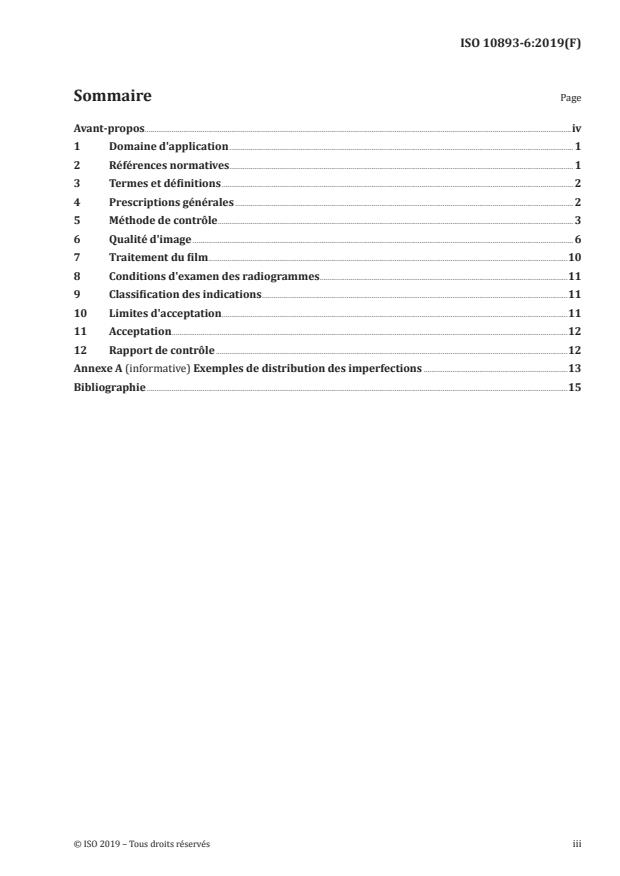
Contents Page
Foreword .iv
1 Scope . 1
2 Normative references . 1
3 Terms and definitions . 1
4 General requirements . 2
5 Test method . 3
6 Image quality . 6
7 Processing of film.10
8 Viewing conditions for radiographs .11
9 Classification of indications .11
10 Acceptance limits .11
11 Acceptance .12
12 Test report .12
Annex A (informative) Examples of distribution of imperfections .13
Bibliography .15
Foreword
ISO (the International Organization for Standardization) is a worldwide federation of national standards
bodies (ISO member bodies). The work of preparing International Standards is normally carried out
through ISO technical committees. Each member body interested in a subject for which a technical
committee has been established has the right to be represented on that committee. International
organizations, governmental and non-governmental, in liaison with ISO, also take part in the work.
ISO collaborates closely with the International Electrotechnical Commission (IEC) on all matters of
electrotechnical standardization.
The procedures used to develop this document and those intended for its further maintenance are
described in the ISO/IEC Directives, Part 1. In particular, the different approval criteria needed for the
different types of ISO documents should be noted. This document was drafted in accordance with the
editorial rules of the ISO/IEC Directives, Part 2 (see www .iso .org/directives).
Attention is drawn to the possibility that some of the elements of this document may be the subject of
patent rights. ISO shall not be held responsible for identifying any or all such patent rights. Details of
any patent rights identified during the development of the document will be in the Introduction and/or
on the ISO list of patent declarations received (see www .iso .org/patents).
Any trade name used in this document is information given for the convenience of users and does not
constitute an endorsement.
For an explanation of the voluntary nature of standards, the meaning of ISO specific terms and
expressions related to conformity assessment, as well as information about ISO's adherence to the
World Trade Organization (WTO) principles in the Technical Barriers to Trade (TBT) see www .iso
.org/iso/foreword .html.
This document was prepared by Technical Committee ISO/TC 17, Steel, Subcommittee SC 19, Technical
delivery conditions for steel tubes for pressure purposes.
This second edition cancels and replaces the first edition (ISO 10893-6:2011), which has been
technically revised. The main changes compared with the previous edition are as follows:
a) evidences about film overlap have been included in 4.7;
b) a safety warning for X and gamma rays has been added at the end of Clause 4;
c) Figure 2 has been aligned with ISO 17636-1 up to 1 000 kV;
d) film side position and location have been clarified in Clause 6;
e) requirements for film processing have been specified in Clause 7;
f) a reference to ISO 5580 has been added in Clause 8;
g) the figures in Annex A have been revised.
Any feedback or questions on this document should be directed to the user’s national standards body. A
complete listing of these bodies can be found at www .iso .org/members .html.
iv © ISO 2019 – All rights reserved
INTERNATIONAL STANDARD ISO 10893-6:2019(E)
Non-destructive testing of steel tubes —
Part 6:
Radiographic testing of the weld seam of welded steel
tubes for the detection of imperfections
1 Scope
This document specifies requirements for film-based radiographic X-ray testing of the longitudinal or
helical weld seams of automated fusion arc-welded steel tubes for the detection of imperfections.
It can also be applicable to the testing of circular hollow sections.
NOTE As an alternative, see ISO 10893-7 for digital radiographic testing.
2 Normative references
The following documents are referred to in the text in such a way that some or all of their content
constitutes requirements of this document. For dated references, only the edition cited applies. For
undated references, the latest edition of the referenced document (including any amendments) applies.
ISO 5576, Non-destructive testing — Industrial X-ray and gamma-ray radiology — Vocabulary
ISO 5579, Non-destructive testing — Radiographic testing of metallic materials using film and X- or gamma
rays — Basic rules
ISO 5580, Non-destructive testing — Industrial radiographic illuminators — Minimum requirements
ISO 9712, Non-destructive testing — Qualification and certification of NDT personnel
ISO 10893-7, Non-destructive testing of steel tubes — Part 7: Digital radiographic testing of the weld seam
of welded steel tubes for the detection of imperfections
ISO 11484, Steel products — Employer’s qualification system for non-destructive testing (NDT) personnel
ISO 11699-1, Non-destructive testing — Industrial radiographic film — Part 1: Classification of film
systems for industrial radiography
ISO 17636-1, Non-destructive testing of welds — Radiographic testing — Part 1: X- and gamma-ray
techniques with film
ISO 19232-1, Non-destructive testing — Image quality of radiographs — Part 1: Determination of the
image quality value using wire-type image quality indicators
ISO 19232-2, Non-destructive testing — Image quality of radiographs — Part 2: Determination of the
image quality value using step/hole-type image quality indicators
3 Terms and definitions
For the purposes of this document, the terms and definitions given in ISO 5576, ISO 11484 and the
following apply.
ISO and IEC maintain terminological databases for use in standardization at the following addresses:
— ISO Online browsing platform: available at https: //www .iso .org/obp
— IEC Electropedia: available at http: //www .electropedia .org/
3.1
tube
hollow long product open at both ends, of any cross-sectional shape
3.2
welded tube
tube (3.1) made by forming a hollow profile from a flat product and welding adjacent edges together,
and which after welding can be further processed, either hot or cold, into its final dimensions
3.3
manufacturer
organization that manufactures products in accordance with the relevant standard(s) and declares the
conformity of the delivered products with all applicable provisions of the relevant standard(s)
3.4
agreement
contractual arrangement between the manufacturer (3.3) and the purchaser at the time of enquiry
and order
4 General requirements
4.1 Unless otherwise specified by the product standard or agreed on by the manufacturer and
the purchaser, a radiographic inspection shall be carried out on tubes after completion of all the
primary production process operations (rolling, heat treating, cold and hot working, sizing, primary
straightening, etc.).
4.2 This inspection shall be carried out by trained operators who are certified (e.g. ISO 9712) or
qualified (e.g. ISO 11484 or ASNT SNT-TC-1A), and supervised by competent personnel nominated by
the manufacturer. In the case of third-party inspection, this shall be agreed on between the manufacturer
and the purchaser.
The operating authorization issued by the employer shall be according to a written procedure. Non-
destructive testing (NDT) operations shall be authorized by a level 3 NDT individual approved by the
employer.
NOTE The definitions of level 1, 2 and 3 can be found in the appropriate International Standards, e.g.
ISO 9712 and ISO 11484.
4.3 The tubes under test shall be sufficiently straight and free of foreign matter as to ensure the validity
of the test. The surfaces of the weld seam and adjacent parent metal shall be sufficiently free of such
foreign matter and surface irregularities, which can interfere with the interpretation of the radiographs.
Surface grinding is permitted in order to achieve an acceptable surface finish.
4.4 In cases where the weld reinforcement is removed, markers, usually in the form of lead arrows,
shall be placed on each side of the weld such that its position can be identified on the radiograph.
4.5 Identification symbols, usually in the form of lead letters, shall be placed on each section of the weld
beam radiograph such that the images of these symbols appear in the radiograph to ensure unequivocal
identification of the section.
2 © ISO 2019 – All rights reserved
4.6 Location information shall be provided by permanent markings on the source side of the tube
surface to provide reference points for the accurate relocation of the position of each radiograph.
Permanent markings are not required when local information for relocating the radiographs, e.g. by
paint marking or reference to accurate sketches are provided.
4.7 When carrying out radiography of a continuous length of a weld with separate films, adjacent
films shall overlap by at least 10 mm to ensure that no portion of the weld length remains unexamined.
Overlap shall be proved using mechanical mark on the surface.
WARNING — Exposure of any part of the human body to X-rays or gamma-rays can be highly
injurious to health. Wherever X-ray equipment or radioactive sources are in use, appropriate
safety measures shall be applied.
Local, national or international safety precautions when using ionizing radiation shall be strictly
applied.
5 Test method
5.1 The weld of longitudinally or helically welded tubes shall be radiographically tested using the X-ray
film technique. The application of non-film, digital radiographic techniques shall conform to ISO 10893-7.
5.2 Two image quality classes A and B, in accordance with ISO 17636-1, shall be specified:
— class A: X-ray examination technique with standard sensitivity;
— class B: X-ray examination technique with enhanced sensitivity.
NOTE Most applications are covered by the use of image quality class A. Image quality class B is intended for
more important and difficult applications where image quality class A can be insufficiently sensitive to reveal
all the imperfections being detected. Image quality class B requires the use of film system class C4 or higher
(fine grain films and lead screens) and, therefore, generally requires a longer exposure time. The required image
quality class is usually stated in the relevant product standard.
5.3 The film system class used shall be at least film system class C5 for image quality class A and shall
be at least C4 (C3 for X-ray voltage < 150 kV) for image quality class B. The classes shall be as defined in
ISO 5579, ISO 11699-1 and ISO 17636-1.
The front intensifying metal screen, for both image quality class B and image quality class A, shall
have a thickness of between 0,02 mm and 0,25 mm. Other thicknesses may be adopted for the back
intensifying screen. In cases where a double film technique is used, both intensifying screens, if used,
shall be in the u
...
NORME ISO
INTERNATIONALE 10893-6
Deuxième édition
2019-02
Essais non destructifs des tubes en
acier —
Partie 6:
Contrôle radiographique du cordon
de soudure des tubes en acier soudés
pour la détection des imperfections
Non-destructive testing of steel tubes —
Part 6: Radiographic testing of the weld seam of welded steel tubes
for the detection of imperfections
Numéro de référence
©
ISO 2019
DOCUMENT PROTÉGÉ PAR COPYRIGHT
© ISO 2019
Tous droits réservés. Sauf prescription différente ou nécessité dans le contexte de sa mise en œuvre, aucune partie de cette
publication ne peut être reproduite ni utilisée sous quelque forme que ce soit et par aucun procédé, électronique ou mécanique,
y compris la photocopie, ou la diffusion sur l’internet ou sur un intranet, sans autorisation écrite préalable. Une autorisation peut
être demandée à l’ISO à l’adresse ci-après ou au comité membre de l’ISO dans le pays du demandeur.
ISO copyright office
Case postale 401 • Ch. de Blandonnet 8
CH-1214 Vernier, Genève
Tél.: +41 22 749 01 11
Fax: +41 22 749 09 47
E-mail: copyright@iso.org
Web: www.iso.org
Publié en Suisse
ii © ISO 2019 – Tous droits réservés
Sommaire Page
Avant-propos .iv
1 Domaine d'application . 1
2 Références normatives . 1
3 Termes et définitions . 2
4 Prescriptions générales . 2
5 Méthode de contrôle . 3
6 Qualité d'image . 6
7 Traitement du film .10
8 Conditions d'examen des radiogrammes .11
9 Classification des indications .11
10 Limites d'acceptation .11
11 Acceptation .12
12 Rapport de contrôle .12
Annexe A (informative) Exemples de distribution des imperfections .13
Bibliographie .15
Avant-propos
L'ISO (Organisation internationale de normalisation) est une fédération mondiale d'organismes
nationaux de normalisation (comités membres de l'ISO). L'élaboration des Normes internationales est
en général confiée aux comités techniques de l'ISO. Chaque comité membre intéressé par une étude
a le droit de faire partie du comité technique créé à cet effet. Les organisations internationales,
gouvernementales et non gouvernementales, en liaison avec l'ISO participent également aux travaux.
L'ISO collabore étroitement avec la Commission électrotechnique internationale (IEC) en ce qui
concerne la normalisation électrotechnique.
Les procédures utilisées pour élaborer le présent document et celles destinées à sa mise à jour sont
décrites dans les Directives ISO/IEC, Partie 1. Il convient, en particulier, de prendre note des différents
critères d'approbation requis pour les différents types de documents ISO. Le présent document a été
rédigé conformément aux règles de rédaction données dans les Directives ISO/IEC, Partie 2 (voir www
.iso .org/directives).
L'attention est attirée sur le fait que certains des éléments du présent document peuvent faire l'objet de
droits de propriété intellectuelle ou de droits analogues. L'ISO ne saurait être tenue pour responsable
de ne pas avoir identifié de tels droits de propriété et averti de leur existence. Les détails concernant
les références aux droits de propriété intellectuelle ou autres droits analogues identifiés lors de
l'élaboration du document sont indiqués dans l'Introduction et/ou dans la liste des déclarations de
brevets reçues par l'ISO (voir www .iso .org/brevets).
Les appellations commerciales éventuellement mentionnées dans le présent document sont données
pour information, par souci de commodité, à l’intention des utilisateurs et ne sauraient constituer un
engagement.
Pour une explication de la nature volontaire des normes, la signification des termes et expressions
spécifiques de l'ISO liés à l'évaluation de la conformité, ou pour toute information au sujet de l'adhésion
de l'ISO aux principes de l’Organisation mondiale du commerce (OMC) concernant les obstacles
techniques au commerce (OTC), voir www .iso .org/avant -propos.
Le présent document a été élaboré par le comité technique ISO/TC 17, Acier, sous-comité SC 19, Conditions
techniques de livraison des tubes d'acier pour appareils à pression.
Cette deuxième édition annule et remplace la première édition (ISO 10893-6:2011), qui a fait l’objet
d’une révision technique.
Les principales modifications par rapport à l’édition précédente sont les suivantes:
a) les preuves concernant le chevauchement des films ont été incluses dans la section 4.7;
b) un avertissement de sécurité pour les rayons X et gamma a été ajouté à la fin de l'Article 4;
c) La Figure 2 a été alignée sur la norme ISO 17636-1 jusqu'à 1 000 kV;
d) La position et l'emplacement du côté du film ont été clarifiés à l'Article 6;
e) les exigences relatives au traitement des films ont été précisées à l'Article 7;
f) une référence à la norme ISO 5580 a été ajoutée à l'Article 8;
g) les figures de l'Annexe A ont été révisés.
Il convient que l’utilisateur adresse tout retour d’information ou toute question concernant le présent
document à l’organisme national de normalisation de son pays. Une liste exhaustive desdits organismes
se trouve à l’adresse www .iso .org/fr/members .html.
iv © ISO 2019 – Tous droits réservés
NORME INTERNATIONALE ISO 10893-6:2019(F)
Essais non destructifs des tubes en acier —
Partie 6:
Contrôle radiographique du cordon de soudure des tubes
en acier soudés pour la détection des imperfections
1 Domaine d'application
Ce document spécifie les prescriptions relatives au contrôle radiographique sur film par rayons X des
cordons de soudure longitudinaux ou hélicoïdaux des tubes en acier soudés en automatique par fusion à
l'arc pour la détection des imperfections.
Ce document s'applique également au contrôle des profils creux circulaires.
NOTE De manière alternative, le contrôle radiographique numérique est spécifié dans l'ISO 10893-7.
2 Références normatives
Les documents suivants sont cités dans le texte de sorte qu’ils constituent, pour tout ou partie de leur
contenu, des exigences du présent document. Pour les références datées, seule l’édition citée s’applique.
Pour les références non datées, la dernière édition du document de référence s'applique (y compris les
éventuels amendements).
ISO 5576, Essais non destructifs — Radiologie industrielle aux rayons X et gamma — Vocabulaire
ISO 5579, Essais non destructifs — Contrôle radiographique des matériaux métalliques au moyen de film et
de rayons X et gamma — Règles de base
ISO 5580, Essais non destructifs — Négatoscopes utilisés en radiographie industrielle — Exigences
minimales
ISO 9712, Essais non destructifs — Qualification et certification du personnel END
ISO 10893-7, Essais non destructifs des tubes en acier — Partie 7: Contrôle radiographique numérique du
cordon de soudure des tubes en acier soudés pour la détection des imperfections
ISO 11484, Produits en acier — Système de qualification, par l’employeur, du personnel pour essais non
destructifs (END)
ISO 11699-1, Essais non destructifs — Film pour radiographie industrielle — Partie 1: Classification des
systèmes films pour radiographie industrielle
ISO 17636-1, Contrôle non destructif des assemblages soudés — Contrôle par radiographie — Partie 1:
Techniques par rayons X ou gamma à l'aide de film
ISO 19232-1, Essais non destructifs — Qualité d'image des radiogrammes — Partie 1: Détermination de
l'indice de qualité d'image à l'aide d'indicateurs à fils
ISO 19232-2, Essais non destructifs — Qualité d'image des radiogrammes — Partie 2: Détermination de
l'indice de qualité d'image à l'aide d'indicateurs à trous et à gradins
3 Termes et définitions
Pour les besoins du présent document, les termes et les définitions de l’ISO 5576 et l’ISO 11484 ainsi que
les suivants s’appliquent.
L’ISO et l’IEC tiennent à jour des bases de données terminologiques destinées à être utilisées en
normalisation, consultables aux adresses suivantes:
— ISO Online browsing platform: disponible à l’adresse https: //www .iso .org/obp
— IEC Electropedia: disponible à l’adresse http: //www .electropedia .org/
3.1
tube
produit long et creux, ouvert à ses deux extrémités, ayant toute forme de section
3.2
tube soudé
tube (3.1) fabriqué par formage d'un produit plat en profil creux et soudage des rives adjacentes., et
qui après soudage, peut être soumis à une transformation, à chaud ou à froid, pour lui donner ses
dimensions définitives
3.3
producteur
organisation qui fabrique des produits conformément à la (aux) norme(s) pertinente(s) et déclare la
conformité des produits livrés à toutes les dispositions applicables de la (des) norme(s) pertinente(s)
3.4
accord
arrangement contractuel entre le producteur (3.3) et l'acheteur au moment de l'appel d'offres et de la
commande
4 Prescriptions générales
4.1 Sauf spécification contraire de la norme de produit ou accord contraire entre le producteur
et l'acheteur, ce contrôle radiographique doit être effectué sur les tubes après exécution de toutes les
opérations principales du processus de fabrication (laminage, traitement thermique, formage à froid ou
à chaud, mise à dimensions, dressage initial, etc.).
4.2 Ce contrôle doit être effectué par des opérateurs formés qui sont certifiés (par exemple ISO 9712)
ou qualifiés (par exemple ISO 11484 ou ASNT SNT-TC-1A-2016) et supervisés par un personnel
compétent désigné par le producteur. Lorsque le contrôle est effectué par une tierce partie, il doit faire
l'objet d'un accord entre le producteur et l'acheteur.
L'autorisation d'opérer délivrée par l'employeur doit être conforme à un mode opératoire écrit. Les
opérations de contrôles non destructifs (CND) doivent être autorisées par un personnel de CND de
niveau 3 approuvé par l'employeur.
NOTE Les définitions des niveaux 1, 2 et 3 peuvent être trouvées dans les normes appropriées, par exemple
l'ISO 9712 et l'ISO 11484.
4.3 Les tubes à contrôler doivent être suffisamment droits et exempts de corps étrangers pour garantir
la validité du contrôle. Les surfaces du cordon de soudure et du métal de base adjacent doivent être
suffisamment exemptes de corps étrangers et d'irrégularités, pouvant perturber l'interprétation des
radiogrammes.
Un meulage superficiel est autorisé afin d'obtenir une finition de surface acceptable.
2 © ISO 2019 – Tous droits réservés
4.4 Dans les cas où le cordon de soudure est éliminé, des repères, généralement sous forme de flèches
en plomb, doivent être placés de part et d'autre de la soudure de sorte que sa position puisse être
identifiée sur le radiogramme.
4.5 Des symboles d'identification, généralement sous forme de lettres en plomb, doivent être placés
sur chaque section de soudure radiographiée de sorte que les images de ces symboles apparaissent sur
le radiogramme et permettent une identification de la section sans risque d'erreur.
4.6 Des informations de repérage par des marquages permanents doivent être réalisés sur la surface
du tube, côté source, afin de constituer des points de référence permettant un repérage précis de la
position de chaque radiogramme.
Des marquages permanents ne sont pas requis lorsque d’autres informations locales pour repositionner
les radiogrammes par exemple des marquages à la peinture ou des références à des schémas exacts
sont fournis.
4.7 Lorsqu'une longueur continue de soudure est radiographiée sur des films différents, les films
doivent se chevaucher sur au moins 10 mm afin de s'assurer qu'aucune portion de la longueur de la
soudure n'échappe au contrôle.Le chevauchement doit être prouvé à l'aide d'un marquage mécanique
sur la surface.
AVERTISSEMENT — L'exposition de toute partie du corps humain aux rayons X ou aux rayons
gamma peut être très nocive pour la santé. Lorsque des appareils à rayons X ou des sources
radioactives sont utilisés, des mesures de sécurité appropriées doivent être appliquées.
Les mesures de sécurité locales, nationales ou internationales lors de l'utilisation des
rayonnements ionisants doivent être strictement appliquées.
5 Méthode de contrôle
5.1 Le cordon des tubes à soudure longitudinale ou hélicoïdale doit être soumis à un contrôle
radiographique par rayons X sur film. Pour l'application de techniques radiographiques numériques sans
film, voir l'ISO 10893-7.
5.2 Deux classes de qualité d'image, A et B, conformément à l'ISO 17636-1, sont prescrites:
— classe A: technique d’examen par rayons X avec sensibilité standard;
— classe B: technique d’examen par rayons X avec sensibilité améliorée.
NOTE La majeure partie des applications sont couvertes par la classe de qualité d'image A. La classe de
qualité d'image B est destinée à des applications plus importantes et plus compliquées pour lesquelles la classe de
qualité d'image A peut s'avérer insuffisamment sensible pour révéler toutes les imperfections que l'on souhaite
détecter. La classe de qualité d'image B exige l'utilisation d'un système film de classe C4 ou supérieure (films à
grains fins et écrans en plomb) et nécessite donc, en général, un temps d'exposition plus long. La classe de qualité
d'image requise est généralement indiquée dans la norme de produit pertinente.
5.3 Le système de film utilisé doit être au minimum de classe C5 pour une classe de qualité d'image A
et doit être au minimum de classe C4 (C3 pour un tube à rayons X de tension < 150 kV) pour une classe
de qualité d'image B. Les classes doivent être telles que définies dans les ISO 5579, ISO 11699-1 et
ISO 17636-1.
Pour les deux classes de qualité d'image A et B, l'écran renforçateur métallique antérieur doit avoir une
épaisseur comprise entre 0,02 mm et 0,25 mm. D'autres épaisseurs peuvent être choisies pour l'écran
renforçateur postérieur. Lorsqu'une technique à double film est utilisée, l'épaisseur des deux écr
...
Questions, Comments and Discussion
Ask us and Technical Secretary will try to provide an answer. You can facilitate discussion about the standard in here.
Loading comments...