

ISO 22483:2020
(Main)Tourism and related services — Hotels — Service requirements
General Information
- Abstract
This document establishes quality requirements and recommendations for hotels regarding staff, service, events, entertainment activities, safety and security, maintenance, cleanliness, supply management and guest satisfaction. The requirements are applicable regardless of their classification and category, and whether the services are provided directly by internal staff or by a subcontractor.
- Status
- Published
- Publication Date
- 13-Apr-2020
- Technical Committee
- ISO/TC 228 - Tourism and related services
- Drafting Committee
- ISO/TC 228/WG 15 - Accommodation
- Current Stage
- 9093 - International Standard confirmed
- Start Date
- 05-Mar-2026
- Completion Date
- 29-Aug-2026
Buy Documents

ISO 22483:2020 - Tourism and related services -- Hotels -- Service requirements
ISO 22483:2020 - Tourism and related services — Hotels — Service requirements/14/2020
Overview
ISO 22483:2020 - Tourism and related services - Hotels - Service requirements is an international standard that defines quality requirements and recommendations for hotel operations. Published in 2020 (first edition), it provides a practical, globally-applicable reference for ensuring consistent guest service across staff, facilities and outsourced services. The standard is designed to support a satisfactory guest experience and promotes guest loyalty by establishing minimum quality expectations for experienced global travellers.
Key topics and technical requirements
ISO 22483:2020 covers a broad set of service areas found in the modern hospitality environment. Major topics include:
Staff requirements
- Organizational structure, roles and responsibilities
- Training programs and guest service competencies
- Management of subcontracted staff and concessionaires
Front desk and guest-facing services
- Reservation, check-in/check-out, billing and luggage handling
- VIP services and guest communication
Accommodation and ancillary services
- Room standards and accommodation service delivery
- Food & beverage operations (buffet and à la carte considerations)
- Pools, spas and other guest facilities
Events and entertainment
- Event organisation requirements and entertainment activity guidelines
Safety, security and health
- Risk and accident prevention, fire protection, emergency management
- Food safety and personal hygiene controls
- Security of people and assets; building and facility safety
Maintenance, cleanliness and supply management
- Cleaning plans and deep-clean programs
- Buildings, equipment maintenance and linen/laundry handling
- Supply chain and inventory best practices
Guest satisfaction
- Feedback compilation and processes to monitor and improve guest experience
The standard applies regardless of hotel category or classification, and whether services are delivered by internal staff or subcontractors.
Practical applications - who uses ISO 22483:2020
ISO 22483:2020 is useful for:
- Hotel owners and general managers seeking consistent service quality
- Operations and department managers (front desk, housekeeping, F&B, events)
- Hotel chains and franchise operators implementing group-wide standards
- Consultants, auditors and certification bodies assessing service quality
- Training providers and HR teams designing competency programs
- Facilities and maintenance teams responsible for safety and cleanliness
- Destination management organizations and regulators referencing minimum service expectations
Implementing ISO 22483 helps reduce operational risk, improve guest satisfaction scores, and align service delivery with international best practices for hospitality.
Related standards
- No normative references are listed in ISO 22483:2020. For integrated management approaches, organizations often consider complementary standards such as ISO 9001 (quality management) and national hotel classification systems. The standard was developed by ISO/TC 228 (Tourism and related services).
Buy Documents
ISO 22483:2020 - Tourism and related services -- Hotels -- Service requirements
ISO 22483:2020 - Tourism and related services — Hotels — Service requirements/14/2020
Get Certified
Connect with accredited certification bodies for this standard

Great Wall Tianjin Quality Assurance Center
Established 1993, first batch to receive national accreditation with IAF recognition.
Hong Kong Quality Assurance Agency (HKQAA)
Hong Kong's leading certification body.

Innovative Quality Certifications Pvt. Ltd. (IQCPL)
Known for integrity, providing ethical & impartial Assessment & Certification. CMMI Institute Partner.
Sponsored listings
Frequently Asked Questions
ISO 22483:2020 is a standard published by the International Organization for Standardization (ISO). Its full title is "Tourism and related services — Hotels — Service requirements". This standard covers: This document establishes quality requirements and recommendations for hotels regarding staff, service, events, entertainment activities, safety and security, maintenance, cleanliness, supply management and guest satisfaction. The requirements are applicable regardless of their classification and category, and whether the services are provided directly by internal staff or by a subcontractor.
This document establishes quality requirements and recommendations for hotels regarding staff, service, events, entertainment activities, safety and security, maintenance, cleanliness, supply management and guest satisfaction. The requirements are applicable regardless of their classification and category, and whether the services are provided directly by internal staff or by a subcontractor.
ISO 22483:2020 is classified under the following ICS (International Classification for Standards) categories: 03.080.30 - Services for consumers; 03.200.01 - Leisure and tourism in general. The ICS classification helps identify the subject area and facilitates finding related standards.
ISO 22483:2020 is available in PDF format for immediate download after purchase. The document can be added to your cart and obtained through the secure checkout process. Digital delivery ensures instant access to the complete standard document.
Standards Content (Sample)
INTERNATIONAL ISO
STANDARD 22483
First edition
2020-04
Tourism and related services — Hotels
— Service requirements
Tourisme et services connexes — Hôtels — Exigences du service
Reference number
©
ISO 2020
© ISO 2020
All rights reserved. Unless otherwise specified, or required in the context of its implementation, no part of this publication may
be reproduced or utilized otherwise in any form or by any means, electronic or mechanical, including photocopying, or posting
on the internet or an intranet, without prior written permission. Permission can be requested from either ISO at the address
below or ISO’s member body in the country of the requester.
ISO copyright office
CP 401 • Ch. de Blandonnet 8
CH-1214 Vernier, Geneva
Phone: +41 22 749 01 11
Fax: +41 22 749 09 47
Email: copyright@iso.org
Website: www.iso.org
Published in Switzerland
ii © ISO 2020 – All rights reserved
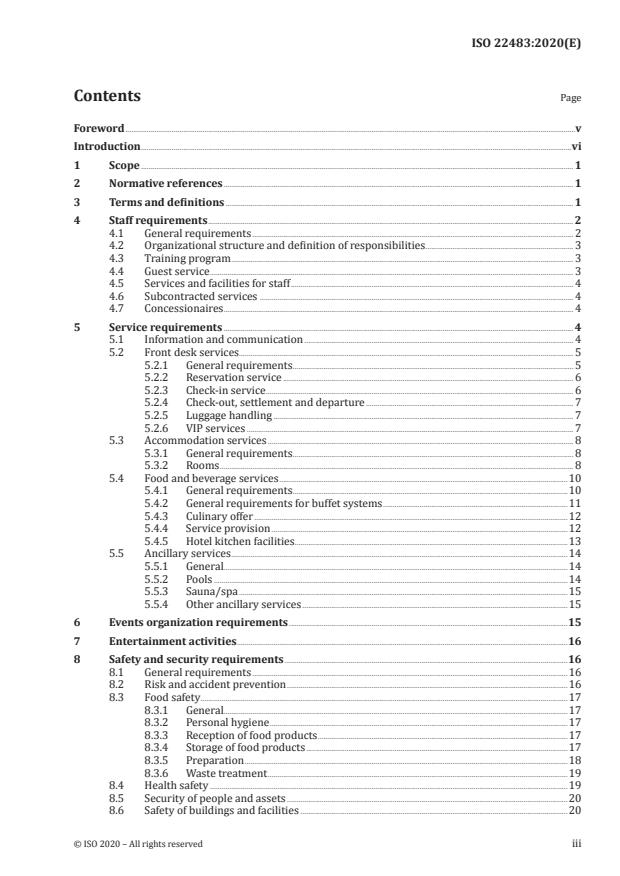
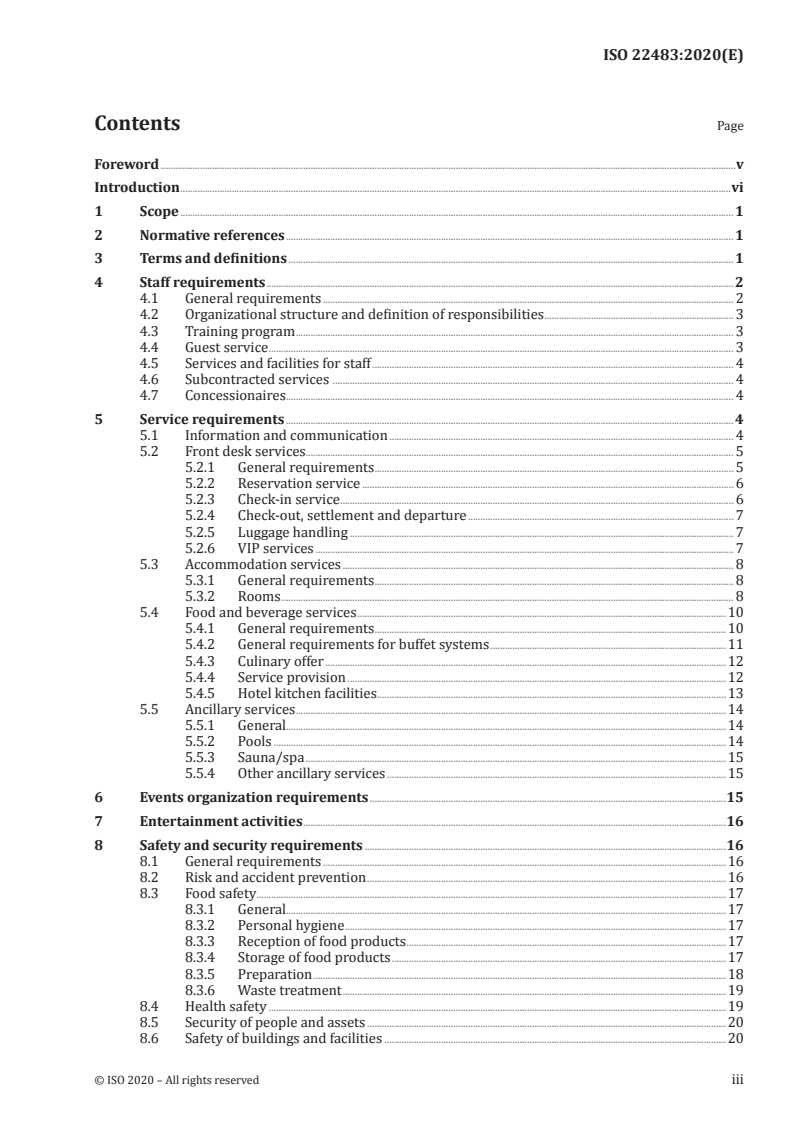
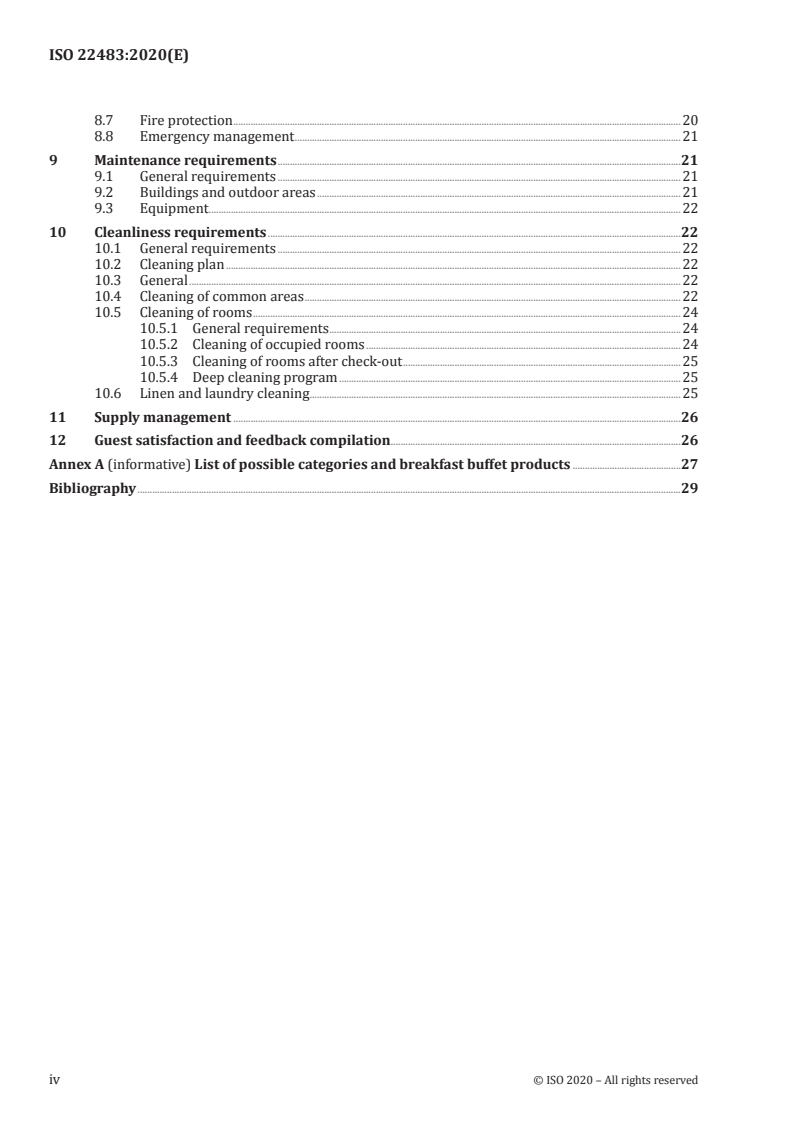
Contents Page
Foreword .v
Introduction .vi
1 Scope . 1
2 Normative references . 1
3 Terms and definitions . 1
4 Staff requirements . 2
4.1 General requirements . 2
4.2 Organizational structure and definition of responsibilities . 3
4.3 Training program . 3
4.4 Guest service . 3
4.5 Services and facilities for staff . 4
4.6 Subcontracted services . 4
4.7 Concessionaires . 4
5 Service requirements . 4
5.1 Information and communication . 4
5.2 Front desk services. 5
5.2.1 General requirements . 5
5.2.2 Reservation service . 6
5.2.3 Check-in service . 6
5.2.4 Check-out, settlement and departure . 7
5.2.5 Luggage handling . 7
5.2.6 VIP services . 7
5.3 Accommodation services . 8
5.3.1 General requirements . 8
5.3.2 Rooms . 8
5.4 Food and beverage services .10
5.4.1 General requirements .10
5.4.2 General requirements for buffet systems .11
5.4.3 Culinary offer .12
5.4.4 Service provision .12
5.4.5 Hotel kitchen facilities . .13
5.5 Ancillary services .14
5.5.1 General.14
5.5.2 Pools .14
5.5.3 Sauna/spa .15
5.5.4 Other ancillary services .15
6 Events organization requirements .15
7 Entertainment activities .16
8 Safety and security requirements .16
8.1 General requirements .16
8.2 Risk and accident prevention .16
8.3 Food safety .17
8.3.1 General.17
8.3.2 Personal hygiene .17
8.3.3 Reception of food products .17
8.3.4 Storage of food products .17
8.3.5 Preparation .18
8.3.6 Waste treatment .19
8.4 Health safety .19
8.5 Security of people and assets .20
8.6 Safety of buildings and facilities .20
8.7 Fire protection .20
8.8 Emergency management .21
9 Maintenance requirements .21
9.1 General requirements .21
9.2 Buildings and outdoor areas .21
9.3 Equipment .22
10 Cleanliness requirements .22
10.1 General requirements .22
10.2 Cleaning plan .22
10.3 General .22
10.4 Cleaning of common areas .22
10.5 Cleaning of rooms .24
10.5.1 General requirements .24
10.5.2 Cleaning of occupied rooms .24
10.5.3 Cleaning of rooms after check-out .25
10.5.4 Deep cleaning program .25
10.6 Linen and laundry cleaning .25
11 Supply management .26
12 Guest satisfaction and feedback compilation.26
Annex A (informative) List of possible categories and breakfast buffet products .27
Bibliography .29
iv © ISO 2020 – All rights reserved
Foreword
ISO (the International Organization for Standardization) is a worldwide federation of national standards
bodies (ISO member bodies). The work of preparing International Standards is normally carried out
through ISO technical committees. Each member body interested in a subject for which a technical
committee has been established has the right to be represented on that committee. International
organizations, governmental and non-governmental, in liaison with ISO, also take part in the work.
ISO collaborates closely with the International Electrotechnical Commission (IEC) on all matters of
electrotechnical standardization.
The procedures used to develop this document and those intended for its further maintenance are
described in the ISO/IEC Directives, Part 1. In particular, the different approval criteria needed for the
different types of ISO documents should be noted. This document was drafted in accordance with the
editorial rules of the ISO/IEC Directives, Part 2 (see www .iso .org/ directives).
Attention is drawn to the possibility that some of the elements of this document may be the subject of
patent rights. ISO shall not be held responsible for identifying any or all such patent rights. Details of
any patent rights identified during the development of the document will be in the Introduction and/or
on the ISO list of patent declarations received (see www .iso .org/ patents).
Any trade name used in this document is information given for the convenience of users and does not
constitute an endorsement.
For an explanation of the voluntary nature of standards, the meaning of ISO specific terms and
expressions related to conformity assessment, as well as information about ISO's adherence to the
World Trade Organization (WTO) principles in the Technical Barriers to Trade (TBT) see www .iso .org/
iso/ foreword .html.
This document was prepared by Technical Committee ISO/TC 228, Tourism and related services.
Any feedback or questions on this document should be directed to the user’s national standards body. A
complete listing of these bodies can be found at www .iso .org/ members .html.
Introduction
Choosing accommodation is one of the first issues that tourists face when they organize a trip, and
hotels are the most popular accommodation choice. In fact, according to the current concept of tourism
and trends, hotels are an important and motivational element of tourists’ trips.
The hotel industry represents a high percentage of tourism activity and is the tourism sector that has
grown the most in recent years. However, the rapid development of the sector, its high competitiveness,
the role that technologies play in the tourism industry value chain and the new accommodation
business models which have arisen during the last decade make the design and implementation of
differentiation strategies a need not only for the hotel industry but also for the destinations themselves.
In this context, offering a quality service to guests plays a major role in the differentiation strategy.
This document provides a common and attainable reference for all hotels in terms of quality service
provision and has been developed considering the different types of hotels in the world, existing
categorization systems, business models, sizes and services offered, as well as the current demands of
guests and global trends.
This document has been conceived as a tool aimed at offering a satisfactory guest experience, promoting
direct and indirect guest loyalty by ensuring the appropriate framework for providing the minimum
quality service expected by an experienced global tourist.
vi © ISO 2020 – All rights reserved
INTERNATIONAL STANDARD ISO 22483:2020(E)
Tourism and related services — Hotels — Service
requirements
1 Scope
This document establishes quality requirements and recommendations for hotels regarding staff,
service, events, entertainment activities, safety and security, maintenance, cleanliness, supply
management and guest satisfaction.
The requirements are applicable regardless of their classification and category, and whether the
services are provided directly by internal staff or by a subcontractor.
2 Normative references
There are no normative references in this document.
3 Terms and definitions
For the purposes of this document, the following terms and definitions apply.
ISO and IEC maintain terminological databases for use in standardization at the following addresses:
— ISO Online browsing platform: available at https:// www .iso .org/ obp
— IEC Electropedia: available at http:// www .electropedia .org/
3.1
accommodation service
provision of at least bedroom/s and bathroom in which a guest may stay
3.2
à la carte
menu system in which all dishes offered are individually priced, listed generally in food groups (e.g.
starters, main course, dessert or meats, fish, vegetarian dishes) and prepared freshly to guest order
3.3
buffet
self service offer displaying beverages and food of which the guest can freely choose in variety and
quantity
Note 1 to entry: This offer is generally associated with a flat rate.
3.4
courtesy service
service offered by the hotel that enhances guest care
EXAMPLE Offering a drink when the room is not ready, looking after luggage, offering late check-out, fruit in
the room or free drinks, giving access to hotel services before check-in or after check-out and providing airport
shuttle services.
Note 1 to entry: Hotel management can define which service is more appropriate depending on the situation or
guest needs.
3.5
entertainment
leisure, sporting or amusement activity provided by the hotel
EXAMPLE Board games, shows, live music.
3.6
event
experience which takes place at a specific time and location
EXAMPLE Celebration, meeting, conference.
3.7
amenity
item offered to guests placed in guestrooms for convenience and comfort
EXAMPLE Shower gel, body lotion, shampoo.
Note 1 to entry: Toilet paper, hygienic bags and towels are not considered amenities.
3.8
hazard analysis critical control points
HACCP
system which identifies, evaluates and controls hazards which are significant for food safety
[SOURCE: Codex Alimentarius]
3.9
hotel
commercial establishment providing at least reception, accommodation and guest services, recognized
or registered as such in the applicable legislation
Note 1 to entry: A hotel might also offer food and beverage services and/or other ancillary services.
3.10
VIP service
special privilege given to certain guests
4 Staff requirements
4.1 General requirements
All staff shall be trained and qualified for their intended field of work.
Qualification shall be ensured by one of the following:
a) an apprenticeship (training on the job) that is guided and supervised by a person that has the skills
regarding the relevant subject as well as the skills to communicate this knowledge with respect to
the apprentice;
b) experience in the field of work (ideally documented with references from the former employer(s) or
the related authority);
c) vocational training;
d) experience in a related field of work combined with a training program that ensures that any
missing qualifications can be addressed. Such an additional training course can be undertaken
alongside the work or sometimes simultaneously;
e) academic training related to the intended field of work (ideally supplemented by practical
experience during the studies).
2 © ISO 2020 – All rights reserved
Certain profiles related to particular tasks may be developed by accredited staff (e.g. entertainment
activities, handling of chemicals).
4.2 Organizational structure and definition of responsibilities
The hotel management shall identify and document the chart and the job descriptions for the most
relevant job positions.
There shall be a person responsible for:
a) monitoring the provision of the services;
b) identifying and recording any incident related to the provision of the services;
c) initiating actions to ensure guest satisfaction.
4.3 Training program
A training program shall be designed, implemented and periodically reviewed by the hotel management
to improve staff competence, according to the identified needs. The training program shall meet the
following requirements:
a) after recruitment of the new member of staff, a training or orientation period shall be provided;
b) for staff in contact with guests, guest service training, including instructions on how to welcome
different types of guests, shall be provided;
c) emergency training (e.g. what to do in an emergency, evacuation plan) and basic life support (BLS)
or first aid training shall be included;
d) other training, such as environmental good practices, hygiene and safety issues, IT skills, foreign
languages and sign language, can be considered.
NOTE ISO 10015 and ISO 29993 can be used in this respect.
4.4 Guest service
All staff are responsible for the quality of guest service and shall:
a) be polite and courteous;
b) be clean, tidy and well groomed;
c) provide service promptly and diligently in accordance with the hotel’s procedures;
d) be identifiable; it is recommended that the staff member’s name is displayed on a tag;
e) avoid making loud noises as much as possible or raised voices during the performance of tasks;
f) not enter rooms without the authorization of the guest when he/she is in the room;
g) know how to act in case of emergency;
h) be aware of the tips policy defined by the hotel management;
i) be aware of any specific accommodation/arrangements available for guests with any kind of
disability.
4.5 Services and facilities for staff
The hotel management shall define the services and facilities offered to staff and conform to the
following:
a) if the hotel management decides that the staff use uniforms, the defined uniforms shall be provided
by the hotel;
b) if staff need to change clothes for their job position, there shall be changing facilities; if needed,
the changing facilities should provide separate men's and women's employee locker rooms and
vestibule entrances to block sightlines into the locker rooms;
c) there shall be bathrooms and closets with toilet paper, paper towels or hand dryers, soap or
sanitizer, wastepaper baskets and hangers. Solid soap shall be avoided;
d) if the hotel offers staff transportation, this service shall be covered by an accident insurance;
e) all staff facilities shall be clean and well maintained.
The hotel should provide the adaptation of the workplace if it employs a person with any kind of
disability.
4.6 Subcontracted services
The hotel management shall have a procedure for subcontracting, which shall include details of
the obligations of the services being contracted, associated terms and conditions and the rules of
engagement of staff. This procedure shall be followed by the responsible staff at the premises and
include at least the following:
a) the hotel shall have a service contract with the subcontractors;
b) a means of identifying staff who work for a subcontractor should be provided;
c) if the subcontractor’s staff provide a service at the hotel facilities on a frequent basis (e.g. cleaning,
maintenance, entertainment activities), the hotel shall inform the subcontractors of the internal
rules which could affect them (e.g. uniform, courtesy rules, name tags);
If the hotel has specific facilities (e.g. spa, gymnasium, restaurants) run by a subcontractor, the guests’
complaint management procedure should be agreed with the subcontractors concerned.
4.7 Concessionaires
If there are concessions in the hotel premises (e.g. shops, hairdressers, restaurants), the hotel
management shall define and document the relationship between both parties (concessionaire and
hotel), including rights and duties.
5 Service requirements
5.1 Information and communication
The hotel shall:
a) provide accurate details of the available services, prices and applicable taxes (if not included in the
price) to the guest through different means such as website, advertisement or brochures;
b) provide to the guest, prior to reservation, details of the different room types, prices, cancellation
policy, deposits, pre-payments, accepted payment methods and other relevant information
regarding reservations;
4 © ISO 2020 – All rights reserved
c) identify which of its services are accessible, providing the necessary information when requested
by the guest. This information should be communicated through the website;
d) respond promptly and specifically if there is a possibility of interacting directly with the guest
through digital channels;
e) provide other relevant information for the guest (e.g smoking policy, pet policy, prevention of
sexual exploitation of children).
5.2 Front desk services
5.2.1 General requirements
The hotel entrance and the hotel's name shall be clearly identifiable from outside and the access area
shall be clean and illuminated. There shall be adequate levels of lighting for safety and comfort in all
public areas, including access to the rooms, light on the stairways and the landing at night.
The space in the reception area shall conform to the following:
— it shall be signposted, as shall access to the rooms and other spaces used to attend guests (e.g. bell
stand, cash desk) if they are not easy to identify;
— the different methods of payment shall be clearly displayed;
The following general requirements related to front desk services shall be met:
a) The front desk staff shall be able to communicate with the guests in at least the local language and
in the most relevant languages for the hotel’s target market.
b) The hotel shall define and implement courtesy rules, as well as a protocol for telephone attention
(including aspects such as prompt assistance, identification of the hotel and staff on the phone and
recover calls).
c) The front desk staff shall have an in-depth knowledge of the hotel, including the location of all
the facilities and services, their accessibility characteristics and, specifically, the characteristics
of the rooms.
1)
NOTE ISO 21902 can be used in this respect.
d) The front desk services staff shall be capable of giving information about the destination and
arrange services accordingly.
e) If the hotel offers the currency exchange service, it shall have an authorization (if applicable)
and inform the guest about the currency exchange rate. Receipts indicating the type of exchange
applied shall be given to the guest.
f) Messages of congratulations, complaints and suggestions shall be collected and managed for further
reference or action. There shall be the possibility to receive complaints in oral and written forms.
g) The hotel shall have a communication system between the guest and the front desk staff in case the
reception is not manned 24 h a day (e.g. in-room/public area telephone system).
h) Security procedures (e.g. verification of the identity of the guest when making a copy of the key
card) shall be addressed by the front desk service.
1) Under preparation. Stage at the time of publication: ISO/DIS 21902:2019.
5.2.2 Reservation service
The hotel shall have a documented procedure which shall include:
a) instructions on how to attend, register, cancel, guarantee (by, for example, pre-payment, deposit,
credit card) and confirm reservations, considering the following:
— requests for reservations shall be answered within 24 h. Once accepted, they shall be recorded,
identifying who made the reservation, the number of rooms and persons, dates, number of
nights to be spent and contact details (if available from the reservation partner), as well as the
applicable price, methods of payment, earliest and latest arrival time, conditions of early check-
in and late check-out if applicable, and possible additional requests such as transfers;
— the acceptance of the reservation, as well as any change, shall be registered and communicated
in writing to the guest when there is enough time between the booking and arrival;
— the hotel shall define and communicate to the guests the first possible check-in time, which
should not be later than 2:00 pm.
b) the analysis of the forecast of reservations and actions (e.g. promotions and offers, closing sales),
including:
— a control of the level of expected occupation to avoid overbooking. There shall be a system which
defines how to act in these situations, offering the guest a service of equal or higher quality and
with the least possible disturbance. Compensation should also be defined, if applicable;
— allocation of rooms in line with the system defined by the hotel, considering the allocation of
specific rooms (e.g. returning guests, requests for specific rooms, facilities for guests with
disabilities).
c) the access by front desk staff to the information on occupancy forecast, list of arrivals, assignments
and the breakfast list;
d) dealing with special cases (e.g. groups, waiting list, no shows) or guests’ requirements (e.g. bedding
type, early check-in, baby cribs).
As far as possible, the hotel should have a historical file of guests that may be used for the allocation of
rooms or for the personalization of the services, taking legal requirements on national data protection
into consideration.
5.2.3 Check-in service
The following requirements shall be met:
a) the check-in service staff shall give priority to direct guest contact over other reception duties;
b) check-in shall be as quick as possible. The following information shall be communicated to the guest:
— how to locate his/her room and the most relevant facilities;
— unusual circumstances (e.g. works, limitations in timetables or services);
— additional services and prices (except for confidential rates) upon request;
— the latest possible check-out time, which should not be earlier than 12:00 pm;
— the appropriate indications and the conditions of use if a parking service is offered.
c) the hotel shall register guests upon arrival;
NOTE Some form of identification document, such as ID, passport or driving license, can be required in
some countries.
6 © ISO 2020 – All rights reserved
d) the information about the services that the guest has contracted shall be validated with the guest
during the check-in process;
e) the hotel shall offer a luggage storage service until the guest can be accommodated;
f) if the room is not available after the check-in time, the hotel shall offer a courtesy service to guests
with a reservation;
g) in the case of groups or mass individual arrivals at the same time, a specific check-in area for the
groups should be prepared so that the service is not interrupted and operations are speeded up.
5.2.4 Check-out, settlement and departure
The following requirements shall be met:
a) the bill shall give a day-by-day detail of the concepts or services used and the prices, unless the
guest asks for a summary bill;
b) upon request, the guests who occupied the rooms shall be identified regardless of whether the bill
is issued under another name;
c) billing and receiving payment shall be done quickly and reliably;
d) the courtesy services that the hotel offers shall be defined;
e) the cases and conditions under which the hotel offers and/or accepts a late check-out shall be
established;
f) the guest shall be informed about the luggage storage service.
5.2.5 Luggage handling
The hotel shall offer a luggage storage service according to the following requirements:
a) there shall be a specific area for the storage of luggage with access restricted to authorized persons;
b) all luggage belonging to individual guests deposited in the left-luggage area shall be clearly identified
(with a receipt or other system) so as to guarantee that it is returned to its rightful owners;
c) the luggage shall be returned to the guest in the state it was given over for custody.
The hotel can offer a luggage transportation service. In these cases, the hotel shall define and
communicate to the guests how this service is provided (i.e. service times, how to ask for the service).
In any case, equipment for transportation shall be clean and well maintained.
5.2.6 VIP services
If the hotel offers VIP services, it should document how to provide these services considering the
following:
a) who is considered a VIP by the hotel management;
b) assignment of room, considering the guest preferences;
c) security issues, according to the type of guest;
d) services that VIP guests might request;
e) protocol;
f) special attention upon arrival (e.g. welcome drink, flowers, fruit).
5.3 Accommodation services
5.3.1 General requirements
The hotel shall offer the following:
a) telephone service and Wi-Fi access for guests; if needed, Wi-Fi access instructions shall be provided;
b) wake-up service on request or alarm clock in the room;
c) plug adaptors;
d) drinking water 24 h a day;
e) forms for taking messages or packages for guests or for the custody of assets;
f) list with emergency telephone numbers;
g) help on request, whenever possible.
There shall be a lost and found policy.
Designated smoking areas (if any) should be signposted.
5.3.2 Rooms
5.3.2.1 General requirements
The following requirements shall be met in each room:
a) a directory of the services offered by the hotel shall be available, with information that may be
of interest to the guests (e.g. opening times of the services, telephone charges, TV channels, local
attractions, voltage, smoking policy);
b) if a product or service in the room is not free, the price shall be indicated (e.g. mini bar price list);
c) a map indicating the evacuation routes, the emergency exit and the nearest fire equipment shall be
displayed in each room, as well as the basic instructions in the case of an emergency, written in at
least the local language and in the most relevant languages for the target market. The signs shall be
understable for the guests;
d) there shall be at least one socket available (not used for another type of permanent device) both in
the room and in the bathroom;
e) instructions about the use of devices whose operation is not clear shall be provided, either in
written form or in oral form;
f) there shall be a bed(s) with mattress, pillow and cover provided for warmth such as blanket(s)
or duvet; bed linen (sheets, pillowcases and duvet covers) shall be changed for each guest. The
mattresses and frames shall be in good condition. Additional mattress, pillow protection and top
cover are optional;
g) there shall be an extra blanket/duvet(s) available, either in the cupboard in the room or provided
by the staff, on request. This extra blanket/duvet(s) shall be protected to keep them clean.
5.3.2.2 Minimum furniture, equipment, facilities and supplies
a) The minimum furniture of the room, if not conflicting with the business model of the hotel, shall
include:
— wardrobe with drawers or shelves or clothes niche. If there are hangers, these shall be for
different types of clothes;
8 © ISO 2020 – All rights reserved
— beside table(s) or equipment with the same functionality (e.g. shelf/shelves);
— writing desk;
— sitting facility (e.g. chair, couch);
— mirror; its position should allow the customer a full-length view;
— luggage rack;
— if there is a terrace or a balcony and space allows, it should have chair(s) and a table.
b) The minimum equipment in the room shall include:
— television with remote control (if not conflicting with the business model of the hotel). Available
TV channels shall be properly tuned in;
— wastepaper basket;
— internal communication device (e.g. telephone, smart TV) to connect with the front desk service
or with other services at the hotel;
— ashtray, when smoking is permitted;
— equipment to regulate the darkness of the room (e.g. blinds, blackout curtains);
— safe deposit box, with a guest room safe disclaimer including instructions about the liability.
Alternatively, the safe deposit box could be at the front office desk;
— a “Do not disturb” system.
c) Furthermore:
— if there is a mini bar in the room, it should be refilled daily;
— if there is an iron in the room, there shall be an ironing board and both should be kept in the
closet/wardrobe;
— if there is an in-room coffee/tea service, cleanliness shall be ensured and coffee mugs, cups,
saucers or paper coffee cups, stir sticks or teaspoons (as appropriate), coffee/tea and sugar
shall be provided;
— the hotel should allow a temperature between 18 °C and 25 °C with air conditioning and/or
heating, depending on the needs. In the rooms of those hotels with heating or air conditioning,
there should be a device that makes it possible to regulate this.
d) All rooms shall have an en-suite bathroom. This bathroom shall include:
— lidded WC;
— shower and/or bath;
— shower screen/curtain;
— washbasin;
— mirror situated above or adjacent to the washbasin;
— internal lock or bolt, operable from outside in case of emergency;
— hook or towel rail;
— hot water at all times with a proper and easily adjustable system to regulate hot, warm and cold
water flow;
— curtains, blinds or shutters to ensure privacy if there is a window;
— handles, slip-resistant systems or others precautions to avoid slipping in the bath or shower,
according to the needs;
— washable flooring;
— one drinking glass per accommodated person;
— covered litter bin;
— toilet paper and spare;
— soap/liquid tray/dispenser;
— tissue box with facial tissues;
— hair dryer (or upon request);
— set(s) of towels, including bath towel, hand towel, mat and bidet towel (if the bathroom is equipped
with a bidet). The number of sets shall be equal to the number of guests accommodated, except
in the case of mats, where there shall be one per room;
— the minimum obligatory amenities (with replacement during the stay of the guest) which shall
include gel and shampoo, or a combination of the previous products. The hotel should also be
able to offer other amenities such as dental set, shaving kit, conditioner, cotton pads, sewing kit,
shower cap or body lotion. If there is an extra charge, this shall be communicated.
e) If the hotel offers a laundry service, the hotel shall provide:
— information about the rates, time required for the services, collection and delivery and contact
details to request more information;
— laundry bag at the disposal of the guest;
— form to be filled in by the guest with room number, number and type of garments deposited,
types of services requested and date on which the delivery is made.
f) The hotel shall provide, when necessary and according to the type of guest, facilities for children,
such as baby cots/cribs and high chairs.
5.4 Food and beverage services
5.4.1 General requirements
The hotel shall offer a breakfast service and define one or more systems to offer it (e.g. buffet, à la carte,
all-inclusive). Additionally, the hotel can offer the following services, choosing one or more systems to
provide them:
— lunch: buffet system, à la carte, mixed;
— dinner: buffet system, à la carte, mixed;
— room service;
— cafeteria/snack bar service.
The hotel shall define where to offer these services (e.g. in the restaurant, cafeteria or similar facilities
of the hotel).
10 © ISO 2020 – All rights reserved
When the hotel offers any of the previous services, it shall conform to the following requirements:
a) the menu list, including the variety of dishes available, prices and method of payment, shall be
provided/available;
b) the opening hours shall be defined taking into account the services provided (e.g. breakfast, lunch,
dinner) and shall be communicated to guests;
c) when using an à la carte system, the table shall be laid out with the necessary tools for the
ordered dishes;
d) if tables are covered, there shall be a stock for replacement during the service. In any case the
surfaces shall be clean;
e) the service/table setting (i.e. glassware, tableware, cutlery, serviettes or napkins) shall be replaced
for each guest;
f) if any dish on offer is not available, the guest shall be informed before he/she orders;
g) staff shall be able to explain to the guest the content, ingredients and allergens of the dishes,
whenever requested.
In addition to the previously defined systems, other types of services such as all-inclusive or continuous
offer can be provided. In these cases, the hotel shall define how, when and where to provide the
service and inform the guest accordingly. In either of these two cases, the hotel shall conform to the
requirements specified in 5.4.2 if a buffet system is used as part of these types of services.
5.4.2 General requirements for buffet systems
Beverages shall be available, either at the buffet table or on the guest table.
The buffet tables shall conform to the following:
a) Before starting the service:
— th
...
INTERNATIONAL ISO
STANDARD 22483
First edition
2020-04
Tourism and related services — Hotels
— Service requirements
Tourisme et services connexes — Hôtels — Exigences du service
Reference number
©
ISO 2020
© ISO 2020
All rights reserved. Unless otherwise specified, or required in the context of its implementation, no part of this publication may
be reproduced or utilized otherwise in any form or by any means, electronic or mechanical, including photocopying, or posting
on the internet or an intranet, without prior written permission. Permission can be requested from either ISO at the address
below or ISO’s member body in the country of the requester.
ISO copyright office
CP 401 • Ch. de Blandonnet 8
CH-1214 Vernier, Geneva
Phone: +41 22 749 01 11
Fax: +41 22 749 09 47
Email: copyright@iso.org
Website: www.iso.org
Published in Switzerland
ii © ISO 2020 – All rights reserved
Contents Page
Foreword .v
Introduction .vi
1 Scope . 1
2 Normative references . 1
3 Terms and definitions . 1
4 Staff requirements . 2
4.1 General requirements . 2
4.2 Organizational structure and definition of responsibilities . 3
4.3 Training program . 3
4.4 Guest service . 3
4.5 Services and facilities for staff . 4
4.6 Subcontracted services . 4
4.7 Concessionaires . 4
5 Service requirements . 4
5.1 Information and communication . 4
5.2 Front desk services. 5
5.2.1 General requirements . 5
5.2.2 Reservation service . 6
5.2.3 Check-in service . 6
5.2.4 Check-out, settlement and departure . 7
5.2.5 Luggage handling . 7
5.2.6 VIP services . 7
5.3 Accommodation services . 8
5.3.1 General requirements . 8
5.3.2 Rooms . 8
5.4 Food and beverage services .10
5.4.1 General requirements .10
5.4.2 General requirements for buffet systems .11
5.4.3 Culinary offer .12
5.4.4 Service provision .12
5.4.5 Hotel kitchen facilities . .13
5.5 Ancillary services .14
5.5.1 General.14
5.5.2 Pools .14
5.5.3 Sauna/spa .15
5.5.4 Other ancillary services .15
6 Events organization requirements .15
7 Entertainment activities .16
8 Safety and security requirements .16
8.1 General requirements .16
8.2 Risk and accident prevention .16
8.3 Food safety .17
8.3.1 General.17
8.3.2 Personal hygiene .17
8.3.3 Reception of food products .17
8.3.4 Storage of food products .17
8.3.5 Preparation .18
8.3.6 Waste treatment .19
8.4 Health safety .19
8.5 Security of people and assets .20
8.6 Safety of buildings and facilities .20
8.7 Fire protection .20
8.8 Emergency management .21
9 Maintenance requirements .21
9.1 General requirements .21
9.2 Buildings and outdoor areas .21
9.3 Equipment .22
10 Cleanliness requirements .22
10.1 General requirements .22
10.2 Cleaning plan .22
10.3 General .22
10.4 Cleaning of common areas .22
10.5 Cleaning of rooms .24
10.5.1 General requirements .24
10.5.2 Cleaning of occupied rooms .24
10.5.3 Cleaning of rooms after check-out .25
10.5.4 Deep cleaning program .25
10.6 Linen and laundry cleaning .25
11 Supply management .26
12 Guest satisfaction and feedback compilation.26
Annex A (informative) List of possible categories and breakfast buffet products .27
Bibliography .29
iv © ISO 2020 – All rights reserved
Foreword
ISO (the International Organization for Standardization) is a worldwide federation of national standards
bodies (ISO member bodies). The work of preparing International Standards is normally carried out
through ISO technical committees. Each member body interested in a subject for which a technical
committee has been established has the right to be represented on that committee. International
organizations, governmental and non-governmental, in liaison with ISO, also take part in the work.
ISO collaborates closely with the International Electrotechnical Commission (IEC) on all matters of
electrotechnical standardization.
The procedures used to develop this document and those intended for its further maintenance are
described in the ISO/IEC Directives, Part 1. In particular, the different approval criteria needed for the
different types of ISO documents should be noted. This document was drafted in accordance with the
editorial rules of the ISO/IEC Directives, Part 2 (see www .iso .org/ directives).
Attention is drawn to the possibility that some of the elements of this document may be the subject of
patent rights. ISO shall not be held responsible for identifying any or all such patent rights. Details of
any patent rights identified during the development of the document will be in the Introduction and/or
on the ISO list of patent declarations received (see www .iso .org/ patents).
Any trade name used in this document is information given for the convenience of users and does not
constitute an endorsement.
For an explanation of the voluntary nature of standards, the meaning of ISO specific terms and
expressions related to conformity assessment, as well as information about ISO's adherence to the
World Trade Organization (WTO) principles in the Technical Barriers to Trade (TBT) see www .iso .org/
iso/ foreword .html.
This document was prepared by Technical Committee ISO/TC 228, Tourism and related services.
Any feedback or questions on this document should be directed to the user’s national standards body. A
complete listing of these bodies can be found at www .iso .org/ members .html.
Introduction
Choosing accommodation is one of the first issues that tourists face when they organize a trip, and
hotels are the most popular accommodation choice. In fact, according to the current concept of tourism
and trends, hotels are an important and motivational element of tourists’ trips.
The hotel industry represents a high percentage of tourism activity and is the tourism sector that has
grown the most in recent years. However, the rapid development of the sector, its high competitiveness,
the role that technologies play in the tourism industry value chain and the new accommodation
business models which have arisen during the last decade make the design and implementation of
differentiation strategies a need not only for the hotel industry but also for the destinations themselves.
In this context, offering a quality service to guests plays a major role in the differentiation strategy.
This document provides a common and attainable reference for all hotels in terms of quality service
provision and has been developed considering the different types of hotels in the world, existing
categorization systems, business models, sizes and services offered, as well as the current demands of
guests and global trends.
This document has been conceived as a tool aimed at offering a satisfactory guest experience, promoting
direct and indirect guest loyalty by ensuring the appropriate framework for providing the minimum
quality service expected by an experienced global tourist.
vi © ISO 2020 – All rights reserved
INTERNATIONAL STANDARD ISO 22483:2020(E)
Tourism and related services — Hotels — Service
requirements
1 Scope
This document establishes quality requirements and recommendations for hotels regarding staff,
service, events, entertainment activities, safety and security, maintenance, cleanliness, supply
management and guest satisfaction.
The requirements are applicable regardless of their classification and category, and whether the
services are provided directly by internal staff or by a subcontractor.
2 Normative references
There are no normative references in this document.
3 Terms and definitions
For the purposes of this document, the following terms and definitions apply.
ISO and IEC maintain terminological databases for use in standardization at the following addresses:
— ISO Online browsing platform: available at https:// www .iso .org/ obp
— IEC Electropedia: available at http:// www .electropedia .org/
3.1
accommodation service
provision of at least bedroom/s and bathroom in which a guest may stay
3.2
à la carte
menu system in which all dishes offered are individually priced, listed generally in food groups (e.g.
starters, main course, dessert or meats, fish, vegetarian dishes) and prepared freshly to guest order
3.3
buffet
self service offer displaying beverages and food of which the guest can freely choose in variety and
quantity
Note 1 to entry: This offer is generally associated with a flat rate.
3.4
courtesy service
service offered by the hotel that enhances guest care
EXAMPLE Offering a drink when the room is not ready, looking after luggage, offering late check-out, fruit in
the room or free drinks, giving access to hotel services before check-in or after check-out and providing airport
shuttle services.
Note 1 to entry: Hotel management can define which service is more appropriate depending on the situation or
guest needs.
3.5
entertainment
leisure, sporting or amusement activity provided by the hotel
EXAMPLE Board games, shows, live music.
3.6
event
experience which takes place at a specific time and location
EXAMPLE Celebration, meeting, conference.
3.7
amenity
item offered to guests placed in guestrooms for convenience and comfort
EXAMPLE Shower gel, body lotion, shampoo.
Note 1 to entry: Toilet paper, hygienic bags and towels are not considered amenities.
3.8
hazard analysis critical control points
HACCP
system which identifies, evaluates and controls hazards which are significant for food safety
[SOURCE: Codex Alimentarius]
3.9
hotel
commercial establishment providing at least reception, accommodation and guest services, recognized
or registered as such in the applicable legislation
Note 1 to entry: A hotel might also offer food and beverage services and/or other ancillary services.
3.10
VIP service
special privilege given to certain guests
4 Staff requirements
4.1 General requirements
All staff shall be trained and qualified for their intended field of work.
Qualification shall be ensured by one of the following:
a) an apprenticeship (training on the job) that is guided and supervised by a person that has the skills
regarding the relevant subject as well as the skills to communicate this knowledge with respect to
the apprentice;
b) experience in the field of work (ideally documented with references from the former employer(s) or
the related authority);
c) vocational training;
d) experience in a related field of work combined with a training program that ensures that any
missing qualifications can be addressed. Such an additional training course can be undertaken
alongside the work or sometimes simultaneously;
e) academic training related to the intended field of work (ideally supplemented by practical
experience during the studies).
2 © ISO 2020 – All rights reserved
Certain profiles related to particular tasks may be developed by accredited staff (e.g. entertainment
activities, handling of chemicals).
4.2 Organizational structure and definition of responsibilities
The hotel management shall identify and document the chart and the job descriptions for the most
relevant job positions.
There shall be a person responsible for:
a) monitoring the provision of the services;
b) identifying and recording any incident related to the provision of the services;
c) initiating actions to ensure guest satisfaction.
4.3 Training program
A training program shall be designed, implemented and periodically reviewed by the hotel management
to improve staff competence, according to the identified needs. The training program shall meet the
following requirements:
a) after recruitment of the new member of staff, a training or orientation period shall be provided;
b) for staff in contact with guests, guest service training, including instructions on how to welcome
different types of guests, shall be provided;
c) emergency training (e.g. what to do in an emergency, evacuation plan) and basic life support (BLS)
or first aid training shall be included;
d) other training, such as environmental good practices, hygiene and safety issues, IT skills, foreign
languages and sign language, can be considered.
NOTE ISO 10015 and ISO 29993 can be used in this respect.
4.4 Guest service
All staff are responsible for the quality of guest service and shall:
a) be polite and courteous;
b) be clean, tidy and well groomed;
c) provide service promptly and diligently in accordance with the hotel’s procedures;
d) be identifiable; it is recommended that the staff member’s name is displayed on a tag;
e) avoid making loud noises as much as possible or raised voices during the performance of tasks;
f) not enter rooms without the authorization of the guest when he/she is in the room;
g) know how to act in case of emergency;
h) be aware of the tips policy defined by the hotel management;
i) be aware of any specific accommodation/arrangements available for guests with any kind of
disability.
4.5 Services and facilities for staff
The hotel management shall define the services and facilities offered to staff and conform to the
following:
a) if the hotel management decides that the staff use uniforms, the defined uniforms shall be provided
by the hotel;
b) if staff need to change clothes for their job position, there shall be changing facilities; if needed,
the changing facilities should provide separate men's and women's employee locker rooms and
vestibule entrances to block sightlines into the locker rooms;
c) there shall be bathrooms and closets with toilet paper, paper towels or hand dryers, soap or
sanitizer, wastepaper baskets and hangers. Solid soap shall be avoided;
d) if the hotel offers staff transportation, this service shall be covered by an accident insurance;
e) all staff facilities shall be clean and well maintained.
The hotel should provide the adaptation of the workplace if it employs a person with any kind of
disability.
4.6 Subcontracted services
The hotel management shall have a procedure for subcontracting, which shall include details of
the obligations of the services being contracted, associated terms and conditions and the rules of
engagement of staff. This procedure shall be followed by the responsible staff at the premises and
include at least the following:
a) the hotel shall have a service contract with the subcontractors;
b) a means of identifying staff who work for a subcontractor should be provided;
c) if the subcontractor’s staff provide a service at the hotel facilities on a frequent basis (e.g. cleaning,
maintenance, entertainment activities), the hotel shall inform the subcontractors of the internal
rules which could affect them (e.g. uniform, courtesy rules, name tags);
If the hotel has specific facilities (e.g. spa, gymnasium, restaurants) run by a subcontractor, the guests’
complaint management procedure should be agreed with the subcontractors concerned.
4.7 Concessionaires
If there are concessions in the hotel premises (e.g. shops, hairdressers, restaurants), the hotel
management shall define and document the relationship between both parties (concessionaire and
hotel), including rights and duties.
5 Service requirements
5.1 Information and communication
The hotel shall:
a) provide accurate details of the available services, prices and applicable taxes (if not included in the
price) to the guest through different means such as website, advertisement or brochures;
b) provide to the guest, prior to reservation, details of the different room types, prices, cancellation
policy, deposits, pre-payments, accepted payment methods and other relevant information
regarding reservations;
4 © ISO 2020 – All rights reserved
c) identify which of its services are accessible, providing the necessary information when requested
by the guest. This information should be communicated through the website;
d) respond promptly and specifically if there is a possibility of interacting directly with the guest
through digital channels;
e) provide other relevant information for the guest (e.g smoking policy, pet policy, prevention of
sexual exploitation of children).
5.2 Front desk services
5.2.1 General requirements
The hotel entrance and the hotel's name shall be clearly identifiable from outside and the access area
shall be clean and illuminated. There shall be adequate levels of lighting for safety and comfort in all
public areas, including access to the rooms, light on the stairways and the landing at night.
The space in the reception area shall conform to the following:
— it shall be signposted, as shall access to the rooms and other spaces used to attend guests (e.g. bell
stand, cash desk) if they are not easy to identify;
— the different methods of payment shall be clearly displayed;
The following general requirements related to front desk services shall be met:
a) The front desk staff shall be able to communicate with the guests in at least the local language and
in the most relevant languages for the hotel’s target market.
b) The hotel shall define and implement courtesy rules, as well as a protocol for telephone attention
(including aspects such as prompt assistance, identification of the hotel and staff on the phone and
recover calls).
c) The front desk staff shall have an in-depth knowledge of the hotel, including the location of all
the facilities and services, their accessibility characteristics and, specifically, the characteristics
of the rooms.
1)
NOTE ISO 21902 can be used in this respect.
d) The front desk services staff shall be capable of giving information about the destination and
arrange services accordingly.
e) If the hotel offers the currency exchange service, it shall have an authorization (if applicable)
and inform the guest about the currency exchange rate. Receipts indicating the type of exchange
applied shall be given to the guest.
f) Messages of congratulations, complaints and suggestions shall be collected and managed for further
reference or action. There shall be the possibility to receive complaints in oral and written forms.
g) The hotel shall have a communication system between the guest and the front desk staff in case the
reception is not manned 24 h a day (e.g. in-room/public area telephone system).
h) Security procedures (e.g. verification of the identity of the guest when making a copy of the key
card) shall be addressed by the front desk service.
1) Under preparation. Stage at the time of publication: ISO/DIS 21902:2019.
5.2.2 Reservation service
The hotel shall have a documented procedure which shall include:
a) instructions on how to attend, register, cancel, guarantee (by, for example, pre-payment, deposit,
credit card) and confirm reservations, considering the following:
— requests for reservations shall be answered within 24 h. Once accepted, they shall be recorded,
identifying who made the reservation, the number of rooms and persons, dates, number of
nights to be spent and contact details (if available from the reservation partner), as well as the
applicable price, methods of payment, earliest and latest arrival time, conditions of early check-
in and late check-out if applicable, and possible additional requests such as transfers;
— the acceptance of the reservation, as well as any change, shall be registered and communicated
in writing to the guest when there is enough time between the booking and arrival;
— the hotel shall define and communicate to the guests the first possible check-in time, which
should not be later than 2:00 pm.
b) the analysis of the forecast of reservations and actions (e.g. promotions and offers, closing sales),
including:
— a control of the level of expected occupation to avoid overbooking. There shall be a system which
defines how to act in these situations, offering the guest a service of equal or higher quality and
with the least possible disturbance. Compensation should also be defined, if applicable;
— allocation of rooms in line with the system defined by the hotel, considering the allocation of
specific rooms (e.g. returning guests, requests for specific rooms, facilities for guests with
disabilities).
c) the access by front desk staff to the information on occupancy forecast, list of arrivals, assignments
and the breakfast list;
d) dealing with special cases (e.g. groups, waiting list, no shows) or guests’ requirements (e.g. bedding
type, early check-in, baby cribs).
As far as possible, the hotel should have a historical file of guests that may be used for the allocation of
rooms or for the personalization of the services, taking legal requirements on national data protection
into consideration.
5.2.3 Check-in service
The following requirements shall be met:
a) the check-in service staff shall give priority to direct guest contact over other reception duties;
b) check-in shall be as quick as possible. The following information shall be communicated to the guest:
— how to locate his/her room and the most relevant facilities;
— unusual circumstances (e.g. works, limitations in timetables or services);
— additional services and prices (except for confidential rates) upon request;
— the latest possible check-out time, which should not be earlier than 12:00 pm;
— the appropriate indications and the conditions of use if a parking service is offered.
c) the hotel shall register guests upon arrival;
NOTE Some form of identification document, such as ID, passport or driving license, can be required in
some countries.
6 © ISO 2020 – All rights reserved
d) the information about the services that the guest has contracted shall be validated with the guest
during the check-in process;
e) the hotel shall offer a luggage storage service until the guest can be accommodated;
f) if the room is not available after the check-in time, the hotel shall offer a courtesy service to guests
with a reservation;
g) in the case of groups or mass individual arrivals at the same time, a specific check-in area for the
groups should be prepared so that the service is not interrupted and operations are speeded up.
5.2.4 Check-out, settlement and departure
The following requirements shall be met:
a) the bill shall give a day-by-day detail of the concepts or services used and the prices, unless the
guest asks for a summary bill;
b) upon request, the guests who occupied the rooms shall be identified regardless of whether the bill
is issued under another name;
c) billing and receiving payment shall be done quickly and reliably;
d) the courtesy services that the hotel offers shall be defined;
e) the cases and conditions under which the hotel offers and/or accepts a late check-out shall be
established;
f) the guest shall be informed about the luggage storage service.
5.2.5 Luggage handling
The hotel shall offer a luggage storage service according to the following requirements:
a) there shall be a specific area for the storage of luggage with access restricted to authorized persons;
b) all luggage belonging to individual guests deposited in the left-luggage area shall be clearly identified
(with a receipt or other system) so as to guarantee that it is returned to its rightful owners;
c) the luggage shall be returned to the guest in the state it was given over for custody.
The hotel can offer a luggage transportation service. In these cases, the hotel shall define and
communicate to the guests how this service is provided (i.e. service times, how to ask for the service).
In any case, equipment for transportation shall be clean and well maintained.
5.2.6 VIP services
If the hotel offers VIP services, it should document how to provide these services considering the
following:
a) who is considered a VIP by the hotel management;
b) assignment of room, considering the guest preferences;
c) security issues, according to the type of guest;
d) services that VIP guests might request;
e) protocol;
f) special attention upon arrival (e.g. welcome drink, flowers, fruit).
5.3 Accommodation services
5.3.1 General requirements
The hotel shall offer the following:
a) telephone service and Wi-Fi access for guests; if needed, Wi-Fi access instructions shall be provided;
b) wake-up service on request or alarm clock in the room;
c) plug adaptors;
d) drinking water 24 h a day;
e) forms for taking messages or packages for guests or for the custody of assets;
f) list with emergency telephone numbers;
g) help on request, whenever possible.
There shall be a lost and found policy.
Designated smoking areas (if any) should be signposted.
5.3.2 Rooms
5.3.2.1 General requirements
The following requirements shall be met in each room:
a) a directory of the services offered by the hotel shall be available, with information that may be
of interest to the guests (e.g. opening times of the services, telephone charges, TV channels, local
attractions, voltage, smoking policy);
b) if a product or service in the room is not free, the price shall be indicated (e.g. mini bar price list);
c) a map indicating the evacuation routes, the emergency exit and the nearest fire equipment shall be
displayed in each room, as well as the basic instructions in the case of an emergency, written in at
least the local language and in the most relevant languages for the target market. The signs shall be
understable for the guests;
d) there shall be at least one socket available (not used for another type of permanent device) both in
the room and in the bathroom;
e) instructions about the use of devices whose operation is not clear shall be provided, either in
written form or in oral form;
f) there shall be a bed(s) with mattress, pillow and cover provided for warmth such as blanket(s)
or duvet; bed linen (sheets, pillowcases and duvet covers) shall be changed for each guest. The
mattresses and frames shall be in good condition. Additional mattress, pillow protection and top
cover are optional;
g) there shall be an extra blanket/duvet(s) available, either in the cupboard in the room or provided
by the staff, on request. This extra blanket/duvet(s) shall be protected to keep them clean.
5.3.2.2 Minimum furniture, equipment, facilities and supplies
a) The minimum furniture of the room, if not conflicting with the business model of the hotel, shall
include:
— wardrobe with drawers or shelves or clothes niche. If there are hangers, these shall be for
different types of clothes;
8 © ISO 2020 – All rights reserved
— beside table(s) or equipment with the same functionality (e.g. shelf/shelves);
— writing desk;
— sitting facility (e.g. chair, couch);
— mirror; its position should allow the customer a full-length view;
— luggage rack;
— if there is a terrace or a balcony and space allows, it should have chair(s) and a table.
b) The minimum equipment in the room shall include:
— television with remote control (if not conflicting with the business model of the hotel). Available
TV channels shall be properly tuned in;
— wastepaper basket;
— internal communication device (e.g. telephone, smart TV) to connect with the front desk service
or with other services at the hotel;
— ashtray, when smoking is permitted;
— equipment to regulate the darkness of the room (e.g. blinds, blackout curtains);
— safe deposit box, with a guest room safe disclaimer including instructions about the liability.
Alternatively, the safe deposit box could be at the front office desk;
— a “Do not disturb” system.
c) Furthermore:
— if there is a mini bar in the room, it should be refilled daily;
— if there is an iron in the room, there shall be an ironing board and both should be kept in the
closet/wardrobe;
— if there is an in-room coffee/tea service, cleanliness shall be ensured and coffee mugs, cups,
saucers or paper coffee cups, stir sticks or teaspoons (as appropriate), coffee/tea and sugar
shall be provided;
— the hotel should allow a temperature between 18 °C and 25 °C with air conditioning and/or
heating, depending on the needs. In the rooms of those hotels with heating or air conditioning,
there should be a device that makes it possible to regulate this.
d) All rooms shall have an en-suite bathroom. This bathroom shall include:
— lidded WC;
— shower and/or bath;
— shower screen/curtain;
— washbasin;
— mirror situated above or adjacent to the washbasin;
— internal lock or bolt, operable from outside in case of emergency;
— hook or towel rail;
— hot water at all times with a proper and easily adjustable system to regulate hot, warm and cold
water flow;
— curtains, blinds or shutters to ensure privacy if there is a window;
— handles, slip-resistant systems or others precautions to avoid slipping in the bath or shower,
according to the needs;
— washable flooring;
— one drinking glass per accommodated person;
— covered litter bin;
— toilet paper and spare;
— soap/liquid tray/dispenser;
— tissue box with facial tissues;
— hair dryer (or upon request);
— set(s) of towels, including bath towel, hand towel, mat and bidet towel (if the bathroom is equipped
with a bidet). The number of sets shall be equal to the number of guests accommodated, except
in the case of mats, where there shall be one per room;
— the minimum obligatory amenities (with replacement during the stay of the guest) which shall
include gel and shampoo, or a combination of the previous products. The hotel should also be
able to offer other amenities such as dental set, shaving kit, conditioner, cotton pads, sewing kit,
shower cap or body lotion. If there is an extra charge, this shall be communicated.
e) If the hotel offers a laundry service, the hotel shall provide:
— information about the rates, time required for the services, collection and delivery and contact
details to request more information;
— laundry bag at the disposal of the guest;
— form to be filled in by the guest with room number, number and type of garments deposited,
types of services requested and date on which the delivery is made.
f) The hotel shall provide, when necessary and according to the type of guest, facilities for children,
such as baby cots/cribs and high chairs.
5.4 Food and beverage services
5.4.1 General requirements
The hotel shall offer a breakfast service and define one or more systems to offer it (e.g. buffet, à la carte,
all-inclusive). Additionally, the hotel can offer the following services, choosing one or more systems to
provide them:
— lunch: buffet system, à la carte, mixed;
— dinner: buffet system, à la carte, mixed;
— room service;
— cafeteria/snack bar service.
The hotel shall define where to offer these services (e.g. in the restaurant, cafeteria or similar facilities
of the hotel).
10 © ISO 2020 – All rights reserved
When the hotel offers any of the previous services, it shall conform to the following requirements:
a) the menu list, including the variety of dishes available, prices and method of payment, shall be
provided/available;
b) the opening hours shall be defined taking into account the services provided (e.g. breakfast, lunch,
dinner) and shall be communicated to guests;
c) when using an à la carte system, the table shall be laid out with the necessary tools for the
ordered dishes;
d) if tables are covered, there shall be a stock for replacement during the service. In any case the
surfaces shall be clean;
e) the service/table setting (i.e. glassware, tableware, cutlery, serviettes or napkins) shall be replaced
for each guest;
f) if any dish on offer is not available, the guest shall be informed before he/she orders;
g) staff shall be able to explain to the guest the content, ingredients and allergens of the dishes,
whenever requested.
In addition to the previously defined systems, other types of services such as all-inclusive or continuous
offer can be provided. In these cases, the hotel shall define how, when and where to provide the
service and inform the guest accordingly. In either of these two cases, the hotel shall conform to the
requirements specified in 5.4.2 if a buffet system is used as part of these types of services.
5.4.2 General requirements for buffet systems
Beverages shall be available, either at the buffet table or on the guest table.
The buffet tables shall conform to the following:
a) Before starting the service:
— th
...