

ISO/TS 44005:2026
(Main)Collaborative business relationship management system — Guidance on leadership for collaborative working
- Abstract
This document gives guidance for leaders operating in collaborative arrangements in alignment with the structure of ISO 44001.
- Status
- Published
- Publication Date
- 04-Jun-2026
- Technical Committee
- ISO/TC 286 - Collaborative business relationship management
- Drafting Committee
- ISO/TC 286 - Collaborative business relationship management
- Current Stage
- 6060 - International Standard published
- Start Date
- 05-Jun-2026
- Due Date
- 15-Jan-2026
- Completion Date
- 05-Jun-2026


ISO/TS 44005:2026 is an ISO technical specification that gives guidance on leadership for collaborative working in collaborative business relationship management systems. It is written for leaders operating in collaborative arrangements and follows the structure of ISO 44001. In practice, it helps senior and operational leaders understand how to support collaboration across the relationship life cycle, from context and planning through to exit strategy, performance and improvement.
What does ISO/TS 44005:2026 specify?
ISO/TS 44005:2026 gives guidance for leaders working in collaborative arrangements, aligned with the structure of ISO 44001. It is organized around the collaboration life cycle, so readers can move from context and leadership to planning, support, operations, performance and improvement.
The document is structured as follows:
- Clause 1 Scope
- Clause 2 Normative references
- Clause 3 Terms and definitions
- Clause 4 Context of the organization
- Clause 5 Leadership
- Clause 6 Planning
- Clause 7 Support
- Clause 8 Operations, including operational planning and control, awareness, knowledge, internal assessment, partner selection, working together, value creation, staying together and exit strategy activation
- Clause 9 Performance
- Clause 10 Improvement
This structure matters because the document is meant to be used stage by stage, not as a general management essay. A reader can go to the part that matches the current challenge in a collaboration.
What are the key requirements of ISO/TS 44005:2026?
ISO/TS 44005:2026 does not add a separate system of its own. Instead, it explains how leadership should respond to the ISO 44001 requirements at each stage of a collaborative relationship.
Context and culture
Clause 4 links collaboration to organizational context, interested parties, systems and values. Leaders are guided to raise the profile of relationships, build trust, understand the wider interested party community and use communications to sustain engagement. In practice, this means collaboration should be treated as a leadership issue, not left to informal goodwill.
Leadership, roles and governance
Clause 5 ties leadership to commitment, policy, roles, responsibilities, authority, accountability, the SER and governance. The document stresses that leaders should act as advocates for collaboration inside their own organizations. That matters because collaborative work often conflicts with internal hierarchies and needs visible sponsorship.
Planning, risk and business case
Clause 6 covers risk, opportunities, priorities, objectives and benefits. Leaders are encouraged to identify mission-critical activities, consider what to transfer externally, retain critical expertise and monitor strategic partnerships. In practice, planning must balance opportunity with continuity, sustainability and risk.
Support, skills and awareness
Clause 7 focuses on resources, competence, communication and collaborative behaviours. It links support to training, change management, trust and the perception of risk. This means organizations need to develop collaborative skills, not just issue policy statements.
Operations across the collaboration life cycle
Clause 8 is the core of the document and follows the relationship from operational planning through exit strategy. It covers awareness, knowledge, internal assessment, partner selection, working together, value creation, staying together and exit strategy activation. The practical message is that leaders should align processes, behaviors, governance, performance measures and joint plans with the collaboration itself.
Performance and improvement
Clauses 9 and 10 connect collaboration to monitoring, evaluation, audit where appropriate and continual improvement. Leaders are expected to review how the management system performs and identify changes when needed. That makes collaboration something to manage and improve, not a one-time agreement.
What terms does ISO/TS 44005:2026 define?
- The leadership - Executive or senior management responsible for establishing a collaborative culture and operating collaborative working activities.
- Leader - People at any level who are charged with implementing collaborative activities.
- Leadership - The style of working, including actions and activities, needed to ensure effective collaborative working.
- SER - Senior executive responsible for executive leadership throughout the collaboration life cycle.
- RMP - Relationship management plan used to manage the collaboration in an organized way.
- ISO 44001 - The management system standard that provides the framework this document follows.
Who uses ISO/TS 44005:2026?
ISO/TS 44005:2026 is used by senior management, operational leaders and anyone responsible for collaborative activities in partnering, alliances or collaborative programmes. It is also relevant to people managing governance, planning, communication, risk, partner selection, joint working and exit planning.
The document is useful across sectors and organizational sizes because it discusses cross-functional work, external partners, supply chains, strategic suppliers and collaborations that cross organizational boundaries. It is especially relevant where different cultures, locations or jurisdictions affect how people work together.
Which standards are used with ISO/TS 44005:2026?
ISO 44001 is the normative reference. It provides the requirements and framework that this document addresses and aligns to.
The bibliography also points to related documents:
- ISO/TR 44000 - principles for successful collaborative business relationship management
- ISO 44002 - guidelines on implementing ISO 44001
- ISO 44003 - guidance for micro, small and medium-sized enterprises
- ISO 44004 - guidance for large organizations collaborating with MSMEs
- ISO/TS 44007 - guidance for ecosystem collaborations
What does the ISO/TS 44005:2026 document contain?
ISO/TS 44005:2026 contains a foreword, introduction, a clause-by-clause structure aligned to ISO 44001, and guidance written as requirements from ISO 44001, leadership challenges and recommendations for leaders. The operational clauses cover context, leadership, planning, support and detailed life-cycle topics such as awareness, knowledge, partner selection, working together, value creation, staying together and exit strategy activation.
The document also includes a performance clause and an improvement clause, so it connects collaboration leadership to monitoring and continual improvement. Its introduction explains why leadership is especially important when delivery crosses organizational boundaries and when trust, influence and culture shape outcomes.
Get Certified
Connect with accredited certification bodies for this standard

BSI Group
BSI (British Standards Institution) is the business standards company that helps organizations make excellence a habit.

Bureau Veritas
Bureau Veritas is a world leader in laboratory testing, inspection and certification services.

DNV
DNV is an independent assurance and risk management provider.
Sponsored listings
Frequently Asked Questions
ISO/TS 44005:2026 is a technical specification published by the International Organization for Standardization (ISO). Its full title is "Collaborative business relationship management system — Guidance on leadership for collaborative working". This standard covers: This document gives guidance for leaders operating in collaborative arrangements in alignment with the structure of ISO 44001.
This document gives guidance for leaders operating in collaborative arrangements in alignment with the structure of ISO 44001.
ISO/TS 44005:2026 is classified under the following ICS (International Classification for Standards) categories: 03.100.02 - Governance and ethics. The ICS classification helps identify the subject area and facilitates finding related standards.
ISO/TS 44005:2026 is available in PDF format for immediate download after purchase. The document can be added to your cart and obtained through the secure checkout process. Digital delivery ensures instant access to the complete standard document.
Standards Content (Sample)
Technical
Specification
ISO/TS 44005
First edition
Collaborative business relationship
2026-06
management system — Guidance
on leadership for collaborative
working
Système de management collaboratif des relations d'affaires —
Recommandations en matière de leadership pour le travail
collaboratif
Reference number
© ISO 2026
All rights reserved. Unless otherwise specified, or required in the context of its implementation, no part of this publication may
be reproduced or utilized otherwise in any form or by any means, electronic or mechanical, including photocopying, or posting on
the internet or an intranet, without prior written permission. Permission can be requested from either ISO at the address below
or ISO’s member body in the country of the requester.
ISO copyright office
CP 401 • Ch. de Blandonnet 8
CH-1214 Vernier, Geneva
Phone: +41 22 749 01 11
Email: copyright@iso.org
Website: www.iso.org
Published in Switzerland
ii
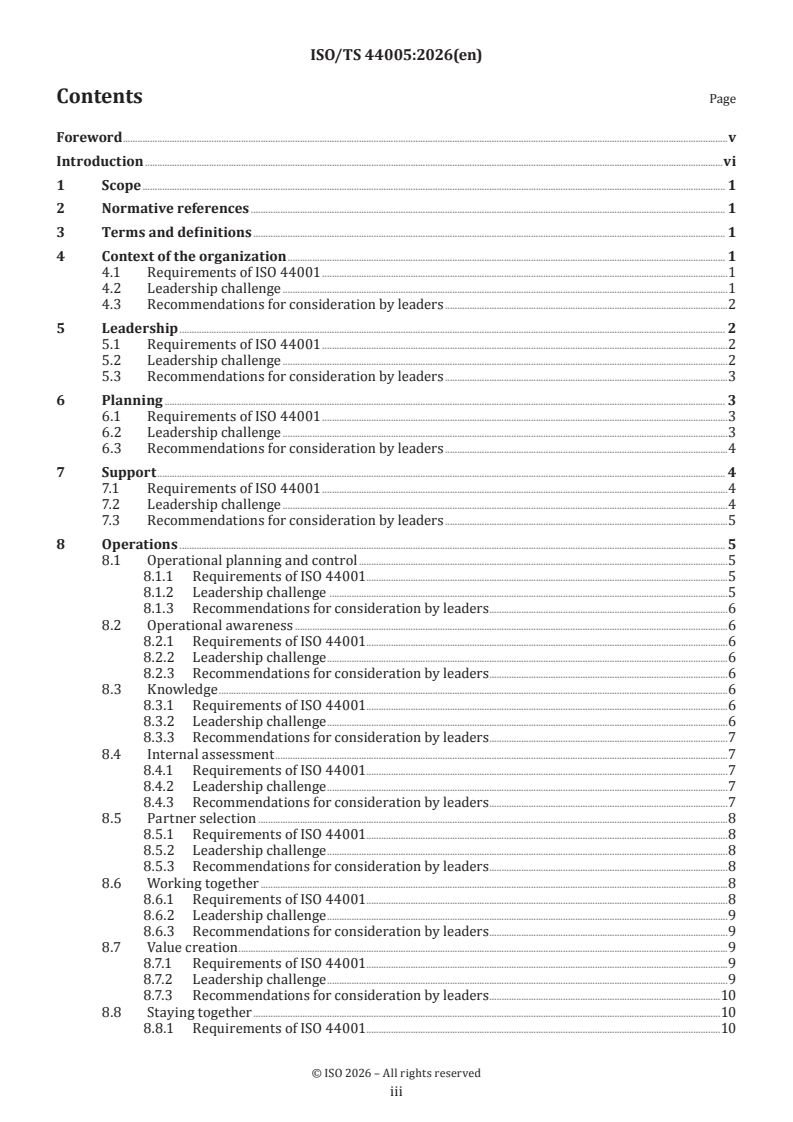
Contents Page
Foreword .v
Introduction .vi
1 Scope . 1
2 Normative references . 1
3 Terms and definitions . 1
4 Context of the organization . 1
4.1 Requirements of ISO 44001 .1
4.2 Leadership challenge .1
4.3 Recommendations for consideration by leaders .2
5 Leadership . 2
5.1 Requirements of ISO 44001 .2
5.2 Leadership challenge .2
5.3 Recommendations for consideration by leaders .3
6 Planning . 3
6.1 Requirements of ISO 44001 .3
6.2 Leadership challenge .3
6.3 Recommendations for consideration by leaders .4
7 Support . 4
7.1 Requirements of ISO 44001 .4
7.2 Leadership challenge .4
7.3 Recommendations for consideration by leaders .5
8 Operations . 5
8.1 Operational planning and control .5
8.1.1 Requirements of ISO 44001 .5
8.1.2 Leadership challenge .5
8.1.3 Recommendations for consideration by leaders .6
8.2 Operational awareness .6
8.2.1 Requirements of ISO 44001 .6
8.2.2 Leadership challenge .6
8.2.3 Recommendations for consideration by leaders .6
8.3 Knowledge .6
8.3.1 Requirements of ISO 44001 .6
8.3.2 Leadership challenge .6
8.3.3 Recommendations for consideration by leaders .7
8.4 Internal assessment .7
8.4.1 Requirements of ISO 44001 .7
8.4.2 Leadership challenge .7
8.4.3 Recommendations for consideration by leaders .7
8.5 Partner selection .8
8.5.1 Requirements of ISO 44001 .8
8.5.2 Leadership challenge .8
8.5.3 Recommendations for consideration by leaders .8
8.6 Working together .8
8.6.1 Requirements of ISO 44001 .8
8.6.2 Leadership challenge .9
8.6.3 Recommendations for consideration by leaders .9
8.7 Value creation .9
8.7.1 Requirements of ISO 44001 .9
8.7.2 Leadership challenge .9
8.7.3 Recommendations for consideration by leaders .10
8.8 Staying together .10
8.8.1 Requirements of ISO 44001 .10
iii
8.8.2 Leadership challenge .10
8.8.3 Recommendations for consideration by leaders .11
8.9 Exit strategy activation .11
8.9.1 Requirements of ISO 44001 .11
8.9.2 Leadership challenge .11
8.9.3 Recommendations for consideration by leaders .11
9 Performance .12
10 Improvement .12
Bibliography .13
iv
Foreword
ISO (the International Organization for Standardization) is a worldwide federation of national standards
bodies (ISO member bodies). The work of preparing International Standards is normally carried out through
ISO technical committees. Each member body interested in a subject for which a technical committee
has been established has the right to be represented on that committee. International organizations,
governmental and non-governmental, in liaison with ISO, also take part in the work. ISO collaborates closely
with the International Electrotechnical Commission (IEC) on all matters of electrotechnical standardization.
The procedures used to develop this document and those intended for its further maintenance are described
in the ISO/IEC Directives, Part 1. In particular, the different approval criteria needed for the different types
of ISO document should be noted. This document was drafted in accordance with the editorial rules of the
ISO/IEC Directives, Part 2 (see www.iso.org/directives).
ISO draws attention to the possibility that the implementation of this document may involve the use of (a)
patent(s). ISO takes no position concerning the evidence, validity or applicability of any claimed patent
rights in respect thereof. As of the date of publication of this document, ISO had not received notice of (a)
patent(s) which may be required to implement this document. However, implementers are cautioned that
this may not represent the latest information, which may be obtained from the patent database available at
www.iso.org/patents. ISO shall not be held responsible for identifying any or all such patent rights.
Any trade name used in this document is information given for the convenience of users and does not
constitute an endorsement.
For an explanation of the voluntary nature of standards, the meaning of ISO specific terms and expressions
related to conformity assessment, as well as information about ISO’s adherence to the World Trade
Organization (WTO) principles in the Technical Barriers to Trade (TBT), see www.iso.org/iso/foreword.html.
This document was prepared by Technical Committee ISO/TC 286, Collaborative business relationship
management.
Any feedback or questions on this document should be directed to the user’s national standards body. A
complete listing of these bodies can be found at www.iso.org/members.html.
v
Introduction
Dynamic leadership is a key facet of every successful business venture. In the context of managing any
partnering, alliance or collaborative programme, where the delivery process bridges organizational
boundaries, the role of the leadership is even more crucial. Developing an effective operational focus is a
challenge in most business environments, but where the traditional command and control structure needs
to embrace cross-functional operations between organizations, the coordination and direction of the
venture is even more complex, and motivation and influence become vital to success.
With respect to this document, it is important to distinguish the term “leadership” as an activity and as a
characteristic of leaders. The term “leaders” is more commonly associated with senior management who,
while having an important role in any collaborative arrangement, leadership activities cascade through in
every level in an organization or in diverse operational teams.
In the context of collaborative relationship, the role of leaders is crucial to developing and maintaining the
ethos of collaboration and establishing the environment where it can prosper. When multiple organizations
are merged together, operating processes and systems can overlap or interact and tensions can be created.
A collaborative culture is both a consequence of the wider business environment within which an
organization operates and a construct of the way it is organized and operated. The external aspect is
partially beyond the control of business leaders; other than in understanding the organization’s visions
and values, its strategic objectives and direction can be selective. In understanding the desired direction
and drivers, the leadership can take steps to refocus their traditional culture and improve their ability to
function more effectively in areas where opportunities do or can exist. Understanding the cultural picture
(whether national, regional, corporate or organizational) helps build confidence to expand the degree of
interaction, with the aim of creating longer-term relationships that are mutually beneficial.
The management system standard ISO 44001 provides a framework to support and develop collaborative
business relationships, including the key requirements for maintaining relationships over time. This
document highlights and reinforces the importance of leadership and the role of leaders within each stage of
the relationship life cycle. The structure of this document therefore follows the structure of the framework.
This document uses a common approach, as follows:
— Requirements of ISO 44001: The requirements of ISO 44001 that this document addresses.
— Leadership challenge: An explanation of how this differs from traditional leadership.
— Recommendations for consideration by leaders.
vi
Technical Specification ISO/TS 44005:2026(en)
Collaborative business relationship management system —
Guidance on leadership for collaborative working
1 Scope
This document gives guidance for leaders operating in collaborative arrangements in alignment with the
structure of ISO 44001.
2 Normative references
The following documents are referred to in the text in such a way that some or all of their content constitutes
requirements of this document. For dated references, only the edition cited applies. For undated references,
the latest edition of the referenced document (including any amendments) applies.
ISO 44001, Collaborative business relationship management systems — Requirements and framework
3 Terms and definitions
For the purposes of this document, the terms and definitions given in ISO 44001 and the following apply.
ISO and IEC maintain terminology databases for use in standardization at the following addresses:
— ISO Online browsing platform: available at https:// www .iso .org/ obp
— IEC Electropedia: available at https:// www .electropedia .org/
3.1
the leadership
executive/senior management responsible for establishing a collaborative culture and operation of
collaborative working activities
3.2
leader
people at any level who are charged with implementing collaborative activities
3.3
leadership
style of working including actions and activities required to ensure effective collaborative working
4 Context of the organization
4.1 Requirements of ISO 44001
The requirements include elements addressing the overall context of the organization, including interested
party engagement, the scope of collaborative activities, systems and organizational values.
4.2 Leadership challenge
Relationships are key to business success, so it is unrealistic to assume that such a critical aspect can be left
to chance. It is important to understand that while organizations can try to project a persona, they are made
up of people and are dependent on their people. Relationships cannot be left to rely on osmosis, attrition or
inaction to develop the appropriate behaviours to support that ethos and culture. Leaders should strive to
embed both structure and collaborative leadership in order to exploit the potential benefits.
Successful leadership has always relied on an individual’s ability to articulate their vision and intent to those
charged with delivering outcomes. Charismatic leaders can inspire the people around them and under their
direction. In a world of diversified, even fragmented organizations, the implications that can emerge from
outside the directly linked participants can be equally damaging. With the proliferation of communications
and technology there is the opportunity to harness these for wider reach, but there is also the potential for
negative influences to gain momentum and become major obstacles to success and reputations. As leaders
seek to drive collaborative enterprises in an integrated world, the more traditional aspects of interested
party management should be re-evaluated and developed.
4.3 Recommendations for consideration by leaders
In relation to the context of the organization, leaders should:
— raise the profile and importance of relationships across the organization;
— identify the values and principles of the organization that have the possibility of being compromised by
association;
— recognize that systems and processes do not replace people’s individual character and ambitions;
— place greater emphasis on embracing the impact of relationships to drive success;
— understand the whole interested party community and not simply the supporters and potential blockers,
as collaborative relationships can have many influencers based on diversity and culture;
— identify those that see collaborative working as an opportunity and those who can potentially have
significant reservations;
— develop strategies to facilitate understanding and engagement;
— implement a robust communications strategy and plan to ensure that engagement is sustained;
— develop high trust culture as an imperative for collaborative organizations;
— emphasis soft skills as essential for leading change and collaboration in a multi-generational workforce.
5 Leadership
5.1 Requirements of ISO 44001
Requirements for leadership include validation of the commitment to collaborative working, establishment
of policies, definition of roles and responsibilities, allocation of authorities and accountability, appointment
of a senior executive responsible (SER) and effective governance.
5.2 Leadership challenge
Effective leaders should recognize that their role is to be the advocate of the collaboration within their
own organizations; this advocacy can often be in conflict with internal structures. Making the shift from
a traditional hierarchical relationship to co-creators often demands both organizational and personal
realignment of thinking and approaches. Effective leadership should operate not from a position of power
but from the ability to influence and inspire, while having an understanding of their relative power. The
most successful leadership will take its strength from being able to draw parties together and create
solutions that use the full potential to optimize performance to produce outcomes which cannot be achieved
in isolation.
The role of leadership in this collaborative environment is more complex than for traditional organizations.
Not only does it have to meet the normal demands of team building and motivation, but also, in a virtual
context, this must be achieved against the variable background of time, power, distance and cultural
diversity. This demands creative leaders with the ability to establish the visions and values that will support
a collaborative arrangement.
Leadership styles should differ, depending on circumstances: in a crisis an urgent decision-maker is
needed, in a stable state consistency of direction is required, and future development requires a visionary
perspective. This is a difficult combination to find, where hierarchical organizational structures fail to
provide the agility and flexibility needed to optimize the effectiveness of responses to critical issues and
build environments where the benefits of collaboration can be exploited and enhanced.
5.3 Recommendations for consideration by leaders
In relation to leadership, leaders should:
— place greater emphasis on embracing the impact of relationships to drive success;
— establish the values by which the organization will govern its performance and operations; these will
likely influence any strategic developments;
— ensure these values are embedded in the organization at every level and are reflected in decision-making
and behaviours both internally and externally;
— develop a business strategy that recognizes the global implications and embraces the opportunities which
can come from adopting collaborative approaches and where external relationships can compromise the
organization’s values;
— understand their own strengths and weaknesses and how these are reflected in the leadership style that
is required to harness collaborative working;
— lead by example and consider how best to motivate those around them;
— be careful not to encourage or endorse opportunistic behaviours by setting targets and incentives that
can detract from the organization’s collaborative ethos;
— evaluate processes to reduce obstacles and constraints on building relationships;
— develop a structured approach to relationship management and evaluate its impact on risk management.
6 Planning
6.1 Requirements of ISO 44001
In planning collaborative activities, the requirements include management of risk, identification of
collaborative opportunities, prioritization of relationships, business aims, drivers, object
...