

IWA 46:2024
(Main)Ethics and integrity in sport — Guidelines
General Information
- Abstract
This document provides principles and guidelines on ethics and integrity for sports organizations to enable integration into policies, procedures and activities. These principles have three main pillars: — ethics and integrity of sports organizations; — ethics and integrity of sports competitions; — ethics and integrity of individuals. This document is applicable to all types of sports organizations, including federations, professional leagues, decentralized bodies, sports associations, sports clubs and competition organizers (private or otherwise), regardless of their size or location.
- Status
- Published
- Publication Date
- 27-Aug-2024
- Technical Committee
- ISO/TMBG - Technical Management Board - groups
- Drafting Committee
- ISO/TMBG - Technical Management Board - groups
- Current Stage
- 6060 - International Standard published
- Start Date
- 28-Aug-2024
- Completion Date
- 28-Aug-2024

Overview
IWA 46:2024 - Ethics and integrity in sport - Guidelines (ISO) provides high‑level principles and practical guidance to help sports organizations embed ethics and integrity across their policies, procedures and activities. The document is structured around three pillars:
- ethics and integrity of sports organizations;
- ethics and integrity of sports competitions;
- ethics and integrity of individuals.
It is explicitly applicable to all types of sports organizations - federations, professional leagues, decentralized bodies, associations, clubs and competition organizers - regardless of size or location.
Key Topics
IWA 46:2024 organizes guidance into discrete “fields of action” and procedural chapters that outline governance, risk and continual improvement. Key technical topics and requirements include:
- Governance and chain of responsibility: defining roles, accountability and democratic principles at governance level.
- Strategy, risk assessment and planning: assessing existing situations, identifying integrity risks and translating principles into objectives and action plans.
- Financial transparency & anti‑corruption: preventive measures, detection and management of corruption-related risks.
- Conflicts of interest & whistleblowing: declarations, management procedures, protections and reporting channels.
- Competition integrity: measures against manipulation of sports competitions, mechanical/technological fraud, and anti‑doping governance.
- Safeguarding and conduct: preventing violence, discrimination and protecting registered and professional athletes.
- Monitoring, evaluation and corrective action: KPIs, audits, incident handling and continual improvement cycles.
- Communication: internal/external and crisis communication strategies and resources.
The standard includes an informative toolbox (Annex A) and contributor list (Annex B).
Applications
IWA 46 is designed for practical use by:
- Executive boards and governance bodies implementing democratic and transparency measures.
- Compliance, integrity and legal teams developing policies on anti‑corruption, conflicts of interest and whistleblowing.
- Event and competition organizers applying controls to prevent match manipulation, mechanical fraud and doping.
- HR, safeguarding and athlete welfare units creating safeguarding frameworks and behaviour codes.
- Risk managers and auditors conducting integrity risk assessments and monitoring programs.
Organizations can use IWA 46 to create or review codes of ethics, integrate integrity into management systems, design reporting channels and build preventative controls tailored to sport contexts.
Related guidance
IWA 46 was developed under ISO procedures (see ISO/IEC Directives) and complements organizational compliance and risk approaches. Users should consult their national standards bodies for implementation support and consider aligning IWA 46 guidance with applicable legal, regulatory and sport‑specific frameworks.
Keywords: IWA 46:2024, ethics and integrity in sport, sports governance, anti‑corruption, whistleblowing, anti‑doping, safeguarding, competition integrity.
Get Certified
Connect with accredited certification bodies for this standard

BSI Group
BSI (British Standards Institution) is the business standards company that helps organizations make excellence a habit.

Bureau Veritas
Bureau Veritas is a world leader in laboratory testing, inspection and certification services.

DNV
DNV is an independent assurance and risk management provider.
Sponsored listings
Frequently Asked Questions
IWA 46:2024 is a standardization document published by the International Organization for Standardization (ISO). Its full title is "Ethics and integrity in sport — Guidelines". This standard covers: This document provides principles and guidelines on ethics and integrity for sports organizations to enable integration into policies, procedures and activities. These principles have three main pillars: — ethics and integrity of sports organizations; — ethics and integrity of sports competitions; — ethics and integrity of individuals. This document is applicable to all types of sports organizations, including federations, professional leagues, decentralized bodies, sports associations, sports clubs and competition organizers (private or otherwise), regardless of their size or location.
This document provides principles and guidelines on ethics and integrity for sports organizations to enable integration into policies, procedures and activities. These principles have three main pillars: — ethics and integrity of sports organizations; — ethics and integrity of sports competitions; — ethics and integrity of individuals. This document is applicable to all types of sports organizations, including federations, professional leagues, decentralized bodies, sports associations, sports clubs and competition organizers (private or otherwise), regardless of their size or location.
IWA 46:2024 is classified under the following ICS (International Classification for Standards) categories: 03.100.02 - Governance and ethics. The ICS classification helps identify the subject area and facilitates finding related standards.
IWA 46:2024 is available in PDF format for immediate download after purchase. The document can be added to your cart and obtained through the secure checkout process. Digital delivery ensures instant access to the complete standard document.
Standards Content (Sample)
International
Workshop
Agreement
IWA 46
First edition
Ethics and integrity in sport —
2024-08
Guidelines
Éthique et intégrité dans le sport — Lignes directrices
Reference number
© ISO 2024
All rights reserved. Unless otherwise specified, or required in the context of its implementation, no part of this publication may
be reproduced or utilized otherwise in any form or by any means, electronic or mechanical, including photocopying, or posting on
the internet or an intranet, without prior written permission. Permission can be requested from either ISO at the address below
or ISO’s member body in the country of the requester.
ISO copyright office
CP 401 • Ch. de Blandonnet 8
CH-1214 Vernier, Geneva
Phone: +41 22 749 01 11
Email: copyright@iso.org
Website: www.iso.org
Published in Switzerland
ii
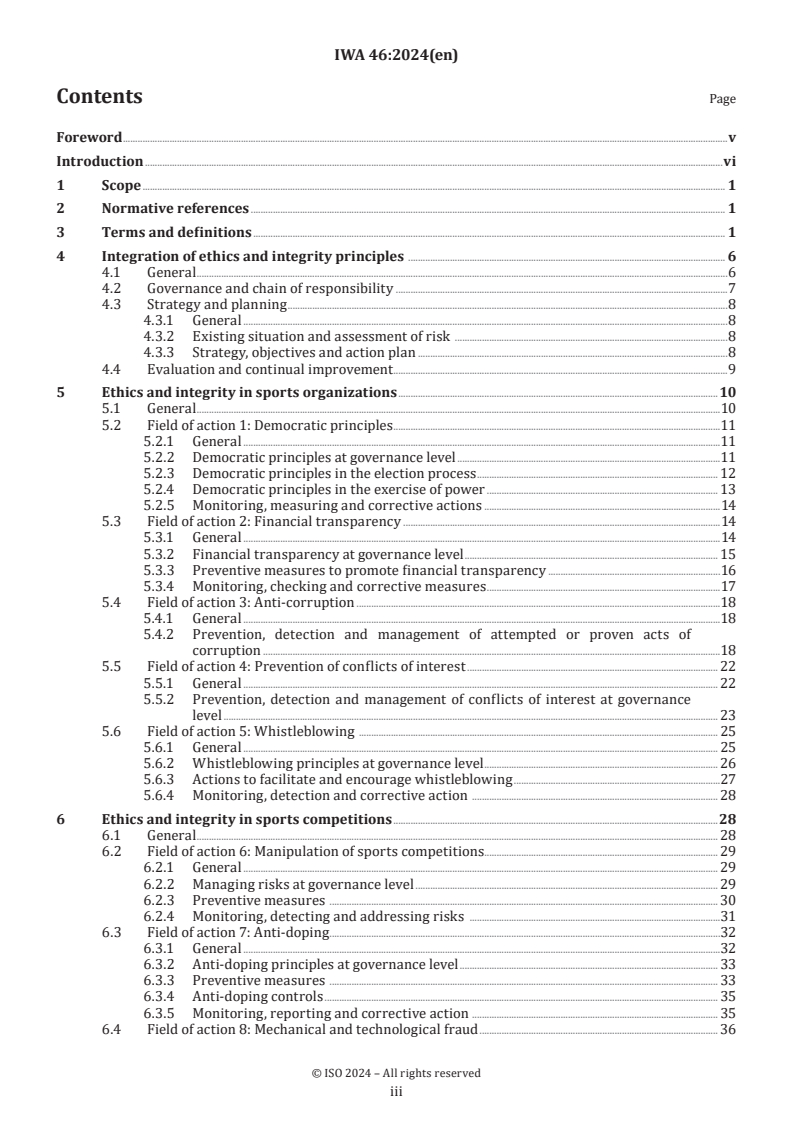
Contents Page
Foreword .v
Introduction .vi
1 Scope . 1
2 Normative references . 1
3 Terms and definitions . 1
4 Integration of ethics and integrity principles . 6
4.1 General .6
4.2 Governance and chain of responsibility .7
4.3 Strategy and planning .8
4.3.1 General .8
4.3.2 Existing situation and assessment of risk .8
4.3.3 Strategy, objectives and action plan .8
4.4 E valuation and continual improvement .9
5 Ethics and integrity in sports organizations . 10
5.1 General .10
5.2 Field of action 1: Democratic principles .11
5.2.1 General .11
5.2.2 Democratic principles at governance level .11
5.2.3 Democratic principles in the election process . 12
5.2.4 Democratic principles in the exercise of power . 13
5.2.5 Monitoring, measuring and corrective actions .14
5.3 Field of action 2: Financial transparency .14
5.3.1 General .14
5.3.2 Financial transparency at governance level . 15
5.3.3 Preventive measures to promote financial transparency .16
5.3.4 Monitoring, checking and corrective measures .17
5.4 Field of action 3: Anti-corruption .18
5.4.1 General .18
5.4.2 Prevention, detection and management of attempted or proven acts of
corruption .18
5.5 Field of action 4: Prevention of conflicts of interest . 22
5.5.1 General . 22
5.5.2 Prevention, detection and management of conflicts of interest at governance
level . 23
5.6 Field of action 5: Whistleblowing . 25
5.6.1 General . 25
5.6.2 Whistleblowing principles at governance level . 26
5.6.3 Actions to facilitate and encourage whistleblowing .27
5.6.4 Monitoring, detection and corrective action . 28
6 Ethics and integrity in sports competitions .28
6.1 General . 28
6.2 Field of action 6: Manipulation of sports competitions . 29
6.2.1 General . 29
6.2.2 Managing risks at governance level . 29
6.2.3 Preventive measures . 30
6.2.4 Monitoring, detecting and addressing risks .31
6.3 Field of action 7: Anti-doping .32
6.3.1 General .32
6.3.2 Anti-doping principles at governance level . 33
6.3.3 Preventive measures . 33
6.3.4 Anti-doping controls . 35
6.3.5 Monitoring, reporting and corrective action . 35
6.4 Field of action 8: Mechanical and technological fraud . 36
iii
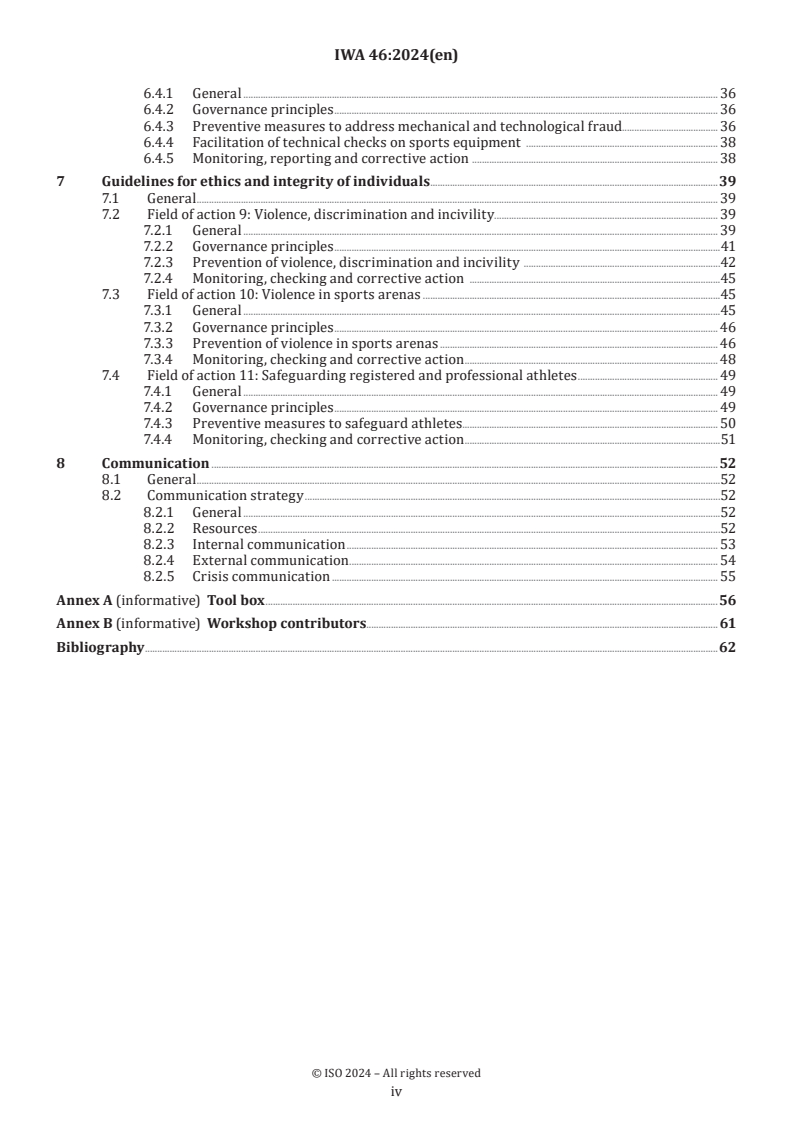
6.4.1 General . 36
6.4.2 Governance principles . 36
6.4.3 Preventive measures to address mechanical and technological fraud. 36
6.4.4 Facilitation of technical checks on sports equipment . 38
6.4.5 Monitoring, reporting and corrective action . 38
7 Guidelines for ethics and integrity of individuals .39
7.1 General . 39
7.2 Field of action 9: Violence, discrimination and incivility. 39
7.2.1 General . 39
7.2.2 Governance principles .41
7.2.3 Prevention of violence, discrimination and incivility .42
7.2.4 Monitoring, checking and corrective action .45
7.3 Field of action 10: Violence in sports arenas .45
7.3.1 General .45
7.3.2 Governance principles . 46
7.3.3 Prevention of violence in sports arenas . 46
7.3.4 Monitoring, checking and corrective action . 48
7.4 Field of action 11: Safeguarding registered and professional athletes . 49
7.4.1 General . 49
7.4.2 Governance principles . 49
7.4.3 Preventive measures to safeguard athletes. 50
7.4.4 M onitoring, checking and corrective action .51
8 Communication .52
8.1 General .52
8.2 Communication strategy .52
8.2.1 General .52
8.2.2 Resources .52
8.2.3 Internal communication . 53
8.2.4 External communication . 54
8.2.5 Crisis communication . 55
Annex A (informative) Tool box .56
Annex B (informative) Workshop contributors. 61
Bibliography .62
iv
Foreword
ISO (the International Organization for Standardization) is a worldwide federation of national standards
bodies (ISO member bodies). The work of preparing International Standards is normally carried out through
ISO technical committees. Each member body interested in a subject for which a technical committee
has been established has the right to be represented on that committee. International organizations,
governmental and non-governmental, in liaison with ISO, also take part in the work. ISO collaborates closely
with the International Electrotechnical Commission (IEC) on all matters of electrotechnical standardization.
The procedures used to develop this document and those intended for its further maintenance are described
in the ISO/IEC Directives, Part 1. In particular, the different approval criteria needed for the different types
of ISO document should be noted. This document was drafted in accordance with the editorial rules of the
ISO/IEC Directives, Part 2 (see www.iso.org/directives).
ISO draws attention to the possibility that the implementation of this document may involve the use of (a)
patent(s). ISO takes no position concerning the evidence, validity or applicability of any claimed patent
rights in respect thereof. As of the date of publication of this document, ISO had not received notice of (a)
patent(s) which may be required to implement this document. However, implementers are cautioned that
this may not represent the latest information, which may be obtained from the patent database available at
www.iso.org/patents. ISO shall not be held responsible for identifying any or all such patent rights.
Any trade name used in this document is information given for the convenience of users and does not
constitute an endorsement.
For an explanation of the voluntary nature of standards, the meaning of ISO specific terms and expressions
related to conformity assessment, as well as information about ISO's adherence to the World Trade
Organization (WTO) principles in the Technical Barriers to Trade (TBT), see www.iso.org/iso/foreword.html.
International Workshop Agreement IWA 46 was approved at a workshop hosted by the French
Standardization Association (AFNOR), in association with the French Ministry of Sports and the Olympics
and Paralympic Games, held in Paris, in June 2024.
Any feedback or questions on this document should be directed to the user’s national standards body. A
complete listing of these bodies can be found at www.iso.org/members.html.
v
Introduction
0.1 As a political, diplomatic and economic tool, sport, is at the heart of numerous aspects of society.
Sport evolves in step with societal changes and can consequently be subject to tensions that challenge the
very values it seeks to promote: justice, ethics, integrity, respect, fair play and honesty.
Illegal and unethical behaviour jeopardize these values and the overall appeal of sport, whether to the general
public, governments or investors. Corruption, money laundering, match-fixing and breaches of human rights
impact sport at all levels, and are likely to reduce confidence and trust in sport. For the sake of sporting
values, sports organizations and relevant stakeholders should work together to combat these issues.
Combatting unethical practices in a professional manner and addressing financial and social shortcomings
contributes to rebuilding trust and ensuring inclusion and equality.
This document provides guidelines on ethics and integrity for sports organizations, sports competitions
and individuals. It applies to all types of sports organizations, including federations, professional leagues,
decentralized bodies, sports associations, sports clubs, and competition organizers (private or otherwise),
regardless of their size or location. This document also provides guidance on how sports organizations can
limit risks relating to ethics and integrity.
0.2 The activities of sports organizations are often subject to the international codes and regulations
[7]
of federations, such as the Olympic Charter of the International Olympic Committee (IOC). The IOC also
requires the sports organizations it recognizes, as well as their individual members, to comply with the IOC
[8]
Code of Ethics. Introduced in 1999, it is regularly updated and is an integral part of the Olympic Charter.
The IOC Code of Ethics promotes five fundamental principles:
— respect for the Olympic spirit;
— respect for the principle of the universality and political neutrality of the Olympic movement;
— respect for autonomy despite working with public authorities;
— respect for international conventions on the protection of human rights;
— protecting participants and keeping them safe.
The Code of Ethics reflects the Olympic values defended in the Charter and focuses on the notions of ethics,
integrity and good governance. The Olympic Charter and Code of Ethics are mandatory for signatories. Any
violation can lead to the application of sanctions, ranging from censure to revocation of the IOC’s recognition
of the party concerned. The National Olympic Committees and the International Sport Federations have
adopted similar charters based on the IOC Charter.
NOTE 1 Some national sports organizations can also be subject to extraterritorial national laws of other countries,
such as the UK Bribery Act (2010) applying in France, which uses definitions whose scope varies when applied within
their territory or abroad.
NOTE 2 International conventions can also apply to sports organizations, such as those of the Organisation for
[22] [23]
Economic Co-operation and Development (OECD) (1997), the Council of Europe (1989), the United Nations
[24]
(2004), the European Parliament's text on an integrated approach to Sport Policy: good governance, accessibility
[25] [26]
and integrity (2017), or the Macolin Convention (2014), some of which have been transposed into the national
legislation of the States Parties.
0.3 At international and regional levels, organizations such as the Council of Europe play an active role
in the fight for integrity in sport, as violations of regulations are tackled more effectively at a supranational
level. The Council of Europe has been the driving force behind a number of initiatives, recommendations and
international conventions.
To date, three major conventions have been written to improve the governance of sports organizations:
— the European Convention on Spectator Violence and Misbehaviour at Sports Events, adopted in 1985
[27][28]
following the Heysel Stadium disaster, which came into force in 2017;
vi
— the Anti-Doping Convention of 1989, in force since 1990, which is the cornerstone of the fight against
[23]
doping, integrity of sport and health of athletes;
— the Convention on the Manipulation of Sports Competitions (Macolin Convention), in force since 2019,
which encourages the interlinking between national organizations that fight match-fixing and establishes
[26]
binding regulations adopted by States Parties with a view to eliminating these practices.
The Council of Europe has also drafted a series of recommendations for the sports sector, such as:
[29]
— Rec(2005)8 on the principles of good governance in sport, adopted in 2005;
[30]
— CM/Rec(2018)12 on the promotion of good governance in sport;
— CM/Rec(2011)10 on the promotion of the integrity of sport against manipulation of results, notably
[31]
match-fixing.
Recommendation CM/Rec(2010)9 on the revised Code of Sports Ethics, adopted in 2010, is accompanied
[32]
by an appendix called the Code of Sports Ethics. This appendix helps define sports ethics and the
responsibilities of governments and sports organizations in promoting integrity in sport, based on the
motto “Fair play - the winning way”.
The aims of the recommendations issued by the Council of Europe are to:
— encourage Member States to coordinate and take effective measures to promote the implementation of
policies of transparency and conform to democratic principles in sports governing bodies;
— reinforce confidence in sport;
— develop its role in society.
This document takes into account such international texts and initiatives, and provides aligned operational
recommendations and evaluation criteria for sports organizations, to facilitate the process of integrating
the principles of ethics and integrity into policies and procedures to combat unethical behaviour.
0.4 This document addresses the principles of ethics and integrity in three main areas:
— ethics and integrity of sports organizations;
— ethics and integrity of sports competitions;
— ethics and integrity of individuals.
Each of these comprises various fields of action, identified as being essential in terms of ethics and integrity,
all of which should be taken into consideration:
— Field of action 1: Democratic principles;
— Field of action 2: Financial transparency;
— Field of action 3: Anti-corruption;
— Field of action 4: Prevention of conflicts of interest;
— Field of action 5: Whistleblowing;
— Field of action 6: Manipulation of sports competitions;
— Field of action 7: Anti-doping;
— Field of action 8: Mechanical and technological fraud;
— Field of action 9: Violence, discrimination and incivility;
— Field of action 10: Violence in sports arenas;
vii
— Field of action 11: Safeguarding registered and professional athletes.
NOTE Table B.1 provides a list of workshop contributors.
viii
International Workshop Agreement IWA 46:2024(en)
Ethics and integrity in sport — Guidelines
1 Scope
This document provides principles and guidelines on ethics and integrity for sports organizations to enable
integration into policies, procedures and activities.
These principles have three main pillars:
— ethics and integrity of sports organizations;
— ethics and integrity of sports competitions;
— ethics and integrity of individuals.
This document is applicable to all types of sports organizations, including federations, professional leagues,
decentralized bodies, sports associations, sports clubs and competition organizers (private or otherwise),
regardless of their size or location.
2 Normative references
There are no normative references in this document.
3 Terms and definitions
For the purposes of this document, the following terms and definitions apply.
ISO and IEC maintain terminology databases for use in standardization at the following addresses:
— ISO Online browsing platform: available at https:// www .iso .org/ obp
— IEC Electropedia: available at https:// www .electropedia .org/
3.1
wrongdoing
action(s) or omission(s) that can cause harm to the sports organization (3.2) or one of its stakeholders (3.29)
Note 1 to entry: A wrongdoing primarily refers to violations of current national or international regulations, such as
fraud, corruption (3.10) (e.g. bribes), discrimination, unauthorized use of public funds or resources, abuse of authority,
conflict of interest, harassment, violence (including sexual violence), etc.
Note 2 to entry: Additionally, actions can also be considered reprehensible with respect to the internal rules set out,
for example, in the organization's codes of conduct or in another relevant code of conduct: serious negligence, violation
of the organization's governance policy or rules (particularly regarding the disclosure of conflicts of interest (3.9)), etc.
Note 3 to entry: A wrongdoing also includes actions or omissions that cause harm or risk of harm to human rights, the
environment, public health and safety, or safe working practices or the public interest.
Note 4 to entry: A wrongdoing or the harm resulting from it can have occurred in the past, be currently occurring or
can occur in the future.
Note 5 to entry: Potential harm can be determined by reference to a single event or a series of events.
[SOURCE: ISO 37002:2021, 3.8, modified — definition and notes to entry have been updated so they are
relevant to a sport context.]
3.2
sports organization
body that governs and promotes a sport, and/or organizes sports competitions (3.8)
Note 1 to entry: The term “sports organization” encompasses the various statuses that exist, such as sports
associations, private sports companies and public sports institutions.
EXAMPLE National/international federations, leagues, clubs.
3.3
doping control officer
person authorized by the competent authorities to carry out doping controls on athletes
3.4
whistleblowing
reporting of wrongdoing (3.1) by a whistleblower (3.24) who has reasonable belief that the information is
true at the time of reporting
Note 1 to entry: A report of a wrongdoing can be verbal, in person, in writing or in an electronic or digital format.
Note 2 to entry: To facilitate the handling of whistleblowing, it is preferable that the identity of the whistleblower be
known. However, in order to protect whistleblowers, it is expected that wrongdoings can be reported anonymously.
[SOURCE: ISO 37002:2021, 3.10, modified — definition and note 2 to entry have been modified; note 3 to
entry has been deleted.]
3.5
prohibited association
act of using the services, paid or unpaid, of any athlete support personnel (3.31) who is the subject to a
disciplinary, administrative or criminal sanction in connection with an anti-doping rule violation
Note 1 to entry: The Prohibited Association List, as established by the World Anti-Doping Agency (WADA), lists the
bans imposed on athletes and their support personnel who have committed anti-doping rule violations.
3.6
money laundering
act of concealing the origin of illegally acquired money by reinvesting it in legal activities
EXAMPLE Money laundering from tax fraud is the reintroduction of money concealed from the tax authorities
back into the economic circuit.
3.7
World Anti-Doping Code
international code published by the World Anti-Doping Agency, harmonizing the anti-doping policies, rules
and regulations of sports organizations (3.2) and public authorities
[36] [37]
Note 1 to entry: The World Anti-Doping Code is accompanied by eight international standards designed to
harmonize different areas of anti-doping: testing and investigations, laboratories, therapeutic use exemptions, list of
prohibited substances and methods, protection of privacy and personal information, code compliance by signatories,
education, and results management.
3.8
sports competition
sports event, tournament, match or encounter that can result in a ranking, and which is organized in
accordance with the rules established by a sports organization (3.2) or its affiliated organizations or, where
applicable, in accordance with the rules of any other competent sports organization
3.9
conflict of interest
situation of actual, potential and perceived interference between the function exercised within an
organization and an individual interest or an interest linked to a function exercised in another organization,
in such a way that this interference influences or appears to influence the loyal exercise of the function on
behalf of this organization
Note 1 to entry: Conflicts of interest can concern all members involved in a sports organization (3.2), regardless of
their status or decision-making capacity.
Note 2 to entry: Both direct and indirect interests should be considered, for example the interests of a third party
(parent, spouse, associated or dependent people or groups).
Note 3 to entry: Financial and other types of gain resulting from a conflict of interest can be subject to criminal law.
3.10
corruption
behaviour constituting a breach of the obligations of probity and integrity in the performance of functions,
whether voluntary or not, that can give rise to disciplinary or criminal sanctions, or both
Note 1 to entry: Corruption can involve all stakeholders (3.29) in a sports organization (3.2), regardless of their status
or decision-making capacity.
Note 2 to entry: In a more restrictive sense, the criminal offence of corruption differs from other breach-of-probity
offences, such as influence peddling, extortion by public officials (3.25), favouritism, misappropriation of public funds
and unlawful acquisition of interest.
3.11
courtsider
gambler, or accomplice of a gambler, who attempts to transmit in real time, in any form, information relating
to the sports competition (3.8) in progress, in order to place bets on the outcome of the competition before
the close of online betting, thereby increasing their chances of financial gain
Note 1 to entry: This practice can be considered illegal, contravening any applicable regulations (e.g. sports betting
(3.28), data transmission).
3.12
cyber violence
aggressive and intentional act perpetrated by an individual or group using digital media against one or
more victims
3.13
professional ethics
set of duties imposed on certain categories of individuals in respect of their behaviour and actions towards
others and the environment
3.14
doping
administration or use of chemical substances or medical procedures defined by ad-hoc organizations in
order to increase the physical and/or mental performance of an athlete or an animal
Note 1 to entry: The list of prohibited substances and methods is drawn up each year by the World Anti-Doping Code
(3.7) and is included in national regulations as appropriate, or by national anti-doping organizations. Therapeutic use
exemptions can also be issued on an individual basis.
3.15
sports arena
sports facility, whether covered or not, designed to host sports competitions (3.8), which are open to the public
3.16
chaperone
duly trained official (3.25), authorized by the sample collection authority to carry out specific tasks during
a doping control
3.17
ethics
body of values, encompassing all the moral principles governing behaviour
Note 1 to entry: Ethics in the context of sport encompasses a number of values that sport should embody, including
self-respect, equal opportunities, self-improvement, respect for others, the health of participants, friendship between
peoples and the quest for excellence.
3.18
mechanical and technological fraud
mechanical and technological modifications to the sports equipment used, including the sports arena (3.15),
with the aim of artificially improving an athlete's sporting performance, and in breach of the material,
technical and technological rules laid down by international and national federal sports organizations (3.2)
3.19
governance of sports organizations
system by which a sports organization (3.2) makes and implements decisions in pursuit of its objectives
[SOURCE: ISO 26000:2010, 2.13, modified — term and definition have been updated so they are relevant to
a sport context.]
3.20
Registered Testing Pool
pool of athletes identified as high priority, respectively, at international level by international federations
and/or at national level by the relevant national anti-doping organization, and who are subject to focused
in-competition and out-of-competition testing
3.21
ultras group
category of supporters, organized in the form of an association, who actively or even fanatically support
their favourite team
3.22
top management
persons who control a sports organization (3.2) at the highest level, responsible for managing it in accordance
with its statutes and the rules in force
Note 1 to entry: These people have the power to organize, allocate resources and represent the entity, which gives
them a decisive role in implementing measures to promote respect for ethics (3.17) and integrity.
Note 2 to entry: The steering committee, general assembly, the board of directors and the executive committee
generally make up the top management of organizations with associative status.
3.23
sport integrity
principle of consistency between the values embodied by sport and the attitude adopted in practice by its
players and institutions
Note 1 to entry: It also aims to ensure that behaviour complies with applicable regulations.
3.24
whistleblower
person who discloses or reports a fact that brings to light illegal or dangerous behaviour threatening the
integrity of a sports organization (3.2) or its members
3.25
official
individual who performs a formal supervisory role regarding the application of federal sports regulations
during local, national or international sports competitions (3.8)
EXAMPLE Judge, referee, jury, race steward.
3.26
sports operator
person responsible for preparing, maintaining and checking the conformity of sports equipment, in
accordance with federal sports regulations
3.27
sports competition organizer
natural or legal person under private law, other than a sports federation, that organizes sports competitions
(3.8) open to licence holders in a discipline, and/or to which the relevant federation authority has delegated
the authority
3.28
sports betting
monetary wager on the progress and/or outcome of a sports competition (3.8), where gamblers’ potential
winnings depend on the accuracy of their predictions
Note 1 to entry: The nature of sports betting varies from sport to sport and can include various parameters relating to
the competition, such as the score (final or intermediate), the players and the winning team.
3.29
stakeholder
individual or group that has an interest in any decision or activity of an organization
Note 1 to entry: Stakeholders can be external and internal. External stakeholders are natural and legal persons
who are not part of the organization but are involved and have a link to, relationship with or interest in the sports
organization (3.2) or could have an impact on it. Internal stakeholders are a group of individuals who are part of the
sports organization.
EXAMPLE 1 External stakeholders include the organization's public or private partners, service providers,
suppliers, associations and members.
EXAMPLE 2 Internal stakeholders include elected representatives, employees or volunteers working on behalf of
the sports organization.
[SOURCE: ISO 26000:2010, 2.20, modified — note to entry and examples have been added.]
3.30
athlete biological passport
programme that monitors selected biological variables specific to the athlete that indirectly reveal doping
(3.14) through changes in those variables
Note 1 to entry: This electronic monitoring is implemented exclusively via the Anti-Doping Administration and
Management System (3.36).
3.31
athlete support personnel
person who works with and cares for athletes in the preparatory phase of a sports competition (3.8), or
during the competition itself
EXAMPLE Coaches, therapists, sports directors, agents, team personnel, team officials (3.25), medical or
paramedical staff.
3.32
national platform for the fight against the manipulation of sports competitions
group of stakeholders (3.29) that acts as a hub for the gathering, collating and sharing of relevant information
to combat match fixing, for promoting cooperation between relevant national and international stakeholders,
and for raising awareness about this subject among those involved in sport
[26]
Note 1 to entry: The tasks of the national platforms are listed in Article 13 of the Macolin Convention.
EXAMPLE In France, the national platform for the fight against the manipulation of sports competitions is chaired
by the French Ministry of Sport.
3.33
democratic principle
form of governance in which power is exercised by all members of a community, either directly or through
their elected representatives
3.34
point of contact
delegate
designated person responsible for carrying out and coordinating the implementation of a mission within
a sports organization (3.2) relating to his/her field of competence and who interfaces with the public
authorities and/or private organizations
EXAMPLE Single points of contact (SPOC) in the field of the prevention of the manipulation of competitions.
3.35
steward
person responsible for the reception, seating and safety of the public in sports arenas (3.15)
3.36
Anti-Doping Administration and Management System
web-based management system for sharing information between organizations involved in anti-doping
operations (partners and athletes), enabling the centralization of doping control-related information such as
analyses results, therapeutic use exemptions (TUEs) and Anti-Doping Rule Violations (ADRVs)
3.37
financial transparency
accessibility of information relating to financial decisions and activities affecting the organization and its
stakeholders (3.29), and willingness to ensure clear, accurate, timely, honest and complete disclosure
Note 1 to entry: The principle of transparency does not require to disclose exclusive information, nor does it involve
the provision of information of a confidential nature or that would contravene legal, commercial, security or personal
privacy obligations.
3.38
vulnerable person
person who is:
a) under the age of 18;
b) aged 18 or over but unable to take care of themselves or protect themselves against harm or exploitation,
due to age, illness, trauma or disability, or any other reason; or
c) aged 18 or over but has experienced or is experiencing poor mental health outcomes, as a result of the
incident in question, due to their life experiences, or as a result of societal factors, including but not
limited to individuals from diverse backgrounds facing disproportionate mental health impacts
4 Integration of ethics and integrity principles
4.1 General
The sports organization should consider ethics and integrity in all of its activities and decisions. The related
issues should be taken into account at the highest level, and incorporated into the organization’s overall
strategy.
Integrating ethics and integrity principles into all aspects of a sports organization requires top management's
commitment and understanding at all levels of the organization.
The sports organization should establish processes to integrate the principles into all policies, strategies,
structures and activities, to enable it to become an integral part of the organization’s culture.
4.2 Governance and chain of responsibility
The sports organization should demonstrate commitment to ethics and integrity and ensure that operational
efficiency is founded on democratic principles. The sports organization should take into account its context,
including the type and size of relevant governing bodies and:
a) ensure that members of governing bodies represent all members of the organization;
b) define clear roles and responsibilities for each member of a governing body;
c) establish an appropriate management structure throughout the organization;
d) appoint competent persons at all levels of the chain of responsibility.
Depending on the size of the sports organization, its available resources and potential level o
...