


ISO 16750-5:2023
(Main)Road vehicles - Environmental conditions and testing for electrical and electronic equipment - Part 5: Chemical loads
Road vehicles - Environmental conditions and testing for electrical and electronic equipment - Part 5: Chemical loads
This document applies to electric and electronic systems and components for vehicles including electric propulsion systems and components with maximum working voltages according to voltage class B. It describes the potential environmental stresses and specifies tests and requirements recommended for the specific mounting location on/in the vehicle. This document describes chemical loads. This document is not intended to apply to environmental requirements or testing for systems and components of motorcycles and mopeds. NOTE Conditions and testing for a continuous contact with chemical agents can be determined from other standards or upon agreement between the customer and the supplier. Systems and their components released for production, or systems and their components already under development prior to the publication date of this document, can be exempted from fulfilling the changes in this edition compared to the previous one.
Véhicules routiers — Spécifications d'environnement et essais de l'équipement électrique et électronique — Partie 5: Contraintes chimiques
General Information
Relations
Overview
ISO 16750-5:2023 - "Road vehicles - Environmental conditions and testing for electrical and electronic equipment - Part 5: Chemical loads" defines chemical exposure requirements and test methods for automotive electrical and electronic systems and components (including electric propulsion and components in voltage class B). The standard describes potential chemical stresses, recommended tests and acceptance criteria based on the component’s mounting location. It is intended for passenger cars and commercial vehicles (not motorcycles or mopeds) and complements other parts of the ISO 16750 series.
Key topics and technical requirements
- Scope: Applies to vehicle electrical/electronic systems and components (incl. electric propulsion) with maximum working voltages in voltage class B; excludes motorcycles/mopeds.
- Purpose: Determine whether temporary exposure to chemical agents causes unacceptable effects on devices under test (DUT). This is a qualification test, not a life test.
- Test planning:
- Select chemical agents according to mounting location (Table 2).
- One DUT per test agent is typical unless otherwise agreed.
- Tests generally conducted in operating mode 1.2 (see ISO 16750-1) or agreed alternative.
- Conditioning:
- DUT storage and test-agent conditioning at room temperature (23 ± 5 °C) and RH 25–75 % unless specified.
- Documentary evidence may be used to demonstrate material immunity.
- Application methods (Table 1): codes I–VI - Spraying, Brushing, Wiping, Pouring, Dipping, Immersing - chosen per agent and mounting location.
- Test conditions (Table 2): maps specific chemicals (diesel, biodiesel, petrol, engine oil, brake fluid, antifreeze, battery fluid, urea/NOx agents, cleaning solvents, acetone, cosmetics, vehicle wash chemicals, etc.) to application method, test temperature (RT or T_max per ISO 16750-4) and duration (e.g., RT 10 min, RT 2 h, T 22 h max).
- Procedure and assessment: pre/post visual and functional checks, conditioning, exposure, storage, post-test evaluation; document results and any agreed exemptions.
Applications - who uses it and why
- Automotive OEMs and Tier suppliers for component qualification and supplier specifications.
- Design and materials engineers for material selection, seals, coatings and connector design to resist chemical exposure.
- Test laboratories and quality/validation teams for conducting standardized chemical-resistance tests and issuing reports.
- EV and battery system teams needing assurance for components in voltage class B against chemical contamination.
Practical uses include verifying protective lacquers, selecting compatible plastics/elastomers, qualifying connectors and enclosures, and defining supplier test requirements based on mounting location.
Related standards
- ISO 16750-1 - General requirements for environmental testing
- ISO 16750-4 - Climatic loads (defines T_max referenced in ISO 16750-5)
- ISO 19453-5:2018 - content integrated/harmonized into this edition
- Full ISO 16750 series for comprehensive electrical/electronic environmental testing
Keywords: ISO 16750-5, chemical loads, automotive environmental testing, chemical resistance testing, road vehicles, electrical and electronic equipment, mounting location, application methods, voltage class B.
Standards Content (Sample)
INTERNATIONAL ISO
STANDARD 16750-5
Third edition
2023-07
Road vehicles — Environmental
conditions and testing for electrical
and electronic equipment —
Part 5:
Chemical loads
Véhicules routiers — Spécifications d'environnement et essais de
l'équipement électrique et électronique —
Partie 5: Contraintes chimiques
Reference number
© ISO 2023
All rights reserved. Unless otherwise specified, or required in the context of its implementation, no part of this publication may
be reproduced or utilized otherwise in any form or by any means, electronic or mechanical, including photocopying, or posting on
the internet or an intranet, without prior written permission. Permission can be requested from either ISO at the address below
or ISO’s member body in the country of the requester.
ISO copyright office
CP 401 • Ch. de Blandonnet 8
CH-1214 Vernier, Geneva
Phone: +41 22 749 01 11
Email: copyright@iso.org
Website: www.iso.org
Published in Switzerland
ii
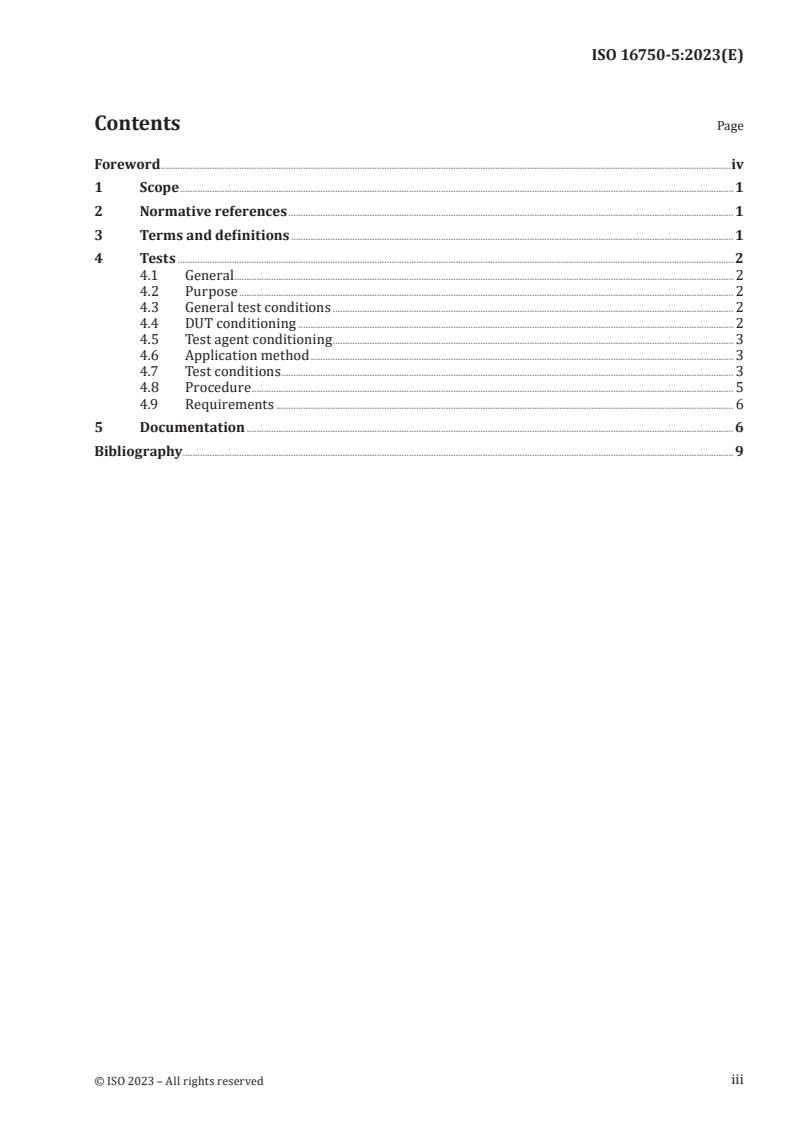
Contents Page
Foreword .iv
1 Scope . 1
2 Normative references . 1
3 Terms and definitions . 1
4 Tests . 2
4.1 General . 2
4.2 Purpose . 2
4.3 General test conditions . 2
4.4 DUT conditioning . 2
4.5 Test agent conditioning . 3
4.6 Application method . 3
4.7 Test conditions . 3
4.8 Procedure . 5
4.9 Requirements . 6
5 Documentation . 6
Bibliography . 9
iii
Foreword
ISO (the International Organization for Standardization) is a worldwide federation of national standards
bodies (ISO member bodies). The work of preparing International Standards is normally carried out
through ISO technical committees. Each member body interested in a subject for which a technical
committee has been established has the right to be represented on that committee. International
organizations, governmental and non-governmental, in liaison with ISO, also take part in the work.
ISO collaborates closely with the International Electrotechnical Commission (IEC) on all matters of
electrotechnical standardization.
The procedures used to develop this document and those intended for its further maintenance are
described in the ISO/IEC Directives, Part 1. In particular, the different approval criteria needed for the
different types of ISO document should be noted. This document was drafted in accordance with the
editorial rules of the ISO/IEC Directives, Part 2 (see www.iso.org/directives).
ISO draws attention to the possibility that the implementation of this document may involve the use
of (a) patent(s). ISO takes no position concerning the evidence, validity or applicability of any claimed
patent rights in respect thereof. As of the date of publication of this document, ISO had not received
notice of (a) patent(s) which may be required to implement this document. However, implementers are
cautioned that this may not represent the latest information, which may be obtained from the patent
database available at www.iso.org/patents. ISO shall not be held responsible for identifying any or all
such patent rights.
Any trade name used in this document is information given for the convenience of users and does not
constitute an endorsement.
For an explanation of the voluntary nature of standards, the meaning of ISO specific terms and
expressions related to conformity assessment, as well as information about ISO's adherence to
the World Trade Organization (WTO) principles in the Technical Barriers to Trade (TBT), see
www.iso.org/iso/foreword.html.
This document was prepared by Technical Committee ISO/TC 22, Road vehicles, Subcommittee SC 32,
Electrical and electronic components and general system aspects.
This third edition cancels and replaces the second edition (ISO 16750-5:2010), which has been
technically revised.
The main changes are as follows:
— integrating and harmonizing contents from ISO 19453-5:2018 (e.g. change of Table 2);
— reorganization of test conditions and application methods in context (4.6, 4.7);
— addition of application method (4.6, Table 1);
— reconsideration of chemical agents (Clause 5, Table 3).
A list of all parts in the ISO 16750 series can be found on the ISO website.
Any feedback or questions on this document should be directed to the user’s national standards body. A
complete listing of these bodies can be found at www.iso.org/members.html.
iv
INTERNATIONAL STANDARD ISO 16750-5:2023(E)
Road vehicles — Environmental conditions and testing for
electrical and electronic equipment —
Part 5:
Chemical loads
1 Scope
This document applies to electric and electronic systems and components for vehicles including electric
propulsion systems and components with maximum working voltages according to voltage class B. It
describes the potential environmental stresses and specifies tests and requirements recommended for
the specific mounting location on/in the vehicle.
This document describes chemical loads.
This document is not intended to apply to environmental requirements or testing for systems and
components of motorcycles and mopeds.
NOTE Conditions and testing for a continuous contact with chemical agents can be determined from other
standards or upon agreement between the customer and the supplier.
Systems and their components released for production, or systems and their components already under
development prior to the publication date of this document, can be exempted from fulfilling the changes
in this edition compared to the previous one.
2 Normative references
The following documents are referred to in the text in such a way that some or all of their content
constitutes requirements of this document. For dated references, only the edition cited applies. For
undated references, the latest edition of the referenced document (including any amendments) applies.
ISO 16750-1, Road vehicles — Environmental conditions and testing for electrical and electronic equipment
— Part 1: General
ISO 16750-4, Road vehicles — Environmental conditions and testing for electrical and electronic equipment
— Part 4: Climatic loads
3 Terms and definitions
For the purposes of this document, the terms and definitions given in ISO 16750-1 apply.
ISO and IEC maintain terminology databases for use in standardization at the following addresses:
— ISO Online browsing platform: available at https:// www .iso .org/ obp
— IEC Electropedia: available at https:// www .electropedia .org/
4 Tests
4.1 General
Components and associated parts that can come into contact with the specified chemical agents shall
be resistant to those agents. The components and associated parts shall be tested with all agents they
are likely to come into contact with, except for those materials which can be shown by documentary
evidence to be immune to the contaminant.
A material is considered to be immune to a contaminant if there is no change in properties sufficient to
affect material performances over the time and at the temperature specified in this clause.
The documentary evidence of immunity shall be provided for any operating conditions that could be
relevant for the DUT, also including the effects of operating temperature and self-heating if deemed
necessary as agreed between the customer and the supplier.
The customer and the supplier shall agree on the type of chemical agents and the manufacturer.
Resistance to the specified chemical agents shall be considered as early as possible during the material
selection process.
4.2 Purpose
The purpose of the test is to determine whether systems/components are unacceptably affected by
temporary exposure to contaminating agents.
NOTE This test is not intended to be a life test.
4.3 General test conditions
Chemical agents shall be selected as defined in Table 2, depending on the mounting location of the DUT.
Unless otherwise specified, one DUT per test agent shall be used.
The following tests describe one test cycle. Unless otherwise specified, one test cycle with one agent
per DUT shall be performed. Any other number of cycles may be agreed between the customer and the
supplier.
During test cycle, the DUT shall be in operating mode 1.2 as defined in ISO 16750-1. Operating mode
1.1 as defined in ISO 16750-1 with protection seals (e.g. sealed mating connector) can be used if agreed
between the customer and the supplier.
NOTE 1 Operating mode with electrical operation can be used if agreed between the customer and the
supplier, and if judged feasible from test setup perspective.
NOTE 2 If the size of the DUT is sufficient, multiple test agents can be applied partially on one DUT provided
that these do not have any influence on each other.
NOTE 3 When only some part of the DUT (e.g. front panel part of audio) is exposed to chemicals, this test can
be performed with the applicable part by agreement between the customer and the supplier. In this case, it is also
relevant to consider sealings, barriers, or other parts of the system that is preventing the exposure of chemical
agents to the hidden parts of the DUT.
4.4 DUT conditioning
Unless otherwise specified, the DUT shall be stored at a room temperature (RT) of (23 ± 5) °C and a
relative humidity (RH) of between 25 % and 75 % until thermal equilibrium is reached.
The DUT shall be tested under conditions of normal use. If necessary, and unless otherwise specified,
unrepresentative coatings or contaminations of the DUT shall be removed.
If a cleaning procedure is needed, the customer and the supplier shall agree on the methodology.
4.5 Test agent conditioning
All test agents shall be stabilised at an RT of (23 ± 5) °C when applied on the DUT.
4.6 Application method
The application method shall be such that the DUT is sufficiently wetted
...
Frequently Asked Questions
ISO 16750-5:2023 is a standard published by the International Organization for Standardization (ISO). Its full title is "Road vehicles - Environmental conditions and testing for electrical and electronic equipment - Part 5: Chemical loads". This standard covers: This document applies to electric and electronic systems and components for vehicles including electric propulsion systems and components with maximum working voltages according to voltage class B. It describes the potential environmental stresses and specifies tests and requirements recommended for the specific mounting location on/in the vehicle. This document describes chemical loads. This document is not intended to apply to environmental requirements or testing for systems and components of motorcycles and mopeds. NOTE Conditions and testing for a continuous contact with chemical agents can be determined from other standards or upon agreement between the customer and the supplier. Systems and their components released for production, or systems and their components already under development prior to the publication date of this document, can be exempted from fulfilling the changes in this edition compared to the previous one.
This document applies to electric and electronic systems and components for vehicles including electric propulsion systems and components with maximum working voltages according to voltage class B. It describes the potential environmental stresses and specifies tests and requirements recommended for the specific mounting location on/in the vehicle. This document describes chemical loads. This document is not intended to apply to environmental requirements or testing for systems and components of motorcycles and mopeds. NOTE Conditions and testing for a continuous contact with chemical agents can be determined from other standards or upon agreement between the customer and the supplier. Systems and their components released for production, or systems and their components already under development prior to the publication date of this document, can be exempted from fulfilling the changes in this edition compared to the previous one.
ISO 16750-5:2023 is classified under the following ICS (International Classification for Standards) categories: 43.040.10 - Electrical and electronic equipment. The ICS classification helps identify the subject area and facilitates finding related standards.
ISO 16750-5:2023 has the following relationships with other standards: It is inter standard links to ISO 16750-5:2010. Understanding these relationships helps ensure you are using the most current and applicable version of the standard.
You can purchase ISO 16750-5:2023 directly from iTeh Standards. The document is available in PDF format and is delivered instantly after payment. Add the standard to your cart and complete the secure checkout process. iTeh Standards is an authorized distributor of ISO standards.
Questions, Comments and Discussion
Ask us and Technical Secretary will try to provide an answer. You can facilitate discussion about the standard in here.
Loading comments...