

IWA 36:2022
(Main)Guidelines for contactless delivery services
General Information
- Abstract
This document provides general guidance on issues to be considered in standards related to contactless delivery services. It covers general principles, roles and responsibilities, delivery methods, service processes, quality control and improvements to be put in place to execute contactless delivery services. This document applies to — instant delivery, which generally applies to the retail, catering and medical sectors (including online food delivery, grocery delivery and medical supplies delivery); and — last-mile delivery with intermediate transfer, which generally applies to express and e-commerce fields (referring to the last-mile delivery of parcels). This document does not apply to cold chain logistics.
- Status
- Published
- Publication Date
- 09-May-2022
- Technical Committee
- ISO/TMBG - Technical Management Board - groups
- Drafting Committee
- ISO/TMBG - Technical Management Board - groups
- Current Stage
- 6060 - International Standard published
- Start Date
- 10-May-2022
- Due Date
- 04-Jun-2022
- Completion Date
- 10-May-2022

Overview
IWA 36:2022 - Guidelines for contactless delivery services (ISO) provides high-level guidance for designing and operating contactless delivery services. The document covers general principles, roles and responsibilities, delivery methods (including instant delivery and last‑mile delivery with intermediate transfer), service processes, and quality control and improvement measures. It applies to retail, catering and medical sectors (online food, grocery, medical supplies) and to parcel last‑mile logistics, but excludes cold‑chain logistics. The guidance supports health, safety and transparency and aligns with UN Sustainable Development Goals (SDG3, SDG8, SDG11, SDG12).
Key topics and technical requirements
The standard emphasizes practical controls and requirements across these areas:
General principles
- Avoidance of physical contact
- Integrity, capability, health & safety
- Confidentiality, privacy, visualization and traceability
Roles and responsibilities
- Delivery service platform operators, merchants, couriers and equipment operators (e.g., smart lockers)
Delivery methods
- Courier delivery and autonomous last‑mile delivery
- Smart locker usage and intermediate transfer processes
Service processes
- Process flows for instant delivery and last‑mile deliveries (courier vs autonomous modes)
- Definitions for orders, parcels, distribution locations and couriers
Quality control and improvement
- Platform quality management, information protection, intelligent devices, exception handling, ongoing evaluation
- Courier service specifications, methods and emergency response
Key technical concepts include real‑time traceability, courier training and assessment, data privacy management, visualization of health/location information, and use of smart lockers and autonomous systems.
Practical applications and users
Who benefits from implementing IWA 36:2022:
- Delivery platform operators and marketplaces seeking best‑practice frameworks for contactless operations
- Retailers, restaurants and medical suppliers implementing instant delivery or platform pickup
- Logistics providers and last‑mile carriers managing parcel transfer hubs and smart locker networks
- Technology vendors of delivery apps, intelligent devices and autonomous delivery vehicles aiming for interoperable process design
- Regulators and standardization stakeholders wanting harmonized guidance on safety, privacy and traceability in contactless services
Practical uses include designing contactless pickup/drop‑off workflows, courier training programs, privacy-first location tracking, smart locker integration and quality control procedures for exception handling.
Related standards
IWA 36 complements standards and guidance in:
- logistics and last‑mile delivery practices
- data protection and privacy frameworks
- autonomous vehicle and robotics safety standards
- smart locker and parcel locker operational guidance
For implementation, consult relevant national regulations and sectoral standards (data protection, transport safety and food/medical handling) alongside IWA 36:2022.
Get Certified
Connect with accredited certification bodies for this standard

Great Wall Tianjin Quality Assurance Center
Established 1993, first batch to receive national accreditation with IAF recognition.
Hong Kong Quality Assurance Agency (HKQAA)
Hong Kong's leading certification body.

Innovative Quality Certifications Pvt. Ltd. (IQCPL)
Known for integrity, providing ethical & impartial Assessment & Certification. CMMI Institute Partner.
Sponsored listings
Frequently Asked Questions
IWA 36:2022 is a standardization document published by the International Organization for Standardization (ISO). Its full title is "Guidelines for contactless delivery services". This standard covers: This document provides general guidance on issues to be considered in standards related to contactless delivery services. It covers general principles, roles and responsibilities, delivery methods, service processes, quality control and improvements to be put in place to execute contactless delivery services. This document applies to — instant delivery, which generally applies to the retail, catering and medical sectors (including online food delivery, grocery delivery and medical supplies delivery); and — last-mile delivery with intermediate transfer, which generally applies to express and e-commerce fields (referring to the last-mile delivery of parcels). This document does not apply to cold chain logistics.
This document provides general guidance on issues to be considered in standards related to contactless delivery services. It covers general principles, roles and responsibilities, delivery methods, service processes, quality control and improvements to be put in place to execute contactless delivery services. This document applies to — instant delivery, which generally applies to the retail, catering and medical sectors (including online food delivery, grocery delivery and medical supplies delivery); and — last-mile delivery with intermediate transfer, which generally applies to express and e-commerce fields (referring to the last-mile delivery of parcels). This document does not apply to cold chain logistics.
IWA 36:2022 is classified under the following ICS (International Classification for Standards) categories: 03.080.30 - Services for consumers. The ICS classification helps identify the subject area and facilitates finding related standards.
IWA 36:2022 is available in PDF format for immediate download after purchase. The document can be added to your cart and obtained through the secure checkout process. Digital delivery ensures instant access to the complete standard document.
Standards Content (Sample)
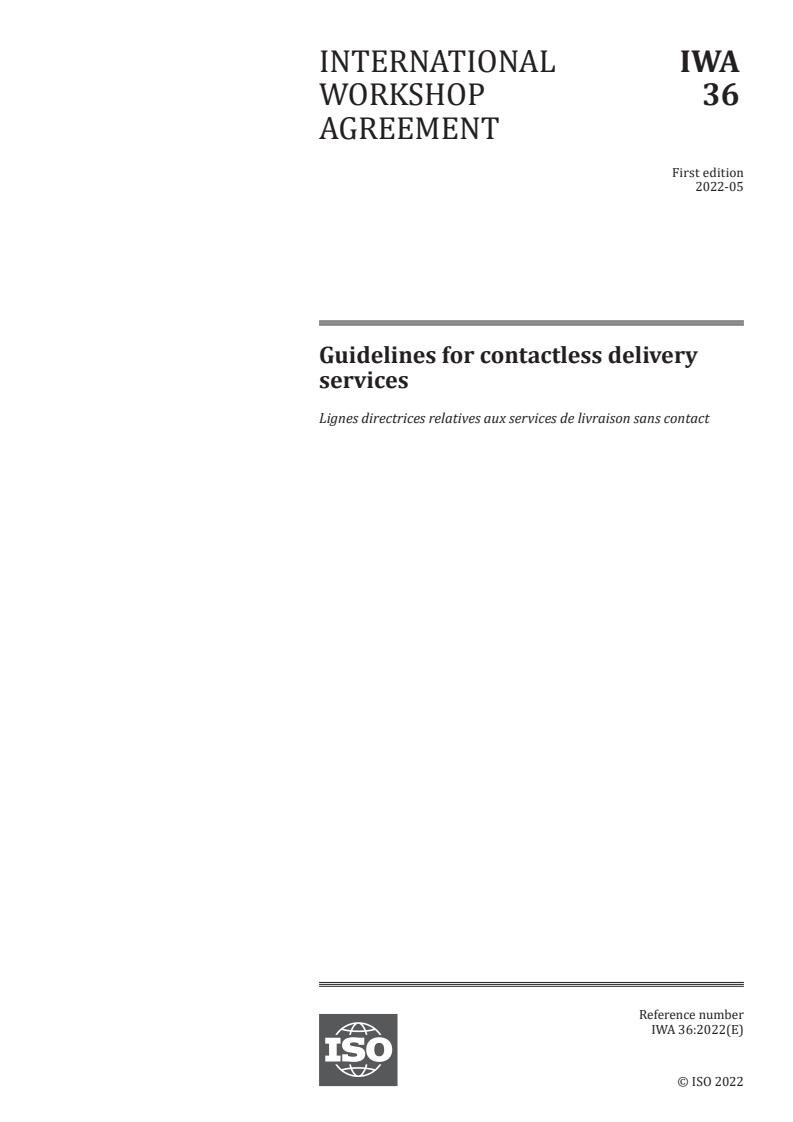
INTERNATIONAL IWA
WORKSHOP 36
AGREEMENT
First edition
2022-05
Guidelines for contactless delivery
services
Lignes directrices relatives aux services de livraison sans contact
Reference number
© ISO 2022
All rights reserved. Unless otherwise specified, or required in the context of its implementation, no part of this publication may
be reproduced or utilized otherwise in any form or by any means, electronic or mechanical, including photocopying, or posting on
the internet or an intranet, without prior written permission. Permission can be requested from either ISO at the address below
or ISO’s member body in the country of the requester.
ISO copyright office
CP 401 • Ch. de Blandonnet 8
CH-1214 Vernier, Geneva
Phone: +41 22 749 01 11
Email: copyright@iso.org
Website: www.iso.org
Published in Switzerland
ii
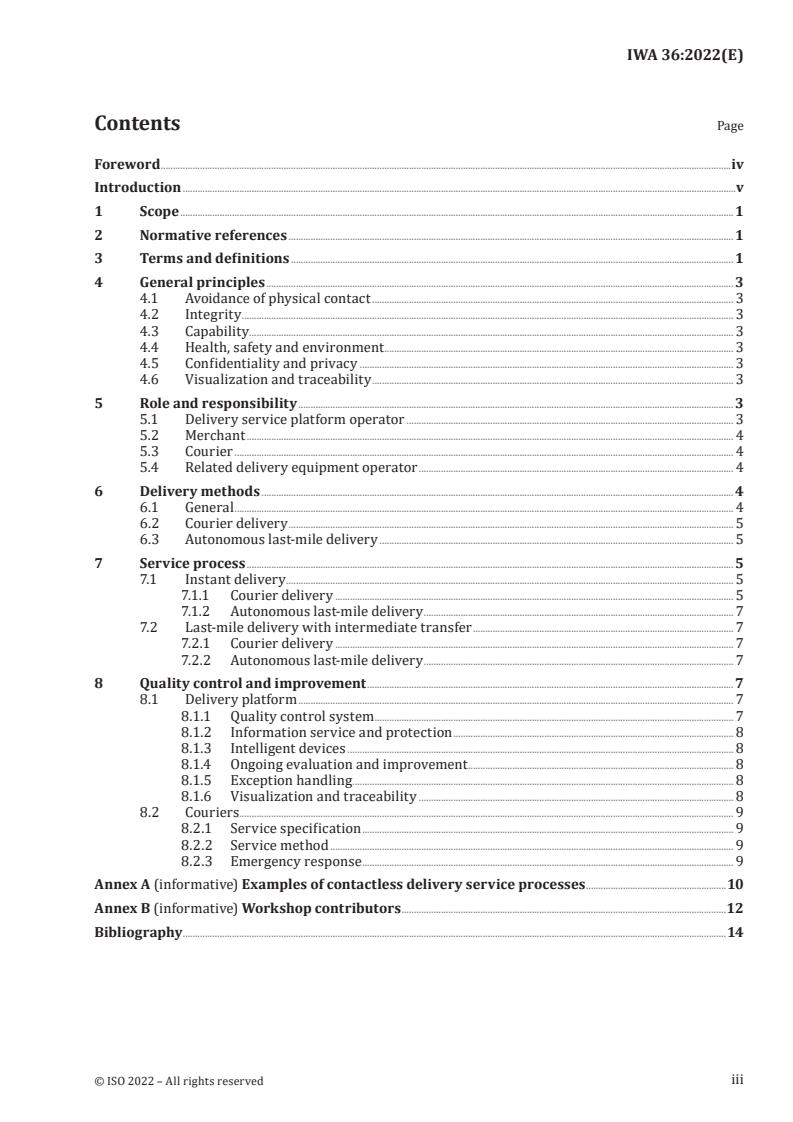
Contents Page
Foreword .iv
Introduction .v
1 Scope . 1
2 Normative references . 1
3 Terms and definitions . 1
4 General principles . 3
4.1 Avoidance of physical contact . 3
4.2 Integrity . 3
4.3 Capability. 3
4.4 Health, safety and environment . 3
4.5 Confidentiality and privacy . 3
4.6 Visualization and traceability . 3
5 Role and responsibility . 3
5.1 Delivery service platform operator . 3
5.2 Merchant . 4
5.3 Courier . 4
5.4 Related delivery equipment operator . 4
6 Delivery methods . 4
6.1 General . 4
6.2 Courier delivery . 5
6.3 Autonomous last-mile delivery . 5
7 Service process . 5
7.1 Instant delivery . 5
7.1.1 Courier delivery . 5
7.1.2 Autonomous last-mile delivery . 7
7.2 Last-mile delivery with intermediate transfer . 7
7.2.1 Courier delivery . 7
7.2.2 Autonomous last-mile delivery . 7
8 Quality control and improvement . 7
8.1 Delivery platform . 7
8.1.1 Quality control system . 7
8.1.2 Information service and protection . 8
8.1.3 Intelligent devices . 8
8.1.4 Ongoing evaluation and improvement . 8
8.1.5 Exception handling . . 8
8.1.6 Visualization and traceability . 8
8.2 Couriers . 9
8.2.1 Service specification . 9
8.2.2 Service method . 9
8.2.3 Emergency response . 9
Annex A (informative) Examples of contactless delivery service processes .10
Annex B (informative) Workshop contributors .12
Bibliography .14
iii
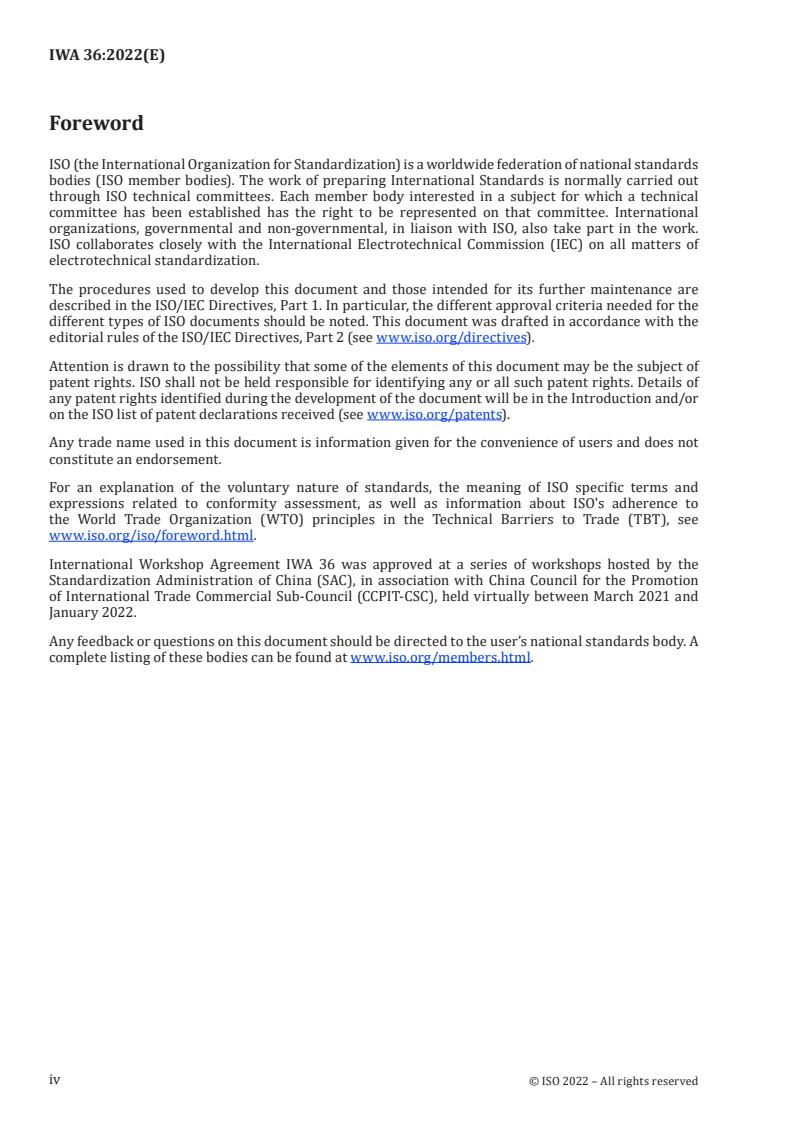
Foreword
ISO (the International Organization for Standardization) is a worldwide federation of national standards
bodies (ISO member bodies). The work of preparing International Standards is normally carried out
through ISO technical committees. Each member body interested in a subject for which a technical
committee has been established has the right to be represented on that committee. International
organizations, governmental and non-governmental, in liaison with ISO, also take part in the work.
ISO collaborates closely with the International Electrotechnical Commission (IEC) on all matters of
electrotechnical standardization.
The procedures used to develop this document and those intended for its further maintenance are
described in the ISO/IEC Directives, Part 1. In particular, the different approval criteria needed for the
different types of ISO documents should be noted. This document was drafted in accordance with the
editorial rules of the ISO/IEC Directives, Part 2 (see www.iso.org/directives).
Attention is drawn to the possibility that some of the elements of this document may be the subject of
patent rights. ISO shall not be held responsible for identifying any or all such patent rights. Details of
any patent rights identified during the development of the document will be in the Introduction and/or
on the ISO list of patent declarations received (see www.iso.org/patents).
Any trade name used in this document is information given for the convenience of users and does not
constitute an endorsement.
For an explanation of the voluntary nature of standards, the meaning of ISO specific terms and
expressions related to conformity assessment, as well as information about ISO's adherence to
the World Trade Organization (WTO) principles in the Technical Barriers to Trade (TBT), see
www.iso.org/iso/foreword.html.
International Workshop Agreement IWA 36 was approved at a series of workshops hosted by the
Standardization Administration of China (SAC), in association with China Council for the Promotion
of International Trade Commercial Sub-Council (CCPIT-CSC), held virtually between March 2021 and
January 2022.
Any feedback or questions on this document should be directed to the user’s national standards body. A
complete listing of these bodies can be found at www.iso.org/members.html.
iv
Introduction
Faced with the impact of the outbreak of the COVID-19 pandemic, related delivery platforms (including
food delivery and grocery delivery) launched a "contactless delivery" service. Contactless delivery
services have made a substantial contribution to the health and safety of consumers and couriers
during the pandemic.
This document aims to improve transparency and understanding between consumers and delivery
service providers and to promote the transformation of service standards and operation models. This
document aims to enable couriers provide better value for consumers and reduce risk in the delivery
service process. This document aims to help enhance the effectiveness of the delivery industry and
accelerate the development of the profession by proposing ways to improve quality, professionalism
and ethical behaviour, as well as the introduction of new techniques in delivery service.
This document is based on good practices from the delivery industry. It includes recommendations to
use contactless delivery services, based on research and the experience of a wide range of delivery
platforms, merchants, couriers, other service providers and their consumers.
This guidance in this document is written from the perspective of couriers. It applies to all couriers,
whoever they are employed by, including delivery platforms, retailers and restaurants.
This document focuses only on the delivery service for material objects. It applies to couriers, consumers
and merchants, not to the delivery platform internal management.
This document supports the implementation of the United Nations Sustainable Development Goals
SDG3 (Good Health and Well-Being), SDG8 (Decent Work and Economic Growth), SDG11 (Sustainable
Cities and Communities) and SDG12 (Responsible Consumption and Production).
v
International Workshop Agreement IWA 36:2022(E)
Guidelines for contactless delivery services
1 Scope
This document provides general guidance on issues to be considered in standards related to contactless
delivery services. It covers general principles, roles and responsibilities, delivery methods, service
processes, quality control and improvements to be put in place to execute contactless delivery services.
This document applies to
— instant delivery, which generally applies to the retail, catering and medical sectors (including online
food delivery, grocery delivery and medical supplies delivery); and
— last-mile delivery with intermediate transfer, which generally applies to express and e-commerce
fields (referring to the last-mile delivery of parcels).
This document does not apply to cold chain logistics.
2 Normative references
There are no normative references in this document.
3 Terms and definitions
For the purposes of this document, the following terms and definitions apply.
ISO and IEC maintain terminological databases for use in standardization at the following addresses:
— ISO Online browsing platform: available at https:// www .iso .org/ obp
— IEC Electropedia: available at https:// www .electropedia .org/
3.1
courier
member of the service personnel who accepts and checks consumer (3.10) orders (3.4) through the
delivery platform or the merchant (3.7) and who deposits the ordered goods (3.8) in the designated
location
Note 1 to entry: The courier is a delivery person who works for the delivery service platform or the merchant.
3.2
contactless delivery
delivery of goods (3.8) to the consumer (3.10) or recipient without direct contact or human involvement
throughout the delivery process, in order to reduce the risk of occupational exposure of the courier
(3.1) and to ensure the safety of the consumer and the courier
Note 1 to entry: Delivery without direct contact generally refers to courier delivery.
Note 2 to entry: Delivery without human involvement generally refers to autonomous last-mile delivery (3.11).
3.3
instant messaging
communication between two or more people on the internet by means of real-time text messages, files,
voice, call and video
3.4
order
transaction information or delivery service demand information for online-purchased goods (3.8)
3.5
delivery service provider
company or organization that provides delivery services
EXAMPLE Delivery service platform operator (3.6); merchant (3.7) on the delivery service platform; related
delivery equipment operator.
3.6
delivery service platform operator
organization or legal entity that operates a delivery service platform
3.7
merchant
individual or organization that supplies goods (3.8) for consumers (3.10) online in the instant delivery
sector
Note 1 to entry: The merchant can use the delivery service of the platform to deliver the goods to the consumers.
It can also deliver the goods to the consumers itself.
Note 2 to entry: For example, the online food delivery segment includes the categories "merchant-to-consumer
delivery" and "platform-to-consumer delivery". Merchant-to-consumer delivery means that the merchant will
pick up the goods and directly deliver them to the consumer. Platform-to-consumer delivery means that the
platform will pick up the goods from the merchant and deliver them to the consumer.
3.8
goods
items or materials that, upon the placement of a purchase order (3.4), are being manufactured,
processed, handled or transported within the supply chain for delivery to a consumer (3.10)
[SOURCE: ISO 28001:2007, 3.11, modified]
3.9
smart locker
self-service equipment located in a publicly accessible area, used by the delivery service provider (3.5) to
deposit goods (3.8) or parcels (3.12) and accessible to the consumer (3.10) to take collection of the goods
or parcels
Note 1 to entry: Smart lockers generally include smart parcel lockers and smart food lockers.
Note 2 to entry: A smart food locker is an intelligent service facility that provides short-term access services for
food and catering in the context of online food delivery.
3.10
consumer
person who initiates the delivery service order (3.4) request to the platform or the merchant (3.7) and
who receives the order
3.11
last-mile delivery
final step in the journey of goods (3.8) from the distribution location (3.13) to the consumer (3.10)
3.12
parcel
physical package that is mailed or shipped
3.13
distribution location
last-mile delivery (3.11) hub that integrates the functions of receiving, temporary storage, distribution
and special operations and that ships goods (3.8) out to the final destination
4 General principles
4.1 Avoidance of physical contact
Physical contact is avoided between couriers and consumers or people who have potential contact
opportunities with couriers when picking up goods from the merchants or in the distribution locations.
4.2 Integrity
Delivery services are conducted in an honest, respectful and courteous manner, taking into account the
interests of consumers, and are communicated accurately.
4.3 Capability
Couriers should have received special training for contactless delivery services and should have passed
the corresponding assessments.
4.4 Health, safety and environment
The health and safety of consumers and couriers and their environmental expectations are given
priority at the operational level.
4.5 Confidentiality and privacy
Personal information should be treated in a confidential manner, respecting
...