

ISO 22059:2020
(Main)Guidelines on consumer warranties/guarantees
General Information
- Abstract
This document specifies the form and content of warranties/guarantees that a manufacturer and/or supplier can use to address reasonable expectations of products by consumers. This document is applicable to transactions between businesses and consumers of new and used products, including online transactions. This document is also applicable to products associated with services to complete a transaction (such as, buying clothes that need alteration).
- Status
- Published
- Publication Date
- 30-Jan-2020
- Technical Committee
- ISO/TMBG - Technical Management Board - groups
- Drafting Committee
- ISO/TMBG - Technical Management Board - groups
- Current Stage
- 9093 - International Standard confirmed
- Start Date
- 12-Aug-2025
- Completion Date
- 29-Aug-2026
Buy Documents
ISO 22059:2020 - Guidelines on consumer warranties/guarantees
ISO 22059:2020 - Guidelines on consumer warranties/guarantees/31/2020
Overview - ISO 22059:2020 (Guidelines on consumer warranties / guarantees)
ISO 22059:2020 provides internationally recognized guidelines on consumer warranties and guarantees, specifying the recommended form and content that manufacturers and suppliers can use to meet reasonable consumer expectations. The standard applies to transactions between businesses and consumers for new and used products, including online transactions and products linked to services (for example garments requiring alteration). Its aim is to improve consumer protection, clarify obligations, and reduce disputes by defining clear warranty terms, remedies and redress processes.
Key topics and technical requirements
The standard organizes practical requirements and recommendations around these core topics:
- Scope & definitions - clear terminology for consumer, product, warranty/guarantee, manufacturer, supplier, redress, implied vs express warranties, perishable vs non‑perishable goods.
- Purpose and principles - fairness, transparency and allocation of risk between consumers, suppliers and manufacturers.
- Form and content - recommendations for warranty/guarantee documents including language, disclosure, clear explanation of coverage, and how to present express terms.
- Registration and status - guidance on pre‑conditions for registration, registration procedures, transferability of warranties, and interaction with statutory rights.
- Duration of coverage - treatment of perishable and non‑perishable products (sections identify considerations for warranty timeframes).
- Categories of warranties - typical warranty types: title/legal rights, quality, fitness for a particular purpose, compliance with description/sample, repairs and spare parts, inspection and express warranties.
- Claims, breach and remedies - documenting how to report defects, processes to resolve breaches, remedies (repair, replace, refund) and handling recurrent defects.
- Exclusions and limitations - treatment of exclusions/limitations of liability and identification of unfair terms to avoid.
- Right of redress - responsibilities and redress routes against suppliers and manufacturers; Annex A includes informative flowcharts illustrating redress processes.
Practical applications and who uses ISO 22059
ISO 22059 is practical for organizations and stakeholders involved in product supply and consumer protection:
- Manufacturers and brand owners - to draft consistent warranty policies and improve after‑sales service.
- Suppliers, retailers and e‑commerce platforms - to present clear warranty terms at point of sale and online listings.
- Legal and compliance teams - to align commercial warranties with statutory consumer rights and avoid unfair contract terms.
- Consumer protection agencies and standard setters - to evaluate warranty fairness and redress mechanisms.
- After‑sales service providers and warranty administrators - to implement claims handling procedures.
Using ISO 22059 helps reduce disputes, increase consumer confidence, and ensure transparent consumer warranty documentation across markets.
Related standards
- ISO 26000 (social responsibility) - used as a source for terms.
- ISO 10377 (consumer product safety guidance) - referenced for product definition.
- ISO 19054 (product labelling/packaging definitions) - referenced for manufacturer definition.
Keywords: ISO 22059:2020, consumer warranties, guarantees, warranty guidelines, online transactions, manufacturer warranty, supplier warranty, consumer protection.
Buy Documents
ISO 22059:2020 - Guidelines on consumer warranties/guarantees
ISO 22059:2020 - Guidelines on consumer warranties/guarantees/31/2020
Get Certified
Connect with accredited certification bodies for this standard

Great Wall Tianjin Quality Assurance Center
Established 1993, first batch to receive national accreditation with IAF recognition.
Hong Kong Quality Assurance Agency (HKQAA)
Hong Kong's leading certification body.

Innovative Quality Certifications Pvt. Ltd. (IQCPL)
Known for integrity, providing ethical & impartial Assessment & Certification. CMMI Institute Partner.
Sponsored listings
Frequently Asked Questions
ISO 22059:2020 is a standard published by the International Organization for Standardization (ISO). Its full title is "Guidelines on consumer warranties/guarantees". This standard covers: This document specifies the form and content of warranties/guarantees that a manufacturer and/or supplier can use to address reasonable expectations of products by consumers. This document is applicable to transactions between businesses and consumers of new and used products, including online transactions. This document is also applicable to products associated with services to complete a transaction (such as, buying clothes that need alteration).
This document specifies the form and content of warranties/guarantees that a manufacturer and/or supplier can use to address reasonable expectations of products by consumers. This document is applicable to transactions between businesses and consumers of new and used products, including online transactions. This document is also applicable to products associated with services to complete a transaction (such as, buying clothes that need alteration).
ISO 22059:2020 is classified under the following ICS (International Classification for Standards) categories: 03.080.30 - Services for consumers. The ICS classification helps identify the subject area and facilitates finding related standards.
ISO 22059:2020 is available in PDF format for immediate download after purchase. The document can be added to your cart and obtained through the secure checkout process. Digital delivery ensures instant access to the complete standard document.
Standards Content (Sample)
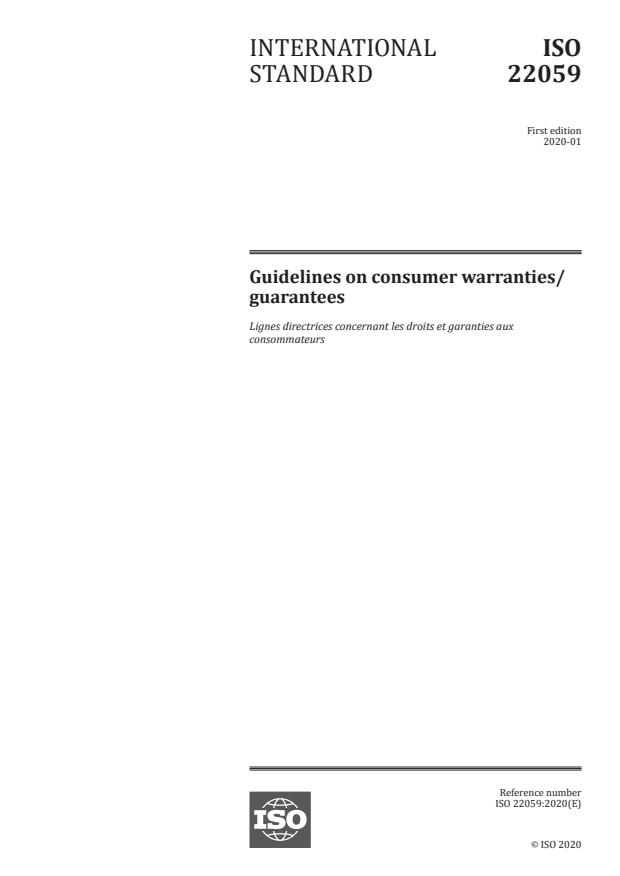
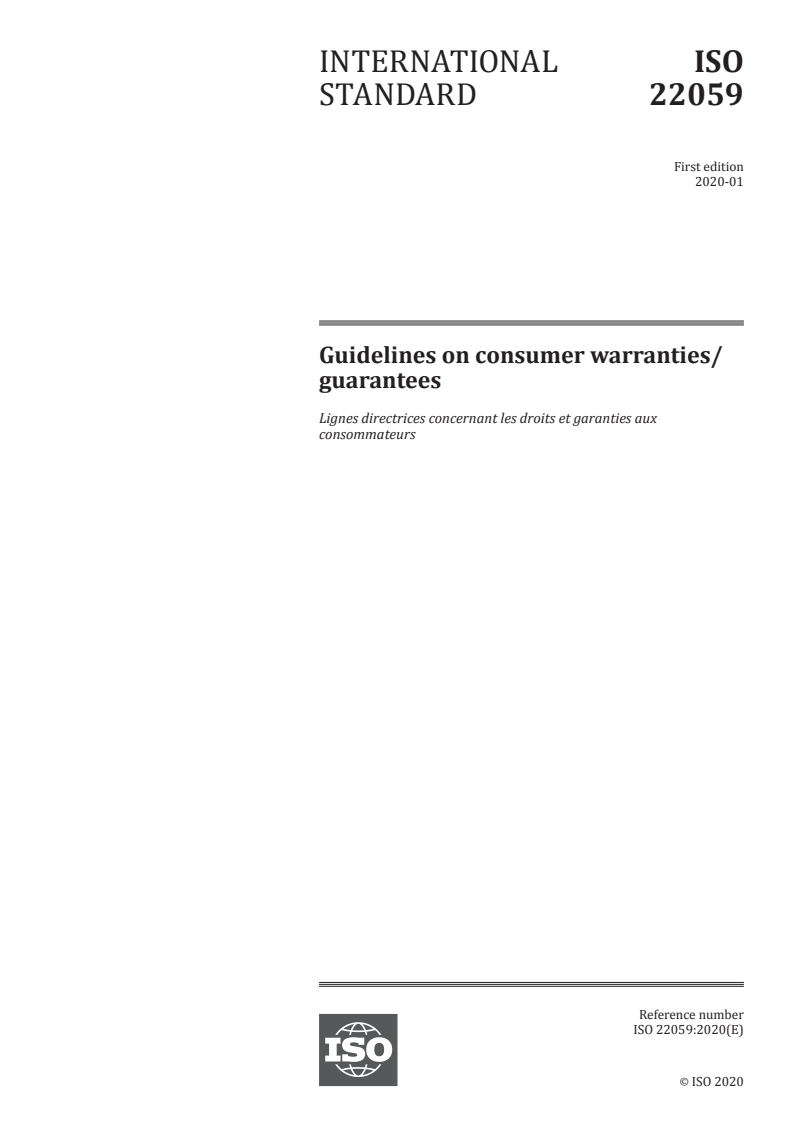
INTERNATIONAL ISO
STANDARD 22059
First edition
2020-01
Guidelines on consumer warranties/
guarantees
Lignes directrices concernant les droits et garanties aux
consommateurs
Reference number
©
ISO 2020
© ISO 2020
All rights reserved. Unless otherwise specified, or required in the context of its implementation, no part of this publication may
be reproduced or utilized otherwise in any form or by any means, electronic or mechanical, including photocopying, or posting
on the internet or an intranet, without prior written permission. Permission can be requested from either ISO at the address
below or ISO’s member body in the country of the requester.
ISO copyright office
CP 401 • Ch. de Blandonnet 8
CH-1214 Vernier, Geneva
Phone: +41 22 749 01 11
Fax: +41 22 749 09 47
Email: copyright@iso.org
Website: www.iso.org
Published in Switzerland
ii © ISO 2020 – All rights reserved
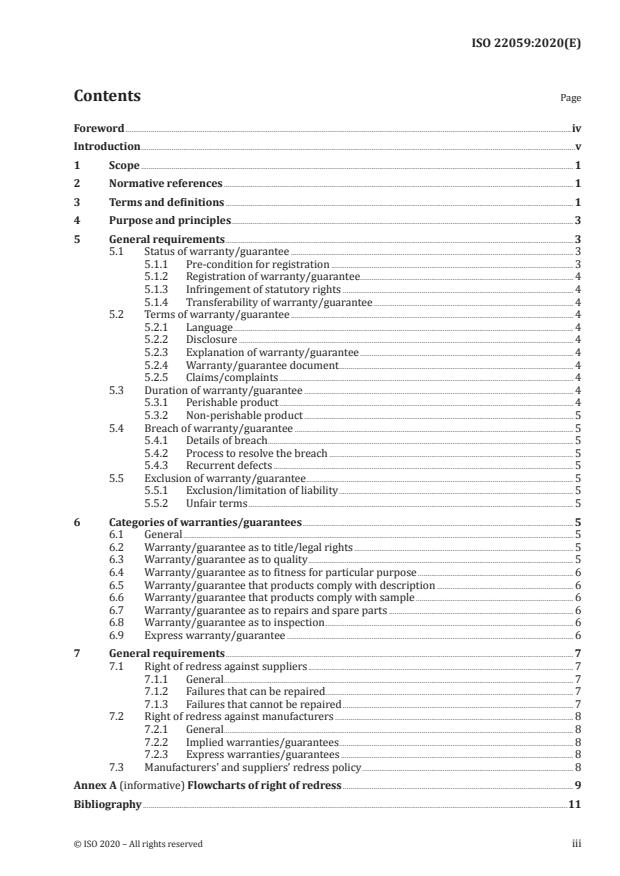
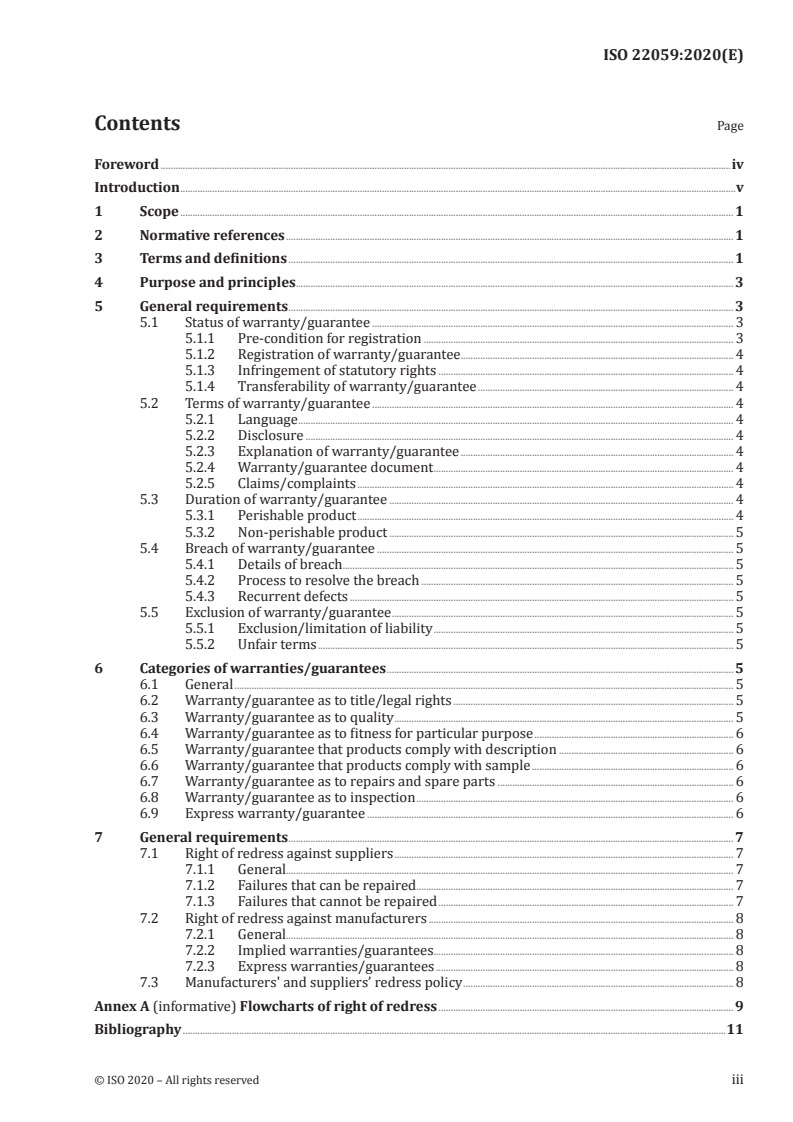
Contents Page
Foreword .iv
Introduction .v
1 Scope . 1
2 Normative references . 1
3 Terms and definitions . 1
4 Purpose and principles . 3
5 General requirements . 3
5.1 Status of warranty/guarantee . 3
5.1.1 Pre-condition for registration . 3
5.1.2 Registration of warranty/guarantee. 4
5.1.3 Infringement of statutory rights . 4
5.1.4 Transferability of warranty/guarantee . 4
5.2 Terms of warranty/guarantee . 4
5.2.1 Language . 4
5.2.2 Disclosure . 4
5.2.3 Explanation of warranty/guarantee . 4
5.2.4 Warranty/guarantee document . 4
5.2.5 Claims/complaints . 4
5.3 Duration of warranty/guarantee . 4
5.3.1 Perishable product . 4
5.3.2 Non-perishable product . 5
5.4 Breach of warranty/guarantee . 5
5.4.1 Details of breach . 5
5.4.2 Process to resolve the breach . 5
5.4.3 Recurrent defects . 5
5.5 Exclusion of warranty/guarantee . 5
5.5.1 Exclusion/limitation of liability . 5
5.5.2 Unfair terms . 5
6 Categories of warranties/guarantees . 5
6.1 General . 5
6.2 Warranty/guarantee as to title/legal rights . 5
6.3 Warranty/guarantee as to quality . 5
6.4 Warranty/guarantee as to fitness for particular purpose . 6
6.5 Warranty/guarantee that products comply with description . 6
6.6 Warranty/guarantee that products comply with sample . 6
6.7 Warranty/guarantee as to repairs and spare parts . 6
6.8 Warranty/guarantee as to inspection . 6
6.9 Express warranty/guarantee . 6
7 General requirements . 7
7.1 Right of redress against suppliers . 7
7.1.1 General. 7
7.1.2 Failures that can be repaired . 7
7.1.3 Failures that cannot be repaired . 7
7.2 Right of redress against manufacturers . 8
7.2.1 General. 8
7.2.2 Implied warranties/guarantees . . 8
7.2.3 Express warranties/guarantees . 8
7.3 Manufacturers' and suppliers’ redress policy . 8
Annex A (informative) Flowcharts of right of redress . 9
Bibliography .11
Foreword
ISO (the International Organization for Standardization) is a worldwide federation of national standards
bodies (ISO member bodies). The work of preparing International Standards is normally carried out
through ISO technical committees. Each member body interested in a subject for which a technical
committee has been established has the right to be represented on that committee. International
organizations, governmental and non-governmental, in liaison with ISO, also take part in the work.
ISO collaborates closely with the International Electrotechnical Commission (IEC) on all matters of
electrotechnical standardization.
The procedures used to develop this document and those intended for its further maintenance are
described in the ISO/IEC Directives, Part 1. In particular, the different approval criteria needed for the
different types of ISO documents should be noted. This document was drafted in accordance with the
editorial rules of the ISO/IEC Directives, Part 2 (see www .iso .org/ directives).
Attention is drawn to the possibility that some of the elements of this document may be the subject of
patent rights. ISO shall not be held responsible for identifying any or all such patent rights. Details of
any patent rights identified during the development of the document will be in the Introduction and/or
on the ISO list of patent declarations received (see www .iso .org/ patents).
Any trade name used in this document is information given for the convenience of users and does not
constitute an endorsement.
For an explanation of the voluntary nature of standards, the meaning of ISO specific terms and
expressions related to conformity assessment, as well as information about ISO's adherence to the
World Trade Organization (WTO) principles in the Technical Barriers to Trade (TBT) see www .iso .org/
iso/ foreword .html.
This document was prepared by Project Committee ISO/PC 303, Guidelines on consumer warranties and
guarantees.
Any feedback or questions on this document should be directed to the user’s national standards body. A
complete listing of these bodies can be found at www .iso .org/ members .html.
iv © ISO 2020 – All rights reserved
Introduction
The rapid globalization of production and the shift in manufacturing and distribution systems has
created a new need for consumer protection. The internet and mobile telephones have revolutionized
the way the business is conducted. The increased usage of the internet has had a great impact
on developed and developing countries. Nearly all countries are experiencing a high demand of
e-commerce activities. This new phenomenon has led to the disparity of knowledge between traders
and consumers. The advancement of technology has placed at the disposal of consumers a range of
complex and sophisticated products, consumable and non-consumable. To protect consumers against
faulty products requires the design of new measures.
Rapid expansion of developing economies has led to the inclusion of millions of new consumers in the
global market. While this is of great benefit to the standard of living of those consumers, the levels
of protection they receive from consumers' law and good business practices is much lower than that
received by consumers in the developed world.
The economic importance of product warranties/guarantees is to provide protection against
unsatisfactory performance of products. They state that products meet a level of quality and
performance that would be reasonable to expect, given their price and description. Traditionally,
warranties and guarantees provide less than full insurance by manufacturers and/or suppliers against
faulty products and this serves as risk-sharing between consumers, manufacturers and/or suppliers.
Manufacturers, for example, give warranties/guarantees to suppliers, who, in turn, give the same
warranties/guarantees to consumers. In this way, all parties connected with the supply of a product
are given protection. In addition, manufacturers and/or suppliers often give express warranties/
guarantees directly to consumers as an incentive to buy their products. Warranties/guarantees help to
improve the quality of products and can be used as a competitive tool in the marketplace.
Warranties/guarantees state exactly what is covered and what is not covered, the time frame of
coverage and what manufacturers and/or suppliers expect of consumers. In addition, warranties/
guarantees state the remedies offered by the manufacturer and/or supplier to consumers in the event
of product failure.
This document can play a significant part in assisting manufacturers and suppliers in understanding
their responsibilities towards consumers while, at the same time, equipping consumers with the sense
of their rights to safe, durable and well-performing products. This document is intended to enhance and
promote confidence in the products supplied by the manufacturer and supplier.
INTERNATIONAL STANDARD ISO 22059:2020(E)
Guidelines on consumer warranties/guarantees
1 Scope
This document specifies the form and content of warranties/guarantees that a manufacturer and/or
supplier can use to address reasonable expectations of products by consumers.
This document is applicable to transactions between businesses and consumers of new and used
products, including online transactions. This document is also applicable to products associated with
services to complete a transaction (such as, buying clothes that need alteration).
2 Normative references
There are no normative references in this document.
3 Terms and definitions
For the purposes of this document, the following terms and definitions apply.
ISO and IEC maintain terminological databases for use in standardization at the following addresses:
— ISO Online browsing platform: available at https:// www .iso .org/ obp
— IEC Electropedia: available at http:// www .electropedia .org/
3.1
business
undertaking carried out for profit in the course of which products are acquired or supplied whether at
a price or otherwise
3.2
consumer
individual member of the general public purchasing or using property, products or services for private
purposes
[SOURCE: ISO 26000:2010, 2.2]
3.3
consumer product
product (3.8), including digital content (3.4), designed and produced primarily for, but not limited to,
personal use, including its components, parts, accessories, instructions, packaging and labelling
[SOURCE: ISO 10377:2013, 2.2, modified – addition of 'including digital content'.]
3.4
digital content
data which are produced and supplied to a consumer in digital form
3.5
exclusion
limitation of liability
terms in a warranty/guarantee (3.15) by which a manufacturer (3.6) or supplier (3.13) seeks to exclude
or limit all or some of their liabilities
3.6
manufacturer
natural or leg
...
INTERNATIONAL ISO
STANDARD 22059
First edition
2020-01
Guidelines on consumer warranties/
guarantees
Lignes directrices concernant les droits et garanties aux
consommateurs
Reference number
©
ISO 2020
© ISO 2020
All rights reserved. Unless otherwise specified, or required in the context of its implementation, no part of this publication may
be reproduced or utilized otherwise in any form or by any means, electronic or mechanical, including photocopying, or posting
on the internet or an intranet, without prior written permission. Permission can be requested from either ISO at the address
below or ISO’s member body in the country of the requester.
ISO copyright office
CP 401 • Ch. de Blandonnet 8
CH-1214 Vernier, Geneva
Phone: +41 22 749 01 11
Fax: +41 22 749 09 47
Email: copyright@iso.org
Website: www.iso.org
Published in Switzerland
ii © ISO 2020 – All rights reserved
Contents Page
Foreword .iv
Introduction .v
1 Scope . 1
2 Normative references . 1
3 Terms and definitions . 1
4 Purpose and principles . 3
5 General requirements . 3
5.1 Status of warranty/guarantee . 3
5.1.1 Pre-condition for registration . 3
5.1.2 Registration of warranty/guarantee. 4
5.1.3 Infringement of statutory rights . 4
5.1.4 Transferability of warranty/guarantee . 4
5.2 Terms of warranty/guarantee . 4
5.2.1 Language . 4
5.2.2 Disclosure . 4
5.2.3 Explanation of warranty/guarantee . 4
5.2.4 Warranty/guarantee document . 4
5.2.5 Claims/complaints . 4
5.3 Duration of warranty/guarantee . 4
5.3.1 Perishable product . 4
5.3.2 Non-perishable product . 5
5.4 Breach of warranty/guarantee . 5
5.4.1 Details of breach . 5
5.4.2 Process to resolve the breach . 5
5.4.3 Recurrent defects . 5
5.5 Exclusion of warranty/guarantee . 5
5.5.1 Exclusion/limitation of liability . 5
5.5.2 Unfair terms . 5
6 Categories of warranties/guarantees . 5
6.1 General . 5
6.2 Warranty/guarantee as to title/legal rights . 5
6.3 Warranty/guarantee as to quality . 5
6.4 Warranty/guarantee as to fitness for particular purpose . 6
6.5 Warranty/guarantee that products comply with description . 6
6.6 Warranty/guarantee that products comply with sample . 6
6.7 Warranty/guarantee as to repairs and spare parts . 6
6.8 Warranty/guarantee as to inspection . 6
6.9 Express warranty/guarantee . 6
7 General requirements . 7
7.1 Right of redress against suppliers . 7
7.1.1 General. 7
7.1.2 Failures that can be repaired . 7
7.1.3 Failures that cannot be repaired . 7
7.2 Right of redress against manufacturers . 8
7.2.1 General. 8
7.2.2 Implied warranties/guarantees . . 8
7.2.3 Express warranties/guarantees . 8
7.3 Manufacturers' and suppliers’ redress policy . 8
Annex A (informative) Flowcharts of right of redress . 9
Bibliography .11
Foreword
ISO (the International Organization for Standardization) is a worldwide federation of national standards
bodies (ISO member bodies). The work of preparing International Standards is normally carried out
through ISO technical committees. Each member body interested in a subject for which a technical
committee has been established has the right to be represented on that committee. International
organizations, governmental and non-governmental, in liaison with ISO, also take part in the work.
ISO collaborates closely with the International Electrotechnical Commission (IEC) on all matters of
electrotechnical standardization.
The procedures used to develop this document and those intended for its further maintenance are
described in the ISO/IEC Directives, Part 1. In particular, the different approval criteria needed for the
different types of ISO documents should be noted. This document was drafted in accordance with the
editorial rules of the ISO/IEC Directives, Part 2 (see www .iso .org/ directives).
Attention is drawn to the possibility that some of the elements of this document may be the subject of
patent rights. ISO shall not be held responsible for identifying any or all such patent rights. Details of
any patent rights identified during the development of the document will be in the Introduction and/or
on the ISO list of patent declarations received (see www .iso .org/ patents).
Any trade name used in this document is information given for the convenience of users and does not
constitute an endorsement.
For an explanation of the voluntary nature of standards, the meaning of ISO specific terms and
expressions related to conformity assessment, as well as information about ISO's adherence to the
World Trade Organization (WTO) principles in the Technical Barriers to Trade (TBT) see www .iso .org/
iso/ foreword .html.
This document was prepared by Project Committee ISO/PC 303, Guidelines on consumer warranties and
guarantees.
Any feedback or questions on this document should be directed to the user’s national standards body. A
complete listing of these bodies can be found at www .iso .org/ members .html.
iv © ISO 2020 – All rights reserved
Introduction
The rapid globalization of production and the shift in manufacturing and distribution systems has
created a new need for consumer protection. The internet and mobile telephones have revolutionized
the way the business is conducted. The increased usage of the internet has had a great impact
on developed and developing countries. Nearly all countries are experiencing a high demand of
e-commerce activities. This new phenomenon has led to the disparity of knowledge between traders
and consumers. The advancement of technology has placed at the disposal of consumers a range of
complex and sophisticated products, consumable and non-consumable. To protect consumers against
faulty products requires the design of new measures.
Rapid expansion of developing economies has led to the inclusion of millions of new consumers in the
global market. While this is of great benefit to the standard of living of those consumers, the levels
of protection they receive from consumers' law and good business practices is much lower than that
received by consumers in the developed world.
The economic importance of product warranties/guarantees is to provide protection against
unsatisfactory performance of products. They state that products meet a level of quality and
performance that would be reasonable to expect, given their price and description. Traditionally,
warranties and guarantees provide less than full insurance by manufacturers and/or suppliers against
faulty products and this serves as risk-sharing between consumers, manufacturers and/or suppliers.
Manufacturers, for example, give warranties/guarantees to suppliers, who, in turn, give the same
warranties/guarantees to consumers. In this way, all parties connected with the supply of a product
are given protection. In addition, manufacturers and/or suppliers often give express warranties/
guarantees directly to consumers as an incentive to buy their products. Warranties/guarantees help to
improve the quality of products and can be used as a competitive tool in the marketplace.
Warranties/guarantees state exactly what is covered and what is not covered, the time frame of
coverage and what manufacturers and/or suppliers expect of consumers. In addition, warranties/
guarantees state the remedies offered by the manufacturer and/or supplier to consumers in the event
of product failure.
This document can play a significant part in assisting manufacturers and suppliers in understanding
their responsibilities towards consumers while, at the same time, equipping consumers with the sense
of their rights to safe, durable and well-performing products. This document is intended to enhance and
promote confidence in the products supplied by the manufacturer and supplier.
INTERNATIONAL STANDARD ISO 22059:2020(E)
Guidelines on consumer warranties/guarantees
1 Scope
This document specifies the form and content of warranties/guarantees that a manufacturer and/or
supplier can use to address reasonable expectations of products by consumers.
This document is applicable to transactions between businesses and consumers of new and used
products, including online transactions. This document is also applicable to products associated with
services to complete a transaction (such as, buying clothes that need alteration).
2 Normative references
There are no normative references in this document.
3 Terms and definitions
For the purposes of this document, the following terms and definitions apply.
ISO and IEC maintain terminological databases for use in standardization at the following addresses:
— ISO Online browsing platform: available at https:// www .iso .org/ obp
— IEC Electropedia: available at http:// www .electropedia .org/
3.1
business
undertaking carried out for profit in the course of which products are acquired or supplied whether at
a price or otherwise
3.2
consumer
individual member of the general public purchasing or using property, products or services for private
purposes
[SOURCE: ISO 26000:2010, 2.2]
3.3
consumer product
product (3.8), including digital content (3.4), designed and produced primarily for, but not limited to,
personal use, including its components, parts, accessories, instructions, packaging and labelling
[SOURCE: ISO 10377:2013, 2.2, modified – addition of 'including digital content'.]
3.4
digital content
data which are produced and supplied to a consumer in digital form
3.5
exclusion
limitation of liability
terms in a warranty/guarantee (3.15) by which a manufacturer (3.6) or supplier (3.13) seeks to exclude
or limit all or some of their liabilities
3.6
manufacturer
natural or leg
...