


ISO/IEC 9797:1989
(Main)Data cryptographic techniques — Data integrity mechanism using a cryptographic check function employing a block cipher algorithm
Data cryptographic techniques — Data integrity mechanism using a cryptographic check function employing a block cipher algorithm
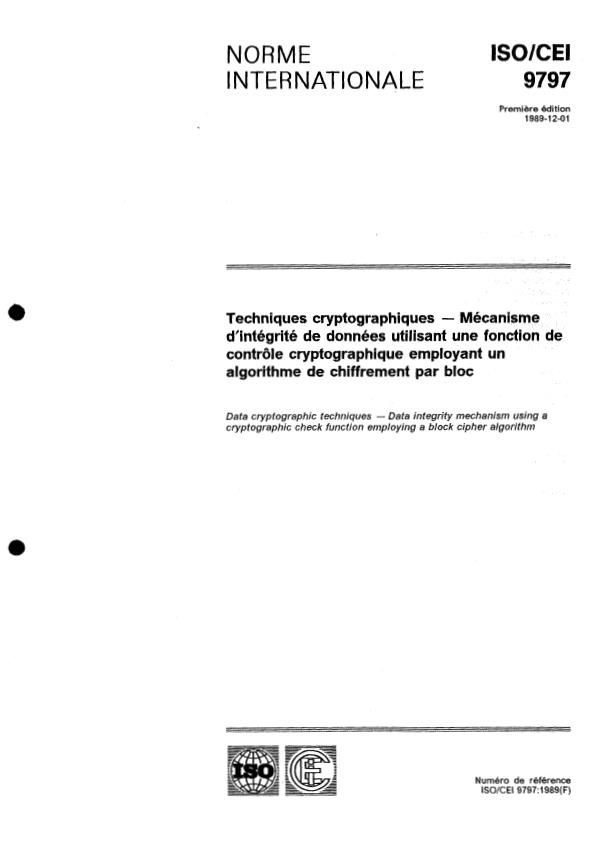
Techniques cryptographiques — Mécanisme d'intégrité des données utilisant une fonction de contrôle cryptographique employant un algorithme de chiffrement par bloc
General Information
- Status
- Withdrawn
- Publication Date
- 22-Nov-1989
- Withdrawal Date
- 22-Nov-1989
- Current Stage
- 9599 - Withdrawal of International Standard
- Start Date
- 07-Apr-1994
- Completion Date
- 14-Feb-2026
Relations
- Effective Date
- 15-Apr-2008
Buy Documents
ISO/IEC 9797:1989 - Data cryptographic techniques -- Data integrity mechanism using a cryptographic check function employing a block cipher algorithm

ISO/IEC 9797:1989 - Techniques cryptographiques -- Mécanisme d'intégrité des données utilisant une fonction de contrôle cryptographique employant un algorithme de chiffrement par bloc
Get Certified
Connect with accredited certification bodies for this standard

BSI Group
BSI (British Standards Institution) is the business standards company that helps organizations make excellence a habit.

Bureau Veritas
Bureau Veritas is a world leader in laboratory testing, inspection and certification services.

DNV
DNV is an independent assurance and risk management provider.
Sponsored listings
Frequently Asked Questions
ISO/IEC 9797:1989 is a standard published by the International Organization for Standardization (ISO). Its full title is "Data cryptographic techniques — Data integrity mechanism using a cryptographic check function employing a block cipher algorithm". This standard covers: Data cryptographic techniques — Data integrity mechanism using a cryptographic check function employing a block cipher algorithm
Data cryptographic techniques — Data integrity mechanism using a cryptographic check function employing a block cipher algorithm
ISO/IEC 9797:1989 is classified under the following ICS (International Classification for Standards) categories: 35.030 - IT Security; 35.040 - Information coding. The ICS classification helps identify the subject area and facilitates finding related standards.
ISO/IEC 9797:1989 has the following relationships with other standards: It is inter standard links to ISO/IEC 9797:1994. Understanding these relationships helps ensure you are using the most current and applicable version of the standard.
ISO/IEC 9797:1989 is available in PDF format for immediate download after purchase. The document can be added to your cart and obtained through the secure checkout process. Digital delivery ensures instant access to the complete standard document.
Standards Content (Sample)
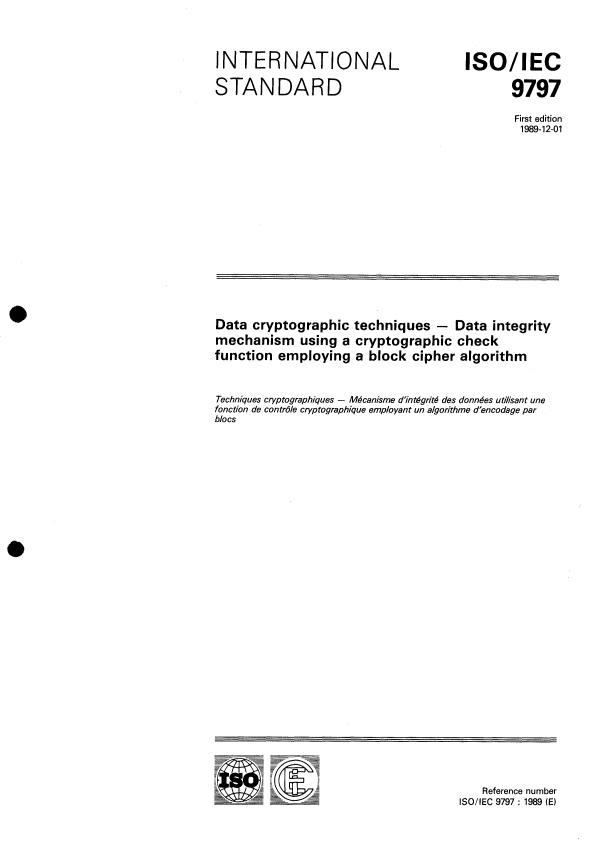
1 NTER NATIONAL
ISOIIEC
STANDARD
First edition
1989- 12-01
Data cryptographic techniques - Data integrity
mechanism using a cryptographic check
function employing a block cipher algorithm
Techniques cryptographiques - Mécanisme d'intégrité des données utilisant une
fonction de contrôle cryptographique employant un algorithme d'encodage par
blocs
Reference number
ISO/IEC 9797 : 1989 (E)
ISO/IEC 9797 : 1989 (E)
Foreword
take part in the work.
quiring at least 75 % approval by the national bodies voting.
Committee ISO/IEC JTC 1, lnformation technology.
O ISO/IEC 1989
All rights reserved. No part of this publication may be reproduced or utilized in
means, electronic or mechanical, including photocopying and microfilm,
writing from the publisher.
ISO/IEC Copyright Office Case postale 56 CH-1211 Genève 20
ISO/IEC 9797 : 1989 (E)
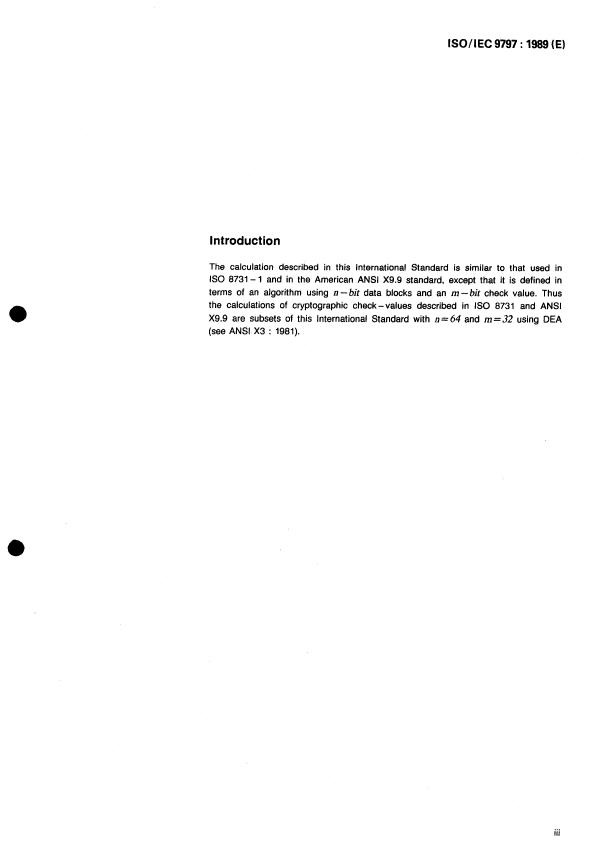
lntroduct ion
The calculation described in this International Standard is similar to that used in
IS0 8731 - 1 and in the American ANSI X9.9 standard, except that it is defined in
terms of an algorithm using n-bit data blocks and an m-bit check value. Thus
the calculations of cryptographic check-values described in IS0 8731 and ANSI
X9.9 are subsets of this International Standard with n=64 and m=32 using DEA
(see ANSI X3 : 1981).
iii
I
INTERNATIONAL STANDARD
ISO/IEC 9797 : 1989 (E)
I
l
Data cryptographic techniques - Data integrity
mechanism using a cryptographic check function
I
employing a block cipher algorithm
This International Standard refers to the check value as a
1 Scope
MAC.
This International Standard specifies a method of using a
key and n - bit algorithms in block cipher mode to calculate
an m-bit cryptographic check value that can be used as a
4 Requirements
data integrity mechanism to detect that data has not been
1) altered in an unauthorised manner. The degree of integrity
The value m will be less than or equal to the block size n.
of the data is dependent on the key length and its secrecy,
The result of the calculation and any optional process is an
on the nature of the cryptographic algorithm, and on m, the
information block of the size n. The cryptographic check
length of the check value.
value is the left-most m bits of the final n-bit block.
Assuming an adequate strength in the algorithm, the larger
This International Standard can be applied to the security
the m value, the greater the protection.
services of any security architecture, process, or
application.
5 Calculation of the MAC
2 Normative references
5.1 The n -bit cryptographic algorithm
The MAC is calculated as illusirated in figure 1. The data
The following standards contain provisions which, through
D,, for which the cryptographic check value is to be
bits on
reference in this text, constitute provisions of this
calculated, are divided into n - bit blocks, D,, D2, . . . , O,-,
International Standard. At the time of publication, the
All standards are subject to followed by a possibly incomplete block D4.
editions indicated were valid.
revision, and parties to agreements based on this
International Standard are encourage
...
ISOICEI
NORME
I NTE R NATIONALE 9797
Première édition
1989-1 2-0 1
Techniques cryptographiques - Mécanism
d’intégrité de données utilisant une fonction de
contrôle cryptographique employant un
algorithme de chiffrement par bloc
Data cryptographic techniques - Data integrity mechanism using a
cryptographic check function employing a block cipher algorithm
Numéro de référence
ISOlCEl 9797:1989( F)
ISO/CEI 9797 : 1989 (FI
Avant-propos
L'ISO (Organisation internationale de normalisation) et la CE1 (Commission électro-
technique internationale) forment ensemble un système consacré à la normalisation
internationale considérée comme un tout. Les organismes nationaux de I'ISO ou de la
CE1 participent au développement de Normes internationaeles par l'intermédiaire des
comités techniques créés par l'organisation concernée afin de s'occuper des différents
domaines particuliers de l'activité technique. Les comités techniques de I'ISO et de la
CE1 collaborent dans des domaines d'intérêt commun. D'autres organisations inter-
nationales, gouvernementales et non gouvernementales, en liaison avec I'ISO et la CE1
participent également aux travaux.
Dans le domaine des technologies de l'information, I'ISO et la CE1 ont créé un comité
technique mixte, I'ISO/CEI JTC 1. Les projets de Normes internationales adoptés par
le comité technique mixte sont soumis aux organismes nationaux pour approbation,
avant leur acceptation comme Normes internationales. Les Normes internationales
sont approuvées conformément aux procédures qui requièrent l'approbation de 75 %
au moins des organismes nationaux votants.
La Norme internationale ISO/CEI 9797 a été élaborée par le comité technique mixte
ISO/CEI JTC 1, Technologies de i'information.
L'annexe A de la présente Norme internationale est donnée uniquement à titre d'infor-
mation.
O ISO/CEI 1989
Droits de reproduction réservés. Aucune partie de cette publication ne peut être reproduite ni
utilisée sous quelque forme que ce soit et par aucun procédé, électronique OU mécanique,
y compris la photocopie et les microfilms, sans l'accord écrit de l'éditeur.
0 Case postale 56 O CH-I211 Genève 20 0 Suisse
ISO/CEI Copyright Office
Version française tirée en 1990
Imprimé en Suisse
ii
ISO/CEI 9797:1989(F)
I nt roduct ion
Le calcul décrit dans la présente Norme internationale est semblable à
celui utilisé dans l’lS0 8731-1 et dans la norme américaine ANSI X9.9,
sauf qu’il est défini en termes d’algorithme utilisant des blocs de don-
nées de n-bits et une valeur de contrôle de m-bits. C’est pourquoi les
calculs des valeurs de contrôle cryptographiques décrites dans
I’ISO 8731 et I‘ANSI X9.9 sont des sous-ensembles de la présente
Norme internationale pour n=64 et m=32, en utilisant DEA (voir
ANSI X3:1981).
iii
NORME INTERNATIONALE ISOlCEl 9797:1989(F)
Techniques cryptographiques - Mécanisme d’intégrité de
données utilisant une fonction de contrôle cryptographique
employant un algorithme de chiffrement par bloc
1 Domaine d’application 3 Terminologie
e
La présente Norme internationale spécifie une mé- La valeur de contrôle cryptographique est indiffé-
thode d’utilisation d’une clé et des algorithmes de remment désignée par les termes:
n-bits en mode de chiffrement par bloc pour calculer
une valeur de contrôle cryptographique de rn-bits code d’authentification de message (MAC);
que l’on peut utiliser comme mécanisme d‘intégrité
de données pour détecter si les données ont été code d‘intégrité de message (MIC); ou
modifiées de façon non autorisée. Le degré d’inté-
grité des données dépend de la longueur de la clé code de détection de modification (MDC).
et de son caractère secret, de la nature de I’algo-
La présente Norme internationale désigne la valeur
rithme cryptographique et de rn, la longueur de la
de contrôle par le terme MAC.
valeur de contrôle.
La présente Norme internationale peut s’appliquer
4 Prescriptions
aux services de sécurité de toute architecture, de
tout processus ou de toute application de sécurité.
La valeur m sera inférieure ou égale à la taille de
bloc n. Le résultat du calcul et de tout processus
optionnel sera un bloc d’information de taille n. La
2 Références normatives
valeur de contrôle cryptographique est con
...
Questions, Comments and Discussion
Ask us and Technical Secretary will try to provide an answer. You can facilitate discussion about the standard in here.
Loading comments...