


ISO 6969:1999
(Main)Road vehicles — Sound signalling devices — Tests after mounting on vehicle
Road vehicles — Sound signalling devices — Tests after mounting on vehicle
Véhicules routiers — Avertisseurs sonores — Essais après montage sur le véhicule
General Information
- Status
- Withdrawn
- Publication Date
- 03-Mar-1999
- Withdrawal Date
- 03-Mar-1999
- Technical Committee
- ISO/TC 22 - Road vehicles
- Drafting Committee
- ISO/TC 22 - Road vehicles
- Current Stage
- 9599 - Withdrawal of International Standard
- Start Date
- 02-Jul-2004
- Completion Date
- 14-Feb-2026
Relations
- Effective Date
- 15-Apr-2008
- Effective Date
- 15-Apr-2008
Buy Documents
ISO 6969:1999 - Road vehicles -- Sound signalling devices -- Tests after mounting on vehicle
ISO 6969:1999 - Véhicules routiers -- Avertisseurs sonores -- Essais apres montage sur le véhicule
Get Certified
Connect with accredited certification bodies for this standard

TÜV Rheinland
TÜV Rheinland is a leading international provider of technical services.

TÜV SÜD
TÜV SÜD is a trusted partner of choice for safety, security and sustainability solutions.

AIAG (Automotive Industry Action Group)
American automotive industry standards and training.
Sponsored listings
Frequently Asked Questions
ISO 6969:1999 is a standard published by the International Organization for Standardization (ISO). Its full title is "Road vehicles — Sound signalling devices — Tests after mounting on vehicle". This standard covers: Road vehicles — Sound signalling devices — Tests after mounting on vehicle
Road vehicles — Sound signalling devices — Tests after mounting on vehicle
ISO 6969:1999 is classified under the following ICS (International Classification for Standards) categories: 43.040.20 - Lighting, signalling and warning devices. The ICS classification helps identify the subject area and facilitates finding related standards.
ISO 6969:1999 has the following relationships with other standards: It is inter standard links to ISO 6969:1981, ISO 6969:2004. Understanding these relationships helps ensure you are using the most current and applicable version of the standard.
ISO 6969:1999 is available in PDF format for immediate download after purchase. The document can be added to your cart and obtained through the secure checkout process. Digital delivery ensures instant access to the complete standard document.
Standards Content (Sample)
INTERNATIONAL ISO
STANDARD 6969
Second edition
1999-03-01
Road vehicles — Sound signalling
devices — Tests after mounting on vehicle
Véhicules routiers — Avertisseurs sonores — Essais après montage sur
le véhicule
A
Reference number
© ISO
Foreword
ISO (the International Organization for Standardization) is a worldwide federation of national standards bodies (ISO
member bodies). The work of preparing International Standards is normally carried out through ISO technical
committees. Each member body interested in a subject for which a technical committee has been established has
the right to be represented on that committee. International organizations, governmental and non-governmental, in
liaison with ISO, also take part in the work. ISO collaborates closely with the International Electrotechnical
Commission (IEC) on all matters of electrotechnical standardization.
Draft International Standards adopted by the technical committees are circulated to the member bodies for voting.
Publication as an International Standard requires approval by at least 75 % of the member bodies casting a vote.
International Standard ISO 6969 was prepared by Technical Committee ISO/TC 22, Road vehicles, Subcommittee
SC 3, Electrical and electronic equipment.
This second edition cancels and replaces the first edition (ISO 6969:1981), of which it constitutes a technical
revision.
Annex A of this International Standard is for information only.
© ISO 1999
All rights reserved. Unless otherwise specified, no part of this publication may be reproduced or utilized in any form or by any means, electronic
or mechanical, including photocopying and microfilm, without permission in writing from the publisher.
International Organization for Standardization
Case postale 56 • CH-1211 Genève 20 • Switzerland
Internet iso@iso.ch
Printed in Switzerland
ii
INTERNATIONAL STANDARD © ISO ISO 6969:1999(E)
Road vehicles — Sound signalling devices — Tests after mounting
on vehicle
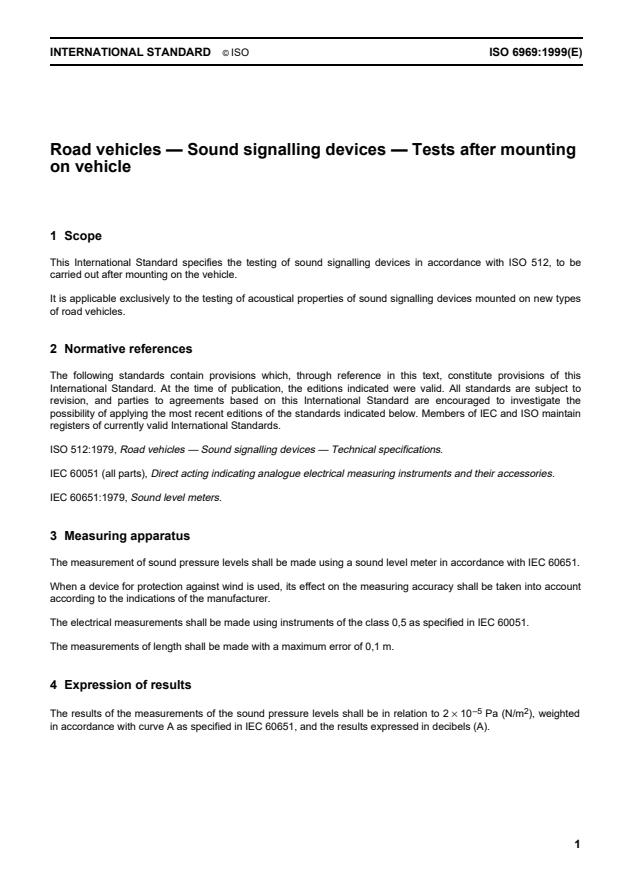
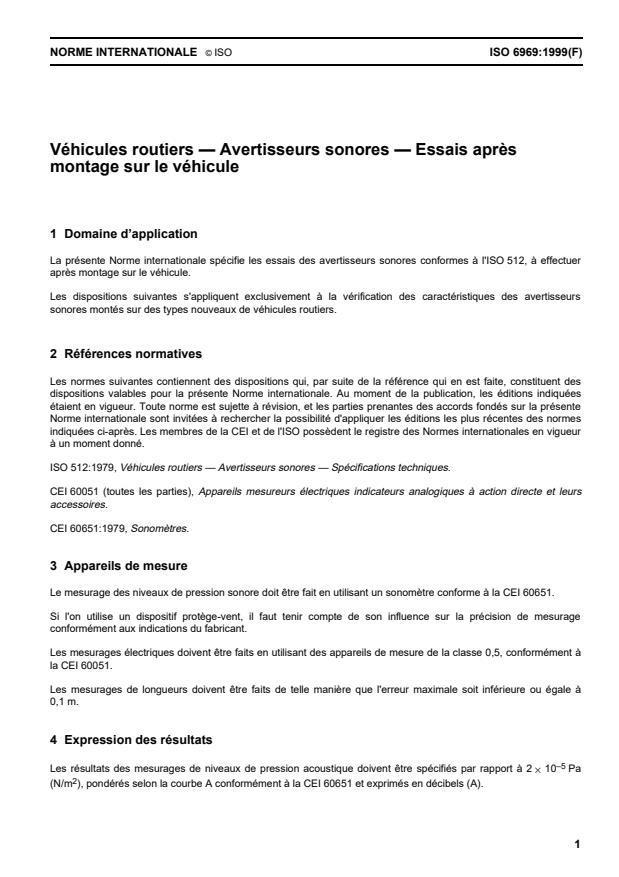
1 Scope
This International Standard specifies the testing of sound signalling devices in accordance with ISO 512, to be
carried out after mounting on the vehicle.
It is applicable exclusively to the testing of acoustical properties of sound signalling devices mounted on new types
of road vehicles.
2 Normative references
The following standards contain provisions which, through reference in this text, constitute provisions of this
International Standard. At the time of publication, the editions indicated were valid. All standards are subject to
revision, and parties to agreements based on this International Standard are encouraged to investigate the
possibility of applying the most recent editions of the standards indicated below. Members of IEC and ISO maintain
registers of currently valid International Standards.
ISO 512:1979, Road vehicles — Sound signalling devices — Technical specifications.
IEC 60051 (all parts), Direct acting indicating analogue electrical measuring instruments and their accessories.
IEC 60651:1979, Sound level meters.
3 Measuring apparatus
The measurement of sound pressure levels shall be made using a sound level meter in accordance with IEC 60651.
When a device for protection against wind is used, its effect on the measuring accuracy shall be taken into account
according to the indications of the manufacturer.
The electrical measurements shall be made using instruments of the class 0,5 as specified in IEC 60051.
The measurements of length shall be made with a maximum error of 0,1 m.
4 Expression of results
–5 2
The results of the measurements of the sound pressure levels shall be in relation to 2 · 10 Pa (N/m ), weighted
in accordance with curve A as specified in IEC 60651, and the results expressed in decibels (A).
© ISO
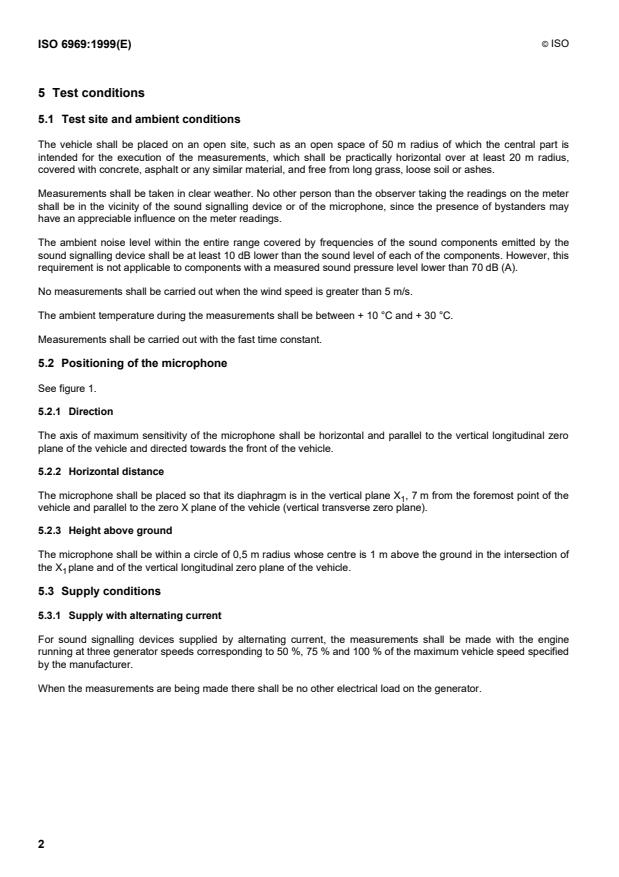
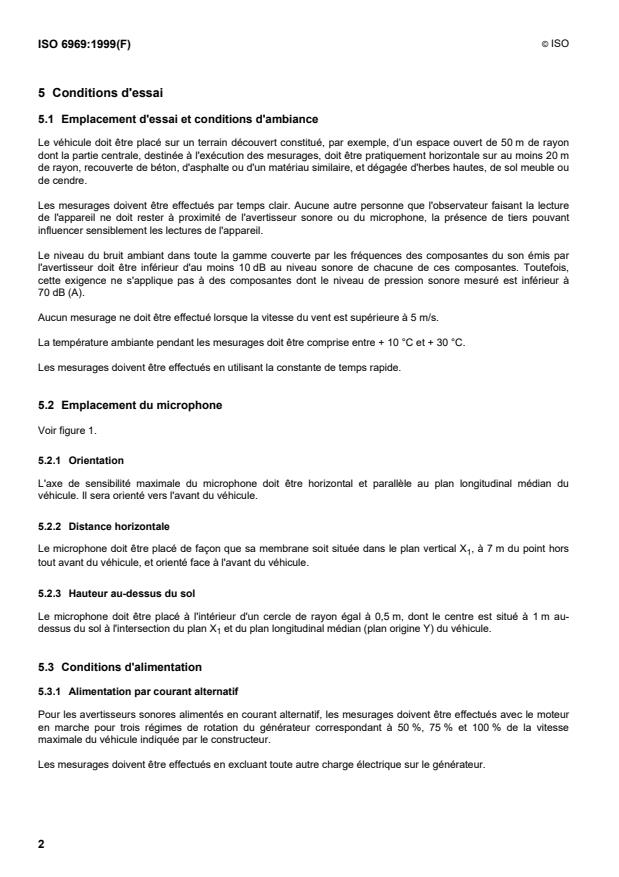
5 Test conditions
5.1 Test site and ambient conditions
The vehicle shall be placed on an open site, such as an open space of 50 m radius of which the central part is
intended for the execution of the measurements, which shall be practically horizontal over at least 20 m radius,
covered with concrete, asphalt or any similar material, and free from long grass, loose soil or ashes.
Measurements shall be taken in clear weather. No other person than the observer taking the readings on the meter
shall be in the vicinity of the sound signalling device or of the microphone, since the presence of bystanders may
have an appreciable influence on the meter readings.
The ambient noise level within the entire range covered by frequencies of the sound components emitted by the
sound signalling device shall be at least 10 dB lower than the sound level of each of the components. However, this
requirement is not applicable to components with a measured sound pressure level lower than 70 dB (A).
No measurements shall be carried out when the wind speed is greater than 5 m/s.
The ambient temperature during the measurements shall be between + 10 °C and + 30 °C.
Measurements shall be carried out with the fast time constant
...
NORME ISO
INTERNATIONALE 6969
Deuxième édition
1999-03-01
Véhicules routiers — Avertisseurs
sonores — Essais après montage sur
le véhicule
Road vehicles — Sound signalling devices — Tests after mounting
on vehicle
A
Numéro de référence
Avant-propos
L'ISO (Organisation internationale de normalisation) est une fédération mondiale d'organismes nationaux de
normalisation (comités membres de l'ISO). L'élaboration des Normes internationales est en général confiée aux
comités techniques de l'ISO. Chaque comité membre intéressé par une étude a le droit de faire partie du comité
technique créé à cet effet. Les organisations internationales, gouvernementales et non gouvernementales, en
liaison avec l'ISO participent également aux travaux. L'ISO collabore étroitement avec la Commission
électrotechnique internationale (CEI) en ce qui concerne la normalisation électrotechnique.
Les projets de Normes internationales adoptés par les comités techniques sont soumis aux comités membres pour
vote. Leur publication comme Normes internationales requiert l'approbation de 75 % au moins des comités
membres votants.
La Norme internationale ISO 6969 a été élaborée par le comité technique ISO/TC 22, Véhicules routiers, sous-
comité SC 3, Équipement électrique et électronique.
Cette deuxième édition annule et remplace la première édition (ISO 6969:1981), dont elle constitue une révision
technique.
L’annexe A de la présente Norme internationale est donnée uniquement à titre d’information.
© ISO 1999
Droits de reproduction réservés. Sauf prescription différente, aucune partie de cette publication ne peut être reproduite ni utilisée sous quelque
forme que ce soit et par aucun procédé, électronique ou mécanique, y compris la photocopie et les microfilms, sans l'accord écrit de l'éditeur.
Organisation internationale de normalisation
Case postale 56 • CH-1211 Genève 20 • Suisse
Internet iso@iso.ch
Imprimé en Suisse
ii
NORME INTERNATIONALE © ISO ISO 6969:1999(F)
Véhicules routiers — Avertisseurs sonores — Essais après
montage sur le véhicule
1 Domaine d’application
La présente Norme internationale spécifie les essais des avertisseurs sonores conformes à l'ISO 512, à effectuer
après montage sur le véhicule.
Les dispositions suivantes s'appliquent exclusivement à la vérification des caractéristiques des avertisseurs
sonores montés sur des types nouveaux de véhicules routiers.
2 Références normatives
Les normes suivantes contiennent des dispositions qui, par suite de la référence qui en est faite, constituent des
dispositions valables pour la présente Norme internationale. Au moment de la publication, les éditions indiquées
étaient en vigueur. Toute norme est sujette à révision, et les parties prenantes des accords fondés sur la présente
Norme internationale sont invitées à rechercher la possibilité d'appliquer les éditions les plus récentes des normes
indiquées ci-après. Les membres de la CEI et de l'ISO possèdent le registre des Normes internationales en vigueur
à un moment donné.
ISO 512:1979, Véhicules routiers — Avertisseurs sonores — Spécifications techniques.
CEI 60051 (toutes les parties), Appareils mesureurs électriques indicateurs analogiques à action directe et leurs
accessoires.
CEI 60651:1979, Sonomètres.
3 Appareils de mesure
Le mesurage des niveaux de pression sonore doit être fait en utilisant un sonomètre conforme à la CEI 60651.
Si l'on utilise un dispositif protège-vent, il faut tenir compte de son influence sur la précision de mesurage
conformément aux indications du fabricant.
Les mesurages électriques doivent être faits en utilisant des appareils de mesure de la classe 0,5, conformément à
la CEI 60051.
Les mesurages de longueurs doivent être faits de telle manière que l'erreur maximale soit inférieure ou égale à
0,1 m.
4 Expression des résultats
–5
Les résultats des mesurages de niveaux de pression acoustique doivent être spécifiés par rapport à 2 · 10 Pa
(N/m ), pondérés selon la courbe A conformément à la CEI 60651 et exprimés en décibels (A).
© ISO
5 Conditions d'essai
5.1 Emplacement d'essai et conditions d'ambiance
Le véhicule doit être placé sur un terrain découvert constitué, par exemple, d’un espace ouvert de 50 m de rayon
dont la partie centrale, destinée à l'exécution des mesurages, doit être pratiquement horizontale sur au moins 20 m
de rayon, recouverte de béton, d'asphalte ou d'un matériau similaire, et dégagée d'herbes hautes, de sol meuble ou
de cendre.
Les mesurages doivent être effectués par temps clair. Aucune autre personne que l'observateur faisant la lecture
de l'appareil ne doit rester à proximité de l'avertisseur sonore ou du microphone, la présence de tiers pouvant
influencer sensiblement les lectures de l'appareil.
Le niveau du bruit ambiant dans toute la gamme couverte par les fréquences des composantes du son émis par
l'avertisseur doit être inférieur d'au moins 10 dB au niveau sonore de chacune de ces composantes. Toutefois,
cette exigence ne s'applique pas à des composantes dont le niveau de pression sonore mesuré est inférieur à
70 dB (A).
Aucun mesurage ne doit être effectué lorsque la vitesse du vent est supérieure à 5 m/s.
La température ambiante pendant les mesurages doit être comprise entre + 10 °C et + 30 °C.
Les mesurages doivent être effectués en utilisa
...
Questions, Comments and Discussion
Ask us and Technical Secretary will try to provide an answer. You can facilitate discussion about the standard in here.
Loading comments...