


ISO 10006:1997
(Main)Quality management — Guidelines to quality in project management
Quality management — Guidelines to quality in project management
Management de la qualité — Lignes directrices pour la qualité en management de projet
Vodenje kakovosti - Smernice kakovosti pri projektnem vodenju
General Information
- Status
- Withdrawn
- Publication Date
- 17-Dec-1997
- Withdrawal Date
- 17-Dec-1997
- Technical Committee
- ISO/TC 176/SC 2 - Quality systems
- Drafting Committee
- ISO/TC 176/SC 2 - Quality systems
- Current Stage
- 9599 - Withdrawal of International Standard
- Start Date
- 20-Jun-2003
- Completion Date
- 14-Feb-2026
Relations
- Effective Date
- 15-Apr-2008
Buy Documents

ISO 10006:1997 - Quality management -- Guidelines to quality in project management
ISO 10006:1997 - Management de la qualité -- Lignes directrices pour la qualité en management de projet
Get Certified
Connect with accredited certification bodies for this standard

BSI Group
BSI (British Standards Institution) is the business standards company that helps organizations make excellence a habit.

Bureau Veritas
Bureau Veritas is a world leader in laboratory testing, inspection and certification services.

DNV
DNV is an independent assurance and risk management provider.
Sponsored listings
Frequently Asked Questions
ISO 10006:1997 is a standard published by the International Organization for Standardization (ISO). Its full title is "Quality management — Guidelines to quality in project management". This standard covers: Quality management — Guidelines to quality in project management
Quality management — Guidelines to quality in project management
ISO 10006:1997 is classified under the following ICS (International Classification for Standards) categories: 03.120.10 - Quality management and quality assurance. The ICS classification helps identify the subject area and facilitates finding related standards.
ISO 10006:1997 has the following relationships with other standards: It is inter standard links to ISO 10006:2003. Understanding these relationships helps ensure you are using the most current and applicable version of the standard.
ISO 10006:1997 is available in PDF format for immediate download after purchase. The document can be added to your cart and obtained through the secure checkout process. Digital delivery ensures instant access to the complete standard document.
Standards Content (Sample)
SLOVENSKI STANDARD
01-avgust-1998
Vodenje kakovosti - Smernice kakovosti pri projektnem vodenju
Quality management -- Guidelines to quality in project management
Management de la qualité -- Lignes directrices pour la qualité en management de projet
Ta slovenski standard je istoveten z: ISO 10006:1997
ICS:
03.120.10 Vodenje in zagotavljanje Quality management and
kakovosti quality assurance
2003-01.Slovenski inštitut za standardizacijo. Razmnoževanje celote ali delov tega standarda ni dovoljeno.
INTERNATIONAL ISO
STANDARD 10006
First edition
1997-12-15
Quality management — Guidelines to
quality in project management
Management de la qualité — Lignes directrices pour la qualité en
management de projet
A
Reference number
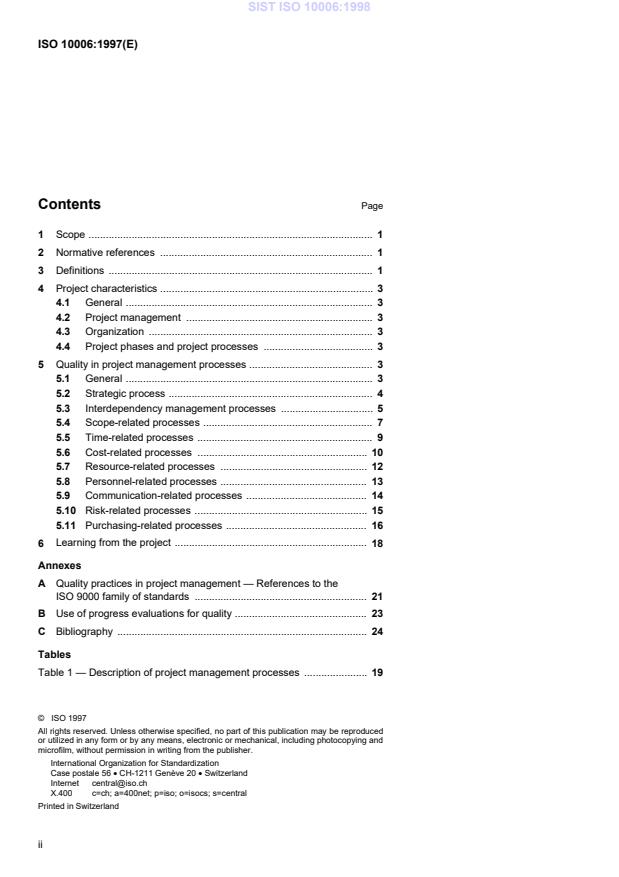
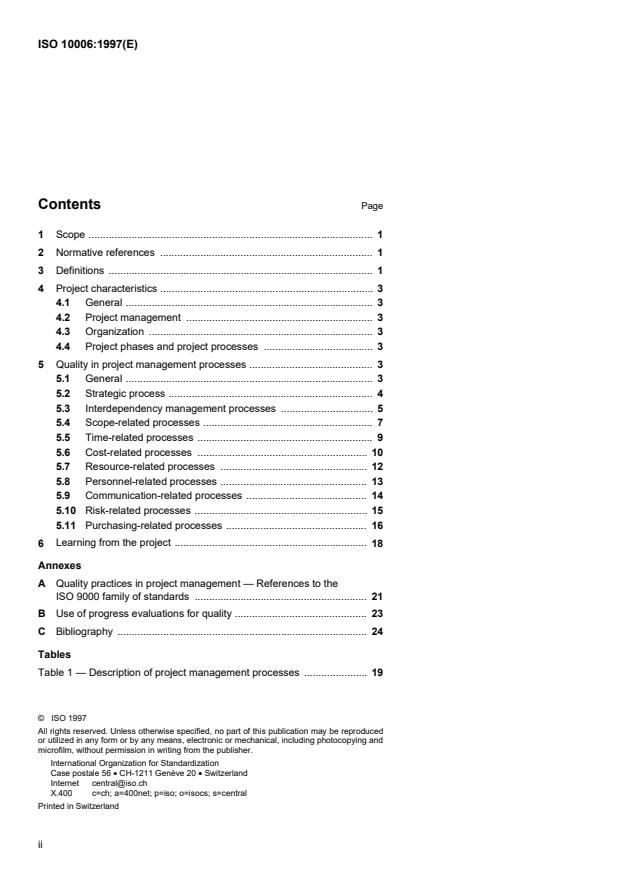
Contents Page
1 Scope . 1
2 Normative references . 1
3 Definitions . 1
4 Project characteristics . 3
4.1 General . 3
Project management .
4.2 3
4.3 Organization . 3
4.4 Project phases and project processes . 3
5 Quality in project management processes . 3
5.1 General . 3
5.2 Strategic process . 4
5.3 Interdependency management processes . 5
5.4 Scope-related processes . 7
5.5 Time-related processes . 9
5.6 Cost-related processes . 10
5.7 Resource-related processes . 12
5.8 Personnel-related processes . 13
5.9 Communication-related processes . 14
5.10 Risk-related processes . 15
5.11 Purchasing-related processes . 16
6 Learning from the project . 18
Annexes
A Quality practices in project management — References to the
ISO 9000 family of standards . 21
B Use of progress evaluations for quality . 23
C Bibliography . 24
Tables
Table 1 — Description of project management processes . 19
© ISO 1997
All rights reserved. Unless otherwise specified, no part of this publication may be reproduced
or utilized in any form or by any means, electronic or mechanical, including photocopying and
microfilm, without permission in writing from the publisher.
International Organization for Standardization
Case postale 56 • CH-1211 Genève 20 • Switzerland
Internet central@iso.ch
X.400 c=ch; a=400net; p=iso; o=isocs; s=central
Printed in Switzerland
ii
©
ISO ISO 10006:1997(E)
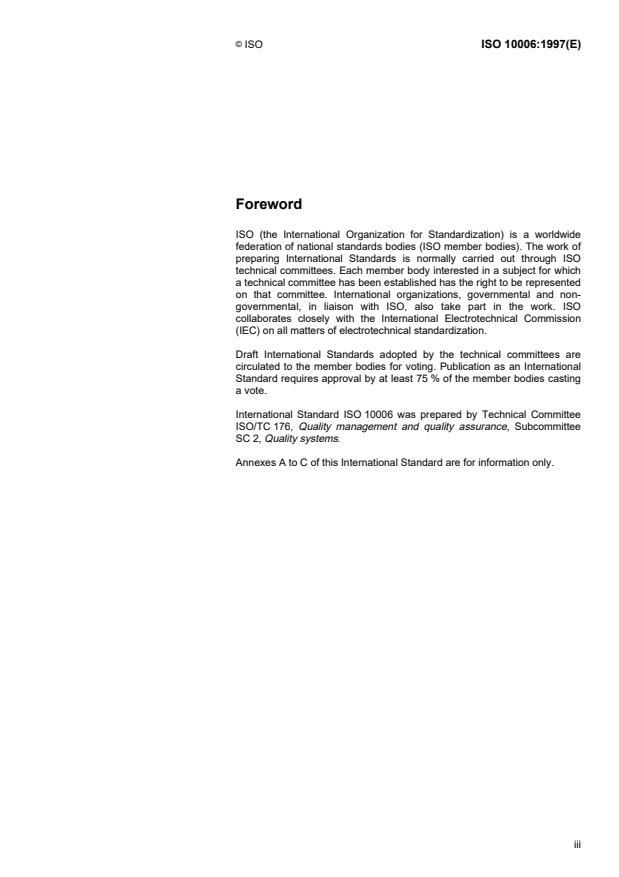
Foreword
ISO (the International Organization for Standardization) is a worldwide
federation of national standards bodies (ISO member bodies). The work of
preparing International Standards is normally carried out through ISO
technical committees. Each member body interested in a subject for which
a technical committee has been established has the right to be represented
on that committee. International organizations, governmental and non-
governmental, in liaison with ISO, also take part in the work. ISO
collaborates closely with the International Electrotechnical Commission
(IEC) on all matters of electrotechnical standardization.
Draft International Standards adopted by the technical committees are
circulated to the member bodies for voting. Publication as an International
Standard requires approval by at least 75 % of the member bodies casting
a vote.
International Standard ISO 10006 was prepared by Technical Committee
ISO/TC 176, Quality management and quality assurance, Subcommittee
SC 2, Quality systems.
Annexes A to C of this International Standard are for information only.
iii
©
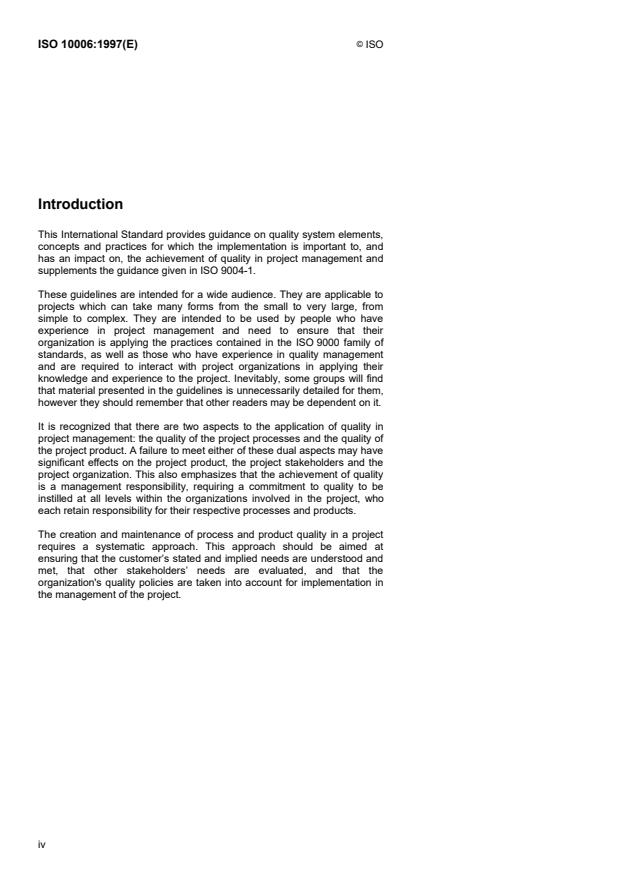
Introduction
This International Standard provides guidance on quality system elements,
concepts and practices for which the implementation is important to, and
has an impact on, the achievement of quality in project management and
supplements the guidance given in ISO 9004-1.
These guidelines are intended for a wide audience. They are applicable to
projects which can take many forms from the small to very large, from
simple to complex. They are intended to be used by people who have
experience in project management and need to ensure that their
organization is applying the practices contained in the ISO 9000 family of
standards, as well as those who have experience in quality management
and are required to interact with project organizations in applying their
knowledge and experience to the project. Inevitably, some groups will find
that material presented in the guidelines is unnecessarily detailed for them,
however they should remember that other readers may be dependent on it.
It is recognized that there are two aspects to the application of quality in
project management: the quality of the project processes and the quality of
the project product. A failure to meet either of these dual aspects may have
significant effects on the project product, the project stakeholders and the
project organization. This also emphasizes that the achievement of quality
is a management responsibility, requiring a commitment to quality to be
instilled at all levels within the organizations involved in the project, who
each retain responsibility for their respective processes and products.
The creation and maintenance of process and product quality in a project
requires a systematic approach. This approach should be aimed at
ensuring that the customer’s stated and implied needs are understood and
met, that other stakeholders’ needs are evaluated, and that the
organization's quality policies are taken into account for implementation in
the management of the project.
iv
©
INTERNATIONAL STANDARD ISO ISO 10006:1997(E)
Quality management — Guidelines to quality in project
management
1 Scope
These guidelines use project management processes to serve as a framework to discuss their
application.
This International Standard is applicable to projects of varying complexity, small or large, of short or long
duration, in different environments, and irrespective of the kind of project product (including hardware,
software, processed material, service or combinations thereof). This may necessitate some tailoring of
the guidance to suit a particular project.
This International Standard is not a guide to project management itself.
2 Normative references
The following standards contain provisions which, through reference in this text, constitute provisions of
this International Standard. At the time of publication, the editions indicated were valid. All standards are
subject to revision, and parties to agreements based on this International Standard are encouraged to
investigate the possibility of applying the most recent editions of the standards indicated below.
Members of IEC and ISO maintain registers of currently valid International Standards.
ISO 8402:1994, Quality management and quality assurance — Vocabulary.
ISO 9004-1:1994, Quality management and quality system elements — Part 1: Guidelines.
NOTE — Annexes A, B and C contain further information and additional references on achieving quality in project
management.
3 Definitions
For the purposes of this International Standard, the definitions given in ISO 8402, together with the
following, apply.
Unique process, consisting of a set of coordinated and controlled activities with start and
3.1 project:
finish dates, undertaken to achieve an objective conforming to specific requirements, including the
constraints of time, cost and resources.
NOTE 1 An individual project may form part of a larger project structure.
NOTE 2 In some projects the objective(s) is(are) refined and the product characteristics defined progressively as
the project proceeds.
©
ISO
NOTE 3 The outcome of a project may be one or several units of product.
NOTE 4 The organization is temporary and established for the lifetime of the project.
NOTE 5 The interactions among project activities may be complex.
3.2 project product: That which is defined in the project product scope and delivered to the customer.
NOTE — The project scope may be updated as the project proceeds.
3.3 project plan: Document setting out what is required to meet the objective(s) of the project.
NOTE 1 A project plan should include or refer to the project’s quality plan.
NOTE 2 The project plan also includes such other plans as organizational structures, resources, schedule and
budget.
: An individual or group of individuals with a common interest in the performance of the
3.4 stakeholder
supplier organization and the environment in which it operates.
[ISO 9000-1:1994,3.5]
NOTE 1 In the context of this definition the supplier organization is the project organization.
NOTE 2 Stakeholders may include:
— customer, recipient of the project product;
— consumer, such as a user of the project product;
— owner, such as the organization originating the project;
— partner, as in joint-venture projects;
— funder, such as a financial institution;
— subcontractor, organization supplying products to the project organization;
— society, such as jurisdictional or regulatory bodies and the public at large;
— internal personnel, such as members of the project organization.
NOTE 3 There may be conflicting interests among stakeholders.
3.5 process: Set of inter-related resources and activities which transform inputs into outputs.
[ISO 8402:1994,1.2]
NOTE 1 Resources may include management, services, personnel, finance, facilities, equipment, techniques and
methods.
NOTE 2 Project processes include project management processes.
3.6 progress evaluation: Assessment of outputs of project activities, carried out at appropriate points
in the project life cycle across project processes, based on defined criteria for project processes and
product.
NOTE — Revision of the project plan may be required as a result of progress evaluation.
©
ISO
4 Project characteristics
4.1 General
This clause deals with those characteristics of projects which are important to the application of this
document.
4.2 Project management
Project management includes the planning, organizing, monitoring and controlling of all aspects of the
project in a continuous process to achieve its objectives. The processes and objectives of quality
management (see ISO 8402) apply to all project management processes.
4.3 Organization
For the purposes of this International Standard, the originating organization is the organization that
decides to undertake the project and assigns the project to a project organization. The project
organization is the organization that carries out the project. The project organization may be a part of the
originating organization which may be constituted as a joint-venture or consortium, etc.
4.4 Project phases and project processes
A project is a process which can be divided into many different interdependent subprocesses.
Implementing the sequence of subprocesses in an orderly and progressive manner may (in some cases
should) require the consistent grouping of subprocesses into phases. To the organization responsible for
the project, "phasing" gives a means of monitoring the realization of objectives (and assessing the
related risks) in order to achieve a progressive commitment. Significant overlapping of phases may
occur in the project life cycle.
To facilitate the discussion of the guidance to quality in project management, a process approach has
been adopted in this International Standard. The project processes have been grouped into two
categories: the project management processes and the project product-related processes (those which
are concerned solely with the project product such as design, production and verification).
Guidance to quality in the project management processes is discussed in this International Standard and
guidance to quality in the project product related processes is covered in ISO 9004-1.
NOTE — In this International Standard, the term process also covers subprocess.
5 Quality in project management processes
5.1 General
Table 1 lists and summarizes the project management processes which are considered to be applicable
for the majority of projects. Not all the processes discussed in this International Standard will necessarily
exist in a particular project, whereas in others additional processes may be necessary.
The project management processes are grouped according to their affinity to one another, for example
all time-related processes are included in one group. Ten groups of project management processes are
presented. The first one is the strategic process which legitimizes and sets the direction for the project.
The second group covers the management of the interdependencies among the other processes. The
other eight groups are processes related to scope, time, cost, resource, personnel, communication, risk
and purchasing.
Each of the project management processes is presented in a separate subclause which includes a
description of the process and guidance to quality in the process.
©
ISO
5.2 Strategic process
The strategic project process is a direction-setting process that organizes and manages the realization
of the other project processes.
In setting the direction for the project, the following concepts, which are important to the achievement of
quality in project management, should be considered:
— satisfaction of the customer's and other stakeholders' stated and implied needs is paramount;
— a project is carried out as a set of planned and interdependent processes;
— a focus on the quality of both processes and products is necessary to meet the project objectives;
— management is responsible for creating an environment for quality;
— management is responsible for continual improvement.
This subclause gives guidance on considering these concepts in the strategic process. Guidance on
considering these concepts in the other processes is given in 5.3 to 5.11.
The achievement of quality in the strategic process is dependent on ensuring that these concepts are
considered in all processes.
5.2.1 Satisfaction of the customer's and other stakeholders' stated and implied needs is paramount.
Customer and other stakeholder needs should be clearly understood to ensure that all processes focus
on and are capable of meeting these needs.
Interfaces should be established with all the stakeholders and feedback obtained as appropriate
throughout the project. Any conflicts between stakeholder needs should be resolved. Normally, when
conflicts arise between the needs of the customer and other stakeholders, customer needs take
precedence. Resolution of conflicts should be agreed to by the customer. Stakeholder agreements
should be formalized. Attention to changing stakeholder needs, including those of new stakeholders,
should continue throughout the project.
The project objectives should be defined to meet the agreed requirements and, if necessary, refined
during the course of the project. They should describe what is to be accomplished, be expressed in
terms of time, cost and product characteristics, and, where possible, be measurable.
5.2.2 A project is carried out as a set of planned and interdependent processes.
The project processes, their owners and the owners’ responsibilities and authority should be identified
and documented. Policies should be set for the project processes. The structure of the end product and
its components should be considered to ensure that the appropriate processes are identified. The
process interdependencies should be defined, coordinated and integrated. The processes should be
designed to take into account processes that occur later in the product life cycle, such as those related
to maintenance. A strategy for obtaining external goods and services should be considered, together
with any impacts on the project organization.
Relationships and a clear division of responsibility and authority between the originating organization
and the project organization should be determined and formalized, as well as those with other relevant
stakeholders.
Progress evaluations (see annex B) should be planned in order to assess the project status and, when
required, provide information for revising the project plan.
©
ISO
5.2.3 A focus on the quality of both processes and products is necessary to meet the project
objectives.
To meet the project objectives, emphasis should be placed on the quality of the project management
processes and the quality of the project product.
The ISO 9000 family of standards presents a number of process- and product-related quality practices,
such as documentation, audits and process controls, which help in meeting the project objectives.
Typical practices applicable across project processes are listed in annex A.
5.2.4 Management is responsible for creating an environment for quality.
Management of both the originating organization and the project organization should cooperate in
creating an environment for quality. The ways and means to create such an environment should include
the following:
— providing an organizational structure and support conducive to meeting the project objectives;
— making decisions based on data and factual information;
— providing for progress evaluations and using them for quality (see annex B);
— involving all project personnel in achieving the quality of the project processes and product;
— establishing mutually beneficial relationships with subcontractors and other organizations.
Competent personnel should be allocated and appropriate tools, techniques, methods and practices
applied to carry out, monitor and control the processes, to implement corrective and preventive action
and to improve the processes.
A project manager should be appointed as early as possible. The project manager is the individual with
the defined accountability, authority and responsibility for managing the project. The authority delegated
to the project manager should be commensurate with the assigned responsibility.
NOTE — The title of the project manager may vary from project to project.
5.2.5 Management is responsible for continual improvement.
In an organization originating projects, management is responsible for continually seeking to improve the
quality of its project processes by learning from experience. To learn from experience, project
management itself should be treated as a process rather than as an isolated activity. A system should
be put in place to collect and analyse the information gained during a project for use in a continual
improvement process.
The project organization is responsible for continually seeking to improve the quality of its own project
processes and activities. Provision should be made for self assessments, internal and possibly external
audits, taking account of the time and resources needed.
NOTE — ISO 9004-4 gives guidance on quality improvement.
5.3 Interdependency management processes
Projects consist of processes and an action in one of these usually affects others. The overall
management of the interdependencies among the project processes is the responsibility of the project
manager. The interdependency management processes are the following:
©
ISO
— project initiation and project plan development: evaluating customer and other stakeholder
requirements, preparing a project plan and initiating other processes;
— interaction management: managing interactions during the project;
— change and configuration management: anticipating change and managing it across all processes;
— closure: closing processes and obtaining feedback.
5.3.1 Project initiation and project plan development
A project plan including a quality plan should always be prepared and kept up to date. The degree of
detail included will be a function of the size and complexity of the project.
The project plan should refer to the documented customer and other relevant stakeholder requirements
and the project objectives. The input source for each requirement should also be documented to allow
traceability.
The product characteristics and how they should be measured and assessed should be identified and
included in the project plan.
Contract reviews should be performed if the purpose of a project is to fulfil the requirements of a
contract.
During project initiation, projects that are the most similar among those already undertaken by the
originating organization should be identified in order to make the best use of feedback from previous
projects.
The project plan should identify and document the project processes and their intention.
The quality system of the project organization should be established and include provision for facilitating
and promoting continual quality improvement. Since quality is an integral part of good project
management, the quality system of the project should be an integral part of the project management
system. The quality system should be documented in the quality plan.
As far as is practicable, the project organization should adopt and, if necessary, adapt the quality system
and procedures of the originating organization. Reference should be made in the quality plan to
applicable parts of the quality system documents from the originating organization. In cases where
specific requirements for the quality system from other stakeholders exist, it should be ensured that the
resulting quality system meets the project needs.
Project plan development involves integrating the plans resulting from the planning carried out in other
project processes. These plans should be reviewed for consistency and any discrepancies resolved.
The project plan should identify, plan for and schedule reviews (see ‘reviews’ in annex A) and plan for
retention of records. Reviews should include reviews of the quality system and of the project plan and
their adequacy to meet the project objectives.
To provide a baseline for progress measurement and control and to provide for planning of the
remaining work, progress evaluations (see annex B) should be scheduled and included in the project
plan.
Requirements for quality practices (see annex A), such as documentation, verification, recording,
traceability, reviews and audits throughout, the project should be established.
In order to monitor progress, performance indicators should be defined and provision made for their
regular assessments. These assessments should facilitate preventive and corrective actions, and should
confirm that the project objectives remain valid in a changing project environment.
©
ISO
Interfaces should be identified in the project plan. Particular attention should be given to the following
interfaces:
— liaison with the customer and other stakeholders;
— the project organization’s connection and reporting lines with the various functions of the originating
organization;
— liaison between functions within the project organization.
5.3.2 Interaction management
To facilitate the planned relationships between processes, the interactions in the project need to be
managed. This should include establishing procedures for interface management, having interfunctional
project meetings, resolving issues such as conflicting responsibilities or changes to risk exposure,
measuring project performance using such techniques as earned value analysis and carrying out
progress evaluations to assess project status and plan for the remaining work (see annex B).
The progress evaluations should also be used to identify potential interface problems. It should be noted
that the interfaces are usually where risk is greater and need to be specially coordinated.
Project communication is a key factor in project coordination and is discussed in 5.9.
5.3.3 Change management
Change management covers the identification and documentation of the need for and of the impact of
change, and the review and approval of changes to processes and product.
Change management includes managing changes to the project scope and to the project plan. Before a
change is authorized, the intent, extent and impact of the change should be analysed and those that
affect the project objectives agreed with the customer and other relevant stakeholders.
Change management includes coordinating changes across interlinked project processes and resolving
any conflicts.
Procedures for change management should include document control.
NOTE 1 For further guidance on change management, see also ISO 9004-1.
NOTE 2 For guidance on configuration management, see ISO 10007.
5.3.4 Closure
During the project, it should be ensured that all the project processes are closed as planned. This
includes ensuring that records are compiled and retained for a specified time.
Whatever the reason for project closure, a complete review of project performance should be
undertaken. It should take into account all relevant records, including those from progress evaluations
and inputs from stakeholders. Special consideration should be given to feedback from the customer and
other relevant stakeholders, which should be quantified where possible. Based on this review,
appropriate reports should be prepared, highlighting experience that can be used by other projects.
The closure of the project should be formally communicated to relevant stakeholders.
5.4 Scope-related processes
For the purposes of this International Standard, "scope" includes a description of the project product, its
characteristics and how they are to be measured or assessed.
These processes aim to:
©
ISO
— translate the customer and other stakeholder requirements into activities to be carried out to achieve
the objectives of the project and to organize these activities;
— ensure that people work within the scope, during the realization of the activities;
— ensure that the activities carried out in the project meet the requirements described in the scope.
The scope-related processes are the following:
— concept development: defining the broad outlines of what the project product will do;
— scope development and control: documenting the characteristics of the project product in
measurable terms and controlling them;
— activity definition: identifying and documenting activities and steps required to achieve the project
objectives;
— activity control: controlling the actual work carried out in the project.
5.4.1 Concept development
Customer needs for product and processes, both expressed and implied, should be translated into
documented requirements which should be agreed to by the customer.
Other stakeholders should be identified and their needs established, translated into documented
requirements and, where relevant, agreed to by the customer.
5.4.2 Scope development and control
When developing the scope, the characteristics of the project product should be identified and
documented as completely as is possible in measurable terms for use as the basis for design and
development. It should be specified how these characteristics should be measured or how their
compliance with customer and other stakeholder requirements should be assessed. Product
characteristics should be traceable to customer and other stakeholder requirements.
Supporting evidence on alternative approaches and solutions, including the results of analyses
performed, considered and included in the scope development, should also be referenced.
Managing changes to the scope is dealt with within the change management process.
5.4.3 Activity definition
The project should be systematically structured into manageable activities to meet customer needs for
product and processes.
NOTE — Frequently, terms such as "activities", "tasks" and "work packages" are used for the elements of this
structuring, and the result is usually known as a work breakdown structure (WBS). For the purposes of this
International Standard, the term "activity" is used as the generic term for an element of the structure.
When defining activities, project management should involve the personnel who will carry out the
activities, in order to benefit from their experience, and to gain their understanding and acceptance.
Each activity should be defined in such a way that its outputs are measurable.
The list of activities should be checked for completeness. Among the activities defined should be quality
practices, progress evaluations and preparing a project plan.
©
ISO
The interactions between activities and the interfaces between the project and the stakeholders should
be identified and documented.
5.4.4 Activity control
Those activities defined through the activity definition process (see 5.4.3) should be carried out and
controlled in accordance with the project plan. Control of activities includes interaction control to
minimize conflicts or misunderstanding. Particular attention should be given to activities which involve
new technologies.
Activities should be reviewed and evaluated to identify deficiencies and opportunities for improvement.
The timing of reviews should be adapted to the complexity of the project.
The results of reviews should be used for progress evaluations to assess process outputs and to plan
for the remaining work. The revised plan for remaining work should be documented.
5.5 Time-related processes
These processes aim to determine dependencies and the duration of activities and to ensure timely
completion of the project. They are the following:
— activity dependency planning: identifying inter-relationships and the logical interactions and
dependencies among project activities;
— duration estimation: estimating the duration of each activity in connection with the specific conditions
and with the resources required;
— schedule development: inter-relating the project time objectives, activity dependencies and their
durations as the framework for developing general and detailed schedules;
— schedule control: controlling the realization of the project activities, for confirming the schedule or for
taking adequate actions to recover from delays.
5.5.1 Activity dependency planning
The inter-relationships, logical interactions and interdependencies among the project activities should be
identified and reviewed for consistency. Any need for changing the reference data should be identified,
justified and documented.
Whenever possible, standard or proven project network diagrams should be used to take advantage of
previous experience. Their appropriateness to the project should be verified.
5.5.2 Estimation of duration
Estimates for the duration of activities should be established by personnel with responsibility for those
activities. Duration estimates from past experience should be checked for correctness and applicability
to present project conditions. The inputs should be documented and traceable to their origin. When
collecting duration estimates, it is useful for resource planning to obtain associated resource estimates
at the same time.
Particular attention should be paid to allocating sufficient time for the quality practices listed in annex A.
When duration estimation involves significant uncertainty, the risks should be evaluated and mitigated,
and appropriate allowances for remaining risks should be incorporated into the estimates.
When useful or required, the customer and other stakeholders should be involved.
©
ISO
5.5.3 Schedule development
Input data for schedule development should be identified and verified for compliance with specific
project conditions. Special care should be taken to identify activities with long lead times, long duration
activities and the critical path.
Standardized schedule formats, suitable for the different user needs, should be identified.
Inconsistencies found in the integration of duration estimates with activity dependencies should be
resolved before schedules are finalized and issued. The schedules should identify critical and near-
critical activities.
The schedule should identify particular events, sometimes referred to as key events or milestones,
requiring specific inputs or decisions or at which major outputs are planned such as progress
evaluations.
The customer and relevant stakeholders should be kept informed during the development of the
schedule and involved when required. Appropriate schedules should be supplied to them for information
or, if required, for approval.
5.5.4 Schedule control
The timing of schedule reviews and the frequency of data collection should be established in order to
ensure adequate control over project activities and related information. Deviation from the schedule
should be identified, analysed and, if significant, acted upon.
Up-to-date schedules should be used in progress evaluations and meetings. Project management
should carry out regular reviews of the project schedule as defined in the project plan.
Project progress trends should be analysed together with the remaining work to anticipate risks and
opportunities.
Root causes for variances from schedule, both favourable and unfavourable, should be identified. Action
should be taken to ensure that unfavourable variances do not affect project objectives. Causes of both
favourable and unfavourable variances should be used as a basis for continual improvement.
Possible impacts of schedule changes on the budget and resources of the project and on the quality of
the product should be determined. Decisions on actions to be taken should only be made after taking
into account the implications for other project processes and objectives. Changes that affect the project
objectives should be agreed to by the customer and relevant stakeholders before implementation. When
action is required to recover from time delays, the personnel involved, and their role, should be
identified. Revisions of the schedule should be coordinated with other project processes in developing
the plan for the remaining work.
The customer and other relevant stakeholders should be kept informed of any proposed changes to the
schedule and involved in making decisions which affect them.
5.6 Cost-related processes
These processes aim to forecast and manage the project costs and to ensure that the project is
completed within budget constraints and are the following:
— cost estimation: developing cost estimates for the project;
— budgeting: using results from cost estimation to produce the project budget;
©
ISO
— cost control: controlling costs and deviations from the project budget.
NOTE — For further guidance, see ISO 10014.
5.6.1 Cost estimation
All project costs should be clearly identified (activities, goods and services) and cost estimation should
consider relevant sources of information and be linked to the work breakdown structure. Cost estimates
from past experience should be checked to ensure that they are correct for present project conditions.
The costs should be documented and traceable to their origin.
Particular attention should be paid to allocating sufficient costs for the quality practices (see also annex A.)
NOTE — For further guidance on the economic effects of quality management, see ISO 10014.
Cost estimation should take into account the economic environment (e.g. inflation, taxation and
exchange rates).
When cost estimation involves significant uncertainty, the risks should be evaluated and mitigated, and
appropriate allowances for remaining risks should be incorporated in the estimates.
The cost estimates should be in a form which enables budgets to be established and developed in
accordance with approved accounting procedures as well as project management needs.
5.6.2 Budgeting
The budget should be based on the cost estimates and schedules with a defined procedure for its
acceptance.
The budget should be consistent with the project requirements and any assumptions, tolerances and
contingencies should be identified and documented. The budget should include all authorized costs and
be in a form suitable for project cost control.
5.6.3 Cost control
Prior to any expenditure, the procedures to be followed in the cost control system should be established,
documented and communicated to those responsible for authorizing work or expenditure.
The timing of reviews and the frequency of data collection and forecasts should be established in order
to ensure adequate control over project activities and related information. It should be checked that the
remaining work to completion can be carried out within the remaining budget. Any deviation from the
budget should be identified, and, if exceeding a defined limit, analysed and acted upon.
Project cost trends should be analysed, using techniques such as earned value analysis, and the plan
for the remaining work reviewed to anticipate risks and opportunities.
Root causes for variances to budget, both favourable and unfavourable, should be identified. Action
should be taken to ensure that unfavourable variances do not affect project objectives. Causes of both
favourable and unfavourable variances should be used as a basis for continual improvement.
Decisions on actions to be taken should only be made after taking into account the implications for other
project processes and objectives. Changes in the cost of the project should be appropriately authorized
prior to expenditure. Revisions of the budget forecast should be coordinated with other project
processes in developing the plan for remaining work.
©
ISO
The information needed to ensure the timely release of funds should be made available and provided as
input to the resource control process.
Project management should carry out regular reviews of the project costs as defined in the project plan
and take into account any other financial reviews (e.g. external reviews by relevant stakeholders).
5.7 Resource-related processes
These processes aim to plan and control resources. They help to identify any possible problems with
resources. Examples of resources include computer software, equipment, facilities, finance, information
systems, materials, personnel, services and space. These processes are the following:
— resource planning: identifying, estimating, scheduling and allocating relevant resources;
— resource control: comparing actual usage against resource plans and taking action, if needed.
NOTE — This subclause applies to the quantitative aspects of personnel management only when regarded as a
resource. The other aspects are covered in 5.8 because their management differs significantly from that of other
resources.
5.7.1 Resource planning
Resources needed for the project should be identified. Resource plans should state what resources will
be required by the project, and when they will be required according to the time schedule. The plans
should indicate how and from where resources will be obtained and allocated and, if applicable, the
methods of disposition of excess resources. The plans should be suitable for resource control. The
validity of the inputs to resource planning should be verified.
The stability, capability and quality of the organizations supplying resources should be evaluated when
identifying resources needed for the project.
Constraints on resources should be taken into account. Examples of constraints include availability,
safety, environmental and cultural considerations, international agreements, labour agreements,
governmental regulations, funding and the impact of the project on the environment.
Resource plans, including estimates, allocations, and constraints together with assumptions made
should be documented.
5.7.2 Resource control
The timing of reviews and the frequency of data collection and forecasts should be established in order
to ensure adequate control over the resource supply and to ensure that the remaining resources are
sufficient to meet the project objectives.
Deviations from the resource plan should be identified, analysed and acted upon.
Decisions on actions to be taken should only be made after taking into account the implications for other
project processes and objectives. Changes that affect the project objectives should be agreed to by the
customer and relevant stakeholders before implementation. Changes in the resource plan should be
authorized as appropriate. Revisions of the resource forecast should be coordinated with other project
processes in developing the plan for remaining work.
Root causes for shortages or excesses in resources should be identified and used for continual
improvement.
©
ISO
5.8 Personnel-related processes
People determine the quality and success of the project.
The personnel-related processes aim to create an environment in which people can contribute
effectively and efficiently to the project. These processes are the following:
— project organizational structure definition: defining a project organizational structure tailored to suit
the project needs, including identifying roles in the project and defining authority and responsibility;
— staff allocation: selecting and assigning sufficient personnel with appropriate competence to suit the
project needs;
— team development: developing individual and team skills and ability to enhance project performance.
NOTE — The quantitative aspects of personnel management are covered in 5.7.
5.8.1 Definition of project organizational structure
The project organizational structure should normally be established in accordance with the policy of the
originating organization and the conditions particular to the project. Previous project experience should
be used, when available, for the selection of the most appropriate organizational structure.
The project organizational structure should be designed to encourage effective communication and
cooperation between all participants in the project.
The project manager should ensure that the project organizational structure is appropriate to the project
scope, size of the project team, local conditions and the division of authority and responsibility with the
originating organization. This division will depend on the originating organizational structure such as a
matrix or functional structure. Special attention should be given to identifying and establishing the inter-
relationships of the project organization with the following:
— customer and other relevant stake
...
INTERNATIONAL ISO
STANDARD 10006
First edition
1997-12-15
Quality management — Guidelines to
quality in project management
Management de la qualité — Lignes directrices pour la qualité en
management de projet
A
Reference number
Contents Page
1 Scope . 1
2 Normative references . 1
3 Definitions . 1
4 Project characteristics . 3
4.1 General . 3
Project management .
4.2 3
4.3 Organization . 3
4.4 Project phases and project processes . 3
5 Quality in project management processes . 3
5.1 General . 3
5.2 Strategic process . 4
5.3 Interdependency management processes . 5
5.4 Scope-related processes . 7
5.5 Time-related processes . 9
5.6 Cost-related processes . 10
5.7 Resource-related processes . 12
5.8 Personnel-related processes . 13
5.9 Communication-related processes . 14
5.10 Risk-related processes . 15
5.11 Purchasing-related processes . 16
6 Learning from the project . 18
Annexes
A Quality practices in project management — References to the
ISO 9000 family of standards . 21
B Use of progress evaluations for quality . 23
C Bibliography . 24
Tables
Table 1 — Description of project management processes . 19
© ISO 1997
All rights reserved. Unless otherwise specified, no part of this publication may be reproduced
or utilized in any form or by any means, electronic or mechanical, including photocopying and
microfilm, without permission in writing from the publisher.
International Organization for Standardization
Case postale 56 • CH-1211 Genève 20 • Switzerland
Internet central@iso.ch
X.400 c=ch; a=400net; p=iso; o=isocs; s=central
Printed in Switzerland
ii
©
ISO ISO 10006:1997(E)
Foreword
ISO (the International Organization for Standardization) is a worldwide
federation of national standards bodies (ISO member bodies). The work of
preparing International Standards is normally carried out through ISO
technical committees. Each member body interested in a subject for which
a technical committee has been established has the right to be represented
on that committee. International organizations, governmental and non-
governmental, in liaison with ISO, also take part in the work. ISO
collaborates closely with the International Electrotechnical Commission
(IEC) on all matters of electrotechnical standardization.
Draft International Standards adopted by the technical committees are
circulated to the member bodies for voting. Publication as an International
Standard requires approval by at least 75 % of the member bodies casting
a vote.
International Standard ISO 10006 was prepared by Technical Committee
ISO/TC 176, Quality management and quality assurance, Subcommittee
SC 2, Quality systems.
Annexes A to C of this International Standard are for information only.
iii
©
Introduction
This International Standard provides guidance on quality system elements,
concepts and practices for which the implementation is important to, and
has an impact on, the achievement of quality in project management and
supplements the guidance given in ISO 9004-1.
These guidelines are intended for a wide audience. They are applicable to
projects which can take many forms from the small to very large, from
simple to complex. They are intended to be used by people who have
experience in project management and need to ensure that their
organization is applying the practices contained in the ISO 9000 family of
standards, as well as those who have experience in quality management
and are required to interact with project organizations in applying their
knowledge and experience to the project. Inevitably, some groups will find
that material presented in the guidelines is unnecessarily detailed for them,
however they should remember that other readers may be dependent on it.
It is recognized that there are two aspects to the application of quality in
project management: the quality of the project processes and the quality of
the project product. A failure to meet either of these dual aspects may have
significant effects on the project product, the project stakeholders and the
project organization. This also emphasizes that the achievement of quality
is a management responsibility, requiring a commitment to quality to be
instilled at all levels within the organizations involved in the project, who
each retain responsibility for their respective processes and products.
The creation and maintenance of process and product quality in a project
requires a systematic approach. This approach should be aimed at
ensuring that the customer’s stated and implied needs are understood and
met, that other stakeholders’ needs are evaluated, and that the
organization's quality policies are taken into account for implementation in
the management of the project.
iv
©
INTERNATIONAL STANDARD ISO ISO 10006:1997(E)
Quality management — Guidelines to quality in project
management
1 Scope
These guidelines use project management processes to serve as a framework to discuss their
application.
This International Standard is applicable to projects of varying complexity, small or large, of short or long
duration, in different environments, and irrespective of the kind of project product (including hardware,
software, processed material, service or combinations thereof). This may necessitate some tailoring of
the guidance to suit a particular project.
This International Standard is not a guide to project management itself.
2 Normative references
The following standards contain provisions which, through reference in this text, constitute provisions of
this International Standard. At the time of publication, the editions indicated were valid. All standards are
subject to revision, and parties to agreements based on this International Standard are encouraged to
investigate the possibility of applying the most recent editions of the standards indicated below.
Members of IEC and ISO maintain registers of currently valid International Standards.
ISO 8402:1994, Quality management and quality assurance — Vocabulary.
ISO 9004-1:1994, Quality management and quality system elements — Part 1: Guidelines.
NOTE — Annexes A, B and C contain further information and additional references on achieving quality in project
management.
3 Definitions
For the purposes of this International Standard, the definitions given in ISO 8402, together with the
following, apply.
Unique process, consisting of a set of coordinated and controlled activities with start and
3.1 project:
finish dates, undertaken to achieve an objective conforming to specific requirements, including the
constraints of time, cost and resources.
NOTE 1 An individual project may form part of a larger project structure.
NOTE 2 In some projects the objective(s) is(are) refined and the product characteristics defined progressively as
the project proceeds.
©
ISO
NOTE 3 The outcome of a project may be one or several units of product.
NOTE 4 The organization is temporary and established for the lifetime of the project.
NOTE 5 The interactions among project activities may be complex.
3.2 project product: That which is defined in the project product scope and delivered to the customer.
NOTE — The project scope may be updated as the project proceeds.
3.3 project plan: Document setting out what is required to meet the objective(s) of the project.
NOTE 1 A project plan should include or refer to the project’s quality plan.
NOTE 2 The project plan also includes such other plans as organizational structures, resources, schedule and
budget.
: An individual or group of individuals with a common interest in the performance of the
3.4 stakeholder
supplier organization and the environment in which it operates.
[ISO 9000-1:1994,3.5]
NOTE 1 In the context of this definition the supplier organization is the project organization.
NOTE 2 Stakeholders may include:
— customer, recipient of the project product;
— consumer, such as a user of the project product;
— owner, such as the organization originating the project;
— partner, as in joint-venture projects;
— funder, such as a financial institution;
— subcontractor, organization supplying products to the project organization;
— society, such as jurisdictional or regulatory bodies and the public at large;
— internal personnel, such as members of the project organization.
NOTE 3 There may be conflicting interests among stakeholders.
3.5 process: Set of inter-related resources and activities which transform inputs into outputs.
[ISO 8402:1994,1.2]
NOTE 1 Resources may include management, services, personnel, finance, facilities, equipment, techniques and
methods.
NOTE 2 Project processes include project management processes.
3.6 progress evaluation: Assessment of outputs of project activities, carried out at appropriate points
in the project life cycle across project processes, based on defined criteria for project processes and
product.
NOTE — Revision of the project plan may be required as a result of progress evaluation.
©
ISO
4 Project characteristics
4.1 General
This clause deals with those characteristics of projects which are important to the application of this
document.
4.2 Project management
Project management includes the planning, organizing, monitoring and controlling of all aspects of the
project in a continuous process to achieve its objectives. The processes and objectives of quality
management (see ISO 8402) apply to all project management processes.
4.3 Organization
For the purposes of this International Standard, the originating organization is the organization that
decides to undertake the project and assigns the project to a project organization. The project
organization is the organization that carries out the project. The project organization may be a part of the
originating organization which may be constituted as a joint-venture or consortium, etc.
4.4 Project phases and project processes
A project is a process which can be divided into many different interdependent subprocesses.
Implementing the sequence of subprocesses in an orderly and progressive manner may (in some cases
should) require the consistent grouping of subprocesses into phases. To the organization responsible for
the project, "phasing" gives a means of monitoring the realization of objectives (and assessing the
related risks) in order to achieve a progressive commitment. Significant overlapping of phases may
occur in the project life cycle.
To facilitate the discussion of the guidance to quality in project management, a process approach has
been adopted in this International Standard. The project processes have been grouped into two
categories: the project management processes and the project product-related processes (those which
are concerned solely with the project product such as design, production and verification).
Guidance to quality in the project management processes is discussed in this International Standard and
guidance to quality in the project product related processes is covered in ISO 9004-1.
NOTE — In this International Standard, the term process also covers subprocess.
5 Quality in project management processes
5.1 General
Table 1 lists and summarizes the project management processes which are considered to be applicable
for the majority of projects. Not all the processes discussed in this International Standard will necessarily
exist in a particular project, whereas in others additional processes may be necessary.
The project management processes are grouped according to their affinity to one another, for example
all time-related processes are included in one group. Ten groups of project management processes are
presented. The first one is the strategic process which legitimizes and sets the direction for the project.
The second group covers the management of the interdependencies among the other processes. The
other eight groups are processes related to scope, time, cost, resource, personnel, communication, risk
and purchasing.
Each of the project management processes is presented in a separate subclause which includes a
description of the process and guidance to quality in the process.
©
ISO
5.2 Strategic process
The strategic project process is a direction-setting process that organizes and manages the realization
of the other project processes.
In setting the direction for the project, the following concepts, which are important to the achievement of
quality in project management, should be considered:
— satisfaction of the customer's and other stakeholders' stated and implied needs is paramount;
— a project is carried out as a set of planned and interdependent processes;
— a focus on the quality of both processes and products is necessary to meet the project objectives;
— management is responsible for creating an environment for quality;
— management is responsible for continual improvement.
This subclause gives guidance on considering these concepts in the strategic process. Guidance on
considering these concepts in the other processes is given in 5.3 to 5.11.
The achievement of quality in the strategic process is dependent on ensuring that these concepts are
considered in all processes.
5.2.1 Satisfaction of the customer's and other stakeholders' stated and implied needs is paramount.
Customer and other stakeholder needs should be clearly understood to ensure that all processes focus
on and are capable of meeting these needs.
Interfaces should be established with all the stakeholders and feedback obtained as appropriate
throughout the project. Any conflicts between stakeholder needs should be resolved. Normally, when
conflicts arise between the needs of the customer and other stakeholders, customer needs take
precedence. Resolution of conflicts should be agreed to by the customer. Stakeholder agreements
should be formalized. Attention to changing stakeholder needs, including those of new stakeholders,
should continue throughout the project.
The project objectives should be defined to meet the agreed requirements and, if necessary, refined
during the course of the project. They should describe what is to be accomplished, be expressed in
terms of time, cost and product characteristics, and, where possible, be measurable.
5.2.2 A project is carried out as a set of planned and interdependent processes.
The project processes, their owners and the owners’ responsibilities and authority should be identified
and documented. Policies should be set for the project processes. The structure of the end product and
its components should be considered to ensure that the appropriate processes are identified. The
process interdependencies should be defined, coordinated and integrated. The processes should be
designed to take into account processes that occur later in the product life cycle, such as those related
to maintenance. A strategy for obtaining external goods and services should be considered, together
with any impacts on the project organization.
Relationships and a clear division of responsibility and authority between the originating organization
and the project organization should be determined and formalized, as well as those with other relevant
stakeholders.
Progress evaluations (see annex B) should be planned in order to assess the project status and, when
required, provide information for revising the project plan.
©
ISO
5.2.3 A focus on the quality of both processes and products is necessary to meet the project
objectives.
To meet the project objectives, emphasis should be placed on the quality of the project management
processes and the quality of the project product.
The ISO 9000 family of standards presents a number of process- and product-related quality practices,
such as documentation, audits and process controls, which help in meeting the project objectives.
Typical practices applicable across project processes are listed in annex A.
5.2.4 Management is responsible for creating an environment for quality.
Management of both the originating organization and the project organization should cooperate in
creating an environment for quality. The ways and means to create such an environment should include
the following:
— providing an organizational structure and support conducive to meeting the project objectives;
— making decisions based on data and factual information;
— providing for progress evaluations and using them for quality (see annex B);
— involving all project personnel in achieving the quality of the project processes and product;
— establishing mutually beneficial relationships with subcontractors and other organizations.
Competent personnel should be allocated and appropriate tools, techniques, methods and practices
applied to carry out, monitor and control the processes, to implement corrective and preventive action
and to improve the processes.
A project manager should be appointed as early as possible. The project manager is the individual with
the defined accountability, authority and responsibility for managing the project. The authority delegated
to the project manager should be commensurate with the assigned responsibility.
NOTE — The title of the project manager may vary from project to project.
5.2.5 Management is responsible for continual improvement.
In an organization originating projects, management is responsible for continually seeking to improve the
quality of its project processes by learning from experience. To learn from experience, project
management itself should be treated as a process rather than as an isolated activity. A system should
be put in place to collect and analyse the information gained during a project for use in a continual
improvement process.
The project organization is responsible for continually seeking to improve the quality of its own project
processes and activities. Provision should be made for self assessments, internal and possibly external
audits, taking account of the time and resources needed.
NOTE — ISO 9004-4 gives guidance on quality improvement.
5.3 Interdependency management processes
Projects consist of processes and an action in one of these usually affects others. The overall
management of the interdependencies among the project processes is the responsibility of the project
manager. The interdependency management processes are the following:
©
ISO
— project initiation and project plan development: evaluating customer and other stakeholder
requirements, preparing a project plan and initiating other processes;
— interaction management: managing interactions during the project;
— change and configuration management: anticipating change and managing it across all processes;
— closure: closing processes and obtaining feedback.
5.3.1 Project initiation and project plan development
A project plan including a quality plan should always be prepared and kept up to date. The degree of
detail included will be a function of the size and complexity of the project.
The project plan should refer to the documented customer and other relevant stakeholder requirements
and the project objectives. The input source for each requirement should also be documented to allow
traceability.
The product characteristics and how they should be measured and assessed should be identified and
included in the project plan.
Contract reviews should be performed if the purpose of a project is to fulfil the requirements of a
contract.
During project initiation, projects that are the most similar among those already undertaken by the
originating organization should be identified in order to make the best use of feedback from previous
projects.
The project plan should identify and document the project processes and their intention.
The quality system of the project organization should be established and include provision for facilitating
and promoting continual quality improvement. Since quality is an integral part of good project
management, the quality system of the project should be an integral part of the project management
system. The quality system should be documented in the quality plan.
As far as is practicable, the project organization should adopt and, if necessary, adapt the quality system
and procedures of the originating organization. Reference should be made in the quality plan to
applicable parts of the quality system documents from the originating organization. In cases where
specific requirements for the quality system from other stakeholders exist, it should be ensured that the
resulting quality system meets the project needs.
Project plan development involves integrating the plans resulting from the planning carried out in other
project processes. These plans should be reviewed for consistency and any discrepancies resolved.
The project plan should identify, plan for and schedule reviews (see ‘reviews’ in annex A) and plan for
retention of records. Reviews should include reviews of the quality system and of the project plan and
their adequacy to meet the project objectives.
To provide a baseline for progress measurement and control and to provide for planning of the
remaining work, progress evaluations (see annex B) should be scheduled and included in the project
plan.
Requirements for quality practices (see annex A), such as documentation, verification, recording,
traceability, reviews and audits throughout, the project should be established.
In order to monitor progress, performance indicators should be defined and provision made for their
regular assessments. These assessments should facilitate preventive and corrective actions, and should
confirm that the project objectives remain valid in a changing project environment.
©
ISO
Interfaces should be identified in the project plan. Particular attention should be given to the following
interfaces:
— liaison with the customer and other stakeholders;
— the project organization’s connection and reporting lines with the various functions of the originating
organization;
— liaison between functions within the project organization.
5.3.2 Interaction management
To facilitate the planned relationships between processes, the interactions in the project need to be
managed. This should include establishing procedures for interface management, having interfunctional
project meetings, resolving issues such as conflicting responsibilities or changes to risk exposure,
measuring project performance using such techniques as earned value analysis and carrying out
progress evaluations to assess project status and plan for the remaining work (see annex B).
The progress evaluations should also be used to identify potential interface problems. It should be noted
that the interfaces are usually where risk is greater and need to be specially coordinated.
Project communication is a key factor in project coordination and is discussed in 5.9.
5.3.3 Change management
Change management covers the identification and documentation of the need for and of the impact of
change, and the review and approval of changes to processes and product.
Change management includes managing changes to the project scope and to the project plan. Before a
change is authorized, the intent, extent and impact of the change should be analysed and those that
affect the project objectives agreed with the customer and other relevant stakeholders.
Change management includes coordinating changes across interlinked project processes and resolving
any conflicts.
Procedures for change management should include document control.
NOTE 1 For further guidance on change management, see also ISO 9004-1.
NOTE 2 For guidance on configuration management, see ISO 10007.
5.3.4 Closure
During the project, it should be ensured that all the project processes are closed as planned. This
includes ensuring that records are compiled and retained for a specified time.
Whatever the reason for project closure, a complete review of project performance should be
undertaken. It should take into account all relevant records, including those from progress evaluations
and inputs from stakeholders. Special consideration should be given to feedback from the customer and
other relevant stakeholders, which should be quantified where possible. Based on this review,
appropriate reports should be prepared, highlighting experience that can be used by other projects.
The closure of the project should be formally communicated to relevant stakeholders.
5.4 Scope-related processes
For the purposes of this International Standard, "scope" includes a description of the project product, its
characteristics and how they are to be measured or assessed.
These processes aim to:
©
ISO
— translate the customer and other stakeholder requirements into activities to be carried out to achieve
the objectives of the project and to organize these activities;
— ensure that people work within the scope, during the realization of the activities;
— ensure that the activities carried out in the project meet the requirements described in the scope.
The scope-related processes are the following:
— concept development: defining the broad outlines of what the project product will do;
— scope development and control: documenting the characteristics of the project product in
measurable terms and controlling them;
— activity definition: identifying and documenting activities and steps required to achieve the project
objectives;
— activity control: controlling the actual work carried out in the project.
5.4.1 Concept development
Customer needs for product and processes, both expressed and implied, should be translated into
documented requirements which should be agreed to by the customer.
Other stakeholders should be identified and their needs established, translated into documented
requirements and, where relevant, agreed to by the customer.
5.4.2 Scope development and control
When developing the scope, the characteristics of the project product should be identified and
documented as completely as is possible in measurable terms for use as the basis for design and
development. It should be specified how these characteristics should be measured or how their
compliance with customer and other stakeholder requirements should be assessed. Product
characteristics should be traceable to customer and other stakeholder requirements.
Supporting evidence on alternative approaches and solutions, including the results of analyses
performed, considered and included in the scope development, should also be referenced.
Managing changes to the scope is dealt with within the change management process.
5.4.3 Activity definition
The project should be systematically structured into manageable activities to meet customer needs for
product and processes.
NOTE — Frequently, terms such as "activities", "tasks" and "work packages" are used for the elements of this
structuring, and the result is usually known as a work breakdown structure (WBS). For the purposes of this
International Standard, the term "activity" is used as the generic term for an element of the structure.
When defining activities, project management should involve the personnel who will carry out the
activities, in order to benefit from their experience, and to gain their understanding and acceptance.
Each activity should be defined in such a way that its outputs are measurable.
The list of activities should be checked for completeness. Among the activities defined should be quality
practices, progress evaluations and preparing a project plan.
©
ISO
The interactions between activities and the interfaces between the project and the stakeholders should
be identified and documented.
5.4.4 Activity control
Those activities defined through the activity definition process (see 5.4.3) should be carried out and
controlled in accordance with the project plan. Control of activities includes interaction control to
minimize conflicts or misunderstanding. Particular attention should be given to activities which involve
new technologies.
Activities should be reviewed and evaluated to identify deficiencies and opportunities for improvement.
The timing of reviews should be adapted to the complexity of the project.
The results of reviews should be used for progress evaluations to assess process outputs and to plan
for the remaining work. The revised plan for remaining work should be documented.
5.5 Time-related processes
These processes aim to determine dependencies and the duration of activities and to ensure timely
completion of the project. They are the following:
— activity dependency planning: identifying inter-relationships and the logical interactions and
dependencies among project activities;
— duration estimation: estimating the duration of each activity in connection with the specific conditions
and with the resources required;
— schedule development: inter-relating the project time objectives, activity dependencies and their
durations as the framework for developing general and detailed schedules;
— schedule control: controlling the realization of the project activities, for confirming the schedule or for
taking adequate actions to recover from delays.
5.5.1 Activity dependency planning
The inter-relationships, logical interactions and interdependencies among the project activities should be
identified and reviewed for consistency. Any need for changing the reference data should be identified,
justified and documented.
Whenever possible, standard or proven project network diagrams should be used to take advantage of
previous experience. Their appropriateness to the project should be verified.
5.5.2 Estimation of duration
Estimates for the duration of activities should be established by personnel with responsibility for those
activities. Duration estimates from past experience should be checked for correctness and applicability
to present project conditions. The inputs should be documented and traceable to their origin. When
collecting duration estimates, it is useful for resource planning to obtain associated resource estimates
at the same time.
Particular attention should be paid to allocating sufficient time for the quality practices listed in annex A.
When duration estimation involves significant uncertainty, the risks should be evaluated and mitigated,
and appropriate allowances for remaining risks should be incorporated into the estimates.
When useful or required, the customer and other stakeholders should be involved.
©
ISO
5.5.3 Schedule development
Input data for schedule development should be identified and verified for compliance with specific
project conditions. Special care should be taken to identify activities with long lead times, long duration
activities and the critical path.
Standardized schedule formats, suitable for the different user needs, should be identified.
Inconsistencies found in the integration of duration estimates with activity dependencies should be
resolved before schedules are finalized and issued. The schedules should identify critical and near-
critical activities.
The schedule should identify particular events, sometimes referred to as key events or milestones,
requiring specific inputs or decisions or at which major outputs are planned such as progress
evaluations.
The customer and relevant stakeholders should be kept informed during the development of the
schedule and involved when required. Appropriate schedules should be supplied to them for information
or, if required, for approval.
5.5.4 Schedule control
The timing of schedule reviews and the frequency of data collection should be established in order to
ensure adequate control over project activities and related information. Deviation from the schedule
should be identified, analysed and, if significant, acted upon.
Up-to-date schedules should be used in progress evaluations and meetings. Project management
should carry out regular reviews of the project schedule as defined in the project plan.
Project progress trends should be analysed together with the remaining work to anticipate risks and
opportunities.
Root causes for variances from schedule, both favourable and unfavourable, should be identified. Action
should be taken to ensure that unfavourable variances do not affect project objectives. Causes of both
favourable and unfavourable variances should be used as a basis for continual improvement.
Possible impacts of schedule changes on the budget and resources of the project and on the quality of
the product should be determined. Decisions on actions to be taken should only be made after taking
into account the implications for other project processes and objectives. Changes that affect the project
objectives should be agreed to by the customer and relevant stakeholders before implementation. When
action is required to recover from time delays, the personnel involved, and their role, should be
identified. Revisions of the schedule should be coordinated with other project processes in developing
the plan for the remaining work.
The customer and other relevant stakeholders should be kept informed of any proposed changes to the
schedule and involved in making decisions which affect them.
5.6 Cost-related processes
These processes aim to forecast and manage the project costs and to ensure that the project is
completed within budget constraints and are the following:
— cost estimation: developing cost estimates for the project;
— budgeting: using results from cost estimation to produce the project budget;
©
ISO
— cost control: controlling costs and deviations from the project budget.
NOTE — For further guidance, see ISO 10014.
5.6.1 Cost estimation
All project costs should be clearly identified (activities, goods and services) and cost estimation should
consider relevant sources of information and be linked to the work breakdown structure. Cost estimates
from past experience should be checked to ensure that they are correct for present project conditions.
The costs should be documented and traceable to their origin.
Particular attention should be paid to allocating sufficient costs for the quality practices (see also annex A.)
NOTE — For further guidance on the economic effects of quality management, see ISO 10014.
Cost estimation should take into account the economic environment (e.g. inflation, taxation and
exchange rates).
When cost estimation involves significant uncertainty, the risks should be evaluated and mitigated, and
appropriate allowances for remaining risks should be incorporated in the estimates.
The cost estimates should be in a form which enables budgets to be established and developed in
accordance with approved accounting procedures as well as project management needs.
5.6.2 Budgeting
The budget should be based on the cost estimates and schedules with a defined procedure for its
acceptance.
The budget should be consistent with the project requirements and any assumptions, tolerances and
contingencies should be identified and documented. The budget should include all authorized costs and
be in a form suitable for project cost control.
5.6.3 Cost control
Prior to any expenditure, the procedures to be followed in the cost control system should be established,
documented and communicated to those responsible for authorizing work or expenditure.
The timing of reviews and the frequency of data collection and forecasts should be established in order
to ensure adequate control over project activities and related information. It should be checked that the
remaining work to completion can be carried out within the remaining budget. Any deviation from the
budget should be identified, and, if exceeding a defined limit, analysed and acted upon.
Project cost trends should be analysed, using techniques such as earned value analysis, and the plan
for the remaining work reviewed to anticipate risks and opportunities.
Root causes for variances to budget, both favourable and unfavourable, should be identified. Action
should be taken to ensure that unfavourable variances do not affect project objectives. Causes of both
favourable and unfavourable variances should be used as a basis for continual improvement.
Decisions on actions to be taken should only be made after taking into account the implications for other
project processes and objectives. Changes in the cost of the project should be appropriately authorized
prior to expenditure. Revisions of the budget forecast should be coordinated with other project
processes in developing the plan for remaining work.
©
ISO
The information needed to ensure the timely release of funds should be made available and provided as
input to the resource control process.
Project management should carry out regular reviews of the project costs as defined in the project plan
and take into account any other financial reviews (e.g. external reviews by relevant stakeholders).
5.7 Resource-related processes
These processes aim to plan and control resources. They help to identify any possible problems with
resources. Examples of resources include computer software, equipment, facilities, finance, information
systems, materials, personnel, services and space. These processes are the following:
— resource planning: identifying, estimating, scheduling and allocating relevant resources;
— resource control: comparing actual usage against resource plans and taking action, if needed.
NOTE — This subclause applies to the quantitative aspects of personnel management only when regarded as a
resource. The other aspects are covered in 5.8 because their management differs significantly from that of other
resources.
5.7.1 Resource planning
Resources needed for the project should be identified. Resource plans should state what resources will
be required by the project, and when they will be required according to the time schedule. The plans
should indicate how and from where resources will be obtained and allocated and, if applicable, the
methods of disposition of excess resources. The plans should be suitable for resource control. The
validity of the inputs to resource planning should be verified.
The stability, capability and quality of the organizations supplying resources should be evaluated when
identifying resources needed for the project.
Constraints on resources should be taken into account. Examples of constraints include availability,
safety, environmental and cultural considerations, international agreements, labour agreements,
governmental regulations, funding and the impact of the project on the environment.
Resource plans, including estimates, allocations, and constraints together with assumptions made
should be documented.
5.7.2 Resource control
The timing of reviews and the frequency of data collection and forecasts should be established in order
to ensure adequate control over the resource supply and to ensure that the remaining resources are
sufficient to meet the project objectives.
Deviations from the resource plan should be identified, analysed and acted upon.
Decisions on actions to be taken should only be made after taking into account the implications for other
project processes and objectives. Changes that affect the project objectives should be agreed to by the
customer and relevant stakeholders before implementation. Changes in the resource plan should be
authorized as appropriate. Revisions of the resource forecast should be coordinated with other project
processes in developing the plan for remaining work.
Root causes for shortages or excesses in resources should be identified and used for continual
improvement.
©
ISO
5.8 Personnel-related processes
People determine the quality and success of the project.
The personnel-related processes aim to create an environment in which people can contribute
effectively and efficiently to the project. These processes are the following:
— project organizational structure definition: defining a project organizational structure tailored to suit
the project needs, including identifying roles in the project and defining authority and responsibility;
— staff allocation: selecting and assigning sufficient personnel with appropriate competence to suit the
project needs;
— team development: developing individual and team skills and ability to enhance project performance.
NOTE — The quantitative aspects of personnel management are covered in 5.7.
5.8.1 Definition of project organizational structure
The project organizational structure should normally be established in accordance with the policy of the
originating organization and the conditions particular to the project. Previous project experience should
be used, when available, for the selection of the most appropriate organizational structure.
The project organizational structure should be designed to encourage effective communication and
cooperation between all participants in the project.
The project manager should ensure that the project organizational structure is appropriate to the project
scope, size of the project team, local conditions and the division of authority and responsibility with the
originating organization. This division will depend on the originating organizational structure such as a
matrix or functional structure. Special attention should be given to identifying and establishing the inter-
relationships of the project organization with the following:
— customer and other relevant stakeholders;
— relevant functions of the originating organization supporting the project, particularly if some are in
charge of monitoring project functions such as schedules, quality and costs.
Assignments of accountability, authority and responsibility should be defined and job descriptions
prepared.
Special attention should be given to the project function dealing with implementing and monitoring the
quality system and to its interfaces with other project functions.
Reviews of the project organizational structure should be planned and carried out periodically to confirm
its validity and adequacy.
5.8.2 Staff allocation
The necessary competence in terms of education, knowledge and experience should be defined for
personnel working on the project. When difficulties are anticipated in recruiting personnel due to the
competence requirements, sufficient lead time should be allowed for additional recruiting and training.
The selection of personnel should be performed in a timely manner on the basis of the job descriptions
and should take into accou
...
NORME ISO
INTERNATIONALE 10006
Première édition
1997-12-15
Management de la qualité — Lignes
directrices pour la qualité en management
de projet
Quality management — Guidelines to quality in project management
A
Numéro de référence
Page
Sommaire
1 Domaine d'application. 1
2 Références normatives. 1
3 Définitions . 1
4 Caractéristiques des projets .3
4.1 Généralités . 3
4.2 Management de projet . 3
4.3 Organisme. 3
4.4 Phases et processus de projet. 3
5 Qualité dans les processus du management de projet . 3
5.1 Généralités . 3
5.2 Processus stratégique. 4
5.3 Management de la coordination des processus. 6
5.4 Processus relatifs au contenu du projet . 8
5.5 Processus relatifs aux délais. 10
Processus relatifs aux coûts.
5.6 12
5.7 Processus relatifs aux ressources . 13
Processus relatifs au personnel .
5.8 14
5.9 Processus relatifs à la communication. 16
5.10 Processus relatifs aux risques. 17
5.11 Processus relatifs aux achats. 18
6 Enseignements à tirer du projet. 20
Annexes
A Pratiques qualité du management de projet. 24
B Application des analyses de l'avancement à la qualité. 26
C Bibliographie . 27
Tableaux
Tableau 1 — Descriptions des processus du management de projet. 22
© ISO 1997
Droits de reproduction réservés. Sauf prescription différente, aucune partie de cette publi-
cation ne peut être reproduite ni utilisée sous quelque forme que ce soit et par aucun pro-
cédé, électronique ou mécanique, y compris la photocopie et les microfilms, sans l'accord
écrit de l'éditeur.
Organisation internationale de normalisation
Case postale 56 • CH-1211 Genève 20 • Suisse
Internet central@iso.ch
X.400 c=ch; a=400net; p=iso; o=isocs; s=central
Imprimé en Suisse
ii
©
ISO ISO 10006:1997(F)
Avant-propos
L'ISO (Organisation internationale de normalisation) est une fédération
mondiale d'organismes nationaux de normalisation (comités membres de
l'ISO). L'élaboration des Normes internationales est normalement confiée
aux comités techniques de l'ISO. Chaque comité membre intéressé par
une étude a le droit de faire partie du comité technique créé à cet effet. Les
organisations internationales, gouvernementales et non gouvernemen-
tales, en liaison avec l'ISO, participent également aux travaux. L'ISO
collabore étroitement avec la Commission électrotechnique internationale
(CEI) en ce qui concerne la normalisation électrotechnique.
Les projets de Normes internationales adoptés par les comités techniques
sont soumis aux comités membres pour vote. Leur publication comme
Normes internationales requiert l'approbation de 75 % au moins des
comités membres votants.
La Norme internationale ISO 10006 a été élaborée par le comité technique
ISO/TC 176, Management et assurance de la qualité, sous-comité SC 2,
Systèmes qualité.
Les annexes A à C de la présente Norme internationale sont données
uniquement à titre d’information.
iii
©
Introduction
La présente Norme internationale donne des lignes directrices pour les
éléments, concepts et pratiques du système qualité pour lesquels la mise
en œuvre est un élément important et a un impact pour l'obtention de la
qualité en management de projet et vient compléter l'ISO 9004-1.
Ces lignes directrices s'adressent à un vaste public. Elles sont applicables
à des projets extrêmement divers, qui vont du plus petit au plus grand et
du plus simple au plus complexe. Elles sont prévues pour être utilisées par
des personnes ayant l'expérience du management de projet et qui ont
besoin de s'assurer que leur organisation applique effectivement les
pratiques contenues dans la famille des normes ISO 9000, ainsi que par
ceux ayant l'expérience du management de la qualité et à qui on demande
de s'impliquer dans des organisations de projet et de mettre leurs connais-
sances et expériences au service du projet en question. Inévitablement,
certains trouveront que les explications données ci-après sont trop
détaillées; il convient cependant de garder à l'esprit que d'autres lecteurs
peuvent les considérer comme indispensables.
Il est admis que l'application de la qualité au management de projet revêt
deux aspects: qualité des processus du projet et qualité du produit du
projet. Il est admis qu'un manquement au respect de l'un ou l'autre de ces
deux aspects est susceptible d'avoir des conséquences considérables sur
le produit du projet, ses parties prenantes et sur l'organisation chargée du
projet. Il est également admis que l'obtention de la qualité est une
responsabilité managériale exigeant un engagement de tous les échelons
impliqués des organisations, lesquels demeurent responsables de leurs
processus et produits respectifs.
Dans un projet, la création et la continuité de la qualité des processus et
des produits exigent que l'on adopte une approche systématique. Il
convient d'orienter cette approche vers la compréhension et la satisfaction
des besoins implicites et explicites des clients, vers l'évaluation des
besoins des autres parties prenantes ainsi que vers la prise en compte des
politiques qualité des organismes afin de les intégrer dans le management
de projet.
iv
©
NORME INTERNATIONALE ISO ISO 10006:1997(F)
Management de la qualité — Lignes directrices pour la qualité en
management de projet
1 Domaine d'application
Ces lignes directrices font appel aux processus du management de projet et servent de cadre de
discussion pour leur mise en application.
La présente Norme internationale s'applique à des projets de complexité variable, qu'ils soient petits ou
grands, de courte ou longue durée, qui se situent dans des environnements distincts et quel que soit le
type de produit du projet, y compris matériels, logiciels, produits issus de processus à caractère continu,
services ou une combinaison de ceux-ci. Il peut s'avérer nécessaire d'adapter ces lignes directrices à un
projet précis.
La présente Norme internationale ne constitue pas un guide pour le management de projet en lui-
même.
2 Références normatives
Les normes suivantes contiennent des dispositions qui, par suite de la référence qui en est faite,
constituent des dispositions valables pour la présente Norme internationale. Au moment de la
publication, les éditions indiquées étaient en vigueur. Toute norme est sujette à revue et les parties
prenantes des accords fondés sur la présente Norme internationale sont invitées à rechercher la
possibilité d'appliquer les éditions les plus récentes des normes indiquées ci-après. Les membres de la
CEI et de l'ISO possèdent le registre des normes internationales en vigueur à un moment donné.
ISO 8402:1994, Management de la qualité et assurance de la qualité - Vocabulaire.
Management de la qualité et éléments du système qualité - Partie 1:
ISO 9004-1:1994,
Lignes directrices.
NOTE – Les annexes A, B et C contiennent d'autres informations et des références complémentaires pour
l'obtention de la qualité en management de projet.
3 Définitions
Pour les besoins de la présente Norme internationale, les définitions contenues dans l'ISO 8402:1994
ainsi que les définitions suivantes s'appliquent.
3.1 projet: Processus unique, qui consiste en un ensemble d'activités coordonnées et maîtrisées
comportant des dates de début et de fin, entrepris dans le but d'atteindre un objectif conforme à des
exigences spécifiques telles que les contraintes de délais, de coûts et de ressources.
NOTE 1 Il est possible qu'un projet individuel fasse partie d'une structure de projet plus large.
NOTE 2 Dans certains projets, le ou les objectifs sont affinés et les caractéristiques du produit sont déterminées
progressivement, à mesure que le projet progresse.
©
NOTE 3 Un projet peut aboutir à une ou plusieurs unités de produit.
NOTE 4 L'organisation est temporaire et n'est mise en place que pour la durée de vie du projet.
NOTE 5 Les interactions entre activités du projet peuvent être complexes.
3.2 produit du projet: Produit défini dans le cadre du projet et livré au client.
NOTE – Le cadre du projet peut être mis à jour au cours du projet.
3.3 plan de projet: Document qui spécifie les exigences permettant d'atteindre l' (les) objectif(s) du
projet.
1)
NOTE 1 Il convient que le plan de projet comprenne le plan qualité du projet ou s'y réfère.
NOTE 2 Le plan de projet comprend également d'autres plans, tels que ceux concernant les structures
organisationnelles, les ressources, le planning et le budget.
3.4 parties prenantes: Personne ou groupe de personnes ayant un intérêt commun dans les
résultats de l'organisme fournisseur et dans l'environnement dans lequel il agit. [ISO 9000-1:1994]
NOTE 1 Dans le contexte de cette définition, l'organisme fournisseur est l'organisme en charge du projet.
NOTE 2 Les parties prenantes peuvent être:
— un client, bénéficiaire du produit du projet;
— un consommateur, par exemple l'utilisateur du produit du projet;
— un propriétaire, par exemple l'initiateur du projet, encore appelé organisme à l'origine du projet;
— un partenaire, lors de projets en participation par exemple;
— un bailleur de fonds, par exemple une institution financière;
— un sous-contractant, organisme qui fournit des produits à l'organisme en charge du projet;
— la société, par exemple une entité juridictionnelle ou à pouvoir réglementaire et le public dans son ensemble;
— le personnel interne, par exemple des membres de l'organisme en charge du projet.
NOTE 3 Des conflits d'intérêts peuvent surgir entre parties prenantes.
3.5 processus: Ensemble de moyens et d'activités liés qui transforment des éléments entrants en
éléments sortants. [ISO 8402:1994, 1.2]
NOTE 1 Les moyens peuvent comprendre le management, les services, le personnel, les finances, les
infrastructures, les équipements, les techniques et les méthodes.
NOTE 2 Les processus du projet comprennent les processus du management de projet.
3.6 analyse de l'avancement: Evaluation des éléments sortants des activités liées au projet, réalisée
à des moments appropriés du cycle de vie du projet, pour tous les processus, et basée sur des critères
définis pour les processus et le produit.
NOTE – Suite à l'analyse de l'avancement, il peut être exigé de procéder à la révision du plan de projet.
______________
1) Le plan de projet est également appelé en français «plan de management de projet», «plan d’exécution de
projet», «plan directeur de projet» ou «manuel de projet».
©
ISO ISO 10006:1997(F)
4 Caractéristiques des projets
4.1 Généralités
Le présent paragraphe traite des caractéristiques des projets qui se révèlent essentielles à la mise en
application de cette norme.
4.2 Management de projet
Le management de projet comprend la planification, l'organisation, le suivi de la progression et la
maîtrise de tous les aspects du projet dans un processus continu, afin d'atteindre ses objectifs. Les
processus et les objectifs du management de la qualité (voir ISO 8402) s'appliquent pour l'ensemble
des processus du management de projet.
4.3 Organisme
Pour les besoins de cette norme, l'organisme à l'origine du projet est celui qui décide d'entreprendre le
projet et qui le confie à un organisme en charge du projet. L'organisme en charge du projet est
l'organisme qui mène à bien ce projet. L'organisme en charge du projet peut faire partie intégrante de
l'organisme à l'origine du projet, laquelle peut être une co-entreprise, un consortium, etc.
4.4 Phases et processus de projet
Un projet est un processus que l'on peut diviser en de nombreux sous-processus distincts et
interdépendants. Il est possible - et parfois recommandé - de regrouper de manière homogène et
ordonnée ces sous-processus en phases. Pour l'organisation responsable du projet, le "phasage" est un
moyen de maîtriser la réalisation des objectifs - et d'évaluer les risques associés - en parvenant à un
engagement progressif. Il se peut que les phases se chevauchent en grande partie au cours du cycle de
vie du projet.
Dans le but de faciliter les discussions sur la qualité en matière de management de projet, une
approche privilégiant les processus a été adoptée dans cette norme ; les processus de projet ont donc
été regroupés en deux catégories : les processus du management de projet et les processus relatifs au
produit du projet (ceux qui sont uniquement concernés par le produit du projet tels que la conception, la
production et la vérification).
La présente norme internationale énumère des lignes directrices pour la qualité des processus du
management de projet alors que l'ISO 9004-1 présente des lignes directrices pour la qualité des
processus relatifs au produit du projet.
NOTE – Dans la présente Norme internationale, le terme processus recouvre également celui de sous-processus.
5 Qualité dans les processus du management de projet
5.1 Généralités
Le tableau 1 liste et résume les processus de management de projet que l'on considère comme
applicables à la majorité des projets. Tous les processus traités dans la présente norme n'existent pas
obligatoirement dans un projet particulier alors que des processus supplémentaires peuvent se révéler
nécessaires dans d'autres.
©
Les processus du management de projet sont regroupés par affinité, par exemple tous les processus
relatifs aux délais appartiennent à un même groupe. Dix groupes de processus de management de
projet sont présentés. Le premier d'entre eux est le processus stratégique qui légitimise et indique les
orientations à prendre pour un projet. Le second groupe couvre le management de la coordination des
processus. Les huit autres groupes sont les processus relatifs au contenu du projet, aux délais, aux
coûts, aux ressources, au personnel, à la communication, aux risques et aux achats.
Chacun des processus de management de projet est présenté dans un article distinct, lequel comprend
une description du processus et des recommandations pour la qualité du processus.
5.2 Processus stratégique
Le processus stratégique est un processus qui précise les orientations, organise et gère la réalisation
des autres processus du projet.
Au moment de définir les orientations du projet, il convient de considérer les concepts suivants,
déterminants pour parvenir à la qualité en management de projet:
— la satisfaction des besoins implicites et explicites du client et de toute autre partie prenante est
primordiale;
— un projet est mené comme un ensemble de processus planifiés et interdépendants;
— il est nécessaire de porter attention à la qualité des processus comme à celle des produits pour
atteindre les objectifs du projet;
— le management est responsable de la création d'un environnement favorable à la qualité;
— le management est responsable de l'amélioration continue.
Le présent paragraphe donne des lignes directrices sur la manière de considérer ces concepts dans le
processus stratégique. Des lignes directrices sur la manière de considérer ces concepts dans les autres
processus sont données dans le reste de l'article 5.
Le processus stratégique sera de qualité si l'on s'est assuré que ces concepts sont pris en compte dans
tous les processus.
5.2.1 La satisfaction des besoins implicites et explicites du client et de toute autre partie prenante est
primordiale.
Il convient de comprendre clairement les besoins du client et de toute autre partie prenante afin de
s'assurer que l'ensemble des processus se concentrent sur ces besoins et sont capables d'y répondre.
Il convient d'établir des interfaces entre toutes les parties prenantes et d'obtenir des retours
d'information, en temps opportun, tout au long du projet. Il est recommandé de résoudre tout conflit
entre parties prenantes. En temps normal, il convient de privilégier les besoins du client lorsque
surgissent des conflits entre ses besoins et ceux des autres parties prenantes. Il convient d'obtenir le
consentement du client lors du règlement des conflits. Il est également recommandé de formaliser les
accords des parties prenantes. Il y a lieu de continuer à porter attention aux besoins des parties
prenantes, tout au long du projet, soit que ces besoins évoluent, soit que de nouvelles parties prenantes
apparaissent.
Il y a lieu de définir les objectifs du projet en vue de satisfaire les exigences spécifiées et, si nécessaire,
de les affiner en cours de projet. Il convient que les objectifs décrivent ce qui doit être réalisé, qu'ils
soient exprimés en termes de délais, coûts, caractéristiques de produits et, lorsque cela est possible,
qu'ils soient mesurables.
©
ISO ISO 10006:1997(F)
5.2.2 Un projet est mené comme un ensemble de sous-processus planifiés et interdépendants.
Il est recommandé d'identifier les processus du projet, ceux qui en sont chargés, leurs responsabilités et
autorité, le tout étant consigné par écrit. Il y a lieu de définir les politiques relatives aux processus de
projet. En général, la structure du produit final et ses composants sont pris en compte pour assurer
l'identification des processus appropriés. Il convient de définir, de coordonner et d'intégrer les
interdépendances des processus. Il y a lieu de concevoir le projet en prenant en compte les processus
intervenant plus tard dans le cycle de vie du produit tels que ceux relatifs à la maintenance. La stratégie
concernant les achats de biens et services à l'extérieur est généralement établie en tenant compte des
impacts possibles sur l'organisme en charge du projet.
Il convient de déterminer et de formaliser les relations, la partage de responsabilité et d'autorité entre
l'organisme à l'origine du projet et l'organisme en charge du projet, ainsi qu'avec les autres parties
prenantes concernées.
Il y a lieu de planifier les analyses de l'avancement (voir annexe B) afin d'évaluer l'état du projet et
d'apporter des informations, s'il y a lieu, pour la révision du plan de projet.
5.2.3 Il est nécessaire de porter attention à la qualité des processus comme à celle des produits pour
atteindre les objectifs du projet.
Pour atteindre les objectifs, il convient de porter une attention particulière à la qualité des processus de
management de projet et à la qualité du produit du projet.
La famille de normes ISO 9000 présente un certain nombre de pratiques qualité relatives aux processus
et produits, tels que la documentation, les audits et maîtrises de processus, qui contribuent à la
réalisation des objectifs du projet. Des pratiques types applicables aux processus de projets dans leur
ensemble sont énumérées en annexe A.
5.2.4 Le management est responsable de la création d'un environnement favorable à la qualité.
Il convient que le management de l'organisme à l'origine du projet et celui de l'organisation de projet
coopèrent dans le but de créer un environnement favorable à la qualité. Il est recommandé que les
moyens permettant de créer un tel environnement comprennent :
— la mise en place d'une structure et d'un soutien organisationnels contribuant à la réalisation des
objectifs;
— la prise de décisions à partir de données et de renseignements factuels;
— la mise en œuvre des analyses de l'avancement et leur utilisation dans un souci de qualité (voir
annexe B);
— l'implication de tout le personnel du projet en vue d'obtenir la qualité des processus et du produit;
— l'établissement de relations réciproques constructives avec les sous-contractants et autres
organisations.
Il convient d'affecter du personnel compétent et d'appliquer des outils, techniques, méthodes et
pratiques appropriés afin d'exécuter, piloter et maîtriser les processus, de déclencher des actions
correctives et préventives, et d'améliorer les processus.
Il convient de nommer un chef de projet dans les meilleurs délais. Le chef de projet est une personne
qui a des responsabilités et une autorité définies pour manager le projet. Il convient que l'autorité
déléguée au chef de projet soit proportionnée à ses responsabilités attribuées.
NOTE – Le titre conféré au chef de projet peut varier d'un projet à l'autre.
©
5.2.5 Le management est responsable de l'amélioration continue.
Dans un organisme initiant des projets, le management est responsable de l'amélioration continue de la
qualité des processus, en se fondant sur l'expérience. Afin de tirer profit de l'expérience, il convient de
traiter le management de projet comme un processus à part entière et non pas comme une activité
isolée. Il y a lieu de mettre en place un système permettant de recueillir et d'analyser les
renseignements obtenus en cours de projet dans le but de les utiliser dans un processus d'amélioration
continue.
L'organisme en charge du projet est chargée d'améliorer en permanence la qualité de ses propres
processus et activités. Il convient de prendre des dispositions pour l'auto-évaluation, les audits internes
et éventuellement externes, en prenant en compte les délais et les ressources nécessaires.
NOTE – L'ISO 9004-4 donne des lignes directrices pour l'amélioration de la qualité.
5.3 Management de la coordination des processus
Un projet se compose de plusieurs processus. Une action entreprise dans l'un de ces processus en
affecte généralement d'autres. La responsabilité du management global de la coordination des
processus du projet incombe au chef de projet. Le management de la coordination des processus
couvre
— le lancement du projet et l'élaboration du plan de projet: évaluer les exigences du client et des autres
parties prenantes; préparer un plan de projet et mettre en route les autres processus;
— le management des interactions: gérer les interactions au cours du projet;
— le management des modifications: anticiper les modifications et les gérer sur la totalité des
processus;
— la clôture: clore les processus et obtenir un retour d'information.
5.3.1 Lancement du projet et élaboration du plan de projet
Il est vivement recommandé de préparer et de mettre à jour en permanence le plan de projet, qui
comprend le plan qualité. Le niveau de détails sera fonction de la taille et de la complexité du projet.
Il convient de faire référence dans le plan de projet aux exigences écrites du client et de toute autre
partie prenante concernée ainsi qu'aux objectifs du projet. Il convient également de consigner par écrit
l'origine de chaque exigence afin de rendre possible sa traçabilité.
Il convient d'identifier et d'inclure dans le plan de projet les caractéristiques du produit et la manière de
les mesurer et les évaluer.
Il est recommandé de procéder à des revues de contrat dans le cas où le but d'un projet est de
répondre aux exigences d'un contrat.
Durant la phase de lancement, il y a lieu d'identifier parmi les projets déjà réalisés par l'organisme à
l'origine du projet, ceux qui se rapprochent le plus du projet à lancer, afin d'exploiter au mieux
l'expérience acquise.
Il convient d'identifier et de formaliser dans le plan de projet, les processus du projet et leurs objectifs.
©
ISO ISO 10006:1997(F)
Il convient d'établir le système qualité du projet et d'y inclure des dispositions visant à faciliter et à
promouvoir l'amélioration continue de la qualité. Puisque la qualité fait partie intégrante d'un projet bien
managé, il est recommandé d'intégrer le système qualité du projet au système de management de
projet. Le système qualité est généralement documenté dans le plan qualité.
Dans la mesure du possible, il convient que l'organisme en charge du projet adopte et, si nécessaire,
adapte le système qualité et les procédures de l'organisme à l'origine du projet. Il est recommandé de
faire référence dans le plan qualité, aux parties applicables de la documentation du système qualité de
l'organisme à l'origine du projet. Dans les cas où d'autres parties prenantes ont des exigences
particulières pour le système qualité, il y a lieu de s'assurer que le système qualité qui en résulte
correspond aux besoins du projet.
L'élaboration du plan de projet implique que l'on intègre les plans résultant de la planification d'autres
processus du projet. ll convient de réviser les plans pour en assurer l'homogénéité et remédier aux
divergences.
Il est recommandé que le plan de projet identifie, prévoit et planifie les revues (voir les "revues" dans
l'annexe A) ainsi que la conservation des enregistrements. Généralement, les revues comprennent
celles du système qualité, du plan de projet et leur adéquation à la réalisation des objectifs du projet.
Dans le but de fournir des indications fondamentales sur la mesure et le suivi des avancements, et de
préparer la planification du travail restant, il convient de programmer et d'inclure les analyses de
l'avancement (voir annexe B) dans le plan de projet.
Il convient d'établir les exigences des pratiques qualité à adopter tout au long du projet (voir annexe A)
telles que la documentation, la vérification, l'enregistrement, la traçabilité, les revues et audits.
Afin d'effectuer le suivi des progressions, il y a lieu de définir des indicateurs de performance et de
prendre des dispositions en vue d'une évaluation régulière. Il convient que les évaluations facilitent les
actions correctives/préventives et confirment la validité des objectifs du projet dans un environnement
changeant.
Il est recommandé d'identifier les interfaces dans le plan de projet. Il convient de porter une attention
particulière aux interfaces suivantes:
— la liaison avec le client et les autres parties prenantes;
— la liaison de l'organisme en charge du projet et les canaux de communication avec les différentes
fonctions de l'organisme à l'origine du projet;
— les interfaces entre fonctions au sein de l'organisme en charge du projet.
5.3.2 Management des interactions
Dans le but de faciliter les relations envisagées entre processus, il convient de gérer les interactions au
sein du projet. Cela inclut généralement la mise en place de procédures visant à établir le management
des interfaces, la tenue de réunions de projet impliquant plusieurs fonctions, l'apport de solutions à des
problèmes tels que les conflits de responsabilités ou les modifications apportées à l'exposition à des
risques, les mesures de performance du projet utilisant des techniques telles que l'analyse de la valeur
acquise du réalisé, et la mise en place d'analyses de l'avancement dans le but de prévoir l'état du projet
et le plan du travail restant (voir annexe B).
Il convient de faire appel aux analyses de l'avancement afin d'identifier les problèmes potentiels
d'interfaces. Il y a lieu de noter que c'est, en règle générale, aux interfaces, que les risques sont les plus
importants et qu'il convient de les coordonner.
La communication dans le cadre du projet est un facteur clé de coordination, comme indiqué en 5.9.
©
5.3.3 Management des modifications
Le management des modifications recouvre l'identification et la consignation par écrit des causes de
modifications, de leur impact, ainsi que la revue et l'approbation des modifications à apporter aux
processus et au produit.
Le management des modifications comprend celles apportées au contenu du projet et au plan de projet.
Avant qu'une modification ne soit autorisée, il convient d'en analyser la finalité, l'étendue et l'impact, en
particulier pour celle qui a une incidence sur les objectifs du projet ayant fait l'objet d'un accord avec le
client et les autres parties prenantes concernées.
Le management des modifications comprend leur coordination au sein de processus de projets liés
entre eux et la résolution de conflits susceptibles de surgir.
Il est recommandé que les procédures de management des modifications comprennent une maîtrise
des documents.
NOTE 1 Pour obtenir des conseils supplémentaires sur le management des modifications, voir également
l'ISO 9004-1.
NOTE 2 Pour obtenir des conseils sur le management de la configuration, voir l'ISO 10007.
5.3.4 Clôture
Au cours du projet, il convient de s'assurer que tous les processus de projet sont clos dans les
conditions prévues. Il faut donc s'assurer que les enregistrements sont compilés et conservés pour un
laps de temps spécifié.
Quelle que soit la raison de la clôture du projet, il convient d'entreprendre une revue complète des
résultats de celui-ci. Il y a alors lieu de prendre en compte l'ensemble des enregistrements pertinents, y
compris ceux qui proviennent des analyses de l'avancement et des parties prenantes. Il est
recommandé de porter une attention particulière au retour d'information du client et des autres parties
prenantes concernées et de le quantifier chaque fois que possible. Des enregistrements appropriés sont
préparés à partir de cette revue, qui font ressortir les expériences susceptibles d'être utilisées par
d'autres projets.
Il convient que la clôture du projet soit portée de manière formelle à la connaissance de toutes les
parties prenantes.
5.4 Processus relatifs au contenu du projet
Pour les besoins de la présente norme, le "contenu du projet" comprend une description du produit du
projet, ses caractéristiques ainsi que la façon dont celles-ci sont mesurées ou évaluées.
Ces processus visent à:
— traduire les exigences du client et de toute autre partie prenante, en activités à accomplir pour
atteindre les objectifs du projet et à organiser ces activités;
— s'assurer que les personnes travaillent dans le contenu du projet, pendant la réalisation des activités;
— s'assurer que les activités mises en œuvre dans le projet satisfont aux exigences décrites dans le
contenu du projet.
©
ISO ISO 10006:1997(F)
Les processus relatifs au contenu du projet sont:
— le développement des concepts: définir les grandes lignes des fonctions du produit du projet;
— l'élaboration du contenu du projet et sa maîtrise: consigner par écrit les caractéristiques du produit
dans des termes mesurables et en assurer la maîtrise;
— la définition des activités: identifier et consigner par écrit les activités et les étapes nécessaires à la
réalisation des objectifs du projet;
— le maîtrise de l'activité: maîtriser les travaux réellement réalisés dans le cadre du projet.
5.4.1 Développement des concepts
Il convient de traduire les besoins implicites ou explicites du client en matière de processus et de produit
en exigences écrites, pour lesquelles il est recommandé de les faire accepter par le client.
Il est recommandé d'identifier les autres parties prenantes et de déterminer leurs besoins, de traduire
ceux-ci en exigences écrites et, lorsque cela est approprié, de les faire accepter par le client.
5.4.2 Elaboration du contenu du projet et sa maîtrise
Au moment d'élaborer le contenu du projet, il convient d'identifier et de consigner par écrit aussi
précisément que possible les caractéristiques du produit dans des termes mesurables destinés à être
utilisés en tant que base de conception et de développement. Il y a également lieu de spécifier les
conditions pour mesurer ces caractéristiques ou la manière d'évaluer la conformité aux exigences du
client et de toute autre partie prenante. Il est recommandé que les caractéristiques du produit soient
traçables par rapport aux exigences du client et de toute autre partie prenante.
Il convient de référencer les justifications venant à l'appui des approches ou solutions alternatives, y
compris les résultats des analyses qui ont été effectuées, considérées et incluses dans l'élaboration du
contenu du projet.
Le management des modifications du contenu du projet est traité dans le cadre du processus de
management des modifications.
5.4.3 Définition des activités
Il convient de structurer systématiquement le projet en activités manageables afin de satisfaire les
besoins du client pour le produit et les processus.
NOTE Fréquemment, des termes tels que activités, tâches et lots de travaux sont employés pour faire référence
aux éléments de cette structuration, le résultat étant généralement connu sous le nom d'organigramme des tâches
(OT). Pour les besoins de la présente Norme internationale, le terme activité est utilisé en tant que terme générique
pour désigner un élément de la structure.
Lors de la définition des activités, il convient que le management de projet implique les membres du
personnel qui réaliseront ces activités, afin de tirer profit de leur expérience et d'obtenir leur accord.
Il y a lieu de définir chaque activité de telle sorte que ses éléments sortants soient mesurables.
Il convient de vérifier que la liste des activités est exhaustive. Parmi les activités définies, il y a lieu de
trouver les pratiques de qualité, les analyses de l'avancement et la préparation d'un plan de projet.
Il est recommandé d'identifier et de consigner par écrit les interactions entre activités et les interfaces
entre le projet et les parties prenantes.
©
5.4.4 Maîtrise des activités
Il convient de mener et de maîtriser ces activités, définies selon le processus de définition des activités
(voir 5.4.3) conformément au plan de projet. La maîtrise des activités comprend la maîtrise des
interactions, afin de minimiser tout conflit ou malentendu. Il est recommandé de porter une attention
particulière aux activités qui font appel à de nouvelles technologies.
Il est recommandé de mener des revues et d'évaluer les activités pour identifier les déficiences et les
possibilités d'amélioration. La planification des revues est généralement adaptée à la complexité du
projet.
Il convient d'utiliser les résultats des revues dans les analyses de l'avancement pour pouvoir évaluer les
éléments sortants des processus et planifier le travail restant. Il y a lieu de consigner par écrit le plan
pour le travail restant après révision.
5.5 Processus relatifs aux délais
Ces processus ont pour objectif de déterminer les liaisons et la durée des activités et d'assurer
l'achèvement du projet dans les délais prévus. Il s'agit de:
— la planification des liaisons entre activités: identifier les interrelations, les interactions logiques ainsi
que les liaisons entre les activités de projet;
— l'estimation des durées: estimer la durée de chaque activité en relation avec les conditions
spécifiques et les ressources nécessaires;
— l'élaboration du planning: mettre en relation les objectifs de délais, les liaisons entre activités et leurs
durées dans le cadre de l'élaboration de plannings généraux et détaillés;
— la maîtrise des délais: maîtriser la réalisation des activités du projet, pour confirmer le planning ou
pour prendre des mesures appropriées permettant de rattraper les retards.
5.5.1 Planification des liaisons entre activités
Il convient d'identifier, parmi les activités de projet, les interrelations, les interactions logiques et les
interdépendances et de passer en revue leur cohérence. Il y a lieu d'identifier, de justifier et de
consigner par écrit tout besoin de modifier les données de référence.
Chaque fois que cela est possible, il est recommandé d'utiliser des diagrammes de réseaux de projet,
types ou attestés, pour tirer profit d'expériences antérieures. Il convient de vérifier l'adéquation de ces
réseaux au projet.
5.5.2 Estimation des durées
Il convient de faire estimer la durée de chaque activité par le personnel responsable de ces activités. Il
est recommandé de vérifier la justesse des estimations de durée à partir d'expériences antérieures et
leur possibilité d'application aux conditions du projet en cours. Il est recommandé que les éléments
entrants soient consignés par écrit et qu'ils soient traçables depuis leur origine. Au moment de collecter
les estimations de durée, il se révèle utile, pour la planification des ressources, d'obtenir simultanément
des estimations de ressources associées.
Il y a lieu de porter une attention particulière à accorder un laps de temps suffisant pour les pratiques
qualité listées en annexe A.
©
ISO ISO 10006:1997(F)
Lorsque les estimations de durée se révèlent particulièrement incertaines, il convient d'en évaluer les
risques, de les réduire puis d'incorporer aux estimations, les marges appropriées pour les risques
restants.
Il convient que le client et les autres parties prenantes soient impliqués lorsque cela se révèle utile ou
nécessaire.
5.5.3 Elaboration du planning
Il y a lieu d'identifier les éléments entrants utiles à l'élaboration du planning et de vérifier s'ils
correspondent aux conditions spécifiques au projet. Il est recommandé de faire particulièrement
attention à l'identification des activités à long délais d'exécution ou de longue durée, et du chemin
critique.
Il est recommandé d'identifier les formats de planning standardisés qui conviennent aux besoins des
divers utilisateurs.
Il convient de remédier aux incohérences détectées dans l'intégration des estimations de durée par
rapport aux liaisons des activités, avant de finaliser et de publier les plannings. Il est recommandé que
ces plannings identifient les activités critiques ou quasi-critiques.
Le planning identifie généralement les événements particuliers, que l'on nomme parfois événements
clés ou étapes jalon, qui nécessitent des éléments entrants ou des décisions spécifiques, ou pour
lesquels on prévoit des éléments sortants majeurs tels que des analyses de l'avancement.
Il y a lieu de tenir informé le client et les parties prenantes concernées lors de l'élaboration du planning
et de les impliquer lorsque cela se révèle nécessaire. En général, des plannings appropriés leur sont
fournis pour information ou, si nécessaire, pour approbation.
5.5.4 Maîtrise des délais
Les échéances des revues du planning et la fréquence de collecte des données sont généralement
fixées afin d'assurer une maîtrise appropriée des activités de projet et des informations qui s'y
rattachent. Il convient d'identifier les écarts par rapport au planning, de les analyser et, si ils sont
conséquents, de les traiter.
Il convient d'utiliser des plannings tenus à jour pour les analyses de l'avancement et lors de réunions. Il
est recommandé que le management de projet procède à des revues régulières du planning du projet,
comme précisé dans le plan de projet.
Il y a lieu d'analyser les tendances d'avancement du projet conjointement au travail restant afin
d'anticiper les risques et opportunités.
Il convient d'identifier les raisons réelles des écarts par rapport au planning, qu'ils soient favorables ou
défavorables. Il y a lieu de prendre des mesures pour faire en sorte que les écarts défavorables
n'affectent pas les objectifs du projet. Il est recommandé de tirer profit des écarts à la fois favorables et
défavorables dans un souci d'amélioration continue.
Il convient de déterminer les impacts possibles des modifications du planning sur le budget et les
ressources du projet ainsi que sur la qualité du produit. Il est recommandé de ne prendre des décisions
concernant des actions à entreprendre qu'après avoir pris en compte les conséquences sur les autres
processus et objectifs du projet. Il y a lieu de demander l'avis du client et des parties prenantes
concernées sur les modifications qui affectent les objectifs du projet avant de les mettre en œuvre.
Lorsque des actions sont nécessaires pour rattraper un retard, il convient que le personnel impliqué
ainsi que son rôle soient identifiés. Les mises à jour du planning sont généralement coordonnées avec
d'autres processus du projet en vue d'élaborer le plan de travail restant.
©
Il convient d'informer le client et les autres parties prenantes concernées de toute proposition de
modification du planning et de les impliquer dans des prises de décisions qui les affectent.
5.6 Processus relatifs aux coûts
Ces processus visent à prévoir et à gérer les coûts du projet et à faire en sorte que le projet soit réalisé
dans les limites du budget alloué. Il s'agit de:
— l'estimation des coûts: procéder à des prévisions de coûts concernant le projet;
— la budgétisation: utiliser les résultats de l'estimation des coûts pour élaborer le budget du projet;
— la coûtenance: maîtriser les coûts et les écarts par rapport au budget.
NOTE – Pour obtenir des conseils supplémentaires, voir l'ISO 10014.
5.6.1 Estimation des coûts
Il convient que tous les coûts soient clairement identifiés (activités, biens et services), que l'estimation
des coûts s'appuie sur des sources pertinentes d'information et qu'elle soit liée à l'Organigramme des
Tâches. Il convient de vérifier les estimations de coûts résultant de l'expérience passée afin de s'assurer
de leur adéquation aux conditions actuelles du projet. Il est recommandé que les coûts soient consignés
par écrit et traçables depuis leur origine.
Il est recommandé de veiller tout particulièrement à prévoir des coûts suffisants pour les pratiques
qualité (voir également l'annexe A).
NOTE – Pour obtenir des conseils supplémentaires sur les effets économiques du management de la qualité, voir
l'ISO 10014.
Il y a lieu que l'estimation des coûts prenne en compte l'environnement économique (par exemple
l'inflation, la fiscalité et les taux de change).
Lorsque les estimations de coûts se révèlent particulièrement incertaines, il convient d'en évaluer les
risques et de réduire ceux-ci. Il est recommandé d'incorporer aux estimations des marges appropriées
pour les risques restants.
Les estimations de coûts sont généralement présentées de manière à permettre l'élaboration de
budgets conformément aux procédures comptables approuvées ainsi qu'aux exigences du management
de projet.
5.6.2 Budgétisation
Il convient que le budget soit basé sur les estimations de coût et les plannings avec une procédure
définie pour son acceptation.
Il est recommandé que le budget soit cohérent par rapport aux exigences du projet et que toute
hypothèse, tolérance ou aléa soient identifiés et consignés par écrit. Généralement, le budget comprend
tous les coûts autorisés et se présente de manière adaptée à la coûtenance du projet.
5.6.3 Coûtenance
Avant de procéder à une dépense, il convient d'établir les procédures que le système de coûtenance
doit suivre, de les consigner par écrit et de les communiquer aux personnes responsables autorisant les
travaux ou les dépenses.
©
ISO ISO 10006:1997(F)
Il y a lieu de planifier les revues, la fréquence de la collecte des données et des prévisions afin de
s'assurer de la bonne maîtrise des activités du projet et des informations qui s'y rattachent. Il est
recommandé de vérifier que le travail restant peut être réalisé dans les limites du budget encore
disponible. Tout écart par rapport au budget est identifié et, dans le cas où il dépasse une limite donnée,
il est analysé et traité.
Il y a lieu d'analyser les tendances des coûts, grâce à des techniques telles que l'analyse de la valeur
acquise du réalisé, et de réviser le plan pour le travail restant, afin d'anticiper les risques et opportunités
qui seraient susceptibles de se présenter.
Il convie
...
Questions, Comments and Discussion
Ask us and Technical Secretary will try to provide an answer. You can facilitate discussion about the standard in here.
Loading comments...