

ISO 19210:2017
(Main)Adhesives — Wood adhesives for non-structural applications — Determination of tensile shear strength of lap joints
General Information
- Abstract
ISO 19210:2017 specifies tests for adhesives for wood and derived timber products for the assessment of their resistance to hot and cold water. It can be used for the assessment of the strength of bonds with a thin bond line. It does not apply to adhesives for structural use or to the manufacture of particleboards, fibreboards and plywood. It does not replace tests on finished products.
- Status
- Published
- Publication Date
- 26-Jul-2017
- Technical Committee
- ISO/TC 61/SC 11 - Products
- Drafting Committee
- ISO/TC 61/SC 11 - Products
- Current Stage
- 9093 - International Standard confirmed
- Start Date
- 29-Jul-2022
- Completion Date
- 29-Aug-2026
Buy Documents
ISO 19210:2017 - Adhesives -- Wood adhesives for non-structural applications -- Determination of tensile shear strength of lap joints
ISO 19210:2017 - Adhesives — Wood adhesives for non-structural applications — Determination of tensile shear strength of lap joints/27/2017
Overview
ISO 19210:2017 - "Adhesives - Wood adhesives for non-structural applications - Determination of tensile shear strength of lap joints" specifies a laboratory method to evaluate the tensile shear strength of thin-bond-line lap joints in wood adhesives used for non-structural applications. The standard focuses on resistance to hot and cold water, classification support for durability classes, and comparative assessment of bond strength for thin adhesive layers. It does not apply to structural adhesives or to manufacturing tests for particleboard, fibreboard or plywood, nor does it replace tests on finished products.
Key topics and technical requirements
- Test principle: Symmetrical single-lap joints of wooden adherends are conditioned and loaded in tensile shear until rupture, with force applied parallel to the grain.
- Test specimens: Typical dimensions provided:
- panel thickness: 5.0 ± 0.1 mm
- test piece width: 20.0 ± 0.2 mm
- total length: 150 ± 5 mm
- overlap length (bonded area): 10.0 ± 0.2 mm
- nominal thin bond line ≈ 0.1 mm
- Conditioning: Standard atmospheres of 20 °C/65% RH or 23 °C/50% RH for at least 7 days; further conditioning sequences specified for durability classification (see ISO 19209 / EN 12765).
- Number of tests: 20 test pieces per conditioning sequence.
- Loading rates:
- Thermoplastic adhesives: approx. 50 mm/min
- Thermosetting adhesives: 6–12 mm/min
- If using constant-rate-of-loading, target rupture times are specified.
- Result expression: Tensile shear strength τ (N/mm²) calculated from maximum force Fmax divided by bonded area (τ = Fmax / (l × b)). Report strength values for 20 specimens, rounded to 0.1 N/mm², plus estimated percentage of wood failure and test conditions.
- Reporting: Detailed reporting requirements include adhesive identity, processing parameters (spread, assembly times, pressure), wood species and moisture content, conditioning, and test rate.
Applications and users
ISO 19210:2017 is used by:
- Adhesive manufacturers for product development, QC and durability classification (supports ISO 19209 and EN 12765 classes).
- Independent test laboratories performing standardized tensile shear tests on lap joints.
- R&D teams optimizing processing parameters (adhesive spread, assembly time, pressure) for thin bond lines.
- Specifiers and procurement teams who need validated comparative data on non-structural wood adhesive performance.
- Certification and compliance bodies assessing claims about water resistance and bond strength.
Related standards
- ISO 19209 - Classification of thermoplastic wood adhesives for non-structural applications
- EN 12765 - Classification of thermosetting wood adhesives for non-structural applications
- ISO 5893 - Test equipment specification (constant rate of traverse)
- EN 923 - Adhesive terms and definitions
Keywords: ISO 19210:2017, wood adhesives, tensile shear strength, lap joints, thin bond line, non-structural adhesives, durability classification, adhesive testing.
Relations
- Effective Date
- 12-Feb-2026
- Effective Date
- 06-Jun-2022
Buy Documents
ISO 19210:2017 - Adhesives -- Wood adhesives for non-structural applications -- Determination of tensile shear strength of lap joints
ISO 19210:2017 - Adhesives — Wood adhesives for non-structural applications — Determination of tensile shear strength of lap joints/27/2017
Get Certified
Connect with accredited certification bodies for this standard

DIN CERTCO
DIN Group product certification.

Smithers Quality Assessments
US management systems and product certification.
Sponsored listings
Frequently Asked Questions
ISO 19210:2017 is a standard published by the International Organization for Standardization (ISO). Its full title is "Adhesives — Wood adhesives for non-structural applications — Determination of tensile shear strength of lap joints". This standard covers: ISO 19210:2017 specifies tests for adhesives for wood and derived timber products for the assessment of their resistance to hot and cold water. It can be used for the assessment of the strength of bonds with a thin bond line. It does not apply to adhesives for structural use or to the manufacture of particleboards, fibreboards and plywood. It does not replace tests on finished products.
ISO 19210:2017 specifies tests for adhesives for wood and derived timber products for the assessment of their resistance to hot and cold water. It can be used for the assessment of the strength of bonds with a thin bond line. It does not apply to adhesives for structural use or to the manufacture of particleboards, fibreboards and plywood. It does not replace tests on finished products.
ISO 19210:2017 is classified under the following ICS (International Classification for Standards) categories: 83.180 - Adhesives. The ICS classification helps identify the subject area and facilitates finding related standards.
ISO 19210:2017 has the following relationships with other standards: It is inter standard links to EN 205:2016, ISO 12402-8:2006. Understanding these relationships helps ensure you are using the most current and applicable version of the standard.
ISO 19210:2017 is available in PDF format for immediate download after purchase. The document can be added to your cart and obtained through the secure checkout process. Digital delivery ensures instant access to the complete standard document.
Standards Content (Sample)
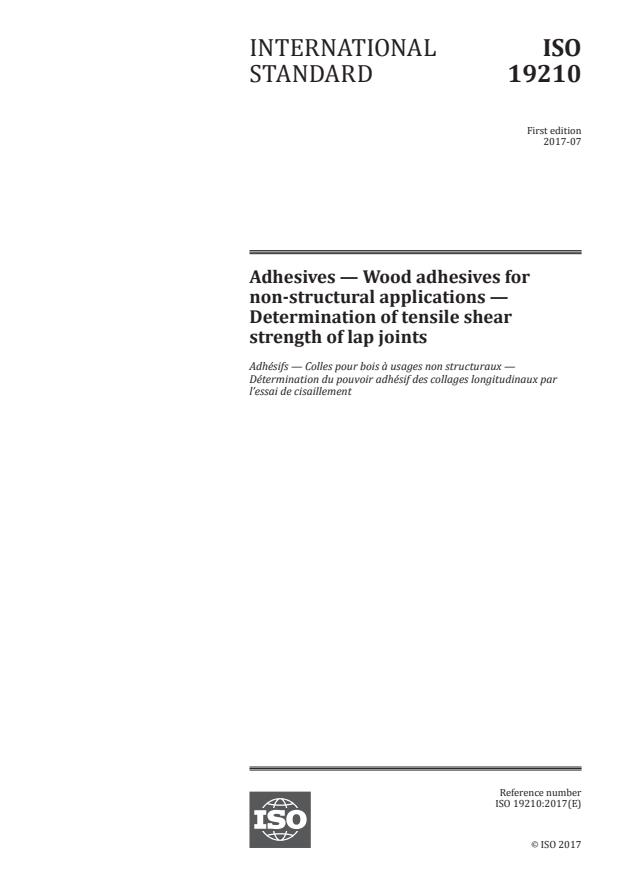
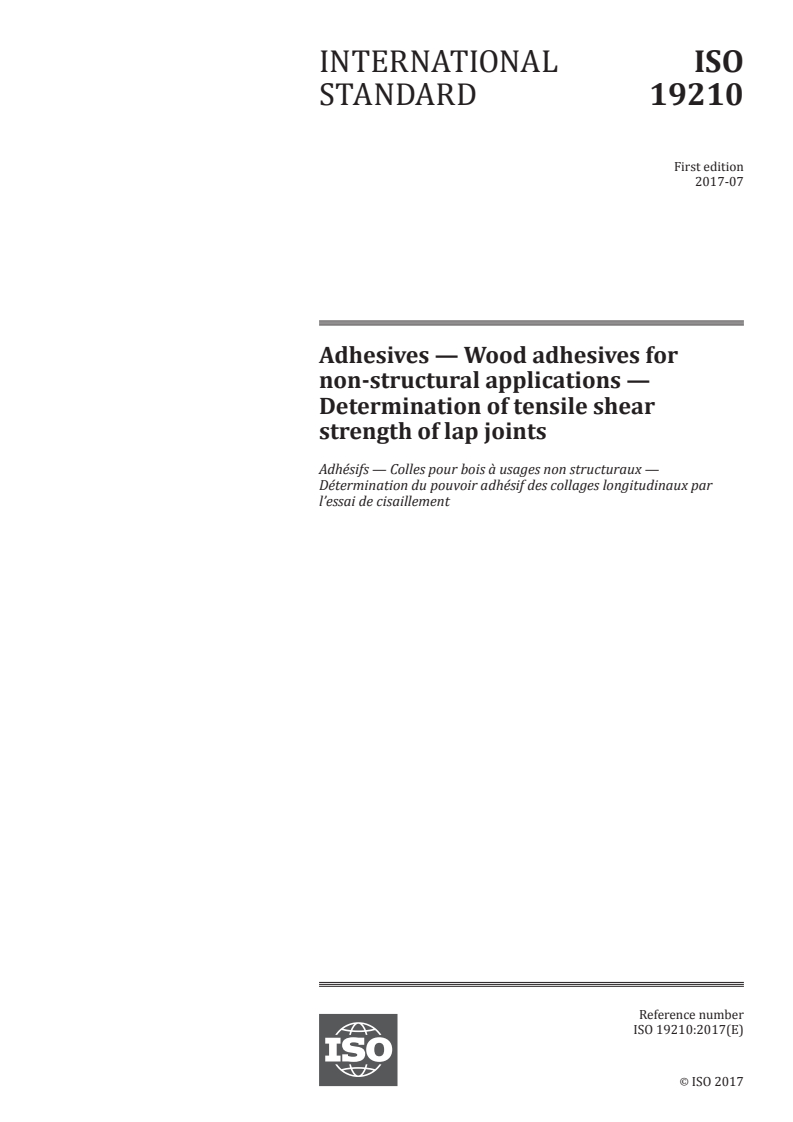
INTERNATIONAL ISO
STANDARD 19210
First edition
2017-07
Adhesives — Wood adhesives for
non-structural applications —
Determination of tensile shear
strength of lap joints
Adhésifs — Colles pour bois à usages non structuraux —
Détermination du pouvoir adhésif des collages longitudinaux par
l’essai de cisaillement
Reference number
©
ISO 2017
© ISO 2017, Published in Switzerland
All rights reserved. Unless otherwise specified, no part of this publication may be reproduced or utilized otherwise in any form
or by any means, electronic or mechanical, including photocopying, or posting on the internet or an intranet, without prior
written permission. Permission can be requested from either ISO at the address below or ISO’s member body in the country of
the requester.
ISO copyright office
Ch. de Blandonnet 8 • CP 401
CH-1214 Vernier, Geneva, Switzerland
Tel. +41 22 749 01 11
Fax +41 22 749 09 47
copyright@iso.org
www.iso.org
ii © ISO 2017 – All rights reserved
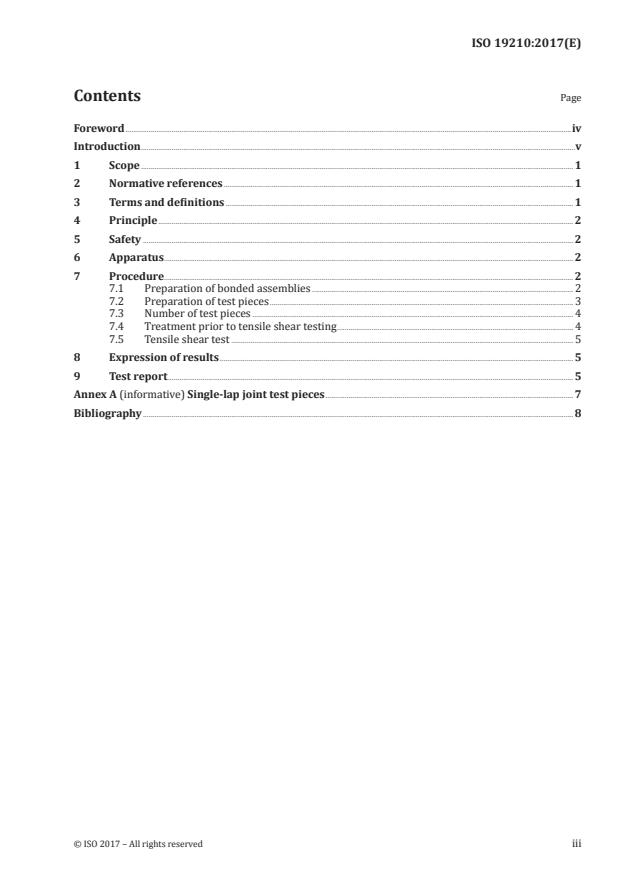
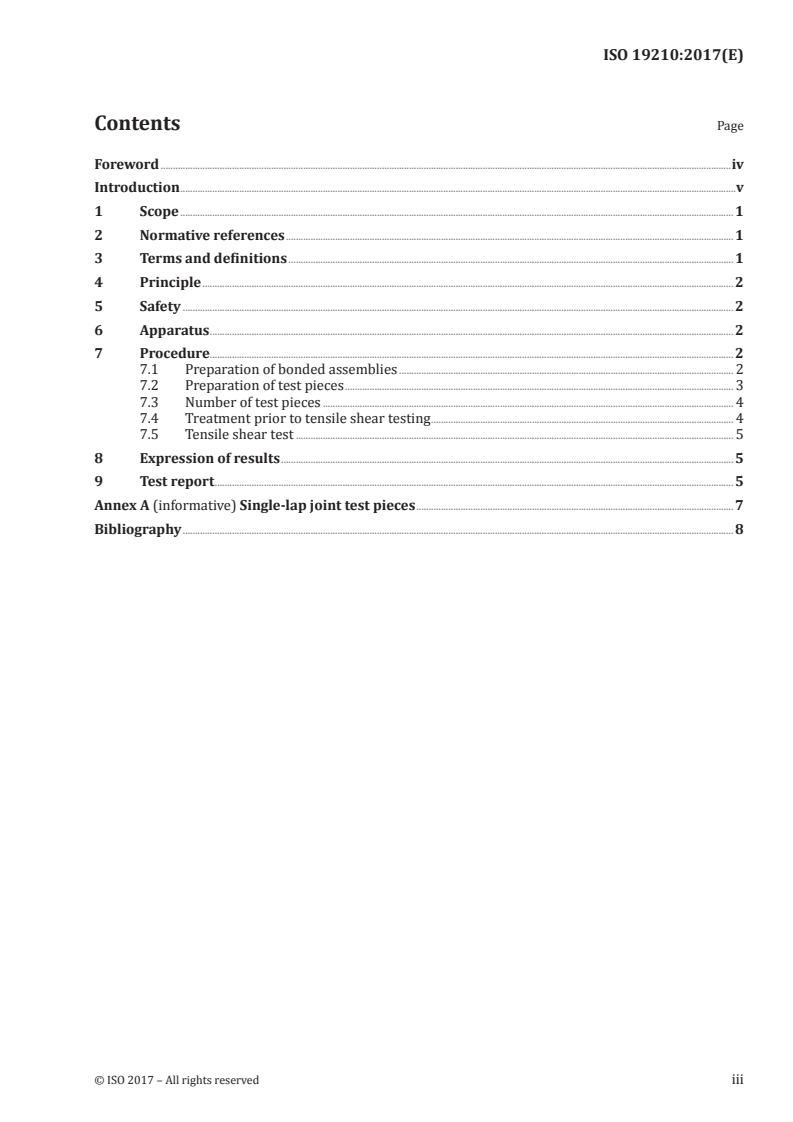
Contents Page
Foreword .iv
Introduction .v
1 Scope . 1
2 Normative references . 1
3 Terms and definitions . 1
4 Principle . 2
5 Safety . 2
6 Apparatus . 2
7 Procedure. 2
7.1 Preparation of bonded assemblies . 2
7.2 Preparation of test pieces . 3
7.3 Number of test pieces . 4
7.4 Treatment prior to tensile shear testing . 4
7.5 Tensile shear test . 5
8 Expression of results . 5
9 Test report . 5
Annex A (informative) Single-lap joint test pieces . 7
Bibliography . 8
Foreword
ISO (the International Organization for Standardization) is a worldwide federation of national standards
bodies (ISO member bodies). The work of preparing International Standards is normally carried out
through ISO technical committees. Each member body interested in a subject for which a technical
committee has been established has the right to be represented on that committee. International
organizations, governmental and non-governmental, in liaison with ISO, also take part in the work.
ISO collaborates closely with the International Electrotechnical Commission (IEC) on all matters of
electrotechnical standardization.
The procedures used to develop this document and those intended for its further maintenance are
described in the ISO/IEC Directives, Part 1. In particular the different approval criteria needed for the
different types of ISO documents should be noted. This document was drafted in accordance with the
editorial rules of the ISO/IEC Directives, Part 2 (see www .iso .org/ directives).
Attention is drawn to the possibility that some of the elements of this document may be the subject of
patent rights. ISO shall not be held responsible for identifying any or all such patent rights. Details of
any patent rights identified during the development of the document will be in the Introduction and/or
on the ISO list of patent declarations received (see www .iso .org/ patents).
Any trade name used in this document is information given for the convenience of users and does not
constitute an endorsement.
For an explanation on the voluntary nature of standards, the meaning of ISO specific terms and
expressions related to conformity assessment, as well as information about ISO’s adherence to the
World Trade Organization (WTO) principles in the Technical Barriers to Trade (TBT) see the following
URL: w w w . i s o .org/ iso/ foreword .html.
ISO 19210 was prepared by CEN/TC 193 as EN 205:2016 and was adopted (without modification) by
Technical Committee ISO/TC 61, Plastics, Subcommittee SC 11, Products.
iv © ISO 2017 – All rights reserved
Introduction
International Standards giving a common classification with respect to durability classes for wood
adhesives allow considerable improvement in consumer protection in any future product liability
system with regard to properties guaranteed by the adhesive manufacturer.
The methods described in this document are suitable for the following and other applications:
— assessing the usability and quality of adhesives for wood and derived timber products;
— classifying these adhesives into the durability classes D1 to D4 of ISO 19210 (thermoplastic
adhesives) and C1 to C4 of EN 12765 (thermosetting adhesives);
— assessing effects on the bond strength resulting from the bonding conditions chosen, the various
conditioning sequences and the treatment of the test pieces before and after bonding.
INTERNATIONAL STANDARD ISO 19210:2017(E)
Adhesives — Wood adhesives for non-structural
applications — Determination of tensile shear strength of
lap joints
SAFETY STATEMENT — Persons using this document should be familiar with the normal
laboratory practice, if applicable. This document does not purport to address all of the safety
problems, if any, associated with its use. It is the responsibility of the user to establish appropriate
safety and health practices and to ensure compliance with any regulatory conditions.
ENVIRONMENTAL STATEMENT — It is understood that some of the material permitted in
this document may have negative environmental impact. As technological advantages lead to
acceptable alternatives for these materials, they will be eliminated from this document to the
extent possible. At the end of the test, it is essential that the user of this document take care to
carry out an appropriate disposal of the wastes according to local regulation.
1 Scope
This document specifies tests for adhesives for wood and derived timber products for the assessment of
their resistance to hot and cold water. It can be used for the assessment of the strength of bonds with a
thin bond line. It does not apply to adhesives for structural use or to the manufacture of particleboards,
fibreboards and plywood. It does not replace tests on finished products.
2 Normative references
The following documents are referred to in the text in such a way that some or all of their content
constitutes requirements of this document. For dated references, only the edition cited applies. For
undated references, the latest edition of the referenced document (including any amendments) applies.
ISO 5893, Rubber and plastics test equipment — Tensile, flexural and compression types (constant rate of
traverse) — Specification
ISO 19209, Adhesives — Classification of thermoplastic wood adhesives for non-structural applications
EN 923, Adhesives — Terms and definitions
EN 12765, Classification of thermosetting wood adhesives for non-structural applications
3 Terms and definitions
For the purposes of this document, the terms and definitions given in EN 923 and the following apply.
ISO and IEC maintain terminological databases for use in standardization at the following addresses:
— IEC Electropedia: available at http:// www .electropedia .org/
— ISO Online browsing platform: available at http:// www .iso .org/ obp
3.1
thin bond line
close contact adhesive joint where the adhesive layer is nominally 0,1 mm thick
I
...
INTERNATIONAL ISO
STANDARD 19210
First edition
2017-07
Adhesives — Wood adhesives for
non-structural applications —
Determination of tensile shear
strength of lap joints
Adhésifs — Colles pour bois à usages non structuraux —
Détermination du pouvoir adhésif des collages longitudinaux par
l’essai de cisaillement
Reference number
©
ISO 2017
© ISO 2017, Published in Switzerland
All rights reserved. Unless otherwise specified, no part of this publication may be reproduced or utilized otherwise in any form
or by any means, electronic or mechanical, including photocopying, or posting on the internet or an intranet, without prior
written permission. Permission can be requested from either ISO at the address below or ISO’s member body in the country of
the requester.
ISO copyright office
Ch. de Blandonnet 8 • CP 401
CH-1214 Vernier, Geneva, Switzerland
Tel. +41 22 749 01 11
Fax +41 22 749 09 47
copyright@iso.org
www.iso.org
ii © ISO 2017 – All rights reserved
Contents Page
Foreword .iv
Introduction .v
1 Scope . 1
2 Normative references . 1
3 Terms and definitions . 1
4 Principle . 2
5 Safety . 2
6 Apparatus . 2
7 Procedure. 2
7.1 Preparation of bonded assemblies . 2
7.2 Preparation of test pieces . 3
7.3 Number of test pieces . 4
7.4 Treatment prior to tensile shear testing . 4
7.5 Tensile shear test . 5
8 Expression of results . 5
9 Test report . 5
Annex A (informative) Single-lap joint test pieces . 7
Bibliography . 8
Foreword
ISO (the International Organization for Standardization) is a worldwide federation of national standards
bodies (ISO member bodies). The work of preparing International Standards is normally carried out
through ISO technical committees. Each member body interested in a subject for which a technical
committee has been established has the right to be represented on that committee. International
organizations, governmental and non-governmental, in liaison with ISO, also take part in the work.
ISO collaborates closely with the International Electrotechnical Commission (IEC) on all matters of
electrotechnical standardization.
The procedures used to develop this document and those intended for its further maintenance are
described in the ISO/IEC Directives, Part 1. In particular the different approval criteria needed for the
different types of ISO documents should be noted. This document was drafted in accordance with the
editorial rules of the ISO/IEC Directives, Part 2 (see www .iso .org/ directives).
Attention is drawn to the possibility that some of the elements of this document may be the subject of
patent rights. ISO shall not be held responsible for identifying any or all such patent rights. Details of
any patent rights identified during the development of the document will be in the Introduction and/or
on the ISO list of patent declarations received (see www .iso .org/ patents).
Any trade name used in this document is information given for the convenience of users and does not
constitute an endorsement.
For an explanation on the voluntary nature of standards, the meaning of ISO specific terms and
expressions related to conformity assessment, as well as information about ISO’s adherence to the
World Trade Organization (WTO) principles in the Technical Barriers to Trade (TBT) see the following
URL: w w w . i s o .org/ iso/ foreword .html.
ISO 19210 was prepared by CEN/TC 193 as EN 205:2016 and was adopted (without modification) by
Technical Committee ISO/TC 61, Plastics, Subcommittee SC 11, Products.
iv © ISO 2017 – All rights reserved
Introduction
International Standards giving a common classification with respect to durability classes for wood
adhesives allow considerable improvement in consumer protection in any future product liability
system with regard to properties guaranteed by the adhesive manufacturer.
The methods described in this document are suitable for the following and other applications:
— assessing the usability and quality of adhesives for wood and derived timber products;
— classifying these adhesives into the durability classes D1 to D4 of ISO 19210 (thermoplastic
adhesives) and C1 to C4 of EN 12765 (thermosetting adhesives);
— assessing effects on the bond strength resulting from the bonding conditions chosen, the various
conditioning sequences and the treatment of the test pieces before and after bonding.
INTERNATIONAL STANDARD ISO 19210:2017(E)
Adhesives — Wood adhesives for non-structural
applications — Determination of tensile shear strength of
lap joints
SAFETY STATEMENT — Persons using this document should be familiar with the normal
laboratory practice, if applicable. This document does not purport to address all of the safety
problems, if any, associated with its use. It is the responsibility of the user to establish appropriate
safety and health practices and to ensure compliance with any regulatory conditions.
ENVIRONMENTAL STATEMENT — It is understood that some of the material permitted in
this document may have negative environmental impact. As technological advantages lead to
acceptable alternatives for these materials, they will be eliminated from this document to the
extent possible. At the end of the test, it is essential that the user of this document take care to
carry out an appropriate disposal of the wastes according to local regulation.
1 Scope
This document specifies tests for adhesives for wood and derived timber products for the assessment of
their resistance to hot and cold water. It can be used for the assessment of the strength of bonds with a
thin bond line. It does not apply to adhesives for structural use or to the manufacture of particleboards,
fibreboards and plywood. It does not replace tests on finished products.
2 Normative references
The following documents are referred to in the text in such a way that some or all of their content
constitutes requirements of this document. For dated references, only the edition cited applies. For
undated references, the latest edition of the referenced document (including any amendments) applies.
ISO 5893, Rubber and plastics test equipment — Tensile, flexural and compression types (constant rate of
traverse) — Specification
ISO 19209, Adhesives — Classification of thermoplastic wood adhesives for non-structural applications
EN 923, Adhesives — Terms and definitions
EN 12765, Classification of thermosetting wood adhesives for non-structural applications
3 Terms and definitions
For the purposes of this document, the terms and definitions given in EN 923 and the following apply.
ISO and IEC maintain terminological databases for use in standardization at the following addresses:
— IEC Electropedia: available at http:// www .electropedia .org/
— ISO Online browsing platform: available at http:// www .iso .org/ obp
3.1
thin bond line
close contact adhesive joint where the adhesive layer is nominally 0,1 mm thick
I
...