


ISO 21037:2026
(Main)Adhesives — Guideline for separating adhesively bonded joints enabling repair and improving recycling
Adhesives — Guideline for separating adhesively bonded joints enabling repair and improving recycling
This document specifies the methods commonly available for separating adhesively bonded joints enabling repair and improving recycling. This document applies to adherends made of metallic and non-metallic inorganic material, plastics including both filler-containing and fibre-reinforced types, wood and wood-based materials, coated materials, adherends of natural and polymeric fibres as well as paper and cardboard.
Titre manque
General Information
- Status
- Published
- Publication Date
- 22-Mar-2026
- Technical Committee
- ISO/TC 61/SC 11 - Products
- Drafting Committee
- ISO/TC 61/SC 11 - Products
- Current Stage
- 6060 - International Standard published
- Start Date
- 23-Mar-2026
- Due Date
- 21-Feb-2027
- Completion Date
- 23-Mar-2026
Overview
ISO 21037:2026, Adhesives - Guideline for separating adhesively bonded joints enabling repair and improving recycling, provides practical methods for separating bonded joints to facilitate product repair and enhance recycling efficiency. The standard applies to a wide range of materials, including metallic and non-metallic inorganics, plastics (with or without fillers/fibres), wood and wood-based materials, coated materials, natural and polymeric fibres, as well as paper and cardboard. This document supports the transition to a circular economy by making repair and recycling of products more accessible, reducing waste, and preserving material value.
Key Topics
Methods for Separating Adhesively Bonded Joints
- Mechanical Methods: Cutting, peeling, stretching of the adhesive carrier, and elongation of adherends. Examples include automotive windshield replacements, resealable packaging closures, removable adhesive tapes, and dental technology.
- Physical Methods: Application of temperature (heating or cooling), electricity, and solvents. Techniques include using heat guns, refrigeration, electric stimulation, or solvent baths to enable debonding without damaging base materials.
- Chemical Methods: Use of expanding or blowing agents and controlled chemical decomposition of adhesive or adherends for easy separation.
Design Considerations
- Balancing product performance during service life with end-of-life disassembly.
- Enhancing reparability and recyclability without compromising joint integrity during use.
Circular Economy and R-Strategies
- Focuses on enabling repair, refurbishment, remanufacture, and recycling (4 of the 9 R-strategies in circular material management).
- Supports waste reduction and regeneration of resources, aligning with sustainability and environmental goals.
Applications
Automotive Repair:
- Facilitates safe and efficient removal of bonded parts such as windshields, panels, and composite components, enabling repairs and extending vehicle lifespan.
Electronics:
- Enables easier servicing and replacement of components in devices like smartphones and tablets by using reversible adhesives combined with heat, electricity, or solvents.
Packaging:
- Improves recycling processes for packaging materials by using adhesives that debond readily, supporting high-throughput cleaning and separation (e.g., labels on returnable bottles, mono-material pouches).
Construction and Manufacturing:
- Allows for repair and recovery of bonded components in building materials, wood products, and fibre composites, aiding refurbishment and upcycling.
Textile and Paper Industries:
- Supports disassembly and processing for recycling or re-use in fibre-based products.
Related Standards
- ISO 472: Plastics - Vocabulary: Provides essential terminology for understanding plastic materials and adhesives as referenced in ISO 21037:2026.
- ISO/TR 2389: Plastics - Recycling and recovery - Necessity of standards: Offers guidance on the importance of standardization in plastics recycling.
- Other Guidance: Related technical papers and standards on adhesive debonding, recycling technologies, and circular economy strategies provide additional context for best practices.
By adopting ISO 21037:2026, organizations can enhance product reparability, improve recycling outcomes, and align with global sustainability objectives. Whether for automotive, electronics, packaging, or industrial applications, this standard enables efficient adhesive debonding, supporting resource conservation and reduced environmental impact throughout the product lifecycle.

Get Certified
Connect with accredited certification bodies for this standard

DIN CERTCO
DIN Group product certification.

Smithers Quality Assessments
US management systems and product certification.
Sponsored listings
Frequently Asked Questions
ISO 21037:2026 is a standard published by the International Organization for Standardization (ISO). Its full title is "Adhesives — Guideline for separating adhesively bonded joints enabling repair and improving recycling". This standard covers: This document specifies the methods commonly available for separating adhesively bonded joints enabling repair and improving recycling. This document applies to adherends made of metallic and non-metallic inorganic material, plastics including both filler-containing and fibre-reinforced types, wood and wood-based materials, coated materials, adherends of natural and polymeric fibres as well as paper and cardboard.
This document specifies the methods commonly available for separating adhesively bonded joints enabling repair and improving recycling. This document applies to adherends made of metallic and non-metallic inorganic material, plastics including both filler-containing and fibre-reinforced types, wood and wood-based materials, coated materials, adherends of natural and polymeric fibres as well as paper and cardboard.
ISO 21037:2026 is classified under the following ICS (International Classification for Standards) categories: 83.180 - Adhesives. The ICS classification helps identify the subject area and facilitates finding related standards.
ISO 21037:2026 is available in PDF format for immediate download after purchase. The document can be added to your cart and obtained through the secure checkout process. Digital delivery ensures instant access to the complete standard document.
Standards Content (Sample)
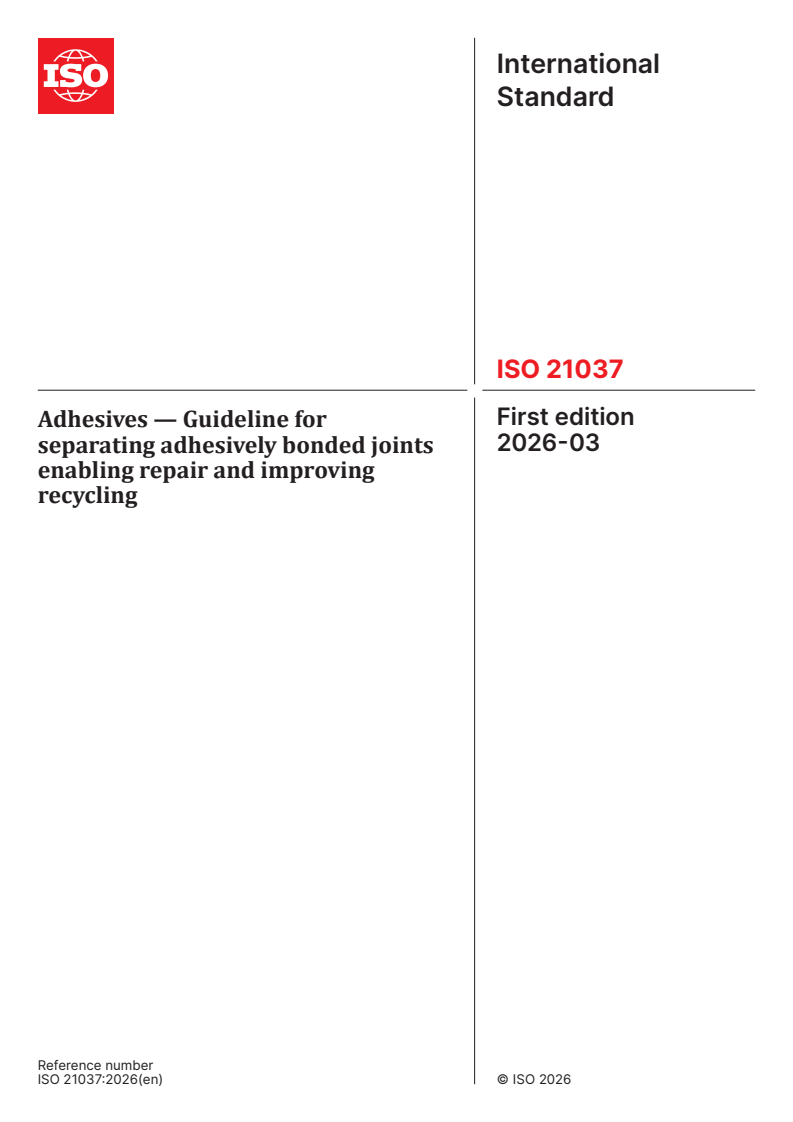
International
Standard
ISO 21037
First edition
Adhesives — Guideline for
2026-03
separating adhesively bonded joints
enabling repair and improving
recycling
Reference number
© ISO 2026
All rights reserved. Unless otherwise specified, or required in the context of its implementation, no part of this publication may
be reproduced or utilized otherwise in any form or by any means, electronic or mechanical, including photocopying, or posting on
the internet or an intranet, without prior written permission. Permission can be requested from either ISO at the address below
or ISO’s member body in the country of the requester.
ISO copyright office
CP 401 • Ch. de Blandonnet 8
CH-1214 Vernier, Geneva
Phone: +41 22 749 01 11
Email: copyright@iso.org
Website: www.iso.org
Published in Switzerland
ii
Contents Page
Foreword .iv
Introduction .v
1 Scope . 1
2 Normative references . 1
3 Terms and definitions . 1
4 Procedure . 1
4.1 Systematics .1
4.2 Mechanical methods for separating adhesively bonded joints .2
4.2.1 Cutting .2
4.2.2 Peeling .2
4.2.3 Stretching of the adhesive carrier .3
4.2.4 Elongation of the adherends .3
4.3 Physical methods for separating adhesively bonded joints .3
4.3.1 Temperature effects .3
4.3.2 Electricity .3
4.3.3 Solvents . .4
4.4 Chemical methods for separating adhesively bonded joints .4
4.4.1 Expanding and blowing agents .4
4.4.2 Decomposition of the adhesive .4
4.4.3 Decomposition of the adherent .4
Annex A (informative) Debonding — Established examples . 5
Bibliography . 9
iii
Foreword
ISO (the International Organization for Standardization) is a worldwide federation of national standards
bodies (ISO member bodies). The work of preparing International Standards is normally carried out through
ISO technical committees. Each member body interested in a subject for which a technical committee
has been established has the right to be represented on that committee. International organizations,
governmental and non-governmental, in liaison with ISO, also take part in the work. ISO collaborates closely
with the International Electrotechnical Commission (IEC) on all matters of electrotechnical standardization.
The procedures used to develop this document and those intended for its further maintenance are described
in the ISO/IEC Directives, Part 1. In particular, the different approval criteria needed for the different types
of ISO documents should be noted. This document was drafted in accordance with the editorial rules of the
ISO/IEC Directives, Part 2 (see www.iso.org/directives).
ISO draws attention to the possibility that the implementation of this document may involve the use of (a)
patent(s). ISO takes no position concerning the evidence, validity or applicability of any claimed patent
rights in respect thereof. As of the date of publication of this document, ISO had not received notice of (a)
patent(s) which may be required to implement this document. However, implementers are cautioned that
this may not represent the latest information, which may be obtained from the patent database available at
www.iso.org/patents. ISO shall not be held responsible for identifying any or all such patent rights.
Any trade name used in this document is information given for the convenience of users and does not
constitute an endorsement.
For an explanation of the voluntary nature of standards, the meaning of ISO specific terms and expressions
related to conformity assessment, as well as information about ISO's adherence to the World Trade
Organization (WTO) principles in the Technical Barriers to Trade (TBT), see www.iso.org/iso/foreword.html.
This document was prepared by Technical Committee ISO/TC 61, Plastics, Subcommittee SC 11, Products.
Any feedback or questions on this document should be directed to the user’s national standards body. A
complete listing of these bodies can be found at www.iso.org/members.html.
iv
Introduction
Given the background of a growing world population, increasing demand for goods, a continuing rise in
waste production and environmental pollution and, last but not least, the expected effects of climate change,
the transition from a linear economy to a circular economy is becoming increasingly important.
The aim of the circular economy concept is to establish closed material cycles through circular strategies
and thereby to build a regenerative system in which value creation, prosperity and security of supply are
achieved within planetary boundaries. In addition to a reduction in the use of resources, the preservation
of the value of raw materials, materials and products are at the forefront of the strategies compiled in the
framework of 9 R-strategies.
The contents of the 9 hierarchically structured R-strategies can be described by the following keywords:
— Refuse;
— Rethink;
— Reduce;
— Reuse;
— Repair;
— Refurbish;
— Remanufacture;
— Repurpose;
— Recycle.
When considering the various R-strategies in the design of products, conflicting goals between the different
R-strategies are certainly conceivable. For example, the weight of a product (e.g. rail vehicle) can be
significantly reduced by using different materials that are joined together in an adhesive bonding process,
thus reducing the energy requirement during the utilization phase. It is also conceivable that the service
life of a product (e.g. electronic components) can be extended by adhesive bonding. On the other hand, the
disadvantage is that bonded joints may make it more difficult to repair or recycle the materials at the end of
the product's life cycle.
In order to identify the most favourable solution from the point of view of resource consumption in the
event of conflicting objectives, a holistic assessment of the resource requirements is required, starting with
the manufacture of the product, through the entire product life to the end of life with the recycling of the
materials and consideration of the type and quantity of residual waste to be removed from the cycle that
cannot be recycled.
With this document, procedures are provided and further explained in Annex A by practical examples
with which the apparent contradiction between adhesive bonding and reparability and recyclability of the
product can be avoided.
v
International Standard ISO 21037:2026(en)
Adhesives — Guideline for separating adhesively bonded
joints enabling repair and improving recycling
1 Scope
This document specifies the methods commonly available for separating adhesively bonded joints enabling
repair and improving recycling.
This document applies to adherends made of metallic and non-metallic inorganic material, plastics including
both filler-containing and fibre-reinforced types, wood and wood-based materials, coated materials,
adherends of natural and polymeric fibres as well as paper and cardboard.
2 Normative references
The following documents are referred to in the text in such a way that some or all of their content constitutes
requirements of this document. For dated references, only the edition cited applies. For undated references,
the latest edition of the referenced document (including any amendments) applies.
ISO 472, Plastics — Vocabulary
3 Terms and definitions
For the purposes of this document, the terms and definitions given in ISO 472 and the following apply.
ISO and IEC maintain terminology databases for use in standardization at the following addresses:
— ISO Online browsing platform: available at https:// www .iso .org/ obp
— IEC Electropedia: available at https:// www .electropedia .org/
3.1
separating
process for disassembling structures or components by disengaging cohesion or adhesion
3.2
recycling
processing of waste materials for the original purpose or for other purposes, excluding energy recovery
[SOURCE: ISO 472:2013, 2.1706]
3.3
debonding
separating an adhesively bonded joint for the purpose of repairing the bonded component, for reuse or
recycling of the adherends
4 Procedure
4.1 Systematics
The available processes for separating adhesively bonded joints can be divided into mechanical, physical and
[1][2][3][4]
chemical process groups according to their mechanisms of action. Figure 1 provides an overview
of the main groups and subgroups according to this systematics. For a further explanation of the various
technologies, Annex A describes various processes that have already demonstrated their effectiveness in
practice.
Figure 1 — Systematics of the main and subgroups for separating adhesively bonded joints
4.2 Mechanical methods for separating adhesively bonded joints
4.2.1 Cutting
If the strength of the adhesive is sufficiently low, bonded joints can be mechanically separated using cutting
tools such as knives, wires or ropes.
Proven application examples can be found in the replacement of windshields in vehicle repair. The use of
auxiliary equipment can reduce the amount of force required and reduce the risk of accidents from handling
sharp-edged tools.
4.2.2 Peeling
When designing adhesively bonded joints, one tries to avoid peeling stresses under service conditions.
Peeling stress is characterized by the fact that the applied load is concentrated linearly, and adhesive
debonding or cohesive separation produces a crack that is driven forward by the applied load. This principle
can be used to separate bonded joints when the tensile strength of the parts being joined is greater than
the peel resistance of the bond. Examples of applications can be found in self-adhesive resealable packaging
closures, hygiene products and removable labels. In combination with the physical processes of subgroups
2.1.1 (heating) or 2.1.2 (cooling) (see Figure 1), the level of peel resistance can be influenced. Examples of
applications for such process combinations can be found in the repair of displays of mobile devices (so-called
smartphones and tablets). Heating with hot air or a heating panel can reduce the peeling resistance of the
edge bonding to such an extent that separating by peeling becomes possible with the use of auxiliary tools.
4.2.3 Stretching of the adhesive carrier
The adhesion of pressure-sensitive adhesives can be reduced by strongly stretching a carrier material
plastically. This principle can be used both for residue-free removable adhesive films and for residue-free
removable double-sided adhesive tapes.
4.2.4 Elongation of the adherends
Similar to that described under 4.2.3, bonded joints can be released by plastic stretching of the adherends.
The working principle is based on the effect that the local fracture strain of the adhesive in the contact
zone to the adherent is lower than the maximum elongation of the adherent. This principle has already been
successfully applied in the design of releasable adhesive brackets in dental technology.
4.3 Physical methods for separating adhesively bonded joints
4.3.1 Temperature effects
4.3.1.1 Heating
The mechanical properties of polymeric adhesives are highly dependent on temperature. Depending on the
type of adhesive used, heating leads to different changes in properties.
— With thermoplastic adhesives, strength decreases with increasing temperatures until flow occurs as the
melting temperature is approached. Bonded joints can be released in this state, preferably under peeling
stress, by cohesive separation of the adhesive joint. So-called “thermoplastic joining interface materials”
applied to the surface of at least one adherend prior bonding using a conventional adhesive allow to
tailor the temperatures required for separation of adhesively bonded joints.
— In the case of low-modulus partially crosslinked adhesives (e.g. crosslinked pressure-sensitive adhesives),
heating also leads to a reduction in peel resistance. However, melting does not occur and such bonded
joints can be separated at elevated temperatures without visible residues.
— In the case of duromeric load-bearing structural adhesives, heating to the vicinity of or above the glass
transition temperature leads to a reduction in strength and peel resistance due to the activation of
relaxation mechanisms. In joints bonded in this manner, the bonded parts and adhesives can be separated
and recovered in this temperature range by peeling or cleavage stress.
Hot air blowers, electric heating wires, infrared radiators, inductors and microwaves have proven to be
suitable heating methods for separating adhesively bonded joints in a wide variety of applications.
4.3.1.2 Cooling
In the case of adhesives being used above their glass transition temperature under the intended service
conditions, cooling to lower temperatures can provoke embrittlement. In the embrittled state, such bonded
joints can be separated with little force by peeling or impact stress due to their low critical crack propagation
energy in the glassy state.
Cooling can be achieved, for example, by liquid refrigerants, expansion of carbon dioxide or by dry ice.
4.3.2 Electricity
By applying a DC voltage in the range of 10 V to 50 V, debonding of joints formed by adhesives specially
formulated to react to electrical stress can be facilitated. The process takes advantage of the low ionic
conductivity of the adhesives to achieve an electrically stimulated weakening of the adhesive zone. The
adherends shall be electrically conductive and electrically insulated from one another to use this principle.
4.3.3 Solvents
In this case, dissolving substances in solvents is the physical principle of action. According to this method,
thermoplastic or water soluble adhesives can be completely dissolved or their cohesive strength is reduced
by swelling to such an extent that easy separation by applying peel or cleavage stress is possible. To some
extent, this can also be achieved by suitable solvents swelling elastomeric polymers. The suitability of the
solvent depends on the composition of the adhesive. Suitable solvents include water and organic solvents
with different polarities.
4.4 Chemical methods for separating adhesively bonded joints
4.4.1 Expanding and blowing agents
Adhesive bonds can be weakened if chemical blowing or foaming agents have been added to the adhesives or
to a functional coating pre-applied to at least one of the adherends. The working principle is similar to that
of so-called baking soda. Above a threshold temperature, which is determined by the agent used, a chemical
reaction leads to the formation
...
Questions, Comments and Discussion
Ask us and Technical Secretary will try to provide an answer. You can facilitate discussion about the standard in here.
Loading comments...