


ISO 12312-1:2022/FDAmd 1
(Amendment)Eye and face protection — Sunglasses and related eyewear — Part 1: Sunglasses for general use — Amendment 1
Eye and face protection — Sunglasses and related eyewear — Part 1: Sunglasses for general use — Amendment 1
Protection des yeux et du visage — Lunettes de soleil et articles de lunetterie associés — Partie 1: Lunettes de soleil pour usage général — Amendement 1
General Information
- Status
- Not Published
- Technical Committee
- ISO/TC 94/SC 6 - Eye and face protection
- Drafting Committee
- ISO/TC 94/SC 6 - Eye and face protection
- Current Stage
- 5020 - FDIS ballot initiated: 2 months. Proof sent to secretariat
- Start Date
- 21-Jan-2026
- Completion Date
- 21-Jan-2026
Relations
- Effective Date
- 12-Feb-2026
- Consolidates
ISO 4917-5:2024 - Design of nuclear power plants against seismic events — Part 5: Seismic instrumentation - Effective Date
- 22-Feb-2025
- Effective Date
- 21-Sep-2024
- Effective Date
- 10-Aug-2024
Overview
ISO 12312-1:2022/FDAmd 1 is an important amendment to the international standard for eye and face protection, specifically focusing on sunglasses for general use. Developed by ISO’s Technical Committee ISO/TC 94/SC 6 in cooperation with the European Committee for Standardization (CEN/TC 85), this standard amendment provides updated terminology, test methods, and product requirements to ensure enhanced safety and performance in sunglasses and related eyewear.
This latest amendment, published in 2025, refines definitions such as replacing “faded” and “darkened” states with “light” and “dark” states, respectively. It incorporates references to newer test methods (ISO 12311:2023, ISO 18526 series) and updates technical specifications including filter uniformity, impact resistance, and resistance to solar radiation. The document also addresses labeling and mandatory information supply ensuring clearer consumer guidance.
Key Topics
Terminology Updates
Changes include replacing older terms “faded” and “darkened” with “light” and “dark,” reflecting modernized vocabulary across electro-optical filters, reaction time, and absorption ratios.Test Methods and Filter Requirements
Transmittance determination follows ISO 18526-2:2020 protocols. Uniformity of luminous transmittance is specifically defined to evaluate visual uniformity, especially in gradient and polarizing filters. Photometric and electro-optical performance are tested based on updated criteria.Robustness and Impact Resistance
The amendment defines clear criteria for filter fracture, using steel ball impact tests in alignment with ISO 18526-3:2020. Filters must resist cracking, detachment, or displacement under impact with precise procedures outlined for strength levels 1, 2, and 3.Material and Coating Durability
Resistance to perspiration and surface degradation is standardized with requirements for no corrosion or color change after exposure to simulated sweat conditions. Antireflective coatings are also evaluated under updated criteria.Information and Labeling
Enhancements include prescribed minimum symbol sizes (5 mm) and verbal descriptions for filter categories to improve user understanding. Additional guidance on uncut and replacement filters ensures consistency in labeling and user information.Electro-Optical Filter Features
Detailed guidance on electro-optical sunglare filters includes light detection mechanisms and reaction time testing. Importantly, the amendment cautions users susceptible to photosensitive seizures from electro-optical filter flashing, aligning with safety protocols in ISO 9241-391.Harmonization with European Regulations
The amendment aligns with Regulation 2016/425 on personal protective equipment, providing a presumption of conformity when followed, aiding manufacturers in meeting EU market requirements.
Applications
ISO 12312-1:2022/FDAmd 1 applies to the design, manufacturing, and testing of sunglasses intended for general use by consumers worldwide. It is highly relevant for:
- Sunglass manufacturers aiming to ensure compliance with international safety and performance standards.
- Quality assurance and testing laboratories applying standardized methods to evaluate optical and mechanical properties.
- Retailers and distributors requiring clear product information and labeling to help consumers make informed purchases.
- Regulators and certification bodies overseeing conformity with safety directives, especially in the EU market.
- Product designers and material scientists focusing on durability and user safety aspects such as impact resistance and perspiration tolerance.
The standard supports improved consumer protection by specifying rigorous test protocols that enhance the reliability and safety of sunglasses used in everyday environments.
Related Standards
- ISO 12311:2023 - Personal protective equipment - Test methods for sunglasses and related eyewear.
- ISO 18526 series (Parts 1, 2, 3, and 4) - Test methods and specifications for the optical and mechanical properties of sunglasses and their components.
- ISO 9241-391 - Ergonomics of human-system interaction - specifically addressing photosensitive seizure risks related to electro-optical devices.
- European PPE Regulation 2016/425 - Governing equipment conformity and market surveillance in the EU.
Adopting ISO 12312-1:2022/FDAmd 1 enables alignment with these complementary standards, fostering a comprehensive approach to eye protection, enhancing safety, and facilitating market acceptance across regions.
Keywords: ISO 12312-1 amendment, sunglasses standard, eye protection, sunglass test methods, luminous transmittance uniformity, impact resistance sunglasses, electro-optical sunglare filter, personal protective equipment standards, EU PPE regulation compliance, sunglass labeling and safety.
Buy Documents

ISO 12312-1:2022/FDAmd 1 - Eye and face protection — Sunglasses and related eyewear — Part 1: Sunglasses for general use — Amendment 1 Released:7. 01. 2026
REDLINE ISO 12312-1:2022/FDAmd 1 - Eye and face protection — Sunglasses and related eyewear — Part 1: Sunglasses for general use — Amendment 1 Released:7. 01. 2026
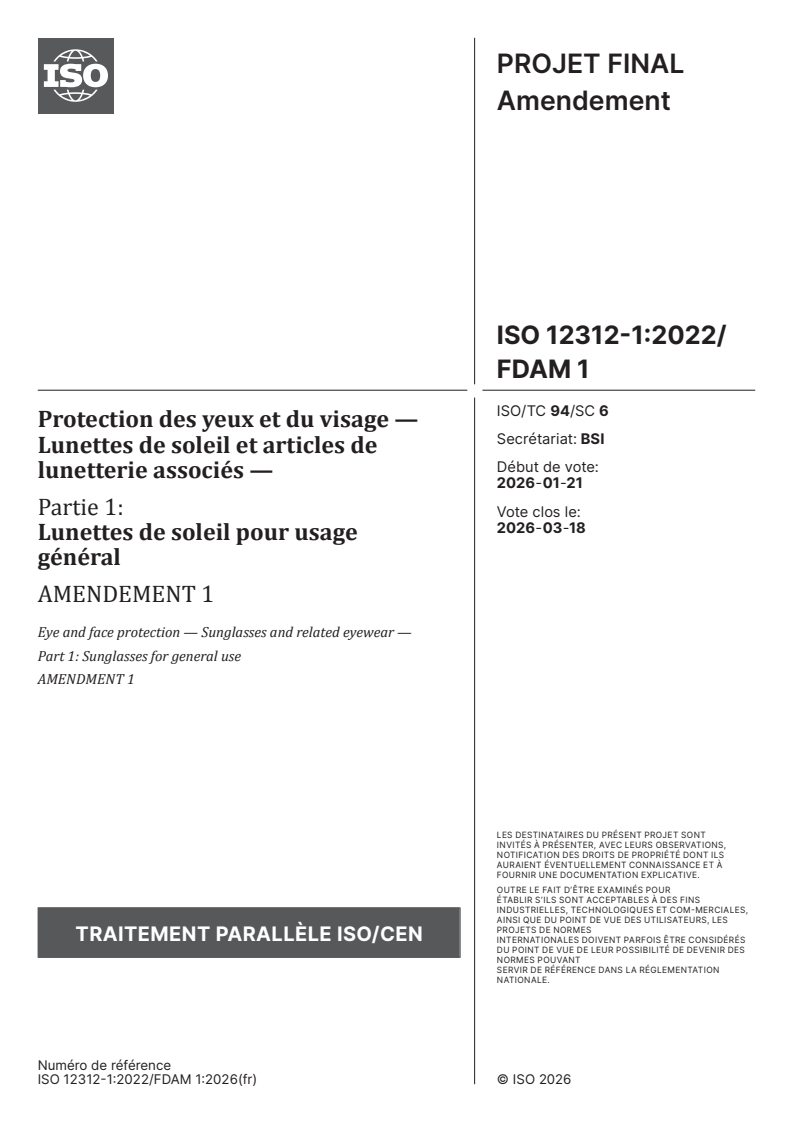

ISO 12312-1:2022/FDAmd 1 - Protection des yeux et du visage — Lunettes de soleil et articles de lunetterie associés — Partie 1: Lunettes de soleil pour usage général — Amendement 1 Released:23. 01. 2026
Get Certified
Connect with accredited certification bodies for this standard

NSF International
Global independent organization facilitating standards development and certification.

CIS Institut d.o.o.
Personal Protective Equipment (PPE) certification body. Notified Body NB-2890 for EU Regulation 2016/425 PPE.

Kiwa BDA Testing
Building and construction product certification.
Sponsored listings
Frequently Asked Questions
ISO 12312-1:2022/FDAmd 1 is a draft published by the International Organization for Standardization (ISO). Its full title is "Eye and face protection — Sunglasses and related eyewear — Part 1: Sunglasses for general use — Amendment 1". This standard covers: Eye and face protection — Sunglasses and related eyewear — Part 1: Sunglasses for general use — Amendment 1
Eye and face protection — Sunglasses and related eyewear — Part 1: Sunglasses for general use — Amendment 1
ISO 12312-1:2022/FDAmd 1 is classified under the following ICS (International Classification for Standards) categories: 13.340.20 - Head protective equipment. The ICS classification helps identify the subject area and facilitates finding related standards.
ISO 12312-1:2022/FDAmd 1 has the following relationships with other standards: It is inter standard links to EN ISO 12312-1:2022/FprA1, ISO 4917-5:2024, ISO 23551-10:2016, ISO 12312-1:2022. Understanding these relationships helps ensure you are using the most current and applicable version of the standard.
ISO 12312-1:2022/FDAmd 1 is available in PDF format for immediate download after purchase. The document can be added to your cart and obtained through the secure checkout process. Digital delivery ensures instant access to the complete standard document.
Standards Content (Sample)
FINAL DRAFT
Amendment
ISO 12312-1:2022/
FDAM 1
ISO/TC 94/SC 6
Eye and face protection —
Secretariat: BSI
Sunglasses and related eyewear —
Voting begins on:
2026-01-21
Part 1:
Sunglasses for general use
Voting terminates on:
2026-03-18
AMENDMENT 1
Protection des yeux et du visage — Lunettes de soleil et articles
de lunetterie associés —
Partie 1: Lunettes de soleil pour usage général
AMENDEMENT 1
RECIPIENTS OF THIS DRAFT ARE INVITED TO SUBMIT,
WITH THEIR COMMENTS, NOTIFICATION OF ANY
RELEVANT PATENT RIGHTS OF WHICH THEY ARE AWARE
AND TO PROVIDE SUPPOR TING DOCUMENTATION.
IN ADDITION TO THEIR EVALUATION AS
BEING ACCEPTABLE FOR INDUSTRIAL, TECHNO-
ISO/CEN PARALLEL PROCESSING LOGICAL, COMMERCIAL AND USER PURPOSES, DRAFT
INTERNATIONAL STANDARDS MAY ON OCCASION HAVE
TO BE CONSIDERED IN THE LIGHT OF THEIR POTENTIAL
TO BECOME STAN DARDS TO WHICH REFERENCE MAY BE
MADE IN NATIONAL REGULATIONS.
Reference number
ISO 12312-1:2022/FDAM 1:2026(en) © ISO 2026
FINAL DRAFT
ISO 12312-1:2022/FDAM 1:2026(en)
Amendment
ISO 12312-1:2022/
FDAM 1
ISO/TC 94/SC 6
Eye and face protection —
Secretariat: BSI
Sunglasses and related eyewear —
Voting begins on:
Part 1:
Sunglasses for general use
Voting terminates on:
AMENDMENT 1
Protection des yeux et du visage — Lunettes de soleil et articles
de lunetterie associés —
Partie 1: Lunettes de soleil pour usage général
AMENDEMENT 1
RECIPIENTS OF THIS DRAFT ARE INVITED TO SUBMIT,
WITH THEIR COMMENTS, NOTIFICATION OF ANY
RELEVANT PATENT RIGHTS OF WHICH THEY ARE AWARE
AND TO PROVIDE SUPPOR TING DOCUMENTATION.
© ISO 2026
IN ADDITION TO THEIR EVALUATION AS
All rights reserved. Unless otherwise specified, or required in the context of its implementation, no part of this publication may
BEING ACCEPTABLE FOR INDUSTRIAL, TECHNO-
ISO/CEN PARALLEL PROCESSING
LOGICAL, COMMERCIAL AND USER PURPOSES, DRAFT
be reproduced or utilized otherwise in any form or by any means, electronic or mechanical, including photocopying, or posting on
INTERNATIONAL STANDARDS MAY ON OCCASION HAVE
the internet or an intranet, without prior written permission. Permission can be requested from either ISO at the address below
TO BE CONSIDERED IN THE LIGHT OF THEIR POTENTIAL
or ISO’s member body in the country of the requester.
TO BECOME STAN DARDS TO WHICH REFERENCE MAY BE
MADE IN NATIONAL REGULATIONS.
ISO copyright office
CP 401 • Ch. de Blandonnet 8
CH-1214 Vernier, Geneva
Phone: +41 22 749 01 11
Email: copyright@iso.org
Website: www.iso.org
Published in Switzerland Reference number
ISO 12312-1:2022/FDAM 1:2025(en) © ISO 2025
ii
ISO 12312-1:2022/FDAM 1:2025(en)
Foreword
ISO (the International Organization for Standardization) is a worldwide federation of national standards
bodies (ISO member bodies). The work of preparing International Standards is normally carried out through
ISO technical committees. Each member body interested in a subject for which a technical committee
has been established has the right to be represented on that committee. International organizations,
governmental and non-governmental, in liaison with ISO, also take part in the work. ISO collaborates closely
with the International Electrotechnical Commission (IEC) on all matters of electrotechnical standardization.
The procedures used to develop this document and those intended for its further maintenance are described
in the ISO/IEC Directives, Part 1. In particular, the different approval criteria needed for the different types
of ISO document should be noted. This document was drafted in accordance with the editorial rules of the
ISO/IEC Directives, Part 2 (see www.iso.org/directives).
ISO draws attention to the possibility that the implementation of this document may involve the use of (a)
patent(s). ISO takes no position concerning the evidence, validity or applicability of any claimed patent
rights in respect thereof. As of the date of publication of this document, ISO had not received notice of (a)
patent(s) which may be required to implement this document. However, implementers are cautioned that
this may not represent the latest information, which may be obtained from the patent database available at
www.iso.org/patents. ISO shall not be held responsible for identifying any or all such patent rights.
Any trade name used in this document is information given for the convenience of users and does not
constitute an endorsement.
For an explanation of the voluntary nature of standards, the meaning of ISO specific terms and expressions
related to conformity assessment, as well as information about ISO's adherence to the World Trade
Organization (WTO) principles in the Technical Barriers to Trade (TBT), see www.iso.org/iso/foreword.html.
This document was prepared by Technical Committee ISO/TC 94, Personal safety — Personal protective
equipment, Subcommittee SC 6, Eye and face protection, in collaboration with the European Committee for
Standardization (CEN) Technical Committee CEN/TC 85, Eye protective equipment, in accordance with the
Agreement on technical cooperation between ISO and CEN (Vienna Agreement).
NOTE Resulting of the replacement in the proposed revision of ISO 4007 of "Faded state" with "Light state" and
“Darkened state” with “Dark state” this Amendment introduces changes in all paragraph where the word "Faded" and
“Darkened” was used.
Any feedback or questions on this document should be directed to the user’s national standards body. A
complete listing of these bodies can be found at www.iso.org/members.html.
iii
ISO 12312-1:2022/FDAM 1:2025(en)
Eye and face protection — Sunglasses and related eyewear —
Part 1:
Sunglasses for general use
AMENDMENT 1
2 Normative references
Replace the existing reference by the following:
“ISO 12311:2023, Personal protective equipment — Test methods for sunglasses and related eyewear”
3.2 Electro-optical filter
Replace “faded” with “light and “darkened” with “dark”
3.3 reaction time
Replace “faded” with “light” and “darkened” with “dark”
3.4 Absorption ratio
Replace “faded” with “light” and “darkened” with “dark”
4.4 Headforms
Delete the existing text and substitute by the following:
"Unless the manufacturer specifies the headform(s) in accordance with ISO 18526-4:2020 that is/
are compatible with the sunglasses, the test methods where (a) headform(s) is/are required shall use
the headform 1-M for adult's sunglasses and (1-C6) or (1-C12) for children's sunglasses as specified in
ISO 18526-4:2020 as the default”
5.1 Test methods
Delete the first paragraph and substitute by the following:
“Transmittance values shall be determined in accordance with ISO 18526-2:2020, Clauses 7, 8, 9 and 10. If
the direction of measurement is not specified, then the direction of measurement shall be normal to the
surface of the test sample at its geometrical centre.”
5.2 Transmittance and filter categories
Replace “faded” with “light” and “darkened” with “dark”
ISO 12312-1:2022/FDAM 1:2025(en)
5.3.1 Uniformity of luminous transmittance
Delete the existing text and substitute by:
“Filters that are intended to be uniformly tinted shall appear to be visually uniform within a circle
(30 ± 1) mm diameter centred on the reference points and appear to have the same transmittance at the
two reference points when inspected against a white background in accordance with ISO 18526-3:2020, 6.6.
For gradient filters the luminous transmittances shall appear constant in the horizontal direction and have
equal transmittance at the reference points.
Where there is visible non-uniformity, or tilt in case of gradient filters, then, when tested according to
ISO 18526-2:2020, 7.4, the relative difference in the luminous transmittance value between any two points
of the filter within a circle (30 ± 1) mm in diameter centred on the reference point shall not be greater than
15 % (relative to the higher value), except for category 4 where it shall not be greater than 20 %. If a 5 mm
wide portion around the edge of the test sample intrudes into this circular area, then this intrusion shall be
excluded from testing.
The geometric or boxed centre takes the place of the reference point if this is not known.
In the case of mounted gradient filters, this requirement shall be limited to sections parallel to the line
connecting the two reference points.
For mounted filters, the relative difference between the luminous transmittance value of the filters at the
reference point for the right and left eyes shall not exceed 20 % for gradient-tinted filters and 15 % for all
other types (relative to the lighter filter).
Changes of luminous transmittance that are caused by thickness variations due to the design of the filter are
permitted. For verification, the test method in ISO 18526-2:2020, 7.4.1.4, shall be used.
The uniformity requirements for electro-optical sunglass filters in the darkened state are given in 5.3.4.4.5”
5.3.4.1 Photochromic filters
Replace “faded” with “light” and “darkened” with “dark”
5.3.4.2 Polarizing filters
Delete the first phrase and substitute by the following:
"If the filters in the sunglasses are claimed to be polarizing, then they shall be tested in accordance with
ISO 18526-2:2020, Clause 15”.
5.3.4.4.1 General
Replace “faded” with “light” and “darkened” with “dark”
5.3.4.4.3 Reaction time
Replace “faded” with “light” and “darkened” with “dark”
5.3.4.4.4 Photosensitive seizures
ISO 12312-1:2022/FDAM 1:2025(en)
The entire paragraph was deleted and moved to Annex B.
The subsequent subclauses shall be renumbered: "5.3.4.4.5" becomes "5.3.4.4.4" and "5.3.4.4.6" becomes
"5.3.4.4.5".
5.3.4.4.5 Narrow angle scatter
Replace “faded” with “light” and “darkened” with “dark”
5.3.5.1.1 and 5.3.5.1.2
Add at the end of the text the following sentence:
“The calculation shall be made according to ISO 18526-2:2020, 9.1”
5.3.5.2.2 and 5.3.5.2.3
Add at the end of the text the following sentence:
“The calculation shall be made according to ISO 18526-2:2020, 8.3”
5.3.5.2.4 and 5.3.5.2.5
Add at the end of the text the following sentence:
“The calculation shall be made according to ISO 18526-2:2020, 8.4”
5.3.5.2.6 and 5.3.5.2.7
Add at the end of the text the following sentence:
“The calculation shall be made according to ISO 18526-2:2020, 8.5”
5.3.5.3 Antireflective coated sunglasses
Replace “faded” with “light” and “darkened” with “dark”
6.3 Prism imbalance (relative prism error)
In the first paragraph replace the existing cross-reference by the following one:
“The complete sunglass shall be tested in the “as-worn” position according to ISO 18526-1:2020, 6.2.”
7.1 Minimum robustness of filters
Delete the paragraph a) and substitute by the following:
a) “Filter fracture: A filter is considered to have fractured when
— it cracks through its entire thickness into two or more pieces, or
...
ISO 12312-1:2022/FDAMFDAmd 1:2025(en)
ISO/TC 94/SC 6
Secretariat: BSI
Date: 2025-11-14xx
Eye and face protection - — Sunglasses and related eyewear —
Part 1:
Sunglasses for general use
AMENDMENT 1
Protection des yeux et du visage - — Lunettes de soleil et articles de lunetterie associés —
Partie 1: Lunettes de soleil pour usage général
AMENDEMENT 1
TTTTTTTThhhhhhhhiiiiiiiissssssss d d d d d d d drrrrrrrraft iaft iaft iaft iaft iaft iaft iaft issssssss su su su su su su su subbbbbbbbmmmmmmmmiiiiiiiitted tted tted tted tted tted tted tted to to to to to to to to a pa pa pa pa pa pa pa parallearallearallearallearallearallearallearallel vl vl vl vl vl vl vl vote ote ote ote ote ote ote ote iiiiiiiinnnnnnnn IS IS IS IS IS IS IS ISOOOOOOOO, CE, CE, CE, CE, CE, CE, CE, CENNNNNNNN.
FDIS stage
All rights reserved. Unless otherwise specified, or required in the context of its implementation, no part of this publication
may be reproduced or utilized otherwise in any form or by any means, electronic or mechanical, including photocopying,
or posting on the internet or an intranet, without prior written permission. Permission can be requested from either ISO
at the address below or ISO'sISO’s member body in the country of the requester.
ISO copyright office
CP 401 • Ch. de Blandonnet 8
CH-1214 Vernier, Geneva
Phone: + 41 22 749 01 11
Email:
E-mail: copyright@iso.org
Website: www.iso.org
Published in Switzerland.
iii
Contents Page
iv
Foreword
ISO (the International Organization for Standardization) is a worldwide federation of national standards
bodies (ISO member bodies). The work of preparing International Standards is normally carried out through
ISO technical committees. Each member body interested in a subject for which a technical committee has been
established has the right to be represented on that committee. International organizations, governmental and
non-governmental, in liaison with ISO, also take part in the work. ISO collaborates closely with the
International Electrotechnical Commission (IEC) on all matters of electrotechnical standardization.
The procedures used to develop this document and those intended for its further maintenance are described
in the ISO/IEC Directives, Part 1. In particular, the different approval criteria needed for the different types of
ISO document should be noted. This document was drafted in accordance with the editorial rules of the
ISO/IEC Directives, Part 2 (see www.iso.org/directives).
ISO draws attention to the possibility that the implementation of this document may involve the use of (a)
patent(s). ISO takes no position concerning the evidence, validity or applicability of any claimed patent rights
in respect thereof. As of the date of publication of this document, ISO had not received notice of (a) patent(s)
which may be required to implement this document. However, implementers are cautioned that this may not
represent the latest information, which may be obtained from the patent database available at
www.iso.org/patents. ISO shall not be held responsible for identifying any or all such patent rights.
Any trade name used in this document is information given for the convenience of users and does not
constitute an endorsement.
For an explanation of the voluntary nature of standards, the meaning of ISO specific terms and expressions
related to conformity assessment, as well as information about ISO's adherence to the World Trade
Organization (WTO) principles in the Technical Barriers to Trade (TBT), see www.iso.org/iso/foreword.html.
This document was prepared by Technical Committee ISO/TC 94, Personal safety -— Personal protective
clothing and equipment, Subcommittee SC 6, and byEye and face protection, in collaboration with the European
Committee for Standardization (CEN) Technical Committee CEN/TC 85, Eye protective equipment in
collaboration., in accordance with the Agreement on technical cooperation between ISO and CEN (Vienna
Agreement).
NOTE: As result Resulting of the replacement in the proposed revision of ISO 4007 of "Faded state" with "Light state"
and “Darkened state” with “Dark state” the amendment introducedthis Amendment introduces changes in all paragraph
where the word "Faded" and “Darkened” was utilizedused.
Any feedback or questions on this document should be directed to the user’s national standards body. A
complete listing of these bodies can be found at www.iso.org/members.html.
v
Eye and face protection - — Sunglasses and related eyewear —
Part 1:
Sunglasses for general use
AMENDMENT 1
2 Normative references
Replace the existing reference by the following:
“ISO 12311:2023, Personal protective equipment — Test methods for sunglasses and related eyewear”
3.2 Electro-optical filter
Replace “faded” with “light and “darkened” with “dark”
3.3 reaction time
Replace “faded” with “light” and “darkened” with “dark”
3.4 Absorption ratio
Replace “faded” with “light” and “darkened” with “dark”
4.4 Headforms
Delete the existing text and substitute by the following:
"Unless the manufacturer specifies the headform(s) in accordance with ISO 18526-4:2020 that is/are
compatible with the sunglasses, the test methods where (a) headform(s) is/are required shall use the
headform 1-M for adult's sunglasses and (1-C6) or (1-C12) for children's sunglasses as specified in ISO 18526-
4:2020 as the default”
5.1 Test methods
Delete the first paragraph and substitute by the following:
“Transmittance values shall be determined in accordance with ISO 18526-2:2020, Clauses 7, 8, 9 and 10. If the
direction of measurement is not specified, then the direction of measurement shall be normal to the surface
of the test sample at its geometrical centre.”
5.2 Transmittance and filter categories
Replace “faded” with “light” and “darkened” with “dark”
5.3.1 Uniformity of luminous transmittance
Delete the existing text and substitute by:
“Filters that are intended to be uniformly tinted shall appear to be visually uniform within a circle (30 ± 1) mm
diameter centred on the reference points and appear to have the same transmittance at the two reference
points when inspected against a white background in accordance with ISO 18526-3:2020, 6.6. For gradient
filters the luminous transmittances shall appear constant in the horizontal direction and have equal
transmittance at the reference points.
Where there is visible non-uniformity, or tilt in case of gradient filters, then, when tested according to
ISO 18526-2:2020, 7.4, the relative difference in the luminous transmittance value between any two points of
the filter within a circle (30 ± 1) mm in diameter centred on the reference point shall not be greater than 15 %
(relative to the higher value), except for category 4 where it shall not be greater than 20 %. If a 5 mm wide
portion around the edge of the test sample intrudes into this circular area, then this intrusion shall be excluded
from testing.
The geometric or boxed centre takes the place of the reference point if this is not known.
In the case of mounted gradient filters, this requirement shall be limited to sections parallel to the line
connecting the two reference points.
For mounted filters, the relative difference between the luminous transmittance value of the filters at the
reference point for the right and left eyes shall not exceed 20 % for gradient-tinted filters and 15 % for all
other types (relative to the lighter filter).
Changes of luminous transmittance that are caused by thickness variations due to the design of the filter are
permitted. For verification, the test method in ISO 18526-2:2020, 7.4.1.4, shall be used.
The uniformity requirements for electro-optical sunglass filters in the darkened state are given in 5.3.4.4.5”
5.3.4.1 Photochromic filters
Replace “faded” with “light” and “darkened” with “dark”
5.3.4.2 Polarizing filters
Delete the first phrase and substitute by the following:
"If the filters in the sunglasses are claimed to be polarizing, then they shall be tested in accordance with ISO
18526-2:2020, Clause 15”.
5.3.4.4.1 General
Replace “faded” with “light” and “darkened” with “dark”
5.3.4.4.3 Reaction time
Replace “faded” with “light” and “darkened” with “dark”
5.3.4.4.4 Photosensitive seizures
The entire paragraph was deleted and moved to Annex B.
The subsequent subclauses shall be renumbered: "5.3.4.4.5" becomes "5.3.4.4.4" and "5.3.4.4.6" becomes
"5.3.4.4.5".
5.3.4.4.5 Narrow angle scatter
Replace “faded” with “light” and “darkened” with “dark”
5.3.5.1.1 and 5.3.5.1.2
Add at the end of the text the following sentence:
“The calculation shall be made according to ISO 18526-2:2020, 9.1”
5.3.5.2.2 and 5.3.5.2.3
Add at the end of the text the following sentence:
“The calculation shall be made according to ISO 18526-2:2020, 8.3”
5.3.5.2.4 and 5.3.5.2.5
Add at the end of the text the following sentence:
“The calculation shall be made according to ISO 18526-2:2020, 8.4”
5.3.5.2.6 and 5.3.5.2.7
Add at the end of the text the following sentence:
“The calculation shall be made according to ISO 18526-2:2020, 8.5”
5.3.5.3 Antireflective coated sunglasses
Replace “faded” with “light” and “darkened” with “dark”
6.3 Prism imbalance (relative prism error)
In the first paragraph replace the existing cross-reference by the following one:
“The complete sunglass shall be tested in the “as-worn” position according to ISO 18526-1:2020, 6.2.”
7.1 Minimum robustness of filters
Delete the paragraph a) and substitute by the following:
a) a) “Filter fracture: A filter is considered to have fractured when
— — it cracks through its entire thickness into two or more pieces, or
— — a trained observer can see, when viewing without magnification but wearing any appropriate
correction for near vision, either a piece of material that has become detached from the surface
opposite to that impacted or a corresponding surface defect
— — the test ball passes through the filter.”
Delete the last sentence and substitute by:
“Regulations in some countries can require certain robustness tests, e.g. in the USA, US CFR21 801.410 impact
resistance test.”
7.2 Frame deformation and retention of filters
In the first paragraph, replace the existing cross-referen
...
PROJET FINAL
Amendement
ISO 12312-1:2022/
FDAM 1
ISO/TC 94/SC 6
Protection des yeux et du visage —
Secrétariat: BSI
Lunettes de soleil et articles de
Début de vote:
lunetterie associés —
2026-01-21
Partie 1:
Vote clos le:
2026-03-18
Lunettes de soleil pour usage
général
AMENDEMENT 1
Eye and face protection — Sunglasses and related eyewear —
Part 1: Sunglasses for general use
AMENDMENT 1
LES DESTINATAIRES DU PRÉSENT PROJET SONT
INVITÉS À PRÉSENTER, AVEC LEURS OBSERVATIONS,
NOTIFICATION DES DROITS DE PROPRIÉTÉ DONT ILS
AURAIENT ÉVENTUELLEMENT CONNAISSANCE ET À
FOURNIR UNE DOCUMENTATION EXPLICATIVE.
OUTRE LE FAIT D’ÊTRE EXAMINÉS POUR
ÉTABLIR S’ILS SONT ACCEPTABLES À DES FINS
INDUSTRIELLES, TECHNOLOGIQUES ET COM-MERCIALES,
AINSI QUE DU POINT DE VUE DES UTILISATEURS, LES
PROJETS DE NORMES
TRAITEMENT PARALLÈLE ISO/CEN
INTERNATIONALES DOIVENT PARFOIS ÊTRE CONSIDÉRÉS
DU POINT DE VUE DE LEUR POSSI BILITÉ DE DEVENIR DES
NORMES POUVANT
SERVIR DE RÉFÉRENCE DANS LA RÉGLEMENTATION
NATIONALE.
Numéro de référence
ISO 12312-1:2022/FDAM 1:2026(fr) © ISO 2026
PROJET FINAL
ISO 12312-1:2022/FDAM 1:2026(fr)
Amendement
ISO 12312-1:2022/
FDAM 1
ISO/TC 94/SC 6
Protection des yeux et du visage —
Secrétariat: BSI
Lunettes de soleil et articles de
Début de vote:
lunetterie associés —
2026-01-21
Partie 1:
Vote clos le:
2026-03-18
Lunettes de soleil pour usage
général
AMENDEMENT 1
Eye and face protection — Sunglasses and related eyewear —
Part 1: Sunglasses for general use
AMENDMENT 1
LES DESTINATAIRES DU PRÉSENT PROJET SONT
INVITÉS À PRÉSENTER, AVEC LEURS OBSERVATIONS,
NOTIFICATION DES DROITS DE PROPRIÉTÉ DONT ILS
AURAIENT ÉVENTUELLEMENT CONNAISSANCE ET À
FOURNIR UNE DOCUMENTATION EXPLICATIVE.
DOCUMENT PROTÉGÉ PAR COPYRIGHT
OUTRE LE FAIT D’ÊTRE EXAMINÉS POUR
ÉTABLIR S’ILS SONT ACCEPTABLES À DES FINS
© ISO 2026 INDUSTRIELLES, TECHNOLOGIQUES ET COM-MERCIALES,
AINSI QUE DU POINT DE VUE DES UTILISATEURS, LES
Tous droits réservés. Sauf prescription différente ou nécessité dans le contexte de sa mise en œuvre, aucune partie de cette
PROJETS DE NORMES
TRAITEMENT PARALLÈLE ISO/CEN
INTERNATIONALES DOIVENT PARFOIS ÊTRE CONSIDÉRÉS
publication ne peut être reproduite ni utilisée sous quelque forme que ce soit et par aucun procédé, électronique ou mécanique,
DU POINT DE VUE DE LEUR POSSI BILITÉ DE DEVENIR DES
y compris la photocopie, ou la diffusion sur l’internet ou sur un intranet, sans autorisation écrite préalable. Une autorisation peut
NORMES POUVANT
être demandée à l’ISO à l’adresse ci-après ou au comité membre de l’ISO dans le pays du demandeur.
SERVIR DE RÉFÉRENCE DANS LA RÉGLEMENTATION
NATIONALE.
ISO copyright office
Case postale 401 • Ch. de Blandonnet 8
CH-1214 Vernier, Genève
Tél.: +41 22 749 01 11
E-mail: copyright@iso.org
Web: www.iso.org
Publié en Suisse Numéro de référence
ISO 12312-1:2022/FDAM 1:2026(fr) © ISO 2026
ii
ISO 12312-1:2022/FDAM 1:2026(fr)
Avant-propos
L’ISO (Organisation internationale de normalisation) est une fédération mondiale d’organismes nationaux
de normalisation (comités membres de l’ISO). L’élaboration des Normes internationales est en général
confiée aux comités techniques de l’ISO. Chaque comité membre intéressé par une étude a le droit de faire
partie du comité technique créé à cet effet. Les organisations internationales, gouvernementales et non
gouvernementales, en liaison avec l’ISO participent également aux travaux. L’ISO collabore étroitement avec
la Commission électrotechnique internationale (IEC) en ce qui concerne la normalisation électrotechnique.
Les procédures utilisées pour élaborer le présent document et celles destinées à sa mise à jour sont
décrites dans les Directives ISO/IEC, Partie 1. Il convient, en particulier, de prendre note des différents
critères d’approbation requis pour les différents types de documents ISO. Le présent document
a été rédigé conformément aux règles de rédaction données dans les Directives ISO/IEC, Partie 2
(voir www.iso.org/directives).
L’ISO attire l’attention sur le fait que la mise en application du présent document peut entraîner l’utilisation
d’un ou de plusieurs brevets. L’ISO ne prend pas position quant à la preuve, à la validité et à l’applicabilité de
tout droit de brevet revendiqué à cet égard. À la date de publication du présent document, l’ISO n’avait pas
reçu notification qu’un ou plusieurs brevets pouvaient être nécessaires à sa mise en application. Toutefois,
il y a lieu d’avertir les responsables de la mise en application du présent document que des informations
plus récentes sont susceptibles de figurer dans la base de données de brevets, disponible à l’adresse
www.iso.org/brevets. L’ISO ne saurait être tenue pour responsable de ne pas avoir identifié tout ou partie de
tels droits de brevet.
Les appellations commerciales éventuellement mentionnées dans le présent document sont données pour
information, par souci de commodité, à l’intention des utilisateurs et ne sauraient constituer un engagement.
Pour une explication de la nature volontaire des normes, la signification des termes et expressions
spécifiques de l’ISO liés à l’évaluation de la conformité, ou pour toute information au sujet de l’adhésion de
l’ISO aux principes de l’Organisation mondiale du commerce (OMC) concernant les obstacles techniques au
commerce (OTC), voir le lien suivant: www.iso.org/avant-propos.
Le présent document a été élaboré par le comité technique ISO/TC 94, Sécurité individuelle — Équipement
de protection individuelle, sous-comité SC 6, Protection des yeux et du visage, en collaboration avec le comité
technique CEN/TC 85, Équipement de protection des yeux, du Comité européen de normalisation (CEN),
conformément à l’Accord de coopération technique entre l’SO et le CEN (Accord de Vienne).
NOTE À la suite du remplacement, dans la révision proposée de l'ISO 4007, des termes anglais “Faded state” par
“Light state” et “Darkened state” par “Dark state”, le présent amendement introduit des modifications dans tous les
alinéas où les termes anglais “Faded” et “Darkened” étaient utilisés.
Il convient que l’utilisateur adresse tout retour d’information ou toute question concernant le présent
document à l’organisme national de normalisation de son pays. Une liste exhaustive desdits organismes se
trouve à l’adresse www.iso.org/members.html.
iii
ISO 12312-1:2022/FDAM 1:2026(fr)
Protection des yeux et du visage — Lunettes de soleil et
articles de lunetterie associés —
Partie 1:
Lunettes de soleil pour usage général
AMENDEMENT 1
2 Références normatives
Remplacer la référence existante par la référence suivante:
“ISO 12311:2023, Équipement de protection individuelle — Méthodes d'essai pour lunettes de soleil et articles de
lunetterie associés”
3.2 Filtre électro-optique de protection contre le rayonnement solaire
Concerne la version anglaise uniquement.
3.3 Temps de réaction
Concerne la version anglaise uniquement.
3.4 Rapport d'absorption
Concerne la version anglaise uniquement.
4.4 Fausses têtes
Supprimer le texte existant et le remplacer par ce qui suit:
“À moins que le fabricant ne préconise la ou les fausses têtes qui, conformément à l'ISO 18526-4:2020, sont
compatibles avec les lunettes de soleil, les méthodes d'essai qui nécessitent l'utilisation de fausses têtes
doivent utiliser par défaut la fausse tête 1-M pour les lunettes de soleil pour adultes et (1C6) ou (1C12) pour
les lunettes de soleil pour enfants, conformément aux spécifications de l'ISO 185264:2020.”
5.1 Méthodes d’essai
Supprimer le premier alinéa et le remplacer par ce qui suit:
“Les valeurs des facteurs de transmission doivent être déterminées conformément aux Articles 7, 8, 9
et 10 de l'ISO 18526-2:2020. Si la direction du mesurage n'est pas spécifiée, celui-ci doit être effectué
perpendiculairement à la surface de l'échantillon pour essai à son centre géométrique.”
ISO 12312-1:2022/FDAM 1:2026(fr)
5.2 Facteur de transmission et catégories de filtres
Concerne la version anglaise uniquement.
5.3.1 Homogénéité du facteur de transmission dans le visible
Supprimer le texte existant et le remplacer par ce qui suit:
“Les filtres destinés à être teintés uniformément doivent être visuellement uniformes à l'intérieur
d'un cercle de (30 ± 1) mm de diamètre centré sur les points de référence, et avoir le même facteur de
transmission aux deux points de référence lorsqu'ils sont examinés sur un fond blanc conformément au 6.6
de l’ISO 18526-3:2020. Pour les filtres dégradés, les facteurs de transmissions dans le visible doivent paraître
constants dans la direction horizontale et avoir le même facteur de transmission aux points de référence.
En cas de non-uniformité visible, ou d'inclinaison pour les filtres dégradés, lors de l'essai conformément
au 7.4 de l’ISO 18526-2:2020, la variation, en valeur relative, du facteur de transmission dans le visible entre
deux points quelconques du filtre, à l'intérieur d'un cercle de (30 ± 1) mm de diamètre centré sur le point de
référence, ne doit pas être supérieure à 15 % (rapportée à la plus forte valeur), sauf pour la catégorie 4 où
elle ne doit pas être supérieure à 20 %. Si une portion de 5 mm de largeur autour du bord de l'échantillon
pour essai empiète sur cette zone circulaire, alors cette intrusion doit être exclue de l'essai.
Le centre géométrique ou centre du verre emboîté remplace le point de référence si ce dernier n'est pas
connu.
Pour les filtres dégradés montés, cette exigence doit être limitée aux zones parallèles à la droite reliant les
deux points de référence.
Pour les filtres montés, la variation, en valeur relative, entre le facteur de transmission dans le visible des
filtres au point de référence de l'œil droit et celui de l'œil gauche ne doit pas dépasser 20 % pour des filtres
dégradés et 15 % pour tous les autres types (rapportée au filtre le plus clair).
Les changements de facteur de transmission dans le visible causés par des variations d'épaisseur en raison
de la conception du filtre sont admis. À des fins de vérification, la méthode d'essai donnée au 7.4.1.4 de
l'ISO 18526-2:2020 doit être utilisée.
Les exigences d'uniformité pour les filtres électro-optiques de lunette solaire à l'état foncé sont données
en 5.3.4.4.5”
5.3.4.1 Filtres photochromiques
Concerne la version anglaise uniquement.
5.3.4.2 Filtres polarisants
Supprimer la première phrase et la remplacer par ce qui suit:
“S'il est revendiqué que les filtres de lunettes de soleil sont polarisants, alors ils doivent être soumis à essai
selon l’Article 15 de l'ISO 18526-2:2020”.
5.3.4.4.1 Généralités
Concerne la version anglaise uniquement.
ISO 12312-1:2022/FDAM 1:2026(fr)
5.3.4.4.3 Temps de réaction
Concerne la version anglaise uniquement.
5.3.4.4.4 Crises de photosensibilité
L'ensemble de l'alinéa a été supprimé et déplacé à l'Annexe B.
Les paragraphes suivants doivent être renumérotés: “5.3.4.4.5” devient “5.3.4.4.4” et “5.3.4.4.6” devient
“5.3.4.4.5”.
5.3.4.4.5 Diffusion à petit angle
Concerne la version anglaise uniquement.
5.3.5.1.1 et 5.3.5.1.2
Ajouter la phrase suivante à la fin du texte:
“Les calculs doivent être effectués conformément à l’ISO 18526-2:2020, 9.1”
5.3.5.2.2 et 5.3.5.2.3
Ajouter la phrase suivante à la fin du texte:
“Les calculs doivent être effectués conformément à l’ISO 18526-2:2020, 8.3”
5.3.5.2.4 et 5.3.5.2.5
Ajouter la phrase suivante à la fin du texte:
“Les calculs doivent être effectués conformément à l’ISO 18526-2:2020, 8.4”
5.3.5.2.6 et 5.3.5.2.7
Ajouter la phrase suivante à la fin du texte:
“Les calculs doivent être effectués conformément à l’ISO 18526-2:2020, 8.5”
5.3.5.3 Lunettes de soleil traitées antireflet
Concerne la version anglaise uniquement.
6.3 Différence d'effet prismatique (erreur prismatique relative)
Dans le premier alinéa, remplacer la référence croisée existante par celle qui suit:
“Les lunettes de soleil complètes doivent être soumises à essai en position “au porté” conformément au 6.2
de l'ISO 18526-1:2020.”
ISO 12312-1:2022/FDAM 1:2026(fr)
7.1 Solidité minimale des filtres
Supprimer l’élément de liste a) et le remplacer par ce qui suit:
a) “Fracture du filtre: Un filtre est jugé fracturé lorsque
— il se fend sur toute son épais
...
Questions, Comments and Discussion
Ask us and Technical Secretary will try to provide an answer. You can facilitate discussion about the standard in here.
Loading comments...