


ISO 17293-2:2014
(Main)Surface active agents - Determination of chloroacetic acid (chloroacetate) in surfactants - Part 2: Ionic chromatographic method
Surface active agents - Determination of chloroacetic acid (chloroacetate) in surfactants - Part 2: Ionic chromatographic method
ISO 17293-2:2014 specifies a method for the determination of monochloroacetic acid (monochloroacetate) and dichloroacetic acid (dichloroacetate) in surfactants by ion chromatographic method. The method applies for anionic surfactants such as alkyl (phenyl) ethoxylated carboxylate (AEC) or amphoteric surfactants such as alkyl imidazoline carboxylate, alkyl dimethyl betaine, and fatty acetyl propyl dimethyl betaine. The limit of detection (LOD) is ≤0,01 µg/ml for monochloroacetic acid and ≤0,05 µg/ml for dichloroacetic acid; and the limit of quantification (LOQ) is ≤0,1 µg/ml for each standard (using a standard solution). The LOD, at 1 g of sample weight, is ≤1 mg/kg for monochloroacetic acid and ≤5 mg/kg for dichloroacetic acid; and the LOQ is ≤10 mg/kg for each acid.
Agents de surface — Détermination de l'acide chloroacétique (chloroacétate) dans les agents tensioactifs — Partie 2: Méthode par chromatographie ionique
General Information
- Status
- Published
- Publication Date
- 18-Mar-2014
- Technical Committee
- ISO/TC 91 - Surface active agents
- Drafting Committee
- ISO/TC 91 - Surface active agents
- Current Stage
- 9093 - International Standard confirmed
- Start Date
- 01-Nov-2024
- Completion Date
- 13-Dec-2025
Overview
ISO 17293-2:2014 is an international standard published by the International Organization for Standardization (ISO) that specifies a precise ionic chromatographic method for the determination of chloroacetic acids (chloroacetates) in surfactants. This method focuses on detecting and quantifying monochloroacetic acid and dichloroacetic acid in both anionic and amphoteric surfactants. Key surfactant types covered include alkyl (phenyl) ethoxylated carboxylate (AEC), alkyl imidazoline carboxylate, alkyl dimethyl betaine, and fatty acetyl propyl dimethyl betaine.
The method provides sensitive detection limits-with limits of detection (LOD) as low as 0.01 µg/ml for monochloroacetic acid and 0.05 µg/ml for dichloroacetic acid-ensuring high accuracy in quality control and regulatory compliance of surfactant products.
Key Points
- Scope: Determines monochloroacetic and dichloroacetic acid levels in anionic and amphoteric surfactants using ion chromatography.
- Analytical technique: Use of anion exchange columns coupled with electrical conductivity detectors.
- Reagents: High purity monocloracetic and dichloroacetic acids, sulfuric acid, sodium carbonate, sodium hydrogen carbonate, and sodium hydroxide solutions.
- Precision: Includes defined repeatability and reproducibility limits for reliable measurement outcomes.
- Sample preparation: Dilution, filtration, and optional pretreatment such as reversed-phase ODS to protect columns.
- Calibration: External calibration with standard solutions ensuring linear correlation coefficients of 0.999 or above.
- Quantification: Results reported in mg/kg based on sample weight and chromatographic analysis.
- Detection limits: LOD of ≤1 mg/kg for monochloroacetic acid and ≤5 mg/kg for dichloroacetic acid in samples.
- Test report: Requires detailed reporting including method reference, compound identification, calibration data, and operational specifics.
Applications
ISO 17293-2:2014 is essential for laboratories and industries involved in the manufacture, quality control, and regulatory assessment of surfactants and detergent products. Practical applications include:
- Ensuring product safety and compliance by monitoring chloroacetic acid impurities.
- Supporting environmental and health risk assessments where surfactant purity is critical.
- Facilitating research and development in surfactant formulation by providing accurate impurity profiling.
- Serving as a standardized test in international trade and certification for surface active agents.
- Protecting ion chromatography equipment by prescribing proper sample pretreatment methods.
This standard is highly valuable for chemical manufacturers, testing laboratories, regulatory agencies, and quality assurance teams requiring validated chromatographic methods to guarantee surfactant purity.
Related Standards
ISO 17293-2:2014 is part of a series addressing chloroacetic acid determination in surfactants:
- ISO 17293-1: High-Performance Liquid Chromatography (HPLC) method for chloroacetic acid determination.
- ISO 607: Methods of sample division for surface active agents and detergents.
- ISO 3696: Specification and test methods for laboratory-grade water.
- ISO 5725-2: Guidelines on accuracy and precision of measurement methods.
Together, these standards provide a comprehensive framework for analytical methods, quality assurance, and reproducibility in the testing of surface active agents.
Enhance your surfactant testing accuracy with ISO 17293-2:2014’s reliable ionic chromatographic method-offering sensitive detection and robust precision to meet international quality standards for chloroacetic acid analysis.
Frequently Asked Questions
ISO 17293-2:2014 is a standard published by the International Organization for Standardization (ISO). Its full title is "Surface active agents - Determination of chloroacetic acid (chloroacetate) in surfactants - Part 2: Ionic chromatographic method". This standard covers: ISO 17293-2:2014 specifies a method for the determination of monochloroacetic acid (monochloroacetate) and dichloroacetic acid (dichloroacetate) in surfactants by ion chromatographic method. The method applies for anionic surfactants such as alkyl (phenyl) ethoxylated carboxylate (AEC) or amphoteric surfactants such as alkyl imidazoline carboxylate, alkyl dimethyl betaine, and fatty acetyl propyl dimethyl betaine. The limit of detection (LOD) is ≤0,01 µg/ml for monochloroacetic acid and ≤0,05 µg/ml for dichloroacetic acid; and the limit of quantification (LOQ) is ≤0,1 µg/ml for each standard (using a standard solution). The LOD, at 1 g of sample weight, is ≤1 mg/kg for monochloroacetic acid and ≤5 mg/kg for dichloroacetic acid; and the LOQ is ≤10 mg/kg for each acid.
ISO 17293-2:2014 specifies a method for the determination of monochloroacetic acid (monochloroacetate) and dichloroacetic acid (dichloroacetate) in surfactants by ion chromatographic method. The method applies for anionic surfactants such as alkyl (phenyl) ethoxylated carboxylate (AEC) or amphoteric surfactants such as alkyl imidazoline carboxylate, alkyl dimethyl betaine, and fatty acetyl propyl dimethyl betaine. The limit of detection (LOD) is ≤0,01 µg/ml for monochloroacetic acid and ≤0,05 µg/ml for dichloroacetic acid; and the limit of quantification (LOQ) is ≤0,1 µg/ml for each standard (using a standard solution). The LOD, at 1 g of sample weight, is ≤1 mg/kg for monochloroacetic acid and ≤5 mg/kg for dichloroacetic acid; and the LOQ is ≤10 mg/kg for each acid.
ISO 17293-2:2014 is classified under the following ICS (International Classification for Standards) categories: 71.100.40 - Surface active agents. The ICS classification helps identify the subject area and facilitates finding related standards.
ISO 17293-2:2014 is available in PDF format for immediate download after purchase. The document can be added to your cart and obtained through the secure checkout process. Digital delivery ensures instant access to the complete standard document.
Standards Content (Sample)
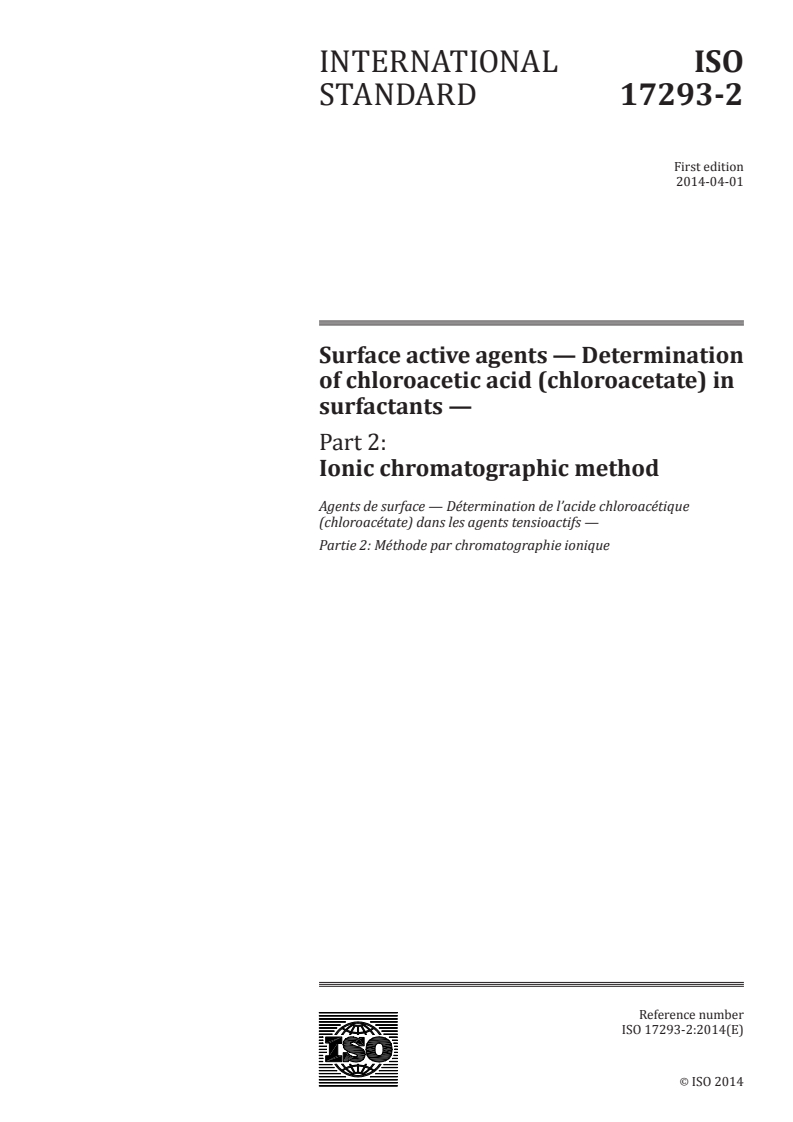
INTERNATIONAL ISO
STANDARD 17293-2
First edition
2014-04-01
Surface active agents — Determination
of chloroacetic acid (chloroacetate) in
surfactants —
Part 2:
Ionic chromatographic method
Agents de surface — Détermination de l’acide chloroacétique
(chloroacétate) dans les agents tensioactifs —
Partie 2: Méthode par chromatographie ionique
Reference number
©
ISO 2014
© ISO 2014
All rights reserved. Unless otherwise specified, no part of this publication may be reproduced or utilized otherwise in any form
or by any means, electronic or mechanical, including photocopying, or posting on the internet or an intranet, without prior
written permission. Permission can be requested from either ISO at the address below or ISO’s member body in the country of
the requester.
ISO copyright office
Case postale 56 • CH-1211 Geneva 20
Tel. + 41 22 749 01 11
Fax + 41 22 749 09 47
E-mail copyright@iso.org
Web www.iso.org
Published in Switzerland
ii © ISO 2014 – All rights reserved
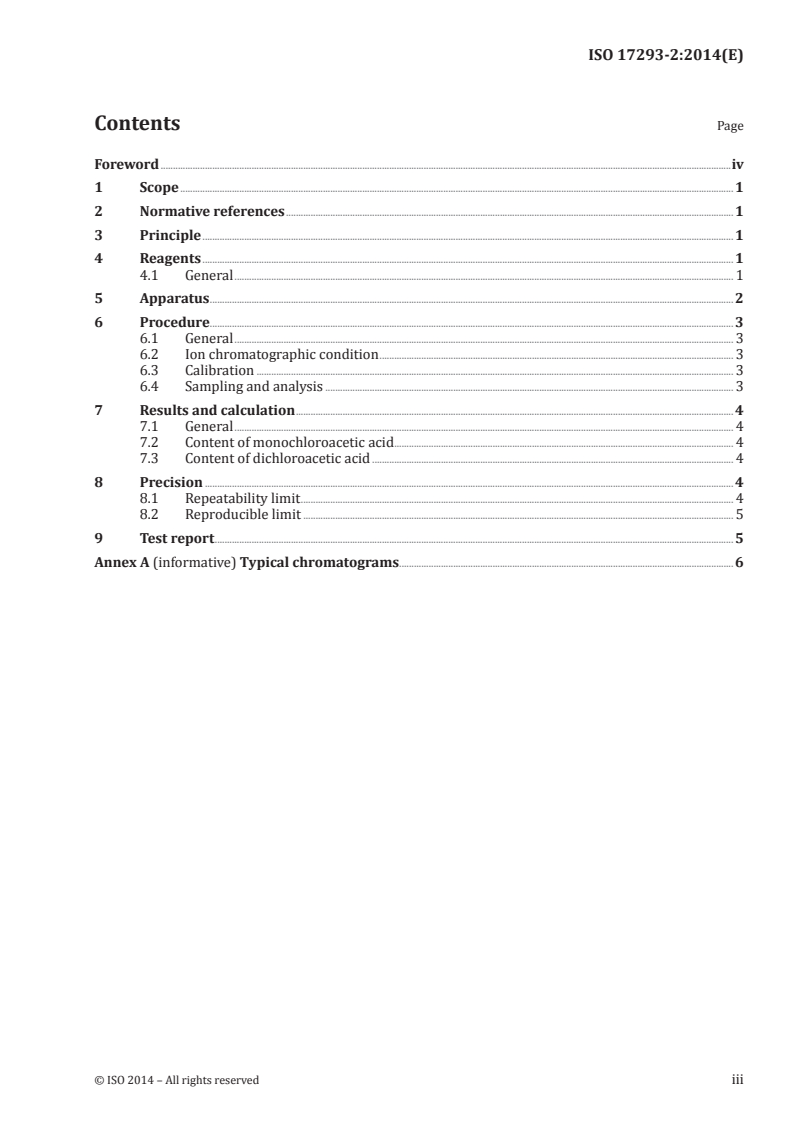
Contents Page
Foreword .iv
1 Scope . 1
2 Normative references . 1
3 Principle . 1
4 Reagents . 1
4.1 General . 1
5 Apparatus . 2
6 Procedure. 3
6.1 General . 3
6.2 Ion chromatographic condition . 3
6.3 Calibration . 3
6.4 Sampling and analysis . 3
7 Results and calculation . 4
7.1 General . 4
7.2 Content of monochloroacetic acid . 4
7.3 Content of dichloroacetic acid . 4
8 Precision . 4
8.1 Repeatability limit . 4
8.2 Reproducible limit . 5
9 Test report . 5
Annex A (informative) Typical chromatograms . 6
Foreword
ISO (the International Organization for Standardization) is a worldwide federation of national standards
bodies (ISO member bodies). The work of preparing International Standards is normally carried out
through ISO technical committees. Each member body interested in a subject for which a technical
committee has been established has the right to be represented on that committee. International
organizations, governmental and non-governmental, in liaison with ISO, also take part in the work.
ISO collaborates closely with the International Electrotechnical Commission (IEC) on all matters of
electrotechnical standardization.
The procedures used to develop this document and those intended for its further maintenance are
described in the ISO/IEC Directives, Part 1. In particular the different approval criteria needed for the
different types of ISO documents should be noted. This document was drafted in accordance with the
editorial rules of the ISO/IEC Directives, Part 2 (see www.iso.org/directives).
Attention is drawn to the possibility that some of the elements of this document may be the subject of
patent rights. ISO shall not be held responsible for identifying any or all such patent rights. Details of
any patent rights identified during the development of the document will be in the Introduction and/or
on the ISO list of patent declarations received (see www.iso.org/patents).
Any trade name used in this document is information given for the convenience of users and does not
constitute an endorsement.
For an explanation on the meaning of ISO specific terms and expressions related to conformity
assessment, as well as information about ISO’s adherence to the WTO principles in the Technical Barriers
to Trade (TBT) see the following URL: Foreword - Supplementary information
The committee responsible for this document is ISO/TC 91, Surface active agents.
ISO 17293 consists of the following parts, under the general title Surface active agents – Determination of
chloroacetic acid (chloroacetate) in surfactants:
— Part 1: HPLC method
— Part 2: Ionic chromatographic method
iv © ISO 2014 – All rights reserved
INTERNATIONAL STANDARD ISO 17293-2:2014(E)
Surface active agents — Determination of chloroacetic acid
(chloroacetate) in surfactants —
Part 2:
Ionic chromatographic method
1 Scope
This part of ISO 17293 specifies a method for the determination of monochloroacetic acid
(monochloroacetate) and dichloroacetic acid (dichloroacetate) in surfactants by ion chromatographic
method.
The method applies for anionic surfactants such as alkyl (phenyl) ethoxylated carboxylate (AEC) or
amphoteric surfactants such as alkyl imidazoline carboxylate, alkyl dimethyl betaine, and fatty acetyl
propyl dimethyl betaine.
The limit of detection (LOD) is ≤0,01 µg/ml for monochloroacetic acid and ≤0,05 µg/ml for dichloroacetic
acid; and the limit of quantification (LOQ) is ≤0,1 µg/ml for each standard (using a standard solution).
The LOD, at 1 g of sample weight, is ≤1 mg/kg for monochloroacetic acid and ≤5 mg/kg for dichloroacetic
acid; and the LOQ is ≤10 mg/kg for each acid.
2 Normative references
The following documents, in whole or in part, are
...
Questions, Comments and Discussion
Ask us and Technical Secretary will try to provide an answer. You can facilitate discussion about the standard in here.
Loading comments...