


ISO 5263:1979
(Main)Pulps — Laboratory wet disintegration
Pulps — Laboratory wet disintegration
Pâtes — Désintégration humide de laboratoire
General Information
- Status
- Withdrawn
- Publication Date
- 30-Apr-1979
- Withdrawal Date
- 30-Apr-1979
- Technical Committee
- ISO/TC 6 - Paper, board and pulps
- Drafting Committee
- ISO/TC 6 - Paper, board and pulps
- Current Stage
- 9599 - Withdrawal of International Standard
- Start Date
- 08-Jun-1995
- Completion Date
- 14-Feb-2026
Relations
- Effective Date
- 12-May-2008
- Effective Date
- 15-Apr-2008

Get Certified
Connect with accredited certification bodies for this standard

Control Union Certifications
Global certification for agriculture and sustainability.

Gozdarski inštitut Slovenije
Slovenian Forestry Institute. Forest management certification support, timber testing.
Sponsored listings
Frequently Asked Questions
ISO 5263:1979 is a standard published by the International Organization for Standardization (ISO). Its full title is "Pulps — Laboratory wet disintegration". This standard covers: Pulps — Laboratory wet disintegration
Pulps — Laboratory wet disintegration
ISO 5263:1979 is classified under the following ICS (International Classification for Standards) categories: 85.040 - Pulps. The ICS classification helps identify the subject area and facilitates finding related standards.
ISO 5263:1979 has the following relationships with other standards: It is inter standard links to SIST ISO 5263:1996, ISO 5263:1995. Understanding these relationships helps ensure you are using the most current and applicable version of the standard.
ISO 5263:1979 is available in PDF format for immediate download after purchase. The document can be added to your cart and obtained through the secure checkout process. Digital delivery ensures instant access to the complete standard document.
Standards Content (Sample)
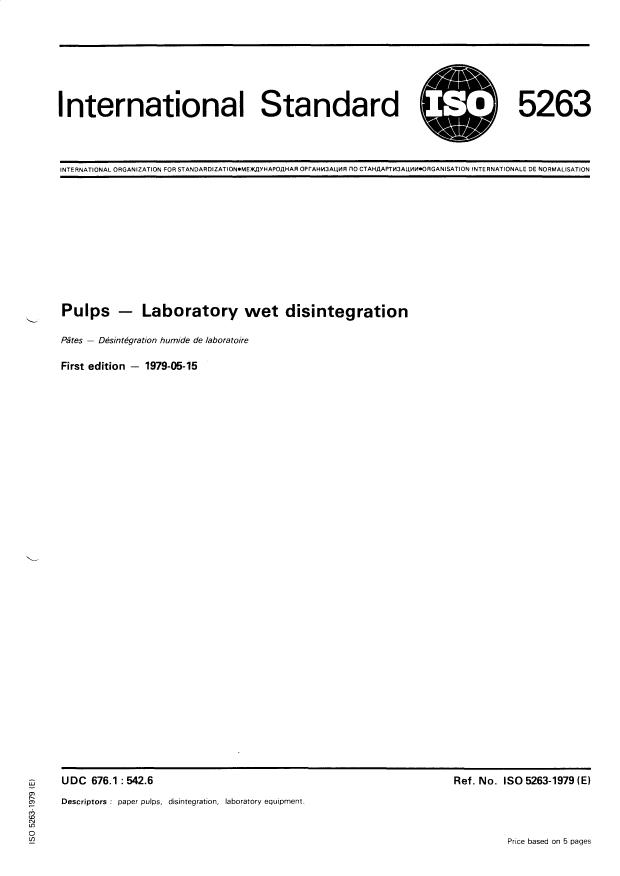
International Standard @ 5263
~
INTERNATIONAL ORGANIZATION FOR STANDARDIZATlONOME~YHAPOflHAR OPrAHH3AUMR Il0 CTAHflAPTH3AUMM.ORGANlSATlON INTERNATIONALE DE NORMALISATION
Pulps - Laboratory wet disintegration
L
Pâtes - Désintégration humide de laboratoire
First edition - 1979-05-15
- UDC 676.1 : 542.6 Ref. NO. IS0 5263-1979 (E)
E
o) r-
Descriptors : paper pulps, disintegration, laboratory equipment.
z
m
w
m
O
v,
Price based on 5 pages
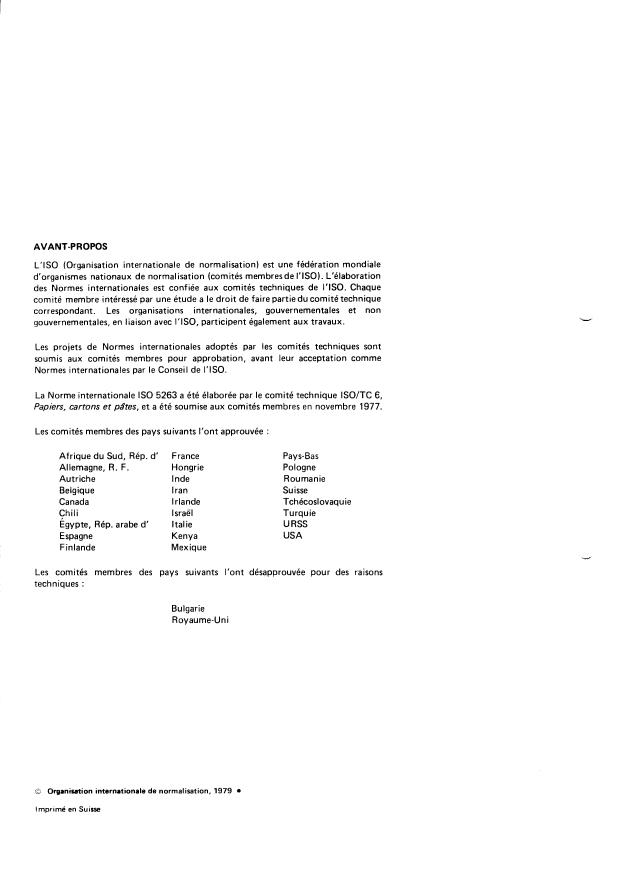
FOREWORD
IS0 (the International Organization for Standardization) is a worldwide federation
of national standards institutes (IS0 member bodies). The work of developing
International Standards is carried out through IS0 technical committees. Every
member body interested in a subject for which a technical committee has been set
up has the right to be represented on that committee. International organizations,
governmental and non-governmental, in liaison with ISO, also take part in the work.
Draft International Standards adopted by the technical committees are circulated
to the member bodies for approval before their acceptance as International
Standards by the IS0 Council.
International Standard IS0 5263 was developed by Technical Committee
ISO/TC 6, Paper, board and pulps, and was circulated to the member bodies in
November 1977.
It has been approved by the member bodies of the following countries :
Austria Hungary Poland
Belgium India Romania
Canada Iran South Africa, Rep. of
Chile Ireland Spain
Czechoslovakia Israel Switzerland
Egypt, Arab Rep. of Italy Turkey
Finland Kenya USA
France Mexico USSR
F. R.
Germany, Netherlands
The member bodies of the following countries expressed disapproval of the
document on technical grounds :
Bulgaria
United Kingdom
, International Organization for Standardization, 1979
Printed in Switzerland
INTERNATIONAL STANDARD IS0 5263-1979 (E)
Pulps - Laboratory wet disintegration
1 SCOPE AND FIELD OF APPLICATION of sheets or slabs, tear the soaked pulp into pieces of
dimensions approximately 25 mm x 25 mm.
This International Standard specifies a method for the
NOTES
disintegration of pulp in a laboratory wet disintegrator.
1 Distilled water or water of similar quality is particularly recorn-
This disintegration procedure does not apply to disinte-
mended with a view to obviating any difficulties that might arise
gration as a preliminary step for laboratory beating of pulp
from the use of different qualities of water by the interested parties.
in accordance with IS0 5264.
L
2 Where necessary for climatic reasons, a temperature of 25 f 5 "C
In principle this method is applicable to most kinds of pulp.
may be applied, provided that this is noted in the test report.
It is not suitable for some very long-fibred pulps, such as
3 Except with some flash-dried mechanical pulps, soaking for a
those from unshortened cotton, flax and similar materials.
longer time than specified, for example overnight, has not been
found to have any significant effect on the results.
2 REFERENCES
TABLE - Summary of the disintegration conditions
IS0 638, Pulps - Determination of dry matter content.
Dninte-
Kind of Massof Soaking gntion of revol-
IS0 41 19, Pulps - Determination of stock concentration.' )
Pulp Pulp time volume utions
rnl
9 [see note)
3 DEFINITION
Chemical 24 4h 2 O00 75 O00
disintegration of a pulp sample : Subjection to mechanical
Flash-dried
60 4h 2 700 30 O00
so that interlaced fibres, which were free
treatment in water
chemical
in the pulp stock, are again separated from one other
Mechanical 60 2 700
4h 30 O00
without appreciably changing their structural properties.
Flash-dried 60 10min 2700
30 O00
mechanical
4 APPARATUS
NOTE - Pulps having a dry matter content of less than 20 36 (rnlrn)
Ordinary laboratory apparatus and
shall be disintegrated for 10 O00 revolutions.
'. .
4.1 Disintegrator, as described in annex A.
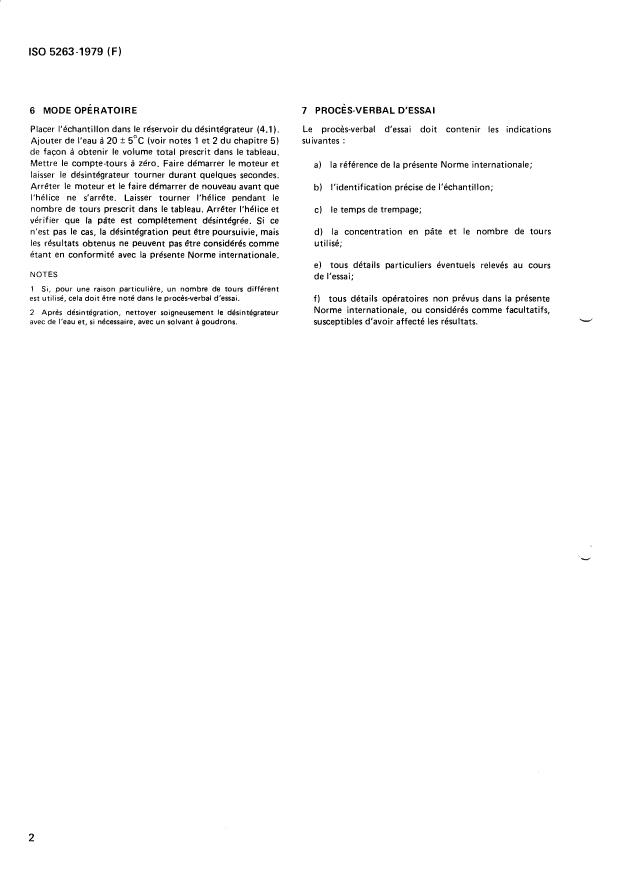
6 PROCEDURE
Details for checking the disintegrator are given in annex B.
Transfer the sample into the container of the disintegrator
(4.1). Add water at 20 f 5 OC (see notes 1 and 2 toclause 5)
4.2 Balance, capable of weighing the sample with an
to give the total volume prescribed in the table. Set the
accuracy of it 0.2 g.
revolution counter to zero. Switch the motor on and allow
the disintegrator to run for a few seconds. Switch the motor
5 PREPARATION OF SAMPLE
off and before the propeller stops, switch on again. Allow
the propeller to make the number of revolutions prescribed
If the pulp is wet or air-dry, weigh out a sample for dry
in the t
...
~ ~ ~~
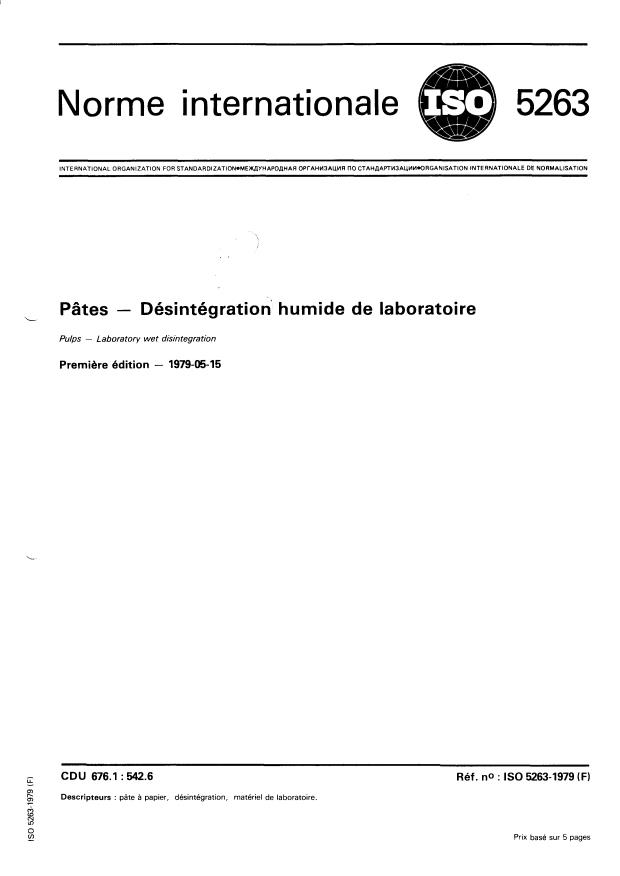
Norme internationale @ 5263
INTERNATIONAL ORGANIZATION FOR STANDARDIZATION*MEXllYHAPOnHAR OPTAHM3AUMR nO CTAHIIAF'TH3AUMM.ORGANlSATlON INTERNATIONALE DE NORMALISATION
Pâtes - Désintégration humide de laboratoire
L
Pulps - Laboratory wet disintegration
Première édition - 1979-05-15
- CDU 676.1 : 542.6
Réf. no : IS0 5263-1979 (FI
E
e
Descripteurs : pâte à papier, désintégration, matériel de laboratoire.
m
U
Prix basé sur 5 pages
E
AVANT-PROPOS
L'ISO (Organisation internationale de normalisation) est une fédération mondiale
d'organismes nationaux de normalisation (comités membresde I'ISO). L'élaboration
des Normes internationales est confiée aux comités techniques de I'ISO. Chaque
comité membre intéressé par une étude a le droit de faire partie du comité technique
correspondant. Les organisations internationales, gouvernementales et non
gouvernementales, en liaison avec I'ISO, participent également aux travaux.
Les projets de Normes internationales adoptés par les comités techniques sont
soumis aux comités membres pour approbation, avant leur acceptation comme
Normes internationales par le Conseil de I'ISO.
La Norme internationale IS0 5263 a été élaborée par le comité technique ISO/TC 6,
Papiers, cartons et p$tes, et a été soumise aux comités membres en novembre 1977.
Les comités membres des pays suivants l'ont approuvée :
Afrique du Sud, Rép. d' France Pays-Bas
Allemagne, R. F. Hongrie Pologne
Inde
Autriche Roumanie
Belgique I ran Suisse
Canada Irlande Tchécoslovaquie
Israël
Chili Turquie
ltal ie URSS
Egypte, Rép. arabe d'
Kenya USA
Espagne
Finlande
Mexique
Les comités membres des pays suivants l'ont désapprouvée pour des raisons
techniques :
Bulgarie
Royaume-Uni
O OrganiMion internationale de normalisation, 1979 0
Imprimé en Suisse
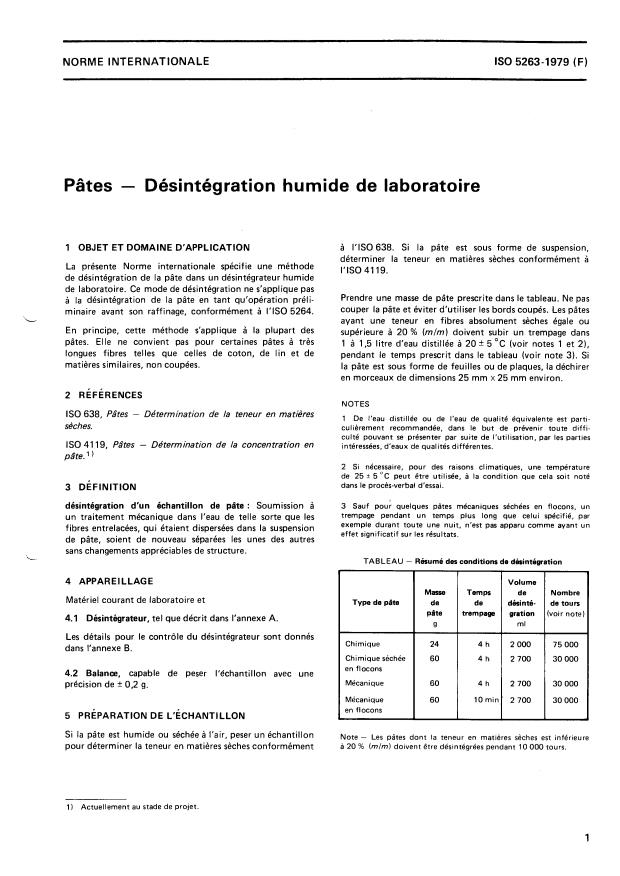
NORME INTERNATIONALE IS0 5263-1979 (F)
Pâtes - Désintégration humide de laboratoire
à I'ISO638. Si la pâte est sous forme de suspension,
1 OBJET ET DOMAINE D'APPLICATION
déterminer la teneur en matières sèches conformément à
La présente Norme internationale spécifie une méthode
1'1S0 41 19.
de désintégration de la pâte dans un désintégrateur humide
de laboratoire. Ce mode de désintégration ne s'applique pas
Prendre une masse de pâte prescrite dans le tableau. Ne pas
à la désintégration de la pâte en tant qu'opération préli-
couper la pâte et éviter d'utiliser les bords coupés. Les pâtes
minaire avant son raffinage, conformément à I'ISO 5264.
L
ayant une teneur en fibres absolument sèches égale ou
En principe, cette méthode s'applique à la plupart des
supérieure à 20% (mlm) doivent subir un trempage dans
pâtes. Elle ne convient pas pour certaines pâtes à très
1 à 1,5 litre d'eau distillée à 20 f 5 "C (voir notes 1 et 2),
longues fibres telles que celles de coton, de lin et de
pendant le temps prescrit dans le tableau (voir note 3). Si
matières similaires, non coupées.
la pâte est sous forme de feuilles ou de plaques, la déchirer
en morceaux de dimensions 25 mm x 25 mm environ.
2 REFERENCES
NOTES
IS0 638, Pâtes - Détermination de la teneur en matières
1 De l'eau distillée ou de l'eau de qualité équivalente est parti-
sèches.
culièrement recommandée, dans le but de prévenir toute diffi-
culté pouvant se présenter par suite de l'utilisation, par les parties
IS0 41 19, Pâtes - Détermination de la concentration en
intéressées, d'eaux de qualités différentes.
pâte. ' )
2 Si nécessaire, pour des raisons climatiques, une température
de 25 f 5 "C peut être utilisée, à la condition que cela soit noté
dans le procès-verbal d'essai.
3 DÉFINITION
désintégration d'un échantillon de pâte : Soumission à 3 Sauf pou; quelques pâtes mécaniques séchées en flocons, un
trempage pendant un temps plus long que celui spécifié, par
un traitement mécanique dans l'eau de telle sorte que les
nuit, n'est pas apparu comme ayant un
exemple durant toute une
fibres entrelacées, qui étaient dispersées dans la suspension
effet significatif sur les résultats.
de pâte, soient de nouveau séparées les unes des autres
sans changements appréciables de structure.
L
TABLEAU - Résumé des conditions de désintégration
~~
4 APPAREILLAGE
Volume
Mm
Temps de Nombre
Matériel courant de laboratoire et
Type de pâte
de de désinté- de tours
pâte
trempage gration voir note)
4.1 Désintégrateur, tel que décrit dans l'annexe A.
9 ml
Les détails pour le contrôle du désintégrateur sont donnés
Chimique 4 h
2000 75 O00
dans l'annexe B.
Chimique séchée 4 h
2700 30 O00
en flocons
4.2 Balance, capable de peser l'échantillon avec une
Mécanique 4 h 2700 30 O00
précision de f 0,2 g.
Mécanique L 60 10min 2700 30 O00
en flocons
5 PREPARATION DE L'ÉCHANTILLON
Si la pâte est humide ou séchée à l'air, peser un échantillon
Note - Les pâtes dont la teneur en matières sèches est inférieure
pour déterminer la teneur en matières sèches conformément à 20 % (rn/rn) doivent être désintégrées pendant 10 O00 tours.
Actuellement
...
Questions, Comments and Discussion
Ask us and Technical Secretary will try to provide an answer. You can facilitate discussion about the standard in here.
Loading comments...