

ISO 13357-2:2017
(Main)Petroleum products — Determination of the filterability of lubricating oils — Part 2: Procedure for dry oils
General Information
- Abstract
ISO 13357-2:2017 specifies a procedure for the evaluation of the filterability of dry lubricating oils, particularly those designed for hydraulic applications. The procedure only applies to mineral-based oils, since fluids manufactured from other materials (e.g. fire-resistant fluids) might not be compatible with the specified test membranes. The range of application has been evaluated with oils of viscosity up to ISO viscosity grade (VG) 100, as defined in ISO 3448. Within the range described, the filterability as defined is not dependent on the viscosity of the oil. The procedure is not suitable for some hydraulic oils on which specific properties have been conferred by the use of insoluble/partially soluble additives, or by particularly large molecular species. NOTE Filterability is a prime requirement for lubricating oils used in hydraulic systems because of the fine filters used in this application. ISO 13357-2:2017 defines a method for assessing the filterability of dry oils. It is necessary to note that some oils exhibit poorer filterability characteristics in the presence of contaminating water. ISO 13357‑1[2] applies to the investigation of the effect of water and high temperature on filterability, if an oil is used in applications where the presence of water in the oil is likely.
- Status
- Withdrawn
- Publication Date
- 08-May-2017
- Technical Committee
- ISO/TC 28 - Petroleum and related products, fuels and lubricants from natural or synthetic sources
- Drafting Committee
- ISO/TC 28/WG 12 - Test methods for hydraulic fluids and oils
- Current Stage
- 9599 - Withdrawal of International Standard
- Start Date
- 02-Apr-2025
- Completion Date
- 29-Aug-2026
Buy Documents
ISO 13357-2:2017 - Petroleum products -- Determination of the filterability of lubricating oils
ISO 13357-2:2017 - Petroleum products — Determination of the filterability of lubricating oils — Part 2: Procedure for dry oils/9/2017
Overview
ISO 13357-2:2017 - "Petroleum products - Determination of the filterability of lubricating oils - Part 2: Procedure for dry oils" - specifies a laboratory method to evaluate the filterability of dry, mineral-based lubricating oils (notably hydraulic oils). The method measures how readily an oil will pass fine filters used in hydraulic systems, using a membrane filtration test and two defined assessment stages (Stage I and Stage II). Results are reported as dimensionless filterability percentages averaged over three determinations.
Key topics and technical requirements
Scope and limitations
- Applies to mineral-based oils, evaluated up to ISO viscosity grade (VG) 100 (ISO 3448).
- Not suitable for some oils containing insoluble additives, very large molecular species, or fluids incompatible with the test membrane (e.g., many fire‑resistant fluids).
- Oils containing water or used at high temperature require ISO 13357-1 assessment.
Test principle
- Oil is filtered through a mixed cellulose ester membrane (47 mm diameter, mean pore size 0.8 µm) under controlled pressure.
- Filtration rates and times for defined filtrate volumes are recorded; filterability is calculated from ratios of early vs later filtration rates/volumes.
Defined measurements
- Stage I filterability: compares initial flow behaviour to a reference volume (procedure uses a 240 ml-based comparison).
- Stage II filterability: compares the initial flow rate to the flow rate between 200 ml and 300 ml of filtered volume - more sensitive to gels and fine silts.
Apparatus and conditions
- Stainless-steel filtration apparatus with an effective filtration area (approx. 1 130 mm² ± 60 mm²).
- Compressed dry gas supply with regulated pressures (nominally 50–200 kPa).
- Measuring cylinder (250 ml, additional graduations up to 300 ml) and timing device; oven for heating to 70 °C ± 10 °C when required.
- Use of reagent-grade wash solvents, filtered isopropyl alcohol and clean water per referenced ISO methods.
Result reporting
- Average of three determinations; test report includes conditions, membranes batch/source, and any deviations.
Applications and who uses it
- Quality control and R&D laboratories testing hydraulic oils and lubricants for fine-filter systems.
- Oil manufacturers benchmarking product filterability for hydraulic applications.
- Maintenance engineers, equipment OEMs and procurement teams specifying oils for systems with fine filtration (e.g., mobile and industrial hydraulics).
- Regulatory and certification bodies needing standardized test evidence of filtration performance.
Related standards
- ISO 13357-1 - Effect of water and high temperature on filterability
- ISO 3448 - Viscosity classification (VG grades)
- ISO 3170 - Sampling of petroleum liquids
- ISO 3696, ISO 4788, ISO 1219-1 - referenced laboratory and equipment requirements
Keywords: ISO 13357-2:2017, filterability test, lubricating oils, hydraulic oils, membrane filtration, 0.8 µm membrane, Stage I, Stage II, ISO viscosity grade.
Relations
- Effective Date
- 20-May-2023
- Effective Date
- 05-Apr-2014
Buy Documents
ISO 13357-2:2017 - Petroleum products -- Determination of the filterability of lubricating oils
ISO 13357-2:2017 - Petroleum products — Determination of the filterability of lubricating oils — Part 2: Procedure for dry oils/9/2017
Get Certified
Connect with accredited certification bodies for this standard

Element Materials Technology
Materials testing and product certification.

ABS Group Brazil
ABS Group certification services in Brazil.

ABS Quality Evaluations Inc.
American Bureau of Shipping quality certification.
Sponsored listings
Frequently Asked Questions
ISO 13357-2:2017 is a standard published by the International Organization for Standardization (ISO). Its full title is "Petroleum products — Determination of the filterability of lubricating oils — Part 2: Procedure for dry oils". This standard covers: ISO 13357-2:2017 specifies a procedure for the evaluation of the filterability of dry lubricating oils, particularly those designed for hydraulic applications. The procedure only applies to mineral-based oils, since fluids manufactured from other materials (e.g. fire-resistant fluids) might not be compatible with the specified test membranes. The range of application has been evaluated with oils of viscosity up to ISO viscosity grade (VG) 100, as defined in ISO 3448. Within the range described, the filterability as defined is not dependent on the viscosity of the oil. The procedure is not suitable for some hydraulic oils on which specific properties have been conferred by the use of insoluble/partially soluble additives, or by particularly large molecular species. NOTE Filterability is a prime requirement for lubricating oils used in hydraulic systems because of the fine filters used in this application. ISO 13357-2:2017 defines a method for assessing the filterability of dry oils. It is necessary to note that some oils exhibit poorer filterability characteristics in the presence of contaminating water. ISO 13357‑1[2] applies to the investigation of the effect of water and high temperature on filterability, if an oil is used in applications where the presence of water in the oil is likely.
ISO 13357-2:2017 specifies a procedure for the evaluation of the filterability of dry lubricating oils, particularly those designed for hydraulic applications. The procedure only applies to mineral-based oils, since fluids manufactured from other materials (e.g. fire-resistant fluids) might not be compatible with the specified test membranes. The range of application has been evaluated with oils of viscosity up to ISO viscosity grade (VG) 100, as defined in ISO 3448. Within the range described, the filterability as defined is not dependent on the viscosity of the oil. The procedure is not suitable for some hydraulic oils on which specific properties have been conferred by the use of insoluble/partially soluble additives, or by particularly large molecular species. NOTE Filterability is a prime requirement for lubricating oils used in hydraulic systems because of the fine filters used in this application. ISO 13357-2:2017 defines a method for assessing the filterability of dry oils. It is necessary to note that some oils exhibit poorer filterability characteristics in the presence of contaminating water. ISO 13357‑1[2] applies to the investigation of the effect of water and high temperature on filterability, if an oil is used in applications where the presence of water in the oil is likely.
ISO 13357-2:2017 is classified under the following ICS (International Classification for Standards) categories: 75.100 - Lubricants, industrial oils and related products. The ICS classification helps identify the subject area and facilitates finding related standards.
ISO 13357-2:2017 has the following relationships with other standards: It is inter standard links to ISO 13357-2:2025, ISO 13357-2:2005. Understanding these relationships helps ensure you are using the most current and applicable version of the standard.
ISO 13357-2:2017 is available in PDF format for immediate download after purchase. The document can be added to your cart and obtained through the secure checkout process. Digital delivery ensures instant access to the complete standard document.
Standards Content (Sample)
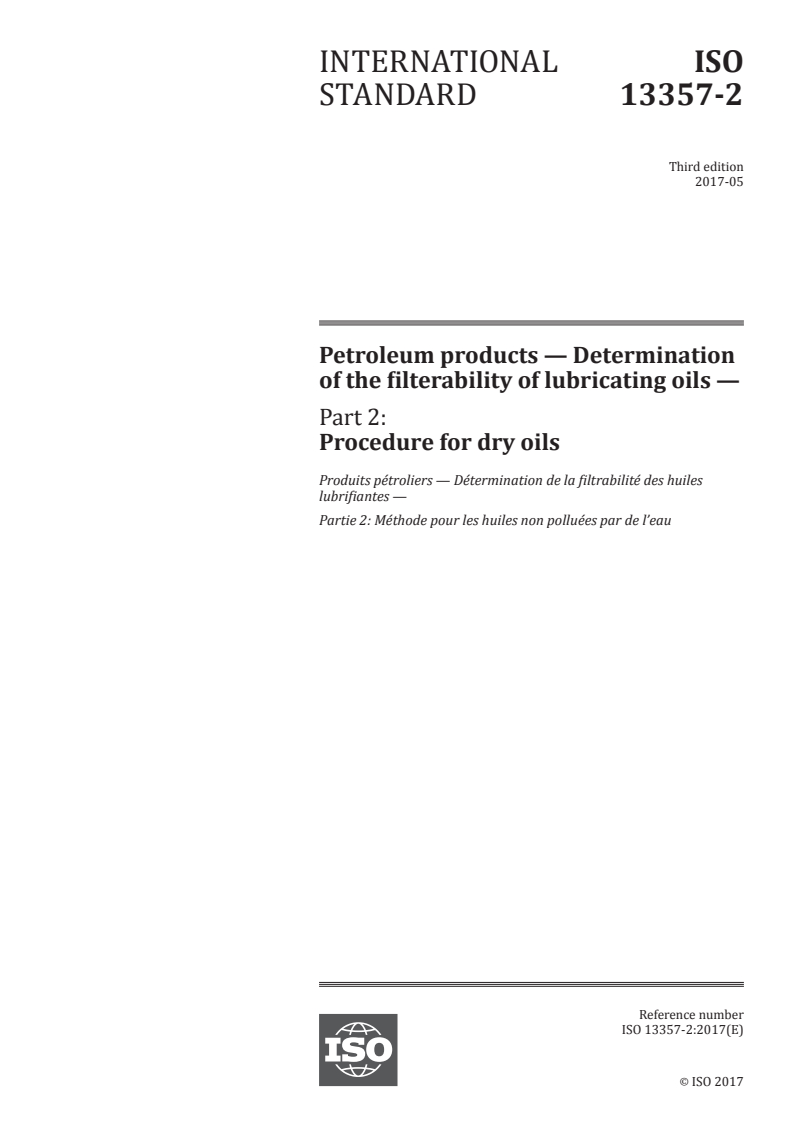
INTERNATIONAL ISO
STANDARD 13357-2
Third edition
2017-05
Petroleum products — Determination
of the filterability of lubricating oils —
Part 2:
Procedure for dry oils
Produits pétroliers — Détermination de la filtrabilité des huiles
lubrifiantes —
Partie 2: Méthode pour les huiles non polluées par de l’eau
Reference number
©
ISO 2017
© ISO 2017, Published in Switzerland
All rights reserved. Unless otherwise specified, no part of this publication may be reproduced or utilized otherwise in any form
or by any means, electronic or mechanical, including photocopying, or posting on the internet or an intranet, without prior
written permission. Permission can be requested from either ISO at the address below or ISO’s member body in the country of
the requester.
ISO copyright office
Ch. de Blandonnet 8 • CP 401
CH-1214 Vernier, Geneva, Switzerland
Tel. +41 22 749 01 11
Fax +41 22 749 09 47
copyright@iso.org
www.iso.org
ii © ISO 2017 – All rights reserved
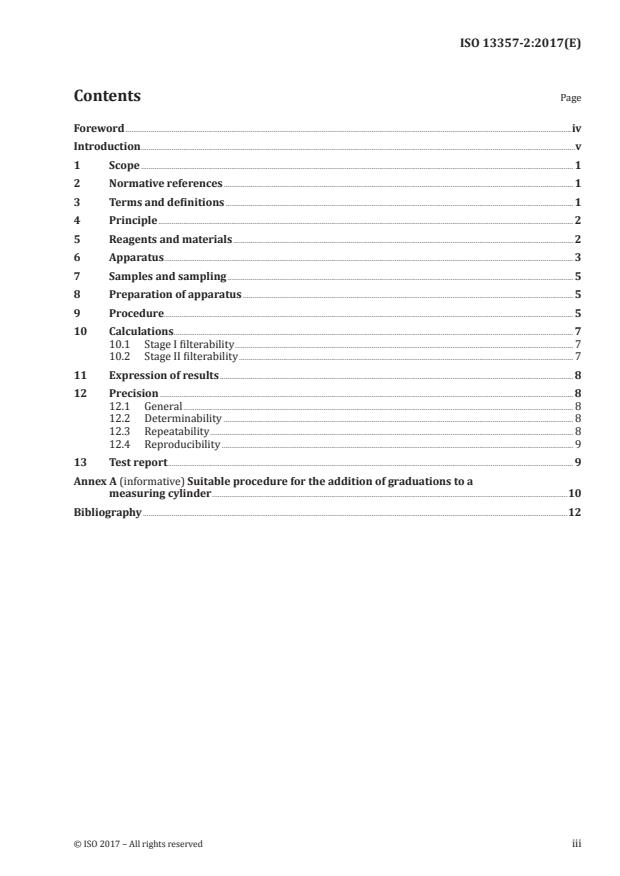
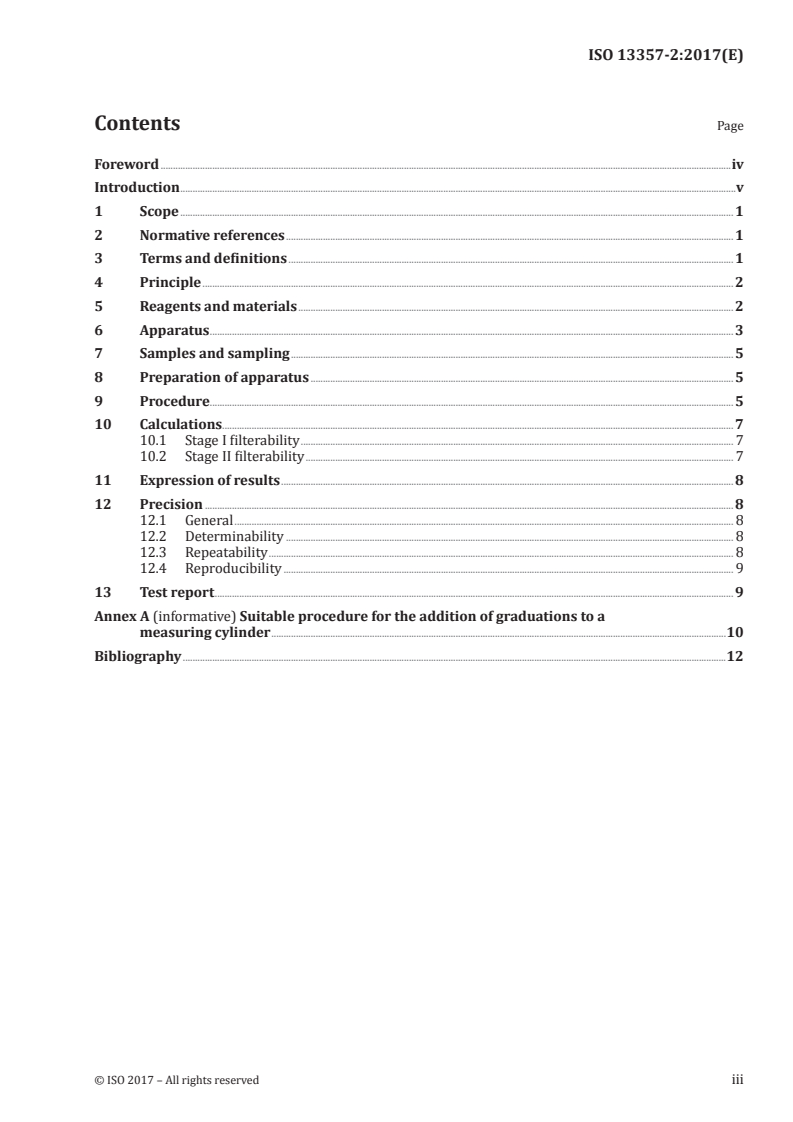
Contents Page
Foreword .iv
Introduction .v
1 Scope . 1
2 Normative references . 1
3 Terms and definitions . 1
4 Principle . 2
5 Reagents and materials . 2
6 Apparatus . 3
7 Samples and sampling . 5
8 Preparation of apparatus . 5
9 Procedure. 5
10 Calculations. 7
10.1 Stage I filterability . 7
10.2 Stage II filterability . 7
11 Expression of results . 8
12 Precision . 8
12.1 General . 8
12.2 Determinability . 8
12.3 Repeatability . 8
12.4 Reproducibility . 9
13 Test report . 9
Annex A (informative) Suitable procedure for the addition of graduations to a
measuring cylinder .10
Bibliography .12
Foreword
ISO (the International Organization for Standardization) is a worldwide federation of national standards
bodies (ISO member bodies). The work of preparing International Standards is normally carried out
through ISO technical committees. Each member body interested in a subject for which a technical
committee has been established has the right to be represented on that committee. International
organizations, governmental and non-governmental, in liaison with ISO, also take part in the work.
ISO collaborates closely with the International Electrotechnical Commission (IEC) on all matters of
electrotechnical standardization.
The procedures used to develop this document and those intended for its further maintenance are
described in the ISO/IEC Directives, Part 1. In particular the different approval criteria needed for the
different types of ISO documents should be noted. This document was drafted in accordance with the
editorial rules of the ISO/IEC Directives, Part 2 (see www .iso .org/ directives).
Attention is drawn to the possibility that some of the elements of this document may be the subject of
patent rights. ISO shall not be held responsible for identifying any or all such patent rights. Details of
any patent rights identified during the development of the document will be in the Introduction and/or
on the ISO list of patent declarations received (see www .iso .org/ patents).
Any trade name used in this document is information given for the convenience of users and does not
constitute an endorsement.
For an explanation on the meaning of ISO specific terms and expressions related to conformity assessment,
as well as information about ISO’s adherence to the World Trade Organization (WTO) principles in the
Technical Barriers to Trade (TBT) see the following URL: www . i so .org/ iso/ foreword .html.
The committee responsible for this document is ISO/TC 28, Petroleum products and related products of
synthetic or biological origin.
This third edition cancels and replaces the second edition (ISO 13357-2:2005), of which it constitutes a
minor revision including alternative membranes in order to enable the continued use of this document.
A list of all parts in the ISO 13357 series can be found on the ISO website.
iv © ISO 2017 – All rights reserved
Introduction
The fluid in a hydraulic system acts as a lubricant, and to minimize wear of the components, it is
important to reduce the concentrations of circulating hard contaminant particles. This is particularly
necessary when the performance of the system depends on the maintenance of small clearances and
orifices. Removal of these contaminants is effected by the use of filters, and the ability of a hydraulic
fluid to pass through fine filters, without plugging them, is called its “filterability”. This document
describes a laboratory test procedure for assessing the filterability of mineral oils in a dry state.
Filterability so determined is not a physical characteristic of the oil, but represents an estimation of its
behaviour in service.
This document describes two measurements, referred to as “stages”. The Stage I determination is based
on a comparison of the mean flow rate of a fluid through a test membrane with its initial flow rate. Oils
having good Stage I filterability, but only a poor Stage II performance (see below), would be unlikely to
give performance problems in use, unless extremely fine system filters are utilized.
The Stage II determination is based upon the ratio between the initial flow rate of fluid through the
test membrane and the rate at the end of the test. It is considered that this part of the procedure is a
more severe test, and is more sensitive to the presence of gels and fine silts in the oil. Silts and gels may
be present in an oil when it is produced, or could be formed as an oil ages, especially when hot. An oil
with good Stage II filterability would be unlikely to give filtration problems even in the most extreme
conditions, and with fine (less than 5 µm) filtration present. It would thus be suitable for use in more
critical hydraulic and lubrication systems.
The procedure has been evaluated with mineral oils up to ISO viscosity grade 100. There would appear
to be no practical reason why it should not be used with oils of higher viscosity grades, but the data
obtained could not be claimed to be completely in accordance with this method. Similarly, it should
be possible to extend the test procedure to fluids other than mineral oils. However, some fluids, e.g.
fire-resistant fluids, will not be compatible with the specified test membranes, and the test could only
be used for comparison purposes even when suitable membranes, with similar pore size/pore density
characteristics to those specified in this procedure, have been identified.
INTERNATIONAL STANDARD ISO 13357-2:2017(E)
Petroleum products — Determination of the filterability of
lubricating oils —
Part 2:
Procedure for dry oils
WARNING — The use of this document can involve hazardous materials, operations and
equipment. This document does not purport to address all of the safety problems associated
with its use. It is the responsibility of the user of this document to establish appropriate safety
and health practices and determine the applicability of regulatory limitations prior to use.
1 Scope
This document specifies a procedure for the evaluation of the filterability of dry lubricating oils,
particularly those designed for hydraulic applications. The procedure only applies to mineral-based
oils, since fluids manufactured from other materials (e.g. fire-resistant fluids) might not be compatible
with the specified test membranes. The range of application has been evaluated with oils of viscosity up
to ISO viscosity grade (VG) 100, as defined in ISO 3448. Within the range described, the filterability as
defined is not dependent on the viscosity of the oil. The procedure is not suitable for some hydraulic oils
on which specific properties have been conferred by the use of insoluble/partially soluble additives, or
by particularly large molecular species.
NOTE Filterability is a prime requirement for lubricating oils used in hydraulic systems because of the fine
filters used in this application.
This document defines a method for assessing the filterability of dry oils. It is necessary to note
that some oils exhibit poorer filterability characteristics in the presence of contaminating water.
[2]
ISO 13357-1 applies to the investigation of the effect of water and high temperature on filterability, if
an oil is used in applications where the presence of water in the oil is likely.
2 Normative references
The following documents are referred to in the text in such a way that some or all of their content
constitutes requirements of this document. For dated references, only the edition cited applies. For
undated references, the latest edition of the referenced document (including any amendments) applies.
ISO 1219-1, Fluid power systems and components — Graphical symbols and circuit diagrams — Part 1:
Graphical symbols for conventional use and data-processing applications
ISO 3170, Petroleum liquids — Manual sampling
ISO 3448, Industrial liquid lubricants — ISO viscosity classification
ISO 3696, Water for analytical laboratory use — Specification and test methods
ISO 4788, Laboratory glassware — Graduated measuring cylinders
3 Terms and definitions
For the purposes of this document, the following terms and definitions apply.
ISO and IEC maintain terminological databases for use in standardization at the following addresses:
— IEC Electropedia: available at http:// www .electropedia .org/
— ISO Online browsing platform: available at http:// www .iso .org/ obp
3.1
filterability
dimensionless number, expressed as a percentage, between volumes (Stage I) or flow rates (Stage II) at
specified intervals in the test procedure
3.2
stage I filterability
ratio, expressed as a percentage, between 240 ml and the volume of oil actually filtered in the time that
240 ml would have theoretically taken, assuming no plugging of the membrane
3.3
stage II filterability
ratio, expressed as a percentage, between the flow rate near the start of the filtration, and the flow rate
between 200 ml and 300 ml of filtered volume
4 Principle
The test fluid is filtered under specified conditions through a membrane of 0,8 µm mean pore diameter
and the times for the specified filtrate volumes are recorded. Filterabilities are calculated from ratios
of the filtration rate near the start of
...
INTERNATIONAL ISO
STANDARD 13357-2
Third edition
2017-05
Petroleum products — Determination
of the filterability of lubricating oils —
Part 2:
Procedure for dry oils
Produits pétroliers — Détermination de la filtrabilité des huiles
lubrifiantes —
Partie 2: Méthode pour les huiles non polluées par de l’eau
Reference number
©
ISO 2017
© ISO 2017, Published in Switzerland
All rights reserved. Unless otherwise specified, no part of this publication may be reproduced or utilized otherwise in any form
or by any means, electronic or mechanical, including photocopying, or posting on the internet or an intranet, without prior
written permission. Permission can be requested from either ISO at the address below or ISO’s member body in the country of
the requester.
ISO copyright office
Ch. de Blandonnet 8 • CP 401
CH-1214 Vernier, Geneva, Switzerland
Tel. +41 22 749 01 11
Fax +41 22 749 09 47
copyright@iso.org
www.iso.org
ii © ISO 2017 – All rights reserved
Contents Page
Foreword .iv
Introduction .v
1 Scope . 1
2 Normative references . 1
3 Terms and definitions . 1
4 Principle . 2
5 Reagents and materials . 2
6 Apparatus . 3
7 Samples and sampling . 5
8 Preparation of apparatus . 5
9 Procedure. 5
10 Calculations. 7
10.1 Stage I filterability . 7
10.2 Stage II filterability . 7
11 Expression of results . 8
12 Precision . 8
12.1 General . 8
12.2 Determinability . 8
12.3 Repeatability . 8
12.4 Reproducibility . 9
13 Test report . 9
Annex A (informative) Suitable procedure for the addition of graduations to a
measuring cylinder .10
Bibliography .12
Foreword
ISO (the International Organization for Standardization) is a worldwide federation of national standards
bodies (ISO member bodies). The work of preparing International Standards is normally carried out
through ISO technical committees. Each member body interested in a subject for which a technical
committee has been established has the right to be represented on that committee. International
organizations, governmental and non-governmental, in liaison with ISO, also take part in the work.
ISO collaborates closely with the International Electrotechnical Commission (IEC) on all matters of
electrotechnical standardization.
The procedures used to develop this document and those intended for its further maintenance are
described in the ISO/IEC Directives, Part 1. In particular the different approval criteria needed for the
different types of ISO documents should be noted. This document was drafted in accordance with the
editorial rules of the ISO/IEC Directives, Part 2 (see www .iso .org/ directives).
Attention is drawn to the possibility that some of the elements of this document may be the subject of
patent rights. ISO shall not be held responsible for identifying any or all such patent rights. Details of
any patent rights identified during the development of the document will be in the Introduction and/or
on the ISO list of patent declarations received (see www .iso .org/ patents).
Any trade name used in this document is information given for the convenience of users and does not
constitute an endorsement.
For an explanation on the meaning of ISO specific terms and expressions related to conformity assessment,
as well as information about ISO’s adherence to the World Trade Organization (WTO) principles in the
Technical Barriers to Trade (TBT) see the following URL: www . i so .org/ iso/ foreword .html.
The committee responsible for this document is ISO/TC 28, Petroleum products and related products of
synthetic or biological origin.
This third edition cancels and replaces the second edition (ISO 13357-2:2005), of which it constitutes a
minor revision including alternative membranes in order to enable the continued use of this document.
A list of all parts in the ISO 13357 series can be found on the ISO website.
iv © ISO 2017 – All rights reserved
Introduction
The fluid in a hydraulic system acts as a lubricant, and to minimize wear of the components, it is
important to reduce the concentrations of circulating hard contaminant particles. This is particularly
necessary when the performance of the system depends on the maintenance of small clearances and
orifices. Removal of these contaminants is effected by the use of filters, and the ability of a hydraulic
fluid to pass through fine filters, without plugging them, is called its “filterability”. This document
describes a laboratory test procedure for assessing the filterability of mineral oils in a dry state.
Filterability so determined is not a physical characteristic of the oil, but represents an estimation of its
behaviour in service.
This document describes two measurements, referred to as “stages”. The Stage I determination is based
on a comparison of the mean flow rate of a fluid through a test membrane with its initial flow rate. Oils
having good Stage I filterability, but only a poor Stage II performance (see below), would be unlikely to
give performance problems in use, unless extremely fine system filters are utilized.
The Stage II determination is based upon the ratio between the initial flow rate of fluid through the
test membrane and the rate at the end of the test. It is considered that this part of the procedure is a
more severe test, and is more sensitive to the presence of gels and fine silts in the oil. Silts and gels may
be present in an oil when it is produced, or could be formed as an oil ages, especially when hot. An oil
with good Stage II filterability would be unlikely to give filtration problems even in the most extreme
conditions, and with fine (less than 5 µm) filtration present. It would thus be suitable for use in more
critical hydraulic and lubrication systems.
The procedure has been evaluated with mineral oils up to ISO viscosity grade 100. There would appear
to be no practical reason why it should not be used with oils of higher viscosity grades, but the data
obtained could not be claimed to be completely in accordance with this method. Similarly, it should
be possible to extend the test procedure to fluids other than mineral oils. However, some fluids, e.g.
fire-resistant fluids, will not be compatible with the specified test membranes, and the test could only
be used for comparison purposes even when suitable membranes, with similar pore size/pore density
characteristics to those specified in this procedure, have been identified.
INTERNATIONAL STANDARD ISO 13357-2:2017(E)
Petroleum products — Determination of the filterability of
lubricating oils —
Part 2:
Procedure for dry oils
WARNING — The use of this document can involve hazardous materials, operations and
equipment. This document does not purport to address all of the safety problems associated
with its use. It is the responsibility of the user of this document to establish appropriate safety
and health practices and determine the applicability of regulatory limitations prior to use.
1 Scope
This document specifies a procedure for the evaluation of the filterability of dry lubricating oils,
particularly those designed for hydraulic applications. The procedure only applies to mineral-based
oils, since fluids manufactured from other materials (e.g. fire-resistant fluids) might not be compatible
with the specified test membranes. The range of application has been evaluated with oils of viscosity up
to ISO viscosity grade (VG) 100, as defined in ISO 3448. Within the range described, the filterability as
defined is not dependent on the viscosity of the oil. The procedure is not suitable for some hydraulic oils
on which specific properties have been conferred by the use of insoluble/partially soluble additives, or
by particularly large molecular species.
NOTE Filterability is a prime requirement for lubricating oils used in hydraulic systems because of the fine
filters used in this application.
This document defines a method for assessing the filterability of dry oils. It is necessary to note
that some oils exhibit poorer filterability characteristics in the presence of contaminating water.
[2]
ISO 13357-1 applies to the investigation of the effect of water and high temperature on filterability, if
an oil is used in applications where the presence of water in the oil is likely.
2 Normative references
The following documents are referred to in the text in such a way that some or all of their content
constitutes requirements of this document. For dated references, only the edition cited applies. For
undated references, the latest edition of the referenced document (including any amendments) applies.
ISO 1219-1, Fluid power systems and components — Graphical symbols and circuit diagrams — Part 1:
Graphical symbols for conventional use and data-processing applications
ISO 3170, Petroleum liquids — Manual sampling
ISO 3448, Industrial liquid lubricants — ISO viscosity classification
ISO 3696, Water for analytical laboratory use — Specification and test methods
ISO 4788, Laboratory glassware — Graduated measuring cylinders
3 Terms and definitions
For the purposes of this document, the following terms and definitions apply.
ISO and IEC maintain terminological databases for use in standardization at the following addresses:
— IEC Electropedia: available at http:// www .electropedia .org/
— ISO Online browsing platform: available at http:// www .iso .org/ obp
3.1
filterability
dimensionless number, expressed as a percentage, between volumes (Stage I) or flow rates (Stage II) at
specified intervals in the test procedure
3.2
stage I filterability
ratio, expressed as a percentage, between 240 ml and the volume of oil actually filtered in the time that
240 ml would have theoretically taken, assuming no plugging of the membrane
3.3
stage II filterability
ratio, expressed as a percentage, between the flow rate near the start of the filtration, and the flow rate
between 200 ml and 300 ml of filtered volume
4 Principle
The test fluid is filtered under specified conditions through a membrane of 0,8 µm mean pore diameter
and the times for the specified filtrate volumes are recorded. Filterabilities are calculated from ratios
of the filtration rate near the start of
...