


ISO 8041:2005
(Main)Human response to vibration — Measuring instrumentation
Human response to vibration — Measuring instrumentation
ISO 8041:2005 specifies the performance specifications and tolerance limits for instruments designed to measure vibration values, for the purpose of assessing human response to vibration. It includes requirements for pattern evaluation, periodic verification and in-situ checks, and the specification of vibration calibrators for in-situ checks. Vibration instruments specified in ISO 8041:2005 can be single instruments, combinations of instrumentation or computer-based acquisition and analysis systems. Three levels of performance testing are defined in ISO 8041:2005: pattern evaluation, i.e. a full test of the instrument against the specifications defined in this International Standard; periodic verification, i.e. an intermediate set of tests designed to ensure that an instrument remains within the required performance specification, and in-situ checks, i.e. a minimum level of testing required to indicate that an instrument is likely to be functioning within the required performance specification.
Réponse des individus aux vibrations — Appareillage de mesure
L'ISO 8041:2005 donne les spécifications de performances et les limites de tolérance pour les instruments destinés à mesurer les valeurs de vibration afin d'évaluer la réponse des individus aux vibrations. Elle inclut les exigences relatives aux essais de conformité, à la vérification périodique et aux contrôles in-situ, ainsi que la spécification concernant les calibrateurs de vibration destinés aux contrôles in-situ. Les instruments de mesure des vibrations spécifiés dans l'ISO 8041:2005 peuvent être des instruments simples, des combinaisons d'instruments ou des systèmes d'acquisition et d'analyse informatisés. Trois niveaux de vérification des performances sont définis dans l'ISO 8041:2005: les essais de conformité, c'est-à-dire un essai complet de l'instrument par rapport aux spécifications définies dans la présente Norme internationale; la vérification périodique, c'est-à-dire un ensemble intermédiaire d'essais destiné à s'assurer qu'un instrument donné relève effectivement de la spécification de performances requise, et contrôles in-situ, c'est-à-dire un niveau minimal de vérification à appliquer pour indiquer que le fonctionnement d'un instrument donné relève vraisemblablement de la spécification de performances requise.
General Information
- Status
- Withdrawn
- Publication Date
- 05-Apr-2005
- Withdrawal Date
- 05-Apr-2005
- Technical Committee
- ISO/TC 108 - Mechanical vibration, shock and condition monitoring
- Drafting Committee
- ISO/TC 108 - Mechanical vibration, shock and condition monitoring
- Current Stage
- 9599 - Withdrawal of International Standard
- Start Date
- 03-May-2017
- Completion Date
- 14-Feb-2026
Relations
- Consolidates
EN ISO 8041:2005 - Human response to vibration - Measuring instrumentation (ISO 8041:2005) - Effective Date
- 12-Feb-2026
- Effective Date
- 06-Jun-2022
- Effective Date
- 07-May-2016
- Effective Date
- 23-Jan-2016
- Revises
ISO 8041:1990/Amd 1:1999 - Human response to vibration — Measuring instrumentation — Amendment 1 - Effective Date
- 15-Apr-2008
- Effective Date
- 15-Apr-2008
- Effective Date
- 15-Apr-2008
Buy Documents
ISO 8041:2005 - Human response to vibration -- Measuring instrumentation
ISO 8041:2005 - Réponse des individus aux vibrations -- Appareillage de mesure
Get Certified
Connect with accredited certification bodies for this standard

NSF International
Global independent organization facilitating standards development and certification.

CIS Institut d.o.o.
Personal Protective Equipment (PPE) certification body. Notified Body NB-2890 for EU Regulation 2016/425 PPE.

Kiwa BDA Testing
Building and construction product certification.
Sponsored listings
Frequently Asked Questions
ISO 8041:2005 is a standard published by the International Organization for Standardization (ISO). Its full title is "Human response to vibration — Measuring instrumentation". This standard covers: ISO 8041:2005 specifies the performance specifications and tolerance limits for instruments designed to measure vibration values, for the purpose of assessing human response to vibration. It includes requirements for pattern evaluation, periodic verification and in-situ checks, and the specification of vibration calibrators for in-situ checks. Vibration instruments specified in ISO 8041:2005 can be single instruments, combinations of instrumentation or computer-based acquisition and analysis systems. Three levels of performance testing are defined in ISO 8041:2005: pattern evaluation, i.e. a full test of the instrument against the specifications defined in this International Standard; periodic verification, i.e. an intermediate set of tests designed to ensure that an instrument remains within the required performance specification, and in-situ checks, i.e. a minimum level of testing required to indicate that an instrument is likely to be functioning within the required performance specification.
ISO 8041:2005 specifies the performance specifications and tolerance limits for instruments designed to measure vibration values, for the purpose of assessing human response to vibration. It includes requirements for pattern evaluation, periodic verification and in-situ checks, and the specification of vibration calibrators for in-situ checks. Vibration instruments specified in ISO 8041:2005 can be single instruments, combinations of instrumentation or computer-based acquisition and analysis systems. Three levels of performance testing are defined in ISO 8041:2005: pattern evaluation, i.e. a full test of the instrument against the specifications defined in this International Standard; periodic verification, i.e. an intermediate set of tests designed to ensure that an instrument remains within the required performance specification, and in-situ checks, i.e. a minimum level of testing required to indicate that an instrument is likely to be functioning within the required performance specification.
ISO 8041:2005 is classified under the following ICS (International Classification for Standards) categories: 13.160 - Vibration and shock with respect to human beings. The ICS classification helps identify the subject area and facilitates finding related standards.
ISO 8041:2005 has the following relationships with other standards: It is inter standard links to EN ISO 8041:2005, ISO 5166:1982, ISO 8041-2:2021, ISO 8041-1:2017, ISO 8041:1990/Amd 1:1999, ISO 8041:1990, ISO 8041:1990/Cor 1:1993. Understanding these relationships helps ensure you are using the most current and applicable version of the standard.
ISO 8041:2005 is available in PDF format for immediate download after purchase. The document can be added to your cart and obtained through the secure checkout process. Digital delivery ensures instant access to the complete standard document.
Standards Content (Sample)
INTERNATIONAL ISO
STANDARD 8041
Second edition
2005-04-01
Human response to vibration —
Measuring instrumentation
Réponse des individus aux vibrations — Appareillage de mesure
Reference number
©
ISO 2005
PDF disclaimer
This PDF file may contain embedded typefaces. In accordance with Adobe's licensing policy, this file may be printed or viewed but
shall not be edited unless the typefaces which are embedded are licensed to and installed on the computer performing the editing. In
downloading this file, parties accept therein the responsibility of not infringing Adobe's licensing policy. The ISO Central Secretariat
accepts no liability in this area.
Adobe is a trademark of Adobe Systems Incorporated.
Details of the software products used to create this PDF file can be found in the General Info relative to the file; the PDF-creation
parameters were optimized for printing. Every care has been taken to ensure that the file is suitable for use by ISO member bodies. In
the unlikely event that a problem relating to it is found, please inform the Central Secretariat at the address given below.
© ISO 2005
All rights reserved. Unless otherwise specified, no part of this publication may be reproduced or utilized in any form or by any means,
electronic or mechanical, including photocopying and microfilm, without permission in writing from either ISO at the address below or
ISO's member body in the country of the requester.
ISO copyright office
Case postale 56 • CH-1211 Geneva 20
Tel. + 41 22 749 01 11
Fax + 41 22 749 09 47
E-mail copyright@iso.org
Web www.iso.org
Published in Switzerland
ii © ISO 2005 – All rights reserved
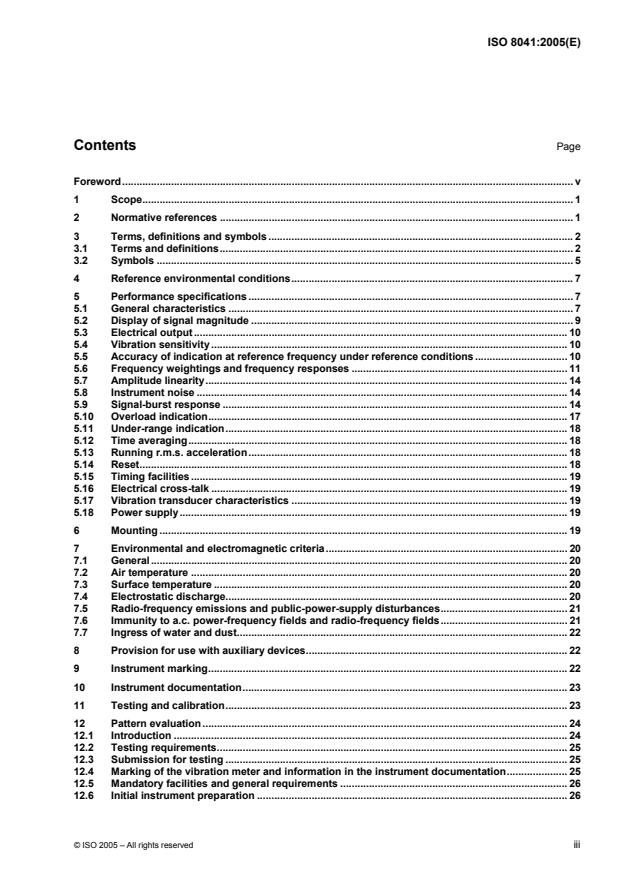
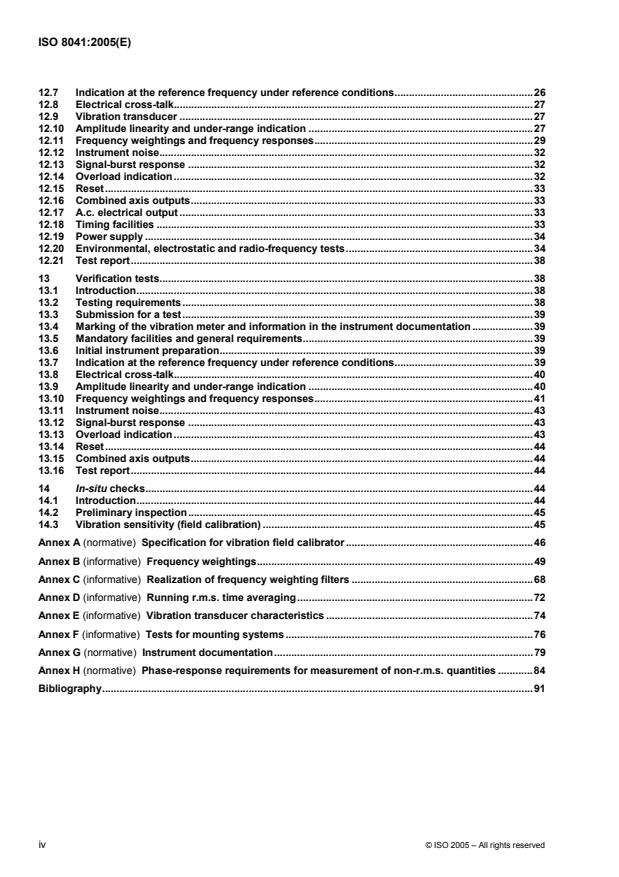
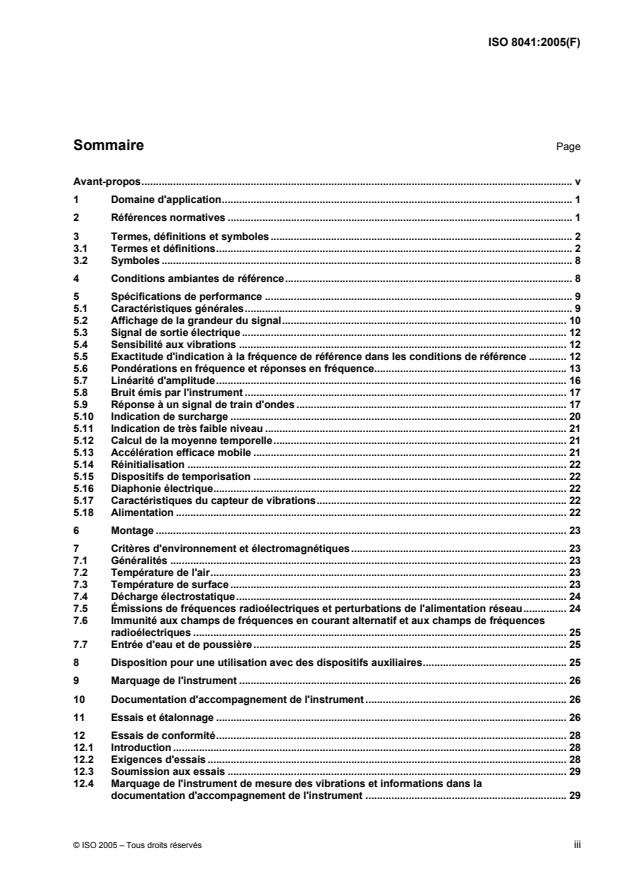
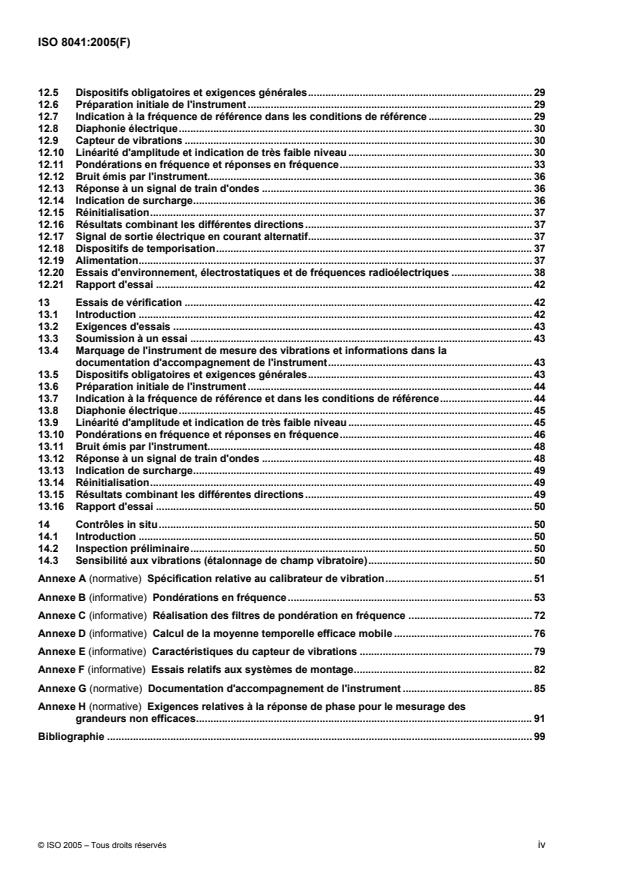
Contents Page
Foreword. v
1 Scope. 1
2 Normative references . 1
3 Terms, definitions and symbols . 2
3.1 Terms and definitions. 2
3.2 Symbols . 5
4 Reference environmental conditions. 7
5 Performance specifications . 7
5.1 General characteristics . 7
5.2 Display of signal magnitude . 9
5.3 Electrical output . 10
5.4 Vibration sensitivity. 10
5.5 Accuracy of indication at reference frequency under reference conditions . 10
5.6 Frequency weightings and frequency responses . 11
5.7 Amplitude linearity. 14
5.8 Instrument noise . 14
5.9 Signal-burst response . 14
5.10 Overload indication. 17
5.11 Under-range indication. 18
5.12 Time averaging. 18
5.13 Running r.m.s. acceleration. 18
5.14 Reset. 18
5.15 Timing facilities . 19
5.16 Electrical cross-talk . 19
5.17 Vibration transducer characteristics . 19
5.18 Power supply. 19
6 Mounting . 19
7 Environmental and electromagnetic criteria. 20
7.1 General. 20
7.2 Air temperature . 20
7.3 Surface temperature . 20
7.4 Electrostatic discharge. 20
7.5 Radio-frequency emissions and public-power-supply disturbances. 21
7.6 Immunity to a.c. power-frequency fields and radio-frequency fields. 21
7.7 Ingress of water and dust. 22
8 Provision for use with auxiliary devices. 22
9 Instrument marking. 22
10 Instrument documentation. 23
11 Testing and calibration. 23
12 Pattern evaluation . 24
12.1 Introduction . 24
12.2 Testing requirements. 25
12.3 Submission for testing . 25
12.4 Marking of the vibration meter and information in the instrument documentation. 25
12.5 Mandatory facilities and general requirements . 26
12.6 Initial instrument preparation . 26
12.7 Indication at the reference frequency under reference conditions.26
12.8 Electrical cross-talk.27
12.9 Vibration transducer .27
12.10 Amplitude linearity and under-range indication .27
12.11 Frequency weightings and frequency responses.29
12.12 Instrument noise.32
12.13 Signal-burst response .32
12.14 Overload indication.32
12.15 Reset.33
12.16 Combined axis outputs.33
12.17 A.c. electrical output .33
12.18 Timing facilities .33
12.19 Power supply .34
12.20 Environmental, electrostatic and radio-frequency tests.34
12.21 Test report.38
13 Verification tests.38
13.1 Introduction.38
13.2 Testing requirements.38
13.3 Submission for a test.39
13.4 Marking of the vibration meter and information in the instrument documentation .39
13.5 Mandatory facilities and general requirements.39
13.6 Initial instrument preparation.39
13.7 Indication at the reference frequency under reference conditions.39
13.8 Electrical cross-talk.40
13.9 Amplitude linearity and under-range indication .40
13.10 Frequency weightings and frequency responses.41
13.11 Instrument noise.43
13.12 Signal-burst response .43
13.13 Overload indication.43
13.14 Reset.44
13.15 Combined axis outputs.44
13.16 Test report.44
14 In-situ checks.44
14.1 Introduction.44
14.2 Preliminary inspection.45
14.3 Vibration sensitivity (field calibration) .45
Annex A (normative) Specification for vibration field calibrator .46
Annex B (informative) Frequency weightings.49
Annex C (informative) Realization of frequency weighting filters .68
Annex D (informative) Running r.m.s. time averaging.72
Annex E (informative) Vibration transducer characteristics .74
Annex F (informative) Tests for mounting systems .76
Annex G (normative) Instrument documentation.79
Annex H (normative) Phase-response requirements for measurement of non-r.m.s. quantities .84
Bibliography.91
iv © ISO 2005 – All rights reserved
Foreword
ISO (the International Organization for Standardization) is a worldwide federation of national standards bodies
(ISO member bodies). The work of preparing International Standards is normally carried out through ISO
technical committees. Each member body interested in a subject for which a technical committee has been
established has the right to be represented on that committee. International organizations, governmental and
non-governmental, in liaison with ISO, also take part in the work. ISO collaborates closely with the
International Electrotechnical Commission (IEC) on all matters of electrotechnical standardization.
International Standards are drafted in accordance with the rules given in the ISO/IEC Directives, Part 2.
The main task of technical committees is to prepare International Standards. Draft International Standards
adopted by the technical committees are circulated to the member bodies for voting. Publication as an
International Standard requires approval by at least 75 % of the member bodies casting a vote.
Attention is drawn to the possibility that some of the elements of this document may be the subject of patent
rights. ISO shall not be held responsible for identifying any or all such patent rights.
ISO 8041 was prepared by Technical Committee ISO/TC 108, Mechanical vibration and shock, Subcommittee
SC 3, Use and calibration of vibration and shock measuring instruments.
This second edition cancels and replaces the first edition (ISO 8041:1990), which has been technically
revised, and incorporates its Amendment, ISO 8041:1990/Amd.1:1999, and Technical Corrigendum
ISO 8041:1990/Cor.1:1993.
The reasons for the main changes introduced in this edition are as follows:
to improve the specifications for human response to vibration measuring instrumentation;
to incorporate into one document the specifications introduced by the 1999 amendment to ISO 8041:1990,
which themselves were required following the introduction of new frequency weightings in
ISO 2631-1:1997;
to recognise changes in the frequency weighting specification introduced in ISO 5349-1:2001 that allows
frequencies outside the one-third octaves from 6,3 Hz to 1250 Hz to be excluded from the weighted
acceleration calculation (this is achieved by changing the frequencies at which the tolerance is extended
to −100 % to be the lower boundary of the 6,3 Hz one-third-octave bands and the upper boundary of the
1 250 Hz one-third-octave band);
to introduce allowances for the uncertainties of testing the conformance of the human vibration measuring
instruments;
to introduce a hierarchy of testing requirements (pattern evaluation, periodic verification and in-situ check)
with tests defined according to the needs of this hierarchy;
to recognise the needs for the specification and testing of new parameters such as maximum transient
vibration value (MTVV) and vibration dose value (VDV);
to recognise the need to test multi-axis instrumentation and to test combined results from these multi-axis
inputs;
to introduce informative tests for mounting methods.
INTERNATIONAL STANDARD ISO 8041:2005(E)
Human response to vibration — Measuring instrumentation
1 Scope
This International Standard specifies the performance specifications and tolerance limits for instruments
designed to measure vibration values, for the purpose of assessing human response to vibration. It includes
requirements for pattern evaluation, periodic verification and in-situ checks, and the specification of vibration
calibrators for in-situ checks.
Vibration instruments specified in this International Standard can be single instruments, combinations of
instrumentation or computer-based acquisition and analysis systems.
Vibration instruments specified in this International Standard are intended to measure vibrations for one or
more applications, such as
hand-transmitted vibration (see ISO 5349-1),
whole-body vibration (see ISO 2631-1, ISO 2631-2, ISO 2631-4), and
low-frequency whole-body vibration in the frequency range from 0,1 Hz to 0,5 Hz (see ISO 2631-1).
Vibration instruments can be designed for measurement according to one or more of the frequency weightings
defined within each of these applications.
Three levels of performance testing are defined in this International Standard:
a) pattern evaluation, i.e. a full test of the instrument against the specifications defined in this International
Standard;
b) periodic verification, i.e. an intermediate set of tests designed to ensure that an instrument remains within
the required performance specification, and
c) in-situ checks, i.e. a minimum level of testing required to indicate that an instrument is likely to be
functioning within the required performance specification.
2 Normative references
The following referenced documents are indispensable for the application of this document. For dated
references, only the edition cited applies. For undated references, the latest edition of the referenced
document (including any amendments) applies.
ISO 2041, Vibration and shock — Vocabulary
ISO 2631-1, Mechanical vibration and shock — Evaluation of human exposure to whole-body vibration —
Part 1: General requirements
ISO 2631-2, Mechanical vibration and shock — Evaluation of human exposure to whole-body vibration —
Part 2: Vibration in buildings (1 Hz to 80 Hz)
ISO 2631-4, Mechanical vibration and shock — Evaluation of human exposure to whole-body vibration —
Part 4: Guidelines for the evaluation of the effects of vibration and rotational motion on passenger and crew
comfort in fixed-guideway transport systems
ISO 5347 (all parts), Methods for the calibration of vibration and shock pick-ups
ISO 5348, Mechanical vibration and shock — Mechanical mounting of accelerometers
ISO 5349-1:2001, Mechanical vibration — Measurement and evaluation of human exposure to
hand-transmitted vibration — Part 1: General requirements
ISO 16063 (all parts), Methods for the calibration of vibration and shock transducers
IEC 61000-4-2:2001, Electromagnetic compatibility (EMC) — Part 4-2: Testing and measurement
techniques — Electrostatic discharge immunity test
IEC 61000-4-3:2002, Electromagnetic compatibility (EMC) — Part 4-3: Testing and measurement
techniques —Radiated, radio-frequency, electromagnetic field immunity test
IEC 61000-4-6, Electromagnetic compatibility (EMC) — Part 4-6: Testing and measurement techniques —
Immunity to conducted disturbances, induced by radio-frequency fields
IEC 61000-6-2:1999, Electromagnetic compatibility (EMC) — Part 6-2: Generic standards — Immunity for
industrial environments
CISPR 22:2003, Information technology equipment — Radio disturbance characteristics — Limits and
methods of measurement
GUM, Guide to the expression of uncertainty in measurement. BIPM, IEC, IFCC, ISO, IUPAC, IUPAP, OIML,
3 Terms, definitions and symbols
3.1 Terms and definitions
For the purposes of this document, the terms and definitions given in ISO 2041, together with the following,
apply.
3.1.1
vibration acceleration
component of acceleration, where the axis of measurement is specified by application standards
3.1.2
band-limiting frequency weighting
component of a frequency weighting defined by the high and low pass band-limiting filters
3.1.3
band-limited frequency range
frequency range defined by the band-limited component of a frequency weighting
3.1.4
nominal frequency range
frequency range of interest, as defined in the relevant measurement standard
3.1.5 Frequency-weighted values
3.1.5.1
time-averaged weighted acceleration value
frequency-weighted r.m.s. vibration acceleration value in a specified axis, a , in metres per second squared or
w
radians per second squared, as defined by the expression:
T
aa= ξξd (1)
()
ww
∫
T
0
2 © ISO 2005 – All rights reserved
where
a (ξ ) is the translational or rotational, weighted vibration acceleration in a specified axis as a function
w
of the instantaneous time, ξ, in metres per second squared (m/s ) or radians per second
squared (rad/s ), respectively;
T is the duration of the measurement
3.1.5.2
time-averaged weighted acceleration level
frequency-weighted r.m.s. vibration acceleration level expressed in decibels, as defined by
a
w
L = 20 lg dB (2)
w
a
where
a is defined in 3.1.5.1;
w
−6 2
a is the reference acceleration (defined as 10 m/s in ISO 1683)
3.1.5.3
running r.m.s. acceleration value
frequency-weighted running r.m.s. vibration acceleration, in metres per second squared, defined by the
expression
t 2
at = a ξξd (3)
() ()
w,θ w
∫
θ
t−θ
where
a (ξ ) is the frequency-weighted instantaneous vibration acceleration at time ξ , in metres per second
w
squared;
θ is the integration time of the measurement;
t is the instantaneous time
NOTE Exponential averaging may be used for the running r.m.s. method, as an approximation of the linear averaging.
The exponential averaging is defined as follows:
t
1 ξ − t
at = aξξexp d (4)
() ()
w,τ w
∫
ττ
−∞
where τ is the time constant.
3.1.5.4
maximum transient vibration value
MTVV
maximum value of the running r.m.s. vibration acceleration value when the integration time is equal to 1 s
3.1.5.5
motion sickness dose value
MSDV
1,5
integral of the squared weighted instantaneous vibration acceleration a (t) in m/s as defined by the
w
expression:
Φ
MSDV = a ξξd (5)
()
w
∫
0
where Φ is the total period during which motion could occur
NOTE 1 The motion sickness dose value may be obtained from the frequency weighted r.m.s. vibration acceleration
through multiplication by Φ .
NOTE 2 For measurement instrumentation, the exposure period Φ is likely to be assumed to be equal to the
measurement period, T, unless otherwise indicated.
3.1.5.6
vibration dose value
VDV
1,75
integral of the fourth power of the weighted instantaneous vibration acceleration a (t) in m/s as defined by
w
the expression
Φ
VDV = a ()ξξd (6)
w
∫
0
where Φ is the total (daily) period for which exposure occurs
NOTE 1 The vibration dose value is more sensitive to peaks than is the r.m.s. value.
NOTE 2 For measurement instrumentation, the exposure period Φ is likely to be assumed to be equal to the
measurement period, T, unless otherwise indicated.
3.1.5.7
vibration total value
combined vibration from three axes of translational vibration, as defined by the expression
22 2
a=+kakak+ a (7)
wwvxx ywy zwz
where
a , a and a are the vibration values in the three orthogonal axes x, y and z;
wx wy wz
k , k and k are multiplying constants whose values depend on the measurement application
x y z
3.1.5.8
peak vibration value
maximum modulus of the instantaneous (positive and negative) peak values of the frequency-weighted
acceleration
3.1.5.9
crest factor
parameter for a measurement period, given by the peak vibration value divided by the r.m.s. acceleration
value, with both values having the same frequency weighting
3.1.6
linear operating range
on each measurement range, the range between lower and upper boundaries over which the linearity errors
are within the applicable tolerance limits specified in this International Standard
4 © ISO 2005 – All rights reserved
3.1.7
overload
condition that occurs when the upper boundary of the linear operating range is exceeded
3.1.8
under-range
condition that occurs when the vibration value is below the lower boundary of the linear operating range
3.1.9
reference measurement range
level range specified for testing the characteristics of the vibration instrumentation
NOTE This range is that used for measuring the reference vibration.
3.1.10
reference vibration signal
sinusoidal vibration signal, the magnitude and frequency of which is specified in this International Standard for
testing the electromechanical performance of a human-vibration meter
NOTE Different reference vibration signals are specified according to the application of the instrumentation.
3.1.11
calibration check frequency
frequency specified for providing a check of the vibration sensitivity of the instrument
3.1.12
tone burst
one or more complete cycles of a sinusoidal signal that start and end at a zero crossing of the waveform
3.1.13
signal burst
one or more complete cycles of a periodic signal (such as saw-tooth) that start and end at a zero crossing of
the waveform
3.1.14
vibration measuring instrumentation
combination of a vibration transducer, signal processor and display, being any single instrument, or a
collection of instruments, which is capable of measuring parameters relating to human response to vibration
NOTE See Figure 1.
3.1.15
instrument documentation
instruction manual, operating procedure, or other documentation provided for the use of users of the vibration
measurement instrument
3.2 Symbols
For the purposes of this document, the following symbols and abbreviated terms are used:
a time-averaged frequency-weighted single-axis vibration acceleration
w
a (t), a (ξ ) instantaneous frequency-weighted translational or rotational single-axis acceleration at time t,
w w
or timeξ
f frequency
H overall frequency weighting function
k multiplying constants applied to the whole-body frequency-weighted acceleration value for axis i
i
n one-third-octave band number
t or ξ instantaneous time
T measurement duration
s variable of the Laplace transform
W frequency weighting x
x
Φ exposure duration
∆ϕ phase error
τ exponential averaging time constant
θ linear averaging time
MTVV maximum transient vibration value
MSDV motion sickness dose value
VDV vibration dose value
Key
1 transducer 8 frequency weighting (including band-limiting)
2 mounting system 9 band-limited output
3 vibrating surface 10 frequency-weighted output
4 cable 11 time weighting
5 electrical input 12 additional processing
6 signal conditioning 13 display
7 band limiting
a) Time-domain signal processing
Figure 1 — Overview of the basic functional path output of a vibration measurement instrument or
measurement system
6 © ISO 2005 – All rights reserved
Key
1 transducer 8 band limiting (calculation)
2 mounting system 9 frequency weighting — including band limiting
(calculation)
3 vibrating surface
10 band-limited output
4 cable
11 frequency-weighted output
5 electrical input
12 accumulation of frequency bands
6 signal conditioning
13 display
7 frequency analysis
time weighting
time averaging
b) Frequency-domain signal processing (not applicable to VDV processing)
Figure 1 (continued)
4 Reference environmental conditions
Reference environmental conditions for specifying the performance of a vibration meter are
air temperature: 23 °C;
relative humidity: 50 %.
5 Performance specifications
5.1 General characteristics
The performance specifications of this clause apply under the reference environmental conditions.
As a minimum, human-vibration measuring instrumentation shall provide a means of displaying
time-averaged weighted vibration acceleration value over the measurement duration,
band-limited time-averaged vibration acceleration value over the measurement duration, and
measurement duration.
The human-vibration measuring instrument shall also provide a means of indicating whether an overload
occurred at any time within the measurement duration.
The human-vibration measuring instrument shall provide a method for setting and adjusting the vibration
sensitivity.
Human-vibration measuring instruments may contain any or all of the design features for which performance
specifications are given in this International Standard. An instrument shall conform to the applicable
performance specifications for those design features that are provided.
If the instrument has more than one measurement range, the instrument documentation shall describe the
measurement ranges that are included and the operation of the measurement range control. The instrument
documentation shall also identify which is the reference measurement range.
The reference vibration signal frequencies and values are given in Table 1.
If the instrument is capable of measuring the maximum (e.g. MTVV) and peak vibration values, a “hold"
function shall be provided. The instrument documentation shall describe the operation of the hold feature and
the method for clearing a display that is held.
Many of the specifications and tests in this International Standard require the application of electrical signals
substituting for the signal from the vibration transducer. The instrument documentation shall specify a means
for substituting an electrical signal, equivalent to the signal from the vibration transducer, for performing
electrical tests on the complete instrument without the vibration transducer. If appropriate, the instrument
documentation may describe alternative methods to test the specified operations of the human vibration meter.
NOTE The manufacturer of the human-vibration meter may provide an input test point, or a dummy vibration
transducer of specified electrical impedance, or an equivalent input adapter (electrical or non-electrical) to perform
electrical tests on the instrument.
The instrument documentation shall specify the maximum peak vibration at the vibration transducer and the
maximum peak-to-peak signal (e.g. charge or voltage) that can be applied at the electrical input facility. The
maximum vibration value and the maximum peak-to-peak voltage shall not cause damage to the instrument.
Table 1 — Reference vibration values and frequencies
Weighting Weighted
Table in
Nominal
Frequency factor at acceleration
annex
Application frequency Reference
weighting
reference at reference
range
(informative)
frequency frequency and
r.m.s.
r.m.s.
acceleration
Frequency acceleration
value
value
Hz m/s
m/s
500 rad/s
W
Hand-transmitted B.6 8 to 1 000 10 0,202 0 2,020
h
(79,58 Hz)
W
B.1 0,812 6 0,812 6
b
W B.2 0,514 5 0,514 5
c
W
B.3 0,126 1 0,126 1
d
0,5 to 80
100 rad/s
Whole-body W 1
B.4 0,062 87 0,062 87
e
(15,915 Hz)
W B.7 1,019 1,019
j
W
B.8 0,771 8 0,771 8
k
W
B.9 1 to 80 0,336 2 0,336 2
m
2,5 rad/s
Low-frequency
W
B.5 0,1 to 0,5 0,1 0,388 8 0,038 88
f
whole-body
(0,397 9 Hz)
8 © ISO 2005 – All rights reserved
The tolerance limits given in this International Standard include the associated expanded uncertainties of
measurement, calculated for a coverage factor of 2, corresponding to a level of confidence of approximately
95 %, in accordance with guidance given in the GUM.
5.2 Display of signal magnitude
5.2.1 General
For instruments that can display more than one measurement quantity, a means shall be provided to ascertain
clearly the measurement quantity that is being displayed, preferably indicated by standard abbreviations or
letter symbols.
The quantities that can be displayed by the human-vibration meter shall be described in the instrument
documentation, along with a description of the corresponding indications on each display device.
The instrument shall display the frequency-weighted acceleration values. Optionally, it may also display the
frequency-weighted acceleration value multiplied by a factor k, as defined in ISO 2631-1. Where the
multiplying factors are used, this shall be clearly indicated on the instrument and the instrument shall be
capable of displaying the multiplying factors.
Where a combined axis output is displayed [e.g. vibration total value, Equation (7)], the instrument shall be
capable of displaying the values of the multiplying factors used.
When results of a measurement are provided at a digital output, the instrument documentation shall describe
the method for transferring or downloading the digital data to an external data-storage or display device. The
instrument documentation shall identify the computer software as well as the hardware for the interface.
Internationally standardized interface bus compatibility is recommended.
Each alternative device for displaying the signal value, stated in the instrument documentation as conforming
to the specifications of this International Standard, is considered an integral part of the instrument. Each such
alternative device shall be included as part of the components required for conformance to the performance
specifications in this clause and the applicable environmental specifications of Clause 7. Examples of
alternative display devices include level recorders or computers with monitor screens.
For an instrument that uses a display device with a range less than the linear operating range specified in 5.7,
the instrument documentation shall describe a means to test the linearity beyond the limits of the indicator
range.
5.2.2 Resolution and refresh rate
The display device(s) specified in the instrument documentation shall permit measurements with a resolution
of 1 % of the indicated value, or better.
If an instrument only has an analog, or simulated analog, display device that provides a continuous indication,
the display shall be a logarithmic display of the vibration value. The range of the analog display device shall
include a display of at least 2 decades, with each decade being at least 10 mm wide. Where the display range
does not encompass the whole of the linearity range of the instrument, then the display range shall be
switchable to allow for the whole of the linearity range to be viewed.
If a digital indicator is provided, and the measurement quantity displayed is a vibration parameter, the display
shall be updated at regular time intervals. The time interval between updates shall be appropriate to the
measurement being displayed. The extent of the range of a digital display shall be at least sufficient to cover
the linear operating range.
For instruments with digital display devices updated at periodic intervals, the indication at each display update
shall be the value of the user-selected quantity at the time of the display update. Other modes of indication at
the time of the display update may be identified in the instrument documentation and, if so, the operation of
such modes shall be explained in the instrument documentation. The instrument documentation shall state
which modes conform to the specifications of this International Standard and which do not conform.
5.2.3 Stabilization, measurement start and display times
Within the prevailing environmental conditions, the time interval required for stabilizing and being ready to use
shall be no greater than 2 min from switching on the instrument.
The display shall indicate when the instrument is ready for use following switch-on, range change or changes
to filter selection.
The time between a user initiating a measurement and the start of that measurement shall be no greater than
0,5 s.
NOTE This may require an initialization procedure, particularly for low-frequency whole-body vibration: an operating
phase prior to measurement initiation that ensures that the instrument has settled following the end of a previous
measurement.
Prior to a measurement result being available, the instrument display shall clearly indicate whether a
measurement is in progress, or whether an initialization stage is underway.
5.3 Electrical output
If an a.c. electrical output is provided, the instrument documentation shall state the characteristics of the
output signals. The characteristics shall include
the range of peak-to-peak voltages, which shall be not less than 1 V peak-to-peak,
the internal electrical impedance at the output,
the minimum load impedance, and
the frequency weightings applied to the output signals.
Connection of passive impedance without stored electrical energy, including a short circuit, to the electrical
output shall not affect any measurement in progress by more than 2 %.
5.4 Vibration sensitivity
The instrument documentation shall specify at least one model of vibration field calibrator as a means to
check and maintain the mechanical sensitivity of the human-vibration instrument. The vibration field calibrator
shall conform to the specifications given in Annex A.
The instrument documentation for the vibration instrument shall describe the procedure for adjusting the
indicated vibration to conform to the specifications in this International Standard by application of the specified
vibration calibrator. The adjustment shall apply to the models of vibration transducers recommended in the
instrument documentation for use with the vibration meter. The adjustment shall also apply to any cables,
connectors and other accessories provided by the manufacturer of the vibration meter for connecting a
vibration transducer to the vibration meter.
5.5 Accuracy of indication at reference frequency under reference conditions
The requirements for tolerance of the displayed results are given in Table 2. The tolerance of indication is
specified at the appropriate reference frequency and reference vibration value specified in Table 1 with the
instrument switched to the reference measurement range, with sinusoidal mechanical vibration applied to the
base of the vibration transducer or specified mounting device. The requirements apply to all frequency
weightings specified in this International Standard and after applying adjustments described in 5.4 and after
the specified stabilization time interval has elapsed.
10 © ISO 2005 – All rights reserved
Table 2 — Tolerances of indication at reference frequency and vibration value
Parameter Tolerance
± 4 % for hand-
transmitted and
whole-body
Tolerance of indication at the reference frequency under reference environmental
vibration
conditions
± 5 % for low-frequency
whole-body
vibration
The difference between the indicated value of any frequency-weighted measurement
quantity and the indicated value of the corresponding band-limiting measurement
± 3 %
multiplied by the appropriate weighting factor (for a steady sinusoidal input vibration signal
at the reference frequency and reference vibration value)
The difference between the indication of the running r.m.s. vibration value with a
band-limiting frequency weighting, and the indication of the band-limiting frequency-
weighted vibration value with the linear time-averaged r.m.s. value over any measurement ± 2 %
time (for a steady sinusoidal input vibration signal at the reference frequency and
reference vibration value)
5.6 Frequency weightings and frequency responses
5.6.1 Parameters
A human vibration meter shall have one or more of the frequency weighting or weightings listed in Table 1,
including the appropriate band-limiting weightings. The frequency weightings are defined by Equations (8) to
(12) and the parameters given in Table 3.
Table 3 — Parameters and transfer functions of the frequency weightings
Band-limiting a-v-transition Upward step Gain
Weighting
f Q f Q f f Q f Q f Q K
1 1 2 2 3 4 4 5 5 6 6
Hz Hz Hz Hz Hz Hz
W 0,4 1/ 2 100 1/ 2 16 16 0,55 2,5 0,9 4 0,951,024
b
W 0,4 1/ 2 100 1/ 2 8 8 0,63 ∞ 1 ∞ 1 1
c
W 0,4 1/ 2 100 1/ 2 2 2 0,63 ∞ 1 ∞ 1 1
d
W 0,4 1/ 2 100 1/ 2 1 1 0,63 ∞ 1 ∞ 1 1
e
W 0,08 1/ 2 0,63 1/ 2 ∞ 0,25 0,86 0,062 5 0,80 0,10 0,80 1
f
8/10 31/10
W 10 1/ 2 10 1/ 2 100/(2π) 100/(2π) 0,64 ∞ 1 ∞ 1 1
h
W 0,4 1/ 2 100 1/ 2 ∞ ∞ 1 3,75 0,91 5,32 0,91 1
j
W 0,4 1/ 2 100 1/ 2 12,5 12,5 0,63 2,37 0,91 3,35 0,91 1
k
–0,1
W 10 1/ 2 100 1/ 2 1/(0,028 ¥ 2π) 1/(0,028 ¥ 2π) 0,5 ∞ 1 ∞ 1 1
m
NOTE 1 For weighting W , Table A.1 of ISO 2631-4:2001 rounds the value of parameter Q to 2 decimal places. The
b 1
parameter specified here is the exact value.
NOTE 2 For weighting W , Table A.1 of ISO 5349-1:2001 rounds the values of parameters f , f , f and f to 5
h 1 2 3 4
significant figures and parameter Q to 2 decimal places. The parameters specified here are the exact values.
The angular frequencies ω , …, ω (given by ω = 2πf where f are the frequencies f , ., f in Table 3) and the
1 6 i i i 1 6
resonant quality factors Q , Q , Q , Q and Q are parameters of the transfer functions in Equations (8) to (12)
1 2 4 5 6
which determine the overall vibration acceleration frequency weightings. The overall frequency weighting
function is a product of band-limiting, a
...
NORME ISO
INTERNATIONALE 8041
Deuxième édition
2005-04-01
Réponse des individus aux vibrations —
Appareillage de mesure
Human response to vibration — Measuring instrumentation
Numéro de référence
©
ISO 2005
PDF – Exonération de responsabilité
Le présent fichier PDF peut contenir des polices de caractères intégrées. Conformément aux conditions de licence d'Adobe, ce fichier
peut être imprimé ou visualisé, mais ne doit pas être modifié à moins que l'ordinateur employé à cet effet ne bénéficie d'une licence
autorisant l'utilisation de ces polices et que celles-ci y soient installées. Lors du téléchargement de ce fichier, les parties concernées
acceptent de fait la responsabilité de ne pas enfreindre les conditions de licence d'Adobe. Le Secrétariat central de l'ISO décline toute
responsabilité en la matière.
Adobe est une marque déposée d'Adobe Systems Incorporated.
Les détails relatifs aux produits logiciels utilisés pour la création du présent fichier PDF sont disponibles dans la rubrique General Info
du fichier; les paramètres de création PDF ont été optimisés pour l'impression. Toutes les mesures ont été prises pour garantir
l'exploitation de ce fichier par les comités membres de l'ISO. Dans le cas peu probable où surviendrait un problème d'utilisation,
veuillez en informer le Secrétariat central à l'adresse donnée ci-dessous.
© ISO 2005
Droits de reproduction réservés. Sauf prescription différente, aucune partie de cette publication ne peut être reproduite ni utilisée sous
quelque forme que ce soit et par aucun procédé, électronique ou mécanique, y compris la photocopie et les microfilms, sans l'accord écrit
de l'ISO à l'adresse ci-après ou du comité membre de l'ISO dans le pays du demandeur.
ISO copyright office
Case postale 56 • CH-1211 Geneva 20
Tel. + 41 22 749 01 11
Fax. + 41 22 749 09 47
E-mail copyright@iso.org
Web www.iso.org
Publié en Suisse
ii © ISO 2005 – Tous droits réservés
Sommaire Page
Avant-propos. v
1 Domaine d'application. 1
2 Références normatives . 1
3 Termes, définitions et symboles. 2
3.1 Termes et définitions. 2
3.2 Symboles . 8
4 Conditions ambiantes de référence. 8
5 Spécifications de performance . 9
5.1 Caractéristiques générales. 9
5.2 Affichage de la grandeur du signal. 10
5.3 Signal de sortie électrique . 12
5.4 Sensibilité aux vibrations . 12
5.5 Exactitude d'indication à la fréquence de référence dans les conditions de référence . 12
5.6 Pondérations en fréquence et réponses en fréquence. 13
5.7 Linéarité d'amplitude. 16
5.8 Bruit émis par l'instrument . 17
5.9 Réponse à un signal de train d'ondes . 17
5.10 Indication de surcharge . 20
5.11 Indication de très faible niveau . 21
5.12 Calcul de la moyenne temporelle. 21
5.13 Accélération efficace mobile . 21
5.14 Réinitialisation . 22
5.15 Dispositifs de temporisation . 22
5.16 Diaphonie électrique. 22
5.17 Caractéristiques du capteur de vibrations.22
5.18 Alimentation . 22
6 Montage . 23
7 Critères d'environnement et électromagnétiques. 23
7.1 Généralités . 23
7.2 Température de l'air. 23
7.3 Température de surface . 23
7.4 Décharge électrostatique. 24
7.5 Émissions de fréquences radioélectriques et perturbations de l'alimentation réseau. 24
7.6 Immunité aux champs de fréquences en courant alternatif et aux champs de fréquences
radioélectriques . 25
7.7 Entrée d'eau et de poussière . 25
8 Disposition pour une utilisation avec des dispositifs auxiliaires. 25
9 Marquage de l'instrument . 26
10 Documentation d'accompagnement de l'instrument . 26
11 Essais et étalonnage . 26
12 Essais de conformité. 28
12.1 Introduction . 28
12.2 Exigences d'essais . 28
12.3 Soumission aux essais . 29
12.4 Marquage de l'instrument de mesure des vibrations et informations dans la
documentation d'accompagnement de l'instrument . 29
12.5 Dispositifs obligatoires et exigences générales. 29
12.6 Préparation initiale de l'instrument . 29
12.7 Indication à la fréquence de référence dans les conditions de référence . 29
12.8 Diaphonie électrique. 30
12.9 Capteur de vibrations . 30
12.10 Linéarité d'amplitude et indication de très faible niveau. 30
12.11 Pondérations en fréquence et réponses en fréquence. 33
12.12 Bruit émis par l'instrument. 36
12.13 Réponse à un signal de train d'ondes . 36
12.14 Indication de surcharge. 36
12.15 Réinitialisation. 37
12.16 Résultats combinant les différentes directions. 37
12.17 Signal de sortie électrique en courant alternatif. 37
12.18 Dispositifs de temporisation. 37
12.19 Alimentation. 37
12.20 Essais d'environnement, électrostatiques et de fréquences radioélectriques . 38
12.21 Rapport d'essai . 42
13 Essais de vérification . 42
13.1 Introduction . 42
13.2 Exigences d'essais . 43
13.3 Soumission à un essai . 43
13.4 Marquage de l'instrument de mesure des vibrations et informations dans la
documentation d'accompagnement de l'instrument. 43
13.5 Dispositifs obligatoires et exigences générales. 43
13.6 Préparation initiale de l'instrument . 44
13.7 Indication à la fréquence de référence et dans les conditions de référence. 44
13.8 Diaphonie électrique. 45
13.9 Linéarité d'amplitude et indication de très faible niveau. 45
13.10 Pondérations en fréquence et réponses en fréquence. 46
13.11 Bruit émis par l'instrument. 48
13.12 Réponse à un signal de train d'ondes . 48
13.13 Indication de surcharge. 49
13.14 Réinitialisation. 49
13.15 Résultats combinant les différentes directions. 49
13.16 Rapport d'essai . 50
14 Contrôles in situ. 50
14.1 Introduction . 50
14.2 Inspection préliminaire. 50
14.3 Sensibilité aux vibrations (étalonnage de champ vibratoire). 50
Annexe A (normative) Spécification relative au calibrateur de vibration. 51
Annexe B (informative) Pondérations en fréquence. 53
Annexe C (informative) Réalisation des filtres de pondération en fréquence . 72
Annexe D (informative) Calcul de la moyenne temporelle efficace mobile . 76
Annexe E (informative) Caractéristiques du capteur de vibrations . 79
Annexe F (informative) Essais relatifs aux systèmes de montage. 82
Annexe G (normative) Documentation d'accompagnement de l'instrument . 85
Annexe H (normative) Exigences relatives à la réponse de phase pour le mesurage des
grandeurs non efficaces. 91
Bibliographie . 99
Avant-propos
L'ISO (Organisation internationale de normalisation) est une fédération mondiale d'organismes nationaux de
normalisation (comités membres de l'ISO). L'élaboration des Normes internationales est en général confiée
aux comités techniques de l'ISO. Chaque comité membre intéressé par une étude a le droit de faire partie du
comité technique créé à cet effet. Les organisations internationales, gouvernementales et non
gouvernementales, en liaison avec l'ISO participent également aux travaux. L'ISO collabore étroitement avec
la Commission électrotechnique internationale (CEI) en ce qui concerne la normalisation électrotechnique.
Les Normes internationales sont rédigées conformément aux règles données dans les Directives ISO/CEI,
Partie 2.
La tâche principale des comités techniques est d'élaborer les Normes internationales. Les projets de Normes
internationales adoptés par les comités techniques sont soumis aux comités membres pour vote. Leur
publication comme Normes internationales requiert l'approbation de 75 % au moins des comités membres
votants.
L'attention est appelée sur le fait que certains des éléments du présent document peuvent faire l'objet de
droits de propriété intellectuelle ou de droits analogues. L'ISO ne saurait être tenue pour responsable de ne
pas avoir identifié de tels droits de propriété et averti de leur existence.
L'ISO 8041 a été élaborée par le comité technique ISO/TC 108, Vibrations et chocs mécaniques, sous-comité
SC 3, Utilisation et étalonnage des instruments de mesure des vibrations et des chocs.
Cette deuxième édition annule et remplace la première édition (ISO 8041:1990), qui a fait l'objet d'une
révision technique et intègre son amendement, ISO 8041:1990/Amd.1:1999 et son rectificatif technique,
ISO 8041:1990/Cor.1:1993.
Les raisons des principaux changements introduits dans la présente édition sont les suivants:
⎯ amélioration des spécifications relatives à l'appareillage de mesure de la réponse des individus aux
vibrations;
⎯ intégration dans un document des spécifications définies par l'amendement de 1999 à l'ISO 8041:1990,
l'existence de ces dernières se révélant nécessaire suite à l'introduction de nouvelles pondérations en
fréquence dans l'ISO 2631-1:1997;
⎯ validation des changements concernant la spécification de la pondération en fréquence établie par
l'ISO 5349-1:2001, permettant d'exclure les fréquences à l'extérieur des tiers d'octave compris entre
6,3 Hz et 1 250 Hz du calcul de l'accélération pondérée (ceci s'effectue en modifiant les fréquences pour
lesquelles la tolérance est étendue à −100 % afin qu'elles constituent la limite inférieure des bandes de
tiers d'octave de 6,3 Hz et la limite supérieure de la bande de tiers d'octave de 1 250 Hz);
⎯ prévision de tolérances eu égard aux incertitudes concernant la vérification de la conformité des
instruments de mesure de la réponse des individus aux vibrations;
⎯ établissement d'une hiérarchie propre aux exigences relatives aux essais (essais de conformité,
vérification périodique et contrôle in situ), ces derniers étant définis selon les besoins de ladite hiérarchie;
⎯ reconnaissance de la nécessité de spécifier et de vérifier les nouveaux paramètres tels que la valeur
maximale de la vibration transitoire (MTVV) et la valeur de dose vibratoire (VDV);
⎯ reconnaissance de la nécessité de soumettre à essai les appareillages de mesure des vibrations et de
vérifier les résultats combinés obtenus à partir de ces informations selon plusieurs axes;
⎯ réalisation d'essais informatifs concernant les méthodes de montage.
NORME INTERNATIONALE ISO 8041:2005(F)
Réponse des individus aux vibrations — Appareillage de
mesure
1 Domaine d'application
La présente Norme internationale donne les spécifications de performances et les limites de tolérance pour
les instruments destinés à mesurer les valeurs de vibration afin d'évaluer la réponse des individus aux
vibrations. Elle inclut les exigences relatives aux essais de conformité, à la vérification périodique et aux
contrôles in situ, ainsi que la spécification concernant les calibrateurs de vibration destinés aux contrôles
in situ.
Les instruments de mesure des vibrations spécifiés dans la présente Norme internationale peuvent être des
instruments simples, des combinaisons d'instruments ou des systèmes d'acquisition et d'analyse informatisés.
Les instruments de mesure des vibrations spécifiés dans la présente Norme internationale sont destinés à
mesurer les vibrations pour une ou plusieurs applications, telles que
⎯ les vibrations transmises par la main (voir l'ISO 5349-1),
⎯ les vibrations globales du corps (voir l'ISO 2631-1, l'ISO 2631-2 et l'ISO 2631-4), et
⎯ les vibrations globales du corps en basses fréquences dans la gamme de fréquences comprises entre
0,1 Hz et 0,5 Hz (voir l'ISO 2631-1).
Les instruments de mesure des vibrations peuvent être conçus pour effectuer un mesurage selon une ou
plusieurs pondérations en fréquence définies pour chacune de ces applications.
Trois niveaux de vérification des performances sont définis dans la présente Norme internationale:
a) essais de conformité, c'est-à-dire un essai complet de l'instrument par rapport aux spécifications définies
dans la présente Norme internationale;
b) vérification périodique, c'est-à-dire un ensemble intermédiaire d'essais destinés à s'assurer qu'un
instrument donné relève effectivement de la spécification de performances requise, et
c) contrôles in situ, c'est-à-dire un niveau minimal de vérification à appliquer pour indiquer que le
fonctionnement d'un instrument donné relève vraisemblablement de la spécification de performances
requise.
2 Références normatives
Les documents de référence suivants sont indispensables pour l'application du présent document. Pour les
références datées, seule l'édition citée s'applique. Pour les références non datées, la dernière édition du
document de référence (y compris les éventuels amendements) s'applique.
ISO 2041, Vibrations et chocs — Vocabulaire
ISO 2631-1, Vibrations et chocs mécaniques — Évaluation de l'exposition des individus à des vibrations
globales du corps — Partie 1: Spécifications générales
ISO 2631-2, Vibrations et chocs mécaniques — Évaluation de l'exposition des individus à des vibrations
globales du corps — Partie 2: Vibrations dans les bâtiments (1 Hz à 80 Hz)
ISO 2631-4, Vibrations et chocs mécaniques — Évaluation de l'exposition des individus à des vibrations
globales du corps — Partie 4: Lignes directrices pour l'évaluation des effets des vibrations et du mouvement
de rotation sur le confort des passagers et du personnel dans les systèmes de transport guidé
ISO 5347 (toutes les parties), Méthodes pour l'étalonnage de capteurs de vibrations et de chocs
ISO 5348, Vibrations et chocs mécaniques — Fixation mécanique des accéléromètres
ISO 5349-1:2001, Vibrations mécaniques — Mesurage et évaluation de l'exposition des individus aux
vibrations transmises par la main — Partie 1: Exigences générales
ISO 16063 (toutes les parties), Méthodes pour l'étalonnage des transducteurs de vibrations et de chocs
CEI 61000-4-2:2001, Compatibilité électromagnétique (CEM) — Partie 4-2: Techniques d'essai et de
mesure — Essai d'immunité aux décharges électrostatiques
CEI 61000-4-3:2002, Compatibilité électromagnétique (CEM) — Partie 4-3: Techniques d'essai et de
mesure — Essai d'immunité aux champs électromagnétiques rayonnés aux fréquences radioélectriques
CEI 61000-4-6, Compatibilité électromagnétique (CEM) — Partie 4-6: Techniques d'essai et de mesure —
Immunité aux perturbations conduites, induites par les champs radioélectriques
CEI 61000-6-2:1999, Compatibilité électromagnétique (CEM) — Partie 6-2: Normes génériques — Immunité
pour les environnements industriels
CISPR 22:2003, Appareils de traitement de l'information — Caractéristiques des perturbations
radioélectriques — Limites et méthodes de mesure
GUM, Guide pour l'expression de l'incertitude de mesure. BIPM, CEI, FICC, ISO, OIML, UICPA, UIPPA, 1995
3 Termes, définitions et symboles
3.1 Termes et définitions
Pour les besoins du présent document, les termes et définitions donnés dans l'ISO 2041 ainsi que les
suivants s'appliquent.
3.1.1
accélération de vibration
élément d'accélération dont l'axe de mesurage est spécifié par les normes d'application
3.1.2
pondération en fréquence à limite de bande
élément d'une pondération en fréquence défini par les filtres de limite de bandes passe-haut et passe-bas
3.1.3
gamme de fréquences à limite de bande
gamme de fréquences définie par l'élément limiteur de bande d'une pondération en fréquence
3.1.4
gamme de fréquences nominale
gamme de fréquences représentative, telle que définie dans l'étalon approprié
2 © ISO 2005 – Tous droits réservés
3.1.5 Valeurs pondérées en fréquence
3.1.5.1
moyenne temporelle de valeur d'accélération pondérée
valeur d'accélération de vibration efficace pondérée en fréquence sur un axe spécifié, a en mètres par
w
seconde carrée ou en radians par seconde carrée, telle que définie par l'expression
T 2
⎛⎞
⎜⎟
aa= ξξd (1)
()
ww
∫
⎜⎟T
⎝⎠
où
a (ξ) est l'accélération en translation ou en rotation de vibration pondérée, sur un axe spécifié, en
w
fonction du temps instantané, ξ, en mètres par seconde carrée (m/s ) ou en radians par
seconde carrée (rad/s ), respectivement;
T est la durée du mesurage
3.1.5.2
moyenne temporelle du niveau d'accélération pondérée
niveau d'accélération de vibration efficace pondéré en fréquence, exprimé en décibels, tel que défini par
a
w
L = 20 lg dB (2)
w
a
où
a est définie en 3.1.5.1;
w
−6 2
a est l'accélération de référence (définie comme 10 m/s dans l'ISO 1683)
3.1.5.3
valeur efficace mobile de l'accélération
la valeur efficace mobile de l'accélération de vibration pondérée en fréquence, exprimée en mètres par
seconde carrée, est définie par l'expression suivante
t
⎛⎞
⎜⎟
at = a ξξd (3)
() ()
w,θ w
∫
⎜⎟
θ
⎝⎠t−θ
où
a (ξ) est l'accélération de vibration instantanée pondérée en fréquence au temps ξ, exprimée en
w
mètre par seconde carrée;
θ est le temps d'intégration du mesurage;
t est le temps instantané
NOTE Le calcul de la moyenne exponentielle peut être utilisé pour la méthode de la valeur efficace mobile, comme
valeur approximative du calcul de la moyenne linéaire. Il se définit comme suit:
t 2
⎛⎞
1 ξ − t
⎛⎞
⎜⎟
at = aξξexp d (4)
() ()
w,τ w ⎜⎟
∫
⎜⎟
ττ
⎝⎠
⎝⎠−∞
où τ est la constante de temps.
3.1.5.4
valeur maximale de la vibration transitoire
MTVV
valeur maximale de la valeur efficace mobile de l'accélération de vibration lorsque le temps d'intégration est
égal à 1 s
3.1.5.5
valeur de la dose relative au mal des transports
MSDV
1,5
intégrale de l'accélération de vibration instantanée pondérée mise au carré a (t) en m/s , telle que définie
w
par l'expression
Φ
⎛⎞
⎜⎟
MSDV = a ξξd (5)
()
w
∫
⎜⎟
⎝⎠0
où Φ est la période totale au cours de laquelle un déplacement peut se produire
NOTE 1 La valeur de la dose relative au mal des transports peut être obtenue à partir de la valeur efficace de
l'accélération de vibration pondérée en fréquence multipliée par Φ .
NOTE 2 Pour les appareillages de mesure, la période d'exposition Φ est supposée être égale à la période de
mesurage, T sauf indication contraire.
3.1.5.6
valeur de dose vibratoire
VDV
1,75
intégrale de la racine quatrième de l'accélération de vibration instantanée pondérée a (t) en m/s , telle que
w
définie par l'expression
Φ
⎛⎞
⎜⎟
VDV = a ξξd (6)
()
w
∫
⎜⎟
⎝⎠0
où Φ est la période (quotidienne) totale d'exposition effective
NOTE 1 La valeur de dose vibratoire est plus sensible aux crêtes que la valeur efficace.
NOTE 2 Pour les appareillages de mesure, la période d'exposition Φ est supposée être égale à la période de
mesurage, T sauf indication contraire.
3.1.5.7
valeur de vibration totale
vibration combinée à partir de trois axes de vibration en translation, telle que définie par l'expression
22 2
ak=+a ka+ka (7)
wwvxx ywy zwz
où
a , a et a sont les valeurs de vibration sur les trois axes orthogonaux x, y et z;
wx wy wz
k , k et k sont des constantes de multiplication dont les valeurs dépendent de l'application de
x y z
mesurage
4 © ISO 2005 – Tous droits réservés
3.1.5.8
valeur de vibration de crête
module maximal des valeurs de crête instantanées (positive et négative) de l'accélération pondérée en
fréquence
3.1.5.9
facteur de crête
paramètre relatif à une période de mesurage, donné par la valeur de vibration de crête divisée par la valeur
efficace d'accélération, les deux valeurs ayant la même pondération en fréquence
3.1.6
plage de fonctionnement linéaire
pour chaque gamme de mesure, gamme comprise entre les limites inférieure et supérieure à l'intérieur
desquelles les erreurs de linéarité se situent dans les limites de tolérance applicables spécifiées dans la
présente Norme internationale
3.1.7
surcharge
condition se produisant en cas de dépassement de la limite supérieure de la plage de fonctionnement linéaire
3.1.8
sous estimation
condition se produisant lorsque la valeur de vibration se situe en dessous de la limite inférieure de la plage de
fonctionnement linéaire
3.1.9
gamme de mesure de référence
gamme de niveau spécifiée pour la vérification des caractéristiques des instruments de mesure des vibrations
NOTE Cette gamme est celle utilisée pour mesurer les vibrations de référence.
3.1.10
signal de vibration de référence
signal de vibration sinusoïdal, dont l'amplitude et la fréquence sont spécifiées dans la présente Norme
internationale en vue de la vérification des performances électromécaniques d'un instrument de mesure de la
réponse des individus aux vibrations
NOTE Différents signaux de vibration de référence sont spécifiés selon l'application des appareillages.
3.1.11
fréquence de contrôle d'étalonnage
fréquence spécifiée pour un contrôle de la sensibilité de l'instrument aux vibrations
3.1.12
train d'ondes
un ou plusieurs cycles complets de signal sinusoïdal, qui commencent et finissent à une intersection zéro de
la forme d'onde
3.1.13
signal de train d'ondes
un ou plusieurs cycles complets d'un signal périodique (tel qu'un signal en dents de scie), qui commencent et
finissent à une intersection zéro de la forme d'onde
3.1.14
appareillage de mesure des vibrations
combinaison d'un capteur de vibrations, d'un dispositif de traitement des signaux et d'un dispositif de
signalisation se présentant sous la forme d'un appareil unique ou d'un ensemble d'appareils, capable de
mesurer des paramètres liés à la réponse des individus aux vibrations
NOTE Voir Figure 1.
3.1.15
documentation d'accompagnement de l'instrument
notice technique, mode opératoire ou autre documentation fournis à l'usage des utilisateurs de l'appareil de
mesure des vibrations
Légende
1 capteur 8 pondération en fréquence (y compris la limite de bande)
2 système de montage 9 signal de sortie à limite de bande
3 surface vibrante 10 signal de sortie pondéré en fréquence
4 câble 11 pondération moyennée sur le temps
5 signal d'entrée électrique 12 traitement supplémentaire
6 conditionnement du signal 13 dispositif de signalisation
7 limite de bande
a) Traitement du signal dans le domaine temporel
Figure 1 — Aperçu du diagramme fonctionnel du résultat d'un appareil ou
d'un système de mesure des vibrations
6 © ISO 2005 – Tous droits réservés
Légende
1 capteur 8 limite de bande (calcul)
2 système de montage 9 pondération en fréquence — y compris la limite de
bande (calcul)
3 surface vibrante
10 signal de sortie à limite de bande
4 câble
11 signal de sortie pondéré en fréquence
5 signal d'entrée électrique
12 accumulation de bandes de fréquences
6 conditionnement du signal
13 dispositif de signalisation
7 analyse de fréquence
pondération moyennée sur le temps
calcul de la moyenne temporelle
b) Traitement du signal dans le domaine de fréquences
(non applicable au traitement de la VDV)
Figure 1 (suite)
3.2 Symboles
Pour les besoins du présent document, les symboles et les termes abrégés suivants s'appliquent:
a moyenne temporelle de l'accélération de vibration unidirectionnelle pondérée en fréquence
w
a (t), a (ξ) accélération unidirectionnelle en translation ou en rotation pondérée en fréquence instantanée
w w
au temps t, ou au temps ξ
f fréquence
H fonction de la pondération en fréquence globale
k constantes de multiplication appliquées à la valeur d'accélération pondérée en fréquence pour
i
les vibrations globales du corps pour l'axe i
n nombre de bandes de tiers d'octave
t ou ξ temps instantané
T durée de mesurage
s variable de la transformation de Laplace
W pondération en fréquence x
x
Φ durée d'exposition
erreur de phase
∆ϕ
τ constante de temps de calcul de la moyenne exponentielle
θ temps de calcul de la moyenne linéaire
MTVV valeur maximale de la vibration transitoire
MSDV valeur de la dose relative au mal des transports
VDV valeur de dose vibratoire
4 Conditions ambiantes de référence
Les conditions ambiantes de référence relatives à la spécification des performances d'un appareil de mesure
des vibrations sont les suivantes:
⎯ température de l'air: 23 °C;
⎯ humidité relative: 50 %.
8 © ISO 2005 – Tous droits réservés
5 Spécifications de performance
5.1 Caractéristiques générales
Les spécifications de performance du présent article s'appliquent dans les conditions ambiantes de référence.
L'appareillage de mesure de la réponse des individus aux vibrations doit au moins prévoir un moyen d'afficher
⎯ la moyenne temporelle de la valeur de l'accélération de vibration pondérée au cours de la durée de
mesurage,
⎯ la moyenne temporelle de la valeur de l'accélération de vibration pondérée avec limite de bande au cours
de la durée du mesurage, et
⎯ la durée du mesurage.
L'appareillage de mesure de la réponse des individus aux vibrations doit également prévoir un moyen
permettant d'indiquer l'occurrence de toute surcharge au cours de la durée du mesurage.
L'appareillage de mesure de la réponse des individus aux vibrations doit par ailleurs fournir une méthode
permettant d'établir et de régler la sensibilité aux vibrations.
Les instruments de mesure de la réponse des individus aux vibrations peuvent comprendre tout ou partie des
caractéristiques de conception pour lesquelles des spécifications de performance sont données dans la
présente Norme internationale. Tout instrument doit être conforme aux spécifications de performance
applicables aux caractéristiques de conception effectives.
Lorsque l'instrument comporte plus d'une gamme de mesure, la documentation d'accompagnement de
l'instrument doit décrire les gammes de mesure incluses ainsi que le fonctionnement du sélecteur de la
gamme de mesure. La documentation d'accompagnement de l'instrument doit également identifier la gamme
de mesure de référence.
Les fréquences et les valeurs des signaux de vibration de référence sont données dans le Tableau 1.
Si l'instrument est capable de mesurer les valeurs maximales de vibration (par exemple MTVV) et les valeurs
de vibration de crête, une fonction «retenue» doit être prévue. La documentation d'accompagnement de
l'instrument doit décrire le fonctionnement de la fonction de retenue ainsi que la méthode permettant d'annuler
l'écran «retenu».
Bon nombre des spécifications et des essais décrits dans la présente Norme internationale nécessitent
l'application de signaux électriques se substituant au signal émis par le capteur de vibrations. La
documentation d'accompagnement de l'instrument doit définir un type de signal se substituant au signal
électrique, qui soit équivalent au signal émis par le capteur de vibrations, afin de soumettre l'instrument
complet à des essais électriques sans ledit capteur. Le cas échéant, la documentation d'accompagnement de
l'instrument peut décrire d'autres méthodes d'essai des utilisations spécifiées de l'instrument de mesure de la
réponse des individus aux vibrations.
NOTE Le fabricant de l'instrument de mesure de la réponse des individus aux vibrations peut prévoir un point
d'entrée pour des essais ou un capteur de vibrations factice à impédance électrique spécifiée, voire un adaptateur de
signaux d'entrée équivalent (signaux électriques ou non électriques) afin de soumettre l'instrument à des essais
électriques.
La documentation d'accompagnement de l'instrument doit spécifier la vibration de crête maximale dans le
capteur de vibrations ainsi que le signal crête-crête maximal (par exemple charge ou tension) pouvant être
appliqué au dispositif du signal d'entrée électrique. La valeur de vibration maximale et la tension crête-crête
maximale ne doivent pas endommager l'instrument.
Tableau 1 — Fréquences de référence et valeurs de vibration
Facteur de
Accélération
Tableau
Pondération Gamme de pondération
pondérée à la
d'annexe
Application en fréquences Référence à la
fréquence de
fréquence nominale fréquence de
référence et
(informative)
référence
valeur
efficace
Valeur efficace
Fréquence
d'accélération
d'accélération
2 2
Hz
m/s m/s
Vibrations
500 rad/s
transmises W B.6 8 à 1 000 10 0,202 0 2,020
h
(79,58 Hz)
par la main
W
B.1 100 rad/s 1 0,812 6 0,812 6
b
W B.2 (15,915 Hz) 0,514 5 0,514 5
c
W
B.3 0,126 1 0,126 1
d
Vibrations
0,5 à 80
globales du W
B.4 0,062 87 0,062 87
e
corps
W
B.7 1,019 1,019
j
W
B.8 0,771 8 0,771 8
k
W
B.9 1 à 80 0,336 2 0,336 2
m
Vibrations
globales du
2,5 rad/s
W
corps en B.5 0,1 à 0,5 0,1 0,388 8 0,038 88
f
(0,397 9 Hz)
basses
fréquences
Les limites de tolérance données dans la présente Norme internationale incluent les incertitudes de mesure
étendues associées, calculées pour un coefficient de couverture égal à 2, et correspondant à un niveau de
confiance d'environ 95 %, conformément aux recommandations données dans le GUM.
5.2 Affichage de la grandeur du signal
5.2.1 Généralités
Pour les instruments pouvant afficher au moins deux grandeurs de mesure, il doit être prévu un dispositif
permettant de déterminer clairement la grandeur de mesure effectivement affichée, indiquée de préférence
par des abréviations courantes ou des symboles littéraux.
Les grandeurs que peut afficher l'instrument de mesure de la réponse des individus aux vibrations doivent
être décrites dans la documentation d'accompagnement de l'instrument, ainsi qu'une description des
indications correspondantes qui s'affichent sur chaque dispositif d'affichage.
L'instrument doit afficher les valeurs d'accélération pondérées en fréquence. Il peut également afficher la
valeur d'accélération pondérée en fréquence multipliée par un coefficient k, telle que définie dans l'ISO 2631-1.
L'utilisation des coefficients multiplicateurs doit être clairement indiquée sur l'instrument qui doit pouvoir
afficher ces derniers.
Lorsqu'un résultat combinant les différentes directions s'affiche [par exemple valeur totale de vibration,
Équation (7)], l'instrument doit pouvoir afficher les valeurs des coefficients multiplicateurs utilisés.
Lorsque les résultats d'un mesurage sont fournis au droit d'un signal de sortie numérique, la documentation
d'accompagnement de l'instrument doit décrire la méthode de transmission ou de chargement des données
10 © ISO 2005 – Tous droits réservés
numériques vers une unité de stockage ou un dispositif d'affichage extérieur. La documentation
d'accompagnement de l'instrument doit identifier le logiciel et le matériel nécessaires à l'interface.
Une compatibilité de bus d'interface normalisée au niveau international est recommandée.
Chaque dispositif alternatif d'affichage de la valeur du signal, dont la documentation d'accompagnement de
l'instrument indique qu'il est conforme aux spécifications de la présente Norme internationale, est considéré
comme partie intégrante de l'instrument. Chaque dispositif de ce type doit faire partie des éléments requis
pour assurer la conformité de l'instrument aux spécifications de performances définies dans le présent article,
ainsi qu'aux spécifications environnementales applicables définies dans l'Article 7. Les dispositifs d'affichage
comprennent, par exemple, les enregistreurs de niveau ou les ordinateurs avec écrans de contrôle.
Dans le cas d'un instrument qui utilise un dispositif d'affichage dont la gamme est inférieure à la plage de
fonctionnement linéaire spécifiée en 5.7, la documentation d'accompagnement de l'instrument doit décrire un
moyen permettant de vérifier la linéarité au-delà des limites de l'étendue de l'indicateur.
5.2.2 Résolution et fréquence de rafraîchissement
Les dispositifs d'affichage spécifiés dans la documentation d'accompagnement de l'instrument doivent
permettre d'effectuer des mesurages avec une résolution minimale de 1 % de la valeur indiquée.
Lorsqu'un instrument comporte uniquement un dispositif d'affichage analogique, ou analogique simulé, qui
fournit une indication continue, le dispositif d'affichage doit être un affichage logarithmique de la valeur de
vibration. La gamme du dispositif d'affichage analogique doit inclure un affichage d'au moins 2 décades,
chaque décade ayant une largeur minimale de 10 mm. Lorsque la gamme d'affichage n'englobe pas la totalité
de la plage de linéarité de l'instrument, elle doit alors pouvoir être commutée afin de visualiser cette dernière.
Lorsqu'un indicateur numérique est prévu et lorsque la grandeur de mesure affichée est un paramètre de
vibration, le dispositif d'affichage doit être actualisé à des intervalles de temps réguliers. L'intervalle de temps
entre les différentes actualisations doit être approprié au mesurage affiché. L'étendue de la gamme d'un
dispositif d'affichage numérique doit permettre au moins de couvrir la plage de fonctionnement linéaire.
Pour les instruments dont les dispositifs d'affichage numérique sont actualisés à des intervalles de temps
réguliers, l'indication fournie à chaque actualisation du dispositif d'affichage doit être la valeur de la grandeur
sélectionnée par l'utilisateur au moment de l'actualisation du dispositif d'affichage. La documentation
d'accompagnement de l'instrument peut identifier d'autres modes d'indication au moment de l'actualisation du
dispositif d'affichage dont le fonctionnement, dans ce cas, doit être explicité dans ladite documentation. La
documentation doit également indiquer les modes qui satisfont aux spécifications de la présente Norme
internationale et ceux qui n'y satisfont pas.
5.2.3 Stabilisation, début de mesurage et temps d'affichage
Dans les conditions ambiantes dominantes, l'intervalle de temps, à compter de la mise sous tension de
l'instrument, nécessaire à la stabilisation et l'aptitude à l'emploi de ce dernier ne doit pas excéder 2 min.
Le dispositif d'affichage doit indiquer le moment où l'instrument est prêt à l'emploi suite à la mise sous tension,
à un changement de gamme ou à des changements relatifs à la sélection du filtre.
L'intervalle de temps entre le moment où un utilisateur commence un mesurage et le début effectif du
mesurage ne doit pas excéder 0,5 s.
NOTE Cette opération peut requérir une procédure d'initialisation, notamment pour des vibrations globales du corps
en basses fréquences: il s'agit d'une phase fonctionnelle préalable au début du mesurage assurant à l'utilisateur que
l'instrument s'est stabilisé au terme d'un mesurage précédent.
Avant toute mise à disposition du résultat d'un mesurage, le dispositif d'affichage de l'instrument doit
clairement indiquer la réalisation ou non d'un mesurage ou le déroulement d'une phase d'initialisation.
5.3 Signal de sortie électrique
Dans le cas d'un signal de sortie électrique de courant alternatif, la documentation d'accompagnement de
l'instrument doit mentionner les caractéristiques des signaux de sortie. Ces caractéristiques doivent
comprend
...
Questions, Comments and Discussion
Ask us and Technical Secretary will try to provide an answer. You can facilitate discussion about the standard in here.
Loading comments...