


ISO/FDIS 15858
(Main)UV-C Devices — Safety information — Permissible human exposure
UV-C Devices — Safety information — Permissible human exposure
ISO 15858:2016 specifies minimum human safety requirements for the use of UVC lamp devices. It is applicable to in-duct UVC systems, upper-air in room UVC systems, portable in-room disinfection UVC devices, and any other UVC devices which may cause UVC exposure to humans. It is not applicable to UVC products used for water disinfection.
Dispositifs UV-C — Information sur la sécurité — Limites admissibles pour l'exposition humaine
L'ISO 15858 :2016 spécifie les prescriptions minimales de sécurité des personnes s'appliquant à l'utilisation des lampes UVC. Elle est applicable aux systèmes UVC en conduit, aux systèmes UVC d'air supérieur, aux dispositifs UVC de désinfection portables et à tout autre dispositif UVC pouvant entraîner une exposition des personnes aux UVC. Elle n'est pas applicable aux produits UVC utilisés pour la désinfection de l'eau.
General Information
- Status
- Not Published
- Technical Committee
- ISO/TC 142 - Cleaning equipment for air and other gases
- Drafting Committee
- ISO/TC 142 - Cleaning equipment for air and other gases
- Current Stage
- 5060 - Close of voting Proof returned by Secretariat
- Start Date
- 24-Mar-2026
- Completion Date
- 23-Mar-2026
Relations
- Consolidates
FprEN ISO 15858 - UV-C Devices - Safety information - Permissible human exposure (ISO/FDIS 15858:2026) - Effective Date
- 12-Feb-2026
- Effective Date
- 06-Jun-2022
- Effective Date
- 06-Jun-2022
Overview
ISO/FDIS 15858:2026 provides internationally recognized safety requirements for the use of UV-C lamp devices in environments where human exposure may occur. Developed by ISO/TC 142, this standard addresses the minimum human safety limits for UV-C exposure from devices with wavelengths between 180 nm and 280 nm. Its main goal is to assist manufacturers, facility managers, and safety officers in assessing, implementing, and maintaining UV-C disinfection systems in compliance with current global safety practices. Importantly, ISO/FDIS 15858:2026 is applicable to in-duct and upper-air UV-C systems, portable in-room disinfection units, and other open or partly open UV-C devices, but not to devices used specifically for water disinfection or fully closed/controlled access systems.
Key Topics
Human Exposure Limits
- Specifies maximum permissible irradiance and cumulative dose for UV-C radiation over an 8-hour workday (in accordance with ICNIRP and ACGIH guidelines).
- Provides spectral weighting functions for accurate exposure assessment.
Safety Assessment Method
- Outlines procedures for in-situ optical radiation safety assessment for commissioning, maintenance, and modification of UV-C devices.
- Details preparatory measures, PPE requirements, measurement equipment and procedures, and reporting obligations.
Labeling and User Information
- Requires manufacturers to provide clear labeling and comprehensive user, maintenance, and safety information per referenced standards (notably IEC 62471-6).
- Includes instructions for safe operation and risk identification.
Exposure Duration Guidelines
- Supplies threshold values for different exposure durations, including short-term and cumulative exposures.
- Advises when and how PPE should be used if limits may be exceeded.
Risk Group Determination
- References protocols for risk group classification based on exposure potential and device configuration.
Applications
ISO/FDIS 15858:2026 is indispensable for:
Designers and Manufacturers
- Ensuring product compliance with international UV-C safety standards.
- Specifying appropriate label warnings and user information.
Facility Managers and Health & Safety Officers
- Assessing UV-C installations in commercial buildings, hospitals, schools, and transportation facilities.
- Conducting regular safety assessments, especially after system modification or maintenance.
- Selecting and configuring personal protective equipment for workers.
Installers and Maintenance Personnel
- Evaluating on-site UV-C exposure risks during installation or adjustment of air and surface disinfection systems.
- Ensuring documentation and reporting meet ISO requirements.
Policy Makers and Regulators
- Aligning local and regional safety regulations for UV-C devices with global best practices.
Sectors benefiting from ISO/FDIS 15858:2026 compliance include healthcare, education, hospitality, public transportation, and industrial facilities where UV-C disinfection is used for air and surface sanitation.
Related Standards
Adherence to ISO/FDIS 15858:2026 benefits from integration with the following key international standards:
IEC 62471-6:2022
- Photobiological safety of lamps and lamp systems - Part 6: Ultraviolet lamp products
EN 14255-1
- Measurement and assessment of personal exposures to incoherent optical radiation - Part 1: Ultraviolet radiation
ISO 15727:2020
- Measurement of the output of a UV-C lamp
IEC PAS 63313:2021
- UV-C safety guidelines
ISO 19734:2021
- Eye and face protection - Guidance on selection, use, and maintenance
ICNIRP & ACGIH Guidelines
- Reference exposure limits and weighting functions for UV-C radiation
For comprehensive UV-C safety and regulatory adherence, organizations should combine ISO/FDIS 15858:2026 with these related documents to ensure resilience and due diligence in human health protection.
Keywords: UV-C safety standard, ISO 15858, UV-C exposure limits, UV disinfection device safety, permissible human exposure, UV safety assessment, photobiological risk, occupational health, facility UV-C compliance, PPE for UV-C, air disinfection UV-C systems.
Buy Documents
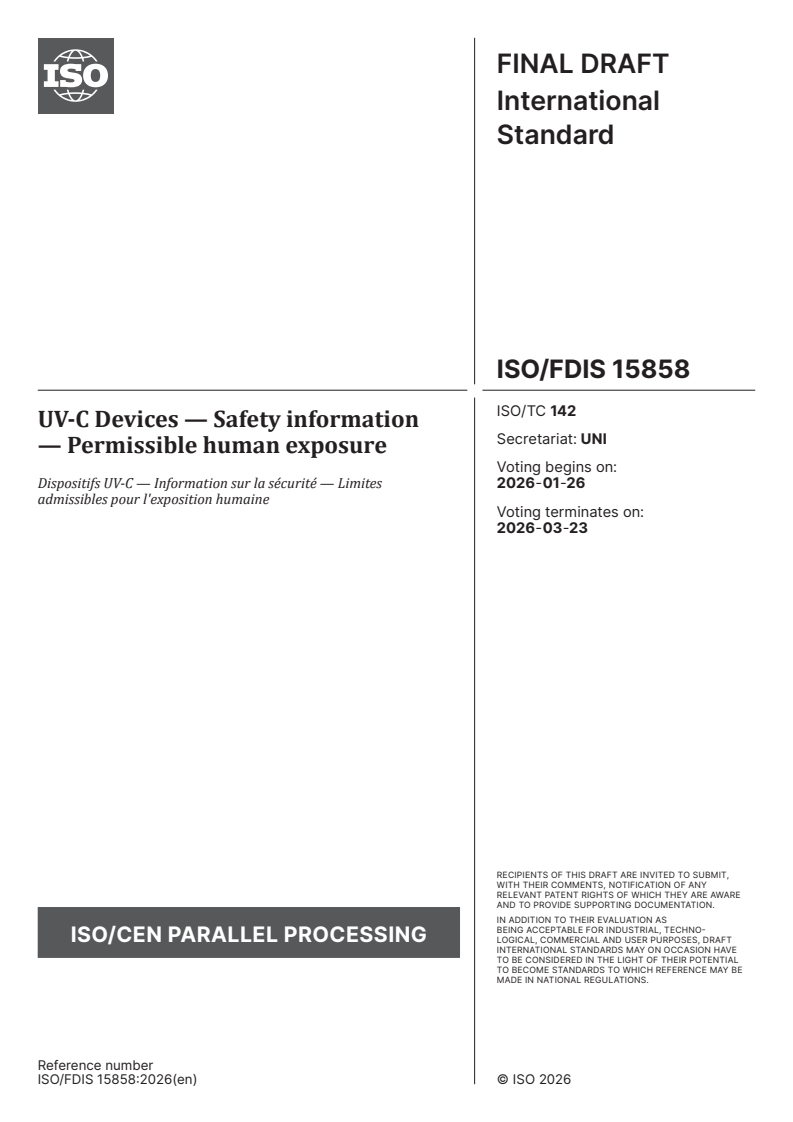
ISO/FDIS 15858 - UV-C Devices — Safety information — Permissible human exposure Released:12. 01. 2026
REDLINE ISO/FDIS 15858 - UV-C Devices — Safety information — Permissible human exposure Released:12. 01. 2026
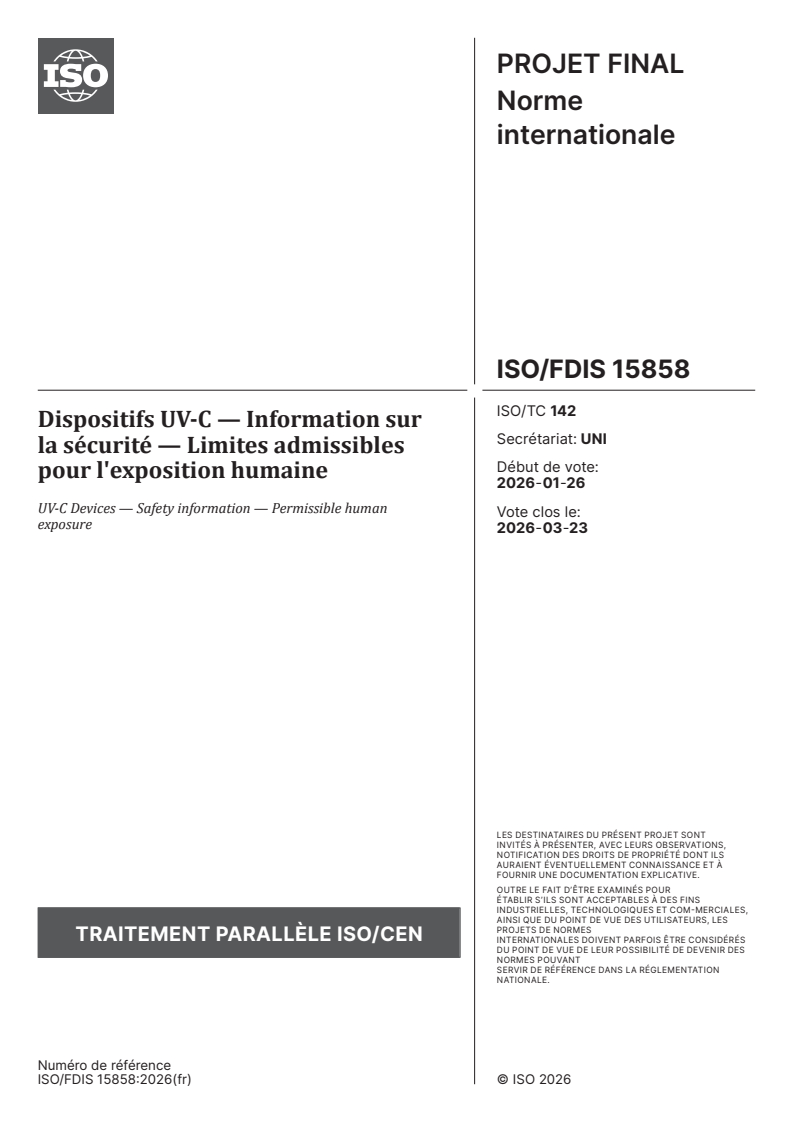
ISO/FDIS 15858 - Dispositifs UV-C — Information sur la sécurité — Limites admissibles pour l'exposition humaine
Get Certified
Connect with accredited certification bodies for this standard

DIBt (Deutsches Institut für Bautechnik)
German Institute for Building Technology.
DIN CERTCO
DIN Group product certification.

Aboma Certification B.V.
Specialized in construction, metal, and transport sectors.
Sponsored listings
Frequently Asked Questions
ISO/FDIS 15858 is a draft published by the International Organization for Standardization (ISO). Its full title is "UV-C Devices — Safety information — Permissible human exposure". This standard covers: ISO 15858:2016 specifies minimum human safety requirements for the use of UVC lamp devices. It is applicable to in-duct UVC systems, upper-air in room UVC systems, portable in-room disinfection UVC devices, and any other UVC devices which may cause UVC exposure to humans. It is not applicable to UVC products used for water disinfection.
ISO 15858:2016 specifies minimum human safety requirements for the use of UVC lamp devices. It is applicable to in-duct UVC systems, upper-air in room UVC systems, portable in-room disinfection UVC devices, and any other UVC devices which may cause UVC exposure to humans. It is not applicable to UVC products used for water disinfection.
ISO/FDIS 15858 is classified under the following ICS (International Classification for Standards) categories: 91.140.30 - Ventilation and air-conditioning systems. The ICS classification helps identify the subject area and facilitates finding related standards.
ISO/FDIS 15858 has the following relationships with other standards: It is inter standard links to FprEN ISO 15858, ISO 15080:2001/Amd 1:2019, ISO 15858:2016. Understanding these relationships helps ensure you are using the most current and applicable version of the standard.
ISO/FDIS 15858 is available in PDF format for immediate download after purchase. The document can be added to your cart and obtained through the secure checkout process. Digital delivery ensures instant access to the complete standard document.
Standards Content (Sample)
FINAL DRAFT
International
Standard
ISO/TC 142
UV-C Devices — Safety information
Secretariat: UNI
— Permissible human exposure
Voting begins on:
Dispositifs UV-C — Information sur la sécurité — Limites 2026-01-26
admissibles pour l'exposition humaine
Voting terminates on:
2026-03-23
RECIPIENTS OF THIS DRAFT ARE INVITED TO SUBMIT,
WITH THEIR COMMENTS, NOTIFICATION OF ANY
RELEVANT PATENT RIGHTS OF WHICH THEY ARE AWARE
AND TO PROVIDE SUPPOR TING DOCUMENTATION.
IN ADDITION TO THEIR EVALUATION AS
BEING ACCEPTABLE FOR INDUSTRIAL, TECHNO
ISO/CEN PARALLEL PROCESSING LOGICAL, COMMERCIAL AND USER PURPOSES, DRAFT
INTERNATIONAL STANDARDS MAY ON OCCASION HAVE
TO BE CONSIDERED IN THE LIGHT OF THEIR POTENTIAL
TO BECOME STAN DARDS TO WHICH REFERENCE MAY BE
MADE IN NATIONAL REGULATIONS.
Reference number
FINAL DRAFT
International
Standard
ISO/TC 142
UV-C Devices — Safety information
Secretariat: UNI
— Permissible human exposure
Voting begins on:
Dispositifs UV-C — Information sur la sécurité — Limites
admissibles pour l'exposition humaine
Voting terminates on:
RECIPIENTS OF THIS DRAFT ARE INVITED TO SUBMIT,
WITH THEIR COMMENTS, NOTIFICATION OF ANY
RELEVANT PATENT RIGHTS OF WHICH THEY ARE AWARE
AND TO PROVIDE SUPPOR TING DOCUMENTATION.
© ISO 2026
IN ADDITION TO THEIR EVALUATION AS
All rights reserved. Unless otherwise specified, or required in the context of its implementation, no part of this publication may
BEING ACCEPTABLE FOR INDUSTRIAL, TECHNO
ISO/CEN PARALLEL PROCESSING
LOGICAL, COMMERCIAL AND USER PURPOSES, DRAFT
be reproduced or utilized otherwise in any form or by any means, electronic or mechanical, including photocopying, or posting on
INTERNATIONAL STANDARDS MAY ON OCCASION HAVE
the internet or an intranet, without prior written permission. Permission can be requested from either ISO at the address below
TO BE CONSIDERED IN THE LIGHT OF THEIR POTENTIAL
or ISO’s member body in the country of the requester.
TO BECOME STAN DARDS TO WHICH REFERENCE MAY BE
MADE IN NATIONAL REGULATIONS.
ISO copyright office
CP 401 • Ch. de Blandonnet 8
CH-1214 Vernier, Geneva
Phone: +41 22 749 01 11
Email: copyright@iso.org
Website: www.iso.org
Published in Switzerland Reference number
ii
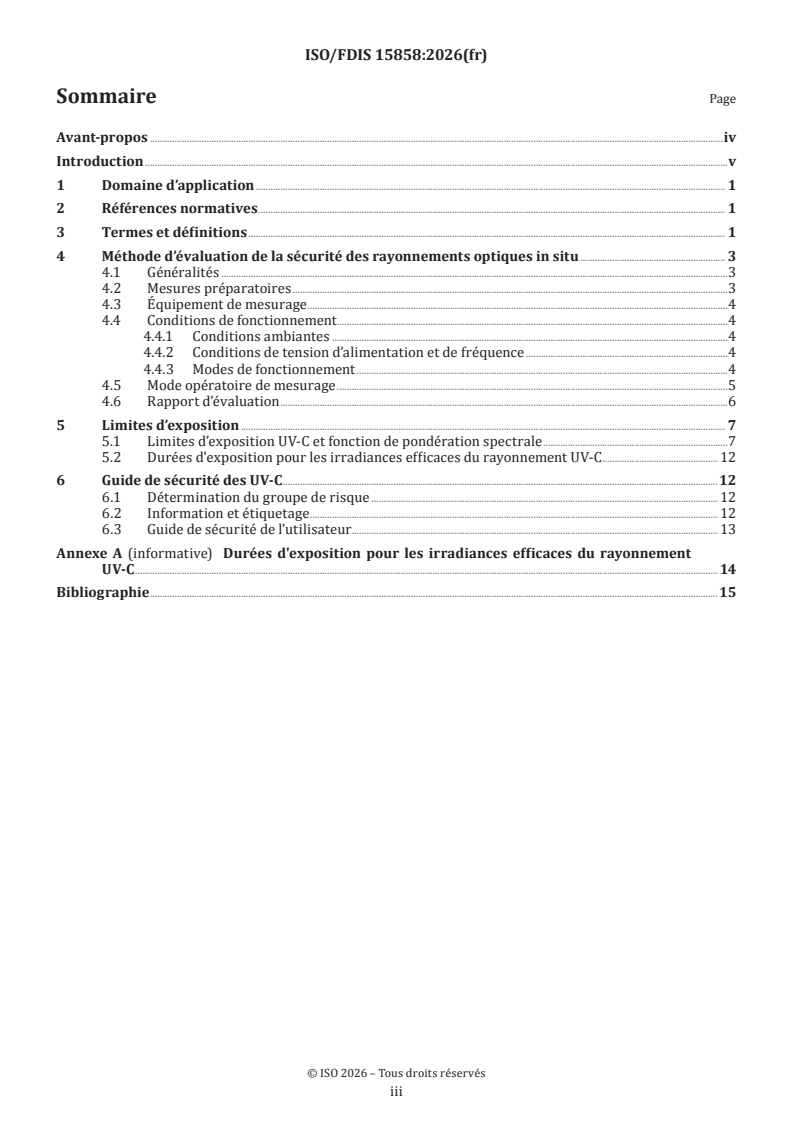
Contents Page
Foreword .iv
Introduction .v
1 Scope . 1
2 Normative references . 1
3 Terms and definitions . 1
4 In-situ optical radiation safety assessment method . 3
4.1 General .3
4.2 Preparatory measures .3
4.3 Measurement equipment.4
4.4 Operating conditions .4
4.4.1 Ambient conditions .4
4.4.2 Supply voltage and frequency conditions .4
4.4.3 Operating modes .4
4.5 Measurement procedure .4
4.6 Assessment Report .6
5 Exposure limits . 7
5.1 UV-C exposure limits and spectral weighting function .7
5.2 Exposure durations for UV-C radiation effective irradiances . 12
6 Safety guide of UV-C .12
6.1 Risk group determination . 12
6.2 Information and labelling . 12
6.3 User safety guide . 12
Annex A (informative) Exposure durations for UV-C radiation effective irradiances .13
Bibliography . 14
iii
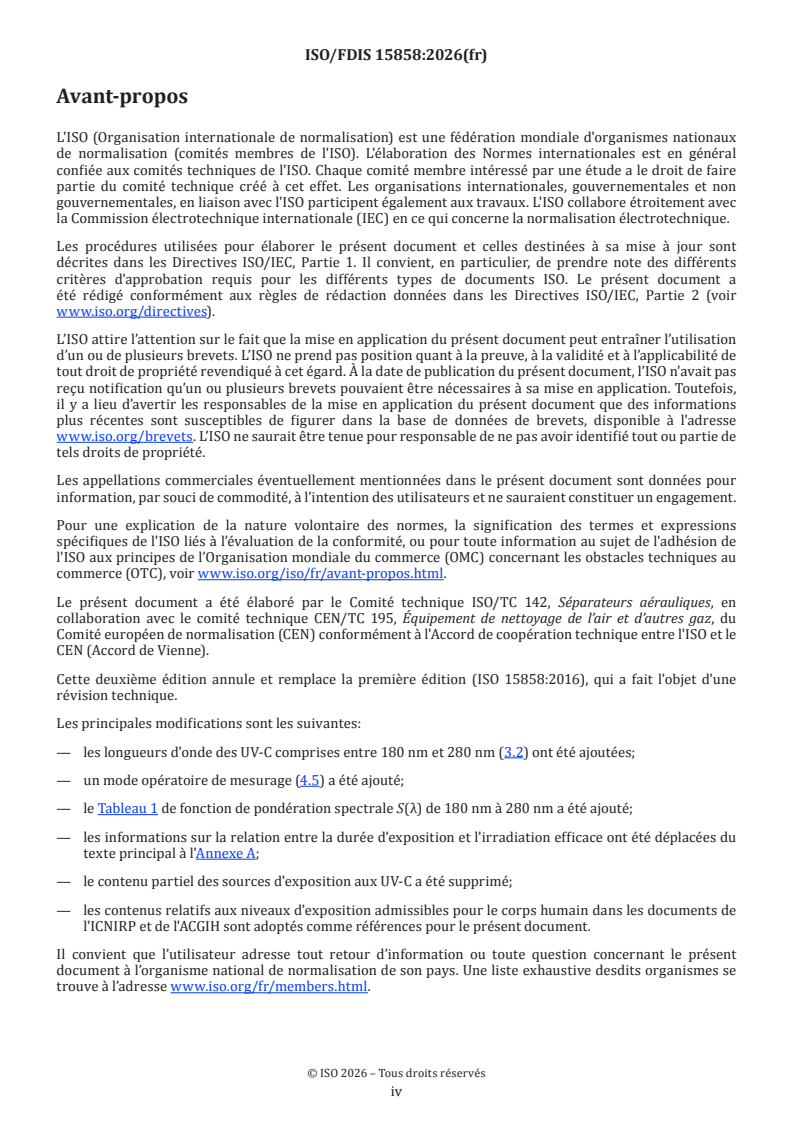
Foreword
ISO (the International Organization for Standardization) is a worldwide federation of national standards
bodies (ISO member bodies). The work of preparing International Standards is normally carried out through
ISO technical committees. Each member body interested in a subject for which a technical committee
has been established has the right to be represented on that committee. International organizations,
governmental and non-governmental, in liaison with ISO, also take part in the work. ISO collaborates closely
with the International Electrotechnical Commission (IEC) on all matters of electrotechnical standardization.
The procedures used to develop this document and those intended for its further maintenance are described
in the ISO/IEC Directives, Part 1. In particular, the different approval criteria needed for the different types
of ISO document should be noted. This document was drafted in accordance with the editorial rules of the
ISO/IEC Directives, Part 2 (see www.iso.org/directives).
ISO draws attention to the possibility that the implementation of this document may involve the use of (a)
patent(s). ISO takes no position concerning the evidence, validity or applicability of any claimed patent
rights in respect thereof. As of the date of publication of this document, ISO had not received notice of (a)
patent(s) which may be required to implement this document. However, implementers are cautioned that
this may not represent the latest information, which may be obtained from the patent database available at
www.iso.org/patents. ISO shall not be held responsible for identifying any or all such patent rights.
Any trade name used in this document is information given for the convenience of users and does not
constitute an endorsement.
For an explanation of the voluntary nature of standards, the meaning of ISO specific terms and expressions
related to conformity assessment, as well as information about ISO's adherence to the World Trade
Organization (WTO) principles in the Technical Barriers to Trade (TBT), see www.iso.org/iso/foreword.html.
This document was prepared by Technical Committee ISO/TC 142 Cleaning equipment for air and other gases,
in collaboration with the European Committee for Standardization (CEN) Technical Committee CEN/TC
195, Cleaning equipment for air and other gases, in accordance with the Agreement on technical cooperation
between ISO and CEN (Vienna Agreement).
This second edition cancels and replaces the first edition (ISO 15858:2016), which has been technically
revised.
The main changes are as follows:
— UV-C wavelengths between 180 nm and 280 nm (3.2) have been included;
— measurement procedure (4.5) has been added;
— table 1 of spectral weighting function S(λ) from 180 nm to 280 nm has been added;
— information on the relation between duration of exposure and effective irradiance has been moved from
the main text to Annex A;
— partial content of the sources of UV-C exposure has been removed;
— the contents related to the permissible exposure levels for the human body in both the ICNIRP and ACGIH
documents are adopted as references for this document
Any feedback or questions on this document should be directed to the user’s national standards body. A
complete listing of these bodies can be found at www.iso.org/members.html.
iv
Introduction
ISO 15858:2016 was developed to specify an in-situ safety assessment method for applications with UV-C
disinfection systems and devices focusing on 254 nm radiation. This new edition of ISO 15858 expands the
applicability of this document to the UV-C wavelength range from 180 nm to 280 nm to take newly developed
technologies in the spectral range below 240 nm into account and offers an improved description of the
scope, limits, assessment method and assessment report.
v
FINAL DRAFT International Standard ISO/FDIS 15858:2026(en)
UV-C Devices — Safety information — Permissible human
exposure
1 Scope
This document specifies an in-situ optical radiation safety assessment method for applications with UV-C
disinfection systems and devices with a wavelength between 180 nm and 280 nm.
This document is applicable to the application of (partly) open in-duct UV-C systems, upper-air in room UV-C
systems, portable in room disinfection UV-C devices and any other device which can expose humans to UV-C
radiation.
This document is not applicable to fully closed UV-C devices, UV-C systems used in controlled access locations
and UV-C devices used for water disinfection.
2 Normative references
The following documents are referred to in the text in such a way that some or all of their content constitutes
requirements of this document. For dated references, only the edition cited applies. For undated references,
the latest edition of the referenced document (including any amendments) applies.
IEC 62471-6:2022, Photobiological safety of lamps and lamp systems - Part 6: Ultraviolet lamp products
EN 14255-1, Measurement and assessment of personal exposures to incoherent optical radiation - Part 1:
Ultraviolet radiation emitted by artificial sources in the workplace
3 Terms and definitions
For the purposes of this document, the following terms and definitions apply.
ISO and IEC maintain terminology databases for use in standardization at the following addresses:
— ISO Online browsing platform: available at https:// www .iso .org/ obp
— IEC Electropedia: available at https:// www .electropedia .org/
3.1
wavelength
distance between repeating units of a wave pattern
Note 1 to entry: Commonly designated by the Greek letter lambda (λ).
[SOURCE: ISO 29464:2024, 3.6.33]
3.2
ultraviolet radiation
UV radiation
optical radiation for which the wavelengths are shorter than those for visible radiation
Note 1 to entry: UV radiation wavelengths are commonly subdivided into:
— UV-A: 315 nm to 400 nm;
— UV-B: 280 nm to 315 nm;
— UV-C: 100 nm to 280 nm.
[SOURCE: ISO 29464:2024, 3.6.24]
3.3
irradiance
power of electromagnetic radiation incident on a surface per unit surface area
Note 1 to entry: Irradiance is expressed in microwatts per square centimetre (μW/cm ). UV-C irradiance is also
2 2
expressed in mW/cm or W/m .
[SOURCE: ISO 29464:2024, 3.6.9]
3.4
UV dose
product of UV irradiance and specific exposure time on a given microorganism or surface
2 2
Note 1 to entry: UV dose is expressed in millijoule per square centimetre (mJ/cm ) or (J/m ).
[SOURCE: ISO 29464:2024, 3.6.26]
3.5
UV-C disinfection
method for disinfection of air, water and surfaces that uses radiation with wavelength (3.1) in the range of
100 nm to 280 nm to kill or inactivate microorganisms
Note 1 to entry: UV irradiation with a wavelength of 100 nm to 280 nm can cause damage to the DNA or RNA of the
microorganisms.
[SOURCE: ISO 29464:2024, 3.6.28]
3.6
radiometer
instrument used to measure radiometric quantities, particularly UV irradiance
3.7
exposure
subjection to infectious agents, irradiation, particulate matter, or chemicals that can have harmful effects
[SOURCE: ISO 29464:2024, 3.6.4]
3.8
personal protective equipment
PPE
clothing, helmets, goggles, respirators, or other specialized gear that is designed to protect the wearer from
injury or illness caused by exposure to specific hazards, typically used for occupational safety and health
purposes
3.9
controlled access location
area where an engineering and administrative control measure is established to prevent access during UV-C
operation
[SOURCE: IEC PAS 63313, 7.3]
4 In-situ optical radiation safety assessment method
4.1 General
This clause describes the preparatory measures, measurement instrumentation requirements, operation
conditions and the measurement procedure of the in-situ optical radiation safety assessment method for
applications with UV-C disinfection systems and devices in case of:
— the initial installation of these systems and devices in the room;
— the maintenance of the installed systems and devices (e.g. replacement of UV-C lamp or source);
— the modification of the systems and devices (e.g. adjustment of device height, location or position of
louvers);
— the modification of the room in which the systems and devices are installed (e.g. changes of UV-C
absorbing or UV-C reflecting materials, or room dimensions, or modular partition heights);
— complaints of possible optical irradiation or UV-C dose overexposure.
4.2 Preparatory measures
In situations where the installation can exceed the threshold limit values (TLVs) personal protective
equipment(PPE) should be considered as part of preparatory measures.
Preparatory measures are as follows:
— Provide the assessors with PPE which consists of the following:
— UV radiation-resistant eyewear, such as goggles, face shields, and safety glasses; a suitable eye
protector should be selected according to ISO 19734;
— clothing known to be non-transparent to UV-C penetration, which covers exposed skin;
— Train the assessors on the following:
— required PPE;
— health and safety topics;
— handling of UV-C lamps, modules, devices;
— hazards generated by accidental UV-C exposure in work areas;
— first aid response post exposure.
— If applicable the UV-C systems and devices should be seasoned (burned-in);
NOTE 1 For example, low pressure mercury sources need to be seasoned for at least 100 h.
— Check that assessors have the right documents including the latest design made for the site, as well as,
if applicable, any information collected during site audit or previous measurements (if applicable) to
compare with the current situation;
— Check if the function of the room (program, occupant tasks, hours occupied, etc) is the same as it was
when the system was designed;
— Check if mechanical ventilation and site conditions are the same as during the audit (this should be done
also during every maintenance visit). If there is no register, register this information accordingly;
— Protective sensors (like presence, distance, illumination sensors) shall not be switched off, during the
measurements described in this document;
— Look for obstacles (hanging from th
...
ISO/TC 142
Secretariat: UNI
Date: 20252026-01-12-02
UV-C Devices – — Safety information –— Permissible human exposure
Dispositifs UV-C — Information sur la sécurité — Limites admissibles pour l'exposition humaine
FDIS stage
ThiThis drs drafaft is t is submitted tsubmitted too a a p parallel arallel vovote in ISOte in ISO, CE, CEN.N.
All rights reserved. Unless otherwise specified, or required in the context of its implementation, no part of this publication
may be reproduced or utilized otherwise in any form or by any means, electronic or mechanical, including photocopying,
or posting on the internet or an intranet, without prior written permission. Permission can be requested from either ISO
at the address below or ISO’s member body in the country of the requester.
ISO copyright office
CP 401 • Ch. de Blandonnet 8
CH-1214 Vernier, Geneva
Phone: + 41 22 749 01 11
EmailE-mail: copyright@iso.org
Website: www.iso.org
Published in Switzerland
© ISO #### 2026 – All rights reserved
ii
Contents
Foreword . iv
Introduction . v
1 Scope . 1
2 Normative references . 1
3 Terms and definitions . 1
4 In-situ optical radiation safety assessment method . 3
4.1 General . 3
4.2 Preparatory measures . 3
4.3 Measurement equipment . 4
4.4 Operating conditions . 4
4.5 Measurement procedure . 5
4.6 Assessment Report . 7
5 Exposure limits . 8
5.1 UV-C exposure limits and spectral weighting function . 8
5.2 Exposure durations for UV-C radiation effective irradiances . 15
6 Safety guide of UV-C . 15
6.1 Risk group determination . 15
6.2 Information and labelling . 15
6.3 User safety guide . 15
Annex A (informative) Exposure durations for UV-C radiation effective irradiances . 16
Bibliography . 17
iii
Foreword
ISO (the International Organization for Standardization) is a worldwide federation of national standards
bodies (ISO member bodies). The work of preparing International Standards is normally carried out through
ISO technical committees. Each member body interested in a subject for which a technical committee has been
established has the right to be represented on that committee. International organizations, governmental and
non-governmental, in liaison with ISO, also take part in the work. ISO collaborates closely with the
International Electrotechnical Commission (IEC) on all matters of electrotechnical standardization.
The procedures used to develop this document and those intended for its further maintenance are described
in the ISO/IEC Directives, Part 1. In particular, the different approval criteria needed for the different types of
ISO document should be noted. This document was drafted in accordance with the editorial rules of the
ISO/IEC Directives, Part 2 (see www.iso.org/directives).
ISO draws attention to the possibility that the implementation of this document may involve the use of (a)
patent(s). ISO takes no position concerning the evidence, validity or applicability of any claimed patent rights
in respect thereof. As of the date of publication of this document, ISO had not received notice of (a) patent(s)
which may be required to implement this document. However, implementers are cautioned that this may not
represent the latest information, which may be obtained from the patent database available at
www.iso.org/patents. ISO shall not be held responsible for identifying any or all such patent rights.
Any trade name used in this document is information given for the convenience of users and does not
constitute an endorsement.
For an explanation of the voluntary nature of standards, the meaning of ISO specific terms and expressions
related to conformity assessment, as well as information about ISO's adherence to the World Trade
Organization (WTO) principles in the Technical Barriers to Trade (TBT), see www.iso.org/iso/foreword.html.
This document was prepared by Technical Committee ISO/TC 142 Cleaning equipment for air and other gases,
in collaboration with the European Committee for Standardization (CEN) Technical Committee CEN/TC 195,
Cleaning equipment for air and other gases, in accordance with the Agreement on technical cooperation
between ISO and CEN (Vienna Agreement).
This second edition cancels and replaces the first edition (ISO 15858:2016), which has been technically
revised.
The main changes are as follows:
— — UV-C wavelengths between 180 nm and 280 nm (Error! Reference source not found.(3.2)) have
been included;
— — measurement procedure (4.5(4.5)) has been added;
— 0— table 1 of spectral weighting function S(λ) from 180 nm to 280 nm has been added;
— — information on the relation between duration of exposure and effective irradiance has been moved
from the main text to Annex AAnnex A;;
— — partial content of the sources of UV-C exposure has been removed;
— — the contents related to the permissible exposure levels for the human body in both the ICNIRP and
ACGIH documents are adopted as references for this document
Any feedback or questions on this document should be directed to the user’s national standards body. A
complete listing of these bodies can be found at www.iso.org/members.htmlA .
© ISO #### 2026 – All rights reserved
iv
complete listing of these bodies can be found at .
v
Introduction
ISO 15858:2016 was developed to specify an in-situ safety assessment method for applications with UV-C
disinfection systems and devices focusing on 254 nm radiation. This new edition of ISO 15858 expands the
applicability of this document to the UV-C wavelength range from 180 nm to 280 nm to take newly developed
technologies in the spectral range below 240 nm into account and offers an improved description of the scope,
limits, assessment method and assessment report.
© ISO #### 2026 – All rights reserved
vi
UV-C Device Devices — Safety information — Permissible human
exposure
1 Scope
This document specifies an in-situ optical radiation safety assessment method for applications with UV-C
disinfection systems and devices with a wavelength between 180 nm and 280 nm.
This document is applicable to the application of (partly) open in-duct UV-C systems, upper-air in room UV-C
systems, portable in room disinfection UV-C devices and any other device which can expose humans to UV-C
radiation.
This document is not applicable to fully closed UV-C devices, UV-C systems used in controlled access locations
and UV-C devices used for water disinfection.
2 Normative references
The following documents are referred to in the text in such a way that some or all of their content constitutes
requirements of this document. For dated references, only the edition cited applies. For undated references,
the latest edition of the referenced document (including any amendments) applies.
IEC 62471--6:2022, Photobiological safety of lamps and lamp systems - Part 6: Ultraviolet lamp products
EN 14255--1, Measurement and assessment of personal exposures to incoherent optical radiation - Part 1:
Ultraviolet radiation emitted by artificial sources in the workplace
3 Terms and definitions
For the purposes of this document, the following terms and definitions apply.
ISO and IEC maintain terminology databases for use in standardization at the following addresses:
— — ISO Online browsing platform: available at https://www.iso.org/obp
— — IEC Electropedia: available at https://www.electropedia.org/
3.1 3.1
wavelength
distance between repeating units of a wave pattern
Note 1 to entry: Commonly designated by the Greek letter lambda (λ).
[SOURCE: ISO 29464:2024, 3.6.33]
3.2 3.2
ultraviolet radiation
UV radiation
optical radiation for which the wavelengths are shorter than those for visible radiation
Note 1 to entry: UV radiation wavelengths are commonly subdivided into:
MUST BE USED
— — UV-A: 315 nm to 400 nm;
FOR FINAL
— — UV-B: 280 nm to 315 nm;
— — UV-C: 100 nm to 280 nm.
[SOURCE: ISO 29464:2024, 3.6.24]
3.3 3.3
irradiance
power of electromagnetic radiation incident on a surface per unit surface area
Note 1 to entry: Irradiance is expressed in microwatts per square centimetre (μW/cm ). UV-C irradiance is also
2 2
expressed in mW/cm or W/m .
[SOURCE: ISO 29464:2024, 3.6.9]
3.4 3.4
UV dose
product of UV irradiance and specific exposure time on a given microorganism or surface
2 2
Note 1 to entry: UV dose is expressed in millijoule per square centimetre (mJ/cm ) or (J/m ).
[SOURCE: ISO 29464:2024, 3.6.26]
3.5 3.5
UV-C disinfection
method for disinfection of air, water and surfaces that uses radiation with wavelength (Error! Reference
source not found.(3.1)) in the range of 100 nm to 280 nm to kill or inactivate microorganisms
Note 1 to entry: UV irradiation with a wavelength of 100 nm to 280 nm can cause damage to the DNA or RNA of the
microorganisms.
[SOURCE: ISO 29464:2024, 3.6.28]
3.6 3.6
radiometer
instrument used to measure radiometric quantities, particularly UV irradiance
3.7 3.7
exposure
subjection to infectious agents, irradiation, particulate matter, or chemicals that can have harmful effects
[SOURCE: ISO 29464:2024, 3.6.4]
3.8 3.8
personal protective equipment
PPE
clothing, helmets, goggles, respirators, or other specialized gear that is designed to protect the wearer from
injury or illness caused by exposure to specific hazards, typically used for occupational safety and health
purposes
3.9 3.9
controlled access location
area where an engineering and administrative control measure is established to prevent access during UV-C
operation
[SOURCE: IEC PAS 63313, 7.3]
© ISO #### 2026 – All rights reserved
4 In-situ optical radiation safety assessment method
4.1 General
This clause describes the preparatory measures, measurement instrumentation requirements, operation
conditions and the measurement procedure of the in-situ optical radiation safety assessment method for
applications with UV-C disinfection systems and devices in case of:
— — the initial installation of these systems and devices in the room;
— — the maintenance of the installed systems and devices (e.g. replacement of UV-C lamp or source);
— — the modification of the systems and devices (e.g. adjustment of device height, location or position of
louvers);
— — the modification of the room in which the systems and devices are installed (e.g. changes of UV-C
absorbing or UV-C reflecting materials, or room dimensions, or modular partition heights);
— — complaints of possible optical irradiation or UV-C dose overexposure.
4.2 Preparatory measures
In situations where the installation can exceed the threshold limit values (TLVs) personal protective
equipment(PPE) should be considered as part of preparatory measures.
Preparatory measures are as follows:
— — Provide the assessors with PPE which consists of the following:
— — UV radiation-resistant eyewear, such as goggles, face shields, and safety glasses; a suitable eye
protector should be selected according to ISO 19734;
— — clothing known to be non-transparent to UV-C penetration, which covers exposed skin;
— — Train the assessors on the following:
— — required PPE;
— — health and safety topics;
— — handling of UV-C lamps, modules, devices;
— — hazards generated by accidental UV-C exposure in work areas;
— — first aid response post exposure.
— — If applicable the UV-C systems and devices should be seasoned (burned-in);
NOTE 1 For example, low pressure mercury sources need to be seasoned for at least 100 h.
— — Check that assessors have the right documents including the latest design made for the site, as well as,
if applicable, any information collected during site audit or previous measurements (if applicable) to
MUST BE USED MUST BE USED
compare with the current situation;
— — Check if the function of the room (program, occupant tasks, hours occupied, etc) is the same as it was
FOR FINAL FOR FINAL
when the system was designed;
— — Check if mechanical ventilation and site conditions are the same as during the audit (this should be
done also during every maintenance visit). If there is no register, register this information accordingly;
— — Protective sensors (like presence, distance, illumination sensors) shall not be switched off, during the
measurements described in this document;
— — Look for obstacles (hanging from the ceiling or higher objects from the floor) that can interfere with
the UV-C radiation and register them;
— — A safety risk assessment should be carried out.
NOTE 2 National regulations for the determination of occupational health and safety measures for individual
processes exist. The measures given within this document can be incomplete or insufficient against the background of
local national regulations. It is presupposed that the national legal situation is considered.
4.3 Measurement equipment
Measurement equipment requirements are as follows:
— — UV-C radiation measurements shall comply with the measuring method in EN 14255-1;
— — Radiometers for in-situ measurement of UV-C irradiance shall be calibrated to the effective irradiance
of the source spectrum of interest;
— — The radiometer shall be cosine corrected;
— — The radiometer should have a resolution of decimal 0,01 μW/cm ;
— — The Field of View (FOV) should be 80° (±40°). External light sources should be considered as a possible
source of measurement error and measures (e.g. installation of a light shield on the radiometer; regular
calibration of the radiometer; averaging of several measurements) should be taken to minimize their
impact on the measurement;
— — Averaging of several measurements should be taken to minimize the impact of external sources on
the measurement.
4.4 Operating conditions
4.4.1 Ambient conditions
Measurements shall be carried out under normal conditions. If the ambient temperature is not within the
range from 15 °C to 30 °C, the instrument calibration should be checked.
4.4.2 Supply voltage and frequency conditions
The supply voltage shall be in the range of the rated voltage. The frequency of the mains supply shall be as
rated for the equipment. When the rated frequency range is 50 Hz or 60 Hz, a measurement at either 50 Hz or
at 60 Hz
...
PROJET FINAL
Norme
internationale
ISO/TC 142
Dispositifs UV-C — Information sur
Secrétariat: UNI
la sécurité — Limites admissibles
Début de vote:
pour l'exposition humaine
2026-01-26
UV-C Devices — Safety information — Permissible human
Vote clos le:
exposure
2026-03-23
LES DESTINATAIRES DU PRÉSENT PROJET SONT
INVITÉS À PRÉSENTER, AVEC LEURS OBSERVATIONS,
NOTIFICATION DES DROITS DE PROPRIÉTÉ DONT ILS
AURAIENT ÉVENTUELLEMENT CONNAISSANCE ET À
FOURNIR UNE DOCUMENTATION EXPLICATIVE.
OUTRE LE FAIT D’ÊTRE EXAMINÉS POUR
ÉTABLIR S’ILS SONT ACCEPTABLES À DES FINS
INDUSTRIELLES, TECHNOLOGIQUES ET COM-MERCIALES,
AINSI QUE DU POINT DE VUE DES UTILISATEURS, LES
PROJETS DE NORMES
TRAITEMENT PARALLÈLE ISO/CEN
INTERNATIONALES DOIVENT PARFOIS ÊTRE CONSIDÉRÉS
DU POINT DE VUE DE LEUR POSSI BILITÉ DE DEVENIR DES
NORMES POUVANT
SERVIR DE RÉFÉRENCE DANS LA RÉGLEMENTATION
NATIONALE.
Numéro de référence
PROJET FINAL
Norme
internationale
ISO/TC 142
Dispositifs UV-C — Information sur
Secrétariat: UNI
la sécurité — Limites admissibles
Début de vote:
pour l'exposition humaine
2026-01-26
UV-C Devices — Safety information — Permissible human
Vote clos le:
exposure
2026-03-23
LES DESTINATAIRES DU PRÉSENT PROJET SONT
INVITÉS À PRÉSENTER, AVEC LEURS OBSERVATIONS,
NOTIFICATION DES DROITS DE PROPRIÉTÉ DONT ILS
AURAIENT ÉVENTUELLEMENT CONNAISSANCE ET À
FOURNIR UNE DOCUMENTATION EXPLICATIVE.
DOCUMENT PROTÉGÉ PAR COPYRIGHT
OUTRE LE FAIT D’ÊTRE EXAMINÉS POUR
ÉTABLIR S’ILS SONT ACCEPTABLES À DES FINS
© ISO 2026 INDUSTRIELLES, TECHNOLOGIQUES ET COM-MERCIALES,
AINSI QUE DU POINT DE VUE DES UTILISATEURS, LES
Tous droits réservés. Sauf prescription différente ou nécessité dans le contexte de sa mise en œuvre, aucune partie de cette
PROJETS DE NORMES
TRAITEMENT PARALLÈLE ISO/CEN
INTERNATIONALES DOIVENT PARFOIS ÊTRE CONSIDÉRÉS
publication ne peut être reproduite ni utilisée sous quelque forme que ce soit et par aucun procédé, électronique ou mécanique,
DU POINT DE VUE DE LEUR POSSI BILITÉ DE DEVENIR DES
y compris la photocopie, ou la diffusion sur l’internet ou sur un intranet, sans autorisation écrite préalable. Une autorisation peut
NORMES POUVANT
être demandée à l’ISO à l’adresse ci-après ou au comité membre de l’ISO dans le pays du demandeur.
SERVIR DE RÉFÉRENCE DANS LA RÉGLEMENTATION
NATIONALE.
ISO copyright office
Case postale 401 • Ch. de Blandonnet 8
CH-1214 Vernier, Genève
Tél.: +41 22 749 01 11
E-mail: copyright@iso.org
Web: www.iso.org
Publié en Suisse Numéro de référence
ii
Sommaire Page
Avant-propos .iv
Introduction .v
1 Domaine d’application . 1
2 Références normatives . 1
3 Termes et définitions . 1
4 Méthode d’évaluation de la sécurité des rayonnements optiques in situ . 3
4.1 Généralités .3
4.2 Mesures préparatoires .3
4.3 Équipement de mesurage .4
4.4 Conditions de fonctionnement . . .4
4.4.1 Conditions ambiantes .4
4.4.2 Conditions de tension d’alimentation et de fréquence .4
4.4.3 Modes de fonctionnement .4
4.5 Mode opératoire de mesurage .5
4.6 Rapport d’évaluation .6
5 Limites d’exposition . 7
5.1 Limites d’exposition UV-C et fonction de pondération spectrale .7
5.2 Durées d'exposition pour les irradiances efficaces du rayonnement UV-C . 12
6 Guide de sécurité des UV-C .12
6.1 Détermination du groupe de risque . 12
6.2 Information et étiquetage . 12
6.3 Guide de sécurité de l’utilisateur. 13
Annexe A (informative) Durées d'exposition pour les irradiances efficaces du rayonnement
UV-C . 14
Bibliographie .15
iii
Avant-propos
L'ISO (Organisation internationale de normalisation) est une fédération mondiale d'organismes nationaux
de normalisation (comités membres de l'ISO). L'élaboration des Normes internationales est en général
confiée aux comités techniques de l'ISO. Chaque comité membre intéressé par une étude a le droit de faire
partie du comité technique créé à cet effet. Les organisations internationales, gouvernementales et non
gouvernementales, en liaison avec l'ISO participent également aux travaux. L'ISO collabore étroitement avec
la Commission électrotechnique internationale (IEC) en ce qui concerne la normalisation électrotechnique.
Les procédures utilisées pour élaborer le présent document et celles destinées à sa mise à jour sont
décrites dans les Directives ISO/IEC, Partie 1. Il convient, en particulier, de prendre note des différents
critères d'approbation requis pour les différents types de documents ISO. Le présent document a
été rédigé conformément aux règles de rédaction données dans les Directives ISO/IEC, Partie 2 (voir
www.iso.org/directives).
L’ISO attire l’attention sur le fait que la mise en application du présent document peut entraîner l’utilisation
d’un ou de plusieurs brevets. L’ISO ne prend pas position quant à la preuve, à la validité et à l’applicabilité de
tout droit de propriété revendiqué à cet égard. À la date de publication du présent document, l’ISO n'avait pas
reçu notification qu’un ou plusieurs brevets pouvaient être nécessaires à sa mise en application. Toutefois,
il y a lieu d’avertir les responsables de la mise en application du présent document que des informations
plus récentes sont susceptibles de figurer dans la base de données de brevets, disponible à l'adresse
www.iso.org/brevets. L’ISO ne saurait être tenue pour responsable de ne pas avoir identifié tout ou partie de
tels droits de propriété.
Les appellations commerciales éventuellement mentionnées dans le présent document sont données pour
information, par souci de commodité, à l’intention des utilisateurs et ne sauraient constituer un engagement.
Pour une explication de la nature volontaire des normes, la signification des termes et expressions
spécifiques de l'ISO liés à l'évaluation de la conformité, ou pour toute information au sujet de l'adhésion de
l'ISO aux principes de l’Organisation mondiale du commerce (OMC) concernant les obstacles techniques au
commerce (OTC), voir www.iso.org/iso/fr/avant-propos.html.
Le présent document a été élaboré par le Comité technique ISO/TC 142, Séparateurs aérauliques, en
collaboration avec le comité technique CEN/TC 195, Équipement de nettoyage de l’air et d’autres gaz, du
Comité européen de normalisation (CEN) conformément à l'Accord de coopération technique entre l'ISO et le
CEN (Accord de Vienne).
Cette deuxième édition annule et remplace la première édition (ISO 15858:2016), qui a fait l'objet d'une
révision technique.
Les principales modifications sont les suivantes:
— les longueurs d'onde des UV-C comprises entre 180 nm et 280 nm (3.2) ont été ajoutées;
— un mode opératoire de mesurage (4.5) a été ajouté;
— le Tableau 1 de fonction de pondération spectrale S(λ) de 180 nm à 280 nm a été ajouté;
— les informations sur la relation entre la durée d'exposition et l'irradiation efficace ont été déplacées du
texte principal à l'Annexe A;
— le contenu partiel des sources d'exposition aux UV-C a été supprimé;
— les contenus relatifs aux niveaux d'exposition admissibles pour le corps humain dans les documents de
l'ICNIRP et de l'ACGIH sont adoptés comme références pour le présent document.
Il convient que l’utilisateur adresse tout retour d’information ou toute question concernant le présent
document à l’organisme national de normalisation de son pays. Une liste exhaustive desdits organismes se
trouve à l’adresse www.iso.org/fr/members.html.
iv
Introduction
L'ISO 15858:2016 a été élaboré pour spécifier une méthode d'évaluation de la sécurité in situ pour les
applications avec des systèmes et des dispositifs de désinfection par UV-C axés sur un rayonnement
de 254 nm. Cette nouvelle édition de l'ISO 15858 étend l'applicabilité du présent document à la plage de
longueurs d'onde UV-C de 180 nm à 280 nm afin de prendre en compte les technologies nouvellement
développées dans la plage spectrale inférieure à 240 nm et offre une description améliorée du domaine
d'application, des limites, de la méthode d'évaluation et du rapport d'évaluation.
v
PROJET FINAL Norme internationale ISO/FDIS 15858:2026(fr)
Dispositifs UV-C — Information sur la sécurité — Limites
admissibles pour l'exposition humaine
1 Domaine d’application
Le présent document spécifie une méthode d’évaluation de la sécurité des rayonnements optiques in situ
pour les applications avec des systèmes et des dispositifs de désinfection UV-C d’une longueur d’onde
comprise entre 180 nm et 280 nm.
Le présent document s’applique à l’utilisation de systèmes UV-C en conduit (partiellement) ouvert, de
systèmes UV-C pour l’air supérieur dans une pièce, de dispositifs UV-C de désinfections portables pour une
pièce et de tout autre dispositif pouvant exposer les humains au rayonnement UV-C.
Le présent document ne s’applique pas aux dispositifs UV-C totalement fermés, aux systèmes UV-C utilisés
dans un emplacement à accès contrôlé et aux dispositifs UV-C utilisés pour la désinfection de l’eau.
2 Références normatives
Les documents suivants sont cités dans le texte de sorte qu’ils constituent, pour tout ou partie de leur
contenu, des exigences du présent document. Pour les références datées, seule l’édition citée s’applique. Pour
les références non datées, la dernière édition du document de référence s'applique (y compris les éventuels
amendements).
IEC 62471-6:2022, Sécurité photobiologique des lampes et des appareils utilisant des lampes — Partie 6:
Appareils à lampes ultraviolettes
EN 14255-1, Mesurage et évaluation de l’exposition des personnes aux rayonnements optiques incohérents —
Partie 1: Rayonnements ultraviolets émis par des sources artificielles sur les lieux de travail
3 Termes et définitions
Pour les besoins du présent document, les termes et définitions suivants s’appliquent.
L’ISO et l’IEC tiennent à jour des bases de données terminologiques destinées à être utilisées en normalisation,
consultables aux adresses suivantes:
— ISO Online browsing platform: disponible à l’adresse https:// www .iso .org/ obp
— IEC Electropedia: disponible à l’adresse sur https:// www .electropedia .org/
3.1
longueur d’onde
distance entre des unités répétées d'une configuration d'onde
Note 1 à l'article: Généralement représentée par la lettre grecque lambda (λ).
[SOURCE: ISO 29464:2024, 3.6.33]
3.2
rayonnement ultraviolet
rayonnement UV
rayonnement optique dont les longueurs d’onde sont plus courtes que celles du rayonnement visible
Note 1 à l'article: Les longueurs d'ondes du rayonnement UV sont généralement divisées comme suit:
— UV-A: 315 nm à 400 nm;
— UV-B: 280 nm à 315 nm;
— UV-C: 100 nm à 280 nm.
[SOURCE: ISO 29464:2024, 3.6.24]
3.3
irradiance
puissance du rayonnement électromagnétique incident sur une surface par unité de surface
Note 1 à l'article: L'irradiance est exprimée en microwatts par centimètre carré (μW/cm ). L'irradiance UV-C est
2 2
également exprimée en mW/cm ou W/m .
[SOURCE: ISO 29464:2024, 3.6.9]
3.4
dose d'UV
produit de l'irradiance UV et du temps d'exposition spécifique sur un micro-organisme ou une surface donné
2 2
Note 1 à l'article: La dose d'UV est exprimée en millijoules par centimètre carré (mJ/cm ) ou (J/m ).
[SOURCE: ISO 29464:2024, 3.6.26]
3.5
désinfection UV-C
méthode de désinfection de l’air, de l’eau et des surfaces qui utilise un rayonnement avec une longueur d'onde
(3.1) dans la plage de 100 nm à 280 nm afin de détruire ou d’inactiver les micro-organismes
Note 1 à l'article: L'irradiation UV avec une longueur d'onde de 100 nm à 280 nm peut endommager l'ADN ou l'ARN des
micro-organismes.
[SOURCE: ISO 29464:2024, 3.6.28]
3.6
radiomètre
instrument utilisé pour mesurer des grandeurs radiométriques, notamment l'irradiance UV
3.7
exposition
soumission à des agents infectieux, à une irradiation, à des particules en suspension ou à des produits
chimiques pouvant avoir des effets nocifs
[SOURCE: ISO 29464:2024, 3.6.4]
3.8
équipement de protection individuelle
EPI
vêtements, casques, lunettes de protection, appareils respiratoires, ou autre équipement spécialisé conçu
pour protéger celui qui les porte contre les blessures ou maladies dues à une exposition à des risques
spécifiques, généralement utilisés à des fins de sécurité et de santé au travail
3.9
emplacement à accès contrôlé
zone où une mesure de contrôle technique ou administrative est mise en place pour empêcher l’accès
pendant la phase d'utilisation des UV-C
[SOURCE: IEC PAS 63313, 7.3]
4 Méthode d’évaluation de la sécurité des rayonnements optiques in situ
4.1 Généralités
Le présent article décrit les mesures préparatoires, les exigences en matière d’instruments de mesure, les
conditions de fonctionnement et le mode opératoire de mesurage de la méthode d’évaluation de la sécurité
des rayonnements optiques in situ pour les applications avec des systèmes et des dispositifs de désinfection
UV-C en cas de:
— l’installation initiale de ces systèmes et dispositifs dans la pièce;
— l’entretien des systèmes et dispositifs installés (par exemple, remplacement de la lampe ou de la source
UV-C);
— la modification des systèmes et des dispositifs (par exemple, réglage de la hauteur d’un dispositif,
emplacement ou position des volets);
— la modification de la pièce dans laquelle les systèmes et les dispositifs sont installés (par exemple,
modification des matériaux absorbant les UV-C ou réfléchissant les UV-C, ou des dimensions de la pièce,
ou des hauteurs des cloisons modulaires);
— les plaintes relatives à une éventuelle surexposition à l’irradiation optique ou à une dose d'UV-C.
4.2 Mesures préparatoires
Dans les situations où l'installation peut dépasser les valeurs limites de seuil (TLV), il convient d'envisager
un équipement de protection individuelle (EPI) comme partie intégrante des mesures préparatoires.
Les mesures préparatoires sont les suivantes:
— Fournir aux évaluateurs un équipement de protection individuelle (EPI) qui comprend les éléments
suivants:
— des lunettes résistantes au rayonnement UV, comme des lunettes de protection, des écrans faciaux,
et des lunettes de sécurité; il convient qu'un protecteur oculaire adapté soit sélectionné selon
l’ISO 19734;
— des vêtements connus pour être non-transparents à la pénétration UV-C, qui couvrent la peau
exposée.
— Former les évaluateurs à ce qui suit:
— les EPI requis;
— les sujets relatifs à la santé et la sécurité;
— la manipulation des lampes, modules, dispositifs UV-C;
— les phénomènes dangereux générés par une exposition accidentelle aux UV-C dans les zones de
travail;
— les premiers soins à dispenser suite à une exposition.
— le cas échéant, il convient que les systèmes et dispositifs UV-C soient rodés (déverminés);
NOTE 1 Par exemple, les sources de mercure à basse pression ont besoin d'être rodées pendant au moins 100 h.
— Vérifier que les évaluateurs ont les bons documents y compris la dernière conception réalisée pour le site,
ainsi que, le cas échéant, toute information recueillie lors de l’audit du site ou les mesures antérieures (le
cas échéant) afin de les comparer à la situation actuelle;
— Vérifier si la fonction de la pièce (programme, tâches des occupants, heures d’occupation, etc.) est la
même que lors de la conception du système;
— Vérifier si la ventilation mécanique et les conditions du site sont les mêmes que lors de l’audit (il convient
que cela soit également réalisé lors de chaque visite de maintenance). S’il n’y a pas de registre, enregistrer
cette information en conséquence;
— Les capteurs de protection (comme les capteurs de présence, de distance, d'éclairage) ne do
...
Questions, Comments and Discussion
Ask us and Technical Secretary will try to provide an answer. You can facilitate discussion about the standard in here.
Loading comments...