

ISO 29463-1:2024
(Main)High efficiency filters and filter media for removing particles in air — Part 1: Classification, performance, testing and marking
General Information
- Abstract
This document establishes a classification of filters based on their performance, as determined in accordance with ISO 29463-3, ISO 29463-4 and ISO 29463-5. It also provides an overview of the test procedures and specifies general requirements for assessing and marking the filters, as well as for documenting the test results. It is intended to be used in conjunction with ISO 29463-2, ISO 29463-3, ISO 29463-4 and ISO 29463-5.
- Status
- Published
- Publication Date
- 07-Aug-2024
- Technical Committee
- ISO/TC 142 - Cleaning equipment for air and other gases
- Drafting Committee
- ISO/TC 142 - Cleaning equipment for air and other gases
- Current Stage
- 6060 - International Standard published
- Start Date
- 08-Aug-2024
- Due Date
- 09-Dec-2024
- Completion Date
- 08-Aug-2024
Overview
ISO 29463-1:2024 - "High efficiency filters and filter media for removing particles in air - Part 1: Classification, performance, testing and marking" defines how high-efficiency air filters (including EPA/HEPA/ULPA classes) are classified, tested, assessed and marked. Part 1 sets out the classification framework and general requirements and is intended to be used together with ISO 29463-2, -3, -4 and -5. The standard is derived from EN 1822 and uses a particle-counting approach at the most penetrating particle size (MPPS) to determine both local and overall filter efficiency (ranging from Group H/E efficiencies through ultra-low penetration grades).
Key technical topics and requirements
- Filter classification: Filters and filter elements are grouped and classed according to efficiency/penetration at the MPPS. New E classes were added in this edition.
- Performance metrics: Integral (overall) and local removal efficiency, penetration, pressure drop (Δp), nominal air volume flow rate and medium velocity are specified as assessment parameters.
- Test methods overview: General test rig and test condition requirements, aerosol generation and measurement principles are described. The series uses particle-counting instruments and aerosols (references include CPC, OPC, DMA/DMPS and test aerosols such as PAO/DEHS/PSL as applicable).
- Leakage and efficiency tests: Includes scan (leakage) methods and procedures for determining filter element efficiency and air flow distribution (Annex C provides an air velocity uniformity test on autoscan systems).
- Documentation and marking: Requirements for test reports, marking conventions, and documentation that accompany certified filters are specified.
- Informative annexes: Guidance on nanoparticle filtration considerations (Annex A) and a summary of classification and test methods (Annex B).
Practical applications and users
ISO 29463-1:2024 is essential for:
- Filter manufacturers validating product performance for EPA/HEPA/ULPA markets
- Independent test laboratories performing efficiency and leakage testing
- HVAC and cleanroom designers specifying filtration for healthcare, pharmaceutical, semiconductor, laboratory and critical manufacturing environments
- Procurement, facility managers and regulators verifying filter marking, documentation and conformity The standard supports reliable selection of high efficiency filters, consistent test reporting, and traceable marking for critical air-cleaning applications.
Related standards
- ISO 29463-2: Aerosol production, measuring equipment and particle-counting statistics
- ISO 29463-3: Testing flat sheet filter media
- ISO 29463-4: Scan method for determining leakage of filter elements
- ISO 29463-5: Test method for filter elements
Keywords: ISO 29463-1:2024, high efficiency filters, HEPA, EPA, filter classification, MPPS, particle counting, filter testing, leakage scan, filter marking, filter media, filtration performance.
Relations
- Effective Date
- 09-Feb-2026
- Effective Date
- 09-Feb-2026
- Effective Date
- 06-Jun-2022
Get Certified
Connect with accredited certification bodies for this standard

DIBt (Deutsches Institut für Bautechnik)
German Institute for Building Technology.
DIN CERTCO
DIN Group product certification.

Aboma Certification B.V.
Specialized in construction, metal, and transport sectors.
Sponsored listings
Frequently Asked Questions
ISO 29463-1:2024 is a standard published by the International Organization for Standardization (ISO). Its full title is "High efficiency filters and filter media for removing particles in air — Part 1: Classification, performance, testing and marking". This standard covers: This document establishes a classification of filters based on their performance, as determined in accordance with ISO 29463-3, ISO 29463-4 and ISO 29463-5. It also provides an overview of the test procedures and specifies general requirements for assessing and marking the filters, as well as for documenting the test results. It is intended to be used in conjunction with ISO 29463-2, ISO 29463-3, ISO 29463-4 and ISO 29463-5.
This document establishes a classification of filters based on their performance, as determined in accordance with ISO 29463-3, ISO 29463-4 and ISO 29463-5. It also provides an overview of the test procedures and specifies general requirements for assessing and marking the filters, as well as for documenting the test results. It is intended to be used in conjunction with ISO 29463-2, ISO 29463-3, ISO 29463-4 and ISO 29463-5.
ISO 29463-1:2024 is classified under the following ICS (International Classification for Standards) categories: 91.140.30 - Ventilation and air-conditioning systems. The ICS classification helps identify the subject area and facilitates finding related standards.
ISO 29463-1:2024 has the following relationships with other standards: It is inter standard links to EN ISO 16890-3:2024, EN ISO 29461-4:2025, ISO 29463-1:2017. Understanding these relationships helps ensure you are using the most current and applicable version of the standard.
ISO 29463-1:2024 is available in PDF format for immediate download after purchase. The document can be added to your cart and obtained through the secure checkout process. Digital delivery ensures instant access to the complete standard document.
Standards Content (Sample)
International
Standard
ISO 29463-1
Third edition
High efficiency filters and filter
2024-08
media for removing particles in air —
Part 1:
Classification, performance, testing
and marking
Filtres à haut rendement et filtres pour l'élimination des
particules dans l'air —
Partie 1: Classification, essais de performance et marquage
Reference number
© ISO 2024
All rights reserved. Unless otherwise specified, or required in the context of its implementation, no part of this publication may
be reproduced or utilized otherwise in any form or by any means, electronic or mechanical, including photocopying, or posting on
the internet or an intranet, without prior written permission. Permission can be requested from either ISO at the address below
or ISO’s member body in the country of the requester.
ISO copyright office
CP 401 • Ch. de Blandonnet 8
CH-1214 Vernier, Geneva
Phone: +41 22 749 01 11
Email: copyright@iso.org
Website: www.iso.org
Published in Switzerland
ii
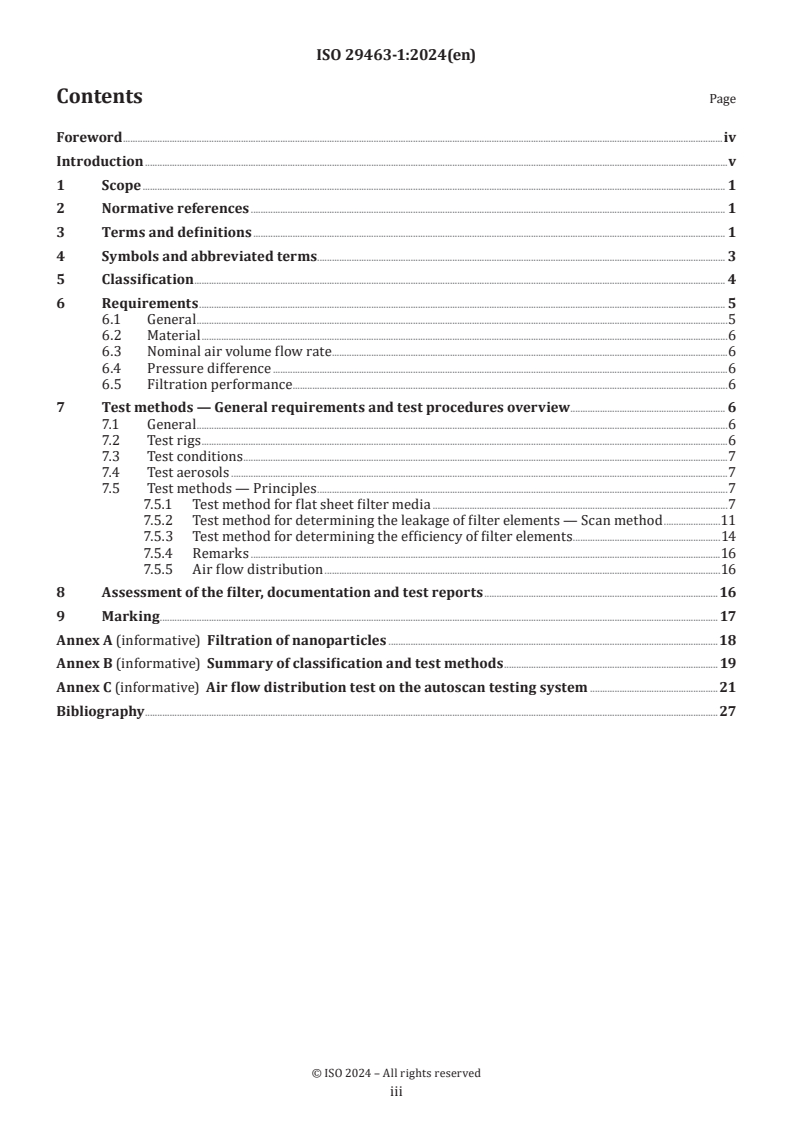
Contents Page
Foreword .iv
Introduction .v
1 Scope . 1
2 Normative references . 1
3 Terms and definitions . 1
4 Symbols and abbreviated terms. 3
5 Classification . 4
6 Requirements . 5
6.1 General .5
6.2 Material .6
6.3 Nominal air volume flow rate .6
6.4 Pressure difference .6
6.5 Filtration performance . .6
7 Test methods — General requirements and test procedures overview . 6
7.1 General .6
7.2 Test rigs .6
7.3 Test conditions .7
7.4 Test aerosols .7
7.5 Test methods — Principles .7
7.5.1 Test method for flat sheet filter media .7
7.5.2 Test method for determining the leakage of filter elements — Scan method .11
7.5.3 Test method for determining the efficiency of filter elements .14
7.5.4 Remarks .16
7.5.5 Air flow distribution .16
8 Assessment of the filter, documentation and test reports .16
9 Marking . . 17
Annex A (informative) Filtration of nanoparticles .18
Annex B (informative) Summary of classification and test methods . 19
Annex C (informative) Air flow distribution test on the autoscan testing system .21
Bibliography .27
iii
Foreword
ISO (the International Organization for Standardization) is a worldwide federation of national standards
bodies (ISO member bodies). The work of preparing International Standards is normally carried out through
ISO technical committees. Each member body interested in a subject for which a technical committee
has been established has the right to be represented on that committee. International organizations,
governmental and non-governmental, in liaison with ISO, also take part in the work. ISO collaborates closely
with the International Electrotechnical Commission (IEC) on all matters of electrotechnical standardization.
The procedures used to develop this document and those intended for its further maintenance are described
in the ISO/IEC Directives, Part 1. In particular, the different approval criteria needed for the different types
of ISO documents should be noted. This document was drafted in accordance with the editorial rules of the
ISO/IEC Directives, Part 2 (see www.iso.org/directives).
ISO draws attention to the possibility that the implementation of this document may involve the use of (a)
patent(s). ISO takes no position concerning the evidence, validity or applicability of any claimed patent
rights in respect thereof. As of the date of publication of this document, ISO had not received notice of (a)
patent(s) which may be required to implement this document. However, implementers are cautioned that
this may not represent the latest information, which may be obtained from the patent database available at
www.iso.org/patents. ISO shall not be held responsible for identifying any or all such patent rights.
Any trade name used in this document is information given for the convenience of users and does not
constitute an endorsement.
For an explanation of the voluntary nature of standards, the meaning of ISO specific terms and expressions
related to conformity assessment, as well as information about ISO's adherence to the World Trade
Organization (WTO) principles in the Technical Barriers to Trade (TBT), see www.iso.org/iso/foreword.html.
This document was prepared by Technical Committee ISO/TC 142, Cleaning equipment for air and other gases.
This third edition cancels and replaces the second edition (ISO 29463-1:2017), which has been technically
revised.
The main changes are as follows:
— two E classes have been included in Tables 1 and 2;
— informative Annex C for measuring air velocity uniformity has been added.
A list of all parts in the ISO 29463 series can be found on the ISO website.
Any feedback or questions on this document should be directed to the user’s national standards body. A
complete listing of these bodies can be found at www.iso.org/member.html.
iv
Introduction
The ISO 29463 series is derived from the EN 1822 series. It contains requirements, fundamental principles
of testing and the marking for high-efficiency particulate air filters with efficiencies from 85 % to
99,999 995 % that can be used for classifying filters in general or for specific use by agreement between
users and suppliers.
The ISO 29463 series establishes a procedure for the determination of the efficiency of all filters on the basis
of a particle counting method using a liquid (or alternatively a solid) test aerosol and allows a standardized
classification of these filters in terms of their efficiency, both local and overall efficiency, which covers most
needs of different applications. The difference between this document and other national standards lies
in the technique used for the determination of the overall efficiency. Instead of mass relationships or total
concentrations, this technique is based on particle counting at the most penetrating particle size (MPPS),
which for micro fibre-glass filter media is usually in the range of 0,12 μm to 0,25 μm. This method also
allows testing ultra-low penetration air filters, which was not possible with the previous test methods
because of their inadequate sensitivity. For membrane filter media, separate rules apply, and are described
in ISO 29463-5:2022, Annex B. Although no equivalent test procedures for testing filters with charged media
is prescribed, a method for dealing with these types of filters is described in ISO 29463-5:2022, Annex C.
Specific requirements for testing method, frequency, and reporting requirements may be modified by
agreement between supplier and customer. For lower efficiency filters (Group H, as described in Clause 5),
alternate leak test methods noted in ISO 29463-4:2011, Annex A may be used by specific agreement between
users and suppliers, but only if the use of these other methods is clearly designated in the filter markings, as
noted in the annex. Although the methods prescribed in this document can be generally used to determine
filter performance for nano-size particles, testing or classification of filters for nano-size particles are
beyond the scope of this document (see Annex A for additional information).
There are differences between the ISO 29463 series and other normative practices common in several
countries. For example, many of these rely on total aerosol concentrations rather than individual particles.
A brief summary of these methods and their reference standards is provided in ISO 29463-5:2022, Annex A.
v
International Standard ISO 29463-1:2024(en)
High efficiency filters and filter media for removing particles
in air —
Part 1:
Classification, performance, testing and marking
1 Scope
This document establishes a classification of filters based on their performance, as determined in accordance
with ISO 29463-3, ISO 29463-4 and ISO 29463-5. It also provides an overview of the test procedures and
specifies general requirements for assessing and marking the filters, as well as for documenting the test
results. It is intended to be used in conjunction with ISO 29463-2, ISO 29463-3, ISO 29463-4 and ISO 29463-5.
2 Normative references
The following documents are referred to in the text in such a way that some or all of their content constitutes
requirements of this document. For dated references, only the edition cited applies. For undated references,
the latest edition of the referenced document (including any amendments) applies.
ISO 29463-2:2011, High-efficiency filters and filter media for removing particles in air — Part 2: Aerosol
production, measuring equipment and particle-counting statistics
ISO 29463-3:2011, High-efficiency filters and filter media for removing particles in air — Part 3: Testing flat
sheet filter media
ISO 29463-4:2011, High-efficiency filters and filter media for removing particles in air — Part 4: Test method
for determining leakage of filter elements-Scan method
ISO 29463-5:2022, High-efficiency filters and filter media for removing particles in air — Part 5: Test method
for filter elements
3 Terms and definitions
For the purposes of this document, the following terms and definitions apply.
ISO and IEC maintain terminology databases for use in standardization at the following addresses:
— ISO Online browsing platform: available at https:// www .iso .org/ obp
— IEC Electropedia: available at https:// www .electropedia .org/
3.1
filter medium
material used for separating contaminants from air and characterized by its porous structure
[SOURCE: ISO 29464:2024, 3.1.25]
3.2
filter element
filter
structure made of the filtering material, its supports and its interfaces with the filter housing
[SOURCE: ISO 29464:2024, 3.2.59, modified — “filter” has been added as a preferred term.]
3.3
removal efficiency
efficiency
fraction or percentage of a challenge contaminant that is removed by an air cleaner
[SOURCE: ISO 29464:2024, 3.1.17 modified — “efficiency” has been added as a preferred term.]
3.4
fractional removal efficiency
fractional efficiency
ability of an air cleaning device to remove particles of a specific size or size range
Note 1 to entry: The efficiency plotted as a function of particle size gives the particle size efficiency spectrum.
[SOURCE: ISO 29464:2024, 3.2.134, modified — “fractional efficiency” has been added as a preferred term.]
3.5
particle diameter
geometric mean diameter (equivalent spherical, optical or aerodynamic, depending on context) of the
particles of an aerosol
Note 1 to entry: Particle diameter is often referred to simply as “particle size”.
[SOURCE: ISO 29464:2024, 3.2.106, modified — “mean” has been added to the definition.]
3.6
integral removal efficiency
overall efficiency
efficiency (3.3), averaged over the whole superficial face area (3.10) of a filter under given operating
conditions
[SOURCE: ISO 29464:2024, 3.2.136, modified — “removal” has been removed from the preferred term
“overall removal efficiency” and from the definition.]
3.7
local filter removal efficiency
local filter efficiency
efficiency (3.3) at a specific point of a filter element (3.2) under given operating conditions
[SOURCE: ISO 29464:2024, 3.2.137, modified — “local filter efficiency” has been added as a preferred term;
“removal” has been removed from the definition.]
3.8
nominal air volume flow rate
air volume flow rate at which the filter element (3.2) is tested as specified by the manufacturer
3.9
filter face area
air cleaner face area
cross-sectional face area of the air cleaner through which air flows into the device
[SOURCE: ISO 29464:2024, 3.1.22]
3.10
superficial face area
cross-sectional area of the filter element (3.2) through which the air flow passes
[SOURCE: ISO 29464:2024, 3.2.48]
3.11
effective filter medium area
area of the filter medium (3.1) contained in the filter element (3.2) through which air passes during operation
Note 1 to entry: This excludes areas covered by sealant, spacers, struts, etc.
Note 2 to entry: Effective filter medium area is expressed in m .
[SOURCE: ISO 29464:2024, 3.1.27]
3.12
medium velocity
nominal filter medium face velocity
volumetric air flow rate divided by the effective filter medium area (3.11) of the filter (3.2)
Note 1 to entry: Filter medium velocity is expressed in m/s (fpm).
Note 2 to entry: In devices where the filter medium surface area has been increased by use of pleats, folds or bags, the
filter medium velocity may be much less than the filter face velocity.
[SOURCE: ISO 29464:2024, 3.1.28, modified — “nominal filter medium face velocity” has been added as a
preferred term.]
3.13
quasi-monodisperse test aerosol
aerosol, the width of whose distribution function, described by the geometric standard deviation σ , is
g
between 1,15 µm and 1,5 µm
[SOURCE: ISO 29464:2024, 3.2.7, modified — “test” has been added to the term.]
3.14
coefficient of variation
CV
standard deviation of a group of measurements divided by the mean
[SOURCE: ISO 29464:2024, 3.2.28]
4 Symbols and abbreviated terms
d particle diameter
p
E efficiency
P penetration
p pressure
Δp differential pressure, pressure drop
CPC condensation particle counter
DEHS sebacic acid-bis (2 ethyl hexyl-) ester (trivial name: di-ethyl-hexyl-sebacate)
DMA differential electric mobility analyser
DMPS differential mobility particle sizer
MPPS most penetrating particle size, that is the particle size for which the filtration efficiency is a minimum
OPC optical particle counter
® 1)
PAO poly-alpha-olefin (CAS Registry Number 68649-12-7)
PSL poly-styrene latex (solid spheres)
φ relative humidity
T temperature
v velocity
x, y, x notation for three cartesian planes
5 Classification
Filters and filter elements are classified in groups and classes based on their efficiency or penetration for
the MPPS particles by testing as prescribed in Clause 6 and in ISO 29463-5. According to this document,
filter elements fall into one of the following groups.
a) Group E: EPA filters (efficient particulate air filter), also commonly referred to as sub-HEPA.
The efficiency of the filters shall be determined by statistical sample testing only in accordance with
ISO 29463-5. Group E filters cannot and shall not be leak tested.
b) Group H: HEPA filters (high-efficiency particle air filter)
Filters are individually tested, and their efficiency shall be determined at MPPS in accordance with
ISO 29463-5. The filter should be leak tested in accordance with ISO 29463-4, where, in addition to
the reference leak scan method, four alternate methods for leak testing are allowed. Alternate methods
used for leak testing should be clearly identified on the filter and certifications.
c) Group U: ULPA filters (ultra-low penetration air filter)
Filters are individually tested, and their efficiency shall be determined at MPPS in accordance with
ISO 29463-5. Filters shall be leak tested according to the scan method in accordance with ISO 29463-4.
No alternate leak testing is allowed.
A detailed specification for each filter group and class is given in Tables 1 and 2. Either of these tables can be
used for filter classification purposes.
Detailed information about the permissible test methods in accordance with the ISO 29463 series for each
filter group and class of filters is given in Annex B, Table B.1. ®
1) Chemical Abstracts Service (CAS) Registry Number is a trademark of the American Chemical Society (ACS). This
information is given for the convenience of users of this document and does not constitute an endorsement by ISO of the
product named. Equivalent products may be used if they can be shown to lead to the same results.
Table 1 — Filter classification: allowed filter classes (5/10th filter efficiency)
a,b
Filter class and group Overall value Local value
Efficiency Penetration Efficiency Penetration
(%) (%) (%) (%)
c c
ISO 05 E ≥ 85 ≤ 15 — —
c c
ISO 15 E ≥ 95 ≤ 5 — —
c c
ISO 25 E ≥ 99,5 ≤ 0,5 — —
d
ISO 35 H ≥ 99,95 ≤ 0,05 ≥ 99,75 ≤ 0,25
d
ISO 45 H ≥ 99,995 ≤ 0,005 ≥ 99,975 ≤ 0,025
ISO 55 U ≥ 99,999 5 ≤ 0,000 5 ≥ 99,997 5 ≤ 0,002 5
ISO 65 U ≥ 99,999 95 ≤ 0,000 05 ≥ 99,999 75 ≤ 0,000 25
ISO 75 U ≥ 99,999 995 ≤ 0,000 005 ≥ 99,999 9 ≤ 0,000 1
a
See 7.5.2.4 and ISO 29463-4.
b
Local penetration values lower than those given in this table can be agreed upon between the supplier
and customer.
c
Filters of Group E cannot and shall not be leak tested for classification purposes.
d
For Group H filters, local penetration is given for reference MPPS particle scanning method. Alternate
limits may be specified when photometer or oil thread leak testing is used.
Table 2 — Filter classification: allowed filter classes (1/10th filter efficiency)
a,b
Filter class and group Overall value Local value
Efficiency Penetration Efficiency Penetration
(%) (%) (%) (%)
c c
ISO 10 E ≥ 90 < 10 — —
c c
ISO 20 E ≥ 99 ≤ 1 — —
c c
ISO 30 E ≥ 99,90 ≤ 0,1 — —
d
ISO 40 H ≥ 99,99 ≤ 0,01 ≥ 99,95 ≤ 0,05
ISO 50 U ≥ 99,999 ≤ 0,001 ≥ 99,995 ≤ 0,005
ISO 60 U ≥ 99,999 9 ≤ 0,000 1 ≥ 99,999 5 ≤ 0,000 5
ISO 70 U ≥ 99,999 99 ≤ 0,000 01 ≥ 99,999 9 ≤ 0,000 1
a
See 7.5.2.4 and ISO 29463-4.
b
Local penetration values lower than those given in this table can be agreed upon between the supplier
and customer.
c
Filters of Group E cannot and shall not be leak tested for classification purposes.
d
For Group H filters, local penetration is given for reference MPPS particle scanning method. Alternate
limits may be specified when photometer or oil thread leak testing is used.
6 Requirements
6.1 General
The filter element shall be designed or marked to prevent incorrect mounting.
The filter element shall be designed so that when correctly mounted in the ventilation duct, no leak occurs
along the sealing edge.
If, for any reason, dimensions do not allow testing of a filter under standard test conditions, assembly of two
or more filters of the same type or model is permitted, provided no leaks occur in the resulting filter. Cutting
or trimming of larger filters is not permitted for testing.
If the filter is tested without the filter seal fitted, and if designed to have a filter seal, then the filter test
certificate shall be clearly marked “filter efficiency tested without filter seal fitted”.
6.2 Material
The filter element shall be made of suitable material to withstand normal usage and exposures to those
temperatures, humidity and corrosive environments that are likely to be encountered.
The filter element shall be designed so that it will withstand mechanical constraints that are likely to be
encountered during normal use.
Dust or fibres released from the filter media by the air flow through the filter element shall not constitute a
hazard or nuisance for the people (or devices) exposed to filtered air.
6.3 Nominal air volume flow rate
The filter element shall be tested at its nominal air volume flow rate for which the filter has been designed
by the manufacturer.
6.4 Pressure difference
The pressure difference across the filter element shall be recorded at the nominal air volume flow rate.
6.5 Filtration performance
The filtration performance is expressed by the efficiency or the penetration as measured by the prescribed
procedures in ISO 29463-5. After testing in accordance with Clause 7, filter elements are classified in
accordance with Tables 1 and 2.
Filters with filter media having an electrostatic charge are classified in accordance with Tables 1 and 2,
based on their discharged efficiency or penetration in accordance with ISO 29463-5:2022, Annex C.
7 Test methods — General requirements and test procedures overview
7.1 General
The complete test method comprises the following three steps, which can be performed independently:
— test for flat sheet filter media, in accordance with ISO 29463-3;
— test for determining the leakage of filter elements (scan method), in accordance with ISO 29463-4;
— test for determining the efficiency of filters, in accordance with ISO 29463-5.
Clause 7 provides the general requirements for the features common to all tests, as well as an overview of
the test procedures.
Detailed information about the permissible test methods for filter elements in accordance with the
ISO 29463 series for each filter group and class of filters is given in Table B.1.
7.2 Test rigs
Test rigs shall be in accordance with ISO 29463-3, ISO 29463-4 and ISO 29463-5 for the respective tests. The
measuring equipment shall be in accordance with ISO 29463-2.
7.3 Test conditions
The air in the test channel used for testing shall comply with the following requirements:
— temperature: 23 °C ± 5 °C
— relative humidity < 75 %.
The temperature shall remain constant during the entire test procedure within ± 2 °C, the relative humidity
shall remain within ± 5 %.
The cleanliness of the test air shall be ensured by appropriate pre-filtering, so that in operation without
addition of aerosol the particle number concentration measured with the particle counting method is less
than 352 000 particles/m . The test specimen shall have the same temperature as the test air and hence shall
be conditioned at test requirements (temperature and relative humidity) long enough to be in equilibrium.
7.4 Test aerosols
For the testing of filters in accordance with this document, a liquid test aerosol shall be used as the reference
test method. Alternatively, a solid aerosol may be used for leak testing (see ISO 29463-4:2011, Annex E).
Possible aerosol substances include, but are not limited to, DEHS, PAO and PSL. For further details, see
ISO 29463-2:2011, 4.1.
The use of alternative materials for challenge aerosols shall be agreed between supplier and customer when
the materials specified in this document are unacceptable.
The concentration and the size distribution of the aerosol shall be constant, within experimental limits, over
time. Details of aerosol generation for testing are addressed in the other parts of ISO 29463. For the leak
test and the efficiency test of the filter element, the count mean particle diameter of the test aerosol shall
correspond to the most penetrating particle size (MPPS) for the filter medium.
7.5 Test methods — Principles
7.5.1 Test method for flat sheet filter media
7.5.1.1 General
The fractional efficiency curve of flat sheet filter medium samples is determined in new condition (material
as supplied by the medium manufacturer) and in discharged condition (see ISO 29463-5:2022, Annex C). If
these measurements reveal that the filter medium is having a significant charge, the filter elements shall
be classified based on the discharged flat sheet efficiency or penetration measurements in accordance with
ISO 29463-5:2022, Annex C.
From the fractional efficiency curve generated this way, the most penetrating particle size (MPPS) shall be
determined.
7.5.1.2 Test samples
The testing procedure requires at least five flat sheet samples of the filter material that will make up the
filter elements.
The test samples shall be free of folds, creases, holes and other irregularities. The flat sheet samples for
testing shall have a minimum size of 200 mm × 200 mm.
7.5.1.3 Test apparatus
The arrangement of the test apparatus is shown in Figure 1. The test rig is described in detail in ISO 29463-3.
The individual measuring instruments and other devices are described in ISO 29463-2. An aerosol is
produced in the aerosol generator, then passed through a conditioner (for example, to evaporate a solvent)
and neutralised, before being brought together with the particle-free mixing air to the test filter medium
mounting assembly.
Sampling points are positioned upstream and downstream from the test filter medium mounting assembly
from which a part of the flow is led to the particle counter. The upstream sampling point is connected with
a known ratio dilution circuit to reduce the high particle concentration down to the actual measuring range
of the particle counter.
When using the total count counting method (CPC), a differential electric mobility analyser (DMA) is included
before the aerosol neutralizer to separate out a quasi-monodisperse fraction of the required particle size
from the initial polydisperse aerosol.
If a counting method with particle size analysis (OPC) is used, the size distribution of a polydisperse aerosol
can be measured before and after the test specimen.
Instead of using a single particle counter, which measures the unfiltered and filtered air consecutively, it is
also permissible to use two particle counters of equal optical design (wavelength of the light source, light
scattering angle, etc.) simultaneously for both measurements. When using two particle counters, the two
counters shall be correlated by measuring the same aerosol to correct for any response differences. It is
known that OPCs of the same model can give different responses.
After the downstream sampling point, the test aerosol is led through an exhaust filter and extracted by a
pump. The apparatus is completed by devices to measure (and regulate) the air volume flow rate and the
differential pressure across the filter under test.
The measurement data are recorded and evaluated by a computer.
The test apparatus can also be operated in an overpressure mode. In this case, the extraction pump is not
required and the mixing air is supplied from a compressed air line. If so desired, the measurement and
regulation of the air volume flow rate can then be carried out on the upstream side.
...