

ISO 15858
(Main)UV-C devices — Safety information — Permissible human exposure
- Abstract
ISO 15858:2016 specifies minimum human safety requirements for the use of UVC lamp devices. It is applicable to in-duct UVC systems, upper-air in room UVC systems, portable in-room disinfection UVC devices, and any other UVC devices which may cause UVC exposure to humans. It is not applicable to UVC products used for water disinfection.
- Status
- Not Published
- Technical Committee
- ISO/TC 142 - Cleaning equipment for air and other gases
- Drafting Committee
- ISO/TC 142/WG 2 - UV-C technology
- Current Stage
- 6000 - International Standard under publication - 60 Publication
- Start Date
- 12-Nov-2026
Buy Documents
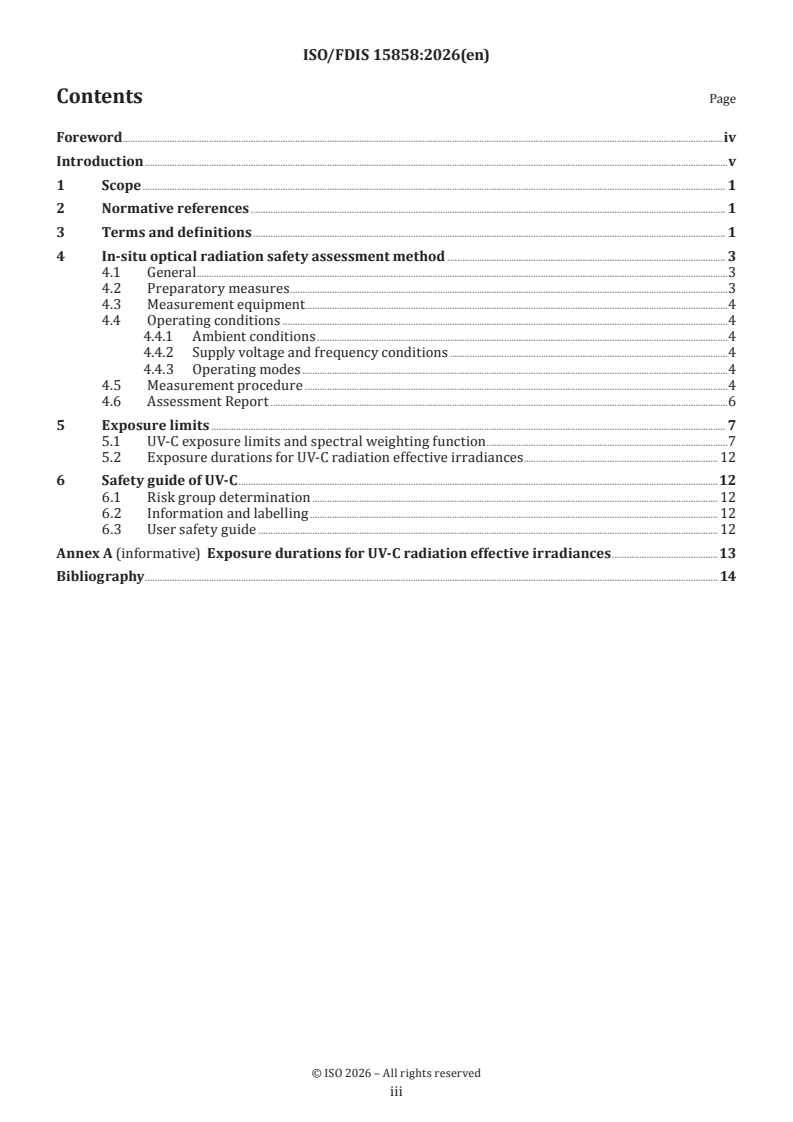
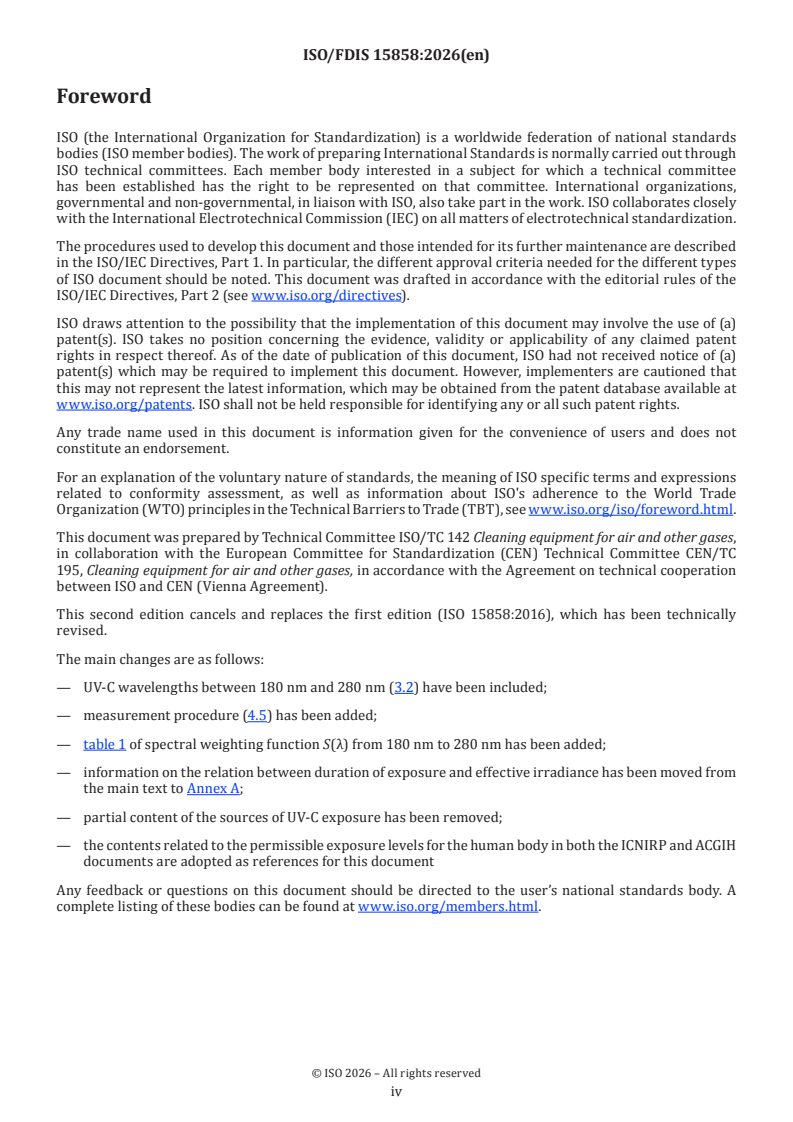
ISO/FDIS 15858 - UV-C Devices — Safety information — Permissible human exposure Released:12. 01. 2026
REDLINE ISO/FDIS 15858 - UV-C Devices — Safety information — Permissible human exposure Released:12. 01. 2026
ISO/FDIS 15858.2 - UV-C devices — Safety information — Permissible human exposure
REDLINE ISO/FDIS 15858.2 - UV-C devices — Safety information — Permissible human exposure
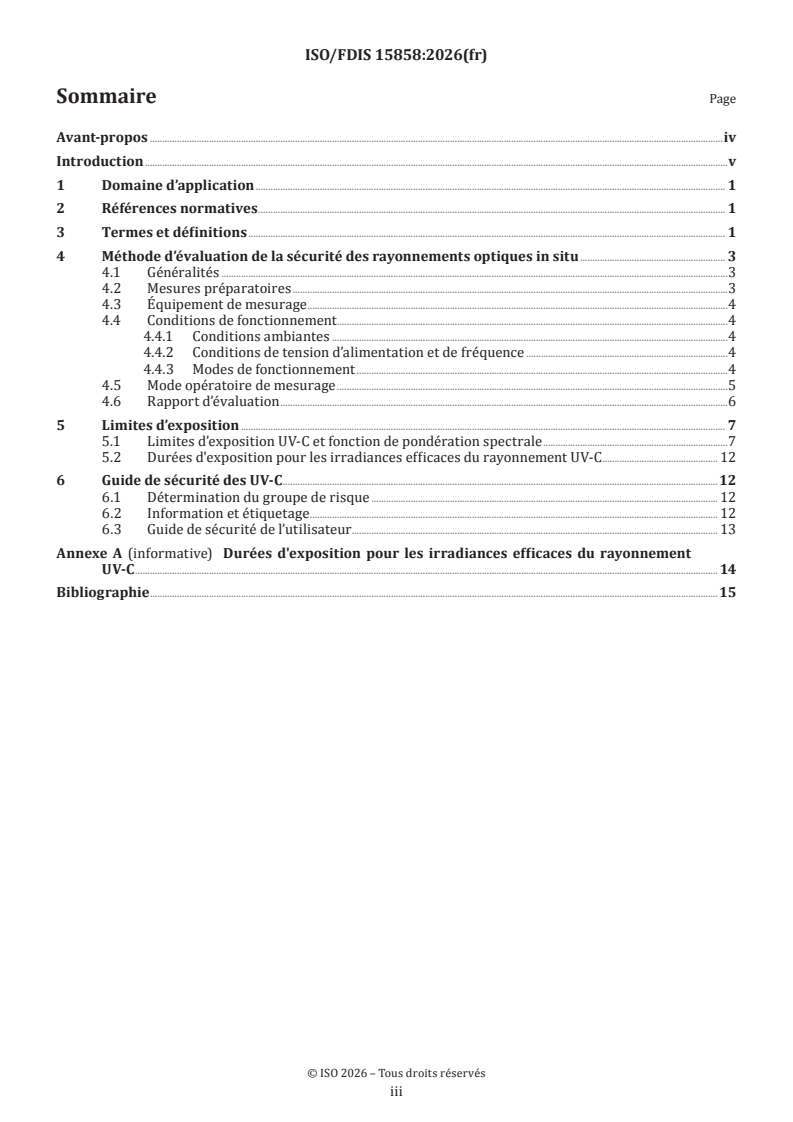
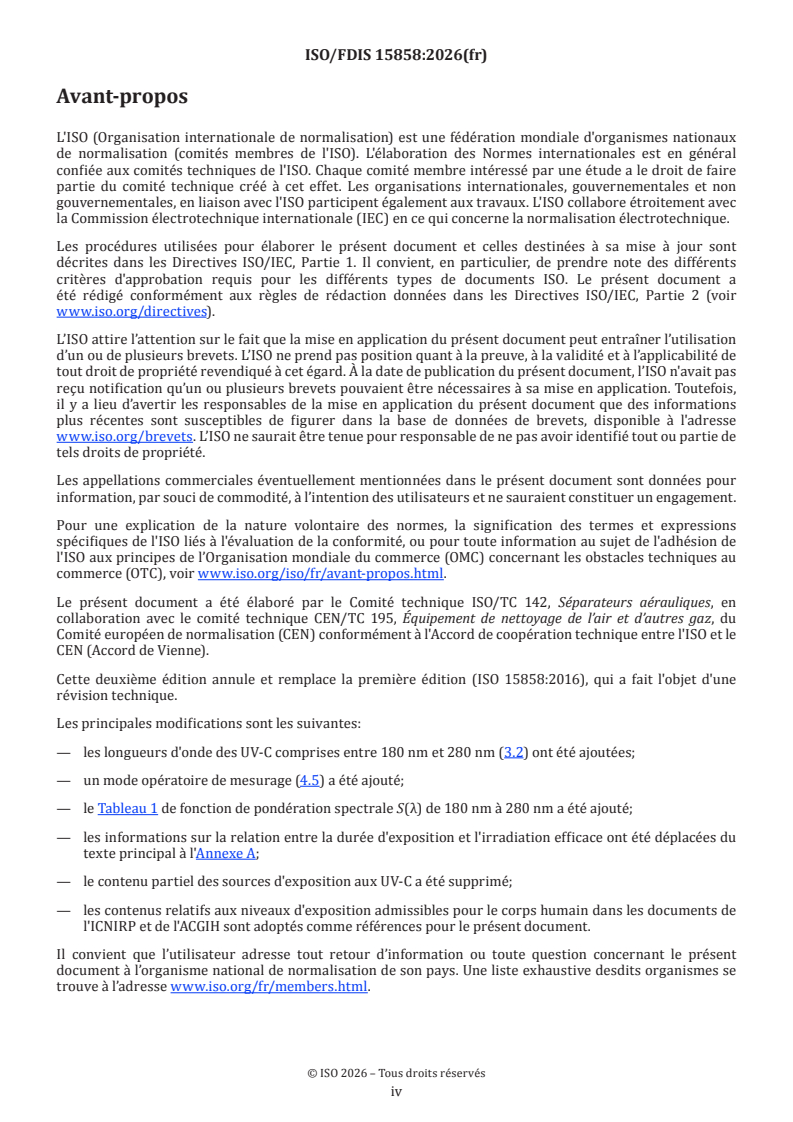
ISO/FDIS 15858 - Dispositifs UV-C — Information sur la sécurité — Limites admissibles pour l'exposition humaine
ISO/FDIS 15858.2 - Dispositifs UV-C — Information sur la sécurité — Limites admissibles pour l'exposition humaine
ISO 15858 is an ISO standard on UV-C devices that gives safety information for permissible human exposure. It specifies an in-situ optical radiation safety assessment method, exposure limits, and user safety guidance for UV-C disinfection systems and devices that can expose people to UV-C radiation.
What does ISO 15858 specify?
ISO 15858 specifies how to assess UV-C exposure in place, what exposure limits to use, and what safety information to provide for UV-C disinfection systems and devices. It is aimed at applications where people may be present near UV-C sources.
The scope covers UV-C systems and devices with wavelengths between 180 nm and 280 nm. It applies to partly open in-duct UV-C systems, upper-air in-room UV-C systems, portable in-room disinfection UV-C devices, and other devices that can expose humans to UV-C radiation. It excludes fully closed UV-C devices, UV-C systems used in controlled access locations, and UV-C devices used for water disinfection.
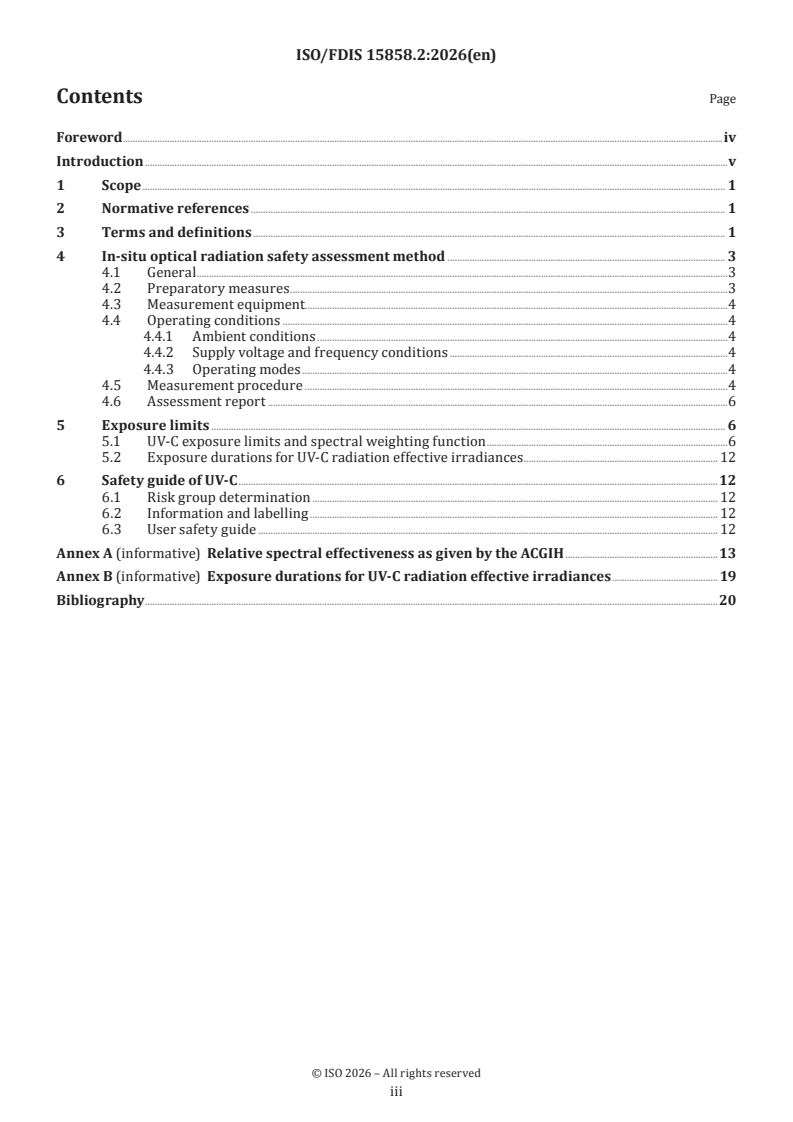
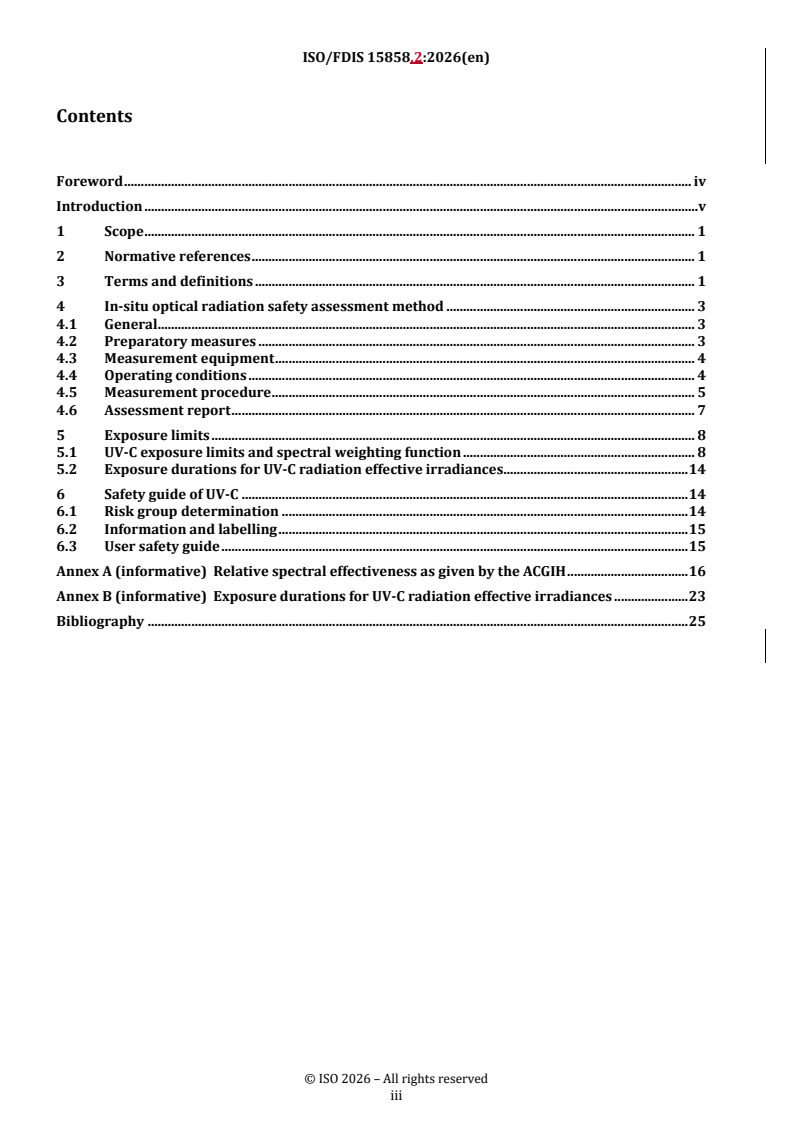
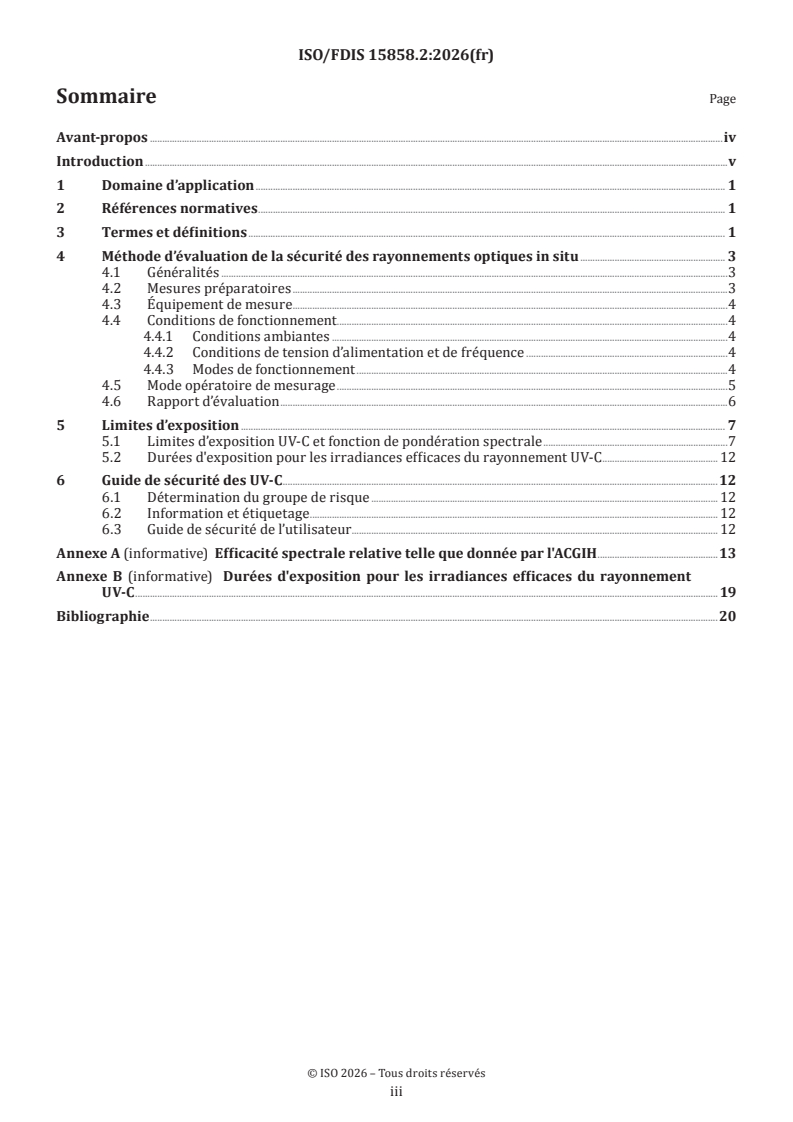
ISO 15858 is organized into six clauses, plus two informative annexes and a bibliography.
| Annex | What it covers |
|---|---|
| Annex A | Relative spectral effectiveness as given by the ACGIH |
| Annex B | Exposure durations for UV-C radiation effective irradiances |
What are the key requirements of ISO 15858?
ISO 15858 is centered on an in-situ assessment of UV-C irradiance, then checking that the installation keeps human exposure within the permitted limits. In practice, that means measuring the installed system in the room or air treatment space rather than relying only on a product datasheet.
Assessment conditions and preparation
Clause 4.1 says the method is used for commissioning, maintenance, modifications to the system, changes to the room, and complaints about possible overexposure. This matters because UV-C safety can change when lamps, positions, room layout, reflective surfaces, or ventilation change.
Clause 4.2 requires preparatory measures before measurement. Assessors are expected to use personal protective equipment (PPE) when threshold limit values may be exceeded, to be trained in UV-C hazards and first aid, and to check the site design, room use, ventilation, and obstacles that may affect radiation. Protective sensors such as presence, distance, or illumination sensors shall not be switched off during measurement.
Measurement equipment and operating conditions
Clause 4.3 requires UV-C measurements to follow EN 14255-1. Radiometers used for in-situ measurement shall be calibrated to the effective irradiance of the source spectrum, cosine corrected, and have suitable resolution and field of view. This matters because the wrong instrument can under-read or over-read the hazard.
Clause 4.4 requires measurements under normal ambient conditions, with calibration checked if temperature is outside 15 °C to 30 °C. It also requires the equipment to be run at rated supply conditions and, where relevant, at the worst-case operating mode such as the highest irradiation level.
Measurement procedure and reporting
Clause 4.5 says measurements are performed during commissioning before normal operation. ISO 15858 calls for a short stabilization period, a rough survey to find hot spots, and full measurements in the identified high-irradiance and extended-occupancy zones.
The procedure uses both horizontal and vertical readings at a default height of 1.8 m. If any reading shows a time-averaged effective irradiance at or above 0.1 µW/cm², the UV-C system shall be configured with a duty cycle to remain within the daily exposure limit. In practice, this means the output may need time control, interlocking, or other operational limiting.
Clause 4.6 requires an assessment report covering the equipment used, installation details, room layout, room function, measurement locations, results, and a clear statement whether the UV-C system or device meets ISO 15858.
Exposure limits and spectral weighting
Clause 5 sets the exposure basis for effective irradiance and daily dose. ISO 15858 limits the effective daily dose to 3 mJ/cm² and uses a spectral weighting function to convert broadband or multi-wavelength UV-C into an effective exposure value. That is the part a designer, tester, or safety assessor needs when deciding whether the installation is acceptable.
Clause 5 also points to Annex B for exposure durations linked to effective irradiance. Annex B is intended for working-population exposure and is tied to the daily exposure time assumed in the document.
Safety guide and product information
Clause 6 links the document to broader UV-C safety practice. Risk group determination shall follow IEC 62471-6:2022 clauses 4 and 5, or the applicable product standard. Manufacturers should provide labelling and detailed information in the user manual, maintenance information, and service information, and the user safety guide should align with IEC PAS 63313:2021 and IEC 62471-6:2022, 7.5, or the applicable product standard.
What terms does ISO 15858 define?
- Wavelength - the distance between repeating units of a wave pattern; ISO 15858 uses it to define the UV-C range.
- Ultraviolet radiation (UV radiation) - optical radiation with wavelengths shorter than visible light; ISO 15858 treats UV-C as the 100 nm to 280 nm subrange.
- Irradiance - the power of radiation incident on a surface per unit area; it is the main quantity measured during assessment.
- UV dose - the product of UV irradiance and exposure time; it is the basis for checking cumulative exposure.
- Ultraviolet germicidal irradiation (UV-C disinfection, UVGI) - a disinfection method using UV radiation to kill or inactivate microorganisms.
- Radiometer - an instrument used to measure radiometric quantities, especially UV irradiance.
- Personal protective equipment (PPE) - protective clothing, eyewear, or other gear used to reduce injury risk from exposure.
- Controlled access location - an area where engineering and administrative controls prevent access during UV-C operation.
Who uses ISO 15858?
ISO 15858 is used by manufacturers, installers, commissioning teams, maintenance personnel, and safety assessors for UV-C disinfection systems and devices. It is also relevant to quality managers, facility operators, and buyers who need to confirm that a UV-C installation can be assessed and documented for human exposure risk.
The document is especially relevant in air-cleaning and indoor disinfection settings such as in-duct systems, upper-air room systems, and portable in-room devices. It supports site audits, changes to installed systems, and investigations after complaints about possible UV-C exposure.
What changed in ISO 15858 from the previous edition?
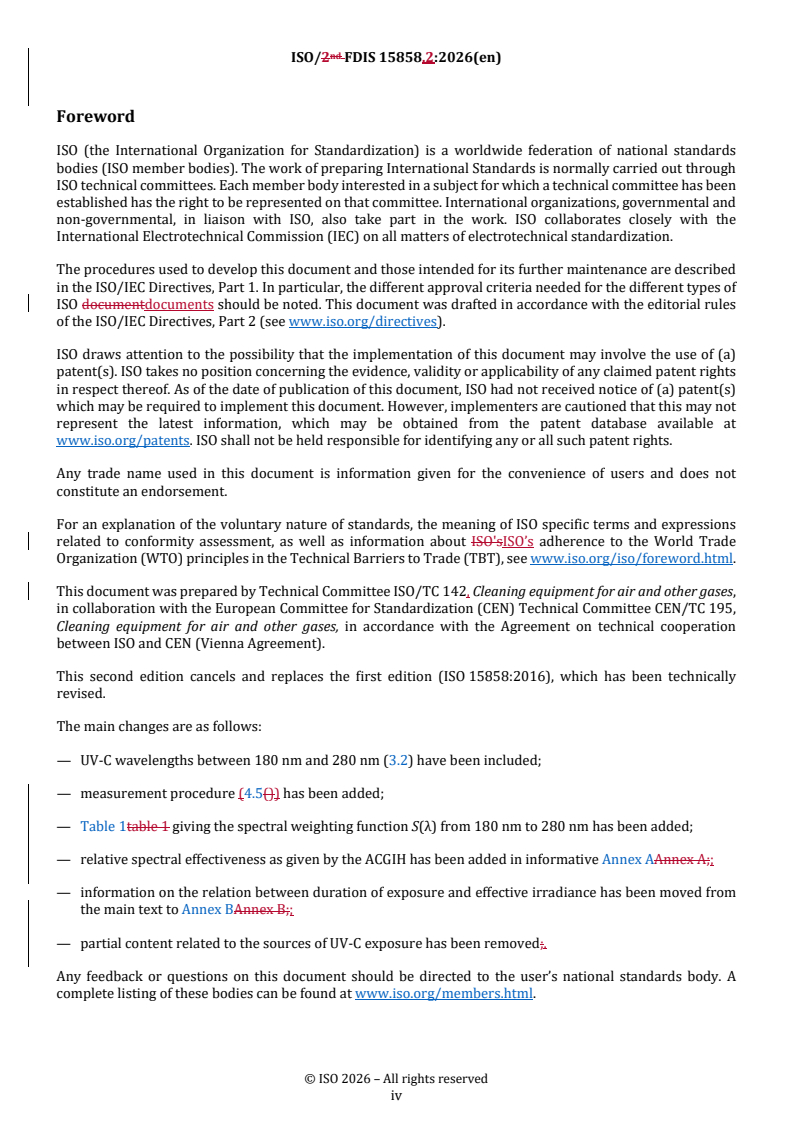
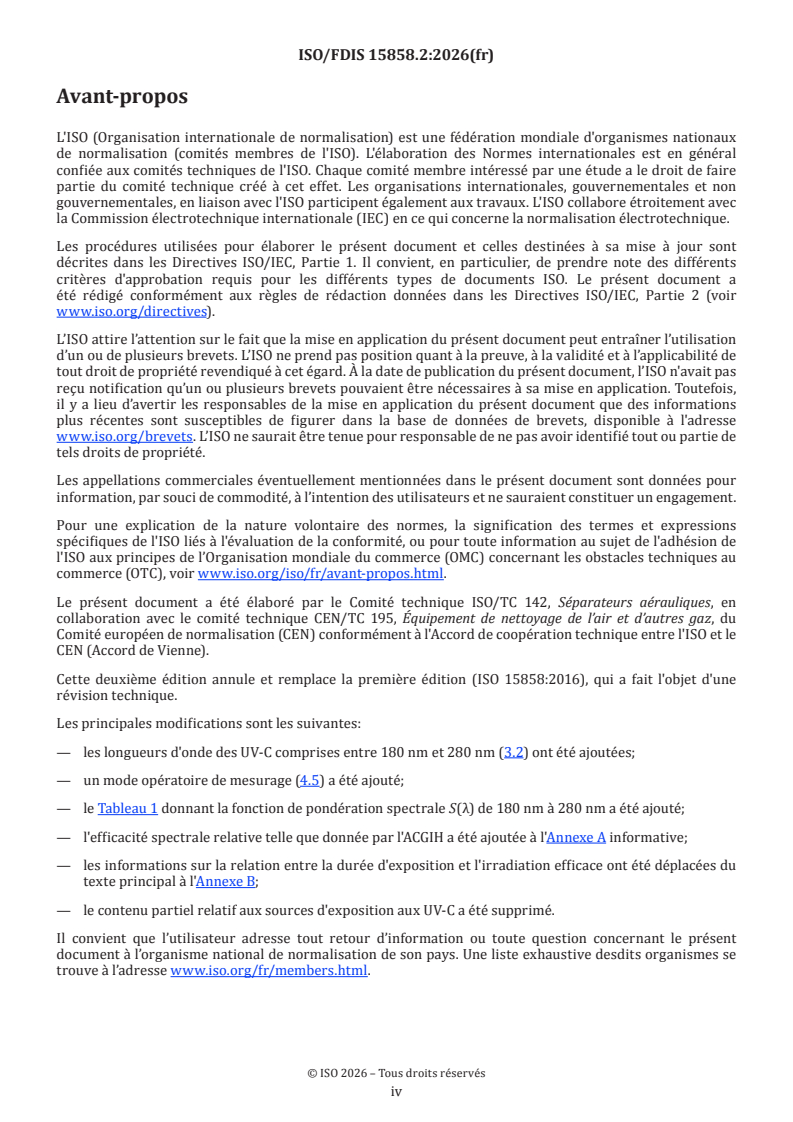
ISO 15858:2026 replaces ISO 15858:2016 and is technically revised. The stated changes are:
- UV-C wavelengths between 180 nm and 280 nm are included.
- A measurement procedure has been added.
- Table 1 with the spectral weighting function S(λ) has been added.
- Informative Annex A adds relative spectral effectiveness as given by the ACGIH.
- Exposure-duration information has been moved from the main text to Annex B.
- Partial content related to sources of UV-C exposure has been removed.
Which standards are used with ISO 15858?
ISO 15858 refers to these standards for methods and supporting guidance:
- IEC 62471-6:2022 - used for risk group determination, classification, labelling, and user safety guide content.
- EN 14255-1 - used for the measurement method for personal exposure to ultraviolet radiation from artificial sources in the workplace.
- ISO 19734 - used for selecting suitable UV radiation-resistant eyewear.
- IEC PAS 63313:2021 - used for safe-operation guidance in the user safety guide.
What does the ISO 15858 document contain?
ISO 15858 contains a practical measurement method, exposure-limit rules, and safety guidance for UV-C devices. Clause 4 covers preparatory measures, instruments, operating conditions, the measurement procedure, and the assessment report.
Clause 5 provides the exposure-limit framework, including the spectral weighting function and the link between effective irradiance and daily dose. Clause 6 covers risk group determination, product information, and user guidance. Annex A gives ACGIH-based weighting values, Annex B gives exposure-duration guidance, and the figures show detector orientation for horizontal and vertical measurements.
Relations
- Consolidates
FprEN ISO 15858 - UV-C Devices - Safety information - Permissible human exposure (ISO/FDIS 15858:2026) - Effective Date
- 12-Feb-2026
- Effective Date
- 06-Jun-2022
- Effective Date
- 06-Jun-2022
Buy Documents
ISO/FDIS 15858 - UV-C Devices — Safety information — Permissible human exposure Released:12. 01. 2026
REDLINE ISO/FDIS 15858 - UV-C Devices — Safety information — Permissible human exposure Released:12. 01. 2026
ISO/FDIS 15858.2 - UV-C devices — Safety information — Permissible human exposure
REDLINE ISO/FDIS 15858.2 - UV-C devices — Safety information — Permissible human exposure
ISO/FDIS 15858 - Dispositifs UV-C — Information sur la sécurité — Limites admissibles pour l'exposition humaine
ISO/FDIS 15858.2 - Dispositifs UV-C — Information sur la sécurité — Limites admissibles pour l'exposition humaine
Get Certified
Connect with accredited certification bodies for this standard

DIBt (Deutsches Institut für Bautechnik)
German Institute for Building Technology.

DIN CERTCO
DIN Group product certification.

Aboma Certification B.V.
Specialized in construction, metal, and transport sectors.
Sponsored listings
Frequently Asked Questions
ISO 15858 is a draft published by the International Organization for Standardization (ISO). Its full title is "UV-C devices — Safety information — Permissible human exposure". This standard covers: ISO 15858:2016 specifies minimum human safety requirements for the use of UVC lamp devices. It is applicable to in-duct UVC systems, upper-air in room UVC systems, portable in-room disinfection UVC devices, and any other UVC devices which may cause UVC exposure to humans. It is not applicable to UVC products used for water disinfection.
ISO 15858:2016 specifies minimum human safety requirements for the use of UVC lamp devices. It is applicable to in-duct UVC systems, upper-air in room UVC systems, portable in-room disinfection UVC devices, and any other UVC devices which may cause UVC exposure to humans. It is not applicable to UVC products used for water disinfection.
ISO 15858 is classified under the following ICS (International Classification for Standards) categories: 91.140.30 - Ventilation and air-conditioning systems. The ICS classification helps identify the subject area and facilitates finding related standards.
ISO 15858 has the following relationships with other standards: It is inter standard links to FprEN ISO 15858, ISO 15080:2001/Amd 1:2019, ISO 15858:2016. Understanding these relationships helps ensure you are using the most current and applicable version of the standard.
ISO 15858 is available in PDF format for immediate download after purchase. The document can be added to your cart and obtained through the secure checkout process. Digital delivery ensures instant access to the complete standard document.
Standards Content (Sample)
Contents
- Introduction
- 1 Scope
- 2 Normative references
- 3 Terms and definitions
- 3.1 wavelength
- 3.2 ultraviolet radiation
- 3.3 irradiance
- 3.4 UV dose
- 3.5 UV-C disinfection
- 3.6 radiometer
- 3.7 exposure
- 3.8 personal protective equipment
- 3.9 controlled access location
- 4 In-situ optical radiation safety assessment method
- 4.1 General
- 4.2 Preparatory measures
- 4.3 Measurement equipment
- 4.4 Operating conditions
- 4.5 Measurement procedure
- 4.6 Assessment Report
- 5 Exposure limits
- 5.1 UV-C exposure limits and spectral weighting function
- 5.2 Exposure durations for UV-C radiation effective irradiances
- 6 Safety guide of UV-C
- 6.1 Risk group determination
- 6.2 Information and labelling
- 6.3 User safety guide
- Annex A
- Bibliography
Introduction
ISO 15858:2016 was developed to specify an in-situ safety assessment method for applications with UV-C disinfection systems and devices focusing on 254 nm radiation. This new edition of ISO 15858 expands the applicability of this document to the UV-C wavelength range from 180 nm to 280 nm to take newly developed technologies in the spectral range below 240 nm into account and offers an improved description of the scope, limits, assessment method and assessment report.
FINAL DRAFT International Standard ISO/FDIS 15858:2026(en) UV-C Devices — Safety information — Permissible human exposure
1 Scope
This document specifies an in-situ optical radiation safety assessment method for applications with UV-C disinfection systems and devices with a wavelength between 180 nm and 280 nm. This document is applicable to the application of (partly) open in-duct UV-C systems, upper-air in room UV-C systems, portable in room disinfection UV-C devices and any other device which can expose humans to UV-C radiation.
This document is not applicable to fully closed UV-C devices, UV-C systems used in controlled access locations and UV-C devices used for water disinfection.
2 Normative references
The following documents are referred to in the text in such a way that some or all of their content constitutes requirements of this document. For dated references, only the edition cited applies. For undated references, the latest edition of the referenced document (including any amendments) applies. IEC 62471-6:2022, Photobiological safety of lamps and lamp systems - Part 6: Ultraviolet lamp products EN 14255-1, Measurement and assessment of personal exposures to incoherent optical radiation - Part 1:
Ultraviolet radiation emitted by artificial sources in the workplace
3 Terms and definitions
For the purposes of this document, the following terms and definitions apply. ISO and IEC maintain terminology databases for use in standardization at the following addresses:
- ISO Online browsing platform: available at https:// www .iso .org/ obp
- IEC Electropedia: available at https:// www .electropedia .org/
3.1 wavelength
distance between repeating units of a wave pattern Note 1 to entry: Commonly designated by the Greek letter lambda (λ). [SOURCE: ISO 29464:2024, 3.6.33]
3.2 ultraviolet radiation
UV radiation optical radiation for which the wavelengths are shorter than those for visible radiation Note 1 to entry: UV radiation wavelengths are commonly subdivided into:
- UV-A: 315 nm to 400 nm;
- UV-B: 280 nm to 315 nm;
ISO/FDIS 15858:2026(en) - UV-C: 100 nm to 280 nm.
[SOURCE: ISO 29464:2024, 3.6.24]
3.3 irradiance
power of electromagnetic radiation incident on a surface per unit surface area
Note 1 to entry: Irradiance is expressed in microwatts per square centimetre (μW/cm ). UV-C irradiance is also 2 2 expressed in mW/cm or W/m .
[SOURCE: ISO 29464:2024, 3.6.9]
3.4 UV dose
product of UV irradiance and specific exposure time on a given microorganism or surface 2 2 Note 1 to entry: UV dose is expressed in millijoule per square centimetre (mJ/cm ) or (J/m ). [SOURCE: ISO 29464:2024, 3.6.26]
3.5 UV-C disinfection
method for disinfection of air, water and surfaces that uses radiation with wavelength (3.1) in the range of 100 nm to 280 nm to kill or inactivate microorganisms Note 1 to entry: UV irradiation with a wavelength of 100 nm to 280 nm can cause damage to the DNA or RNA of the microorganisms.
[SOURCE: ISO 29464:2024, 3.6.28]
3.6 radiometer
instrument used to measure radiometric quantities, particularly UV irradiance
3.7 exposure
subjection to infectious agents, irradiation, particulate matter, or chemicals that can have harmful effects [SOURCE: ISO 29464:2024, 3.6.4]
3.8 personal protective equipment
PPE clothing, helmets, goggles, respirators, or other specialized gear that is designed to protect the wearer from injury or illness caused by exposure to specific hazards, typically used for occupational safety and health purposes
3.9 controlled access location
area where an engineering and administrative control measure is established to prevent access during UV-C operation [SOURCE: IEC PAS 63313, 7.3]
ISO/FDIS 15858:2026(en)
4 In-situ optical radiation safety assessment method
4.1 General
This clause describes the preparatory measures, measurement instrumentation requirements, operation conditions and the measurement procedure of the in-situ optical radiation safety assessment method for applications with UV-C disinfection systems and devices in case of:
- the initial installation of these systems and devices in the room;
- the maintenance of the installed systems and devices (e.g. replacement of UV-C lamp or source);
- the modification of the systems and devices (e.g. adjustment of device height, location or position of louvers);
- the modification of the room in which the systems and devices are installed (e.g. changes of UV-C absorbing or UV-C reflecting materials, or room dimensions, or modular partition heights);
- complaints of possible optical irradiation or UV-C dose overexposure.
4.2 Preparatory measures
In situations where the installation can exceed the threshold limit values (TLVs) personal protective equipment(PPE) should be considered as part of preparatory measures. Preparatory measures are as follows:
- Provide the assessors with PPE which consists of the following:
- UV radiation-resistant eyewear, such as goggles, face shields, and safety glasses; a suitable eye protector should be selected according to ISO 19734;
- clothing known to be non-transparent to UV-C penetration, which covers exposed skin;
- Train the assessors on the following:
- required PPE;
- health and safety topics;
- handling of UV-C lamps, modules, devices;
- hazards generated by accidental UV-C exposure in work areas;
- first aid response post exposure.
- If applicable the UV-C systems and devices should be seasoned (burned-in); NOTE 1 For example, low pressure mercury sources need to be seasoned for at least 100 h. - Check that assessors have the right documents including the latest design made for the site, as well as, if applicable, any information collected during site audit or previous measurements (if applicable) to compare with the current situation; - Check if the function of the room (program, occupant tasks, hours occupied, etc) is the same as it was when the system was designed; - Check if mechanical ventilation and site conditions are the same as during the audit (this should be done also during every maintenance visit). If there is no register, register this information accordingly; - Protective sensors (like presence, distance, illumination sensors) shall not be switched off, during the measurements described in this document;
ISO/FDIS 15858:2026(en) - Look for obstacles (hanging from the ceiling or higher objects from the floor) that can interfere with the UV-C radiation and register them; - A safety risk assessment should be carried out.
NOTE 2 National regulations for the determination of occupational health and safety measures for individual processes exist. The measures given within this document can be incomplete or insufficient against the background of local national regulations. It is presupposed that the national legal situation is considered.
4.3 Measurement equipment
Measurement equipment requirements are as follows:
- UV-C radiation measurements shall comply with the measuring method in EN 14255-1;
- Radiometers for in-situ measurement of UV-C irradiance shall be calibrated to the effective irradiance of the source spectrum of interest;
- The radiometer shall be cosine corrected;
- The radiometer should have a resolution of decimal 0,01 μW/cm ;
- The Field of View (FOV) should be 80° (±40°). External light sources should be considered as a possible source of measurement error and measures (e.g. installation of a light shield on the radiometer; regular calibration of the radiometer; averaging of several measurements) should be taken to minimize their impact on the measurement;
- Averaging of several measurements should be taken to minimize the impact of external sources on the measurement.
...
Contents
- Introduction
- 1 Scope
- 2 Normative references
- 3 Terms and definitions
- 4 In-situ optical radiation safety assessment method
- 4.1 General
- 4.2 Preparatory measures
- 4.3 Measurement equipment
- 4.4 Operating conditions
- 4.5 Measurement procedure
- 4.6 Assessment Report
- 5 Exposure limits
- 5.1 UV-C exposure limits and spectral weighting function
- 5.2 Exposure durations for UV-C radiation effective irradiances
- 6 Safety guide of UV-C
- 6.1 Risk group determination
- 6.2 Information and labelling
- 6.3 User safety guide
- Annex A
- Bibliography
Introduction
ISO 15858:2016 was developed to specify an in-situ safety assessment method for applications with UV-C disinfection systems and devices focusing on 254 nm radiation. This new edition of ISO 15858 expands the applicability of this document to the UV-C wavelength range from 180 nm to 280 nm to take newly developed technologies in the spectral range below 240 nm into account and offers an improved description of the scope, limits, assessment method and assessment report.
ISO/FDIS 15858:2025 (Ed.2) UV-C Device Devices — Safety information — Permissible human exposure
1 Scope
This document specifies an in-situ optical radiation safety assessment method for applications with UV-C disinfection systems and devices with a wavelength between 180 nm and 280 nm. This document is applicable to the application of (partly) open in-duct UV-C systems, upper-air in room UV-C systems, portable in room disinfection UV-C devices and any other device which can expose humans to UV-C radiation.
This document is not applicable to fully closed UV-C devices, UV-C systems used in controlled access locations and UV-C devices used for water disinfection.
2 Normative references
The following documents are referred to in the text in such a way that some or all of their content constitutes requirements of this document. For dated references, only the edition cited applies. For undated references, the latest edition of the referenced document (including any amendments) applies. IEC 62471--6:2022, Photobiological safety of lamps and lamp systems - Part 6: Ultraviolet lamp products EN 14255--1, Measurement and assessment of personal exposures to incoherent optical radiation - Part 1:
Ultraviolet radiation emitted by artificial sources in the workplace
3 Terms and definitions
For the purposes of this document, the following terms and definitions apply. ISO and IEC maintain terminology databases for use in standardization at the following addresses:
- — ISO Online browsing platform: available at https://www.iso.org/obp
- — IEC Electropedia: available at https://www.electropedia.org/ 3.1 3.1 wavelength distance between repeating units of a wave pattern Note 1 to entry: Commonly designated by the Greek letter lambda (λ). [SOURCE: ISO 29464:2024, 3.6.33] 3.2 3.2 ultraviolet radiation UV radiation optical radiation for which the wavelengths are shorter than those for visible radiation Note 1 to entry: UV radiation wavelengths are commonly subdivided into:
MUST BE USED - — UV-A: 315 nm to 400 nm; FOR FINAL
ISO/FDIS 15858:2026(en) - — UV-B: 280 nm to 315 nm; - — UV-C: 100 nm to 280 nm.
[SOURCE: ISO 29464:2024, 3.6.24] 3.3 3.3 irradiance power of electromagnetic radiation incident on a surface per unit surface area
Note 1 to entry: Irradiance is expressed in microwatts per square centimetre (μW/cm ). UV-C irradiance is also 2 2 expressed in mW/cm or W/m .
[SOURCE: ISO 29464:2024, 3.6.9] 3.4 3.4 UV dose product of UV irradiance and specific exposure time on a given microorganism or surface 2 2 Note 1 to entry: UV dose is expressed in millijoule per square centimetre (mJ/cm ) or (J/m ). [SOURCE: ISO 29464:2024, 3.6.26] 3.5 3.5 UV-C disinfection method for disinfection of air, water and surfaces that uses radiation with wavelength (Error! Reference source not found.(3.1)) in the range of 100 nm to 280 nm to kill or inactivate microorganisms Note 1 to entry: UV irradiation with a wavelength of 100 nm to 280 nm can cause damage to the DNA or RNA of the microorganisms.
[SOURCE: ISO 29464:2024, 3.6.28] 3.6 3.6 radiometer instrument used to measure radiometric quantities, particularly UV irradiance 3.7 3.7 exposure subjection to infectious agents, irradiation, particulate matter, or chemicals that can have harmful effects [SOURCE: ISO 29464:2024, 3.6.4] 3.8 3.8 personal protective equipment PPE clothing, helmets, goggles, respirators, or other specialized gear that is designed to protect the wearer from injury or illness caused by exposure to specific hazards, typically used for occupational safety and health purposes 3.9 3.9 controlled access location area where an engineering and administrative control measure is established to prevent access during UV-C operation [SOURCE: IEC PAS 63313, 7.3]
ISO/FDIS 15858:2025 (Ed.2)2026(en)
4 In-situ optical radiation safety assessment method
4.1 General
This clause describes the preparatory measures, measurement instrumentation requirements, operation conditions and the measurement procedure of the in-situ optical radiation safety assessment method for applications with UV-C disinfection systems and devices in case of:
- — the initial installation of these systems and devices in the room;
- — the maintenance of the installed systems and devices (e.g. replacement of UV-C lamp or source);
- — the modification of the systems and devices (e.g. adjustment of device height, location or position of louvers);
- — the modification of the room in which the systems and devices are installed (e.g. changes of UV-C absorbing or UV-C reflecting materials, or room dimensions, or modular partition heights);
- — complaints of possible optical irradiation or UV-C dose overexposure.
4.2 Preparatory measures
In situations where the installation can exceed the threshold limit values (TLVs) personal protective equipment(PPE) should be considered as part of preparatory measures. Preparatory measures are as follows:
- — Provide the assessors with PPE which consists of the following:
- — UV radiation-resistant eyewear, such as goggles, face shields, and safety glasses; a suitable eye protector should be selected according to ISO 19734;
- — clothing known to be non-transparent to UV-C penetration, which covers exposed skin;
- — Train the assessors on the following:
- — required PPE;
- — health and safety topics;
- — handling of UV-C lamps, modules, devices;
- — hazards generated by accidental UV-C exposure in work areas;
- — first aid response post exposure.
- — If applicable the UV-C systems and devices should be seasoned (burned-in); NOTE 1 For example, low pressure mercury sources need to be seasoned for at least 100 h. - — Check that assessors have the right documents including the latest design made for the site, as well as, if applicable, any information collected during site audit or previous measurements (if applicable) to MUST BE USED MUST BE USED compare with the current situation; - — Check if the function of the room (program, occupant tasks, hours occupied, etc) is the same as it was FOR FINAL FOR FINAL when the system was designed;
ISO/FDIS 15858:2026(en) - — Check if mechanical ventilation and site conditions are the same as during the audit (this should be done also during every maintenance visit). If there is no register, register this information accordingly; - — Protective sensors (like presence, distance, illumination sensors) shall not be switched off, during the measurements described in this document; - — Look for obstacles (hanging from the ceiling or higher objects from the floor) that can interfere with the UV-C radiation and register them; - — A safety risk assessment should be carried out.
NOTE 2 National regulations for the determination of occupational health and safety measures for individual processes exist. The measures given within this document can be incomplete or insufficient against the background of local national regulations. It is presupposed that the national legal situation is considered.
4.3 Measurement equipment
Measurement equipment requirements are as follows:
- — UV-C radiation measurements shall comply with the measuring method in EN 14255-1;
- — Radiometers for in-situ measurement of UV-C irradiance shall be calibrated to the effective irradiance of the source spectrum of interest;
- — The radiometer shall be cosine corrected;
- — The radiometer should have a resolution of decimal 0,01 μW/cm ;
- — The Field of View (FOV) should be 80° (±40°). External light sources should be considered as a possible source of measurement error and measures (e.g. installation of a light shield on the radiometer; regular calibration of the radiometer; averaging of several measurements) should be taken to minimize their impact on the measurement;
- — Averaging of several measurements should be taken to minimize the impact of external sources on the measurement.
4.4 Operating conditions
4.4.1 Ambient conditions
Measurements shall be carried out under normal conditions. If the ambient temperature is not within the range from 15 °C to 30 °C, the instrument calibration should be checked.
...
Contents
- Introduction
- 1 Scope
- 2 Normative references
- 3 Terms and definitions
- 3.1 wavelength
- 3.2 ultraviolet radiation
- 3.3 irradiance
- 3.4 UV dose
- 3.5 ultraviolet germicidal irradiation
- 3.6 radiometer
- 3.7 exposure
- 3.8 personal protective equipment
- 3.9 controlled access location
- 4 In-situ optical radiation safety assessment method
- 4.1 General
- 4.2 Preparatory measures
- 4.3 Measurement equipment
- 4.4 Operating conditions
- 4.5 Measurement procedure
- 4.6 Assessment report
- 5 Exposure limits
- 5.1 UV-C exposure limits and spectral weighting function
- 5.2 Exposure durations for UV-C radiation effective irradiances
- 6 Safety guide of UV-C
- 6.1 Risk group determination
- 6.2 Information and labelling
- 6.3 User safety guide
- Annex A
- Annex B
- Bibliography
Introduction
The previous edition of this document (ISO 15858:2016) was developed to specify an in-situ safety assessment method for applications with UV-C disinfection systems and devices focusing on 254 nm radiation. This new edition expands the applicability of this document to the UV-C wavelength range from 180 nm to 280 nm to take newly developed technologies in the spectral range below 240 nm into account and offers an improved description of the scope, limits, assessment method and assessment report.
FINAL DRAFT International Standard ISO/FDIS 15858.2:2026(en) UV-C devices — Safety information — Permissible human exposure
1 Scope
This document specifies an in-situ optical radiation safety assessment method for applications with UV-C disinfection systems and devices with a wavelength between 180 nm and 280 nm. This document is applicable to the implementation of (partly) open in-duct UV-C systems, upper-air in room UV-C systems, portable in room disinfection UV-C devices and any other device which can expose humans to UV-C radiation.
This document is not applicable to fully closed UV-C devices, UV-C systems used in controlled access locations and UV-C devices used for water disinfection.
2 Normative references
The following documents are referred to in the text in such a way that some or all of their content constitutes requirements of this document. For dated references, only the edition cited applies. For undated references, the latest edition of the referenced document (including any amendments) applies. IEC 62471-6:2022, Photobiological safety of lamps and lamp systems - Part 6: Ultraviolet lamp products EN 14255-1, Measurement and assessment of personal exposures to incoherent optical radiation - Part 1:
Ultraviolet radiation emitted by artificial sources in the workplace
3 Terms and definitions
For the purposes of this document, the following terms and definitions apply. ISO and IEC maintain terminology databases for use in standardization at the following addresses:
- ISO Online browsing platform: available at https:// www .iso .org/ obp
- IEC Electropedia: available at https:// www .electropedia .org/
3.1 wavelength
distance between repeating units of a wave pattern Note 1 to entry: Commonly designated by the Greek letter lambda (λ). [SOURCE: ISO 29464:2024, 3.6.33]
3.2 ultraviolet radiation
UV radiation optical radiation for which the wavelengths (3.1) are shorter than those for visible radiation Note 1 to entry: UV radiation wavelengths are commonly subdivided into:
- UV-A: 315 nm to 400 nm;
- UV-B: 280 nm to 315 nm;
ISO/FDIS 15858.2:2026(en) - UV-C: 100 nm to 280 nm.
[SOURCE: ISO 29464:2024, 3.6.24]
3.3 irradiance
power of electromagnetic radiation incident on a surface per unit surface area
Note 1 to entry: Irradiance is expressed in microwatts per square centimetre (μW/cm ). UV-C irradiance is also 2 2 expressed in mW/cm or W/m .
[SOURCE: ISO 29464:2024, 3.6.9]
3.4 UV dose
product of UV irradiance (3.3) and specific exposure (3.7) time on a given microorganism or surface 2 2 Note 1 to entry: UV dose is expressed in millijoule per square centimetre (mJ/cm ) or (J/m ). [SOURCE: ISO 29464:2024, 3.6.26]
3.5 ultraviolet germicidal irradiation
UV-C disinfection UVGI method for disinfection of air, water and surfaces that uses radiation with wavelength (3.1) in the range of 100 nm to 280 nm to kill or inactivate microorganisms Note 1 to entry: UV irradiation with a wavelength of 100 nm to 280 nm can cause damage to the DNA or RNA of the microorganisms.
[SOURCE: ISO 29464:2024, 3.6.28]
3.6 radiometer
instrument used to measure radiometric quantities, particularly UV irradiance (3.3)
3.7 exposure
subjection to infectious agents, irradiation, particulate matter, or chemicals that can have harmful effects [SOURCE: ISO 29464:2024, 3.6.4]
3.8 personal protective equipment
PPE clothing, helmets, goggles, respirators, or other specialized gear that is designed to protect the wearer from injury or illness caused by exposure (3.7) to specific hazards, typically used for occupational safety and health purposes
3.9 controlled access location
area where an engineering and administrative control measure is established to prevent access during UV-C operation [SOURCE: IEC PAS 63313:2021, 7.3]
ISO/FDIS 15858.2:2026(en)
4 In-situ optical radiation safety assessment method
4.1 General
This clause describes the preparatory measures, measurement instrumentation requirements, operation conditions and the measurement procedure of the in-situ optical radiation safety assessment method for applications with UV-C disinfection systems and devices in case of:
- the initial installation of these systems and devices in the room;
- the maintenance of the installed systems and devices (e.g. replacement of UV-C lamp or source);
- the modification of the systems and devices (e.g. adjustment of device height, location or position of louvers);
- the modification of the room in which the systems and devices are installed (e.g. changes of UV-C absorbing or UV-C reflecting materials, or room dimensions, or modular partition heights);
- complaints of possible optical irradiation or UV-C dose overexposure.
4.2 Preparatory measures
In situations where the installation can exceed the threshold limit values (TLVs) personal protective equipment (PPE) should be considered as part of preparatory measures. Preparatory measures are as follows.
- Provide the assessors with PPE which consists of the following:
- UV radiation-resistant eyewear, such as goggles, face shields, and safety glasses; a suitable eye protector should be selected according to ISO 19734;
- clothing known to be non-transparent to UV-C penetration, which covers exposed skin.
- Train the assessors on the following:
- required PPE;
- health and safety topics;
- handling of UV-C lamps, modules, devices;
- hazards generated by accidental UV-C exposure in work areas;
- first aid response post exposure.
- If applicable the UV-C systems and devices should be seasoned (burned-in). NOTE 1 For example, low pressure mercury sources need to be seasoned for at least 100 h. - Check that assessors have the right documents including the latest design made for the site, as well as any information collected during site audit or previous measurements (if applicable) to compare with the current situation.
- Check if the function of the room (program, occupant tasks, hours occupied, etc) is the same as it was when the system was designed.
- Check if mechanical ventilation and site conditions are the same as during the audit (this should be done also during every maintenance visit). If there is no register, register this information accordingly.
- Protective sensors (like presence, distance, illumination sensors) shall not be switched off during the measurements described in this document.
ISO/FDIS 15858.2:2026(en) - Look for obstacles (hanging from the ceiling or higher objects from the floor) that can interfere with the UV-C radiation and register them.
- A safety risk assessment should be carried out.
NOTE 2 National regulations for the determination of occupational health and safety measures for individual processes exist. The measures given within this document can be incomplete or insufficient against the background of local national regulations. It is presupposed that the national legal situation is considered.
4.3 Measurement equipment
Measurement equipment requirements and recommendations are as follows. - UV-C radiation measurements shall conform with the measuring method in EN 14255-1. - Radiometers for in-situ measurement of UV-C irradiance shall be calibrated to the effective irradiance of the source spectrum of interest.
- The radiometer shall be cosine corrected.
- The radiometer should have a resolution of decimal 0,01 μW/cm ;
- The field of view (FOV) should be 80° (±40°). External light sources should be considered as a possible source of measurement error, and measures (e.g. installation of a light shield on the radiometer; regular calibration of the radiometer; averaging of several measurements) should be taken to minimize their impact on the measurement.
- Averaging of several measurements should be used to minimize the impact of external sources on the measurement.
4.4 Operating conditions
4.4.1 Ambient conditions
Measurements shall be carried out under normal conditions. If the ambient temperature is not within the range from 15 °C to 30 °C, the instrument calibration should be checked.
4.4.2 Supply voltage and frequency conditions
The supply voltage shall be in the range of the rated voltage. The frequency of the mains supply shall be as rated for the equipment. When the device can operate at a nominal frequency of 50 Hz or 60 Hz, a measurement shall be performed at the relevant nominal frequency. The emissions at the other mains frequency are then covered by this measurement.
4.4.3 Operating modes
If the systems and devices are capable of being used in different operating modes (e.g. dimming), then measurements shall be performed in the worst-case mode of operation, i.e. at the highest irradiation levels.
4.5 Measurement procedure
The following steps shall be taken when preparing and executing the UV-C irradiance measurements. - Measurements shall be performed during commissioning and before placing the UV-C disinfection systems and devices into normal operation.
...
Contents
- Introduction
- 1 Scope
- 2 Normative references
- 3 Terms and definitions
- 3.1 wavelength
- 3.2 ultraviolet radiation
- 3.3 irradiance
- 3.4 UV dose
- 3.5 ultraviolet germicidal irradiation
- 3.6 radiometer
- 3.7 exposure
- 3.8 personal protective equipment
- 3.9 controlled access location
- 4 In-situ optical radiation safety assessment method
- 4.1 General
- 4.2 Preparatory measures
- 4.3 Measurement equipment
- 4.4 Operating conditions
- 4.5 Measurement procedure
- 4.6 Assessment report
- 5 Exposure limits
- 5.1 UV-C exposure limits and spectral weighting function
- 5.2 Exposure durations for UV-C radiation effective irradiances
- 6 Safety guide of UV-C
- 6.1 Risk group determination
- 6.2 Information and labelling
- 6.3 User safety guide
- Annex A
- Annex B
- Bibliography
Introduction
The previous edition of this document (ISO 15858:2016) was developed to specify an in-situ safety assessment method for applications with UV-C disinfection systems and devices focusing on 254 nm radiation. This new edition of ISO 15858 expands the applicability of this document to the UV-C wavelength range from 180 nm to 280 nm to take newly developed technologies in the spectral range below 240 nm into account and offers an improved description of the scope, limits, assessment method and assessment report.
nd ISO/2 FDIS 15858.2:2026(en) UV-C Devicesdevices — Safety information — Permissible human exposure
1 Scope
This document specifies an in-situ optical radiation safety assessment method for applications with UV-C disinfection systems and devices with a wavelength between 180 nm and 280 nm. This document is applicable to the implementation of (partly) open in-duct UV-C systems, upper-air in room UV-C systems, portable in room disinfection UV-C devices and any other device which can expose humans to UV-C radiation.
This document is not applicable to fully closed UV-C devices, UV-C systems used in controlled access locations and UV-C devices used for water disinfection.
2 Normative references
The following documents are referred to in the text in such a way that some or all of their content constitutes requirements of this document. For dated references, only the edition cited applies. For undated references, the latest edition of the referenced document (including any amendments) applies. IEC 62471-6:2022, Photobiological safety of lamps and lamp systems - Part 6: Ultraviolet lamp products EN 14255-1, Measurement and assessment of personal exposures to incoherent optical radiation - Part 1:
Ultraviolet radiation emitted by artificial sources in the workplace
3 Terms and definitions
For the purposes of this document, the following terms and definitions apply. ISO and IEC maintain terminology databases for use in standardization at the following addresses:
- ISO Online browsing platform: available at https://www.iso.org/obp
- IEC Electropedia: available at https://www.electropedia.org/
3.1 wavelength
distance between repeating units of a wave pattern Note 1 to entry: Commonly designated by the Greek letter lambda (λ). [SOURCE: ISO 29464:2024, 3.6.33]
3.2 ultraviolet radiation
UV radiation optical radiation for which the wavelengths (3.1) are shorter than those for visible radiation Note 1 to entry: UV radiation wavelengths are commonly subdivided into:
- UV-A: 315 nm to 400 nm;
- UV-B: 280 nm to 315 nm;
nd ISO/2 FDIS 15858.2:2026(en) - UV-C: 100 nm to 280 nm.
[SOURCE: ISO 29464:2024, 3.6.24]
3.3 irradiance
power of electromagnetic radiation incident on a surface per unit surface area
Note 1 to entry: Irradiance is expressed in microwatts per square centimetre (μW/cm ). UV-C irradiance is also 2 2 expressed in mW/cm or W/m .
[SOURCE: ISO 29464:2024, 3.6.9]
3.4 UV dose
product of UV irradiance (3.3) and specific exposure (3.7) time on a given microorganism or surface 2 2 Note 1 to entry: UV dose is expressed in millijoule per square centimetre (mJ/cm ) or (J/m ). [SOURCE: ISO 29464:2024, 3.6.26]
3.5 ultraviolet germicidal irradiation
UV-C disinfection UVGI method for disinfection of air, water and surfaces that uses radiation with wavelength (3.1(3.1)) in the range of 100 nm to 280 nm to kill or inactivate microorganisms Note 1 to entry: UV irradiation with a wavelength of 100 nm to 280 nm can cause damage to the DNA or RNA of the microorganisms.
[SOURCE: ISO 29464:2024, 3.6.28]
3.6 radiometer
instrument used to measure radiometric quantities, particularly UV irradiance (3.3)
3.7 exposure
subjection to infectious agents, irradiation, particulate matter, or chemicals that can have harmful effects [SOURCE: ISO 29464:2024, 3.6.4]
3.8 personal protective equipment
PPE clothing, helmets, goggles, respirators, or other specialized gear that is designed to protect the wearer from injury or illness caused by exposure (3.7) to specific hazards, typically used for occupational safety and health purposes
3.9 controlled access location
area where an engineering and administrative control measure is established to prevent access during UV-C operation [SOURCE: IEC PAS 63313:2021, 7.3]
nd ISO/2 FDIS 15858.2:2026(en)
4 In-situ optical radiation safety assessment method
4.1 General
This clause describes the preparatory measures, measurement instrumentation requirements, operation conditions and the measurement procedure of the in-situ optical radiation safety assessment method for applications with UV-C disinfection systems and devices in case of:
- the initial installation of these systems and devices in the room;
- the maintenance of the installed systems and devices (e.g. replacement of UV-C lamp or source);
- the modification of the systems and devices (e.g. adjustment of device height, location or position of louvers);
- the modification of the room in which the systems and devices are installed (e.g. changes of UV-C absorbing or UV-C reflecting materials, or room dimensions, or modular partition heights);
- complaints of possible optical irradiation or UV-C dose overexposure.
4.2 Preparatory measures
In situations where the installation can exceed the threshold limit values (TLVs) personal protective equipment (PPE) should be considered as part of preparatory measures. Preparatory measures are as follows:.
- Provide the assessors with PPE which consists of the following:
- UV radiation-resistant eyewear, such as goggles, face shields, and safety glasses; a suitable eye protector should be selected according to ISO 19734;
- clothing known to be non-transparent to UV-C penetration, which covers exposed skin;.
- Train the assessors on the following:
- required PPE;
- health and safety topics;
- handling of UV-C lamps, modules, devices;
- hazards generated by accidental UV-C exposure in work areas;
- first aid response post exposure.
- If applicable the UV-C systems and devices should be seasoned (burned-in);). NOTE 1 For example, low pressure mercury sources need to be seasoned for at least 100 h. - Check that assessors have the right documents including the latest design made for the site, as well as, any information collected during site audit or previous measurements (if applicable) to compare with the current situation;.
- Check if the function of the room (program, occupant tasks, hours occupied, etc) is the same as it was when the system was designed;.
nd ISO/2 FDIS 15858.2:2026(en) - Check if mechanical ventilation and site conditions are the same as during the audit (this should be done also during every maintenance visit). If there is no register, register this information accordingly;. - Protective sensors (like presence, distance, illumination sensors) shall not be switched off during the measurements described in this document;.
- Look for obstacles (hanging from the ceiling or higher objects from the floor) that can interfere with the UV-C radiation and register them;.
- A safety risk assessment should be carried out.
NOTE 2 National regulations for the determination of occupational health and safety measures for individual processes exist. The measures given within this document can be incomplete or insufficient against the background of local national regulations. It is presupposed that the national legal situation is considered.
4.3 Measurement equipment
Measurement equipment requirements and recommendations are as follows:. - UV-C radiation measurements shall complyconform with the measuring method in EN 14255-1;. - Radiometers for in-situ measurement of UV-C irradiance shall be calibrated to the effective irradiance of the source spectrum of interest;.
- The radiometer shall be cosine corrected;.
- The radiometer should have a resolution of decimal 0,01 μW/cm ;
- The Fieldfield of Viewview (FOV) should be 80° (±40°). External light sources should be considered as a possible source of measurement error, and measures (e.g. installation of a light shield on the radiometer; regular calibration of the radiometer; averaging of several measurements) should be taken to minimize their impact on the measurement;.
- Averaging of several measurements should be used to minimize the impact of external sources on the measurement.
4.4 Operating conditions
4.4.1 Ambient conditions
Measurements shall be carried out under normal conditions. If the ambient temperature is not within the range from 15 °C to 30 °C, the instrument calibration should be checked.
4.4.2 Supply voltage and frequency conditions
The supply voltage shall be in the range of the rated voltage. The frequency of the mains supply shall be as rated for the equipment. When the device can operate at a nominal frequency of 50 Hz or 60 Hz, a measurement shall be performed at the relevant nominal frequency. The emissions at the other mains frequency are then covered by this measurement.
4.4.3 Operating modes
If the systems and devices are capable of being used in different operating modes (e.g. dimming), then measurements shall be performed in the worst-case mode of operation, i.e. at the highest irradiation levels.
nd ISO/2 FDIS 15858.2:2026(en)
4.5 Measurement procedure
The following steps shall be taken when preparing and executing the UV-C irradiance measurements:. - Measurements shall be performed during commissioning and before placing the UV-C disinfection systems and devices into normal operation.
- Make sure that the preparatory measures (4.2(4.2),), measurement equipment requirements (4.3(4.3)) and operating conditions (4.4(4.4)) are fulfilled;.
...
Contents
- Introduction
- 1 Domaine d’application
- 2 Références normatives
- 3 Termes et définitions
- 3.1 longueur d’onde
- 3.2 rayonnement ultraviolet
- 3.3 irradiance
- 3.4 dose d'UV
- 3.5 désinfection UV-C
- 3.6 radiomètre
- 3.7 exposition
- 3.8 équipement de protection individuelle
- 3.9 emplacement à accès contrôlé
- 4 Méthode d’évaluation de la sécurité des rayonnements optiques in situ
- 4.1 Généralités
- 4.2 Mesures préparatoires
- 4.3 Équipement de mesurage
- 4.4 Conditions de fonctionnement
- 4.5 Mode opératoire de mesurage
- 4.6 Rapport d’évaluation
- 5 Limites d’exposition
- 5.1 Limites d’exposition UV-C et fonction de pondération spectrale
- 5.2 Durées d'exposition pour les irradiances efficaces du rayonnement UV-C
- 6 Guide de sécurité des UV-C
- 6.1 Détermination du groupe de risque
- 6.2 Information et étiquetage
- 6.3 Guide de sécurité de l’utilisateur
- Annexe A
- Bibliographie
Introduction
L'ISO 15858:2016 a été élaboré pour spécifier une méthode d'évaluation de la sécurité in situ pour les applications avec des systèmes et des dispositifs de désinfection par UV-C axés sur un rayonnement de 254 nm. Cette nouvelle édition de l'ISO 15858 étend l'applicabilité du présent document à la plage de longueurs d'onde UV-C de 180 nm à 280 nm afin de prendre en compte les technologies nouvellement développées dans la plage spectrale inférieure à 240 nm et offre une description améliorée du domaine d'application, des limites, de la méthode d'évaluation et du rapport d'évaluation.
PROJET FINAL Norme internationale ISO/FDIS 15858:2026(fr) Dispositifs UV-C — Information sur la sécurité — Limites admissibles pour l'exposition humaine
1 Domaine d’application
Le présent document spécifie une méthode d’évaluation de la sécurité des rayonnements optiques in situ pour les applications avec des systèmes et des dispositifs de désinfection UV-C d’une longueur d’onde comprise entre 180 nm et 280 nm.
Le présent document s’applique à l’utilisation de systèmes UV-C en conduit (partiellement) ouvert, de systèmes UV-C pour l’air supérieur dans une pièce, de dispositifs UV-C de désinfections portables pour une pièce et de tout autre dispositif pouvant exposer les humains au rayonnement UV-C. Le présent document ne s’applique pas aux dispositifs UV-C totalement fermés, aux systèmes UV-C utilisés dans un emplacement à accès contrôlé et aux dispositifs UV-C utilisés pour la désinfection de l’eau.
2 Références normatives
Les documents suivants sont cités dans le texte de sorte qu’ils constituent, pour tout ou partie de leur contenu, des exigences du présent document. Pour les références datées, seule l’édition citée s’applique. Pour les références non datées, la dernière édition du document de référence s'applique (y compris les éventuels amendements).
IEC 62471-6:2022, Sécurité photobiologique des lampes et des appareils utilisant des lampes — Partie 6:
Appareils à lampes ultraviolettes EN 14255-1, Mesurage et évaluation de l’exposition des personnes aux rayonnements optiques incohérents — Partie 1: Rayonnements ultraviolets émis par des sources artificielles sur les lieux de travail
3 Termes et définitions
Pour les besoins du présent document, les termes et définitions suivants s’appliquent. L’ISO et l’IEC tiennent à jour des bases de données terminologiques destinées à être utilisées en normalisation, consultables aux adresses suivantes:
- ISO Online browsing platform: disponible à l’adresse https:// www .iso .org/ obp
- IEC Electropedia: disponible à l’adresse sur https:// www .electropedia .org/
3.1 longueur d’onde
distance entre des unités répétées d'une configuration d'onde Note 1 à l'article: Généralement représentée par la lettre grecque lambda (λ). [SOURCE: ISO 29464:2024, 3.6.33]
3.2 rayonnement ultraviolet
rayonnement UV rayonnement optique dont les longueurs d’onde sont plus courtes que celles du rayonnement visible Note 1 à l'article: Les longueurs d'ondes du rayonnement UV sont généralement divisées comme suit:
ISO/FDIS 15858:2026(fr) - UV-A: 315 nm à 400 nm; - UV-B: 280 nm à 315 nm; - UV-C: 100 nm à 280 nm.
[SOURCE: ISO 29464:2024, 3.6.24]
3.3 irradiance
puissance du rayonnement électromagnétique incident sur une surface par unité de surface
Note 1 à l'article: L'irradiance est exprimée en microwatts par centimètre carré (μW/cm ). L'irradiance UV-C est 2 2 également exprimée en mW/cm ou W/m .
[SOURCE: ISO 29464:2024, 3.6.9]
3.4 dose d'UV
produit de l'irradiance UV et du temps d'exposition spécifique sur un micro-organisme ou une surface donné 2 2 Note 1 à l'article: La dose d'UV est exprimée en millijoules par centimètre carré (mJ/cm ) ou (J/m ). [SOURCE: ISO 29464:2024, 3.6.26]
3.5 désinfection UV-C
méthode de désinfection de l’air, de l’eau et des surfaces qui utilise un rayonnement avec une longueur d'onde (3.1) dans la plage de 100 nm à 280 nm afin de détruire ou d’inactiver les micro-organismes Note 1 à l'article: L'irradiation UV avec une longueur d'onde de 100 nm à 280 nm peut endommager l'ADN ou l'ARN des micro-organismes.
[SOURCE: ISO 29464:2024, 3.6.28]
3.6 radiomètre
instrument utilisé pour mesurer des grandeurs radiométriques, notamment l'irradiance UV
3.7 exposition
soumission à des agents infectieux, à une irradiation, à des particules en suspension ou à des produits chimiques pouvant avoir des effets nocifs [SOURCE: ISO 29464:2024, 3.6.4]
3.8 équipement de protection individuelle
EPI vêtements, casques, lunettes de protection, appareils respiratoires, ou autre équipement spécialisé conçu pour protéger celui qui les porte contre les blessures ou maladies dues à une exposition à des risques spécifiques, généralement utilisés à des fins de sécurité et de santé au travail
3.9 emplacement à accès contrôlé
zone où une mesure de contrôle technique ou administrative est mise en place pour empêcher l’accès pendant la phase d'utilisation des UV-C [SOURCE: IEC PAS 63313, 7.3]
ISO/FDIS 15858:2026(fr)
4 Méthode d’évaluation de la sécurité des rayonnements optiques in situ
4.1 Généralités
Le présent article décrit les mesures préparatoires, les exigences en matière d’instruments de mesure, les conditions de fonctionnement et le mode opératoire de mesurage de la méthode d’évaluation de la sécurité des rayonnements optiques in situ pour les applications avec des systèmes et des dispositifs de désinfection UV-C en cas de:
- l’installation initiale de ces systèmes et dispositifs dans la pièce;
- l’entretien des systèmes et dispositifs installés (par exemple, remplacement de la lampe ou de la source UV-C);
- la modification des systèmes et des dispositifs (par exemple, réglage de la hauteur d’un dispositif, emplacement ou position des volets);
- la modification de la pièce dans laquelle les systèmes et les dispositifs sont installés (par exemple, modification des matériaux absorbant les UV-C ou réfléchissant les UV-C, ou des dimensions de la pièce, ou des hauteurs des cloisons modulaires);
- les plaintes relatives à une éventuelle surexposition à l’irradiation optique ou à une dose d'UV-C.
4.2 Mesures préparatoires
Dans les situations où l'installation peut dépasser les valeurs limites de seuil (TLV), il convient d'envisager un équipement de protection individuelle (EPI) comme partie intégrante des mesures préparatoires. Les mesures préparatoires sont les suivantes:
- Fournir aux évaluateurs un équipement de protection individuelle (EPI) qui comprend les éléments suivants:
- des lunettes résistantes au rayonnement UV, comme des lunettes de protection, des écrans faciaux, et des lunettes de sécurité; il convient qu'un protecteur oculaire adapté soit sélectionné selon l’ISO 19734;
- des vêtements connus pour être non-transparents à la pénétration UV-C, qui couvrent la peau exposée.
- Former les évaluateurs à ce qui suit:
- les EPI requis;
- les sujets relatifs à la santé et la sécurité;
- la manipulation des lampes, modules, dispositifs UV-C;
- les phénomènes dangereux générés par une exposition accidentelle aux UV-C dans les zones de travail;
- les premiers soins à dispenser suite à une exposition.
- le cas échéant, il convient que les systèmes et dispositifs UV-C soient rodés (déverminés); NOTE 1 Par exemple, les sources de mercure à basse pression ont besoin d'être rodées pendant au moins 100 h. - Vérifier que les évaluateurs ont les bons documents y compris la dernière conception réalisée pour le site, ainsi que, le cas échéant, toute information recueillie lors de l’audit du site ou les mesures antérieures (le cas échéant) afin de les comparer à la situation actuelle; - Vérifier si la fonction de la pièce (programme, tâches des occupants, heures d’occupation, etc.) est la même que lors de la conception du système;
ISO/FDIS 15858:2026(fr) - Vérifier si la ventilation mécanique et les conditions du site sont les mêmes que lors de l’audit (il convient que cela soit également réalisé lors de chaque visite de maintenance). S’il n’y a pas de registre, enregistrer cette information en conséquence; - Les capteurs de protection (comme les capteurs de présence, de distance, d'éclairage) ne doivent pas être désactivés pendant les mesurages décrits dans le présent document; - Rechercher les obstacles (suspendus au plafond ou objets plus hauts que le sol) qui peuvent interférer avec le rayonnement UV-C et les enregistrer; - Il convient qu'une évaluation des risques pour la sécurité soit effectuée. NOTE 2 Il existe des réglementations nationales pour la détermination des mesures de santé et de sécurité au travail pour les processus individuels. Les mesures données dans le présent document peuvent être incomplètes ou insuffisantes au regard des réglementations nationales locales. Il est présupposé que la situation juridique nationale est prise en compte.
4.3 Équipement de mesurage
Les exigences relatives à l’équipement de mesurage sont les suivantes:
- Les mesurages du rayonnement UV-C doivent être conformes à la méthode de mesurage de l’EN 14255-1.
- Les radiomètres pour le mesurage in situ de l’irradiance UV-C doivent être étalonnés à l'irradiance efficace du spectre de la source d'intérêt.
- Le radiomètre doit être corrigé en cosinus.
...
Contents
- Introduction
- 1 Domaine d’application
- 2 Références normatives
- 3 Termes et définitions
- 3.1 longueur d’onde
- 3.2 rayonnement ultraviolet
- 3.3 irradiance
- 3.4 dose d'UV
- 3.5 irradiation germicide aux ultraviolets
- 3.6 radiomètre
- 3.7 exposition
- 3.8 équipement de protection individuelle
- 3.9 emplacement à accès contrôlé
- 4 Méthode d’évaluation de la sécurité des rayonnements optiques in situ
- 4.1 Généralités
- 4.2 Mesures préparatoires
- 4.3 Équipement de mesure
- 4.4 Conditions de fonctionnement
- 4.5 Mode opératoire de mesurage
- 4.6 Rapport d’évaluation
- 5 Limites d’exposition
- 5.1 Limites d’exposition UV-C et fonction de pondération spectrale
- 5.2 Durées d'exposition pour les irradiances efficaces du rayonnement UV-C
- 6 Guide de sécurité des UV-C
- 6.1 Détermination du groupe de risque
- 6.2 Information et étiquetage
- 6.3 Guide de sécurité de l’utilisateur
- Annexe A
- Annexe B
- Bibliographie
Introduction
L'édition précédente du présent document (ISO 15858:2016) a été élaboré pour spécifier une méthode d'évaluation de la sécurité in situ pour les applications avec des systèmes et des dispositifs de désinfection par UV-C axés sur un rayonnement de 254 nm. Cette nouvelle édition étend l'applicabilité du présent document à la plage de longueurs d'onde UV-C de 180 nm à 280 nm afin de prendre en compte les technologies nouvellement développées dans la plage spectrale inférieure à 240 nm et offre une description améliorée du domaine d'application, des limites, de la méthode d'évaluation et du rapport d'évaluation.
PROJET FINAL Norme internationale ISO/FDIS 15858.2:2026(fr) Dispositifs UV-C — Information sur la sécurité — Limites admissibles pour l'exposition humaine
1 Domaine d’application
Le présent document spécifie une méthode d’évaluation de la sécurité des rayonnements optiques in situ pour les applications avec des systèmes et des dispositifs de désinfection UV-C d’une longueur d’onde comprise entre 180 nm et 280 nm.
Le présent document s’applique à la mise en œuvre de systèmes UV-C en conduit (partiellement) ouvert, de systèmes UV-C pour l’air supérieur dans une pièce, de dispositifs UV-C de désinfections portables pour une pièce et de tout autre dispositif pouvant exposer les humains au rayonnement UV-C. Le présent document ne s’applique pas aux dispositifs UV-C totalement fermés, aux systèmes UV-C utilisés dans des lieux à accès contrôlé et aux dispositifs UV-C utilisés pour la désinfection de l’eau.
2 Références normatives
Les documents suivants sont cités dans le texte de sorte qu’ils constituent, pour tout ou partie de leur contenu, des exigences du présent document. Pour les références datées, seule l’édition citée s’applique. Pour les références non datées, la dernière édition du document de référence s'applique (y compris les éventuels amendements).
IEC 62471-6:2022, Sécurité photobiologique des lampes et des appareils utilisant des lampes — Partie 6:
Appareils à lampes ultraviolettes EN 14255-1, Mesurage et évaluation de l’exposition des personnes aux rayonnements optiques incohérents — Partie 1: Rayonnements ultraviolets émis par des sources artificielles sur les lieux de travail
3 Termes et définitions
Pour les besoins du présent document, les termes et définitions suivants s’appliquent. L’ISO et l’IEC tiennent à jour des bases de données terminologiques destinées à être utilisées en normalisation, consultables aux adresses suivantes:
- ISO Online browsing platform: disponible à l’adresse https:// www .iso .org/ obp
- IEC Electropedia: disponible à l’adresse sur https:// www .electropedia .org/
3.1 longueur d’onde
distance entre des unités répétées d'une configuration d'onde Note 1 à l'article: Généralement représentée par la lettre grecque lambda (λ). [SOURCE: ISO 29464:2024, 3.6.33]
3.2 rayonnement ultraviolet
rayonnement UV rayonnement optique dont les longueurs d’onde (3.1) sont plus courtes que celles du rayonnement visible Note 1 à l'article: Les longueurs d'ondes du rayonnement UV sont généralement divisées comme suit:
ISO/FDIS 15858.2:2026(fr) - UV-A: 315 nm à 400 nm; - UV-B: 280 nm à 315 nm; - UV-C: 100 nm à 280 nm.
[SOURCE: ISO 29464:2024, 3.6.24]
3.3 irradiance
puissance du rayonnement électromagnétique incident sur une surface par unité de surface
Note 1 à l'article: L'irradiance est exprimée en microwatts par centimètre carré (μW/cm ). L'irradiance UV-C est 2 2 également exprimée en mW/cm ou W/m .
[SOURCE: ISO 29464:2024, 3.6.9]
3.4 dose d'UV
produit de l'irradiance (3.3) UV et du temps d'exposition (3.7) spécifique sur un micro-organisme ou une surface donné 2 2 Note 1 à l'article: La dose d'UV est exprimée en millijoules par centimètre carré (mJ/cm ) ou (J/m ). [SOURCE: ISO 29464:2024, 3.6.26]
3.5 irradiation germicide aux ultraviolets
désinfection UV-C UVGI méthode de désinfection de l’air, de l’eau et des surfaces qui utilise un rayonnement avec une longueur d'onde (3.1) dans la plage de 100 nm à 280 nm afin de détruire ou d’inactiver les micro-organismes Note 1 à l'article: L'irradiation UV avec une longueur d'onde de 100 nm à 280 nm peut endommager l'ADN ou l'ARN des micro-organismes.
[SOURCE: ISO 29464:2024, 3.6.28]
3.6 radiomètre
instrument utilisé pour mesurer des grandeurs radiométriques, notamment l'irradiance (3.3) UV
3.7 exposition
soumission à des agents infectieux, à une irradiation, à des particules en suspension ou à des produits chimiques pouvant avoir des effets nocifs [SOURCE: ISO 29464:2024, 3.6.4]
3.8 équipement de protection individuelle
EPI vêtements, casques, lunettes de protection, appareils respiratoires, ou autre équipement spécialisé conçu pour protéger celui qui les porte contre les blessures ou maladies dues à une exposition (3.7) à des risques spécifiques, généralement utilisés à des fins de sécurité et de santé au travail
3.9 emplacement à accès contrôlé
zone où une mesure de contrôle technique et administrative est mise en place pour empêcher l’accès pendant la phase d'utilisation des UV-C [SOURCE: IEC PAS 63313:2021, 7.3]
ISO/FDIS 15858.2:2026(fr)
4 Méthode d’évaluation de la sécurité des rayonnements optiques in situ
4.1 Généralités
Le présent article décrit les mesures préparatoires, les exigences en matière d’instruments de mesure, les conditions de fonctionnement et le mode opératoire de mesurage de la méthode d’évaluation in situ de la sécurité en matière de rayonnement optique pour les applications avec des systèmes et des dispositifs de désinfection UV-C en cas de:
- l’installation initiale de ces systèmes et dispositifs dans la pièce;
- l’entretien des systèmes et dispositifs installés (par exemple, remplacement de la lampe ou de la source UV-C);
- la modification des systèmes et des dispositifs (par exemple, réglage de la hauteur d’un dispositif, emplacement ou position des volets);
- la modification de la pièce dans laquelle les systèmes et les dispositifs sont installés (par exemple, modification des matériaux absorbant les UV-C ou réfléchissant les UV-C, ou des dimensions de la pièce, ou des hauteurs des cloisons modulaires);
- les plaintes relatives à une éventuelle surexposition à l’irradiation optique ou à une dose d'UV-C.
4.2 Mesures préparatoires
Dans les situations où l'installation peut dépasser les valeurs limites de seuil (TLV), il convient d'envisager un équipement de protection individuelle (EPI) comme partie intégrante des mesures préparatoires. Les mesures préparatoires sont les suivantes:
- Fournir aux évaluateurs un équipement de protection individuelle (EPI) qui comprend les éléments suivants:
- des lunettes résistantes au rayonnement UV, comme des lunettes de protection, des écrans faciaux, et des lunettes de sécurité; il convient qu'un protecteur oculaire adapté soit sélectionné selon l’ISO 19734;
- des vêtements connus pour être non-transparents à la pénétration UV-C, qui couvrent la peau exposée.
- Former les évaluateurs à ce qui suit:
- les EPI requis;
- les sujets relatifs à la santé et la sécurité;
- la manipulation des lampes, modules, dispositifs UV-C;
- les phénomènes dangereux générés par une exposition accidentelle aux UV-C dans les zones de travail;
- les premiers soins à dispenser suite à une exposition.
- le cas échéant, il convient que les systèmes et dispositifs UV-C soient rodés (déverminés); NOTE 1 Par exemple, les sources de mercure à basse pression ont besoin d'être rodées pendant au moins 100 h. - Vérifier que les évaluateurs ont les bons documents y compris la dernière conception réalisée pour le site, ainsi que toute information recueillie lors de l’audit du site ou les mesures antérieures (le cas échéant) afin de les comparer à la situation actuelle; - Vérifier si la fonction de la pièce (programme, tâches des occupants, heures d’occupation, etc.) est la même que lors de la conception du système;
ISO/FDIS 15858.2:2026(fr) - Vérifier si la ventilation mécanique et les conditions du site sont les mêmes que lors de l’audit (il convient que cela soit également réalisé lors de chaque visite de maintenance). S’il n’y a pas de registre, enregistrer cette information en conséquence; - Les capteurs de protection (comme les capteurs de présence, de distance, d'éclairage) ne doivent pas être désactivés pendant les mesurages décrits dans le présent document; - Rechercher les obstacles (suspendus au plafond ou objets plus hauts que le sol) qui peuvent interférer avec le rayonnement UV-C et les enregistrer; - Il convient qu'une évaluation des risques pour la sécurité soit effectuée. NOTE 2 Il existe des réglementations nationales pour la détermination des mesures de santé et de sécurité au travail pour les processus individuels. Les mesures données dans le présent document peuvent être incomplètes ou insuffisantes au regard des réglementations nationales locales. Il est présupposé que la situation juridique nationale est prise en compte.
4.3 Équipement de mesure
Les exigences et les recommandations relatives à l’équipement de mesure sont les suivantes:
- Les mesurages du rayonnement UV-C doivent être conformes à la méthode de mesurage de l’EN 14255-1.
- Les radiomètres pour le mesurage in situ de l’irradiance UV-C doivent être étalonnés à l'irradiance efficace du spectre de la source d'intérêt.
- Le radiomètre doit être corrigé en cosinus.
- Il convient que le radiomètre ait une résolution décimale de 0,01 μW/cm .
- Il convient que le champ de vision (FOV) soit de 80° (±40°). Il convient que les sources lumineuses externes soient considérées comme des sources possibles d’erreur de mesure et il convient que des mesures (par exemple, installation d'un écran lumineux sur le radiomètre, étalonnage régulier du radiomètre, calcul de la moyenne de plusieurs mesures) soient prises pour minimiser leur impact sur le mesurage.
- Il convient de calculer la moyenne de plusieurs mesures afin de minimiser l'impact des sources externes sur la mesure.
4.4 Conditions de fonctionnement
4.4.1 Conditions ambiantes
Les mesurages doivent être effectués dans des conditions normales. Si la température ambiante n'est pas dans la plage de 15 °C à 30 °C, il convient que l'étalonnage de l'instrument soit vérifié.
4.4.2 Conditions de tension d’alimentation et de fréquence
La tension d’alimentation doit être dans la plage de la tension nominale. La fréquence de l’alimentation réseau doit être celle prévue pour l’équipement. Lorsque le dispositif peut fonctionner à une fréquence nominale de 50 Hz ou 60 Hz, un mesurage doit être effectué à la fréquence nominale pertinente. Les émissions à l’autre fréquence réseau sont alors couvertes par ce mesurage.
...