

ISO/IEC 14443-4:2018
(Main)Cards and security devices for personal identification — Contactless proximity objects — Part 4: Transmission protocol
General Information
- Abstract
This document specifies a half-duplex block transmission protocol featuring the special needs of a contactless environment and defines the activation and deactivation sequence of the protocol. This document is intended to be used in conjunction with other parts of ISO/IEC 14443 and is applicable to proximity cards or objects of Type A and Type B.
- Status
- Published
- Publication Date
- 20-Jun-2018
- Technical Committee
- ISO/IEC JTC 1/SC 17 - Cards and security devices for personal identification
- Drafting Committee
- ISO/IEC JTC 1/SC 17/WG 8 - Integrated circuit cards without contacts
- Current Stage
- 6060 - International Standard published
- Start Date
- 21-Jun-2018
- Due Date
- 10-Apr-2020
- Completion Date
- 10-Apr-2020
Buy Documents

ISO/IEC 14443-4:2018 - Cards and security devices for personal identification -- Contactless proximity objects

ISO/IEC 14443-4:2018 - Cards and security devices for personal identification — Contactless proximity objects — Part 4: Transmission protocol/21/2018
Overview
ISO/IEC 14443-4:2018 defines the transmission protocol for contactless proximity cards and security devices. It specifies a half‑duplex block transmission protocol and the activation/deactivation sequences tailored to the constraints of a contactless environment. The standard applies to Type A and Type B proximity cards/objects and is intended to be used together with other parts of ISO/IEC 14443 (physical, RF interface and anticollision) and ISO/IEC 7816‑4 (APDU/application protocol mapping).
Key topics and technical requirements
- Half‑duplex block protocol: Block-oriented communication with defined prologue, information and epilogue fields for reliable transfer in a proximity environment.
- Activation / deactivation sequences: Procedures for entering and exiting the PROTOCOL state, including RATS/ATS exchanges and interoperation with anticollision and initialization.
- Frame and block formats: Definitions for length fields, prologue/epilogue bytes, chaining, block numbering and S/P/I block types for control, parameter exchange and data.
- Frame waiting time (FWT) and extensions: Timing rules and mechanisms to manage response latency in contactless links.
- Error detection and recovery: CRC mechanisms, retransmission rules, and presence check behaviors to handle collisions and noisy RF conditions.
- Bit rates & framing options: Activation and negotiation of bit rates and framing (including provisions for specific bit‑rate framings such as fc/16, fc/8, fc/4, fc/2 and higher) and enhanced frames with error correction.
- Enhanced error correction: Optional frame formats and Hamming‑based sub‑blocks and CRC_32 annexes for stronger error correction capabilities.
- Parameter negotiation: Use of PPS, CID and parameter blocks to set interface bytes, block sizes and protocol parameters.
- Annexes & examples: Multi‑activation examples, protocol scenarios and coding overviews to support implementation and conformance testing.
Practical applications
ISO/IEC 14443-4 is fundamental to systems using secure contactless communication:
- Contactless payment cards and terminals (EMV implementations)
- e‑Passports, national ID and secure identity documents
- Access control and transit ticketing systems
- NFC-enabled devices and readers that need ISO/IEC 7816 APDU transport over RF
- Smartcard and secure element manufacturers implementing robust RF protocols
Who uses this standard
- Smart card designers and secure element vendors
- Payment scheme architects and terminal manufacturers
- System integrators for transit, access control and identity systems
- Test labs and conformity assessors validating contactless products
- NFC developers requiring interoperability with ISO/IEC 14443 proximity cards
Related standards
- ISO/IEC 14443‑2 (RF power & signal interface)
- ISO/IEC 14443‑3 (Initialization & anticollision)
- ISO/IEC 7816‑4 (APDUs and application protocol)
- ISO/IEC 18092 / 21481 (NFC / alternative proximity interfaces)
Keywords: ISO/IEC 14443-4, contactless proximity, transmission protocol, proximity cards, Type A, Type B, half‑duplex, APDU, NFC, smart cards, error correction.
Relations
- Effective Date
- 25-Aug-2026
- Effective Date
- 17-Jun-2026
- Effective Date
- 03-Jun-2026
- Effective Date
- 03-Jun-2026
- Effective Date
- 10-Feb-2026
- Referred By
EN IEC 63365:2022 - Industrial process measurement, control and automation - Digital nameplate - Effective Date
- 10-Feb-2026
- Effective Date
- 10-Feb-2026
- Effective Date
- 25-Mar-2023
- Effective Date
- 21-Aug-2021
- Effective Date
- 23-Apr-2020
- Effective Date
- 23-Apr-2020
- Effective Date
- 22-Apr-2017
Buy Documents
ISO/IEC 14443-4:2018 - Cards and security devices for personal identification -- Contactless proximity objects
ISO/IEC 14443-4:2018 - Cards and security devices for personal identification — Contactless proximity objects — Part 4: Transmission protocol/21/2018
Get Certified
Connect with accredited certification bodies for this standard

BSI Group
BSI (British Standards Institution) is the business standards company that helps organizations make excellence a habit.

NYCE
Mexican standards and certification body.
Sponsored listings
Frequently Asked Questions
ISO/IEC 14443-4:2018 is a standard published by the International Organization for Standardization (ISO). Its full title is "Cards and security devices for personal identification — Contactless proximity objects — Part 4: Transmission protocol". This standard covers: This document specifies a half-duplex block transmission protocol featuring the special needs of a contactless environment and defines the activation and deactivation sequence of the protocol. This document is intended to be used in conjunction with other parts of ISO/IEC 14443 and is applicable to proximity cards or objects of Type A and Type B.
This document specifies a half-duplex block transmission protocol featuring the special needs of a contactless environment and defines the activation and deactivation sequence of the protocol. This document is intended to be used in conjunction with other parts of ISO/IEC 14443 and is applicable to proximity cards or objects of Type A and Type B.
ISO/IEC 14443-4:2018 is classified under the following ICS (International Classification for Standards) categories: 35.240.15 - Identification cards. Chip cards. Biometrics. The ICS classification helps identify the subject area and facilitates finding related standards.
ISO/IEC 14443-4:2018 has the following relationships with other standards: It is inter standard links to CEN ISO/TS 21719-3:2021, EN 18220:2026, CEN/TS 16794-2:2019, CEN/TS 16794-1:2019, CLC IEC/TS 61851-3-4:2023, EN IEC 63365:2022, EN IEC 61406-1:2022, ISO/IEC 14443-4:2018/Amd 3, ISO/IEC 14443-4:2018/Amd 1:2021, ISO/IEC 14443-4:2018/Amd 2:2020, ISO/IEC 14443-4:2016/Amd 1:2016, ISO/IEC 14443-4:2016. Understanding these relationships helps ensure you are using the most current and applicable version of the standard.
ISO/IEC 14443-4:2018 is available in PDF format for immediate download after purchase. The document can be added to your cart and obtained through the secure checkout process. Digital delivery ensures instant access to the complete standard document.
Standards Content (Sample)
INTERNATIONAL ISO/IEC
STANDARD 14443-4
Fourth edition
2018-07
Cards and security devices for
personal identification — Contactless
proximity objects —
Part 4:
Transmission protocol
Cartes et dispositifs de sécurité pour l'identification personnelle —
Objets sans contact de proximité —
Partie 4: Protocole de transmission
Reference number
©
ISO/IEC 2018
© ISO/IEC 2018
All rights reserved. Unless otherwise specified, or required in the context of its implementation, no part of this publication may
be reproduced or utilized otherwise in any form or by any means, electronic or mechanical, including photocopying, or posting
on the internet or an intranet, without prior written permission. Permission can be requested from either ISO at the address
below or ISO’s member body in the country of the requester.
ISO copyright office
CP 401 • Ch. de Blandonnet 8
CH-1214 Vernier, Geneva
Phone: +41 22 749 01 11
Fax: +41 22 749 09 47
Email: copyright@iso.org
Website: www.iso.org
Published in Switzerland
ii © ISO/IEC 2018 – All rights reserved
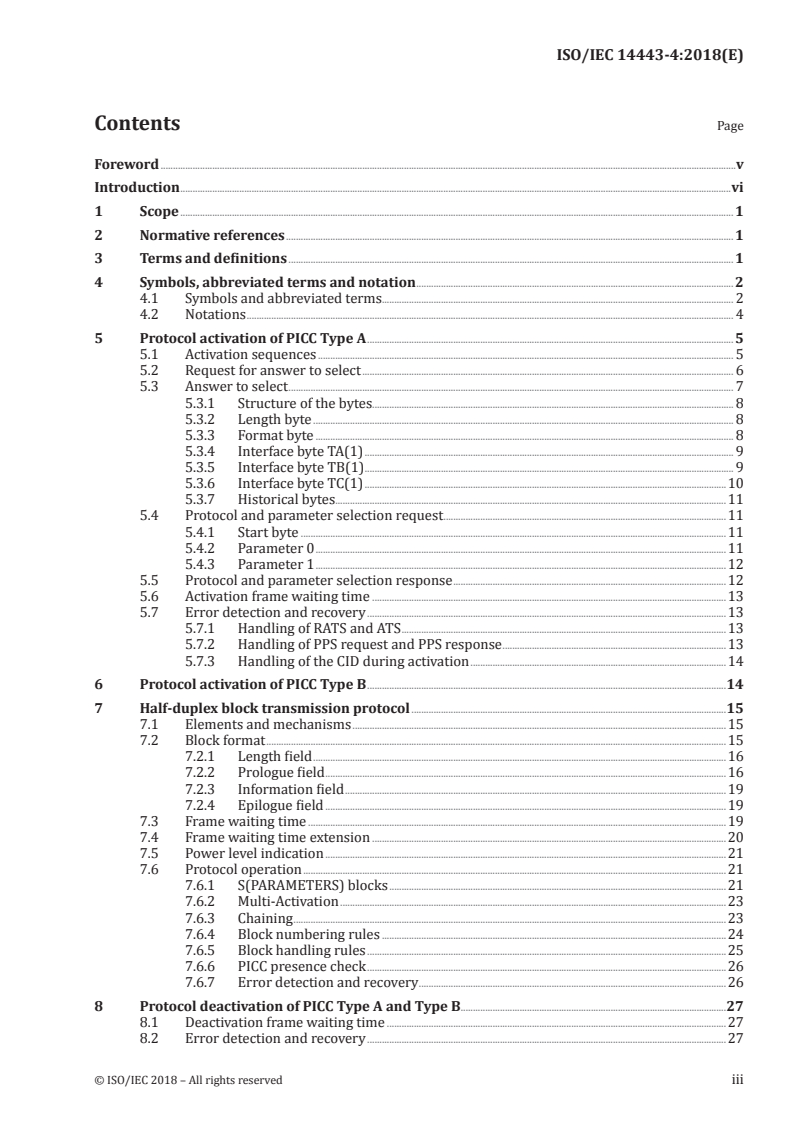
Contents Page
Foreword .v
Introduction .vi
1 Scope . 1
2 Normative references . 1
3 Terms and definitions . 1
4 Symbols, abbreviated terms and notation . 2
4.1 Symbols and abbreviated terms. 2
4.2 Notations . 4
5 Protocol activation of PICC Type A . 5
5.1 Activation sequences . 5
5.2 Request for answer to select . 6
5.3 Answer to select . 7
5.3.1 Structure of the bytes. 8
5.3.2 Length byte . 8
5.3.3 Format byte . 8
5.3.4 Interface byte TA(1) . 9
5.3.5 Interface byte TB(1) . 9
5.3.6 Interface byte TC(1) .10
5.3.7 Historical bytes . . .11
5.4 Protocol and parameter selection request .11
5.4.1 Start byte .11
5.4.2 Parameter 0 .11
5.4.3 Parameter 1 .12
5.5 Protocol and parameter selection response .12
5.6 Activation frame waiting time .13
5.7 Error detection and recovery .13
5.7.1 Handling of RATS and ATS .13
5.7.2 Handling of PPS request and PPS response .13
5.7.3 Handling of the CID during activation .14
6 Protocol activation of PICC Type B .14
7 Half-duplex block transmission protocol .15
7.1 Elements and mechanisms .15
7.2 Block format .15
7.2.1 Length field .16
7.2.2 Prologue field .16
7.2.3 Information field .19
7.2.4 Epilogue field .19
7.3 Frame waiting time .19
7.4 Frame waiting time extension .20
7.5 Power level indication .21
7.6 Protocol operation .21
7.6.1 S(PARAMETERS) blocks .21
7.6.2 Multi-Activation .23
7.6.3 Chaining .23
7.6.4 Block numbering rules .24
7.6.5 Block handling rules .25
7.6.6 PICC presence check .26
7.6.7 Error detection and recovery .26
8 Protocol deactivation of PICC Type A and Type B.27
8.1 Deactivation frame waiting time .27
8.2 Error detection and recovery .27
© ISO/IEC 2018 – All rights reserved iii
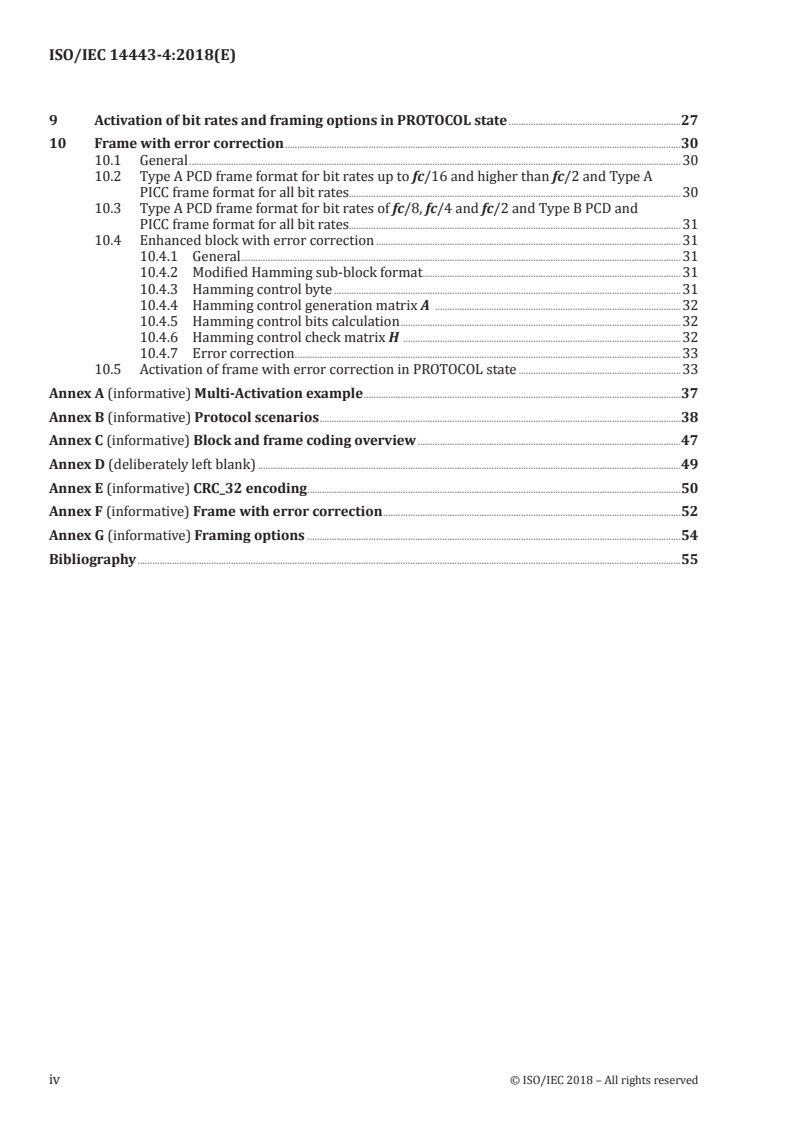
9 Activation of bit rates and framing options in PROTOCOL state .27
10 Frame with error correction .30
10.1 General .30
10.2 Type A PCD frame format for bit rates up to fc/16 and higher than fc/2 and Type A
PICC frame format for all bit rates.30
10.3 Type A PCD frame format for bit rates of fc/8, fc/4 and fc/2 and Type B PCD and
PICC frame format for all bit rates.31
10.4 Enhanced block with error correction .31
10.4.1 General.31
10.4.2 Modified Hamming sub-block format .31
10.4.3 Hamming control byte .31
10.4.4 Hamming control generation matrix A .32
10.4.5 Hamming control bits calculation .32
10.4.6 Hamming control check matrix H .32
10.4.7 Error correction .33
10.5 Activation of frame with error correction in PROTOCOL state .33
Annex A (informative) Multi-Activation example .37
Annex B (informative) Protocol scenarios .38
Annex C (informative) Block and frame coding overview .47
Annex D (deliberately left blank) .49
Annex E (informative) CRC_32 encoding.50
Annex F (informative) Frame with error correction .52
Annex G (informative) Framing options .54
Bibliography .55
iv © ISO/IEC 2018 – All rights reserved
Foreword
ISO (the International Organization for Standardization) and IEC (the International Electrotechnical
Commission) form the specialized system for worldwide standardization. National bodies that are
members of ISO or IEC participate in the development of International Standards through technical
committees established by the respective organization to deal with particular fields of technical
activity. ISO and IEC technical committees collaborate in fields of mutual interest. Other international
organizations, governmental and non-governmental, in liaison with ISO and IEC, also take part in the
work. In the field of information technology, ISO and IEC have established a joint technical committee,
ISO/IEC JTC 1.
The procedures used to develop this document and those intended for its further maintenance are
described in the ISO/IEC Directives, Part 1. In particular the different approval criteria needed for
the different types of document should be noted. This document was drafted in accordance with the
editorial rules of the ISO/IEC Directives, Part 2 (see www .iso .org/directives).
Attention is drawn to the possibility that some of the elements of this document may be the subject
of patent rights. ISO and IEC shall not be held responsible for identifying any or all such patent
rights. Details of any patent rights identified during the development of the document will be in the
Introduction and/or on the ISO list of patent declarations received (see www .iso .org/patents).
Any trade name used in this document is information given for the convenience of users and does not
constitute an endorsement.
For an explanation on the voluntary nature of standards, the meaning of ISO specific terms and
expressions related to conformity assessment, as well as information about ISO's adherence to the
World Trade Organization (WTO) principles in the Technical Barriers to Trade (TBT) see the following
URL: www .iso .org/iso/foreword .html.
This document was prepared by ISO/IEC JTC 1, Information technology, SC 17, Cards and security devices
for personal identification.
This fourth edition cancels and replaces the third edition (ISO/IEC 14443-4:2016), which has been
technically revised.
A list of all the parts in the ISO/IEC 14443 series can be found on the ISO website.
© ISO/IEC 2018 – All rights reserved v
Introduction
The ISO/IEC 14443 series of standards describes the parameters for identification cards or objects for
international interchange.
The protocol, as defined in this document, is capable of transferring the application protocol data units
as defined in ISO/IEC 7816-4. Thus, application protocol data units and application selection may be
used as defined in ISO/IEC 7816-4.
The ISO/IEC 14443 series of standards is intended to allow operation of proximity cards in the presence
of other contactless cards or objects conforming to the ISO/IEC 10536 series of standards and the
ISO/IEC 15693 series of standards and near field communication (NFC) devices conforming to ISO/
IEC 18092 and ISO/IEC 21481.
vi © ISO/IEC 2018 – All rights reserved
INTERNATIONAL STANDARD ISO/IEC 14443-4:2018(E)
Cards and security devices for personal identification —
Contactless proximity objects —
Part 4:
Transmission protocol
1 Scope
This document specifies a half-duplex block transmission protocol featuring the special needs of a
contactless environment and defines the activation and deactivation sequence of the protocol.
This document is intended to be used in conjunction with other parts of ISO/IEC 14443 and is applicable
to proximity cards or objects of Type A and Type B.
2 Normative references
The following documents are referred to in the text in such a way that some or all of their content
constitutes requirements of this document. For dated references, only the edition cited applies. For
undated references, the latest edition of the referenced document (including any amendments) applies.
ISO/IEC 7816-3, Identification cards — Integrated circuit cards — Part 3: Cards with contacts — Electrical
interface and transmission protocols
ISO/IEC 7816-4:2013, Identification cards — Integrated circuit cards — Part 4: Organization, security and
commands for interchange
1)
ISO/IEC 14443-2 , Cards and security devices for personal identification — Contactless proximity objects
— Part 2: Radio frequency power and signal interface
ISO/IEC 14443-3, Cards and security devices for personal identification — Contactless proximity objects —
Part 3: Initialization and anticollision
3 Terms and definitions
For the purposes of this document, the following terms and definitions apply.
ISO and IEC maintain terminological databases for use in standardization at the following addresses:
— IEC Electropedia: available at http: //www .electropedia .org/
— ISO Online browsing platform: available at https: //www .iso .org/obp
3.1
bit duration
one elementary time unit (etu), calculated by the following formula:
1 etu = 128/(D × fc)
Note 1 to entry: The initial value of the divisor D is 1, giving the initial etu as follows:
1 etu = 128/fc
1) Fourth edition to be published. Current stage: 40.60.
© ISO/IEC 2018 – All rights reserved 1
where fc is the carrier frequency as defined in ISO/IEC 14443-2.
3.2
block
special type of frame, which contains a valid protocol data format
Note 1 to entry: A valid protocol data format includes I-blocks, R-blocks or S-blocks.
3.3
invalid block
type of frame, which contains an invalid protocol format
Note 1 to entry: A time-out, when no frame has been received, is not interpreted as an invalid block.
3.4
frame
sequence of bits as defined in ISO/IEC 14443-3
Note 1 to entry: The PICC independent from its type may use the frame with error correction defined in Clause 10.
Alternatively, the PICC Type A can use one of the standard frames defined for Type A and the PICC Type B can use
the frame defined for Type B. This Type B frame is called standard frame, too, within this document.
4 Symbols, abbreviated terms and notation
4.1 Symbols and abbreviated terms
A Hamming control bits generation matrix (6 rows, 56 columns)
ACK positive ACKnowledgement
ATS Answer To Select
ATQA Answer To reQuest, Type A
ATQB Answer To reQuest, Type B
CID Card IDentifier
CRC Cyclic Redundancy Check, as defined for each PICC Type in ISO/IEC 14443-3
CRC1 most significant byte of CRC (b16 to b9)
CRC2 least significant byte of CRC (b8 to b1)
CRC_32 Cyclic Redundancy Check error detection code used within enhanced block
c Hamming control bit n
n
vector containing 56 data bits
d
d data bit n
n
D Divisor
DR Divisor Receive (PCD to PICC)
DRI Divisor Receive Integer (PCD to PICC)
DS Divisor Send (PICC to PCD)
2 © ISO/IEC 2018 – All rights reserved
DSI Divisor Send Integer (PICC to PCD)
EDC Error Detection Code
etu elementary time unit
fc carrier frequency
FSC Frame Size for proximity Card
FSCI Frame Size for proximity Card Integer
FSD Frame Size for proximity coupling Device
FSDI Frame Size for proximity coupling Device Integer
FWI Frame Waiting time Integer
FWT Frame Waiting Time
FWT temporary Frame Waiting Time
TEMP
H matrix needed to calculate Hamming syndrome s (6 rows, 62 columns)
h′ element in row m and column n of matrix H′
m,n
H′ matrix needed to get matrix A (6 rows, 62 columns)
column vector of matrix H′
h′
n
HLTA HALT command, Type A
I 6 by 6 Identity matrix
6 × 6
I-block Information block
INF INFormation field
LEN two bytes LENgth field used within enhanced block
m row index
MAX index to define a MAXimum value
MIN index to define a MINimum value
n column index
NAD Node ADdress
NAK Negative AcKnowledgement
OSI Open Systems Interconnection
PCB Protocol Control Byte
PCD Proximity Coupling Device
PICC Proximity card or object
PPS Protocol and Parameter Selection
© ISO/IEC 2018 – All rights reserved 3
PPSS Protocol and Parameter Selection Start
PPS0 Protocol and Parameter Selection parameter 0
PPS1 Protocol and Parameter Selection parameter 1
R-block Receive ready block
R(ACK) R-block containing a positive acknowledgement
R(NAK) R-block containing a negative acknowledgement
RATS Request for Answer To Select
REQA REQuest command, Type A
RFU Reserved for Future Use
s 6-bit vector containing Hamming syndrome
s′ error position code
s error position
S-block Supervisory block
SAK Select AcKnowledge
SFGI Start-up Frame Guard time Integer
SFGT Start-up Frame Guard Time
SYNC SYNChronization sequence
WUPA Wake-UP command, Type A
WTX Waiting Time eXtension
WTXM Waiting Time eXtension Multiplier
y
64-bit vector ( y′ with no padding bits)
64-bit vector containing received modified Hamming sub-block
y′
y′ received bit n in each modified Hamming sub-block
n
4.2 Notations
For the purposes of this document, the following notations apply:
— (xxxxx)b data bit representation;
— ‘XY’ hexadecimal notation, equal to XY to the base 16.
4 © ISO/IEC 2018 – All rights reserved
5 Protocol activation of PICC Type A
5.1 Activation sequences
The following activation sequence shall be applied.
— PICC activation sequence as defined in ISO/IEC 14443-3 (request, anticollision loop and select).
— The SAK byte shall be checked to get information if the PICC is compliant with ISO/IEC 14443-4. The
SAK byte is defined in ISO/IEC 14443-3.
— The PICC may be set to HALT state, using the HLTA command as defined in ISO/IEC 14443-3, if e.g.
no ISO/IEC 14443-4 protocol is used at the PCD (the PCD cannot continue the activation sequence in
that case).
— If the PICC is compliant to ISO/IEC 14443-4, the RATS may be sent by the PCD as next command after
receiving the SAK.
— The PICC shall send its ATS as answer to the RATS. The PICC shall only answer to the RATS if the
RATS is received directly after the selection.
— If the PICC supports any changeable parameters in the ATS, a PPS request may be used by the PCD
as the next command after receiving the ATS to change parameters.
— The PICC shall send a PPS Response as answer to the PPS request.
The PICC does not need to implement the PPS, if it does not support any changeable parameters in the ATS.
The PCD activation sequence for a PICC Type A is shown in Figure 1.
The RFU handling specified in ISO/IEC 14443-3:2018, 5.3 applies for Clause 5.
© ISO/IEC 2018 – All rights reserved 5
Figure 1 — Activation of a PICC Type A by a PCD
5.2 Request for answer to select
This clause defines the RATS with all its fields (see Figure 2).
6 © ISO/IEC 2018 – All rights reserved
Figure 2 — Request for answer to select
The parameter byte consists of two parts (see Figure 3).
— The most significant half-byte b8 to b5 is called FSDI and codes FSD. The FSD defines the maximum
size of a frame the PCD is able to receive. The coding of FSD is given in Table 1.
— Until the RFU values 'D'–'F' are assigned, a PICC receiving an FSDI with a value = 'D'–'F' shall interpret
it as FSDI = 'C' (FSD = 4 096 bytes).
NOTE This PCD requirement is added for PCD’s compatibility with future PICCs when a revision to this
document further defines the behaviour for the RFU values of 'D'–'F'.
— The least significant half byte b4 to b1 is named CID and it defines the logical number of the
addressed PICC in the range from 0 to 14. The value 15 is RFU. The CID is specified by the PCD and
shall be unique for all PICCs, which are in ACTIVE state at the same time. The CID is fixed for the
time the PICC is active and the PICC shall use the CID as its logical identifier, which is contained in
the first error-free RATS received.
Figure 3 — Coding of RATS parameter byte
Table 1 — FSDI to FSD conversion
FSDI ‘0’ ‘1’ ‘2’ ‘3’ ‘4’ ‘5’ ‘6’ ‘7’ ‘8’ ‘9’ ‘A’ ‘B’ ‘C’ ‘D’ - ‘F’
FSD (bytes) 16 24 32 40 48 64 96 128 256 512 1 024 2 048 4 096 RFU
5.3 Answer to select
This clause defines the ATS with all its available fields (see Figure 4).
In the case that one of the defined fields is not present in an ATS sent by the PICC, the default values for
that field shall apply.
© ISO/IEC 2018 – All rights reserved 7
Figure 4 — Structure of the ATS
5.3.1 Structure of the bytes
The length byte TL is followed by a variable number of optional subsequent bytes in the following order:
— format byte T0;
— interface bytes TA(1), TB(1), TC(1);
— historical bytes T1 to Tk.
5.3.2 Length byte
The length byte TL is mandatory and specifies the length of the transmitted ATS including itself. The
two CRC bytes are not included in TL. The maximum size of the ATS shall not exceed the indicated FSD.
Therefore, the maximum value of TL shall not exceed FSD-2.
5.3.3 Format byte
The format byte T0 is optional and is present as soon as the length is greater than 1. The ATS can only
contain the following optional bytes when this format byte is present.
T0 consists of three parts (see Figure 5).
— b8 is RFU.
— b7 to b5 contain Y(1) indicating the presence of subsequent interface bytes TC(1), TB(1) and TA(1).
— The least significant half byte b4 to b1 is called FSCI and codes FSC. The FSC defines the maximum
size of a frame accepted by the PICC. The default value of FSCI is 2 and leads to a FSC of 32 bytes. The
coding of FSC is equal to the coding of FSD (see Table 1).
— Until the RFU values 'D'–'F' are assigned, a PCD receiving an FSCI with a value = 'D'–'F' shall interpret
it as FSCI = 'C (FSC = 4 096 bytes).
NOTE This PICC requirement is added for PICC's compatibility with future PCDs when a revision to this
document further defines the behaviour for the RFU values 'D' – 'F'.
8 © ISO/IEC 2018 – All rights reserved
Figure 5 — Coding of format byte
5.3.4 Interface byte TA(1)
The interface byte TA(1) consists of four parts (see Figure 6).
— b8 codes the possibility to handle different divisors for each direction. When this bit is set to 1 the
PICC is unable to handle different divisors for each direction.
— b7 to b5 code the bit rate capability of the PICC for the direction from PICC to PCD, called DS. The
default value shall be (000)b.
— b4 shall be set to (0)b.
— b3 to b1 code the bit rate capability of the PICC for the direction from PCD to PICC, called DR. The
default value shall be (000)b.
Figure 6 — Coding of interface byte TA(1)
The selection of a specific divisor D for each direction may be done by the PCD using PPS.
A PCD receiving TA(1) with b4 = (1)b shall interpret it as (b8 to b1) = (00000000)b, implying only
~106 kbit/s supported in both directions. The definition of TA(1) with b4 = (1)b is otherwise undefined.
5.3.5 Interface byte TB(1)
The interface byte TB(1) conveys information to define the frame waiting time and the start-up frame
guard time.
The interface byte TB(1) consists of two parts (see Figure 7).
— The most significant half-byte b8 to b5 is called FWI and codes FWT (see 7.3).
© ISO/IEC 2018 – All rights reserved 9
— The least significant half byte b4 to b1 is called SFGI and codes a multiplier value used to define
the SFGT. The SFGT defines a specific guard time needed by the PICC before it is ready to receive
the next frame after it has sent the ATS. SFGI is coded in the range from 0 to 14. The value of 15 is
RFU. The value of 0 indicates no SFGT needed and the values in the range from 1 to 14 are used to
calculate the SFGT with the formula given below. The default value of SFGI is 0.
Figure 7 — Coding of interface byte TB(1)
SFGT is calculated by the following formulae:
SFGI
SFGT = (256 × 16/fc) × 2
SFGT = minimum value of the frame delay time as defined in ISO/IEC 14443-3
MIN
SFGT = minimum value of the frame delay time as defined in ISO/IEC 14443-3
DEFAULT
SFGT = (256 × 16/fc) × 2 (~4 949 ms)
MAX
Until the RFU value 15 is assigned, a PCD receiving SFGI = 15 shall interpret it as SFGI = 0.
Until the RFU value 15 is assigned, a PCD receiving FWI = 15 shall interpret it as FWI = 4.
5.3.6 Interface byte TC(1)
The interface byte TC(1) specifies a parameter of the protocol.
The specific interface byte TC(1) consists of two parts (see Figure 8).
— b8 to b3 are each RFU.
— b2 and b1 define which optional fields in the prologue field a PICC does support. The PCD is allowed
to skip fields, which are supported by the PICC, but a field not supported by the PICC shall never
be transmitted by the PCD. The default value shall be (10)b indicating CID supported and NAD not
supported.
Figure 8 — Coding of interface byte TC(1)
10 © ISO/IEC 2018 – All rights reserved
5.3.7 Historical bytes
The historical bytes T1 to Tk are optional and designate general information. The maximum length of
the ATS gives the maximum possible number of historical bytes. ISO/IEC 7816-4 specifies the content of
the historical bytes.
5.4 Protocol and parameter selection request
PPS request contains the start byte that is followed by two parameter bytes (see Figure 9).
Figure 9 — Protocol and parameter selection request
5.4.1 Start byte
PPSS consists of two parts (see Figure 10).
— The most significant half byte b8 to b5 shall be set to (1101)b and identifies the PPS.
— The least significant half byte b4 to b1 is named CID and it defines the logical number of the
addressed PICC.
Figure 10 — Coding of PPSS
5.4.2 Parameter 0
PPS0 indicates the presence of the optional byte PPS1 (see Figure 11).
The PCD shall set (b4 to b1) = (0001)b and (b8 to b6) = (000)b.
© ISO/IEC 2018 – All rights reserved 11
Figure 11 — Coding of PPS0
5.4.3 Parameter 1
PPS1 consists of three parts (see Figure 12).
— b8 to b5 shall each be (0)b; a PICC receiving any bit b8 to b5 set to (1)b shall apply 5.7.2.2 b).
— The two-bit value field (b4, b3) is called DSI and codes the selected divisor integer from PICC to PCD.
— The two-bit value field (b2, b1) is called DRI and codes the selected divisor integer from PCD to PICC.
Figure 12 — Coding of PPS1
DS and DR are specified in 5.3.4.
The coding of D is given in Table 2.
Table 2 — DRI, DSI to D conversion
DRI, DSI (00)b (01)b (10)b (11)b
D 1 2 4 8
5.5 Protocol and parameter selection response
The PPS response acknowledges the received PPS request (see Figure 13) and it contains only the start
byte (see 5.4.1).
The new bit rates shall become effective in the PICC immediately after it has sent the PPS response.
The PCD shall not change the bit rate when the PPS response is missing or invalid or when the PPSS
returned by the PICC is not identical with the PPSS sent by the PCD.
12 © ISO/IEC 2018 – All rights reserved
Figure 13 — Protocol and parameter selection response
5.6 Activation frame waiting time
The activation frame waiting time defines the maximum time for a PICC to start sending its response
frame after the end of a frame received from the PCD and has a value of 65 536/fc (~4 833 µs).
NOTE The minimum time between frames in any direction is defined in ISO/IEC 14443-3.
5.7 Error detection and recovery
5.7.1 Handling of RATS and ATS
5.7.1.1 PCD rules
When the PCD has sent the RATS and receives a valid ATS the PCD shall continue operation.
In any other case, the PCD may retransmit the RATS before it shall use the deactivation sequence as
defined in Clause 8. In case of failure of this deactivation sequence, it may use the HLTA command as
defined in ISO/IEC 14443-3.
5.7.1.2 PICC rules
When the PICC has been selected with the last command and
a) receives a valid RATS, the PICC
— shall send back its ATS, and
— shall disable the RATS (stop responding to received RATS);
b) receives a valid HLTA, the PICC
— shall process the command and shall enter HALT state;
c) receives an invalid command, an error or a RATS command with CID = 15, the PICC
— shall not respond and shall enter IDLE state or HALT state as specified in ISO/IEC 14443-3:2018,
Figure 7.
5.7.2 Handling of PPS request and PPS response
5.7.2.1 PCD rules
When the PCD has sent a PPS request and received a valid PPS response, the PCD shall activate the
selected parameters and continue operation. In any other case, the PCD may retransmit a PPS request
and continue operation.
© ISO/IEC 2018 – All rights reserved 13
5.7.2.2 PICC rules
When the PICC has received a RATS, sent its ATS and
a) received a valid PPS request, the PICC
— shall send the PPS response,
— shall disable the PPS request (stop responding to received PPS requests), and
— shall activate the received parameter;
b) received an invalid block, the PICC
— shall disable the PPS request (stop responding to received PPS requests), and
— shall remain in receive mode;
c) received a valid block, except a PPS request, the PICC
— shall disable the PPS request (stop responding to received PPS requests), and
— shall continue operation.
5.7.3 Handling of the CID during activation
When the PCD has sent a RATS containing a CID = n not equal to 0 and
— received an ATS indicating CID is supported, the PCD
— shall send blocks containing CID = n to this PICC, and
— shall not use the CID = n for further RATS while this PICC is in ACTIVE state;
— received an ATS indicating CID is not supported, the PCD
— shall send blocks containing no CID to this PICC, and
— shall not activate any other PICC while this PICC is in ACTIVE state.
When the PCD has sent a RATS containing a CID equal to 0 and
— received an ATS indicating CID is supported, the PCD
— shall send blocks containing either CID equal to 0 or no CID to this PICC, not toggling between
these two options until protocol deactivation, and
— shall not activate any other PICC while this PICC is in ACTIVE state;
— received an ATS indicating CID is not supported, the PCD
— shall send blocks containing no CID to this PICC, and
— shall not activate any other PICC while this PICC is in ACTIVE state.
6 Protocol activation of PICC Type B
The activation sequence for a PICC Type B is described in ISO/IEC 14443-3.
14 © ISO/IEC 2018 – All rights reserved
7 Half-duplex block transmission protocol
7.1 Elements and mechanisms
The half-duplex block transmission protocol addresses the special needs of contactless card
environments and uses the frame format as defined in ISO/IEC 14443-3.
Other relevant elements of the frame format are
— block format;
— maximum frame waiting time;
— power indication; and
— protocol operation.
A mechanism is provided in order to introduce additional protocol functions that may be defined from
time to time in this document or in other standards that use this document as their foundation.
This protocol is designed according to the principle layering of the OSI reference model, with particular
attention to the minimization of interactions across boundaries. Four layers are defined as follows:
— physical layer exchanges bytes according to ISO/IEC 14443-3;
— data link layer exchanges blocks as defined in this clause;
— session layer combined with the data link layer for a minimum overhead;
— application layer processing commands, which involve the exchange of at least one block or chain of
blocks in either direction.
Application selection may be used as defined in ISO/IEC 7816-4. Implicit application selection is not
recommended to be used with multi-application PICCs.
The RFU handling specified in ISO/IEC 14443-3:2018, 5.3 applies for Clauses 7, 8, 9 and 10.
7.2 Block format
The block format depends on the frame format used for its transmission.
The standard block format as specified in Figure 14 shall be used in standard frames as defined in ISO/
IEC 14443-3 and consists of the following:
— a prologue field (mandatory);
— an information field (optional);
— a two-byte epilogue field (mandatory).
The enhanced block format specified in Figure 15 shall be used in frames with error correction as
defined in Clause 10 and consists of the following:
— a length field (mandatory);
— a prologue field (mandatory);
— an information field (optional);
— a four-byte epilogue field (mandatory).
© ISO/IEC 2018 – All rights reserved 15
Figure 14 — Standard block format
NOTE 1 The items in brackets indicate optional requirements.
Figure 15 — Enhanced block format
NOTE 2 The items in brackets indicate optional requirements.
7.2.1 Length field
The two-byte length field shall contain the total number of bytes contained in the following fields:
— length field;
— prologue field;
— information field.
Least significant byte is transmitted first, then most significant byte.
7.2.2 Prologue field
The prologue field is mandatory and may be 1, 2, or 3 bytes with PCB mandatory and CID and NAD
optional.
7.2.2.1 Protocol control byte field
The PCB is used to convey the information required to control the data transmission.
The protocol defines three fundamental types of blocks.
— I-block used to convey information for use by the application layer.
— R-block used to convey positive or negative acknowledgements. An R-block never contains an INF
field. The acknowledgement relates to the last received block.
16 © ISO/IEC 2018 – All rights reserved
— S-block used to exchange control information between the PCD and the PICC. The support of the
S(PARAMETERS) block is optional for PCDs and PICCs. Three different types of S-blocks are defined.
1) "Waiting time extension" containing a 1 byte long INF field;
2) "DESELECT" containing no INF field;
3) "PARAMETERS" containing a n-byte long INF field with n ≥ 0.
The coding of the PCB depends on its type and is defined by the following figures. The setting of (b8,b7)
is used to identify its block type as defined in Table 3.
A PICC or PCD receiving (b8,b7) = (01)b shall treat it as a protocol error.
Table 3 — Coding of block type
(b8,b7) Block type
(00)b I-block
(01)b RFU
(10)b R-block
(11)b S-block
The coding of I-block PCB is shown in Figure 16.
Figure 16 — Coding of I-block PCB
A PICC or PCD receiving an I-Block with b2 = (0)b shall treat it as a protocol error.
A PICC or PCD receiving an I-Block with b6 = (1)b should treat it as a protocol error.
The coding of R-block PCB is shown in Figure 17.
Figure 17 — Coding of R-block PCB
© ISO/IEC 2018 – All rights reserved 17
A PICC or PCD receiving an R-Block with b6 = (0)b or b3 = (1)b shall treat it as a protocol error.
A PICC or PCD receiving an R-Block with b2 = (0)b should treat it as a protocol error.
The coding of S-block PCB is shown in Figure 18.
Figure 18 — Coding of S-block PCB
A PICC or PCD receiving S-Block with b3 = (1)b shall treat it as a protocol error.
A PICC or PCD receiving S-Block with b1 = (1)b should treat it as a protocol error.
A PICC or PCD receiving S-Block with b2 = (0)b and (b6,b5) <> (11) b shall treat it as a protocol error.
A PICC or PCD receiving S-Block with b2 = (1)b and (b6,b5) = (01)b or (10)b shall treat it as a protocol error.
7.2.2.2 Card identifier field
The CID field is used to identify a specific PICC and consists of three parts (see Figure 19).
— b8 and b7 are used to indicate the power level indication received by a PICC from a PCD. These two
bits shall be set to (00)b for PCD to PICC communication. For a definition of power level indication
see 7.5.
— (b6,b5) shall be set to (00)b.
— A PICC or PCD receiving (b6,b5) = (01)b or (10)b or (11)b shall treat it as a protocol error.
— b4 to b1 code the CID.
Figure 19 — Coding of card identifier
The coding of CID is given in 5.2 for Type A and ISO/IEC 14443-3 for Type B.
The handling of the CID by a PICC is described below:
If the PICC does not support a CID, it shall ignore any block containing a CID.
18 © ISO/IEC 2018 – All rights reserved
If the PICC does support a CID, it
— shall respond to blocks containing its CID by using its CID,
— shall ignore blocks containing other CIDs, and
— shall, in case its CID is 0, respond also to blocks containing no CID by using no CID.
7.2.2.3 Node address field
The usage of the NAD shall be in accordance with the definition of NAD in ISO/IEC 7816-3.
The following definitions shall apply for the usage of the NAD:
a) the NAD field shall only be used for I-blocks;
b) when the PCD uses the NAD, the PICC shall also use the NAD;
c) during chaining the NAD shall only be transmitted in the first block of chain;
d) the PCD shall never use the NAD to address different PICCs (The CID shall be used to address
different PICCs);
e) when the PICC does not support the NAD, it shall ignore any block containing the NAD.
7.2.3 Information field
The INF field is optional. When present, the INF field conveys either application data in I-blocks or non-
application data and status information in S-blocks. The le
...
INTERNATIONAL ISO/IEC
STANDARD 14443-4
Fourth edition
2018-07
Cards and security devices for
personal identification — Contactless
proximity objects —
Part 4:
Transmission protocol
Cartes et dispositifs de sécurité pour l'identification personnelle —
Objets sans contact de proximité —
Partie 4: Protocole de transmission
Reference number
©
ISO/IEC 2018
© ISO/IEC 2018
All rights reserved. Unless otherwise specified, or required in the context of its implementation, no part of this publication may
be reproduced or utilized otherwise in any form or by any means, electronic or mechanical, including photocopying, or posting
on the internet or an intranet, without prior written permission. Permission can be requested from either ISO at the address
below or ISO’s member body in the country of the requester.
ISO copyright office
CP 401 • Ch. de Blandonnet 8
CH-1214 Vernier, Geneva
Phone: +41 22 749 01 11
Fax: +41 22 749 09 47
Email: copyright@iso.org
Website: www.iso.org
Published in Switzerland
ii © ISO/IEC 2018 – All rights reserved
Contents Page
Foreword .v
Introduction .vi
1 Scope . 1
2 Normative references . 1
3 Terms and definitions . 1
4 Symbols, abbreviated terms and notation . 2
4.1 Symbols and abbreviated terms. 2
4.2 Notations . 4
5 Protocol activation of PICC Type A . 5
5.1 Activation sequences . 5
5.2 Request for answer to select . 6
5.3 Answer to select . 7
5.3.1 Structure of the bytes. 8
5.3.2 Length byte . 8
5.3.3 Format byte . 8
5.3.4 Interface byte TA(1) . 9
5.3.5 Interface byte TB(1) . 9
5.3.6 Interface byte TC(1) .10
5.3.7 Historical bytes . . .11
5.4 Protocol and parameter selection request .11
5.4.1 Start byte .11
5.4.2 Parameter 0 .11
5.4.3 Parameter 1 .12
5.5 Protocol and parameter selection response .12
5.6 Activation frame waiting time .13
5.7 Error detection and recovery .13
5.7.1 Handling of RATS and ATS .13
5.7.2 Handling of PPS request and PPS response .13
5.7.3 Handling of the CID during activation .14
6 Protocol activation of PICC Type B .14
7 Half-duplex block transmission protocol .15
7.1 Elements and mechanisms .15
7.2 Block format .15
7.2.1 Length field .16
7.2.2 Prologue field .16
7.2.3 Information field .19
7.2.4 Epilogue field .19
7.3 Frame waiting time .19
7.4 Frame waiting time extension .20
7.5 Power level indication .21
7.6 Protocol operation .21
7.6.1 S(PARAMETERS) blocks .21
7.6.2 Multi-Activation .23
7.6.3 Chaining .23
7.6.4 Block numbering rules .24
7.6.5 Block handling rules .25
7.6.6 PICC presence check .26
7.6.7 Error detection and recovery .26
8 Protocol deactivation of PICC Type A and Type B.27
8.1 Deactivation frame waiting time .27
8.2 Error detection and recovery .27
© ISO/IEC 2018 – All rights reserved iii
9 Activation of bit rates and framing options in PROTOCOL state .27
10 Frame with error correction .30
10.1 General .30
10.2 Type A PCD frame format for bit rates up to fc/16 and higher than fc/2 and Type A
PICC frame format for all bit rates.30
10.3 Type A PCD frame format for bit rates of fc/8, fc/4 and fc/2 and Type B PCD and
PICC frame format for all bit rates.31
10.4 Enhanced block with error correction .31
10.4.1 General.31
10.4.2 Modified Hamming sub-block format .31
10.4.3 Hamming control byte .31
10.4.4 Hamming control generation matrix A .32
10.4.5 Hamming control bits calculation .32
10.4.6 Hamming control check matrix H .32
10.4.7 Error correction .33
10.5 Activation of frame with error correction in PROTOCOL state .33
Annex A (informative) Multi-Activation example .37
Annex B (informative) Protocol scenarios .38
Annex C (informative) Block and frame coding overview .47
Annex D (deliberately left blank) .49
Annex E (informative) CRC_32 encoding.50
Annex F (informative) Frame with error correction .52
Annex G (informative) Framing options .54
Bibliography .55
iv © ISO/IEC 2018 – All rights reserved
Foreword
ISO (the International Organization for Standardization) and IEC (the International Electrotechnical
Commission) form the specialized system for worldwide standardization. National bodies that are
members of ISO or IEC participate in the development of International Standards through technical
committees established by the respective organization to deal with particular fields of technical
activity. ISO and IEC technical committees collaborate in fields of mutual interest. Other international
organizations, governmental and non-governmental, in liaison with ISO and IEC, also take part in the
work. In the field of information technology, ISO and IEC have established a joint technical committee,
ISO/IEC JTC 1.
The procedures used to develop this document and those intended for its further maintenance are
described in the ISO/IEC Directives, Part 1. In particular the different approval criteria needed for
the different types of document should be noted. This document was drafted in accordance with the
editorial rules of the ISO/IEC Directives, Part 2 (see www .iso .org/directives).
Attention is drawn to the possibility that some of the elements of this document may be the subject
of patent rights. ISO and IEC shall not be held responsible for identifying any or all such patent
rights. Details of any patent rights identified during the development of the document will be in the
Introduction and/or on the ISO list of patent declarations received (see www .iso .org/patents).
Any trade name used in this document is information given for the convenience of users and does not
constitute an endorsement.
For an explanation on the voluntary nature of standards, the meaning of ISO specific terms and
expressions related to conformity assessment, as well as information about ISO's adherence to the
World Trade Organization (WTO) principles in the Technical Barriers to Trade (TBT) see the following
URL: www .iso .org/iso/foreword .html.
This document was prepared by ISO/IEC JTC 1, Information technology, SC 17, Cards and security devices
for personal identification.
This fourth edition cancels and replaces the third edition (ISO/IEC 14443-4:2016), which has been
technically revised.
A list of all the parts in the ISO/IEC 14443 series can be found on the ISO website.
© ISO/IEC 2018 – All rights reserved v
Introduction
The ISO/IEC 14443 series of standards describes the parameters for identification cards or objects for
international interchange.
The protocol, as defined in this document, is capable of transferring the application protocol data units
as defined in ISO/IEC 7816-4. Thus, application protocol data units and application selection may be
used as defined in ISO/IEC 7816-4.
The ISO/IEC 14443 series of standards is intended to allow operation of proximity cards in the presence
of other contactless cards or objects conforming to the ISO/IEC 10536 series of standards and the
ISO/IEC 15693 series of standards and near field communication (NFC) devices conforming to ISO/
IEC 18092 and ISO/IEC 21481.
vi © ISO/IEC 2018 – All rights reserved
INTERNATIONAL STANDARD ISO/IEC 14443-4:2018(E)
Cards and security devices for personal identification —
Contactless proximity objects —
Part 4:
Transmission protocol
1 Scope
This document specifies a half-duplex block transmission protocol featuring the special needs of a
contactless environment and defines the activation and deactivation sequence of the protocol.
This document is intended to be used in conjunction with other parts of ISO/IEC 14443 and is applicable
to proximity cards or objects of Type A and Type B.
2 Normative references
The following documents are referred to in the text in such a way that some or all of their content
constitutes requirements of this document. For dated references, only the edition cited applies. For
undated references, the latest edition of the referenced document (including any amendments) applies.
ISO/IEC 7816-3, Identification cards — Integrated circuit cards — Part 3: Cards with contacts — Electrical
interface and transmission protocols
ISO/IEC 7816-4:2013, Identification cards — Integrated circuit cards — Part 4: Organization, security and
commands for interchange
1)
ISO/IEC 14443-2 , Cards and security devices for personal identification — Contactless proximity objects
— Part 2: Radio frequency power and signal interface
ISO/IEC 14443-3, Cards and security devices for personal identification — Contactless proximity objects —
Part 3: Initialization and anticollision
3 Terms and definitions
For the purposes of this document, the following terms and definitions apply.
ISO and IEC maintain terminological databases for use in standardization at the following addresses:
— IEC Electropedia: available at http: //www .electropedia .org/
— ISO Online browsing platform: available at https: //www .iso .org/obp
3.1
bit duration
one elementary time unit (etu), calculated by the following formula:
1 etu = 128/(D × fc)
Note 1 to entry: The initial value of the divisor D is 1, giving the initial etu as follows:
1 etu = 128/fc
1) Fourth edition to be published. Current stage: 40.60.
© ISO/IEC 2018 – All rights reserved 1
where fc is the carrier frequency as defined in ISO/IEC 14443-2.
3.2
block
special type of frame, which contains a valid protocol data format
Note 1 to entry: A valid protocol data format includes I-blocks, R-blocks or S-blocks.
3.3
invalid block
type of frame, which contains an invalid protocol format
Note 1 to entry: A time-out, when no frame has been received, is not interpreted as an invalid block.
3.4
frame
sequence of bits as defined in ISO/IEC 14443-3
Note 1 to entry: The PICC independent from its type may use the frame with error correction defined in Clause 10.
Alternatively, the PICC Type A can use one of the standard frames defined for Type A and the PICC Type B can use
the frame defined for Type B. This Type B frame is called standard frame, too, within this document.
4 Symbols, abbreviated terms and notation
4.1 Symbols and abbreviated terms
A Hamming control bits generation matrix (6 rows, 56 columns)
ACK positive ACKnowledgement
ATS Answer To Select
ATQA Answer To reQuest, Type A
ATQB Answer To reQuest, Type B
CID Card IDentifier
CRC Cyclic Redundancy Check, as defined for each PICC Type in ISO/IEC 14443-3
CRC1 most significant byte of CRC (b16 to b9)
CRC2 least significant byte of CRC (b8 to b1)
CRC_32 Cyclic Redundancy Check error detection code used within enhanced block
c Hamming control bit n
n
vector containing 56 data bits
d
d data bit n
n
D Divisor
DR Divisor Receive (PCD to PICC)
DRI Divisor Receive Integer (PCD to PICC)
DS Divisor Send (PICC to PCD)
2 © ISO/IEC 2018 – All rights reserved
DSI Divisor Send Integer (PICC to PCD)
EDC Error Detection Code
etu elementary time unit
fc carrier frequency
FSC Frame Size for proximity Card
FSCI Frame Size for proximity Card Integer
FSD Frame Size for proximity coupling Device
FSDI Frame Size for proximity coupling Device Integer
FWI Frame Waiting time Integer
FWT Frame Waiting Time
FWT temporary Frame Waiting Time
TEMP
H matrix needed to calculate Hamming syndrome s (6 rows, 62 columns)
h′ element in row m and column n of matrix H′
m,n
H′ matrix needed to get matrix A (6 rows, 62 columns)
column vector of matrix H′
h′
n
HLTA HALT command, Type A
I 6 by 6 Identity matrix
6 × 6
I-block Information block
INF INFormation field
LEN two bytes LENgth field used within enhanced block
m row index
MAX index to define a MAXimum value
MIN index to define a MINimum value
n column index
NAD Node ADdress
NAK Negative AcKnowledgement
OSI Open Systems Interconnection
PCB Protocol Control Byte
PCD Proximity Coupling Device
PICC Proximity card or object
PPS Protocol and Parameter Selection
© ISO/IEC 2018 – All rights reserved 3
PPSS Protocol and Parameter Selection Start
PPS0 Protocol and Parameter Selection parameter 0
PPS1 Protocol and Parameter Selection parameter 1
R-block Receive ready block
R(ACK) R-block containing a positive acknowledgement
R(NAK) R-block containing a negative acknowledgement
RATS Request for Answer To Select
REQA REQuest command, Type A
RFU Reserved for Future Use
s 6-bit vector containing Hamming syndrome
s′ error position code
s error position
S-block Supervisory block
SAK Select AcKnowledge
SFGI Start-up Frame Guard time Integer
SFGT Start-up Frame Guard Time
SYNC SYNChronization sequence
WUPA Wake-UP command, Type A
WTX Waiting Time eXtension
WTXM Waiting Time eXtension Multiplier
y
64-bit vector ( y′ with no padding bits)
64-bit vector containing received modified Hamming sub-block
y′
y′ received bit n in each modified Hamming sub-block
n
4.2 Notations
For the purposes of this document, the following notations apply:
— (xxxxx)b data bit representation;
— ‘XY’ hexadecimal notation, equal to XY to the base 16.
4 © ISO/IEC 2018 – All rights reserved
5 Protocol activation of PICC Type A
5.1 Activation sequences
The following activation sequence shall be applied.
— PICC activation sequence as defined in ISO/IEC 14443-3 (request, anticollision loop and select).
— The SAK byte shall be checked to get information if the PICC is compliant with ISO/IEC 14443-4. The
SAK byte is defined in ISO/IEC 14443-3.
— The PICC may be set to HALT state, using the HLTA command as defined in ISO/IEC 14443-3, if e.g.
no ISO/IEC 14443-4 protocol is used at the PCD (the PCD cannot continue the activation sequence in
that case).
— If the PICC is compliant to ISO/IEC 14443-4, the RATS may be sent by the PCD as next command after
receiving the SAK.
— The PICC shall send its ATS as answer to the RATS. The PICC shall only answer to the RATS if the
RATS is received directly after the selection.
— If the PICC supports any changeable parameters in the ATS, a PPS request may be used by the PCD
as the next command after receiving the ATS to change parameters.
— The PICC shall send a PPS Response as answer to the PPS request.
The PICC does not need to implement the PPS, if it does not support any changeable parameters in the ATS.
The PCD activation sequence for a PICC Type A is shown in Figure 1.
The RFU handling specified in ISO/IEC 14443-3:2018, 5.3 applies for Clause 5.
© ISO/IEC 2018 – All rights reserved 5
Figure 1 — Activation of a PICC Type A by a PCD
5.2 Request for answer to select
This clause defines the RATS with all its fields (see Figure 2).
6 © ISO/IEC 2018 – All rights reserved
Figure 2 — Request for answer to select
The parameter byte consists of two parts (see Figure 3).
— The most significant half-byte b8 to b5 is called FSDI and codes FSD. The FSD defines the maximum
size of a frame the PCD is able to receive. The coding of FSD is given in Table 1.
— Until the RFU values 'D'–'F' are assigned, a PICC receiving an FSDI with a value = 'D'–'F' shall interpret
it as FSDI = 'C' (FSD = 4 096 bytes).
NOTE This PCD requirement is added for PCD’s compatibility with future PICCs when a revision to this
document further defines the behaviour for the RFU values of 'D'–'F'.
— The least significant half byte b4 to b1 is named CID and it defines the logical number of the
addressed PICC in the range from 0 to 14. The value 15 is RFU. The CID is specified by the PCD and
shall be unique for all PICCs, which are in ACTIVE state at the same time. The CID is fixed for the
time the PICC is active and the PICC shall use the CID as its logical identifier, which is contained in
the first error-free RATS received.
Figure 3 — Coding of RATS parameter byte
Table 1 — FSDI to FSD conversion
FSDI ‘0’ ‘1’ ‘2’ ‘3’ ‘4’ ‘5’ ‘6’ ‘7’ ‘8’ ‘9’ ‘A’ ‘B’ ‘C’ ‘D’ - ‘F’
FSD (bytes) 16 24 32 40 48 64 96 128 256 512 1 024 2 048 4 096 RFU
5.3 Answer to select
This clause defines the ATS with all its available fields (see Figure 4).
In the case that one of the defined fields is not present in an ATS sent by the PICC, the default values for
that field shall apply.
© ISO/IEC 2018 – All rights reserved 7
Figure 4 — Structure of the ATS
5.3.1 Structure of the bytes
The length byte TL is followed by a variable number of optional subsequent bytes in the following order:
— format byte T0;
— interface bytes TA(1), TB(1), TC(1);
— historical bytes T1 to Tk.
5.3.2 Length byte
The length byte TL is mandatory and specifies the length of the transmitted ATS including itself. The
two CRC bytes are not included in TL. The maximum size of the ATS shall not exceed the indicated FSD.
Therefore, the maximum value of TL shall not exceed FSD-2.
5.3.3 Format byte
The format byte T0 is optional and is present as soon as the length is greater than 1. The ATS can only
contain the following optional bytes when this format byte is present.
T0 consists of three parts (see Figure 5).
— b8 is RFU.
— b7 to b5 contain Y(1) indicating the presence of subsequent interface bytes TC(1), TB(1) and TA(1).
— The least significant half byte b4 to b1 is called FSCI and codes FSC. The FSC defines the maximum
size of a frame accepted by the PICC. The default value of FSCI is 2 and leads to a FSC of 32 bytes. The
coding of FSC is equal to the coding of FSD (see Table 1).
— Until the RFU values 'D'–'F' are assigned, a PCD receiving an FSCI with a value = 'D'–'F' shall interpret
it as FSCI = 'C (FSC = 4 096 bytes).
NOTE This PICC requirement is added for PICC's compatibility with future PCDs when a revision to this
document further defines the behaviour for the RFU values 'D' – 'F'.
8 © ISO/IEC 2018 – All rights reserved
Figure 5 — Coding of format byte
5.3.4 Interface byte TA(1)
The interface byte TA(1) consists of four parts (see Figure 6).
— b8 codes the possibility to handle different divisors for each direction. When this bit is set to 1 the
PICC is unable to handle different divisors for each direction.
— b7 to b5 code the bit rate capability of the PICC for the direction from PICC to PCD, called DS. The
default value shall be (000)b.
— b4 shall be set to (0)b.
— b3 to b1 code the bit rate capability of the PICC for the direction from PCD to PICC, called DR. The
default value shall be (000)b.
Figure 6 — Coding of interface byte TA(1)
The selection of a specific divisor D for each direction may be done by the PCD using PPS.
A PCD receiving TA(1) with b4 = (1)b shall interpret it as (b8 to b1) = (00000000)b, implying only
~106 kbit/s supported in both directions. The definition of TA(1) with b4 = (1)b is otherwise undefined.
5.3.5 Interface byte TB(1)
The interface byte TB(1) conveys information to define the frame waiting time and the start-up frame
guard time.
The interface byte TB(1) consists of two parts (see Figure 7).
— The most significant half-byte b8 to b5 is called FWI and codes FWT (see 7.3).
© ISO/IEC 2018 – All rights reserved 9
— The least significant half byte b4 to b1 is called SFGI and codes a multiplier value used to define
the SFGT. The SFGT defines a specific guard time needed by the PICC before it is ready to receive
the next frame after it has sent the ATS. SFGI is coded in the range from 0 to 14. The value of 15 is
RFU. The value of 0 indicates no SFGT needed and the values in the range from 1 to 14 are used to
calculate the SFGT with the formula given below. The default value of SFGI is 0.
Figure 7 — Coding of interface byte TB(1)
SFGT is calculated by the following formulae:
SFGI
SFGT = (256 × 16/fc) × 2
SFGT = minimum value of the frame delay time as defined in ISO/IEC 14443-3
MIN
SFGT = minimum value of the frame delay time as defined in ISO/IEC 14443-3
DEFAULT
SFGT = (256 × 16/fc) × 2 (~4 949 ms)
MAX
Until the RFU value 15 is assigned, a PCD receiving SFGI = 15 shall interpret it as SFGI = 0.
Until the RFU value 15 is assigned, a PCD receiving FWI = 15 shall interpret it as FWI = 4.
5.3.6 Interface byte TC(1)
The interface byte TC(1) specifies a parameter of the protocol.
The specific interface byte TC(1) consists of two parts (see Figure 8).
— b8 to b3 are each RFU.
— b2 and b1 define which optional fields in the prologue field a PICC does support. The PCD is allowed
to skip fields, which are supported by the PICC, but a field not supported by the PICC shall never
be transmitted by the PCD. The default value shall be (10)b indicating CID supported and NAD not
supported.
Figure 8 — Coding of interface byte TC(1)
10 © ISO/IEC 2018 – All rights reserved
5.3.7 Historical bytes
The historical bytes T1 to Tk are optional and designate general information. The maximum length of
the ATS gives the maximum possible number of historical bytes. ISO/IEC 7816-4 specifies the content of
the historical bytes.
5.4 Protocol and parameter selection request
PPS request contains the start byte that is followed by two parameter bytes (see Figure 9).
Figure 9 — Protocol and parameter selection request
5.4.1 Start byte
PPSS consists of two parts (see Figure 10).
— The most significant half byte b8 to b5 shall be set to (1101)b and identifies the PPS.
— The least significant half byte b4 to b1 is named CID and it defines the logical number of the
addressed PICC.
Figure 10 — Coding of PPSS
5.4.2 Parameter 0
PPS0 indicates the presence of the optional byte PPS1 (see Figure 11).
The PCD shall set (b4 to b1) = (0001)b and (b8 to b6) = (000)b.
© ISO/IEC 2018 – All rights reserved 11
Figure 11 — Coding of PPS0
5.4.3 Parameter 1
PPS1 consists of three parts (see Figure 12).
— b8 to b5 shall each be (0)b; a PICC receiving any bit b8 to b5 set to (1)b shall apply 5.7.2.2 b).
— The two-bit value field (b4, b3) is called DSI and codes the selected divisor integer from PICC to PCD.
— The two-bit value field (b2, b1) is called DRI and codes the selected divisor integer from PCD to PICC.
Figure 12 — Coding of PPS1
DS and DR are specified in 5.3.4.
The coding of D is given in Table 2.
Table 2 — DRI, DSI to D conversion
DRI, DSI (00)b (01)b (10)b (11)b
D 1 2 4 8
5.5 Protocol and parameter selection response
The PPS response acknowledges the received PPS request (see Figure 13) and it contains only the start
byte (see 5.4.1).
The new bit rates shall become effective in the PICC immediately after it has sent the PPS response.
The PCD shall not change the bit rate when the PPS response is missing or invalid or when the PPSS
returned by the PICC is not identical with the PPSS sent by the PCD.
12 © ISO/IEC 2018 – All rights reserved
Figure 13 — Protocol and parameter selection response
5.6 Activation frame waiting time
The activation frame waiting time defines the maximum time for a PICC to start sending its response
frame after the end of a frame received from the PCD and has a value of 65 536/fc (~4 833 µs).
NOTE The minimum time between frames in any direction is defined in ISO/IEC 14443-3.
5.7 Error detection and recovery
5.7.1 Handling of RATS and ATS
5.7.1.1 PCD rules
When the PCD has sent the RATS and receives a valid ATS the PCD shall continue operation.
In any other case, the PCD may retransmit the RATS before it shall use the deactivation sequence as
defined in Clause 8. In case of failure of this deactivation sequence, it may use the HLTA command as
defined in ISO/IEC 14443-3.
5.7.1.2 PICC rules
When the PICC has been selected with the last command and
a) receives a valid RATS, the PICC
— shall send back its ATS, and
— shall disable the RATS (stop responding to received RATS);
b) receives a valid HLTA, the PICC
— shall process the command and shall enter HALT state;
c) receives an invalid command, an error or a RATS command with CID = 15, the PICC
— shall not respond and shall enter IDLE state or HALT state as specified in ISO/IEC 14443-3:2018,
Figure 7.
5.7.2 Handling of PPS request and PPS response
5.7.2.1 PCD rules
When the PCD has sent a PPS request and received a valid PPS response, the PCD shall activate the
selected parameters and continue operation. In any other case, the PCD may retransmit a PPS request
and continue operation.
© ISO/IEC 2018 – All rights reserved 13
5.7.2.2 PICC rules
When the PICC has received a RATS, sent its ATS and
a) received a valid PPS request, the PICC
— shall send the PPS response,
— shall disable the PPS request (stop responding to received PPS requests), and
— shall activate the received parameter;
b) received an invalid block, the PICC
— shall disable the PPS request (stop responding to received PPS requests), and
— shall remain in receive mode;
c) received a valid block, except a PPS request, the PICC
— shall disable the PPS request (stop responding to received PPS requests), and
— shall continue operation.
5.7.3 Handling of the CID during activation
When the PCD has sent a RATS containing a CID = n not equal to 0 and
— received an ATS indicating CID is supported, the PCD
— shall send blocks containing CID = n to this PICC, and
— shall not use the CID = n for further RATS while this PICC is in ACTIVE state;
— received an ATS indicating CID is not supported, the PCD
— shall send blocks containing no CID to this PICC, and
— shall not activate any other PICC while this PICC is in ACTIVE state.
When the PCD has sent a RATS containing a CID equal to 0 and
— received an ATS indicating CID is supported, the PCD
— shall send blocks containing either CID equal to 0 or no CID to this PICC, not toggling between
these two options until protocol deactivation, and
— shall not activate any other PICC while this PICC is in ACTIVE state;
— received an ATS indicating CID is not supported, the PCD
— shall send blocks containing no CID to this PICC, and
— shall not activate any other PICC while this PICC is in ACTIVE state.
6 Protocol activation of PICC Type B
The activation sequence for a PICC Type B is described in ISO/IEC 14443-3.
14 © ISO/IEC 2018 – All rights reserved
7 Half-duplex block transmission protocol
7.1 Elements and mechanisms
The half-duplex block transmission protocol addresses the special needs of contactless card
environments and uses the frame format as defined in ISO/IEC 14443-3.
Other relevant elements of the frame format are
— block format;
— maximum frame waiting time;
— power indication; and
— protocol operation.
A mechanism is provided in order to introduce additional protocol functions that may be defined from
time to time in this document or in other standards that use this document as their foundation.
This protocol is designed according to the principle layering of the OSI reference model, with particular
attention to the minimization of interactions across boundaries. Four layers are defined as follows:
— physical layer exchanges bytes according to ISO/IEC 14443-3;
— data link layer exchanges blocks as defined in this clause;
— session layer combined with the data link layer for a minimum overhead;
— application layer processing commands, which involve the exchange of at least one block or chain of
blocks in either direction.
Application selection may be used as defined in ISO/IEC 7816-4. Implicit application selection is not
recommended to be used with multi-application PICCs.
The RFU handling specified in ISO/IEC 14443-3:2018, 5.3 applies for Clauses 7, 8, 9 and 10.
7.2 Block format
The block format depends on the frame format used for its transmission.
The standard block format as specified in Figure 14 shall be used in standard frames as defined in ISO/
IEC 14443-3 and consists of the following:
— a prologue field (mandatory);
— an information field (optional);
— a two-byte epilogue field (mandatory).
The enhanced block format specified in Figure 15 shall be used in frames with error correction as
defined in Clause 10 and consists of the following:
— a length field (mandatory);
— a prologue field (mandatory);
— an information field (optional);
— a four-byte epilogue field (mandatory).
© ISO/IEC 2018 – All rights reserved 15
Figure 14 — Standard block format
NOTE 1 The items in brackets indicate optional requirements.
Figure 15 — Enhanced block format
NOTE 2 The items in brackets indicate optional requirements.
7.2.1 Length field
The two-byte length field shall contain the total number of bytes contained in the following fields:
— length field;
— prologue field;
— information field.
Least significant byte is transmitted first, then most significant byte.
7.2.2 Prologue field
The prologue field is mandatory and may be 1, 2, or 3 bytes with PCB mandatory and CID and NAD
optional.
7.2.2.1 Protocol control byte field
The PCB is used to convey the information required to control the data transmission.
The protocol defines three fundamental types of blocks.
— I-block used to convey information for use by the application layer.
— R-block used to convey positive or negative acknowledgements. An R-block never contains an INF
field. The acknowledgement relates to the last received block.
16 © ISO/IEC 2018 – All rights reserved
— S-block used to exchange control information between the PCD and the PICC. The support of the
S(PARAMETERS) block is optional for PCDs and PICCs. Three different types of S-blocks are defined.
1) "Waiting time extension" containing a 1 byte long INF field;
2) "DESELECT" containing no INF field;
3) "PARAMETERS" containing a n-byte long INF field with n ≥ 0.
The coding of the PCB depends on its type and is defined by the following figures. The setting of (b8,b7)
is used to identify its block type as defined in Table 3.
A PICC or PCD receiving (b8,b7) = (01)b shall treat it as a protocol error.
Table 3 — Coding of block type
(b8,b7) Block type
(00)b I-block
(01)b RFU
(10)b R-block
(11)b S-block
The coding of I-block PCB is shown in Figure 16.
Figure 16 — Coding of I-block PCB
A PICC or PCD receiving an I-Block with b2 = (0)b shall treat it as a protocol error.
A PICC or PCD receiving an I-Block with b6 = (1)b should treat it as a protocol error.
The coding of R-block PCB is shown in Figure 17.
Figure 17 — Coding of R-block PCB
© ISO/IEC 2018 – All rights reserved 17
A PICC or PCD receiving an R-Block with b6 = (0)b or b3 = (1)b shall treat it as a protocol error.
A PICC or PCD receiving an R-Block with b2 = (0)b should treat it as a protocol error.
The coding of S-block PCB is shown in Figure 18.
Figure 18 — Coding of S-block PCB
A PICC or PCD receiving S-Block with b3 = (1)b shall treat it as a protocol error.
A PICC or PCD receiving S-Block with b1 = (1)b should treat it as a protocol error.
A PICC or PCD receiving S-Block with b2 = (0)b and (b6,b5) <> (11) b shall treat it as a protocol error.
A PICC or PCD receiving S-Block with b2 = (1)b and (b6,b5) = (01)b or (10)b shall treat it as a protocol error.
7.2.2.2 Card identifier field
The CID field is used to identify a specific PICC and consists of three parts (see Figure 19).
— b8 and b7 are used to indicate the power level indication received by a PICC from a PCD. These two
bits shall be set to (00)b for PCD to PICC communication. For a definition of power level indication
see 7.5.
— (b6,b5) shall be set to (00)b.
— A PICC or PCD receiving (b6,b5) = (01)b or (10)b or (11)b shall treat it as a protocol error.
— b4 to b1 code the CID.
Figure 19 — Coding of card identifier
The coding of CID is given in 5.2 for Type A and ISO/IEC 14443-3 for Type B.
The handling of the CID by a PICC is described below:
If the PICC does not support a CID, it shall ignore any block containing a CID.
18 © ISO/IEC 2018 – All rights reserved
If the PICC does support a CID, it
— shall respond to blocks containing its CID by using its CID,
— shall ignore blocks containing other CIDs, and
— shall, in case its CID is 0, respond also to blocks containing no CID by using no CID.
7.2.2.3 Node address field
The usage of the NAD shall be in accordance with the definition of NAD in ISO/IEC 7816-3.
The following definitions shall apply for the usage of the NAD:
a) the NAD field shall only be used for I-blocks;
b) when the PCD uses the NAD, the PICC shall also use the NAD;
c) during chaining the NAD shall only be transmitted in the first block of chain;
d) the PCD shall never use the NAD to address different PICCs (The CID shall be used to address
different PICCs);
e) when the PICC does not support the NAD, it shall ignore any block containing the NAD.
7.2.3 Information field
The INF field is optional. When present, the INF field conveys either application data in I-blocks or non-
application data and status information in S-blocks. The le
...