

ISO 580:2005
(Main)Plastics piping and ducting systems — Injection-moulded thermoplastics fittings — Methods for visually assessing the effects of heating
General Information
- Abstract
ISO 580:2005 specifies two methods for assessing the effects of heating on injection-moulded thermoplastics pipe fittings -- method A, using an air oven, and method B, using a liquid bath. In case of disagreement, method A is the reference method. ISO 580:2005 is applicable to cement-welded fittings as well as to flanged fittings and fittings incorporating elastomeric seals and to fittings consisting of the assembly of several moulded parts (e.g. union connectors). It is applicable to both pressure and non-pressure fittings.
- Status
- Published
- Publication Date
- 06-Mar-2005
- Current Stage
- 9093 - International Standard confirmed
- Start Date
- 24-Jun-2024
- Completion Date
- 29-Aug-2026
Buy Documents
ISO 580:2005 - Plastics piping and ducting systems — Injection-moulded thermoplastics fittings — Methods for visually assessing the effects of heating Released:3/7/2005
ISO 580:2005 - Systemes de canalisations et de gaines en plastiques — Raccords thermoplastiques moulés par injection — Méthodes d'essai pour estimer visuellement les effets de la chaleur Released:3/7/2005
Overview
ISO 580:2005 is an international standard published by the International Organization for Standardization (ISO) that defines methods for visually assessing the effects of heating on injection-moulded thermoplastics pipe fittings. This standard applies to a variety of fittings including cement-welded, flanged, those with elastomeric seals, and assemblies of multiple moulded parts such as union connectors. It is relevant for both pressure and non-pressure plastic piping and ducting systems.
The main focus of ISO 580:2005 is to provide reliable procedures-using either an air oven or a liquid bath-to evaluate thermoplastic fittings for defects and stresses caused by heating, which can impact the integrity and performance of plastic piping installations.
Key Topics
Test Methods
ISO 580:2005 specifies two test methods for assessing the effects of heating on injection-moulded fittings:- Method A: Heating in a thermostatically controlled air-circulating oven. This is the reference method in case of discrepancies.
- Method B: Heating in a thermostatically controlled liquid bath using stable, non-reactive liquids like glycerine or mineral oil based on the material under test.
Test Parameters
Parameters such as temperature, heating time, and number of test pieces depend on the material type and wall thickness. The standard provides specific guidance for materials like ABS, PE, PP, PVC-U, PVC-C, and SAN+PVC, with corresponding temperatures and heating durations.Assessment Criteria
After heating, fittings are examined visually for:- Cracks
- Blisters
- Delaminations
- Opening of fusion lines
The extent of these defects is measured and expressed as a percentage of the wall thickness to determine the quality and integrity of the fittings. The standard also addresses the presence of cold slugs, unfused areas, porosity, moulded-in stress, and contamination.
Test Reporting
The report must include details such as test method, temperature, duration, number and type of fittings tested, visible defects found, and their dimensions relative to wall thickness, as well as any factors affecting the results.
Applications
ISO 580:2005 is essential for manufacturers and quality control laboratories involved in the production and certification of thermoplastics pipe fittings. It helps in:
Quality Assurance in Manufacturing
Ensuring the fittings are free from manufacturing defects such as stress-induced cracks or unfused areas which can lead to premature failure.Material Performance Verification
Verifying that the thermoplastic fittings maintain mechanical integrity after exposure to heat, simulating real-world thermal stresses during installation or operation.Compliance with Product Standards
Supporting product certification by harmonizing testing and evaluation according to international criteria for both pressure and non-pressure piping components.Design and Process Optimization
Providing feedback on injection moulding techniques such as gating methods (sprue, diaphragm, ring gating) to minimize stress and improve product durability.
Related Standards
ISO 580:2005 complements and supports other standards related to plastics piping systems, such as:
- ISO 1452 - Plastics piping systems for water supply and drainage.
- ISO 4427 - Polyethylene piping systems for water supply.
- ISO 7391 - Testing of thermoplastics fittings for pressure applications.
- ISO 9080 - Hydrostatic strength of polyethylene (PE) pipes and fittings for water supply.
These standards collectively ensure safety, reliability, and performance of plastic piping systems used in various industrial, commercial, and municipal applications.
Keywords: ISO 580:2005, injection-moulded thermoplastics fittings, plastics piping systems, visual assessment, heating effects, air oven test, liquid bath test, piping quality control, thermoplastics pipe fittings defects, moulding stress evaluation, fusion line integrity, plastics piping standard.
Relations
- Effective Date
- 25-Aug-2026
- Effective Date
- 25-Aug-2026
- Effective Date
- 25-Aug-2026
- Effective Date
- 25-Aug-2026
- Effective Date
- 12-Feb-2026
- Effective Date
- 15-Apr-2008
Buy Documents
ISO 580:2005 - Plastics piping and ducting systems — Injection-moulded thermoplastics fittings — Methods for visually assessing the effects of heating Released:3/7/2005
ISO 580:2005 - Systemes de canalisations et de gaines en plastiques — Raccords thermoplastiques moulés par injection — Méthodes d'essai pour estimer visuellement les effets de la chaleur Released:3/7/2005
Get Certified
Connect with accredited certification bodies for this standard

Institut za varilstvo d.o.o. (Welding Institute)
Slovenia's leading welding institute since 1952. ISO 3834, EN 1090, pressure equipment certification, NDT personnel, welder qualification. Only IIW Au
Sponsored listings
Frequently Asked Questions
ISO 580:2005 is a standard published by the International Organization for Standardization (ISO). Its full title is "Plastics piping and ducting systems — Injection-moulded thermoplastics fittings — Methods for visually assessing the effects of heating". This standard covers: ISO 580:2005 specifies two methods for assessing the effects of heating on injection-moulded thermoplastics pipe fittings -- method A, using an air oven, and method B, using a liquid bath. In case of disagreement, method A is the reference method. ISO 580:2005 is applicable to cement-welded fittings as well as to flanged fittings and fittings incorporating elastomeric seals and to fittings consisting of the assembly of several moulded parts (e.g. union connectors). It is applicable to both pressure and non-pressure fittings.
ISO 580:2005 specifies two methods for assessing the effects of heating on injection-moulded thermoplastics pipe fittings -- method A, using an air oven, and method B, using a liquid bath. In case of disagreement, method A is the reference method. ISO 580:2005 is applicable to cement-welded fittings as well as to flanged fittings and fittings incorporating elastomeric seals and to fittings consisting of the assembly of several moulded parts (e.g. union connectors). It is applicable to both pressure and non-pressure fittings.
ISO 580:2005 is classified under the following ICS (International Classification for Standards) categories: 23.040.45 - Plastics fittings. The ICS classification helps identify the subject area and facilitates finding related standards.
ISO 580:2005 has the following relationships with other standards: It is inter standard links to EN ISO 15493:2003, EN ISO 1452-4:2009, EN ISO 15877-3:2009, EN ISO 1452-3:2010, EN ISO 580:2005, ISO 580:1990. Understanding these relationships helps ensure you are using the most current and applicable version of the standard.
ISO 580:2005 is available in PDF format for immediate download after purchase. The document can be added to your cart and obtained through the secure checkout process. Digital delivery ensures instant access to the complete standard document.
Standards Content (Sample)
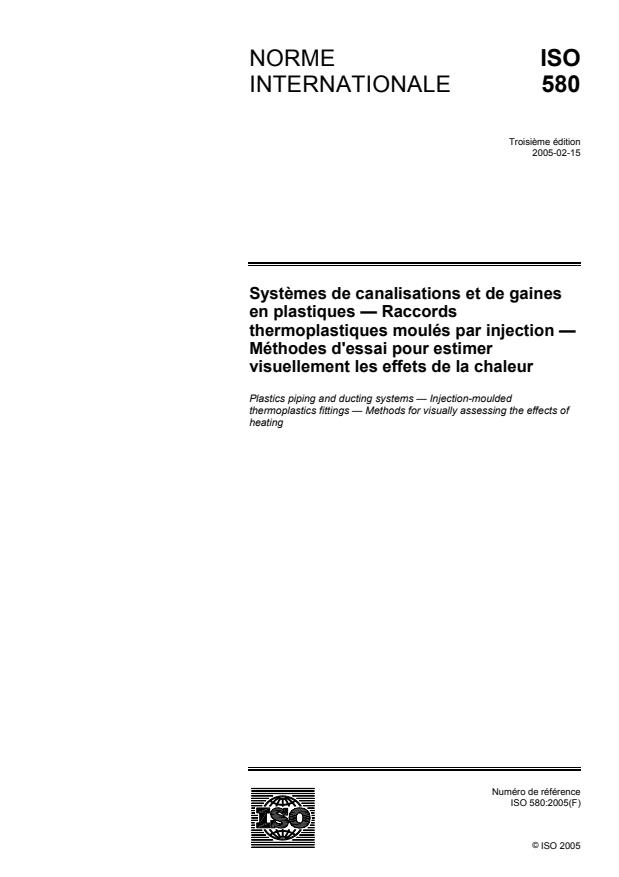
INTERNATIONAL ISO
STANDARD 580
Third edition
2005-02-15
Plastics piping and ducting systems —
Injection-moulded thermoplastics
fittings — Methods for visually assessing
the effects of heating
Systèmes de canalisations et de gaines en plastiques — Raccords
thermoplastiques moulés par injection — Méthodes d'essai pour
estimer visuellement les effets de la chaleur
Reference number
©
ISO 2005
PDF disclaimer
This PDF file may contain embedded typefaces. In accordance with Adobe's licensing policy, this file may be printed or viewed but
shall not be edited unless the typefaces which are embedded are licensed to and installed on the computer performing the editing. In
downloading this file, parties accept therein the responsibility of not infringing Adobe's licensing policy. The ISO Central Secretariat
accepts no liability in this area.
Adobe is a trademark of Adobe Systems Incorporated.
Details of the software products used to create this PDF file can be found in the General Info relative to the file; the PDF-creation
parameters were optimized for printing. Every care has been taken to ensure that the file is suitable for use by ISO member bodies. In
the unlikely event that a problem relating to it is found, please inform the Central Secretariat at the address given below.
© ISO 2005
All rights reserved. Unless otherwise specified, no part of this publication may be reproduced or utilized in any form or by any means,
electronic or mechanical, including photocopying and microfilm, without permission in writing from either ISO at the address below or
ISO's member body in the country of the requester.
ISO copyright office
Case postale 56 • CH-1211 Geneva 20
Tel. + 41 22 749 01 11
Fax + 41 22 749 09 47
E-mail copyright@iso.org
Web www.iso.org
Published in Switzerland
ii © ISO 2005 – All rights reserved
Foreword
ISO (the International Organization for Standardization) is a worldwide federation of national standards bodies
(ISO member bodies). The work of preparing International Standards is normally carried out through ISO
technical committees. Each member body interested in a subject for which a technical committee has been
established has the right to be represented on that committee. International organizations, governmental and
non-governmental, in liaison with ISO, also take part in the work. ISO collaborates closely with the
International Electrotechnical Commission (IEC) on all matters of electrotechnical standardization.
International Standards are drafted in accordance with the rules given in the ISO/IEC Directives, Part 2.
The main task of technical committees is to prepare International Standards. Draft International Standards
adopted by the technical committees are circulated to the member bodies for voting. Publication as an
International Standard requires approval by at least 75 % of the member bodies casting a vote.
Attention is drawn to the possibility that some of the elements of this document may be the subject of patent
rights. ISO shall not be held responsible for identifying any or all such patent rights.
ISO 580 was prepared by Technical Committee ISO/TC 138, Plastics pipes, fittings and valves for the
transport of fluids, Subcommittee SC 5, General properties of pipes, fittings and valves of plastic materials and
their accessories — Test methods and basic specifications.
This third edition cancels and replaces the second edition (ISO 580:1990), which has been technically revised.
Introduction
The test for determination of the resistance to heat according to the two test methods specified in this
International Standard is applicable for distinguishing between properly and improperly moulded
thermoplastics pipe fittings.
It can be used to
determine whether cold slugs (pieces of material that enter the mould at a temperature significantly lower
than the rest of the mass) or unfused areas are present,
reveal cavities and porosity,
determine the amount of moulded-in stress produced by the moulding process,
reveal contamination, and
show the integrity of the fusion line.
A stress-free part will generally have better properties and higher strength than parts with a higher degree of
residual stress and will generally be less reactive when exposed to chemicals. By placing moulded fittings in a
heated medium (air or liquid) at elevated temperature for a period of time dependant on their wall thickness, it
is possible to detect internal stress.
Since the stresses start to be released as soon as the material passes to the rubbery state, it is only
necessary to maintain the moulded pieces at a higher temperature for a defined period of time.
NOTE Injection-moulded fittings can be made by a number of techniques, whereby the material is injected into the
mould cavity. These include single- or multi-point injection, diaphragm gating and ring gating. The technique used in the
manufacture of mouldings will affect the way in which they are assessed.
iv © ISO 2005 – All rights reserved
INTERNATIONAL STANDARD ISO 580:2005(E)
Plastics piping and ducting systems — Injection-moulded
thermoplastics fittings — Methods for visually assessing the
effects of heating
1 Scope
This International Standard specifies two methods for assessing the effects of heating on injection-moulded
thermoplastics pipe fittings — method A, using an air oven, and method B, using a liquid bath. In case of
disagreement, method A is the reference method.
This International Standard is applicable to cement-welded fittings as well as to flanged fittings and fittings
incorporating elastomeric seals and to fittings consisting of the assembly of several moulded parts (e.g. union
connectors). It is applicable to both pressure and non-pressure fittings.
2 Principle
Complete mouldings are subjected to an elevated specified temperature in an air-circulating oven or a liquid
bath for a given period of time, depending upon the wall thickness of the fitting and the material being
moulded.
The surfaces of the moulding are examined before and after heating, and any cracks, blisters, delaminations
or opening of fusion lines are measured and expressed as a percentage of the wall thickness.
3 Test parameters
The following test parameters are specified by the subclauses referenced as follows and in Table 1 for the
particular material used in the manufacturer of the fitting, unless the referring standard (a standard making
reference to this International Standard in its own provisions) or regulations specify otherwise:
a) the test temperature, T (see 4.1.1 and 4.3);
b) the number of test pieces (see 4.2.2);
c) the heating time, t (see 4.3.3);
d) the test method to be used and, for method B (liquid bath) only, the test liquid.
e) the acceptable limits for the occurrence or dimensions of any cracks or other features found (see 4.3.6).
Unless otherwise specified in the referring standard or regulations, the test parameters shall be in accordance
with Table 1.
Table 1 — Test parameters to be used in absence of guidance in the referring standard
Temperature Heating time
T
Mean wall thickness Duration
Material
± 2
e t
m
°C
mm min
ABS 150
e u 3 15
m
PE 110 3 < e u 10 30
m
PP 10 < e u 20 60
m
20 < e u 30 140
PVC-U
m
30 < e u 40 220
PVC-C m
40 < e 240
m
SAN+PVC
4 Method A
4.1 Apparatus
4.1.1 Air-circulating oven, thermostatically controlled, equipped with a thermostat so that the
temperature of the working zone can be maintained at the prescribed test temperature throughout the test and
of sufficient heating capacity to enable the test temperature to be regained within 15 min of insertion of the
test pieces.
4.1.2 Thermometer, graduated in 0,5 °C. Or a type “T” thermocouple with a resolution of 0,1 °C and an
ac
...
NORME ISO
INTERNATIONALE 580
Troisième édition
2005-02-15
Systèmes de canalisations et de gaines
en plastiques — Raccords
thermoplastiques moulés par injection —
Méthodes d'essai pour estimer
visuellement les effets de la chaleur
Plastics piping and ducting systems — Injection-moulded
thermoplastics fittings — Methods for visually assessing the effects of
heating
Numéro de référence
©
ISO 2005
PDF – Exonération de responsabilité
Le présent fichier PDF peut contenir des polices de caractères intégrées. Conformément aux conditions de licence d'Adobe, ce fichier
peut être imprimé ou visualisé, mais ne doit pas être modifié à moins que l'ordinateur employé à cet effet ne bénéficie d'une licence
autorisant l'utilisation de ces polices et que celles-ci y soient installées. Lors du téléchargement de ce fichier, les parties concernées
acceptent de fait la responsabilité de ne pas enfreindre les conditions de licence d'Adobe. Le Secrétariat central de l'ISO décline toute
responsabilité en la matière.
Adobe est une marque déposée d'Adobe Systems Incorporated.
Les détails relatifs aux produits logiciels utilisés pour la création du présent fichier PDF sont disponibles dans la rubrique General Info
du fichier; les paramètres de création PDF ont été optimisés pour l'impression. Toutes les mesures ont été prises pour garantir
l'exploitation de ce fichier par les comités membres de l'ISO. Dans le cas peu probable où surviendrait un problème d'utilisation,
veuillez en informer le Secrétariat central à l'adresse donnée ci-dessous.
© ISO 2005
Droits de reproduction réservés. Sauf prescription différente, aucune partie de cette publication ne peut être reproduite ni utilisée sous
quelque forme que ce soit et par aucun procédé, électronique ou mécanique, y compris la photocopie et les microfilms, sans l'accord écrit
de l'ISO à l'adresse ci-après ou du comité membre de l'ISO dans le pays du demandeur.
ISO copyright office
Case postale 56 • CH-1211 Geneva 20
Tel. + 41 22 749 01 11
Fax. + 41 22 749 09 47
E-mail copyright@iso.org
Web www.iso.org
Publié en Suisse
ii © ISO 2005 – Tous droits réservés
Avant-propos
L'ISO (Organisation internationale de normalisation) est une fédération mondiale d'organismes nationaux de
normalisation (comités membres de l'ISO). L'élaboration des Normes internationales est en général confiée
aux comités techniques de l'ISO. Chaque comité membre intéressé par une étude a le droit de faire partie du
comité technique créé à cet effet. Les organisations internationales, gouvernementales et non
gouvernementales, en liaison avec l'ISO participent également aux travaux. L'ISO collabore étroitement avec
la Commission électrotechnique internationale (CEI) en ce qui concerne la normalisation électrotechnique.
Les Normes internationales sont rédigées conformément aux règles données dans les Directives ISO/CEI,
Partie 2.
La tâche principale des comités techniques est d'élaborer les Normes internationales. Les projets de Normes
internationales adoptés par les comités techniques sont soumis aux comités membres pour vote. Leur
publication comme Normes internationales requiert l'approbation de 75 % au moins des comités membres
votants.
L'attention est appelée sur le fait que certains des éléments du présent document peuvent faire l'objet de
droits de propriété intellectuelle ou de droits analogues. L'ISO ne saurait être tenue pour responsable de ne
pas avoir identifié de tels droits de propriété et averti de leur existence.
L'ISO 580 a été élaborée par le comité technique ISO/TC 138, Tubes, raccords et robinetterie en matières
plastiques pour le transport des fluides, sous-comité SC 5, Propriétés générales des tubes, raccords et
robinetteries en matières plastiques et leurs accessoires — Méthodes d'essais et spécifications de base.
Cette troisième édition annule et remplace la deuxième édition (ISO 580:1990), dont elle constitue une
révision technique.
Introduction
L'essai de détermination de la résistance à la chaleur selon les deux méthodes d'essai spécifiées dans la
présente Norme internationale est applicable pour faire la distinction entre les raccords thermoplastiques
moulés d'une manière satisfaisante et ceux qui ne le sont pas.
Il peut être utilisé pour
déterminer si des gouttes froides ou des zones non fondues sont présentes (une goutte froide est une
portion de matière qui pénètre dans le moule à une température significativement plus basse que le reste
de la matière);
déceler la présence de cavités et de porosités;
déterminer la quantité de contraintes internes créées lors du moulage;
déceler les contaminations;
indiquer la qualité de la ligne de soudure.
Une pièce sans contraintes internes aura en général de meilleures propriétés et une résistance supérieure à
celles des pièces présentant un niveau supérieur de contraintes résiduelles, et elle aura en général une moins
grande réactivité lorsqu'elle est exposée aux produits chimiques. En plaçant les raccords moulés dans un
milieu calorifique (air ou liquides) à température élevée, pendant une durée qui dépend de leur épaisseur de
paroi, il est possible de mettre en évidence les contraintes internes.
Étant donné que les contraintes commencent à être libérées dès que la matière franchit l'état caoutchouteux,
il est seulement nécessaire de maintenir les pièces moulées à une température supérieure pendant une
période de temps définie.
NOTE Les raccords moulés par injection peuvent être fabriqués selon plusieurs techniques dans lesquelles la
matière est injectée dans l'empreinte du moule. Ces techniques comprennent l'injection avec un ou plusieurs points
d'injection, avec des seuils à diaphragme ou annulaires. La technique utilisée pour la fabrication des pièces moulées
interviendra sur la manière retenue pour les évaluer.
iv © ISO 2005 – Tous droits réservés
NORME INTERNATIONALE ISO 580:2005(F)
Systèmes de canalisations et de gaines en plastiques —
Raccords thermoplastiques moulés par injection — Méthodes
d'essai pour estimer visuellement les effets de la chaleur
1 Domaine d'application
La présente Norme internationale spécifie deux méthodes d'essai, la méthode A qui utilise une étuve et la
méthode B un bain liquide, pour estimer visuellement les effets de la chaleur sur des raccords de
canalisations thermoplastiques moulés par injection. En cas de désaccord, la méthode A est utilisée comme
méthode de référence.
La présente Norme internationale s'applique aux raccords à coller, y compris aux raccords à brides, aux
raccords munis d'une bague d'étanchéité en élastomère et aux raccords constitués par l'assemblage de
plusieurs éléments moulés (par exemple les raccords union). Elle s'applique à la fois aux raccords sous
pression et aux raccords sans pression.
2 Principe
Les raccords complets sont soumis à une température spécifiée élevée dans une étuve à circulation d'air ou
dans un bain liquide pendant une période donnée de temps, fonction de l'épaisseur de paroi du raccord et de
la matière qui sera moulée.
Les états de surface des pièces moulées sont examinés avant et après le chauffage, et toutes les fissures, les
boursouflures, les délaminages ou l'ouverture des lignes de soudure sont mesurées, et les résultats sont
exprimés en pourcentage de l'épaisseur de paroi.
3 Paramètres d'essai
Les paramètres d'essai suivants sont spécifiés dans les paragraphes référencés et dans le Tableau 1 pour la
matière particulière utilisée pour la fabrication du raccord, sauf spécification contraire de la norme faisant
référence à la présente Norme internationale ou des réglementations:
a) la température d'essai, T (voir 4.1.1 et 4.3);
b) le nombre d'éprouvettes (voir 4.2.2);
c) le temps de chauffage, t (voir 4.3.3);
d) la méthode d'essai qui est utilisée et, uniquement pour la méthode B (bain liquide), le liquide d'essai;
e) les limites acceptables pour l'apparition et les dimensions de toute fissure ou autres défauts observés
(voir 4.3.6).
Sauf spécification contraire de la norme faisant référence à la présente Norme internationale ou des
réglementations, les paramètres d'essai doivent être ceux spécifiés dans le Tableau 1.
Tableau 1 — Paramètres d'essai à utiliser en l'absence de spécification dans la norme
faisant référence à la présente Norme internationale
Température Chauffage
T
Épaisseur moyenne de paroi Temps
Matière
± 2
e t
m
°C
mm min
ABS 150
e u 3 15
m
PE 110
3 < e u 10 30
m
10 < e u 20 60
PP
m
20 < e u 30 140
PVC-U
m
30 < e u 40 220
PVC-C m
40 < e 240
SAN+PVC m
4 Méthode A
4.1 Appareillage
4.1.1 Étuve ventilée, équipée d'un thermostat capable de maintenir la température de la zone de travail à
la température d'essai prescrite pendant tout l'essai, et d'une puissance de chauffe suffisante pour que la
température soit rétablie 15 min, au plus, après l'introduction des éprouvettes.
4.1.2 Thermomètre, gradué en 0,5 °C ou thermocouple, de type T avec une résolution de 0,1 °C et une
exactitude d'au moins ± 0,8 °C.
4.2 Éprouvettes
4.2.1 Préparation des éprouvettes
Après avoir séparé
...