

ISO/TS 26873:2010
(Main)Plastics pipes and fittings — Definition and construction procedures for reference lines
General Information
- Abstract
ISO/TS 26873:2010 defines reference lines as the generic representation of the creep rupture properties of pipes made of thermoplastics material and gives procedures for drafting reference lines in a mathematical form.
- Status
- Published
- Publication Date
- 10-Aug-2010
- Current Stage
- 9093 - International Standard confirmed
- Start Date
- 17-Apr-2024
- Completion Date
- 29-Aug-2026
Overview
ISO/TS 26873:2010 is an international technical specification published by the International Organization for Standardization (ISO). It focuses on plastics pipes and fittings, specifically defining and providing construction procedures for reference lines. These reference lines serve as a generic representation of the creep rupture properties of thermoplastic pipes, which are critical for assessing their long-term strength and durability under internal pressure.
This document delivers a standardized method for drafting reference lines in a mathematical format, ensuring consistency and reliability in evaluating the performance of thermoplastic pipes used in various fluid conveyance systems.
Key Topics
Reference Lines Definition: A mathematical description of stress rupture properties in thermoplastics, predicting the hoop strength of pipes with at least 97.5% confidence.
Mathematical Model: Uses a four-parameter equation incorporating time to failure (hours), hoop stress (MPa), and temperature (Kelvin) to derive the reference lines. The formula accommodates two branches to represent brittle and ductile behavior.
Construction Procedures:
- Regression Method: Analysis based on data sets from tests at minimum three temperatures with at least 10 K spacing, followed by vertical adjustment of the regression line to cover 97.5% of test points.
- Constructed Reference Lines: A 4-parameter model developed when regression is inapplicable.
Scope & Applicability: Targets thermoplastic materials like PE (Polyethylene), PB (Polybutene), PE-X (Cross-linked polyethylene), PE-RT (Raised temperature resistant polyethylene), PP (Polypropylene), PVC-C (Chlorinated PVC), PVC-U (Unplasticized PVC), ABS, and PVDF, among others.
Related ISO Standards: References to ISO 1167-1 and ISO 1167-2 for internal pressure testing and ISO 9080 for long-term hydrostatic strength determination, ensuring alignment with other test methodologies.
Applications
Product Design & Specification: Enables accurate calculation of design stress values for thermoplastic pipes, critical in product standardization and safety assurances.
Reliability Engineering: Facilitates the prediction of pipe lifespan under varying temperature and pressure conditions through standardized reference lines.
Quality Control & Certification: Provides benchmark lines used in assessing conformity to international standards and ensuring product fitness for purpose.
Industry Use Cases:
- Water supply and drainage systems
- Industrial fluid conveyance
- Hot and cold water installation piping
- Sewerage and pressure pipe systems
Performance Evaluation: Supports interpolation and extrapolation for stress rupture properties and application of cumulative damage calculation methods such as Miner's rule (ISO 13760).
Related Standards
ISO/TS 26873:2010 complements a wide range of other ISO standards that specify reference lines and requirements for various thermoplastic materials and piping systems, including:
Polypropylene (PP): ISO 3213, ISO 15874 series (Parts 1, 2, 3)
Cross-Linked Polyethylene (PE-X): ISO 10146, ISO 15875 series
Polybutene (PB): ISO 12230, ISO 15876 series
Polyethylene of Raised Temperature Resistance (PE-RT): ISO 24033, ISO 22391 series
PVC-C and PVC-U: ISO 15877 series, ISO 1452-1
ABS and PVC-U/C: ISO 15493
PVDF: ISO 10931
Test Methods for Internal Pressure Resistance: ISO 1167-1, ISO 1167-2
Long-Term Hydrostatic Strength: ISO 9080
Cumulative Damage Calculation: ISO 13760
These related standards provide a comprehensive framework supporting the design, testing, and certification of thermoplastic piping systems worldwide.
Keywords: ISO/TS 26873:2010, plastics pipes, fittings, reference lines, thermoplastics, creep rupture properties, pipe strength, stress rupture, internal pressure, ISO standards, polypropylene (PP), polyethylene (PE), PVC, pipe durability, piping system standards, long-term strength, design stress calculation.
Get Certified
Connect with accredited certification bodies for this standard

Institut za varilstvo d.o.o. (Welding Institute)
Slovenia's leading welding institute since 1952. ISO 3834, EN 1090, pressure equipment certification, NDT personnel, welder qualification. Only IIW Au
Sponsored listings
Frequently Asked Questions
ISO/TS 26873:2010 is a technical specification published by the International Organization for Standardization (ISO). Its full title is "Plastics pipes and fittings — Definition and construction procedures for reference lines". This standard covers: ISO/TS 26873:2010 defines reference lines as the generic representation of the creep rupture properties of pipes made of thermoplastics material and gives procedures for drafting reference lines in a mathematical form.
ISO/TS 26873:2010 defines reference lines as the generic representation of the creep rupture properties of pipes made of thermoplastics material and gives procedures for drafting reference lines in a mathematical form.
ISO/TS 26873:2010 is classified under the following ICS (International Classification for Standards) categories: 23.040.20 - Plastics pipes; 23.040.45 - Plastics fittings. The ICS classification helps identify the subject area and facilitates finding related standards.
ISO/TS 26873:2010 is available in PDF format for immediate download after purchase. The document can be added to your cart and obtained through the secure checkout process. Digital delivery ensures instant access to the complete standard document.
Standards Content (Sample)
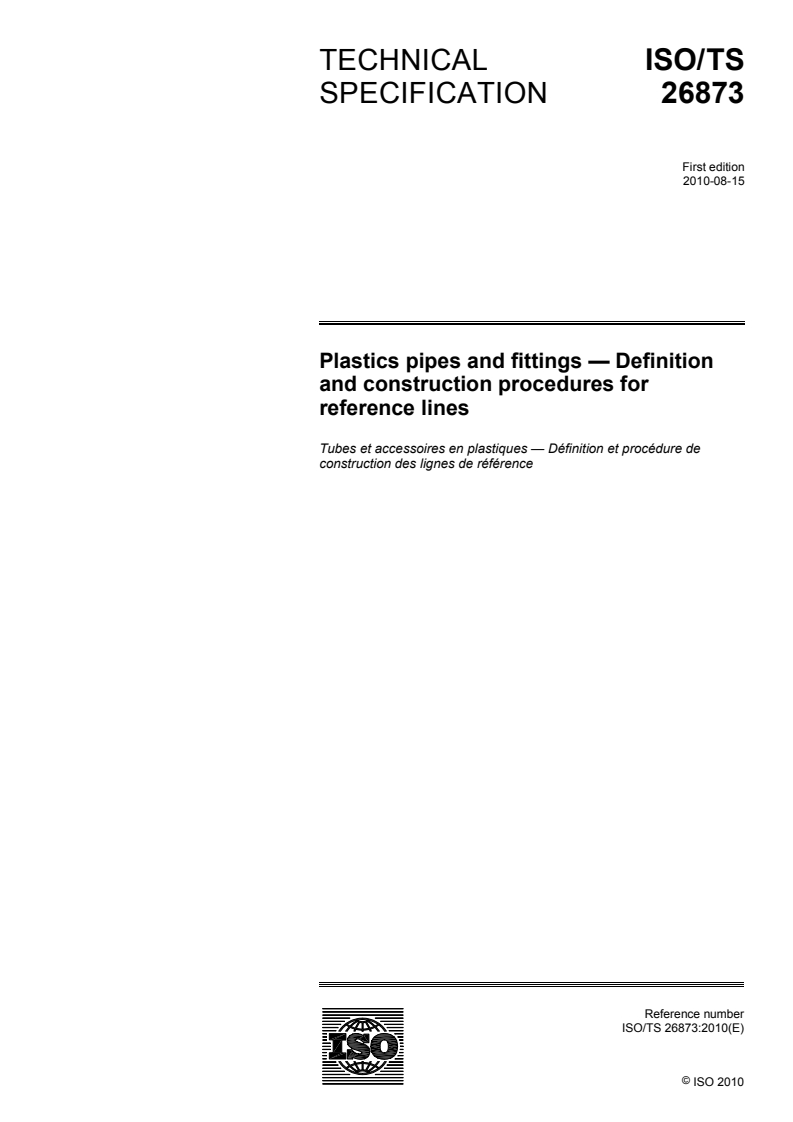
TECHNICAL ISO/TS
SPECIFICATION 26873
First edition
2010-08-15
Plastics pipes and fittings — Definition
and construction procedures for
reference lines
Tubes et accessoires en plastiques — Définition et procédure de
construction des lignes de référence
Reference number
©
ISO 2010
PDF disclaimer
This PDF file may contain embedded typefaces. In accordance with Adobe's licensing policy, this file may be printed or viewed but
shall not be edited unless the typefaces which are embedded are licensed to and installed on the computer performing the editing. In
downloading this file, parties accept therein the responsibility of not infringing Adobe's licensing policy. The ISO Central Secretariat
accepts no liability in this area.
Adobe is a trademark of Adobe Systems Incorporated.
Details of the software products used to create this PDF file can be found in the General Info relative to the file; the PDF-creation
parameters were optimized for printing. Every care has been taken to ensure that the file is suitable for use by ISO member bodies. In
the unlikely event that a problem relating to it is found, please inform the Central Secretariat at the address given below.
© ISO 2010
All rights reserved. Unless otherwise specified, no part of this publication may be reproduced or utilized in any form or by any means,
electronic or mechanical, including photocopying and microfilm, without permission in writing from either ISO at the address below or
ISO's member body in the country of the requester.
ISO copyright office
Case postale 56 • CH-1211 Geneva 20
Tel. + 41 22 749 01 11
Fax + 41 22 749 09 47
E-mail copyright@iso.org
Web www.iso.org
Published in Switzerland
ii © ISO 2010 – All rights reserved
Foreword
ISO (the International Organization for Standardization) is a worldwide federation of national standards bodies
(ISO member bodies). The work of preparing International Standards is normally carried out through ISO
technical committees. Each member body interested in a subject for which a technical committee has been
established has the right to be represented on that committee. International organizations, governmental and
non-governmental, in liaison with ISO, also take part in the work. ISO collaborates closely with the
International Electrotechnical Commission (IEC) on all matters of electrotechnical standardization.
International Standards are drafted in accordance with the rules given in the ISO/IEC Directives, Part 2.
The main task of technical committees is to prepare International Standards. Draft International Standards
adopted by the technical committees are circulated to the member bodies for voting. Publication as an
International Standard requires approval by at least 75 % of the member bodies casting a vote.
In other circumstances, particularly when there is an urgent market requirement for such documents, a
technical committee may decide to publish other types of document:
⎯ an ISO Publicly Available Specification (ISO/PAS) represents an agreement between technical experts in
an ISO working group and is accepted for publication if it is approved by more than 50 % of the members
of the parent committee casting a vote;
⎯ an ISO Technical Specification (ISO/TS) represents an agreement between the members of a technical
committee and is accepted for publication if it is approved by 2/3 of the members of the committee casting
a vote.
An ISO/PAS or ISO/TS is reviewed after three years in order to decide whether it will be confirmed for a
further three years, revised to become an International Standard, or withdrawn. If the ISO/PAS or ISO/TS is
confirmed, it is reviewed again after a further three years, at which time it must either be transformed into an
International Standard or be withdrawn.
Attention is drawn to the possibility that some of the elements of this document may be the subject of patent
rights. ISO shall not be held responsible for identifying any or all such patent rights.
ISO/TS 26873 was prepared by Technical Committee ISO/TC 138, Plastics pipes, fittings and valves for the
transport of fluids, Subcommittee SC 5, General properties of pipes, fittings and valves of plastic materials and
their accessories — Test methods and basic specifications.
Introduction
This Technical Specification gives guidance to the construction of a stress rupture diagram, consisting of
reference lines, giving the expected minimum required strength of plastics pipes under internal pressure as a
function of time and temperature. Such lines are used for the interpolation and extrapolation of stress rupture
properties and for the application of Miner's rule (see ISO 13760) in product standards (see Annex A).
iv © ISO 2010 – All rights reserved
TECHNICAL SPECIFICATION ISO/TS 26873:2010(E)
Plastics pipes and fittings — Definition and construction
procedures for reference lines
1 Scope
This Technical Specification defines reference lines as the generic representation of the creep rupture
properties of pipes made of thermoplastics material and gives procedures for drafting reference lines in a
mathematical form.
2 Normative references
The following referenced documents are indispensable for the application of this document. For dated
references, only the edition cited applies. For undated references, the latest edition of the referenced
document (including any amendments) applies.
ISO 1167-1, Thermoplastics pipes, fittings and assemblies for the conveyance of fluids — Determination of
the resistance to internal pressure — Part 1: General method
ISO 1167-2, Thermoplastics pipes, fittings and assemblies for the conveyance of fluids — Determination of
the resistance to internal pressure — Part 2: Preparation of pipe test pieces
ISO 9080:—, Plastics piping and ducting systems — Determination of the long-term hydrostatic strength of
1)
thermoplastics materials in pipe form by extrapolation
3 Terms and definitions
For the purposes of this document, the following terms and definitions apply.
3.1
reference line
mathematical description of the stress rupture properties of thermoplastics materials giving the expected hoop
strength of the product with a certainty of at least 97,5 % when tested in accordance with ISO 1167-1 and
ISO 1167-2
NOTE 1 Reference lines can be used for the calculation of design stress. They begin and end according to limits
defined in ISO 9080.
1) Under preparation.
NOTE 2 Reference lines are defined using Equation (1):
log σ C
10 i
log tA=+B + +D log σ (1)
10 ii i 10
TT
where
t is the expected time to failure, in hours;
σ is the hoop stress, in megapascals;
T is the temperature, in kelvins (°C + 273,15);
A, B, C, D are the parameters used in the model;
i is 1 or 2, in the case of two separate branches (sometimes referred to as brittle and ductile).
NOTE 3 Equation (1) is similar t
...