

ISO 4076:2025
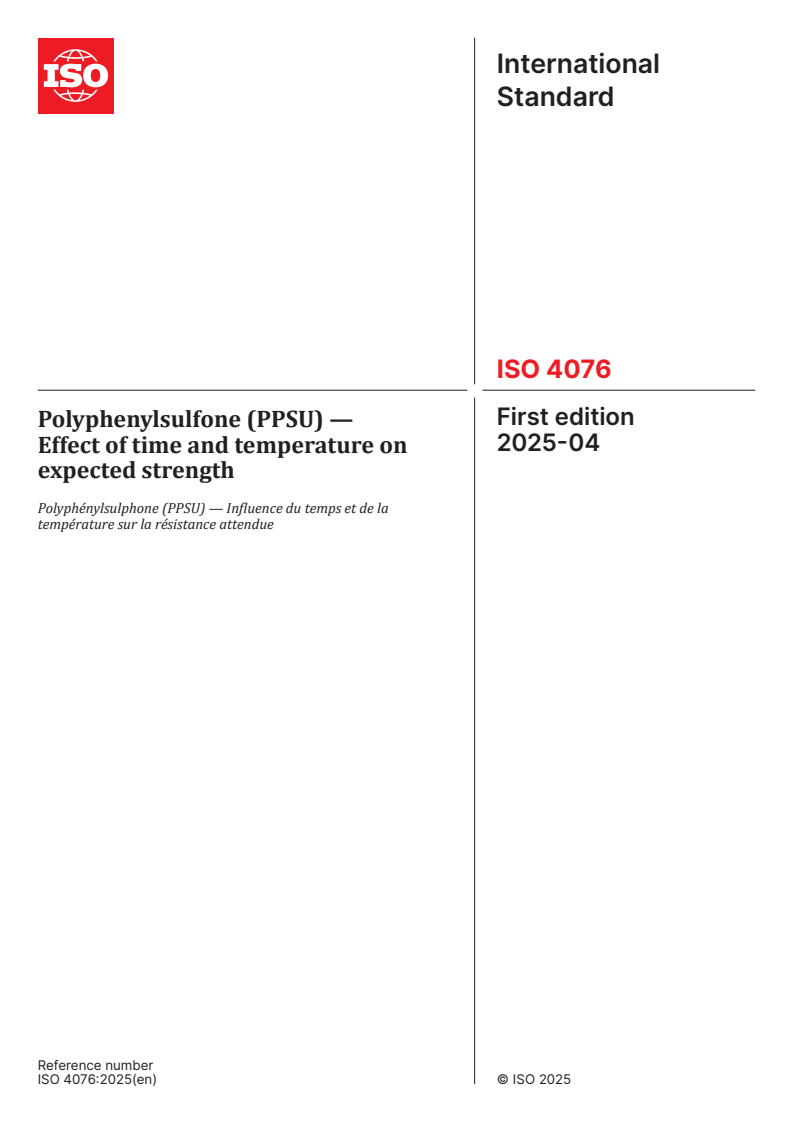
(Main)Polyphenylsulfone (PPSU) — Effect of time and temperature on expected strength
General Information
- Abstract
This document specifies the minimum values for expected strength as a function of time and temperature in the form of reference lines, for use in calculations on polyphenylsulfone (PPSU) injection moulded fittings.
- Status
- Published
- Publication Date
- 03-Apr-2025
- Current Stage
- 6060 - International Standard published
- Start Date
- 04-Apr-2025
- Due Date
- 03-May-2025
- Completion Date
- 04-Apr-2025
Overview
ISO 4076:2025 - Polyphenylsulfone (PPSU) - specifies minimum expected strength (hoop stress) for injection‑moulded PPSU fittings as a function of time and temperature. It defines generic reference lines (mathematical curves) for long‑term hydrostatic strength to be used in design calculations, establishes extrapolation limits for life‑time predictions, and gives procedures to demonstrate conformance. The reference lines are intended as generic guidance (not grade‑ or supplier‑specific).
Key topics and requirements
- Reference equation (applicable 10 °C–135 °C):
log10 t = A + B/T + C log10 σ + (D/T) log10 σ
For PPSU the document gives numerical coefficients: A = −64.495, B = 31 700.557, C = 28.281, D = −15 573.347 (T in K, t in hours, σ in MPa). - Extrapolation limits: minimum allowable extrapolation times are established (based on experimental data at 110 °C and Arrhenius behaviour with an activation energy of 110 kJ/mol). Table 1 provides limits (e.g., ≤60 °C → 100 years).
- Tabulated expected strengths: Table 2 lists calculated hoop strength values for common temperatures and service times (examples: at 20 °C - 1 year: 39.6 MPa; 100 years: 32.9 MPa).
- Conformance testing (Annex A): materials evaluated per ISO 9080/ISO 1167; testing temperatures include 20 °C, 60–70 °C, 95 °C and 110–135 °C. At least 97.5% of test results must lie on or above the reference lines.
- Design & wall thickness (Annex B): principles for deriving S values and minimum wall thicknesses relative to application classes, design pressures and service coefficients (uses Miner’s rule and ISO 10508 guidance).
Applications and who uses it
ISO 4076:2025 is useful for:
- PPSU fittings manufacturers for component design and wall‑thickness calculations.
- Design engineers and specifiers of hot/cold water piping systems who need time‑temperature strength data.
- Materials suppliers and R&D teams validating PPSU grades for plumbing applications.
- Testing laboratories and conformity assessors using ISO 9080 / ISO 1167 test methods to demonstrate compliance.
- Certification bodies and standards committees harmonizing piping system design for buildings and industrial fluid transport.
Practical uses include lifetime predictions, dimensioning of injection‑moulded fittings, product certification, and comparing materials for hot‑water plumbing applications.
Related standards
- ISO 9080:2012 (long‑term hydrostatic strength extrapolation)
- ISO 1167‑1 / ISO 1167‑2 (internal pressure testing)
- ISO 10508, ISO 12162 and related ISO 1587x / 22391 piping system standards for contextual design use.
Keywords: ISO 4076:2025, PPSU, polyphenylsulfone, expected strength, reference lines, injection moulded fittings, long‑term hydrostatic strength, extrapolation limits, ISO 9080, hoop stress.
Get Certified
Connect with accredited certification bodies for this standard

Institut za varilstvo d.o.o. (Welding Institute)
Slovenia's leading welding institute since 1952. ISO 3834, EN 1090, pressure equipment certification, NDT personnel, welder qualification. Only IIW Au
Sponsored listings
Frequently Asked Questions
ISO 4076:2025 is a standard published by the International Organization for Standardization (ISO). Its full title is "Polyphenylsulfone (PPSU) — Effect of time and temperature on expected strength". This standard covers: This document specifies the minimum values for expected strength as a function of time and temperature in the form of reference lines, for use in calculations on polyphenylsulfone (PPSU) injection moulded fittings.
This document specifies the minimum values for expected strength as a function of time and temperature in the form of reference lines, for use in calculations on polyphenylsulfone (PPSU) injection moulded fittings.
ISO 4076:2025 is classified under the following ICS (International Classification for Standards) categories: 23.040.45 - Plastics fittings. The ICS classification helps identify the subject area and facilitates finding related standards.
ISO 4076:2025 is available in PDF format for immediate download after purchase. The document can be added to your cart and obtained through the secure checkout process. Digital delivery ensures instant access to the complete standard document.
Standards Content (Sample)
International
Standard
ISO 4076
First edition
Polyphenylsulfone (PPSU) —
2025-04
Effect of time and temperature on
expected strength
Polyphénylsulphone (PPSU) — Influence du temps et de la
température sur la résistance attendue
Reference number
© ISO 2025
All rights reserved. Unless otherwise specified, or required in the context of its implementation, no part of this publication may
be reproduced or utilized otherwise in any form or by any means, electronic or mechanical, including photocopying, or posting on
the internet or an intranet, without prior written permission. Permission can be requested from either ISO at the address below
or ISO’s member body in the country of the requester.
ISO copyright office
CP 401 • Ch. de Blandonnet 8
CH-1214 Vernier, Geneva
Phone: +41 22 749 01 11
Email: copyright@iso.org
Website: www.iso.org
Published in Switzerland
ii
Contents Page
Foreword .iv
Introduction .v
1 Scope . 1
2 Normative references . 1
3 Terms and definitions . 1
4 Basic formulae . 1
5 Expected strength . 2
5.1 Extrapolation limits .2
5.2 Graphical representation .2
5.3 Tabulated values .4
6 Demonstrating conformance . 5
7 Derivation of wall thickness . . 5
Annex A (normative) Demonstrating conformance to the reference lines . 6
Annex B (informative) Derivation of S values. 7
calc,max
Bibliography .10
iii
Foreword
ISO (the International Organization for Standardization) is a worldwide federation of national standards
bodies (ISO member bodies). The work of preparing International Standards is normally carried out through
ISO technical committees. Each member body interested in a subject for which a technical committee
has been established has the right to be represented on that committee. International organizations,
governmental and non-governmental, in liaison with ISO, also take part in the work. ISO collaborates closely
with the International Electrotechnical Commission (IEC) on all matters of electrotechnical standardization.
The procedures used to develop this document and those intended for its further maintenance are described
in the ISO/IEC Directives, Part 1. In particular, the different approval criteria needed for the different types
of ISO document should be noted. This document was drafted in accordance with the editorial rules of the
ISO/IEC Directives, Part 2 (see www.iso.org/directives).
ISO draws attention to the possibility that the implementation of this document may involve the use of (a)
patent(s). ISO takes no position concerning the evidence, validity or applicability of any claimed patent
rights in respect thereof. As of the date of publication of this document, ISO had not received notice of (a)
patent(s) which may be required to implement this document. However, implementers are cautioned that
this may not represent the latest information, which may be obtained from the patent database available at
www.iso.org/patents. ISO shall not be held responsible for identifying any or all such patent rights.
Any trade name used in this document is information given for the convenience of users and does not
constitute an endorsement.
For an explanation of the voluntary nature of standards, the meaning of ISO specific terms and expressions
related to conformity assessment, as well as information about ISO's adherence to the World Trade
Organization (WTO) principles in the Technical Barriers to Trade (TBT), see www.iso.org/iso/foreword.html.
This document was prepared by Technical Committee ISO/TC 138, Plastics pipes, fittings and valves for the
transport of fluids, Subcommittee SC 5, General properties of pipes, fittings and valves of plastic materials and
their accessories — Test methods and basic specifications.
Any feedback or questions on this document should be directed to the user’s national standards body. A
complete listing of these bodies can be found at www.iso.org/members.html.
iv
Introduction
In the early 2000s, manufacturers of plastics and multilayer piping systems for hot and cold-water
installations began to consider the use of alternative plastics materials beside the widely used metallic
materials (e.g. copper alloys or stainless steel) for components and fittings. Before this point, no materials
were available which had the high material strengths that are required for fittings and components.
With the market availability of Polyvinylidenefluoride (PVDF), Polysulfone (PSU) and Polyphenylsulfone
(PPSU), the option for the use of plastics materials, instead of metallic materials, for fittings and components
as part of plastics and multilayer piping systems was made possible, and products mainly produced by
injection molding have been introduced into the market.
In the beginning, the design and the calculation for the dimensioning was based on individual ISO 9080
analyses for each individual PVDF/PSU/PPSU compound.
This document has been developed with the intention of aligning the values for the expected strength over
the time (reference lines) for PVDF/PSU/PPSU, in order to simplify and unify all design procedures for which
the expected strength over the time is needed.
The reference lines for polyphenylsulfone (PPSU) referred to in this document have been agreed upon by a
group of experts from ISO/TC 138, Plastics pipes, fittings and valves for the transport of fluids, Subcommittee
SC 5, General properties of pipes, fittings and valves of plastic materials and their accessories —Test methods
and basic specifications, after considering experimental data and have been accepted by the relevant ISO
technical committees.
At the date of publication of this document, the following International Standards dealing with plastics and
multilayer piping systems for hot and cold water installations have been published:
— ISO 15874 series, Plastics piping systems for hot and cold water installations — Polypropylene (PP)
— ISO 15875 series, Plastics piping systems for hot and cold water installations — Crosslinked polyethylene (PE-X)
— ISO 15876 series, Plastics piping systems for hot and cold water installations — Polybutene (PB)
— ISO 15877 series, Plastics piping systems for hot and cold water installations — Chlorinated poly(vinyl
chloride) (PVC-C)
— ISO 22391 series, Plastics piping systems for hot and cold water installations — Polyethylene of raised
temperature resistance (PE-RT)
— ISO 21003 series, Multilayer piping systems for hot and cold water installations inside buildings
v
International Standard ISO 4076:2025(en)
Polyphenylsulfone (PPSU) — Effect of time and temperature
on expected strength
1 Scope
This document specifies the minimum values for expected strength as a function of time and temperature in
the form of reference lines, for use in calculations on polyphenylsulfone (PPSU) injection moulded fittings.
2 Normative references
The following documents are referred to in the text in such a way that some or all of their content constitutes
requirements of this document. For dated references, only the edition cited applies. For undated references,
the latest edition of the referenced document (including any amendments) applies.
ISO 1167-1, Thermoplastics pipes, fittings and assemblies for the conveyance of fluids — Determination of the
resistance to internal pressure — Part 1: General method
ISO 1167-2, Thermoplastics pipes, fittings and assemblies for the conveyance of fluids — Determination of the
resistance to internal pressure — Part 2: Preparation of pipe test pieces
ISO 9080:2012, Plastics piping and ducting systems — Deter
...